
1. The financing question
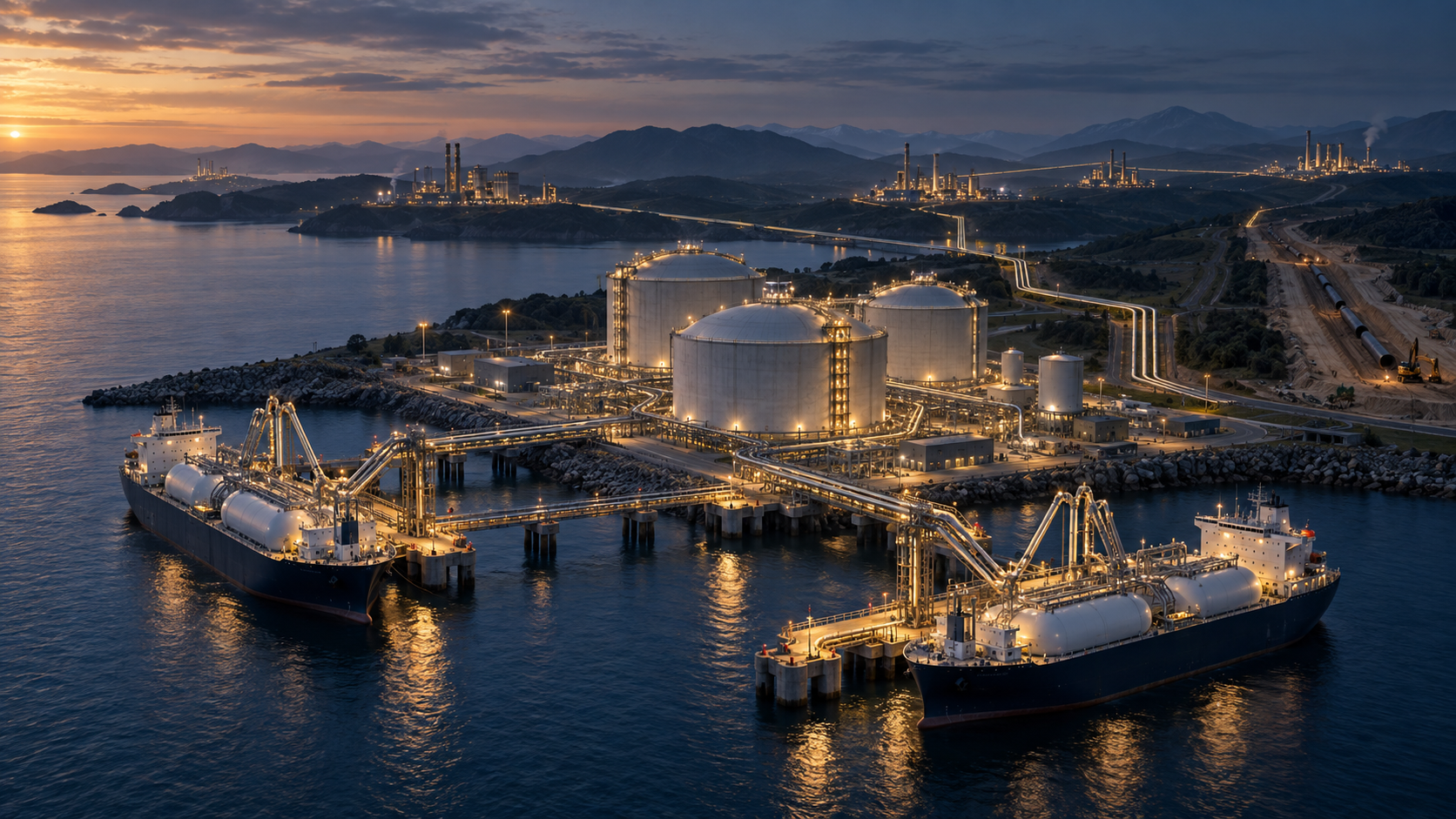
Industrial emitters can be ready to capture carbon dioxide years before a regional pipeline reaches permitting, volume or construction maturity. A ship-first hub addresses that timing mismatch by collecting liquefied carbon dioxide at one or more ports, moving it in specialised vessels and delivering it to a receiving terminal connected to permanent storage. The commercial question is whether the first phase can support debt before the system reaches pipeline scale.
The answer depends on contracts rather than vessel technology alone. Lenders need evidence that capture plants will deliver qualifying volumes, terminals will be available, vessels will arrive within workable windows, storage capacity will accept the product, and payment obligations will survive interruptions elsewhere in the chain. The investment case therefore begins with the allocation of cross-chain risk and ends with a staged capital plan.
2. Why shipping can precede pipelines
Pipelines have high fixed costs, long permitting periods and route-specific construction risk. Their unit cost can become attractive at high, stable throughput, yet early capture portfolios may comprise dispersed sources with different commissioning dates. Shipping converts part of the transport system into mobile capacity. It can aggregate volumes across ports, redirect cargoes where contracts allow and begin with smaller annual throughput.
The European Commission's Joint Research Centre has stated that shipping should be considered before 2030 because pipeline networks are capital intensive and have long lead times [1]. Shipping does not remove the need for onshore pipelines, storage wells or terminal infrastructure. It changes their timing and scale. A hub can build collection, liquefaction and berth capacity around contracted emitters while reserving expansion corridors for a later pipeline backbone.
The choice among ship-first, pipeline-first and hybrid development should be made against contracted volume, geography, route certainty and schedule. The comparison below is qualitative. A detailed transport study should use site-specific capital, operating, energy, emissions, permitting and reliability assumptions.
Table 1. Qualitative comparison of early carbon-dioxide transport strategies
| Decision factor | Ship-first | Pipeline-first | Hybrid staged network |
|---|---|---|---|
| Initial scale | Can begin with smaller, aggregated cargo volumes | Favours high and stable throughput | Can start with shipping and add fixed links as demand matures |
| Route flexibility | Vessels can serve compatible terminals and storage routes | Fixed to the permitted alignment | Preserves marine optionality around a growing backbone |
| Upfront capital profile | Terminal, tanks and vessel commitments can be modular | Large route-specific investment before operation | Capital is divided into phases with additional interface cost |
| Permitting exposure | Port, marine, terminal and cross-border approvals | Land, crossing, safety and route approvals | Requires coordinated approvals for successive modes |
| Operating complexity | Batch logistics, weather and scheduling are material | Continuous flow with compression and network control | Requires scheduling across marine and pipeline systems |
| Expansion method | Additional tanks, berths, vessels and cargo slots | Compression, looping or additional pipeline capacity | Capacity migrates toward the mode justified by demand |
| Stranding risk | Vessels may be redeployed; terminals remain location specific | Route can be underused if volumes arrive late | Early assets need explicit integration or redeployment plans |
| Best suited to | Dispersed sources, coastal access and uncertain ramp-up | Dense clusters with mature contracted volumes | Regions expecting later pipeline scale but needing early access |
General decision framework. Relative assessments depend on distance, throughput, geography, storage location and project design.
3. The chain is a single service system
A ship-based chain includes capture, conditioning, compression or liquefaction, temporary storage, loading, marine transport, unloading, receiving storage, pumping, offshore transport and injection. Each element can be owned by a different entity. Physical completion of one asset creates little value if another element is late or unavailable.
Project finance treats this as an interface problem. Every obligation promised to an emitter should be supported by a corresponding right against terminal, vessel and storage providers. Where remedies cannot be matched, the hub company needs liquidity, sponsor support, insurance or public risk sharing. A financing model that evaluates each asset independently can miss the contingent liabilities created by the connected chain.
4. Current market evidence
Northern Lights provides an operating reference for ship-based, cross-border carbon transport and storage. Its first phase has capacity of 1.5 million tonnes a year, and the operator reports expansion to at least 5 million tonnes a year following the start of operations in 2025 [2]. The expansion includes tanks, pumps, a new jetty, wells, subsea infrastructure and additional vessels [3].
This precedent demonstrates the physical architecture and the importance of state participation, contracted customers and phased scale. It does not establish a universal tariff or financing template. Each proposed hub has different distances, port constraints, storage geology, carbon-dioxide composition, regulation, support mechanisms and customer credit. Comparable evidence should inform assumptions without replacing project-specific engineering and contracting.
5. Policy is creating demand and obligations
The European Union's industrial carbon management strategy seeks a competitive carbon-dioxide market and recognises pipelines, ships, rail and trucks as transport options [4]. The Net-Zero Industry Act sets a legally binding objective of fifty million tonnes of annual carbon-dioxide injection capacity in the European Union by 2030 [4]. These policies can support long-term demand for transport and storage.
Policy creates obligations as well as opportunity. Projects must fit emissions-trading rules, storage permits, state-aid conditions, trans-European infrastructure requirements and national licensing regimes. Revenue support may depend on verified delivery and permanent storage. A hub cannot treat regulatory eligibility as a general market assumption; each payment stream needs documented conditions precedent and continuing compliance covenants.
6. Cross-border legality is a financing condition
The London Protocol provides the international framework for export of carbon dioxide for sub-seabed geological storage. Parties adopted an amendment to Article 6 in 2009 and allowed provisional application in 2019. Participating countries must make the relevant declarations and notify agreements or arrangements covering permitting and responsibilities [5].
A cross-border project should identify every exporting, transit and receiving jurisdiction. Counsel should confirm treaty status, bilateral arrangements, waste and shipment classifications, customs treatment, environmental approvals and allocation of monitoring responsibility. Lenders should receive legal opinions on the route actually contracted. A general expectation that governments will cooperate cannot substitute for permissions required before first cargo.
7. The commercial perimeter
The hub company can provide a narrow terminal service or an integrated transport-and-storage service. A narrow perimeter may begin at custody transfer into the export terminal and end after loading. An integrated service can include collection, liquefaction, shipping, receiving and injection. A broader perimeter increases revenue control while adding assets, working capital and liabilities.
The selected perimeter should reflect controllability. A company should not guarantee storage availability without firm storage rights, or marine schedules without contracted vessels. The service agreement needs battery limits, measurement points and product specifications. It should state which party bears losses between capture meter and storage meter and which evidence determines the number of tonnes eligible for payment or regulatory credit.
8. Contractual interface map
The figure maps the core physical and contractual relationships. The hub sits between emitters and storage, while vessels and public support provide essential capacity and revenue support. Lenders require coordinated direct agreements across the system.
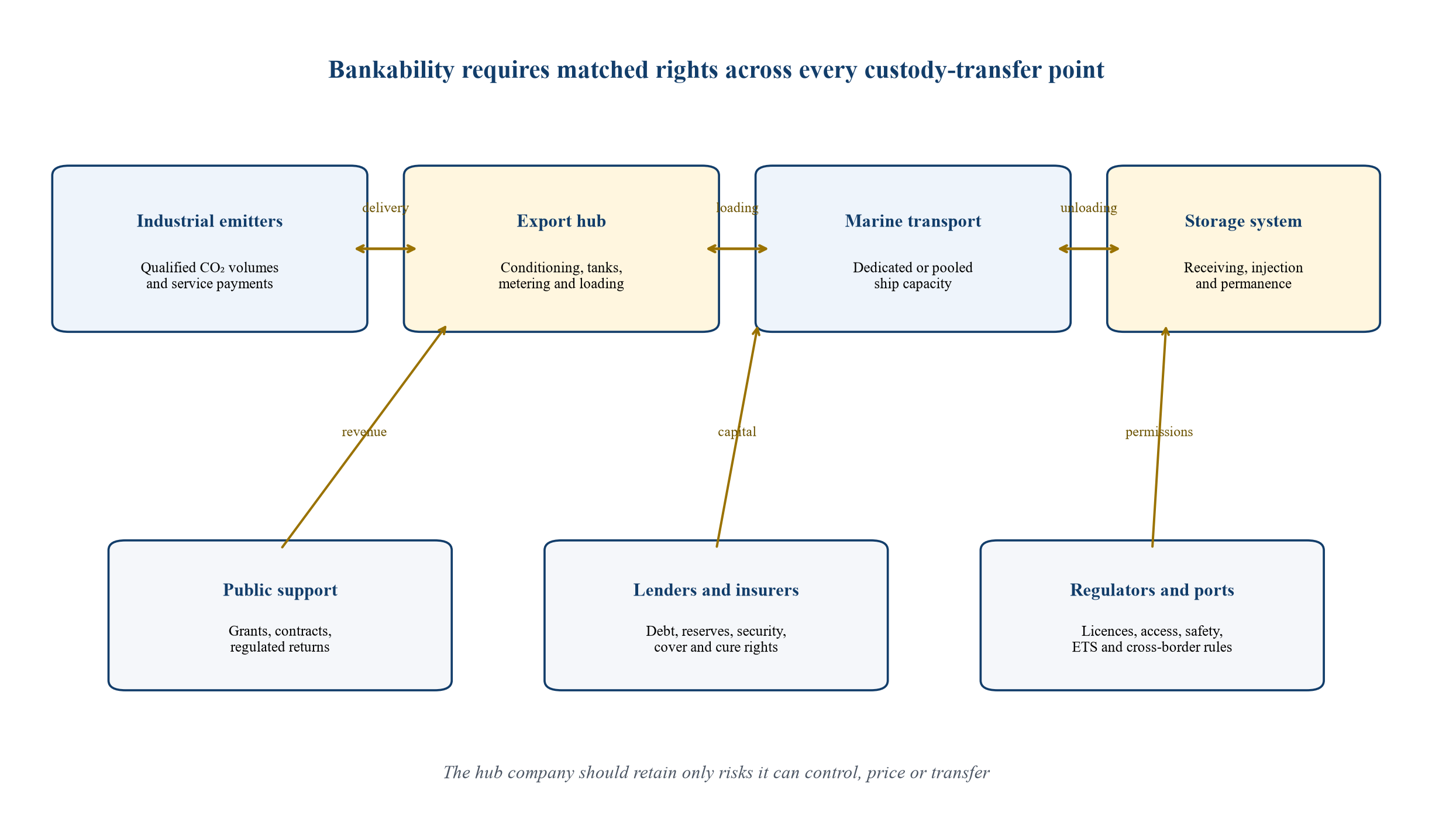
Generic structure. Actual ownership, regulation and contracts depend on the jurisdictions and project configuration.
9. Anchor volumes create the first credit case
An early hub needs enough committed volume to cover fixed operating costs, minimum vessel obligations, storage reservations and debt service. An anchor customer can provide that base. Multiple smaller emitters diversify counterparty exposure, although their different schedules and technical characteristics increase coordination risk.
The credit case should use contracted minimum revenue rather than announced capture capacity. Binding contracts need commencement dates, volume bands, credit support and compensation if an emitter is late or produces less than its commitment. Development-stage memoranda and letters of intent can support pipeline analysis, but they should not be included as base-case revenue unless their conditions and termination rights justify that treatment.
10. Capacity booking should reflect readiness
Emitters may reserve capacity before their capture plants reach final investment decision. A reservation system can allocate scarce terminal and storage capacity while protecting the hub from speculative bookings. The structure can combine development deposits, milestone payments, capacity reservation charges and conversion to long-term ship-or-pay commitments.
Milestones should include permits, financing, construction awards and commissioning evidence. Capacity that fails objective milestones can return to the market. Deposits should increase as the hub commits capital. A transparent queue reduces disputes and supports open-access obligations. Lenders need visibility over the proportion of booked capacity supported by enforceable payment and the amount that remains contingent.
11. Minimum revenue can be more important than volume
Debt service depends on cash, not physical tonnes alone. A minimum-revenue structure can combine fixed capacity charges, throughput tariffs and pass-through expenses. Fixed charges support terminal and vessel commitments. Variable charges recover energy, consumables and storage fees. Indexed components can address power, fuel, labour and port costs.
The contract should preserve incentives for availability. An emitter should not pay a full capacity charge when the hub is unavailable for a reason within the operator's control. The hub should receive deemed revenue when it is available and an emitter fails to deliver committed product. Deductions, caps and relief events should be sized against the debt model and tested for cumulative effects.
12. Product specification is a network standard
Carbon-dioxide streams can contain water, oxygen, nitrogen, sulphur compounds and other impurities. Composition affects corrosion, phase behaviour, liquefaction, vessel design, metering, injection and reservoir performance. A hub serving multiple emitters needs a common acceptance specification and procedures for sampling, rejection, blending and remediation.
The specification should be compatible with the receiving terminal and storage permit. Responsibility should follow control: the emitter bears feed contamination it creates; the hub bears conditioning performance within the contracted inlet envelope; the vessel operator bears contamination arising in carriage. Changes to network specifications need notice, technical review and compensation where they require material capital modifications.
13. Custody transfer must reconcile three accounts
The commercial account measures tonnes delivered and accepted. The regulatory account establishes emissions deductions or support eligibility. The storage account records tonnes injected and retained. Losses, venting, measurement uncertainty and temporary inventory can create differences among these accounts.
Contracts should define primary meters, calibration, substitute data and independent verification. Inventory reconciliation should occur at agreed intervals. The United Kingdom has consulted on monitoring, reporting and verification for non-pipeline transport, including treatment of transport emissions and losses [6]. Projects should align commercial measurement with applicable regulatory methods before financial close.
14. Vessel procurement choices
A hub can own vessels, enter long-term charters, reserve slots in a pooled fleet or use voyage charters. Ownership provides control and residual exposure. A long-term charter converts capital into fixed operating commitment. Pooled fleets can improve utilisation and resilience if specifications and schedules are compatible. Voyage charters preserve flexibility but may not provide firm availability for a contracted service.
The decision should consider vessel size, pressure and temperature regime, port limitations, sailing distance, weather, turnaround, maintenance and future compatibility. Shipbuilding delay and cost escalation require completion security. Lenders need direct rights or replacement mechanisms if the vessel owner defaults. A diversified fleet can reduce single-asset interruption risk while increasing contracting complexity.
15. Buffer storage determines resilience
Liquefaction and shipping operate in batches while capture plants may run continuously. Export and receiving tanks bridge that mismatch. Insufficient storage can force emitter curtailment when a vessel is delayed. Excess capacity raises capital cost and may extend residence times. Tank sizing therefore affects both service quality and debt capacity.
The model should simulate daily production, loading windows, voyage duration, unloading, weather delay and maintenance. A target number of days of buffer should follow the credible delay distribution and the cost of lost capture. Expansion space can be more valuable than building all tanks initially. Emergency venting and controlled shutdown procedures must meet safety and environmental rules.
16. Port and berth risk
The export hub depends on land rights, marine access, berth windows, dredging, navigation, safety zones and compatible loading arms. A shared port can create congestion and priority disputes. Greenfield marine works add permitting and construction risk. Brownfield terminals may offer utilities and operating capability while imposing interface constraints.
The port agreement should secure a term that matches the financing, defined access, expansion rights, tariff rules and relief for port-caused delay. The environmental assessment should cover marine construction and ship movements. Lenders need step-in or substitute arrangements where feasible. A terminal without durable berth rights is not a bankable logistics asset.
17. Storage is the ultimate capacity constraint
Ship mobility cannot compensate for unavailable injection capacity. Storage rights must specify annual and daily rates, quality, scheduling, monitoring, liability, interruption and remedies. Geological characterisation and permitting determine whether nominal capacity is bankable. IEA financing guidance identifies storage development and long-term liability as material financing issues [7].
The hub should reserve sufficient base capacity and establish expansion options. It should avoid committing emitter capacity materially beyond confirmed injection rights. If several storage sites are technically compatible, diversion rights can improve resilience. Each alternative route needs legal approval, terminal compatibility and pricing. Optionality has value only when it can be exercised operationally and contractually.
18. Liability follows custody and control
The transaction documents should identify when title, custody and environmental responsibility transfer. An emitter may retain responsibility for off-specification product. The hub may bear losses in its terminal. The vessel owner may bear carriage incidents. The storage operator assumes injection obligations subject to the governing regulatory regime.
Long-term storage liability may transfer to the state after regulatory conditions are satisfied in some jurisdictions. That future transfer should not obscure the pre-transfer obligations for monitoring, remediation and financial security. Indemnities need caps, survival periods and credit support. Unlimited liability can make a project unfinanceable even when the probability of loss is low.
19. Chain interruption needs specific regimes
Force majeure is too broad to manage recurring interface risks. Contracts should distinguish emitter outage, export-terminal outage, vessel unavailability, receiving-terminal outage and storage interruption. Each event needs defined payment, mitigation, duration and termination consequences.
The operator controlling an asset should bear availability deductions within an agreed cap. Events outside control may activate reserves, insurance or shared cost. Prolonged interruption can trigger alternate routing, temporary storage, suspension or termination. The remedies across upstream and downstream contracts should be aligned so that the hub is not required to compensate emitters while receiving no remedy from the failed provider.
20. A phased infrastructure strategy
Shipping can serve as a bridge from dispersed early volumes to a mature network. Phase one can connect an anchor emitter and storage route. Phase two can add tanks, vessels and customers. Phase three can integrate regional collection pipelines or a backbone where volume and route certainty support the capital.
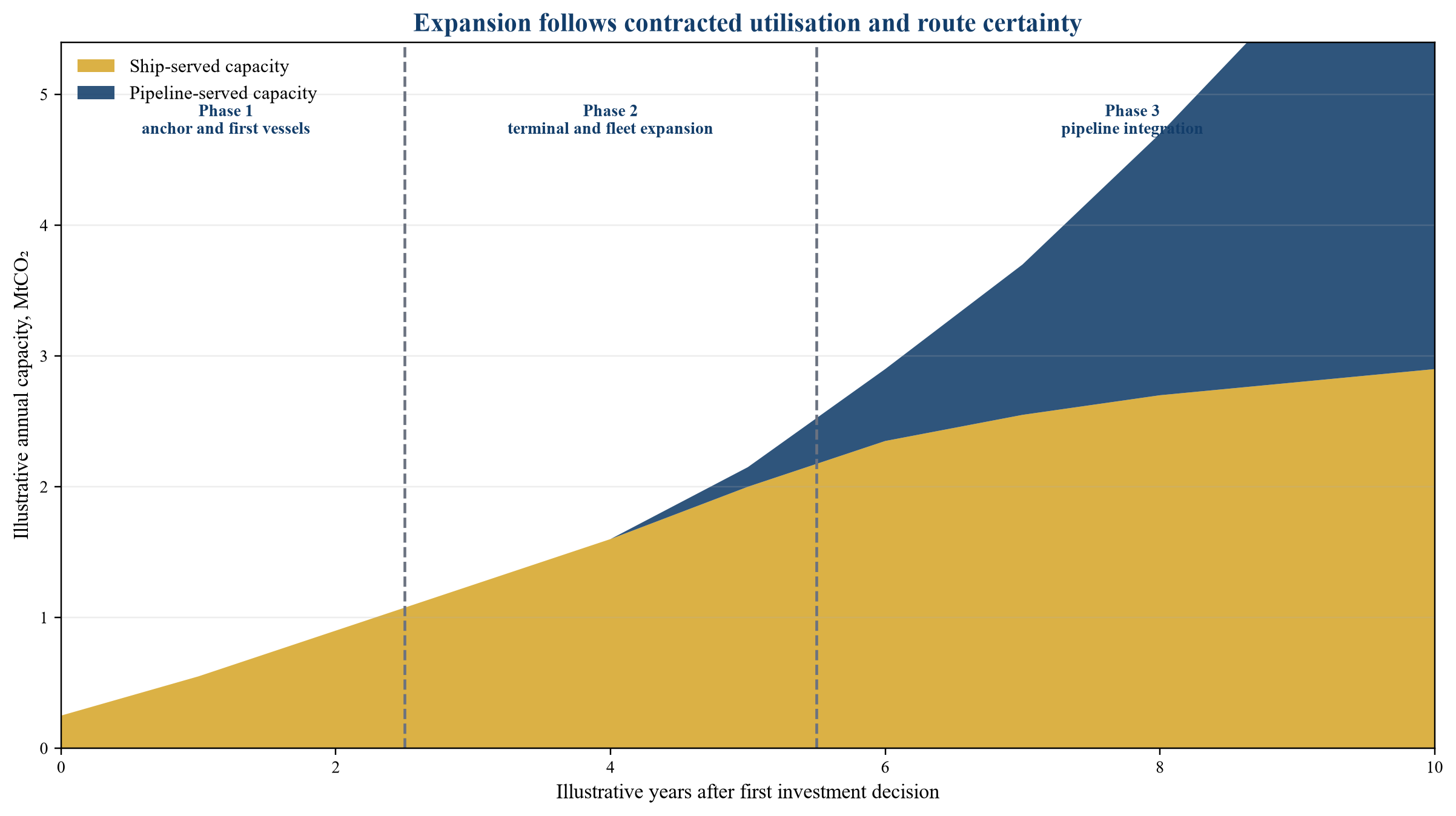
Conceptual sequencing only. Timing and capacity triggers must be determined from project-specific evidence.
21. Expansion triggers should be objective
Expansion should not rely on headline market forecasts. Triggers can include contracted minimum revenue, utilisation over a trailing period, storage capacity reservations, permits, shipyard slots and minimum sponsor equity. The next phase should preserve base-case debt service if prospective customers are delayed.
An expansion facility can be committed at initial close subject to conditions, or raised later after performance is proven. Pre-agreed security sharing, intercreditor terms and asset boundaries reduce refinancing friction. Existing customers may need protection against construction disruption and cross-subsidy. New capital should pay for new capacity unless shared assets create demonstrable benefits for all users.
22. Pipeline conversion requires optionality
A later pipeline can reduce unit transport cost at sufficient volume, yet it may strand vessels or terminal equipment. The first phase should preserve alternative uses, redeployment and integration. Tanks, pumps and jetties may remain useful for remote emitters, backup capacity or exports to other storage sites.
Long-term charters should align with realistic pipeline timing and include extension, assignment or termination options. Terminal design should accommodate both marine and pipeline interfaces where justified. A conversion plan should identify which assets continue, which are repurposed and which require compensation. Debt tenor should avoid assuming residual value that depends on an uncommitted future market.
23. Hypothetical sources and uses
The table presents an illustrative first phase designed around one export terminal, two vessels and contracted storage. It is a financing example rather than an engineering estimate. Actual costs depend on site, vessel specification, shipyard, tanks, distance, port works, storage interface, currency and procurement timing.
Table 2. Hypothetical sources and uses for a ship-first carbon hub
| Uses | USDm | Sources | USDm |
|---|---|---|---|
| Export terminal, liquefaction and tanks | 390 | Senior secured debt | 520 |
| Two specialised vessels | 260 | Sponsor equity | 260 |
| Receiving interface and injection works | 185 | Public capital grant | 130 |
| Development, permits and owner costs | 70 | Subordinated sponsor facility | 55 |
| Financing fees and interest during construction | 55 | ||
| Contingency | 80 | ||
| Initial reserves and working capital | 45 | ||
| Total uses | 1,085 | Total sources | 965 |
| Funding gap requiring redesign or support | 120 | Additional committed support required | 120 |
Illustrative assumptions only. Currency is USD. Figures exclude tax and do not represent a quotation, forecast or valuation.
24. The funding gap is a structuring signal
The illustrative case deliberately shows a gap. A model that closes only by assuming high uncontracted utilisation is not ready for debt. The gap can be addressed through scope reduction, greater grant support, additional equity, vendor financing, higher contracted tariffs, storage participation or phased investment.
Each solution changes risk. Higher tariffs can weaken customer economics. More debt can reduce resilience. Deferred capacity can constrain growth. Public capital may add procurement and performance conditions. The correct response is a transparent allocation supported by the service contracts, rather than a plug labelled future customers or terminal value.
25. Debt sizing follows downside cash flow
Senior debt should be sized to contracted cash flow after operating costs, vessel obligations, storage charges, maintenance, taxes and reserves. The base case should reflect credible commissioning and ramp-up. Downside cases should combine lower volume, delay, cost inflation, higher energy use and interruption rather than testing each risk only in isolation.
Debt service coverage ratios provide one measure, but liquidity and tail are also important. A project with a satisfactory annual ratio can fail during a seasonal or outage-driven cash deficit. The financing should include debt-service reserves, maintenance reserves, distribution tests and cure rights. Maturity should leave time between final debt repayment and expiry of core contracts.
26. Debt-service sensitivity
The figure illustrates how utilisation and round-trip marine cost can affect debt-service coverage in a hypothetical hub. The model assumes a fixed capacity charge plus throughput revenue, with a portion of marine cost passed through. Values are illustrative and should not be read as project forecasts.
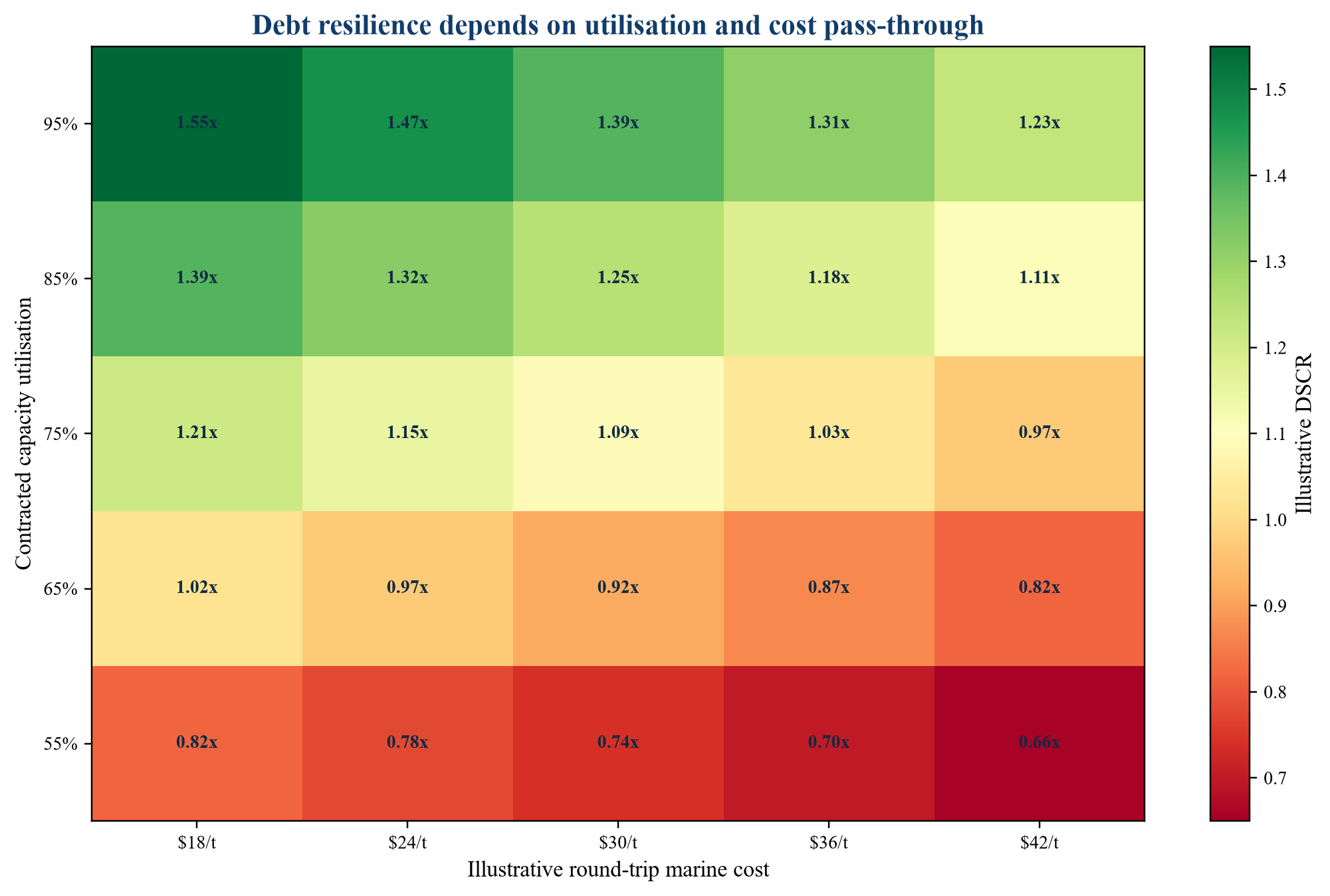
Illustrative scenario only. DSCR means debt-service coverage ratio. Results are not a forecast, offer or valuation.
27. Utilisation support should be temporary and targeted
Early hubs face a coordination gap: emitters wait for infrastructure, while infrastructure waits for emitters. Public support can bridge that gap through grants, minimum-revenue mechanisms, regulated returns, capacity payments or guarantees. The design should preserve incentives to contract customers and control costs.
Support can step down as utilisation rises or as defined milestones are met. It should cover risks the private sector cannot efficiently manage during market creation, while leaving construction and operating performance with capable sponsors. Eligibility, termination and recovery provisions must be reflected in the debt documents. Unconfirmed support should remain outside the financing base case.
28. Credit support from emitters
Long-term ship-or-pay obligations expose the hub to emitter credit. Investment-grade sponsors may provide direct obligations. Project-financed capture plants may require letters of credit, parent guarantees, reserve accounts or public-contract assignments. Credit support should cover termination exposure as well as current invoices.
The hub should evaluate correlation among customers. Several emitters in one commodity sector or region can fail together during a downturn or policy change. Replacement rights and open-access capacity can mitigate long-term exposure, but replacing a customer takes time. Debt sizing should reflect the strongest enforceable support available at financial close rather than an assumed future customer pool.
29. Construction contracting
The hub can use a single engineering, procurement and construction contractor, multiple packages or an alliance. A single wrap simplifies remedies but may be expensive or unavailable for novel interfaces. Multiple packages can access specialist capability while leaving integration risk with the owner.
The contracting plan should identify a systems integrator, common design basis, interface register and integrated commissioning test. Liquidated damages should align with debt and customer exposure. Caps, exclusions and security must be assessed in aggregate. Schedule contingency should reflect permits, marine works, shipbuilding and storage readiness, with long-lead procurement linked to financing certainty.
30. Commissioning is a chain test
Terminal mechanical completion does not establish service availability. Commissioning should demonstrate emitter delivery, liquefaction, tank management, loading, voyage, unloading, receiving, injection, metering and regulatory reporting. Initial cargoes may reveal specification or scheduling issues that individual equipment tests do not capture.
Service commencement can occur after a reliability period and acceptance of a defined number of cargoes. Temporary waivers should have expiry dates and remediation plans. Customers, regulators and lenders need coordinated notice and access to test evidence. Delay responsibility should follow the failed element, subject to agreed relief where another chain component prevents testing.
31. Operating model and governance
The hub requires marine, terminal, process, storage-interface, scheduling, commercial and regulatory capabilities. Some functions can be outsourced, but the project company needs sufficient expertise to manage contractors and remain accountable. A thin special-purpose vehicle without operating competence may struggle during interruptions and disputes.
Governance should define reserved matters, budget approval, customer onboarding, capacity allocation, related-party contracts and expansion decisions. Independent directors can support conflict management where sponsors also provide vessels, storage or construction. Lenders need information rights and consent over changes that materially affect contracted revenue or technical compatibility.
32. Maintenance and lifecycle capital
Tanks, pumps, liquefaction trains, loading systems and vessels require planned maintenance and periodic overhaul. Storage wells and subsea equipment have separate intervention cycles. The financial model should distinguish routine operating cost from lifecycle capital and fund reserves before major work.
Maintenance scheduling should preserve chain availability. A spare vessel, pooled capacity or seasonal campaign can protect service during dry docking. Critical spares and proprietary equipment need long-term supply arrangements. A maintenance deferral that improves short-term coverage can create larger future outages; distribution tests should therefore consider compliance with the approved lifecycle plan.
33. Energy and emissions
Liquefaction, pumping and transport consume energy and create emissions. Those costs affect the net abatement and tariff. The project should measure energy intensity, ship fuel, venting and losses. Applicable emissions-trading systems may require allowances for transport emissions or fugitive releases [6].
The tariff can pass through market energy prices while holding the operator to efficiency benchmarks. Low-carbon power and marine fuels can improve lifecycle performance, subject to availability and cost. Customer claims should use a documented boundary and verified data. Gross tonnes loaded should not be presented as net abatement without accounting for chain emissions and losses.
34. Insurance and residual risk
Relevant cover can include construction all-risks, delay in start-up, marine hull and machinery, protection and indemnity, cargo liability, property damage, machinery breakdown, business interruption, environmental liability and cyber cover. Terms depend on market capacity and the project's risk profile.
Insurance has exclusions, deductibles and limits. The contract map should identify which liabilities are insured, retained or capped. Lenders need loss-payee rights and notice. Proceeds should follow an agreed repair or prepayment waterfall. Uninsured interface losses require liquidity, sponsor support or contractual limitation; they should not disappear from the model because cover is expected to be available.
35. Data and digital scheduling
A multi-user hub must coordinate nominations, product quality, tank inventory, berth windows, vessel routes, receiving capacity and injection schedules. A digital scheduling platform can reduce conflicts and improve asset utilisation. It also becomes operationally critical.
The contracts should define data ownership, access, cybersecurity, audit trails and fallback procedures. Automated optimisation can recommend schedules, but accountable personnel should approve decisions affecting safety, regulatory compliance and customer priority. The system should preserve evidence for invoices, emissions reporting and disputes. Cyber incident response needs manual operating modes and communication protocols.
36. Risk-allocation matrix
The table summarises a bankability allocation. It identifies the party with primary control and the principal mitigant. Actual allocation depends on bargaining power, law, support schemes and asset ownership.
Table 3. Illustrative risk-allocation matrix for a ship-first carbon hub
| Risk | Primary allocation | Principal mitigant | Lender evidence |
|---|---|---|---|
| Emitter volume shortfall | Emitter within commitment band | Ship-or-pay, credit support, replacement rights | Executed service contracts and guarantees |
| Off-specification CO₂ | Party causing deviation | Acceptance specification, testing and remediation | Aligned technical schedules |
| Terminal construction | Hub company and contractors | Completion security, contingency and integrated test | Fixed-scope contracts and independent review |
| Vessel delay or outage | Vessel owner or hub | Delay damages, spare or pooled capacity | Charter, shipyard security and replacement rights |
| Port access | Hub company | Long-term concession and berth rights | Executed land and port agreements |
| Storage interruption | Storage operator within control | Firm capacity, remedies and alternative route | Storage agreement and permit evidence |
| Cross-border permission | Sponsors and relevant governments | Conditions precedent and bilateral arrangements | Legal opinions and filed approvals |
| Energy-price movement | Allocated by tariff design | Indexation, hedging and efficiency benchmark | Model audit and hedge policy |
| Ramp-up utilisation | Sponsors or public support | Minimum revenue and staged capital | Binding support and equity commitments |
| Long-term liability | Storage regime and responsible operator | Financial security, caps and statutory transfer | Legal and regulatory diligence |
| Change in law | Shared by defined category | Reopener, support adjustment and termination | Contract alignment review |
| Chain interruption | Party controlling failed asset | Specific event regimes and reserves | Interface matrix and downside model |
General financing framework only. Legal, technical, tax and regulatory advice is required for a specific transaction.
37. Conditions precedent to financial close
Financial close should require more than core contracts in agreed form. Key conditions include land and port rights, environmental approvals, cross-border permissions, storage licences, capacity reservations, vessel contracts, construction packages, public support, hedging, insurance commitments, equity funding and independent technical review.
Some permits can remain as post-close conditions if their timing and risk are acceptable. The financing should prevent irreversible spending before critical permissions are obtained. Long-stop dates and sponsor funding obligations need to cover delay. A consolidated conditions matrix should identify responsible parties, evidence, dependencies and consequences of failure.
38. Financing roadmap
The first development stage should establish route legality, storage readiness, emitter demand and a reference design. Front-end engineering should then define terminal scope, vessel specification, interfaces and cost. Commercial work should progress in parallel so that technical capacity corresponds to contracted demand.
Before debt marketing, sponsors should have a coherent base case, downside model, risk-allocation matrix, draft contracts and permitting schedule. Lenders can then test completion, utilisation, credit and interruption risk. Final documentation should align cure rights and termination payments across the chain. Expansion financing should begin only after objective triggers demonstrate demand and operational readiness.
39. Board decision framework
The board should ask five questions. First, does the project have a legally executable route from each emitter to permitted storage? Second, is minimum contracted revenue sufficient under conservative ramp-up? Third, are technical specifications compatible across custody points? Fourth, can every material interruption be funded, transferred or capped? Fifth, does the first phase preserve expansion and pipeline-integration options?
A positive answer requires evidence, not broad market confidence. The board pack should distinguish executed commitments from prospects, confirmed support from applications, permitted capacity from geological potential, and engineered cost from preliminary benchmarks. Decisions can then be staged through development funding, conditional investment and full financial close.
40. Conclusion
Shipping can unlock carbon-dioxide transport before pipeline scale by connecting dispersed industrial sources to storage through modular terminals and mobile marine capacity. Its flexibility is commercially valuable during market formation. The same flexibility creates a multi-contract system whose value depends on precise coordination.
Financeability rests on anchor revenue, storage certainty, cross-border permission, compatible specifications, integrated commissioning and matched remedies. A staged capital plan can begin with ships and terminals, add customers and vessels as utilisation is proven, and integrate pipelines when routes and volumes justify them. The result is a practical path from early capture projects to a larger carbon-management network without financing future demand as though it were already contracted.
References
- European Commission Joint Research Centre, “CO₂ transport infrastructure: key to achieving climate neutrality by 2050,” 6 February 2024. https://joint-research-centre.ec.europa.eu/jrc-news-and-updates/co2-transport-infrastructure-key-achieving-climate-neutrality-2050-2024-02-06_en
- Northern Lights, “How to store CO₂ with Northern Lights,” accessed September 2026. https://norlights.com/how-to-store-co2-with-northern-lights/
- Northern Lights, “Northern Lights Phase 2: Expanding Europe’s CO₂ Storage Capacity,” 2026. https://norlights.com/news/northern-lights-phase-2-expanding-europes-co%E2%82%82-storage-capacity/
- European Commission, “Industrial carbon management,” accessed September 2026. https://energy.ec.europa.eu/topics/carbon-management-and-fossil-fuels/industrial-carbon-management_en
- International Maritime Organization, “Carbon Capture and Sequestration,” accessed September 2026. https://www.imo.org/en/ourwork/environment/pages/ccs-default.aspx
- UK Government, “UK Emissions Trading Scheme: Non-pipeline transportation of carbon dioxide,” 2024. https://www.gov.uk/government/consultations/uk-ets-scope-expansion-ccs-non-pipeline-transport-of-carbon-dioxide/uk-emissions-trading-scheme-uk-ets-non-pipeline-transportation-of-carbon-dioxide-html
- International Energy Agency, Financing CCUS at Scale, Paris, 2026. https://www.iea.org/reports/financing-ccus-at-scale
- UK Government, “Carbon capture, usage and storage: consultation on non-pipeline transport,” 2026. https://www.gov.uk/government/consultations/carbon-capture-usage-and-storage-ccus-non-pipeline-transport
- UK Government, “CCUS: non-pipeline transport and cross-border CO₂ networks, call for evidence,” 2023. https://www.gov.uk/government/calls-for-evidence/carbon-capture-usage-and-storage-ccus-non-pipeline-transport-and-cross-border-co2-networks
- UK Government, “Carbon Capture, Usage and Storage: a vision to establish a competitive market,” 2023. https://www.gov.uk/government/publications/carbon-capture-usage-and-storage-a-vision-to-establish-a-competitive-market
- UK Government, Energy Act 2023. https://www.legislation.gov.uk/ukpga/2023/52
- European Commission, “Towards a European market for cross-border CO₂ transport and storage,” Industrial Carbon Management Forum, 2025. https://energy.ec.europa.eu/topics/carbon-management-and-fossil-fuels/industrial-carbon-management/icm-forum-and-working-groups_en
- European Commission Joint Research Centre, Shaping the Future CO₂ Transport Network for Europe, JRC136833, 2024. https://publications.jrc.ec.europa.eu/repository/bitstream/JRC136833/JRC136833_01.pdf
- European Commission Joint Research Centre, The Evolution of the Extent and the Investment Requirements of a Trans-European CO₂ Transport Network, JRC136709, 2024. https://publications.jrc.ec.europa.eu/repository/bitstream/JRC136709/JRC136709_01.pdf
- European Commission, Technical Document for the First Union List of Projects of Common and Mutual Interest, 2024. https://energy.ec.europa.eu/document/download/944b96b9-4efd-44a3-bbfe-45b752b0b55f_en
- International Energy Agency, CCUS in Clean Energy Transitions, Paris, 2020. https://www.iea.org/reports/ccus-in-clean-energy-transitions
- International Energy Agency, “It is time for CCUS to deliver,” 2024. https://www.iea.org/commentaries/it-is-time-for-ccus-to-deliver
- Northern Lights, Annual Report 2022, 2023. https://norlights.com/wp-content/uploads/2023/04/Northern-Lights-Annual-Report-2022.pdf
- International Maritime Organization, “41st Consultative Meeting of Contracting Parties to the London Convention and 14th Meeting of Contracting Parties to the London Protocol,” 2019. https://www.imo.org/en/mediacentre/meetingsummaries/pages/lc-41-lp-14-.aspx
- European Parliament and Council, Regulation (EU) 2024/1735 on establishing a framework of measures for strengthening Europe’s net-zero technology manufacturing ecosystem. https://eur-lex.europa.eu/eli/reg/2024/1735/oj
- European Parliament and Council, Directive 2009/31/EC on geological storage of carbon dioxide. https://eur-lex.europa.eu/eli/dir/2009/31/oj
- European Parliament and Council, Regulation (EU) 2022/869 on guidelines for trans-European energy infrastructure. https://eur-lex.europa.eu/eli/reg/2022/869/oj
- UK Government, “Carbon Capture, Usage and Storage: update on the business model for transport and storage,” January 2022. https://www.gov.uk/government/publications/carbon-capture-usage-and-storage-ccus-business-models
- UK Government, “The Carbon Capture and Storage Infrastructure Fund: an update on its design,” 2021. https://www.gov.uk/government/publications/design-of-the-carbon-capture-and-storage-ccs-infrastructure-fund
- International Organization for Standardization, ISO 27913:2024, Carbon dioxide capture, transportation and geological storage; Pipeline transportation systems. https://www.iso.org/standard/64235.html
About the Author
Chennakeshav (CK) is a corporate finance and investment banking executive with 25+ years of global experience in deal origination, structuring and execution across M&A, growth capital and corporate strategy. He has led value-creation mandates for founders, corporates and funds — bridging the boardroom view to hands-on execution and close.
His career spans Morgan Stanley, HSBC, Lloyds Banking Group, EWEC, ADQ portfolio companies and Emirates Growth Fund, across TMT, real estate, fintech, deeptech, cleantech, infrastructure and energy. He has partnered with C-suite leaders, private equity and venture funds, sovereign wealth funds and family offices to finance complex fund raises and scale-up ventures, and has led M&A due diligence, post-merger integration and business-transformation initiatives to create value.
At Matchpoint Partners he is Managing Partner, leading the firm's corporate finance, M&A and capital-raising practice. He holds an MBA from London Business School, an engineering degree from VTU and a Master of Laws (LLM, in progress) from UCL London.
An active start-up mentor, CK mentors at Techstars, DIFC FinTech Hive, Startup Grind, Founder Institute and IN5, serves as Entrepreneur Mentor in Residence (EMiR) at London Business School, and judges the Entrepreneurship World Cup.
LinkedIn: https://www.linkedin.com/in/ckadya/
Profile: https://www.matchpoint-partners.com/team/ck-adya.html
