

1. The financing question
A smart-meter rollout becomes financeable when measured outcomes convert into reliable cash available for scheduled debt service. The investment committee should begin with the payment source, rather than the device count. Meter accuracy, communications availability and billing integration matter because they determine whether eligible consumption reaches a valid invoice and whether that invoice reaches cash collection.
The decision should state the service territory, customer classes, meter estate, tariff rules, baseline, programme cost, payment mechanism, financing tenor, security package and verification standard. Each claimed benefit should be traced to the party that pays.
2. Benefit is not cash
Smart metering can produce social, environmental, regulatory, operating and financial value. These categories overlap, yet they are not interchangeable for credit analysis. Reduced abstraction can preserve scarce resources. Faster leak notification can reduce damage. Accurate reads can improve bills. Remote reading can reduce field cost. Only some outcomes create cash that the borrower can control and pledge.
The financing model should classify every benefit as revenue, cost saving, working-capital release, funded regulatory allowance, contractual payment or wider economic value. Double counting between categories should be prohibited.
3. The cash-conversion chain
The core chain runs from a functioning meter to a valid read, accepted data, correct tariff, accurate invoice, customer receipt, cleared payment and available cash. Failure at any stage can break attribution. The programme therefore extends beyond meters into communications, meter data management, customer information, billing, payment, dispute, field and finance systems.
Debt service should follow cleared and reconciled cash. A predicted billing uplift or issued invoice does not establish collection.
4. A global deployment context
Regulated, municipal and national programmes provide useful scale evidence. Ofwat allowed £1.7 billion for 10.4 million new or upgraded smart meters during 2025–30 [1]. PUB Singapore reports roughly 300,000 smart water meters in the first phase of its programme [2]. These programmes demonstrate material deployment ambition, while their costs, tariffs, customer systems and regulatory arrangements cannot be transferred directly to another utility.
Each sponsor should build a local meter-level and system-level cost baseline.
5. What the meter changes
A smart water meter records consumption at a chosen interval and transmits reads through a communications network. The utility can reduce estimated reads, identify continuous flow, accelerate exceptions and provide customers with more timely information. Advanced functionality can also support tamper detection, service diagnostics and demand analysis.
The meter does not repair leaks, resolve customer records or collect debt on its own. Realisation depends on workflow and customer action.
6. The financeable-benefit architecture
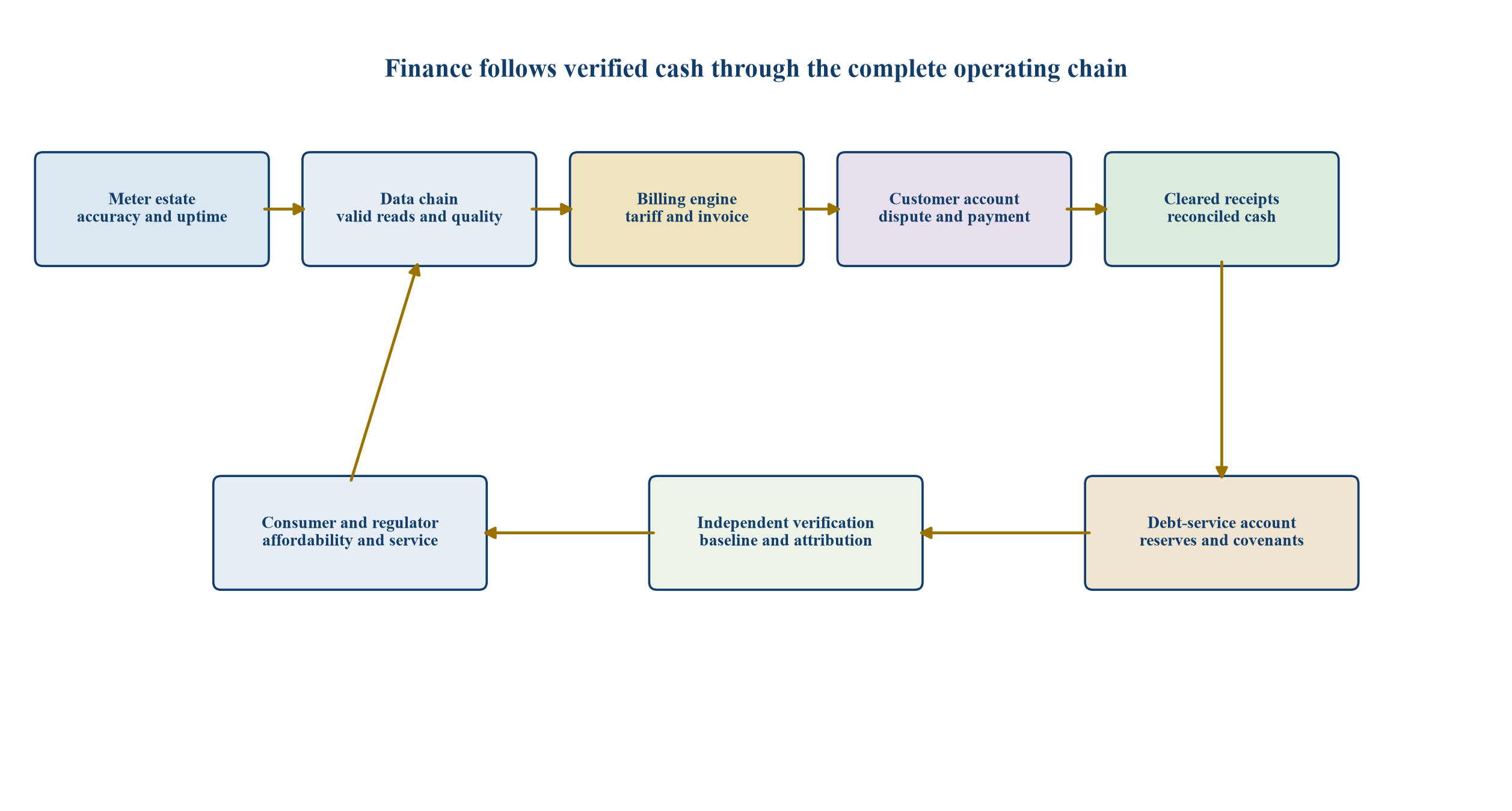
Generic decision architecture; actual payment and regulatory structures depend on jurisdiction and contract.
7. Define the unit of account
The programme should choose a consistent unit for meter installation, active communication, valid interval data, billable read, invoice, collection and verified benefit. Device counts alone can hide meters that are installed but inaccessible, uncommissioned, disconnected from customer records or excluded from billing.
Monthly reporting should reconcile the installed population to the active billing population and explain every exclusion. Lenders need the denominator as well as the success rate.
8. Establish the counterfactual
Benefits should be measured against the outcome expected without the programme. The baseline should document manual reading cost, estimated-bill rate, unbilled accounts, meter under-registration, billing corrections, debtor days, collection efficiency, customer complaints, water use, customer-side leakage and service levels.
Season, tariff changes, population, industrial demand, economic conditions and enforcement programmes can change these metrics independently. The verification method should specify permitted adjustments before financing closes.
9. Separate physical and commercial water loss
Physical loss represents water escaping the network. Commercial loss can include meter under-registration, unauthorised consumption, customer-data gaps and billing error. Smart customer meters can influence both, while the cash pathways differ.
Physical loss reduction can avoid production and treatment cost or defer capacity. Commercial-loss reduction can increase valid billed volume and receipts. The model should avoid valuing the same cubic metre as both recovered revenue and avoided production cost.
10. Billing accuracy
Accurate reads can replace estimates and identify broken, inaccessible or mis-sized meters. The financial effect depends on the direction of existing error. Some accounts may have been under-billed; others may have been over-billed. A rollout can therefore increase or decrease gross billing while improving accuracy.
The investment case should analyse error distributions by customer class and meter age. A one-sided uplift assumption is weak credit evidence.
11. Collection efficiency
Collection efficiency measures the conversion of valid billed amounts into cash. Metering can strengthen evidence and reduce disputes, but affordability, payment channels, public-sector arrears and debt-management practice remain important. World Bank utility-creditworthiness guidance treats billing efficiency, collection efficiency and debtor days as distinct measures [3].
The lender model should preserve that distinction and track cash by billing cohort.
12. Working-capital release
Faster, more frequent and more accurate billing can reduce the time between consumption, invoice and collection. The resulting receivables release is usually a one-time cash benefit, followed by a recurring reduction in financing cost. It should not be capitalised as a perpetual revenue stream.
The model should include billing frequency, payment terms, delays, reversals, refunds and bad-debt treatment. Working-capital proceeds should be reconciled against the ledger.
13. Remote-reading savings
Automated reads can reduce routine site visits, estimated readings and rework. The cash saving depends on labour contracts, redeployment, outsourced service terms, route density and residual field requirements. A reduction in field hours does not create cash when the cost base remains fixed.
The baseline should separate avoidable cash cost from absorbed overhead. Savings should enter debt service only after an approved operating plan makes them real.
14. Customer leak benefits
Interval data can identify continuous use and notify customers of possible premises leakage. A California randomised controlled trial found additional household water savings after AMI installation and conservation messaging, with most estimated savings attributed to leak reduction in that study [4]. The result provides evidence for a use case, not a universal forecast.
Finance models should use local event rates, response and repair behaviour.
15. Demand reduction
Consumption information, targets and alerts can influence use. Lower demand can reduce variable production cost and relieve resource pressure. Under volumetric tariffs, it can also reduce billed revenue. The net financial effect depends on tariff design, marginal cost, fixed-cost recovery and regulatory treatment.
The investment committee should see revenue erosion and operating savings together. Water saved should not automatically be priced at the retail tariff.
16. Capacity deferral
Sustained demand reduction can defer treatment, abstraction, conveyance or network investment. Deferral value depends on a specific constrained asset, timing, probability and approved capital plan. It is an option value until the investment decision changes.
The model should document the avoided project, trigger, deferral period and financing effect. Generic long-term capacity value is unsuitable for scheduled debt service without a funded payment mechanism.
17. Regulatory allowances
Some regulated utilities recover approved metering investment through customer charges or regulated revenue. The credit case then depends on the determination, delivery conditions, performance incentives, cost disallowance risk and timing of recovery. Ofwat’s PR24 programme links allowances with delivery expectations and performance outcomes [1].
Legal and regulatory diligence should confirm whether the allowance is committed, conditional, reopenable or subject to clawback.
18. Availability payments
A public authority or utility can pay an SPV for meters and data services that meet availability and performance standards. This creates a contractual payment stream independent of individual customer collections, subject to deductions, appropriations, termination and counterparty credit.
Debt sizing should model deduction caps, persistent failure, payment delay and termination compensation. Availability should include usable data and billing integration, not device power alone.
19. Performance payments
Performance-based contracts can link payment to valid meter installations, incremental collections, reduced estimated bills, verified water saved or service levels. World Bank case material documents performance contracts for meter replacement, commercial management and collection improvement [5].
A payment formula must define the baseline, eligible accounts, causality, verification, exclusions, timing and dispute process. Performance risk should sit with the party able to control it.
20. Benefit classification
Table 1. Benefit classification for financing analysis
| Outcome | Verification evidence | Cash treatment | Principal caution |
|---|---|---|---|
| Incremental valid billing | Meter, tariff, invoice and account reconciliation | Eligible only to the extent collected and legally retainable | Tariff change, account correction and disputes can distort uplift |
| Improved collections | Cleared receipts by billing cohort | Recurring cash after reversals, refunds and bad debt | Metering may not control affordability or enforcement |
| Reduced meter-reading cost | Payroll, contractor invoices and operating plan | Avoidable cash saving after implementation | Redeployed labour is not automatically a cash saving |
| Reduced estimated bills | Billing-system audit | Service-quality benefit; cash impact separately demonstrated | Accuracy can move bills in both directions |
| Customer-side leak reduction | Interval data, notification and repair evidence | Customer or social benefit unless monetised contractually | Alert does not prove repair or persistence |
| Reduced production cost | Verified volume and marginal unit cost | Operating saving when variable cost is avoided | Average tariff or average cost can overstate value |
| Capacity deferral | Approved capital plan and changed investment date | Financing benefit only when the deferral is committed | Option value is uncertain and timing-sensitive |
| Regulatory allowance | Final determination and compliance evidence | Contracted or regulated revenue subject to conditions | Delivery failure, clawback and reopening risk |
21. Evidence from commercial-performance contracts
The World Bank’s operational manual records examples in Brazil, Burkina Faso and Jordan where metering, customer data, billing and collections formed part of performance improvement [5]. The cases show that commercial operations can change materially under structured programmes. They also show the need to understand local baselines, payment design and operating responsibilities.
Historical results should inform questions and ranges. They should not be inserted into a new forecast without local evidence.
22. Tariff design
Tariffs may combine fixed charges, volumetric blocks, social tariffs, connection charges and penalties. Smart-meter cash flow depends on how interval consumption enters this design. Increasing measured volume can improve revenue on under-registered accounts, while conservation can reduce volumetric receipts.
The financial model should test customer-class mix, minimum charges, block migration, seasonal pricing, exemptions and political constraints. Tariff authority should be documented.
23. Affordability and vulnerable customers
Accurate billing can expose previously hidden consumption and create bill shocks. Consumer protection should cover notice, dispute, payment plans, leakage allowances, social tariffs, medical needs and disconnection rules. The EU Drinking Water Directive requires accessible consumer information on consumption and tariffs while recognising data-protection requirements [6].
Affordability controls support legitimacy and collection quality. Aggressive collection assumptions can damage both service and credit.
24. Customer communication
Customers need to understand installation, data use, bill changes, leak alerts and remedies. Communication should start before deployment and continue through first billing cycles. The programme should track delivery, portal activation, complaints, disputes, repairs and satisfaction.
Clear communication reduces avoidable calls and contested invoices. It also creates evidence that the utility provided appropriate notice and support.
25. Data rights and privacy
Interval consumption can reveal occupancy and behavioural patterns. Contracts and policy should define lawful purpose, access, retention, sharing, customer choice, security and deletion. The required controls depend on jurisdiction.
The financing diligence file should show that billing, analytics and verification uses are permitted. A cash-flow structure should not depend on a data use that can be withdrawn or prohibited.
26. Cybersecurity
Meters, gateways, communications and platforms expand the utility’s attack surface. US EPA guidance notes that AMI networks can be vulnerable to intrusion, disruption and information theft [7]. NIST’s 2026 water-sector architecture provides implementation examples for secure remote access [8].
The budget should include identity, encryption, segmentation, logging, patching, incident response, supplier access and recovery. Cyber resilience is an operating and credit requirement.
27. Meter accuracy and degradation
Meter performance varies with technology, size, flow profile, water quality, installation and age. The rollout should specify accuracy classes, testing, acceptance, maintenance and replacement. Under-registration can return as the estate ages.
Debt tenor should not exceed the period in which the meter and communications assets can deliver service without funded renewal. Lifecycle replacement and battery cost belong in the base case.
28. Communications performance
Remote reading depends on coverage, power, network capacity and field conditions. A meter can be mechanically accurate while its data arrive late or incomplete. Availability metrics should therefore separate device, communication, platform and end-to-end billing availability.
The design should test difficult premises and dense or remote areas before final procurement. Coverage remediation needs a priced plan.
29. Meter data management
The meter data management platform validates, estimates, edits, stores and publishes reads. Its rules can affect billing and benefit claims. Controls should cover duplicates, gaps, clock errors, resets, outliers, replacement and version changes.
Every billing read should retain provenance. Manual edits should have authority, reason and audit trail. Verification should be able to reproduce the reported outcome.
30. Customer and asset identity
Meter, premises, customer, tariff, account and network identifiers must reconcile. Mismatches can create orphan reads, duplicate bills and unattributed benefit. A rollout often exposes legacy customer-data problems that require remediation.
The programme should fund a controlled data-cleaning workstream. Benefits from correcting the register should be measured separately from the ongoing technology effect.
31. Billing-system integration
Integration should cover validated reads, tariff calculation, exceptions, rebills, credits, move-in and move-out, meter exchange and payment allocation. Parallel billing and sample reconciliation can reduce implementation risk.
Acceptance should include complete billing cycles across customer classes and exception scenarios. A technically successful read is insufficient when the invoice is wrong.
32. Baseline governance
The baseline should be frozen before performance exposure. It should include source systems, extraction time, quality tests, adjustments and sign-off. Material data gaps should be disclosed and treated conservatively.
When baseline quality is weak, the contract can begin with fixed or milestone payments and transition to outcome payments after evidence improves. World Bank guidance describes phased performance-contract approaches where data are initially limited [9].
33. Measurement and verification plan
The plan should define each outcome, formula, frequency, evidence, responsible party, independent verifier, exclusions and dispute process. It should distinguish operational reporting from payment certification.
Certification should reconcile meter-level or account-level evidence to the general ledger and bank receipts where cash is claimed. Sampling can support assurance when the population is large, provided the method and confidence are agreed.
34. Attribution
Collections can change because of tariffs, enforcement, economic conditions, billing frequency, amnesties, payment channels or public transfers. The method should isolate or adjust for these factors. Cohort comparison, matched areas, phased rollout and controlled pilots can strengthen attribution.
The verifier should report residual uncertainty. A financing model should apply a haircut where attribution remains weak.
35. Persistence
A benefit observed in the first year may fade through device failure, customer behaviour, meter ageing or operating drift. Persistence testing should compare outcomes over seasons and cohorts. Maintenance and customer engagement should be linked to sustained performance.
Debt sizing should use a persistence curve and reserve for replacement. A short pilot uplift should not be extrapolated unchanged across a long tenor.
36. Cash eligibility rules
Eligible cash should be attributable, collected, unrestricted, legally retainable, free from double counting and net of associated operating cost. Exclusions should cover taxes, grants restricted to capital use, disputed receipts, tariff increases unrelated to the rollout, arrears settlements, penalties and unrelated enforcement campaigns.
The eligibility schedule belongs in the finance documents and verification protocol.
37. The collection account
Customer receipts may enter a utility-wide account that cannot be isolated by programme. An SPV structure can use a defined service payment rather than attempting to assign individual customer cash. Where receivables are pledged, account control, commingling, set-off, refunds and public-law restrictions require diligence.
The cash-management design should match the legal and operating reality.
38. Cash waterfall
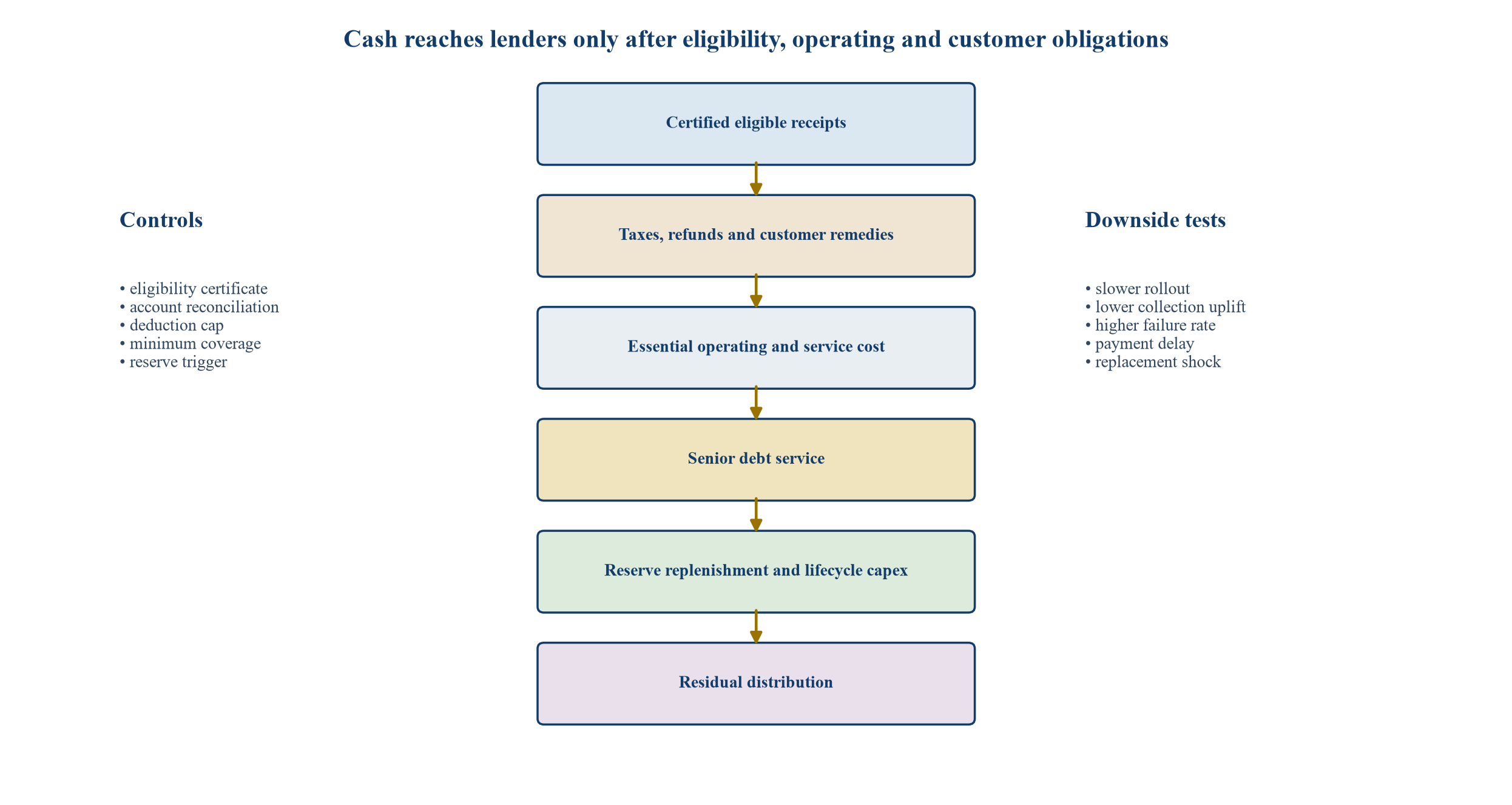
Hypothetical structure; no named utility, lender or transaction is represented.
39. Sources and uses
Uses include meters, installation, communications, platform, integration, customer engagement, cybersecurity, programme management, verification, contingencies, interest during rollout and reserves. Sources can include utility equity, public grants, concessional debt, commercial debt, vendor finance and performance capital.
The plan should match long-lived assets with suitable tenor and retain equity for uncertain development and integration cost. Grants should absorb public-good components rather than artificially inflate debt capacity.
40. Corporate borrowing
Corporate debt relies on the utility’s overall credit, tariffs, governance and cash flow. It can simplify security and accommodate portfolio benefits. The lender will still diligence the rollout because project failure can weaken the borrower.
This structure suits a creditworthy utility with transparent accounts and regulatory support. It provides less ring-fencing of programme performance.
41. Project or SPV financing
An SPV can procure, finance and operate meters under an availability or performance contract. Cash flow depends on the service agreement and public or utility counterparty. The SPV should have clear rights to install, access, maintain, use data and receive payment.
Interface risk with the utility’s billing and customer systems remains material. The contract matrix should allocate each dependency and relief event.
42. Vendor finance
A technology or service provider can defer part of the purchase price or accept payment over the asset life. Vendor finance can align performance and reduce initial cash need. It can also increase concentration, termination and lock-in risk.
The utility should compare the implied financing cost, equipment price, service obligation, security and exit terms with independent debt.
43. Receivables financing
Incremental or existing utility receivables may support a borrowing base where assignment is lawful and data are reliable. Eligibility criteria should address account age, disputes, public-sector customers, concentration, refunds and dilution.
Financing should not assume that a modelled future uplift already exists. A ramping facility can add receivables after demonstrated billing and collection.
44. Green and sustainability-linked finance
Smart-water investment may fit green-finance categories when proceeds and impacts meet the relevant framework. Sustainability-linked finance ties economics to material performance targets rather than a restricted use of proceeds. ICMA and loan-market principles emphasise transparency, materiality, reporting and verification [10][11].
The financing label does not replace credit quality. Water metrics should be ambitious, measurable and protected against methodology changes.
45. Blended finance
Concessional capital, guarantees, grants or first-loss support can absorb risks that commercial lenders cannot price during early deployment. The structure should identify the market failure, additionality, subsidy period and path to commercial sustainability.
Blended finance is most credible when it funds affordability, data remediation, early evidence or public benefits while commercial debt relies on proven cash flow.
46. Credit enhancement
Enhancement can include government support, partial guarantees, liquidity facilities, reserve accounts, escrow, minimum payments and termination compensation. Each tool addresses a specific risk and should be valued transparently.
A guarantee should not conceal weak operations. Lenders still need a functioning meter-to-cash system and clear recourse process.
47. Financing structure comparison
Table 2. Illustrative financing structures and gating questions
| Structure | Primary repayment source | Suitable condition | Key diligence question |
|---|---|---|---|
| Utility corporate loan | Utility-wide operating cash | Creditworthy utility and stable tariff framework | Can the utility service debt under programme underperformance? |
| SPV availability financing | Contracted service payment | Strong public or utility counterparty and measurable availability | Are deductions, appropriations and termination payments bankable? |
| Performance-payment financing | Certified outcome payment | Robust baseline, control and independent verification | Who bears baseline and attribution risk? |
| Receivables facility | Eligible customer receivables | Reliable billing, collections and assignment rights | How are disputes, dilution and commingling controlled? |
| Vendor finance | Deferred service or equipment payments | Supplier has balance-sheet capacity and aligned obligations | What happens on vendor default, replacement or exit? |
| Blended facility | Contracted cash plus concessional support | Early evidence, affordability or public-benefit gap | Is support targeted, time-bound and additional? |
| Green or sustainability-linked loan | Borrower cash with labelled use or KPI | Credible framework, material targets and reporting | Do impact claims and credit cash flow remain separately sound? |
48. Debt sizing
Debt should be sized against the lower of contracted payment and conservative eligible cash. The model should include rollout ramp, collection lag, operating cost, taxes, deductions, lifecycle capex, reserve funding and downside cases. Coverage ratios should be calculated on cash after essential programme cost.
The sponsor should disclose whether the ratio uses forecast, certified or collected amounts. Cash available for debt service should reconcile to accounts.
49. Illustrative case assumptions
Consider a hypothetical programme with 500,000 target meters, a five-year rollout, mixed new and replacement devices, and a service-payment structure. The example assumes no named jurisdiction, tariff or supplier. Every input is a decision variable requiring local evidence.
The case should test installation cost, communications, platform, maintenance, collection effect, operating savings, payment deductions, inflation, interest and replacement. It should also include a no-uplift case.
50. Capex sensitivity
Meter hardware may be a minority of total installed cost once surveys, civil work, difficult premises, communications, systems, customer engagement and programme management are included. Averages can hide long-tail installation cost.
Procurement should request unit rates by installation class and cap exposure to exceptions. The financing model should include contingency and a mechanism for verified quantity changes.
51. Operating-cost sensitivity
Recurring cost includes connectivity, data platform, software, licences, field maintenance, battery or device replacement, customer service, cyber monitoring, verification and supplier management. Costs can rise with data frequency and retention.
The downside case should test communications repricing, higher failure rates and supplier transition. Lifecycle cost matters more than the initial device price.
52. Benefit sensitivity
The case should vary meter under-registration, estimated-bill correction, collection rate, debtor days, avoidable reading cost, customer leak response and marginal water cost. Correlated downside matters: weak communications can reduce billing benefit while increasing maintenance cost.
Management should identify the few variables that determine viability and design the pilot to measure them.
53. Demand-revenue tension
If conservation reduces billed consumption, the utility may lose revenue while achieving public policy goals. A decoupled tariff, fixed charge, regulatory true-up or performance payment can resolve part of this tension. The arrangement requires lawful approval.
The cash model should show both utility economics and customer or resource benefit. Hidden reliance on future tariff increases should be avoided.
54. Debt-service reserve
A reserve can cover timing mismatch, deductions or temporary data failure. Its required size depends on payment frequency, counterparty delay, operating volatility and cure periods. Replenishment rules should sit above distributions.
The reserve is liquidity protection rather than a substitute for structural cash generation. Draws should trigger reporting and corrective action.
55. Lifecycle reserve
Meters and communications components require replacement. A lifecycle reserve can accumulate cash before expected renewal peaks. The model should use tested failure and battery curves, procurement lead times and field cost.
Release of the reserve should require evidence that the estate remains capable of meeting service standards through the debt tenor.
56. Covenant package
Covenants can cover rollout progress, active-meter ratio, valid-read availability, billing integration, dispute rate, collection, debt-service coverage, reserve levels, cybersecurity, insurance and reporting. Cure rights should reflect whether the issue is technical, operational or financial.
Metrics should be hard to manipulate and should not encourage unsafe billing or customer treatment.
57. Security package
Security may include account control, assignment of service payments, receivables, contract rights, insurance, equipment and sponsor support. Public-law and regulatory restrictions can limit enforcement. Asset repossession may have little value when meters are embedded in a public network.
Lenders should focus on cash continuity, step-in, replacement and termination compensation rather than nominal equipment collateral.
58. Counterparty risk
An availability payment is only as strong as the payer’s legal obligation, budget process and credit. Diligence should cover authority, appropriations, payment history, sovereign or municipal support and dispute rights.
The model should test delayed payment and provide liquidity. Political commitment should be supported by enforceable documents.
59. Supplier risk
The supplier may control devices, firmware, network, data and analytics. Failure or insolvency can interrupt billing. The utility should assess financial capacity, subcontractors, component supply, escrow, interfaces and transition support.
Critical data and configuration should remain accessible. A replacement plan should be operational before financial close.
60. Technology obsolescence
Communications standards, security requirements and platform architectures change. Procurement should use interoperability, modularity and open interfaces where practical. Technology refresh should be funded and governed.
Debt tenor should reflect the service life of the whole architecture. A meter body lasting longer than its communications module does not extend useful system life automatically.
61. Insurance
Coverage can include property damage, cyber, professional liability, public liability, business interruption and contractor risks. Availability and exclusions vary. Insurance proceeds should follow a reinstatement and debt-protection waterfall.
The programme should avoid treating insurance as comprehensive risk transfer. Deductibles, waiting periods and non-insurable events belong in the downside case.
62. Procurement model
Options include asset purchase, design-build, managed service, metering-as-a-service and performance contract. Evaluation should compare lifecycle cost, control, risk transfer, data rights, financeability and exit.
The tender should disclose baseline limitations and interface responsibilities. Bidders should price the same service definition so that financing and operating proposals are comparable.
63. Payment mechanics
Payments can combine installation milestones, availability, valid data, billing integration and outcomes. Early fixed payments can cover controllable mobilisation while later performance payments follow evidence. A balanced formula reduces disputes and avoids transferring risks the supplier cannot control.
The payment schedule should identify caps, floors, deductions, bonuses, indexation, tax and certification timing.
64. Change control
Tariffs, regulation, meter specifications, customer policy and cyber standards may change during a long programme. The contract should define qualifying change, notice, evidence, price adjustment and dispute procedure.
Changes should be assessed for both service and financing impact. Uncontrolled scope growth can consume contingency and weaken coverage.
65. Termination
Termination provisions should cover supplier default, utility default, prolonged force majeure, law change and voluntary termination. Compensation should address debt, asset value, break cost, rectification and handover without rewarding poor performance.
The lender should understand whether payment is timely, appropriated, enforceable and sufficient under each case.
66. Risk allocation
Table 3. Illustrative smart-meter financing risk matrix
| Risk | Preferred owner | Contract treatment | Financing response |
|---|---|---|---|
| Baseline error | Utility for disclosed source data; verifier for agreed process | Frozen baseline, adjustment rules and audit | Haircut uncertain benefit and phase performance exposure |
| Installation access | Party controlling customer and site access | Survey, notice, relief events and difficult-install rate | Contingency and milestone evidence |
| Meter and communications performance | Supplier within specification | End-to-end availability, repair and replacement | Deductions, warranty and lifecycle reserve |
| Billing integration | Shared by interface responsibility | Test cases, parallel run and acceptance | Delay debt draw until billing gate passes |
| Collection and affordability | Utility or public counterparty | Customer safeguards and eligible-cash definition | Base debt on collected cash or contracted payment |
| Tariff and regulatory change | Public or utility counterparty subject to law | Change mechanism and regulatory covenant | Downside case, support or rebalancing |
| Cyber incident | Party controlling affected layer | Security baseline, notification and recovery | Reserve, insurance and step-in plan |
| Data rights and privacy | Utility and processor by legal role | Purpose, access, retention, audit and deletion | Legal opinion and use-case restriction |
| Supplier failure | Supplier with utility continuity rights | Escrow, interfaces, transition and replacement | Step-in, reserve and concentration limit |
| Benefit persistence | Shared through maintenance and operations | Sustained-performance tests | Conservative curve and cash sweep |
67. Pilot design
The pilot should cover representative customer classes, installation conditions, communications environments, tariffs and billing exceptions. It should run through complete billing and collection cycles and preserve a comparison group or credible counterfactual.
The purpose is to measure the variables that drive cash and risk. A showcase deployment in easy premises is weak evidence for full-scale finance.
68. Technical acceptance
Acceptance should test installation quality, accuracy, transmission, data completeness, latency, security, system integration and replacement. It should include failure and recovery scenarios.
Metrics should be measured end to end. A platform uptime figure does not establish that invoices received valid reads.
69. Commercial acceptance
Commercial acceptance should test customer-register reconciliation, valid bills, correction rate, disputes, collection, operating effort and service cost. The programme should trace sample accounts from meter through bank receipt.
Benefits should be certified after enough cycles to observe reversals, refunds and customer response. Early invoicing uplift alone is insufficient.
70. Financing gates
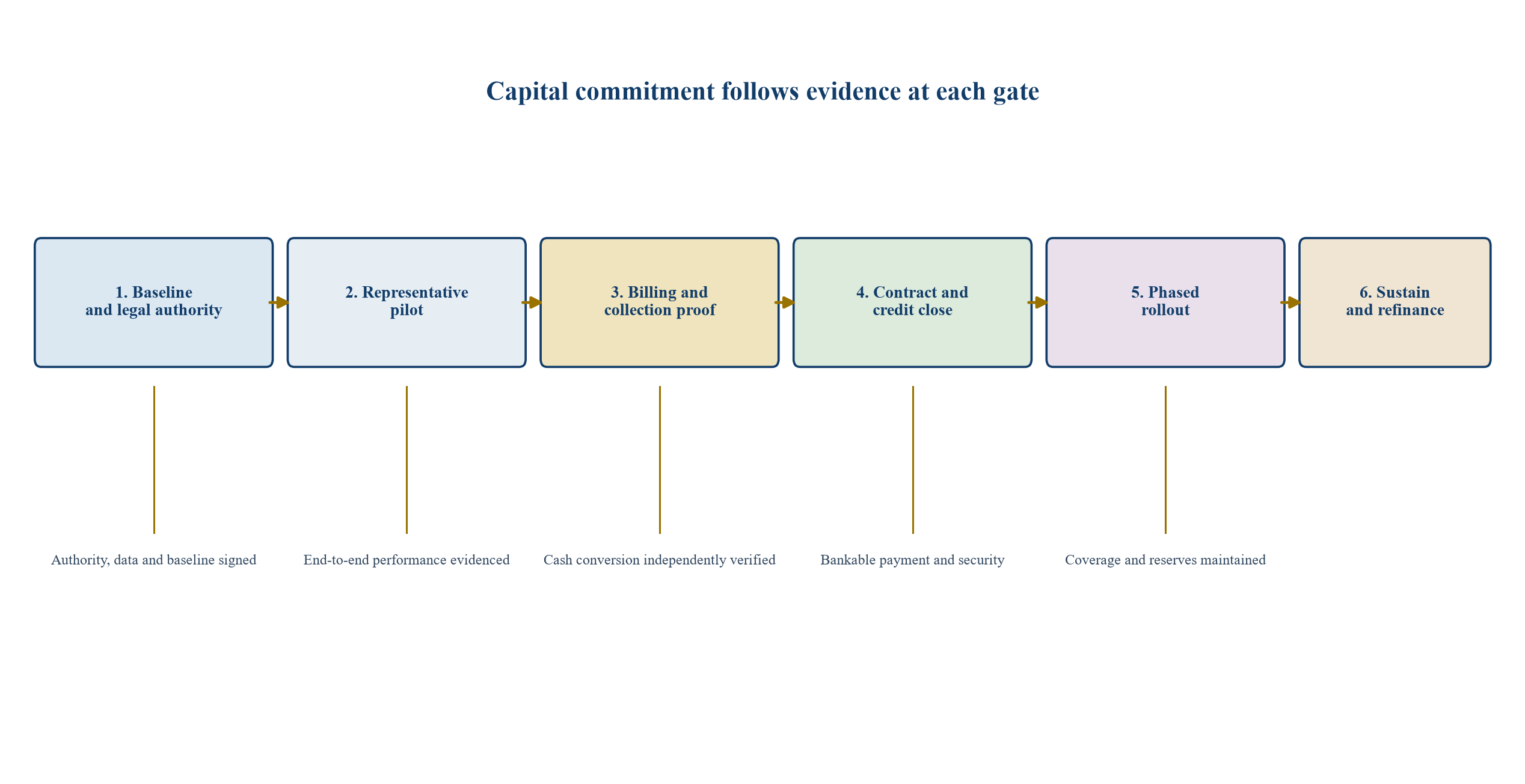
Generic implementation sequence; timing depends on procurement, regulation and utility readiness.
71. Phased debt draw
The facility can draw against verified installation and acceptance rather than the full budget on day one. Conditions can include equity spent, site access, active meters, billing integration, insurance and no material default.
Phased draw reduces negative carry and limits lender exposure before operating evidence exists. It also requires realistic contingency funding for delays.
72. Completion test
Completion should require the target active-meter population, sustained valid-read availability, billing acceptance, agreed customer-service performance, cyber controls, documentation, training, reserves and absence of material defects.
A device-installation percentage alone is an incomplete completion test. The system must support reliable service and cash generation.
73. Independent engineer and verifier
The independent engineer can review design, installation, testing, lifecycle assumptions and progress. The outcome verifier can certify baseline, calculations and eligible cash. Their scopes should avoid gaps and duplication.
Reports should identify qualifications, missing evidence and unresolved disputes. Lenders should retain direct reliance rights where appropriate.
74. Monthly lender report
The report should reconcile target, installed, commissioned, communicating and billing-active meters; valid-read availability; billing and collection cohorts; deductions; operating cost; reserves; cyber incidents; complaints; disputes; and covenant compliance.
It should also show baseline adjustments and methodology changes. Restatements should remain visible.
75. Red flags
Red flags include benefits valued at retail tariff without cash evidence, one-sided billing uplift, estimated receipts presented as collections, no affordability plan, device availability substituted for end-to-end service, weak customer-register reconciliation, unfunded replacement, proprietary data lock-in, synthetic cybersecurity assurance and debt sized before pilot evidence.
Each red flag requires redesign, price protection, additional support or a decision not to finance.
76. First 180 days
The first six months should confirm legal authority, tariff and consumer rules; audit meter and customer data; define the baseline and benefit ledger; map systems and interfaces; select representative pilot areas; design verification; test procurement options; and engage potential financiers.
Management should approve the cash definition and downside cases before issuing a financeable tender.
77. Investment-committee pack
The pack should include service objectives, local evidence, benefit classification, baseline, technology architecture, customer safeguards, cyber review, procurement evaluation, contract matrix, sources and uses, cash waterfall, financing options, downside cases, risk allocation, verification and stage gates.
All management estimates should be identified. Historical programme evidence should retain its source and context.
78. Decision rule
Proceed when the programme can produce valid and secure billing data, convert approved benefits into enforceable and verifiable cash, protect customers, sustain operations through the debt tenor and preserve positive coverage under credible downside conditions.
Use public or concessional capital for benefits that remain valuable but do not create lender cash. Match the capital instrument to the actual benefit.
79. Broader strategic value
Once the meter-to-cash chain is reliable, the same data can improve demand planning, leakage response, customer service and investment prioritisation. Those options can increase strategic value without being required to repay the initial debt.
The sponsor should preserve interoperability and data rights so later applications remain contestable. Optional value should stay outside the base debt case until evidenced.
80. Conclusion
Smart-water meters can strengthen billing, collections and operating decisions, yet financeability depends on the complete system around the meter. The decisive work is to identify cash, prove attribution, protect customers, allocate risk and create a payment mechanism that survives downside conditions.
A credible rollout measures the benefit before pledging it. It uses staged evidence, independent verification, disciplined cash eligibility and lifecycle funding to connect digital water infrastructure with appropriate capital.
References
- Ofwat. PR24 Final Determinations: Expenditure Allowances. December 2024. https://www.ofwat.gov.uk/wp-content/uploads/2024/12/PR24-final-determinations-Expenditure-allowances-V2.pdf
- PUB, Singapore's National Water Agency. Smart Water Meter Programme. https://www.pub.gov.sg/Public/KeyInitiatives/Smart-Water-Meter
- World Bank. Kenya Water Service Provider Creditworthiness Index Report. 2015. https://documents1.worldbank.org/curated/en/614491468285302041/pdf/P144507-AAA-Finalize-Output.pdf
- Brueck, T. et al. AMI water meters deliver end-use water and financial savings in leaky households: experimental evidence from California. Environmental Research Letters, 2024. https://doi.org/10.1088/1748-9326/ad7bce
- World Bank. The Use of Performance-Based Contracts for Nonrevenue Water Reduction: Output of the Global Program on Developing Good PBC Practices for Managing NRW. 2018. https://documents1.worldbank.org/curated/en/314541537521949076/pdf/130050-20-9-2018-12-7-9-WPBCforNRWOperationalManualWEBPDF.pdf
- European Union. Directive (EU) 2020/2184 on the quality of water intended for human consumption. https://eur-lex.europa.eu/legal-content/EN/TXT/?uri=CELEX%3A32020L2184
- United States Environmental Protection Agency. Using Advanced Metering Infrastructure in a Water Quality Surveillance and Response System. 2021. https://www.epa.gov/sites/default/files/2021-03/documents/srs_ami_guidance_20210223_508_complete.pdf
- National Institute of Standards and Technology. SP 1800-45, Cybersecurity for the Water and Wastewater Sector: Build Architecture. 2026. https://doi.org/10.6028/NIST.SP.1800-45
- World Bank. Performance-Based Contracts for Non-Revenue Water Management. https://connect4impact.worldbank.org/topic/performance-based-contracts-non-revenue-water-management
- International Capital Market Association. Sustainable Bonds for Nature: A Practitioner's Guide and 2025 updates. https://www.icmagroup.org/News/news-in-brief/the-executive-committee-of-the-principles-announces-a-practitioners-guide-on-sustainable-bonds-for-nature-alongside-updates-to-existing-guidance/
- Loan Market Association, Asia Pacific Loan Market Association and Loan Syndications and Trading Association. Sustainability-Linked Loan Principles and related guidance. https://www.lma.eu.com/sustainable-lending/documents
- Ofwat. Smart Metering Report. 2024. https://www.ofwat.gov.uk/wp-content/uploads/2024/09/Ofwat-Smart-Metering-Report.pdf
- Environment Agency. Water resources 2024 to 2025: analysis of the water industry's annual water resources performance. 2025. https://www.gov.uk/government/publications/water-resources-2024-2025-analysis-of-the-water-industrys-annual-water-resources-performance/water-resources-2024-to-2025-analysis-of-the-water-industrys-annual-water-resources-performance
- World Bank. Performance Improvement Planning: Developing Effective Billing and Collection Practices. https://documents1.worldbank.org/curated/en/713571468138288578/pdf/Performance-improvement-planning-developing-effective-billing-and-collection-practices.pdf
- World Bank. Jordan: Micro Private Sector Participation in Water Operations and Management. https://documents1.worldbank.org/curated/en/405461468136207446/pdf/717450WP0Box3700Principle00Practice.pdf
- World Bank. GWSP: Financing the Water Sector. https://www.worldbank.org/en/programs/global-water-security-sanitation-partnership/publications/gwsp-financing-the-water-sector
About the Author
Chennakeshav (CK) is a corporate finance and investment banking executive with 25+ years of global experience in deal origination, structuring and execution across M&A, growth capital and corporate strategy. He has led value-creation mandates for founders, corporates and funds — bridging the boardroom view to hands-on execution and close.
His career spans Morgan Stanley, HSBC, Lloyds Banking Group, EWEC, ADQ portfolio companies and Emirates Growth Fund, across TMT, real estate, fintech, deeptech, cleantech, infrastructure and energy. He has partnered with C-suite leaders, private equity and venture funds, sovereign wealth funds and family offices to finance complex fund raises and scale-up ventures, and has led M&A due diligence, post-merger integration and business-transformation initiatives to create value.
At Matchpoint Partners he is Managing Partner, leading the firm's corporate finance, M&A and capital-raising practice. He holds an MBA from London Business School, an engineering degree from VTU and a Master of Laws (LLM, in progress) from UCL London.
An active start-up mentor, CK mentors at Techstars, DIFC FinTech Hive, Startup Grind, Founder Institute and IN5, serves as Entrepreneur Mentor in Residence (EMiR) at London Business School, and judges the Entrepreneurship World Cup.
LinkedIn: https://www.linkedin.com/in/ckadya/
Profile: https://www.matchpoint-partners.com/team/ck-adya.html
