

1. Define the infrastructure decision
The decision question is which public service, resilience outcome and financing decision the programme must support. The diligence team should begin with hazard studies, service standards, public plans, ecosystem condition, beneficiaries and budget authority. Evidence should be attributable, versioned and reconciled across ecological, engineering, social, legal, commercial and financial workstreams. [1][2]
The principal failure mode is that a broad nature narrative can conceal an undefined service, payer and accountable owner. Management estimates can support planning when they are identified as estimates and kept separate from observations, verified outcomes, executed contracts and regulatory approvals. The model should show how each unresolved item changes service performance, schedule, cost, payment, liquidity, safeguards or control.
The recommended response is to state the service, intervention, beneficiary, counterfactual, payer and decision rule for every component. A named executive should own delivery, an independent reviewer should challenge material assumptions, and the approval body should see the evidence required to release capital or certify payment. Central, downside and stop cases should identify the financial effect and the earliest practical intervention. In the hypothetical programme, unsupported value remains outside the base case or is carried through probability, contingency, holdback, reserve or a closing condition.
2. Establish baseline and counterfactual
The decision question is what would occur without the programme and which starting condition governs measurement. The diligence team should begin with historical imagery, field inventories, hydrology, land-use records, hazard maps and intervention history. Evidence should be attributable, versioned and reconciled across ecological, engineering, social, legal, commercial and financial workstreams. [3][4]
The principal failure mode is that a selected baseline can overstate improvement or credit trends that began before investment. Management estimates can support planning when they are identified as estimates and kept separate from observations, verified outcomes, executed contracts and regulatory approvals. The model should show how each unresolved item changes service performance, schedule, cost, payment, liquidity, safeguards or control.
The recommended response is to pre-register baseline periods, exclusions, adjustment rules and independent challenge. A named executive should own delivery, an independent reviewer should challenge material assumptions, and the approval body should see the evidence required to release capital or certify payment. Central, downside and stop cases should identify the financial effect and the earliest practical intervention. In the hypothetical programme, unsupported value remains outside the base case or is carried through probability, contingency, holdback, reserve or a closing condition.
| Item | Primary evidence | Risk if unresolved | Financing treatment |
|---|---|---|---|
| project parcels | cadastral and customary-right records | inaccessible or contested sites | closing condition |
| water and coastal access | permits and easements | intervention cannot function | condition precedent |
| community use | participatory mapping and agreements | livelihood harm or dispute | safeguards covenant |
| monitoring access | licences and field protocols | unverifiable outcome | reserved payment |
| maintenance rights | service contract and authority | reversal after delivery | funded stewardship |
| environmental attributes | registry and contract terms | double claim or invalid transfer | warranty and audit |
Proposed diligence map; jurisdiction-specific advisers should confirm rights.
3. Secure land, water and resource rights
The decision question is whether sponsors can implement, monitor, maintain and enforce the intervention for the required term. The diligence team should begin with cadastral records, concessions, customary rights, permits, easements and resource-use agreements. Evidence should be attributable, versioned and reconciled across ecological, engineering, social, legal, commercial and financial workstreams. [5][6]
The principal failure mode is that uncertain tenure can interrupt access, displace communities or make an outcome claim unenforceable. Management estimates can support planning when they are identified as estimates and kept separate from observations, verified outcomes, executed contracts and regulatory approvals. The model should show how each unresolved item changes service performance, schedule, cost, payment, liquidity, safeguards or control.
The recommended response is to map every parcel, right, consent, restriction and remedy to the financed perimeter. A named executive should own delivery, an independent reviewer should challenge material assumptions, and the approval body should see the evidence required to release capital or certify payment. Central, downside and stop cases should identify the financial effect and the earliest practical intervention. In the hypothetical programme, unsupported value remains outside the base case or is carried through probability, contingency, holdback, reserve or a closing condition.
4. Build the theory of change
The decision question is how activities create biophysical outputs, public services and financeable outcomes. The diligence team should begin with ecological evidence, engineering models, causal pathways, time lags and external drivers. Evidence should be attributable, versioned and reconciled across ecological, engineering, social, legal, commercial and financial workstreams. [1][7]
The principal failure mode is that activity counts can be mistaken for risk reduction when survival, connectivity or hydraulic function is weak. Management estimates can support planning when they are identified as estimates and kept separate from observations, verified outcomes, executed contracts and regulatory approvals. The model should show how each unresolved item changes service performance, schedule, cost, payment, liquidity, safeguards or control.
The recommended response is to link inputs to outputs, outcomes, attribution tests and decision thresholds. A named executive should own delivery, an independent reviewer should challenge material assumptions, and the approval body should see the evidence required to release capital or certify payment. Central, downside and stop cases should identify the financial effect and the earliest practical intervention. In the hypothetical programme, unsupported value remains outside the base case or is carried through probability, contingency, holdback, reserve or a closing condition.
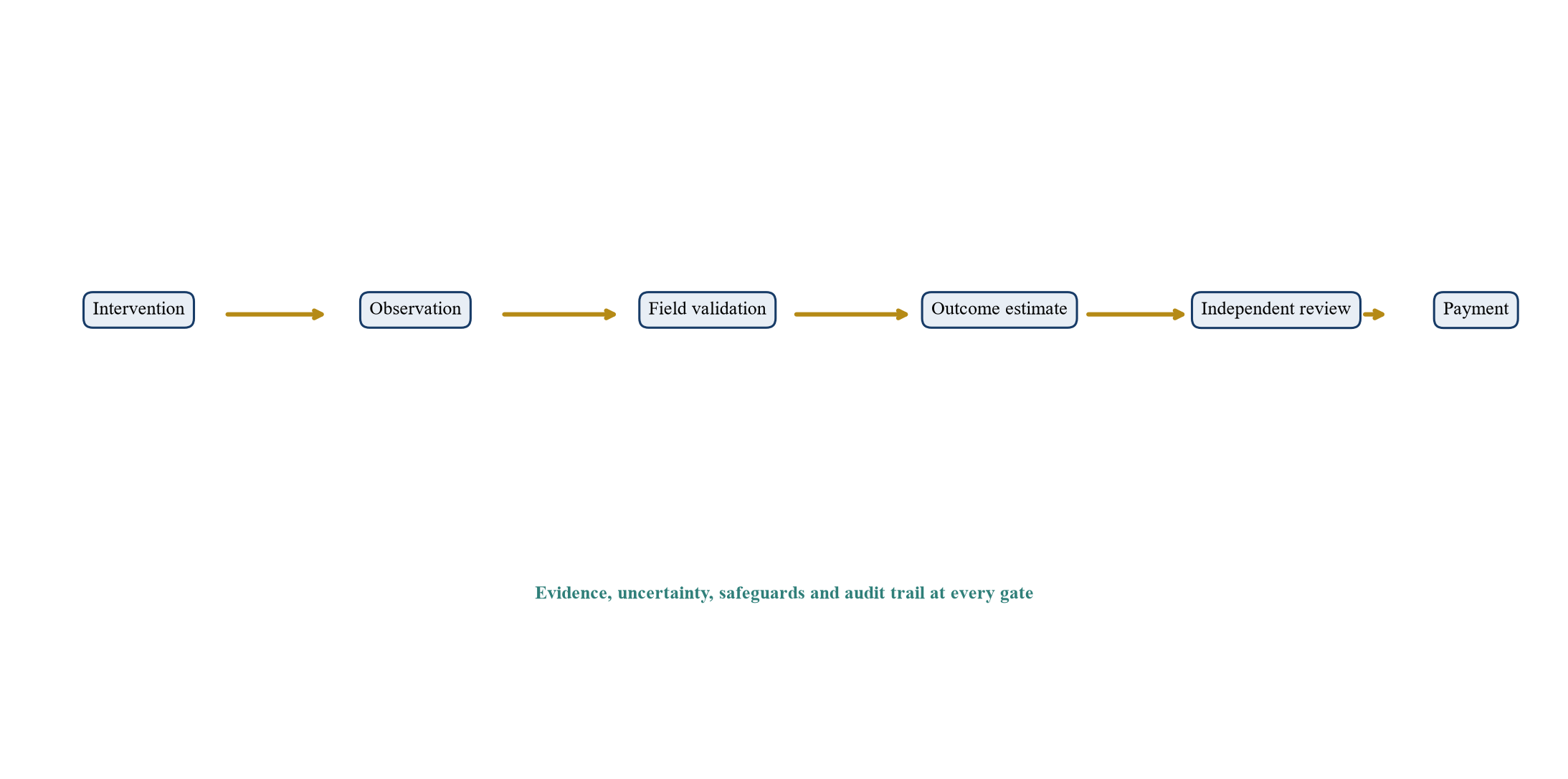
Analytical framework; project-specific contracts and methods govern each decision.
5. Design the MRV architecture
The decision question is which measurements, reports, reviews and approvals support each capital or payment decision. The diligence team should begin with indicator definitions, methods, frequency, data owners, assurance levels and registers. Evidence should be attributable, versioned and reconciled across ecological, engineering, social, legal, commercial and financial workstreams. [3][8]
The principal failure mode is that a monitoring plan can collect extensive data without producing a decision-grade claim. Management estimates can support planning when they are identified as estimates and kept separate from observations, verified outcomes, executed contracts and regulatory approvals. The model should show how each unresolved item changes service performance, schedule, cost, payment, liquidity, safeguards or control.
The recommended response is to assign evidence, uncertainty, reviewer and release rule to every payment or covenant. A named executive should own delivery, an independent reviewer should challenge material assumptions, and the approval body should see the evidence required to release capital or certify payment. Central, downside and stop cases should identify the financial effect and the earliest practical intervention. In the hypothetical programme, unsupported value remains outside the base case or is carried through probability, contingency, holdback, reserve or a closing condition.
6. Govern satellite and aerial observations
The decision question is which sensors, resolutions, revisit periods and preprocessing steps can observe the intervention. The diligence team should begin with sensor specifications, imagery licences, atmospheric correction, geolocation, mosaics and change logs. Evidence should be attributable, versioned and reconciled across ecological, engineering, social, legal, commercial and financial workstreams. [9][10]
The principal failure mode is that cloud cover, tidal state, seasonality, sensor change or preprocessing can mimic ecological change. Management estimates can support planning when they are identified as estimates and kept separate from observations, verified outcomes, executed contracts and regulatory approvals. The model should show how each unresolved item changes service performance, schedule, cost, payment, liquidity, safeguards or control.
The recommended response is to use versioned acquisition protocols, quality masks and cross-sensor reconciliation. A named executive should own delivery, an independent reviewer should challenge material assumptions, and the approval body should see the evidence required to release capital or certify payment. Central, downside and stop cases should identify the financial effect and the earliest practical intervention. In the hypothetical programme, unsupported value remains outside the base case or is carried through probability, contingency, holdback, reserve or a closing condition.
| Indicator | Remote observation | Field evidence | Principal limitation |
|---|---|---|---|
| land cover | optical and radar classification | geolocated validation plots | cloud and class confusion |
| canopy or biomass | spectral, radar or lidar proxy | diameter, height and species plots | model transferability |
| inundation | radar and water indices | gauges and surveyed levels | timing and tidal state |
| shoreline | image-derived boundary | survey control points | seasonal morphology |
| water quality | spectral proxy | laboratory samples | constituent-specific calibration |
| habitat condition | structure and fragmentation | ecological assessment | quality beyond visible cover |
Proposed method design; actual sensors and samples depend on the indicator.
7. Design field measurement and calibration
The decision question is which ground observations establish condition, validate maps and measure variables unavailable from space. The diligence team should begin with sample frames, plots, transects, gauges, laboratory methods, equipment calibration and custody. Evidence should be attributable, versioned and reconciled across ecological, engineering, social, legal, commercial and financial workstreams. [3][11]
The principal failure mode is that convenient or sparse samples can validate the model only where access is easiest. Management estimates can support planning when they are identified as estimates and kept separate from observations, verified outcomes, executed contracts and regulatory approvals. The model should show how each unresolved item changes service performance, schedule, cost, payment, liquidity, safeguards or control.
The recommended response is to use risk-based stratified sampling, documented custody and repeatable field protocols. A named executive should own delivery, an independent reviewer should challenge material assumptions, and the approval body should see the evidence required to release capital or certify payment. Central, downside and stop cases should identify the financial effect and the earliest practical intervention. In the hypothetical programme, unsupported value remains outside the base case or is carried through probability, contingency, holdback, reserve or a closing condition.
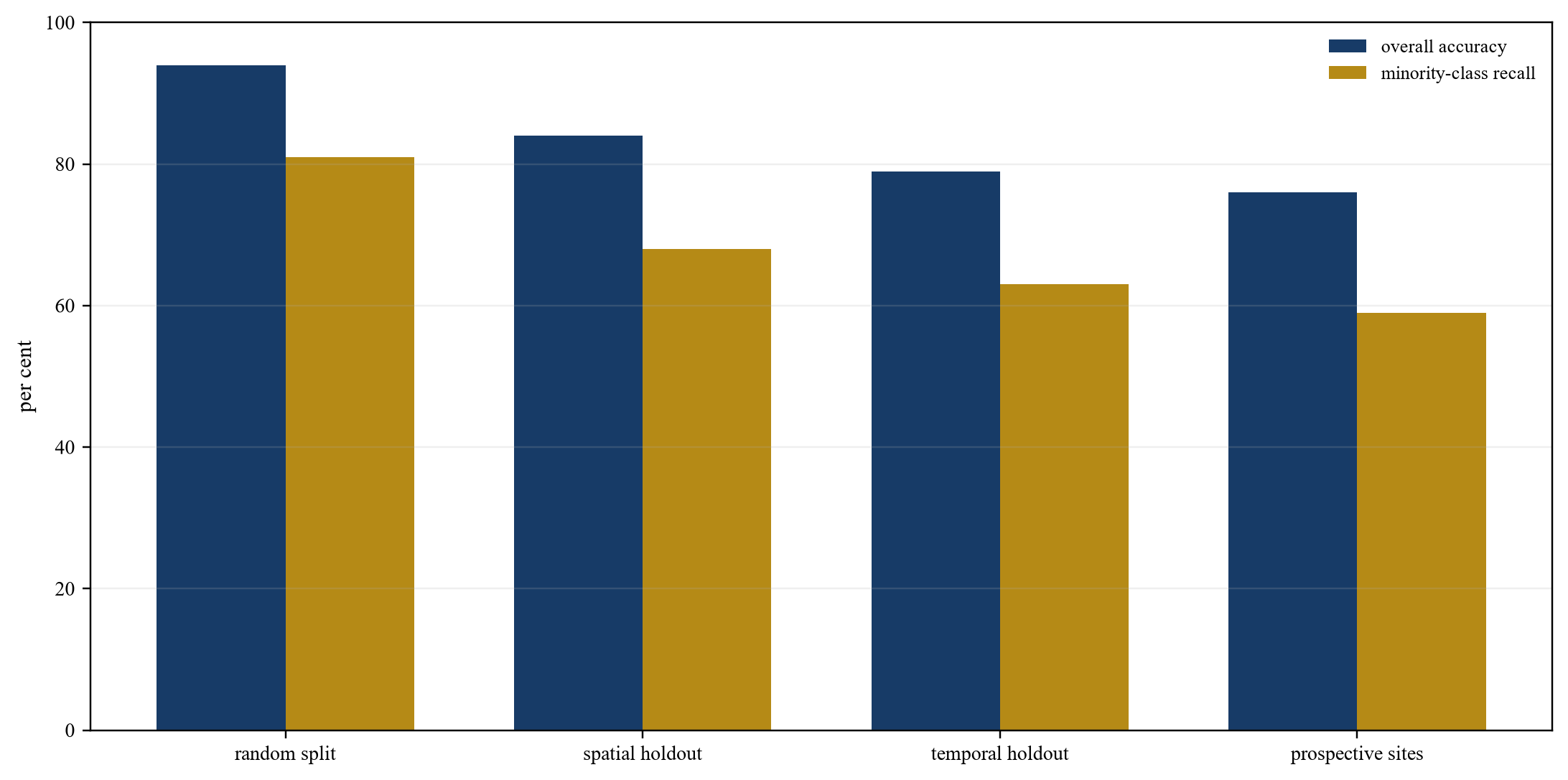
Wholly hypothetical accuracy measures; prospective project evidence is required.
8. Validate AI-assisted classification
The decision question is whether models generalise across geography, seasons, sensors and project stages. The diligence team should begin with label provenance, feature sets, spatial holdouts, error matrices, confidence and override logs. Evidence should be attributable, versioned and reconciled across ecological, engineering, social, legal, commercial and financial workstreams. [12][13]
The principal failure mode is that random train-test splits can leak neighbouring pixels and produce overstated accuracy. Management estimates can support planning when they are identified as estimates and kept separate from observations, verified outcomes, executed contracts and regulatory approvals. The model should show how each unresolved item changes service performance, schedule, cost, payment, liquidity, safeguards or control.
The recommended response is to use spatial and temporal holdouts, prospective tests and outcome-specific error thresholds. A named executive should own delivery, an independent reviewer should challenge material assumptions, and the approval body should see the evidence required to release capital or certify payment. Central, downside and stop cases should identify the financial effect and the earliest practical intervention. In the hypothetical programme, unsupported value remains outside the base case or is carried through probability, contingency, holdback, reserve or a closing condition.
| Risk | Evidence | Conservative treatment | Remedy |
|---|---|---|---|
| classification error | confusion matrix and sample design | lower confidence bound | additional validation |
| baseline uncertainty | historical range and sensitivity | exclude ambiguous area | baseline reset process |
| leakage | surrounding-zone monitoring | deduction or buffer | broader intervention |
| reversal | disturbance and survival monitoring | reserve account | replacement obligation |
| sensor discontinuity | overlap and cross-calibration | hold certification | reconciled time series |
| extreme event | event attribution and site review | suspend normal comparison | exceptional-event rule |
Proposed control framework; definitive methodology governs claims.
9. Quantify uncertainty, leakage and permanence
The decision question is how measurement error, displaced activity, reversal and extreme events affect credited outcomes. The diligence team should begin with confidence intervals, leakage zones, disturbance histories, buffers and monitoring obligations. Evidence should be attributable, versioned and reconciled across ecological, engineering, social, legal, commercial and financial workstreams. [3][14]
The principal failure mode is that a single point estimate can transfer measurement and reversal risk to the payer or lender. Management estimates can support planning when they are identified as estimates and kept separate from observations, verified outcomes, executed contracts and regulatory approvals. The model should show how each unresolved item changes service performance, schedule, cost, payment, liquidity, safeguards or control.
The recommended response is to apply conservative claims, buffers, reserve accounts and defined replacement rules. A named executive should own delivery, an independent reviewer should challenge material assumptions, and the approval body should see the evidence required to release capital or certify payment. Central, downside and stop cases should identify the financial effect and the earliest practical intervention. In the hypothetical programme, unsupported value remains outside the base case or is carried through probability, contingency, holdback, reserve or a closing condition.
10. Select climate, water and biodiversity indicators
The decision question is which measures are material, attributable, feasible and decision-relevant. The diligence team should begin with hazard reduction, inundation, water quality, habitat, species, carbon and livelihood evidence. Evidence should be attributable, versioned and reconciled across ecological, engineering, social, legal, commercial and financial workstreams. [1][15]
The principal failure mode is that too many indicators raise cost while weak proxies may fail to represent the financed service. Management estimates can support planning when they are identified as estimates and kept separate from observations, verified outcomes, executed contracts and regulatory approvals. The model should show how each unresolved item changes service performance, schedule, cost, payment, liquidity, safeguards or control.
The recommended response is to use a limited hierarchy of core payment indicators and diagnostic indicators. A named executive should own delivery, an independent reviewer should challenge material assumptions, and the approval body should see the evidence required to release capital or certify payment. Central, downside and stop cases should identify the financial effect and the earliest practical intervention. In the hypothetical programme, unsupported value remains outside the base case or is carried through probability, contingency, holdback, reserve or a closing condition.
11. Embed social safeguards and community rights
The decision question is how participation, benefit sharing, grievance and livelihood effects shape legitimacy and durability. The diligence team should begin with stakeholder mapping, consent requirements, social baselines, agreements and grievance records. Evidence should be attributable, versioned and reconciled across ecological, engineering, social, legal, commercial and financial workstreams. [5][16]
The principal failure mode is that remote evidence can overlook exclusion, access loss, unequal benefits or local ecological knowledge. Management estimates can support planning when they are identified as estimates and kept separate from observations, verified outcomes, executed contracts and regulatory approvals. The model should show how each unresolved item changes service performance, schedule, cost, payment, liquidity, safeguards or control.
The recommended response is to make participation, benefit delivery and grievance closure enforceable programme obligations. A named executive should own delivery, an independent reviewer should challenge material assumptions, and the approval body should see the evidence required to release capital or certify payment. Central, downside and stop cases should identify the financial effect and the earliest practical intervention. In the hypothetical programme, unsupported value remains outside the base case or is carried through probability, contingency, holdback, reserve or a closing condition.
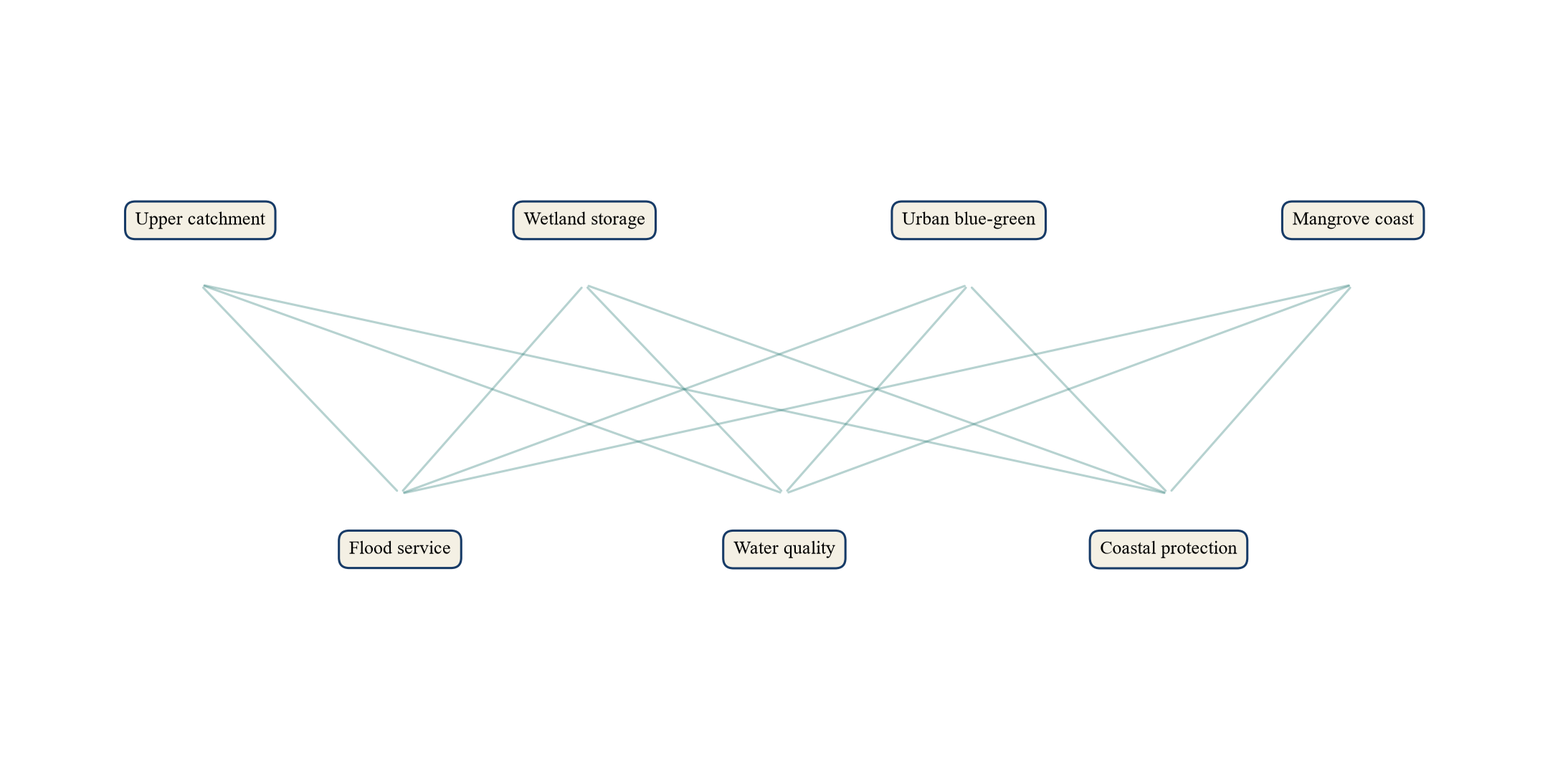
Illustrative system map; actual intervention design requires site evidence.
12. Engineer the intervention portfolio
The decision question is which ecological and grey-infrastructure measures work together under design conditions. The diligence team should begin with site assessment, hydrology, morphology, species, soils, interfaces and maintenance needs. Evidence should be attributable, versioned and reconciled across ecological, engineering, social, legal, commercial and financial workstreams. [7][17]
The principal failure mode is that planting targets can fail where elevation, water flow, sediment or urban drainage interfaces are wrong. Management estimates can support planning when they are identified as estimates and kept separate from observations, verified outcomes, executed contracts and regulatory approvals. The model should show how each unresolved item changes service performance, schedule, cost, payment, liquidity, safeguards or control.
The recommended response is to design for system function, constructability, adaptive maintenance and extreme events. A named executive should own delivery, an independent reviewer should challenge material assumptions, and the approval body should see the evidence required to release capital or certify payment. Central, downside and stop cases should identify the financial effect and the earliest practical intervention. In the hypothetical programme, unsupported value remains outside the base case or is carried through probability, contingency, holdback, reserve or a closing condition.
13. Estimate life-cycle cost and schedule
The decision question is what capital, operating, monitoring and stewardship expenditure is required over the full term. The diligence team should begin with quantities, procurement, land access, mobilisation, monitoring, maintenance and contingency. Evidence should be attributable, versioned and reconciled across ecological, engineering, social, legal, commercial and financial workstreams. [18]
The principal failure mode is that headline restoration cost can omit long-term stewardship, replacement and verification. Management estimates can support planning when they are identified as estimates and kept separate from observations, verified outcomes, executed contracts and regulatory approvals. The model should show how each unresolved item changes service performance, schedule, cost, payment, liquidity, safeguards or control.
The recommended response is to use range-based whole-life estimates tied to physical quantities and risk maturity. A named executive should own delivery, an independent reviewer should challenge material assumptions, and the approval body should see the evidence required to release capital or certify payment. Central, downside and stop cases should identify the financial effect and the earliest practical intervention. In the hypothetical programme, unsupported value remains outside the base case or is carried through probability, contingency, holdback, reserve or a closing condition.
| Layer | Evidence | Economic meaning | Cash treatment |
|---|---|---|---|
| physical output | hectares, structures and maintenance | delivered intervention | milestone payment |
| service outcome | flood, water or coastal performance | public-service value | availability or outcome fee |
| carbon result | verified emissions or removals | tradable or policy value | separate eligible receipt |
| biodiversity result | condition or species metric | ecological performance | contractual or credit receipt |
| social benefit | livelihood and access measures | distributional outcome | covenant or incentive |
| wider co-benefit | health, amenity and option value | economic value without payer | disclosed outside base cash |
Proposed commercial reconciliation; executed contracts govern payment.
14. Price environmental and resilience outcomes
The decision question is how a payer values verified service without double counting public, carbon or biodiversity benefits. The diligence team should begin with avoided-loss models, unit costs, market evidence, fiscal savings and willingness to pay. Evidence should be attributable, versioned and reconciled across ecological, engineering, social, legal, commercial and financial workstreams. [19][20]
The principal failure mode is that monetised co-benefits can exceed realistic cash receipts or count the same outcome twice. Management estimates can support planning when they are identified as estimates and kept separate from observations, verified outcomes, executed contracts and regulatory approvals. The model should show how each unresolved item changes service performance, schedule, cost, payment, liquidity, safeguards or control.
The recommended response is to separate economic value, contractual payment, market credit and unmonetised benefit. A named executive should own delivery, an independent reviewer should challenge material assumptions, and the approval body should see the evidence required to release capital or certify payment. Central, downside and stop cases should identify the financial effect and the earliest practical intervention. In the hypothetical programme, unsupported value remains outside the base case or is carried through probability, contingency, holdback, reserve or a closing condition.
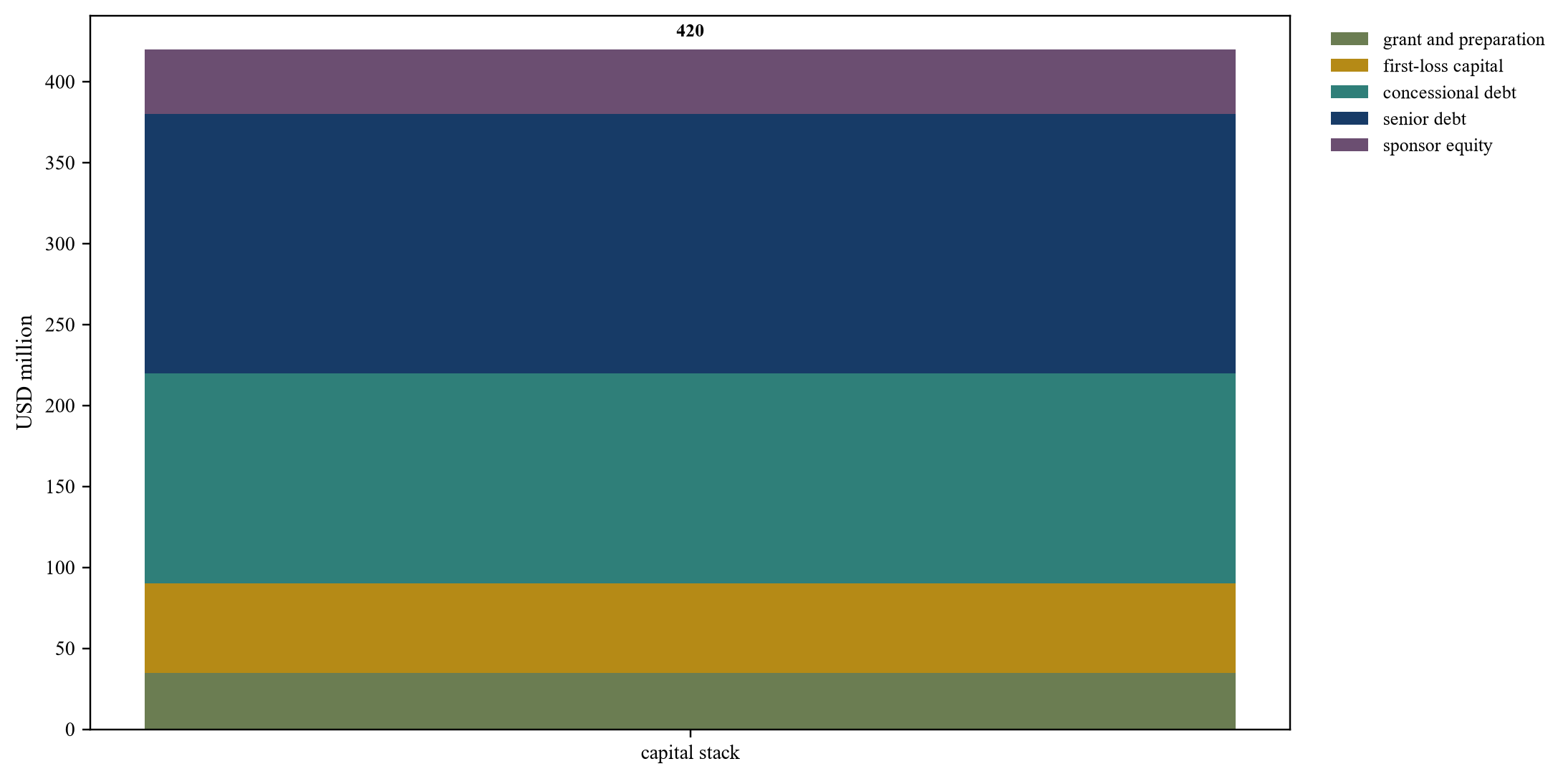
Wholly hypothetical USD millions; this is not a financing recommendation.
| Capital source | Amount | Primary use | Risk absorbed |
|---|---|---|---|
| preparation grant | 35 | rights, studies and MRV pilot | development risk |
| first-loss capital | 55 | construction and performance reserve | early outcome risk |
| concessional debt | 130 | eligible programme expenditure | tenor and pricing gap |
| senior debt | 160 | contracted delivery | payment and completion risk |
| sponsor equity | 40 | co-funding and liquidity | residual risk |
| total | 420 | integrated programme | subject to evidence gates |
Wholly hypothetical USD millions; the table is not a financing recommendation.
15. Assemble the blended-finance stack
The decision question is which grants, first-loss capital, guarantees, concessional debt and commercial capital fund each risk stage. The diligence team should begin with sources and uses, eligibility, tenor, pricing, subordination, covenants and conditions. Evidence should be attributable, versioned and reconciled across ecological, engineering, social, legal, commercial and financial workstreams. [2][21]
The principal failure mode is that concessional capital can subsidise an unbankable design without creating a route to repayment. Management estimates can support planning when they are identified as estimates and kept separate from observations, verified outcomes, executed contracts and regulatory approvals. The model should show how each unresolved item changes service performance, schedule, cost, payment, liquidity, safeguards or control.
The recommended response is to allocate scarce risk-bearing capital to identifiable barriers and crowd-in tests. A named executive should own delivery, an independent reviewer should challenge material assumptions, and the approval body should see the evidence required to release capital or certify payment. Central, downside and stop cases should identify the financial effect and the earliest practical intervention. In the hypothetical programme, unsupported value remains outside the base case or is carried through probability, contingency, holdback, reserve or a closing condition.
16. Allocate risk and guarantee coverage
The decision question is which party carries construction, performance, policy, currency, payment and force-majeure risk. The diligence team should begin with risk matrix, contracts, guarantee terms, insurance, reserve accounts and termination payments. Evidence should be attributable, versioned and reconciled across ecological, engineering, social, legal, commercial and financial workstreams. [21][22]
The principal failure mode is that a guarantee can cover credit loss while leaving verification or appropriation risk unresolved. Management estimates can support planning when they are identified as estimates and kept separate from observations, verified outcomes, executed contracts and regulatory approvals. The model should show how each unresolved item changes service performance, schedule, cost, payment, liquidity, safeguards or control.
The recommended response is to match each instrument to a defined loss event, evidence requirement and recovery process. A named executive should own delivery, an independent reviewer should challenge material assumptions, and the approval body should see the evidence required to release capital or certify payment. Central, downside and stop cases should identify the financial effect and the earliest practical intervention. In the hypothetical programme, unsupported value remains outside the base case or is carried through probability, contingency, holdback, reserve or a closing condition.
| Trigger | Evidence | Payment band | Control |
|---|---|---|---|
| site delivered | geotagged completion and acceptance | milestone amount | independent inspection |
| ecological survival | remote and field sample | graduated percentage | replacement holdback |
| resilience service | model and observed events | threshold or indexed amount | method review |
| safeguards | grievance and benefit records | full, held or suspended | community verification |
| data quality | completeness and uncertainty test | proportional holdback | cure period |
| long-term stewardship | maintenance and condition | annual availability payment | reserve and step-in |
Proposed contract architecture; definitive agreements govern certification.
17. Define performance-payment triggers
The decision question is when capital or revenue is released and what happens when evidence is incomplete or disputed. The diligence team should begin with measurement windows, thresholds, verification reports, cure periods and dispute procedures. Evidence should be attributable, versioned and reconciled across ecological, engineering, social, legal, commercial and financial workstreams. [3][23]
The principal failure mode is that binary triggers can create cliff effects, gaming or liquidity failure after minor shortfalls. Management estimates can support planning when they are identified as estimates and kept separate from observations, verified outcomes, executed contracts and regulatory approvals. The model should show how each unresolved item changes service performance, schedule, cost, payment, liquidity, safeguards or control.
The recommended response is to use graduated bands, materiality, holdbacks, cure and independent determination. A named executive should own delivery, an independent reviewer should challenge material assumptions, and the approval body should see the evidence required to release capital or certify payment. Central, downside and stop cases should identify the financial effect and the earliest practical intervention. In the hypothetical programme, unsupported value remains outside the base case or is carried through probability, contingency, holdback, reserve or a closing condition.
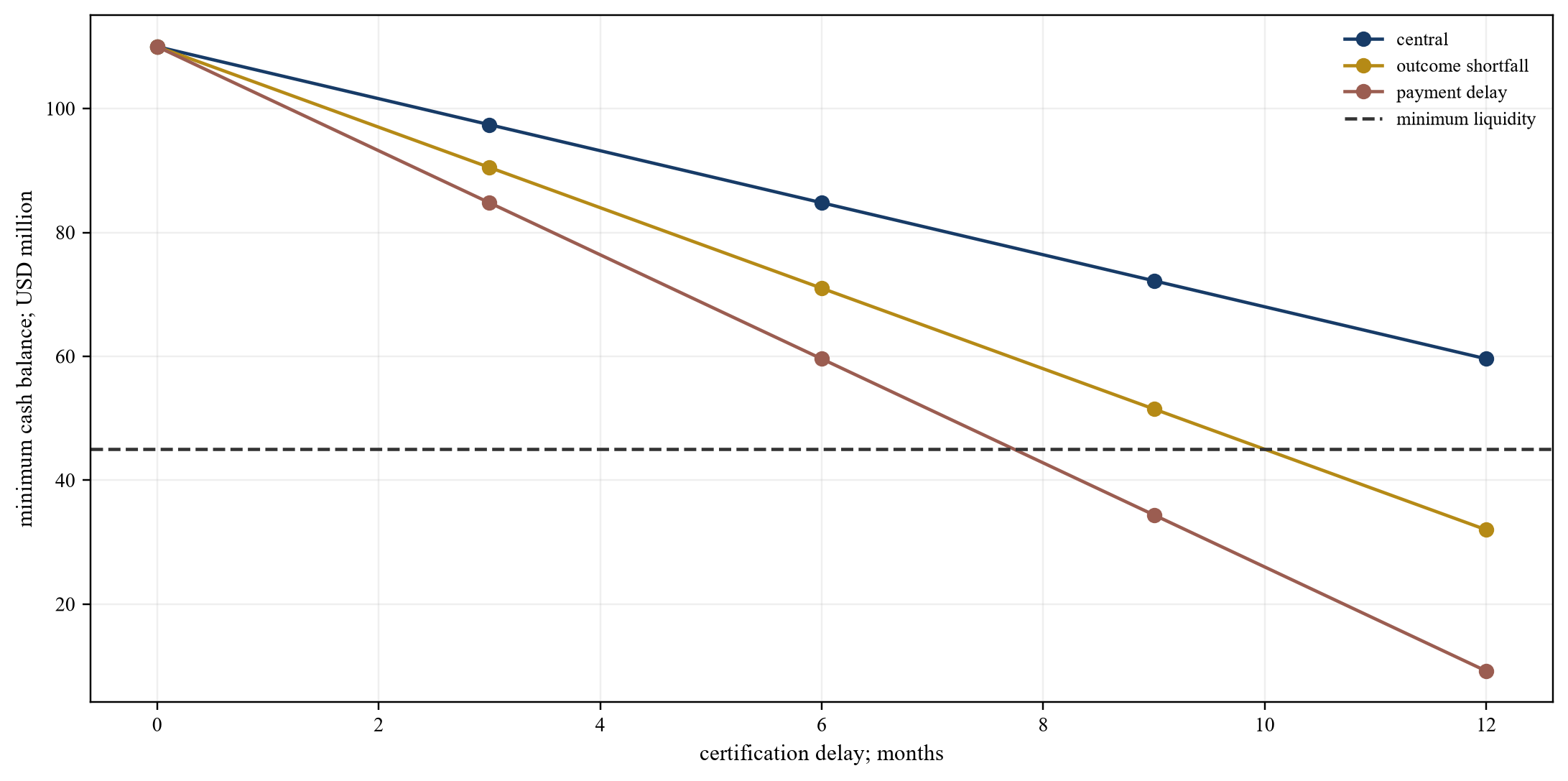
Wholly hypothetical USD millions; values require transaction-specific validation.
18. Model cash flow and liquidity
The decision question is how construction draws, availability payments, outcome payments and delays affect debt service. The diligence team should begin with payment calendars, working capital, reserves, debt service and downside timing. Evidence should be attributable, versioned and reconciled across ecological, engineering, social, legal, commercial and financial workstreams. [21][24]
The principal failure mode is that annual outcome value can appear adequate while verification delay creates an interim cash deficit. Management estimates can support planning when they are identified as estimates and kept separate from observations, verified outcomes, executed contracts and regulatory approvals. The model should show how each unresolved item changes service performance, schedule, cost, payment, liquidity, safeguards or control.
The recommended response is to model monthly cash, delayed certification and funded liquidity under central and downside cases. A named executive should own delivery, an independent reviewer should challenge material assumptions, and the approval body should see the evidence required to release capital or certify payment. Central, downside and stop cases should identify the financial effect and the earliest practical intervention. In the hypothetical programme, unsupported value remains outside the base case or is carried through probability, contingency, holdback, reserve or a closing condition.
19. Choose procurement and contracting form
The decision question is which public, private and community parties design, build, maintain, monitor and accept performance risk. The diligence team should begin with procurement law, concessions, output specifications, service contracts and community agreements. Evidence should be attributable, versioned and reconciled across ecological, engineering, social, legal, commercial and financial workstreams. [17][25]
The principal failure mode is that transferring ecological risk without control or data access can raise price and weaken accountability. Management estimates can support planning when they are identified as estimates and kept separate from observations, verified outcomes, executed contracts and regulatory approvals. The model should show how each unresolved item changes service performance, schedule, cost, payment, liquidity, safeguards or control.
The recommended response is to bundle only risks the contractor can manage and preserve public monitoring rights. A named executive should own delivery, an independent reviewer should challenge material assumptions, and the approval body should see the evidence required to release capital or certify payment. Central, downside and stop cases should identify the financial effect and the earliest practical intervention. In the hypothetical programme, unsupported value remains outside the base case or is carried through probability, contingency, holdback, reserve or a closing condition.
20. Protect data, models and auditability
The decision question is who owns observations, labels, models, code, reports and permitted derivative use. The diligence team should begin with data licences, repositories, access logs, model cards, retention and cybersecurity controls. Evidence should be attributable, versioned and reconciled across ecological, engineering, social, legal, commercial and financial workstreams. [12][26]
The principal failure mode is that proprietary systems can prevent replication, lender diligence or continuation after provider failure. Management estimates can support planning when they are identified as estimates and kept separate from observations, verified outcomes, executed contracts and regulatory approvals. The model should show how each unresolved item changes service performance, schedule, cost, payment, liquidity, safeguards or control.
The recommended response is to require durable access, documented transformations, reproducibility and exit rights. A named executive should own delivery, an independent reviewer should challenge material assumptions, and the approval body should see the evidence required to release capital or certify payment. Central, downside and stop cases should identify the financial effect and the earliest practical intervention. In the hypothetical programme, unsupported value remains outside the base case or is carried through probability, contingency, holdback, reserve or a closing condition.
21. Value the programme and test additionality
The decision question is which cash flows and risk reductions are attributable to financed action. The diligence team should begin with contractual receipts, avoided costs, comparable projects, additionality tests and scenario models. Evidence should be attributable, versioned and reconciled across ecological, engineering, social, legal, commercial and financial workstreams. [19][27]
The principal failure mode is that project value can include benefits that have no payer or would occur under existing obligations. Management estimates can support planning when they are identified as estimates and kept separate from observations, verified outcomes, executed contracts and regulatory approvals. The model should show how each unresolved item changes service performance, schedule, cost, payment, liquidity, safeguards or control.
The recommended response is to value contracted cash separately and test incremental public and environmental outcomes. A named executive should own delivery, an independent reviewer should challenge material assumptions, and the approval body should see the evidence required to release capital or certify payment. Central, downside and stop cases should identify the financial effect and the earliest practical intervention. In the hypothetical programme, unsupported value remains outside the base case or is carried through probability, contingency, holdback, reserve or a closing condition.
22. Create governance, assurance and grievance routes
The decision question is which body approves methods, data changes, payments, exceptions and stakeholder remedies. The diligence team should begin with committee charters, independence, conflicts, delegations, audit and grievance procedures. Evidence should be attributable, versioned and reconciled across ecological, engineering, social, legal, commercial and financial workstreams. [3][16]
The principal failure mode is that one sponsor controlling implementation, measurement and payment approval can undermine credibility. Management estimates can support planning when they are identified as estimates and kept separate from observations, verified outcomes, executed contracts and regulatory approvals. The model should show how each unresolved item changes service performance, schedule, cost, payment, liquidity, safeguards or control.
The recommended response is to separate delivery, measurement, verification, payment approval and appeal. A named executive should own delivery, an independent reviewer should challenge material assumptions, and the approval body should see the evidence required to release capital or certify payment. Central, downside and stop cases should identify the financial effect and the earliest practical intervention. In the hypothetical programme, unsupported value remains outside the base case or is carried through probability, contingency, holdback, reserve or a closing condition.
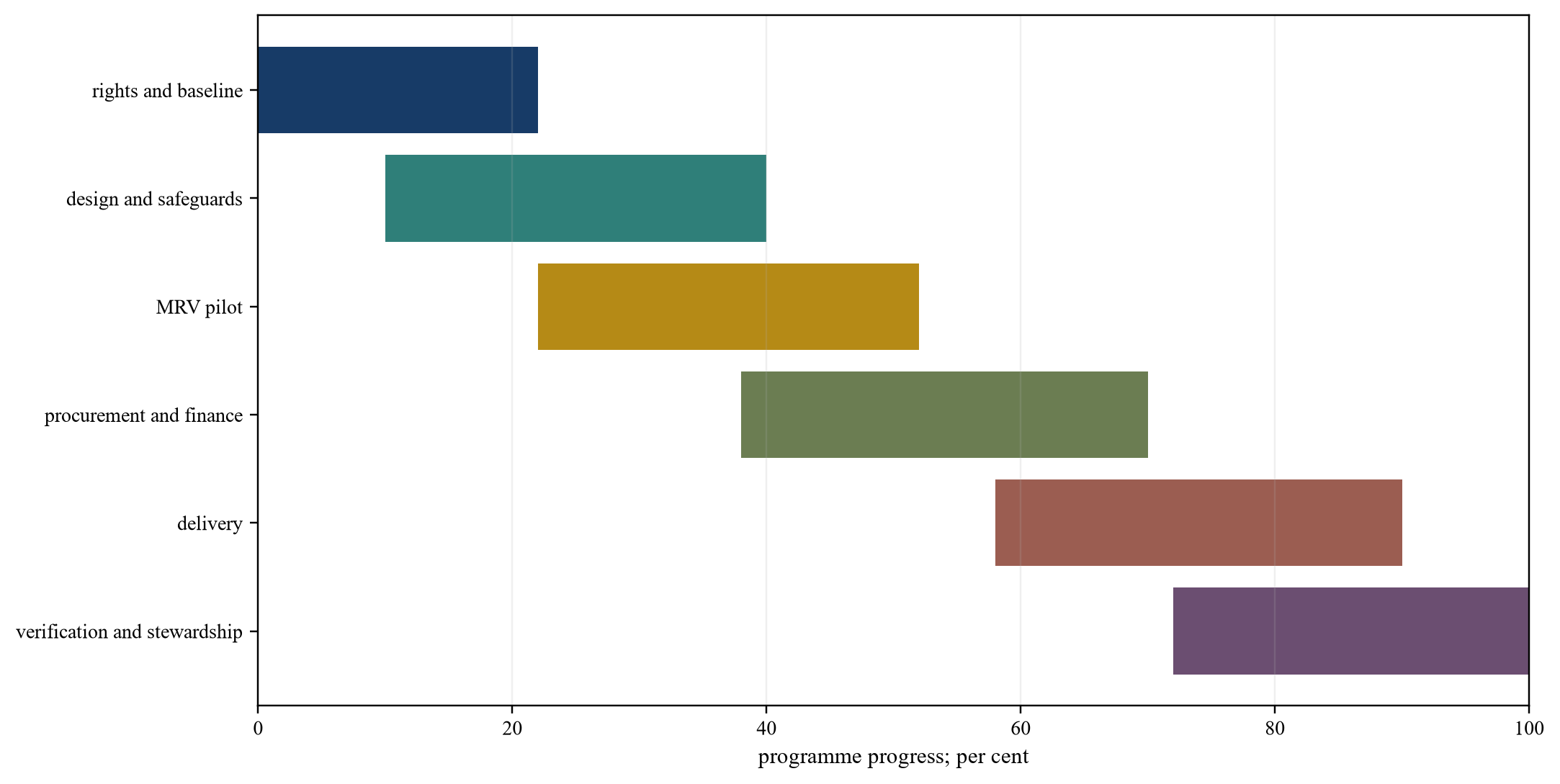
Illustrative sequence; actual timing depends on rights, ecology, procurement and finance.
23. Execute a milestone-based programme
The decision question is which decisions move the project from preparation to operations and long-term stewardship. The diligence team should begin with integrated schedule, permits, procurement, financing, evidence gates and accountable owners. Evidence should be attributable, versioned and reconciled across ecological, engineering, social, legal, commercial and financial workstreams. [2][17]
The principal failure mode is that technical, social, finance and data workstreams can diverge until the payment model no longer matches delivery. Management estimates can support planning when they are identified as estimates and kept separate from observations, verified outcomes, executed contracts and regulatory approvals. The model should show how each unresolved item changes service performance, schedule, cost, payment, liquidity, safeguards or control.
The recommended response is to maintain one controlled requirements register and decision model across all parties. A named executive should own delivery, an independent reviewer should challenge material assumptions, and the approval body should see the evidence required to release capital or certify payment. Central, downside and stop cases should identify the financial effect and the earliest practical intervention. In the hypothetical programme, unsupported value remains outside the base case or is carried through probability, contingency, holdback, reserve or a closing condition.
Implementation detail: converting environmental evidence into financeable performance
The programme should begin with a controlled requirements register. Each proposed outcome identifies the beneficiary, public service, legal authority, intervention, baseline, counterfactual, observation method, uncertainty threshold, verifier, payment consequence and accountable owner. The register prevents a technical monitoring plan from drifting away from the financing agreement.
Spatial perimeter control is fundamental. Every parcel should have a stable identifier linked to tenure, customary use, intervention status, monitoring access and maintenance responsibility. Project maps should distinguish financed sites, comparison areas, leakage zones and excluded areas. Boundary changes require documented approval because they can change both the measured result and the rights of affected people.
Baseline selection should follow the causal question. A historical average may suit land-cover change; hydrological performance may require event-based or modelled comparison; biodiversity may require reference sites and seasonal observation. The method should explain pre-existing trends, planned public works and external drivers. Retrospective baseline selection after outcomes are visible should be prohibited.
Remote-sensing acquisition requires an operating protocol. The protocol states sensors, spatial and temporal resolution, acquisition windows, cloud and quality masks, atmospheric or geometric correction, tidal or seasonal controls and licence terms. Raw imagery, processed products and final indicators remain separately retained. A crosswalk is needed when a sensor, provider or processing chain changes.
Field work should be designed from the decision and error structure. Sampling intensity can be increased where classes are difficult to distinguish, ecological value is high or payments are sensitive. Plots and instruments need geolocation, calibration, chain of custody and repeatability. Community monitors can add local coverage and knowledge when training, compensation, verification and data rights are explicit.
AI and statistical models should be registered with their purpose, training data, features, labels, validation geography, performance measures, uncertainty and known limitations. Accuracy alone is insufficient. Minority classes, rare degradation and false improvement can have greater financial importance than dominant land-cover classes. Spatial and temporal holdouts should precede prospective use.
The model-change process should preserve comparability. A new algorithm can improve measurement while changing previously reported outcomes. The governance body should decide whether to restate history, run parallel versions or apply the new method prospectively. Material changes require independent review before they alter payment. Code, configurations and dependency versions should be retained for replication.
Uncertainty should enter the commercial formula. A project can use conservative lower bounds, deductions, confidence bands or payment holdbacks. The agreement should distinguish measurement uncertainty from delivery shortfall. Additional fieldwork may cure evidence uncertainty; replacement or remediation may cure physical underperformance. The payment administrator needs a rule for each case.
Outcome claims should avoid double counting. The same mangrove intervention can contribute to coastal protection, carbon, habitat, fisheries and livelihoods. Economic analysis may value these services, while contracted cash may cover only some. Carbon or biodiversity credits need eligibility, ownership, registry, corresponding claim and buyer terms. The base financing model should include only enforceable receipts.
The engineering and ecological design should remain integrated. Upstream restoration, wetlands, urban drainage and coastal measures may change flows across the system. Construction access can damage the asset it seeks to create. Species choice, elevation, salinity, sediment, hydrology and maintenance determine survival. Interfaces with roads, drains, embankments and utilities require named engineering responsibility.
Safeguards are operating requirements. Stakeholder mapping should identify users, rights holders, vulnerable groups and affected livelihoods. Participation records should describe the decision, information provided, feedback and response. Benefit-sharing commitments need budgets, schedules and verification. A grievance mechanism should offer accessible intake, protection against retaliation, escalation and documented closure.
The capital stack should correspond to risks. Grants may fund public data, early studies and project preparation. First-loss or subordinated capital can absorb early performance variability. Concessional debt can extend tenor or fund public-good components. Senior commercial debt requires dependable cash, enforceable payment obligations, reserves and credible completion support. Every concessional instrument should state the barrier it addresses.
Availability payments and outcome payments can be combined. Availability payments support fixed operating and stewardship costs when the service remains ready. Outcome payments reward measured performance. A wholly outcome-dependent structure can create insolvency when ecology develops slowly or verification is delayed. A wholly availability-based structure can weaken performance incentives. The balance should follow controllability and evidence maturity.
Guarantees should describe covered events precisely. A payment guarantee may cover authority default; it may exclude measurement disagreement. Political-risk cover may address transfer or expropriation; it may not address ecological failure. Currency hedging, reserve accounts, termination payments and insurance may cover separate risks. The financial model should not count overlapping protections twice.
The certification calendar should align with debt service. Data acquisition, field validation, report preparation, verifier review, dispute and payment each consume time. The model should include normal and delayed cycles. A liquidity reserve or revolving facility may bridge certified receivables. Outcome shortfall, evidence delay and payer delay should appear as separate scenarios because remedies differ.
Procurement should allocate controllable risk. An ecological contractor can control planting quality and maintenance; it may not control unprecedented storms, upstream public works or community rights outside its contract. A monitoring provider can control processing quality; it may not control satellite continuity. Output specifications should preserve method discipline while allowing adaptive management under governed change.
Independent assurance should be risk based. High-value triggers, novel indicators, material method changes and adverse findings warrant deeper review. Assurance should test source data, transformations, sampling, model performance, uncertainty, safeguards and contract calculations. The verifier should disclose conflicts and retain access to necessary evidence. Payment approval should remain distinct from delivery and measurement.
Long-term stewardship requires ring-fenced resources. Maintenance, replacement, invasive-species control, fire, patrol, sediment management, community engagement and continued monitoring extend beyond construction. Reserve accounts, endowments, public budgets or service payments can fund them. Step-in rights should allow continuity if an operator fails while respecting land and community agreements.
The governing board should receive a concise dashboard. It can show rights secured, sites ready, intervention quantities, condition and survival, monitoring completeness, uncertainty, safeguards, grievances, payment status, liquidity, debt service, reserves and upcoming decisions. Changes should bridge from the approved case to current evidence. Traffic-light presentation should retain the underlying data and decision owner.
Red-team analysis should combine events. Cloud or sensor failure can coincide with an extreme event and delayed field access. Community dispute can delay works and invalidate an assumed payment area. Ecological underperformance can consume reserves while a public payer faces budget delay. The model should identify the first liquidity breach, covenant trigger and step-in option under each compound scenario.
Final approval should state conditions rather than rely on general confidence. The committee should receive the rights map, intervention design, baseline, MRV protocol, safeguards plan, sources and uses, payment contract, guarantees, liquidity, procurement, governance, downside cases and stewardship plan. Each unresolved item should have an owner, deadline, financial consequence and stop rule. This converts an environmental ambition into a measurable, financeable and governable infrastructure programme.
24. Red-team the evidence and financing
The decision question is how correlated measurement, ecological, social and payment failures affect solvency and legitimacy. The diligence team should begin with scenario combinations, model replication, site inspection, contract challenge and liquidity tests. Evidence should be attributable, versioned and reconciled across ecological, engineering, social, legal, commercial and financial workstreams. [14][24]
The principal failure mode is that controls that pass separately can fail together during an extreme event or political delay. Management estimates can support planning when they are identified as estimates and kept separate from observations, verified outcomes, executed contracts and regulatory approvals. The model should show how each unresolved item changes service performance, schedule, cost, payment, liquidity, safeguards or control.
The recommended response is to test compound events, locate failure points and pre-agree intervention rights. A named executive should own delivery, an independent reviewer should challenge material assumptions, and the approval body should see the evidence required to release capital or certify payment. Central, downside and stop cases should identify the financial effect and the earliest practical intervention. In the hypothetical programme, unsupported value remains outside the base case or is carried through probability, contingency, holdback, reserve or a closing condition.
| Finding | Cash consequence | Deal response | Accountable owner |
|---|---|---|---|
| rights or consent are incomplete | inaccessible sites and delay | exclude or condition funding | legal and social leads |
| baseline is unstable | overstated performance | reset method and hold payment | MRV lead |
| model validation is weak | unreliable outcome claim | field work and prospective test | technical verifier |
| payer obligation is conditional | revenue and liquidity gap | guarantee, reserve or lower debt | finance lead |
| maintenance is unfunded | reversal and service failure | ring-fenced stewardship | operator and authority |
| downside remains funded and governed | stronger execution capacity | approve subject to evidence gates | investment committee |
Proposed decision framework; it is not an investment recommendation.
25. Use an investment-committee decision matrix
The decision question is whether service value, evidence, safeguards, cash and control support commitment. The diligence team should begin with technical design, MRV plan, financial model, contracts, assurance and implementation plan. Evidence should be attributable, versioned and reconciled across ecological, engineering, social, legal, commercial and financial workstreams. [1][21]
The principal failure mode is that a large project file can leave the committee without explicit stop conditions or downside owners. Management estimates can support planning when they are identified as estimates and kept separate from observations, verified outcomes, executed contracts and regulatory approvals. The model should show how each unresolved item changes service performance, schedule, cost, payment, liquidity, safeguards or control.
The recommended response is to convert every material finding into cash effect, protection, owner, deadline and approval condition. A named executive should own delivery, an independent reviewer should challenge material assumptions, and the approval body should see the evidence required to release capital or certify payment. Central, downside and stop cases should identify the financial effect and the earliest practical intervention. In the hypothetical programme, unsupported value remains outside the base case or is carried through probability, contingency, holdback, reserve or a closing condition.
Sources
- ASEAN, Enhancing Climate and Disaster Resilience through Nature-based Solutions Across ASEAN: Financing Barriers, Enablers and Opportunities, Read the primary source
- Asian Development Bank, Green Finance and the ASEAN Catalytic Green Finance Facility, Read the primary source
- UNFCCC, REDD+ MRV and Results-Based Payments, Read the primary source
- IPCC, 2019 Refinement to the 2006 IPCC Guidelines for National Greenhouse Gas Inventories, Read the primary source
- World Bank, Environmental and Social Framework, Read the primary source
- FAO, Voluntary Guidelines on the Responsible Governance of Tenure, Read the primary source
- World Bank, Nature-Based Solutions for Disaster and Climate Resilience, Read the primary source
- UNFCCC, REDD+ Knowledge Products and Warsaw Framework Resources, Read the primary source
- European Space Agency, Sentinel-2 Mission, Read the primary source
- European Space Agency, Sentinel-1 Mission, Read the primary source
- Global Forest Observations Initiative, Methods and Guidance Documentation, Read the primary source
- National Institute of Standards and Technology, Artificial Intelligence Risk Management Framework, Read the primary source
- Group on Earth Observations, Earth Observations for Sustainable Development, Read the primary source
- Verra, Verified Carbon Standard Program, Read the primary source
- Convention on Biological Diversity, Kunming-Montreal Global Biodiversity Framework, Read the primary source
- International Finance Corporation, Performance Standards on Environmental and Social Sustainability, Read the primary source
- World Bank, Implementing Nature-Based Flood Protection, Read the primary source
- Association for the Advancement of Cost Engineering, Cost Estimate Classification System, Read the primary source
- World Bank, Unlocking Private Capital to Scale Environmental Solutions, Read the primary source
- United Nations System of Environmental Economic Accounting, Ecosystem Accounting, Read the primary source
- OECD, Blended Finance Guidance, Read the primary source
- Multilateral Investment Guarantee Agency, Products, Read the primary source
- World Bank, Results-Based Financing, Read the primary source
- IFRS Foundation, IFRS 9 Financial Instruments, Read the primary source
- UNCITRAL, Public-Private Partnerships Legislative Guide, Read the primary source
- ISO, ISO 19115 Geographic Information Metadata, Read the primary source
- IFRS Foundation, IFRS S2 Climate-related Disclosures, Read the primary source
