

Introduction
The transition from fossil-intensive systems to lower-emissions power, transport, industry, buildings and water infrastructure requires unusually large, long-duration investments. The International Energy Agency estimated global energy investment at USD 3.3 trillion in 2025, including approximately USD 2.2 trillion for renewables, nuclear, grids, storage, low-emissions fuels, efficiency and electrification. Investment remains uneven across regions. The International Renewable Energy Agency reported that a large share of global transition investment was concentrated in advanced economies and in China, India and Brazil, while more than 150 other economies received a small fraction of the total.
Sovereign capital can help close part of this gap. A sovereign wealth fund, strategic investment fund, public pension investor, state-owned enterprise or government-backed platform may provide long-duration equity, local credibility, development capacity, risk absorption and access to complementary public instruments. An industrial sponsor can provide technology, development pipeline, operational expertise, procurement capability and execution accountability. The combination can unlock projects that neither participant would pursue alone.
The governance challenge begins when the two participants bring different mandates and different sources of power. The sovereign investor may seek commercial return, domestic industrial development, energy security, employment, affordability, emissions reduction or technology transfer. The sponsor may seek project margin, equipment sales, management fees, platform control, follow-on awards and a strategic exit. These objectives can coexist. They should be made explicit because an unstated objective becomes a hidden transaction term.
The structure also has to address multiple public roles. A ministry may set policy. A regulator may approve tariffs. A state-owned utility may purchase output. A public authority may grant land, a concession or a guarantee. The sovereign investor may appoint directors to the same project company. A single public-sector label can therefore conceal separate legal entities, duties and incentives. Transaction governance should map each role and prevent one role from being treated as an assurance for another.
This paper develops a practical framework for boards, sovereign investors, sponsors, lenders and transaction advisers. It begins with mandate clarity and transaction perimeter. It then designs approvals, board composition, reserved matters, conflicts controls, information rights, fiscal-risk governance, valuation, exit and downside management. The objective is a co-investment that can remain commercially disciplined while delivering a defined public purpose.
1. Define the sovereign role before negotiating economics
The label sovereign capital covers institutions with materially different mandates. A stabilisation fund protects public finances against commodity or macroeconomic shocks. A savings fund transfers wealth across generations. A reserve investment corporation manages foreign assets. A strategic investment fund seeks domestic development or economic transformation. A public pension investor serves beneficiaries. A state-owned holding company may combine commercial ownership with industrial policy. Governance should begin by identifying which mandate applies.
The Santiago Principles state that a sovereign wealth fund's legal framework should be sound, its policy purpose clearly defined and its activities coordinated with fiscal and monetary authorities when they have significant domestic macroeconomic implications. These principles support a basic transaction discipline: the co-investment committee should be able to trace the proposed investment to the institution's lawful mandate, approved investment policy and delegated authority.
Mandate clarity affects the return hurdle, holding period, risk tolerance, currency exposure and reporting standard. A commercial investor may require a market return and conventional exit. A strategic investor may accept a longer holding period or a measured policy outcome, provided that any departure from commercial terms is separately authorised and transparently valued. A pension investor may face concentration and liability constraints. A state holding company may be expected to build national capability while preserving enterprise value.
The investment memorandum should state the institution's role in one sentence and list the consequences. It should identify whether the sovereign entity is investing on commercial terms, providing concessional capital, executing an industrial-policy mandate, warehousing assets, anchoring a capital raise or combining these roles. If more than one role applies, each should have its own approval, pricing logic and reporting channel.
2. Map every state and sponsor capacity
Transition infrastructure often depends on a network of public and private contracts. The state may appear through the sovereign investor, ministry, regulator, grantor, landowner, utility, offtaker, guarantor, tax authority, environmental authority and lender. The sponsor may appear through the parent company, development vehicle, engineering contractor, operator, equipment supplier, intellectual-property licensor and service provider. Each capacity can create rights, obligations and conflicts.
A role map should identify the legal entity, decision maker, contract, source of authority, economic exposure and information held in each capacity. It should distinguish a shareholder obligation from a regulatory expectation, a contractual payment from a policy objective, and a parent guarantee from reputational support. This prevents the project model from treating broad sovereign affiliation as a credit enhancement.
The same map should expose related-party value flows. Sponsor-controlled engineering, procurement, operations, development, licensing and asset-management agreements can transfer value away from the jointly owned company. Public land, connection rights, guarantees, tax concessions or availability payments can transfer value toward it. Each flow needs a pricing basis, approval route, disclosure standard and audit right.
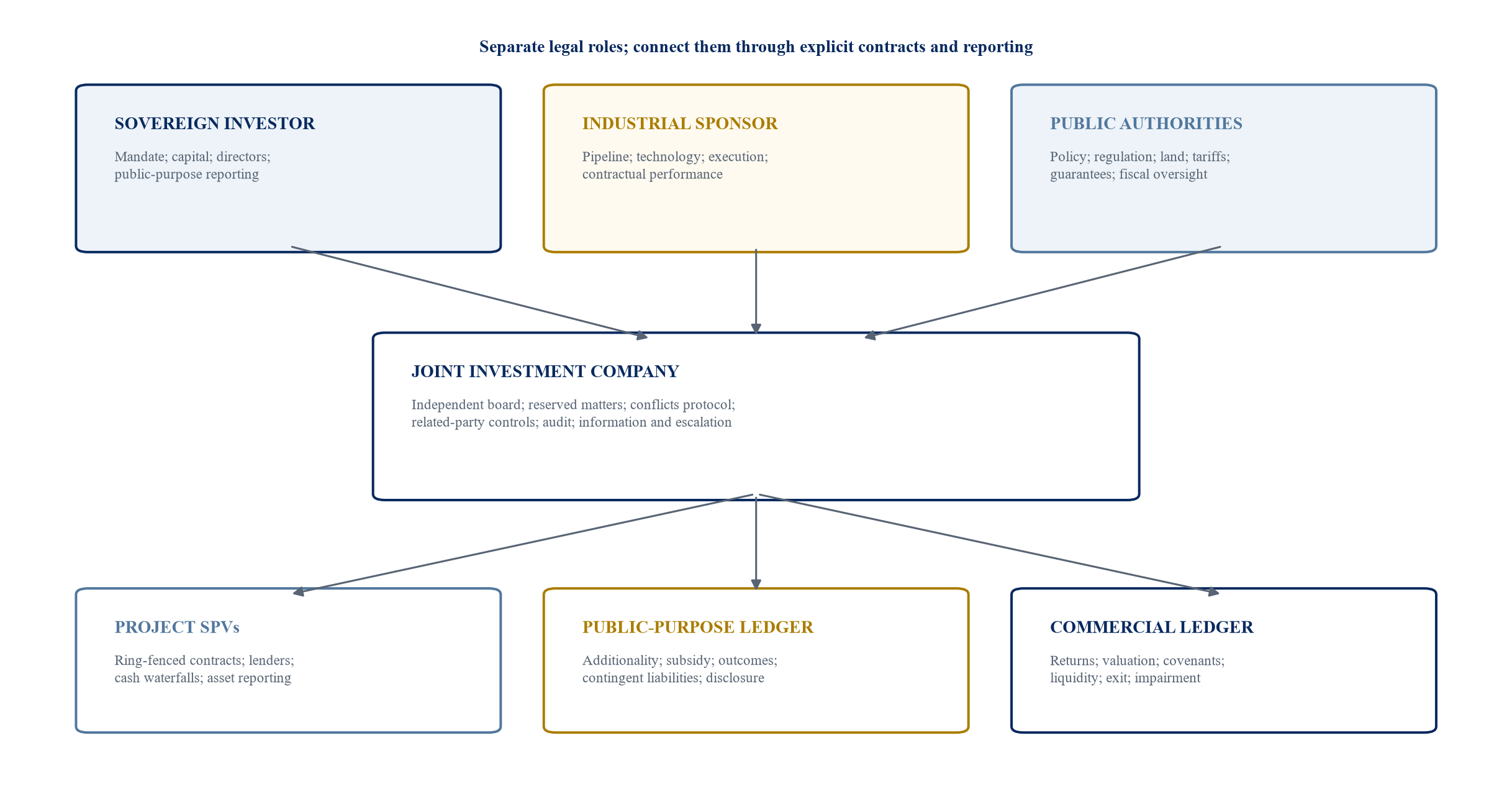
The structure separates commercial ownership, public-purpose oversight and external public roles. Legal implementation depends on jurisdiction and transaction form.
3. Establish a two-track investment thesis
The co-investment should contain a commercial thesis and a public-purpose thesis. The commercial thesis explains how the asset creates cash, how the investors are paid, which risks they bear and how value is realised. The public-purpose thesis explains the market failure or strategic objective, why sovereign participation is additional, which outcomes are expected and how any public support is measured.
Combining the two theses in one undifferentiated narrative weakens decision quality. A project can create public value and remain commercially unattractive. It can earn a high return because public support transfers risk away from private investors. It can also be commercially sound without requiring concessional support. The board needs to see each proposition independently and understand the bridge between them.
IFC's blended-finance principles provide a useful discipline where public or concessional resources participate. They require an additionality rationale, minimum concessionality, commercial sustainability, reinforcement of markets and high standards. The 2025 IFC review of blended finance emphasises transparency, market development and the use of only the support needed to attract private capital. These concepts can be applied beyond concessional finance whenever sovereign participation changes transaction economics.
4. Set the transaction perimeter before valuation
The sponsor may offer one project, a development pipeline, a regional platform, operating assets, intellectual property or a combination. The perimeter determines which risks and opportunities the sovereign investor receives. A platform with early-stage development can generate higher growth and higher attrition. A single operating project offers clearer cash flow and less pipeline optionality. A mixed portfolio can allow mature assets to support development while it can also obscure cross-subsidy.
The perimeter schedule should list legal entities, assets, licences, contracts, employees, land, data, intellectual property, liabilities and development rights. It should identify exclusions, shared services and dependencies on the sponsor group. The valuation should use the same perimeter. A term sheet that prices an enterprise before the asset boundary is settled creates avoidable dispute.
Pipeline rights require particular precision. The agreement should define which opportunities must be offered to the joint platform, which remain with the sponsor, how geographic and sector boundaries apply, and how opportunities are priced. A right of first offer can be weak when the sponsor controls information and timing. A binding exclusivity or opportunity-allocation policy can be stronger, while it may restrict the sponsor excessively. The chosen mechanism should reflect the value attributed to the pipeline.
The perimeter should also identify public dependencies. Land allocation, grid connection, tariff approval, permits and offtake may sit outside the company. Their status should be represented accurately in valuation and conditions precedent. A policy announcement should not be modelled as an executed right.
5. Allocate control according to risk and responsibility
Equity percentage provides a starting point for governance. It does not resolve operational control, public accountability or minority protection. The sponsor may hold a majority because it develops and operates the assets. The sovereign investor may require rights over matters that affect public resources, strategic scope or value. Lenders add contractual controls through covenants and security. Regulators retain statutory powers.
Control should be separated into ordinary management, board oversight and shareholder reserved matters. Management should operate within an approved business plan and delegated authority. The board should appoint and oversee management, approve strategy, monitor risk and challenge performance. Shareholders should decide fundamental changes such as new capital, major acquisitions, asset sales, related-party transactions and changes to the platform's purpose.
The G20/OECD Principles of Corporate Governance emphasise board objectivity, management of conflicts and protection of shareholders. The OECD's 2024 guidelines for state-owned enterprises call for professionalised ownership, autonomy, transparency, integrity and a level playing field. These standards support a board that owes duties to the company rather than serving as a negotiating forum for appointing shareholders.
Responsibility should follow control. A shareholder that directs procurement should accept accountability for procurement performance and conflicts. A sponsor that operates the assets should provide measurable service obligations, reporting and remedies. A sovereign investor that requires a non-commercial policy action should use an authorised public-purpose mechanism and disclose its economic effect.
6. Design the board for objective judgement
Board composition should reflect the scale, risk and conflicts of the platform. Equal appointment rights can create deadlock. Majority appointment rights can leave the minority exposed. Independent directors can improve objective judgement when their selection, tenure, information access and authority are credible.
A practical board may include sponsor nominees, sovereign nominees and one or more independent directors. The chair can be independent or rotate, depending on local law and ownership. The audit and risk committee should include members capable of challenging financial reporting, valuation, related-party transactions, project risk and internal controls. A nominations and remuneration committee can align management incentives with commercial performance and public-purpose measures.
Director duties should be explained at appointment. Nominee directors may receive information from the appointing shareholder, while they generally owe duties under the law and constitutional documents to the company. Confidentiality, information sharing and conflict procedures should be documented. The shareholder agreement should avoid requiring a director to breach applicable duties.
7. Define reserved matters narrowly and completely
Reserved matters protect investors against fundamental changes. A list that is too narrow leaves material value decisions with management or the controlling shareholder. A list that is too broad turns routine operations into shareholder negotiation and can paralyse the company.
The parties should begin with value at risk. Matters commonly requiring enhanced approval include changes to constitutional documents, new share classes, capital issuance, borrowing beyond limits, guarantees, acquisitions, disposals, major contracts, business-plan changes, related-party transactions, distributions, insolvency actions, material litigation and changes to accounting or valuation policy. Transition platforms may also reserve changes to technology scope, geography, emissions or impact commitments, public support and project-selection criteria.
Thresholds should scale with the business. A fixed monetary threshold can become obsolete as the platform grows or inflation changes. A threshold based on assets, equity, enterprise value or approved budget can remain proportionate. Aggregation rules should prevent a series of smaller transactions from bypassing approval. Emergency authority should be narrow, time-limited and reported immediately.
Voting rules should identify the decision body, quorum, required majority and consequences of non-approval. A sovereign veto should protect clearly defined interests. It should not create informal responsibility for every operating decision. Sponsor control should support execution. It should not permit unilateral value transfer.
Table 1. Reserved-matter design for a sovereign-sponsor transition platform
| Matter | Primary risk | Suggested approval principle | Evidence required |
|---|---|---|---|
| New equity or securities | Dilution and change of control | Enhanced shareholder approval with pre-emption protections | Funding plan, valuation and use of proceeds |
| Borrowing and guarantees | Leverage, recourse and contingent loss | Board limit plus shareholder approval above a scaled threshold | Debt capacity, covenant and downside analysis |
| Acquisition or disposal | Perimeter and valuation transfer | Independent board review and enhanced approval | Valuation, diligence, conflicts and strategic fit |
| Related-party contract | Value leakage and non-market terms | Disinterested approval with benchmarking | Counterparty map, tender or fairness evidence |
| Business-plan deviation | Mandate drift and liquidity strain | Board approval within tolerance; shareholder approval beyond it | Revised plan, funding and outcome impact |
| Public support or subsidy | Fiscal exposure and market distortion | Separate public-authority and company approvals | Additionality, minimum support and disclosure plan |
| Distribution | Solvency, reinvestment and policy conflict | Objective distribution test and board recommendation | Liquidity, covenants, capital and forecast |
| Technology or geography change | Risk profile and public-purpose change | Enhanced approval tied to platform mandate | Technical case, policy fit and concentration |
| Major dispute or settlement | Precedent, cash and reputation | Board oversight above materiality threshold | Legal merits, value range and stakeholder impact |
| Exit, IPO or winding-up | Timing, control and public obligations | Shareholder process with defined minority rights | Valuation, buyer diligence and continuity plan |
Thresholds and voting rights require transaction-specific legal advice and jurisdictional implementation.
8. Create an independent conflicts system
Conflicts are structural in co-investment. The sponsor may sell equipment, provide construction and management services, allocate opportunities among funds, or buy and sell assets with the platform. The sovereign participant may influence land, tariffs, permits, guarantees or procurement. Directors may hold duties across related entities. A conflicts register should identify these situations before they become transactions.
The system should contain disclosure, recusal, independent review, market testing, valuation and approval. An interested director should disclose the interest and abstain where required. Management should present alternatives and comparable pricing. Material transactions can require a competitive process, an independent fairness opinion or approval by disinterested directors or shareholders.
The G20/OECD Principles state that related-party transactions should be approved and conducted in a manner that manages conflicts and protects the company and shareholders. They support clear definitions, disclosure, board or shareholder approval, independent review and abstention by interested participants. IFC's blended-finance governance similarly separates decisions over concessional resources from operational deal teams to manage conflicts between public and own-account capital.
Conflicts governance should cover opportunity allocation as well as signed contracts. The sponsor may see attractive projects first and allocate weaker projects to the joint platform. The sovereign investor may direct the platform toward a policy priority without revising economics. A written allocation policy, periodic audit and board reporting can expose these biases.
9. Separate public support from shareholder economics
Public support can take the form of grants, concessional debt, guarantees, viability-gap funding, tax benefits, land, infrastructure, minimum revenue, availability payments or termination compensation. Each instrument changes risk allocation and potentially creates a fiscal commitment. The company should account for the support according to applicable standards and report its commercial effect.
The IMF's Public-Private Partnership Fiscal Risk Assessment Model asks who initiates and controls the asset, who pays, what additional support government provides and what the contract implies for fiscal risk. This decision sequence is useful for sovereign co-investment even when the structure is not formally a public-private partnership. The investor and fiscal authority should identify direct payments, contingent liabilities and correlated exposures across projects.
Minimum support is a core governance principle. The public contribution should address a defined market failure or affordability constraint. Its amount and duration should be tested against a counterfactual. A permanent subsidy can mask an unviable asset or inefficient operator. A temporary guarantee can enable market entry and decline as risk becomes observable.
The shareholder return should be shown before and after public support. This allows the sovereign owner, private sponsor and public authority to understand who receives the benefit. Support should not be awarded by a conflicted project board where law or policy requires a separate public process.
10. Protect competitive neutrality
A sovereign-backed platform can receive advantages unavailable to competitors: preferential access to land, licences, data, finance, offtake or guarantees. Some advantages may be justified by a transparent public mandate. Undisclosed advantages can distort markets, discourage new entrants and transfer public value without accountability.
The OECD's state-owned-enterprise guidelines emphasise a level playing field and separation of ownership from other state functions. The company's governance should therefore distinguish the sovereign's shareholder role from regulatory, procurement and policy roles. Regulatory decisions should follow applicable procedures. Public contracts should follow the required procurement framework. Commercial counterparties should not assume that the investor can direct independent authorities.
Competitive-neutrality analysis should form part of the transaction approval. The paper should list public advantages, their legal basis, value and availability to other participants. It should assess whether support is proportionate to the public objective and whether disclosure is required. Where the platform receives exclusivity, the term, performance conditions and review mechanism should be clear.
11. Build information symmetry
The operating sponsor often controls the project model, suppliers, construction data, customers and management team. The sovereign investor may control policy and public-sector information. Information asymmetry can allow either party to shape decisions selectively.
The shareholder agreement should define regular financial, operational, technical, environmental, social, safety and public-purpose reporting. It should provide access to project-level data, contracts, models, board materials, audit work and material correspondence, subject to law and legitimate confidentiality. Data definitions should be standardised so that performance can be compared across projects and periods.
Forecast governance is particularly important. Management should maintain one board-approved model with controlled assumptions and version history. Sponsor bids, lender cases, public-authority cases and investor valuations may use different assumptions for legitimate reasons. Reconciliation should explain the differences. A board should not approve an acquisition using one demand forecast and a guarantee using another without seeing the bridge.
Independent assurance can cover financial statements, project controls, emissions, availability, procurement and public outcomes. The board should have direct access to internal audit or an equivalent control function. Whistleblowing arrangements should allow concerns to reach independent directors or the audit committee.
12. Govern valuation at entry and during ownership
Entry valuation determines how much value each party contributes and receives. The sponsor may contribute cash, projects, development expenditure, permits, teams, technology or pipeline rights. The sovereign investor may contribute cash, assets, land rights or a strategic platform. Each non-cash contribution should have a documented valuation basis and legal transfer.
Development assets require probability-weighted valuation. A pipeline should be segmented by maturity, control of rights, permit status, grid access, offtake, costs, competition and expected attrition. Historical expenditure is evidence of cost, not necessarily value. A sponsor should not receive full operating-project value for an early-stage opportunity.
Ongoing valuation should be independent from management incentives. The policy should cover methodology, discount rates, comparable transactions, probability weighting, impairment, foreign exchange and public support. Related-party transactions should use the same policy and additional conflict controls. Material uncertainty should be reported as a range.
13. Align management incentives
Management may be seconded by the sponsor, hired by the joint company or drawn from both shareholders. Incentives should promote company value, safe execution, compliance and public-purpose outcomes. They should not reward deployment, construction progress or headline capacity without regard to capital efficiency and operating performance.
A balanced scorecard can include risk-adjusted return, schedule, cost, availability, safety, customer outcomes, emissions or resilience measures, cash conversion and control quality. Measures should be within management influence and independently verifiable. Long-term incentives should vest over a period that captures construction and operating outcomes. Malus and clawback may be appropriate where local law permits.
Secondment arrangements should specify duty, confidentiality, cost, supervision, performance review and termination. An employee should know whether the sponsor or joint company directs the work. Intellectual-property and data rights created by secondees should be clear. The company should develop its own institutional capacity rather than remaining permanently dependent on one shareholder.
14. Allocate procurement and operating contracts transparently
The sponsor may be the strongest contractor or operator. Direct appointment can protect interface knowledge and accountability. It can also transfer value through margin, change orders, intellectual-property fees and limited competitive tension. The governance framework should decide when direct appointment is justified and how price and performance are tested.
The project should define scope, price, schedule, performance, liability, security, change control and termination. Open-book evidence can support negotiated contracts. Independent engineering and cost advisers can test assumptions. Benchmarking should consider full lifecycle cost, technology performance and interface risk rather than only initial price.
Material changes should return to the disinterested approval process. A fixed-price contract can become economically different after scope changes. A sponsor guarantee may weaken if the guarantor changes. An operating agreement may create perpetual fees without performance remedies. The board should monitor cumulative change orders and related-party exposure.
Procurement records should be auditable. Where public procurement law applies, the platform should follow it. Where it does not, shareholders can still adopt a policy for competition, exceptions, conflicts and approval. The objective is credible value for money and enforceable performance.
15. Integrate lenders without transferring governance responsibility
Project lenders can strengthen discipline through due diligence, covenants, reserve accounts, cash waterfalls, security and step-in rights. Their requirements can expose weaknesses in contracts, construction and revenue. Lender approval should complement shareholder governance.
Debt documents can also constrain strategic flexibility. Distribution locks, additional-debt tests, change-of-control provisions and consent rights affect shareholder decisions. The equity model should incorporate these restrictions. A reserved matter cannot be exercised freely when lender consent is also required.
Intercreditor and shareholder arrangements should align enforcement and cure. Shareholders may have rights to fund a cure, replace a contractor or transfer shares. Public authorities may have direct-agreement rights or continuity obligations. These paths should be tested before close.
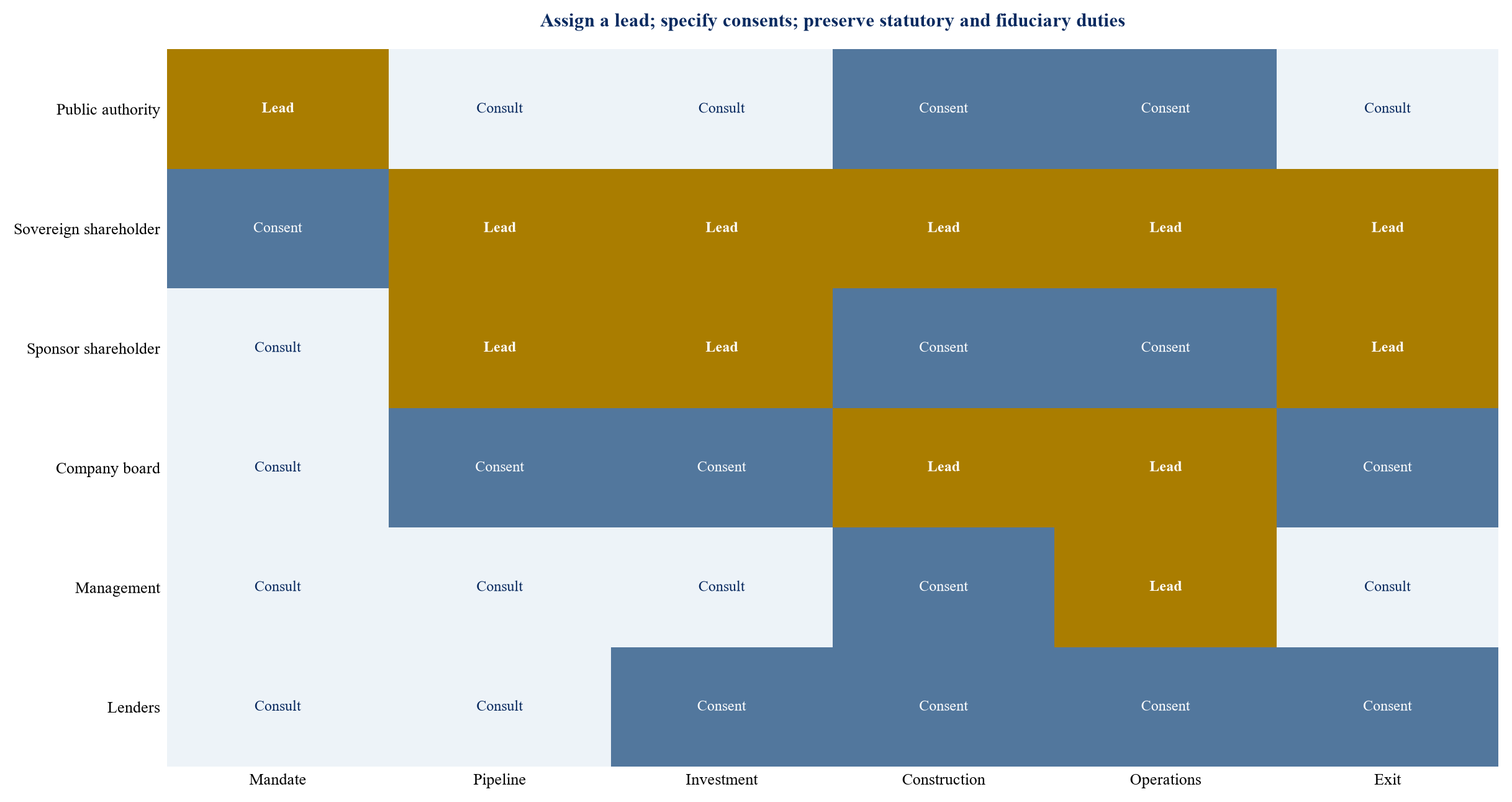
The matrix is illustrative. Exact rights depend on law, ownership, financing and public mandates.
16. Measure climate and public outcomes with commercial discipline
Transition co-investment often carries emissions, resilience, access, affordability, employment or industrial-development objectives. Each objective should have a baseline, metric, methodology, target, owner, reporting frequency and assurance level. A broad description such as green infrastructure is insufficient for governance.
One Planet Sovereign Wealth Funds encourages integration of climate considerations into governance, strategy, risk management and reporting. The World Bank's climate toolkits for infrastructure public-private partnerships connect climate analysis with project preparation, risk allocation and contract design. These approaches support a transaction model in which climate risk affects engineering, revenue, insurance, capital expenditure and valuation.
Outcome measures should sit beside financial measures. An emissions reduction estimate can depend on grid factors, utilisation, counterfactual generation and asset life. Water resilience can depend on leakage, supply reliability and drought scenarios. Employment can distinguish temporary construction jobs from durable skilled roles. Local content can affect cost and schedule. The board should understand these relationships.
Failure to meet a public target should have a defined consequence. The response may include a remedial plan, incentive adjustment, disclosure, loss of support or reconsideration of the programme. Automatic financial penalties are suitable only when the metric is robust and within management control.
17. Make fiscal risk visible at project and portfolio level
Government exposure can arise through equity, shareholder loans, guarantees, minimum revenue, availability payments, tax commitments, foreign-exchange support, termination compensation and rescue expectations. These exposures should be recorded even when accounting recognition differs.
The IMF emphasises gateway processes, central fiscal-risk management, reporting and a whole-lifecycle approach for public-private partnerships. A ministry of finance or equivalent authority should be able to see aggregate exposure across projects and scenarios. The co-investment company should provide the data required by the public owner and fiscal authority without treating fiscal oversight as an operating shareholder veto.
Portfolio analysis matters because projects can be correlated. Currency depreciation, interest-rate shocks, commodity prices, demand changes, drought, grid constraints or policy shifts may activate several guarantees at once. The sovereign may also own the offtaker and lender. Exposure mapping should avoid counting transfers within the public sector as independent risk reduction.
The board should receive a project-level risk register and the sovereign owner should maintain a public-sector exposure register. Scenario analysis should estimate cash calls, guarantee payments, revenue shortfalls and refinancing needs. Material contingent liabilities should follow applicable disclosure and budget rules.
18. Prepare for political and regulatory change
Transition assets operate through long contracts and evolving policy. Tariffs, carbon rules, subsidies, local-content requirements, environmental standards, taxation and market design can change during the holding period. Governance should distinguish ordinary regulatory risk from a targeted action against the project.
Contracts can allocate change-in-law costs, while broad protection can transfer excessive policy risk to the public. The parties should define qualifying events, thresholds, mitigation, sharing and dispute resolution. The model should test plausible regulatory changes without assuming full compensation.
Political cycles can change public priorities or leadership. The sovereign investor's mandate and the company's constitutional documents should provide continuity. Board appointments should use skills and terms rather than changing automatically with political office. Major public-purpose commitments should be documented so that successors can evaluate them.
19. Design exit at entry
Sovereign and sponsor investors can have different time horizons. The sponsor may seek consolidation, refinancing, sale or an initial public offering. The sovereign investor may seek a long hold, domestic ownership or capital recycling. Exit rights should be negotiated before value and policy interests diverge.
The agreement can include lock-ups, rights of first offer, rights of first refusal, tag-along, drag-along, put and call options, IPO cooperation and transfer restrictions. Each right needs a trigger, valuation mechanism, funding process, regulatory condition and timetable. A put against a public entity may create a contingent fiscal liability and should receive separate authorisation.
Strategic restrictions should be specific. A prohibition on sales to certain buyers may protect national security or continuity. It can also reduce value and marketability. The economic effect should be recognised at entry. A transition platform may require continuing technical services after a sponsor exit. Those services and intellectual-property licences should survive or transfer.
Exit valuation should address control premium, minority discount, public support, pipeline value and related-party contracts. An independent valuation mechanism can reduce dispute, while it cannot remove uncertainty. A staged sell-down can introduce institutional capital and preserve strategic oversight.
20. Resolve deadlock without damaging the asset
Deadlock can arise over capital calls, strategy, acquisitions, budgets, related-party contracts, distributions or exit. Infrastructure companies cannot suspend safety, operations or debt service while shareholders negotiate. The agreement should preserve essential operations and the last approved business plan during deadlock.
An escalation ladder can begin with management, move to the board, then to senior shareholder representatives, mediation or expert determination for technical matters. Arbitration or courts may resolve legal disputes. Buy-sell mechanisms can resolve ownership deadlock, while they may favour the party with greater liquidity. Their use should be compatible with public-law, procurement and fiscal constraints.
Emergency powers should cover safety, legal compliance, asset protection and debt-service continuity. They should require prompt reporting and later ratification. Emergency authority should not become a route around reserved matters.
Table 2. Conflict and escalation matrix
| Conflict | Immediate control | Independent evidence | Resolution route |
|---|---|---|---|
| Sponsor service pricing | Interested-party recusal and contract benchmark | Tender, open-book cost or independent commercial review | Disinterested board or shareholder approval |
| Pipeline allocation | Opportunity register and allocation policy | Comparable project log and periodic audit | Conflicts committee and contractual remedy |
| Public-policy direction | Written request and economic-impact assessment | Mandate, legal authority and fiscal analysis | Separate public approval plus company decision |
| Capital call | Funding notice and liquidity bridge | Approved plan, downside case and valuation | Cure period, dilution, shareholder loan or third-party capital |
| Budget deadlock | Continue essential operations under last plan | Updated forecast and covenant analysis | Senior escalation, mediation or lapse of discretionary spend |
| Asset sale | Process controls and buyer screening | Independent valuation and market test | Reserved-matter vote with tag or drag rights |
| Related-party acquisition | Information barrier and recusal | Diligence, fairness opinion and alternatives | Disinterested approval or shareholder vote |
| Performance failure | Contractual notice and remedial plan | Independent engineer or operator review | Cure, fee adjustment, replacement or termination |
| Valuation dispute | Preserve current reporting with uncertainty disclosure | Two valuations and expert methodology | Expert determination under agreed standard |
| Exit dispute | Continue governance and distributions under agreement | Sale process evidence and valuation range | Negotiated sale, IPO process or agreed buy-sell mechanism |
The matrix links common conflicts to an evidence path and resolution mechanism.
21. Protect integrity, beneficial ownership and sanctions compliance
Strategic infrastructure attracts public scrutiny and can involve complex procurement, agents, intermediaries and cross-border capital. The company should identify beneficial owners, politically exposed persons, sanctions exposure, agents, conflicts and source of funds according to applicable law and risk.
Integrity due diligence should cover sponsors, key contractors, operators, consortium members and material counterparties. It should examine ownership, litigation, debarment, adverse findings and compliance systems. Contractual representations should be supported by monitoring and audit rights. A code of conduct without operating controls provides weak assurance.
Integrity events can affect financing, permits, contracts, reputation and exit. The downside model should include suspension, replacement, investigation cost and potential loss of public support. Remediation should preserve evidence and follow legal advice.
22. Build a post-close operating system
Closing transfers capital and contractual rights. It does not create governance capacity automatically. The company should have a first-year governance calendar covering board meetings, committee meetings, budgets, audits, valuation, risk reviews, lender reporting, public-purpose reporting and policy approvals.
The first 100 days should establish the authority matrix, conflicts register, opportunity register, contract register, risk register, data room, reporting templates and escalation contacts. Existing sponsor systems may be used under a documented service arrangement. The company should retain access to its own records and build a migration plan where dependence is material.
Board packs should track the assumptions approved at investment. If value depended on project awards, cost reductions, refinancing, tariff changes or operational synergies, each should have an owner and evidence. Variance analysis should separate market movements, execution performance and public support.
Annual governance review should examine board effectiveness, conflicts, reserved matters, shareholder services, information quality, public outcomes and fiscal exposure. Material findings should produce actions with deadlines. Governance should evolve as the platform moves from development to construction, operations and capital recycling.
23. Hypothetical transition co-investment platform
Consider a hypothetical sovereign strategic investor and an industrial sponsor establishing a transition infrastructure platform. The example is a structural model. It does not describe an actual investor, government, sponsor, project, transaction or forecast.
The platform receives USD 1.20 billion of committed equity. The sovereign investor commits USD 480 million for 40 percent. The sponsor commits USD 720 million for 60 percent and contributes a development team under a separately priced services agreement. The platform targets regulated grid reinforcement, battery storage, water-efficiency infrastructure and contracted renewable generation across three jurisdictions.
The base case deploys capital over five years. Each project sits in a ring-fenced special-purpose vehicle. The joint company board has two sovereign nominees, two sponsor nominees and two independent directors, including an independent chair. Ordinary decisions require a board majority. Specified related-party transactions require approval by the independent directors and the non-interested shareholder. Fundamental reserved matters require support from both shareholders.
Public support is limited to one partial credit guarantee for a local-currency grid project and a competitively awarded availability payment for water infrastructure. The guarantee is approved outside the company by the authorised public body and recorded in a public-purpose ledger. The company model reports returns before and after the guarantee effect.
The downside case assumes a twelve-month grid delay, battery revenue below plan, a sponsor-contractor change order, currency depreciation in one market and postponed refinancing. Management must preserve safety and existing operations under the approved budget. New acquisitions pause. The board activates the capital and conflicts protocols rather than relying on informal shareholder support.
Table 3. Hypothetical sovereign-sponsor transition platform
| Component | Equity allocation | Ownership and control | Principal governance issue | Downside response |
|---|---|---|---|---|
| Regulated grid reinforcement | 360 | Platform SPV; regulated revenue | Tariff, guarantee and public-role separation | Delay capex, use contingency, disclose guarantee exposure |
| Battery storage | 240 | Platform SPV; merchant and contracted revenue | Model risk, dispatch and sponsor technology contract | Rebase revenue, test impairment, restrict distributions |
| Water-efficiency infrastructure | 300 | Platform SPV; availability payment | Procurement, performance deductions and public affordability | Independent performance review and remedial plan |
| Contracted renewable generation | 210 | Platform SPV; long-term offtake | Offtaker credit, curtailment and related-party operations | Cash sweep, reserve and operator-performance remedy |
| Platform liquidity and development | 90 | Joint company | Pipeline allocation and capital discipline | Pause new commitments and prioritise committed projects |
| Total | 1,200 | Sovereign 40%; sponsor 60% | Mandate, conflicts, reserved matters and exit | Stage-gated capital plan and shareholder escalation |
All values and assumptions are hypothetical. They demonstrate governance logic and do not provide a forecast or investment recommendation.
24. Test governance under the hypothetical downside
The grid delay first activates project reporting and the lender cure plan. The company board reviews schedule, cost to complete, tariff timing, guarantee coverage and fiscal exposure. The sovereign-appointed directors do not direct the regulator or guarantor. The responsible public entities act under their own legal processes.
The sponsor-contractor change order creates a related-party conflict. Sponsor nominees disclose and abstain. Independent directors commission an engineering and commercial review. The company tests alternatives, cumulative changes and sponsor security. Approval depends on evidence that the change is necessary and priced fairly.
Battery revenue below plan triggers a valuation and capital-allocation review. The board updates price, cycling, degradation and operating assumptions. It separates technology performance from market prices. New battery projects remain subject to the revised case rather than the original platform forecast.
Currency depreciation affects the local project and consolidated valuation. The company tests debt service, hedging and distributions. The shareholders consider additional funding under the agreed capital-call rules. The sovereign investor cannot be assumed to fund automatically because public ownership does not constitute an unlimited guarantee.
Postponed refinancing tests liquidity and exit. The board may retain cash, extend debt where possible, slow development or bring in third-party capital. Each action follows reserved matters and lender consents. The governance system turns a multi-factor stress into defined decisions.
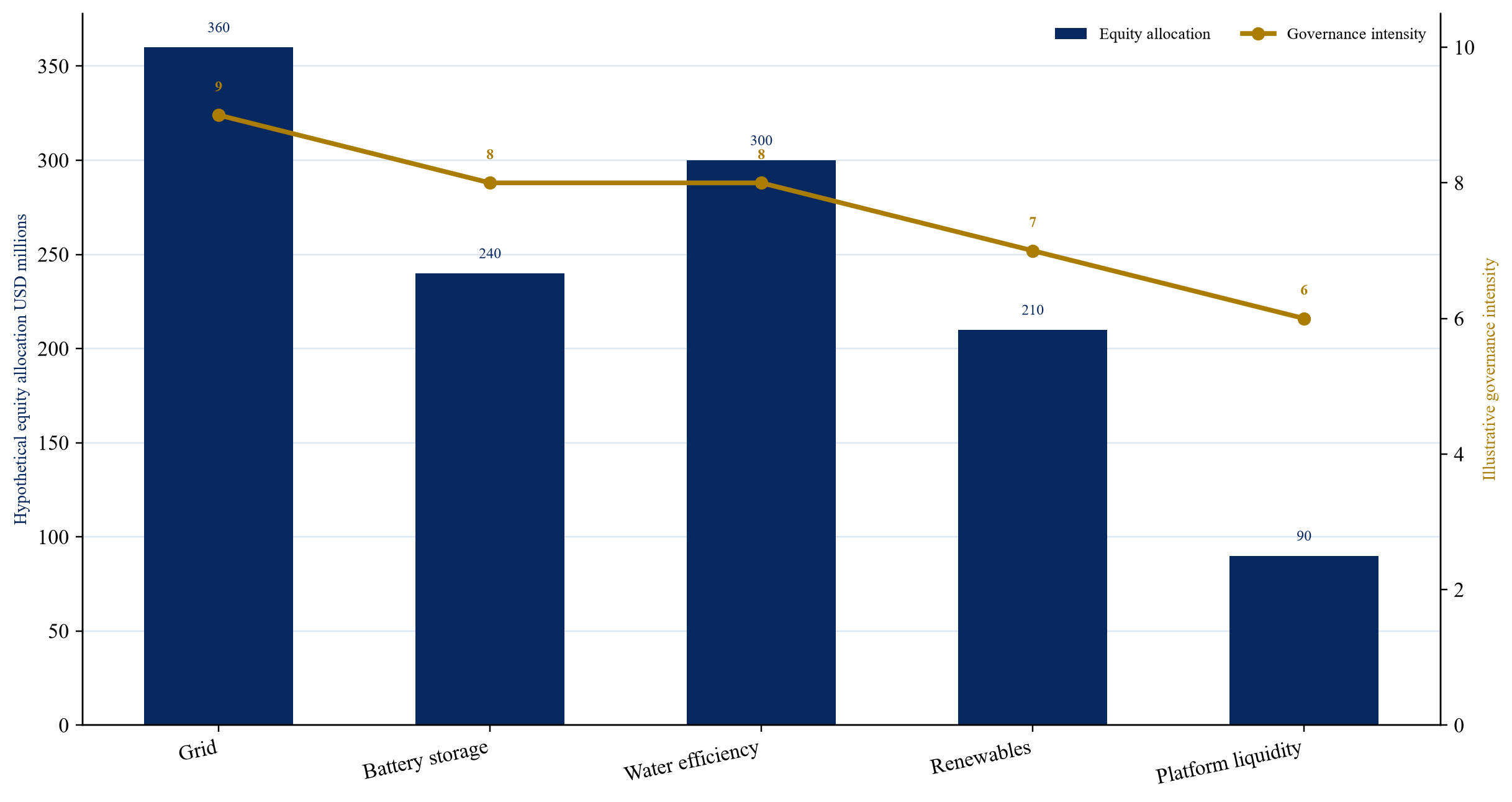
Equity values are hypothetical USD millions. Governance intensity is an illustrative score from one to ten.
25. Apply a transaction diligence sequence
The diligence sequence should begin with legal mandate and role mapping. The team should confirm the sovereign investor's authority, sponsor ownership, beneficial ownership, public counterparties and transaction perimeter. It should then test commercial cash flows, project maturity, technology, contracts, permits, environmental and social obligations, financing and tax.
Governance diligence should run alongside asset diligence. The team should design board composition, authority, reserved matters, conflicts, information, valuation, incentives, procurement, public support, fiscal reporting, exit and disputes. Each material risk should have an owner, contract, metric and escalation path.
The investment committee should receive one integrated memorandum. It should state the commercial thesis, public-purpose thesis, support instruments, return before and after support, related-party flows and downside funding. It should list open matters and conditions. It should show how the legal documents implement the approved governance.
Closing documents should be checked against the investment decision. Definitions, thresholds, schedules and cross-references often determine the real protection. A summary term sheet is insufficient evidence. Conditions precedent should include the independent approvals, transfers and support instruments required for the economics.
26. Use a board decision framework
The governing bodies can use twelve questions. What lawful mandate authorises the investment? Which commercial and public-purpose outcomes are expected? Which entities and assets form the perimeter? In which capacities do the state and sponsor act? Which party controls ordinary operations? Which matters require board, independent or shareholder approval? How are related-party transactions and opportunity allocation governed? What public support exists and what fiscal exposure does it create? How are valuation and performance measured? What information and assurance reach the board? What happens during underperformance, deadlock and capital shortfall? How can each investor exit without damaging continuity or public obligations?
The answers should be translated into the shareholder agreement, constitution, board charter, authority matrix, conflicts policy, services agreements, project documents, public-support instruments and reporting calendar. A protection that appears only in an investment memorandum can disappear after close.
The committee should reject false precision. Long-duration transition projects face policy, technology, market and climate uncertainty. Governance should create decision rights, evidence and escalation for uncertainty. It cannot remove uncertainty.
Conclusion
Sovereign capital and industrial sponsorship can create a powerful platform for transition infrastructure. Sovereign participation can extend the holding period, provide local alignment and connect projects with public objectives. Sponsor participation can provide execution, technology, procurement and operating capability. The value of the combination depends on governance that is explicit before capital is committed.
The strongest structure separates roles and ledgers. The sovereign shareholder, public authority, regulator, offtaker and guarantor act through distinct mandates. The sponsor shareholder, contractor, operator and supplier act through distinct contracts. Commercial return and public purpose are measured separately. Related-party value flows receive independent review. Public support is authorised, valued and disclosed. Fiscal exposure is visible at project and portfolio level.
Board composition, reserved matters, information rights, valuation, incentives, procurement, lender interfaces, exit and deadlock should form one operating system. That system should remain effective during delay, underperformance, capital shortfall and political change. Sovereign capital can then sit beside the sponsor with patient commitment and credible accountability.
Frequently Asked Questions
1. Why use sovereign capital alongside an industrial sponsor?
The combination can bring long-duration capital, local alignment, policy understanding, project development and operating capability. The transaction should define what each participant contributes and price those contributions transparently.
2. Should a sovereign investor accept a lower return for public purpose?
Any departure from commercial terms should be authorised under the investor's mandate, valued and reported. The commercial return and public-purpose outcome should be shown separately so that decision makers can assess both.
3. How should related-party contracts with the sponsor be approved?
The interested party should disclose the conflict and abstain where required. Material contracts should use market testing, open-book evidence, independent review or a fairness assessment and should be approved by disinterested decision makers.
4. What belongs on the reserved-matters list?
The list should cover fundamental changes and material value transfers, including capital, leverage, acquisitions, disposals, related-party transactions, business-plan deviations, public support, distributions, major disputes and exit. Thresholds should be proportionate and aggregated.
5. How should public guarantees be treated?
The guarantee should have a lawful approval, defined coverage, price, trigger, term, reporting and fiscal-risk treatment. The company should report returns before and after the guarantee effect and should not treat broad sovereign affiliation as equivalent protection.
6. Can independent directors resolve every shareholder conflict?
Independent directors can improve objective judgement and oversee conflicts. Their effectiveness depends on selection, duties, information, time and authority. Fundamental shareholder disagreements still require contractual escalation and resolution.
7. What happens when the platform needs more capital?
The agreement should define notice, evidence, shareholder participation, third-party funding, dilution, shareholder loans and the consequences of non-participation. Public ownership should not be modelled as an automatic funding guarantee.
8. When should exit rights be negotiated?
Exit rights should be negotiated at entry. Lock-ups, transfer restrictions, tag, drag, put, call, IPO and valuation provisions should reflect strategic restrictions, continuity, funding capacity and potential fiscal exposure.
References
- International Forum of Sovereign Wealth Funds. Santiago Principles. https://www.ifswf.org/santiago-principles
- International Forum of Sovereign Wealth Funds. Generally Accepted Principles and Practices for Sovereign Wealth Funds. https://www.ifswf.org/media-download/15326
- Organisation for Economic Co-operation and Development. OECD Guidelines on Corporate Governance of State-Owned Enterprises 2024. https://www.oecd.org/en/publications/oecd-guidelines-on-corporate-governance-of-state-owned-enterprises-2024_18a24f43-en.html
- Organisation for Economic Co-operation and Development. G20/OECD Principles of Corporate Governance 2023. https://www.oecd.org/en/publications/g20-oecd-principles-of-corporate-governance-2023_ed750b30-en.html
- Organisation for Economic Co-operation and Development. Safeguarding State-Owned Enterprises from Undue Influence, 2023. https://www.oecd.org/en/publications/safeguarding-state-owned-enterprises-from-undue-influence_47444e1c-en.html
- Organisation for Economic Co-operation and Development. Recommendation of the Council on Principles for Public Governance of Public-Private Partnerships. https://legalinstruments.oecd.org/public/doc/275/275.en.pdf
- International Monetary Fund. Public-Private Partnerships and PFRAM. https://infrastructuregovern.imf.org/content/PIMA/Home/PPPs-and-PFRAM.html
- International Monetary Fund. Mastering the Risky Business of Public-Private Partnerships in Infrastructure, 2021. https://www.imf.org/en/publications/departmental-papers-policy-papers/issues/2021/05/10/mastering-the-risky-business-of-public-private-partnerships-in-infrastructure-50335
- International Monetary Fund. Fiscal Risk Toolkit. https://www.imf.org/en/topics/fiscal-policies/fiscal-risks/fiscal-risks-toolkit
- World Bank Group. PPP Reference Guide Version 3. https://ppp.worldbank.org/PPP-Reference-Guide
- World Bank Group. Public Financial Management Frameworks for PPPs. https://ppp.worldbank.org/public-financial-management-frameworks-ppps
- World Bank Group. Climate Toolkits for Infrastructure PPPs, 2022. https://ppp.worldbank.org/library/climate-toolkits-infrastructure-ppps
- World Bank Group. Private Participation in Infrastructure 2024 Annual Report. https://ppi.worldbank.org/content/dam/PPI/documents/PPI-2024-Annual-Report.pdf
- World Bank Group. Infrastructure Monitor 2024, 2025. https://ppp.worldbank.org/library/infrastructure-monitor-2024-global-trends-private-investment-infrastructure
- International Finance Corporation. How Blended Finance Works. https://www.ifc.org/en/what-we-do/sector-expertise/blended-finance/how-blended-finance-works
- International Finance Corporation. The Role of Blended Finance in an Evolving Global Context, 2025. https://www.ifc.org/content/dam/ifc/doc/2025/role-of-blended-finance-in-an-evolving-global-context.pdf
- International Finance Corporation. DFI Enhanced Blended Concessional Finance Principles for Private Sector Projects, 2023. https://www.ifc.org/content/dam/ifc/doc/mgrt/2023-03-dfi-bcf-joint-report.pdf
- International Finance Corporation. Corporate Governance Development Framework. https://www.ifc.org/en/what-we-do/sector-expertise/corporate-governance/cg-development-framework
- International Finance Corporation. Due Diligence Process, updated 2024. https://www.ifc.org/en/about/accountability/due-diligence
- International Energy Agency. World Energy Investment 2025. https://www.iea.org/reports/world-energy-investment-2025
- International Renewable Energy Agency. World Energy Transitions Outlook 2024. https://www.irena.org/publications/2024/Nov/World-Energy-Transitions-Outlook-2024
- One Planet Sovereign Wealth Funds. One Planet Sovereign Wealth Funds Framework. https://oneplanetswfs.org/
About the Author
Chennakeshav (CK) is a corporate finance and investment banking executive with 25+ years of global experience in deal origination, structuring and execution across M&A, growth capital and corporate strategy. He has led value-creation mandates for founders, corporates and funds — bridging the boardroom view to hands-on execution and close.
His career spans Morgan Stanley, HSBC, Lloyds Banking Group, EWEC, ADQ portfolio companies and Emirates Growth Fund, across TMT, real estate, fintech, deeptech, cleantech, infrastructure and energy. He has partnered with C-suite leaders, private equity and venture funds, sovereign wealth funds and family offices to finance complex fund raises and scale-up ventures, and has led M&A due diligence, post-merger integration and business-transformation initiatives to create value.
At Matchpoint Partners he is Managing Partner, leading the firm's corporate finance, M&A and capital-raising practice. He holds an MBA from London Business School, an engineering degree from VTU and a Master of Laws (LLM, in progress) from UCL London.
An active start-up mentor, CK mentors at Techstars, DIFC FinTech Hive, Startup Grind, Founder Institute and IN5, serves as Entrepreneur Mentor in Residence (EMiR) at London Business School, and judges the Entrepreneurship World Cup.
