
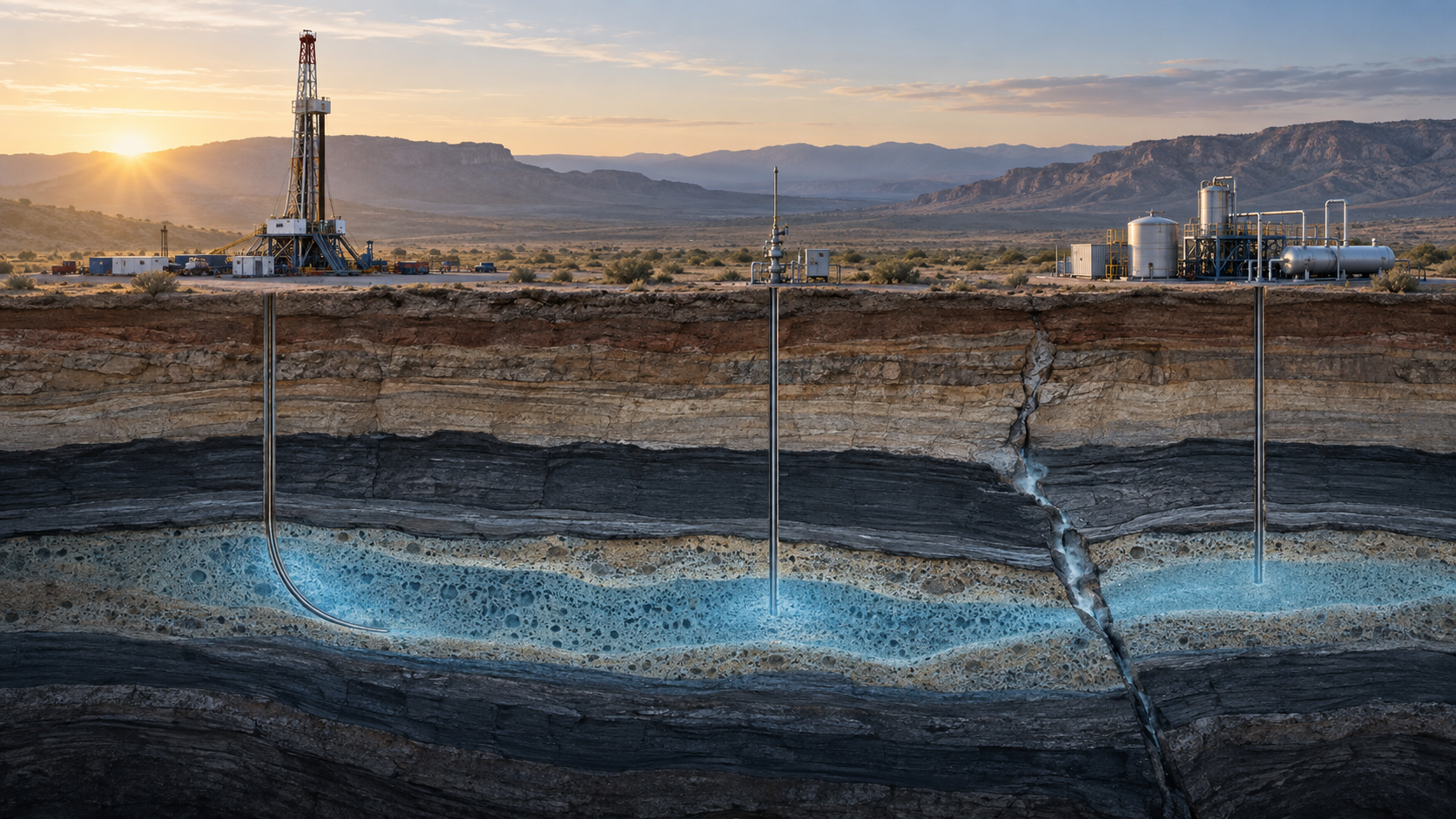
1. Capital should follow evidence
Geologic hydrogen offers a potentially important source of low-emissions energy, feedstock and strategic optionality. Its investment case remains unusually sensitive to subsurface uncertainty. A prospective geological setting can contain the ingredients for hydrogen generation and still fail to produce a recoverable accumulation. A well can encounter hydrogen and still fail because flow, purity, pressure, continuity or decline is inadequate. A pilot can produce gas and still fail commercially because processing, transport, rights or offtake cannot support the delivered product.
The appropriate capital strategy is therefore sequential. Each expenditure should purchase a defined reduction in uncertainty and create a decision that can be exercised. Early capital tests whether a credible hydrogen system exists. Discovery capital tests whether an accumulation is present. Appraisal capital tests scale, connectivity and repeatability. Pilot capital tests sustained deliverability and complete-system performance. Development capital follows only when the remaining risks can be priced, allocated and financed.
This sequence protects investors from two errors. The first is advancing a technically interesting prospect before evidence supports commercial scale. The second is abandoning a promising system because one early test was designed around the wrong geological model. Clear gates, pre-agreed failure tests and disciplined data capture make both errors less likely.
2. Natural and stimulated hydrogen are different businesses
Natural geologic hydrogen is generated by subsurface processes and may migrate into reservoirs or remain in active reaction zones. Proposed mechanisms include water-rock reactions involving iron-rich minerals, radiolysis of water and other geological or biological processes [1, 6]. The exploration task is to identify source, water availability, migration, reservoir, seal and preservation within a coherent system.
Stimulated geologic hydrogen seeks to accelerate hydrogen-generating reactions or improve recovery through engineered intervention. The commercial proposition includes the reaction substrate, injected fluids, heat and mass transfer, reaction kinetics, mineral alteration, well integrity, produced-fluid management and repeatability. Public research programmes in the United States are examining subsurface engineering and reservoir management for stimulated production [7-10].
The two models can share land, wells, subsurface data and surface facilities, but they require different proof. A natural accumulation must demonstrate charge, trap and producible inventory. A stimulated system must demonstrate controllable generation rate, recovery and net energy and environmental performance. Investment materials should identify which model is being financed. Blending the evidence can exaggerate maturity and obscure the capital needed to reach the next gate.
3. A hydrogen system requires generation, migration, trap and preservation
The United States Geological Survey frames a geologic hydrogen system around generation, migration, accumulation and preservation [1, 3]. This system view is more rigorous than screening for a single favourable rock type. Hydrogen can be generated and lost through diffusion, reaction, microbial consumption or leakage. It can migrate away from the source and accumulate only where reservoir quality and seal integrity are sufficient.
Exploration should map each element and the timing relationship between them. A source that became active after a trap failed may leave a surface signal without a retained accumulation. A strong seal can preserve gas but provide no value if the source and migration paths are absent. Faults can act as conduits, barriers or both at different times.
The investment memorandum should state the play concept as a falsifiable chain. It should identify the proposed generation mechanism, expected migration pathway, reservoir, seal, preservation mechanism and present-day charge. Each data set should test one or more links. The decision gate should fail when a required link is absent or when the remaining uncertainty cannot be resolved at an acceptable cost.
4. Prospectivity is not a resource or reserve
Prospectivity maps identify locations where favourable geological attributes may coincide. They support regional prioritisation and cannot establish discovered quantities, recoverability or commerciality. The USGS released a first national prospectivity map for geologic hydrogen in 2025 and expressly distinguished prospectivity from a quantitative resource assessment [2, 3].
The distinction matters for financing and valuation. A mapped area can contain no accumulation. A discovery can contain gas that cannot flow commercially. Recoverable volume requires reservoir geometry, saturation, pressure, composition, permeability, drive mechanism and recovery assumptions supported by wells and tests. Reserves require additional evidence for development feasibility and commercial conditions under the applicable classification framework.
Boards should require consistent language at each gate. Regional attributes support a play hypothesis. Leads are mapped features requiring further evidence. Prospects have a defined target and drilling decision. Discoveries require direct subsurface evidence. Contingent resources and reserves, where used, require competent professional classification under a recognised framework. Public and transaction materials should preserve these boundaries.
5. Exploration should be play based
A play-based programme groups prospects that share a generation, migration, reservoir and seal concept. The approach allows evidence from one licence or well to update the probability of other prospects without assuming that every feature is independent. It also helps investors distinguish basin-wide risk from prospect-specific risk.
The initial play model should integrate geology, geophysics, geochemistry, thermal history, structural evolution, hydrology and known gas occurrences. It should state alternative explanations for each signal. Surface hydrogen can indicate active migration, shallow generation, biological activity, sampling artefact or leakage from a deeper accumulation. A defensible programme designs tests that discriminate among these explanations.
Capital allocation should favour experiments with high information value. A regional survey that eliminates an entire weak play can be more valuable than acquiring another licence. A stratigraphic well can reduce reservoir and seal uncertainty before an expensive deep test. The exploration budget should show which uncertainty each activity addresses, how the result changes prospect probability and what action follows a positive, ambiguous or negative outcome.
6. Technology readiness has several dimensions
Technology readiness cannot be represented by one number. Subsurface understanding, drilling, stimulation, reservoir management, gas processing, measurement, transport and environmental monitoring can sit at different maturity levels. Conventional oil and gas equipment may be available while hydrogen-specific material compatibility, reaction control or resource estimation remains uncertain.
The investment gate should therefore track four parallel readiness dimensions: geological evidence, engineering performance, commercial formation and regulatory permission. Development cannot proceed when any critical dimension remains below the level required for construction finance. A technically mature well design does not cure an undefined resource right. A signed offtake memorandum does not cure an unproven production profile.
The curve below shows a hypothetical progression. It illustrates the principle that evidence accumulates unevenly and that capital exposure should rise only when the slowest critical dimension reaches the next threshold. Project-specific readiness must be assessed from verified evidence.
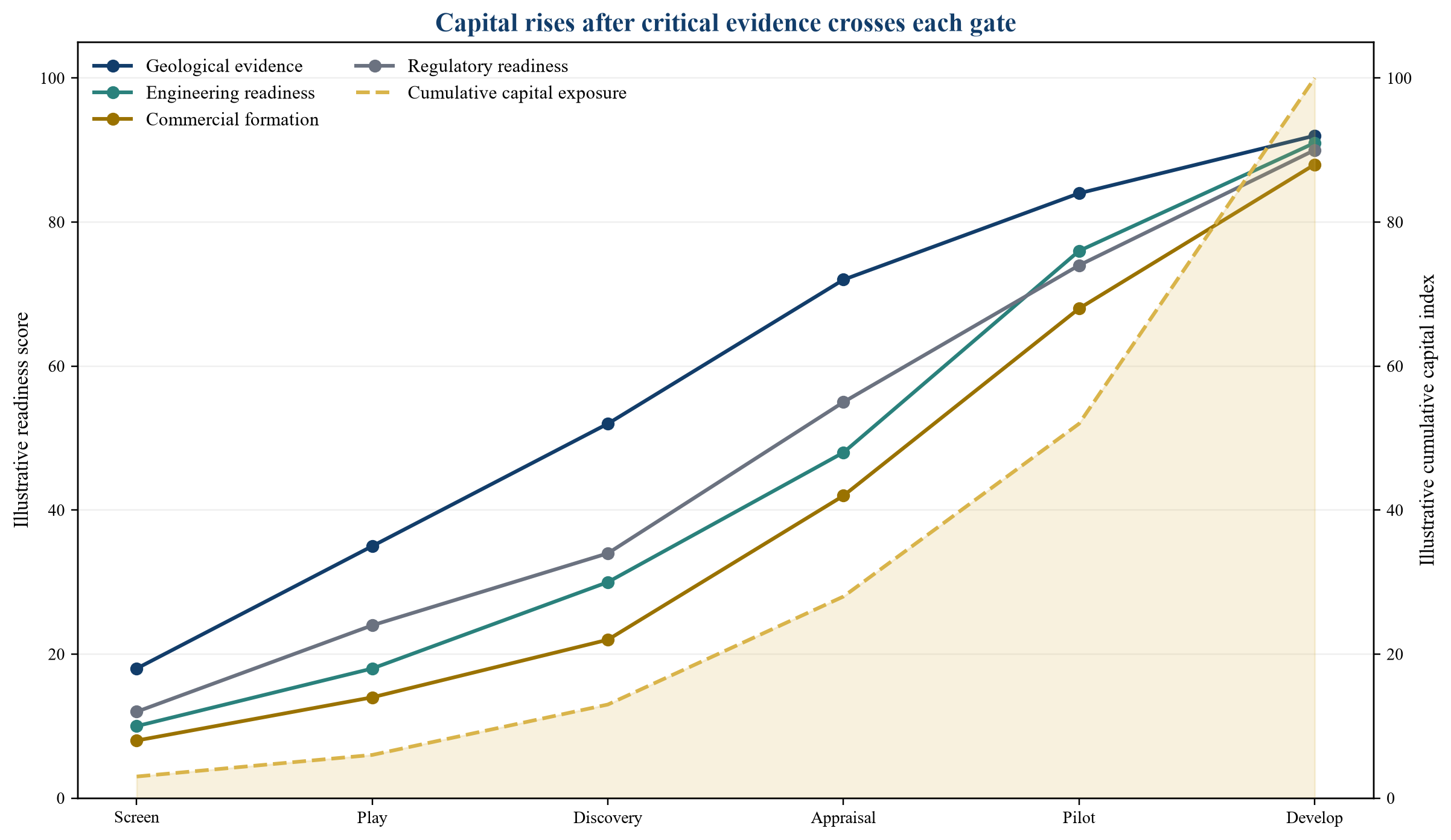
The curves are hypothetical and illustrate a staged decision architecture. They are not measurements of a named project.
7. Stage gates convert uncertainty into decisions
A gate is a decision, not a progress report. It should specify the evidence required, the capital at risk, the failure test, the allowed response and the authority to proceed. A gate that automatically advances after expenditure has occurred provides no protection against sunk-cost escalation.
Early gates should be cheap and severe. They should remove plays with weak generation potential, incompatible rights, unacceptable environmental exposure or no plausible market route. Later gates become more expensive because they test reservoir performance and integrated operations. Their evidence must be correspondingly stronger.
The table defines a generic capital architecture. Amounts are deliberately omitted because cost depends on depth, terrain, jurisdiction, data availability, well design and infrastructure. The governing principle is that each stage funds only the work required to reach the next decision.
Table 1. Evidence-gated capital architecture
| Stage | Capital purpose | Required evidence | Failure test | Typical financing fit |
|---|---|---|---|---|
| Regional screen | Eliminate weak basins and identify play concepts | Generation mechanisms, source-water relationship, structure, known occurrences, land and market screen | No coherent hydrogen system or no viable access route | Sponsor research budget or public research grant |
| Licence and baseline | Secure rights and establish pre-entry condition | Title, subsurface rights, environmental baseline, stakeholder map, data access | Rights uncertain, baseline unacceptable or access impracticable | Sponsor equity or strategic seed capital |
| Play confirmation | Rank leads and define drillable prospects | Integrated geoscience, alternative hypotheses, target geometry, well objectives | Critical play element unsupported or target cannot be tested economically | Staged exploration equity or farm-in |
| Discovery drilling | Test presence, composition and initial deliverability | Well logs, samples, pressure, formation tests, gas composition, chain of custody | No hydrogen accumulation or composition and flow fall below pre-agreed threshold | Exploration equity or carried interest |
| Appraisal | Test scale, connectivity, repeatability and decline | Multiple penetrations, interference or pressure data, dynamic model, processing tests | Volume, continuity or sustained rate cannot support a pilot | Strategic capital, appraisal facility or joint venture |
| Pilot production | Demonstrate integrated sustained delivery | Production history, decline, purity, processing, water, emissions, uptime and buyer test | Delivered product and operating envelope fail commercial thresholds | Convertible project capital, strategic offtaker or public co-funding |
| Development | Build contracted production and infrastructure | Classified recoverable quantities, FEED, permits, contracts, reserves or resource report where applicable, funded downside | Completion, market or operating risks cannot be allocated or financed | Project debt, sponsor equity and infrastructure finance |
The framework is generic. Activities, governance and classification should be adapted to the jurisdiction and project.
8. Regional screening should eliminate weak plays cheaply
Regional screening combines public geology, legacy wells, geophysical data, remote sensing, geochemistry and infrastructure. Its purpose is prioritisation. It should identify where a coherent system is plausible and where a decisive data gap can be closed without drilling a development-scale well.
Screening quality depends on provenance. Legacy gas analyses may lack hydrogen because sampling and laboratory methods were not designed to preserve it. Hydrogen can diffuse through containers, react with materials or be created during sampling. Data should be graded by collection method, custody, detection limit and reproducibility. Weak data can guide new measurement and should not be treated as discovery evidence.
Commercial screening should occur at the same time. Depth, terrain, land access, water, roads, power, pipelines, industrial demand and regulation affect the cost of proof. A geologically attractive remote area can require a different product strategy from a basin near ammonia, refining or power demand. The output is a ranked set of plays with evidence gaps, not a headline estimate of value.
9. Licence, land and ownership can stop the project early
Subsurface hydrogen rights are not uniform. Petroleum, mineral, geothermal or general subsurface regimes may apply, and some jurisdictions have amended existing laws or licence frameworks to recognise hydrogen exploration [11-15]. The project must establish who owns the resource, which authority grants access, what activities are permitted and how production, stimulation, injection and abandonment are regulated.
Surface access and subsurface rights can be held by different parties. Seismic work, roads, drilling pads, water supply, pipelines and monitoring each require permissions. Indigenous, cultural-heritage and community obligations may begin before licence award. A technically attractive prospect can become unfinanceable when access timing, compensation or consent remains unresolved.
The early legal work should produce a title opinion, permit map, land strategy and change-of-law analysis. It should identify relinquishment, work commitments, data ownership, transfer restrictions, royalties and decommissioning security. Investors should condition material expenditure on a clear and durable right to test and, if successful, develop the resource.
10. Surface geochemistry is a lead, not discovery proof
Surface and soil-gas surveys can reveal anomalous hydrogen, associated gases and migration patterns. They are useful for mapping active systems and ranking targets. Their interpretation is difficult because hydrogen is mobile, measurements vary with weather and soil conditions, and near-surface biological or mineral reactions can create or consume gas.
Sampling design should include blanks, duplicates, calibration, time-series measurements and independent laboratory confirmation. The programme should test whether anomalies repeat, align with structure and remain coherent with the proposed source and migration model. Helium, methane, nitrogen and other gases can provide additional context, although none is definitive alone.
An anomaly should change the probability assigned to a prospect; it should not be converted directly into volume or production. The decision to drill should integrate geochemistry with geology, geophysics, reservoir prediction and well economics. A prospect with a striking surface signal and no credible reservoir or seal remains a weak capital proposition.
11. The first well should test the full hydrogen system
The first exploration well is an information instrument. Its design should answer the questions that determine the next capital decision: whether hydrogen is present; where it occurs; how it was generated; whether the target has reservoir quality and seal; what gases, fluids and minerals accompany it; and whether initial flow is measurable.
The well programme should protect sample integrity. Materials, mud systems, circulation, pressure changes and surface handling can alter gas composition. Downhole and surface measurements should be reconciled through documented custody and laboratory methods. Background and drilling-generated hydrogen should be distinguished from formation gas.
Success criteria should be set before drilling. A gas show can be a technical success and a commercial failure. Conversely, a dry target can provide valuable basin information if it tests a key play element. The post-well review should update the entire play model and prospect portfolio, record alternative explanations and recommend appraisal, redesign or exit.
12. Appraisal proves repeatability and volume
A discovery well establishes presence at one location. Appraisal tests whether the accumulation or productive process is laterally and vertically persistent, whether wells communicate and whether pressure and composition support a recoverable volume. It should reduce uncertainty in geometry, saturation, permeability, drive, replenishment and decline.
The programme can include step-out wells, pressure build-up, interference, extended flow, tracers, cores, fluid analysis and repeated sampling. Natural systems may show active recharge, isolated pockets or depletion. Stimulated systems require measurement of reaction extent, generated volume, injectivity, recovery and changes in rock and fluids.
Resource estimates should present ranges and dependencies. A large in-place estimate has limited financial meaning when recovery, rate or purity is unknown. Appraisal should produce a dynamic model tied to observed pressure and flow. The gate should require a credible path to sustained pilot production, not a larger static volume alone.
13. A pilot must demonstrate sustained deliverable gas
Pilot production is the bridge between a discovery and a financeable project. It should run long enough to observe pressure response, decline, composition stability, water and contaminant behaviour, well integrity and surface-facility performance. Short tests can overstate sustainable rate and understate processing requirements.
The pilot boundary should extend to a defined delivered product. It includes separation, purification, compression, storage or transport, metering, emissions measurement and waste management. Where a buyer trial is possible, the pilot should test the buyer's purity, pressure and delivery profile.
The operating plan should specify minimum sustained rate, availability, hydrogen recovery, product purity, decline envelope and cost per delivered kilogram. It should also define stop conditions for safety, environmental or reservoir performance. Successful operation creates evidence for engineering design, offtake, resource classification and debt diligence. Failure at pilot scale should preserve enough data to determine whether redesign or exit creates more value.
14. Reservoir performance controls economics
Well productivity, pressure support and decline determine how many wells and facilities are required for a contracted output. A high hydrogen concentration can still be uneconomic at a low flow rate. A strong initial flow can be misleading if pressure falls rapidly or composition deteriorates.
The reservoir model should link geological uncertainty to cash flow. It should translate permeability, thickness, pressure, saturation, connectivity, recharge and well spacing into production profiles. Each parameter should retain an evidence grade. History matching should update the model as pilot data accumulate.
Development design must consider interference and field-wide behaviour. Closely spaced wells can compete for a limited accumulation. Stimulated reactions can change permeability or create unwanted fluid movement. The base case should use a conservative sustainable rate and include workover, redrill and abandonment. Equity can retain upside from improved performance; debt should rely on demonstrated deliverability.
15. Gas composition determines processing and product value
Produced gas may contain hydrogen with nitrogen, helium, methane, carbon dioxide, water vapour, hydrogen sulphide or other constituents. Composition can vary between wells and over time. The process design must achieve the buyer's specification while retaining acceptable recovery, energy use and waste handling.
Purification cost depends on feed composition, pressure, flow and product purity. A small change in hydrogen concentration can change equipment size and energy demand. Corrosive or toxic contaminants can alter materials, safety systems and permitting. Valuable helium can improve economics when concentration, recovery, market access and contract terms are verified; it should remain separate upside before then.
The model should begin with measured samples and a range that reflects appraisal uncertainty. It should calculate hydrogen recovered after processing, not raw gas produced. Product revenue, compression and transport should use the recovered stream. Off-spec gas, purge streams and residual emissions need an explicit disposition and cost.
16. Surface facilities and transport belong in the boundary
The commercial asset includes wells, gathering, separation, purification, compression, storage, metering and delivery. The cheapest subsurface hydrogen can become expensive when the field is remote or the product requires long-distance transport. Conversely, a modest accumulation beside an industrial buyer can have strategic value.
Development alternatives include on-site use, pipeline delivery, blending where permitted, conversion to ammonia or another carrier, and captive power or heat. Each alternative changes product value, capital intensity, energy loss, regulation and buyer set. The early concept study should preserve several routes until resource and market evidence support selection.
Infrastructure timing must align with the field ramp. A dedicated pipeline can be underutilised during appraisal and early production. Modular processing and trucked or converted product can support a pilot while retaining a path to scale. Shared infrastructure can lower unit cost and creates capacity, completion and counterparty dependencies that belong in the financing case.
17. Environmental and community risks enter before drilling
Geologic hydrogen development can affect land, water, biodiversity, noise, traffic and local communities. Stimulation can introduce additional concerns about injected fluids, induced seismicity, subsurface migration and produced water. The appropriate assessment depends on the geology, technology, jurisdiction and scale.
Baseline data should precede disturbance. Water quality, soil gas, seismicity, ecosystems and existing land use provide the reference for impact assessment and monitoring. A weak baseline can make later attribution difficult and increase conflict. The project should explain sampling methods, data access and response thresholds to regulators and affected communities.
Community engagement should address the actual programme and uncertainty. Claims that hydrogen is inherently clean or renewable can undermine trust when the production method, timescale or impacts remain unproven. The social-value plan should identify local procurement, employment, land use, emergency response and closure. These obligations are project costs and schedule items, not communications afterthoughts.
18. Carbon intensity requires measurement, not a colour label
Geologic hydrogen has no universal carbon-intensity value. Emissions can arise from drilling, stimulation inputs, power, processing, leakage, compression, transport and conversion. The system boundary and counterfactual treatment affect the result. A natural accumulation and an engineered generation process can have different energy and emissions profiles.
The project should prepare a lifecycle inventory tied to measured operations. It should state electricity source, fuel use, materials, gas losses, treatment, transport and co-product allocation. Hydrogen leakage should be monitored because indirect climate effects are an active research area and can affect environmental credibility.
Claims should use a recognised methodology applicable to the target market and disclose material exclusions. Early estimates can support design comparisons when their assumptions are visible. Certification and premium revenue should enter the finance case only after the governing standard, measurement plan and audit route are identified.
19. Cost estimates should show denominator and evidence class
Published geologic-hydrogen cost ranges are highly sensitive to assumed flow, purity, depth, well cost, stimulation, processing and infrastructure. Recent peer-reviewed models report potentially low costs under favourable assumptions, while their scenario ranges remain broad [16-18]. These studies are useful for identifying dominant variables and do not establish the cost of a named project.
Every cost should state its denominator. Dollars per kilogram of raw hydrogen in produced gas differ from dollars per kilogram of purified product delivered to a buyer. A cost excluding exploration failures, appraisal, infrastructure, finance and closure cannot be compared with a fully delivered cost.
The estimate should also state its evidence class. Screening estimates rely on analogues and ranges. Concept estimates incorporate site and process assumptions. Front-end engineering uses defined equipment and quantities. Operating forecasts use demonstrated pilot data. Investment approval should reconcile capital, operating cost, production and contingency to the same design basis.
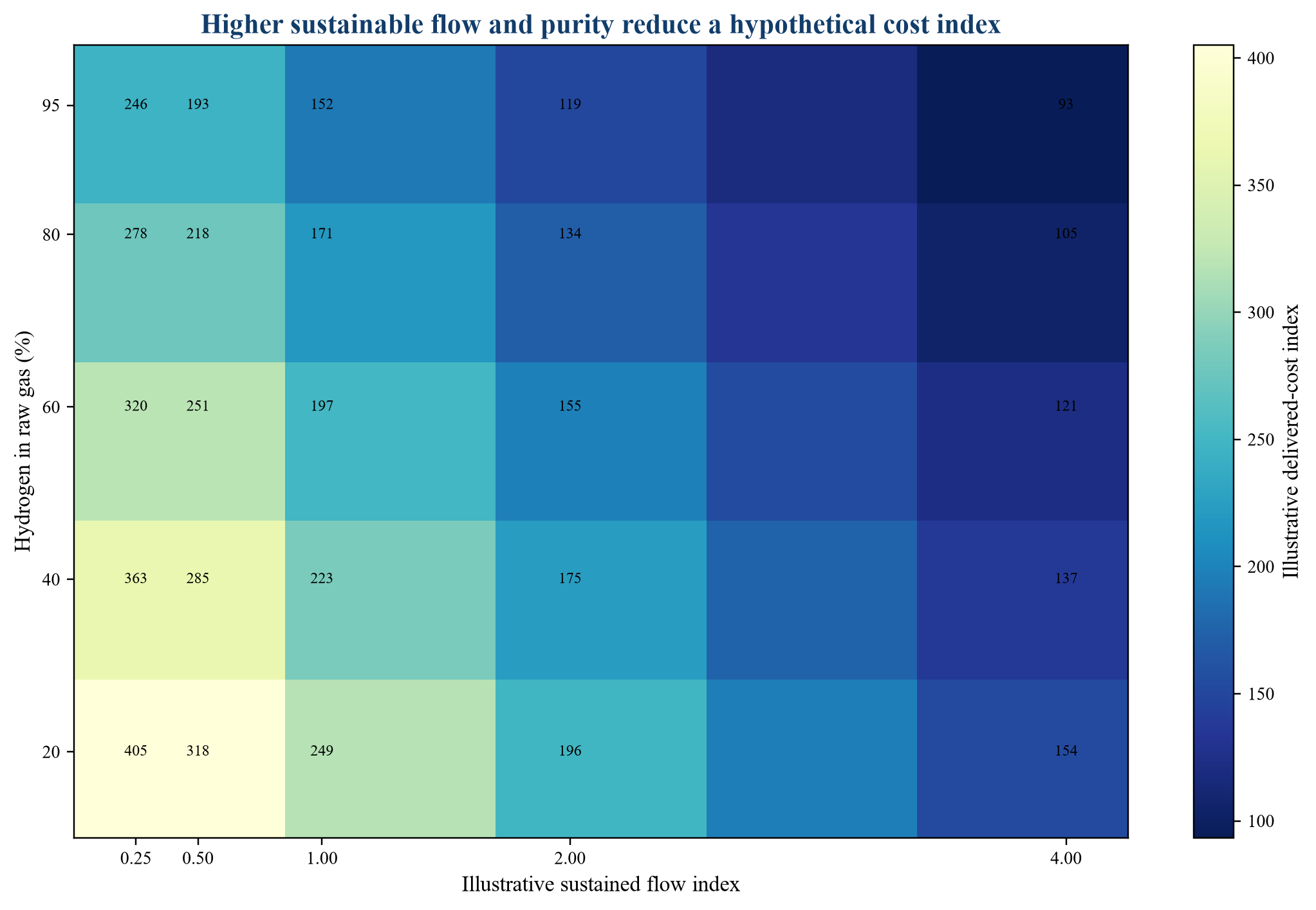
Values are illustrative cost indices for analytical use only. They are not market forecasts, engineering estimates or evidence for a named resource.
20. Flow and purity dominate many cost cases
Sustained flow determines how much production supports each well, gathering line and operating team. Purity influences gas handling, separation, compression and hydrogen recovery. The interaction can dominate depth or equipment cost in early models. Low flow and low purity create a double penalty through smaller product volume and higher processing duty.
Sensitivity analysis should vary flow, purity, decline and well cost together. Independent sensitivities can miss the correlation between reservoir quality and composition. The model should show raw-gas production, hydrogen content, process recovery and delivered product for every case.
Early cost claims should be reported as conditional statements. A cost can be achievable if a specified rate, purity, uptime, processing performance and infrastructure cost are demonstrated. The investment gate then funds the tests required to verify those conditions. This converts a promotional headline into a measurable programme.
21. Valuation should be probability weighted and stage specific
Before discovery and appraisal, a single development net present value can create false precision. Probability-weighted valuation separates the value of success from the cost and probability of reaching each gate. It allows an investor to compare the cost of another test with the expected change in decision quality.
The model should define technical, commercial and execution probabilities separately. Technical chance covers the hydrogen system and recoverability. Commercial chance covers product route, rights, regulation, offtake and infrastructure. Execution chance covers cost, schedule and operating performance. Correlation should be recognised rather than multiplying optimistic independent inputs.
The figure below uses hypothetical values to show how uncertainty narrows and capital exposure rises. It is a decision illustration. It does not value a named project.
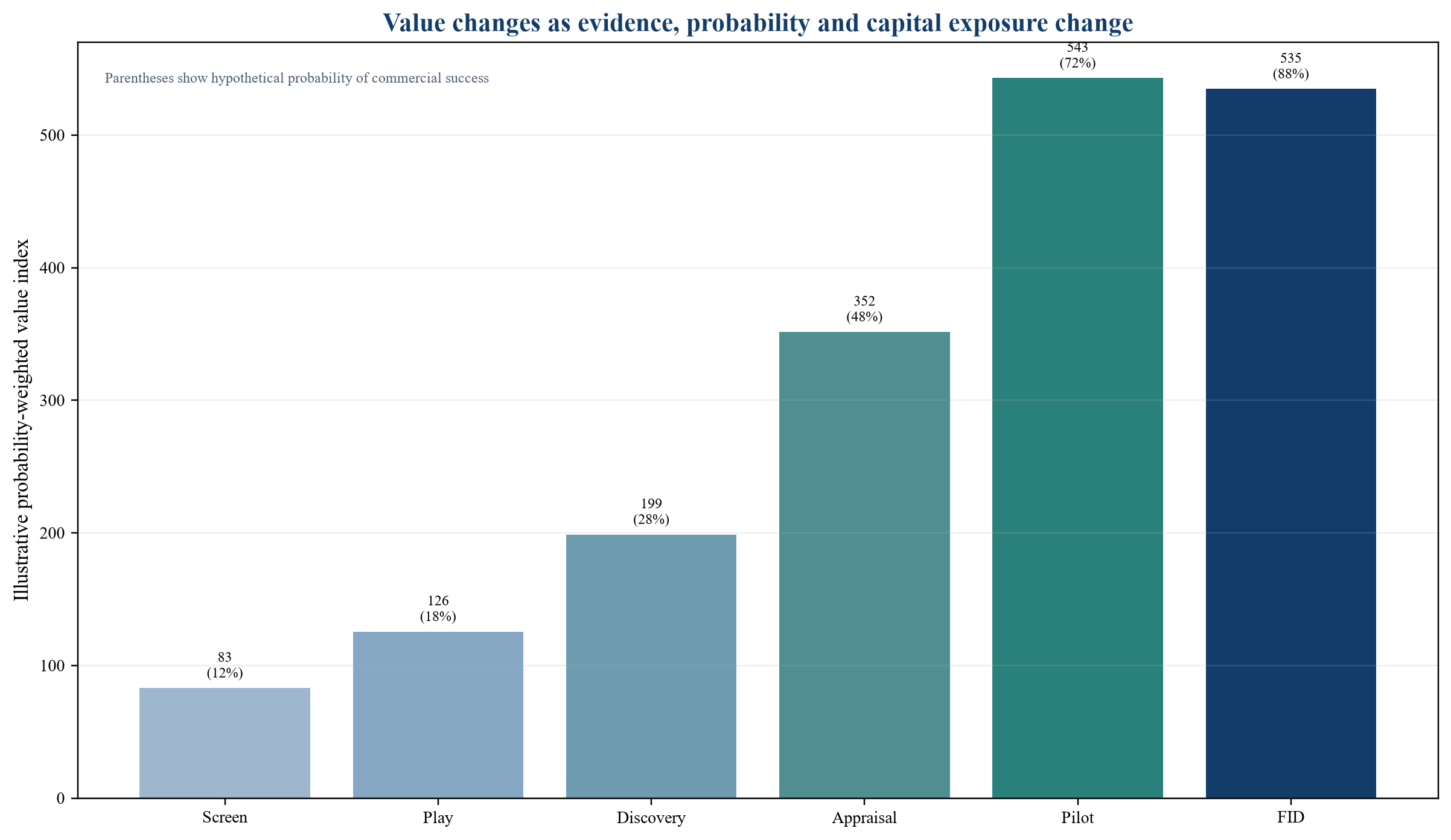
Monetary values and probabilities are analytical assumptions only. They do not represent a valuation, forecast, financing offer or project estimate.
22. Option value matters before resource proof
An exploration licence creates the right, within its terms, to spend more after learning. This flexibility has value when management can stop, defer, redesign, farm down or expand. A conventional discounted cash flow that assumes immediate full development can miss the value of staged decisions and overstate the value of weak evidence.
Real-option analysis begins with decision points. After regional work, the investor can relinquish or acquire more data. After a discovery, it can appraise, sell, farm down or wait. After a pilot, it can develop modularly or commit to scale. Each option depends on licence duration, work obligations, information ownership, market timing and the ability to preserve rights.
Option value does not rescue an uneconomic project. It is strongest when uncertainty can be resolved through bounded expenditure and when the investor can act on the result. The investment memorandum should identify the option, exercise cost, expiry, decision authority and evidence trigger. It should also recognise obligations that reduce flexibility.
23. Financing instruments should match the evidence stage
Early geological work is exposed to binary and difficult-to-secure risk. Sponsor equity, grants, strategic research funding and farm-ins are generally better suited than senior debt. A farm-in can exchange an interest for defined work while preserving capital for the original holder. Its terms should distinguish spending commitment, operatorship, data rights and consequences of an unsuccessful well.
Appraisal and pilot stages can attract strategic capital from industrial buyers, energy companies, infrastructure providers or technology partners. Convertible or milestone-based funding can price uncertainty after new evidence. Public co-funding can support pre-commercial engineering where programme terms align with project rights and disclosure.
Project debt becomes credible after sustainable production, recoverable quantities, engineering, permits, contracts and completion tests are sufficiently defined. Debt should be sized to conservative delivered output and contracted cash flow. Exploration upside, unverified recharge, future co-products and expected policy changes should remain with equity until supported.
24. Strategic partners can supply missing capabilities
A geologic hydrogen developer may control licences and geoscience while lacking drilling, reservoir, processing, offtake or infrastructure capabilities. Strategic partnerships can fill those gaps and provide independent technical challenge. The partner's contribution should be concrete: capital, equipment, operating team, market access, data or contractual capacity.
Joint-venture governance must preserve decision discipline. Work programmes, budgets, operatorship, technical standards, data sharing, related-party procurement and approval thresholds should be defined. A partner with a downstream interest can favour early scale; a licence holder can favour acreage retention. Reserved matters and independent review can manage these incentives.
Value should be allocated according to evidence and contribution. A headline resource narrative should not substitute for technical diligence. Milestone-based earn-ins, contingent consideration and carry structures can bridge valuation gaps. Their milestones should use measurable subsurface and commercial outcomes, not discretionary descriptions such as satisfactory progress.
25. Portfolios reduce single-prospect risk
Exploration outcomes are uncertain and uneven. A portfolio can spread prospect-specific risk and create learning across a play. Shared seismic, laboratories, drilling contracts and infrastructure can reduce unit cost. A successful well can update neighbouring prospects and a failed well can eliminate them.
Diversification is effective only when risks are genuinely distinct. Ten prospects dependent on the same unproven source mechanism, seal or regulatory interpretation form a concentrated portfolio. The investor should map common risk factors and estimate how one result changes the others. Capital should be reserved for follow-up after a positive result rather than committed equally in advance.
Portfolio ranking can use expected information value, technical chance, commercial route, capital need and time to decision. Management should disclose when a lead is a variant of an existing play rather than an independent opportunity. This prevents acreage quantity from being mistaken for diversified value.
26. Data architecture is a financing asset
Geologic hydrogen projects combine samples, laboratory results, logs, seismic, models, permits, land rights, costs and contracts. Data quality determines whether results can be reproduced and trusted by partners, competent persons, lenders and buyers. A weak chain of custody can destroy the value of otherwise promising evidence.
The data room should preserve raw data, processed outputs, methods, calibration, version history, coordinates, units and responsible persons. Every material model input should link to a source and evidence grade. Interpretations should remain separate from observations. Negative results should be retained because they constrain the play model.
Governance should cover cybersecurity, access, export controls where relevant, regulator submissions and partner rights. A buyer or farm-in partner should be able to reconstruct the decision history. This reduces diligence time, narrows valuation disputes and enables independent review. Data discipline is part of the asset, not an administrative appendix.
27. Development approval requires commercial proof
Final investment approval should require a demonstrated resource and a complete commercial system. The board should receive a dynamic production model, recoverable-volume classification where applicable, field development plan, processing design, infrastructure route, environmental approvals, closure plan and executable revenue and supply contracts.
The financial model should reconcile wells and facilities to delivered hydrogen. It should include exploration write-offs, appraisal, sustaining wells, decline, processing recovery, energy, water, waste, transport, royalties, tax, financing, decommissioning and working capital. The downside case should test combined geological, operating, price and schedule events.
The hypothetical cases below show the discipline of combining variables. They are not estimates of a named project.
Table 2. Hypothetical base, downside and failure cases
| Variable | Base case | Downside case | Failure case |
|---|---|---|---|
| Probability-adjusted recoverable product versus plan | 100% | 62% | 18% |
| Sustained well flow versus pilot target | 105% | 68% | 25% |
| Hydrogen concentration in raw gas | 82% | 54% | 24% |
| Processing recovery | 92% | 83% | 61% |
| Field decline in year two | 9% | 22% | 48% |
| Well cost versus budget | 100% | 128% | 165% |
| Delivered infrastructure cost versus budget | 100% | 124% | 158% |
| Development schedule delay | 0 months | 9 months | 24 months |
| Contracted product price versus base | 100% | 82% | 65% |
| Illustrative project DSCR | 1.60x | 1.04x | 0.43x |
| Gate decision | Proceed with controls | Redesign and reappraise | Stop or preserve option |
Every value is an analytical assumption. The cases are not market forecasts, resource estimates, engineering quotations or valuations.
28. Commercialisation proceeds through proof
Commercialisation begins by defining a customer problem. A nearby industrial buyer may value low-emissions hydrogen, secure domestic supply, flexible production or a helium co-product. The required product specification, volume, timing and evidence determine the development route.
The route should scale with proof. Early samples support technical engagement. A discovery supports a non-binding market process. Appraisal supports conditional offtake design. A pilot supports qualification, pricing and performance terms. Binding long-term commitments should follow demonstrated deliverability and a credible completion package.
The roadmap below aligns evidence, engineering and finance. The sequence can overlap when governance preserves the gate and does not allow commercial momentum to override technical results.
Table 3. Commercialisation and financing roadmap
| Phase | Customer and product task | Technical proof | Commercial and financing output | Stop or redesign trigger |
|---|---|---|---|---|
| System definition | Identify buyer use, specification and logistics | Coherent play and preliminary processing route | Product brief, market screen and exploration budget | No credible delivered product or competitive route |
| Discovery | Engage buyers on sample and potential scale | Direct evidence of hydrogen and initial flow | Conditional interest, appraisal plan and data rights | Composition or rate cannot support plausible treatment |
| Appraisal | Define volume range and delivery profile | Repeatable wells, dynamic reservoir model and processing tests | Draft offtake structure, infrastructure concept and staged capital | Connectivity, recovery or rights remain unresolved |
| Pilot | Qualify product and operating interface | Sustained integrated production and environmental monitoring | Buyer qualification, FEED basis, support and financing diligence | Delivered product misses rate, quality, cost or impact threshold |
| Development | Convert proof into contracted capacity | Classified recoverable quantities, engineered field and completion tests | Executable contracts, committed equity and project debt | Downside cannot preserve liquidity or contractual performance |
| Expansion | Add wells, modules or markets | History-matched performance and operating reliability | Refinancing, modular expansion or strategic transaction | Incremental economics or reservoir response deteriorates |
The roadmap should be adapted to the project's resource type, market, jurisdiction and scale.
29. Farm-ins, joint ventures and M&A need clear evidence boundaries
Transactions can accelerate exploration and combine complementary capabilities. They also create valuation risk when parties use different definitions of prospectivity, discovery, resource and reserves. The data room and transaction documents should state the evidence supporting each term and prohibit unsupported conversion between them.
Farm-in consideration can be tied to work, wells, appraisal results, pilot performance or development approval. M&A consideration can include contingent value rights or earn-outs linked to measurable milestones. The milestone should specify measurement method, independent expert, timing, cost responsibility and treatment of changes in programme design.
Representations should cover title, permits, data provenance, sample custody, environmental baseline, technical reports and disclosure of failed tests. Buyers should test whether historical hydrogen readings are reproducible under current methods. Sellers should avoid guaranteeing geological outcomes beyond their control. A transaction creates value when it allocates risk to the party best able to fund, test or manage it.
30. Governance should stop sunk-cost escalation
Exploration teams develop expertise and conviction through repeated work. That conviction can create value and can make exit decisions difficult. Governance should separate technical recommendation, capital approval and independent assurance. The same team can present the evidence while a designated committee applies the pre-agreed gate.
Every gate paper should compare actual results with the original success and failure criteria. It should explain deviations, alternative interpretations, remaining uncertainty, next-stage cost and expected information gain. Expenditure already incurred should not enter the forward decision except where it creates obligations or salvage value.
Management incentives should reward disciplined learning as well as discoveries. A high-quality negative result can protect capital and strengthen the portfolio. Post-well reviews, model audits and periodic licence rationalisation create an institutional record. The board should be able to stop, redesign, farm down or proceed without changing the definition of success after the result is known.
31. Investment committee checklist
The committee should receive a defined hydrogen-system model, evidence register and decision tree. It should know which observations are direct, which are interpreted and which remain assumptions. The proposed activity should link to a specific uncertainty and a pre-agreed action for each outcome.
Technical diligence should cover generation, migration, reservoir, seal, preservation, sampling, drilling, flow, composition, processing and environmental effects. Commercial diligence should cover rights, permits, infrastructure, buyer specification, competitive supply, pricing, support and closure. Financial diligence should connect these facts to production, capital, operating cost, liquidity and value.
Approval should state the maximum capital at risk before the next gate, contingency authority, reporting cadence and stop-work conditions. It should reserve funds for data quality, independent review and abandonment. The committee should record the facts that would change its decision and the evidence required to claim a discovery, resource, pilot success or development-ready project.
32. Limits of the analysis
Geologic hydrogen science, regulation and commercial practice are developing. Evidence from one geological setting may not transfer to another. Published resource and cost models use assumptions that can span several orders of magnitude. This paper does not estimate the resource, reserves, production, cost or value of a named project.
The numerical figures and tables are hypothetical analytical assumptions. They are not observed performance, engineering quotations, market forecasts, financing offers or valuations. Actual results depend on geology, well design, stimulation, processing, infrastructure, rights, contracts, tax, policy, financing and operations.
Resource and reserve terminology must be applied by qualified professionals under an appropriate framework and jurisdiction. Environmental and carbon claims require project-specific measurement and legal review. Investors should update every assumption as verified data become available and should preserve the option to stop when evidence fails the gate.
33. Conclusion
Geologic hydrogen can become an investable resource only through disciplined proof. A regional map or surface anomaly begins a question. A discovery well establishes presence. Appraisal tests scale and repeatability. A pilot demonstrates sustained deliverable product. Development capital follows when resource, engineering, infrastructure, market and regulation form one financeable system.
Natural accumulations and stimulated generation require distinct evidence. Both benefit from play-based exploration, rigorous sampling, dynamic reservoir models, integrated pilots and transparent lifecycle accounting. Flow, purity, decline, processing and infrastructure drive commercial performance and must be measured rather than assumed.
Staged capital converts uncertainty into decisions. Probability-weighted value and real options reflect the ability to learn, stop, redesign, partner or scale. Clear gates prevent prospectivity from being represented as reserves and prevent sunk cost from replacing evidence. The governing discipline is simple: drill to test the system, prove sustained delivery, and scale only after the complete commercial proposition survives the downside.
References
- United States Geological Survey. Geologic Hydrogen. https://www.usgs.gov/centers/central-energy-resources-science-center/science/geologic-hydrogen
- United States Geological Survey. USGS Releases First-Ever Map of Potential Geologic Hydrogen Resources in U.S. 16 January 2025. https://www.usgs.gov/news/national-news-release/usgs-releases-first-ever-map-potential-geologic-hydrogen-us
- United States Geological Survey. Prospectivity mapping for geologic hydrogen. Professional Paper 1900. 2025. https://www.usgs.gov/publications/prospectivity-mapping-geologic-hydrogen
- United States Geological Survey. Data Release for Prospectivity Mapping for Geologic Hydrogen. 2025. https://www.usgs.gov/data/data-release-prospectivity-mapping-geologic-hydrogen
- Ellis, G. S. and Gelman, S. E. Model predictions of global geologic hydrogen resources. Science Advances. 2024. https://www.usgs.gov/publications/model-predictions-global-geologic-hydrogen-resources
- Zgonnik, V. and others. Natural hydrogen resource accumulation in the continental crust. Nature Reviews Earth & Environment. 2025. https://www.nature.com/articles/s43017-025-00670-1
- Advanced Research Projects Agency-Energy. Geologic Hydrogen Project Descriptions. 2025. https://arpa-e.energy.gov/sites/default/files/2025-01/Project%20Descriptions_GeologicHydrogen.pdf
- United States Department of Energy. Exploratory Topic H: Subsurface Engineering for Hydrogen Reservoir Management. https://www.energy.gov/nepa/articles/cx-030447-exploratory-topic-h-subsurface-engineering-hydrogen-reservoir-management-de
- Advanced Research Projects Agency-Energy. Enhanced Hydrogen Production through an Empirically Validated Modelling Approach. https://arpa-e.energy.gov/programs-and-initiatives/search-all-projects/enhanced-hydrogen-production-empirically-validated-modelling-approach
- Advanced Research Projects Agency-Energy. Geologic Hydrogen Project Descriptions, R25.1. 2025. https://arpa-e.energy.gov/sites/default/files/2025-04/ARPA-E%20Project%20Descriptions%C2%AD%C2%AD_Geologic%20Hydrogen_R25.1%20.pdf
- Geoscience Australia. Hydrogen: Australia Energy Commodity Resources 2025. https://www.ga.gov.au/aecr2025/hydrogen
- Geoscience Australia. National Resource Assessments. https://www.ga.gov.au/scientific-topics/resourcing-australias-prosperity/national-resource-assessments
- Geoscience Australia. Hydrogen Current Projects. https://www.ga.gov.au/scientific-topics/energy/resources/hydrogen/current-projects
- Geoscience Australia. Hydrogen Studies. https://www.eftf.ga.gov.au/hydrogen-studies
- International Energy Agency. Regulatory Proposals for Geologic Hydrogen, New Zealand. https://www.iea.org/policies/28535-regulatory-proposals-for-geologic-hydrogen
- Energy & Environmental Science. Natural and stimulated geologic hydrogen: mechanisms, opportunities and challenges. 2025. https://pubs.rsc.org/en/content/articlehtml/2025/ee/d5ee02910d
- International Journal of Hydrogen Energy. Techno-economic assessment of natural and stimulated geologic hydrogen. 2025. https://doi.org/10.1016/j.ijhydene.2025.150872
- National Science Review. Techno-economic perspectives on geologic hydrogen. 2025. https://academic.oup.com/nsr/article/12/10/nwaf368/8246644
- International Energy Agency. Global Hydrogen Review 2025, Executive summary. https://www.iea.org/reports/global-hydrogen-review-2025/executive-summary
- United States Geological Survey. Geologic Hydrogen Resources. https://www.usgs.gov/mission-areas/energy-and-minerals/science/geologic-hydrogen-resources
- United States Department of Energy. Geologic Hydrogen. https://www.energy.gov/eere/fuelcells/geologic-hydrogen
- Geological Survey of Finland. Natural hydrogen research. https://www.gtk.fi/en/research/natural-hydrogen/
- British Geological Survey. Natural hydrogen: a potential low-carbon energy source. https://www.bgs.ac.uk/news/natural-hydrogen-a-potential-low-carbon-energy-source/
- Society of Petroleum Engineers. Petroleum Resources Management System. https://www.spe.org/en/industry/petroleum-resources-management-system-2018/
- International Valuation Standards Council. International Valuation Standards. https://www.ivsc.org/standards/
- International Finance Corporation. Environmental, Health, and Safety Guidelines for Onshore Oil and Gas Development. https://www.ifc.org/en/insights-reports/2000/general-environmental-health-and-safety-guidelines
About the Author
Chennakeshav (CK) is a corporate finance and investment banking executive with 25+ years of global experience in deal origination, structuring and execution across M&A, growth capital and corporate strategy. He has led value-creation mandates for founders, corporates and funds — bridging the boardroom view to hands-on execution and close.
His career spans Morgan Stanley, HSBC, Lloyds Banking Group, EWEC, ADQ portfolio companies and Emirates Growth Fund, across TMT, real estate, fintech, deeptech, cleantech, infrastructure and energy. He has partnered with C-suite leaders, private equity and venture funds, sovereign wealth funds and family offices to finance complex fund raises and scale-up ventures, and has led M&A due diligence, post-merger integration and business-transformation initiatives to create value.
At Matchpoint Partners he is Managing Partner, leading the firm's corporate finance, M&A and capital-raising practice. He holds an MBA from London Business School, an engineering degree from VTU and a Master of Laws (LLM, in progress) from UCL London.
An active start-up mentor, CK mentors at Techstars, DIFC FinTech Hive, Startup Grind, Founder Institute and IN5, serves as Entrepreneur Mentor in Residence (EMiR) at London Business School, and judges the Entrepreneurship World Cup.
LinkedIn: https://www.linkedin.com/in/ckadya/
Profile: https://www.matchpoint-partners.com/team/ck-adya.html
