
1. Chemistry choice changes the investment case
Battery chemistry influences far more than the purchase price of a cell. It affects the number of containers, land and civil works, thermal management, fire testing, usable energy, degradation, augmentation, insurance, financing and the supplier set available at replacement. A project can buy the lowest-priced cells and still produce a higher lifetime cost if the system needs more land, cooling, replacement, downtime or risk capital.
The choice must therefore be made at project level. A four-hour grid battery in a temperate market has different priorities from a battery on an islanded system, an urban site, a cold-climate renewable project or an uninterruptible power supply. The operating duty also matters. Frequent cycling, sustained high state of charge, fast response and seasonal inactivity place different stresses on cells and systems.
The International Energy Agency reported that global battery storage additions reached 108 GW in 2025, 40 percent more than in 2024, and that LFP accounted for around 90 percent of deployment. This scale makes LFP the current reference case for stationary procurement. A reference case remains subject to evidence. Site constraints can support another chemistry when the value difference is measured and contractible.
2. Define the decision before comparing technologies
The investment committee should define the service, duration, connection, climate, site envelope, availability target and contract life before it requests a chemistry recommendation. A procurement process that begins with a preferred product can force the project model to justify a preselected answer.
The unit of account should be the installed and commissioned system that can deliver the contracted service. It includes cells, modules, enclosures, power conversion, transformers, controls, thermal management, fire protection, civil works, interconnection and commissioning. It also includes the future cash needed to preserve usable energy and power.
A useful comparison keeps power and usable energy separate. The project may need 100 MW of discharge and 400 MWh of usable energy at the delivery point. Nameplate direct-current energy does not satisfy that requirement by itself. Round-trip losses, state-of-charge limits, auxiliary loads, degradation and connection losses must be included.
3. Use LFP as the current stationary reference case
LFP contains lithium, iron and phosphate in the cathode and avoids nickel and cobalt. The chemistry generally offers lower material cost, long cycle life and lower flammability than nickel-rich lithium-ion alternatives. These characteristics suit stationary systems where volume and mass usually matter less than in vehicles.
IEA data show the speed of adoption. LFP represented 80 percent of new battery storage in 2023 and around 90 percent in 2025. NREL's 2024 Annual Technology Baseline also treats LFP as the primary stationary chemistry from 2022. This operating and procurement base supports supplier competition, lender familiarity and a growing evidence set.
The same evidence identifies concentration risk. The IEA reports that LFP manufacturing capacity and technical expertise remain heavily concentrated in China. A project should therefore test the source of cells, cathode material, anode material, power electronics and replacement inventory. A low initial price can coexist with tariff, eligibility, logistics or geopolitical exposure.
4. Compare chemistry through project attributes
Chemistry selection works best as a traceable matrix. Each row should state the evidence, the project consequence and the contract response. Qualitative labels such as safe, cheap or mature should be replaced by test results, delivered cost, operating limits and enforceable obligations.
Table 1. Project-level comparison of stationary battery chemistry
| Attribute | LFP | NMC | Sodium-ion | Investment question |
|---|---|---|---|---|
| Stationary market maturity | Dominant current chemistry | Mature lithium-ion chemistry with a smaller stationary share | Early commercial deployment | Is there sufficient operating and replacement evidence for the contract life? |
| Cell energy density | Medium | Higher | Lower | Does the site pay for footprint or mass reduction? |
| Current relative cell cost | Generally lower | Generally higher | Application-dependent and not consistently below LFP | Does delivered system cost support the claimed advantage? |
| Cycle suitability | Strong fit for frequent stationary cycling | Product-specific | Product-specific with limited long-duration field history | Does the warranty match the dispatch duty and temperature profile? |
| Thermal behaviour | Lower flammability relative to NMC, subject to system testing | Greater thermal-management burden in many designs | Product-specific evidence required | What does representative large-scale testing show? |
| Critical-material exposure | No nickel or cobalt in cathode; lithium and graphite exposure remain | Nickel, manganese, cobalt and lithium exposure | Avoids lithium and graphite in some designs; other materials can remain concentrated | Which inputs drive price, eligibility and replacement risk? |
| Cold-temperature potential | Heating or derating may be material | Product-specific | Potential advantage in severe cold | Does avoided heating and retained output exceed other disadvantages? |
| Financing familiarity | High for proven suppliers and configurations | Established, with project-specific safety and warranty review | Lower until operating data and supplier support deepen | Can lenders rely on testing, warranty, service and replacement? |
Directional comparison based on current public evidence. Product and project performance depend on the tested design, supplier, operating duty, climate and contract.
5. Treat NMC density as an economic option
NMC combines nickel, manganese and cobalt in the cathode. Its higher gravimetric and volumetric energy density can reduce the area or mass required for a given nameplate capacity. That advantage has clear value in vehicles. In stationary projects, it matters when the site, building, platform, vessel or transport envelope is constrained.
The density advantage should be converted into cash flows. A compact system may avoid land acquisition, reduce building volume, preserve rentable area or fit behind an existing connection. It can also reduce transport and structural requirements. These benefits should be compared with the complete installed cost, thermal controls, testing, insurance and lifetime obligations.
The IEA reported that average LFP battery packs were more than 40 percent cheaper than NMC alternatives per kilowatt-hour in 2025 across the battery market. That market average does not price a specific stationary project. It sets a burden of proof: NMC should earn or avoid enough value to cover its project-level premium.
6. Treat sodium-ion as a real option with execution risk
Sodium-ion replaces lithium ions with sodium ions and can use different cathode and anode families. It can reduce direct dependence on lithium and graphite in some designs. It can also offer stronger low-temperature performance. These features make it relevant to stationary storage, industrial equipment and hybrid battery strategies.
Commercial readiness remains uneven. The IEA reported that installed sodium-ion cell manufacturing capacity in 2025 was only just over 1 percent of lithium-ion capacity. Announced sodium-ion projects for 2030 amounted to about 7 percent of committed lithium-ion capacity. Nearly all current and announced capacity was concentrated in China.
Sodium-ion should therefore be valued as both a technology and a supply option. A project may accept a limited initial tranche, require performance evidence, preserve an alternative design and secure expansion rights. This staged structure can capture learning without placing the entire asset on an immature replacement ecosystem.
7. Separate cell price from installed system cost
Cell price is one part of the capital stack. The installed system also includes modules, racks, containers, thermal management, fire systems, power conversion, transformers, cabling, controls, foundations, roads, drainage, security, commissioning and grid compliance. Lower energy density can increase several of these costs per usable megawatt-hour.
The cost model should use delivered and warranted usable energy at the grid meter. It should state import duties, freight, insurance, financing during construction, spares and commissioning. Supplier quotations should be normalised for scope and schedule. Exclusions are often more important than the headline price.
NREL's cost framework separates energy-related and power-related components and shows that cost per kilowatt-hour declines as duration rises while cost per kilowatt increases. Chemistry comparison should preserve that distinction. A cell-level saving cannot be applied to every balance-of-system component.
8. Model footprint as a constrained resource
Land is cheap in some locations and decisive in others. The relevant measure is the area needed for the entire compliant installation, including separation, access, fire response, transformers, drainage, setbacks and future augmentation. A dense cell does not automatically create a dense project.
The model should assign an economic value to the marginal square metre. This may be land cost, avoided lease cost, preserved redevelopment value or revenue from another use. It should also include the cost of expanding the site and the probability that expansion is permitted.
NMC can become attractive in a highly constrained urban, marine or industrial site. LFP can remain superior on a spacious utility site because its lower price and mature stationary supply base outweigh density. Sodium-ion may need more area at current density, although site-specific container design can change the result.
9. Test safety at the installed-system level
Chemistry influences thermal behaviour, but cell labels do not prove installation safety. The design includes cell format, module barriers, spacing, detection, ventilation, deflagration control, suppression, emergency shutdown, water management and first-responder access. State of charge and operating temperature also change hazard behaviour.
The 2026 edition of UL 9540A introduced a large-scale installation-level fire test and a large-scale deflagration path. UL Solutions states that the 2026 edition of NFPA 855 and the 2024 International Fire Code require representative fire and large-scale testing in specified circumstances. Investors should review the exact test report for the proposed configuration and any deviations.
A project should avoid claims that one chemistry eliminates fire risk. LFP has lower flammability than NMC in broad chemistry comparisons, while LFP systems can still release flammable and toxic gases under thermal runaway. Sodium-ion requires its own product and installation evidence. Safety conclusions should follow representative testing and the local authority's requirements.
10. Translate safety evidence into project economics
Safety affects site layout, permitting, schedule, insurance, operating procedures and financing reserves. A chemistry that allows a smaller separation distance after accepted testing may reduce land and cable cost. A design that triggers additional testing or redesign can delay commercial operation.
The investment model should include the cost and timing of required tests, authority review, design changes and emergency-response commitments. It should also model deductibles, coverage exclusions and business interruption. Insurance indications should match the proposed chemistry, enclosure, spacing and jurisdiction.
Lenders should receive a safety evidence index rather than a collection of certificates. The index should connect each hazard to a test, design control, operating procedure, responsible party, contractual remedy, insurance response and residual exposure.
11. Match degradation to the dispatch duty
Cycle life is often quoted under laboratory conditions that differ from project operation. Calendar ageing, cycle depth, charge rate, discharge rate, state of charge, temperature and dwell time can all change usable capacity and resistance. Chemistry is only one determinant.
The dispatch model should calculate degradation for the proposed operating schedule. It should distinguish energy throughput from equivalent full cycles and state whether ancillary-service operation adds shallow cycling or high-power stress. The warranty should use the same definitions as the financial model.
The project should test whether revenue optimisation consumes warranty headroom. A strategy that maximises first-year revenue can accelerate augmentation or reduce later availability. The valuation should charge degradation to the service that causes it.
12. Value augmentation and replacement explicitly
Every chemistry requires a plan for maintaining contracted energy and power. The plan should state the expected timing, quantity, price, installation scope, outage and funding source for augmentation. It should also address compatibility between original and replacement equipment.
Chemistry evolution creates both opportunity and risk. Future cells may be cheaper or denser, while changes in voltage, form factor, controls and certification can prevent simple substitution. A supplier's right to replace a product with an equivalent model should contain measurable performance, safety and interface criteria.
The financial model should separate committed supplier augmentation, owner-funded augmentation and contingent replacement. A reserve should reflect dated cash needs and credible recoveries. Terminal value should include remaining capability, future obligations and the probability of continued support.
13. Model temperature as a cash-flow driver
Ambient temperature affects electrochemical performance, thermal management and degradation. Cooling consumes energy in hot climates. Heating, insulation or derating can be material in cold climates. The weather file and enclosure design should therefore enter the dispatch model.
Sodium-ion can offer an advantage in severe cold. The IEA reported recent claims of around 90 percent nominal-capacity retention at minus 40 degrees Celsius for advanced sodium-ion cells, while also warning that performance varies by chemistry and product. A live project should rely on independently supported product data and representative system testing.
The economic comparison should calculate retained deliverable energy, auxiliary consumption, heating and cooling capital, downtime and degradation for the site's hourly temperatures. A generic temperature coefficient is not enough.
14. Preserve the difference between energy and power
Stationary projects earn value through both energy and power. Energy capacity determines duration; power capability determines the rate of charge and discharge. Chemistry and cell design can affect continuous and peak power, efficiency, thermal limits and state-of-charge dependence.
The model should calculate the power available at the grid meter under the full operating envelope. It should include inverter capability, cell limits, thermal derating, auxiliary load and connection constraints. A system can hold sufficient energy and still fail a power obligation during extreme conditions.
Revenue contracts should align measurement and cure rights with these physical limits. A warranty that measures direct-current cell capacity does not by itself protect alternating-current delivery at the meter.
15. Use round-trip efficiency carefully
Round-trip efficiency changes charging cost, delivered energy and the number of cycles needed to provide a service. It depends on the cells, power electronics, thermal management, auxiliary loads, operating point and measurement boundary.
Supplier efficiency claims should identify the state-of-charge window, power level, temperature, beginning-of-life condition and test boundary. The financial model should use an efficiency surface or several operating points where revenue depends on partial-load behaviour.
An efficiency difference can be valued as the present value of avoided charging energy and increased deliverable output. It should also be tested against price spreads. A higher efficiency has limited value when charging energy is frequently curtailed and low-cost, but greater value in a tight arbitrage market.
16. Recognise supply-chain concentration by layer
Chemistry changes the bill of materials, but geographic concentration can remain elsewhere. LFP avoids nickel and cobalt in the cathode, while LFP cathode production and expertise are concentrated in China. Sodium-ion can avoid lithium and graphite in some designs, yet hard-carbon and cathode supply chains remain small and concentrated. NMC relies on nickel, manganese, cobalt and lithium processing.
The supply-chain map should cover active materials, cells, modules, enclosures, battery management, power conversion and replacement parts. It should identify single-source components, origin restrictions, tariff exposure, sanctions, logistics routes and lead times.
The financing case should use replacement availability rather than initial delivery alone. A project with twenty years of cash flows needs a credible route to compatible cells and controls after the original production line changes.
17. Test price exposure with indexed scenarios
Chemistry cost can move with minerals, manufacturing utilisation, trade policy, energy prices and supplier margins. The IEA reported very low LFP prices in 2025 and warned that producer losses and consolidation could place upward pressure on costs. A procurement budget should not treat the latest trough as a permanent base case.
The model should separate commodity-linked exposure from manufacturing and integration cost. It should include a fixed-price case, an indexed case and a delayed-order case. Contract price adjustment should follow published inputs and contain caps, floors and evidence requirements.
Sodium-ion can hedge lithium-price exposure, although current lithium prices may leave it more expensive than LFP in many applications. The option becomes valuable when a project can switch technologies without losing connection, permitting or schedule.
18. Apply regulation to the specific battery and market
Regulation can change the value of traceability, recycled content, manufacturing emissions and supplier data. The EU Batteries Regulation requires carbon-footprint calculations based on the bill of materials, production energy and the specific plant for covered battery categories. It also establishes future declarations, performance classes and thresholds through staged implementation.
The project should identify which rules apply to the battery, placing-on-market activity and jurisdiction. It should obtain supplier data rights before financial close. A contractual promise to comply is weaker than a dated data package, audit right and remedy.
The regulatory model should include reporting cost, verification, potential redesign, recycling arrangements and end-of-life responsibility. These costs can differ by chemistry and supply chain.
19. Compare carbon on a delivered-lifetime basis
Manufacturing carbon per kilowatt-hour is only one part of the comparison. A durable battery can spread its production footprint over more delivered energy. Efficiency, degradation, augmentation, replacement and recycling also affect lifetime emissions.
The Joint Research Centre's 2025 work on industrial batteries uses the total service provided over the battery's lifetime and covers raw materials, manufacturing, distribution and end of life, excluding use in the cited methodology. This functional-unit approach supports a project comparison that reflects durability.
Investment committees should request plant-specific data where required and document the calculation boundary. Carbon claims should not be converted into value unless the project faces a price, procurement score, financing term or customer requirement linked to the metric.
20. Assess supplier bankability with evidence
Supplier size is an incomplete proxy for bankability. The project needs audited financial capacity, manufacturing quality, product history, test evidence, warranty reserves, service coverage, spare parts, data access and enforceable parent support. A large supplier can still sell through a thin project entity.
The diligence should distinguish cell manufacturer, system integrator, power-conversion supplier and long-term service provider. It should map which party controls software, firmware, telemetry and warranty decisions. Interface gaps can leave the owner with no single accountable counterparty.
Sodium-ion suppliers may require stronger evidence, milestone controls and alternative-source rights because the market is smaller. NMC and LFP projects also need product-specific review. Market maturity does not validate a new cell, factory or enclosure.
21. Build the decision architecture before scoring
A scorecard is useful only after the project has defined its constraints and eliminated infeasible options. The first layer contains hard gates: grid requirements, site envelope, fire-code acceptance, operating temperature, delivery date, duration and contractual output. A technology that fails a hard gate should not remain in the ranking because a high score elsewhere cannot cure non-compliance.
The second layer measures project economics. It includes installed capital, operating cost, losses, degradation, augmentation, availability, financing and residual value. The third layer measures execution risk through supplier capacity, testing, approvals, logistics, service and replacement.
The final decision should show which assumptions cause the ranking to change. This turns a static score into a strategy. The project can negotiate the variables that matter, preserve alternatives and set a deadline for committing to a chemistry.
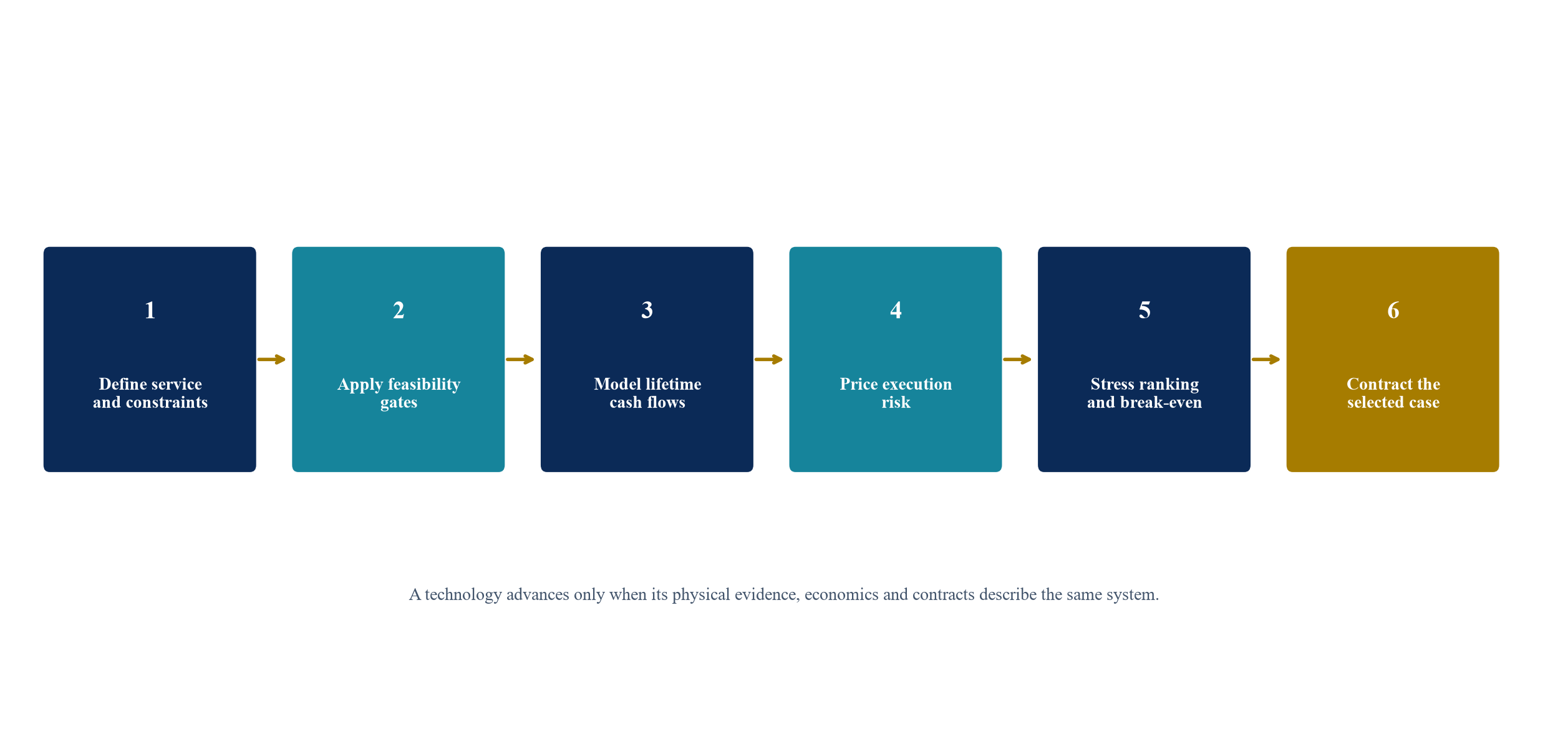
The project first applies non-negotiable feasibility gates, then values lifetime cash flows and execution risk.
22. Set weights from project value
Weights should reflect the project's sources of value and loss. A land-constrained data-centre site may place greater weight on footprint, reliability and integration. A remote renewable project may emphasise delivered cost, logistics, cycle life and service. A cold-climate project may increase the weight of retained output and heating load.
Every weight should have an owner and a reason. The investment committee should approve the weights before it reviews vendor scores. Changing weights after bids arrive can disguise preference as analysis.
The scoring scale should also be defined. A five-point scale can work when each point has an evidence threshold. For example, a bankability score of five could require operating history, accepted tests, audited support, a financeable warranty and proven service coverage. A score of two might reflect limited field evidence and dependence on uncommitted support.
23. Convert technical differences into cash flows
The model should calculate the economic consequence of each technical input. Lower density affects land and construction. Lower efficiency affects charging cost and deliverable energy. Higher degradation affects augmentation and availability. Temperature performance affects auxiliary load and output.
This conversion avoids double counting. A chemistry should not receive a higher technical score for cycle life and a separate valuation premium that already includes the same avoided replacement. The scorecard can summarise evidence; the discounted cash-flow model should carry the financial effect once.
The model should preserve uncertainty. Product data can be entered as a range, with the base case limited to warranted or independently supported performance. Aspirational roadmaps belong in an upside case with a probability and decision date.
24. Use a common dispatch and degradation model
All chemistries should be tested against the same market prices, connection, service obligations and dispatch logic. Chemistry-specific efficiency, power, state-of-charge, temperature and degradation inputs can then change the outcome. Separate dispatch models make comparison difficult because differences may come from assumptions rather than technology.
The optimiser should respect warranty and safety limits. It should model unavailable periods, maintenance, augmentation and any operating restriction required by the offtake agreement. It should also show annual throughput, equivalent full cycles and time at high state of charge.
The output should reconcile revenue, charging cost, losses and degradation cost. The investment committee can then see whether a chemistry earns more gross revenue, preserves more value or simply consumes more of its lifetime entitlement.
25. Align warranties with the financial model
Battery warranties can cover product defects, capacity retention, energy throughput, availability or combinations of these measures. The financial model should use the same boundary, test method, exclusions and remedy. A promised capacity curve has limited value if the owner's operating pattern falls outside the warranty.
The contract should state how capacity is tested, how state of charge and temperature are normalised, who controls dispatch data and how disputes are resolved. It should define cure timing, replacement scope, freight, labour, recommissioning and lost revenue. A cell replacement remedy can leave substantial owner cost.
Warranty credit should be discounted for counterparty risk and recovery delay. Parent support, reserve accounts, letters of credit or insurance can improve the value of the promise when the supplier's long-term credit is uncertain.
26. Use a controlled hypothetical case
Consider a hypothetical 100 MW / 400 MWh battery with a twenty-year operating period. The project has sufficient land for any of the three configurations, a moderate summer cooling load, occasional sub-zero winter operation and a daily cycling duty. All values in this case demonstrate the method and are not market quotes, forecasts or recommendations.
The project assigns 22 percent of the decision weight to lifetime cost, 18 percent to delivered energy and degradation, 12 percent to footprint, 16 percent to safety and permitting, 12 percent to supply-chain resilience, 12 percent to financeability and 8 percent to end-of-life and regulation. The team scores each option from one to five against defined evidence thresholds.
Table 2. Hypothetical weighted chemistry score for a stationary asset
| Criterion | Weight | LFP score | NMC score | Sodium-ion score | Evidence required |
|---|---|---|---|---|---|
| Lifetime installed cost | 22% | 4.5 | 2.8 | 3.4 | Normalised bid, operating cost, augmentation and residual value |
| Delivered energy and degradation | 18% | 4.4 | 4.0 | 3.5 | Common dispatch model and warranted performance |
| Footprint and mass | 12% | 3.2 | 4.8 | 2.5 | Compliant site layout and structural design |
| Safety and permitting | 16% | 4.2 | 2.8 | 3.7 | Representative tests, authority review and design controls |
| Supply-chain resilience | 12% | 2.6 | 3.3 | 2.0 | Origin map, capacity, alternatives and replacement plan |
| Financeability | 12% | 4.7 | 4.0 | 2.2 | Operating history, warranty, service and credit support |
| End of life and regulation | 8% | 3.8 | 3.3 | 3.6 | Carbon data, recycling and compliance package |
| Weighted score | 100% | 4.02 | 3.50 | 3.06 | Sum of weight multiplied by score |
Constructed scores on a one-to-five scale. The weights and scores illustrate the method and do not describe an actual product or project.
The central ranking favours LFP because the hypothetical site does not monetise NMC's density sufficiently and sodium-ion carries a bankability penalty. The result is conditional. A smaller site, colder climate, different supplier package or lithium-price shock can change the ranking.
27. Read the score as a valuation bridge
The score is a governance aid. The valuation should show the cash difference. In the constructed case, LFP provides the lowest lifetime cost and strongest financeability. NMC avoids some land and structural cost but does not recover its higher system price and safety-control burden. Sodium-ion reduces cold-weather energy loss but requires additional contingency and a higher discount for supplier and replacement risk.
Each disadvantage should have a break-even value. NMC might become preferable if avoided site and building cost exceeds its cost and risk premium. Sodium-ion might become preferable if avoided heating, retained winter output and lithium-price protection exceed the cost of lower density and immature supply.
This bridge guides negotiation. A vendor can improve its position through price, performance guarantees, evidence, parent support, service or replacement commitments. The project should update the bridge as bids develop.
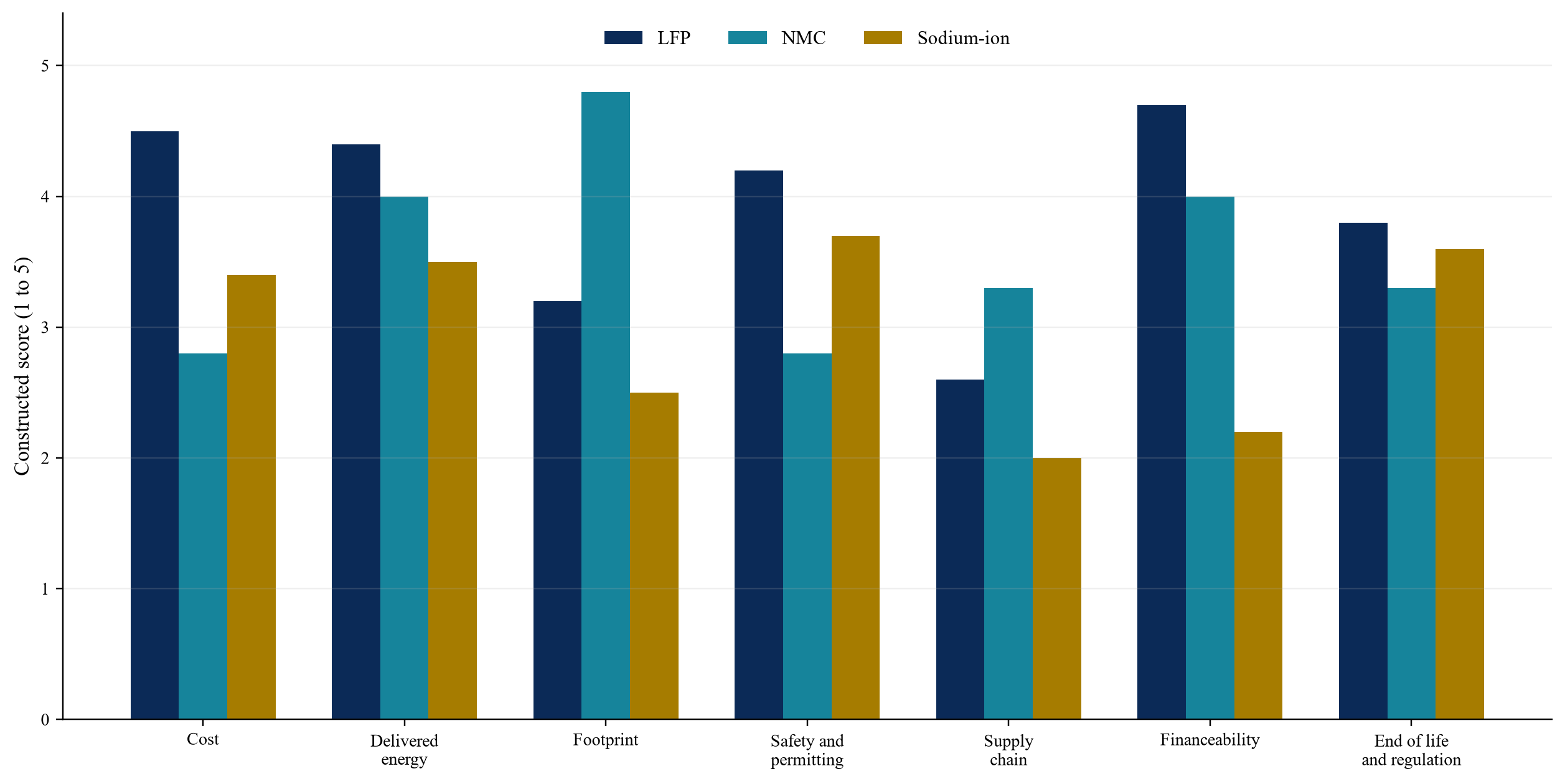
Hypothetical one-to-five scores from Table 2. Values demonstrate the selection method and are not product ratings.
28. Stress the ranking with project scenarios
The central score should be recalculated under distinct project conditions. A space-constrained case raises the footprint weight and applies real avoided-site cost. A cold-climate case uses hourly temperatures and auxiliary loads. A supply-disruption case changes cell prices, delivery timing and replacement availability. A financing case changes debt terms by technology and supplier.
The project should also test operating changes. A battery procured for one cycle a day may later provide ancillary services, capacity or more frequent intraday trading. The chemistry and warranty should preserve reasonable adaptation.
Sensitivity output should distinguish total-project value from chemistry preference. A fall in market spreads can reduce the value of every option without changing the ranking. A land constraint can change the ranking even when market revenue is constant.
29. Use break-even tests instead of point forecasts
Break-even tests show the value required to justify a departure from the reference case. For NMC, the model can solve for the land value, construction saving or additional revenue needed to offset higher system and risk costs. For sodium-ion, it can solve for the lithium price, avoided heating cost, winter output or supplier support required.
These thresholds can be compared with observable project evidence. If the land saving needed is twice the appraised site value, the density argument is weak. If sodium-ion becomes preferable with a modest winter-output improvement that a warranted test supports, the option deserves deeper diligence.
The investment committee should approve the threshold and the evidence source. This is more reliable than selecting a single forecast from a wide range.
30. Structure procurement to preserve competition
Procurement should define performance at the system boundary and allow qualified chemistry alternatives where the site permits. Bidders should submit a normalised technical and commercial schedule. The schedule should disclose nameplate and usable energy, degradation, efficiency, auxiliary load, footprint, tests, warranties, origins, service and exclusions.
The project can use a two-stage process. The first stage confirms feasibility, evidence and indicative economics. The second stage requests binding terms from a shortlist. This structure avoids spending detailed diligence on options that fail a hard gate.
Bid validity and substitution rights require care in a fast-changing market. The contract should prevent an unreviewed change in cell, factory, module, firmware or safety configuration. Approved substitutions should repeat the relevant technical, regulatory and financing review.
31. Allocate chemistry risk in the contracts
The supply agreement, EPC contract, long-term service agreement, offtake agreement and financing documents should describe the same system. Each should use consistent definitions for capacity, power, availability, efficiency, degradation and acceptance.
Table 3. Contract controls for chemistry-specific investment risk
| Risk | Evidence before commitment | Contract control | Financing response |
|---|---|---|---|
| Product change | Final bill of materials, factory and configuration | Prior consent and repeat testing for material change | Drawstop until technical review completes |
| Performance shortfall | Common model and acceptance protocol | Capacity, efficiency and availability remedies | Base-case sizing to warranted output |
| Degradation | Duty-specific forecast and warranty | Throughput, temperature and state-of-charge definitions | Augmentation reserve and downside case |
| Safety and permitting | Representative test reports and authority path | Compliance, redesign and delay responsibility | Contingency, insurance and completion support |
| Supply interruption | Origin map and replacement plan | Alternative-source, spares and step-in rights | Liquidity reserve and replacement sensitivity |
| Supplier credit | Audited financials and support structure | Parent guarantee, security or funded support | Recovery haircut and counterparty limits |
| End of life | Recycling route and cost evidence | Take-back, data and compliance obligations | Decommissioning reserve |
Illustrative control schedule. Final allocation depends on the project, jurisdiction, counterparties and governing law.
The contract should assign each interface. A system integrator should not exclude cell performance while the cell manufacturer avoids direct owner obligations. The owner needs a coherent recovery path for the complete delivered system.
32. Finance the warranted case
Debt sizing should use output, degradation and availability that lenders can verify and enforce. Upside from future chemistry improvement, lower replacement cost or merchant flexibility can support equity value but should not fund fixed debt service without evidence.
The financing model should include chemistry-specific contingencies. These can cover augmentation, extended commissioning, test failure, replacement, warranty delay and obsolescence. Reserve sizing should use dated downside cash flows rather than a flat percentage of capital cost.
Lender technical advice should review the proposed configuration and operating duty. Reliance on a general technology report can miss a new cell, factory, enclosure or control system. The independent review should reconcile engineering assumptions with the financial model and contracts.
33. Protect software and data continuity
Battery systems depend on battery management, energy management, power conversion and remote service software. Chemistry-specific controls can determine state estimation, thermal limits, balancing and warranty compliance. The owner should understand who controls these systems and what happens if a supplier exits.
The project should secure data access, interfaces, cybersecurity obligations, update controls and continuity rights. It should preserve time-series data needed to prove performance and warranty claims. A supplier should not be the only party able to interpret the evidence used to judge its own liability.
Change-of-control and insolvency provisions should address licences, source materials where justified, credentials, cloud services and replacement support. These rights affect the transfer value of the asset.
34. Plan recycling and decommissioning before close
End-of-life value can include recoverable materials, reusable equipment and avoided disposal cost. It can also include transport, hazardous handling, site restoration and regulatory obligations. Chemistry affects the material mix and the economics of recovery.
The project should obtain a documented route for recycling or take-back and test the counterparty's capacity. A nominal scrap value should not be included without a credible market, cost and date. Decommissioning security should reflect the owner's residual obligation if the supplier or recycler fails.
The EU framework increases the value of traceability and life-cycle data for covered markets. Similar customer and financing requirements can apply outside the EU. The data room should retain bill-of-materials, origin, carbon and end-of-life evidence in a transferable form.
35. Value portfolio standardisation and diversification
A portfolio can benefit from standardising cells, containers, controls, spares and service. Standardisation can reduce engineering, inventory, training and downtime. It can also concentrate recall, supplier, firmware and supply-chain risk.
The portfolio model should compare a single-chemistry strategy with controlled diversification. A second chemistry can provide a hedge against material prices, product failure or supplier disruption, while increasing complexity. The optimal choice depends on portfolio scale, geography and operating duty.
Sodium-ion may enter first as a targeted portfolio option in cold or less space-constrained sites. NMC may remain in compact installations. LFP can remain the common platform for routine utility-scale assets. The portfolio should define where exceptions create measurable value.
36. Build the chemistry data room
The data room should contain cell and system specifications, factory identity, bill of materials, origin evidence, test reports, certifications, failure analysis, warranties, service plans, software architecture, dispatch assumptions, degradation models, insurance indications and regulatory mapping.
It should connect evidence to the exact offered configuration. Test reports for another cell or enclosure should be identified as such and supported by an engineering equivalence analysis where allowed. Redactions should not remove the information needed to evaluate risk.
The financial model, technical model and contracts should share version control. A late product substitution can invalidate several workstreams at once. The transaction team should maintain a decision log for material changes.
37. Apply seven approval gates
The process begins with service and site requirements. It then confirms product evidence, models lifetime performance, tests safety and approvals, reviews supply and counterparties, negotiates contracts and completes the valuation and financing reconciliation.
Each gate should have a named decision, required evidence and failure response. A project can pause, reject, redesign or request additional support. Conditional approval should state the condition and deadline.
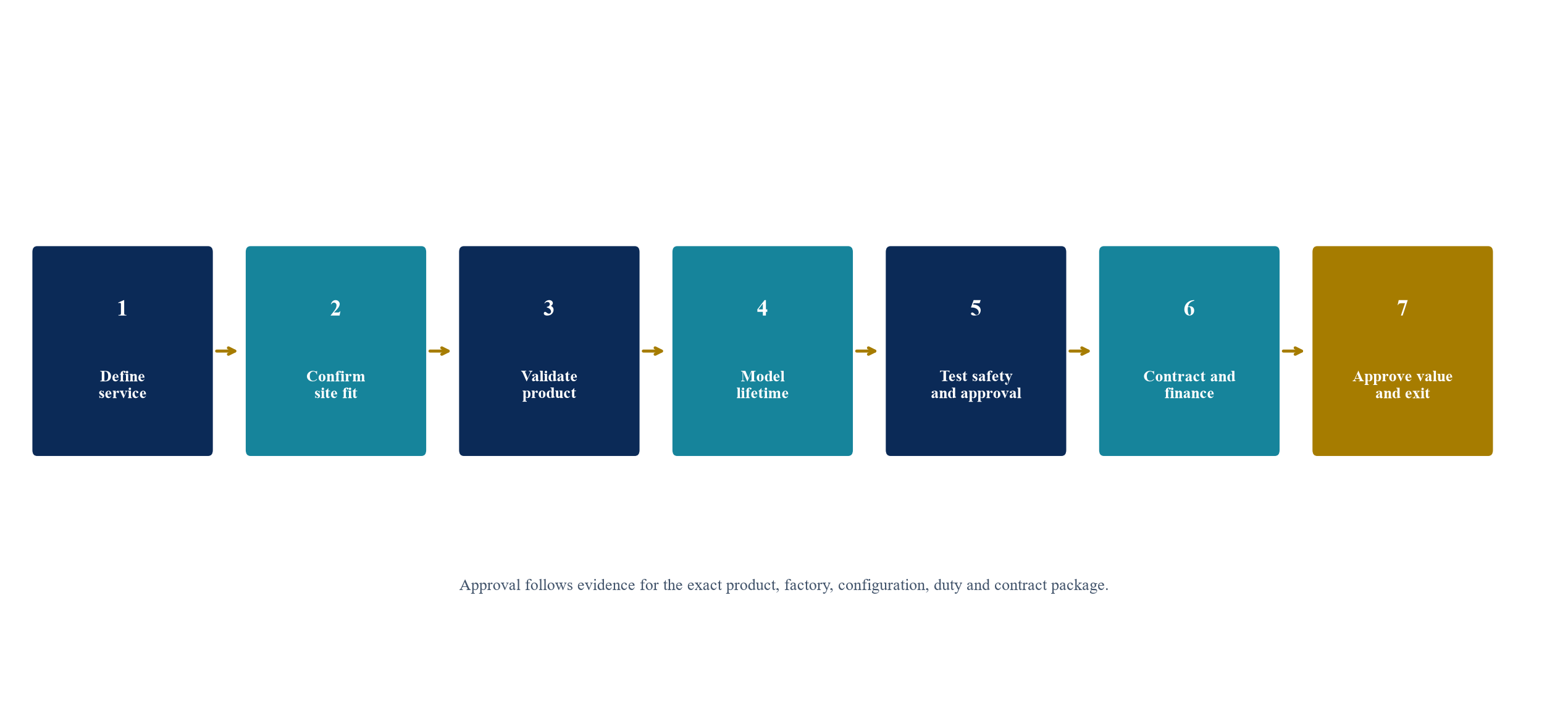
Governance sequence for development, procurement, financing and acquisition review.
38. Recognise limits and research needs
Public comparisons often mix cell, pack and installed-system data. Products change quickly, supplier claims use different test conditions and operating records can be confidential. Market shares and announced factories do not prove future production or project availability.
The constructed scorecard in this paper illustrates a method. It does not rate a named product or estimate the cost, safety, tax treatment or preferred chemistry of a particular project. Engineering, fire, environmental, regulatory, legal, tax and financing conclusions require project-specific advice.
Further research should publish comparable field data for efficiency, degradation, auxiliary load, failure, maintenance and end-of-life across climates and duties. Standardised reporting at the installed-system boundary would improve procurement, finance and transaction valuation.
39. Conclusion
Chemistry is a capital-allocation decision because it changes the system that earns, preserves and transfers project value. LFP is the current stationary reference case because market scale, cost, cycle suitability and maturity align with frequent grid operation. NMC can justify its premium where density creates measurable site or revenue value. Sodium-ion can add value in severe cold or as a strategic supply option when performance and support are proven.
The selection process should begin with the service and hard constraints. It should then compare installed lifetime cash flows, safety evidence, degradation, supply-chain resilience, regulation, contracts and financing. A weighted score can organise the evidence, while the valuation bridge and break-even tests make the decision economic.
The preferred chemistry is conditional on the site, duty, supplier and contract. A disciplined process preserves that condition through procurement, financial close, operation and exit.
References
- International Energy Agency, Global Energy Review 2026: Technology: Battery Storage, 2026. https://www.iea.org/reports/global-energy-review-2026/technology-battery-storage
- International Energy Agency, Global EV Outlook 2026: Electric Vehicle Batteries, 2026. https://www.iea.org/reports/global-ev-outlook-2026/electric-vehicle-batteries
- International Energy Agency, Sodium-Ion Battery Momentum Grows, but Challenges Remain, 2026. https://www.iea.org/commentaries/sodium-ion-battery-momentum-grows-but-challenges-remain
- International Energy Agency, Batteries and Secure Energy Transitions, 2024. https://www.iea.org/reports/batteries-and-secure-energy-transitions
- International Energy Agency, Global EV Outlook 2025: Electric Vehicle Batteries, 2025. https://www.iea.org/reports/global-ev-outlook-2025/electric-vehicle-batteries
- International Energy Agency, Global EV Outlook 2024: Trends in Electric Vehicle Batteries, 2024. https://www.iea.org/reports/global-ev-outlook-2024/trends-in-electric-vehicle-batteries
- International Energy Agency, Global Battery Markets Are Growing Strongly and So Are the Supply Risks, 2026. https://www.iea.org/commentaries/global-battery-markets-are-growing-strongly-and-so-are-the-supply-risks
- National Renewable Energy Laboratory, Annual Technology Baseline 2024: Utility-Scale Battery Storage, 2024. https://atb.nrel.gov/electricity/2024b/utility-scale_battery_storage
- Cole, W., and Karmakar, A., Cost Projections for Utility-Scale Battery Storage: 2023 Update, National Renewable Energy Laboratory, 2023. https://www.nrel.gov/docs/fy23osti/85332.pdf
- U.S. Department of Energy, Energy Storage Safety Strategic Plan, 2024. https://www.energy.gov/sites/default/files/2024-05/EED_2827_FIG_SafetyStrategy%20240505v2.pdf
- U.S. Department of Energy, Electricity Storage Technology Review, 2020. https://www.energy.gov/sites/default/files/2020/10/f79/Electricity%20Storage%20Technologies%20%20Report.pdf
- UL Solutions, Installation Codes and Requirements for Energy Storage Systems: FAQs, 2026. https://www.ul.com/resources/installation-codes-and-requirements-energy-storage-systems-ess-faqs
- UL Solutions, Understanding UL 9540A, NFPA 855 and Large-Scale Fire Testing for Battery Energy Storage Systems, 2026. https://www.ul.com/thecodeauthority/knowledge/understanding-UL-9540A-NFPA-855
- European Parliament and Council, Regulation (EU) 2023/1542 Concerning Batteries and Waste Batteries, 2023. https://eur-lex.europa.eu/legal-content/EN/TXT/?uri=CELEX:32023R1542
- European Commission Joint Research Centre, Calculating the Carbon Footprint of Industrial Batteries: A Methodological Support, 2025. https://joint-research-centre.ec.europa.eu/jrc-news-and-updates/calculating-carbon-footprint-industrial-batteries-methodological-support-2025-05-28_en
- International Renewable Energy Agency, Renewable Power Generation Costs in 2024, 2025. https://www.irena.org/Digital-Report/Renewable-Power-Generation-Costs-in-2024
- Federal Energy Regulatory Commission Staff, Hybrid Resources White Paper, Docket AD20-9-000, 2021. https://www.ferc.gov/sites/default/files/2021-05/white-paper-hybrid-resources.pdf
- Australian Energy Market Operator, Integrating Energy Storage Systems, updated 2025. https://tech-specs.docs.public.aemo.com.au/Content/TSP_EMMS_June2024/Integrating_Energy_Storage.htm
About the Author
Chennakeshav (CK) is a corporate finance and investment banking executive with 25+ years of global experience in deal origination, structuring and execution across M&A, growth capital and corporate strategy. He has led value-creation mandates for founders, corporates and funds — bridging the boardroom view to hands-on execution and close.
His career spans Morgan Stanley, HSBC, Lloyds Banking Group, EWEC, ADQ portfolio companies and Emirates Growth Fund, across TMT, real estate, fintech, deeptech, cleantech, infrastructure and energy. He has partnered with C-suite leaders, private equity and venture funds, sovereign wealth funds and family offices to finance complex fund raises and scale-up ventures, and has led M&A due diligence, post-merger integration and business-transformation initiatives to create value.
At Matchpoint Partners he is Managing Partner, leading the firm's corporate finance, M&A and capital-raising practice. He holds an MBA from London Business School, an engineering degree from VTU and a Master of Laws (LLM, in progress) from UCL London.
An active start-up mentor, CK mentors at Techstars, DIFC FinTech Hive, Startup Grind, Founder Institute and IN5, serves as Entrepreneur Mentor in Residence (EMiR) at London Business School, and judges the Entrepreneurship World Cup.
LinkedIn: https://www.linkedin.com/in/ckadya/
Profile: https://www.matchpoint-partners.com/team/ck-adya.html
