

1. The acquisition question
A carbon-storage project is a coordinated set of rights and obligations. The physical reservoir matters, yet it generates no cash without authority to appraise, inject, monitor and close; surface and subsurface access; carbon dioxide transport; customers; metering; environmental-accounting rules; and capital for construction and long-term stewardship. The acquisition question is therefore which legal entity and contract package controls an executable storage service.
The buyer should identify the decision it is making. It may acquire a development platform, a permitted project, an operating storage asset, a minority interest, a portfolio of licences or a transport-and-storage system. Each perimeter has a different risk allocation. A platform valuation can include development options. An operating-asset valuation should be supported by permitted capacity, available infrastructure and contracted cash flow.
2. The storage-rights stack
Storage rights can include exploration or appraisal authority, rights to use pore space, a storage licence, a lease, an injection-well permit, environmental approvals, surface rights and access to monitoring areas. These rights may not sit in one company. Their duration and transfer rules may differ.
The UK North Sea Transition Authority states that anyone wishing to explore for or use a geological feature for long-term offshore carbon dioxide storage must hold a carbon-storage licence. It also notes that a Crown Estate lease is required, among other consents. In the United States, state property law can govern pore-space ownership while the Environmental Protection Agency or a state with primacy regulates Class VI injection wells. A transaction map should show every right, owner, authority, expiry date and consent.
3. Transaction perimeter
The perimeter should include assets, liabilities, rights, contracts, data, employees and systems needed to deliver the storage service. It should also show what remains with the seller. Shared subsurface models, seismic data, wells, pipelines, control rooms, permits, insurance and carbon-accounting systems can create dependencies after closing.
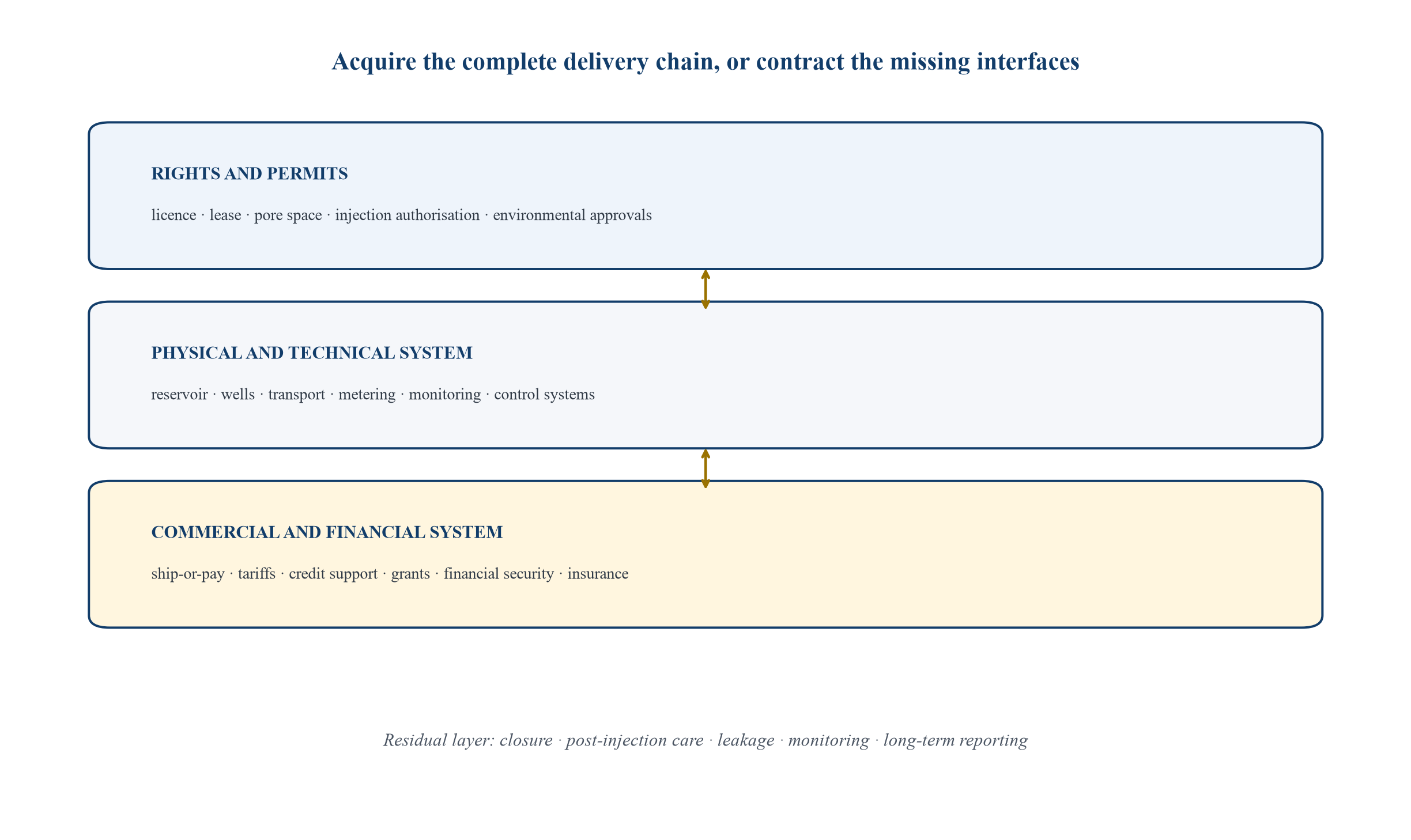
Generic framework. Applicable rights and authorities depend on jurisdiction and project structure.
4. Share purchase or asset purchase
A share purchase can preserve the permit holder, contractual counterparty, staff and operating history. It also transfers historic liabilities within the acquired entities. Change-of-control clauses, regulatory approvals, licence terms and financing documents can still require consent.
An asset purchase can select assets and assumed liabilities. It may require assignment, novation, new licences, permit modification, land transfer, data rights and employee arrangements. Carbon-storage permissions can be personal to an operator or conditioned on technical and financial capacity. The legal perimeter should therefore be compared with the regulatory perimeter before a structure is chosen.
5. Geological capacity is not one number
Headline pore volume is not equivalent to saleable capacity. Capacity depends on geology, pressure, injectivity, plume behaviour, faults, legacy wells, well count, operating limits, monitoring and regulatory approval. The amount accepted by an authority can differ from a developer's theoretical estimate.
The buyer should reconcile resource, contingent, permitted and contracted capacity. It should identify the evidence standard and uncertainty range for each. A valuation should use capacity that can be accessed within the investment period after development, contingency and operating constraints. Expansion volume can be valued as a risked option.
Capacity should also be reconciled across rate and volume. A reservoir may have substantial theoretical volume while near-term injectivity limits annual throughput and revenue. Well spacing, pressure interference, compression, water management and maintenance affect the profile. The buyer should request an annual injection schedule by well and compare it with customer commitments, construction and the permit. The lower executable constraint should drive the base case.
6. Class VI permits in the United States
The EPA Class VI programme regulates wells used for long-term geological sequestration and protection of underground sources of drinking water. Requirements include site characterisation, plume and pressure-front modelling, area-of-review corrective action, well construction, testing, monitoring, plugging, post-injection care, emergency response and financial responsibility.
Each well requires a permit. The permitting authority may be the EPA or a state, territory or tribe with approved primary enforcement authority. A buyer should verify the precise permit status: application, completeness, draft permit, final permit, construction, authorisation to inject, operation, post-injection or closure. A submitted application is not an operating right.
7. UK offshore licence and lease
The Energy Act 2008 underpins the UK offshore carbon-storage licensing regime. The NSTA issues carbon-storage licences. A Crown Estate or Crown Estate Scotland lease is also required for relevant offshore storage activity, alongside other consents and approvals.
Diligence should distinguish the licence area, storage complex, permitted injection facilities and leased seabed. Work obligations, milestones, relinquishment, reporting, operator competence and financial capability should be reviewed. The buyer should confirm whether a transfer, assignment or change of control requires consent and whether the authority can amend, revoke or refuse the transaction.
8. European storage permits and responsibility
Directive 2009/31/EC establishes a European framework for geological storage. It addresses exploration, storage permits, operation, monitoring, corrective measures, closure, transfer of responsibility and financial security. Implementation occurs through national law and competent authorities.
The Directive requires financial security to cover permit obligations, including closure and post-closure obligations, and provides for transfer of responsibility to the competent authority after conditions are met. A buyer should examine national implementation, permit terms, security amount, adjustment process, closure plan, contribution mechanism and evidence required for eventual transfer.
9. Cross-border transport and the London Protocol
Offshore projects may depend on carbon dioxide exported from another country. The International Maritime Organization explains that the 2009 amendment to Article 6 of the London Protocol enables export for sub-seabed geological storage, subject to the Protocol's protection standards. In 2019, parties adopted a resolution allowing provisional application while the amendment awaits full entry into force.
Participating countries need declarations and arrangements covering permitting and responsibilities. A transaction should not treat a memorandum between governments as a complete commercial route. It should verify domestic implementation, bilateral arrangements, permits, specifications, liability, customs or waste classification where relevant, shipping or pipeline access and customer contracts.
10. Pore-space title
Subsurface ownership can be separated from surface and mineral interests. Split estates, public land, offshore jurisdiction and multiple owners can complicate control. The EPA's 2025 report to Congress notes long-term liability complications associated with split estates and multiple-resource ownership.
Title diligence should identify the owner, legal basis, spatial boundary, competing mineral or water rights, easements, unitisation, access, condemnation powers and disputes. The buyer should understand whether rights cover appraisal, injection, monitoring, remediation and post-closure access. A narrow injection right without monitoring access can create an incomplete asset.
11. Legacy wells and corrective action
Existing wells can create leakage pathways. Class VI requirements include identifying and addressing deficient wells in the area of review. Offshore depleted fields can contain historic wells drilled under different standards and ownership.
The buyer should obtain well records, integrity data, abandonment design, ownership, location uncertainty and corrective-action estimates. It should determine who bears cost if the area of review expands or a previously unknown well is discovered. Specific indemnities and escrows may be appropriate where the seller controlled historic operations.
Cost estimates should distinguish investigation, monitoring, re-entry, repair, plugging and contingency. Accessibility can determine cost offshore or in developed areas. A seller representation that wells were abandoned under the standards of their time does not establish suitability for new pressure conditions. Independent well review should inform the purchase price, permit plan and funded reserve.
12. Plume and pressure management
Stored carbon dioxide and the associated pressure front can extend beyond the injection point. Models should be updated with new data. Pressure management, brine production or additional wells may be required. The commercial impact can include lower injection rates, more capital and additional monitoring.
The buyer should test model calibration, uncertainty, boundary assumptions, fault behaviour and interference with neighbouring projects. Rights should cover the anticipated plume and pressure footprint. Cross-boundary migration and notification rules should be understood before capacity is valued.
13. Diligence heatmap
The heatmap links probability and value impact to a defined response. Red risks require a condition precedent, price protection or retained liability. Amber risks require funded mitigation and timetable. Green risks remain subject to ordinary representations and operating covenants.
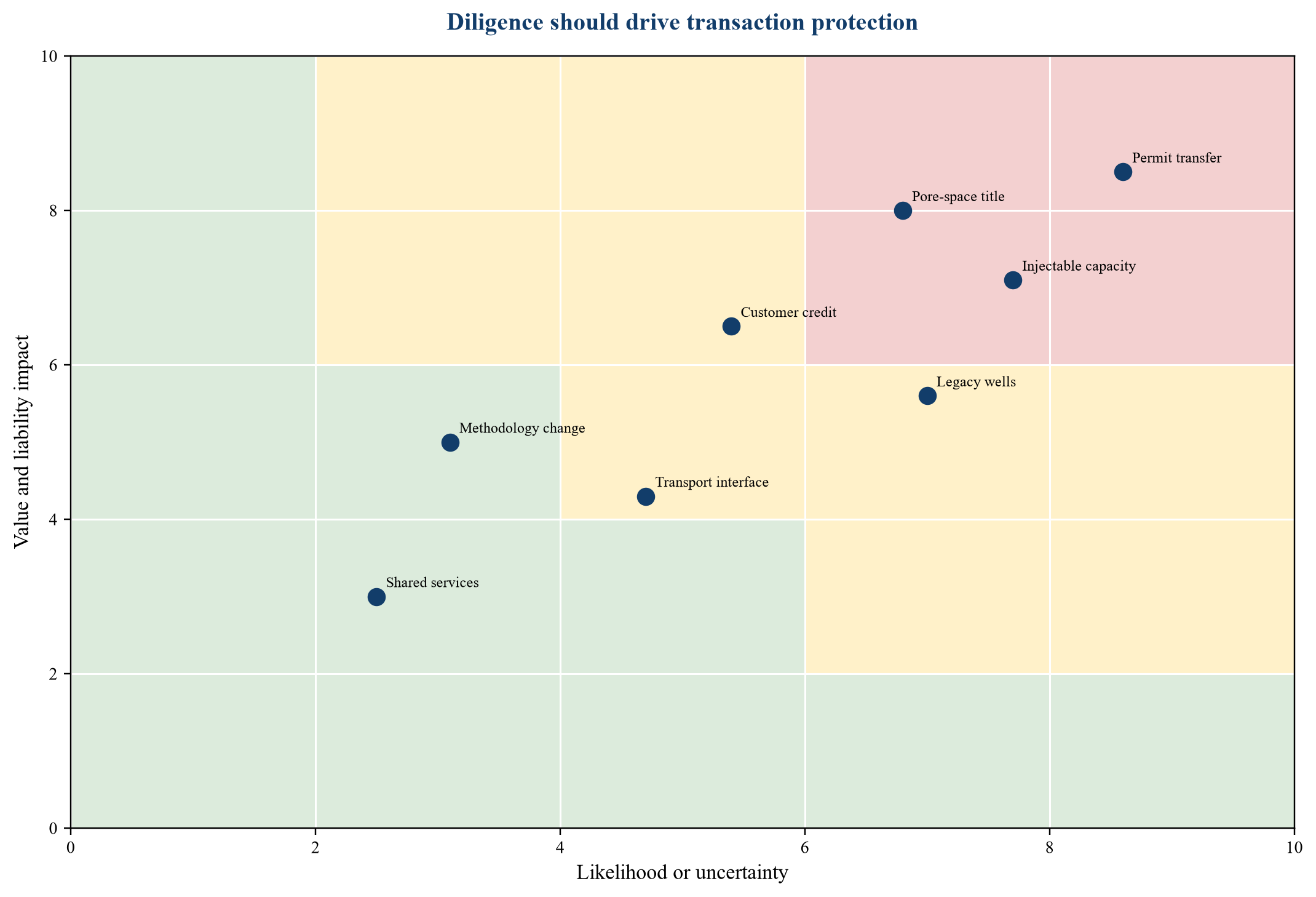
Illustrative prioritisation. Actual ratings require project-specific technical, legal and regulatory evidence.
14. Permit and rights register
Table 1. Transaction permit and rights register
| Item | Evidence | Transfer issue | Value consequence | Protection |
|---|---|---|---|---|
| Storage licence | executed licence, area, term and work programme | consent or change of control | loss or delay of development right | condition precedent and long-stop |
| Pore-space right or lease | title, spatial boundary and access | assignment, landlord or state consent | capacity and access impairment | title warranty and specific indemnity |
| Injection permit | application, final permit and authorisation status | operator qualification and modification | timing, rate and capacity reduction | staged price and regulatory covenant |
| Environmental approvals | approved plans and conditions | amendment on design or ownership change | additional capital and schedule | remediation plan and escrow |
| Monitoring and closure | approved plan and cost basis | continuing operator obligations | long-tail cash requirement | funded reserve and retained liability |
| Cross-border permission | treaties, declarations and domestic permits | country and route specific | inaccessible customer volume | closing condition and alternative route |
Generic diligence framework. Jurisdiction-specific legal advice is required.
15. Carbon dioxide supply and offtake
Storage businesses use transport-and-storage agreements, capacity reservation, ship-or-pay, take-or-pay, minimum-volume commitments and usage tariffs. The label matters less than the obligation. Diligence should identify committed volume, nomination, specifications, commissioning, shortfall, interruption, force majeure, credit support, price indexation and termination.
An emitter's future carbon dioxide depends on capture-plant performance and the continued operation of the underlying facility. A long contract with a weak or transitional emitter can be less valuable than diversified contracted volume. The buyer should model customer credit and physical delivery together.
Contract tenor should align with debt and infrastructure life. Renewal assumptions need evidence. Termination payments should cover stranded capital where the customer controls early exit, subject to credit support and enforceability. Portfolio concentration should be measured by revenue, committed volume and correlated industry exposure. Customers in the same sector can be affected by the same commodity, policy or technology shock.
16. Specifications and acceptance
Carbon dioxide streams can contain water, oxygen, sulphur compounds and other impurities. Specifications affect corrosion, phase behaviour, transport and storage. Different customers and networks may use different limits.
Contracts should define sampling, metering, rejection, blending, remediation and liability. The buyer should verify that capture plants can meet the network and storage specification across operating conditions. A technically available reservoir cannot earn revenue from off-specification streams that the system cannot accept.
17. Transport access
Pipelines, ships, terminals, compression and conditioning can sit outside the target. Capacity, scheduling and tariffs may be regulated or contracted. A storage acquisition with no firm transport route can remain stranded.
The buyer should review ownership, third-party access, expansion rights, priority, outage, nomination, interface standards and direct agreements. Transport commencement must align with storage readiness and customer capture. Delay allocation across three parties is a core bankability issue.
18. Tariff architecture
The tariff may include reservation, throughput, injection, monitoring, carbon-accounting and termination components. A reservation charge supports fixed cost; a variable charge covers operating volume. Indexation and pass-through can protect cost while weakening customer affordability.
The valuation should reconcile tariff with permitted rate, contracted capacity, customer credit and cost. It should distinguish revenue from unavailable capacity, customer shortfall and actual injection. Penalties can improve discipline but should not be assumed collectible beyond counterparty credit and contractual caps.
19. Carbon accounting and environmental attributes
The storage operator records received, injected and monitored carbon dioxide. Customers may rely on this evidence for regulatory surrender, tax incentives, voluntary claims or product accounting. The operator's data and control environment therefore supports commercial value.
Diligence should examine metering, uncertainty, chain of custody, reporting, verification, registry or government submissions and correction procedures. Contracts should allocate title to environmental attributes and risk of invalidation. The same stored quantity should not support incompatible claims.
20. Financial responsibility
The EPA requires Class VI owners or operators to maintain financial instruments covering corrective action, plugging, post-injection site care, closure and emergency response. The European framework also requires financial security for permit obligations. Amounts can change as plans and risks change.
Financial security can consume liquidity or credit capacity. A buyer should confirm approved instruments, providers, collateral, renewal, cancellation notice, cost estimates and adjustment history. Purchase price should reflect incremental security required after closing or expansion.
The replacement sequence matters. An authority may require the buyer's security before releasing the seller's instrument. This can create temporary double funding. The sale agreement should define cooperation, timing, fees and recourse if replacement is rejected. The acquisition financing should reserve headroom for an authority's revised cost estimate rather than rely on the seller's historic amount.
21. Closure and long-tail liability
Injection revenue ends before monitoring and closure obligations. The project may need decades of post-injection activity, depending on the regime and site. Transfer to a public authority, where available, requires evidence and satisfaction of conditions.
The model should include plugging, monitoring, remediation, site restoration, reporting and authority contributions. The buyer should identify liability that remains after a permit transfer or sale. A seller indemnity has limited value if the seller lacks durable credit support.
22. Insurance
Insurance can address construction, property, control of well, pollution and liability exposures within policy terms. Coverage for gradual pollution, subsurface migration, credit invalidation or very long-tail obligations may be limited.
The buyer should review policy wording, named insureds, retroactive dates, exclusions, limits, deductibles, claims history and change-of-control consequences. Insurance should be modelled as a recovery mechanism, not as a substitute for technical controls or funded obligations.
23. Valuation bridge
The illustrative bridge starts with contracted operating value, then adjusts for capacity evidence, development capital, permit timing, long-tail obligations and expansion options. Values are hypothetical indices.
Discount rates should reflect the stage and risk of each cash-flow stream. Contracted operating revenue, uncontracted utilisation, development options and closure obligations should not share one rate by convenience. Probability weighting can be used for discrete permit and expansion outcomes. Scenario analysis should test combined events because permit delay, customer delay and additional capex can arise from the same technical finding.
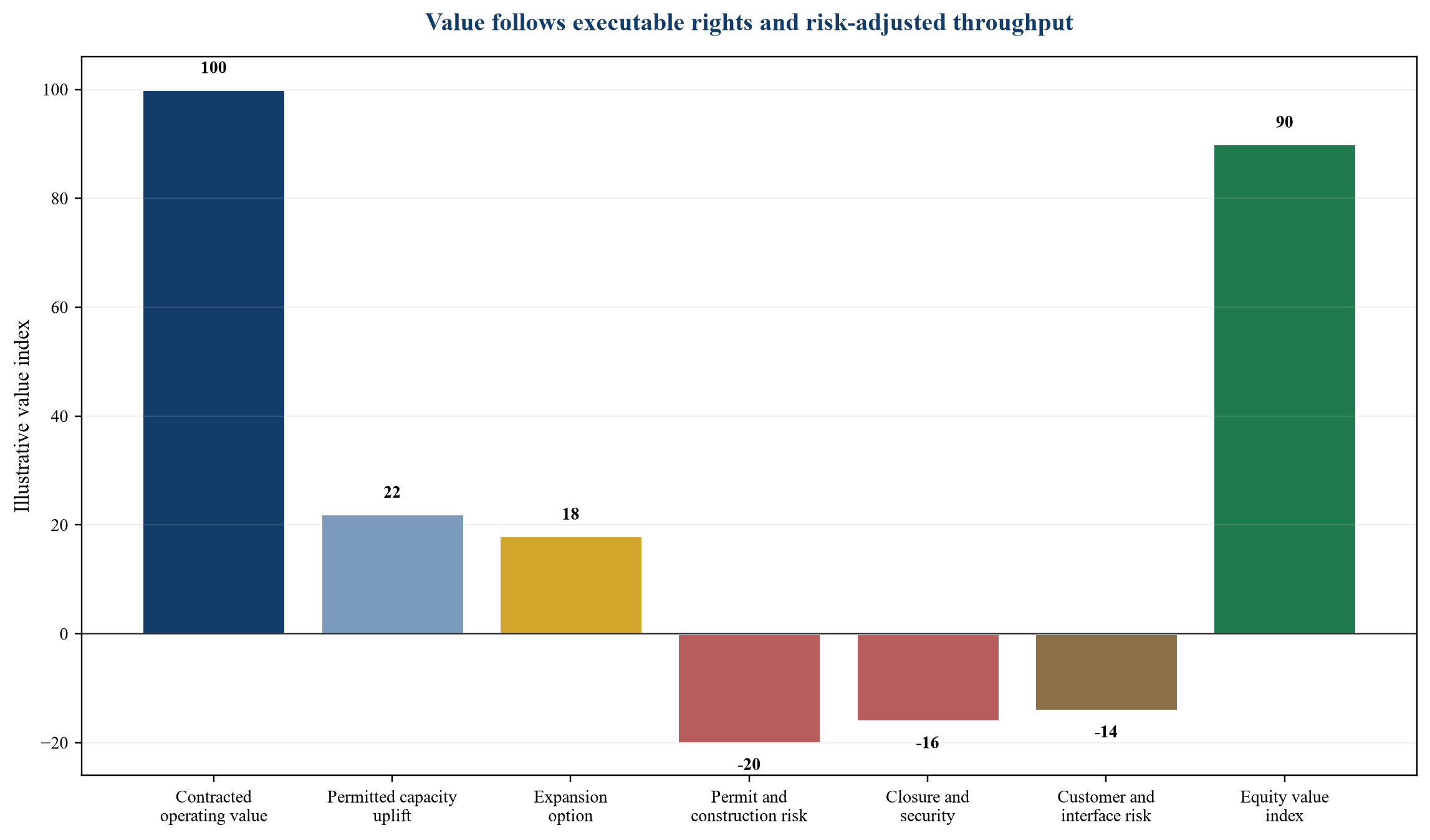
Illustrative index values only. The figure is not a valuation, forecast or market-data statement.
24. Contracted-value model
Table 2. Hypothetical contracted-value model
| Driver | Base index | Downside index | Diligence focus |
|---|---|---|---|
| Contracted reservation revenue | 70 | 52 | enforceable capacity commitment and customer credit |
| Throughput and injection revenue | 48 | 29 | capture availability, transport and permitted rate |
| Operating and transport-interface cost | (35) | (44) | allocation of energy, shipping and network cost |
| Monitoring and verification | (8) | (11) | permit and customer reporting scope |
| Maintenance and well intervention | (12) | (20) | well integrity and operating history |
| Closure and financial-security provision | (10) | (18) | approved cost basis and security mechanism |
| Contribution before financing | 53 | (12) | combined volume, cost and timing resilience |
Illustrative index values only. They are not market data, forecasts or transaction terms.
25. Development and expansion options
Unpermitted acreage, additional wells and adjacent stores can create option value. The option should be risked for title, data, appraisal, permitting, infrastructure, customer demand and future capital. A large theoretical capacity figure should not be capitalised at the operating-asset multiple.
Milestone valuation can assign value when appraisal, permit, contracting and final-investment-decision gates are achieved. Earn-outs or contingent value rights can bridge buyer and seller views while requiring clear measurement and control provisions.
26. Purchase-price mechanics
Completion accounts can adjust for cash, debt, working capital and specified provisions. Locked-box structures require confidence in leakage controls and liabilities. Storage transactions may need specific adjustments for grants, decommissioning security, customer prepayments, capex commitments and environmental obligations.
The buyer should avoid double counting a provision in enterprise value and completion accounts. Definitions should match the financial model. Disputed capacity or permit outcomes are often better addressed through contingent consideration than a general working-capital adjustment.
27. Representations and indemnities
Representations should cover title, permits, compliance, data, wells, contracts, claims, litigation, grants, tax, intellectual property, insurance and environmental matters. Disclosure should be specific enough to price risk.
Specific indemnities can address known legacy wells, contamination, permit breaches, grant clawback or historic operations. Caps, survival and security should match the possible loss period. Long-tail obligations may require escrow, guarantee or retained ownership rather than an unsecured promise.
28. Conditions precedent
Closing conditions can include regulatory approval, licence transfer, landlord or Crown consent, permit modification, customer novation, financing, financial-security replacement and absence of material adverse regulatory change. Conditions should be objectively drafted with a long-stop and cooperation covenant.
A buyer should not close on the assumption that an essential right will transfer later. A seller should not bear open-ended efforts obligations for approvals outside its control. Risk-sharing can include reverse termination fees, staged closing or interim operating arrangements.
29. Integration or separation roadmap
Table 3. Integration and separation roadmap
| Phase | Priority action | Evidence of completion | Principal risk |
|---|---|---|---|
| Signing to closing | secure regulatory and contractual consents | approvals, novations and replacement security | value leakage before control transfers |
| Day one | preserve safe operations and reporting | authority contacts, control room, monitoring and incident protocols | permit or safety breach |
| First 100 days | reconcile capacity, capex and customer plan | approved integrated operating and funding plan | inconsistent technical and commercial assumptions |
| Separation | replace seller systems, data and shared services | tested standalone systems and data custody | loss of modelling or compliance capability |
| Integration | align governance, finance and commercial portfolio | single risk register, investment gates and customer strategy | premature synergy or capex assumptions |
| Long term | fund closure, monitoring and expansion | ring-fenced obligations and approved expansion gates | underfunded tail liability |
Generic framework. Timing and workstreams depend on the transaction perimeter.
The roadmap should be costed before signing. Transitional service charges, systems replacement, retention, security replacement and duplicated teams can materially affect acquisition economics. Each workstream should have a regulator-facing owner and a transaction-facing owner. Completion evidence should be reviewed by governance rather than inferred from elapsed time. A delayed separation should trigger an agreed extension or contingency plan before operational control is impaired.
30. Investment committee decision
The committee should approve only a clearly defined perimeter supported by a rights map, permit register, independent capacity review, contracted-value model, closure provision and transition plan. It should know which value depends on operating rights at closing and which depends on future regulatory action.
The recommendation should state the maximum price before contingent consideration, required conditions, specific protections, funding reserve and stop rights. The buyer's return should survive a combined downside in permit timing, injectable rate, customer throughput and closure cost.
31. Tax credits, subsidies and grants
Public support can attach to capture, transport, storage, construction or verified tonnes. Eligibility may depend on ownership, commencement, labour, domestic content, reporting, tax status or continued operation. A change of control can require consent, notification or recapture analysis. The buyer should reconcile every incentive with the acquiring entity, transaction structure and post-closing operating plan.
Headline support should be converted into cash timing. Tax credits may require taxable capacity, transfer or monetisation. Grants may reimburse eligible cost after expenditure and audit. A seller may have recognised income before cash is secure. Diligence should review award documents, claims, cost allocation, compliance, clawback, assignment and audit rights. Purchase-price treatment should distinguish earned receivables, future support and seller-retained liabilities.
32. Data and subsurface models
Reservoir value depends on seismic data, well logs, cores, pressure tests, simulation models and interpretation. Data can be owned, licensed, confidential or subject to government release. Software licences and specialist workflows may sit with a parent company outside the target.
The buyer should inventory raw data, processed data, models, assumptions, version history, quality control and rights of use. It should test whether the model can be reproduced by the acquired team. A static report is insufficient if the underlying data and code cannot transfer. Transaction documents should require delivery, usable formats, licences, credentials and assistance. The separation plan should preserve authority reporting and model updates from signing through closing.
33. Digital systems and cyber risk
Operating storage assets rely on metering, telemetry, supervisory control, laboratory systems, reporting platforms and customer interfaces. A cyber incident can affect safety, custody measurement and regulatory reporting. Shared parent-company systems can create a day-one dependency.
Diligence should map operational technology, information technology, vendors, remote access, patching, backups, incident response and data retention. The buyer should identify systems that need transitional service agreements or replacement. Cyber representations should cover known incidents and compliance. The integration plan should avoid intrusive changes during injection or critical monitoring. Access rights should be reissued at closing and privileged seller access removed under a controlled procedure.
34. Community and stakeholder permissions
Permits do not eliminate social and political risk. Communities can raise concerns about safety, pipelines, traffic, property, water, induced seismicity and the distribution of benefits. The EPA encourages early engagement for Class VI projects and includes public participation in permitting.
The buyer should review consultation records, commitments, complaints, litigation, landowner arrangements, emergency coordination and environmental-justice analysis. Informal commitments can become material even when they are not in the permit. The transaction should allocate responsibility for historic statements and fund future commitments. Closing communications should identify the new owner, preserve emergency channels and avoid implying regulatory approval beyond what has been granted.
35. Health, safety and emergency response
Carbon dioxide can create asphyxiation and pressure hazards. Wells, pipelines, ships and terminals add construction and process-safety risks. Emergency plans should align across capture, transport and storage operators and local responders.
The buyer should examine hazard studies, incident history, training, exercises, alarms, dispersion modelling, exclusion zones, mutual aid and corrective actions. It should confirm that permits, contracts and insurance use compatible incident definitions. A seller's safety system may depend on group resources that do not transfer. Day-one readiness requires accountable personnel, communications, contractor controls and the ability to notify authorities and customers without delay.
36. Competition and third-party access
Transport and storage networks can display natural-monopoly characteristics. Regulation, licence conditions or funding agreements may require transparent access, tariff conduct or expansion for third parties. Exclusivity granted to anchor customers can conflict with access duties.
The buyer should review competition law, sector rules, regulated-asset boundaries, capacity allocation, congestion, affiliate transactions and customer discrimination. A valuation based on unrestricted tariff increases may be inconsistent with the licence or market design. Expansion economics should reflect access obligations and the capital contribution expected from new users. Merger-control analysis should consider regional storage and transport capacity as well as the parties' positions in capture and downstream markets.
37. Joint ventures and governance
Many storage projects are joint ventures among emitters, infrastructure companies, subsurface specialists and public entities. Governance can determine budget, capacity allocation, contracting, expansion, transfer and exit. A minority interest may have limited control over safety-critical capital or customer strategy.
Diligence should review reserved matters, voting thresholds, deadlock, operator appointment, budgets, default, dilution, related-party contracts, information rights and transfer restrictions. The buyer should model future capital calls and the consequences of non-funding. Governance rights should match the liabilities carried. A party exposed to closure or guarantee obligations needs sufficient information and influence to monitor risk.
38. Acquisition financing
Acquisition debt should be sized to cash flow that survives permit, throughput and customer downside. Lenders will examine security over shares, accounts, material contracts and assets; direct agreements; distributions; capex; financial security; and regulatory enforcement. Some licences or leases may restrict security or enforcement transfer.
The financing plan should separate acquisition debt, project capex and closure funding. A buyer can acquire a development platform with corporate capital and introduce project finance after permits and contracts mature. Debt documents should allow required monitoring and remediation spending. Cash sweeps can build reserves when injection volume exceeds the base case. Covenant cure should not divert funds needed for safe operation.
39. Seller financing and contingent consideration
Seller notes, earn-outs and capacity payments can bridge valuation uncertainty. They are useful where permits, injection tests or customer contracts will mature after closing. The metric must be observable and protected from manipulation.
A capacity earn-out should state whether capacity means licensed, permitted, independently certified, tested or contracted volume. A revenue earn-out should address tariffs, affiliate contracts, curtailment and buyer control of expansion. Seller debt should be subordinated to project and regulatory obligations where necessary. Set-off rights can connect contingent consideration to indemnity claims, subject to negotiated limits and dispute procedures.
40. Distressed and enforcement transactions
A distressed storage project can have valuable licences and data while lacking capital to satisfy work programmes or financial security. Insolvency can trigger regulatory concern, contract termination and loss of key staff. A secured lender's enforcement rights may not make it an acceptable operator.
The buyer should engage authorities early, identify cure periods and provide evidence of technical and financial capacity. An accelerated sale still requires title, permit, safety and funding diligence. Transaction structure should preserve continuity of monitoring and emergency response. Rescue capital may need priority and authority consent. Purchase-price savings should be tested against unpaid obligations, security replacement, restart cost and customer claims.
41. Accounting and provisioning
Financial statements may include exploration cost, capitalised development, grants, customer prepayments, asset-retirement obligations and provisions. Accounting judgements can differ from the transaction model. A provision recognised under accounting rules may not equal the cash required by a regulator or lender.
The buyer should reconcile fixed assets to the physical register, commitments and remaining construction. It should test useful lives, impairment triggers, grant conditions and restoration estimates. Customer prepayments should be mapped to future delivery obligations and refund rights. Deferred tax and tax-credit balances require separate diligence. The purchase-price allocation should distinguish tangible infrastructure, identifiable rights, contracts, data and goodwill.
42. Synergies and integration value
Potential synergies include shared transport, combined monitoring, customer diversification, procurement, financing and portfolio development. Each synergy should have an action, owner, cost, timing and dependency. Regulatory ring-fencing or customer protections can limit extraction.
Capacity synergy is particularly sensitive. Two projects cannot both claim the same pressure envelope, pipeline slot or customer volume. Technical teams should validate compatibility before the value is included. Cost savings should preserve competence, monitoring and emergency capability. Revenue synergy should be based on qualified customers and available capacity. The board should keep uncommitted synergy outside the price ceiling unless the buyer has a credible execution advantage.
43. Carve-out execution
A storage business carved from an energy or industrial group may depend on shared subsurface teams, procurement, treasury, insurance, legal, regulatory reporting, cyber systems and facilities. The seller may also retain capture assets that become customers of the target.
The separation schedule should list every dependency, replacement route, cost and exit criterion. Transitional services need service levels, information security, regulatory access and extension terms. Data migration should preserve model lineage and reporting evidence. Related-party transport-and-storage contracts should be negotiated on durable terms before closing. A buyer should budget the standalone cost rather than inheriting the seller's allocated corporate charge.
44. Final diligence checklist
The final committee pack should include a legal rights map, regulator-confirmed permit status, independent capacity and well review, contracted-volume schedule, customer credit assessment, transport-interface analysis, carbon-accounting control review, financial-security schedule, closure model and transition plan. Each material finding should be resolved, priced, allocated or identified as a condition.
The pack should reconcile capacity across technical, regulatory, commercial and financial documents. It should reconcile dates across permits, construction, transport, capture plants and customer commitments. It should reconcile liabilities across accounts, authority estimates, insurance and transaction documents. Unreconciled differences should remain visible. The acquisition recommendation should explain which risks the buyer can manage and which require seller or regulatory protection.
The committee should also receive a sources-and-uses schedule through closing and the first two years of ownership. It should include purchase consideration, fees, required security, committed capex, transition cost, customer prepayment treatment, working capital and reserves. Funding certainty should extend beyond acquisition consideration. A transaction that closes without enough capital to satisfy permit milestones or monitoring obligations can destroy the rights it acquired.
45. Sanctions, trade and shipping controls
Cross-border projects can involve ships, terminals, technology providers, insurers and customers in several jurisdictions. Sanctions, export controls, vessel restrictions and trade rules can affect equipment, financing and carbon dioxide movement. The buyer should screen counterparties, beneficial owners, vessels and critical suppliers and understand contractual rights if a route becomes prohibited.
Shipping contracts should address flag, class, port access, sanctions clauses, alternative routes and cargo specification. Technology licences should allow operation in the target geography and transfer on change of control. A transaction model should avoid assuming that all contracted international volume can be redirected without cost. Compliance systems need ownership, escalation and records from day one.
46. Change of law and methodology
Carbon-storage regulation, financial-security requirements, accounting rules and environmental methodologies can change during a long asset life. Contracts often allocate change-of-law cost by category. A broad pass-through can protect the operator while weakening customer affordability and credit.
The buyer should review existing allocation, reopening thresholds, termination and tariff adjustment. The financial model should include plausible compliance capex and operating cost. Methodology risk should be separated from physical storage risk. A change in crediting or reporting may reduce customer value without changing containment. Transaction documents can use a material-adverse-regulatory-change condition for defined pre-closing events and post-closing adjustment under customer contracts.
47. Leakage, remediation and credit replacement
Leakage can trigger monitoring, corrective action, permit enforcement, customer claims and environmental-attribute replacement. The physical event, regulatory determination and commercial remedy may use different thresholds. The buyer should map them before quantifying exposure.
Technical diligence should examine detection capability, response plans, wells, faults and pressure management. Legal diligence should examine responsibility, limitation, reporting and transfer of liability. Commercial contracts should define when stored units fail, who replaces them and whether replacement is in kind or cash. The valuation should include funded response and a severe scenario. Insurance and seller protection should be assessed against the duration and scope of possible claims.
48. Portfolio strategy
A portfolio can diversify geology, permitting, customers and transport routes. It can also concentrate shared technology, policy and capital risk. Portfolio value should be built from project-level capacity and contracts, then adjusted for genuine diversification and shared infrastructure.
The buyer should rank stores by readiness, strategic route and incremental capital. Development spending can be staged to preserve options while avoiding simultaneous commitments. Common customer contracts and specifications can improve flexibility where networks interconnect. Subsurface capacity cannot be moved between regions, so portfolio labels do not remove local constraints. Governance should compare capital across stores using consistent technical, commercial and liability measures.
49. Post-closing value-control system
The board should maintain one integrated register connecting rights, permit conditions, capacity, wells, customers, capex, financial security and closure obligations. Each value driver should have an owner and evidence source. Each material risk should have a limit, trigger and funded response.
Monthly reporting should reconcile nominations, accepted carbon dioxide, injected volume, availability, metering differences, operating cost and customer billing. Quarterly reporting should update capacity models, area of review, permit milestones, long-term provisions and downside liquidity. Investment decisions should use the latest reconciled case. This system allows management to identify whether value change comes from geology, regulation, customer performance, execution or financing and to act before a covenant or permit threshold is breached.
50. Conclusion
Geological carbon storage is acquired through a chain of legal, technical, commercial and financial rights. Headline pore volume has limited value until it is converted into permitted, accessible, monitored and contracted injection capacity. Transaction diligence should follow that conversion chain.
The buyer should map title, licences, permits, wells, plume, transport, customers, carbon accounting, financial security and long-tail obligations into one model. Transaction structure and documentation should then allocate risks that cannot be eliminated. This discipline allows CCUS M&A to price an executable storage service rather than an unbounded subsurface promise.
References
- US Environmental Protection Agency. Class VI Wells Used for Geologic Sequestration of Carbon Dioxide. https://www.epa.gov/uic/class-vi-wells-used-geologic-sequestration-carbon-dioxide
- US Environmental Protection Agency. Federal Requirements Under the UIC Program for Carbon Dioxide Geologic Sequestration Wells Final Rule. https://www.epa.gov/uic/federal-requirements-under-underground-injection-control-uic-program-carbon-dioxide-co2
- US Environmental Protection Agency. Final Class VI Guidance Documents. https://www.epa.gov/uic/final-class-vi-guidance-documents
- US Environmental Protection Agency. Geologic Sequestration of Carbon Dioxide in Deep Saline Formations: Report to Congress. January 2025. https://www.epa.gov/system/files/documents/2025-01/deepsalineformation_rtc_jan2025.pdf
- North Sea Transition Authority. Carbon Storage Licensing. https://www.nstauthority.co.uk/regulatory-information/carbon-storage/carbon-storage-licensing/
- United Kingdom. Energy Act 2008. https://www.legislation.gov.uk/ukpga/2008/32/contents
- European Union. Directive 2009/31/EC on the geological storage of carbon dioxide. https://eur-lex.europa.eu/eli/dir/2009/31/oj/eng
- International Maritime Organization. Carbon Capture and Sequestration. https://www.imo.org/en/ourwork/environment/pages/ccs-default.aspx
- International Maritime Organization. Resolution LP.5(14): Provisional Application of the 2009 Amendment to Article 6 of the London Protocol. 2019. https://wwwcdn.imo.org/localresources/en/OurWork/Environment/Documents/LC_LP/LP%20provisional%20application%202009%20amendment.pdf
- International Maritime Organization. 2012 Specific Guidelines for the Assessment of Carbon Dioxide Streams for Disposal into Sub-seabed Geological Formations. https://wwwcdn.imo.org/localresources/en/OurWork/Environment/Documents/2012%20SPECIFIC%20GUIDELINES%20FOR%20THE%20ASSESSMENT%20OF%20CARBON%20DIOXIDE.pdf
- International Energy Agency. Carbon Capture, Utilisation and Storage. https://www.iea.org/fuels-and-technologies/carbon-capture-utilisation-and-storage/
- Intergovernmental Panel on Climate Change. Climate Change 2022: Mitigation of Climate Change. Working Group III contribution to the Sixth Assessment Report. https://www.ipcc.ch/report/ar6/wg3/
- Global CCS Institute. Global Status of CCS. https://www.globalccsinstitute.com/resources/global-status-report/
- ISO. ISO 27914:2017 Carbon dioxide capture, transportation and geological storage: Geological storage.
- ISO. ISO 27916:2019 Carbon dioxide capture, transportation and geological storage: Carbon dioxide storage using enhanced oil recovery.
About the Author
Chennakeshav (CK) is a corporate finance and investment banking executive with 25+ years of global experience in deal origination, structuring and execution across M&A, growth capital and corporate strategy. He has led value-creation mandates for founders, corporates and funds — bridging the boardroom view to hands-on execution and close.
His career spans Morgan Stanley, HSBC, Lloyds Banking Group, EWEC, ADQ portfolio companies and Emirates Growth Fund, across TMT, real estate, fintech, deeptech, cleantech, infrastructure and energy. He has partnered with C-suite leaders, private equity and venture funds, sovereign wealth funds and family offices to finance complex fund raises and scale-up ventures, and has led M&A due diligence, post-merger integration and business-transformation initiatives to create value.
At Matchpoint Partners he is Managing Partner, leading the firm's corporate finance, M&A and capital-raising practice. He holds an MBA from London Business School, an engineering degree from VTU and a Master of Laws (LLM, in progress) from UCL London.
An active start-up mentor, CK mentors at Techstars, DIFC FinTech Hive, Startup Grind, Founder Institute and IN5, serves as Entrepreneur Mentor in Residence (EMiR) at London Business School, and judges the Entrepreneurship World Cup.
LinkedIn: https://www.linkedin.com/in/ckadya/
Profile: https://www.matchpoint-partners.com/team/ck-adya.html
