

1. Define the exit decision
The termination clause must answer a practical question: who receives what, when, and against which evidence if the project ends early? The answer affects lender appetite, debt sizing, sponsor returns, public affordability and continuity of an essential service.
The drafting exercise should begin before financial close and continue through contract management. A formula that appears precise can still fail if it omits payment timing, asset transfer, lender cure, dispute procedure, tax or funding authority.
2. Separate termination from expiry
Scheduled expiry is the planned end of the concession or offtake term. Early termination is an exceptional event triggered by a defined default, public decision, prolonged event or agreed settlement.
The two routes can share handback obligations, but their economics differ. Scheduled expiry normally assumes debt amortisation and planned asset condition. Early exit can crystallise debt and break costs while the public counterparty has little time to arrange replacement service.
3. Make cause control compensation
Termination compensation should vary with cause. Contracting-authority default and voluntary termination commonly provide stronger protection than project-company default. Prolonged force majeure or political events normally sit between those outcomes [1][2][3].
The event taxonomy should be exhaustive enough for financing and simple enough to administer. Ambiguous overlap between authority default, political force majeure, change in law and ordinary force majeure creates valuation disputes at the moment of greatest stress.
4. Identify the bankability problem
Lenders finance a ring-fenced project company whose main asset is a long-term contract. If that contract disappears, the physical plant may have limited alternative revenue and limited liquidation value.
World Bank guidance describes termination compensation as a key determinant of financeability. Lenders therefore assess the payment formula, direct agreement, cure rights, sovereign credit, appropriation process and enforceability as a single credit package [1][2].
5. Identify the fiscal problem
A termination promise is a contingent public obligation. Exposure can be highest soon after construction, when senior debt remains large and the asset has not generated enough cash to amortise it [5].
The procurer should estimate exposure by event and year, incorporate it into fiscal-risk reporting and define funding authority. A payment formula that lacks a credible payment mechanism does not provide lender protection and can conceal public risk.
Table 1. Termination event, evidence and compensation map
| Termination route | Core evidence | Typical compensation logic | Principal deductions | Control objective |
|---|---|---|---|---|
| Contracting-authority default | Notice, uncured breach, payment record, direct agreement compliance | Eligible senior debt, permitted break costs, third-party costs and defined equity compensation | Cash, insurance, hedge gains, amounts already recovered | Restore the protected financing position without windfall |
| Voluntary public termination | Valid public decision, approvals, valuation date and asset transfer plan | Financing liabilities plus contractually defined shareholder compensation and transition cost | Recoveries, avoided cost and excluded related-party amounts | Preserve public option while pricing it transparently |
| Project-company default | Default evidence, cure record, lender step-in process and asset valuation | Retender proceeds, fair value or a defined percentage or amount of eligible debt | Rectification, procurement, service-continuity and other permitted costs | Preserve lender discipline and avoid public windfall |
| Prolonged force majeure | Event evidence, relief period, mitigation record and insurance | Eligible debt and defined equity or invested capital, with limited break costs | Insurance and other recoveries | Share an event outside either party's control |
| Political event or change in law | Legal change, attribution, materiality and relief process | Often aligned with authority-risk compensation, subject to contract | Recoveries and mitigated cost | Allocate risks controlled or absorbed by the public side |
The allocation is illustrative. Executed law, procurement rules, financing documents and project-specific risk allocation govern each transaction.
6. Map the contract perimeter
The payment clause cannot be assessed in isolation. The PPA, water purchase agreement, concession, implementation agreement, land lease, fuel agreement, EPC contract, O&M contract, direct agreement, hedge and financing documents can all affect termination.
The contract map should show triggers, cure periods, cross-defaults, transfer obligations, payment priorities and survival clauses. A conflict between documents can delay payment or cause a liability to survive without a corresponding source of cash.
7. Map the parties
The relevant parties usually include the public procurer, utility or offtaker, project company, sponsors, lenders, facility agent, security trustee, EPC contractor, operator, fuel supplier, insurers, hedge providers and government support provider.
Each party has a different claim and control right. The model should distinguish obligations owed by the public counterparty from claims paid through the project company and from recoveries controlled by secured lenders.
8. Define the valuation date
The valuation date determines outstanding debt, accrued interest, cash, hedge value, insurance and asset condition. It may be the termination notice date, effective termination date, transfer date or payment date.
A clear rule should address cash flows between dates. Otherwise the parties can dispute who bears operating losses, interest accrual, collections and capital expenditure while the exit is being completed.
9. Define eligible senior debt
Eligible senior debt should be limited to amounts raised under approved finance documents and applied to permitted project purposes. It can include outstanding principal and defined accrued interest.
The definition should exclude shareholder debt unless expressly treated as equity, unauthorised refinancing, default interest caused by sponsor breach, distributions and amounts diverted from the project. The public counterparty needs information rights sufficient to test eligibility.
10. Control future debt changes
Debt can change through drawdown, refinancing, hedging, working capital, capital expenditure and waiver. A termination formula tied to debt should not grow without public visibility.
The contract should state which changes require consent, which are deemed approved, and how efficiency gains are shared. Refinancing controls should preserve bankability while preventing the public exposure from being increased solely by private financing choices.
11. Treat accrued interest carefully
Ordinary accrued interest between the last payment date and termination may be legitimate. Default interest, penalty interest and prolonged post-termination accrual require tighter control.
The formula should distinguish delay attributable to the public payer, lender enforcement, project-company default and disputed calculation. A defined payment timetable and interest convention reduce the incentive to delay agreement.
12. Treat hedge close-out symmetrically
Interest-rate and currency hedges can create a cost or gain at termination. The payment formula should recognise approved hedge close-out on a symmetrical basis.
The calculation should deduct hedge gains and include eligible losses only to the extent the hedge matched approved debt exposure. Speculative, over-hedged or unapproved positions should not become public obligations.
13. Treat break costs as evidenced costs
Prepayment premium, swap close-out, commitment cancellation and transaction unwind cost can arise when debt is repaid early. Each item should be evidenced against contractual terms and mitigation.
Related-party fees and amounts that could reasonably have been avoided should be excluded. The public party should obtain a lender certificate while retaining audit and manifest-error rights.
14. Reconcile project cash
Cash and permitted investments standing to the credit of secured project accounts should normally reduce the payment. Otherwise lenders or shareholders can receive the same value twice.
The reconciliation should address debt-service reserve, maintenance reserve, insurance proceeds, receivables, unpaid invoices and restricted cash. It should also specify which cash is required to fund service continuity before transfer.
15. Reconcile insurance proceeds
Insurance recoveries connected to the terminating event should reduce compensation to the extent they cover the same loss. Pending claims require an assignment, trust or later true-up.
The parties should avoid leaving the public counterparty to pay first while the private side retains the recovery. Insurance deductibles and uncovered losses should follow the agreed risk allocation.
16. Measure asset condition
The public side may receive an asset that requires rectification, recommissioning or environmental remediation. Condition therefore affects the economic value of termination.
An independent survey should compare actual condition with contractual requirements and prudent operating standards. The process should distinguish ordinary life-cycle wear from breach, latent defect and damage caused by the terminating event.
17. Measure rectification cost
Rectification should be scoped, priced and timed. A broad reserve without engineering evidence can become punitive; an omitted reserve can shift private underperformance to the public balance sheet.
The calculation should address mobilisation, contingency, lost availability and taxes. Disputed amounts can be escrowed while undisputed compensation is paid to reduce financing disruption.
18. Measure service-continuity cost
Power and water are essential services. Termination can require an interim operator, emergency fuel, spare parts, replacement offtake, temporary generation, water trucking or accelerated procurement.
The contract should specify which continuity costs are deductible for project-company default and which remain public costs. The transition plan should be prepared before a notice is served.
19. Measure subcontract liabilities
EPC, O&M, fuel, land and supply contracts may terminate with the project agreement. Their close-out amounts can include demobilisation, inventory, employee, cancellation and dispute cost.
Eligible costs should be limited to arm's-length, approved and unavoidable liabilities. Direct agreements should clarify whether the public counterparty can step into selected subcontracts and how direct payments are treated in the final account.
20. Build the contract structure
The structure links the public procurer and project company through the PPP or offtake agreement, lenders through finance and direct agreements, and delivery parties through project contracts. Termination moves rights and money across every link.
The transaction map should be attached to the negotiation model. Legal drafting, financial modelling and operational handover should refer to the same structure and event definitions.
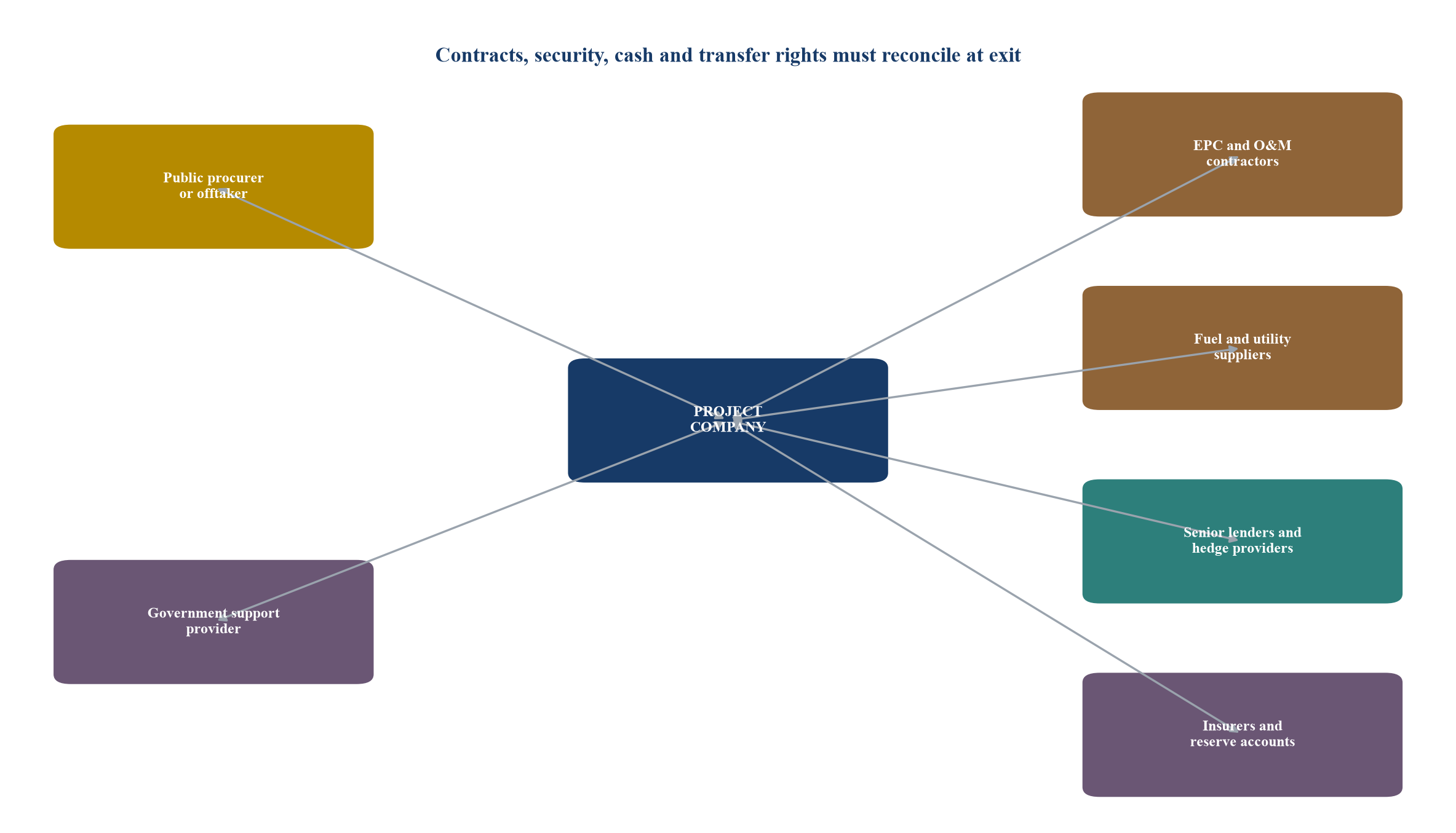
The diagram is a generic framework. Project-specific rights require review of executed documents and applicable law.
21. Define authority default
Authority default can include prolonged non-payment, repudiation, failure of government support, unlawful interference or breach that materially prevents performance. The trigger should include notice and cure.
Compensation commonly protects approved debt and defined investor economics because the public side caused the early exit. The formula should remain bounded by defined costs, recoveries and a documented equity method.
22. Define voluntary termination
The public party may require a right to terminate for policy, system or public-interest reasons. The right should have a price and approval process.
The calculation often resembles authority-default compensation. A notice period, transition plan and funding approval can reduce cost and protect service continuity. Voluntary termination should not be used to bypass a disputed default process.
23. Define project-company default
Project-company default may include abandonment, insolvency, persistent performance failure, corruption, unlawful transfer or failure to maintain security. The trigger should be material and capable of objective proof.
Lenders should receive notice and an opportunity to cure or substitute. Compensation after uncured default should protect public value and lender discipline while recognising the value of the asset transferred.
24. Define force majeure termination
Prolonged force majeure can make performance impossible without fault. Relief, mitigation and insurance should operate before termination becomes available.
Compensation can share loss between public and private sides. Eligible debt may receive strong protection, while equity treatment and break costs are more limited than under authority default. The contract should distinguish natural and political events.
25. Define political events
Political force majeure, material adverse government action and discriminatory change in law can fall within public-risk allocation. The event must be attributable, material and not caused by the project company.
The contract should define the relationship among relief, tariff adjustment, restoration of economic position and termination. Double recovery across those remedies should be excluded.
26. Define corruption consequences
Corruption or prohibited conduct can affect termination rights and compensation. The clause should align with procurement law, financing covenants and debarment rules.
The consequences require careful legal drafting. Protection of innocent secured lenders may be considered without preserving economic value for culpable sponsors. Evidence, due process and enforceability are essential.
27. Define illegality and sanctions
Illegality, sanctions or loss of licence can arise from party conduct, law or geopolitical events. The cause should determine treatment.
The formula should not reward a party for its own breach. Payment mechanics must comply with applicable sanctions, banking and public-finance rules. Blocked payments may require escrow or another lawful mechanism.
28. Preserve cure rights
Cure rights allow the defaulting party to remedy breach before termination. They protect continuity and prevent premature crystallisation of contingent liabilities.
Cure periods should match the breach. Payment default may need a short period; technical rectification may need a credible programme. Cure should not become indefinite delay where health, safety or system reliability is at risk.
29. Preserve lender step-in
The direct agreement should give lenders notice and a defined opportunity to step in, appoint a representative or substitute the project company. World Bank and UK guidance treat these rights as central to project-finance continuity [1][4].
The process should state qualification, liability, timing, cure standards and step-out. Step-in should not erase accrued public claims, but it can avoid termination and reduce compensation exposure.
30. Test substitution feasibility
Substitution works only if a qualified operator, sponsor or buyer can assume the project and finance. Transfer restrictions and regulatory approvals must permit it.
The parties should test market depth and transaction time. An assumed substitution route that cannot be executed leaves lenders and the public counterparty relying on a payment that neither side planned to fund.
31. Choose the project-company-default method
Three broad methods are common: retender proceeds, estimated fair value and a finance-based formula. Each allocates valuation and market risk differently.
Retendering can reveal market value where a liquid market exists. Estimated fair value requires assumptions and expertise. A debt-based formula improves certainty but can weaken lender discipline if it guarantees full recovery regardless of monitoring.
32. Use retendering carefully
A retender transfers the contract or project to a new provider and uses proceeds to determine compensation. The process needs a liquid market, reliable information and enough time.
The defaulting sponsors should not control the retender. Bid adjustments, rectification obligations, transaction costs and liabilities assumed by the new provider should be transparent. Failed retendering needs a fallback method.
33. Use fair value carefully
Fair value can reflect remaining contract cash flows, operating cost, capital expenditure, condition and risk. It can also become highly sensitive to discount rate, inflation and performance assumptions.
The valuation standard, information date, independent expert and dispute process should be specified. The contract should address whether value can be negative and how public rectification cost is treated [4].
34. Use debt-based compensation carefully
A debt-based method can provide lender certainty by linking compensation to approved outstanding debt. It should retain incentives to monitor, cure and step in.
Possible controls include a haircut for project-company default, exclusion of default-related costs, a cap at asset or contract value, and deductions for recoveries and rectification. The appropriate design depends on market conditions and law [1].
35. Set equity compensation method
Authority-risk termination may compensate shareholder investment and a defined return. Methods can include base-case return, market value or discounted future shareholder distributions [2][4].
The contract should choose one method and avoid the best of multiple alternatives. The model should deduct distributions already received and exclude value created by unsupported assumptions.
Table 2. Illustrative risk-allocation matrix for termination compensation
| Cost or value item | Authority default | Voluntary termination | Project-company default | Prolonged force majeure |
|---|---|---|---|---|
| Approved senior principal | Strong protection | Strong protection | Partial protection or value-based recovery | Strong or shared protection |
| Ordinary accrued interest | Strong protection | Strong protection | Limited to defined period | Defined protection |
| Default interest | Limited to authority-caused delay | Limited | Usually excluded | Usually excluded |
| Approved hedge break cost | Included net of gains | Included net of gains | Limited if caused by default | Shared or defined |
| Equity invested | Defined compensation | Defined compensation | Residual only | Partial or defined recovery |
| Future equity return | Defined and bounded | Defined and bounded | Excluded | Usually excluded |
| Rectification and continuity cost | Limited deduction | Limited deduction | Strong deduction | Allocated by cause |
| Cash, insurance and recoveries | Deducted | Deducted | Deducted | Deducted |
Strong, partial and limited indicate relative protection within the hypothetical framework; they are not legal conclusions.
36. Build the payment waterfall
The waterfall begins with gross eligible claims and then deducts cash, insurance, hedge gains, prior recoveries and excluded amounts. It applies event-specific adjustments before determining the final amount.
The result should reconcile to the project balance sheet, debt certificate and asset-transfer account. A single schedule should show each input, source document, responsible verifier and dispute status.
37. Sequence payment priorities
Payment may flow to lenders, hedge providers, project creditors, employees and shareholders. Security documents and insolvency law can control priority.
The public counterparty should avoid paying shareholders while protected senior liabilities remain outstanding. Payment instructions from the security trustee can reduce misapplication risk, subject to applicable law and verified entitlement.
38. Prevent double recovery
Double recovery can arise when a claim is paid through termination compensation and also recovered from insurance, a subcontractor, a guarantor or asset sale.
The contract should require disclosure, assignment or true-up. Recoveries received after payment should be returned or credited. The rule should apply symmetrically to gains and losses connected to the same exposure.
39. Cap public exposure intelligently
A simple nominal cap can undermine bankability if it falls below legitimate debt. An uncapped promise can undermine fiscal control.
The better approach combines approved-debt boundaries, event-specific components, recoveries, consent controls, exposure reporting and funding governance. Any cap should have a defined base, indexation rule and treatment of accrued payment delay.
40. Model the payment waterfall
The illustrative waterfall below separates senior protection from sponsor value and public deductions. It is a calculation sequence rather than a claim that every project should use the same formula.
Each box should correspond to a model schedule and evidence folder. The calculation should be reproducible by an independent reviewer from the executed documents and termination accounts.
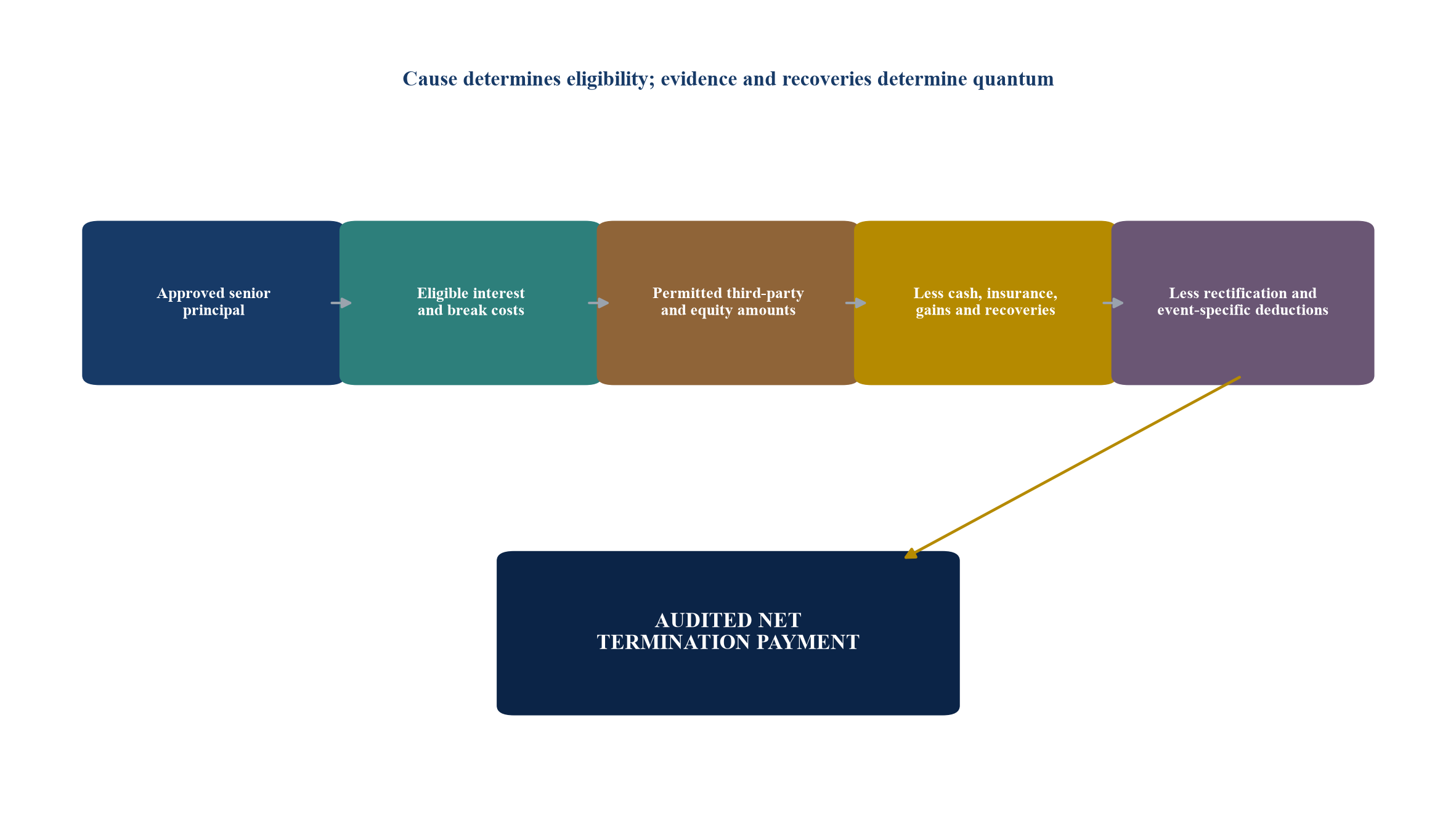
The sequence is hypothetical and must be adapted to applicable law, contract and financing structure.
41. Model debt-service sensitivity
The lender should test whether compensation covers principal, accrued interest, hedge close-out and payment delay. The public side should test the same variables as contingent exposure.
The sensitivity should vary termination year, interest rates, currency, construction completion, refinancing, reserve balances and deductions. It should identify the maximum cash requirement and the conditions that produce it.
Table 3. Hypothetical debt-service sensitivity at termination
| Scenario | Eligible principal | Interest and break cost | Cash and recoveries | Rectification deduction | Net lender-protection amount | Public funding implication |
|---|---|---|---|---|---|---|
| Early operations; low deduction | 780 | 46 | 55 | 10 | 761 | Peak exposure near completion |
| Mid-term; base assumptions | 520 | 31 | 42 | 25 | 484 | Material but declining exposure |
| Mid-term; high rates | 520 | 68 | 42 | 25 | 521 | Hedge and delay sensitivity dominate |
| Project default; material defects | 520 | 18 | 42 | 115 | 381 | Lower payment with larger service-recovery need |
| Late term | 170 | 12 | 28 | 15 | 139 | Debt protection falls as amortisation advances |
All values are hypothetical management assumptions in USD millions and demonstrate method only. They are not observations, forecasts or valuation conclusions.
42. Test construction-phase termination
Before completion, the asset may have limited operating value while debt is high. EPC claims, insurance, completion support and undrawn commitments affect the calculation.
The model should distinguish spent cost from cost to complete. The public side should decide whether to complete, reprocure or abandon the asset. Lenders should demonstrate that draws were approved and properly applied.
43. Test early-operations termination
Early operations can combine high debt, commissioning defects, ramp-up risk and limited operating history. The termination account should separate incomplete works from ordinary performance deductions.
Technical advisers should verify capacity, reliability and compliance. A hurried transfer without a condition baseline can convert a financing payment into an additional capital-repair obligation.
44. Test mid-life termination
Mid-life projects may have refinanced debt, accumulated reserves, replacement obligations and a more reliable operating record. Fair value may be easier to estimate, but life-cycle liabilities can be material.
The analysis should reconcile refinancing gains, maintenance deferral, remaining component life and environmental obligations. Historical availability should inform replacement-service planning.
45. Test late-life termination
Late-life debt may be small while decommissioning, remediation and handback cost grows. A debt-only formula can therefore understate or misallocate the economic consequences.
The contract should coordinate termination with handback reserve, asset-condition tests and residual-life standards. Public ownership of an exhausted asset is not equivalent to receipt of a compliant operating facility.
46. Define payment timing
The payment timetable should include preliminary calculation, information delivery, expert review, invoice, undisputed payment, disputed escrow and final true-up.
Delay can create additional interest and liquidity pressure. Lenders need certainty on timing, while the public side needs enough time for verification and lawful appropriation. The timetable should match those constraints.
47. Define payment currency
Project debt, tariff and public budgets may use different currencies. The clause should specify conversion date, rate source, hedge treatment and transfer restrictions.
Currency protection should follow the original risk allocation. A public payer should not absorb an open position created by unapproved borrowing, and lenders should not bear a conversion mismatch created by delayed payment.
48. Define tax treatment
Termination can trigger income tax, VAT, withholding, transfer duty and tax on debt or hedge close-out. Gross-up rights can materially change public exposure.
The model should use tax advice and show tax separately. It should distinguish tax required by law from tax generated by the recipient's structure or failure to provide documentation.
49. Establish funding governance
The contracting authority should identify the legal appropriation, budget owner, approval threshold and payment source before signing the obligation. A government guarantee does not remove the need for process.
The fiscal-risk register should track exposure over time. Stress testing should inform liquidity planning, and decision-makers should understand the difference between expected payment and contingent maximum.
50. Establish accounting and disclosure
PPP obligations may require recognition, disclosure or statistical treatment under applicable public-sector standards. The termination clause can affect risk allocation and balance-sheet interpretation.
Finance, legal and accounting teams should review the same model. Disclosure should explain the nature of the obligation, major uncertainties and risk-management controls without compromising protected commercial information.
51. Establish independent determination
Disputes over debt, fair value, defects and break costs require different expertise. The contract should identify whether an engineer, accountant, valuer or legal tribunal decides each issue.
The process should allow payment of undisputed amounts. Expert scope, information access, timetable, manifest-error standard and cost allocation should be clear enough to avoid a second dispute about procedure.
52. Protect records and audit rights
Termination calculations depend on years of financing, operation and contract records. The project company should maintain them in a form that can be transferred and audited.
The public side and lenders need access to approved finance documents, account statements, hedge confirmations, insurance claims, asset registers, maintenance history and subcontract liabilities. Confidentiality should survive without preventing verification.
53. Integrate environmental and social obligations
Asset transfer can carry environmental, labour, community, health and safety obligations. International standards require structured assessment, mitigation, engagement and management of material impacts [7][8].
The exit plan should allocate remediation, permits, monitoring data, workforce transition and grievance responsibilities. A payment should not close the transaction while leaving an unmanaged public liability.
54. Integrate asset handover
Handover should include title, land rights, licences, manuals, software, control systems, spares, warranties, data, inventory and operating personnel arrangements.
Conditions precedent should be proportionate. Lenders need payment certainty, while the public side needs possession and control. Escrow, simultaneous completion and post-transfer true-up can resolve timing conflicts.
55. Integrate replacement procurement
Termination may require a new operator, emergency contract or full reprocurement. Procurement law, transition time and market capacity affect the route.
The public authority should begin an options assessment before termination where permitted. UK guidance emphasises comparison of termination with other resolutions and careful preparation for financial and operational consequences [4][6].
56. Run the evidence gate
The first gate confirms the event, notice, cure, direct-agreement compliance and legal authority. No valuation should be treated as final until the termination route is established.
The gate file should contain notices, board and government approvals, breach evidence, mitigation and legal opinions. It should record unresolved issues and the impact of each issue on quantum.
57. Run the finance gate
The second gate validates approved debt, interest, hedge, cash, insurance, refinancing and recoveries. The facility agent certificate should reconcile to bank statements and finance documents.
The model should show gross claim, deductions and net result by recipient. Sensitivities should identify the factors most likely to change public exposure or lender recovery.
58. Run the asset and service gate
The third gate validates condition, rectification, environmental obligations, handover and continuity. Engineering evidence should connect directly to financial deductions and transition cost.
The authority should decide who operates the asset on day one after transfer. Fuel, chemicals, staffing, grid dispatch and water delivery require confirmed arrangements before completion.
59. Run the approval and funding gate
The fourth gate confirms appropriation, guarantees, currency, tax, accounting, disclosure and payment instruction. Required approvals should be mapped by amount and authority.
The fifth gate is completion: simultaneous payment, release or transfer of security, asset handover, assignment of claims, records transfer and post-completion true-up. No element should depend on an undocumented understanding.
60. Adopt the decision record and 90-day plan
The final decision record should state the selected route, alternatives considered, event classification, payment method, key assumptions, maximum exposure, service plan, approvals and residual risks. It should be signed by accountable legal, finance, technical and procurement owners.
The 90-day plan below can be adapted for live distress or for pre-signing design. Early preparation preserves options, reduces dispute and makes the contingent obligation visible before it becomes an urgent cash requirement.
The opening two weeks should establish a controlled information environment. The parties should identify the authoritative contract set, freeze model versions, preserve privileged advice and designate one calculation owner. Contract notices and operational communications should continue through the channels required by the documents. A parallel finance team can assemble the facility register, payment history, security package, account balances, hedge confirmations and insurer correspondence. The purpose is to create one reconciled fact base before positions harden.
The preliminary event memorandum should distinguish established facts from disputed allegations. It should map each alleged breach to the relevant clause, materiality threshold, notice requirement, cure period and consequence. It should also identify whether the same event activates relief, change in law, force majeure, government support, lender step-in or cross-default elsewhere. This mapping prevents a party from selecting a compensation route before the underlying event has been classified.
The preliminary financial memorandum should calculate a range rather than one apparent point estimate. The lower, central and upper cases should show the treatment of disputed debt, payment delay, hedge close-out, tax, insurance, rectification and equity. Each line should carry a source, owner, date and confidence status. Decision-makers can then see whether the negotiation is driven by legal interpretation, market valuation, engineering condition or financing arithmetic.
The project company should provide a debt certificate that reconciles principal to original drawdowns, repayments and approved refinancing. The certificate should distinguish cash interest, capitalised interest, fees, commitment charges, break costs and default amounts. The public counterparty should compare the certificate with bank evidence and financing approvals. Any difference should be isolated without delaying payment of amounts that are both undisputed and due.
The technical workstream should establish the physical perimeter of the transfer. For a combined power and water asset, this can include generation units, desalination trains, intake and outfall, grid connection, pipelines, shared utilities, laboratories, control systems, fuel facilities, spares and intellectual property. Interfaces with other assets require particular attention because a legal transfer may leave the new operator dependent on services that remain with the former owner or an affiliate.
The operations workstream should produce a day-one service plan. It should identify responsible control-room staff, dispatch and nomination procedures, chemical and fuel inventory, laboratory testing, cyber access, emergency response, maintenance permits and key vendor support. Employee transfer, immigration, accommodation and payroll can become critical in jurisdictions where the operating workforce is sponsored by the outgoing contractor. Continuity planning should therefore proceed alongside payment negotiations.
The public finance workstream should translate the model into cash, budget and approval consequences. It should identify whether payment is made by the utility, ministry, treasury, guarantee provider or another entity; whether appropriation is current or supplemental; and whether currency conversion or central-bank approval is needed. It should also model the cost of replacement service and asset repair, because the termination payment is only one component of the public decision.
The options paper should compare continued performance, contractual cure, negotiated reset, lender step-in, sponsor substitution, retendering, consensual exit and unilateral termination. Each option should be assessed against legal authority, timing, service continuity, cash requirement, long-term cost, dispute risk and market feasibility. The preferred route should be supported by evidence. A negotiated outcome can be attractive only where its full economic cost and risk allocation are understood.
The completion protocol should operate as a transaction checklist. It should specify payment accounts, releases, transfer instruments, licences, security discharge, asset registers, data-room delivery, password custody, claims assignment, employee actions, insurance transition and public announcements. It should state which actions occur simultaneously, which survive completion and which are subject to a later true-up. An agreed protocol reduces the chance that payment occurs without operational control or that control transfers without the intended lender release.
After completion, a defined reconciliation period should capture final invoices, insurance recoveries, tax assessments, inventory counts and costs that could not be measured at the transfer date. The true-up should use the same eligibility and evidence principles as the main calculation. A long, open-ended adjustment period should be avoided. The post-completion file should close with a final account, lessons-learned report and updated fiscal-risk register so that the transaction informs future procurement and contract design.
Table 4. Illustrative 90-day termination-payment workplan
| Period | Workstream | Core actions | Decision output | Accountable owner |
|---|---|---|---|---|
| Days 1-15 | Event and governance | Preserve rights; map notices, cure, authority and direct agreements; establish clean team | Confirmed event routes and decision governance | General counsel and project director |
| Days 16-30 | Finance and contracts | Reconcile debt, hedge, accounts, insurance, subcontracts and recoveries | Preliminary payment range and evidence gaps | CFO and financial adviser |
| Days 31-45 | Asset and service | Complete condition, rectification, E&S and continuity assessment | Transfer and replacement-service plan | Technical and operations leads |
| Days 46-60 | Options and valuation | Compare cure, step-in, substitution, settlement, retender and termination | Recommended route and sensitivity case | Steering committee |
| Days 61-75 | Funding and approvals | Secure appropriation, guarantee, tax, accounting and procurement approvals | Executable funding and approval package | Treasury and contracting authority |
| Days 76-90 | Completion preparation | Agree calculation, escrow, payment, handover, releases and true-up | Signed completion protocol and day-one plan | Transaction lead |
Timing is indicative and should be adapted to contractual notices, urgency, procurement rules and service-continuity requirements.
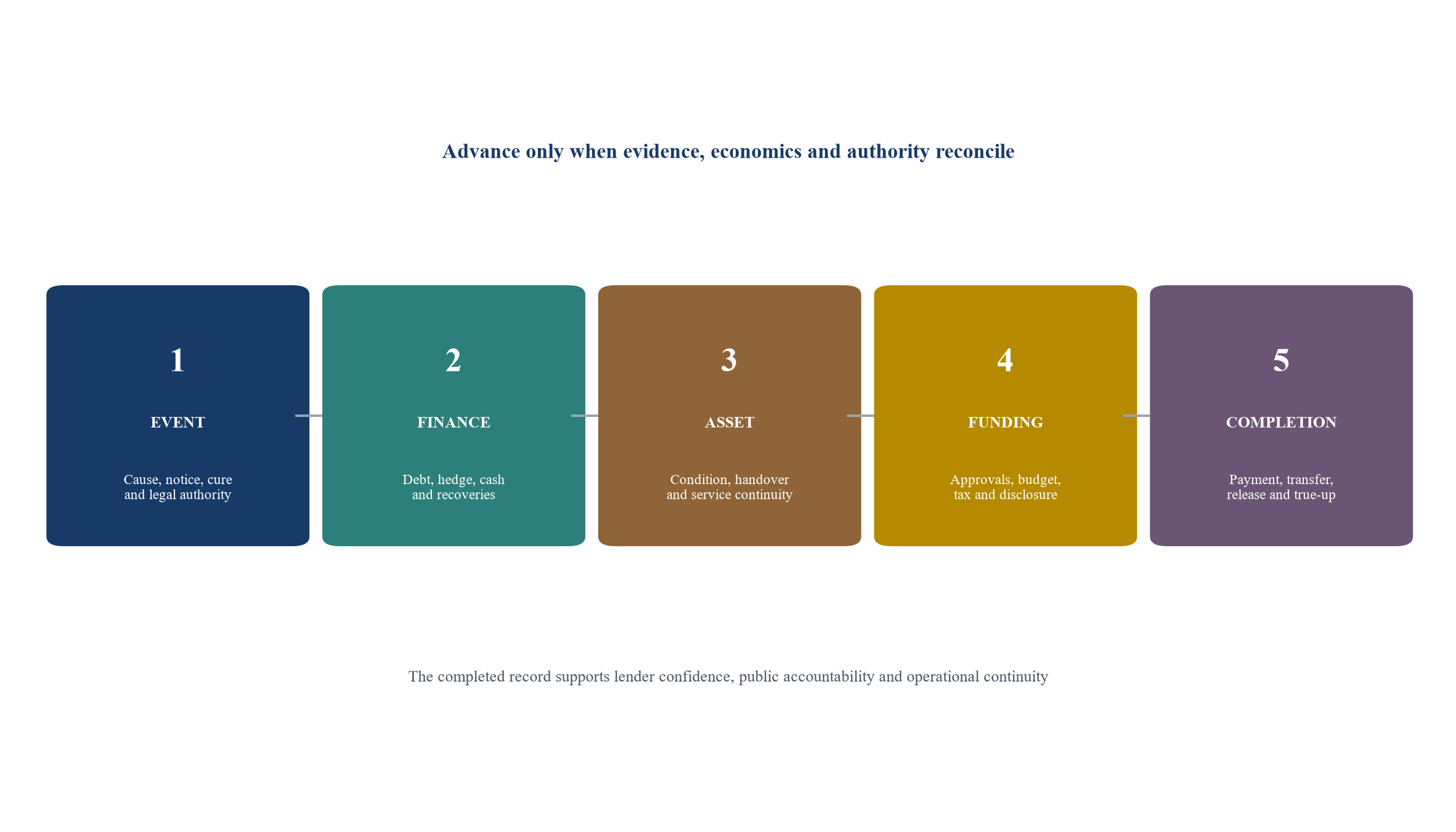
Each gate requires documented evidence before the transaction advances.
The framework produces a balanced exit clause by connecting cause, debt eligibility, recoveries, asset value, service continuity and public governance. Lenders receive a credible route to recover legitimate approved financing. Sponsors retain the economics allocated to them by the contract. The public side retains cure, step-in, valuation, deduction, audit and fiscal-control mechanisms.
The quality of the outcome depends on preparation. A clause cannot compensate for missing records, unclear authority, unfunded obligations or an unmanaged handover. The strongest termination regime is one that is priced before signing, monitored during operations and executable under stress.
For future procurements, the model should be retained as a living contract-management instrument. Annual updates can capture debt amortisation, refinancing, reserve balances, insurance, major maintenance, asset condition and changes in law. The resulting exposure curve supports treasury planning and gives the project board an early warning when contractual, financial and operational records diverge. It also allows the procurer to test proposed waivers or amendments against their effect on bankability and contingent public cost before approval.
References
- World Bank Group, "Key Issues in Developing Project Financed Transactions," PPP Resource Center, current online guidance, https://ppp.worldbank.org/financing/issues-in-project-financed-transactions
- World Bank Group, "Report on Recommended PPP Contractual Provisions," Section 4: Termination Payments, 2015, https://ppp.worldbank.org/sites/default/files/2024-09/world_bank_group_report_on_recommended_ppp_contractual_provisions.pdf
- World Bank Group, "Renegotiation, Government Step-in Rights, Termination, and Dispute Resolution," PPP Resource Center, current online guidance, https://ppp.worldbank.org/renegotiation-government-step-rights-termination-and-dispute-resolution
- UK Government, National Infrastructure and Service Transformation Authority, "Part 4: Contract termination and Direct Agreements," Navigating the risks of PFI project distress, updated 2026, https://www.gov.uk/government/publications/navigating-the-risks-of-pfi-project-distress/part-4-contract-termination-and-direct-agreements
- World Bank Group, "PPP Reference Guide: Default and Termination," PPP Resource Center, https://ppp.worldbank.org/sites/default/files/2024-10/updated_full-document_art3_web.pdf
- UK Government, HM Treasury, "PPP Policy Note: Early termination of contracts," https://www.gov.uk/government/publications/ppp-policy-note-early-termination-of-contracts
- International Finance Corporation, "Performance Standards on Environmental and Social Sustainability," 2012, https://www.ifc.org/en/insights-reports/2012/ifc-performance-standards
- Equator Principles Association, "The Equator Principles EP4," 2020, https://equator-principles.com/app/uploads/The-Equator-Principles_EP4_July2020.pdf
About the Author
Chennakeshav (CK) is a corporate finance and investment banking executive with 25+ years of global experience in deal origination, structuring and execution across M&A, growth capital and corporate strategy. He has led value-creation mandates for founders, corporates and funds — bridging the boardroom view to hands-on execution and close.
His career spans Morgan Stanley, HSBC, Lloyds Banking Group, EWEC, ADQ portfolio companies and Emirates Growth Fund, across TMT, real estate, fintech, deeptech, cleantech, infrastructure and energy. He has partnered with C-suite leaders, private equity and venture funds, sovereign wealth funds and family offices to finance complex fund raises and scale-up ventures, and has led M&A due diligence, post-merger integration and business-transformation initiatives to create value.
At Matchpoint Partners he is Managing Partner, leading the firm's corporate finance, M&A and capital-raising practice. He holds an MBA from London Business School, an engineering degree from VTU and a Master of Laws (LLM, in progress) from UCL London.
An active start-up mentor, CK mentors at Techstars, DIFC FinTech Hive, Startup Grind, Founder Institute and IN5, serves as Entrepreneur Mentor in Residence (EMiR) at London Business School, and judges the Entrepreneurship World Cup.
