

1 Define the decision before testing the claim
The investment committee's first question is precise: may this fund make this sustainability claim to this investor, in this jurisdiction, at this date, on the evidence now available? A general view that electricity or water infrastructure is beneficial cannot answer it. A fund's name may be regulated, a disclosure may be mandatory, and an impact figure may be voluntarily reported. Each has a separate perimeter, calculation and standard of proof. The committee should write down the exact statement it is asked to approve before examining a portfolio dashboard.
The source of a claim matters. A name on a prospectus, a sustainability label, a pre-contractual disclosure, a bond framework, a quarterly investor letter and an asset manager's website can convey different commitments. A claim that a fund targets reduced emissions is prospective. A statement that it delivered a specified reduction refers to an observed period and requires measured data and a defensible counterfactual. A claim that an asset is eligible for assessment under a taxonomy is different from a claim that it meets every alignment criterion. Diligence should preserve the original wording, date, audience and approver rather than rewrite all statements as one marketing theme.
The framework developed here is a decision aid for an institutional investor, fund sponsor, placement adviser or transaction team. It is not a certification scheme, legal opinion or assurance engagement. An actual conclusion depends on the fund's domicile and distribution footprint, asset evidence, governing documents, applicable rules and the wording of the intended claim. Where a source is a voluntary market principle, this paper identifies it as such. Where a regulatory proposal is still being considered, it remains a proposal [1-6].
The committee can require one deliverable: a claim register. Every material statement is assigned a legal owner, test, denominator, source document, data owner, review date and decision. Claims whose evidence is incomplete should be narrowed or deferred. That discipline protects investor understanding while keeping potentially valuable transition assets within an honest description.
2 Keep four analytical layers separate
A useful green-fund review separates four layers. The first is the fund-level label and marketing layer: what the product is called, which sustainability objective it states and which disclosure regime applies. The second is asset-level classification: what economic activity each asset carries out, whether a taxonomy covers it, and whether technical and safeguard conditions are met. The third is capital allocation: how the fund's capital or a designated financing instrument is actually used. The fourth is realised operating outcome: what the asset produced, consumed, emitted, saved or made available during a defined period. A fifth, cross-cutting layer is the governance and audit trail connecting the others.
These layers have different denominators. A fund label may test a percentage of product assets. Taxonomy reporting may look at eligible or aligned turnover, capital expenditure or operating expenditure under a defined method. A green bond reports an amount equal to proceeds allocated to projects and the related project outputs. An avoided-emissions estimate needs a project boundary, baseline and operating period. Using the same green percentage for all four layers would conceal what is being counted.
Consider a transmission company that is eligible for a taxonomy assessment, has an approved grid-upgrade capital plan and has drawn only a fraction of its dedicated green facility. Its eligibility does not show that the technical screening criteria, do-no-significant-harm conditions and minimum safeguards have been evidenced [3,4]. The approved plan does not prove the cash has reached the project. A commissioned line does not by itself quantify displaced fossil generation. Each further claim requires evidence that the prior layer does not supply.
The committee should create a bridge between layers for every material asset. Record the legal entity, economic activity, asset value, committed and deployed capital, eligibility decision, alignment decision, annual operating metric and impact method. An empty field is a visible diligence item. It must not be silently set to zero or treated as passed. The bridge can then be consolidated into the fund's reporting denominator without losing asset-specific qualifications.
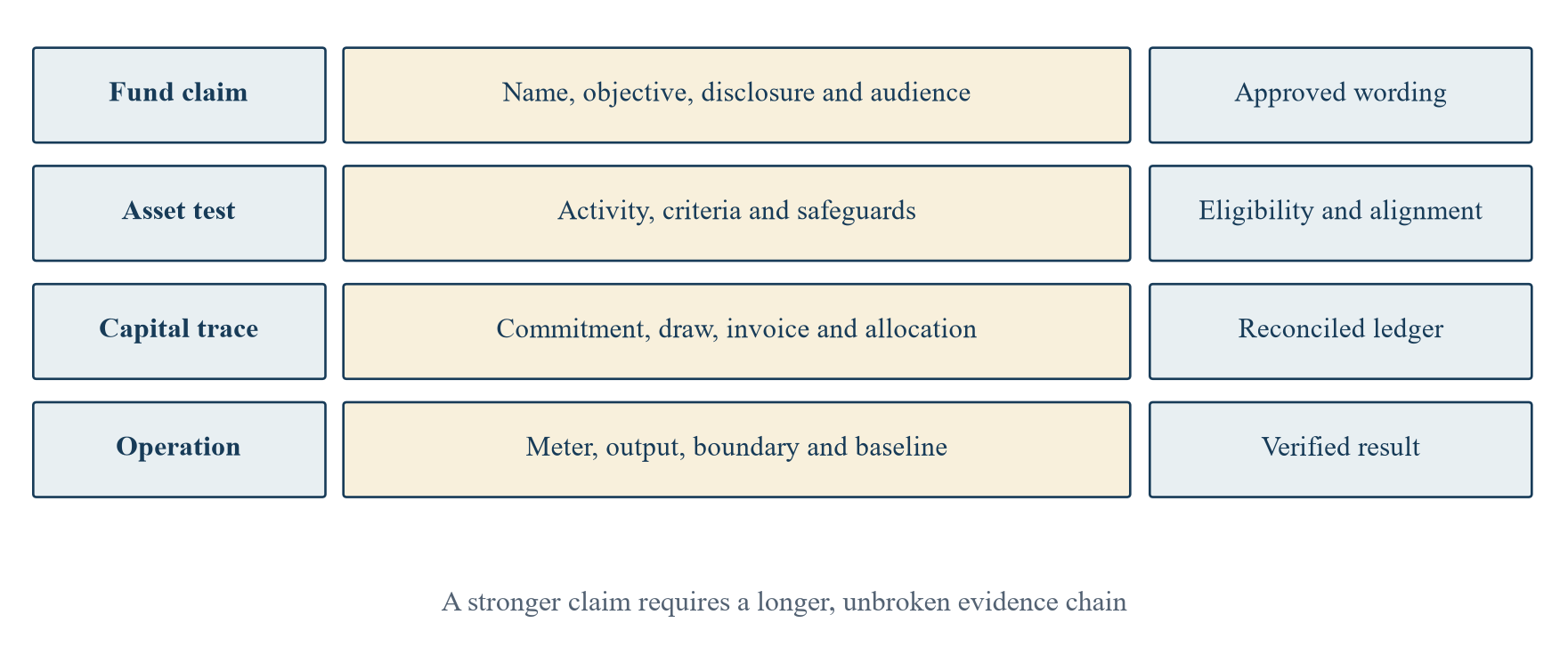
Author-developed decision map. Applicable laws and standards depend on fund, asset and distribution scope.
3 Identify the regulatory perimeter at the product level
The European Union and United Kingdom address sustainable investment products through different structures. A fund distributed across both markets needs a jurisdiction-by-jurisdiction analysis rather than an imported label. In the EU, the Sustainable Finance Disclosure Regulation sets disclosure obligations for financial market participants and products. The European Commission has acknowledged that Articles 8 and 9 have often been used as de facto labels, even though that was not their intended role. Its November 2025 proposal would introduce a new voluntary categorisation structure; as at the research date, a proposal should not be treated as enacted rules [1].
ESMA's guidelines on fund names using ESG or sustainability-related terms establish a separate name test. The guidelines set an 80% minimum threshold for investments used to meet environmental or social characteristics or sustainable investment objectives, with exclusions and further conditions varying by term [2]. A manager must review the precise wording, benchmark and applicable transitional provisions. A fund that meets a portfolio percentage can still make a misleading impact assertion if its claimed result lacks a baseline or if the relevant exclusions fail. The name threshold does not substitute for an impact audit.
The UK Financial Conduct Authority's Sustainability Disclosure Requirements regime has four voluntary investment labels for in-scope funds, along with mandatory anti-greenwashing, naming, marketing and disclosure rules that apply according to scope [5,6]. The FCA states that an in-scope product using a label must have a clear, specific, measurable sustainability objective and invest at least 70% of its assets in accordance with that objective, subject to the label's further criteria [6]. For in-scope product names, the words sustainable, sustainability and impact, and their variations, are restricted without a label in the circumstances described by the FCA [5]. A manager should check its actual product and client scope against the FCA Handbook; a percentage alone does not authorise a label.
An overseas-domiciled fund offered to UK retail investors can face distributor-notice requirements even if the fund itself is outside the UK labelling perimeter [5]. Institutional-only distribution may bring different obligations. The record should name the regulated entity, product form, distribution channel and investor location. A legal review belongs before prospectus approval, while the evidence map remains useful even where no named regulatory label applies.
4 Treat a taxonomy as a test of activities
The EU Taxonomy Regulation evaluates economic activities against environmental objectives. Under Article 3, an activity is environmentally sustainable only when it substantially contributes to an objective, does no significant harm to the other objectives, complies with minimum safeguards and meets the applicable technical screening criteria [3]. A sector name or a project description does not establish all four conditions. Detailed criteria are set out in delegated acts, and the Commission's implementing list should be checked at the reporting date [4].
Eligibility and alignment must be recorded separately. An activity may fall within a described taxonomy category and therefore be eligible for assessment while failing, or lacking evidence for, one of the alignment tests. Missing evidence is a different state from a proved failure. A manager should keep distinct statuses such as eligible and evidenced aligned, eligible with evidence outstanding, eligible but presently non-aligned, and not covered. Those are author-developed operational statuses, not official regulatory categories. They prevent an optimistic dashboard from treating unknown as passed.
Infrastructure assets often have mixed activities. A water utility may operate treatment works, distribution networks and associated buildings. A transport concession may own electrified lines and diesel backup systems. A renewable platform may include generation, storage and grid assets. The manager should map the actual economic activities and financial figures to the applicable delegated criteria, rather than classifying the entire company from a headline asset. Technical tests can depend on commissioning date, life-cycle emissions, energy performance, environmental assessments or other activity-specific facts. Qualified specialists should verify the underlying engineering and legal conditions.
The EU framework continues to be amended. The Commission lists a 2026 delegated regulation simplifying aspects of disclosures and technical screening, while a further review of some criteria was open for feedback in March 2026 [4]. The team must version its test: state the rule text, effective date, accounting period, asset data date and sign-off. A green claim copied from an earlier fundraise can become stale when the asset, data or applicable criteria change. The purpose of version control is to preserve a defensible current conclusion.
5 Benchmark the claims that investors actually see
Market benchmarks are useful only when the comparator and method are stated. The first benchmark is regulatory: what conditions apply to the product name, label and disclosure in the relevant market? The second is operational: how do an asset's measured outcomes compare with a relevant peer or credible threshold? The third is financial: what capital and operating cost are required to attain and sustain the claimed outcome? These benchmarks answer different questions and should occupy separate lines in a diligence memo.
For the regulatory benchmark, ESMA's 80% naming threshold and the FCA's 70% asset threshold for UK-labelled products cannot be compared as competing quality scores [2,6]. Their scopes, terminology, exclusions and product tests differ. EU Taxonomy alignment is an activity test, and ICMA Green Bond Principles govern use-of-proceeds bond practice rather than fund labels [3,8]. A fund that passes one regime is not automatically compliant with another. The following table records the exact question to test in each framework.
Table 1. Framework benchmark for an infrastructure-fund claim
| Framework | Unit of assessment | Core question for diligence | Common mistaken shortcut |
|---|---|---|---|
| EU SFDR | Financial product disclosure | What claims and disclosures apply under the current regime? | Calling an Article 8 or 9 disclosure a universal green label |
| ESMA fund-name guidelines | Investments and name terms | Does the named fund meet the relevant threshold, exclusions and term conditions? | Treating 80% as proof of realised environmental impact |
| EU Taxonomy | Economic activity and reported financial metric | Is the activity eligible, then fully aligned on the evidenced criteria? | Equating eligibility with alignment |
| UK SDR | In-scope product, label and marketing | Does the product meet the label-specific objective, strategy and reporting tests? | Assuming a green asset mix alone permits a label |
| ICMA Green Bond Principles | Bond proceeds and eligible projects | Are project selection, proceeds management and reporting evidenced? | Treating a green bond allocation as a fund-wide label |
Source-grounded summary of distinct frameworks; legal applicability and exact criteria require product-specific review [1-6,8].
For operating benchmarks, the GIIN's IRIS+ tools describe sector-specific impact metrics and peer comparisons that account for context such as region, strategy and investee features [9]. That is a more useful comparison than dividing every project's claimed tonnes of carbon dioxide by capital deployed and ranking the result without technology or geography. If benchmark data are unavailable or incomparable, the paper should state the limitation. An investor can still test trajectory against a documented engineering baseline and independently verified performance, without manufacturing a market percentile.
The International Energy Agency's World Energy Investment 2026 report and datafile track capital flows across renewables, networks and other energy assets [11]. They can provide market context for the scale and direction of spending. They do not establish a project's taxonomy status, fund return or additional impact. A committee can use such market data to ask whether construction costs and deployment assumptions are plausible, while keeping the asset-specific evidence and transaction model as the basis for approval.
6 Trace a financing instrument's proceeds to real work
An infrastructure fund may finance assets through fund equity, project debt, a green bond, a sustainability-linked facility or combinations of them. The capital trace must follow the instrument actually used. ICMA's 2025 Green Bond Principles identify four core components: use of proceeds, project evaluation and selection, management of proceeds, and reporting. They recommend bond frameworks and external reviews for additional transparency [8]. These principles are voluntary guidance; the security documents and issuer framework determine the transaction's actual obligations.
The proceeds ledger should identify each draw, account, recipient, invoice, asset, eligible activity, allocation date, refinancing share and balance of unallocated proceeds. The manager should reconcile this ledger to the issuer's finance system and asset-level capital register. If one substation upgrade is funded partly by a green bond and partly by fund equity, the disclosure must avoid allocating the same expenditure twice. A pro-rata approach requires a documented rule and a schedule that can be reproduced by a reviewer.
The question becomes harder for acquisitions. Buying an operating renewable asset may finance ownership transfer, while a later capital call may fund new panels, storage or grid connections. The acquisition cost and improvement expenditure carry different incremental-impact narratives. A green bond framework may permit refinancing of eligible projects, but ICMA recommends disclosure of financing versus refinancing and the relevant look-back period where appropriate [8]. A fund should make the same distinction in investor materials even when a particular instrument does not mandate an identical table.
Use-of-proceeds integrity and operating impact must be reported beside each other. A fully allocated bond can finance an asset that suffers downtime. An operating plant can produce clean electricity before the current fund acquired it. The allocation statement demonstrates where money went; the operating statement demonstrates what happened in the measurement period. Neither alone proves that the fund caused all the reported environmental benefit.
7 Choose the correct boundary for impact measurement
An impact number depends on a physical boundary and a reporting boundary. A solar plant's delivered megawatt-hours can be measured at the export meter. A water project's treatment volume may be measured at the plant outlet, but the claimed social outcome may depend on network losses, service continuity and water quality at customer delivery. A rail project's passenger journeys can be counted, but a claimed reduction in road emissions requires a counterfactual about trips displaced. The metric should match the actual claim.
The ICMA Harmonised Framework for Impact Reporting recommends both qualitative indicators and, where feasible, quantitative measures with underlying methodology and assumptions disclosed [10]. It offers sector-specific indicators and reporting templates for categories including renewable energy, water and transport. The GIIN's IRIS+ framework similarly emphasises context and comparable metrics [9]. These sources help specify a measurement system; neither verifies a particular fund's meter or baseline.
Separate outputs, outcomes and investor contribution. Installed capacity and expenditure are inputs or capacity indicators. Electricity actually generated or water reliably supplied are operational outputs. Avoided emissions or improved health and resilience are outcomes that require attribution or comparison to a counterfactual. The fund's contribution is a further question: did its capital, governance or technical work materially enable the result? A portfolio acquisition can give the investor exposure to an existing output without establishing incremental causation. The reporting pack should state these layers rather than treating every output as a fund-created outcome.
Avoided-emissions calculations require particular care. State the operating period, energy or service quantity, baseline technology, emission factor source, time variation, network boundary and any displacement assumption. Report absolute and intensity measures where each is useful. A change in the grid's carbon intensity can alter avoided emissions even when a plant produces the same output. That is a measurement effect, not proof of a change in the plant's performance. Keep the source data and assumption version so an investor can reproduce the calculation.
8 Build an evidence ledger at asset level
For each asset, create one permanent identification record. It should contain the legal owner, operator, address or geographic boundary, capacity, commissioned date, concession or contract term, fund ownership share and financing instruments. The classification schedule attaches the taxonomy or other criteria, evidence files, assessment date and reviewer. The capital schedule attaches the expenditure, invoice and funding source. The operating schedule attaches meter and counterfactual data. A unique asset key links the schedules and prevents duplicate counting when the fund reorganises holdings.
Every data point should have a status. A project-design estimate, provisional management report, audited financial amount, independently assured meter value and externally reviewed taxonomy conclusion do not carry the same weight. Store the original source, observation date, unit, data owner, change history and reviewer. The paper's suggested evidence tiers are an author-developed control, not a regulator-issued hierarchy. They allow the investment committee to understand which part of a claim could survive third-party review today.
Where a sponsor relies on a concession company or contractor for data, assign a contractual reporting right before closing. A minority fund investment may have limited access to plant meters, procurement records or environmental permits. Data rights, audit access and remedies for non-delivery can be negotiated in shareholder agreements or financing covenants. The fund should not promise annual verified impact to investors if the portfolio documents give it no path to the underlying evidence.
The ledger should also record adverse and contradictory information. A renewable facility can have a biodiversity condition, a water plant can have a discharge incident, and an electrified rail asset can use diesel standby power. The fund needs the facts to evaluate do-no-significant-harm and safeguarding requirements where relevant [3,4]. Excluding such events from a glossy impact report can make the classification less credible. A negative finding may be remediable; hiding it removes the ability to assess the claim.
9 Model a fictional mixed-asset infrastructure fund
The worked fund is fictional. All values, operating measures and cases in this section are author-assumed teaching inputs; they are not market observations or a recommendation to invest. Assume a USD 600 million committed infrastructure fund with USD 500 million of invested asset value at the test date and USD 100 million of undrawn or reserved commitments. The illustrative assets are an existing solar platform valued at USD 180 million, an electricity-grid platform at USD 140 million, a water-treatment business at USD 110 million and an electrified rail concession at USD 70 million. Their values sum to USD 500 million. Commitment, invested value and proceeds are deliberately kept separate.
Assume the fund announces a USD 120 million upgrade programme: USD 40 million for solar repowering and storage connection, USD 35 million for grid-loss and resilience works, USD 30 million for water process efficiency and USD 15 million for rail electrification completion. The programme is not automatically taxonomy-aligned. Each activity would need to be mapped to a relevant criterion, and each item would need evidence for do-no-significant-harm and minimum safeguards where applicable [3,4]. The programme is also separate from the fund's historical acquisition costs.
For a transparent demonstration, suppose an internal preliminary screen identifies USD 430 million of asset value associated with activities potentially eligible for taxonomy assessment, while only USD 260 million has complete evidence for alignment under the illustrative screen. These are author-assumed values, not a legal taxonomy calculation. The simple ratios are 86% of the USD 500 million invested-value denominator potentially eligible and 52% with complete alignment evidence. Neither figure establishes compliance with a fund-name or UK-label rule, which uses its own defined terms, assets, exclusions and tests [2,6]. It would be misleading to present 86% as a verified green share.
Suppose USD 65 million of the planned USD 120 million upgrade capital has actually been paid against approved invoices. The manager can report the paid amount and the corresponding asset allocation if reconciled. It should not describe the full USD 120 million programme as deployed. If a separate green bond funds USD 50 million of those invoices, the fund-level report and bond report must identify the same expenditure as one physical use of money with two financing perspectives, not two independent projects. A claim that financing created an incremental impact still requires a counterfactual.
Table 2. Fictional portfolio and planned improvement capital, USD million
| Asset | Invested value | Planned upgrade capex | Illustrative classification question | Initial operating metric |
|---|---|---|---|---|
| Solar platform | 180 | 40 | Activity criteria, storage boundary and safeguards | Delivered MWh |
| Electricity grid | 140 | 35 | Network activity and relevant technical tests | Losses and service hours |
| Water treatment | 110 | 30 | Water activity, discharge and energy criteria | Treated cubic metres |
| Electrified rail | 70 | 15 | Transport activity, fleet and power boundary | Passenger-kilometres |
| Total | 500 | 120 | Assess each activity separately | No single physical unit |
All numbers are author assumptions. Potential eligibility and alignment evidence are simplified illustration statuses, not official product classifications.
10 Stress the capital programme before promising conversion
The hypothetical upgrade plan has a completion risk, cost risk and operating-performance risk. A label that depends on future improvement should distinguish what has been funded, what has been contracted, and what remains an aspiration. The 2026 FCA label guidance describes distinct approaches such as Sustainability Focus, Improvers, Impact and Mixed Goals, with objectives and strategies that must match the chosen label [6]. It would be a mistake to describe a fund as already delivering a specified improvement merely because its investment committee approved a future capex budget.
Assume the USD 120 million programme has a central cost case, a 15% cost overrun and a 20% overrun. Those author-assumed sensitivities imply total programme costs of USD 120 million, USD 138 million and USD 144 million. If the fund has a fixed USD 120 million capital budget, the overruns create USD 18 million and USD 24 million funding gaps unless scope is cut or new funding is secured. The model must state whether reserves, asset cash, co-investment, debt or follow-on fund capital can fill them. A green claim should not depend on an unfinanced step.
Operational output may also be lower than the engineering case. Assume, for illustration, that solar repowering is forecast to add 90,000 MWh of annual generation once fully operational. A 10% underperformance case adds 81,000 MWh, and a 20% underperformance case adds 72,000 MWh. These outputs are hypothetical; no asset performance or peer benchmark is asserted. If the impact report applies a hypothetical 0.35 tonnes of carbon dioxide equivalent per MWh displacement factor, the corresponding arithmetic is 31,500, 28,350 and 25,200 tonnes. A different credible baseline can change the result without changing delivered MWh. The investment committee should therefore approve the generation assumption and the baseline method separately.
Grid and water projects require their own measures. A grid upgrade can reduce technical losses but may also serve load growth. A water-treatment retrofit can reduce energy intensity while total energy use rises with volume. Reporting only an intensity improvement can conceal an increase in absolute consumption. Reporting only absolute consumption can conceal a real efficiency gain during service expansion. For a mixed portfolio, publish asset-level units and a clearly explained portfolio narrative; avoid a single additive impact number assembled from incompatible outcomes.
Table 3. Author-assumed capital and operating sensitivities for the fictional fund
| Case | Programme capex, USD m | Gap versus USD 120m budget | Added solar output, MWh/year | Illustrative avoided emissions, tCO2e/year |
|---|---|---|---|---|
| Central assumption | 120 | 0 | 90,000 | 31,500 |
| 15% capex overrun and 10% output shortfall | 138 | 18 | 81,000 | 28,350 |
| 20% capex overrun and 20% output shortfall | 144 | 24 | 72,000 | 25,200 |
Arithmetic examples only; the displacement factor, output and capex assumptions are not observed data or validated forecasts.
11 Keep classification and performance sensitivity linked
The illustrative screen shows a common tension. If a fund's claim depends on a high share of qualifying assets, classification evidence can change at the same time as financial returns and operating results. A grid asset may need expensive upgrades to satisfy a technical criterion. Delayed commissioning can postpone both the claimed alignment and the cash yield. A water business may meet a design standard while its actual energy intensity misses an internal target. A taxonomy decision and an impact result are separate, yet the same engineering programme can influence both.
Model this dependency as a sequence rather than a single green-value premium. First, determine the asset's current activity and evidenced classification state. Second, identify a feasible change programme and the specific criterion or impact claim it may affect. Third, cost the change and its time to service. Fourth, adjust operating cash, debt service, terminal capital needs and the fund's return case. Fifth, update classification only after the required evidence exists. A prospectus should describe the future step as a plan or target until it is achieved and verified.
The valuation effect cannot be assumed positive. Efficiency capex may lower operating cost, but delayed procurement or grid connection can consume capital before benefits arrive. A wider investor universe may improve exit options, but this paper has no evidence quantifying a green-fund valuation premium. The correct transaction question is whether the proposed expenditure improves risk-adjusted cash flows and the credibility of the claim enough to justify its cost. The investment committee can compare a base case and downside case without assigning a speculative multiple uplift.
The fund's capital call schedule should show who bears overrun risk. If a project company can borrow for the works, lender conditions may depend on engineering certificates or reserve levels. If the fund uses undrawn commitments, investor documents may constrain use, concentration or recycling. If the capex is funded from asset cash, distributions may fall. The legal and financing structure changes the feasible sustainability pathway. A statement of intended alignment that omits its funding path is incomplete.
12 Make avoided-emissions reporting reproducible
An avoided-emissions estimate is a comparison between observed project operation and a chosen baseline. It is sensitive to what would otherwise have happened. A solar plant connected to a grid with a declining emissions factor should not automatically claim the same avoided emissions per MWh forever. An electricity network may enable future renewable connections, but allocating all subsequent generation benefits to one grid upgrade risks double counting. A rail project may displace different travel modes in different cities. The model should expose these choices.
The reporting file should store the raw output, adjustment for own-use or curtailment, baseline technology, emission factor, period and calculation. If the factor is updated, publish the old and new factor and restate prior figures only under a disclosed method. Report the observed physical output beside the calculated estimate. This lets investors see whether a changed impact number reflects asset operation or an assumption change. ICMA's impact-reporting handbook recommends disclosure of methodology and assumptions for quantitative measures [10].
For the fictional solar improvement, the assumed 90,000 MWh of additional annual output and 0.35 tCO2e/MWh factor yield 31,500 tCO2e. If the illustrative factor falls to 0.20 with the same output, the calculated estimate becomes 18,000 tCO2e. Nothing in that arithmetic establishes the actual grid factor, displacement or project additionality. It demonstrates why publishing a single rounded avoided-emissions figure without a baseline is weak evidence. The project should disclose actual metered output and a range of plausible baselines where the counterfactual is uncertain.
Attribution is a separate step. The fund may own only part of an asset, or its capital may refinance an existing facility. An ownership-weighted portfolio report can show attributable exposure if the method is disclosed. It should not imply that ownership caused every tonne of avoided emissions. The investor contribution narrative should specify a documented action, such as funding repowering, underwriting a connection or changing procurement, and the causal limits of that action. If the contribution cannot be established, report the asset outcome without claiming sole credit for it.
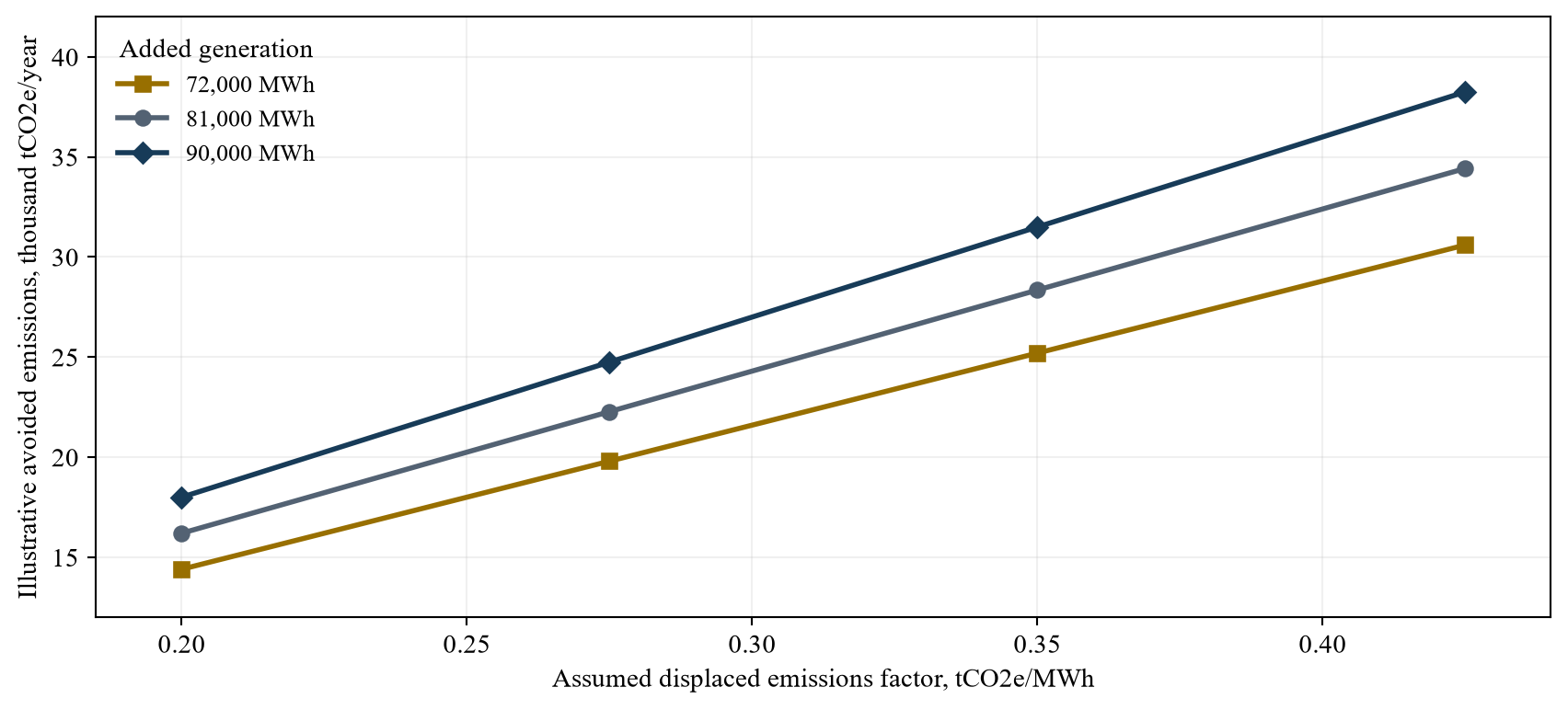
Author-assumed output and displacement factors; not a project forecast, grid factor or verified impact result.
13 Check whether the impact can be attributed to the fund
An infrastructure fund typically invests through project companies, joint ventures and holding vehicles. The fund may contribute primary equity for new construction, buy secondary interests in an established asset, provide follow-on capital or refinance debt. Those transaction types have different claims to investor contribution. A secondary purchase changes the owner and may bring new governance or capital, but the historic output existed before the purchase. A green label can describe exposure to qualifying assets without claiming that the fund invented their prior outcomes.
For every headline impact claim, require a contribution note. It should identify the fund action, date, cash amount, governance right or technical intervention, and the observed change after that action. The note should explain what other parties contributed and which causal links cannot be established. It is possible to show credible contribution without claiming sole causation. A fund can finance a water plant expansion that increases access while a public authority supplies land and network connections. Both roles belong in the account.
Institutional investors can ask for a pre-investment baseline and a post-investment observation. Where a baseline is unavailable, the result should be reported as an asset-level output with the gap disclosed. Some projects have long development timelines and produce no operational output during the first reporting years. Their construction progress and expected outcome can be reported separately from realised impact. The reader should be able to distinguish installed capacity, forecast benefit and actual delivery at a glance.
The fund's return model should also reflect the contribution claim. If the narrative says the fund's operational programme created value, the model should identify the programme's capex, timetable, operating savings or revenue, financing and exit implications. If the model contains no such bridge, the value-creation and impact narratives are disconnected. A diligence reviewer should ask the sponsor to reconcile them before accepting an asserted double dividend.
14 Examine safeguards and trade-offs in critical infrastructure
Critical infrastructure has externalities that a single carbon metric cannot capture. Grid reinforcement may improve reliability but require land, materials and community engagement. Water treatment can improve service while increasing electricity demand or producing sludge. Renewable generation can affect land use and biodiversity. Rail development can change access and local displacement. The EU Taxonomy's do-no-significant-harm and minimum-safeguard requirements exist because contribution to one objective does not excuse harm to others [3]. Applicable environmental and social duties may also arise outside any taxonomy.
The manager should maintain an adverse-impact and incident register alongside the positive-metric dashboard. Record environmental permits, land acquisition issues, worker safety, community grievances, water stress, construction emissions and unresolved remediation actions. A regulator's compliance notice should trigger a classification review, not merely a note in an operations report. The exact effect on alignment depends on the applicable criteria and facts, so specialist review is necessary.
The test should ask whether the fund's governance can change the outcome. Board representation, budget approval, engineering oversight and contract rights can be relevant in a controlled platform. A minority investor may need explicit information and escalation rights. If the manager cannot influence a material harm or access evidence, it should narrow its claim rather than assume that a portfolio-level green theme cures the weakness.
Trade-offs belong in investment papers. A resilience retrofit may require concrete and higher near-term embodied emissions while reducing outage risk. A new water process may save water but raise energy use. The decision can still be justified, but it should show the physical and financial consequences on the same timeline. A label is credible when it survives these tensions and uses the applicable criteria rather than a selective positive indicator.
15 Write a fund report that an investor can examine
The annual investor report should begin with the fund's stated sustainability objective and exact product scope. It should show the portfolio denominator, investments by asset, changes in ownership and classification status, and the amount of capital committed, paid and allocated. It should then present operational results in the units that matter for each asset. A short methodology appendix should define boundaries, baselines, estimates, missing data, assurance scope and changes from the previous year. This structure makes a claim checkable without overwhelming the reader with unconnected indicators.
Financed emissions also need their own line. IFRS S2 contains additional financed-emissions disclosure requirements for entities engaged in asset management where the standard applies, and the ISSB issued targeted amendments in December 2025 with an effective date for periods beginning on or after 1 January 2027, subject to early application [7]. Financed emissions are attributed gross emissions associated with investments; they should not be netted mechanically against an avoided-emissions estimate. A fund can report both with their respective boundaries and methods. Neither measure alone certifies impact.
Avoid publishing only an aggregate percentage. The fictional fund's USD 430 million potential eligibility figure and USD 260 million complete-alignment-evidence figure illustrate why the detail matters. An investor needs to know whether a gap reflects incomplete engineering evidence, a criterion not met, a new acquisition or a genuine decline. The report should include both the opening and closing portfolio, asset sales and new investments so a rising ratio is not automatically described as improved asset performance.
For impact, report target, baseline, actual outcome and variance for each material measure. Show whether the measure is audited, independently assured, management-estimated or modelled. Include any revised factor or methodology and enough data to recalculate major figures. ICMA's handbook offers reporting templates for project categories [10], while the GIIN's tools show how sector-specific indicators can be compared with context [9]. The manager should select measures that fit its assets rather than paste an unrelated template into every holding.
The report should state the status of independent review. An external opinion on a green bond framework assesses the framework described at issuance; it does not necessarily verify every later invoice or actual impact result. Financial-statement audit, taxonomy assessment and impact assurance can have different scopes and providers. Describe each review by provider, period, standard, subject and conclusion. Marketing phrases such as independently validated should be used only when the precise validated object is clear.
16 Govern changes to the portfolio and the rulebook
An infrastructure fund changes over its life. It may sell a generating plant, acquire a water platform, add a brownfield improvement strategy or move from construction to operations. Each transaction can change the name threshold, label eligibility, taxonomy bridge, proceeds ledger and reported outcomes. The compliance team should have a transaction trigger that reruns the claim register before closing or before new marketing materials are issued. A quarterly dashboard that updates only once a year can leave investors looking at a stale portfolio claim.
Rule changes also require version control. The Commission's proposed SFDR changes should be monitored without presenting them as current law [1]. The EU Taxonomy delegated acts and applicable technical screening criteria should be checked for the reporting year [4]. FCA guidance and Handbook provisions should be reviewed for the product's UK scope [5,6]. ESMA name guidance can affect a fund that changes strategy or name [2]. A legal register should therefore identify both current rule and planned effective dates.
The investment committee should specify decision rights. The deal team proposes the asset classification and contribution narrative. Technical experts test activity criteria and impact methods. Finance reconciles committed, deployed and allocated capital. Legal and compliance approve claim wording and distribution. The fund's governing body approves material changes to the sustainability objective or investment policy. These roles are a recommended governance design; a real manager's regulated responsibilities and documents control the actual allocation.
Where a claim weakens, the manager should decide whether to cure evidence, change the portfolio, amend disclosures or stop using the wording. The decision should be recorded with dates and investor communication. A name or label should not persist by inertia when its supporting portfolio has changed. Equally, an asset whose data arrive late should not automatically be described as harmful; classify the evidence gap and obtain the facts.
17 Use analytics as a control, with accountable review
Asset-level data can be joined across ledgers, invoices, meters, engineering reports and regulatory criteria. Analytics can flag duplicate invoices, inconsistent units, missing periods, surprising changes in output or assets near a stated portfolio threshold. Language models can help extract candidate activity codes or compare draft claims with source documents. These tools can make review more systematic only when a human reviewer checks the output against the underlying record. An automatically generated match is not an assurance conclusion.
The data model needs stable identifiers and time stamps. Store asset ID, reporting period, activity code, taxonomy version, funding instrument, invoice reference, meter source and reviewer decision. Keep source documents and calculation scripts versioned. A changed engineering report should not overwrite the basis for last year's published figure. The system should reproduce the prior report and show the effect of any later correction. That capability matters when an investor asks why the fund's aligned share or avoided-emissions figure moved.
Automated exception tests can be concrete. Flag one invoice linked to two green-financing allocations, an impact number with no metered output, a classification decision made before the relevant permit, a portfolio ratio that uses committed capital in one quarter and invested value in another, or an asset sold before the reported operating period ended. The exception should route to finance, operations or compliance, with a recorded disposition. A quiet dashboard with unresolved source gaps is not a sign of quality.
Digital controls also need access rules. Infrastructure asset data can be commercially sensitive, and fund reports can contain non-public valuation or investment information. Assign permissions by role and retain the minimal evidence required for investor review and regulatory retention. The method supports human accountability and a better audit trail; it does not replace technical, legal or assurance specialists.
18 Implement the claim-to-evidence system in stages
The first stage is claim inventory. Collect the prospectus, marketing deck, website, investor letters, product disclosures and financing frameworks. Record every sustainability-related statement with its exact wording and intended audience. The second stage is a product-scope review: fund form, domicile, distribution jurisdictions, investor type and applicable rules. Legal and compliance can identify terms that need immediate narrowing while asset evidence is assembled.
The third stage is an asset map. Link each holding to economic activities, governing criteria, technical documents, safeguards and a dated classification conclusion. The fourth stage is capital reconciliation: ownership, committed and invested capital, improvement capex, designated instrument proceeds, invoices and remaining funding. The fifth stage is operating measurement: meters, service outputs, baselines, calculation methods and independent review. Each stage should end with a signed exception list, not just a percentage dashboard.
The sixth stage is a decision meeting. The investment committee examines claims ranked by materiality and consequence. A claim may be approved as evidenced, approved with narrower words, deferred pending data or rejected. The decision should carry a review date and an owner. For the fictional fund, the committee could report USD 65 million of paid improvement capital if reconciled, disclose the USD 120 million programme as planned, and withhold a verified annual avoided-emissions figure until the operating data and baseline are checked. That is an illustrative decision, not a conclusion about a real product.
The final stage is recurring control. New acquisitions, disposals, rule changes, material incidents and annual reporting each trigger an update. The output is a portfolio with a durable evidence trail that supports prospectus drafting, LP diligence, financing and exit. A buyer can examine the same asset key, capital history and measured outcomes rather than reconstructing the sustainability story from marketing files at sale.
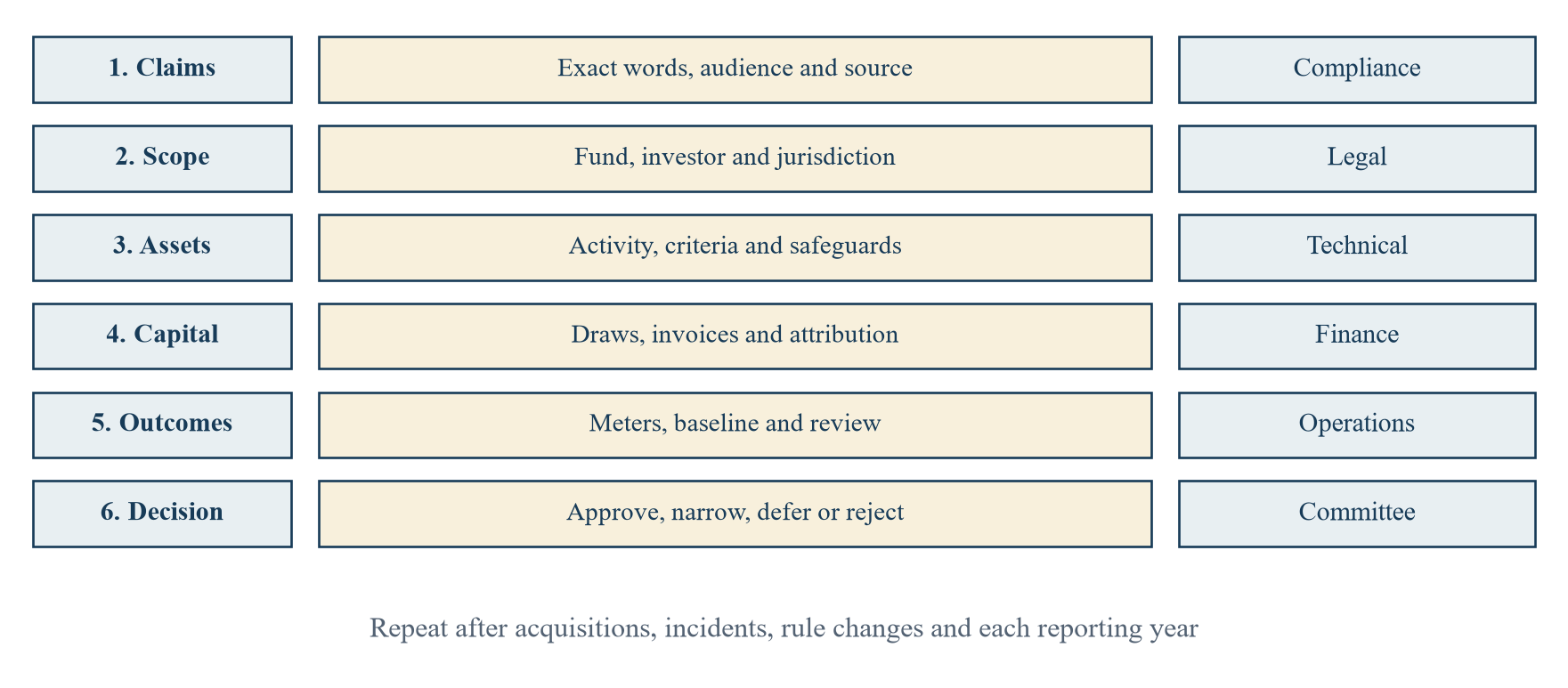
Author-developed process; management should adapt owners, timing and approval rights to its fund documents and regulatory scope.
19 State the limits of the analysis
This paper offers a diligence framework, not a determination that a named fund or asset is green, taxonomy-aligned, label-eligible or impact-generating. The relevant rules depend on legal form, distribution, reporting period and activity. The SFDR revision cited here was a European Commission proposal at the research date [1]. ESMA fund-name guidance, EU Taxonomy criteria and UK SDR have different tests [2-6]. ICMA principles and GIIN tools are market frameworks, not substitute statutory approvals [8-10].
The fictional USD 600 million fund is an educational model. The asset values, potential eligibility, complete-evidence amount, programme capex, invoice allocation, generation increase, carbon factor and stress cases are author assumptions. No company supplied them. The model does not include transaction costs, fund fees, tax, leverage, asset-level debt service, exchange rates, full construction timing or realised returns. Its classification ratios use a simplified invested-value denominator solely to demonstrate separation of concepts; an actual regulatory calculation must use the applicable rule's definition.
The operating example does not estimate real avoided emissions. A rigorous assessment would need metered output, credible location-specific and time-specific baseline, consideration of curtailment and dispatch, ownership and contribution analysis, and verification of the calculation. For water, networks and rail, the relevant outcomes and counterfactuals differ. No one aggregate carbon measure can capture all environmental and social consequences of an infrastructure portfolio.
Further empirical research could study whether verified asset-level evidence changes LP selection, financing terms or exit outcomes. Such work would need transaction-level controls for sector, jurisdiction, vintage, leverage and manager quality. A correlation between a green name and fund inflows would not establish that the name caused stronger asset performance. This paper therefore confines its conclusion to a reproducible decision process and clearly bounded illustrative arithmetic.
20 Conclusion
A credible green claim is a chain of propositions that can be checked independently. A fund's name and label refer to a product under a specific regulatory scope. Taxonomy alignment requires evidence at the economic-activity level. A designated financing instrument must trace money to eligible uses. An impact result requires measured operation and a disclosed method. Investors should approve the exact claim that the available chain supports, with dates and denominators attached.
The fictional fund illustrates why the layers matter. Its author-assumed USD 430 million of potentially eligible asset value does not establish a USD 430 million aligned portfolio. Its USD 120 million capital plan does not equal USD 120 million paid. Its hypothetical 31,500 tonnes of avoided emissions depends on both output and an assumed displacement factor. A change to any one input alters the claim that can honestly be made. The purpose of the model is to make those dependencies visible, not to confer a label.
The practical standard is a claim register linked to an asset map, proceeds ledger, operating evidence and explicit approval. Re-run that system when the fund buys or sells an asset, a project changes, a material incident occurs or a rule is amended. A strong report can acknowledge an incomplete data point and still explain the investment case. The fund earns confidence by letting a reader trace each material statement from prospectus to plant and back again.
References
- European Commission. Commission proposes improvements to SFDR, 21 November 2025. Accessed 6 October 2026. https://finance.ec.europa.eu/news/commission-proposes-improvements-sfdr-2025-11-21_en
- European Securities and Markets Authority. Guidelines on funds' names using ESG or sustainability-related terms, 2024, ESMA34-1592494965-657; associated explanatory release. Accessed 6 October 2026. https://www.esma.europa.eu/document/guidelines-funds-names-using-esg-or-sustainability-related-terms
- European Union. Regulation (EU) 2020/852, Articles 1 and 3. Accessed 6 October 2026. https://eur-lex.europa.eu/legal-content/EN/ALL/?uri=CELEX%3A32020R0852
- European Commission. Taxonomy Regulation: Implementing and Delegated Acts, updated March 2026. Accessed 6 October 2026. https://finance.ec.europa.eu/regulation-and-supervision/financial-services-legislation/implementing-and-delegated-acts/taxonomy-regulation_en
- Financial Conduct Authority. Sustainability Disclosure Requirements regime, updated June 2026. Accessed 6 October 2026. https://www.fca.org.uk/firms/climate-change-and-sustainable-finance/sustainability-disclosure-requirements-sdr-regime
- Financial Conduct Authority. How to use sustainability labels, updated June 2026. Accessed 6 October 2026. https://www.fca.org.uk/firms/climate-change-and-sustainable-finance/labels
- IFRS Foundation. Targeted amendments to IFRS S2 GHG emissions disclosure requirements, December 2025. Accessed 6 October 2026. https://www.ifrs.org/news-and-events/news/2025/12/issb-issues-targeted-amendments-ifrs-s2/
- International Capital Market Association. Green Bond Principles, June 2025. Accessed 6 October 2026. https://www.icmagroup.org/assets/documents/Sustainable-finance/2025-updates/Green-Bond-Principles-GBP-June-2025.pdf
- Global Impact Investing Network. IRIS+ Analytics and impact performance benchmarks. Accessed 6 October 2026. https://iris.thegiin.org/help/iris-analytics/
- International Capital Market Association. Handbook: Harmonised Framework for Impact Reporting, June 2024. Accessed 6 October 2026. https://www.icmagroup.org/assets/documents/Sustainable-finance/2024-updates/Handbook-Harmonised-Framework-for-Impact-Reporting-June-2024.pdf
- International Energy Agency. World Energy Investment 2026. Accessed 6 October 2026. https://www.iea.org/reports/world-energy-investment-2026
About the Author
Chennakeshav (CK) is a corporate finance and investment banking executive with 25+ years of global experience in deal origination, structuring and execution across M&A, growth capital and corporate strategy. He has led value-creation mandates for founders, corporates and funds — bridging the boardroom view to hands-on execution and close.
His career spans Morgan Stanley, HSBC, Lloyds Banking Group, EWEC, ADQ portfolio companies and Emirates Growth Fund, across TMT, real estate, fintech, deeptech, cleantech, infrastructure and energy. He has partnered with C-suite leaders, private equity and venture funds, sovereign wealth funds and family offices to finance complex fund raises and scale-up ventures, and has led M&A due diligence, post-merger integration and business-transformation initiatives to create value.
At Matchpoint Partners he is Managing Partner, leading the firm's corporate finance, M&A and capital-raising practice. He holds an MBA from London Business School, an engineering degree from VTU and a Master of Laws (LLM, in progress) from UCL London.
An active start-up mentor, CK mentors at Techstars, DIFC FinTech Hive, Startup Grind, Founder Institute and IN5, serves as Entrepreneur Mentor in Residence (EMiR) at London Business School, and judges the Entrepreneurship World Cup.
