
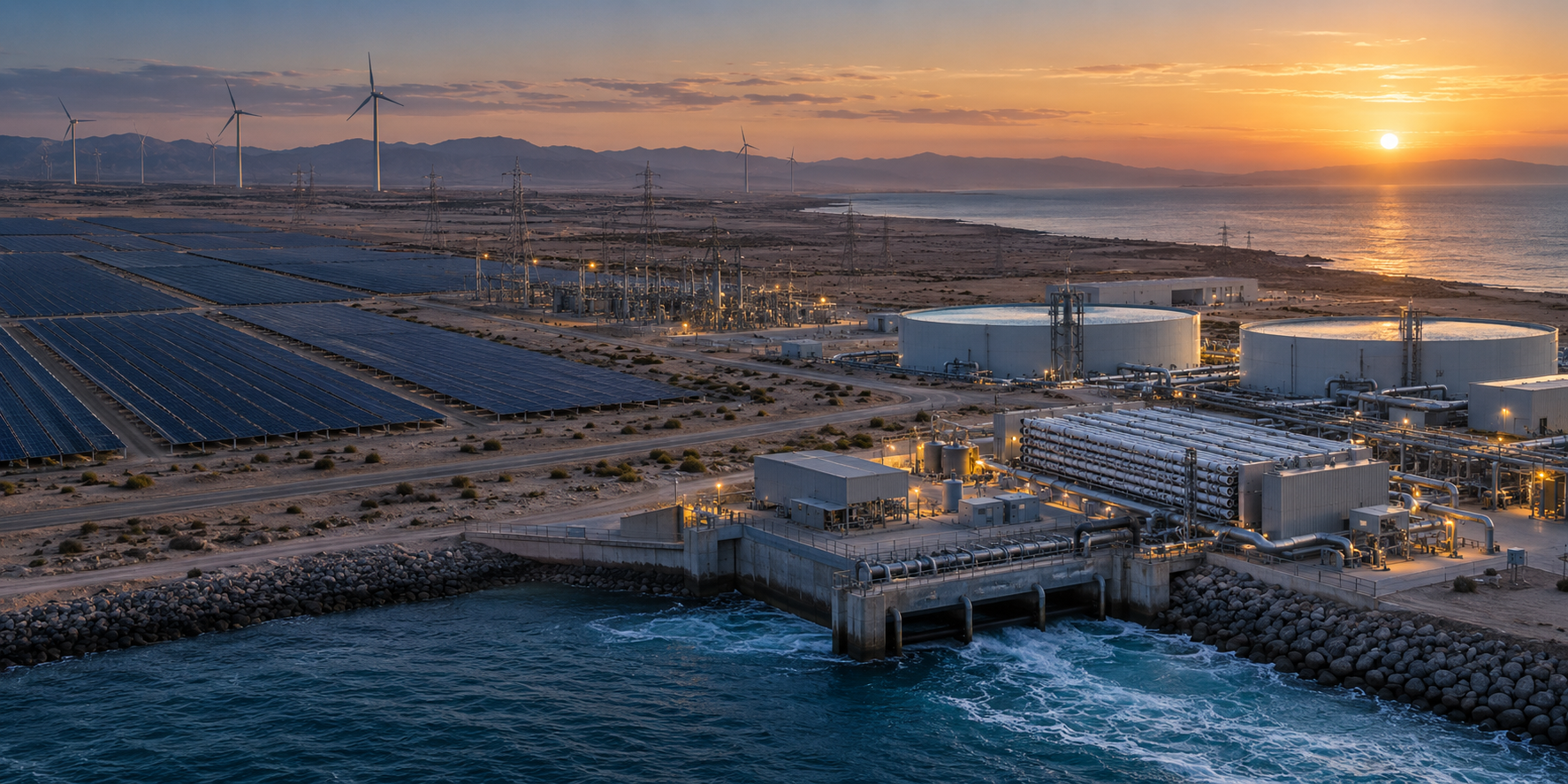
Introduction
Water utilities and industrial plants often buy electricity as though every megawatt-hour has the same system value. Renewable generation does not arrive in that form. Solar output concentrates around daylight hours. Wind output varies across hours and seasons. Network constraints can make electricity abundant in one location and scarce in another. A flat volumetric tariff averages these conditions. The customer sees a stable price, while the utility or renewable supplier absorbs balancing, curtailment, congestion and firming costs.
Some large loads can change when they consume without reducing final output. A reverse-osmosis desalination plant can produce more water when renewable supply is abundant and draw from a product-water reservoir later. An industrial boiler can charge thermal storage. Refrigeration can pre-cool within product-quality limits. Compressed-air systems, pumping, electrolysis and batch production can move within defined operating windows. This flexibility has limits. Membranes, furnaces, labour schedules, environmental permits, minimum stable loads, ramp rates, maintenance and delivery obligations all constrain dispatch.
Demand response is already material but underused. The International Energy Agency estimates that about 100 GW of demand response was used globally in 2024, with industry providing roughly 75 GW [2]. IRENA estimates that daily power-system flexibility needs in 2030 will be around three times their 2019 level [3]. The commercial question is how to translate physical flexibility into a tariff and contract that lower system cost without exposing the project company to cash-flow risk it cannot control.
This paper addresses that question from the perspective of sponsors, public authorities, utilities, lenders and industrial offtakers. It covers tariff architecture, water purchase agreements, power purchase agreements, operating constraints, measurement, revenue stability, debt sizing and implementation. It distinguishes public evidence from hypothetical author modelling. It does not value a named project or recommend a specific tariff for any jurisdiction.
1 Start with the service obligation
A tariff should begin with the service the customer or project company must deliver. A desalination concession may require minimum daily and annual water volumes, pressure, quality and availability. An industrial site may have product commitments, safety obligations, minimum throughput and delivery windows. These obligations determine how much load can move and for how long.
The operating baseline should identify non-flexible, shiftable, curtailable and recoverable demand. Non-flexible demand includes safety systems, critical pumps, control equipment and processes that cannot stop without damage. Shiftable demand can move within a window while preserving output. Curtailable demand can reduce temporarily, sometimes at a cost. Recoverable demand must be served later, creating a rebound that can coincide with a new system peak.
The distinction matters for finance. A lender cannot rely on a flexibility payment if the project must breach its output obligation to earn it. The base case should use only the operating envelope demonstrated through engineering tests, historical data or contractual performance guarantees. Additional flexibility can remain upside until evidence supports inclusion.
2 Map the physical flexibility envelope
The flexibility envelope should state the minimum and maximum electrical load, ramp rate, duration, recovery time, notice requirement, daily event limit, annual event limit and consequence for output. It should also record ambient conditions, feedwater quality, product inventory, maintenance status and other variables that change capability.
Reverse-osmosis desalination can provide scheduling value because product water is storable. Its flexibility still depends on intake, pretreatment, membrane trains, high-pressure pumps, remineralisation, storage capacity and distribution demand. Frequent cycling can affect membranes and ancillary equipment. A plant designed for steady operation may require controls, redundancy or additional storage before it can respond regularly.
Industrial flexibility is process-specific. Thermal storage can separate electric heating from steam demand. Refrigeration can pre-cool within temperature and quality limits. Batch production can move between tariff windows. Electrolysers can follow renewable generation when hydrogen storage and downstream demand permit. A tariff should pay for proven capability rather than assume that the full connected load is dispatchable.
3 Separate energy timing from total consumption
Efficiency and flexibility solve different problems. Efficiency reduces total electricity used for a unit of water or product. Flexibility changes when the remaining electricity is consumed. A plant can be efficient and inflexible, or flexible and inefficient. The contract should measure both.
For desalination, a guaranteed specific energy consumption in kilowatt-hours per cubic metre can create an efficiency benchmark. World Bank analysis of Cyprus describes contracts where electricity cost was passed through at an industrial tariff, while the concessionaire faced a penalty when actual energy use exceeded the contractual efficiency target and retained savings when performance improved [12]. That structure protects the developer from market electricity prices while preserving an incentive to operate efficiently.
Time-based pricing adds another layer. The customer can receive lower energy or network charges during renewable-rich periods and higher charges during constrained periods. The tariff should avoid rewarding a shift that increases total consumption enough to erase the system benefit. Measurement therefore needs both energy intensity and time profile.
4 Build a transparent tariff stack
A financeable tariff should identify each economic function. The fixed or capacity component covers capital recovery and fixed operating cost for available service. A variable output component covers consumables and costs linked to delivered water or product. An energy component reflects electricity procurement. A network component reflects connection and system use. A flexibility component pays for verified load movement or shares the avoided cost.
Blending every function into one unit price weakens accountability. The project company cannot see whether a revenue shortfall came from output, energy prices, network charges or dispatch. Lenders cannot isolate the risk that drives debt-service volatility. Regulators cannot distinguish a genuine efficiency gain from a transfer between tariff components.
The stack should specify indexation, tax treatment, losses, metering point, settlement interval and reconciliation. Any cap, collar or floor should identify the risk it addresses. A floor can protect fixed-cost recovery. A cap can protect customers against extreme events. A deadband can avoid settlement for immaterial deviations. These devices should be modelled as contract terms rather than hidden assumptions.
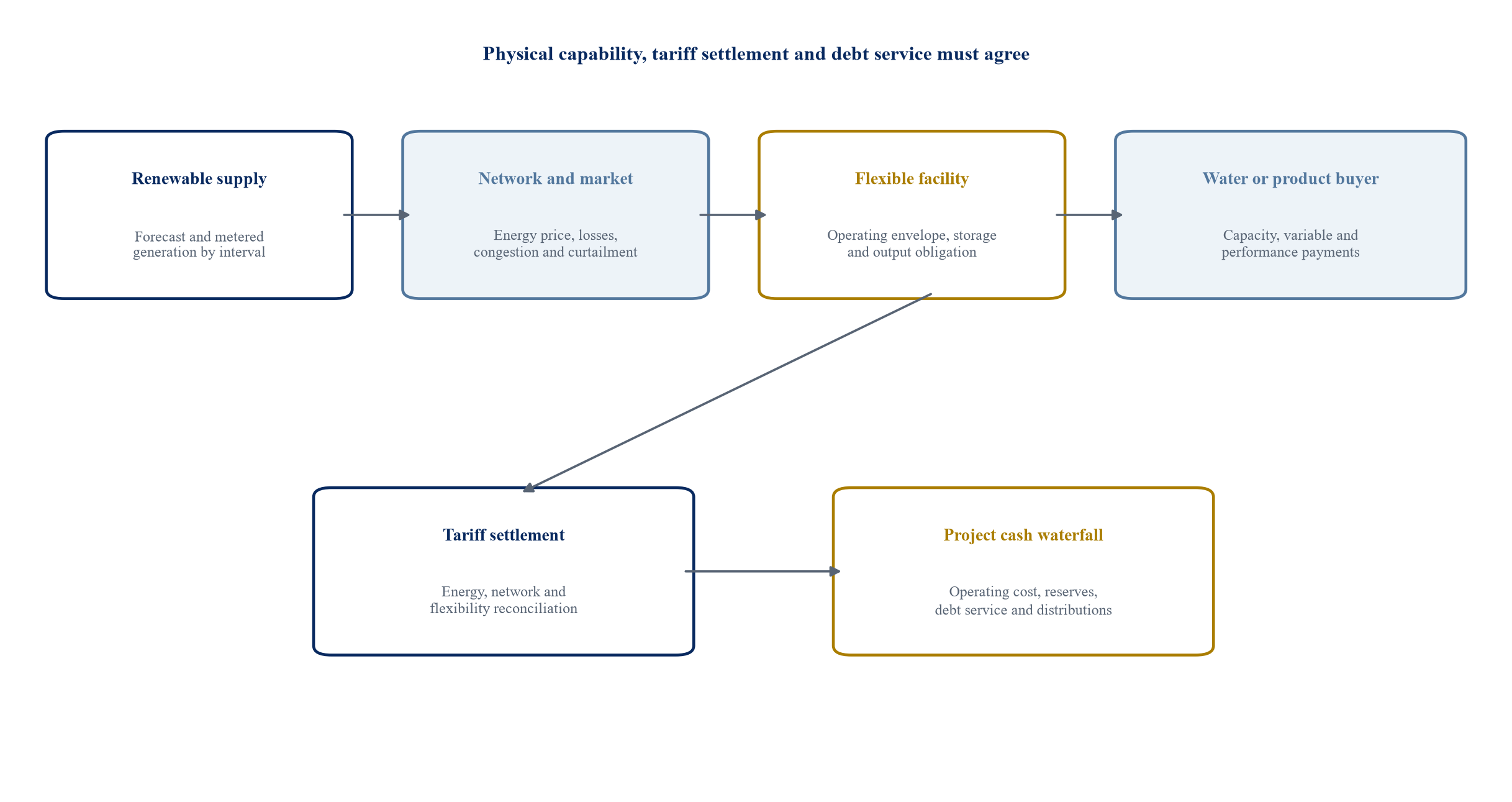
The system map separates physical dispatch, tariff settlement and lender cash flow. The structure is illustrative and should be adapted to the project documents and local market rules.
5 Use a two-part payment for essential output
Water and critical industrial infrastructure carry large fixed costs. A tariff based only on metered output can expose the project company to demand risk that the public authority or buyer controls. World Bank guidance describes desalination build-own-operate-transfer arrangements with a fixed capacity payment for capital and fixed operating costs and a variable payment for variable operating costs [10]. Sample bulk-water agreements use the same capacity-plus-volume logic [14].
The fixed payment should depend on availability and performance within the project company's control. It can be abated for unavailability, water-quality failure or failure to maintain the agreed flexible capability. It should not fall because the buyer chooses to call less output, unless the project company expressly accepted volume risk and priced it.
The variable payment should track delivered volume and costs that genuinely vary with production. Energy can sit inside that variable component, but its risk treatment should remain explicit. A take-or-pay quantity, minimum offtake or deemed-production mechanism can protect debt service when the facility is available and the buyer does not dispatch it.
6 Price time through a limited number of states
A tariff with hundreds of dynamic price points can be economically precise and operationally difficult. Many projects can begin with a small number of system states: renewable surplus, ordinary operation, constrained peak and emergency event. Each state should have observable entry and exit rules.
The renewable-surplus state can offer a discounted energy or network charge when forecast generation is high and network capacity is available. The ordinary state supports normal operation. The constrained-peak state raises the marginal charge or pays a rebate for verified reduction. The emergency state may permit direct dispatch under a separately compensated demand-response agreement.
The system state should be published with sufficient notice for the facility to respond. Day-ahead notification can support batch scheduling and reservoir planning. Intraday updates can refine the signal. Real-time dispatch may be appropriate only for automated load with tested controls. The tariff should specify which signal governs settlement when forecasts change.
7 Match the tariff window to renewable output
Fixed time-of-use windows can be useful when the renewable and demand profiles are stable. IRENA describes time-varying tariffs as a means to shift consumption toward lower-cost periods and reduce peak load and network investment [4]. The window should be reviewed because additional solar, storage and flexible demand can change the system profile.
A solar-rich system may have low-cost midday energy and an evening ramp. A wind-rich system may need seasonal or day-ahead variation. A hydro system may value demand reduction during dry periods. Applying one universal peak window can create a secondary peak when all customers respond at the boundary.
The contract should permit periodic recalibration under a defined methodology. Recalibration should use published data, preserve an agreed notice period and protect the economic balance of long-term contracts. A unilateral right to change windows without compensation can create unquantifiable merchant exposure.
8 Allocate dispatch risk to the controlling party
Risk should follow control. The facility controls equipment availability, process scheduling within the agreed envelope, maintenance and compliance with dispatch instructions. The utility or system operator controls network availability, tariff publication and curtailment instructions. The renewable generator controls plant availability subject to resource risk and contractual exceptions. The buyer controls product demand and offtake.
Misallocation raises the financing cost. A project company should not lose availability revenue when it followed a valid instruction that reduced output. A utility should not pay flexibility compensation when the facility was already planning to reduce load. A renewable generator should not bear network curtailment beyond the risks accepted in its power purchase agreement.
The direct agreements should give lenders notice and cure rights before termination. Dispatch disputes should use meter data and a defined calculation. The contract should state how force majeure, network outages, renewable shortfall, water-quality events and customer default affect each payment component.
Table 1. Risk-allocation matrix for time-aligned demand
| Risk | Primary controller | Tariff or contract treatment | Lender concern |
|---|---|---|---|
| Facility availability | Project company | Capacity payment abatement and cure regime | Prolonged loss of fixed revenue |
| Output demand | Water or product buyer | Minimum offtake, take-or-pay or deemed output | Volume shortfall outside operator control |
| Energy efficiency | Project company | Specific-consumption benchmark and sharing rule | Opex erosion and performance penalties |
| Wholesale price | Assigned by PPA or tariff | Pass-through, indexed band, collar or hedge | Cash-flow volatility and hedge tenor |
| Renewable shortfall | Generator or buyer under contract | Firming obligation, replacement energy and caps | Unfunded replacement-power cost |
| Network congestion | Network or allocated user | Locational charge, curtailment compensation and cap | Unbounded wheeling or congestion cost |
| Dispatch instruction | System operator or buyer | Event payment, baseline and make-whole rule | Lost output and rebound cost |
| Storage performance | Project company | Availability test and degradation reserve | Reduced flexibility and replacement capex |
| Change in tariff rules | Public authority | Change-in-law and economic-balance mechanism | Structural revenue loss |
The allocation is illustrative. The final position depends on control, insurance, local law, procurement policy and the project documents.
9 Choose the power procurement model
The project may buy electricity from the regulated grid, negotiate a physical PPA, use a sleeved PPA, self-generate, combine sources or settle a financial hedge. Each model assigns price, volume, profile, basis, loss and curtailment risk differently.
World Bank analysis of desalination describes a wide range. In regulated systems, energy cost can be passed through to the water buyer subject to a guaranteed efficiency level. In liberalised markets, developers may procure their own electricity, optimise supply and accept more energy risk [9]. Analysis of Israel notes that developers can arrange power separately and may carry energy price risk rather than receiving a pass-through [11].
The tariff should follow the procurement model. A project with full energy pass-through has little incentive to time demand unless it receives a sharing payment. A project that bears the market price has a strong incentive but may face unbankable volatility. A collar, benchmark-and-share mechanism or contracted flexibility payment can divide savings while limiting downside.
10 Treat network charges as a separate decision
Energy can be cheap while network use is expensive. Wheeling charges, losses, demand charges, connection capacity and congestion can determine whether load shifting creates value. A renewable generator and industrial customer may be distant, requiring transmission access and settlement across several entities.
World Bank analysis of renewable desalination in the Middle East and North Africa states that tariffs and wheeling charges should reflect the load profile of the desalination and renewable plants, plus grid expansion, transmission and storage services [9]. A tariff that discounts energy but ignores a coincident network peak can increase system cost.
The financial model should therefore separate energy, network and balancing charges by interval. It should test connection-capacity limits and demand-charge ratchets. Locational signals should be transparent enough for the customer to respond. Charges outside the customer's control may need caps, indexation or reopening provisions.
11 Value water and product storage before batteries
Electricity storage is one way to move renewable energy across time. Product storage can perform the same economic function when production is flexible. A water reservoir permits desalination during low-cost hours and delivery during peak demand. Thermal storage permits electric boilers or heat pumps to run when renewable supply is abundant. Cold storage can shift refrigeration load.
The comparison should use the full system cost. Product storage requires land, civil works, treatment integrity, pumping and inventory controls. Electricity storage has power and energy costs, round-trip losses, degradation and replacement needs. Process flexibility may require redundant equipment or higher production capacity to recover deferred output.
A least-cost study should compare storage duration, efficiency, operating limits and avoided charges. The project should avoid purchasing a battery when a water reservoir or thermal store provides the required shift more cheaply. It should also avoid oversizing product storage when process risk or demand variability prevents regular use.
12 Protect process integrity and service quality
Demand flexibility cannot compromise drinking-water quality, product specification, worker safety or environmental permits. The operating envelope should include hard constraints that override the tariff signal. The facility control system should record when a dispatch instruction was rejected for a protected reason.
For desalination, constraints can include pretreatment stability, membrane pressure, recovery ratio, brine discharge conditions, remineralisation, reservoir levels and distribution pressure. For industry, constraints can include furnace temperature, cold-chain compliance, batch integrity, emissions limits and minimum staffing.
The tariff should not penalise a facility for rejecting an instruction outside the agreed envelope. Repeated inability to deliver a contracted service should trigger a capability review. The contract can distinguish a temporary protected constraint from failure to maintain the promised flexibility asset.
13 Build the baseline from metered operations
Flexibility settlement requires a counterfactual: what would the facility have consumed without the event? A weak baseline can pay for reductions that would have occurred anyway or deny payment for genuine response. The methodology should be defined before commercial operation.
Baseline choices include recent comparable days, weather-adjusted models, production-adjusted models, nominated schedules and engineering calculations. Industrial sites require output normalization because electricity use changes with production. Desalination requires normalization for water volume, feedwater conditions and reservoir state.
The contract should specify data intervals, exclusions, adjustment rights and audit. A nominated schedule can be simple but may invite strategic bias. A statistical baseline can be more accurate but harder to explain. The settlement should use the least complex method that is robust for the process.
14 Account for rebound and recovery
Reducing load during a peak can shift consumption into the next interval. That rebound may create a second peak or require expensive replacement energy. The model should measure the entire event cycle from pre-positioning through recovery.
A water plant may increase production before an event, draw down its reservoir during the event and restore inventory later. An industrial facility may reschedule a batch or pre-heat thermal storage. Each action has energy, efficiency and operating consequences. The flexibility payment should reflect net system benefit after recovery.
The dispatch rule can limit the speed of recovery or identify preferred recovery windows. The facility should retain minimum inventory and process margins. Lenders should test whether repeated events reduce saleable output, increase maintenance or create working-capital needs.
15 Model cash available for debt service
Project finance depends on cash available for debt service rather than gross tariff savings. The model should start with capacity and output payments, subtract operating costs, energy, network charges, taxes and required reserves, then calculate debt service coverage.
World Bank guidance defines the debt service coverage ratio as cash available for debt service divided by scheduled interest and principal for the relevant period [15]. IFC guidance recommends sensitivity analysis on tariff, capital cost, energy yield and operating cost and notes that lenders consider minimum and average coverage across scenarios [16]. The exact covenant depends on the transaction and should not be inferred from an illustrative benchmark.
Time-based tariffs affect both revenue and cost. A lower energy charge during renewable-rich hours can improve cash flow. A peak penalty or failed-response charge can reduce it. Storage capex, controls, metering and additional maintenance require funding. The model should reconcile interval settlement to the monthly cash waterfall used for debt service.
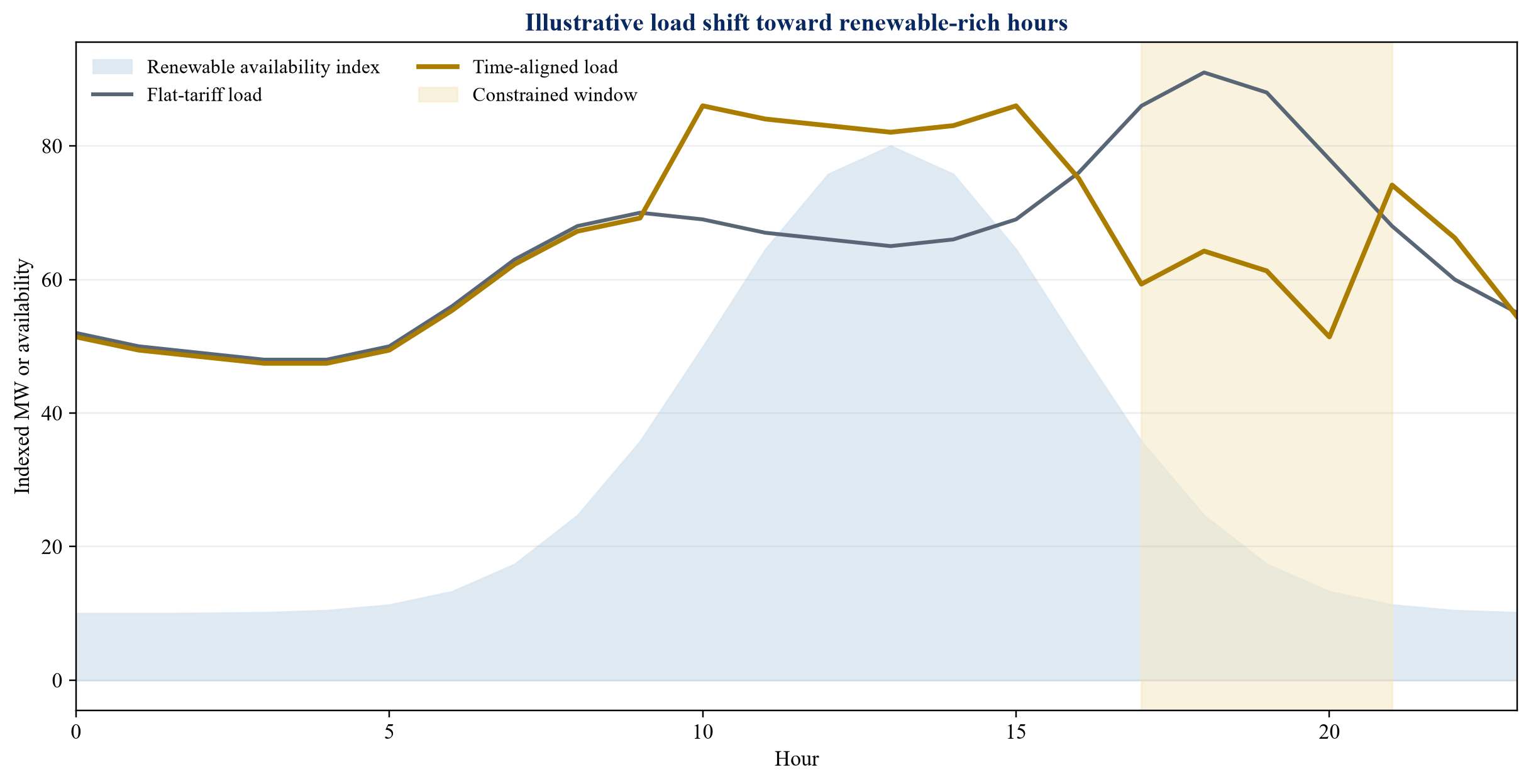
The hourly load and renewable profiles are author modelling assumptions. They demonstrate how flexible production can move toward renewable supply while preserving total daily output.
16 Run debt-service sensitivities by tariff component
One blended tariff sensitivity conceals the source of risk. The model should vary the fixed payment, production volume, energy price, network charge, flexibility revenue, efficiency, storage availability, curtailment and interest rate separately. Correlated cases should then combine plausible movements.
The downside case should include a high renewable-shortfall cost when the project bears replacement energy, lower flexible capability after equipment degradation, and a delayed tariff recalibration. The lender case may exclude uncontracted flexibility revenue or cap it at a conservative share of debt service. Contracted floors should be tested against counterparty credit and termination rights.
The model should also test upside carefully. Lower energy cost can raise cash available for debt service, but a sharing mechanism may allocate some benefit to the buyer. Revenue from market participation may require registration, aggregation or separate collateral. Upside should not be used to support debt unless the project documents and operating evidence make it dependable.
Table 2. Hypothetical tariff and debt-service sensitivity
| Case | Capacity payment | Average energy cost | Flexible-load delivery | Minimum DSCR | Interpretation |
|---|---|---|---|---|---|
| Base case | 100% of contracted | USD 58/MWh | 90% of nominated capability | 1.36x | Contract and operating case align |
| Renewable-rich case | 100% | USD 47/MWh | 96% | 1.49x | Lower energy cost supports cash flow |
| Weak-response case | 98% after abatement | USD 58/MWh | 55% | 1.22x | Capability shortfall erodes payment and efficiency |
| Price-stress case | 100% | USD 79/MWh | 90% | 1.17x | Uncapped replacement energy weakens coverage |
| Network-stress case | 100% | USD 58/MWh plus higher wheeling | 82% | 1.20x | Congestion and demand charges offset energy savings |
| Combined downside | 96% after abatement | USD 82/MWh plus higher wheeling | 50% | 0.98x | Debt service is not covered without mitigation |
Values are author modelling assumptions for method demonstration. They are not observed project data, financing terms or forecasts.
17 Use reserves for risks that remain with the project
Reserves can address timing risk but cannot repair an unbankable allocation. A debt-service reserve can cover temporary cash shortfalls. A maintenance reserve can fund membrane replacement, control equipment and storage degradation. A tariff stabilization account can smooth customer charges when public policy supports it.
Reserve sizing should follow the risk. A project that bears short-term wholesale prices may need liquidity for collateral and settlement. A plant with battery storage may require a replacement reserve linked to degradation. A concession with delayed public payments may need a payment-security mechanism or liquidity facility.
Reserves consume capital and can reduce equity returns. The contract should first assign risk to the party able to manage it, then use reserves for residual volatility. A facility with structurally negative cash flow under ordinary prices needs a tariff or contract correction rather than a larger reserve.
18 Align the water agreement and power agreement
The water purchase agreement and power arrangement should use compatible definitions. Delivery day, force majeure, change in law, metering, curtailment, indexation and dispute resolution should not create gaps. A power interruption excused under the PPA can still expose the project company to water-availability deductions unless the WPA contains corresponding relief.
The term and volume profile also need alignment. A twenty-five-year water concession supported by a ten-year hedge leaves an open electricity-price position after hedge expiry. A renewable PPA may deliver a profile that differs from water production. Replacement-power rights, extensions and refinancing assumptions should be explicit.
Direct agreements can give lenders cure rights and preserve essential contracts after project-company default. Assignment and step-in provisions should cover the tariff, renewable supply, network access, land, permits and major operating agreements. A tariff model cannot compensate for missing contractual continuity.
19 Address curtailment and renewable shortfall separately
Curtailment is an instruction or network outcome that reduces renewable delivery despite resource availability. Renewable shortfall arises when the resource or plant produces less than expected. The controlling causes and mitigation differ.
World Bank guidance on power projects commonly allocates transmission-related curtailment beyond an agreed threshold to the offtaker or provides compensation, while renewable resource risk remains with the generator subject to the contract [17]. A flexible customer can absorb some generation that would otherwise be curtailed, but network constraints may still prevent physical delivery.
The tariff should define whether curtailed energy qualifies for a low-price window, whether the customer must shift when instructed, and who pays for replacement energy. The model should avoid counting both curtailment compensation and flexibility value for the same megawatt-hour unless both payments are contractually available.
20 Protect against indexation mismatch
Long-term projects combine costs with different escalation. Debt may carry fixed or floating interest. Labour, chemicals and maintenance may follow domestic inflation. Equipment replacement may be foreign-currency denominated. Electricity can follow a regulated tariff, market index or contracted escalation.
The tariff should map each material cost to an appropriate index with a base date, reset frequency, lag and cap. Broad consumer inflation may be a poor proxy for imported membranes or wholesale electricity. A formula with many indices can become opaque, so materiality should guide selection.
Foreign-exchange risk requires separate treatment. A local-currency water payment and foreign-currency debt can create a structural mismatch. Hedging, indexed components, reserve accounts or public support may be required. The project model should test devaluation with energy and interest-rate stress where those risks are correlated.
21 Use flexibility sharing to align incentives
When the customer or project company can create system savings, a sharing formula can align incentives. The benchmark might compare actual interval cost with a contractually defined reference schedule. Savings can be divided after deducting incremental operating cost, degradation and verified output effects.
The benchmark should avoid paying for changes driven by unrelated production decline. It should also avoid penalising the operator for following an instruction that later proves unnecessary. A floor can protect the facility's reasonable incremental cost. A cap can protect the buyer from paying more than the system benefit.
Sharing can work where a full dynamic tariff would create excessive volatility. It preserves a stable base payment while rewarding measured flexibility. Lenders may treat the variable share as upside until a track record develops.
22 Procure capability and operating performance
Tender documents should describe the desired service rather than prescribe one technology. Bidders can then compare process changes, product storage, thermal storage, batteries, controls and renewable procurement. The bid evaluation should separate fixed tariff, variable tariff, energy-risk position and flexibility capability.
The authority should require a dispatch simulation, equipment schedule, control architecture, metering plan and financial model. The model should show sources and uses, cash waterfall, coverage ratios and sensitivities. Bid assumptions on renewable output, network charges and product demand should use a common data room so prices are comparable.
Commercial evaluation should account for risk transfer. A low headline tariff can conceal an uncapped pass-through to the public buyer. A higher fixed payment may be efficient if it removes expensive merchant exposure and lowers financing cost. The evaluation should compare whole-life expected cost under the same scenarios.
23 Implement controls before dynamic settlement
The facility needs interval meters, reliable communications, a production schedule, automated controls and a settlement engine. Cybersecurity and operating authority should be defined because an external price or dispatch signal can affect critical infrastructure.
Implementation should begin with shadow settlement. The parties calculate the dynamic tariff without changing invoices, compare the result with operations and correct data or baseline errors. A limited pilot can then use capped payments and events. Full settlement follows after independent verification of metering and controls.
The control room needs clear priority rules. Safety, water quality, product integrity and environmental compliance take precedence. The operator should know which instruction is binding, how to reject it and how to record the reason. Settlement disputes should be resolved from a common event log.
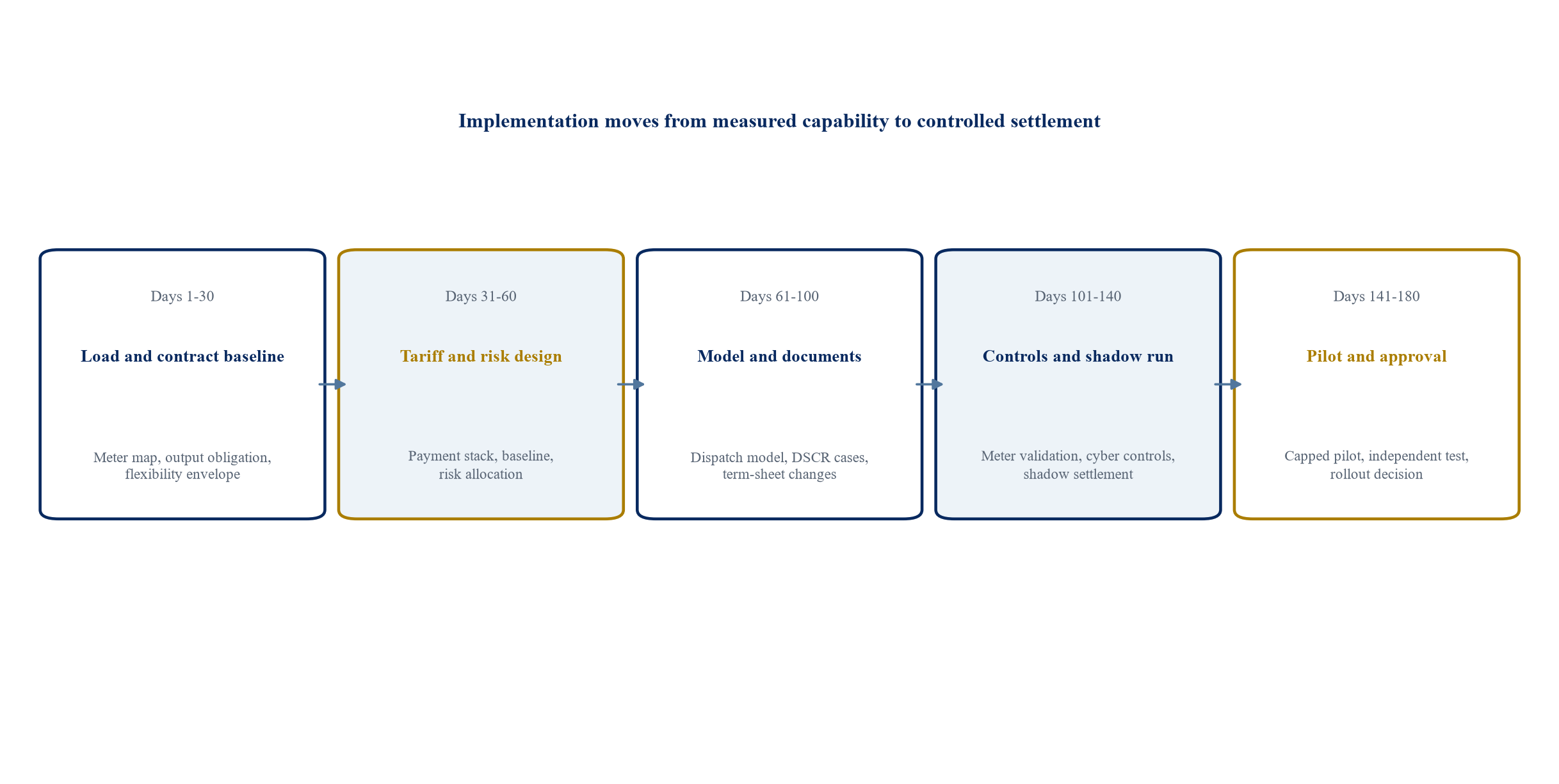
The roadmap is illustrative. Timing depends on procurement, regulation, metering, controls and existing contracts.
24 Govern tariff changes with evidence
The tariff committee should include the buyer, facility operator, system or network representative and an independent technical or regulatory function where appropriate. Lenders need consultation rights for changes that affect debt service.
The committee should review metering quality, response delivery, output effects, customer cost, renewable absorption, curtailment, network conditions and disputes. It should distinguish a parameter update under the agreed methodology from a fundamental change in risk allocation. Fundamental changes require the contractual approval process.
Decision records should show the data period, model version, assumptions and distributional effects. A tariff change that reduces system cost can still harm a vulnerable customer or shift cost to another class. The regulator or authority should examine affordability and cost allocation alongside project bankability.
25 Use a financing decision checklist
The investment committee should require evidence that physical flexibility exists, is measurable and does not impair the core service. It should confirm that fixed-cost recovery does not depend on voluntary dispatch by another party. It should trace every material energy and network risk to a contract, cap, hedge or downside case.
The lender model should reproduce interval tariff settlement and reconcile it to monthly invoices and cash available for debt service. Minimum coverage should survive agreed downside cases. Reserves, distribution locks and cure rights should respond to the actual risk. The project should retain a refinancing path when the initial hedge or tariff period is shorter than the concession.
The operating plan should contain meters, automation, cybersecurity, baseline methodology, event logs and a protected-constraint process. The project should enter full dynamic settlement only after shadow operation and an independent capability test.
Table 3. Tariff choices and suitable financing treatment
| Tariff structure | Main benefit | Main risk | Financing treatment |
|---|---|---|---|
| Flat volumetric tariff | Simple billing and stable customer price | Hides system timing cost and weakens flexibility incentive | Use only where timing value is immaterial or captured elsewhere |
| Static time-of-use tariff | Predictable incentive and simple operations | Windows can become outdated and create rebound peaks | Define review methodology and notice period |
| Dynamic energy price | Strong response to current system conditions | High cash-flow volatility and operational complexity | Use caps, collars, hedges and conservative lender case |
| Capacity plus variable tariff | Protects fixed-cost recovery while preserving output incentives | Requires careful availability and abatement rules | Align fixed payment with debt service and controllable performance |
| Benchmark-and-share | Shares verified savings without full merchant exposure | Baseline disputes and gaming risk | Independent baseline, audit and upside treatment |
| Dispatchable flexibility contract | Pays for tested capability and events | Penalties can exceed operating value if envelope is wrong | Capability test, event limits, make-whole and liability cap |
| Integrated WPA and PPA structure | Aligns water, energy and network obligations | Complex interfaces and term mismatch | Direct agreements, compatible relief and matched tenor |
The table summarises common structures. Suitability depends on the physical service, market design, credit quality and contract package.
26 Sequence capital commitments around tariff certainty
The project should avoid committing every flexibility investment before the tariff and operating evidence are mature. Metering, controls and data integration can be installed early because they improve visibility under almost every commercial structure. Product storage, redundant process capacity and batteries require a stronger link to measured value.
A staged capital plan can use decision points. The first release funds interval metering, engineering studies and shadow settlement. The second follows a verified operating envelope and agreed tariff term sheet. The final release funds major storage or process modification after the pilot demonstrates dispatch delivery, output recovery, equipment effects and settlement accuracy. Each decision point should identify the required evidence, budget, owner and financing source.
The construction contract should preserve interfaces for later equipment where possible. Space, electrical connections, controls and civil allowances can reduce future retrofit cost. The financial model should distinguish committed capex from options and show how each stage changes energy cost, availability and coverage ratios.
Procurement timing also affects competitive tension. Packaging every component into the original plant contract may simplify responsibility but reduce visibility into the cost of flexibility. Separate packages can improve price discovery and create interface risk. The authority should choose the package structure after defining performance responsibility and lender step-in rights.
27 Test transferability across market structures
The same physical facility can require different tariff treatment across jurisdictions. A vertically integrated utility may control generation, network, water production and retail billing. A liberalised market may separate the renewable generator, network operator, retailer, water buyer and flexibility aggregator. The number of interfaces changes who can send a price signal and settle the response.
In a vertically integrated system, the authority can evaluate avoided generation, fuel, curtailment and network cost across the whole portfolio. A shadow tariff may be sufficient for internal dispatch before customer-facing reform. In a competitive market, the project needs contractual access to interval prices, balancing arrangements and network rules. A retailer or aggregator may combine the load with other assets and pay the project for delivered flexibility.
Credit support differs as well. A public offtaker may provide a sovereign or government support arrangement subject to law and fiscal policy. A corporate industrial buyer may offer a parent guarantee, letter of credit, collateral or termination payment. A market-based revenue stream can require clearing-member arrangements and collateral that move with volatility. The lender should assess the specific payment path rather than rely on the public or private label of the counterparty.
Transferability should therefore be tested component by component. The physical flexibility envelope may transfer. The tariff formula, baseline, dispatch authority, indexation, credit support and change-in-law protection may not. A project entering a new geography should rebuild these commercial elements from local rules and contracts.
28 Recognise limitations
The framework does not determine the efficient tariff for a named jurisdiction. That decision requires system dispatch data, network constraints, customer classes, policy objectives, legal authority and project-specific engineering. Public data on industrial operating flexibility are limited because production schedules and contracts are commercially sensitive.
The hypothetical exhibits simplify plant operations, wholesale markets, network tariffs and debt documents. They demonstrate model structure. They do not show an expected return or a universal coverage threshold. Tariff effects can change as renewable penetration, storage and customer behaviour evolve.
Further research should compare measured flexibility across desalination technologies and industrial processes, quantify equipment and product-quality effects from cycling, and evaluate how tariff design changes financing cost. Pilot programmes should publish anonymised interval performance and settlement outcomes where confidentiality permits.
Conclusion
Renewable supply and essential demand can be aligned when tariff design begins with the physical service. A project needs a defined output obligation, a measured flexibility envelope and a payment stack that separates fixed-cost recovery from energy, network and performance components. Time signals should be simple enough to operate, transparent enough to finance and responsive enough to reflect system conditions.
Desalination and industrial processes can supply valuable flexibility through scheduling, product storage, thermal storage and controls. The value depends on process limits, network conditions and contract design. Efficiency, timing and service quality should be measured separately. Risk should sit with the party that controls it, supported by compatible water, power, network and financing agreements.
A lender should see interval settlement flow through to cash available for debt service under ordinary and stressed conditions. A public authority should see the whole-life system cost and customer effect. A facility operator should have clear dispatch priorities and protection for safety and quality. When those conditions are present, time-aligned demand can reduce renewable curtailment, manage network peaks and support financeable water and industrial infrastructure.
References
- International Energy Agency. The Value of Demand Flexibility. 2025. https://www.iea.org/reports/the-value-of-demand-flexibility
- International Energy Agency. Electricity 2026: Flexibility. 2026. https://www.iea.org/reports/electricity-2026/flexibility
- International Renewable Energy Agency. Flexibility for a Secure and Affordable Power Sector Transformation. 2026. https://www.irena.org/Publications/2026/Jan/Flexibility-for-a-secure-and-affordable-power-sector-transformation
- International Renewable Energy Agency. Time-of-Use Tariffs: Innovation Landscape Brief. 2019. https://www.irena.org/-/media/Files/IRENA/Agency/Publication/2019/Feb/IRENA_Innovation_ToU_tariffs_2019.pdf
- International Energy Agency. Renewables for Industry. 2025. https://www.iea.org/reports/renewables-for-industry
- International Energy Agency. Renewables Integration in India. 2021. https://www.iea.org/reports/renewables-integration-in-india
- United States Department of Energy. Demand Response and Time-Variable Pricing Programs. https://www.energy.gov/cmei/femp/demand-response-and-time-variable-pricing-programs
- United States Department of Energy. Demand Response in Industrial Facilities. 2022. https://betterbuildingssolutioncenter.energy.gov/sites/default/files/attachments/Demand%20Response%20in%20Industrial%20Manufacturing_Final%20V2.pdf
- World Bank. Fresh Perspectives: Emerging Issues and Opportunities for Desalination in the Middle East and North Africa. 2025. https://documents1.worldbank.org/curated/en/099120325085522367/pdf/P510972-95cd0c55-9926-4bca-a6fe-422af95faaff.pdf
- World Bank. The Role of Desalination in an Increasingly Water-Scarce World. 2019. https://documents1.worldbank.org/curated/en/476041552622967264/pdf/135312-WP-PUBLIC-14-3-2019-12-3-35-W.pdf
- World Bank. Desalination PPPs in Israel: Energy Supply and Tariff Allocation. 2025. https://documents1.worldbank.org/curated/en/099651407222523237/pdf/IDU-ad9f7d2c-4ca8-4176-a5fa-d35850e8b307.pdf
- World Bank. Securing Potable Water Supply through Desalination in Cyprus. 2018. https://documents1.worldbank.org/curated/en/166941539893383666/pdf/131040-WP-P159228-Securing-Potable-Water-Supply-PUBLIC.pdf
- World Bank PPP Resource Center. Desalination Plant, Ensenada, Mexico. https://ppp.worldbank.org/water-and-sanitation/desalination-plant-ensenada-mexico
- World Bank PPP Resource Center. Sample Bulk Supply Agreement for Water. https://ppp.worldbank.org/library/sample-bulk-supply-agreement-bot-water
- World Bank PPP Resource Center. Key Issues in Developing Project Financed Transactions. https://ppp.worldbank.org/financing/issues-in-project-financed-transactions
- International Finance Corporation. Utility-Scale Solar Photovoltaic: A Guide for Project Developers. https://ppp.worldbank.org/public-private-partnership/sites/ppp.worldbank.org/files/2022-03/IFC_Solar_Report_Web__08_05.pdf
- World Bank PPP Resource Center. Power Generation Module and Risk Allocation. https://ppp.worldbank.org/energy-and-power/power-generation-module
- World Bank PPP Resource Center. Power Purchase Agreements and Energy Purchase Agreements. https://ppp.worldbank.org/sector/energy/energy-power-agreements/power-purchase-agreements
- World Bank. Making Greenfield Projects Bankable. 2021. https://blogs.worldbank.org/en/ppps/making-greenfield-projects-bankable
- International Finance Corporation. Power Market Database. https://www.worldbank.org/en/who-we-are/ifc/power-markets-database
- World Bank PPP Resource Center. Wheeling and Banking Strategies for Optimal Renewable Energy Deployment. 2016. https://ppp.worldbank.org/library/wheeling-and-banking-strategies-optimal-renewable-energy-deployment-international-experiences
- International Renewable Energy Agency. Renewable Desalination Technology Options for Islands. 2015. https://www.irena.org/Publications/2015/Dec/Renewable-Desalination-Technology-Options-for-Islands
- United States Department of Energy. The Future of Resource Adequacy. 2024. https://www.energy.gov/sites/default/files/2024-04/2024%20The%20Future%20of%20Resource%20Adequacy%20Report.pdf
- Dubai Electricity and Water Authority. Integrated Report 2025. 2026. https://www.dewa.gov.ae/-/media/Files/Investor-Relations-Files/Integrated-report-for-the-year-2025.ashx
- Dubai Electricity and Water Authority. Hassyan Seawater Reverse-Osmosis Project. https://dewa.gov.ae/en/about-us/strategic-initiatives/hassyan
- Dubai Electricity and Water Authority. First-Half 2026 Operational and Financial Results. 2026. https://dewa.gov.ae/en/about-us/media-publications/latest-news/2026/8/dubai-electricity-and-water-authority-pjsc-announces
- Saudi Water Partnership Company. Company Profile and Project Programme. 2026. https://www.swpc.sa/wp-content/uploads/2026/02/SWPC-profile-en.pdf
- World Bank PPP Resource Center. Water and Sanitation Public-Private Partnerships. https://ppp.worldbank.org/water-and-sanitation/water-sanitation-ppps
- World Bank PPP Resource Center. Considerations for Government: Bankability. https://ppp.worldbank.org/considerations-government
- International Energy Agency. Scaling Up Demand Flexibility. 2026. https://www.iea.org/reports/scaling-up-demand-flexibility
About the Author
Authored by Chennakeshav Adya Independent Researcher
Chennakeshav (CK) is a corporate finance and investment banking executive with 25+ years of global experience in deal origination, structuring and execution across M&A, growth capital and corporate strategy. He has led value-creation mandates for founders, corporates and funds — bridging the boardroom view to hands-on execution and close.
His career spans Morgan Stanley, HSBC, Lloyds Banking Group, EWEC, ADQ portfolio companies and Emirates Growth Fund, across TMT, real estate, fintech, deeptech, cleantech, infrastructure and energy. He has partnered with C-suite leaders, private equity and venture funds, sovereign wealth funds and family offices to finance complex fund raises and scale-up ventures, and has led M&A due diligence, post-merger integration and business-transformation initiatives to create value.
At Matchpoint Partners he is Managing Partner, leading the firm's corporate finance, M&A and capital-raising practice. He holds an MBA from London Business School, an engineering degree from VTU and a Master of Laws (LLM, in progress) from UCL London.
An active start-up mentor, CK mentors at Techstars, DIFC FinTech Hive, Startup Grind, Founder Institute and IN5, serves as Entrepreneur Mentor in Residence (EMiR) at London Business School, and judges the Entrepreneurship World Cup.
https://www.linkedin.com/in/ckadya/ https://www.matchpoint-partners.com/team/ck-adya.html
This paper is part of a continuing series on the structure of private and alternative markets. The views expressed are the author's own. The paper is for information only, describes market structure in general terms, and does not constitute investment, legal, tax or regulatory advice or a recommendation in respect of any security, vehicle or counterparty.
