

1. Define the financing decision
A transformer manufacturer must decide how much capacity to add, which products to prioritise, how quickly to ramp and which capital sources can absorb construction, commissioning and demand risk. The financing case should connect contracted demand to specific equipment, labour, materials and cash flows.
The evidence package should reconcile customer contract, product specification, constrained work centre, supplier quote, capex estimate, schedule and financing assumption. Management estimates should remain identified and should not be presented as observed performance.
A financeable plan assigns the risk to the party able to control it, establishes measurable gates and retains liquidity for the ramp. Approval should depend on evidence that the expansion can produce qualified units and convert them into cash.
2. Separate product markets
Large power transformers, distribution transformers, mobile units, switchgear and critical components have different designs, customers, production cycles and qualification requirements. Capacity should be measured by constrained work centre and product family rather than headline factory area.
The analysis should distinguish committed backlog, qualified pipeline and market demand. Lenders and boards need sensitivity ranges for price, volume, delivery, yield, working capital and customer acceptance, supported by accountable data owners.
The investment committee should see the consequence of delay, lower utilisation, material inflation, failed tests and customer cancellation. The recommended structure should remain compliant under a credible downside case.
3. Build the demand case
The base case should reconcile utility replacement, transmission expansion, renewable connections, industrial electrification, data-centre load and resilience procurement. Customer forecasts should be weighted by approved capital plans, interconnection maturity, procurement status and cancellation history.
The financing model should connect each draw to a physical milestone and each repayment source to enforceable cash receipts. Public support, customer advances and collateral should be recognised only when eligibility and control are documented.
Execution should translate the decision into engineering, procurement, workforce, commercial and financing workstreams. A controlled decision record should capture assumptions, owners, dates, approvals and change triggers.
4. Map the customer procurement cycle
Utilities may procure through frameworks, individual tenders, emergency reserves or regulated programmes. The model should reflect specification, bid, engineering approval, manufacturing, factory testing, transport, installation and acceptance milestones.
The evidence package should reconcile customer contract, product specification, constrained work centre, supplier quote, capex estimate, schedule and financing assumption. Management estimates should remain identified and should not be presented as observed performance.
A financeable plan assigns the risk to the party able to control it, establishes measurable gates and retains liquidity for the ramp. Approval should depend on evidence that the expansion can produce qualified units and convert them into cash.
5. Test backlog quality
Backlog value can overstate financeable revenue when specifications remain open, deposits are refundable, delivery slots can move or price escalation is incomplete. Lenders need a contract-by-contract bridge from reported backlog to enforceable cash flow.
The analysis should distinguish committed backlog, qualified pipeline and market demand. Lenders and boards need sensitivity ranges for price, volume, delivery, yield, working capital and customer acceptance, supported by accountable data owners.
The investment committee should see the consequence of delay, lower utilisation, material inflation, failed tests and customer cancellation. The recommended structure should remain compliant under a credible downside case.
Table 1. Transformer-capacity financing evidence map
| Decision area | Operating evidence | Commercial evidence | Financing implication | Principal downside |
|---|---|---|---|---|
| Product scope | Qualified design families and test requirements | Customer specifications and tender history | Asset scope and eligible capex | Product mismatch |
| Capacity | Standard hours by constrained work centre | Firm delivery schedule | Draw and completion milestones | Bottleneck migration |
| Backlog | Approved engineering and material release | Deposit, cancellation and price terms | Financeable cash-flow base | Deferral or cancellation |
| Supply chain | Qualified suppliers and lead times | Pass-through and substitution rights | Working-capital and contingency need | Input delay or inflation |
| Ramp | Hiring, yield and throughput curve | Customer acceptance plan | Equity buffer and covenant profile | Delayed debt service |
The evidence requirement varies by product, jurisdiction and transaction; independent diligence remains necessary.
6. Identify the binding work centres
Winding, core cutting, drying, tank fabrication, final assembly, high-voltage testing and specialist engineering can each constrain throughput. Capital should target the bottleneck that governs completed units and cash conversion.
The financing model should connect each draw to a physical milestone and each repayment source to enforceable cash receipts. Public support, customer advances and collateral should be recognised only when eligibility and control are documented.
Execution should translate the decision into engineering, procurement, workforce, commercial and financing workstreams. A controlled decision record should capture assumptions, owners, dates, approvals and change triggers.
7. Choose brownfield or greenfield expansion
Brownfield investment can use existing skills, certifications and customer approvals while facing layout and outage constraints. Greenfield capacity can optimise flow and scale but adds site, utility, workforce and qualification risk.
The evidence package should reconcile customer contract, product specification, constrained work centre, supplier quote, capex estimate, schedule and financing assumption. Management estimates should remain identified and should not be presented as observed performance.
A financeable plan assigns the risk to the party able to control it, establishes measurable gates and retains liquidity for the ramp. Approval should depend on evidence that the expansion can produce qualified units and convert them into cash.
8. Stage the factory expansion
A modular programme can release capital through design, long-lead orders, building works, equipment installation, pilot production and commercial ramp. Each gate should depend on evidence that reduces the next tranche's risk.
The analysis should distinguish committed backlog, qualified pipeline and market demand. Lenders and boards need sensitivity ranges for price, volume, delivery, yield, working capital and customer acceptance, supported by accountable data owners.
The investment committee should see the consequence of delay, lower utilisation, material inflation, failed tests and customer cancellation. The recommended structure should remain compliant under a credible downside case.
9. Secure grain-oriented electrical steel
Transformer cores depend on electrical steel with demanding magnetic properties. The case should test supplier concentration, grade substitution, qualification time, minimum orders, tariffs, logistics and inventory policy.
The financing model should connect each draw to a physical milestone and each repayment source to enforceable cash receipts. Public support, customer advances and collateral should be recognised only when eligibility and control are documented.
Execution should translate the decision into engineering, procurement, workforce, commercial and financing workstreams. A controlled decision record should capture assumptions, owners, dates, approvals and change triggers.
10. Secure copper and conductor inputs
Copper price, conductor design and continuously transposed conductor availability influence cost and schedule. Procurement terms should match customer escalation mechanisms and avoid unhedged commodity exposure.
The evidence package should reconcile customer contract, product specification, constrained work centre, supplier quote, capex estimate, schedule and financing assumption. Management estimates should remain identified and should not be presented as observed performance.
A financeable plan assigns the risk to the party able to control it, establishes measurable gates and retains liquidity for the ramp. Approval should depend on evidence that the expansion can produce qualified units and convert them into cash.
11. Secure insulation and specialist components
Pressboard, bushings, tap changers, cooling systems, monitoring devices and control equipment can govern delivery. Dual sourcing requires technical qualification and should be funded before a disruption occurs.
The analysis should distinguish committed backlog, qualified pipeline and market demand. Lenders and boards need sensitivity ranges for price, volume, delivery, yield, working capital and customer acceptance, supported by accountable data owners.
The investment committee should see the consequence of delay, lower utilisation, material inflation, failed tests and customer cancellation. The recommended structure should remain compliant under a credible downside case.
12. Finance tooling and test capacity
High-voltage laboratories, impulse generators, cranes, vacuum systems, drying ovens and winding machines are specialised and may have limited alternative use. Debt tenor and collateral value should reflect that specificity.
The financing model should connect each draw to a physical milestone and each repayment source to enforceable cash receipts. Public support, customer advances and collateral should be recognised only when eligibility and control are documented.
Execution should translate the decision into engineering, procurement, workforce, commercial and financing workstreams. A controlled decision record should capture assumptions, owners, dates, approvals and change triggers.
13. Build the workforce plan
Coil winding, high-voltage design, testing, welding and quality assurance require experienced labour. The ramp model should include recruitment, training, certification, learning curves, retention and supervisory capacity.
The evidence package should reconcile customer contract, product specification, constrained work centre, supplier quote, capex estimate, schedule and financing assumption. Management estimates should remain identified and should not be presented as observed performance.
A financeable plan assigns the risk to the party able to control it, establishes measurable gates and retains liquidity for the ramp. Approval should depend on evidence that the expansion can produce qualified units and convert them into cash.
14. Reduce specification fragmentation
DOE reports that US utilities use a very large number of distribution-transformer variants. Standard platforms and accepted accessories can improve batch size, component commonality and throughput while preserving required electrical performance.
The analysis should distinguish committed backlog, qualified pipeline and market demand. Lenders and boards need sensitivity ranges for price, volume, delivery, yield, working capital and customer acceptance, supported by accountable data owners.
The investment committee should see the consequence of delay, lower utilisation, material inflation, failed tests and customer cancellation. The recommended structure should remain compliant under a credible downside case.
15. Create a configurable design platform
A governed library of cores, windings, tanks, bushings and accessories can shorten engineering and procurement cycles. Configuration controls should protect clearances, losses, impedance, thermal performance and customer approvals.
The financing model should connect each draw to a physical milestone and each repayment source to enforceable cash receipts. Public support, customer advances and collateral should be recognised only when eligibility and control are documented.
Execution should translate the decision into engineering, procurement, workforce, commercial and financing workstreams. A controlled decision record should capture assumptions, owners, dates, approvals and change triggers.
16. Use flexible transformer architecture
Flexible or modular transformer designs can improve interchangeability and reserve value. Commercial adoption depends on qualification, utility standards, transport, operating history and the allocation of performance risk.
The evidence package should reconcile customer contract, product specification, constrained work centre, supplier quote, capex estimate, schedule and financing assumption. Management estimates should remain identified and should not be presented as observed performance.
A financeable plan assigns the risk to the party able to control it, establishes measurable gates and retains liquidity for the ramp. Approval should depend on evidence that the expansion can produce qualified units and convert them into cash.
17. Protect quality and reliability
A manufacturing acceleration that increases defects can destroy value through rework, warranty claims and field failure. The financing model should include first-pass yield, test failure, rework hours and warranty reserves.
The analysis should distinguish committed backlog, qualified pipeline and market demand. Lenders and boards need sensitivity ranges for price, volume, delivery, yield, working capital and customer acceptance, supported by accountable data owners.
The investment committee should see the consequence of delay, lower utilisation, material inflation, failed tests and customer cancellation. The recommended structure should remain compliant under a credible downside case.
18. Plan certification and customer qualification
New lines, materials, suppliers and sites may require audits, type tests, first-article approval and operating evidence. Revenue recognition and debt service should follow realistic approval dates.
The financing model should connect each draw to a physical milestone and each repayment source to enforceable cash receipts. Public support, customer advances and collateral should be recognised only when eligibility and control are documented.
Execution should translate the decision into engineering, procurement, workforce, commercial and financing workstreams. A controlled decision record should capture assumptions, owners, dates, approvals and change triggers.
19. Define the capacity unit
MVA, units, tonnes or labour hours alone can distort output because product complexity varies. The operating model should use standard hours by work centre and translate them into qualified shipment capacity.
The evidence package should reconcile customer contract, product specification, constrained work centre, supplier quote, capex estimate, schedule and financing assumption. Management estimates should remain identified and should not be presented as observed performance.
A financeable plan assigns the risk to the party able to control it, establishes measurable gates and retains liquidity for the ramp. Approval should depend on evidence that the expansion can produce qualified units and convert them into cash.
20. Create the production digital twin
A controlled model of routing, cycle time, yield, queue, labour and maintenance can identify the real bottleneck. It should be reconciled to actual orders and shop-floor data before lenders rely on it.
The analysis should distinguish committed backlog, qualified pipeline and market demand. Lenders and boards need sensitivity ranges for price, volume, delivery, yield, working capital and customer acceptance, supported by accountable data owners.
The investment committee should see the consequence of delay, lower utilisation, material inflation, failed tests and customer cancellation. The recommended structure should remain compliant under a credible downside case.
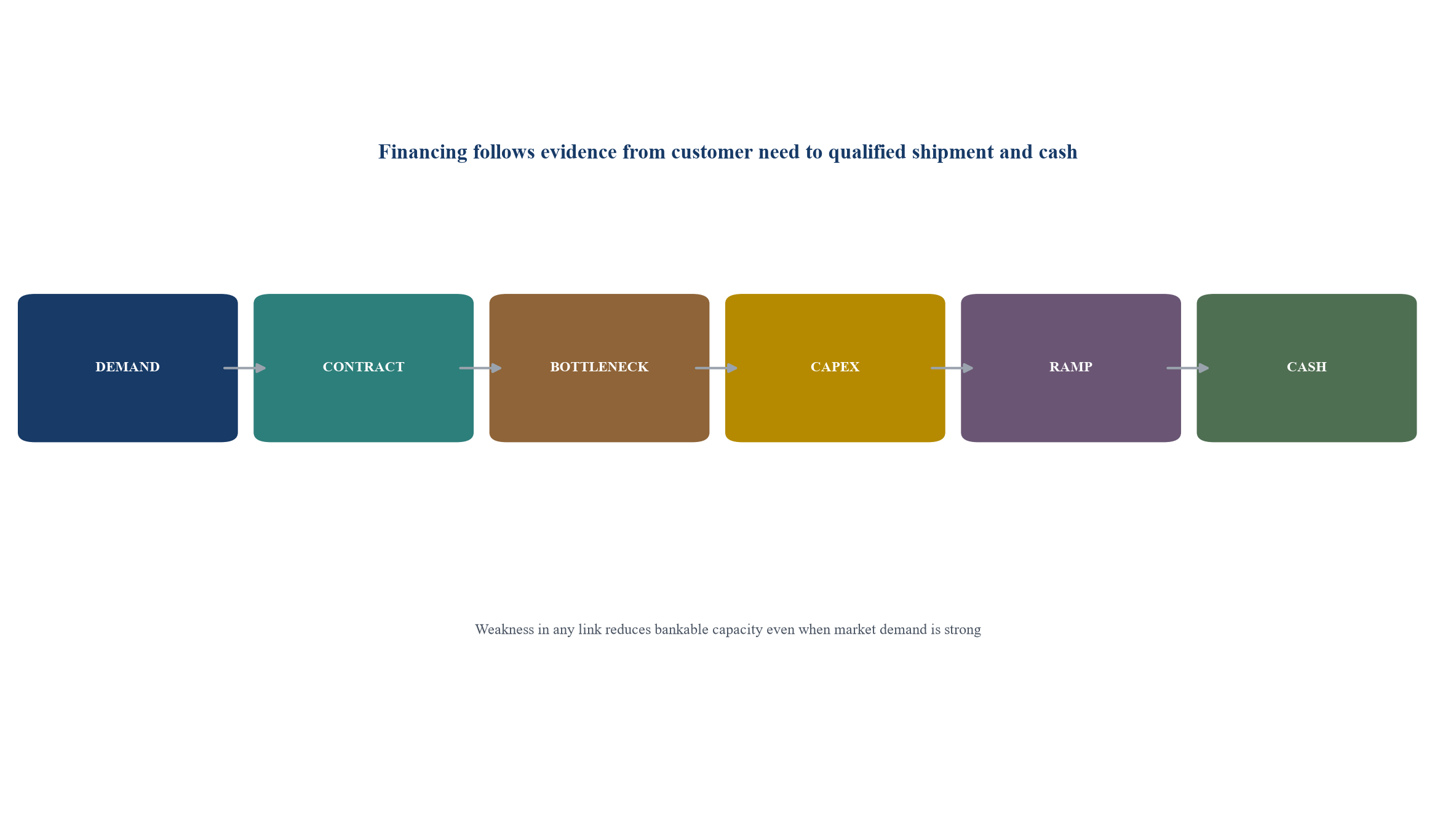
Capital commitment should trace from demand through qualified cash receipts.
21. Build the sources and uses
Sources and uses should cover land, buildings, equipment, test systems, engineering, pre-production labour, inventory, contingency, financing fees and ramp losses. Owner costs and working capital should remain visible.
The financing model should connect each draw to a physical milestone and each repayment source to enforceable cash receipts. Public support, customer advances and collateral should be recognised only when eligibility and control are documented.
Execution should translate the decision into engineering, procurement, workforce, commercial and financing workstreams. A controlled decision record should capture assumptions, owners, dates, approvals and change triggers.
22. Model construction and commissioning
Schedule risk should include permits, utility connections, civil works, imported equipment, installation, calibration, software integration and acceptance testing. Contingency should follow quantified risk rather than a flat percentage alone.
The evidence package should reconcile customer contract, product specification, constrained work centre, supplier quote, capex estimate, schedule and financing assumption. Management estimates should remain identified and should not be presented as observed performance.
A financeable plan assigns the risk to the party able to control it, establishes measurable gates and retains liquidity for the ramp. Approval should depend on evidence that the expansion can produce qualified units and convert them into cash.
23. Model ramp-up economics
Nameplate capacity rarely appears immediately. The model should include hiring cadence, learning, scrap, rework, maintenance, product mix and customer approvals by month until stable output is achieved.
The analysis should distinguish committed backlog, qualified pipeline and market demand. Lenders and boards need sensitivity ranges for price, volume, delivery, yield, working capital and customer acceptance, supported by accountable data owners.
The investment committee should see the consequence of delay, lower utilisation, material inflation, failed tests and customer cancellation. The recommended structure should remain compliant under a credible downside case.
24. Fund working capital
Long manufacturing cycles create cash needs for steel, copper, components and labour before shipment. Deposits and milestone payments can reduce debt needs, while delayed acceptance can extend the cash-conversion cycle.
The financing model should connect each draw to a physical milestone and each repayment source to enforceable cash receipts. Public support, customer advances and collateral should be recognised only when eligibility and control are documented.
Execution should translate the decision into engineering, procurement, workforce, commercial and financing workstreams. A controlled decision record should capture assumptions, owners, dates, approvals and change triggers.
25. Design customer deposits
Deposits should be sized to fund committed materials and scarce production slots. Refundability, security, cancellation rights, title to work in progress and treatment on supplier insolvency should be explicit.
The evidence package should reconcile customer contract, product specification, constrained work centre, supplier quote, capex estimate, schedule and financing assumption. Management estimates should remain identified and should not be presented as observed performance.
A financeable plan assigns the risk to the party able to control it, establishes measurable gates and retains liquidity for the ramp. Approval should depend on evidence that the expansion can produce qualified units and convert them into cash.
26. Use progress billing
Engineering approval, material release, core and coil completion, factory acceptance and shipment can support contractual milestones. Lenders should test whether invoices are enforceable and independent of discretionary acceptance.
The analysis should distinguish committed backlog, qualified pipeline and market demand. Lenders and boards need sensitivity ranges for price, volume, delivery, yield, working capital and customer acceptance, supported by accountable data owners.
The investment committee should see the consequence of delay, lower utilisation, material inflation, failed tests and customer cancellation. The recommended structure should remain compliant under a credible downside case.
27. Pass through input inflation
Copper, steel, energy, freight and labour costs can move during long lead times. Indices, collars, reopeners and change-order rules should align contract price with the manufacturer's exposure.
The financing model should connect each draw to a physical milestone and each repayment source to enforceable cash receipts. Public support, customer advances and collateral should be recognised only when eligibility and control are documented.
Execution should translate the decision into engineering, procurement, workforce, commercial and financing workstreams. A controlled decision record should capture assumptions, owners, dates, approvals and change triggers.
28. Control inventory
Strategic inventory can protect production while tying up capital and risking obsolescence. Policy should distinguish long-lead qualified components, standard materials, customer-specific items and recoverable scrap.
The evidence package should reconcile customer contract, product specification, constrained work centre, supplier quote, capex estimate, schedule and financing assumption. Management estimates should remain identified and should not be presented as observed performance.
A financeable plan assigns the risk to the party able to control it, establishes measurable gates and retains liquidity for the ramp. Approval should depend on evidence that the expansion can produce qualified units and convert them into cash.
29. Control receivables and acceptance
Payment can be delayed by documentation, factory tests, transport damage, site readiness or performance disputes. Borrowing-base eligibility should reflect ageing, concentration, set-off and acceptance conditions.
The analysis should distinguish committed backlog, qualified pipeline and market demand. Lenders and boards need sensitivity ranges for price, volume, delivery, yield, working capital and customer acceptance, supported by accountable data owners.
The investment committee should see the consequence of delay, lower utilisation, material inflation, failed tests and customer cancellation. The recommended structure should remain compliant under a credible downside case.
30. Fund warranty and field obligations
Warranty reserves should reflect product mix, operating history, service response and component exposure. A weak reserve may flatter EBITDA and reduce liquidity precisely when field failures emerge.
The financing model should connect each draw to a physical milestone and each repayment source to enforceable cash receipts. Public support, customer advances and collateral should be recognised only when eligibility and control are documented.
Execution should translate the decision into engineering, procurement, workforce, commercial and financing workstreams. A controlled decision record should capture assumptions, owners, dates, approvals and change triggers.
Table 2. Illustrative risk allocation for a capacity expansion
| Risk | Manufacturer | Customer | Equipment vendor or contractor | Financier control |
|---|---|---|---|---|
| Demand and cancellation | Diversified order book | Deposit and cancellation payment | Not generally applicable | Backlog eligibility and concentration limits |
| Cost inflation | Procurement and productivity | Indexed or reopened price | Fixed or capped equipment package | Contingency and equity cure |
| Schedule | Integrated programme control | Timely approvals and site readiness | Delivery and performance obligations | Milestone draws and long-stop dates |
| Ramp and yield | Workforce, process and quality | First-article cooperation | Commissioning and warranty support | Completion test and liquidity reserve |
| Input disruption | Dual sourcing and inventory | Approved substitutions | Parts availability | Supplier monitoring and borrowing-base haircuts |
| Acceptance and warranty | Testing and field service | Objective acceptance process | Component warranty | Reserve, insurance and cash controls |
Allocation should follow control, insurability, balance-sheet capacity and the governing contracts.
31. Manage currency and trade exposure
Imported equipment, components and materials can create currency, tariff and trade-compliance risk. Hedging and pricing clauses should be tied to firm purchase and sales commitments.
The evidence package should reconcile customer contract, product specification, constrained work centre, supplier quote, capex estimate, schedule and financing assumption. Management estimates should remain identified and should not be presented as observed performance.
A financeable plan assigns the risk to the party able to control it, establishes measurable gates and retains liquidity for the ramp. Approval should depend on evidence that the expansion can produce qualified units and convert them into cash.
32. Build a financeable revenue model
Revenue should be separated into deposits, progress invoices, shipment, installation and final acceptance. Accounting recognition, cash receipt and lender availability may occur at different times.
The analysis should distinguish committed backlog, qualified pipeline and market demand. Lenders and boards need sensitivity ranges for price, volume, delivery, yield, working capital and customer acceptance, supported by accountable data owners.
The investment committee should see the consequence of delay, lower utilisation, material inflation, failed tests and customer cancellation. The recommended structure should remain compliant under a credible downside case.
33. Structure offtake-backed debt
A portfolio of firm utility orders can support term debt when contracts have credible buyers, deposits, cancellation protection and price adjustment. The borrowing case should exclude soft pipeline and unapproved framework volumes.
The financing model should connect each draw to a physical milestone and each repayment source to enforceable cash receipts. Public support, customer advances and collateral should be recognised only when eligibility and control are documented.
Execution should translate the decision into engineering, procurement, workforce, commercial and financing workstreams. A controlled decision record should capture assumptions, owners, dates, approvals and change triggers.
34. Structure equipment finance
Production machinery and test assets may support leases or secured facilities. Advance rates should reflect installation cost, specialised use, removal difficulty, resale market and remaining life.
The evidence package should reconcile customer contract, product specification, constrained work centre, supplier quote, capex estimate, schedule and financing assumption. Management estimates should remain identified and should not be presented as observed performance.
A financeable plan assigns the risk to the party able to control it, establishes measurable gates and retains liquidity for the ramp. Approval should depend on evidence that the expansion can produce qualified units and convert them into cash.
35. Use project-finance discipline
Ring-fencing a capacity expansion can improve transparency where contracted cash flows, construction obligations and asset boundaries are clear. Completion support remains necessary before stable operation.
The analysis should distinguish committed backlog, qualified pipeline and market demand. Lenders and boards need sensitivity ranges for price, volume, delivery, yield, working capital and customer acceptance, supported by accountable data owners.
The investment committee should see the consequence of delay, lower utilisation, material inflation, failed tests and customer cancellation. The recommended structure should remain compliant under a credible downside case.
36. Use corporate debt selectively
An established manufacturer may finance expansion on its consolidated balance sheet. The board should test whether legacy leverage, pension, litigation, working capital and cyclicality weaken the new programme.
The financing model should connect each draw to a physical milestone and each repayment source to enforceable cash receipts. Public support, customer advances and collateral should be recognised only when eligibility and control are documented.
Execution should translate the decision into engineering, procurement, workforce, commercial and financing workstreams. A controlled decision record should capture assumptions, owners, dates, approvals and change triggers.
37. Use private credit for complexity
Private credit can accommodate delayed draw, acquisition, capex and working-capital elements with negotiated covenants. Pricing should be compared with the value of speed, certainty and structural flexibility.
The evidence package should reconcile customer contract, product specification, constrained work centre, supplier quote, capex estimate, schedule and financing assumption. Management estimates should remain identified and should not be presented as observed performance.
A financeable plan assigns the risk to the party able to control it, establishes measurable gates and retains liquidity for the ramp. Approval should depend on evidence that the expansion can produce qualified units and convert them into cash.
38. Design vendor finance
Equipment vendors may defer payment or provide leases, warranties and performance support. The package should preserve step-in, spare parts, software access and lender security.
The analysis should distinguish committed backlog, qualified pipeline and market demand. Lenders and boards need sensitivity ranges for price, volume, delivery, yield, working capital and customer acceptance, supported by accountable data owners.
The investment committee should see the consequence of delay, lower utilisation, material inflation, failed tests and customer cancellation. The recommended structure should remain compliant under a credible downside case.
39. Map public support
Loans, grants, guarantees, tax credits, workforce programmes and industrial-policy support can reduce capital cost. Eligibility, milestones, recapture, prevailing-wage rules and reporting should be modelled explicitly.
The financing model should connect each draw to a physical milestone and each repayment source to enforceable cash receipts. Public support, customer advances and collateral should be recognised only when eligibility and control are documented.
Execution should translate the decision into engineering, procurement, workforce, commercial and financing workstreams. A controlled decision record should capture assumptions, owners, dates, approvals and change triggers.
40. Size the equity buffer
Equity should absorb development, cost overrun, ramp delay, working-capital volatility and demand downside that debt cannot carry. Sponsor returns should be tested after realistic contingency and dilution.
The evidence package should reconcile customer contract, product specification, constrained work centre, supplier quote, capex estimate, schedule and financing assumption. Management estimates should remain identified and should not be presented as observed performance.
A financeable plan assigns the risk to the party able to control it, establishes measurable gates and retains liquidity for the ramp. Approval should depend on evidence that the expansion can produce qualified units and convert them into cash.
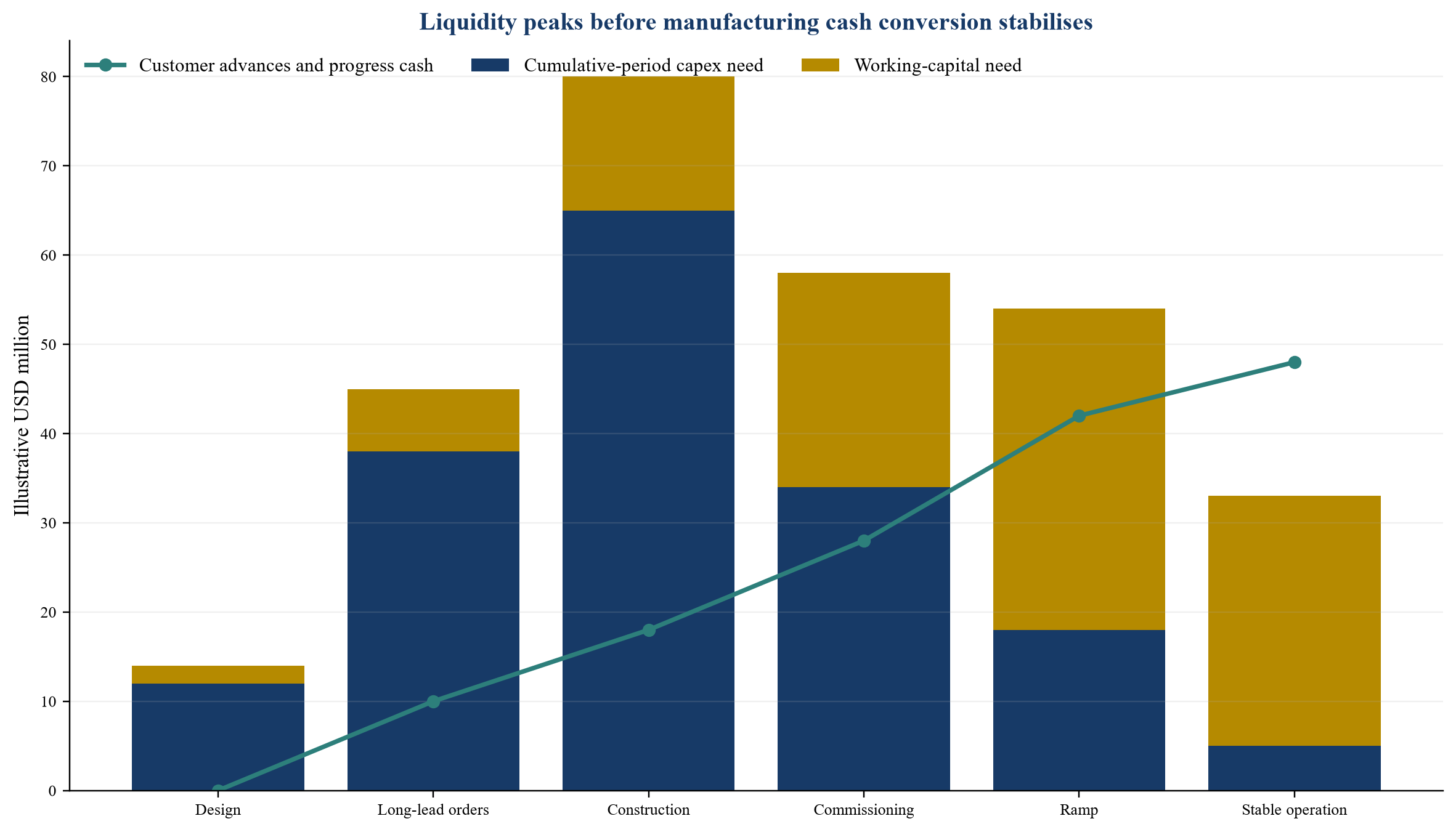
Values are hypothetical management assumptions used solely to demonstrate liquidity sequencing.
41. Set leverage and coverage
Debt sizing should use contracted and risk-adjusted cash flow, not nameplate output. Minimum liquidity, interest coverage, fixed-charge coverage and leverage should remain compliant under ramp and delay cases.
The analysis should distinguish committed backlog, qualified pipeline and market demand. Lenders and boards need sensitivity ranges for price, volume, delivery, yield, working capital and customer acceptance, supported by accountable data owners.
The investment committee should see the consequence of delay, lower utilisation, material inflation, failed tests and customer cancellation. The recommended structure should remain compliant under a credible downside case.
42. Build the security package
Security may include land, buildings, equipment, inventory, receivables, contracts, bank accounts, insurance and shares. Customer title, retention-of-title suppliers and public funding restrictions can limit collateral.
The financing model should connect each draw to a physical milestone and each repayment source to enforceable cash receipts. Public support, customer advances and collateral should be recognised only when eligibility and control are documented.
Execution should translate the decision into engineering, procurement, workforce, commercial and financing workstreams. A controlled decision record should capture assumptions, owners, dates, approvals and change triggers.
43. Define completion
Mechanical completion, energisation, calibration, product qualification, throughput, yield and customer acceptance are different milestones. Financial completion should require demonstrated output and cash generation over a defined period.
The evidence package should reconcile customer contract, product specification, constrained work centre, supplier quote, capex estimate, schedule and financing assumption. Management estimates should remain identified and should not be presented as observed performance.
A financeable plan assigns the risk to the party able to control it, establishes measurable gates and retains liquidity for the ramp. Approval should depend on evidence that the expansion can produce qualified units and convert them into cash.
44. Allocate cost-overrun risk
Fixed-price contracts may be unavailable for bespoke industrial expansions. Sponsor support, contingency, vendor caps, insurance and staged scope should cover overruns without starving working capital.
The analysis should distinguish committed backlog, qualified pipeline and market demand. Lenders and boards need sensitivity ranges for price, volume, delivery, yield, working capital and customer acceptance, supported by accountable data owners.
The investment committee should see the consequence of delay, lower utilisation, material inflation, failed tests and customer cancellation. The recommended structure should remain compliant under a credible downside case.
45. Design ramp covenants
Covenants can track capex, milestone dates, backlog conversion, yield, throughput, liquidity and customer concentration. Cure rights should support recovery while preserving lender intervention before value deteriorates.
The financing model should connect each draw to a physical milestone and each repayment source to enforceable cash receipts. Public support, customer advances and collateral should be recognised only when eligibility and control are documented.
Execution should translate the decision into engineering, procurement, workforce, commercial and financing workstreams. A controlled decision record should capture assumptions, owners, dates, approvals and change triggers.
46. Stress demand downside
The downside should test project delays, utility budget changes, data-centre deferrals, lower replacement demand and customer cancellations. Product flexibility and export capability may mitigate concentration.
The evidence package should reconcile customer contract, product specification, constrained work centre, supplier quote, capex estimate, schedule and financing assumption. Management estimates should remain identified and should not be presented as observed performance.
A financeable plan assigns the risk to the party able to control it, establishes measurable gates and retains liquidity for the ramp. Approval should depend on evidence that the expansion can produce qualified units and convert them into cash.
47. Stress cancellation and repricing
Long lead times increase the chance that customers change specifications, defer delivery or challenge price. Contract remedies, deposits and slot-transfer rights should be quantified in the cash model.
The analysis should distinguish committed backlog, qualified pipeline and market demand. Lenders and boards need sensitivity ranges for price, volume, delivery, yield, working capital and customer acceptance, supported by accountable data owners.
The investment committee should see the consequence of delay, lower utilisation, material inflation, failed tests and customer cancellation. The recommended structure should remain compliant under a credible downside case.
48. Stress supplier failure
A failure in bushings, tap changers, steel, conductor or insulation can stop completed units. The plan should include approved alternatives, buffer stock, tooling access, technical data and financial monitoring.
The financing model should connect each draw to a physical milestone and each repayment source to enforceable cash receipts. Public support, customer advances and collateral should be recognised only when eligibility and control are documented.
Execution should translate the decision into engineering, procurement, workforce, commercial and financing workstreams. A controlled decision record should capture assumptions, owners, dates, approvals and change triggers.
49. Stress technology change
Solid-state, modular, flexible and alternative-material technologies may alter future demand. The factory should preserve adaptable equipment, data rights and engineering capability rather than assume a static product mix.
The evidence package should reconcile customer contract, product specification, constrained work centre, supplier quote, capex estimate, schedule and financing assumption. Management estimates should remain identified and should not be presented as observed performance.
A financeable plan assigns the risk to the party able to control it, establishes measurable gates and retains liquidity for the ramp. Approval should depend on evidence that the expansion can produce qualified units and convert them into cash.
50. Stress trade and geopolitical disruption
Tariffs, sanctions, export controls, port disruption and concentrated foreign supply can affect cost and delivery. Scenarios should identify the cash, schedule and qualification consequences of substitution.
The analysis should distinguish committed backlog, qualified pipeline and market demand. Lenders and boards need sensitivity ranges for price, volume, delivery, yield, working capital and customer acceptance, supported by accountable data owners.
The investment committee should see the consequence of delay, lower utilisation, material inflation, failed tests and customer cancellation. The recommended structure should remain compliant under a credible downside case.
Table 3. Hypothetical financing sensitivity
| Case | Capex, USD m | Peak working capital, USD m | Stable utilisation | Completion delay | Minimum debt-service coverage |
|---|---|---|---|---|---|
| Base case | 180 | 42 | 78% | None | 1.55x |
| Six-month ramp delay | 188 | 55 | 72% | 6 months | 1.19x |
| Material inflation | 205 | 49 | 76% | 2 months | 1.28x |
| Customer deferral | 180 | 63 | 61% | 5 months | 0.96x |
| Staged expansion | 138 initial | 38 | 74% | None | 1.62x |
All values are hypothetical management assumptions and do not represent an actual manufacturer, project or forecast.
51. Build refurbishment and circular capacity
Repair, remanufacture, spare pooling and material recovery can create faster resilience options and recurring service revenue. Financing should separate service margins from new-unit manufacturing assumptions.
The financing model should connect each draw to a physical milestone and each repayment source to enforceable cash receipts. Public support, customer advances and collateral should be recognised only when eligibility and control are documented.
Execution should translate the decision into engineering, procurement, workforce, commercial and financing workstreams. A controlled decision record should capture assumptions, owners, dates, approvals and change triggers.
52. Use data and AI with controls
Computer vision, predictive maintenance, scheduling and design optimisation can improve yield and throughput. Benefits should be measured in controlled pilots, with cybersecurity, model governance and human approval.
The evidence package should reconcile customer contract, product specification, constrained work centre, supplier quote, capex estimate, schedule and financing assumption. Management estimates should remain identified and should not be presented as observed performance.
A financeable plan assigns the risk to the party able to control it, establishes measurable gates and retains liquidity for the ramp. Approval should depend on evidence that the expansion can produce qualified units and convert them into cash.
53. Create a lender-grade data room
The data room should reconcile contracts, backlog, specifications, capex quotes, permits, suppliers, production model, workforce, quality, insurance and financial forecasts. Each assumption needs an owner and source.
The analysis should distinguish committed backlog, qualified pipeline and market demand. Lenders and boards need sensitivity ranges for price, volume, delivery, yield, working capital and customer acceptance, supported by accountable data owners.
The investment committee should see the consequence of delay, lower utilisation, material inflation, failed tests and customer cancellation. The recommended structure should remain compliant under a credible downside case.
54. Address US investment conditions
US policy, utility demand, industrial incentives and domestic-supply objectives can support expansion. The case should incorporate current programme rules, customer qualification and regional workforce constraints.
The financing model should connect each draw to a physical milestone and each repayment source to enforceable cash receipts. Public support, customer advances and collateral should be recognised only when eligibility and control are documented.
Execution should translate the decision into engineering, procurement, workforce, commercial and financing workstreams. A controlled decision record should capture assumptions, owners, dates, approvals and change triggers.
55. Address UK and European conditions
Network investment, offshore wind, interconnection, ageing assets and energy security shape demand. The model should test procurement frameworks, standards, trade exposure and power costs by site.
The evidence package should reconcile customer contract, product specification, constrained work centre, supplier quote, capex estimate, schedule and financing assumption. Management estimates should remain identified and should not be presented as observed performance.
A financeable plan assigns the risk to the party able to control it, establishes measurable gates and retains liquidity for the ramp. Approval should depend on evidence that the expansion can produce qualified units and convert them into cash.
56. Address GCC investment conditions
Rapid load growth, data centres, renewable programmes and grid reinforcement can support regional capacity. Bankability depends on procurement visibility, localisation requirements, utilities, export markets and skilled labour.
The analysis should distinguish committed backlog, qualified pipeline and market demand. Lenders and boards need sensitivity ranges for price, volume, delivery, yield, working capital and customer acceptance, supported by accountable data owners.
The investment committee should see the consequence of delay, lower utilisation, material inflation, failed tests and customer cancellation. The recommended structure should remain compliant under a credible downside case.
57. Run commercial due diligence
Diligence should validate the addressable product set, customer budgets, tender pipeline, backlog terms, pricing, competitors, supplier constraints and substitution risk. Management forecasts should be reconciled to external and contract evidence.
The financing model should connect each draw to a physical milestone and each repayment source to enforceable cash receipts. Public support, customer advances and collateral should be recognised only when eligibility and control are documented.
Execution should translate the decision into engineering, procurement, workforce, commercial and financing workstreams. A controlled decision record should capture assumptions, owners, dates, approvals and change triggers.
58. Run technical and operational diligence
Independent review should confirm process design, equipment specification, layout, utilities, throughput, quality, qualification, maintenance and ramp assumptions. Capacity claims should trace to the binding work centre.
The evidence package should reconcile customer contract, product specification, constrained work centre, supplier quote, capex estimate, schedule and financing assumption. Management estimates should remain identified and should not be presented as observed performance.
A financeable plan assigns the risk to the party able to control it, establishes measurable gates and retains liquidity for the ramp. Approval should depend on evidence that the expansion can produce qualified units and convert them into cash.
59. Create programme governance
The sponsor, manufacturer, lenders, customers, engineering team and public authorities need defined decisions, information rights and escalation. A controlled baseline should govern scope, schedule, cost and benefit changes.
The analysis should distinguish committed backlog, qualified pipeline and market demand. Lenders and boards need sensitivity ranges for price, volume, delivery, yield, working capital and customer acceptance, supported by accountable data owners.
The investment committee should see the consequence of delay, lower utilisation, material inflation, failed tests and customer cancellation. The recommended structure should remain compliant under a credible downside case.
60. Adopt the financing record and 90-day plan
The final record should state capacity need, product strategy, contracts, sources and uses, financing, risk allocation, covenants and milestones. The first 90 days should close evidence gaps that could change capital commitment.
The financing model should connect each draw to a physical milestone and each repayment source to enforceable cash receipts. Public support, customer advances and collateral should be recognised only when eligibility and control are documented.
Execution should translate the decision into engineering, procurement, workforce, commercial and financing workstreams. A controlled decision record should capture assumptions, owners, dates, approvals and change triggers.
Table 4. Illustrative 90-day financing programme
| Period | Workstream | Core actions | Decision output | Accountable owner |
|---|---|---|---|---|
| Days 1-15 | Demand and contracts | Reconcile customers, specifications, backlog terms and delivery dates | Financeable backlog schedule | Commercial lead |
| Days 16-30 | Capacity and design | Confirm product platforms, constrained work centres and expansion scope | Qualified capacity baseline | Manufacturing lead |
| Days 31-45 | Capex and ramp | Validate quotes, schedule, workforce, yield and commissioning | Costed implementation plan | Programme director |
| Days 46-60 | Cash and downside | Model deposits, progress billing, working capital, delay and cancellation | Risk-adjusted cash model | CFO |
| Days 61-75 | Capital structure | Size equity, debt, equipment finance, public support and reserves | Financeable term sheet | Corporate-finance adviser |
| Days 76-90 | Diligence and approval | Close technical, legal, insurance, security and covenant evidence | Authorised financing package | Board and lenders |
Timing is indicative and should be adapted to transaction governance and jurisdiction.
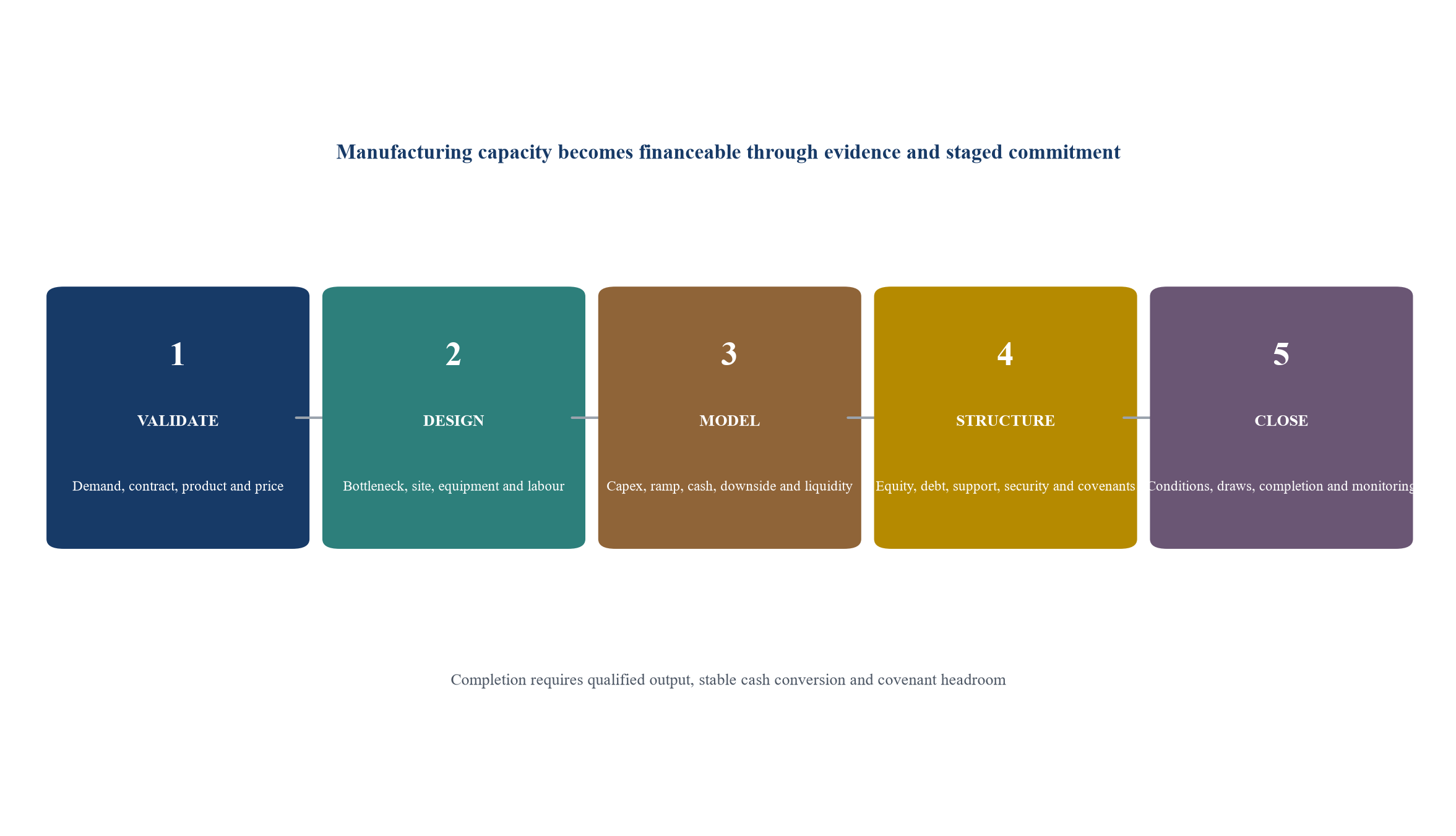
Each gate requires documented evidence before the next capital commitment.
The framework converts urgent market demand into a controlled industrial-finance decision. It requires a direct evidence chain from customer obligation through manufacturing capacity to cash conversion and debt service.
Capacity expansion should preserve liquidity through construction, qualification and ramp. Contract design, staged capital, completion tests and transparent monitoring determine whether growth creates resilient value.
References
- US Department of Energy, "Supply Chain and Market Analysis," https://www.energy.gov/oe/supply-chain-and-market-analysis
- US Department of Energy, "Large Power Transformer Resilience Report to Congress," July 2024, https://www.energy.gov/sites/default/files/2024-10/EXEC-2022-001242%20-%20Large%20Power%20Transformer%20Resilience%20Report%20signed%20by%20Secretary%20Granholm%20on%207-10-24.pdf
- US Department of Energy, "R&D Efforts to Address Transformer Supply," https://www.energy.gov/oe/rd-efforts-address-transformer-supply
- US Department of Energy, "Supply Chain Resources," https://www.energy.gov/oe/supply-chain-resources
- US Department of Energy, "Transformer Resilience and Advanced Components Program," https://www.energy.gov/oe/transformer-resilience-and-advanced-components-trac-program
- US Department of Energy, "Energy Department Advances U.S. Electric Grid Resilience and Reliability with New Transformer and Silicon Carbide Packaging Projects," 3 December 2024, https://www.energy.gov/oe/articles/energy-department-advances-us-electric-grid-resilience-and-reliability-new-transformer
- US Department of Energy, "Distribution Transformers," https://www.energy.gov/cmei/buildings/distribution-transformers
- US Department of Energy, "DOE Finalizes Energy Efficiency Standards for Distribution Transformers," 4 April 2024, https://www.energy.gov/articles/doe-finalizes-energy-efficiency-standards-distribution-transformers-protect-domestic
- US Department of Energy, "First Projects Receiving Clean Energy Manufacturing Investments in America's Industrial and Energy Communities," 19 April 2024, https://www.energy.gov/articles/biden-harris-administration-announces-first-projects-receiving-clean-energy-manufacturing
- Federal Energy Regulatory Commission, "2023 Summer Energy Market and Electric Reliability Assessment," May 2023, https://www.ferc.gov/sites/default/files/2023-05/23_Summer-Assessment_0517_1745.pdf
About the Author
Chennakeshav (CK) is a corporate finance and investment banking executive with 25+ years of global experience in deal origination, structuring and execution across M&A, growth capital and corporate strategy. He has led value-creation mandates for founders, corporates and funds — bridging the boardroom view to hands-on execution and close.
His career spans Morgan Stanley, HSBC, Lloyds Banking Group, EWEC, ADQ portfolio companies and Emirates Growth Fund, across TMT, real estate, fintech, deeptech, cleantech, infrastructure and energy. He has partnered with C-suite leaders, private equity and venture funds, sovereign wealth funds and family offices to finance complex fund raises and scale-up ventures, and has led M&A due diligence, post-merger integration and business-transformation initiatives to create value.
At Matchpoint Partners he is Managing Partner, leading the firm's corporate finance, M&A and capital-raising practice. He holds an MBA from London Business School, an engineering degree from VTU and a Master of Laws (LLM, in progress) from UCL London.
An active start-up mentor, CK mentors at Techstars, DIFC FinTech Hive, Startup Grind, Founder Institute and IN5, serves as Entrepreneur Mentor in Residence (EMiR) at London Business School, and judges the Entrepreneurship World Cup.
