

1. Frame the wider-grid allocation decision
A transmission project can produce reliability, congestion, resource-access, resilience and option benefits across several pricing zones. The allocation decision must connect each supported benefit to identifiable beneficiaries and a durable recovery route.
The evidence file should identify the governing tariff, planning instrument, system model, cost estimate, benefit calculation and approval authority. Every material input needs an owner, date, source and review trigger so the allocation remains reproducible.
A practical transaction review asks who pays, how much, from when, under which instrument and subject to which adjustment. The answer should support tariff approval, contractual commitment and financeability at the same time.
2. Define the facility and decision perimeter
The record should distinguish local, regional, interregional and cross-border facilities, including shared substations and enabling works. Asset boundaries determine which costs enter the common pool and which remain directly assigned.
The analysis should distinguish measured system effects, scenario outputs and policy judgements. Where monetisation remains uncertain, the decision record should retain the physical metric and explain how uncertainty affects the allocated share.
Allocation becomes executable when the approved cost base, payment obligation, credit support, true-up and dispute route are documented together. The capital structure should use only revenue supported by that enforceable package.
3. Separate cost causation from benefit attribution
Cost causation asks which activity created the need. Benefit attribution asks which customers gain from the selected investment. A defensible method documents both tests and reconciles conflicts between them.
The working model should reconcile project cost, benefits and beneficiary geography under a common set of scenarios. Changes to topology, demand, generation or timing should flow through the same controlled calculation rather than an off-model adjustment.
The board and regulator should see the distribution of value and downside by region before committing capital. The preferred method should remain operable under delay, cost escalation, lower benefits and changes in participant composition.
4. Map the regulatory authority
Jurisdiction over planning, tariffs, siting and consumer protection can sit with different bodies. The allocation design should identify who approves the method, who files it and who resolves disputes.
The evidence file should identify the governing tariff, planning instrument, system model, cost estimate, benefit calculation and approval authority. Every material input needs an owner, date, source and review trigger so the allocation remains reproducible.
A practical transaction review asks who pays, how much, from when, under which instrument and subject to which adjustment. The answer should support tariff approval, contractual commitment and financeability at the same time.
5. Establish the beneficiary-pays principle
Beneficiary-pays allocation links charges to estimated benefits and protects customers from unrelated expenditure. Application requires transparent benefit metrics, geographic granularity and treatment of uncertainty.
The analysis should distinguish measured system effects, scenario outputs and policy judgements. Where monetisation remains uncertain, the decision record should retain the physical metric and explain how uncertainty affects the allocated share.
Allocation becomes executable when the approved cost base, payment obligation, credit support, true-up and dispute route are documented together. The capital structure should use only revenue supported by that enforceable package.
Table 1. Comparative regional transmission cost-allocation architectures
| Market | Planning and allocation anchor | Principal allocation feature | Financeability consideration | Current execution issue |
|---|---|---|---|---|
| United States | FERC Orders 1920, 1920-A and 1920-B | Ex ante regional method and state agreement process tied to benefits | Filed tariff method and zone-level revenue | Multi-state agreement and benefit quantification |
| Great Britain | TNUoS, connection charging and strategic network planning | National recovery with locational signals for generation and demand | Predictability of lifetime network charges | Reform alignment with strategic spatial planning |
| European cross-border projects | TEN-E and ACER cross-border cost allocation | Efficient cost shared among significantly affected countries | Joint regulatory decision and adjustment mechanism | Asymmetric national benefits and funding dependency |
| India | CERC inter-state transmission-sharing regulations | National, regional and directly attributable components | Timely commencement and credit of designated customers | Rapid build, evolving use and state coordination |
| GCC | National frameworks and GCC interconnection arrangements | Negotiated sovereign, utility and project contribution | Member-state commitment and currency treatment | Benefit evidence, dispatch and institutional agreement |
The summary is conceptual and subject to governing law, tariffs, regulatory decisions and project documents.
6. Choose the allocation unit
Costs may be assigned to countries, states, zones, utilities, generators, load or user classes. The unit should match available evidence and avoid false precision unsupported by system models.
The working model should reconcile project cost, benefits and beneficiary geography under a common set of scenarios. Changes to topology, demand, generation or timing should flow through the same controlled calculation rather than an off-model adjustment.
The board and regulator should see the distribution of value and downside by region before committing capital. The preferred method should remain operable under delay, cost escalation, lower benefits and changes in participant composition.
7. Build the counterfactual
Benefits should be measured against a credible system without the project or with the next-best alternative. The counterfactual must use consistent demand, generation, fuel, reliability and policy assumptions.
The evidence file should identify the governing tariff, planning instrument, system model, cost estimate, benefit calculation and approval authority. Every material input needs an owner, date, source and review trigger so the allocation remains reproducible.
A practical transaction review asks who pays, how much, from when, under which instrument and subject to which adjustment. The answer should support tariff approval, contractual commitment and financeability at the same time.
8. Define the planning horizon
Long-lived transmission can create benefits for decades while forecasts change. The horizon should capture useful life, replacement cycles and future system states without overstating remote benefits.
The analysis should distinguish measured system effects, scenario outputs and policy judgements. Where monetisation remains uncertain, the decision record should retain the physical metric and explain how uncertainty affects the allocated share.
Allocation becomes executable when the approved cost base, payment obligation, credit support, true-up and dispute route are documented together. The capital structure should use only revenue supported by that enforceable package.
9. Use multiple scenarios
Load, generation, retirement, policy, fuel and weather pathways should expose which benefits are robust. Scenario weights should be documented as decision assumptions rather than observed probabilities.
The working model should reconcile project cost, benefits and beneficiary geography under a common set of scenarios. Changes to topology, demand, generation or timing should flow through the same controlled calculation rather than an off-model adjustment.
The board and regulator should see the distribution of value and downside by region before committing capital. The preferred method should remain operable under delay, cost escalation, lower benefits and changes in participant composition.
10. Create the benefits register
The register should list each claimed benefit, calculation method, geography, beneficiary, timing, interaction with other benefits and evidence owner. Unsupported narrative benefits should remain outside allocation.
The evidence file should identify the governing tariff, planning instrument, system model, cost estimate, benefit calculation and approval authority. Every material input needs an owner, date, source and review trigger so the allocation remains reproducible.
A practical transaction review asks who pays, how much, from when, under which instrument and subject to which adjustment. The answer should support tariff approval, contractual commitment and financeability at the same time.
11. Measure reliability value
Reliability benefits can include avoided unserved energy, reserve sharing, voltage support, stability and contingency performance. Engineering studies should establish the causal contribution of the proposed facility.
The analysis should distinguish measured system effects, scenario outputs and policy judgements. Where monetisation remains uncertain, the decision record should retain the physical metric and explain how uncertainty affects the allocated share.
Allocation becomes executable when the approved cost base, payment obligation, credit support, true-up and dispute route are documented together. The capital structure should use only revenue supported by that enforceable package.
12. Measure congestion reduction
Production-cost modelling can estimate changes in dispatch, congestion and losses. Model topology, constraints, fuel inputs and resource availability should be disclosed sufficiently for review.
The working model should reconcile project cost, benefits and beneficiary geography under a common set of scenarios. Changes to topology, demand, generation or timing should flow through the same controlled calculation rather than an off-model adjustment.
The board and regulator should see the distribution of value and downside by region before committing capital. The preferred method should remain operable under delay, cost escalation, lower benefits and changes in participant composition.
13. Measure access to lower-cost resources
A wider grid can connect customers to diverse generation and storage. Allocation should recognise whether the benefit is broad, concentrated or conditional on separate investments.
The evidence file should identify the governing tariff, planning instrument, system model, cost estimate, benefit calculation and approval authority. Every material input needs an owner, date, source and review trigger so the allocation remains reproducible.
A practical transaction review asks who pays, how much, from when, under which instrument and subject to which adjustment. The answer should support tariff approval, contractual commitment and financeability at the same time.
14. Measure avoided local reinforcement
Regional facilities can replace or defer several local projects. Avoided-cost evidence should show that the local expenditure is genuinely displaced and exclude costs already counted elsewhere.
The analysis should distinguish measured system effects, scenario outputs and policy judgements. Where monetisation remains uncertain, the decision record should retain the physical metric and explain how uncertainty affects the allocated share.
Allocation becomes executable when the approved cost base, payment obligation, credit support, true-up and dispute route are documented together. The capital structure should use only revenue supported by that enforceable package.
15. Measure reduced curtailment
Transmission can release renewable output that would otherwise be constrained. The analysis should distinguish energy value, support payments and system costs to prevent double counting.
The working model should reconcile project cost, benefits and beneficiary geography under a common set of scenarios. Changes to topology, demand, generation or timing should flow through the same controlled calculation rather than an off-model adjustment.
The board and regulator should see the distribution of value and downside by region before committing capital. The preferred method should remain operable under delay, cost escalation, lower benefits and changes in participant composition.
16. Measure resilience and extreme-event value
Geographic diversity and transfer capability can improve recovery from storms, heat, drought or fuel disruption. Event sets should be credible, stress-tested and separated from routine reliability benefits.
The evidence file should identify the governing tariff, planning instrument, system model, cost estimate, benefit calculation and approval authority. Every material input needs an owner, date, source and review trigger so the allocation remains reproducible.
A practical transaction review asks who pays, how much, from when, under which instrument and subject to which adjustment. The answer should support tariff approval, contractual commitment and financeability at the same time.
17. Measure capacity and resource adequacy value
Interregional transfer can reduce the capacity needed to meet peak demand. Accreditation, coincident-weather risk and deliverability should reflect the receiving system's planning rules.
The analysis should distinguish measured system effects, scenario outputs and policy judgements. Where monetisation remains uncertain, the decision record should retain the physical metric and explain how uncertainty affects the allocated share.
Allocation becomes executable when the approved cost base, payment obligation, credit support, true-up and dispute route are documented together. The capital structure should use only revenue supported by that enforceable package.
18. Measure option value
Headroom can support future industrial, digital or generation growth. Option value belongs in the decision record only where future pathways and use rights are defined.
The working model should reconcile project cost, benefits and beneficiary geography under a common set of scenarios. Changes to topology, demand, generation or timing should flow through the same controlled calculation rather than an off-model adjustment.
The board and regulator should see the distribution of value and downside by region before committing capital. The preferred method should remain operable under delay, cost escalation, lower benefits and changes in participant composition.
19. Recognise economic-development claims carefully
Jobs, industrial location and regional growth can matter to public authorities. Such claims should use transparent economic methods and remain separate from electricity-system benefits.
The evidence file should identify the governing tariff, planning instrument, system model, cost estimate, benefit calculation and approval authority. Every material input needs an owner, date, source and review trigger so the allocation remains reproducible.
A practical transaction review asks who pays, how much, from when, under which instrument and subject to which adjustment. The answer should support tariff approval, contractual commitment and financeability at the same time.
20. Avoid double counting
Reliability, capacity, congestion and resource-access benefits can overlap. A causal map should identify shared drivers and cap aggregate value where methods measure the same outcome.
The analysis should distinguish measured system effects, scenario outputs and policy judgements. Where monetisation remains uncertain, the decision record should retain the physical metric and explain how uncertainty affects the allocated share.
Allocation becomes executable when the approved cost base, payment obligation, credit support, true-up and dispute route are documented together. The capital structure should use only revenue supported by that enforceable package.
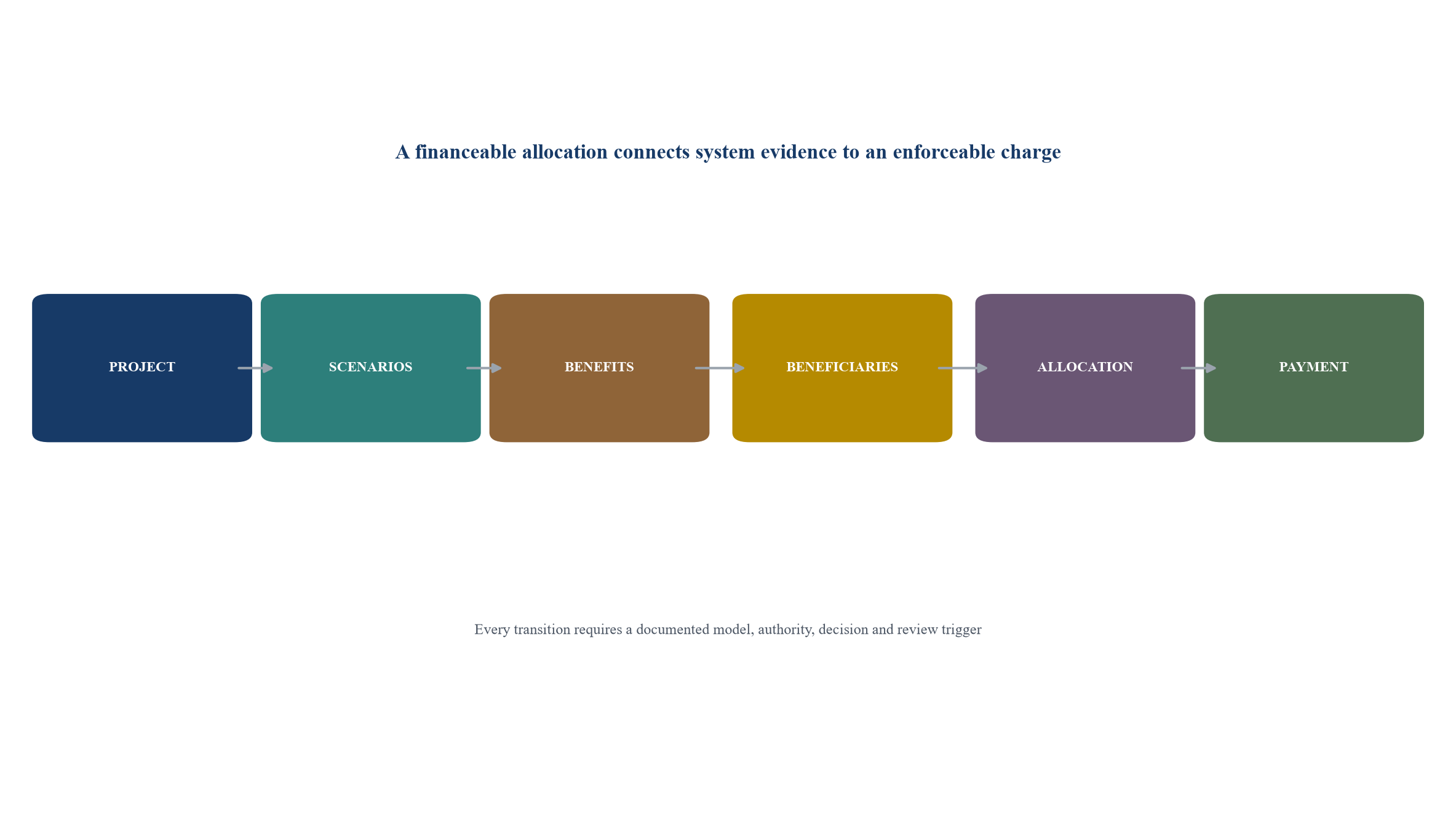
Recoverable cost should move through a controlled chain from project definition to enforceable payment.
21. Allocate by present value of benefits
A present-value method can assign cost in proportion to monetised benefits across zones. Discount rates, timing and terminal value should be common across the allocation model.
The working model should reconcile project cost, benefits and beneficiary geography under a common set of scenarios. Changes to topology, demand, generation or timing should flow through the same controlled calculation rather than an off-model adjustment.
The board and regulator should see the distribution of value and downside by region before committing capital. The preferred method should remain operable under delay, cost escalation, lower benefits and changes in participant composition.
22. Allocate by usage or flow
Postage-stamp, peak-demand, energy-use or power-flow methods can simplify recovery. The method should explain how present use relates to long-term benefit and future users.
The evidence file should identify the governing tariff, planning instrument, system model, cost estimate, benefit calculation and approval authority. Every material input needs an owner, date, source and review trigger so the allocation remains reproducible.
A practical transaction review asks who pays, how much, from when, under which instrument and subject to which adjustment. The answer should support tariff approval, contractual commitment and financeability at the same time.
23. Allocate by cost causation
Connection or causation methods charge parties whose projects trigger reinforcement. They can be precise for direct works and incomplete for broader regional value.
The analysis should distinguish measured system effects, scenario outputs and policy judgements. Where monetisation remains uncertain, the decision record should retain the physical metric and explain how uncertainty affects the allocated share.
Allocation becomes executable when the approved cost base, payment obligation, credit support, true-up and dispute route are documented together. The capital structure should use only revenue supported by that enforceable package.
24. Use hybrid allocation
A hybrid can combine region-wide, zonal, direct-user and public contributions. Each layer should have its own rationale, base and reconciliation rule.
The working model should reconcile project cost, benefits and beneficiary geography under a common set of scenarios. Changes to topology, demand, generation or timing should flow through the same controlled calculation rather than an off-model adjustment.
The board and regulator should see the distribution of value and downside by region before committing capital. The preferred method should remain operable under delay, cost escalation, lower benefits and changes in participant composition.
25. Define de minimis thresholds
Zones with immaterial benefits may be excluded where rules permit. Thresholds should reduce administrative complexity without shifting disproportionate costs to remaining participants.
The evidence file should identify the governing tariff, planning instrument, system model, cost estimate, benefit calculation and approval authority. Every material input needs an owner, date, source and review trigger so the allocation remains reproducible.
A practical transaction review asks who pays, how much, from when, under which instrument and subject to which adjustment. The answer should support tariff approval, contractual commitment and financeability at the same time.
26. Treat negative benefits
A project can increase congestion, losses or market exposure in some zones. The method should disclose adverse effects and determine whether compensation or netting is allowed.
The analysis should distinguish measured system effects, scenario outputs and policy judgements. Where monetisation remains uncertain, the decision record should retain the physical metric and explain how uncertainty affects the allocated share.
Allocation becomes executable when the approved cost base, payment obligation, credit support, true-up and dispute route are documented together. The capital structure should use only revenue supported by that enforceable package.
27. Address uncertainty explicitly
Benefit estimates depend on model inputs and future conditions. Confidence bands, break-even cases and periodic review can improve decisions without implying false certainty.
The working model should reconcile project cost, benefits and beneficiary geography under a common set of scenarios. Changes to topology, demand, generation or timing should flow through the same controlled calculation rather than an off-model adjustment.
The board and regulator should see the distribution of value and downside by region before committing capital. The preferred method should remain operable under delay, cost escalation, lower benefits and changes in participant composition.
28. Select ex ante or ex post allocation
Ex ante allocation gives financing certainty before construction. Ex post adjustment can respond to actual use but may weaken bankability and expose participants to retrospective change.
The evidence file should identify the governing tariff, planning instrument, system model, cost estimate, benefit calculation and approval authority. Every material input needs an owner, date, source and review trigger so the allocation remains reproducible.
A practical transaction review asks who pays, how much, from when, under which instrument and subject to which adjustment. The answer should support tariff approval, contractual commitment and financeability at the same time.
29. Design true-up mechanisms
True-ups can respond to cost changes, scope changes or material benefit shifts. Triggers, caps, timing and appeal rights should be established before commitment.
The analysis should distinguish measured system effects, scenario outputs and policy judgements. Where monetisation remains uncertain, the decision record should retain the physical metric and explain how uncertainty affects the allocated share.
Allocation becomes executable when the approved cost base, payment obligation, credit support, true-up and dispute route are documented together. The capital structure should use only revenue supported by that enforceable package.
30. Allocate development and cancellation cost
Early engineering, land and procurement expenditure needs a recovery rule even if the project changes or stops. Responsibility should follow authorised scope and controllable performance.
The working model should reconcile project cost, benefits and beneficiary geography under a common set of scenarios. Changes to topology, demand, generation or timing should flow through the same controlled calculation rather than an off-model adjustment.
The board and regulator should see the distribution of value and downside by region before committing capital. The preferred method should remain operable under delay, cost escalation, lower benefits and changes in participant composition.
Table 2. Benefit-to-allocation matrix
| Benefit | Primary evidence | Likely beneficiary unit | Allocation option | Principal control |
|---|---|---|---|---|
| Reliability and resilience | Contingency and event studies | Load zone or system | Zonal or region-wide share | Avoid overlap with capacity value |
| Congestion and production-cost reduction | Production-cost model | Pricing zone and customers | Present-value benefit ratio | Common counterfactual and model audit |
| Resource access and curtailment reduction | Dispatch and network studies | Generation and load zones | Hybrid direct and beneficiary share | Separate energy and support-payment effects |
| Avoided local reinforcement | Approved local plans and cost estimates | Utility or zone | Direct avoided-cost credit | Evidence that expenditure is displaced |
| Capacity and adequacy | Resource-adequacy model | Receiving load zones | Accredited contribution ratio | Coincident-weather and deliverability stress |
| Option and economic-development value | Scenario and public-policy record | Future users or public authority | Public or staged contribution | No allocation based on unsupported narrative |
Allocation depends on evidence quality and governing rules; the methods shown are decision options.
31. Allocate cost overruns
Efficient escalation, owner underperformance and external change should receive different treatment. A sharing formula should preserve delivery incentives and legitimate recovery.
The evidence file should identify the governing tariff, planning instrument, system model, cost estimate, benefit calculation and approval authority. Every material input needs an owner, date, source and review trigger so the allocation remains reproducible.
A practical transaction review asks who pays, how much, from when, under which instrument and subject to which adjustment. The answer should support tariff approval, contractual commitment and financeability at the same time.
32. Coordinate portfolio and project allocation
A portfolio method can smooth volatility and recognise interactions. Project-level visibility remains necessary for prudence, benefit and cancellation decisions.
The analysis should distinguish measured system effects, scenario outputs and policy judgements. Where monetisation remains uncertain, the decision record should retain the physical metric and explain how uncertainty affects the allocated share.
Allocation becomes executable when the approved cost base, payment obligation, credit support, true-up and dispute route are documented together. The capital structure should use only revenue supported by that enforceable package.
33. Apply the framework to the United States
FERC Orders 1920, 1920-A and 1920-B require long-term regional planning, benefits, ex ante methods and enhanced state engagement while retaining the roughly-commensurate-with-benefits principle.
The working model should reconcile project cost, benefits and beneficiary geography under a common set of scenarios. Changes to topology, demand, generation or timing should flow through the same controlled calculation rather than an off-model adjustment.
The board and regulator should see the distribution of value and downside by region before committing capital. The preferred method should remain operable under delay, cost escalation, lower benefits and changes in participant composition.
34. Use the state agreement process
Relevant state entities may seek a regional method or project-specific agreement. Decision rules, evidence and fallback arrangements should be settled before negotiations become deadline-driven.
The evidence file should identify the governing tariff, planning instrument, system model, cost estimate, benefit calculation and approval authority. Every material input needs an owner, date, source and review trigger so the allocation remains reproducible.
A practical transaction review asks who pays, how much, from when, under which instrument and subject to which adjustment. The answer should support tariff approval, contractual commitment and financeability at the same time.
35. Apply the framework to Great Britain
TNUoS and connection charging recover network costs and provide locational signals. Current reform must balance predictability, strategic planning, investor confidence and consumer protection.
The analysis should distinguish measured system effects, scenario outputs and policy judgements. Where monetisation remains uncertain, the decision record should retain the physical metric and explain how uncertainty affects the allocated share.
Allocation becomes executable when the approved cost base, payment obligation, credit support, true-up and dispute route are documented together. The capital structure should use only revenue supported by that enforceable package.
36. Apply the European cross-border model
ACER's cross-border cost-allocation framework considers efficient investment cost and impacts across countries. Joint regulatory scrutiny and adjustment mechanisms support projects with asymmetric benefits.
The working model should reconcile project cost, benefits and beneficiary geography under a common set of scenarios. Changes to topology, demand, generation or timing should flow through the same controlled calculation rather than an off-model adjustment.
The board and regulator should see the distribution of value and downside by region before committing capital. The preferred method should remain operable under delay, cost escalation, lower benefits and changes in participant composition.
37. Apply the framework to India
India's inter-state transmission-sharing rules combine national and regional components within a rapidly expanding system. Allocation should remain aligned with planning, connectivity and commercial-operation timing.
The evidence file should identify the governing tariff, planning instrument, system model, cost estimate, benefit calculation and approval authority. Every material input needs an owner, date, source and review trigger so the allocation remains reproducible.
A practical transaction review asks who pays, how much, from when, under which instrument and subject to which adjustment. The answer should support tariff approval, contractual commitment and financeability at the same time.
38. Apply the framework to the GCC
Regional interconnection supports security, trade and system diversity. Member-state allocation needs an agreed benefit model, sovereign approvals, currency treatment and dispatch framework.
The analysis should distinguish measured system effects, scenario outputs and policy judgements. Where monetisation remains uncertain, the decision record should retain the physical metric and explain how uncertainty affects the allocated share.
Allocation becomes executable when the approved cost base, payment obligation, credit support, true-up and dispute route are documented together. The capital structure should use only revenue supported by that enforceable package.
39. Address offshore and multi-terminal grids
Offshore networks can connect generation and countries through shared assets. Allocation should separate generation connection, interconnector and wider-system functions.
The working model should reconcile project cost, benefits and beneficiary geography under a common set of scenarios. Changes to topology, demand, generation or timing should flow through the same controlled calculation rather than an off-model adjustment.
The board and regulator should see the distribution of value and downside by region before committing capital. The preferred method should remain operable under delay, cost escalation, lower benefits and changes in participant composition.
40. Address data-centre and industrial clusters
Large new loads can trigger local and regional works while creating wider economic value. Direct commitment, flexible connection and common-network allocation should be analysed together.
The evidence file should identify the governing tariff, planning instrument, system model, cost estimate, benefit calculation and approval authority. Every material input needs an owner, date, source and review trigger so the allocation remains reproducible.
A practical transaction review asks who pays, how much, from when, under which instrument and subject to which adjustment. The answer should support tariff approval, contractual commitment and financeability at the same time.
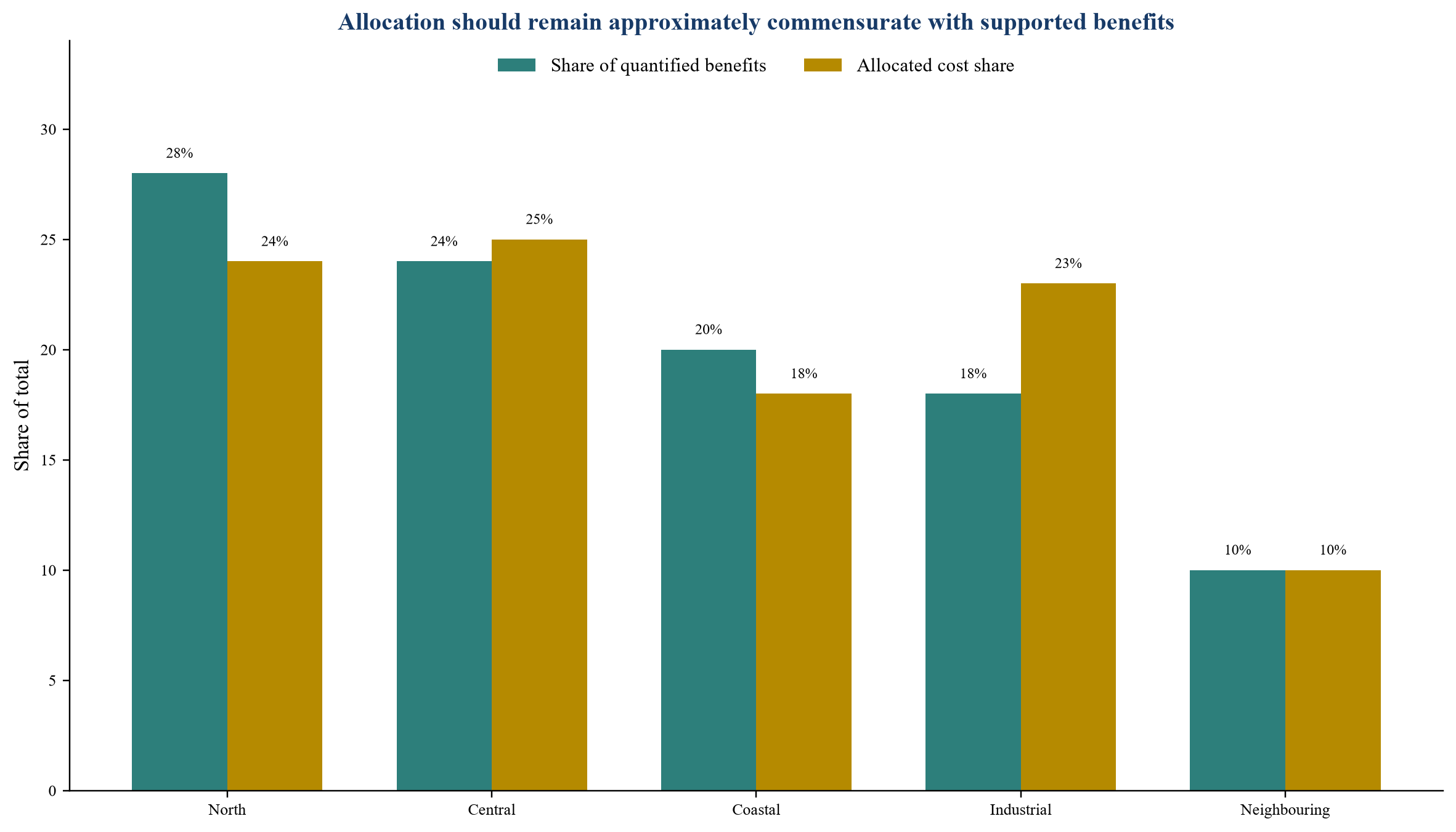
Values are hypothetical management assumptions used solely to demonstrate the method.
41. Address renewable-energy zones
Strategic corridors can aggregate remote generation before individual projects commit. Allocation should stage user contributions and wider-system recovery as utilisation develops.
The analysis should distinguish measured system effects, scenario outputs and policy judgements. Where monetisation remains uncertain, the decision record should retain the physical metric and explain how uncertainty affects the allocated share.
Allocation becomes executable when the approved cost base, payment obligation, credit support, true-up and dispute route are documented together. The capital structure should use only revenue supported by that enforceable package.
42. Address storage and flexible demand
Storage and flexibility can both benefit from and reduce transmission requirements. Models should capture dispatch response and avoid charging the same service twice.
The working model should reconcile project cost, benefits and beneficiary geography under a common set of scenarios. Changes to topology, demand, generation or timing should flow through the same controlled calculation rather than an off-model adjustment.
The board and regulator should see the distribution of value and downside by region before committing capital. The preferred method should remain operable under delay, cost escalation, lower benefits and changes in participant composition.
43. Link allocation to financing
Lenders and investors need predictable revenue, enforceable tariffs and controlled adjustment. Allocation disputes can become construction, liquidity and refinancing risks.
The evidence file should identify the governing tariff, planning instrument, system model, cost estimate, benefit calculation and approval authority. Every material input needs an owner, date, source and review trigger so the allocation remains reproducible.
A practical transaction review asks who pays, how much, from when, under which instrument and subject to which adjustment. The answer should support tariff approval, contractual commitment and financeability at the same time.
44. Build the sources-and-uses schedule
Development, land, equipment, construction, financing and reserves should be mapped to regulated, public, user and private sources. Priority and reimbursement should be explicit.
The analysis should distinguish measured system effects, scenario outputs and policy judgements. Where monetisation remains uncertain, the decision record should retain the physical metric and explain how uncertainty affects the allocated share.
Allocation becomes executable when the approved cost base, payment obligation, credit support, true-up and dispute route are documented together. The capital structure should use only revenue supported by that enforceable package.
45. Size debt against allocated revenue
Debt sizing should reflect the timing, certainty and diversity of allocated charges. DSCR sensitivities should include delay, disallowance, reallocation and demand shifts.
The working model should reconcile project cost, benefits and beneficiary geography under a common set of scenarios. Changes to topology, demand, generation or timing should flow through the same controlled calculation rather than an off-model adjustment.
The board and regulator should see the distribution of value and downside by region before committing capital. The preferred method should remain operable under delay, cost escalation, lower benefits and changes in participant composition.
46. Use public support selectively
Grants, guarantees or sovereign funding can bridge benefits that are public or difficult to monetise. Support should target a defined gap and retain allocation transparency.
The evidence file should identify the governing tariff, planning instrument, system model, cost estimate, benefit calculation and approval authority. Every material input needs an owner, date, source and review trigger so the allocation remains reproducible.
A practical transaction review asks who pays, how much, from when, under which instrument and subject to which adjustment. The answer should support tariff approval, contractual commitment and financeability at the same time.
47. Protect consumers
Prudence review, independent modelling, staged approvals, incentives, caps and clawbacks can protect customers. Consumer impacts should be shown by zone and customer class where evidence allows.
The analysis should distinguish measured system effects, scenario outputs and policy judgements. Where monetisation remains uncertain, the decision record should retain the physical metric and explain how uncertainty affects the allocated share.
Allocation becomes executable when the approved cost base, payment obligation, credit support, true-up and dispute route are documented together. The capital structure should use only revenue supported by that enforceable package.
48. Protect project sponsors
Sponsors need stable rules, timely decisions and treatment of approved expenditure. Transitional provisions can preserve confidence when charging regimes change.
The working model should reconcile project cost, benefits and beneficiary geography under a common set of scenarios. Changes to topology, demand, generation or timing should flow through the same controlled calculation rather than an off-model adjustment.
The board and regulator should see the distribution of value and downside by region before committing capital. The preferred method should remain operable under delay, cost escalation, lower benefits and changes in participant composition.
49. Design the governance forum
System planners, regulators, states or countries, owners, users and consumer bodies need defined decision rights. Governance should include data protocols, conflicts and escalation.
The evidence file should identify the governing tariff, planning instrument, system model, cost estimate, benefit calculation and approval authority. Every material input needs an owner, date, source and review trigger so the allocation remains reproducible.
A practical transaction review asks who pays, how much, from when, under which instrument and subject to which adjustment. The answer should support tariff approval, contractual commitment and financeability at the same time.
50. Create a common data room
The allocation model should have controlled versions of topology, forecasts, costs, benefits, scenarios and approvals. Audit trails support regulatory review and financing diligence.
The analysis should distinguish measured system effects, scenario outputs and policy judgements. Where monetisation remains uncertain, the decision record should retain the physical metric and explain how uncertainty affects the allocated share.
Allocation becomes executable when the approved cost base, payment obligation, credit support, true-up and dispute route are documented together. The capital structure should use only revenue supported by that enforceable package.
Table 3. Hypothetical allocation and debt-service sensitivity
| Scenario | Recoverable cost, USD m | Revenue coverage | Allocation subject to dispute | Minimum DSCR | Decision implication |
|---|---|---|---|---|---|
| Base ex ante method | 1,000 | 100% | 0% | 1.40x | Financeable under approved tariff and credit package |
| Ten per cent cost escalation | 1,100 | 95% | 5% | 1.26x | Sharing and contingency require confirmation |
| One major zone delays agreement | 1,000 | 82% | 18% | 1.08x | Bridge liquidity or public backstop required |
| Benefit true-up shifts fifteen per cent | 1,000 | 100% | 15% | 1.16x | Reallocation timing and credit exposure become material |
| Partial disallowance and delay | 1,150 | 78% | 12% | 0.88x | Capital structure and project scope require reset |
All values are hypothetical management assumptions and do not represent an actual project or forecast.
51. Appoint independent review
Independent technical and economic review can test model design, inputs and allocation. The reviewer should have a defined mandate and access to underlying evidence.
The working model should reconcile project cost, benefits and beneficiary geography under a common set of scenarios. Changes to topology, demand, generation or timing should flow through the same controlled calculation rather than an off-model adjustment.
The board and regulator should see the distribution of value and downside by region before committing capital. The preferred method should remain operable under delay, cost escalation, lower benefits and changes in participant composition.
52. Publish a transparent allocation statement
The statement should explain the project, beneficiaries, cost base, method, sensitivities, zone results and protections. Confidential inputs can be protected while preserving decision logic.
The evidence file should identify the governing tariff, planning instrument, system model, cost estimate, benefit calculation and approval authority. Every material input needs an owner, date, source and review trigger so the allocation remains reproducible.
A practical transaction review asks who pays, how much, from when, under which instrument and subject to which adjustment. The answer should support tariff approval, contractual commitment and financeability at the same time.
53. Define dispute resolution
Allocation disputes may involve modelling, jurisdiction, tariff or treaty issues. Expert determination, regulatory appeal and contractual remedies should have clear boundaries.
The analysis should distinguish measured system effects, scenario outputs and policy judgements. Where monetisation remains uncertain, the decision record should retain the physical metric and explain how uncertainty affects the allocated share.
Allocation becomes executable when the approved cost base, payment obligation, credit support, true-up and dispute route are documented together. The capital structure should use only revenue supported by that enforceable package.
54. Test legal durability
The method should comply with statutory authority, tariff rules, non-discrimination and cost-causation principles. Legal review should follow material design changes.
The working model should reconcile project cost, benefits and beneficiary geography under a common set of scenarios. Changes to topology, demand, generation or timing should flow through the same controlled calculation rather than an off-model adjustment.
The board and regulator should see the distribution of value and downside by region before committing capital. The preferred method should remain operable under delay, cost escalation, lower benefits and changes in participant composition.
55. Run the project-definition gate
This gate confirms asset scope, alternatives, cost baseline, jurisdiction and schedule. It prevents an allocation debate around an unstable project definition.
The evidence file should identify the governing tariff, planning instrument, system model, cost estimate, benefit calculation and approval authority. Every material input needs an owner, date, source and review trigger so the allocation remains reproducible.
A practical transaction review asks who pays, how much, from when, under which instrument and subject to which adjustment. The answer should support tariff approval, contractual commitment and financeability at the same time.
56. Run the benefits gate
This gate validates counterfactuals, scenarios, benefit methods, interactions and beneficiaries. Unsupported benefits should be removed before allocation.
The analysis should distinguish measured system effects, scenario outputs and policy judgements. Where monetisation remains uncertain, the decision record should retain the physical metric and explain how uncertainty affects the allocated share.
Allocation becomes executable when the approved cost base, payment obligation, credit support, true-up and dispute route are documented together. The capital structure should use only revenue supported by that enforceable package.
57. Run the allocation gate
This gate applies the approved method, thresholds, true-ups and consumer protections. Zone results should reconcile exactly to the recoverable cost base.
The working model should reconcile project cost, benefits and beneficiary geography under a common set of scenarios. Changes to topology, demand, generation or timing should flow through the same controlled calculation rather than an off-model adjustment.
The board and regulator should see the distribution of value and downside by region before committing capital. The preferred method should remain operable under delay, cost escalation, lower benefits and changes in participant composition.
58. Run the financeability gate
This gate tests revenue timing, credit, debt capacity, liquidity and change risk. Financing should reflect the approved allocation rather than an expected future compromise.
The evidence file should identify the governing tariff, planning instrument, system model, cost estimate, benefit calculation and approval authority. Every material input needs an owner, date, source and review trigger so the allocation remains reproducible.
A practical transaction review asks who pays, how much, from when, under which instrument and subject to which adjustment. The answer should support tariff approval, contractual commitment and financeability at the same time.
59. Run the delivery and monitoring gate
This gate confirms contracts, milestones, cost control, reporting and benefit review. It links actual delivery to permitted recovery and future true-ups.
The analysis should distinguish measured system effects, scenario outputs and policy judgements. Where monetisation remains uncertain, the decision record should retain the physical metric and explain how uncertainty affects the allocated share.
Allocation becomes executable when the approved cost base, payment obligation, credit support, true-up and dispute route are documented together. The capital structure should use only revenue supported by that enforceable package.
60. Adopt the decision record and 90-day plan
The final record states scope, benefits, allocation, financing, protections, risk owners and review points. The first 90 days should close the highest-value evidence and agreement gaps.
The working model should reconcile project cost, benefits and beneficiary geography under a common set of scenarios. Changes to topology, demand, generation or timing should flow through the same controlled calculation rather than an off-model adjustment.
The board and regulator should see the distribution of value and downside by region before committing capital. The preferred method should remain operable under delay, cost escalation, lower benefits and changes in participant composition.
Table 4. Illustrative 90-day regional cost-allocation programme
| Period | Workstream | Core actions | Decision output | Accountable owner |
|---|---|---|---|---|
| Days 1-15 | Project and authority | Confirm scope, alternatives, cost base, jurisdictions and approvals | Controlled project definition | System planner and counsel |
| Days 16-30 | Scenarios and models | Reconcile topology, demand, generation, policy and counterfactuals | Approved modelling protocol | Technical adviser |
| Days 31-45 | Benefits and beneficiaries | Quantify benefits, interactions, geography and uncertainty | Auditable benefits register | Economist and independent reviewer |
| Days 46-60 | Allocation | Apply candidate methods, thresholds, true-ups and protections | Preferred allocation statement | Regulators and participant forum |
| Days 61-75 | Financing and documents | Test revenue, credit, debt capacity, liquidity and dispute terms | Financeable payment package | Financial adviser and counsel |
| Days 76-90 | Decision record | Approve shares, conditions, monitoring and escalation | Executable allocation decision | Authorised regulators and boards |
Timing is indicative and should be adapted to the governing planning and regulatory process.
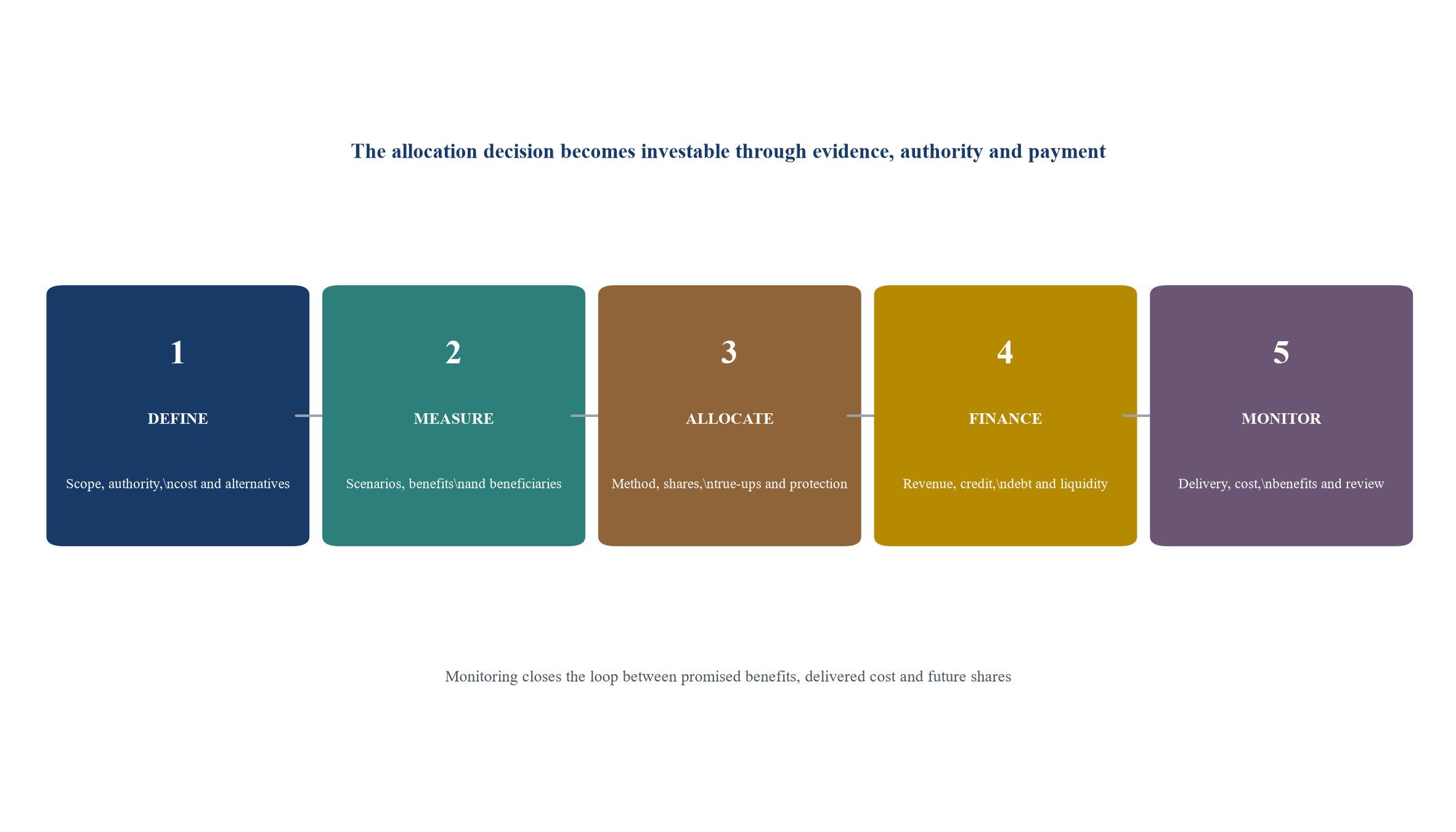
Each gate requires documented evidence before the next capital commitment.
The framework converts a contested policy question into an auditable investment process. It connects project definition, quantified system value and beneficiary geography to an approved method, enforceable payment and financeable revenue.
Execution quality depends on maintaining the evidence after approval. Delivery cost, system use and benefits should be monitored against the same controlled model so that any true-up follows pre-agreed rules.
References
- Federal Energy Regulatory Commission, "Fact Sheet: Building for the Future Through Electric Regional Transmission Planning and Cost Allocation," 2024, https://www.ferc.gov/news-events/news/fact-sheet-building-future-through-electric-regional-transmission-planning-and
- Federal Energy Regulatory Commission, "Explainer on the Transmission Planning and Cost Allocation Final Rule," https://www.ferc.gov/explainer-transmission-planning-and-cost-allocation-final-rule
- Federal Energy Regulatory Commission, "What State Regulators Need to Know About Order No. 1920-B," 2025, https://www.ferc.gov/what-state-regulators-need-know-about-order-no-1920-b
- Federal Energy Regulatory Commission, "Major Orders and Regulations," https://www.ferc.gov/major-orders-regulations
- UK Government, "Review of Electricity Market Arrangements: Summer Update 2025," https://www.gov.uk/government/publications/review-of-electricity-market-arrangements-rema-summer-update-2025/review-of-electricity-market-arrangements-rema-summer-update-2025-accessible-webpage
- UK Government, "Reformed National Pricing: Delivery Plan," 2026, https://www.gov.uk/government/publications/reformed-national-pricing-rnp-delivery-plan/reformed-national-pricing-rnp-delivery-plan-accessible-webpage
- Ofgem, "Reforming Network Charging Signals to Align with the Future Design of Great Britain's Electricity System," 2025, https://www.ofgem.gov.uk/policy/reforming-network-charging-signals-align-future-design-great-britains-electricity-system
- Agency for the Cooperation of Energy Regulators, "Cross-Border Cost Allocation," https://www.acer.europa.eu/electricity/infrastructure/projects-common-interest/cross-border-cost-allocation
- Agency for the Cooperation of Energy Regulators, "Access to EU Funding Is the Main Driver for Electricity and Gas Cross-Border Cost Allocation Decisions," 2025, https://www.acer.europa.eu/news/access-eu-funding-main-driver-electricity-and-gas-cross-border-cost-allocation-decisions
- Central Electricity Regulatory Commission, "Current Regulations: Sharing of Inter-State Transmission Charges and Losses," https://cercind.gov.in/current_reg.html
- Central Electricity Authority, "National Electricity Plan, Volume II: Transmission," https://cea.nic.in/psp___a_i/national-electricity-plan-volume-ii-transmission/?lang=en
- GCC Interconnection Authority, "Our Plans," https://gccia.com.sa/gccia-grid/our-plans/
About the Author
Chennakeshav (CK) is a corporate finance and investment banking executive with 25+ years of global experience in deal origination, structuring and execution across M&A, growth capital and corporate strategy. He has led value-creation mandates for founders, corporates and funds — bridging the boardroom view to hands-on execution and close.
His career spans Morgan Stanley, HSBC, Lloyds Banking Group, EWEC, ADQ portfolio companies and Emirates Growth Fund, across TMT, real estate, fintech, deeptech, cleantech, infrastructure and energy. He has partnered with C-suite leaders, private equity and venture funds, sovereign wealth funds and family offices to finance complex fund raises and scale-up ventures, and has led M&A due diligence, post-merger integration and business-transformation initiatives to create value.
At Matchpoint Partners he is Managing Partner, leading the firm's corporate finance, M&A and capital-raising practice. He holds an MBA from London Business School, an engineering degree from VTU and a Master of Laws (LLM, in progress) from UCL London.
An active start-up mentor, CK mentors at Techstars, DIFC FinTech Hive, Startup Grind, Founder Institute and IN5, serves as Entrepreneur Mentor in Residence (EMiR) at London Business School, and judges the Entrepreneurship World Cup.
