

1 The financing decision
A utility considering a digital twin should identify the operating expenditure it expects the service to change, the evidence needed to attribute that change and the party funding implementation. The financing decision concerns the cost and allocation of those commitments over time. Prepare the comparison before choosing a supplier payment model. A projected reduction in consumption needs a separate bridge to the utility's actual cash obligations, including tariff structure and minimum contractual purchases.
The relevant investment perimeter can be narrow. A pumping station optimisation service, a treatment process information service or a network maintenance application may each have a different savings boundary. Define the assets, interventions and operating decisions included in the proposed project. Separate expenditure on sensors, integration, implementation, continuing service and independent verification. Keep essential operational controls under the utility's authorised operating arrangements.
This paper proposes a savings-to-payment record that follows an improvement from its initial operating hypothesis through evidence, approval and settlement. It compares sponsor-funded expenditure with a supplier-financed service using explicit fictional cash assumptions. The purpose is to expose the financing consequences of measurement cost, savings variation and contract duration. The paper supplies no prediction about a particular utility's performance or the financing terms it could obtain.
An investment committee should receive a defined choice. Specify the service, funding parties, maximum initial commitment, proposed contract term and evidence required before recurring payments. Include the alternative of holding the decision while measurement or commercial rights are unresolved. A decision to fund a bounded evidence exercise carries different obligations from a decision to procure a long-term service.
2 Define the digital twin and its operating boundary
NIST IR 8356 describes digital twins as electronic representations of real-world entities and addresses their operational uses, cybersecurity challenges and trust considerations.[1] Its scope gives context for describing the information service being procured. It establishes no project savings, investment return or lender acceptance. The financing review should identify the particular representation, data connections and authorised uses relevant to the proposed expenditure.
Prepare a short boundary description that a plant operator and a financial reviewer can both understand. Name the physical assets represented, the readings received, the decisions supported and the parties permitted to change the system. Include an effective date and version. Separate recommendations delivered to staff from any approved action affecting the plant. An investment case should cost the service actually permitted by the operator.
The proposed boundary should also identify physical interventions required to realise the claimed improvement. A model may identify a maintenance opportunity that needs a shutdown, replacement equipment or a separate contractor. Include those dependencies in the funding plan. A software subscription alone supplies no evidence that the intervention has occurred or that the associated operating expenditure has changed.
Record material exclusions. These may include asset replacement already approved under another programme, benefits dependent on future tariff changes or operations outside the measurement perimeter. Assign each exclusion a reason and a responsible reviewer. Keep changes to the boundary visible throughout the contract so later savings calculations can be related to the service originally financed. The boundary becomes a controlled commercial record rather than a broad description of technology ambition.
3 Use primary guidance within its actual scope
The United States Department of Energy describes federal energy savings performance contracts as arrangements in which an energy service company audits facilities, implements improvements and arranges financing. Federal requirements include measurement and verification and savings exceeding payments in each contract year; the stated maximum term is twenty-five years.[2] These features belong to that federal contracting framework. A utility service in another jurisdiction needs its own procurement authority and enforceable terms.
The Department's final September 2024 measurement and verification guidance addresses baselines, adjustments, alternative measurement approaches, risk allocation and the relationship between verification cost and rigour.[3] The EPA's water utility guide uses a systematic management approach for assessing energy use and improving performance.[4] They provide relevant context for an evidence-led review. They supply no digital twin performance estimate for the fictional cases in this paper.
The World Bank's published discussion of energy service companies describes shared-savings and guaranteed-savings structures and financing experience in specified markets.[5] Its examples should retain their own geography and contractual scope. NIST's voluntary AI framework materials provide governance context when an application includes AI.[6] An IFRS Interpretations Committee discussion states the identified-asset and control-of-use basis for assessing whether a contract contains a lease.[7]
The commercial structure developed below is the author's proposal. It combines those bounded references with original cash illustrations and practical evidence requests. It has not been empirically validated or endorsed by the institutions cited. Actual approval requires qualified engineering, legal, financial and accounting review of the utility, supplier and executed agreements.
4 Establish the savings to payment record
Give each proposed savings item a stable identifier. Connect the operating intervention to its measurement boundary, baseline period, adjustment rules, accepted evidence and proposed payment. Identify who owns the original data and who certifies the settlement calculation. The record should make a payment claim reproducible from preserved observations and agreed rules.
Table 1. Proposed savings to payment evidence record
| Review item | Required record | Financing consequence |
|---|---|---|
| Operating boundary | Assets and permitted intervention | Expenditure eligible for funding |
| Baseline | Period, meter and adjustment rules | Comparison used for savings |
| Cash conversion | Tariff and avoided payment basis | Available cash for settlement |
| Verification | Reviewer, frequency and budget | Continuing project cost |
| Payment | Formula, deductions and approvals | Contractual supplier receipts |
| Continuity | Data access and exit arrangements | Duration of usable service |
Table 1 is an original proposed record with no observed project entries. Complete it before treating a proposed savings stream as available cash. Where a field remains unresolved, identify the expenditure or payment assumption affected. A missing tariff review can leave the cash value unresolved even when the physical consumption calculation is complete. A missing data right can interrupt later verification.
The utility and supplier should retain the same accepted record for each settlement period. Preserve the inputs used, calculation version, exceptions, reviewer decision and payment outcome. An amended settlement requires a documented reason and an identifiable predecessor. Avoid silently replacing historical data when a meter or model is revised. The original and revised records may be needed to determine the contractual consequence of the change.
This record should remain proportionate to the project. Its purpose is to connect specific claims to financial commitments. A limited service may require fewer fields or less frequent review, provided the parties can still reproduce the agreed calculation. Budget the work required to maintain that evidence instead of treating its production as a free by-product of the software platform.
5 Review evidence readiness before financing scale
Use an evidence sequence to decide whether further commitment is justified. The author proposes five stages: defined operating boundary, accepted baseline, bounded intervention, independently reviewed settlement and reviewed expansion. The sequence is qualitative. The positions in Figure 1 indicate order only and provide no measured maturity score, confidence level or probability of savings.
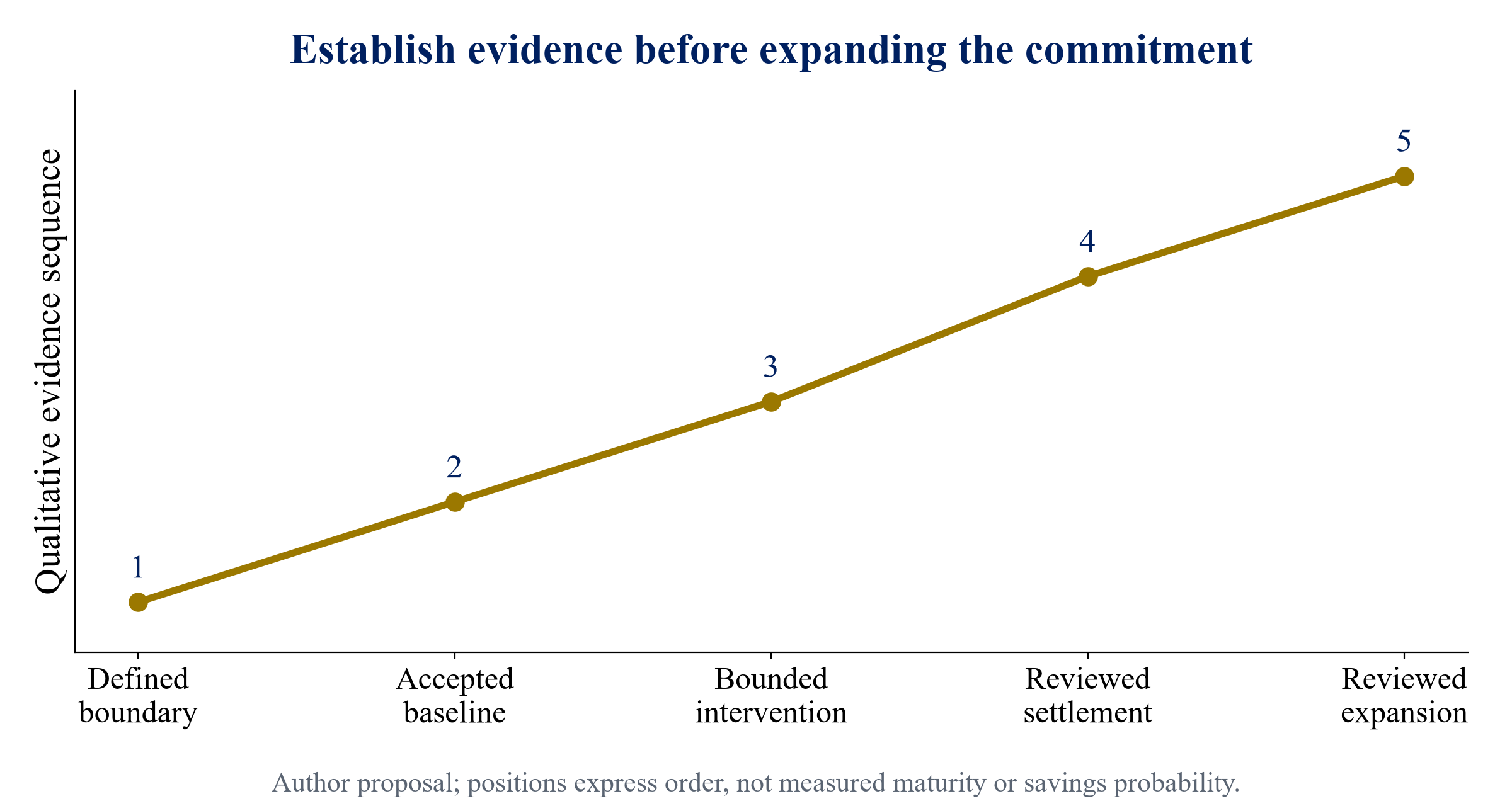
At the first stage, establish the service and operating permissions. At the second, agree how the starting condition will be represented. The intervention stage should retain a dated record of what changed, who approved it and what expenditure was incurred. Settlement review should connect the reported improvement to the payment rule. Expansion should require evidence relevant to the additional assets and commercial commitments.
A successful technical demonstration can support a bounded test without establishing a financeable savings stream. Explain the remaining steps in the investment memorandum and price their costs. If a baseline needs another season of observations, show the proposed observation expenditure and decision timing. Avoid translating incomplete readiness into an invented expected completion date or a general percentage discount to value.
Different projects may enter the sequence at different points. An existing instrumented plant may already have suitable observations, while a new network application may require metering work. Record the actual evidence available. Funding can then be approved for the next defined activity, with a stated exposure and review condition. This staged structure is a proposal for governing commitments and requires assessment against the utility's procurement and budget procedures.
6 Specify the comparison that savings will use
A financing case needs an agreed comparison between the conditions used to represent the baseline and those observed after intervention. Describe the measurement period, operating boundary, units and information excluded. Identify changes in production, demand, weather, water quality or operating restrictions that could alter the comparison. The parties should resolve the treatment of material changes before using the resulting calculation for payment.
For the proposed financing record, retain a baseline register with source data, approved transformations and the date of acceptance. Document missing observations and the method permitted for handling them. A reviewer should be able to distinguish a measured input from an assumed parameter. Any assumption that materially affects settlement should have a defined review procedure and an identified owner.
Consider a fictional water pumping service. Lower energy use after implementation might coincide with a reduction in water delivered or a change in pumping head. The financing review should require a method appropriate to those conditions. No numerical reduction is assumed here. The example illustrates why a raw before-and-after invoice comparison needs an agreed operating interpretation before it can support a recurring service payment.
The project should also define the point at which the original comparison ceases to be useful. A substantial asset replacement, changed network boundary or revised service obligation may require a formal adjustment or a new basis. Set out approval rights and payment treatment while review is pending. An open-ended ability to change the comparison would create a commercial uncertainty that should appear explicitly in the funding decision.
7 Convert operating improvement into cash
List the specific cash payments expected to change. Energy consumption, peak demand, chemicals, emergency repairs and contracted labour can each have a different relationship to expenditure. Check the actual purchase agreement or tariff before assigning a monetary value. The analysis should retain the unit, time period and billing component associated with each proposed reduction.
Separate avoided cash expenditure from unused staff capacity and deferred spending. Releasing employee time can support another operating task without reducing payroll. Deferring replacement work changes the timing of expenditure and may introduce a later obligation. Treat such benefits through their stated financial mechanism. Where no cash mechanism can be evidenced, keep the benefit outside the payment-funded case and describe it separately.
An operational improvement may also change revenue or service deductions. Those effects need their own contract and collection evidence. Avoid counting increased billed volume, reduced leakage and saved treatment costs as three independent cash streams when they arise from the same underlying change. Prepare a benefit reconciliation that identifies the common physical driver and the distinct payment consequences.
The author proposes a cash conversion schedule showing the gross operating result, contractual price, avoidable portion and timing of the related payment. Deduct continuing costs required to obtain and verify the result. Have finance review the schedule before it enters the investment model. The schedule provides a transparent route from operational evidence to available cash; its completion supplies no assurance that the savings will persist through the service term.
8 Allocate verification responsibility and expense
The proposed contract should name the party compiling observations, the party reviewing them and the decision-maker accepting a settlement. Independence should be assessed in relation to the actual service and potential conflicts. A supplier can produce useful evidence while an independent reviewer checks the calculation and its compliance with the agreed methodology. State the division of work in the budget.
Verification expenditure includes more than an annual report. Cost instrumentation, data retention, calibration, site access, calculation preparation, independent review and dispute support where required. Identify costs already borne by the utility and incremental costs created by the contract. A comparison that allocates these expenses differently between alternatives can produce a misleading financing preference.
Choose a review intensity that matches the financial exposure and the uncertainty in the proposed savings. A simpler operating intervention may permit a narrower review, subject to qualified assessment. A project involving several changing conditions may require more work. The cost-performance comparison should show both the expense and the evidence delivered. A larger verification budget establishes no universal increase in accuracy.
Agree how extraordinary review costs will be authorised. Meter failure, missing information or a disputed adjustment can create work outside the routine budget. Set approval rights and the effect on payment timing. If the utility bears all exceptional cost, disclose that obligation in the sponsor comparison. If the supplier bears it, assess whether the service price and liquidity are sufficient for the proposed responsibilities.
9 Compare funding alternatives on a common perimeter
Sponsor-funded investment requires the utility to provide initial implementation capital and meet continuing obligations. A supplier-funded service moves initial expenditure to the provider and introduces recurring payments. A hybrid may split instrumentation, implementation and software service between the parties. Evaluate each structure using the same operating boundary, assumptions and review horizon.
Prepare a common cost schedule before comparing headline payments. Include all parties' implementation costs, annual support, verification, permitted renewal expenditure and exit assistance. Show payment timing explicitly. Explain differences in asset ownership and residual rights. A service price that excludes an essential integration or metering package needs the omitted expenditure added to the utility case.
The author proposes evaluating the utility and supplier cases together. A utility may show an attractive cash result when an assumed service fee is too low for the provider to recover its expenditure. The joint review should expose that inconsistency. Supplier viability depends on its actual funding terms, operating costs, contractual rights and credit exposure; the fictional illustration below establishes none of those conditions.
Keep financing and procurement conclusions separate. A favourable cash calculation can inform the choice of structure, while procurement review determines whether that structure and supplier selection are permitted. Accounting review addresses the treatment of the resulting obligations. Obtain those conclusions before claiming that the service creates a particular balance-sheet effect or is available under the utility's purchasing authority.
10 Define the fictional investment assumptions
The numerical illustration assumes initial implementation expenditure of USD 1.4 million paid at time zero. Annual gross cash savings are assumed to be USD 600,000. Annual operating and service costs are USD 180,000, with annual measurement and verification costs of USD 80,000. The six-year horizon uses a ten percent annual discount rate and year-end cash payments. Every input is fictional and was selected to demonstrate the financing arithmetic.
No actual utility, vendor quotation, observed savings, lending proposal or comparable transaction supplies these values. The model assumes that the specified savings and costs remain constant. It excludes tax, debt, working capital, implementation delay, inflation and terminal value. Those exclusions limit the analysis to the stated investment cash flows and should not be carried into an actual approval without review.
The sponsor's assumed annual net cash benefit is USD 340,000, calculated by deducting operating and verification expense from gross savings. Discounting six equal annual benefits at ten percent produces an annuity factor of 4.3552607. The present value of those benefits is approximately USD 1,480,789. Deducting initial expenditure gives net present value of USD 80,789, rounded to the nearest dollar.
A positive result in this fictional base case has limited headroom. It describes the chosen inputs and supplies no project return forecast. The review should show the effect of changing savings, costs and the collection horizon. Round displayed outputs only after computing the cash model at full precision, and keep the exact assumptions available for independent recalculation.
11 Test the savings sensitivity before pricing service
The author compares three fictional annual gross savings assumptions: USD 450,000, USD 600,000 and USD 750,000. Initial expenditure, continuing costs, timing and discount rate remain unchanged. This isolates the effect of savings on the sponsor investment; it establishes no probability distribution, confidence interval or empirical range for utility performance.
Table 2. Fictional six year sponsor investment sensitivity
| Annual gross savings USD | Annual net benefit USD | Investment NPV USD |
|---|---|---|
| 450,000 | 190,000 | -572,500 |
| 600,000 | 340,000 | 80,789 |
| 750,000 | 490,000 | 734,078 |
The negative lower-savings result shows that the same initial commitment can become uneconomic under the stated cash assumptions. The base case and higher-savings case differ only in the annual gross amount. None of the cases includes a compensating supplier payment, operating change or additional capital requirement. Any actual response to lower savings needs its own expenditure and timing assumptions.
Figure 2 compares gross annual savings with the annual cost-equivalent threshold for the six-year investment. That threshold combines operating costs, verification costs and recovery of initial expenditure at the assumed discount rate. The chart is an original costing illustration. It provides no measured technology performance and no market price benchmark.
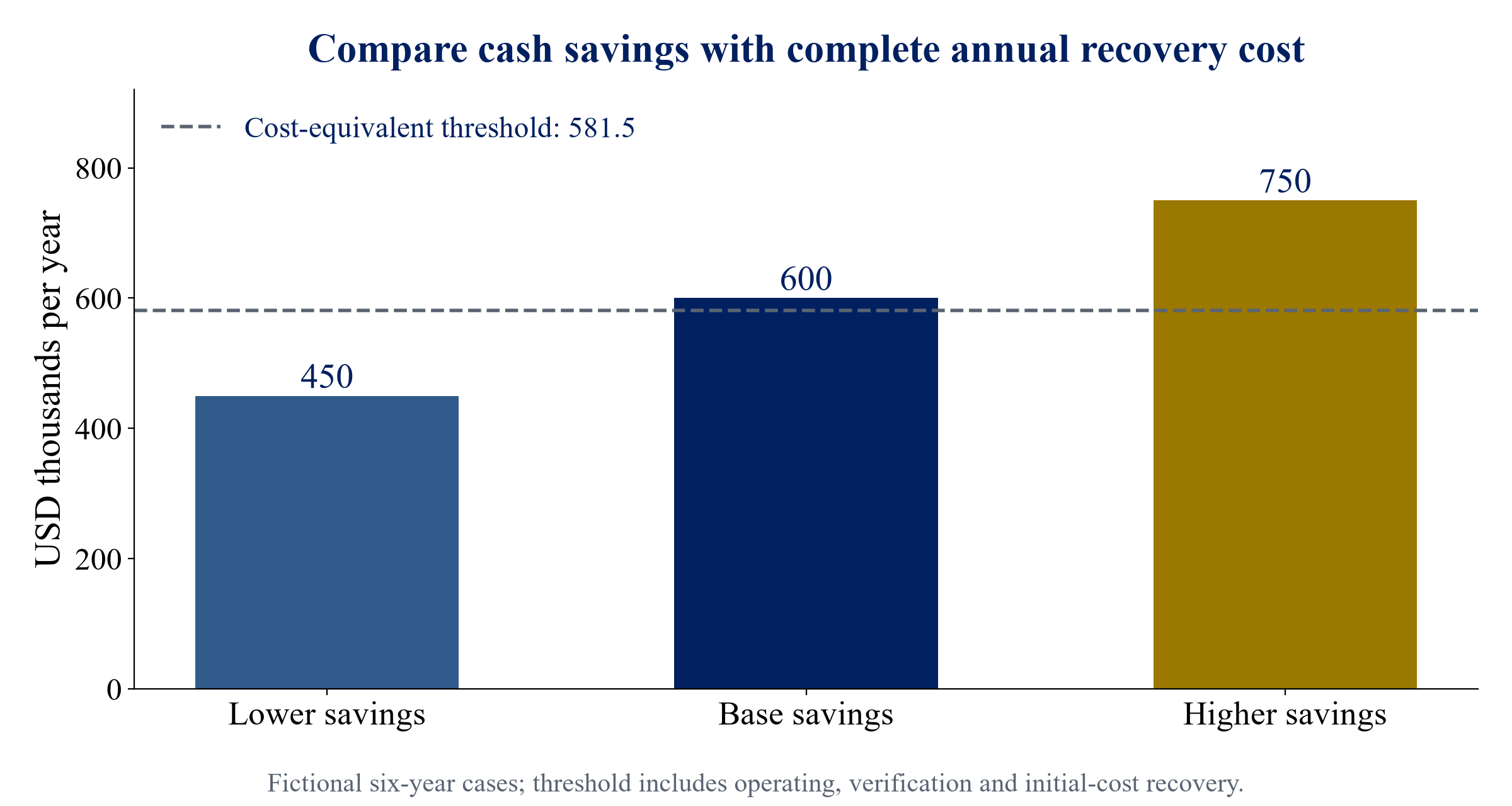
An investment committee should examine the evidence supporting the gross savings assumption before accepting the base case. Where the amount depends on future operating conditions or an unfinished verification exercise, state that dependency. A sensitivity table makes the financial consequence visible; it supplies no substitute for a defensible operating and measurement case.
12 Price a cost equivalent supplier service
Assume the supplier pays the same USD 1.4 million initial expenditure and bears annual operating costs of USD 180,000. The utility continues to bear USD 80,000 of annual verification costs. For the limited illustration, both parties use the same ten percent discount rate and six-year term. The annual fee required to recover the supplier's initial expenditure and operating costs is USD 501,450, rounded after calculation.
The calculation divides initial expenditure by the six-year annuity factor and adds annual operating costs. At the unrounded fee, the supplier has zero net present value at the chosen discount rate. This is a cost-equivalent calculation before any additional margin, transaction expense or omitted risk cost. It is not a supplier quote or a statement of acceptable commercial return.
The utility retains fictional annual cash of approximately USD 18,550 after paying that fee and its verification costs from USD 600,000 gross savings. The present value of this retained cash equals the sponsor investment's USD 80,789 under the exact common assumptions. That equality follows from moving the same initial cost between parties and pricing its recovery consistently.
Actual proposals can differ because funding costs, taxes, service scope, guarantees, residual rights and risk allocation differ. Obtain those inputs instead of assuming equality in a transaction. A provider may have economies of scale or different financing access, but this paper contains no evidence of either for a specific supplier. Price the claimed difference from authorised project records before incorporating it into the procurement comparison.
13 Test whether a proposed savings share funds the provider
Consider a separate fictional proposal paying the supplier seventy percent of USD 600,000 annual gross savings. The annual payment would be USD 420,000. Retain the supplier's USD 1.4 million initial expenditure, USD 180,000 annual operating cost, six-year term and ten percent discount rate. The resulting supplier net present value is negative USD 354,737.
The utility would retain USD 100,000 annually after that payment and its assumed USD 80,000 verification cost. Its cash result can therefore look attractive while the supplier case fails to recover the same initial investment at the specified discount rate. The illustration exposes a pricing inconsistency. It does not establish that seventy percent is an observed market share or a recommended contractual percentage.
Resolve a negative supplier case through evidence about actual scope, funding, cost, term or investment requirements. If implementation is partly funded by the utility, include that contribution in both models. If a grant is proposed, verify eligibility, payment conditions and availability before treating it as a funding source. A hypothetical subsidy should remain a separate conditional case.
For a savings-sharing arrangement, identify the base to which the percentage applies. Gross energy cost reduction, net verified cash savings and savings after agreed expenses can produce different receipts. Set the treatment of negative periods, adjustments and payment caps. Model the exact proposed formula and preserve a settlement example that both parties can reproduce. The commercial review should cost the uncertainty borne by each party.
14 Relate contract duration to recoverable expenditure
Contract duration determines how many payments are available to recover initial expenditure under the fictional fixed-fee structure. Holding the initial USD 1.4 million, annual operating cost and ten percent discount rate constant, the annual cost-equivalent supplier fee falls as the payment horizon increases. This is a financing identity under unchanged assumptions, with no prediction about actual contractual availability.
Table 3. Fictional contract duration and annual service affordability
| Contract years | Supplier fee USD per year | Utility cash after fee and verification USD |
|---|---|---|
| 3 | 742,961 | -222,961 |
| 6 | 501,450 | 18,550 |
| 9 | 423,097 | 96,903 |
Table 3 uses USD 600,000 annual gross savings and USD 80,000 verification expense. Each row separately prices recovery across its own term. The supplier has zero net present value at ten percent before omitted costs in each row. Longer duration also extends the period during which the assumed service, costs and savings must remain available.
A longer term needs evidence about service continuity, procurement authority, operating life, data access and termination rights. Analyse those conditions before using the nine-year amount in a real proposal. A provider cannot collect the modelled fee after expiry of an essential customer permission unless enforceable arrangements allow continuing delivery and payment.
Show the horizon on every displayed value. Comparing a three-year payment with a nine-year payment without its duration would obscure the commitment. Include the total nominal obligation and discounted cost in an actual procurement review, alongside annual affordability. The illustration excludes renewal expenditure and residual value; those items require separate transaction-specific assessment.
15 Design settlement rights and payment timing
Define the event that creates a payable amount. It might be an accepted service period, an independently reviewed savings statement or a combination of fixed and variable conditions. Link each event to required evidence and an approving party. Specify invoice timing and the contractual period for review. The financing model should follow that actual sequence.
Distinguish dispute resolution from routine approval. A disputed adjustment may affect only part of the period's payment or the full amount, depending on the agreement. Legal review should determine enforceable treatment. Model delayed and reduced receipts separately so the provider's liquidity case reflects the proposed arrangement. An annual discounted model can conceal a material short-term funding requirement.
The parties should define remedies for missed performance obligations and the process for evaluating a claimed cause. Separate supplier-controlled delivery issues from changes initiated by the utility. Specify the evidence needed to determine responsibility. Avoid assuming a contractual reimbursement arrives immediately or in full without examining the counterparty's resources and the enforcement process.
Retain an auditable connection between settlement and the general ledger. The approved statement, invoice, payment, credit note and later adjustment should remain traceable. This proposed control helps financial reviewers test whether the modelled cash stream corresponds to an actual contractual claim. Its existence provides no assurance about collection, legal enforceability or continued performance; those conclusions require their own evidence.
16 Review financing and counterparty credit separately
A savings-supported service depends on the utility's obligation and capacity to pay, as well as the project's operating result. Review the relevant legal entity, payment authority, budget process and contract. A technically accepted calculation alone establishes no collection date. The provider's funding plan should identify the party whose receivable is being financed.
For proposed debt funding, obtain the actual facility terms. Examine eligible receivables, payment conditions, borrowing base, reserves, covenants and repayment schedule where applicable. The lender may assess the supplier's overall credit and other business activities. This paper provides no evidence that a stand-alone digital twin contract can secure project debt or that particular leverage is available.
Evaluate concentration and continuity in the supplier case. A provider relying on one customer may face a large funding exposure if payment is delayed. The utility should understand the resources available for continuing service during a dispute or financial stress. Consider the operational consequences of supplier failure and the cost of an agreed transition arrangement.
Any credit enhancement should be stated precisely. Identify the guarantor, beneficiary, amount, duration, conditions and claims procedure. Verify authority and financial capacity before assigning value to it. An assurance about savings and an assurance about payment address different obligations. Model the specific protection offered without assuming that it covers every source of loss or will produce immediate recoveries.
17 Allocate data rights and continuing access
The savings evidence may rely on utility readings, supplier transformations and third-party information. Identify the permitted use and retention of each input. The proposed agreement should allow the parties and authorised reviewers to reproduce settlement throughout the required period. Review contractual restrictions before relying on access in the financial case.
Describe the evidence export required at termination. It should preserve the source observations, transformation rules, relevant versions and accepted settlement records within applicable permissions. A utility may need continuing access even after the service stops, because a prior claim or adjustment remains open. Cost the supplier effort required to provide the agreed materials and document any excluded proprietary component.
Changes to hosting, subcontractors or licences can affect service continuity. Identify approval rights and notice obligations in the contract. The utility's operational and security owners should review the actual connections and access arrangements. The financing memorandum should show any expense required to retain or replace an essential dependency during the proposed term.
For procurement comparison, include transition costs and the effect of unusable evidence. A low annual fee with an expensive or impractical exit can carry a material obligation outside the headline price. Request a practical exit demonstration where appropriate, using approved information. This proposal concerns evidence continuity and commercial rights; it supplies no blanket cybersecurity certification or assurance that a particular transfer complies with applicable law.
18 Govern model changes that affect settlement
NIST's AI Risk Management Framework materials identify the voluntary functions Govern, Map, Measure and Manage.[6] They provide governance context for AI-enabled services. The financing arrangement proposed here should separately control changes that affect a savings claim or payment. An improved prediction metric alone establishes no additional contractual cash benefit.
Keep the model used for operating recommendations distinguishable from the method used to determine settlement. A supplier might update an operational model while a previously agreed baseline remains in force. Record versions and the date a change becomes effective. A change to the payment calculation should require the approval process specified in the agreement.
The proposed change record should describe the reason, supporting evaluation, operating effect and potential settlement effect. Identify who may approve deployment and who reviews its financial consequence. Preserve the prior version and calculation evidence. Where a change would alter historical amounts, agree whether a retrospective adjustment is permitted and how it will be reviewed.
Assess the resources required to maintain this governance over the term. Budget evaluation, documentation, review and staff training where they are part of the service obligation. A continuing supplier fee should identify which changes are included and which require a separate order. The review should avoid an uncapped obligation to fund every new feature or a presumption that every future model version maintains the same savings performance.
19 Examine accounting and procurement before approval
The IFRS Interpretations Committee's March 2023 discussion records the IFRS 16 basis for assessing whether an arrangement conveys control over an identified asset for a period in exchange for consideration.[7] A service label alone provides no accounting conclusion. Qualified advisers should assess the actual rights, assets and decisions in the proposed contract under the standards applicable to the utility.
Prepare the information accounting reviewers need before comparing claimed balance-sheet effects. Describe asset ownership, substitution rights, operating decisions, minimum payments and termination conditions. Include any dedicated equipment or implementation arrangement. The financial model should retain the cash obligations even while classification is under review; uncertainty about accounting treatment does not remove the contractual payment requirement.
Procurement review should address authority for the contract term, supplier selection, performance conditions and the proposed financing structure. Public and regulated utilities can have requirements that differ by jurisdiction and entity. Obtain transaction-specific advice before importing a structure from the United States federal examples or the World Bank's described markets.
The author proposes a final approval memorandum separating operating evidence, cash appraisal, procurement authority and accounting conclusions. Name the reviewer and date for each determination. Record unresolved issues as conditions to approval where that treatment is permitted. This structure supplies an orderly record of the decision; it creates no professional opinion about the legality, tax treatment or accounting classification of an actual contract.
20 Build a commercialisation roadmap with funded milestones
Begin with a bounded evidence engagement specifying the service perimeter, baseline work, cost and decision required at its conclusion. The next commitment should depend on the completed evidence and the utility's approval. Cost the intervention and the first settlement review before proposing wider deployment. Each stage should have a defined deliverable and budget.
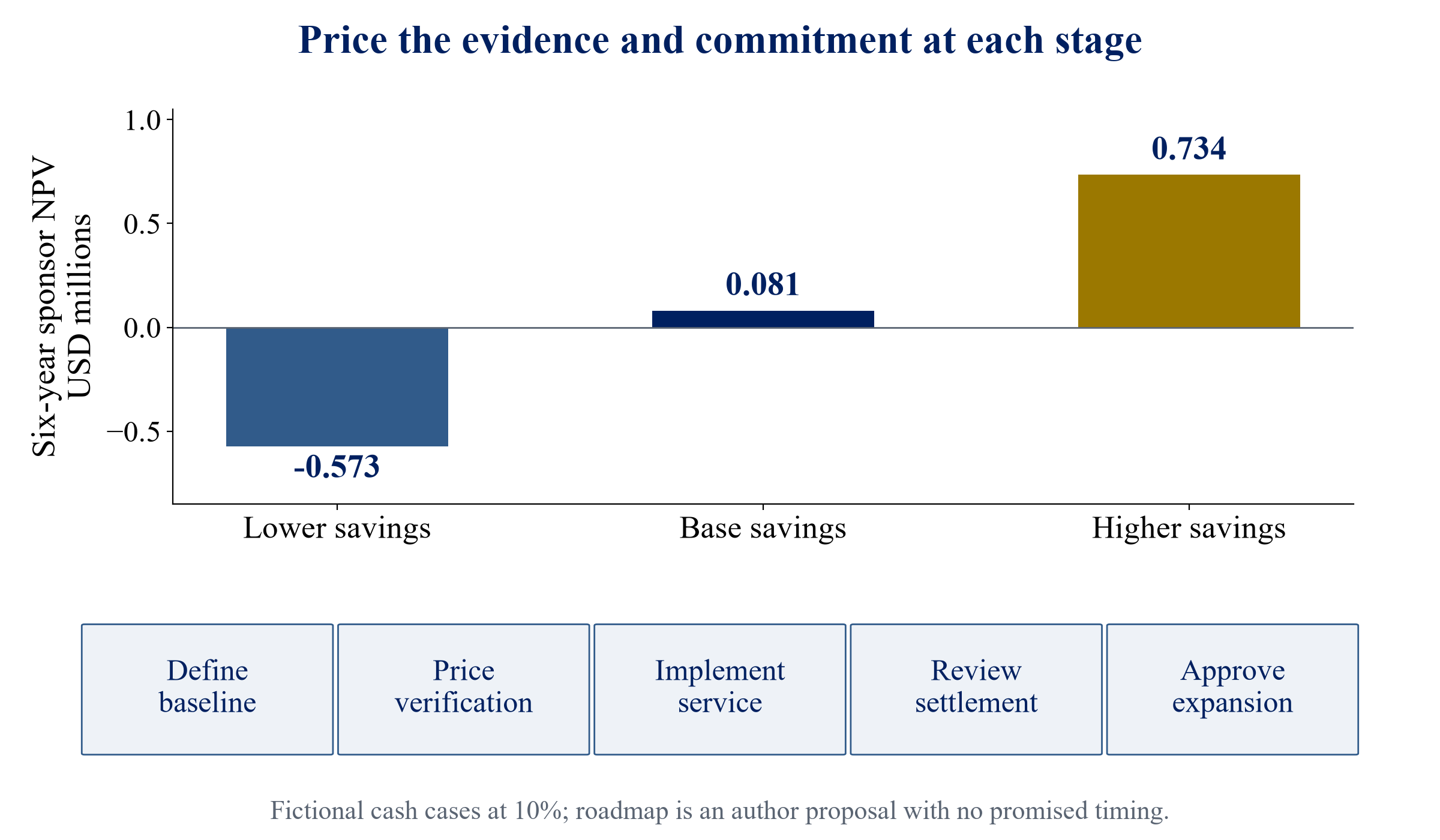
Figure 3 combines the fictional sponsor investment sensitivities with a proposed sequence from baseline definition to reviewed expansion. The cash values derive only from the assumptions in Sections 10 and 11. The roadmap is a qualitative commercial proposal with no promised timeline or measured conversion probability. It should be adapted to the actual procurement and operating conditions.
Before expansion, review the portability of the evidence. Another plant may have different assets, operating conditions, tariffs and permissions. Identify what can be reused and what requires additional observations or implementation. Include the cost of that work in the new proposal. A completed first project establishes evidence only for its stated perimeter and period.
The utility can use the roadmap to limit commitments while the savings and settlement method are being established. The supplier can use it to identify the expenditure required before recurring cash receipts. Agree the ownership and permitted use of work produced if the project stops after an early stage. Those rights should be priced and documented rather than left to a later negotiation.
21 Prepare the sponsor investment committee memorandum
Present the proposed decision, alternatives and maximum exposure on the first page of the memorandum. State the service perimeter, evidence available and outstanding conditions. Include the common cost comparison and the parties responsible for verification and settlement. A committee should be able to locate the assumptions supporting the requested commitment without relying on the supplier's presentation.
Attach the savings-to-payment record, cash conversion schedule and contractual payment example. Show the base assumptions and specific sensitivities. Explain which values are observed, quoted, forecast or hypothetical. Where a calculation depends on unfinished work, identify that work and the amount of capital exposed before it is complete. Keep optional future expansion outside the committed base unless approval expressly includes it.
Include a supplier viability assessment appropriate to the exposure. Reconcile the proposed price with implementation cost, continuing responsibilities and funding. Examine the supplier's actual resources for performance and transition obligations. A committee considering service financing should understand the dependence on the provider's ability to deliver throughout the proposed term.
The author recommends recording the permitted next action, the approval conditions and the reviewer responsible for checking them. A decision to approve baseline work should specify its own budget and deliverable. A decision to approve the service should identify the executed terms required before mobilisation. Preserve the approved memorandum and later amendments so performance review can relate actual obligations to the original decision.
22 Establish post acceptance financial review
The Department of Energy's description of post-acceptance federal ESPC administration includes continuing supplier performance, annual measurement and verification and agency responsibilities.[8] That source concerns the federal process. For the utility service proposed here, define the continuing financial review appropriate to the actual contract and retain the resources needed to perform it.
Prepare a period report linking operating observations, accepted savings, supplier obligations, payment and exceptions. Include verification expenditure against budget. Compare the actual cash treatment with the approved model, retaining the original assumptions. A variance should identify its cause and proposed action; a revised forecast should not overwrite the record used for investment approval.
Review unresolved matters before they accumulate across settlement periods. A repeated missing-data exception, delayed invoice or model change may affect the financing case. Assign an owner and a review date. Consider whether additional expenditure, a contract amendment or restricted operation is required, with appropriate professional and operational approval.
Use the review to determine whether continued funding remains justified under the available evidence. Expansion should be separately approved rather than triggered automatically by a favourable early period. A period with lower payments or savings needs interpretation under the contract and actual operating conditions. The proposed review process supplies a financial governance structure, with no assurance about future savings, supplier solvency or recovery of initial expenditure.
23 Limitations and a research agenda
The framework is an original proposal and has no empirical validation. The eight references establish bounded technical, governance and contracting context. They do not verify demand for a particular digital twin, service pricing, achievable savings or project finance availability. The numerical examples use fictional constant annual values and omit several factors needed for a transaction appraisal.
Further research should test the framework against authorised utility records. A useful study would preserve the baseline, implemented intervention, accepted savings, cash conversion, verification expense and actual settlement. It should disclose the period observed and material exclusions. An independent review could then compare the proposed record with evidence needed to resolve real payment decisions.
Research on verification expense should compare like-for-like operating boundaries and uncertainty. A fee comparison without the evidence delivered provides little guidance for procurement. Research on contract duration should also account for renewal costs, service changes, funding terms and residual rights. Actual observations would be necessary to estimate any relationship between those factors and supplier or utility outcomes.
Cross-jurisdictional work should examine the specific procurement, accounting and contractual conditions rather than presume one financing model travels unchanged. Report limits on access and comparability. The proposed financial identities can be recalculated, while any claim about practical financing success needs documented agreements and realised cash. No commercial or investment conclusion should be inferred from the absence of those observations.
24 Conclusion and recommended next decision
Approve utility digital twin financing against an agreed operating boundary, reproducible savings evidence and a costed settlement process. Compare sponsor expenditure and supplier-funded service payments on the same scope and horizon. Examine both parties' cash cases before accepting a proposed price or savings share. These are recommendations for transaction review, with project-specific conclusions remaining dependent on evidence and professional assessment.
The fictional six-year sponsor case produces net present value of USD 80,789. Moving its initial expenditure to a supplier at a cost-equivalent annual fee of USD 501,450 leaves the same utility present value under the exact shared assumptions. A fictional seventy percent savings fee leaves the provider with negative net present value of USD 354,737. The calculations show why a funding proposal should identify who ultimately recovers implementation expenditure.
Contract duration and measurement cost should be explicit in the approval. The fictional three-year fee exceeds the assumed available savings, while longer horizons reduce the annual recovery requirement. Each extension also requires continuing service, evidence and enforceable payment rights. Actual terms need independent review and should not be justified through the fictional values presented here.
The recommended next action is a bounded feasibility and settlement assessment. Define the service, gather authorised operating and payment evidence, price verification and prepare consistent utility and supplier cash models. Report unresolved conditions before requesting the long-term commitment. This work can establish a documented financing decision without claiming an observed savings result, a lender offer or a particular accounting outcome.
References
- NIST. Security and Trust Considerations for Digital Twin Technology. NIST IR 8356, final, February 2025. https://csrc.nist.gov/pubs/ir/8356/final. Accessed 4 October 2026.
- United States Department of Energy. About Federal Energy Savings Performance Contracts. Federal programme scope. https://www.energy.gov/cmei/femp/about-federal-energy-savings-performance-contracts. Accessed 4 October 2026.
- United States Department of Energy. M&V Guidelines: Measurement and Verification for Performance-Based Contracts. Version 5.0, final, September 2024. https://www.energy.gov/sites/default/files/2024-10/mv_guide_5_0.pdf. Accessed 4 October 2026.
- United States Environmental Protection Agency. Ensuring a Sustainable Future: An Energy Management Guidebook for Wastewater and Water Utilities. 2008; management-method context. https://www.epa.gov/sites/default/files/documents/guidebook_si_energymanagement.pdf. Accessed 4 October 2026.
- World Bank. Demystifying ESCOs and Energy Performance Contracts. Published discussion of specific market experience. https://connect4impact.worldbank.org/topic/demystifying-escos-and-energy-performance-contracts. Accessed 4 October 2026.
- NIST. AI Risk Management Framework Playbook. Voluntary guidance based on AI RMF 1.0; webpage updated June 2026. https://www.nist.gov/itl/ai-risk-management-framework/nist-ai-rmf-playbook. Accessed 4 October 2026.
- IFRS Foundation. IFRIC Update March 2023. Definition of a lease and substitution rights discussion. https://www.ifrs.org/news-and-events/updates/ifric/2023/ifric-update-march-2023/. Accessed 4 October 2026.
- United States Department of Energy. Federal ESPC Process Phase 5: Post-Acceptance Performance. Federal programme administration. https://www.energy.gov/cmei/femp/federal-espc-process-phase-5-post-acceptance-performance. Accessed 4 October 2026.
About the Author
Chennakeshav (CK) is a corporate finance and investment banking executive with 25+ years of global experience in deal origination, structuring and execution across M&A, growth capital and corporate strategy. He has led value-creation mandates for founders, corporates and funds — bridging the boardroom view to hands-on execution and close.
His career spans Morgan Stanley, HSBC, Lloyds Banking Group, EWEC, ADQ portfolio companies and Emirates Growth Fund, across TMT, real estate, fintech, deeptech, cleantech, infrastructure and energy. He has partnered with C-suite leaders, private equity and venture funds, sovereign wealth funds and family offices to finance complex fund raises and scale-up ventures, and has led M&A due diligence, post-merger integration and business-transformation initiatives to create value.
At Matchpoint Partners he is Managing Partner, leading the firm's corporate finance, M&A and capital-raising practice. He holds an MBA from London Business School, an engineering degree from VTU and a Master of Laws (LLM, in progress) from UCL London.
An active start-up mentor, CK mentors at Techstars, DIFC FinTech Hive, Startup Grind, Founder Institute and IN5, serves as Entrepreneur Mentor in Residence (EMiR) at London Business School, and judges the Entrepreneurship World Cup.
