

1. The decision before the mineral is a mine
Deep-sea mineral ventures are often presented as future mines containing nickel, copper, cobalt, manganese or other strategic materials. That description skips the most important valuation question. Before commercial recovery begins, the venture may hold an exploration contract, geological data, environmental surveys, prototype technology, sponsorship arrangements and a prospective route to regulation. Each element is valuable only to the extent that it survives the next legal, technical, environmental and financing gate.
The correct starting point is therefore a staged decision rather than a production forecast. Investors must decide what information to fund now, what rights can be protected, what conditions must be satisfied before committing further capital, and what value remains if approval is delayed or denied. A credible model assigns capital and value to those stages.
This paper focuses on commercial valuation and transaction design. It does not decide whether deep-sea mining should proceed. It does not estimate a resource for any contract area. It provides a method for keeping geological potential, legal title, environmental evidence, technology readiness and market economics separate until evidence supports integration.
2. Three mineral systems, different businesses
Deep-ocean mineral interest is concentrated in polymetallic nodules, seafloor massive sulphides and cobalt-rich ferromanganese crusts. They differ in location, shape, recovery method, metal mix and environmental setting.
The US Geological Survey describes polymetallic nodules as deposits lying on sediment-covered abyssal plains, commonly at depths of roughly 3,500 to 6,500 metres. Metals of economic interest include nickel, copper, manganese and cobalt. Cobalt-rich crusts form on seamounts and ridges and may contain cobalt, manganese, tellurium, platinum and rare-earth elements. Seafloor massive sulphides are associated with hydrothermal systems and can contain copper, zinc, gold, silver and other metals.
These systems should not share one valuation template. Nodule recovery may depend on large-area collection, riser systems, support vessels and onshore processing. Crust recovery may require selective cutting on complex terrain. Sulphide recovery has different geology, equipment and environmental interfaces. Comparable-company analysis must therefore test whether the assets are technically and legally comparable.
3. The legal boundary changes the asset
The United Nations Convention on the Law of the Sea distinguishes national continental shelves and exclusive economic zones from the seabed beyond national jurisdiction, known in Part XI as “the Area”. Article 136 states that the Area and its resources are the common heritage of mankind. Article 137 provides that rights in those resources are vested in humankind as a whole and administered through the International Seabed Authority.
Within national jurisdiction, a coastal state exercises rights under UNCLOS and its domestic law. Contract form, fiscal terms, environmental review and security can differ materially by country. Beyond national jurisdiction, exploration and future exploitation sit within the UNCLOS and ISA system for States Parties. The United States has not ratified UNCLOS and maintains a separate domestic statutory route under the Deep Seabed Hard Mineral Resources Act for eligible US applicants.
A company may therefore hold assets across distinct legal regimes. Their dates, obligations and dispute pathways cannot be blended. A buyer should value each right according to the law that created it, the sponsoring or permitting authority, its term, transferability, compliance history and the approvals still required.
Table 1. Principal legal and commercial pathways for seabed mineral projects
| Pathway | Governing basis | Commercial right before approval | Core public authority | Key valuation uncertainty | Transaction consequence |
|---|---|---|---|---|---|
| International seabed Area for UNCLOS parties | UNCLOS Part XI, 1994 Agreement and ISA rules | ISA exploration contract with State sponsorship | International Seabed Authority and sponsoring State | Exploitation rules, approval, payment, environmental and benefit-sharing terms | Value title, sponsorship and gate progress separately from production |
| National EEZ or continental shelf | UNCLOS coastal-State rights and domestic law | Licence, concession, lease or research right under national law | Coastal State regulator | Domestic fiscal terms, marine spatial conflict, environmental approval and political continuity | Model jurisdiction-specific rights, security and change-in-law protection |
| United States DSHMRA route beyond national jurisdiction | Deep Seabed Hard Mineral Resources Act and NOAA regulations | Exploration licence application or existing licence | NOAA | Permit decision, international legal contest, environmental conditions and market access | Apply legal-pathway scenarios and financing restrictions |
| United States Outer Continental Shelf | Outer Continental Shelf Lands Act and implementing process | Prospecting permit, lease or application | Bureau of Ocean Energy Management and other agencies | Area availability, lease terms, environmental review and infrastructure | Treat as a distinct domestic offshore-minerals project |
High-level comparison for transaction analysis; project-specific legal advice and current regulatory verification are required.
4. The international regime
UNCLOS Part XI and the 1994 Agreement establish the framework for activities in the Area. The International Seabed Authority organises and controls mineral-related activities for States Parties, administers exploration contracts and develops the rules, regulations and procedures for exploitation. The regime includes environmental protection, contractor obligations, payments and equitable-sharing considerations.
An ISA exploration contract is not a production permit. It provides defined exploration rights and obligations for a term, subject to the contract and applicable rules. It can create information, relationships and procedural position. Its value depends on compliance, sponsorship, data quality, contract duration and the ability to progress toward an approved plan of work for exploitation.
The ISA’s contractor lists show exploration agreements across polymetallic nodules, polymetallic sulphides and cobalt-rich crusts. Some contracts have been extended, while later contracts run into the 2030s. Expiry and extension risk should be modelled explicitly because the information programme and exploitation timeline may exceed the remaining exploration term.
5. The evolving Mining Code
The ISA Council continued work during its thirty-first session in 2026 on draft exploitation regulations and associated standards, guidelines and institutional arrangements. The official July 2026 session materials include textual proposals, compliance architecture and technical work on mitigation. The commercial implication is that important terms can remain under negotiation while companies incur exploration and engineering expenditure.
Unsettled elements can include approval procedures, environmental thresholds, performance assessment, compliance, financial terms, insurance, closure, liability and the interaction between regulations and standards. A valuation should not treat a working draft as an approved final term.
The correct model maintains a regulatory term sheet. Each unresolved item is linked to a cash-flow effect, condition or option. Payment rate affects operating margin. Environmental thresholds can affect collector design, accessible area and monitoring cost. Closure security affects funding. Approval timelines affect discounting and contract life. Transfer rules affect acquisition structure.
6. Sponsoring-state responsibility
Entities operating under the international regime depend on sponsorship by a State Party. The International Tribunal for the Law of the Sea addressed sponsoring-state responsibilities in its 2011 advisory opinion. The questions concerned State responsibilities, liability and the necessary and appropriate measures required under UNCLOS and the 1994 Agreement.
For valuation, sponsorship is an operating dependency. A company should document the domestic legislation, supervision, reporting, financial capability, environmental requirements and conditions supporting continued sponsorship. A change in sponsor policy, law or capacity can affect the asset even if the ISA contract remains formally in place.
Acquisition diligence should examine whether sponsorship survives a change of control, restructuring or transfer. Contract and corporate actions may require consents. A buyer should not assume that ownership of the contractor automatically transfers the same regulatory relationship.
7. A system of conditional rights
Figure 1 maps the asset as a system of conditional rights. Geological knowledge sits at the centre, surrounded by exploration title, sponsoring-state support, environmental baseline, technology evidence, processing route, offtake and finance. Commercial production requires all of these elements to align.
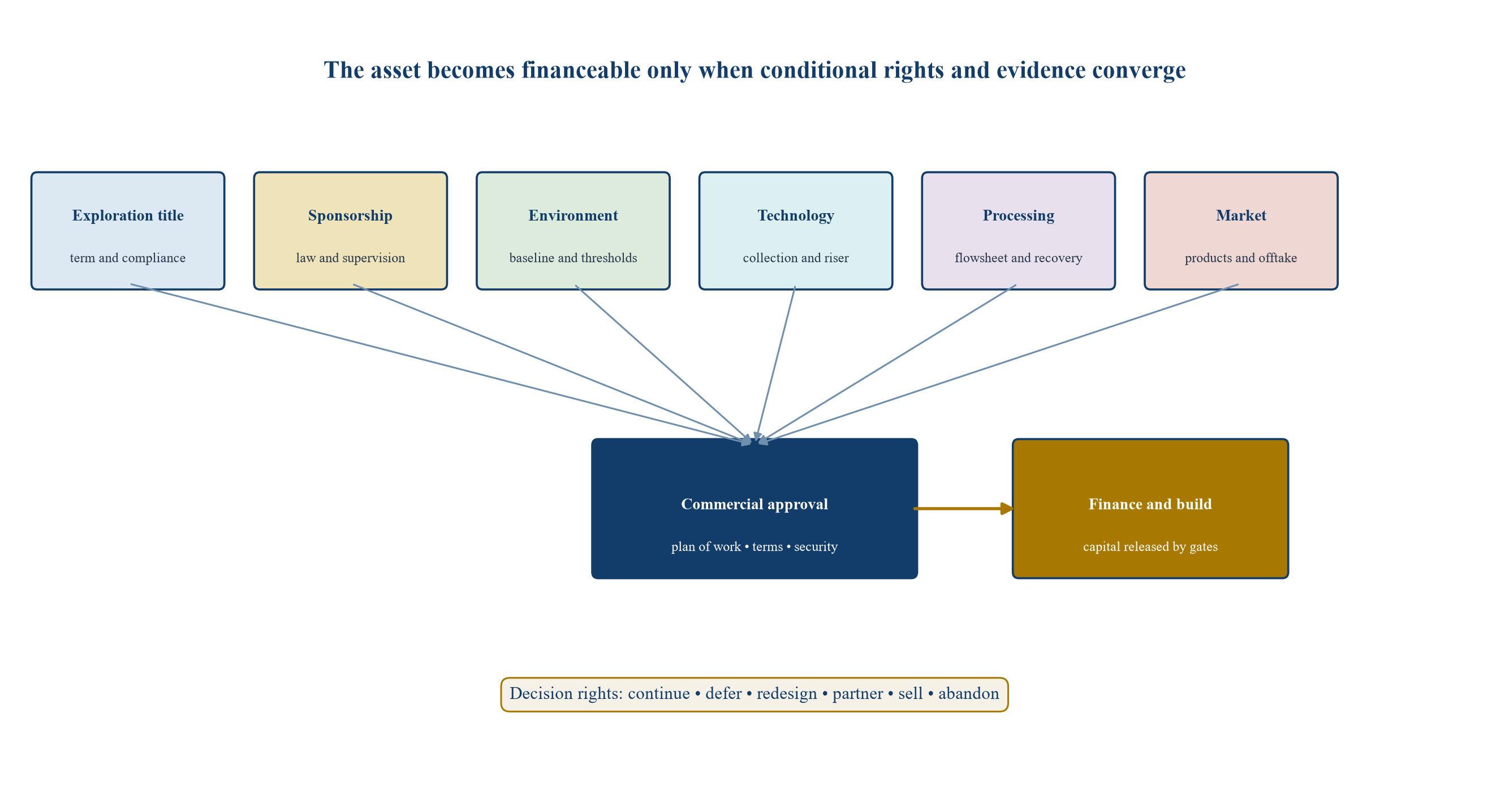
Generic decision framework; legal, technical, environmental and commercial conditions require project-specific verification.
8. Why a conventional mine DCF can mislead
A conventional mine model usually begins with a reserve or resource, production schedule, capital cost, operating cost, commodity price, fiscal regime and closure obligation. In an early deep-sea venture, several of those inputs may remain contingent. The model can still calculate a number, but precision does not create evidence.
The common error is a single assumed approval date followed by full production. This collapses regulatory delay, redesign, further science and financing into a binary switch. It also assumes that an exploration area becomes a commercially accessible mining footprint.
A better model begins with decision nodes. At each node, the investor chooses whether to spend the next amount of capital based on information then available. Failed tests can reduce future losses. Successful tests can increase the probability of approval, narrow cost ranges or create strategic sale value.
9. Geological confidence and economic area
Seabed maps and nodule-density estimates create an exploration case. Economic valuation requires more. Sampling density, continuity, abundance, grade, recoverability, terrain, sediment characteristics and protected or excluded areas affect the recoverable footprint.
The USGS describes substantial global endowment and identifies the Clarion-Clipperton Zone as the largest known nodule field. Such regional estimates do not establish the mineral inventory of a particular contract area. Company-specific value requires verified data, an appropriate resource methodology and a recovery plan.
The economic area can be smaller than the geological area because of preservation reference zones, environmental exclusions, operating buffers, terrain, cable routes, interference and collector limitations. The valuation model should move from contract area to surveyed area, prospective area, environmentally available area, technically collectable area and scheduled area.
10. Environmental baseline as a capital asset
Environmental surveys are often treated as compliance expense. They also create information needed for design, approval, liability control and investment decisions. Baseline programmes can identify habitats, species, sediment conditions, plume behaviour and temporal variability.
The ISA’s regional environmental management plans are intended to support protection of the marine environment at a regional scale. The Clarion-Clipperton Zone has an established plan, while work has continued for other regions. A project should align site evidence with regional measures and the evolving exploitation framework.
Data value depends on quality, coverage, methods, chain of custody and accessibility. A buyer should test whether the baseline supports the proposed footprint and equipment, whether gaps are known, and whether raw data and intellectual-property rights transfer.
11. Impact uncertainty and redesign
Collection can disturb seabed habitat and sediment. Riser discharge, surface operations, light, noise and accidental releases create additional pathways. The magnitude and acceptability of impact are scientific and regulatory questions that require evidence.
Valuation should connect uncertainty to design choices. Slower collection, different discharge depth, reduced footprint, exclusion zones, adaptive management or additional monitoring can change capital, operating cost and recoverable volume. The model should preserve a redesign option rather than assume that the initial engineering concept will be approved unchanged.
Environmental liability should be modelled through prevention, monitoring, financial security, insurance, remediation and residual exposure. An undefined liability is not resolved by assigning a generic contingency percentage.
12. Technology readiness
A deep-sea production system may include collectors, control systems, umbilicals, risers, pumps, production support vessels, dewatering, return-water management, transport and onshore processing. Each subsystem can work independently while the integrated system remains unproven at commercial scale.
Technology diligence should trace evidence from component tests to integrated offshore trials, endurance, recovery, maintenance and availability. The relevant metric is not only whether nodules can be collected. It is whether the system can deliver a stable, specified feed to processing at an acceptable cost while meeting environmental and safety conditions.
Prototype expenditure creates information. It becomes productive capital only when the design remains useful for the approved system. A regulatory requirement that changes discharge, footprint or monitoring can strand part of the prototype investment.
13. Processing and product route
Nodules contain multiple metals in a mineral matrix. Commercial value depends on the process route, recoveries, product form, reagent and energy use, residue management, capital intensity and the markets available for intermediate products.
A venture that demonstrates offshore collection without a financeable processing route has not closed the value chain. Processing location can introduce permitting, trade, transport, power, water, waste and geopolitical issues. The revenue model should recognise payable products rather than the gross in-situ value of contained metals.
Processing optionality can be valuable when alternative flowsheets or partners remain available. It can also hide indecision. Stage-gate funding should require increasingly specific mass balance, recovery, impurity, product and residue evidence.
14. Market outlook and substitution
The IEA’s Global Critical Minerals Outlook 2026 projects continued demand growth across critical minerals under its scenarios. Copper records large absolute growth, while demand for nickel and other energy minerals also expands. The report also notes changing battery chemistries and a moderated cobalt-demand outlook relative to earlier expectations.
Deep-sea project economics should therefore use metal-specific scenarios. A multi-metal nodule can diversify revenue, yet co-product dependence can create complexity. Lower cobalt intensity, nickel oversupply, manganese pricing or copper deficits affect the revenue mix differently.
Market value should be linked to product quality and processing yield. Strategic scarcity may support policy interest or offtake, while lenders still require a bankable price deck and downside coverage.
15. Payment regime and public share
UNCLOS and the 1994 Agreement contemplate payments to the Authority and benefit sharing. The 1994 Agreement states principles for a payment system that is fair to the contractor and the Authority and broadly comparable with land-based mining of similar minerals.
The final economic burden can affect project value through royalties, profit-related payments, fees, administrative cost and financial security. A model should include alternative payment structures until terms are final and applicable.
Public-share obligations can also affect investor perception and contractual design. Transparent reporting, transfer pricing, product sales and audit rights may be necessary. A transaction should identify which entity earns each margin in collection, transport, processing and marketing.
16. A staged sources-and-uses plan
The following hypothetical case illustrates staged capital for a nodule venture before a construction decision. Amounts are analytical assumptions and do not describe a company.
Table 2. Hypothetical staged capital plan before commercial construction
| Stage | Principal use | Capital | Evidence required to release capital | Principal funding source |
|---|---|---|---|---|
| A | Contract compliance, data integration and targeted surveys | 18 | Valid title, sponsorship, work programme and data rights | Sponsor equity |
| B | Environmental baseline and technology subsystem tests | 42 | Survey quality plan, approved test design and technical readiness | Equity and strategic partner capital |
| C | Integrated offshore trial and processing pilot | 95 | Successful subsystems, permits, independent test protocol and processing route | Consortium equity and public or strategic support |
| D | Exploitation application, detailed engineering and commercial contracts | 70 | Draft project definition, environmental assessment, financial terms and offtake strategy | Growth equity and subordinated capital |
| E | Early works after approval | 160 | Effective approval, enforceable conditions, funding plan and long-lead controls | Sponsor equity and bridge facilities |
| F | Full construction | 1,450 | Completion package, contracted technology, processing, insurance and debt conditions | Project equity, senior debt and agency support |
Illustrative USD million amounts; funding depends on verified rights, evidence, approvals and sponsor capacity.
The staged plan protects capital. Expenditure increases only when information improves. Capital earmarked for full construction should not be presented as committed before the approval and financing package exists.
17. The real-options lens
A real option is the right, without the obligation, to make a future investment after uncertainty changes. Exploration rights and technical knowledge can provide options to continue, defer, redesign, partner or sell. The option has value when management can act on new information.
Traditional net present value can understate flexibility when it assumes immediate commitment. It can overstate value when it assumes that management will continue spending through adverse outcomes. A decision-tree model makes the choices explicit.
Option value is not a licence to assign speculative premiums. The analyst needs a valid right, sufficient term, a feasible next step, funded decision cost and a plausible exercise pathway. An expiring contract with no extension route can have low option value despite attractive geology.
18. Hypothetical decision tree
Assume a venture can spend USD 42 million on baseline and subsystem work. A successful result allows a USD 95 million integrated trial. A successful trial and clearer regulation permit a USD 70 million application and engineering programme. Approval can then open the construction decision.
Figure 2 shows the structure. It does not assign probabilities as facts. A transaction model should use ranges approved by the investment committee, document their basis and update them after each gate.
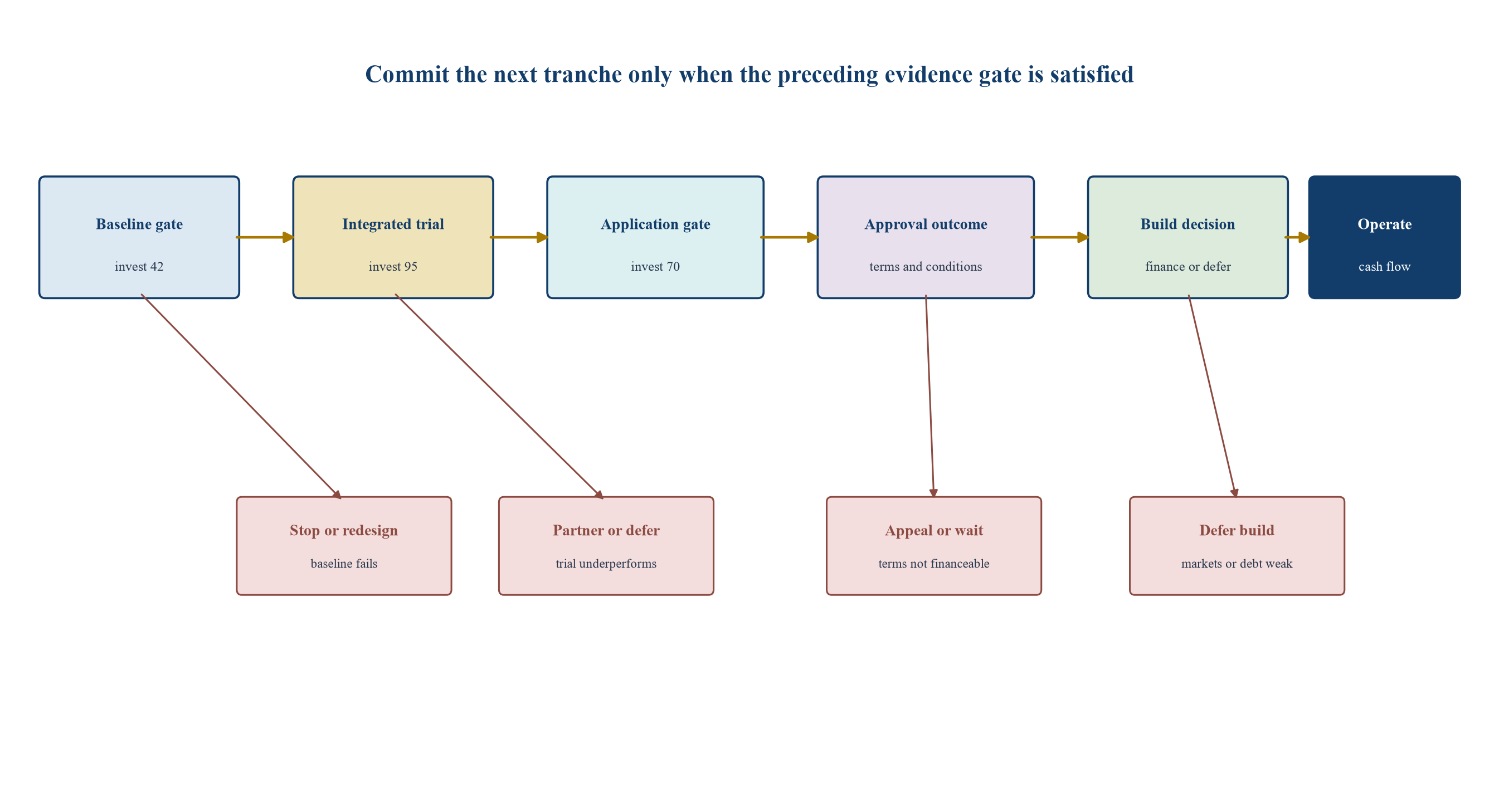
Illustrative decision architecture; probabilities and amounts are assumptions rather than forecasts.
19. Scenario architecture
A useful valuation contains at least four regulatory scenarios. The first is orderly ISA approval under financeable final terms. The second is delayed approval with additional studies and contract extension. The third is approval under restrictive conditions that reduce accessible area or increase cost. The fourth is no financeable approval during the model period.
Technical scenarios should overlay the regulatory cases. Collection rate, availability, recovery, weather downtime, riser performance and processing recovery can vary. Market scenarios should change each metal price and product deduction.
The model should avoid multiplying a long list of unsupported point probabilities. Use transparent cases, break-even thresholds and decision triggers. Probability-weighted value can be shown as an investment-committee summary after the underlying scenarios are understood.
20. Hypothetical option-value sensitivity
Assume the risked value of a venture depends on two variables: the date at which a financeable approval becomes effective and the long-run realised basket margin after processing and public payments. A later date reduces present value and can consume contract term. A lower margin reduces debt capacity and the value of exercising the construction option.
Table 3. Hypothetical risked project value by approval timing and basket margin
| Risked project value | 2028 approval | 2030 | 2032 | 2034 | No approval in model |
|---|---|---|---|---|---|
| USD 180/t basket margin | 280 | 205 | 145 | 95 | (135) |
| USD 145/t basket margin | 190 | 130 | 78 | 35 | (135) |
| USD 110/t basket margin | 105 | 58 | 18 | (20) | (135) |
| USD 80/t basket margin | 35 | 2 | (35) | (65) | (135) |
| USD 55/t basket margin | (20) | (42) | (70) | (92) | (135) |
Illustrative USD million values; the table is a decision example rather than a valuation of any company or contract.
The negative no-approval value represents remaining committed exploration, compliance and close-out costs in the hypothetical case. Real projects require their own cost, tax, payment, processing, contract-life and liability assumptions.
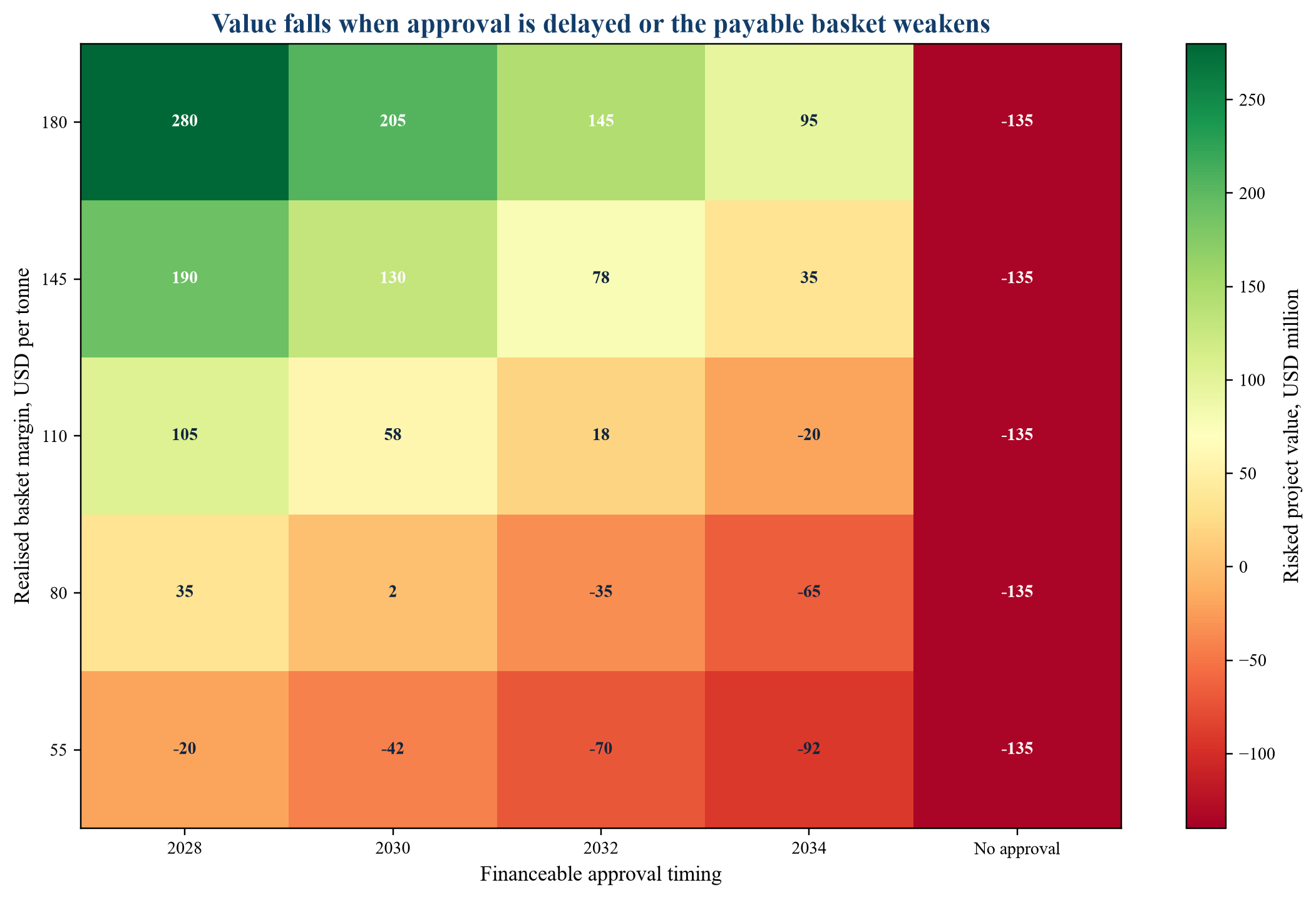
Illustrative USD million values; timing and margin cases are assumptions rather than forecasts.
21. Contract term and time decay
An option loses value as its term shortens. Exploration contract expiry, extensions, work obligations and relinquishment affect the time available to complete science, testing, application, financing and construction.
The model should show years remaining at each decision date. A delayed approval may require extension or a new legal step. Extension cannot be assumed without verifying the applicable framework, contractor performance and decision process.
Time decay also affects equipment and knowledge. Prototype technology can become obsolete. Processing assumptions can change with product standards. Staff and partnerships can disperse during long delays. Carrying cost should include organisational capability, not only licence fees.
22. Financing before approval
Pre-approval capital is structurally equity-like because repayment depends on uncertain future rights. Venture, strategic and sovereign capital may fund science and technology. Conventional senior debt has limited capacity to absorb regulatory and development risk without strong recourse or other assets.
Milestone convertibles, preferred equity, joint ventures and farm-in arrangements can allocate risk. A strategic processor may fund pilot work for product rights. A sponsoring-state vehicle may support research. Public agencies may support technology or supply-chain objectives where mandates allow.
Terms should avoid transferring control that jeopardises sponsorship or contract compliance. Funding documents must align with consent, ownership and reporting obligations.
23. Project finance after approval
Commercial approval alone does not guarantee project finance. Lenders need effective rights, stable terms, completion support, proven technology, processing and offtake, environmental compliance, insurance, security and remedies.
The project may span offshore collection, vessels, transport and onshore processing. Ring-fencing is difficult if critical assets sit in different jurisdictions or entities. Direct agreements and step-in rights must respect the governing public-law regime.
Debt sizing should use downside collection, availability, recovery, metal prices, payment obligations and operating cost. Reserve accounts should cover ramp-up, weather, maintenance and environmental monitoring. Completion tests should demonstrate integrated throughput and product quality.
24. Acquisition valuation
A buyer should separate consideration into existing evidence, conditional value and future funding. Upfront price can reflect valid title, transferable data, tested technology and organisational capability. Contingent consideration can depend on contract extension, exploitation application, approval, technical tests or financing.
Earn-outs based on headline mineral tonnes are weak because geology alone does not create cash. Milestones should be objective, controllable and linked to value. Approval under uneconomic terms should not trigger the same payment as financeable approval.
The buyer also acquires obligations. Unfunded work programmes, environmental commitments, contractor liabilities, sponsorship undertakings and close-out cost reduce enterprise value. Working capital and committed vessels should be reconciled separately.
25. Joint ventures and consortia
Deep-sea projects can require capabilities across ocean science, robotics, offshore operations, processing, marketing and public governance. A consortium can assemble them. It can also create slow decisions and divided accountability.
The joint-venture agreement should define funding calls, default, data ownership, technology licensing, transfer, regulatory control, reserved matters, deadlock, dilution and exit. The contractor entity’s obligations remain central even when services are outsourced.
A partner’s contribution should be valued after testing exclusivity, availability and enforceability. A memorandum of understanding is not equivalent to committed capability.
26. Offtake and strategic buyers
Offtake can support product definition, processing and finance. The agreement must match the output actually expected from the flowsheet. Price formula, payability, impurities, treatment charges, logistics and qualification affect value.
Strategic security-of-supply interest may support investment or floor mechanisms. It may also impose destination, traceability or domestic-processing conditions. The model should capture both benefit and constraint.
Long-term contracts should preserve flexibility across multiple metals. A buyer for one product should not capture disproportionate economics from other products without compensation.
27. Insurance and financial security
Marine operations, environmental exposure, technology and long project duration create a complex insurance programme. Availability, limits, exclusions and cost can change before commercial operations.
Regulation may require financial security for performance, closure or liability. The structure, amount and release conditions affect capital. A parent guarantee, letter of credit, trust or funded reserve has different cash and credit consequences.
The investment case should identify uninsured and uninsurable exposures. A generic insurance assumption cannot replace broker evidence and policy review.
28. Red flags in diligence
Red flags include unclear contract ownership, limited remaining term, unresolved sponsorship conditions, material non-compliance, environmental data that cannot support the proposed footprint, prototype results presented without independent protocol, processing recoveries derived from unrepresentative samples, and valuation based on gross contained metal.
Other concerns include payment terms assumed before adoption, omitted close-out liabilities, no route for residues, unsupported approval dates, and capex that excludes vessels, processing or integration.
Each issue should change price, funding conditions, representation, indemnity or the decision to proceed. Diligence findings need a financial consequence.
29. Investment committee dashboard
The board should receive a one-page dashboard showing legal rights, term remaining, sponsorship, regulatory status, baseline coverage, technology readiness, processing evidence, capital spent, committed obligations and the next decision.
Values should be labelled by evidence status. Verified contract facts, management estimates and hypothetical scenarios should remain distinct. Probability changes should be approved with reasons.
The dashboard should show the cost to reach the next gate and the maximum avoidable loss. This keeps optionality connected to capital discipline.
30. 100-day transaction plan
Days one to thirty establish the asset map. The buyer confirms entities, contracts, sponsorship, consents, data, intellectual property, obligations and expenditure. It freezes unsupported external claims.
Days thirty-one to sixty rebuild the decision model. Technical, environmental and market teams agree stage gates, downside cases and information gaps. Finance reconciles sunk cost, future commitments and liquidity.
Days sixty-one to one hundred establish the ownership plan. The board approves partner strategy, funding tranches, application path, regulatory engagement, risk controls and exit options. New spending is released against named evidence.
31. Strategic alternatives
The company may continue independently, form a consortium, farm down, sell selected technology, license data, merge with another contractor, pivot toward environmental monitoring or defer. These alternatives should be valued before a full-build commitment.
A buyer with processing or offshore capability may realise synergies that a standalone venture cannot. Those are buyer-specific values. The base case should not capitalise them without an executable transaction route.
Deferral can be rational when regulation, science or markets are likely to clarify and carrying cost is controlled. Deferral destroys value when contract term, capability or stakeholder support decays faster than uncertainty resolves.
32. Risked valuation mechanics
The risked model should contain three linked schedules. The first schedule values the contractual and information asset before exploitation. It includes cash, committed exploration cost, data, technology and the cost of maintaining sponsorship and capability. The second schedule models each development scenario from application through construction. The third schedule values residual alternatives if the preferred mining concept does not proceed.
Probability weighting should occur after scenario cash flows are complete. Applying a single probability to an unrisked net present value can conceal different failure points and sunk costs. A project may have a high chance of completing another survey and a much lower chance of reaching financeable construction. Each gate deserves its own probability or decision rule.
Discount rates and probabilities should not double-count the same risk without explanation. Regulatory delay can be represented through timing and scenario probability. Technology performance can be represented through throughput and capex cases. A higher discount rate can capture remaining systematic and financing risk. The model should state which mechanism addresses each uncertainty.
33. Enterprise value and funding obligations
Enterprise value is not equal to risked project value when the owner must fund future gates. The buyer pays for existing equity value and then supplies development capital. A transaction model should show both amounts.
Committed obligations can include annual work programmes, contract fees, surveys, vessel reservations, employee retention, prototype storage, insurance and close-out. Some costs remain payable after a decision to stop. These liabilities reduce value and can require escrow or parent support.
The funding plan should identify minimum liquidity through the next gate. A company that can reach an information event without emergency financing has more bargaining power. A company with an expiring contract and unfunded work may accept punitive capital even when the geological option is attractive.
34. Accounting and disclosure
Exploration and evaluation expenditure may be expensed or capitalised under the applicable accounting framework and policy. Carrying value does not prove recoverability. Impairment indicators can include loss of title, inability to fund, adverse regulation, failed tests or a decision not to develop.
Public and transaction disclosures should distinguish exploration rights, mineral estimates, internal scenarios and approved reserves. Revenue potential based on gross contained metal should not be presented as project value. Historical expenditure should not be described as value created without evidence of transferable information or capability.
The quality-of-earnings review should identify recurring corporate cost, capitalised development, related-party services, share-based compensation and contingent commitments. Cash burn should be reconciled to work completed and data obtained.
35. Data-room architecture
A transaction-ready data room should be organised around decision evidence. The legal folder contains contract, sponsorship, domestic law, consents, compliance and correspondence. The resource folder contains survey plans, samples, laboratory results, geostatistics, quality control and independent reviews. The environmental folder contains baseline methods, raw data, reports, gaps and regulator feedback.
The technology folder contains design basis, test protocols, failures, maintenance, scale-up assumptions and intellectual-property rights. Processing contains samples, mass balances, recoveries, products, impurities, residues, energy and water. Commercial contains price decks, offtake discussions, logistics and processing partners. Finance contains spend, commitments, stage budgets, liquidity and scenarios.
Version control matters because regulation and designs evolve. A buyer should be able to identify the assumption set used for each valuation and application document.
36. Geopolitics and route fragmentation
The 2025 United States executive order directed agencies to accelerate seabed-mineral licensing and commercial-recovery review under US law, support mapping and develop domestic processing. NOAA’s 2026 final rule revised application procedures and its public page records a first commercial-recovery application under review. This creates a pathway distinct from the ISA regime followed by UNCLOS States Parties.
Route fragmentation affects counterparties. Sponsoring States, financiers, insurers, ports, processors and customers may take different views on legality, jurisdiction and reputational exposure. A permit from one authority does not compel another party to finance, insure, process or buy.
Valuation should therefore include a market-access test. Identify which vessels, ports, processors, lenders and buyers remain available under each legal pathway. Contract termination and sanctions clauses require review even where no sanction currently applies.
37. Stakeholder and reputational exposure
Deep-sea mining attracts scrutiny from governments, scientists, communities, investors, customers and civil society. Stakeholder position can affect approval, capital, offtake and recruitment. Reputation is a commercial variable, although it should not be reduced to a public-relations score.
The company should maintain an evidence register for material claims. Statements about lower environmental impact, land displacement, carbon, waste or biodiversity need defined boundaries and comparative methodology. Unresolved scientific questions should be stated clearly.
Customer diligence may extend through the supply chain. An offtaker can require traceability, environmental reporting and audit. A weak evidence system can reduce product access even after physical recovery succeeds.
38. Closure, suspension and handback
Closure planning begins before production because the contractor can suspend, surrender, expire or fail to progress. Obligations may include equipment removal, monitoring, data delivery, site measures and financial security.
The downside model should distinguish voluntary deferral from regulatory suspension and permanent termination. Each state has different carrying cost, asset preservation and restart requirements. Vessels and processing assets may have alternative uses, while bespoke collectors and risers may have limited recovery value.
Handback and close-out data can retain scientific or regulatory value. Ownership, confidentiality and delivery obligations should be mapped. The model should fund responsible closure rather than assume zero cost when no mine is built.
39. Governance and decision rights
The board should establish reserved matters for applications, material regulator submissions, technology changes, environmental commitments, sponsorship changes, major contracts and public claims. These decisions can alter the legal and economic asset.
Independent technical, environmental and legal committees can challenge assumptions, while the board retains capital responsibility. Committee advice should be connected to named gates and documented conclusions.
Incentives should reward evidence and disciplined capital rather than headline resource size or expenditure. A team that recommends stopping an uneconomic route can preserve more value than one that meets a spending target.
40. Decision framework
The investment committee can use seven tests.
Legal test. Are the rights valid, transferable, compliant and long enough for the next stages?
Sponsorship test. Is State support grounded in law, supervision and change-of-control continuity?
Evidence test. Do geology, baseline, technology and processing data support the proposed design?
Regulatory test. Are unresolved terms mapped to cash, conditions and redesign options?
Market test. Do product forms and payable metals match credible demand and offtake?
Capital test. Is each tranche proportionate to the information it can create?
Exit test. Can the venture defer, partner, sell or close without uncontrolled liability?
41. Conclusion
Deep-sea mineral ventures are not conventional mines waiting only for capital. Before commercial approval, they are systems of conditional rights, evidence, technology and relationships. Their value changes as regulation, environmental science, engineering, processing and markets develop.
A disciplined valuation separates geological potential from economic area, exploration title from exploitation approval, prototypes from commercial systems, and contained metal from payable product. It releases value only when evidence crosses a gate.
Real-options analysis is useful because management can continue, defer, redesign, partner, sell or abandon. The option remains credible only when legal term, funding, capability and a feasible next step exist.
For investors and acquirers, the central question is the cost and evidence required to reach the next financeable decision. A staged transaction can capture upside while limiting exposure to unresolved legal, environmental and technical conditions.
Frequently asked questions
Does an exploration contract establish a commercial mine?
No. It establishes exploration rights and obligations under its governing regime. Commercial recovery requires additional approvals, terms, environmental evidence, technology, processing, finance and market arrangements.
Why use real-options analysis?
The project can be continued, deferred, redesigned, partnered, sold or abandoned after new information. A decision-tree model values those choices and the capital required to preserve them.
How should an unresolved payment regime be modelled?
Use transparent alternative structures and break-even thresholds. Do not present a working proposal as a final adopted term.
What is the most important acquisition diligence issue?
Confirm the exact legal rights, sponsorship, term, transfer conditions, compliance record and obligations before assigning value to geology or future production.
Can project debt fund a pre-approval venture?
Pre-approval capital is generally equity-like because repayment depends on uncertain future rights. Senior debt becomes more plausible after financeable approval, proven technology and contracted commercial arrangements.
How should environmental uncertainty affect value?
Map baseline gaps and potential conditions to accessible area, equipment design, monitoring, financial security, timing and liability. Preserve redesign and abandonment options.
About the Author
Authored by Chennakeshav Adya Independent Researcher
Chennakeshav (CK) is a corporate finance and investment banking executive with 25+ years of global experience in deal origination, structuring and execution across M&A, growth capital and corporate strategy. He has led value-creation mandates for founders, corporates and funds — bridging the boardroom view to hands-on execution and close.
His career spans Morgan Stanley, HSBC, Lloyds Banking Group, EWEC, ADQ portfolio companies and Emirates Growth Fund, across TMT, real estate, fintech, deeptech, cleantech, infrastructure and energy. He has partnered with C-suite leaders, private equity and venture funds, sovereign wealth funds and family offices to finance complex fund raises and scale-up ventures, and has led M&A due diligence, post-merger integration and business-transformation initiatives to create value.
At Matchpoint Partners he is Managing Partner, leading the firm's corporate finance, M&A and capital-raising practice. He holds an MBA from London Business School, an engineering degree from VTU and a Master of Laws (LLM, in progress) from UCL London.
An active start-up mentor, CK mentors at Techstars, DIFC FinTech Hive, Startup Grind, Founder Institute and IN5, serves as Entrepreneur Mentor in Residence (EMiR) at London Business School, and judges the Entrepreneurship World Cup.
Matchpoint profile: https://www.matchpoint-partners.com/team/ck-adya.html LinkedIn: https://www.linkedin.com/in/ckadya/
