

1. The investment question
Fusion attracts capital because successful commercialisation could create a large market for firm, low-carbon electricity and high-temperature energy. The investment question is narrower: what should be paid today for the right to participate in future value when the date, cost and technical route remain uncertain? A market narrative cannot answer that question.
The investor needs a sequence of decisions. Each capital tranche should purchase evidence, capability and an option on the next stage. The valuation should identify what has been proved, what remains an engineering assumption, which milestone changes financing risk and what rights survive if the original schedule fails. This approach turns a distant revenue story into a controlled learning programme.
2. Scientific progress and commercial proof are different
Lawrence Livermore National Laboratory reported that the National Ignition Facility produced 8.6 MJ of fusion energy in April 2025 from 2.08 MJ of laser energy delivered to the target, a target gain of 4.13 [1]. This is an important scientific result. It is not a demonstration of a power plant that repeatedly produces net electricity after all facility inputs, converts heat, breeds or supplies fuel, survives neutron exposure and operates economically.
Valuation should preserve this distinction. Scientific milestones can reduce one uncertainty while leaving plant engineering, availability, capital cost and regulatory risk largely unchanged. A developer's achievement should be credited precisely for the risk it retires.
3. The policy and infrastructure context
DOE's 2024 strategy organised United States fusion activity around closing scientific and technological gaps, preparing commercial deployment and building partnerships [2]. Its 2026 Science and Technology Roadmap describes a Build, Innovate and Grow approach and identifies structural materials, plasma-facing components, confinement, fuel cycle, blankets and plant integration as critical areas [3].
The roadmap matters to investors because private value can depend on public test facilities, national laboratories, regulation, workforce and supply chains. Government support can reduce cost and accelerate evidence. Future appropriations, facility schedules and programme priorities remain outside a private company's control. Public support should therefore be treated as a conditional resource rather than committed company capital unless an enforceable award exists.
4. Timeline uncertainty is observable
ITER's updated baseline targets Start of Research Operation in 2034, full magnetic energy in 2036 and the start of deuterium-tritium operations in 2039 [4]. The changes reflect first-of-a-kind components, repairs, commissioning and an updated operating sequence. STEP targets a prototype United Kingdom plant around 2040 [5]. Private developers have announced earlier commercial targets.
These dates serve different programmes and should not be compared as promises of equivalent output. They demonstrate the range of pathways and definitions. A valuation needs milestone semantics: plasma operation, fusion gain, net plant electricity, grid delivery, repeatability and commercial availability each mark a different point.
5. Commercial commitments create demand evidence
Helion announced a power purchase agreement with Microsoft for a plant targeting at least 50 MW after ramp-up and initial operations in 2028 [6]. Commonwealth Fusion Systems announced a 200 MW offtake agreement with Google for its first ARC plant, which CFS expects to deliver in the early 2030s [7]. Financial terms are not publicly disclosed in those releases.
The agreements show customer willingness to engage with fusion development. They do not disclose every condition, remedy, price, security or technology gate. An investor should value an offtake by reading the binding documents, assessing termination and delay provisions, and determining whether it can support financing. Announcement value and contract value are separate.
6. Fusion is a family of technical pathways
Magnetic-confinement tokamaks, stellarators, field-reversed configurations, magnetised-target systems, inertial confinement and other concepts use different physics and engineering. They require different magnets, drivers, chambers, fuels, materials, pulse cycles, heat-conversion systems and maintenance strategies.
The valuation model should reflect the chosen architecture. A milestone meaningful for one pathway may have limited relevance to another. Cross-company comparisons based only on target year or claimed output can misprice risk. The investor should begin with the device's energy balance, operating cycle, component life, fuel cycle and route from experiment to maintainable plant.
7. Define the valuation perimeter
The company can contain several assets: scientific intellectual property, engineering know-how, specialist teams, prototype hardware, test facilities, software, supply agreements, offtake rights, government awards and future project-development opportunities. These should not be merged into one terminal value.
Platform value concerns the repeatable technology and organisation. Project value concerns a particular site, offtake and financing. Supply-chain value may sit in magnets, materials, power electronics, robotics or tritium systems. Separating these perimeters clarifies which evidence supports each value pool and prevents one commercial announcement from inflating unrelated assets.
8. A technology-readiness curve
Readiness should be plotted against the evidence needed for a commercial plant, not a generic laboratory scale. The curve begins with validated physics and progresses through integrated device operation, net electricity, maintainability, fuel closure, licensed pilot operation and repeatable delivery. Progress can be uneven because one subsystem may be mature while another remains experimental.
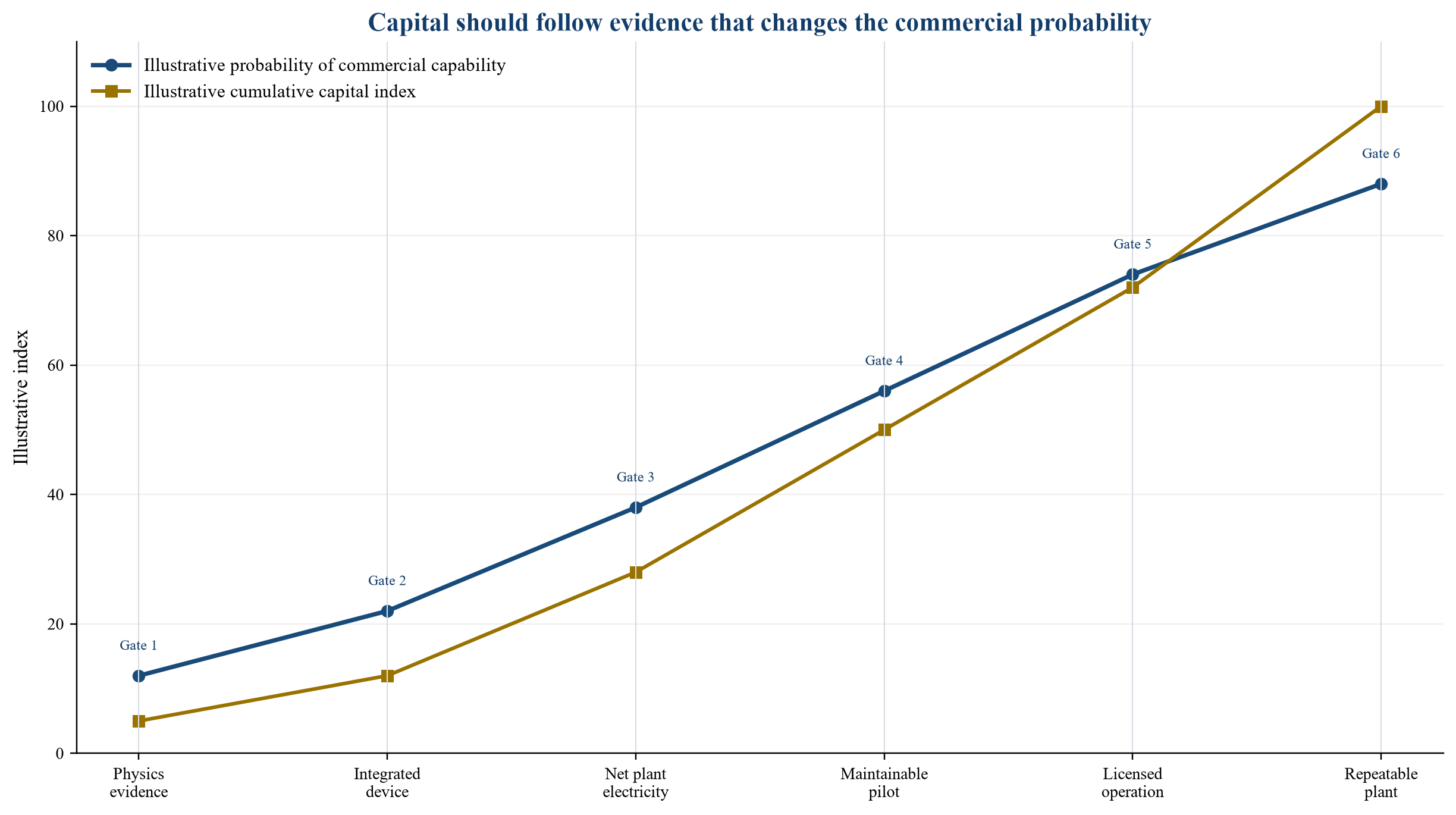
Generic framework; technical pathways require different evidence and gate definitions.
The curve is not a forecast. Its purpose is to force agreement on the evidence required at each stage. A financing round should state which gate it funds, the test protocol, the time and capital to result, and the rights activated by success or failure.
9. Milestone one: reproducible physics
The first gate requires repeatable performance under documented conditions. Energy gain definitions should specify the measurement boundary. Target gain, plasma gain, engineering gain and net electrical output are not interchangeable. Pulse duration, frequency, stability and diagnostic uncertainty also matter.
Independent review should examine raw data, calibration, failed runs and reproducibility. A single record result can demonstrate possibility. A commercial programme needs a repeatable operating envelope. Financing can reward a breakthrough while reserving larger capital for evidence that the result can be produced on schedule and extended toward an integrated system.
10. Milestone two: integrated engineering
A fusion plant combines plasma, magnets or drivers, vacuum, cryogenics, heating, shielding, tritium or alternative fuel handling, heat extraction, power conversion, controls, remote maintenance and grid systems. Subsystems that work individually can interact in ways that reduce performance or availability.
The integrated-device gate should verify interfaces, parasitic loads, thermal management, fault response and maintainability. Configuration control matters because rapid experiments can leave drawings and hardware inconsistent. The investor should seek a reconciled design basis and evidence that the next device tests the architecture needed for the plant rather than a scientific result with no scalable path.
11. Milestone three: net plant electricity
Net plant electricity means energy delivered after the internal consumption of magnets, cryogenics, heating, pumps, drivers, controls and power conversion. It is more demanding than fusion energy gain. The duration and repetition rate must also support useful generation.
The model should use an explicit power balance. UKAEA materials show that STEP targets at least 100 MW net electric output and must account for substantial plant loads [8]. Each developer should provide a pathway-specific balance, expected uncertainty and measurement plan. Valuation should discount projected output until the plant boundary and supporting tests are clear.
12. Milestone four: materials and component life
Fusion environments can expose components to heat flux, neutron damage, electromagnetic loads and activated materials. Component life affects availability, replacement cost and waste management. A plant that produces power but requires frequent, lengthy replacement can fail commercially.
Evidence should include material qualification, irradiation exposure, joining methods, inspection, manufacturing yield and remote-replacement design. DOE's roadmap treats structural materials and plasma-facing components as distinct challenge areas [3]. The financing plan should identify which facilities and samples close these gaps, because some tests cannot be replicated inside the company's own device.
13. Milestone five: fuel cycle
Deuterium-tritium pathways require tritium inventory, processing, containment and breeding. The plant must demonstrate a credible route to fuel self-sufficiency and regulatory compliance. Alternative fuels can reduce some tritium issues while imposing more difficult plasma conditions or different conversion challenges.
The investor should map starting inventory, losses, breeding assumptions, processing throughput, measurement uncertainty and supply rights. Fuel-cycle value belongs in the integrated plant model. A plasma result that excludes the commercial fuel system leaves a major capital and operating question open.
14. Milestone six: maintainability and availability
Commercial power buyers value dependable output. Fusion devices can contain components that are difficult to access after activation. Remote handling, modular replacement, inspection and decontamination influence outage duration and labour exposure.
The pilot should test maintenance sequences and tooling before a commercial commitment relies on high availability. Digital models and mock-ups help, while operating evidence remains essential. The financial model should translate component lifetime and replacement duration into capacity factor, spare inventory and maintenance capital. Availability claims unsupported by a maintenance plan should receive a large valuation discount.
15. Regulatory maturity
The United States NRC published a proposed technology-neutral fusion-machine rule in February 2026 and related draft guidance [9]. The process aims to establish a materials-based regulatory framework while coordinating with Agreement States. The final requirements and implementation experience will affect licensing cost, evidence and schedule.
Regulatory progress should be valued through completed engagement, accepted licensing strategy, site pathway, environmental review and approved licences. General policy support is useful. It is not a project licence. The company should fund regulatory work early enough to influence design and avoid costly redesign.
16. Supply-chain readiness
Fusion supply chains may need high-temperature superconductors, specialised steels, tungsten, precision vessels, lasers, pulsed-power systems, cryogenics, diagnostics, robotics and tritium equipment. Production capacity, quality and lead time can constrain scale even after technical success.
Supplier memoranda should be distinguished from qualified production contracts. Diligence should review make-or-buy decisions, single sources, yield, tooling, export controls and supplier finance. Strategic investments in suppliers can protect schedule and create separate value. Vertical integration can secure capability while increasing capital intensity and organisational complexity.
17. Workforce and tacit knowledge
Fusion teams combine plasma physics, nuclear engineering, materials, magnets, power systems, software, manufacturing and project delivery. Key knowledge may reside in a small group. The next stage can require different leadership from the laboratory phase.
The investor should map technical authority, succession, recruitment and documentation. Equity retention can support continuity, while governance must allow independent challenge. A founder-led culture that moves quickly can still need configuration control, safety systems and megaproject discipline. Organisational readiness belongs in technology valuation because execution capacity affects every milestone.
18. Cost-performance benchmark
The commercial plant competes with other sources of firm power. A benchmark should compare delivered cost, availability, construction time, site needs, fuel exposure, network value and carbon attributes. It should avoid selecting one favourable metric.
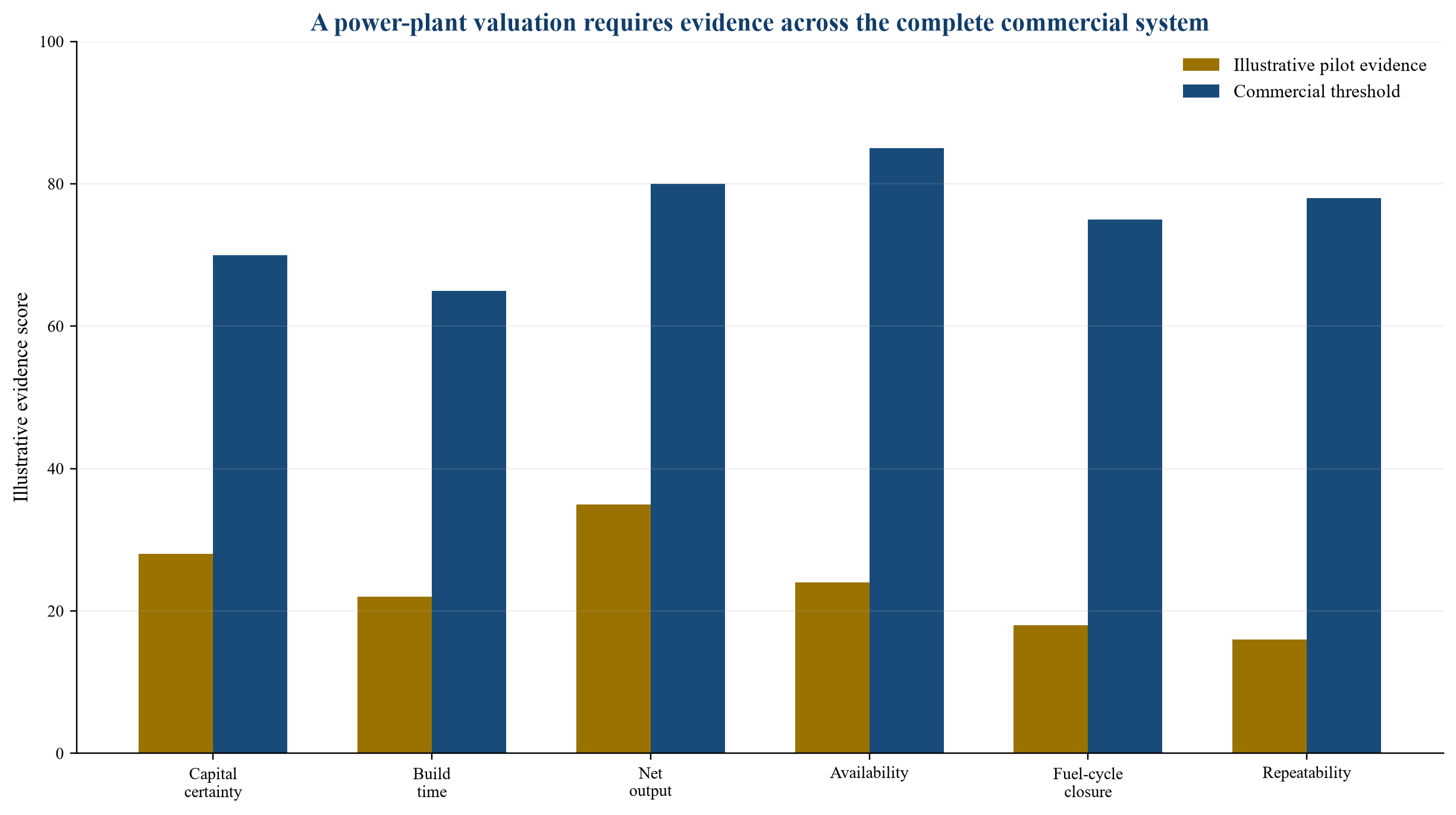
Hypothetical indices for decision structure only; not technology forecasts or comparative investment advice.
The gap between current evidence and commercial threshold drives the cost and duration of the programme. The investor should fund the highest-value gap closures rather than assume every category improves together.
19. Why conventional DCF can mislead
A single discounted cash flow requires a commercial date, plant count, price, margin, capital cost and terminal value. Small changes in a distant start date or terminal assumption can dominate present value. The model can create false precision where failure, redesign and staged financing are central.
DCF remains useful for a defined project after key uncertainties narrow. Earlier, it should be paired with scenarios and real options. Cash flows should be probability-weighted at the milestone level, with explicit dilution and capital calls. Terminal value should not assume an unconstrained global fleet before the first plant demonstrates repeatability.
20. Scenario valuation
The valuation should include at least four states: timely technical success, delayed success, niche or licensing outcome, and programme failure. Each state needs probability, future capital, ownership dilution, commercial timing and exit value. Probabilities should change only when evidence changes.
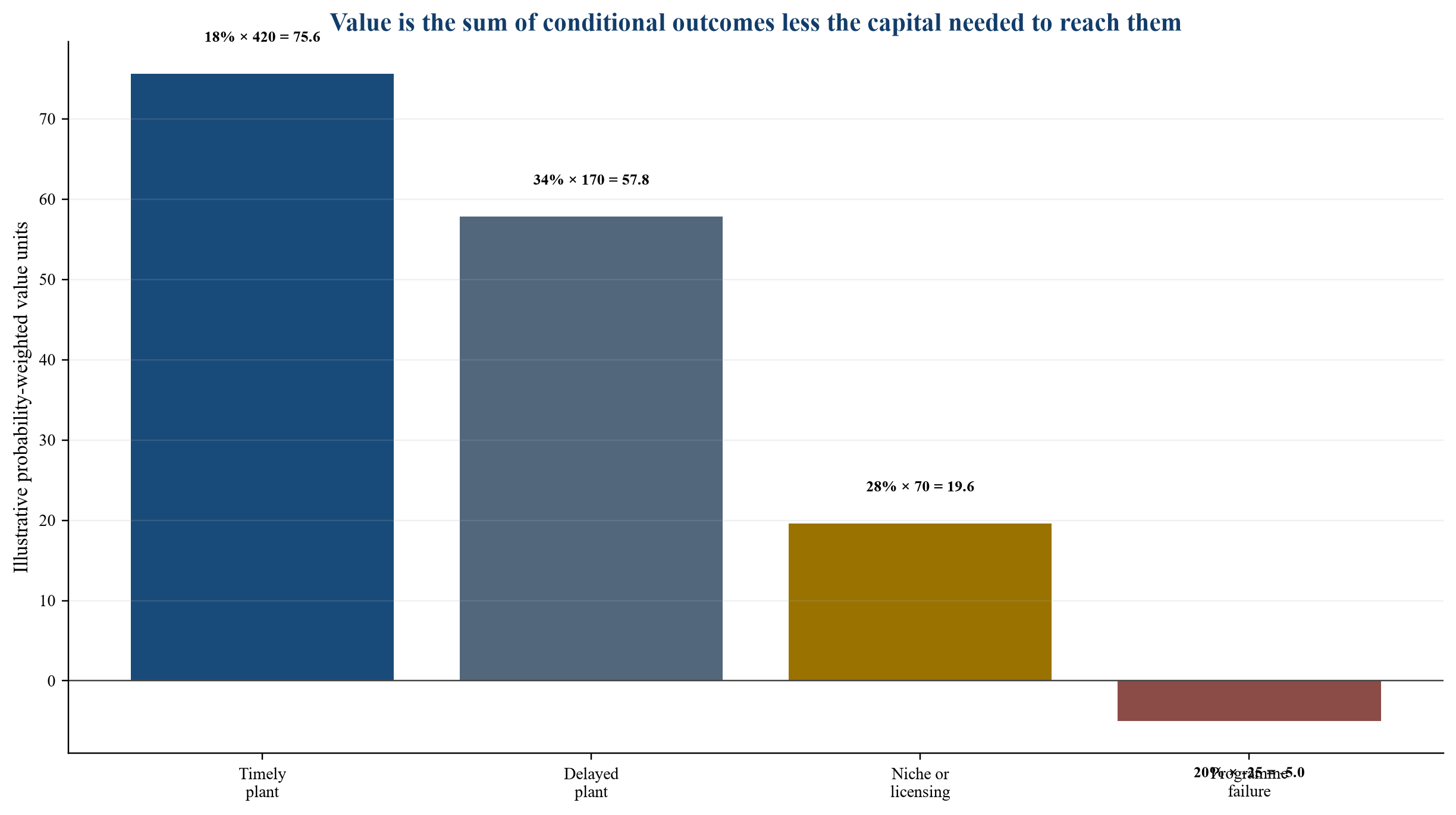
Hypothetical values for methodology only; not a valuation of any developer or programme.
The calculation should subtract future capital on a fully diluted basis. A large success value can still produce limited value per current share if many rounds are required. The investor should model follow-on participation rights and the amount needed to protect ownership.
21. Real-options logic
Each tranche can create an option to invest after a test. The option becomes more valuable when the next milestone is informative, the investor can decline future capital, upside is preserved and failure losses are capped. It becomes less valuable when funding is effectively committed, milestones are subjective or later rounds can exclude existing investors.
The term sheet should therefore connect capital release, information rights and participation. An option without access to the evidence or a right to maintain ownership may be weak. A staged security can use tranched preferred equity, warrants, convertible instruments or project-level options depending on legal and tax context.
22. Fund the next information-producing milestone
The right funding amount is the cost of reaching a decision-quality result plus contingency and orderly shutdown. Funding several uncertain stages at once can reduce discipline and increase dilution. Underfunding can create a distressed raise before the test is complete.
The budget should reconcile people, equipment, facility, supplier, regulatory and test costs to the milestone schedule. The investor should confirm that failure modes still produce interpretable data. A demonstration that can fail ambiguously has lower option value than one with a clear diagnostic plan.
23. Milestone definition
Milestones should be specific, measurable, independently reviewable and commercially relevant. A statement such as “advance the prototype” is inadequate. A stronger milestone defines output, duration, repetition, measurement boundary, operating conditions, component state and accepted review process.
DOE's Milestone-Based Fusion Development Program uses public-private agreements to support defined progress toward pilot-scale demonstrations [10]. Private contracts can use the same principle while preserving company-specific metrics. Payment should follow evidence, not calendar time or expenditure alone.
24. Independent verification
Investors need access to raw data, calibration, test logs, design configuration and adverse results. An independent technical adviser should review the evidence under confidentiality. The adviser should understand the specific fusion pathway and plant system.
Verification should avoid creating operational control or displacing management responsibility. Its purpose is to confirm whether the agreed gate has been met and identify remaining uncertainty. Reviewer independence, scope, standards and dispute procedures should be agreed before the test. A post-result debate over definitions can destroy financing momentum.
25. Capital structure by stage
Early scientific and prototype work usually requires equity, grants and strategic capital because cash flow is absent and asset recovery is limited. Later pilot construction can add equipment finance, government cost share or structured capital. Project debt becomes credible only when technology, construction, regulation and offtake support predictable cash flow.
Debt introduced too early can create covenants and repayment obligations that conflict with experimentation. Equity can absorb uncertainty but dilutes founders and investors. The structure should match the risk retired at each stage. A project subsidiary can ring-fence a site after platform risk has reduced.
26. Strategic investor value
A utility, technology buyer, industrial group or sovereign investor may receive benefits beyond financial return: supply access, learning, localisation, offtake, workforce or ecosystem positioning. These benefits should be stated and governed. They should not justify an undefined premium.
Strategic rights can include observation, joint development, supply preference, site options or offtake priority. Excessive exclusivity can reduce the company's market and later financing. The board should price each right separately and preserve the ability to work with other customers and suppliers.
27. Offtake valuation
An offtake creates value when it is binding, creditworthy, financeable and aligned with the plant's probable output. Key terms include price, volume, tenor, delivery point, start date, delay treatment, performance, curtailment, environmental attributes, credit support and termination.
An early fusion agreement may intentionally accommodate uncertainty. That flexibility can support partnership while limiting lender value. Investors should review the executed agreement rather than infer economics from the announced megawatts. Contingent offtake can still be valuable as demand validation and a route to structured project development.
28. Intellectual property
Fusion intellectual property can include device geometry, magnets, drivers, materials, control software, diagnostics, fuel handling, manufacturing and maintenance. Patents should be linked to the commercial architecture and jurisdictions. Trade secrets require access controls and employee assignments.
Freedom to operate matters because programmes build on decades of public research and overlapping technologies. Government awards, university agreements and national-laboratory work can carry rights or restrictions. The investor should map background IP, project IP, licences and publication obligations. Patent count is a weak substitute for defensible system capability.
29. Data and AI
Fusion programmes generate simulation, experiment, control and materials data. AI can support plasma control, surrogate models, anomaly detection, design optimisation and maintenance. Its value depends on data quality, lawful rights, validation and integration with physical systems.
Models should be assessed for operating envelope, uncertainty and failure response. A control model that performs in simulation may not generalise to a new device configuration. Safety-relevant uses need verification and governance. Data value belongs in the platform only where it can be retained, reused and applied across machines.
30. Manufacturing scale
The first machine can rely on bespoke components and expert intervention. A fleet requires repeatable designs, qualified suppliers, tooling, inspection and learning. Manufacturing yield and lead time affect both capital cost and construction schedule.
The commercialisation plan should identify design freeze, supplier qualification, long-lead procurement and factory strategy. The investor should distinguish prototype cost from nth-plant cost and require a transparent learning curve. Cost reduction cannot be assumed solely from volume when materials or quality requirements remain unresolved.
31. Site and grid development
A fusion plant needs land, grid connection, water or cooling, transport, permits, emergency planning and community acceptance. Site work can proceed in parallel with technology development, creating value and potential stranded cost.
The developer should stage site control, studies and deposits. An optioned site with credible grid access can support project value before the machine is ready. Full construction commitments should follow technology and regulatory gates. Portfolio sites can preserve flexibility while increasing development expenditure.
32. Commercialisation roadmap
The roadmap should connect device evidence, plant design, licence, supply chain, site, offtake, financing, construction and operation. Parallel work can shorten time, while dependencies must remain visible. A public target date should not drive premature commitments.
Table 1. Fusion commercialisation roadmap
| Stage | Technical evidence | Commercial evidence | Financing response |
|---|---|---|---|
| Physics device | Reproducible gain and control | Strategic interest and grants | Equity and public cost share |
| Integrated prototype | Power balance and subsystem interfaces | Site and supplier options | Tranched growth equity |
| Pilot design | Maintainability, fuel and materials plan | Licensing path and conditional offtake | Strategic and structured capital |
| Pilot construction | Qualified design and funded contingency | Binding contracts and approved permits | Equity, public support and limited project debt |
| Pilot operation | Net electricity and availability | Metered delivery and operating cost | Refinancing and first commercial project capital |
| Repeatable plant | Standard design and supply chain | Bankable offtake and delivery record | Project finance and infrastructure capital |
Generic sequence; actual pathway and duration depend on technology, jurisdiction and evidence.
33. Failure and pivot rights
A staged programme needs predefined responses to missed milestones. Options include redesign, extending the test, changing application, licensing a subsystem, selling equipment, merging with another platform or winding down. The board should preserve data, IP, key staff and safety obligations during a pivot.
Automatic continuation after a failed test weakens milestone discipline. Immediate liquidation can destroy option value. Governance should define who decides, what new evidence is required and how much bridge capital is available. Investor consent rights should focus on material changes without paralysing technical iteration.
34. Governance
The board needs expertise across science, engineering, megaproject delivery, regulation, finance and commercial markets. Technical authority should be clear. Safety and data integrity should have independent escalation routes. Related-party and strategic-investor conflicts need management.
Reporting should show milestone evidence, cost to complete, schedule range, configuration changes, supplier status, licensing, workforce and capital runway. A single percentage-complete measure is inappropriate for discovery-heavy programmes. The board should see both progress and the uncertainty that remains.
35. Scenario probabilities
Probabilities should be decomposed. The chance of commercial operation is the product or conditional sequence of physics, engineering, fuel, materials, regulation, construction and market events. Correlations and redesign paths complicate simple multiplication, but decomposition exposes assumptions.
Probabilities should be updated after independently reviewed evidence. Management optimism and investor sentiment are not milestone evidence. External programme dates can inform a reference class while technologies differ. The model should preserve a range and show which probability changes drive value.
36. Time and discount rate
Long timelines reduce present value, while using an extremely high discount rate can hide the structure of risk. A better model uses scenario-specific cash flows, milestone probabilities and dilution, then applies a rate appropriate to residual risk. Time-to-milestone should be represented as a distribution.
Delay has several costs: operating burn, supplier escalation, further dilution, lost market timing and contract exposure. It may also produce better technology or regulation. The model should calculate the capital needed for each delay state and the rights available to investors.
37. Cost to complete
Valuation should be stated net of future capital required to reach a monetisable asset. The budget should include prototypes, facilities, suppliers, licensing, site, grid, pilot construction, contingency and corporate overhead. It should distinguish committed funding from hoped-for grants or partners.
Cost estimates should carry maturity classes and ranges. First-of-a-kind equipment, specialist materials and integration have asymmetric overrun risk. The investor's share of future funding depends on syndication and pro rata rights. Enterprise value without cost to complete can substantially overstate current equity value.
38. Dilution analysis
Future rounds can dilute current ownership even when enterprise value rises. The investor should model round size, valuation, option pools, convertibles, warrants and participation. Pay-to-play or milestone ratchets can alter outcomes.
Pro rata rights protect participation but require additional cash. Super pro rata rights can secure upside while complicating syndication. The valuation should present both company success value and investor return after dilution. A distant multibillion-dollar outcome can produce a modest return if capital intensity and dilution are ignored.
39. Exit routes
Possible exits include strategic acquisition, public markets, merger, technology licensing, supply-chain sale and long-term project ownership. The likely route changes by stage. A science platform may be acquired for team and IP. A bankable plant developer may attract infrastructure capital.
Exit assumptions should reflect evidence and comparable business models. A utility multiple is inappropriate before recurring plant cash flow. A software multiple may not fit capital-intensive hardware. The investor should value optional exits while avoiding a terminal multiple unsupported by the likely asset.
40. Portfolio construction
Fusion exposure can be diversified across technical pathways, enabling technologies and geographies. A portfolio of magnet, materials, robotics or power-electronics companies may generate revenue before commercial fusion plants. Direct developer investments offer greater fusion upside and greater binary risk.
Portfolio design should consider correlated dependencies such as tritium, neutron-resistant materials, public facilities and grid demand. Several companies may rely on the same scarce suppliers. The investor should map common failure modes and avoid interpreting different company names as independent risk.
41. Public-private partnership value
Government programmes can fund shared infrastructure and milestones that private investors would struggle to support alone. DOE's FIRE Collaboratives and Milestone Program are designed to connect public science with industry needs [10]. STEP explicitly aims to create industrial capability around a prototype [5].
Public capital can crowd in private investment when governance, milestones and IP terms are clear. It can also introduce appropriations, procurement and schedule dependencies. The company should disclose cost share, reimbursement conditions, audit rights, background IP and termination exposure.
42. Country and regulatory strategy
The United States, United Kingdom, European Union and other jurisdictions are developing different fusion programmes and regulatory approaches. Site selection can affect licensing, grants, workforce, supply chain, electricity market and export controls.
The developer should compare jurisdictions for the complete commercial path, not only research funding. Cross-border teams need data, technology-transfer and national-security controls. A country strategy can diversify policy risk while multiplying compliance and infrastructure demands. The investor should value confirmed advantages and budget the coordination cost.
43. Risk register
The risk register should connect uncertainty to evidence, owner, capital, contract and decision. Scientific, engineering, programme, supply, regulatory, financing, site, offtake and governance risks need separate treatment.
Table 2. Fusion investment risk register
| Risk | Evidence required | Capital response | Contract or governance response |
|---|---|---|---|
| Physics not reproducible | Independent repeated test | Limit next tranche | Objective acceptance protocol |
| Net power shortfall | Integrated power balance | Fund subsystem redesign only after review | Milestone and stop right |
| Materials life inadequate | Irradiation and component tests | Stage pilot commitment | Supplier warranties and test access |
| Fuel cycle incomplete | Inventory and breeding model | Ring-fence fuel programme | Partnership and licence conditions |
| Licensing delay | Accepted regulatory plan | Delay site capital | Long-stop date and reporting |
| Supply-chain bottleneck | Qualified supplier plan | Strategic supplier investment | Capacity reservation and dual source |
| Capital overrun | Updated cost to complete | Syndicate or resize programme | Budget covenant and consent threshold |
| Offtake not financeable | Executed contract review | Defer project debt | Conditions and credit support |
Generic structure; probability and impact require pathway-specific diligence.
44. Diligence programme
Scientific diligence should examine results, diagnostics, simulations and adverse tests. Engineering diligence should examine design maturity, interfaces, component life and power balance. Commercial diligence should review market, offtake, competitors and applications. Financial diligence should rebuild cost to complete, runway and dilution.
Legal diligence should cover IP, grants, export controls, regulation, contracts and employment. Site and project diligence should address land, grid, permits and community. The workstreams should reconcile around the commercialisation roadmap. Separate reports can miss a dependency that determines value.
45. Red flags
Red flags include gain metrics without a measurement boundary, net-power claims that omit plant loads, a commercial date without integrated design or licence path, a fleet valuation before pilot evidence, cost estimates excluding remote maintenance, uncommitted grants counted as cash and offtake announced without financeable terms.
Other warnings include dependence on one scientist, undocumented configuration, supplier concentration, fuel assumptions without inventory, milestones controlled solely by management, and terminal value based on total electricity demand. Any issue may be manageable. Several together can show that the proposed financing purchases narrative rather than decision-quality evidence.
46. Investment-committee scorecard
The committee should assess technical evidence, commercial relevance, cost to next gate, cost to complete, runway, governance, rights, dilution and downside recovery. The decision should state which uncertainty the investment is intended to reduce.
Table 3. Fusion investment-committee scorecard
| Dimension | Approval evidence | Warning sign | Decision response |
|---|---|---|---|
| Technical | Reproducible, independently reviewed milestone | Record result without repeatability | Smaller tranche or decline |
| Commercial | Credible plant boundary and customer pathway | Announcement without contract detail | Conditional value only |
| Capital | Funded test with transparent contingency | Round ends before interpretable result | Resize or syndicate |
| Governance | Clear technical authority and board challenge | Milestone definitions controlled after testing | Pre-agree verification |
| Rights | Information, participation and failure protections | Upside diluted or data unavailable | Renegotiate structure |
| Downside | IP, team or subsystem retains value | No pivot or orderly wind-down plan | Limit exposure |
Illustrative framework; weights and thresholds require mandate-specific approval.
47. Board decision framework
The board paper should describe the pathway, current evidence, unresolved gaps, next milestone, test protocol, capital, schedule distribution, future funding, scenario valuation and investor rights. It should distinguish company targets from independently verified achievements.
Approval conditions can include adviser sign-off, supplier contracts, regulatory engagement, co-investor commitments and data access. The board should record the reasons for probability and valuation changes. A disciplined record supports future rounds and prevents retrospective rewriting of the investment thesis.
48. Commercialisation without a fixed date
A company can progress credibly without presenting one deterministic commercial date. It can publish a milestone range, dependencies and decision gates. Customers can reserve future capacity through conditional contracts. Suppliers can develop components under staged orders. Investors can price options.
This approach preserves urgency and accountability. It also reflects the physical reality of first-of-a-kind systems. A target date remains useful for coordination. Its role is programme management, not proof of value. The valuation should move when evidence changes, even when the public date does not.
49. Limits of the framework
This paper does not estimate the probability, cost or value of any named developer. Public releases omit confidential technical, contractual and financial information. Fusion pathways differ materially, and public programmes pursue missions beyond commercial electricity.
The framework is designed for diligence and capital allocation. A specific decision requires access to company data, independent technical review, executed agreements, regulatory advice and a fully diluted financial model. Scenario values and gates should be tailored to the technology. Public target dates should be cited as disclosures, not verified outcomes.
50. Conclusion
Fusion capital should be valued as a sequence of options on evidence. Scientific progress, integrated engineering, net electricity, maintainability, fuel closure, licensing and repeatable construction are distinct gates. Each gate changes the probability and cost of commercial success.
The recommended discipline is to define the commercial plant boundary; separate platform, project and supply-chain value; fund the next information-producing milestone; verify results independently; model scenarios and dilution; and preserve rights to participate, pivot or stop. This approach recognises fusion's transformative upside while keeping valuation anchored to evidence, capital and time.
51. Valuation reporting after investment
Quarterly valuation should follow the same evidence map used at entry. The company should report milestone status, configuration changes, capital spent, cost to complete, runway, new rights, financing terms and the evidence supporting any probability change. A higher financing price is relevant market evidence, but it does not by itself prove that technical risk has reduced. A down round can reflect market conditions even when engineering advances.
The investor should reconcile enterprise value to fully diluted ownership and remaining capital. It should document the treatment of grants, offtake, supplier investments and project subsidiaries. Where a milestone slips, the valuation should show the additional burn and dilution rather than move the commercial date without consequence. Consistent reporting allows the board to distinguish technical progress, financing conditions and narrative momentum.
52. Comparative capital allocation
Fusion competes for capital with advanced nuclear, geothermal, storage, grid infrastructure and other deep technologies. The comparison should use the investor's mandate, time horizon, liquidity, loss tolerance and strategic objectives. Fusion exposure can be appropriate where the investor accepts binary technical risk and can reserve follow-on capital. Infrastructure mandates may enter later, after technology and construction risks narrow.
The committee should compare the information produced per unit of capital. A modest investment that secures rights through a decisive test can have attractive option value. A larger investment funding an ambiguous demonstration can destroy value despite a compelling market. Capital allocation should also consider opportunity cost: public or strategic programmes may fund some gaps more efficiently, allowing private capital to focus on company-specific integration and commercial assets. The selected structure should match the investor's ability to govern, understand and continue funding the programme.
References
- [1] Lawrence Livermore National Laboratory. National Ignition Facility 2025 Annual Report. https://annual.llnl.gov/fy-2025/national-ignition-facility-2025
- [2] United States Department of Energy. DOE Fusion Energy Strategy 2024. 6 June 2024. https://www.energy.gov/fusion/doe-fusion-energy-strategy-2024-executive-summary
- [3] United States Department of Energy. Fusion Science and Technology Roadmap. June 2026. https://www.energy.gov/documents/fusion-science-and-technology-roadmap
- [4] ITER Organization. ITER Timeline and Updated Baseline. 2025. https://www.iter.org/few-lines
- [5] United Kingdom Atomic Energy Authority. STEP Fusion. https://step.ukaea.uk/
- [6] Helion Energy. Helion Announces World's First Fusion Energy Purchase Agreement with Microsoft. 10 May 2023. https://www.helionenergy.com/newsroom/helion-announces-worlds-first-fusion-ppa-with-microsoft
- [7] Commonwealth Fusion Systems. Google and Commonwealth Fusion Systems Sign Strategic Partnership. 30 June 2025. https://www.cfs.energy/news-and-media/google-and-commonwealth-fusion-systems-sign-strategic-partnership/
- [8] United Kingdom Atomic Energy Authority. STEP Fusion: Overview of the Concept Design for the Spherical Tokamak for Energy Production and Lessons Learnt. 2026. https://scientific-publications.ukaea.uk/papers/step-fusion-overview-of-the-concept-design-for-the-spherical-tokamak-for-energy-production-and-lessons-learnt/
- [9] United States Nuclear Regulatory Commission. Fusion Machine Rulemaking Status. 26 February 2026. https://www.nrc.gov/materials/fusion/rulemaking-status
- [10] United States Department of Energy. DOE Announces New Decadal Fusion Energy Strategy. 6 June 2024. https://www.energy.gov/articles/doe-announces-new-decadal-fusion-energy-strategy
- [11] ITER Organization. New Baseline to Prioritize Robust Start to Exploitation. 3 July 2024. https://www.iter.org/node/20687/new-baseline-prioritize-robust-start-exploitation
- [12] United States Nuclear Regulatory Commission. Fusion Energy. https://www.nrc.gov/materials/fusion
About the Author
Chennakeshav (CK) is a corporate finance and investment banking executive with 25+ years of global experience in deal origination, structuring and execution across M&A, growth capital and corporate strategy. He has led value-creation mandates for founders, corporates and funds — bridging the boardroom view to hands-on execution and close.
His career spans Morgan Stanley, HSBC, Lloyds Banking Group, EWEC, ADQ portfolio companies and Emirates Growth Fund, across TMT, real estate, fintech, deeptech, cleantech, infrastructure and energy. He has partnered with C-suite leaders, private equity and venture funds, sovereign wealth funds and family offices to finance complex fund raises and scale-up ventures, and has led M&A due diligence, post-merger integration and business-transformation initiatives to create value.
At Matchpoint Partners he is Managing Partner, leading the firm's corporate finance, M&A and capital-raising practice. He holds an MBA from London Business School, an engineering degree from VTU and a Master of Laws (LLM, in progress) from UCL London.
An active start-up mentor, CK mentors at Techstars, DIFC FinTech Hive, Startup Grind, Founder Institute and IN5, serves as Entrepreneur Mentor in Residence (EMiR) at London Business School, and judges the Entrepreneurship World Cup.
LinkedIn: https://www.linkedin.com/in/ckadya/
Profile: https://www.matchpoint-partners.com/team/ck-adya.html
