

1. Define the investment decision
The immediate investment decision is whether the company can convert a technically credible quantum-network architecture into a repeatable, interoperable and financeable deployment before its capital is exhausted. That question applies to venture rounds, corporate acquisitions, joint ventures, project grants and strategic supply agreements. It cannot be answered by counting patents, laboratory publications or announced partnerships alone.
The investor should define the asset being valued. A quantum-network company may own a photon source, detector, memory, transducer, control plane, orchestration layer, security module, integrated repeater node or managed service. Each asset sits at a different point in the dependency chain. A component may have value in sensing or computing even if a long-distance network arrives later. A vertically integrated system may control more of the performance envelope while carrying more capital, manufacturing and deployment risk.
The transaction perimeter should therefore state the product, target network architecture, deployment environment, customer, evidence package and next capital requirement. The investment committee should identify the milestone that the current financing is intended to reach and the evidence that will allow the next investor, customer or acquirer to underwrite the business on better terms.
Table 1. The six clocks that govern quantum-network value
| Clock | Core question | Observable evidence | Principal valuation error |
|---|---|---|---|
| Physics | Can the device create and preserve the required quantum state? | Rate, fidelity, efficiency, coherence, noise and uncertainty | Treating a best result as a stable operating envelope |
| Engineering | Can components operate together as a system? | Integrated link tests, duty cycle, calibration, packaging and yield | Adding component records that cannot coexist |
| Deployment | Can the system operate on real fibre or free-space routes? | Distance, coexistence, uptime, environment, maintenance and safety | Pricing a laboratory setup as deployable infrastructure |
| Interoperability | Can independent systems exchange and control service? | Standards profile, interfaces, conformance and multi-vendor tests | Assuming standards participation equals compatibility |
| Customer | Will a user pay for the defined outcome? | Paid pilot, procurement route, usage, renewal and switching evidence | Capitalising memoranda and grant participation as revenue |
| Financeability | Can the company fund delivery without destructive dilution? | Cash runway, milestone cost, working capital, supply terms and financing access | Ignoring capital needed to reach commercial evidence |
A financing case should state the current time on every clock and the evidence required to advance it.
2. Separate quantum networking from quantum-secure communications
Quantum networking is a broad field. It includes quantum key distribution, entanglement distribution, distributed quantum computing, networked sensing, clock synchronisation and remote access to quantum resources. Near-term commercial systems may provide quantum-secure key services without transmitting arbitrary quantum states end to end. A valuation should identify which service the product can actually deliver.
QKD networks generate and distribute cryptographic keys through quantum and classical channels. ITU architecture and protocol standards increasingly define the functional layers, key management, interworking and integration with user networks. These systems can create commercial learning and revenue before a general quantum internet exists. Their architecture may rely on trusted nodes rather than entanglement-preserving repeaters.
A quantum repeater has a different purpose. It seeks to extend quantum communication beyond the direct-transmission limit through entanglement generation, storage, swapping, purification or error correction. The no-cloning principle prevents straightforward optical amplification of an unknown quantum state. Investors should avoid transferring the maturity, economics or customer evidence of a QKD service to a repeater platform without an explicit technical bridge.
3. Understand the repeater constraint
Loss increases with distance in fibre and free-space links. Classical networks compensate through detection, regeneration and amplification. Quantum states cannot be copied in the same way. A repeater architecture divides a route into elementary links, establishes entanglement across them and joins those links through entanglement swapping. Memory, synchronisation, source brightness, detector efficiency, conversion efficiency and control latency determine whether the resulting service is useful.
The relevant result is end-to-end. A component can report high fidelity in isolation while the integrated system delivers low rate, limited distance or an impractical duty cycle. Multiplexing can increase opportunities to establish links. Longer memory time can preserve states while neighbouring links succeed. Each improvement can introduce complexity, loss, cooling, control or manufacturing burdens.
The Department of Energy roadmap proposes a demanding milestone: a repeater should outperform the equivalent passive channel. This advantage test gives investors a clearer boundary than a generic claim of progress. It asks whether the integrated device improves the rate-distance trade-off after including real loss, noise and operation. The evidence should describe the comparison path, assumptions, confidence interval and repeatability.
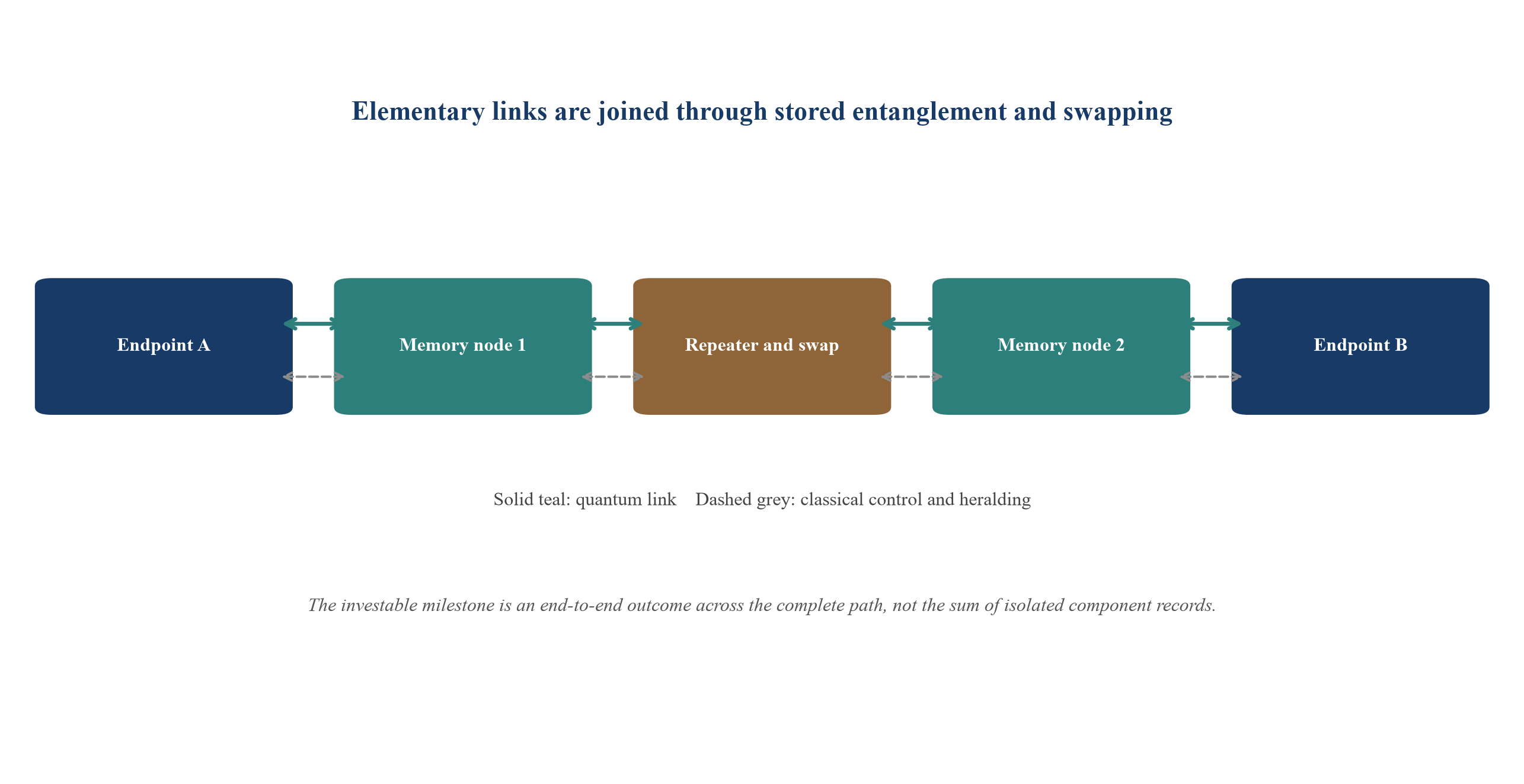
Classical control accompanies the quantum links; useful end-to-end performance depends on every source, memory, interface and swapping operation.
4. Use entangled bits per second as a starting metric
The DOE roadmap identifies entangled bits per second as a natural measure of network quality. It represents the rate at which useful entangled pairs can be supplied, allowing for distillation where a larger number of noisy states produces fewer higher-quality states. This measure connects physical performance to a service resource.
The metric still needs qualification. Rate without fidelity can be unusable. Fidelity without rate can be commercially irrelevant. A result over short laboratory fibre may not survive deployed fibre, temperature changes, vibration, connector loss or coexisting classical traffic. A burst result can conceal a low duty cycle. A network average can conceal a fragile worst link.
The diligence data room should therefore include rate, fidelity, distance, uptime, duty cycle, confidence interval and operating conditions together. It should show raw and post-selected results, excluded observations, calibration frequency and the share of time spent producing usable output. Management should define the minimum service threshold for the intended application and show the margin between demonstrated performance and that threshold.
5. Build a metric tree from physics to cash
Valuation requires a chain that links laboratory measures to commercial outcomes. The first layer contains physical metrics such as source efficiency, detector efficiency, memory coherence, retrieval efficiency, gate fidelity and conversion loss. The second layer combines these into link performance. The third layer describes network service. The fourth layer records customer use. The fifth layer converts use into contribution and cash.
This tree prevents a common error: applying a revenue assumption directly to a component record. A detector improvement only creates enterprise value if it increases usable network performance, reduces cost, improves reliability or opens a customer requirement. The effect may depend on every other component in the system.
Each branch should have a verified baseline, target, owner and sensitivity. The model should identify which technical variable is binding at each deployment stage. When a constraint moves, another can become binding. A company that solves memory coherence may next face conversion loss, source synchronisation, packaging yield or orchestration latency. The valuation should reward closed constraints and reserve for the unresolved ones.
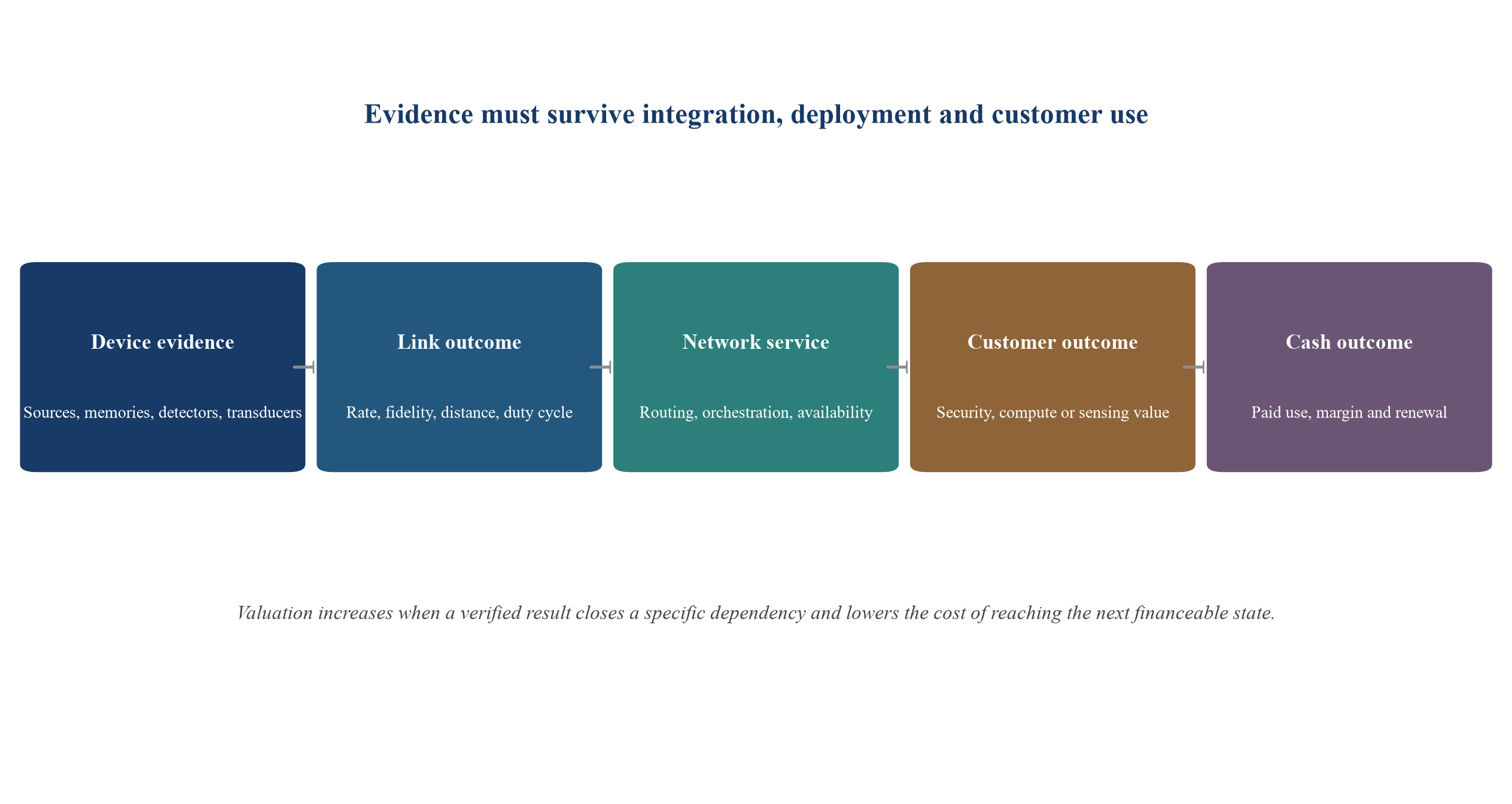
Enterprise value depends on evidence travelling through every layer; a broken link prevents a technical record from becoming durable commercial value.
6. Establish a reproducible evidence baseline
A diligence team should reproduce the evidence register before assigning value to milestones. Every claimed result should identify the test date, configuration, distance, channel, environmental conditions, sample size, excluded data, calibration method, software version and responsible reviewer. Independent replication carries more weight than an internal demonstration.
The baseline should distinguish simulation, bench experiment, testbed and field operation. Simulation is valuable for architecture selection and sensitivity analysis. It does not prove component behaviour outside the model. A bench experiment can establish physical feasibility. It does not demonstrate packaging or maintainability. A testbed can demonstrate integration. It may still rely on specialist intervention or controlled routes. A field deployment begins to reveal reliability, maintenance and customer constraints.
Evidence should be transferable to a buyer or subsequent investor. Raw data, control code, configuration records, lab notebooks, equipment calibration, intellectual-property rights and third-party permissions should remain available after a transaction. A result that depends on one founder's undocumented knowledge carries a key-person discount even when scientifically credible.
7. Define the physics clock
The physics clock advances when repeatable evidence establishes that the underlying mechanism can meet a specified operating envelope. Relevant measures include entanglement generation probability, fidelity, coherence time, storage and retrieval efficiency, detector performance, source purity, conversion efficiency and sensitivity to noise.
The clock should contain gates rather than aspirational dates. A gate might require a stated fidelity at a stated rate over a stated elementary-link length, repeated across devices and days. Another gate might require memory-assisted operation that improves an end-to-end result. The gate should specify who verifies it and what data are retained.
The valuation effect depends on the alternative the result displaces. A technical milestone has more value when it eliminates a plausible failure mode, shortens the route to a customer requirement or creates a licensable component. A record that exceeds the company's earlier result but remains below the service threshold can still improve knowledge; it may have limited transaction value.
8. Define the engineering clock
The engineering clock begins where isolated records end. It tests whether the complete system can initialise, calibrate, operate, recover and repeat. Packaging, thermal stability, optical alignment, control electronics, software, safety and manufacturability become part of the product.
Engineering evidence should include an integrated bill of materials, critical component sources, calibration time, operator intervention, maintenance interval, power and cooling, rack footprint, failure rate and repair procedure. The team should show how performance varies across manufactured units. A single hand-tuned prototype does not establish production yield.
The clock advances through design freezes and controlled builds. Each freeze should identify the performance envelope and change-control process. If a new source, memory or detector forces a redesign of interfaces and control, earlier engineering evidence may need to be repeated. Investors should reserve for this integration recursion when underwriting a platform whose core components remain fluid.
9. Define the deployment clock
The deployment clock measures performance on the infrastructure that customers will use. It covers installed fibre, splices, connectors, route loss, classical-channel coexistence, free-space weather, satellite passes, timing, physical security, access permissions and maintenance windows.
The UK reported a 410-kilometre quantum-secure fibre demonstration in 2025 connecting Bristol and Cambridge and combining QKD with classical data transmission. Such testbeds provide valuable deployment evidence. A repeater investment should still identify whether the demonstration used trusted nodes, quantum memories or entanglement-preserving repeaters. Distance alone does not establish architecture maturity.
Deployment evidence should be collected over time. Availability, drift, recalibration, component replacement and environmental variance determine operating cost. The model should distinguish route kilometres passed, kilometres activated, nodes installed and service endpoints. Each measure has different capital and revenue implications.
10. Define the interoperability clock
Quantum networks will combine classical and quantum control, heterogeneous components and multiple administrative domains. ITU work now covers QKD network architecture, interworking, software-defined control, orchestration and integration with user networks. These standards reduce interface uncertainty and create a common vocabulary.
Standards maturity does not prove product conformity. The company should identify the exact recommendation, version, optional profile and interface implemented. It should test with independently developed equipment and preserve conformance results. Proprietary extensions should be documented and priced as integration or lock-in risk.
The clock advances from internal interfaces to reference implementation, bilateral interoperability, multi-vendor test and customer acceptance. Management-plane functions matter as much as the optical path: provisioning, topology, key or entanglement resource management, telemetry, fault handling, accounting and security determine whether a network can be operated at scale.
11. Define the customer clock
The customer clock starts with a defined problem and budget owner. Public authorities may fund secure infrastructure, testbeds and sovereign capability. Telecom operators may seek new services, network differentiation and future-proofing. Data centres and quantum-computing providers may explore distributed compute. Banks, defence organisations and critical-infrastructure operators may value long-term confidentiality or advanced sensing.
The evidence ladder should distinguish research collaboration, grant consortium, memorandum, unpaid pilot, paid pilot, framework agreement, production order and renewal. Each step carries different commercial weight. A customer can be technically engaged without having procurement authority or a production budget.
The company should quantify the cost of customer-specific integration and security assurance. Early contracts often require engineering work that resembles funded development rather than repeatable product revenue. The valuation model should recognise the learning and access rights created by such work while separating non-recurring engineering from scalable service margin.
12. Define the financeability clock
The financeability clock asks whether the company can reach the next evidence state with available capital and credible funding sources. Quantum-network companies can face long technical cycles, specialist equipment, scarce talent, custom supply chains and slow public procurement. The capital path may combine equity, grants, strategic advances, research contracts, equipment finance and project funding.
The model should calculate cash to milestone, time to milestone and contingency. Technical delay can increase burn while postponing the evidence needed for the next round. A company may meet its scientific objective and still lose negotiating power because it reaches the result with insufficient runway.
Investors should map financing eligibility and restrictions. Grant-funded assets may carry access, location, collaboration, reporting or change-of-control conditions. Strategic funding may include exclusivity, preferential supply, intellectual-property rights or field restrictions. These terms can support survival while narrowing future transaction options.
13. Construct the Repeater Clock scorecard
The scorecard assigns each clock a current stage, target gate, verification owner, expected cost and expected time. It also records dependencies. A deployment gate should not be marked complete if it relies on a laboratory component that has not reached the required duty cycle. A customer gate should not be marked complete when the paid service uses a different architecture from the product being valued.
Scores should represent evidence states, not subjective percentages. A five-stage scale can use: hypothesis, controlled demonstration, independent verification, field operation and repeatable commercial operation. The definitions should be specific to each clock. The investment committee can then see imbalance: strong physics with weak deployment; strong public demand with weak economics; or good interoperability with insufficient runway.
The scorecard is updated when evidence changes. It should never advance solely because time has passed. A missed date changes cash requirements and confidence in execution; it does not automatically reverse a verified technical result. The model therefore separates state from schedule.
Table 2. Example milestone gates for a memory-assisted repeater platform
| Stage | Required evidence | Independent check | Value implication |
|---|---|---|---|
| 1 Component | Memory, source, detector and interface meet stated individual envelopes | Replicated measurement and raw-data review | Establishes feasible building blocks |
| 2 Integrated link | Two-node memory-assisted entanglement with documented rate and fidelity | Witnessed repeat and configuration audit | Closes first integration dependency |
| 3 Advantage | End-to-end result exceeds the agreed direct-transmission benchmark | Independent benchmark design and test | Establishes repeater relevance |
| 4 Field node | Operation on deployed route with uptime and maintenance evidence | Customer or testbed acceptance | Converts laboratory value into deployment evidence |
| 5 Multi-vendor network | Orchestration and interfaces work across independent systems | Conformance and interoperability event | Reduces ecosystem and lock-in risk |
| 6 Paid service | Customer pays, uses and renews for a defined outcome | Contract, invoices, usage and margin audit | Supports commercial valuation methods |
Thresholds are illustrative design examples; an actual transaction must set values for the target architecture and customer use case.
14. Value milestone-weighted replacement cost
Replacement cost is useful when revenue evidence is immature. It asks what a capable buyer would spend to recreate the team, intellectual property, equipment, data, software and verified results. The method should exclude failed or redundant expenditure and should not reward inefficient spending.
Milestone weighting improves the method. Expenditure linked to a reproducible, transferable result carries more weight than exploratory work whose outcome is undocumented. Unique fabrication processes, test datasets, control software and integration knowledge can reduce the time and risk of replacement. Assets restricted by grant terms or third-party licences may be less transferable.
The calculation should separate scientific learning from deployable product. Research spending can create option value without meeting accounting recognition criteria. IAS 38 requires research expenditure to be expensed and permits development recognition only when defined feasibility, intention, resources, market or usefulness and measurement conditions are met. Transaction valuation can recognise economic evidence beyond book value, while remaining disciplined about technical feasibility and future benefits.
15. Build probability-adjusted scenarios
A probability-adjusted model should use distinct technical and commercial states rather than one probability applied to a full forecast. Example states might include component licensing, specialised QKD deployment, repeater-assisted metropolitan service, inter-city network and distributed-compute connectivity. Each state requires different milestones, capital and timing.
Probabilities should be conditional. The chance of field deployment depends on achieving an integrated link. The chance of profitable scale depends on field reliability, interoperability, anchor demand and unit economics. The model should avoid multiplying subjective probabilities to produce spurious precision. It should use ranges, reference evidence and explicit decision gates.
Scenario value should include downside uses. A memory or transducer may serve computing, sensing or timing even if the primary network architecture stalls. The team and patents may have strategic acquisition value. These paths should be supported by identifiable technical fit, customer interest and freedom to operate; generic optionality should not become a balancing figure.
16. Apply real-option logic
Staged financing creates options. The investor funds the next milestone and retains the choice to continue, sell, partner or stop after observing evidence. This structure is especially relevant where technical uncertainty is high and learning is concentrated in discrete experiments.
Option value increases when the milestone is informative, affordable and timely. A test that produces an ambiguous result has lower value. A milestone that costs nearly as much as full development provides little capital protection. A milestone that takes longer than the company's runway can transfer negotiating power to emergency capital.
The financing instrument should match the option. Tranched equity, milestone-linked convertibles, strategic development agreements and grant matching can release capital against defined evidence. The terms should avoid incentives to optimise a narrow metric while degrading system performance. Milestones should include minimum end-to-end outcomes and data delivery.
17. Model unit economics before commercial maturity
Early unit economics should be engineering economics, not a polished steady-state margin. The model should calculate node hardware, installation, fibre access, site work, cooling, control, security, maintenance, spares, calibration, network operations and customer integration. It should identify which costs decline with volume and which remain route- or customer-specific.
The service denominator must be explicit. Possible denominators include endpoint, route kilometre, key volume, useful entangled bit, reserved capacity, protected application or availability tier. The company should choose a unit that the customer values and can audit.
Cost per useful entangled bit provides a bridge from physics to economics. It combines hardware and operating cost with rate, fidelity, duty cycle and utilisation. The measure is architecture-specific and may be unsuitable for every application. Its main value is diagnostic: it shows whether a technical improvement changes delivered economics.
Table 3. Illustrative equipment and deployment cost map
| Cost layer | Typical contents | Principal driver | Financing implication |
|---|---|---|---|
| Quantum node | Source, memory, detector, transducer and local optics | Performance envelope, yield and cooling | Early units usually require equity or grant support |
| Classical control | Timing, control electronics, orchestration and security | Interface maturity and redundancy | Software can scale; integration remains route-specific |
| Site and route | Fibre access, shelters, power, cooling and physical security | Distance, loss, access rights and environment | Route vehicle may become financeable after acceptance |
| Installation | Survey, splice, alignment, commissioning and certification | Route complexity and specialist labour | Requires working capital before customer acceptance |
| Operations | Monitoring, calibration, spares, maintenance and support | Drift, failure rate and service level | Determines recurring contribution and warranty reserve |
| Technology refresh | Replacement nodes, standards updates and obsolescence | Pace of component and protocol change | Needs lifecycle reserve in infrastructure financing |
Cost categories are decision prompts rather than market estimates; an actual case should use supplier quotations, route surveys and operating evidence.
18. Distinguish route economics from platform economics
A route is an infrastructure project with geography, permits, fibre, sites, nodes, customers and operating obligations. A platform supplies equipment, software or intellectual property across routes. Mixing the two can obscure capital intensity and margin.
A platform company may sell nodes, licences, maintenance and orchestration. It carries product development, inventory, warranty and channel risk. A route vehicle may own deployed assets and contract with users under long-term availability or capacity arrangements. It carries utilisation, counterparty and infrastructure risks.
The transaction structure can separate them. A technology company may contribute intellectual property and equipment to a project special-purpose vehicle alongside a telecom operator and anchor customer. The project can finance deployment after technical and demand gates are met. The technology company retains platform upside while limiting balance-sheet exposure. Related-party pricing, performance guarantees and step-in rights need careful governance.
19. Underwrite anchor demand
Public programmes can create anchor demand, test infrastructure and certification. The UK's 2035 mission, EuroQCI, United States testbeds and national security programmes demonstrate strategic commitment. They also involve policy, budget and procurement dependencies.
An anchor contract should state the service, acceptance test, volume, price, term, termination rights and funding source. A grant consortium membership is not equivalent to a purchase commitment. A pilot funded from an innovation budget may not convert to an operating contract.
The investor should examine whether the customer has a problem that requires the proposed architecture. Post-quantum cryptography may address many security needs at lower cost and earlier maturity. QKD or entanglement networking may still be chosen for specific assurance, sovereignty, scientific or compute requirements. The commercial case should explain the incremental outcome and buyer willingness to pay.
20. Price competition from post-quantum cryptography
NIST finalised its first post-quantum cryptography standards in 2024. These algorithms can be deployed through software and classical infrastructure, although migration remains complex. They change the competitive context for quantum-secure networking.
A QKD or quantum-network investment should not assume that concern about future quantum attacks automatically creates demand for physical quantum links. The company should identify use cases where key generation, physics-based assurance, sovereign control, forward secrecy or networked quantum capability supports additional value. It should also show how its system integrates with post-quantum authentication and hybrid cryptography.
Competition analysis should compare total deployment cost, operational complexity, certification, key lifecycle, endpoint integration and threat model. Hybrid offerings may be commercially stronger than a technology-pure position. The valuation should reserve for customer education and migration rather than treating the security narrative as booked demand.
21. Evaluate standards as an asset and obligation
Participation in standards can give a company early knowledge, ecosystem credibility and influence over interfaces. Implemented conformance can reduce integration cost. Patent contributions can create licensing opportunities where rights are valid, essential and enforceable under applicable commitments.
Standards also impose obligations. Interfaces can commoditise proprietary functions. Interoperability can lower switching costs. Essential patent commitments can constrain licensing terms. A product designed to a draft may require redesign when the recommendation changes.
The diligence team should map contributions, declared intellectual property, implementation status and conformance evidence. ITU's recent work on QKD network interworking, orchestration and user-network integration shows that the control and management stack is still developing. The company's roadmap should budget for standards evolution and backward compatibility.
22. Diligence intellectual property and freedom to operate
Quantum-network intellectual property can cover devices, materials, control, protocols, packaging and applications. Patent count is a weak proxy for value. Claims should be mapped to the product architecture, technical milestone and jurisdictions of expected manufacture and sale.
University licences, government funding and collaborative research can introduce ownership, publication, access, march-in, revenue-share or change-of-control provisions. Joint inventorship and background intellectual property should be resolved before closing. Open-source software and standards code require a separate licence review.
Freedom to operate should focus on the planned commercial configuration. A company may have a strong patent on a memory while requiring third-party rights for sources, transduction or network control. The valuation should distinguish blocking rights, design-around cost, defensive value and licensable scope.
23. Diligence the supply chain
Critical components can include lasers, cryogenic equipment, detectors, specialised fibre, photonic integrated circuits, atomic or solid-state materials, timing systems and precision electronics. Lead times, export controls, supplier concentration and qualification affect both milestone timing and gross margin.
The company should maintain an approved vendor list, component traceability, incoming inspection and second-source plan. A laboratory component selected for performance may not be available at production volume. Redesigning around a commercial component can alter the operating envelope.
The model should connect procurement to cash. Long-lead deposits and inventory can consume capital before customer acceptance. Strategic customers may fund tooling or reserve capacity. Equipment finance may become available after specifications and residual value stabilise. Until then, equity and grants often carry the integration risk.
24. Test manufacturing yield and serviceability
Repeatability across units is a major value gate. The company should report first-pass yield, rework, calibration time, performance distribution and failure modes. A production target based on the best prototype can understate cost and delay.
Serviceability matters for deployed networks. Node replacement, optical realignment, cryogenic maintenance and software recovery may require scarce specialists. The operating model should specify remote diagnostics, spares, field procedures and response times.
Design for manufacturing and service can reduce peak laboratory performance while increasing delivered availability. The valuation should reflect the customer requirement rather than rewarding a record that cannot be maintained. A controlled product baseline with modest performance can be more financeable than a fragile frontier demonstration.
25. Analyse team dependency
Quantum-network companies depend on interdisciplinary teams spanning physics, photonics, materials, controls, software, telecoms, cybersecurity, product and business development. The investment case should identify which knowledge is institutionalised and which remains concentrated in individuals.
Key-person risk can be reduced through documentation, code review, cross-training, laboratory protocols, succession and retention. Academic founders may retain university roles or publication commitments. Commercial leadership may be unfamiliar with deep-technology evidence. The board should pair scientific authority with programme, manufacturing and customer execution.
Retention arrangements should align with milestones without encouraging overstatement. Technical reviewers need independence to report negative results. Management incentives should include evidence quality, repeatability and capital discipline alongside dates and revenue.
26. Use milestone-linked transaction terms
An acquisition or strategic investment can bridge valuation uncertainty through staged consideration. Upfront value can reflect transferable assets and verified milestones. Deferred value can depend on integrated performance, field acceptance, interoperability, paid orders or contribution margin.
The metric definition is critical. A technical earnout should specify configuration, test route, baseline, data, verifier, permitted exclusions and dispute process. A commercial earnout should address customer concentration, transfer pricing, bundling, pricing discretion and buyer support.
Governance during the measurement period should preserve the ability to reach the milestone. The buyer may need to fund equipment, retain staff and provide route access. Sellers should not control evidence collection without independent review. Both sides should agree how standards changes or customer delays affect the test.
Table 4. Transaction protections matched to unresolved quantum-network risk
| Risk | Evidence gap | Transaction protection | Release condition |
|---|---|---|---|
| Technical | Integrated performance remains unverified | Tranche, escrow or contingent value | Independent end-to-end test |
| Deployment | Field reliability and maintenance unknown | Holdback and service warranty | Sustained route acceptance |
| Standards | Interfaces remain proprietary or provisional | Covenant and interoperability milestone | Multi-vendor conformance |
| Customer | Pilot has no production commitment | Commercial earnout | Paid order, usage and renewal |
| Supply | Critical component has one source | Working-capital reserve and consent right | Qualified second source or inventory plan |
| Finance | Cash to next state is uncertain | Budget covenant and staged funding | Verified milestone within agreed spend |
Protections should release when defined evidence closes the corresponding risk.
27. Design project and special-purpose financing
Commercial routes may eventually support special-purpose financing when technology, customer and operating risks are sufficiently bounded. The project vehicle can contract for fibre, sites, nodes, operations and anchor service. Technology suppliers can provide performance warranties and long-term support.
Project finance requires predictable cash, enforceable contracts and risk allocation. An early repeater deployment may still require sponsor equity, grants or guarantees. Lenders will examine acceptance tests, liquidated damages, replacement rights, cyber obligations, obsolescence and termination payments.
The route should avoid relying on speculative secondary demand. Anchor payments, availability contracts or public procurement can support debt capacity after conditions precedent are met. The finance model should also reserve for technology refresh, because quantum-network components and standards may evolve faster than conventional telecom assets.
28. Apply the framework to a hypothetical company
Consider a wholly hypothetical company developing memory-assisted repeater nodes and orchestration software. It has demonstrated individual memory, source and detector performance and an integrated two-node laboratory link. It has not yet shown a repeater advantage over an agreed direct-transmission benchmark. It participates in a national testbed and has one paid engineering pilot.
Illustrative management assumptions set current annual cash use at USD 14 million, cash on hand at USD 21 million and estimated cash required to the advantage milestone at USD 18 million. The field-node milestone is assumed to require a further USD 24 million. A strategic investor proposes USD 30 million of financing in two tranches.
All figures, probabilities and outcomes in this case are illustrative management assumptions. They are not observed company data, a market forecast, a fairness opinion, an investment recommendation or an offer. The purpose is to show how evidence and financing can be linked.
29. Map the hypothetical clocks
The physics clock is at independent component verification. The engineering clock is at controlled integrated demonstration. The deployment clock is at testbed preparation. The interoperability clock is at internal interface definition. The customer clock is at a paid engineering pilot. The financeability clock has less than two years of runway under the illustrative burn assumption.
The imbalance matters. Management could present the paid pilot and testbed membership as commercial traction. The evidence supports customer access and funded learning. It does not support a production-network multiple. The central value gate remains the advantage milestone followed by field reliability.
The investor should fund the evidence path. An initial tranche can support the advantage test, design freeze and raw-data package. A second tranche can follow independent verification and fund a field node. The price of the second tranche can step up if the verified result reduces technical risk.
30. Build the illustrative valuation bridge
Assume a milestone-weighted replacement-cost range of USD 42 million to USD 58 million for the transferable team, intellectual property, equipment, software and verified evidence. Assume downside component and licensing options of USD 12 million to USD 22 million. Assume a successful field-network scenario with materially higher value, discounted for technical, deployment, customer and financing risk.
The board should avoid collapsing these paths into a single precise number. A negotiated pre-money range can be anchored to replacement evidence and downside options, with additional value delivered through staged pricing or contingent rights. This preserves upside for existing holders while protecting new capital from paying immediately for unverified network economics.
The most useful output is the bridge: current evidence value; capital required to the next gate; value released by verification; and remaining exposure. The bridge can be updated after each test. It creates a common language for scientists, investors and strategic partners.
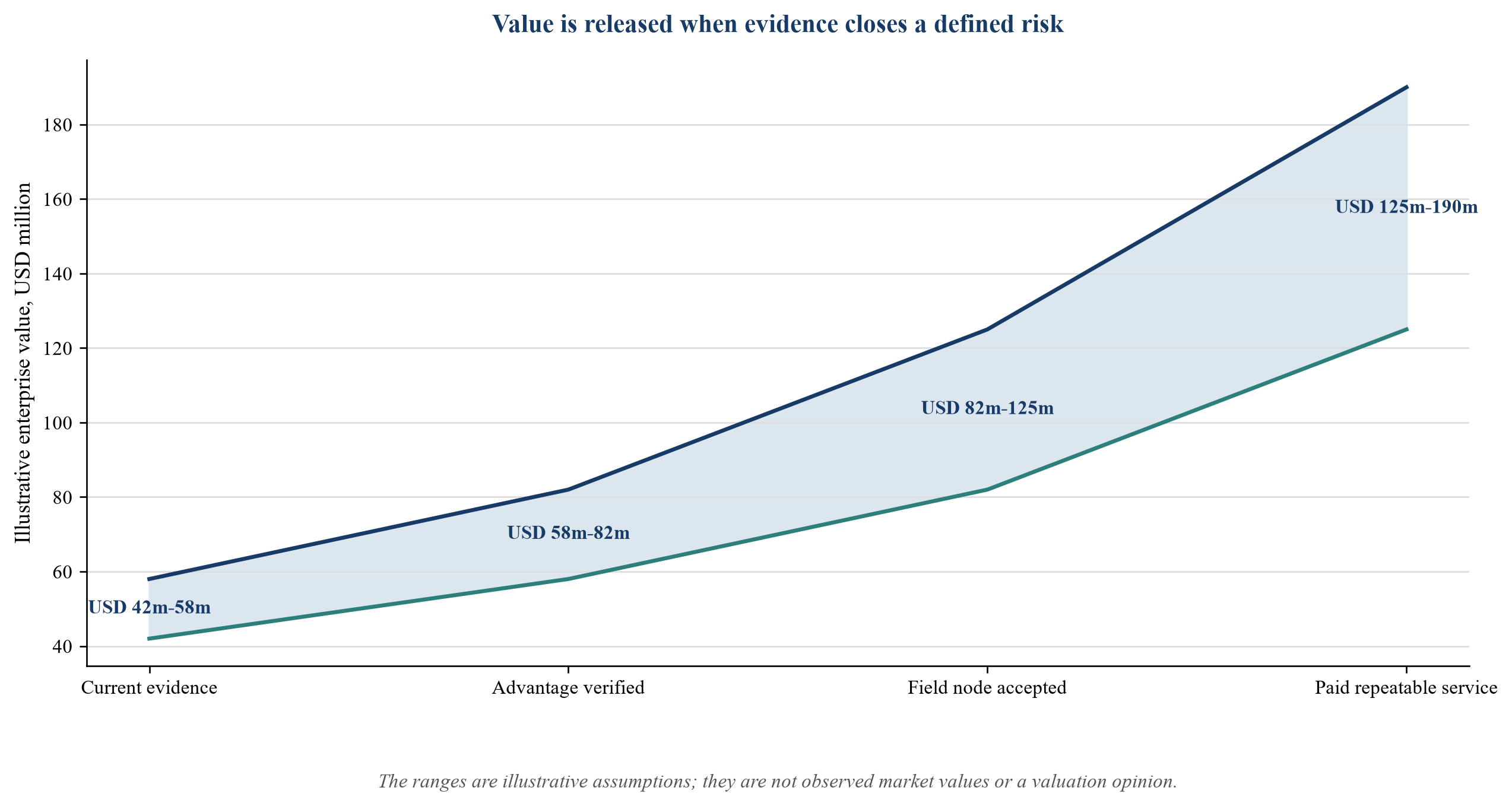
All amounts and probability ranges are hypothetical management assumptions used solely to demonstrate the framework.
31. Stress-test delay and capital intensity
The illustrative case should test a six-, twelve- and eighteen-month delay to the advantage milestone. Each delay increases cash need and can postpone the field programme. It may also allow standards, competitors or customer requirements to move.
The company can respond by narrowing scope, adding a strategic development contract, licensing a component, extending grant funding or increasing the round. Each response changes future option value. A scope reduction can produce a cleaner test while postponing full integration. Strategic funding can reduce dilution while creating exclusivity. Licensing can generate cash while revealing demand for the component rather than the network.
The board should define a stop or pivot rule before capital becomes scarce. The rule might require a minimum verified rate-distance improvement, a field partner and funded route access by a specified cash threshold. A disciplined pivot protects the residual value of the team and technology.
32. Stress-test customer concentration
Early quantum-network revenue can be concentrated in governments, defence organisations, research institutions and major telecom operators. These customers can provide credible validation and large contracts. Their procurement cycles and policy priorities can also create volatility.
The model should separate customer count, programme count and budget source. Several contracts can depend on one national programme. A change in policy can affect them together. The company should map termination, appropriation, security clearance, export and local-content provisions.
Commercial diversification should follow adjacent use cases that share the core platform. A repeater node may support secure links, distributed compute experiments or networked sensing. The company should avoid promising unrelated verticals that require separate products and sales channels. Evidence of reuse matters more than the number of use cases in a presentation.
33. Stress-test standards and architecture change
Quantum repeater architectures include memory-assisted and all-photonic approaches, with different generations and error-management strategies. A company can execute well and still face architecture displacement.
The valuation should identify which assets survive a change. Control software, photonic packaging, detectors, sources, test infrastructure, customer access and standards knowledge may retain value. A proprietary memory interface may not. Modularity and documented interfaces increase option value.
Standards change should be modelled as engineering work, certification cost and schedule. The company should maintain a compatibility matrix and participate in test events. A strong standards position is demonstrated through implemented interoperability, not committee attendance.
34. Govern evidence at board level
The board should receive a one-page clock dashboard and an evidence appendix. The dashboard should show state, target, cost, schedule, dependencies and variance for each clock. The appendix should link every claim to raw data, independent review, contract or standard.
Scientific advisory boards can challenge methods and interpretation. They should not substitute for corporate governance. The directors remain responsible for capital allocation, risk, disclosures and stakeholder commitments. Conflicts should be declared where reviewers are collaborators, licensors or prospective investors.
External communications should use the same evidence definitions as internal reporting. A milestone described as an integrated laboratory result should not become a field-ready network in investor materials. Consistent language protects credibility and reduces diligence friction.
35. Use a ninety-day transaction plan
During the first thirty days, the buyer or investor should establish the architecture, product boundary, evidence register, intellectual-property map, cash runway and customer contract hierarchy. It should agree the direct-transmission benchmark and the technical data required for verification.
During days thirty-one to sixty, independent specialists should reproduce the metric analysis, inspect the integrated system, review supply and manufacturing, test the financial model and interview anchor customers. Legal diligence should cover funding restrictions, university rights, export, security and standards commitments.
During days sixty-one to ninety, the parties should negotiate the valuation bridge, milestone definitions, financing tranches, governance, retention and evidence delivery. The closing plan should preserve runway and order long-lead equipment. Conditions precedent should focus on risks that cannot be priced or governed after closing.
36. Decision rules for investors and boards
Proceed when the company has a defined service, reproducible evidence, a credible route to the next gate, sufficient capital and contractual access to test or deploy. Price current evidence and use staged terms for uncertain upside.
Proceed with conditions when the science is credible but integration, route access, interoperability or customer procurement remains incomplete. Make funding, valuation and governance contingent on evidence that closes the specific gap.
Pause when claims cannot be reproduced, the benchmark is undefined, capital to the next gate is unknown, intellectual-property rights are unstable or customer interest cannot be distinguished from funded procurement. A pause can preserve negotiating leverage and prevent spending from being mistaken for progress.
37. Limitations
The framework does not produce a universal quantum-network valuation multiple. Architectures, applications, geographies and financing environments differ. Public programmes can change. Standards continue to evolve. Technical evidence can become obsolete as benchmarks improve.
The illustrative case is deliberately simplified. It excludes tax, detailed dilution, liquidation preferences, foreign exchange, export licensing and jurisdiction-specific legal advice. All numerical case inputs are hypothetical management assumptions.
The framework should be updated with specialist technical, legal, accounting, cybersecurity and market diligence. Its purpose is to make assumptions, dependencies and evidence visible before capital is committed.
38. Conclusion
Quantum networks should be valued as staged systems of evidence. Physics, engineering, deployment, interoperability, customer adoption and financeability advance at different speeds. The weakest unresolved dependency can control the value of the whole platform.
The Repeater Clock converts that complexity into decision gates. It asks whether a result is reproducible, integrated, deployable, interoperable, paid and financeable. It links each gate to the capital required and the value released. It also preserves downside options in components, software, intellectual property and strategic capability.
The decisive milestone is not a date on a roadmap. It is independently verified evidence that the architecture improves a customer-relevant outcome and can be repeated at an acceptable cost. Transactions that price current evidence and stage payment for future proof can finance progress while containing the risk of premature certainty.
References
- U.S. Department of Energy, From Long-Distance Entanglement to Building a Nationwide Quantum Internet: Report of the DOE Quantum Internet Blueprint Workshop, 2020, https://www.energy.gov/sites/prod/files/2020/07/f76/QuantumWkshpRpt20FINAL_Nav_0.pdf
- U.S. Department of Energy, Quantum Information Science and Technology Roadmap, 2024, https://www.quantum.gov/wp-content/uploads/2024/12/DOE_QIS_Roadmap_Final.pdf
- U.S. Department of Energy, DOE Explains Quantum Networks, https://www.energy.gov/science/doe-explainsquantum-networks
- National Institute of Standards and Technology, Connecting Quantum Network Nodes, https://www.nist.gov/pml/productsservices/quantum-networks-nist/connecting-quantum-network-nodes
- National Institute of Standards and Technology, Quantum Network Metrology, https://www.nist.gov/pml/productsservices/quantum-networks-nist/quantum-network-metrology
- National Institute of Standards and Technology, Quantum Memory and Repeaters, https://www.nist.gov/pml/productsservices/quantum-networks-nist/technologies-quantum-networks/quantum-memory-and
- UK Department for Science, Innovation and Technology, National Quantum Strategy Missions, 2023, https://www.gov.uk/government/publications/national-quantum-strategy/national-quantum-strategy-missions
- UK Department for Education, Quantum Key Distribution Research Report, 2026, https://www.gov.uk/government/publications/quantum-key-distribution-research-report/quantum-key-distribution-research-report
- European Commission, European Quantum Communication Infrastructure, https://digital-strategy.ec.europa.eu/en/policies/european-quantum-communication-infrastructure-euroqci
- European Commission, Commission and European Space Agency Sign EuroQCI Implementation Agreement, 30 January 2025, https://digital-strategy.ec.europa.eu/en/news/commission-and-european-space-agency-sign-euroqci-implementation-agreement
- International Telecommunication Union, Recommendation ITU-T Y.3802, Quantum Key Distribution Networks Functional Architecture, 2020 with 2023 amendment, https://www.itu.int/epublications/publication/itu-t-y-3802-2020-amd-1-2023-11
- International Telecommunication Union, Recommendation ITU-T Y.3820, Quantum Key Distribution Network Interworking Software-Defined Networking Control, 2024, https://www.itu.int/epublications/publication/itu-t-y-3820-2024-09-quantum-key-distribution-network-interworking-software-defined-networking-control
- International Telecommunication Union, Recommendation ITU-T Y.3831, Integration of Quantum Key Distribution Network and User Networks Supporting End-to-End Modern Cryptography Services, 2025, https://www.itu.int/rec/T-REC-Y.3831-202512-I
- International Telecommunication Union, Recommendation ITU-T Y.3832, Quantum Key Distribution Networks Framework for Orchestration, 2025, https://www.itu.int/rec/T-REC-Y.3832-202512-P
- International Telecommunication Union, Recommendation ITU-T Q.4165, Quantum Key Distribution Network Interworking Protocol Framework, 2026, https://www.itu.int/epublications/en/publication/itu-t-q-4165-2026-01-quantum-key-distribution-network-interworking-protocol-framework
- International Telecommunication Union, Technical Considerations towards Quantum Networks, Supplement 98 to the ITU-T Y-series Recommendations, 2025, https://www.itu.int/rec/T-REC-Y.Sup98-202511-I
- K. Azuma et al., Quantum Repeaters: From Quantum Networks to the Quantum Internet, Reviews of Modern Physics 95, 045006, 2023, https://doi.org/10.1103/RevModPhys.95.045006
- S. Brand et al., Faithfully Simulating Near-Term Quantum Repeaters, PRX Quantum 5, 010351, 2024, https://doi.org/10.1103/PRXQuantum.5.010351
- E. S. Moiseev et al., Hong-Ou-Mandel Interference of Single-Photon-Level Pulses Stored in Independent Room-Temperature Quantum Memories, npj Quantum Information 10, 2024, https://doi.org/10.1038/s41534-024-00803-2
- E. Shchukin et al., Exact Rate Analysis for Quantum Repeaters with Imperfect Memories and Entanglement Swapping as Soon as Possible, Physical Review Research 5, 023086, 2023, https://doi.org/10.1103/PhysRevResearch.5.023086
- M. K. Bhaskar et al., Towards a Spectrally Multiplexed Quantum Repeater, npj Quantum Information 11, 2025, https://doi.org/10.1038/s41534-024-00946-2
- Optical Society and European research community, Roadmap for Optical Metasurfaces and Quantum Networks, Journal of Optics 26, 093001, 2024, https://doi.org/10.1088/2040-8986/ad5b6f
- Organisation for Economic Co-operation and Development, A Quantum Technologies Policy Primer, 2025, https://www.oecd.org/content/dam/oecd/en/publications/reports/2025/01/a-quantum-technologies-policy-primer_bdac5544/fd1153c3-en.pdf
- Organisation for Economic Co-operation and Development and European Patent Office, Mapping the Global Quantum Ecosystem, 2025, https://www.oecd.org/en/about/news/press-releases/2025/12/mapping-the-global-quantum-ecosystem.html
- IFRS Foundation, IAS 38 Intangible Assets, https://www.ifrs.org/issued-standards/list-of-standards/ias-38-intangible-assets/
- National Institute of Standards and Technology, Module-Lattice-Based Key-Encapsulation Mechanism Standard, FIPS 203, 2024, https://doi.org/10.6028/NIST.FIPS.203
- National Institute of Standards and Technology, Module-Lattice-Based Digital Signature Standard, FIPS 204, 2024, https://doi.org/10.6028/NIST.FIPS.204
- National Institute of Standards and Technology, Stateless Hash-Based Digital Signature Standard, FIPS 205, 2024, https://doi.org/10.6028/NIST.FIPS.205
- European Commission, Digital Europe Call DIGITAL-IRIS2-2025-QCI, European Quantum Communication Infrastructure, 2025, https://ec.europa.eu/info/funding-tenders/opportunities/docs/2021-2027/digital/wp-call/2025/call-fiche_digital-iris2-2025-qci_en.pdf
- Center for Quantum Networks, Research Strategic Plan, 2024, https://cqn-erc.org/wp-content/uploads/2024/04/1-Co-Directors-Overview.pdf
About the Author
Chennakeshav (CK) is a corporate finance and investment banking executive with 25+ years of global experience in deal origination, structuring and execution across M&A, growth capital and corporate strategy. He has led value-creation mandates for founders, corporates and funds — bridging the boardroom view to hands-on execution and close.
His career spans Morgan Stanley, HSBC, Lloyds Banking Group, EWEC, ADQ portfolio companies and Emirates Growth Fund, across TMT, real estate, fintech, deeptech, cleantech, infrastructure and energy. He has partnered with C-suite leaders, private equity and venture funds, sovereign wealth funds and family offices to finance complex fund raises and scale-up ventures, and has led M&A due diligence, post-merger integration and business-transformation initiatives to create value.
At Matchpoint Partners he is Managing Partner, leading the firm's corporate finance, M&A and capital-raising practice. He holds an MBA from London Business School, an engineering degree from VTU and a Master of Laws (LLM, in progress) from UCL London.
An active start-up mentor, CK mentors at Techstars, DIFC FinTech Hive, Startup Grind, Founder Institute and IN5, serves as Entrepreneur Mentor in Residence (EMiR) at London Business School, and judges the Entrepreneurship World Cup.
https://www.linkedin.com/in/ckadya/
https://www.matchpoint-partners.com/team/ck-adya.html
This paper is part of a continuing series on the structure of private and alternative markets. The views expressed are the author's own. The paper is for information only, describes market structure in general terms, and does not constitute investment, legal, tax or regulatory advice or a recommendation in respect of any security, vehicle or counterparty.
