
Introduction
Energy infrastructure is both an economic asset and an essential service. A power plant, substation, fuel terminal, pipeline, renewable project or control system can be damaged directly and can also lose value through blocked access, missing fuel, damaged grid connections, workforce displacement or government action. A single policy label does not capture these pathways.
War-risk analysis should therefore begin with the service and loss chain. The question is not merely whether an asset can buy a policy. The decision is whether the capital structure, contracts, operational design and public arrangements allow the service and the financing to survive a defined conflict scenario.
Public institutions provide relevant evidence. The World Bank Group's Multilateral Investment Guarantee Agency offers political-risk products that can include war and civil disturbance. The United States International Development Finance Corporation provides political-risk insurance and guarantees. UK Export Finance describes overseas-investment insurance that can include war, civil war, revolution and insurrection. The European Bank for Reconstruction and Development has used a donor-backed guarantee to support war-risk reinsurance capacity in Ukraine.
1 Define the decision perimeter
The investment committee should identify the assets, countries, entities, contracts and financing instruments under review. Coverage for an equity investment, a project loan, physical property, cargo, construction works and operating revenue can differ materially. The perimeter should include shared infrastructure and third-party dependencies whose loss could interrupt service.
The decision period also matters. Construction, commissioning, operation, expansion and decommissioning have different insured values and interruption exposures. A policy that begins after commercial operation leaves construction mobilisation and stored equipment outside its term. A facility that covers mobile cargo may not cover fixed generation assets.
The perimeter record should state ownership, operator, site, replacement value, revenue source, debt, security and contractual counterparties. Undefined interests create claims and recovery uncertainty.
2 Map the service and loss chain
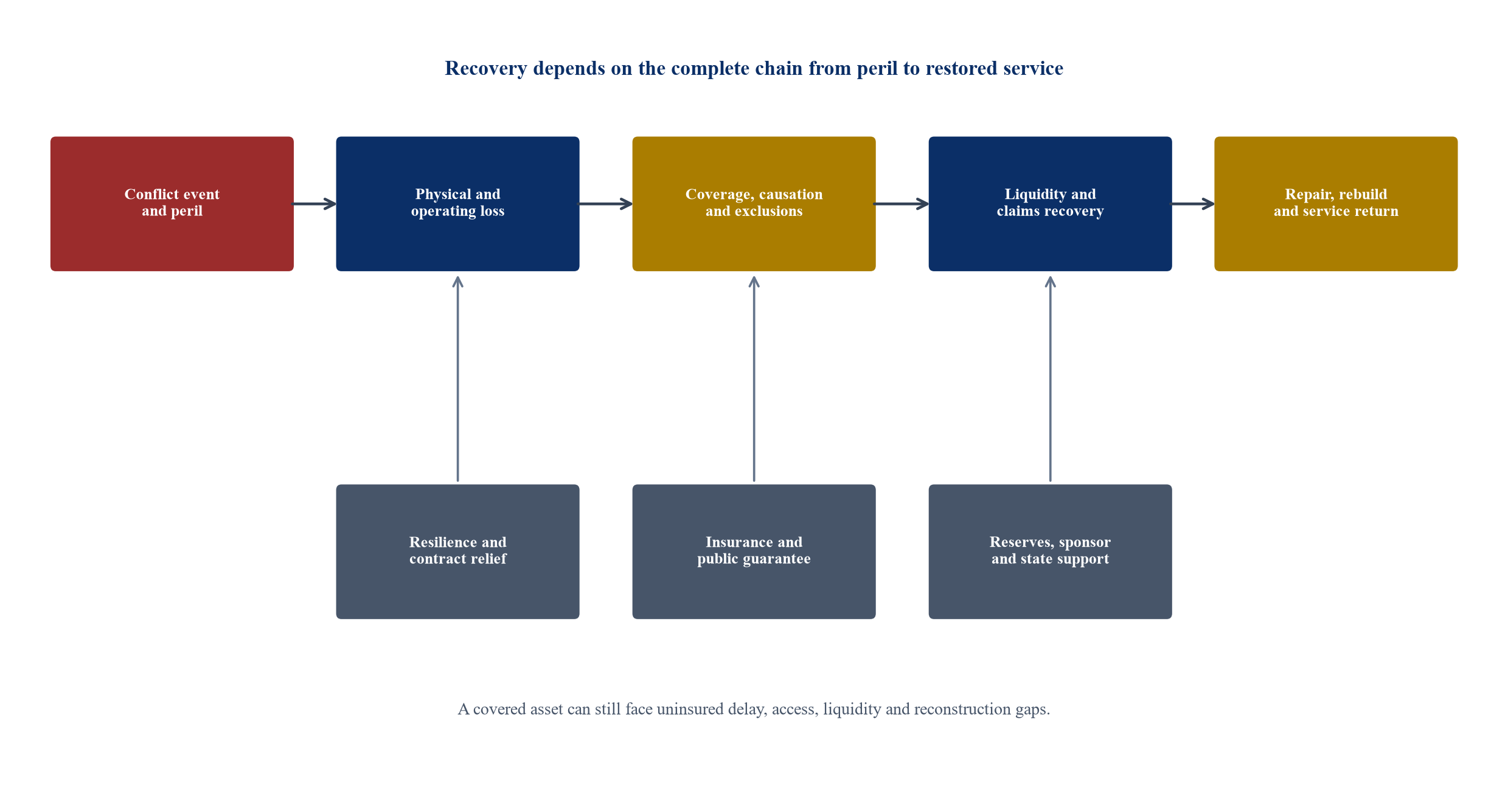
The diagram is an author-developed framework. Every transfer or retention mechanism requires project-specific evidence and enforceable terms.
The map should trace direct damage, interruption, access, grid connection, fuel, communications, labour, imports and payment. A solar plant may remain physically intact while a damaged substation prevents dispatch. A gas plant may be available while its pipeline or payment system is unavailable. Each dependency needs a treatment.
3 Classify the perils
Political violence can include war, civil war, insurrection, revolution, terrorism, sabotage, riots or civil commotion, subject to policy definitions. Property policies can use separate terminology and exclusions. Cyber operations may be excluded or treated under specialised cover. Government action can involve expropriation, licence withdrawal, requisition, currency restrictions or breach of contract.
Causation should be tested. A loss can result from several concurrent causes, such as physical attack, grid failure and a government evacuation order. Policy wording, law and facts determine response. The risk register should avoid assuming that a general reference to war risk covers every connected loss.
4 Build a coverage evidence table
Table 1. War-risk coverage and evidence tests
| Exposure | Evidence required | Potential protection route | Typical retained issue |
|---|---|---|---|
| Direct physical damage | Asset schedule, location, cause, replacement value and damage record | Property extension, political-violence cover or political-risk insurance | Deductible, sublimit, excluded weapon or unproven causation |
| Business interruption | Revenue baseline, indemnity period, physical-damage trigger and dependency map | Business-interruption extension or political-violence interruption cover | Waiting period, underinsurance, access and non-damage interruption |
| Expropriation or requisition | Government act, ownership, rights, compensation and permanence | Political-risk insurance and treaty or contract rights | Gradual action, regulatory change and valuation dispute |
| Currency and transfer restriction | Cash entitlement, local balance, legal restriction and attempted transfer | Currency inconvertibility or transfer-restriction cover | Devaluation, commercial illiquidity and excluded pre-existing controls |
| State or utility contract breach | Executed contract, breach record, dispute process and award | Breach-of-contract or arbitral-award cover | Waiting period, enforcement steps and commercial performance dispute |
| Cargo and replacement equipment | Title, route, value, transit period and storage | Marine war, cargo or guarantee-supported local cover | Route closure, delay, accumulation and sanctions |
| Cyber-related conflict loss | Attribution, system logs, affected asset and policy definitions | Cyber cover or specific war carve-back where available | State attribution, infrastructure exclusion and silent-cyber uncertainty |
Policy wording and applicable law govern. The table is a diligence framework rather than a coverage opinion.
The diligence team should obtain policies, endorsements, schedules, exclusions, deductibles, limits, waiting periods, claims protocols and broker analyses. A certificate or premium invoice is insufficient.
5 Separate insurable and financeable value
Replacement cost, book value, enterprise value and debt exposure are different measures. Property insurance may respond to repair or replacement subject to valuation terms. Political-risk insurance may protect an investment or loan. Business interruption may use gross profit, standing charges or another defined measure.
The financial model should reconcile these bases. An asset with a replacement cost below enterprise value can leave equity value exposed after a total loss. A loan policy may protect scheduled principal while operational cash flow remains impaired. Underinsurance and average provisions can reduce recovery.
6 Benchmark market mechanisms
Table 2. Selected war-risk and political-risk mechanisms
| Mechanism | Publicly described role | Relevant strength | Core diligence question |
|---|---|---|---|
| MIGA political-risk insurance | Covers eligible cross-border investments against defined political risks, including war and civil disturbance | Long-tenor multilateral support and claims-prevention role | Does the investor, country, investment and peril meet current eligibility and underwriting requirements? |
| DFC political-risk insurance | Supports eligible investments and financing against defined political risks | Government-backed capacity and experience with energy projects | Which investment interests, perils, limits and development-policy conditions apply? |
| UKEF overseas-investment insurance | Can protect eligible UK overseas investment against case-specific political risks | Public capacity where private-market capacity is constrained | Is the investor and investment eligible, and what percentage, waiting period and exclusions apply? |
| EBRD Ukraine guarantee facility | Supports reinsurance of certain war risks written by local insurers | Uses guarantee capacity to crowd private reinsurance back into a conflict market | Which asset classes and policies are currently admitted, and how does the guarantee attach? |
| Private political-violence market | Property and interruption protection under negotiated wordings | Specialist underwriting and layered capacity | Which war, terrorism, sabotage, strike and civil-commotion definitions, exclusions and aggregates apply? |
| Marine and cargo war cover | Protects eligible vessels, cargo or transit exposures under defined areas and terms | Can respond to mobile assets and replacement equipment | When can terms, listed areas or cancellation provisions change during transit? |
| Sponsor or state support | Contractual liquidity, indemnity or reconstruction commitment | Can address exclusions and timing gaps | Is the support legally binding, funded, senior enough and available during the same stress? |
Public programme descriptions are summarised from cited authorities. Availability, eligibility, scope, price and capacity require current transaction-specific confirmation.
Benchmarking should compare function rather than product names. Public facilities can add capacity or cover risks that the private market will not carry. Private insurers can provide underwriting, claims and distribution infrastructure. Project resilience and reserves remain necessary in every structure.
7 Read exclusions as a capital schedule
Every exclusion should appear in the financial model. War exclusions, nuclear or radiological exclusions, cyber war, confiscation, sanctions, unexploded ordnance, contamination, indirect loss and gradual deterioration can leave material exposure. Policy language and applicable law determine effect.
The exclusion schedule should estimate maximum credible loss, operating consequence, contractual relief and available liquidity. An exclusion with low probability and extreme consequence can require public contingency or a redesign rather than a large cash reserve.
8 Model deductibles and waiting periods
A deductible is immediate retained loss. A waiting period is a liquidity requirement. Projects need cash to secure sites, protect equipment, pay staff, mobilise contractors and order replacements before a claim is agreed.
The model should test one event affecting several insured sections. Separate deductibles can apply to property, interruption, terrorism and cyber claims. Waiting periods can begin on different dates. The project should know whether the reserve covers cumulative retention.
9 Test policy limits and aggregation
War losses can affect many assets at once. Insurers and reinsurers therefore manage geographic and event aggregates. A project limit can appear adequate while an occurrence definition groups several attacks or sites under one cap.
The review should identify per-asset, per-occurrence and annual aggregate limits. Shared group programmes need allocation rules when several subsidiaries claim. Reinstatement terms and additional premium should be understood before a loss.
10 Map geographic concentration
Asset concentration increases correlated loss. Generation, substations, control centres, fuel and workforce can share one geographic exposure. A portfolio map should include critical third-party infrastructure and likely blast, flood, fire or access zones.
Decentralised generation, alternate control centres, sectionalised networks and spare equipment can reduce service loss even when total asset value is unchanged. Resilience investment should be compared with insurance premium, deductible and unavailable capacity.
11 Value reconstruction cost
Reconstruction cost can exceed original cost through inflation, scarcity, security, demolition, debris removal, site clearance, redesign and new codes. Foreign exchange and import duties may move at the same time as loss. Long-lead transformers, turbines and control systems can extend interruption.
The value schedule should use current engineering quantities and supplier evidence where available. Escalation and contingency should be explicit. A fixed insured value should be reviewed during construction and after major capital additions.
12 Measure business interruption
Business-interruption value depends on the revenue mechanism. A merchant generator faces volume and price changes. A contracted project may have deemed-energy, force-majeure and termination provisions. A regulated utility may recover prudent cost with delay.
The indemnity period should reflect repair, permits, grid restoration, import, testing and ramp-up. Physical repair can finish before revenue returns. The model should avoid assuming immediate full output after reconstruction.
13 Analyse non-damage interruption
Access denial, curfew, evacuation, port closure, grid outage and government orders can stop operations without insured physical damage at the project. Standard interruption cover may require damage to insured property or a named dependency.
The contract should identify non-damage extensions and sublimits. Operational planning should establish remote operation, alternate routes, minimum staffing and degraded service. Retained non-damage risk can be larger than direct damage for dispersed assets.
14 Preserve claims evidence
Conflict can destroy records and restrict adjuster access. The project should maintain off-site copies of asset schedules, drawings, maintenance, values, photographs, contracts and revenue data. Time-stamped operational logs support causation and interruption measurement.
The claims protocol should define notification, emergency work, evidence preservation, interim payments, adjusters and dispute escalation. Safety takes priority, while documented decisions reduce later uncertainty.
15 Plan sanctions and payment compliance
Sanctions can affect insurers, banks, contractors, suppliers and beneficiaries. A policy can include sanctions limitations. Claims and reconstruction payments can be delayed while parties verify legality and payment routes.
The project should maintain counterparty screening, ownership information, approved banks and alternate lawful procurement. Legal review should address current rules for the actual transaction. A general sanctions clause does not establish that a payment can be made.
16 Allocate cyber war
Energy assets depend on operational technology and communications. A cyber event can produce physical damage or prolonged service loss. Attribution to a state or conflict can be uncertain. Cyber policies and property policies can allocate war-related cyber exposure differently.
The review should reconcile wordings across programmes and identify gaps or overlaps. Security architecture, offline backups, manual operation, network segmentation and incident response reduce loss independently of insurance.
17 Protect construction and stored equipment
Projects under construction have changing values, temporary works, imported equipment and contractor interfaces. Delay in start-up can exceed direct damage. Stored equipment may sit at ports or warehouses outside the project site.
The owner should align construction all-risks, political violence, cargo, delay and political-risk cover. Contract terms should assign deductibles, uninsured delay and replacement ordering. Lenders need notice of cancellation or material change.
18 Coordinate project contracts
Power-purchase, concession, fuel, grid-connection, EPC, operations and land agreements should use consistent force-majeure concepts where practical. A project can face a gap when one contract excuses performance and another continues payment or debt service.
The matrix should show relief, termination, compensation, insurance proceeds and reinstatement duties. The project should know whether public counterparties recognise war damage in tariffs or termination payments.
19 Protect lender rights
Lenders typically require loss-payee status, endorsements, notice, non-vitiation where available, policy assignment and control of material proceeds. These rights should preserve urgent life-safety and stabilisation spending.
The proceeds waterfall should fund emergency protection, repair, debt service, mandatory prepayment and distributions in agreed order. A total-loss decision needs objective tests and lender voting rules.
20 Build the liquidity bridge
Final claim settlement can take time. The project needs an emergency reserve, working-capital line, sponsor commitment or public bridge. The amount should reflect deductibles, waiting periods, emergency operations, debt service and initial reconstruction.
Bridge financing should identify repayment from claim proceeds or other support. Lenders providing the bridge need priority, security and certainty that insurance assignment permits repayment.
21 Layer capital and protection
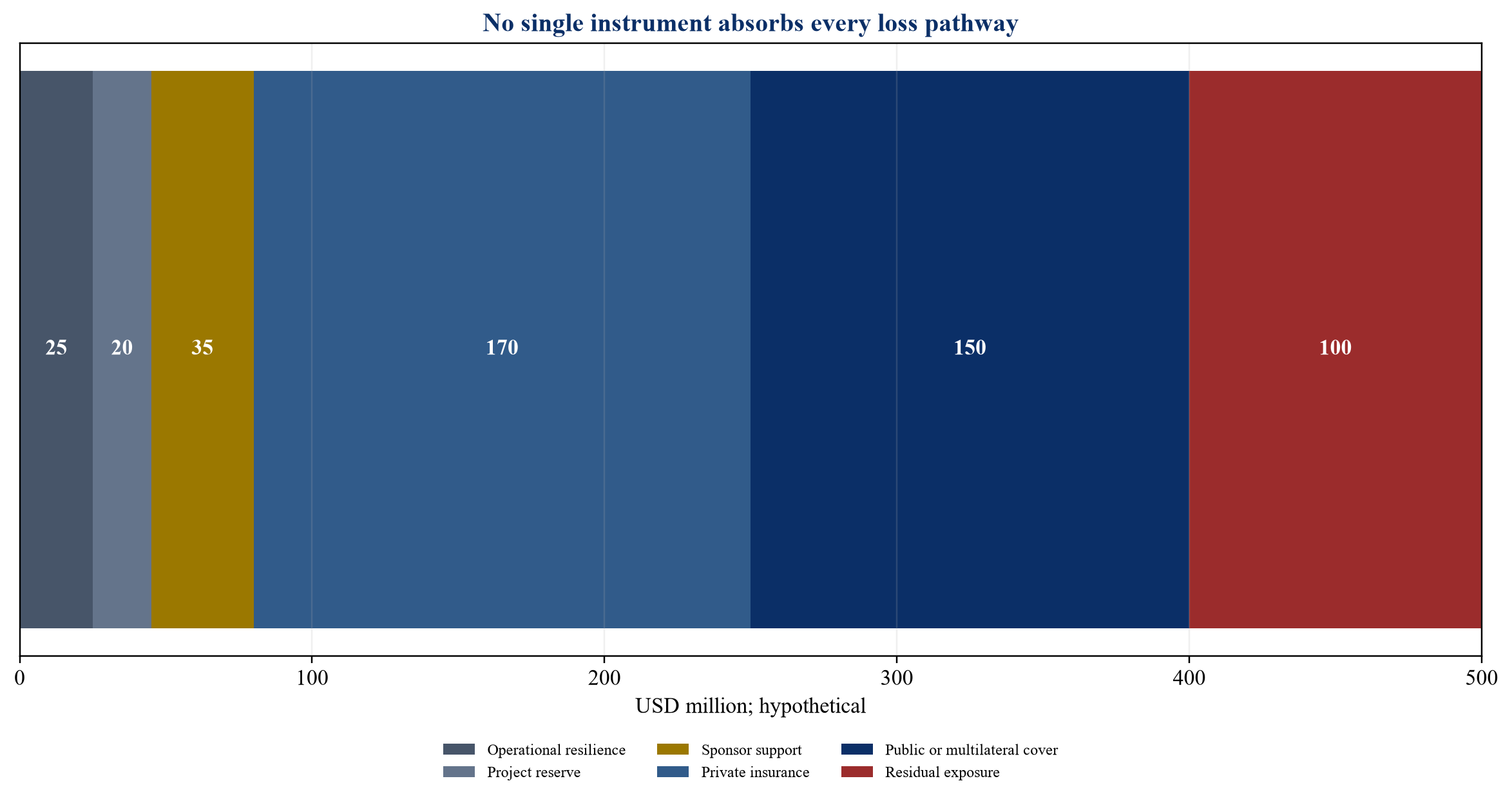
Values are author-modelled assumptions in USD millions for demonstrating allocation. They are not market quotations, recommended limits or observed losses.
The illustrative stack shows allocation, not recoverability. Each layer requires an enforceable source and conditions. Operational resilience reduces the loss before finance responds. Reserves provide rapid liquidity. Insurance and public cover respond only to insured perils and proven claims. Residual exposure remains with equity, customers or the state.
22 Size debt under conflict stress
Senior debt should be sized against cash flow that survives the agreed stress. The model should test partial service, prolonged outage, delayed claims, reduced tariffs, currency controls and reconstruction spend. Contract termination value can support debt only when enforceable and payable under the relevant event.
Covenants can require minimum cover, reserves, policy renewal, insurer ratings, claims cooperation and resilience actions. A policy cancellation or material exclusion change should trigger review before distributions.
23 Model capital and operating sensitivities
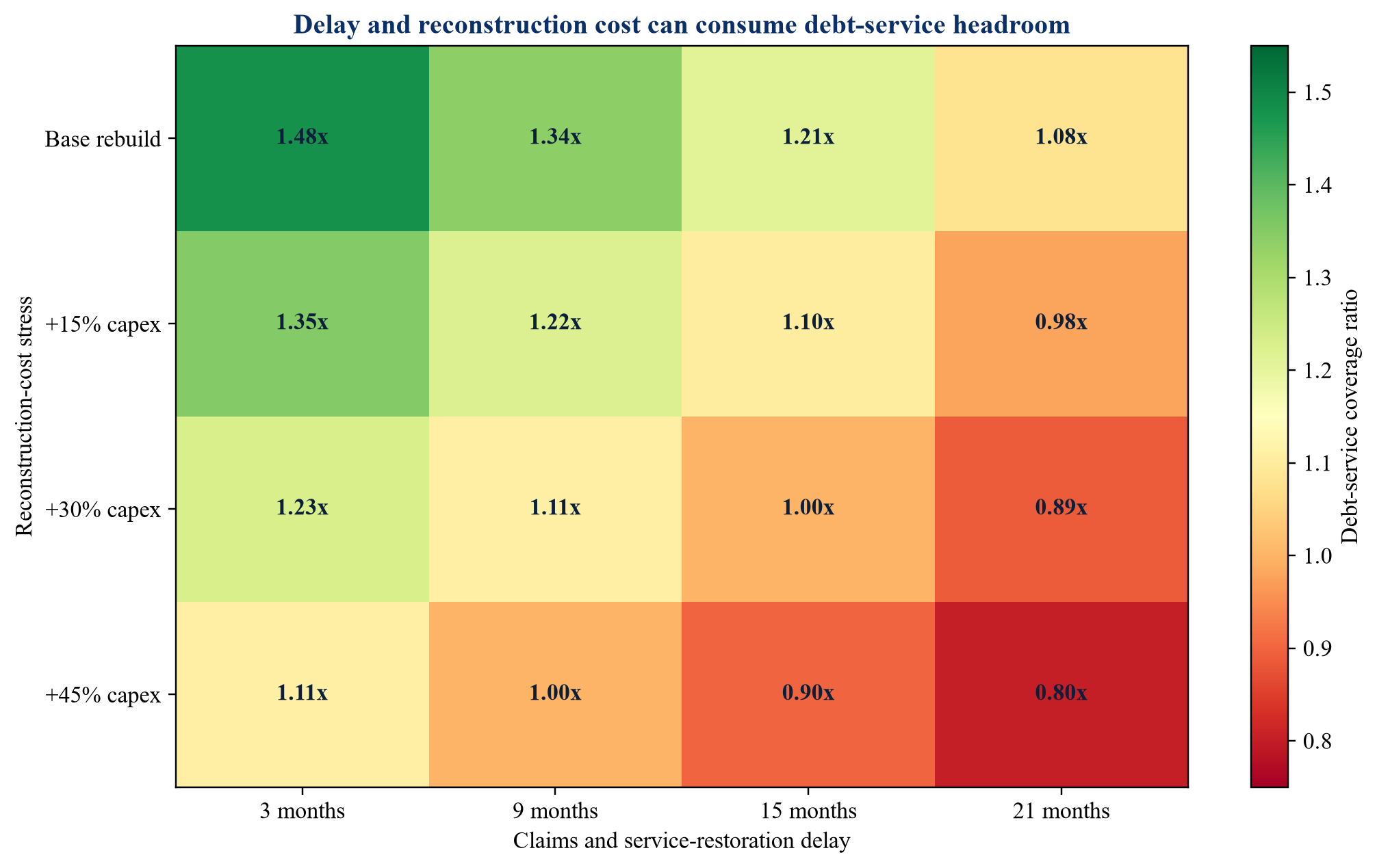
Ratios use author-modelled assumptions. They are not forecasts or observed project performance.
The model should add operating-security cost, workforce retention, alternate fuel, logistics and cyber response. The downside case should show the liquidity low point and the date at which sponsor or public support is required.
24 Allocate risks in the contracts
Table 3. Illustrative war-risk allocation matrix
| Risk | Primary control owner | Allocation mechanism | Financing response |
|---|---|---|---|
| Direct asset damage | Owner and operator | Insurance, hardening and emergency response | Deductible reserve, cover covenant and repair waterfall |
| Grid or fuel dependency loss | Utility, supplier and project | Connection, supply and force-majeure terms | Diversification, alternate service and liquidity buffer |
| Excluded weapon or peril | Sponsor and public authority | Retention, indemnity or public contingency | Equity sizing, stop-loss and sovereign engagement |
| Access and evacuation | Operator and government | Emergency protocol and non-damage extension | Minimum staffing, remote operation and reserve |
| Reconstruction escalation | Owner, EPC and insurer under agreed terms | Replacement-value review, indexation and contingency | Cost-overrun facility and sponsor support |
| Claims delay | Insured, broker and insurer | Evidence protocol, interim payment and dispute route | Claims bridge and debt-service reserve |
| Currency or transfer restriction | Government and financing parties | Political-risk cover, offshore accounts and contractual adjustment | Currency reserve, hedge where lawful and maturity headroom |
| Cyber conflict | Operator and insurers | Cyber controls and reconciled policy wording | Incident liquidity and excluded-loss scenario |
| Sanctions constraint | All transaction parties | Compliance protocol, lawful alternatives and policy terms | Alternate bank and procurement routes; payment contingency |
| Total loss and termination | Owner, lenders and public counterparty | Objective tests, compensation and proceeds waterfall | Debt prepayment, rebuild vote and equity loss allocation |
Allocation should be reflected in definitive contracts, policies and public instruments under applicable law.
Unallocated exposure usually returns to the project company. The matrix should identify that outcome explicitly. A force-majeure clause that excuses performance without providing cash does not fund debt service.
25 Use public support with a defined attachment
Public guarantees can restore capacity where correlated conflict risk exceeds private appetite. The attachment should be clear: first loss, excess loss, portfolio guarantee, reinsurance or specific political-risk cover. Donors and taxpayers need eligibility, reporting and claims governance.
The EBRD's Ukraine facility illustrates a guarantee supporting reinsurance for specified locally written war risks. Its published initial focus on mobile and transit assets also demonstrates that a facility can begin with bounded exposures and expand as experience and capacity develop.
26 Design for degraded operation
The asset should define minimum safe service after damage. Microgrids, sectionalising, black-start capability, mobile generation, redundant communications, spare transformers and alternate control sites can reduce interruption.
Degraded operation needs fuel, staffing, security and dispatch rules. The value case should quantify avoided service loss and the financing benefit from lower interruption. Insurance premium savings can be included only when supported by quotations.
27 Prepare the reconstruction standard
The project should decide whether proceeds restore the original design or build to a new resilience standard. Codes, technology and network needs can change. Betterment may be excluded from indemnity unless required or agreed.
A reconstruction protocol should approve scope, procurement, independent engineering, cost, schedule and change. Public grants or sponsor equity can fund resilience upgrades beyond insured reinstatement.
28 Establish governance
The board should approve risk appetite, retained limits, insurance strategy, public-support assumptions and emergency authorities. A cross-functional committee should include operations, engineering, finance, insurance, legal, cyber, security and public affairs.
Reporting should show insured values, exclusions, deductibles, aggregates, claims readiness, reserve adequacy, concentration and remediation. Renewals should begin early enough to address market withdrawal or changing terms.
29 Implement in twelve months
Months one to three should define the service, perimeter, asset register, dependencies and peril taxonomy. Months four to six should complete policy and contract gap analysis, replacement values and initial stress models. Months seven to nine should negotiate protection, reserves, lender rights and public support. Months ten to twelve should complete exercises, claims evidence, liquidity arrangements and board approval.
Existing policies should remain in force during review. Material gaps should enter a named remediation plan. Urgent operational controls can proceed before final insurance placement where authorised.
30 Set investment gates
Gate one approves the service and scenario. Gate two approves values, dependencies and retained loss. Gate three confirms insurance, public support and contract allocation. Gate four confirms liquidity and lender rights. Gate five tests claims and emergency operation.
Each gate should identify evidence, owner, deadline and stop condition. Assumptions should remain outside the insured base case until supported by binding terms.
31 Measure performance
Useful measures include insured-value accuracy, policy gaps, concentration, reserve coverage, claims-document completeness, restoration time, degraded-service capacity and unresolved exclusions. Premium alone is a weak performance measure.
Exercises should test notification, authority, evidence, payment and restoration. Findings should update policies, contracts and capital. Repeated exceptions should affect eligibility for distributions or new investment.
32 Interpret insurance as one control layer
Insurance can transfer defined financial loss and provide claims expertise. It cannot guarantee access, replacement equipment, grid restoration, workforce safety or public permission. The investment decision should recognise each function separately.
The strongest structure combines loss prevention, resilience, contract relief, liquidity, insurance, public mechanisms and equity. Layering also reduces dependence on one market that may withdraw after an event.
33 Translate war risk into valuation and transaction terms
War-risk diligence should connect operational exposure to enterprise value, debt capacity and transaction documents. A risk register that sits outside the financial model leaves the investment committee without a quantified decision. The valuation should therefore translate each material loss pathway into revenue, cost, capital expenditure, working capital, liquidity and timing assumptions. The transaction team can then allocate responsibility through price, conditions, covenants, indemnities, insurance and post-closing actions.
The base case should include only protection supported by existing policies, executed contracts, funded reserves or binding public instruments. Proposed renewals, anticipated endorsements, expected government assistance and indicative broker capacity belong in clearly identified scenarios until they become enforceable. This treatment avoids capitalising a benefit that may disappear during underwriting, sanctions review, documentation or policy renewal.
A discounted cash-flow model should distinguish three effects. The first is expected operating performance under ordinary conditions, including recurring security, resilience and compliance costs. The second is the defined downside scenario, including reduced availability, repair expenditure, delayed revenue, higher logistics cost and claims timing. The third is residual tail exposure outside the protection stack. Combining these effects into a single risk-premium adjustment can conceal the source and timing of loss. Explicit cash-flow scenarios show when liquidity is required and which stakeholder bears it.
Transaction multiples also require adjustment. A buyer comparing an exposed energy asset with a diversified peer should examine insured-value accuracy, concentration, dependency redundancy, claims history, policy stability and the enforceability of public or contractual support. A higher premium or deductible may be manageable where cash generation and reserves remain strong. A low premium can coexist with a large exclusion, short cancellation provision or insufficient indemnity period. Price should follow the economic protection delivered by the complete structure.
Debt sizing should use the stressed cash flow that remains available after deductibles, waiting periods, security cost and minimum restoration expenditure. Claim proceeds should enter the model when the policy and claims assumptions support their timing. A claim expected after the debt-service date does not solve the immediate liquidity requirement. The financing package can address the interval through a debt-service reserve, claims bridge, sponsor facility or committed public mechanism. Each source should have defined availability, priority, maturity and repayment.
Acquisition agreements should identify the condition of policies, asset schedules, claims, notices, premium payment, sanctions compliance and insurer correspondence. Representations can address accuracy and disclosure, while covenants can preserve cover between signing and closing. A specific indemnity may address a known uninsured event, subject to negotiated scope, duration, cap and credit support. Purchase-price retention or escrow can support an obligation where the seller's future credit is uncertain. These mechanisms should reflect legal advice for the transaction and governing law.
Conditions precedent should focus on items that determine financeability. Examples include an acceptable policy and endorsement package, lender notices, updated replacement valuations, funded reserves, executed emergency-service agreements, evidence of lawful payment routes and resolution of material exclusions. A condition should use measurable evidence and an identified approver. Broad wording that requires satisfactory insurance without defining the required features can delay closing and create disagreement.
Post-closing plans should prioritise exposures that can alter value quickly. The first hundred days can reconcile asset data, close policy gaps, update emergency authorities, secure off-site records, confirm critical spares and test the claims protocol. Longer-term measures can redesign network redundancy, relocate control functions, diversify logistics and negotiate public-support mechanisms. The value-creation plan should state the expected operational effect, required capital, accountable executive and completion evidence for each measure.
Portfolio transactions add aggregation risk. A buyer may acquire several assets that share one conflict zone, port, grid node, insurer aggregate or control platform. Asset-level diligence can miss this concentration. The portfolio model should test concurrent interruption, shared-policy exhaustion, simultaneous deductible funding and competition for the same replacement equipment. Limits and reserves should then be allocated across the portfolio under a documented rule.
The investment committee should receive a reconciliation from gross exposure to residual equity risk. The schedule should show the modelled loss pathway, operational mitigation, contract relief, insured recovery, public protection, liquidity timing and remaining amount. It should also identify assumptions that depend on future action. This reconciliation creates a common record for the investment case, financing documents, insurance placement and operating plan.
A transaction can proceed with material residual war risk when the exposure is visible, bounded and supported by sufficient return and liquidity. The approval record should state the accepted residual exposure, decision owner, monitoring trigger and action if protection weakens. Renewal, cancellation, geographic escalation, sanctions change, counterparty downgrade and material damage can each trigger re-underwriting or distribution restrictions. This governance preserves the economic bargain after closing.
34 Prepare the placement and renewal strategy
War-risk capacity can change as loss experience, geographic aggregation, sanctions and reinsurance conditions develop. The project should approach placement as a controlled financing workstream. The process begins with accurate information, a defined protection objective and sufficient time for underwriting, engineering review, public-facility eligibility and lender approval.
The submission should describe ownership, project purpose, asset locations, construction or operating status, values, revenue contracts, security, loss history and requested cover. It should also explain risk controls. Underwriters need evidence of site protection, network redundancy, emergency response, cyber architecture, maintenance, critical spares, access arrangements and management authority. A concise submission with reconciled schedules supports a clearer underwriting decision than a large data room containing inconsistent asset and financial records.
The requested structure should separate essential protection from optional extensions. Essential items may include specified physical damage, business interruption, political violence, expropriation, currency restriction or contract-related protection, depending on the investment and financing. Optional layers can then be tested for price and capacity. This hierarchy helps the project preserve the core financing requirement when the market cannot provide the entire preferred programme.
Competing quotations should be compared through a clause and economics matrix. Premium, tax and fees form one part of the comparison. Definitions, exclusions, sublimits, deductibles, waiting periods, cancellation rights, insurer security, claims control, governing law and dispute routes can change economic value more significantly. A lower quoted premium can impose higher retained loss, shorter indemnity or weaker certainty. The board should receive the full comparison.
Co-insurance and layered programmes require consistent terms. Different insurers can apply separate exclusions, claims-control provisions or interpretations of one event. The lead wording, follow-form arrangements, attachment points and exhaustion requirements should be documented. The project should understand whether a disputed underlying claim can delay an excess layer and whether each insurer recognises the same loss evidence.
Public or multilateral engagement may require separate eligibility, environmental, social, development, procurement or integrity work. These requirements should enter the closing plan early. The project should avoid representing expected public support as committed capacity until approval and documentation are complete. Where a public instrument operates through a local insurer or reinsurer, the diligence team should map every contract in the chain and identify who pays the insured claim.
Renewal preparation should start with changes since the prior placement. Asset additions, revised values, new debt, altered counterparties, geographic exposure, incidents, claims and control improvements should be disclosed through a controlled process. Management should compare expiring and proposed terms clause by clause. A renewal that preserves the headline limit while adding a material exclusion or reducing an interruption period can weaken the financing package.
The project should maintain alternatives for a constrained renewal. Options can include additional retention, a higher deductible, a smaller insured layer, captive participation, sponsor support, a public guarantee, operating redesign or debt reduction. Each option changes capital, governance and residual exposure. The contingency decision should be prepared before the expiry date and should identify which operating or distribution actions apply if cover falls below the approved minimum.
Claims experience should feed the renewal submission and the capital plan. A project should record event chronology, mitigation, evidence quality, insurer interaction, interim payments, disputes, restoration and lessons. This record supports underwriting and reveals operational changes that may reduce future loss. Open claims should be reconciled to accounting, cash forecasts, lender reporting and any proposed transaction.
Placement governance should define authority to accept terms, change limits, agree exclusions and bind cover. Material deviations from the approved protection objective should return to the designated committee. The final record should include the policy package, comparison matrix, approvals, premium funding, lender acknowledgements and unresolved actions. This evidence allows the project to demonstrate the protection that actually exists at inception and renewal.
Conclusion
War risk is not one peril and cannot be solved by one policy. Energy assets face direct damage, interruption, dependency failure, government action, currency constraints, cyber loss, reconstruction escalation and claims delay. Each exposure needs a named owner and funded response.
The framework converts uncertainty into a capital and operating plan. It defines the service, maps the loss chain, tests policy wording, reconciles values, allocates exclusions, sizes liquidity, preserves lender rights and establishes reconstruction gates. Public facilities can expand capacity when they attach to bounded exposures and transparent claims rules.
An investable project states the residual risk. Senior debt is protected by surviving cash flow, reserves, enforceable contracts and responsive cover. Equity carries the agreed remainder. Governments address exceptional public-service consequences through pre-defined instruments. Operational resilience reduces the loss before financial protection begins.
The practical test is whether the project can protect people, maintain essential service, fund immediate response and restore productive capacity under the selected scenario. A policy supports that result only when the peril, asset, evidence, liquidity and reconstruction route align.
References
- Multilateral Investment Guarantee Agency, War and Civil Disturbance. https://www.miga.org/product/war-and-civil-disturbance
- Multilateral Investment Guarantee Agency, Political Risk Insurance. https://www.miga.org/political-risk-insurance
- Multilateral Investment Guarantee Agency, Ukraine Investment Support. https://www.miga.org/ukraine
- World Bank Group, World Bank Group Guarantee Platform. https://www.worldbank.org/en/programs/guarantees-platform
- World Bank, Ukraine Rapid Damage and Needs Assessment. https://www.worldbank.org/en/country/ukraine/publication/rapid-damage-and-needs-assessment-rdna4
- European Bank for Reconstruction and Development, EBRD and Aon launch war-risk insurance facility for Ukraine, 2024. https://www.ebrd.com/home/news-and-events/news/2024/ebrd-and-aon-launch-innovative-war-risk-insurance-facility-for-u.html
- European Bank for Reconstruction and Development, Overview of EBRD Activities in Ukraine, 2024. https://www.ebrd.com/content/dam/ebrd_dxp/assets/pdfs/donor-co-financing/annual-reports/Highlights-2024.pdf
- European Bank for Reconstruction and Development, EBRD deploys record EUR 2.4 billion in Ukraine in 2024. https://www.ebrd.com/home/news-and-events/news/2025/EBRD-deploys-record--2-4-billion-in-Ukraine-in-2024.html
- U.S. International Development Finance Corporation, Political Risk Insurance. https://www.dfc.gov/what-we-offer/our-products/political-risk-insurance
- U.S. International Development Finance Corporation, Political Risk Insurance Facilities for Private Equity Investment Funds. https://www.dfc.gov/sites/default/files/2019-08/Political%20Risk%20Insurance%20Facilities%20for%20Private%20Equity%20Funds.pdf
- U.S. International Development Finance Corporation, Tripling Electricity Generating Capacity in Togo. https://www.dfc.gov/investment-story/tripling-electricity-generating-capacity-togo
- U.S. International Development Finance Corporation, Adding 86 MW of Power in Senegal. https://www.dfc.gov/investment-story/adding-86-mw-power-senegal
- U.S. International Development Finance Corporation, DFC and MIGA Cooperation on Political Risk Insurance in Ukraine, 2026. https://www.dfc.gov/media/press-releases/dfc-miga-sign-agreement-advance-political-risk-insurance-ukraine
- UK Export Finance, Overseas Investment Insurance. https://www.gov.uk/guidance/overseas-investment-insurance
- UK Export Finance, Enhanced Overseas Investment Insurance, 2017. https://www.gov.uk/government/news/ukef-launches-enhanced-overseas-investment-insurance-product-to-protect-uk-businesses-investing-abroad
- UK Export Finance, Export Insurance Policy. https://www.ukexportfinance.gov.uk/products-and-services/export-insurance-policy/
- UK Export Finance, Annual Report and Accounts 2023 to 2024. https://www.gov.uk/government/publications/uk-export-finance-annual-report-and-accounts-2023-to-2024
- OECD, Arrangement on Officially Supported Export Credits. https://www.oecd.org/trade/topics/export-credits/arrangement-and-sector-understandings/
- OECD, Country Risk Classification. https://www.oecd.org/trade/topics/export-credits/arrangement-and-sector-understandings/financing-terms-and-conditions/country-risk-classification/
- Berne Union, About the Berne Union. https://www.berneunion.org/Stub/Display/8
- International Association of Insurance Supervisors, Insurance Core Principles. https://www.iaisweb.org/activities-topics/standard-setting/icps-and-comframe/
- International Association of Insurance Supervisors, Global Insurance Market Report. https://www.iaisweb.org/activities-topics/financial-stability/global-insurance-market-report/
- International Energy Agency, Ukraine's Energy Security and the Coming Winter, 2024. https://www.iea.org/reports/ukraines-energy-security-and-the-coming-winter
- International Energy Agency, Energy Security. https://www.iea.org/topics/energy-security
- International Atomic Energy Agency, Nuclear Safety, Security and Safeguards in Ukraine. https://www.iaea.org/topics/response/nuclear-safety-security-and-safeguards-in-ukraine
- International Committee of the Red Cross, Protection of Objects Indispensable to the Survival of the Civilian Population. https://ihl-databases.icrc.org/en/customary-ihl/v1/rule54
- International Committee of the Red Cross, International Humanitarian Law and the Challenges of Contemporary Armed Conflicts. https://www.icrc.org/en/document/ihl-challenges-report-2019
- United Nations Office for Disaster Risk Reduction, Principles for Resilient Infrastructure. https://www.undrr.org/publication/principles-resilient-infrastructure
- United Nations Development Programme, Energy Infrastructure Recovery in Ukraine. https://www.undp.org/ukraine/energy
- European Commission, Critical Entities Resilience Directive. https://home-affairs.ec.europa.eu/policies/internal-security/counter-terrorism-and-radicalisation/protection/critical-infrastructure-resilience_en
- European Commission, Ukraine Facility. https://enlargement.ec.europa.eu/funding-technical-assistance/ukraine-facility_en
- European Union, Directive (EU) 2022/2557 on the resilience of critical entities. https://eur-lex.europa.eu/eli/dir/2022/2557/oj
- U.S. Department of Energy, Cybersecurity, Energy Security, and Emergency Response. https://www.energy.gov/ceser/office-cybersecurity-energy-security-and-emergency-response
- U.S. Cybersecurity and Infrastructure Security Agency, Energy Sector. https://www.cisa.gov/topics/critical-infrastructure-security-and-resilience/critical-infrastructure-sectors/energy-sector
- National Institute of Standards and Technology, Community Resilience Planning Guide. https://www.nist.gov/topics/community-resilience/planning-guide
About the Author
Chennakeshav (CK) is a corporate finance and investment banking executive with 25+ years of global experience in deal origination, structuring and execution across M&A, growth capital and corporate strategy. He has led value-creation mandates for founders, corporates and funds — bridging the boardroom view to hands-on execution and close.
His career spans Morgan Stanley, HSBC, Lloyds Banking Group, EWEC, ADQ portfolio companies and Emirates Growth Fund, across TMT, real estate, fintech, deeptech, cleantech, infrastructure and energy. He has partnered with C-suite leaders, private equity and venture funds, sovereign wealth funds and family offices to finance complex fund raises and scale-up ventures, and has led M&A due diligence, post-merger integration and business-transformation initiatives to create value.
At Matchpoint Partners he is Managing Partner, leading the firm's corporate finance, M&A and capital-raising practice. He holds an MBA from London Business School, an engineering degree from VTU and a Master of Laws (LLM, in progress) from UCL London.
An active start-up mentor, CK mentors at Techstars, DIFC FinTech Hive, Startup Grind, Founder Institute and IN5, serves as Entrepreneur Mentor in Residence (EMiR) at London Business School, and judges the Entrepreneurship World Cup.
