
1. Water belongs in the location decision
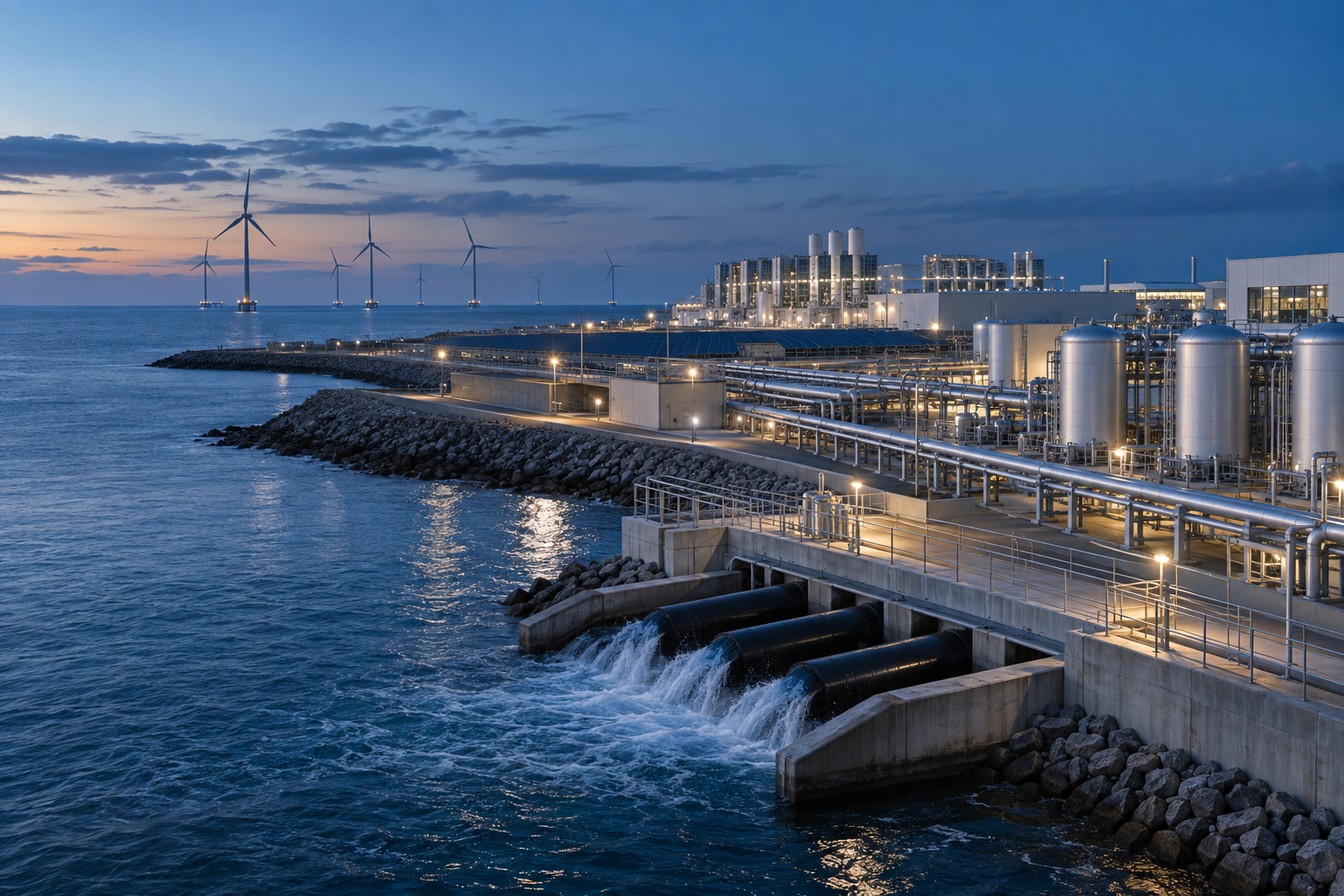
The water question begins before electrolyser selection. A hydrogen site can combine excellent renewable resources, port access and prospective offtake while remaining unfinanceable because the water source is fully allocated, seasonally unreliable, politically contested or dependent on infrastructure that will complete after the production plant. Treating water as a commodity purchase after site selection places a foundational interface outside the main investment decision.
The correct starting point is the local water system. Sponsors should identify who owns and regulates the resource, which users already depend on it, how availability changes through drought and climate conditions, what quality reaches the site, which treatment and conveyance assets are required, and where residuals can lawfully go. The answer can favour municipal recycled water, industrial effluent, brackish groundwater, seawater desalination, surface water or a portfolio of sources. The lowest quoted tariff may not provide the most reliable or socially durable supply.
This framing changes transaction strategy. Location value reflects enforceable rights, infrastructure readiness, treatment recovery, discharge capacity and community acceptance. A cheap power site with weak water evidence should carry schedule, capital and terminal-value adjustments. Water diligence should therefore run alongside power, land and offtake diligence from the first investment screen.
2. The chemical minimum is not the project requirement
Electrolysis consumes water according to reaction stoichiometry. The United States Department of Energy uses 8.93 kilograms, or about 2.36 US gallons, of water consumed per kilogram of hydrogen as the reaction minimum [1]. A plant cannot operate at this theoretical number because feedwater must be purified, equipment loses water, and cooling or ancillary systems may withdraw and consume additional volumes.
DOE's 2026 programme record separates consumption, additional withdrawals and total withdrawals across minimal, efficient and unconstrained cases [1]. That distinction is essential. Water withdrawn from a source can exceed water chemically incorporated into hydrogen. Some water returns as concentrate, blowdown or treated discharge. Some evaporates or leaves with product streams. The environmental and infrastructure implications depend on where and in what condition it returns.
A credible investment case therefore presents at least four numbers: raw-water withdrawal, treated-water production, net consumption and discharge. It also states the boundary. A figure covering only the electrolyser stack cannot support a permit, utility agreement or community claim for the complete site. The balance must include purification, polishing, cooling, washing, steam, firewater, domestic use and downstream synthesis where those facilities share the project boundary.
3. The complete water balance is a chain
Water reaches the electrolyser through a sequence of assets and losses. The chain can include abstraction, screening, pretreatment, membrane filtration, reverse osmosis, demineralisation, storage, pumping, polishing, stack circulation, cooling, condensate recovery, wastewater treatment and discharge. Each step changes quantity, quality, energy demand and residuals.
The figure maps this chain. Its percentages are illustrative and do not describe a named technology or site. A project should replace them with supplier guarantees, raw-water testing, operating philosophy and seasonal cases. The purpose is to prevent a single litres-per-kilogram assumption from concealing the assets that support it.
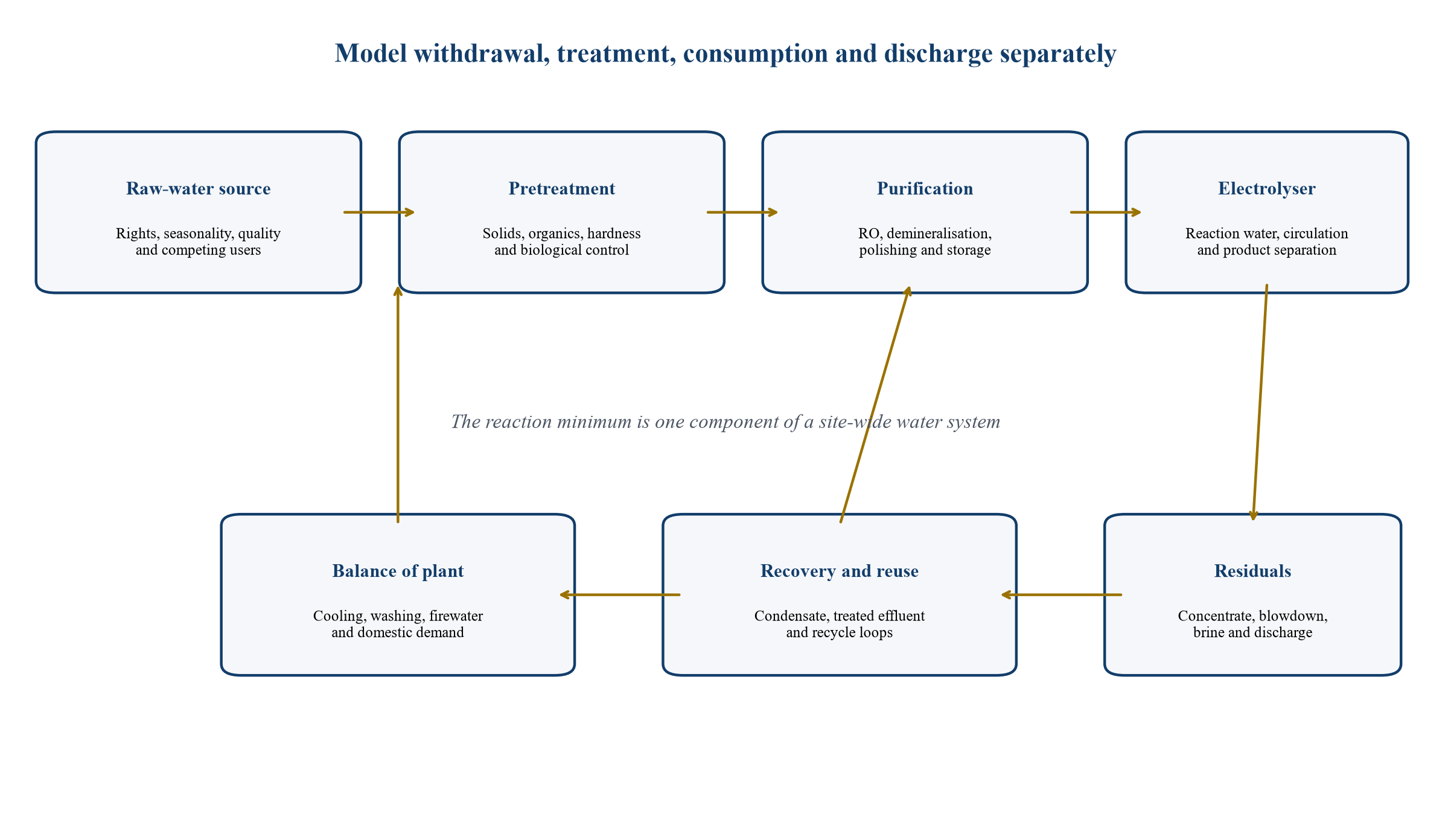
Percentages and flows are illustrative. Actual recovery, recycling and consumption depend on water quality, treatment design, cooling system, operating conditions and discharge requirements.
4. Source quality determines treatment architecture
Electrolysers require high-purity feedwater, while source waters carry different combinations of dissolved salts, hardness, silica, organics, suspended solids, microbes and industrial contaminants. Municipal potable water can reduce pretreatment complexity but may be scarce, politically sensitive and priced to recover public-system costs. Recycled municipal or industrial water can protect freshwater supplies while requiring robust characterisation and treatment. Seawater is abundant near suitable coasts and creates desalination, intake and brine obligations.
Raw-water testing should cover normal, seasonal and upset conditions. A single laboratory sample does not establish design quality. Storms, algal blooms, industrial discharges, temperature, salinity and upstream operations can alter membrane loading and chemical demand. The engineering basis should define the worst credible envelope, pretreatment redundancy, cleaning cycles, consumables, reject management and product-water guarantees.
Source quality also affects schedule and financing. A treatment supplier may guarantee outlet quality only within a specified inlet range. If the utility or source agreement does not guarantee that range, the project retains interface risk. Lenders will examine whether off-spec water reduces hydrogen output, damages equipment or triggers warranty exclusions. The water contract, treatment design and electrolyser warranty must therefore align at the same quality boundary.
5. Freshwater carries an opportunity cost beyond tariff
Freshwater may appear inexpensive where regulated tariffs or historic allocations do not reflect scarcity. The project still competes with households, agriculture, ecosystems and existing industry. In a water-stressed basin, a nominal tariff can understate the economic, political and social cost of taking a durable share of supply.
The IEA reported that around 40 percent of planned low-emissions hydrogen projects in its 2024 pipeline were located in water-stressed regions [3]. The statistic does not prove that each project is unsustainable. It establishes the need for local analysis rather than a global litres-per-kilogram comparison. Basin condition, source, season, return flow and alternative supply determine impact.
Sponsors should price scarcity through scenarios that include tariff escalation, drought curtailment, mitigation commitments, replacement supply and delay. They should also test the value created by using recycled or desalinated water. A more expensive source can protect production, strengthen community legitimacy and preserve freshwater for higher-value uses. The board should see both the accounting tariff and the risk-adjusted cost of the source decision.
6. Recycled water can connect hydrogen with local infrastructure renewal
Treated municipal wastewater and industrial effluent can offer a dependable source near cities, refineries, chemical clusters and ports. Using it can reduce freshwater abstraction and create revenue for wastewater upgrades. The opportunity depends on flow, quality, competing reuse, conveyance, public-health rules and the reliability of the treatment operator.
Recycled water is not automatically available because it reaches an outfall. Municipalities may already plan reuse for irrigation, industrial demand or environmental flows. Industrial effluent can vary with the host plant's operations and may contain constituents that complicate treatment. The hydrogen project needs rights to volume and quality through drought, shutdowns and future changes in upstream users.
The commercial structure can include a long-term supply agreement, shared treatment investment and service standards. It should allocate inlet-quality excursions, minimum flow, planned outages, emergency supply, capital expansion, tariff indexation and residual disposal. Where the project finances public-system upgrades, procurement and ownership should preserve completion accountability. A shared asset can create local value, while an unclear interface can delay both the water system and hydrogen plant.
7. Desalination can be cheap per kilogram and material as a system
Public analyses frequently find that desalination adds only a small amount to hydrogen production cost. DOE estimated an incremental range of approximately USD 0.01 to USD 0.04 per kilogram of hydrogen under the assumptions cited in its water-use explanation [5]. Australia's hydrogen strategy similarly stated that the electricity cost of desalination could be below five cents per kilogram [6]. These figures are useful scale indicators rather than universal project costs.
The unit-cost contribution can remain small because electrolysis electricity dominates hydrogen cost and the chemical water requirement is modest relative to a kilogram of product. The system consequences can still be material. A coastal project may need intake and outfall structures, pretreatment, reverse osmosis, polishing, storage, pipelines, pumping, land, grid or renewable capacity, brine dispersion studies and marine permits. Inland delivery can add elevation, distance and rights-of-way.
The correct comparison includes delivered demineralised water at the electrolyser battery limit and all associated completion risk. A sponsor should separate the mature process of desalination from the site-specific challenge of permitting, connecting and operating the entire system. Small unit cost does not establish small capital exposure or short schedule.
8. Brine is a project output with its own permit path
Reverse osmosis concentrates salts and constituents removed from feedwater. Coastal disposal requires intake and outfall design, mixing-zone analysis, marine ecology evidence, monitoring and compliance with local rules. Inland concentrate can be more difficult because a nearby receiving body may be unavailable and evaporation, deep-well injection, crystallisation or off-site disposal can be costly.
Brine risk depends on salinity, temperature, treatment chemicals, discharge location, currents and ecological sensitivity. Co-location with an existing desalination or industrial outfall may create efficiencies, but shared capacity and liability must be verified. The project should not assume that a water permit automatically authorises concentrate disposal.
Environmental studies, baseline data and stakeholder consultation can become critical-path activities. Financing documents should treat the intake, treatment and outfall as part of the minimum complete facility where hydrogen production depends on them. A delayed outfall can strand a finished electrolyser. Completion tests should therefore include lawful, stable water production and residual management at required throughput.
9. Inland projects face a different water equation
Inland renewable resources can be strong while water and discharge options are weak. Transporting desalinated water inland requires pipelines, pumping energy, easements and elevation. Brackish groundwater may be available but can affect aquifers and create concentrate without a marine outlet. Municipal recycled water may offer a practical source where population centres and hydrogen loads align.
The location model should compare moving electrons, water, hydrogen and derivatives. Locating the electrolyser at the coast can simplify water and export logistics while requiring power transmission. Locating near renewable generation can reduce electrical infrastructure and require water conveyance or hydrogen transport. Producing ammonia or another derivative at either site changes the balance again.
The decision should use common boundaries and realistic infrastructure dates. A low-cost renewable resource does not create value if the water pipeline, grid connection or product route cannot complete. Optionality can come from phased electrolysis near existing water and network capacity, followed by expansion when dedicated infrastructure is proven.
10. Cooling choice can dominate additional water demand
Electrolyser stacks, rectifiers, compressors and downstream processes reject heat. Cooling design influences water withdrawal, consumption, electricity use, capital and performance in hot climates. Wet cooling can consume water through evaporation and blowdown. Dry cooling reduces consumption while increasing capital and auxiliary load and can reduce performance during high ambient temperatures. Hybrid systems trade between the two.
DOE's current water-use work explicitly separates reaction water, purification and cooling assumptions [1, 4]. That structure should be reproduced in project models. A water intensity quoted without its cooling basis is incomplete. Ammonia synthesis, hydrogen compression and other integrated processes can introduce additional cooling loads beyond the electrolyser.
The design case should test hourly temperature and humidity, not only annual averages. Peak ambient conditions may coincide with low water availability or high power prices. Sponsors should value production derating, water storage and hybrid operating modes. The preferred system minimises total delivered-hydrogen cost and local impact under actual climate conditions rather than optimising one engineering metric.
11. Operating profile changes both volume and treatment economics
An electrolyser following variable renewable generation may cycle and operate below nameplate capacity. Annual water demand falls with production, but treatment equipment, storage and minimum operating requirements do not scale linearly. Frequent starts, low flows and long standby periods can affect water quality, membrane operation and chemical use.
The water system should be sized around hourly production, maintenance and reserve requirements. It may run steadily and fill product-water storage while the electrolyser varies. This can improve treatment efficiency and create operating buffer. It also introduces storage quality, tank capacity and working-capital considerations.
Contracts need to reflect the operating profile. A take-or-pay water agreement sized to nameplate demand can burden a low-utilisation plant. A purely volumetric contract may not support the supplier's dedicated infrastructure. Capacity and usage charges can align fixed and variable costs. The base case should separate treatment availability from hydrogen utilisation and show how each affects unit cost.
12. Water source screening should eliminate weak locations early
A disciplined screen compares sources on reliability, quality, capital, operating cost, permit path, residuals, schedule, community impact and expansion. The table is a generic framework. Ratings should be replaced with site evidence.
Table 1. Water-source screening matrix for an electrolytic hydrogen project
| Source | Strategic strength | Principal constraint | Required evidence | Typical mitigation |
|---|---|---|---|---|
| Potable municipal water | Existing treatment and network | Competing essential demand and tariff or allocation risk | Long-term capacity, drought rules, quality and expansion plan | Limit use, fund alternative supply or reserve for emergency only |
| Surface water | Potential scale and established allocation systems | Seasonality, ecosystem flows and climate sensitivity | Basin allocation, hydrology, permits and competing-use analysis | Storage, diversified sources and conservative drought case |
| Groundwater | Local supply and potentially stable quality | Aquifer depletion, salinity, subsidence and concentrate | Sustainable yield, monitoring, rights and hydrogeology | Abstraction caps, recharge monitoring and alternative source |
| Municipal recycled water | Protects freshwater and can support urban infrastructure | Variable quality, competing reuse and conveyance | Flow history, future allocation, treatment tests and contract | Equalisation, advanced treatment, storage and backup supply |
| Industrial effluent | Co-location and circular use | Host-plant dependency and contaminants | Operating profile, constituent envelope and shutdown plan | Pretreatment, multiple suppliers and emergency inventory |
| Seawater desalination | Large coastal resource and controllable production | Intake, energy, brine, marine permits and coastal siting | Site tests, dispersion model, power and permit schedule | Efficient RO, suitable outfall, monitoring and shared infrastructure |
| Brackish water | Lower salinity than seawater in suitable locations | Aquifer impact and inland concentrate disposal | Sustainable yield, treatment recovery and disposal route | High-recovery treatment, monitored abstraction and residual plan |
The matrix is a generic decision framework. Project teams should replace qualitative observations with local rights, tests, engineering, permits, tariffs and stakeholder evidence.
13. Water pricing needs a complete boundary
A quoted bulk-water tariff rarely represents the full cost delivered to electrolyser specification. The project may pay abstraction fees, utility capacity charges, treatment capital, membranes and chemicals, electricity, labour, storage, pumping, wastewater treatment, discharge fees, monitoring and environmental mitigation. Dedicated assets may also require return on capital and minimum-volume commitments.
The financial model should identify the battery limit for every number. Raw water at source, potable water at a municipal meter and demineralised water at the stack are different products. A comparison that places one beside another without treatment and conveyance creates a false location advantage.
The model should also distinguish accounting cost from economic exposure. A sponsor-owned desalination plant may show low operating cost while embedding capital, renewal and performance risk. A utility tariff may transfer those risks and include escalation or curtailment rights. A third-party water-as-a-service contract may convert capital to operating expense while creating counterparty and termination exposure. The preferred structure depends on risk allocation, balance-sheet capacity and the availability required by the hydrogen offtake.
14. A cost bridge converts water assumptions into hydrogen economics
Water often contributes less to levelised hydrogen cost than electricity and electrolyser capital. This observation is useful only when it follows a complete water balance. The table illustrates how source, treatment, cooling and fixed infrastructure can change the water contribution even though all cases serve the same hypothetical hydrogen output.
The values are management-style scenarios created for analysis. They are not observed market tariffs, engineering estimates, supplier bids or forecasts. The annual hydrogen volume, water intensity and costs are simplified so the mechanics remain visible.
Table 2. Hypothetical water-cost bridge for one kilogram of hydrogen
| Component | Potable utility and wet cooling | Recycled water and hybrid cooling | Coastal desalination and dry cooling | Inland conveyed desalinated water |
|---|---|---|---|---|
| Total raw-water withdrawal, litres per kg hydrogen | 26 | 23 | 15 | 15 |
| Raw-water or utility charge | 0.045 | 0.018 | 0.002 | 0.002 |
| Treatment and polishing | 0.018 | 0.035 | 0.028 | 0.028 |
| Cooling-water system | 0.022 | 0.013 | 0.004 | 0.004 |
| Conveyance and pumping | 0.006 | 0.014 | 0.009 | 0.055 |
| Residuals and discharge | 0.004 | 0.009 | 0.012 | 0.045 |
| Fixed capacity and renewal allowance | 0.010 | 0.016 | 0.020 | 0.035 |
| Total illustrative water-system cost | 0.105 | 0.105 | 0.075 | 0.169 |
Values are illustrative USD per kilogram of hydrogen. They do not represent a quotation, forecast, engineering design or named project. Total water intensity includes reaction, treatment losses and the stated cooling configuration.
15. Small hydrogen-cost effects can coexist with large value effects
Water may represent cents within a hydrogen cost measured in dollars per kilogram. A failure to secure it can still destroy project value by delaying completion, reducing output or breaching offtake. The expected-value impact follows probability and consequence, not the percentage of steady-state unit cost.
Consider a treatment plant that adds USD 0.05 per kilogram but completes the water permit and provides reliable output through drought. Its cost can be economically attractive if it avoids months of lost hydrogen revenue or preserves debt service. Conversely, an inexpensive municipal allocation can be value destructive if it is interruptible during the operating season that supports the customer's production.
Investment committees should therefore see two analyses. The first is the full steady-state contribution to delivered hydrogen cost. The second is a risk-adjusted valuation bridge covering delay, curtailment, mitigation capital and terminal-value effects. Water should not receive little diligence merely because its base-case unit cost is low.
16. Scarcity should enter valuation through scenarios
Long-lived hydrogen assets may operate through changing rainfall, population, industrial demand and regulation. Historic average availability does not establish future reliability. The sponsor should build source-specific scenarios rather than apply a generic water-risk score as a valuation haircut.
Scenarios can include normal supply, seasonal restriction, multi-year drought, tariff reform, upstream-quality deterioration, delayed shared infrastructure and an alternative-source conversion. Each should state production impact, mitigation, capital, operating cost, recovery time and contractual remedies. Probabilities may remain uncertain; presenting consequences and breakpoints is still more informative than omitting the risk.
The valuation should distinguish temporary production loss from permanent impairment. A modular desalination option may cap downside. A source with no permitted alternative can create a larger terminal-value risk. Land, intake corridors, pipeline routes and power capacity for future treatment can preserve option value if they are secured and feasible.
17. Location screening should combine resource and transaction evidence
Renewable power maps and port maps are insufficient for siting. A financeable location needs compatible evidence across water, electricity, land, product logistics, permits, labour, community, customers and funding. Weakness in one interface can dominate several strong inputs.
The figure presents a hypothetical screening surface. It compares four archetypes using illustrative scores. A coastal industrial cluster benefits from water and logistics but can face land and permit congestion. An inland renewable zone can have excellent power and weak water or product routes. A municipal reuse cluster can align circular infrastructure with demand. A remote export site can require multiple greenfield interfaces.
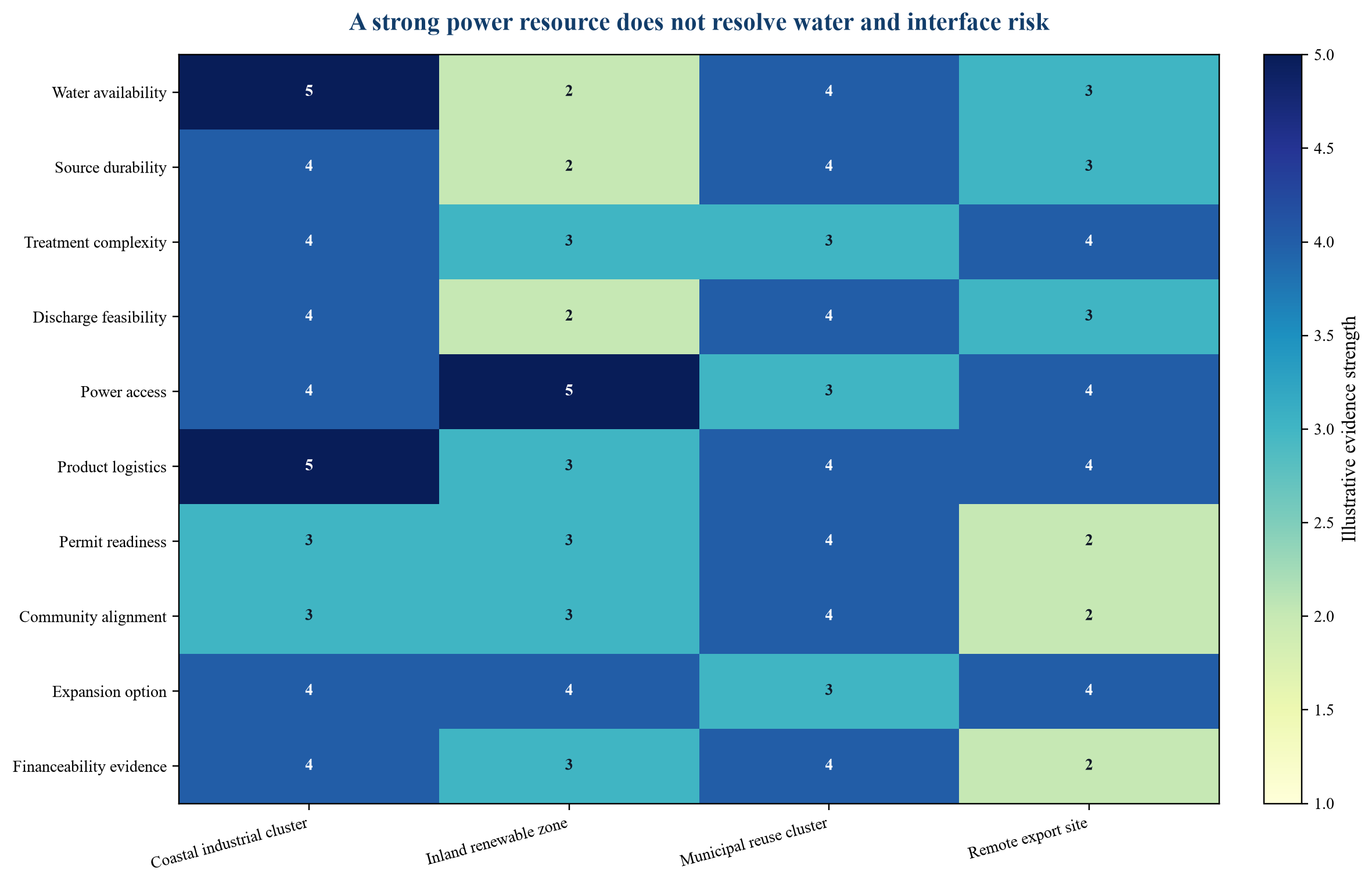
Scores are hypothetical priorities from 1 to 5. They do not assess a named location or establish technical, commercial or environmental feasibility.
18. Water rights must be enforceable for the debt tenor
Physical availability does not establish legal access. The project needs a valid allocation, licence, utility contract or property right that supports required volume and use through construction, ramp and debt maturity. It also needs clarity on priority during shortage, renewal, transfer, change of control and expansion.
Rights can depend on permits, land ownership, beneficial-use rules, basin plans or infrastructure capacity. A right may be revocable, subject to annual adjustment or junior to public needs. A utility agreement may reserve capacity while allowing emergency interruption. These provisions affect debt sizing and reserve requirements.
Legal diligence should trace the source, authority, term, conditions and appeals. Technical diligence should confirm that the physical system can deliver the legal volume. Commercial diligence should reconcile the right with the hydrogen operating profile. A paper allocation without conveyance or treatment capacity does not support completion.
19. Drought and curtailment rules belong in contracts
Drought risk should be allocated before it occurs. A water supply agreement should define shortage stages, priority, notice, rationing, emergency sources and restoration. A hydrogen offtake agreement should address whether water-related curtailment qualifies as force majeure, how supply obligations change and which party bears replacement-product cost.
Broad force-majeure language can leave the project exposed if drought is foreseeable or if alternative supply was technically available. Lenders will test whether relief matches the duration of debt service and operating costs. They will also test whether the sponsor must continue fixed water payments while hydrogen revenue stops.
A robust structure combines physical mitigation with contractual alignment. Storage can cover brief interruptions. Multiple sources or mobile treatment can address selected events. Insurance may offer limited protection and can exclude gradual scarcity or regulatory action. The residual risk should be visible in liquidity and covenant cases.
20. Shared infrastructure requires a clear capacity regime
Hydrogen projects can share desalination, recycled-water treatment, pipelines, storage and outfalls with cities or industrial clusters. Shared assets can improve scale and reduce duplication. They can also create priority, expansion and completion disputes.
The capacity regime should define reserved and interruptible volumes, quality bands, pressure, delivery points, outages, maintenance, metering and expansion. It should state how costs are allocated between initial and future users and how public benefits are funded. Cross-subsidy assumptions need transparency.
Where a municipality or regulated utility owns the system, procurement and tariff approvals can affect schedule. Where a special-purpose company owns it, credit and governance matter. The hydrogen lenders need step-in, cure and continuity arrangements proportionate to dependence. A shared-water asset is a critical counterparty even when its charge is a small part of hydrogen cost.
21. Treatment performance needs contractual boundaries
Water treatment contracts should guarantee output quantity and quality at defined inlet conditions. The specification must match the electrolyser supplier's requirements for conductivity, total dissolved solids, silica, hardness, organics and other relevant constituents. A guarantee without aligned sampling and measurement can be difficult to enforce.
The contract should cover recovery, energy consumption, chemical use, membrane life, availability, ramp, turndown, waste volumes and product-water storage. It should define responsibility for raw-water excursions and changes in upstream treatment. Performance tests need representative source conditions.
Remedies should reflect the economic consequence. Liquidated damages may address delay or underperformance, but caps can be small relative to lost hydrogen revenue. The sponsor should test redundancy, spares, consumables, supplier support and the time required to repair or replace critical equipment. Operational resilience belongs in the bankability case.
22. Electrolyser warranties depend on feedwater discipline
Electrolyser warranties can exclude damage or performance loss caused by feedwater outside specification. The project therefore needs monitoring, alarms, isolation and traceability between the treatment outlet and stack inlet. A quality event should not become an unresolved dispute between the water-system contractor and electrolyser supplier.
Interface schedules should identify sampling points, instruments, calibration, data ownership and acceptance criteria. Storage tanks and distribution lines can introduce contamination after treatment. Commissioning water, cleaning chemicals and preservation procedures also require control.
The completion programme should test the integrated system. Demonstrating treatment output in isolation is insufficient if the electrolyser cannot sustain performance using the delivered water. Integrated tests should cover normal production, turndown, source variability, transition to backup supply and recovery from an excursion.
23. Downstream derivatives add water and cooling demand
A hydrogen project may produce ammonia, methanol, synthetic fuels, direct-reduced iron or other derivatives. These facilities can require process water, steam and cooling beyond electrolysis. Quoting only electrolyser intensity understates the shared site's demand and discharge.
The integrated balance should identify each process, internal recycle and common utility. Ammonia synthesis can create substantial cooling loads. Carbon capture or synthesis routes can add washing and steam systems. Product handling and port facilities may need additional firewater and cleaning capacity.
Shared utilities can create economies and common-mode risk. A water treatment or cooling failure can stop several revenue streams. Capacity should therefore be allocated across operating cases, including one train offline, product-switching and expansion. Financing and insurance should recognise the integrated dependency.
24. Energy for water belongs in emissions accounting
Desalination, pumping and advanced treatment consume electricity. Their contribution to hydrogen emissions may be small relative to electrolysis, but it should be included where certification or customer claims use a lifecycle boundary. Long-distance or high-elevation conveyance can increase it.
The project should meter energy by subsystem and identify the power source. If water is purchased from a utility, embedded energy and emissions may be estimated under the applicable methodology. The analysis should avoid precision unsupported by supplier data.
Water-system emissions can also affect location comparisons. A coastal electrolyser using desalination may avoid pumping to an inland site, while requiring transmission of renewable electricity. The integrated power, water and product model provides the appropriate boundary. Carbon claims should follow the rules governing the target market and should be updated when those rules change.
25. Direct seawater electrolysis remains a technology question
Research into electrolysis using impure or saline water seeks to reduce pretreatment, energy or infrastructure. The potential is commercially relevant, and DOE has funded work on electrolysers tolerant of lower-quality water [5]. Research publications have also reported laboratory and demonstration advances. These developments do not remove the need to evaluate durability, selectivity, corrosion, gas purity, safety, residuals and scale.
A project financing case should distinguish conventional electrolysis supplied by desalinated and polished water from direct seawater or other emerging configurations. Technology-readiness claims require operating hours, scale, degradation, maintenance, independent testing and supplier support. A successful short-duration test does not establish multi-year availability.
Sponsors can preserve innovation options through pilot capacity and adaptable pretreatment. The base case should use the technology and water quality supported by warranties and performance evidence. Upside from future direct-use systems can remain an option until it satisfies the same completion and operating tests as the commercial plant.
26. Social licence depends on visible local allocation
Communities may assess a hydrogen project through its effect on drinking water, agriculture, ecosystems, employment and public infrastructure. A technically modest demand can attract opposition when allocation is opaque or the project appears to receive priority over existing users. Transparent evidence is therefore part of development strategy.
Engagement should explain source, volume, seasonality, treatment, discharge, drought response and public benefit in terms relevant to the locality. It should identify uncertainty and the process for monitoring it. A statement that hydrogen uses less water than another industry does not answer whether the proposed source is appropriate in that basin.
Benefit-sharing can include financing wastewater upgrades, expanding municipal desalination, creating emergency capacity, supporting monitoring or using lower-quality water that otherwise has limited value. Commitments should be specific, funded and compatible with permits. Social investment cannot substitute for a sustainable source, but a well-designed shared system can improve both project durability and local water security.
27. Public policy can improve coordination without hiding cost
Governments can support water and hydrogen development through basin planning, shared infrastructure, transparent allocation, data, streamlined permitting and finance for public-benefit components. Australia's 2024 hydrogen strategy calls for early planning and recognises that new desalination, recycling, stormwater and pipeline infrastructure may be required [6]. Its national water work has developed regional methods to evaluate hydrogen demand and competing users [7].
Support should retain cost and risk visibility. A grant can reduce initial capital, while the project still needs operating revenue, maintenance, renewal and lawful discharge. A regulated tariff can spread shared infrastructure cost, while allocation between hydrogen users and communities remains a policy decision.
The investment case should show economics before discretionary support and then add support that is awarded and enforceable. Conditions, milestones and clawback should be modelled. Public participation can improve coordination; it does not remove completion, demand or operating risk.
28. Financing should follow a minimum complete water chain
Project finance requires a water chain capable of supporting contracted hydrogen output. The minimum complete facility may include source rights, intake, treatment, storage, pumping, cooling, wastewater and outfall. Omitting a sponsor-owned or third-party interface from completion analysis can leave debt exposed to an unfinished system.
Conditions precedent should cover permits, land, source agreements, engineering, construction contracts, warranties, utility connections, environmental approvals, contingency and sponsor funding. Lenders should receive direct agreements or equivalent protections from critical water suppliers and infrastructure owners. Completion tests should measure quality, quantity, availability, energy and discharge compliance over a representative period.
Debt sizing should use the reliable water case rather than nameplate treatment capacity. A curtailed source, low recovery or high ambient temperature can reduce hydrogen production. Reserve accounts and contingent facilities should reflect the time and cost of mitigation. A water system that completes after the electrolyser should be treated as a schedule dependency, not a later operating matter.
29. Capital structure should recognise interface and ramp risk
Dedicated desalination or reuse infrastructure can be financed inside the hydrogen vehicle, in a separate utility vehicle or by a public or private third party. Each structure allocates capital, control and credit differently. Integrated ownership provides control and increases funding needs. Third-party ownership can reduce capital while introducing counterparty and tariff risk.
A separate water special-purpose vehicle may support several users and a longer asset life. Its contracts need sufficient fixed revenue and credit. Hydrogen users should retain capacity, performance and step-in protections. Cross-default and termination arrangements should avoid a failure in one vehicle unnecessarily destroying value in the other.
Construction and ramp should be modelled separately. Water infrastructure may operate before full hydrogen output and incur fixed costs. Treatment consumables, commissioning waste, initial membrane conditioning and low utilisation affect early cash flow. The funding plan should include these periods rather than assume immediate steady-state unit cost.
30. M&A diligence should treat water as an asset and liability
An acquisition of a hydrogen project or platform should verify water rights, infrastructure, permits, contracts, operating data, residuals and community commitments. Development-stage value can be overstated when a source is described as available without an executed agreement or when a treatment study omits conveyance and discharge.
The buyer should reconcile project documents with public allocations, utility plans, environmental submissions and land rights. It should identify renewal dates, change-of-control consents, security, tariff reopeners, curtailment and historic non-compliance. Technical review should compare actual or tested raw-water quality with design limits and warranties.
Transaction protections can include conditions precedent, price adjustment, escrow, indemnity and specific remediation covenants. The valuation should reduce probability-weighted value for unresolved water interfaces and include capital required to reach a financeable state. A generic contingency percentage is weaker than an evidence-based mitigation plan.
31. Diligence should concentrate on evidence gaps
Water risk can appear manageable in summary documents while material evidence remains absent. The diligence team should maintain a register linking each assumption to a right, test, design, permit, contract, owner and update date. Engineering, environmental, legal, commercial, tax, insurance and financing workstreams should use the same definitions.
The figure provides a hypothetical heatmap. High scores indicate issues where weak evidence can materially affect value, schedule or financing. The scores do not assess a named project.
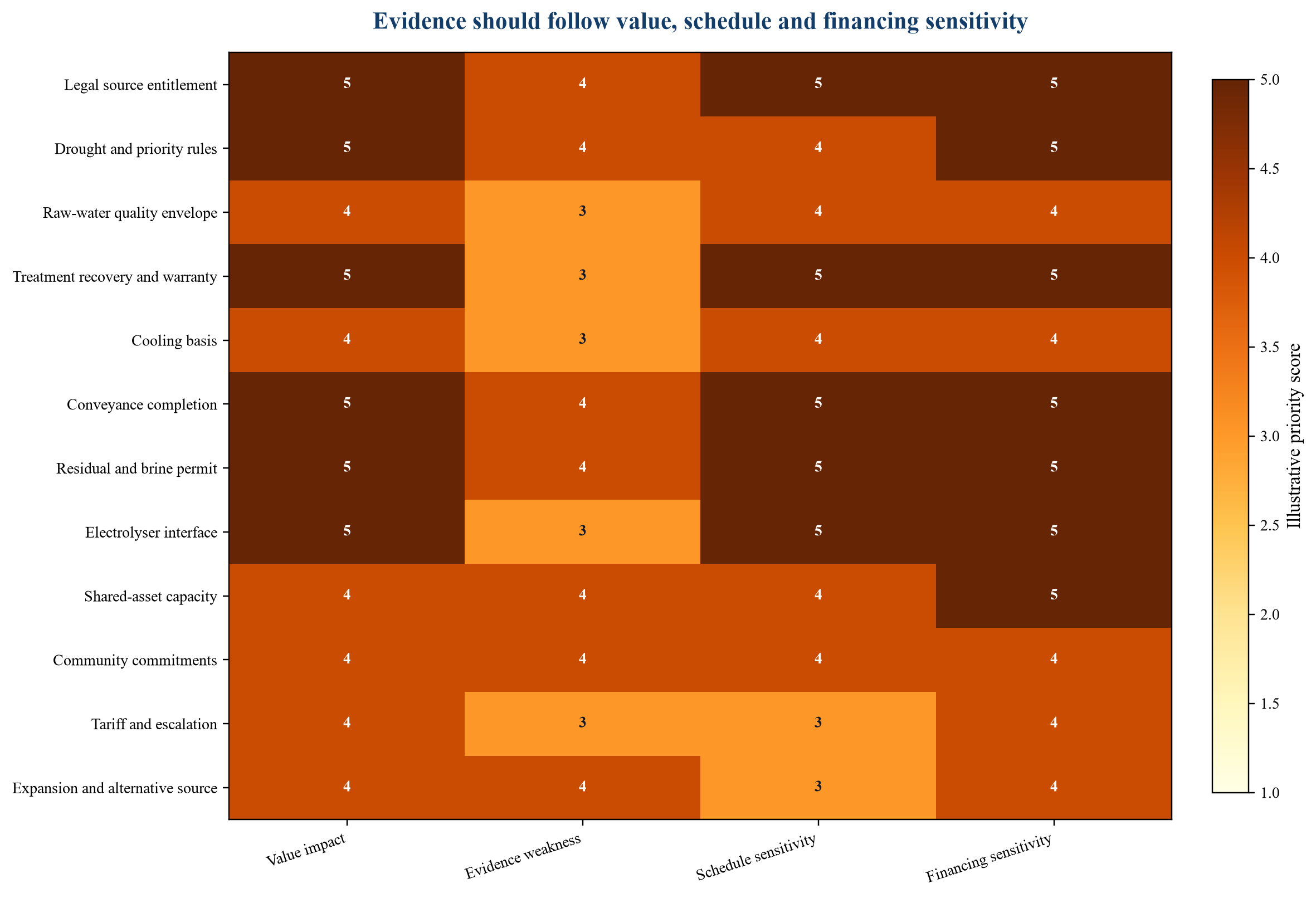
Scores are hypothetical priorities from 1 to 5 and do not assess a named source, project or jurisdiction.
32. Stage gates should prevent premature location lock-in
Water development should progress through defined gates. Early work identifies sources and competing uses. Testing and concept design establish treatment and residual options. Detailed development should follow evidence that the water chain, power system and product route can complete together.
The table provides a generic sequence. A project should define decision authority and required evidence for each gate. Failed premises should return the location to option analysis rather than pass forward as assumptions.
Table 3. Water development and financing stage gates
| Gate | Decision | Required evidence | Capital at risk | Exit test |
|---|---|---|---|---|
| Basin and location screen | Which sites warrant investigation | Source inventory, competing users, water stress, power, logistics and land | Desktop studies and options | At least one credible water and location pathway |
| Source characterisation | Which sources can support concept design | Rights, flow history, seasonal testing, quality, drought and residual options | Sampling, studies and preliminary rights | Defined source envelope and alternatives |
| Treatment concept | Can compliant water be produced and residuals managed | Pilot or vendor design, recovery, energy, cooling, discharge and storage | Concept engineering and permit studies | Integrated water balance and feasible permit path |
| Commercial structuring | Can supply and infrastructure be contracted | Capacity, quality, tariff, curtailment, performance, ownership and expansion | Negotiation and development capital | Contracts align with electrolyser and offtake obligations |
| Detailed design and permits | Can the complete chain be built and operated | FEED, environmental approval, land, EPC, warranty, monitoring and community commitments | Material development expenditure | Bankable scope, schedule, cost and risk allocation |
| Final investment decision | Should construction capital be committed | Funding, conditions precedent, contingency, direct agreements and downside liquidity | Full construction commitment | Board and lender cases pass water and completion downside |
| Integrated commissioning | Can contracted hydrogen output be sustained | Source, treatment, cooling, discharge and electrolyser performance tests | Drawn debt and equity | Stable compliant operation at contractual boundaries |
| Expansion | Should reserved capacity be exercised | Additional rights, users, treatment, discharge, permits and finance | Modular expansion capital | Incremental returns and local resource limits meet thresholds |
The sequence is illustrative. Actual approvals depend on source, project, technology, environmental setting and jurisdiction.
33. Governance needs one controlled water model
Water data can fragment across environmental consultants, process engineers, utilities, electrolyser suppliers, financial advisers and lawyers. Different documents may use withdrawal, consumption and demand interchangeably or apply different production volumes. Governance should maintain one controlled balance and terminology.
Every material assumption should have a source, owner, date, boundary and status. Observed source data should be distinguished from engineering estimates, supplier guarantees and management scenarios. Changes in hydrogen capacity, cooling, derivative production or source quality should trigger updates across permits, contracts and financing.
The investment committee should receive a concise dashboard covering rights, reliable volume, quality, treatment recovery, storage, drought, discharge, completion, cost and open evidence. The detailed register should remain accessible for diligence. A disciplined model creates value by revealing inconsistencies before procurement or financing makes them expensive.
34. Limits of the analysis
This paper provides a general investment and transaction framework. It does not assess a named water source, basin, hydrogen project, treatment technology, community, company or jurisdiction. Engineering, hydrological, environmental, safety, legal, regulatory, tax, accounting and financing conclusions require project-specific professional work.
The numerical exhibits are hypothetical analytical assumptions. They are not observed costs, forecasts, supplier quotations, market prices, engineering designs, offers, fairness opinions or valuations. Actual results depend on water quality, climate, source rights, recovery, cooling, discharge, scale, utilisation, electricity, contracts, credit, policy, financing and construction.
Institutional reports use different boundaries and scenarios. Their findings should not be transferred mechanically into a project model. Water conditions and rules can change. Sponsors should update every input at the decision date, reconcile definitions, retain evidence and test the complete water chain against current local requirements.
35. Conclusion
Water is a modest chemical input and a potentially decisive project interface. The reaction minimum of about 8.93 kilograms per kilogram of hydrogen does not describe raw-water withdrawal, cooling, treatment loss or discharge. A financeable project begins with a site-specific balance and a durable source.
Freshwater, recycled water, industrial effluent, brackish water and seawater create different rights, treatment, energy, residual and community obligations. Desalination can add only cents to hydrogen cost under favourable assumptions while requiring material infrastructure and permitting. Recycled water can create shared local value when flow, quality and priority are contracted. Cooling and downstream derivatives can change the site-wide requirement materially.
The investment decision should price the complete delivered-water system and its downside. Rights, drought rules, source quality, treatment guarantees, discharge, shared infrastructure and electrolyser warranties must align. Completion should prove the integrated chain. A stage-gated approach preserves alternative sources and location options until evidence supports irreversible capital. Water becomes bankable when physical supply, legal entitlement, operating performance and local legitimacy support the same production case.
References
- United States Department of Energy. Alternative Fuels and Feedstocks Office Program Record 25003: Water Use in Hydrogen Production. 2026. https://www.energy.gov/documents/record-25003-water-use-hydrogen-production
- International Renewable Energy Agency and Bluerisk. Water for hydrogen production. 2023. https://www.irena.org/Publications/2023/Dec/Water-for-hydrogen-production
- International Energy Agency. Global Hydrogen Review 2024: Hydrogen production. 2024. https://www.iea.org/reports/global-hydrogen-review-2024/hydrogen-production
- United States Department of Energy. Hydrogen Shot: Water Electrolysis Technology Assessment. 2024. https://www.energy.gov/sites/default/files/2024-12/hydrogen-shot-water-electrolysis-technology-assessment.pdf
- United States Department of Energy. Can water usage for electrolysis pose problems for parts of the United States currently facing water shortages? https://www.energy.gov/cmei/fuels/can-water-usage-electrolysis-pose-problems-parts-united-states-currently-facing-water
- Australian Government Department of Climate Change, Energy, the Environment and Water. National Hydrogen Strategy 2024. https://www.dcceew.gov.au/energy/publications/australias-national-hydrogen-strategy
- Australian Government Department of Climate Change, Energy, the Environment and Water. Securing water for an emerging Australian hydrogen industry. Updated 25 February 2026. https://www.dcceew.gov.au/water/national-water-grid/projects/securing-water-emerging-australian-hydrogen-industry
- Australian Government Department of Climate Change, Energy, the Environment and Water. State of Hydrogen 2022. https://www.dcceew.gov.au/sites/default/files/documents/state-of-hydrogen-2022.pdf
- International Renewable Energy Agency. Green hydrogen cost reduction: Scaling up electrolysers to meet the 1.5 C climate goal. 2020. https://www.irena.org/publications/2020/Dec/Green-hydrogen-cost-reduction
- National Laboratory of the Rockies. H2A Hydrogen Production Models. https://www.nlr.gov/hydrogen/h2a-production-models
- Argonne National Laboratory. Greenhouse Gases, Regulated Emissions, and Energy Use in Technologies Model. https://greet.anl.gov/
- International Finance Corporation. General Environmental, Health, and Safety Guidelines. https://www.ifc.org/en/insights-reports/2000/general-environmental-health-and-safety-guidelines
- World Bank. Scaling Water Reuse: A Tipping Point for Municipal and Industrial Use. 2025. https://www.worldbank.org/en/topic/water/publication/scaling-water-reuse
- World Resources Institute. Aqueduct 4.0: Updated decision-relevant global water risk indicators. 2023. https://www.wri.org/research/aqueduct-40-updated-decision-relevant-global-water-risk-indicators
- European Commission. Renewable hydrogen. https://energy.ec.europa.eu/topics/eus-energy-system/hydrogen/renewable-hydrogen_en
- International Organization for Standardization. ISO 22734:2019 Hydrogen generators using water electrolysis. https://www.iso.org/standard/69212.html
- International Energy Agency. Global Hydrogen Review 2026. 2026. https://www.iea.org/reports/global-hydrogen-review-2026
- United States Environmental Protection Agency. National Water Reuse Action Plan. https://www.epa.gov/waterreuse/national-water-reuse-action-plan-online-platform
- European Commission. European Water Resilience Strategy. 2025. https://environment.ec.europa.eu/topics/water/water-resilience-strategy_en
- Joint Research Centre. Water electrolysis and hydrogen in the European Union. 2023. https://setis.ec.europa.eu/water-electrolysis-and-hydrogen-european-union_en
- United States Department of Energy. Water Electrolyzer Installations Summary Report. 2024. https://www.energy.gov/sites/default/files/2024-03/water-electrolyzer-installations-summary-report.pdf
- Australian Government Department of Climate Change, Energy, the Environment and Water. National Hydrogen Infrastructure Assessment: Final Report. 2023. https://www.dcceew.gov.au/sites/default/files/documents/national-hydrogen-infrastructure-assessment-final-report.pdf
- International Energy Agency. Global water withdrawal in the energy sector by fuel and power generation type in the Stated Policies Scenario, 2021 and 2030. https://www.iea.org/data-and-statistics/charts/global-water-withdrawal-in-the-energy-sector-by-fuel-and-power-generation-type-in-the-stated-policies-scenario-2021-and-2030
- Beswick, R., Oliveira, A. and Yan, Y. Does the Green Hydrogen Economy Have a Water Problem? ACS Energy Letters, 2021. https://doi.org/10.1021/acsenergylett.1c01375
- United States Department of Energy. Hydrogen Production: Electrolysis. https://www.energy.gov/cmei/fuels/hydrogen-production-electrolysis
- United States Department of Energy. Pacific Northwest Hydrogen Hub Environmental Impact Statement. https://www.energy.gov/nepa/doeeis-0571-pacific-northwest-hydrogen-hub
About the Author
Chennakeshav (CK) is a corporate finance and investment banking executive with 25+ years of global experience in deal origination, structuring and execution across M&A, growth capital and corporate strategy. He has led value-creation mandates for founders, corporates and funds — bridging the boardroom view to hands-on execution and close.
His career spans Morgan Stanley, HSBC, Lloyds Banking Group, EWEC, ADQ portfolio companies and Emirates Growth Fund, across TMT, real estate, fintech, deeptech, cleantech, infrastructure and energy. He has partnered with C-suite leaders, private equity and venture funds, sovereign wealth funds and family offices to finance complex fund raises and scale-up ventures, and has led M&A due diligence, post-merger integration and business-transformation initiatives to create value.
At Matchpoint Partners he is Managing Partner, leading the firm's corporate finance, M&A and capital-raising practice. He holds an MBA from London Business School, an engineering degree from VTU and a Master of Laws (LLM, in progress) from UCL London.
An active start-up mentor, CK mentors at Techstars, DIFC FinTech Hive, Startup Grind, Founder Institute and IN5, serves as Entrepreneur Mentor in Residence (EMiR) at London Business School, and judges the Entrepreneurship World Cup.
LinkedIn: https://www.linkedin.com/in/ckadya/
Profile: https://www.matchpoint-partners.com/team/ck-adya.html
