
Introduction
Water, energy and food security are produced by connected physical and financial systems. Water is needed for agriculture, cooling, extraction, processing and households. Energy is needed to pump, treat, desalinate, distribute and reuse water, and to produce, store, process and transport food. Food systems depend on land, water, electricity, fuels, fertiliser, cold chains and logistics. Ecosystems support each system through water regulation, soils, pollination and climate resilience.
The institutional architecture often separates these decisions. Ministries prepare sector strategies, utilities prepare capital plans, development banks assess projects, and finance ministries arbitrate fiscal envelopes. Each appraisal can be technically sound within its mandate while omitting costs imposed on another system. The resulting problem is a portfolio problem: scarce capital must be allocated across interdependent assets whose benefits and risks cannot be valued independently.
FAO and UNECE describe the water-energy-food-ecosystems nexus as a framework for managing cross-sector effects, trade-offs and synergies. The IEA has documented the two-way dependence between energy and water. The World Bank, IFAD and multilateral development banks have developed financing and investment frameworks for water security, climate-smart agriculture and resilient food systems. This paper connects that evidence to the discipline of capital budgeting and transaction structuring.
1 Define security as a service outcome
Capital allocation should begin with the services that must be maintained. Water security may include safe household supply, industrial continuity, irrigation reliability, drought reserves and environmental flows. Energy security may include adequate capacity, reliable grids, fuel diversity, affordability and restoration capability. Food security includes availability, access, utilisation and stability, with domestic production forming only part of the system.
Service definitions should include geography, population, quality, reliability and time. A national average can conceal a regional bottleneck. Additional generation capacity does not solve a transmission constraint. Additional irrigation infrastructure does not create water where the basin balance is already overdrawn. Additional food production does not assure access where storage, logistics, income or affordability is the binding constraint.
The capital-budget memorandum should state measurable service floors and the conditions under which they must hold. These form the portfolio's constraints. Projects are then valued by their contribution to the service floor and to longer-term productivity, resilience and affordability.
2 Establish one decision perimeter
The perimeter should include assets, operating systems, natural resources, imports, public support and institutions that determine the three outcomes. It should cover generation and networks; reservoirs, aquifers, treatment, reuse and distribution; farms, irrigation, inputs, storage, processing and logistics; and shared digital, financial and emergency systems.
The perimeter also needs a fiscal boundary. Governments can support projects through budget expenditure, subsidies, guarantees, tax relief, land, concessional loans, offtake commitments or regulated tariffs. These obligations should appear in one record even when they sit in different entities. A project that is privately financed can still create material contingent liabilities through minimum-revenue, termination or currency-support arrangements.
Imports and trade belong in the perimeter because food, fuel, power and water-intensive commodities can substitute for domestic capital. Trade can be a security tool where domestic production would consume scarce water or land. The portfolio should test import concentration, logistics and foreign-exchange risk alongside domestic self-sufficiency objectives.
3 Map the physical and financial system
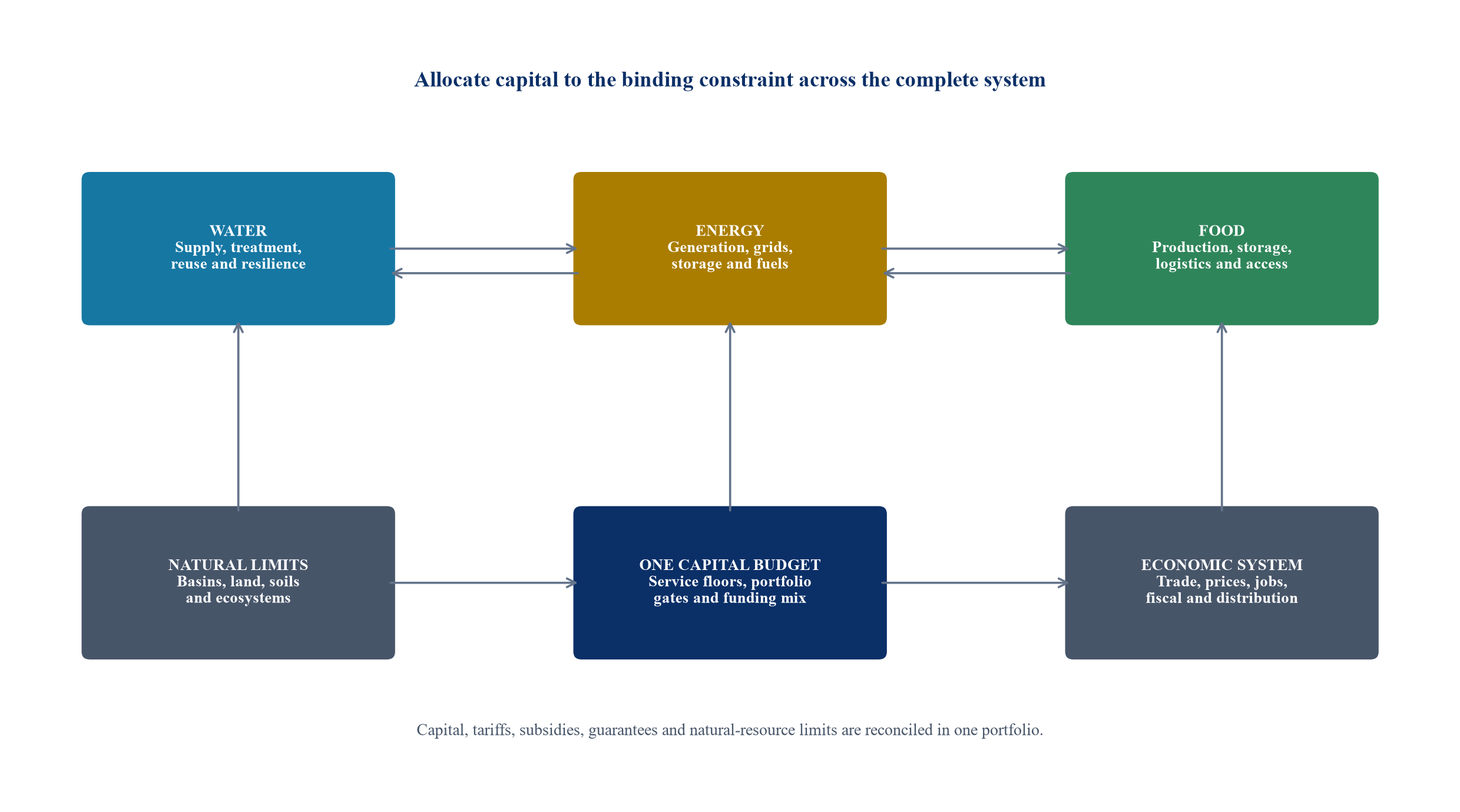
The figure is an author-developed decision framework. Every connection requires country-specific technical, legal and financial evidence.
The system map should show physical flows, decision rights and financial obligations. Water flows should identify source, quality, treatment, conveyance, storage, use and return. Energy flows should identify supply, grid constraints, fuel, balancing and critical loads. Food flows should identify production, inputs, processing, storage, transport, imports and access.
Financial flows should show who pays capital expenditure, who receives revenue, who carries demand and price risk, and which public entity provides support. The map should identify shared dependencies such as electricity for pumping, water for cooling, ports for imports, digital networks for dispatch and roads for food distribution.
The purpose is decision clarity. A dependency without an owner, contract, resource allocation or funding source is a portfolio risk. A benefit counted in more than one sector is a double count.
4 Build the resource balance before the project list
The physical resource balance should precede project ranking. Water availability should reflect renewable supply, groundwater condition, quality, return flows, environmental requirements and drought conditions. Energy balances should reflect dependable capacity, networks, flexibility, fuel and reserve margins. Food balances should reflect production, stocks, losses, trade, logistics and affordability.
FAO's AQUASTAT distinguishes agricultural, municipal and industrial withdrawals and reports large regional differences. UN-Water's water-stress indicator compares withdrawals with available renewable freshwater after considering environmental requirements. These measures should be used with local data and uncertainty ranges. A national capital budget cannot rely on a single global ratio.
The resource balance should show annual and peak conditions. Irrigation, cooling and household demand can peak together. Solar output, hydropower inflows and crop-water requirements are seasonal. Storage and interconnection can move resources across time and geography, while they add capital cost and operating dependencies.
5 Diagnose the binding constraint
The binding constraint is the condition that limits the service outcome after considering the connected system. It can be physical, financial, institutional or contractual. Examples include a depleted aquifer, a congested grid, a weak distribution network, insufficient storage, an unaffordable tariff, a missing land right, poor maintenance, an import bottleneck or an agency without authority.
Project selection should test whether removing one constraint exposes another. New desalination can produce water while grid capacity remains insufficient. Solar irrigation can reduce fuel cost while accelerating groundwater abstraction. Additional renewable generation can lower energy cost while transmission remains constrained. A new cold chain can reduce food loss while farms lack reliable water.
The portfolio should fund diagnostic and enabling assets early. Metering, hydrology, grid studies, land records, system controls and data standards may carry lower political visibility than large construction, yet they can determine the value of the entire programme.
6 Create a common evidence table
Table 1. Cross-system evidence and decision tests
| Decision area | Water evidence | Energy evidence | Food-system evidence | Capital-budget test |
|---|---|---|---|---|
| Service need | Demand, quality, reliability and drought floor | Load, dependable capacity, network and restoration | Availability, access, storage, imports and logistics | Which service outcome changes, for whom and by when? |
| Resource limit | Basin balance, aquifer condition and environmental flow | Fuel, land, water, grid and flexibility | Land, soil, water, inputs and climate exposure | Does the project remain feasible under the constrained resource case? |
| Economic value | Avoided shortage, health, industrial and resilience effects | Avoided outage, fuel and system cost | Yield, loss reduction, value added and affordability | Which benefits are cash, fiscal, social or avoided loss? |
| Revenue | Tariff, connection, bulk sale or availability payment | Tariff, market sale, capacity or offtake | Commodity sale, service fee, lease or logistics charge | Is revenue sufficient, enforceable and affordable? |
| Public obligation | Grant, subsidy, guarantee, land or utility support | Sovereign support, regulated return or offtake | Support programme, insurance, storage or trade intervention | What is the present value and stress exposure of public support? |
| Delivery readiness | Permits, source rights, design and operator | Connection, permits, fuel, offtake and operator | Land, aggregation, buyers, logistics and extension | What evidence must exist before capital is committed? |
| Distribution | Household, regional and livelihood effects | Affordability and access effects | Farmer, consumer, nutrition and income effects | Who receives benefit and who bears cost or displacement? |
| Environmental limit | Water quality, abstraction and ecosystem condition | Emissions, land, water and biodiversity | Soil, nutrient, water and habitat effects | Which threshold is a hard constraint rather than a score? |
Evidence requirements vary by jurisdiction and project. The table is an appraisal framework rather than a technical or legal opinion.
Evidence quality should influence approval. Measured data, executed contracts and engineering studies deserve more weight than policy aspiration. Missing evidence should remain an explicit uncertainty. The appraisal should identify the decision that can be made now and the evidence required for the next gate.
7 Use a common economic boundary
Sector appraisals often use different discount rates, prices, planning periods and risk treatments. A combined portfolio needs a common economic boundary. The finance ministry or designated portfolio authority should define the currency, price basis, discounting approach, social and distributional treatment, climate scenarios and method for valuing avoided loss.
The framework should separate financial returns from economic and security benefits. A wastewater-reuse project may generate tariffs and reduce freshwater abstraction. A strategic food reserve may have limited operating profit while reducing disruption exposure. A grid upgrade can enable private renewable and water investment beyond its own regulated revenue.
The analysis should avoid forcing all benefits into a fragile monetary estimate. Material outcomes can be represented through service metrics and minimum constraints. Monetised benefits, quantified non-monetary indicators and qualitative considerations should remain distinguishable in the decision record.
8 Avoid double counting
Interdependent projects can claim the same benefit. A renewable plant may count emissions reduction; a desalination project powered by the plant may also count it. An irrigation project and an agricultural-processing project may both count the same incremental crop value. The portfolio model should assign each benefit once and show how projects share it.
Enabling projects create option value. A transmission line can unlock several generators; a reuse network can support farms and industry; a data platform can improve allocation across agencies. The value should be linked to a credible dependent-project pipeline and adjusted for delivery probability.
Portfolio reporting should include gross project benefits, overlaps, enabling effects and net portfolio benefit. This reconciliation is essential for investment committees, lenders and development partners evaluating additionality.
9 Treat ecological thresholds as constraints
Ecosystem services support water availability, soil productivity, flood protection and climate resilience. Environmental flows, aquifer recharge, water quality, habitat and soil condition should enter the model as constraints or costs. A project that exceeds a binding ecological threshold should not be rescued by a high composite score.
Thresholds require local evidence and lawful allocation. They should be stress-tested for drought, climate and cumulative development. Permit compliance can be necessary while remaining insufficient for long-term security if the legal allocation exceeds the physical resource base.
Nature-based interventions can form part of the capital programme where their service, cost, maintenance, land and performance can be defined. Watershed restoration, soil-water retention, wetlands and recharge measures should be compared with engineered alternatives and combinations on a consistent basis.
10 Model climate and compound shocks
The portfolio should use a small set of coherent scenarios rather than independent sector stresses. A compound scenario can combine drought, high electricity demand, reduced hydropower, crop losses, food-price pressure and constrained public finances. Flood scenarios can disrupt power, contaminate water and damage logistics at the same time.
Climate scenarios should affect resource availability, asset performance, demand, maintenance, insurance and financing. The analysis should disclose the source, period, spatial resolution and uncertainty of climate data. The Intergovernmental Panel on Climate Change provides assessed evidence on climate risks; project design still requires local engineering and hydrological studies.
The decision question is whether the portfolio preserves minimum service and fiscal capacity under the agreed stress. Projects that perform well across scenarios can receive resilience value. Projects that depend on one forecast should be staged or redesigned.
11 Price water and energy transparently
Prices influence demand, maintenance and investment. Subsidised electricity can encourage groundwater pumping. Water tariffs below operating cost can weaken service and prevent maintenance. Sudden price reform can harm vulnerable households and farmers. The capital plan should therefore link tariff design, targeted support, efficiency and service obligations.
The model should state the full resource cost, financial tariff, subsidy and collection assumptions. Cross-subsidies should be visible. Affordability support should identify beneficiaries, eligibility, funding and delivery mechanism. Efficiency gains should be based on measurable consumption and service data.
Price reform should be sequenced with metering, service improvement and protection for vulnerable users. Capital should not be allocated on the assumption that an unspecified future tariff increase will close the financing gap.
12 Value efficiency before new supply
Demand management can defer or reduce capital. Water-loss reduction, efficient irrigation, appliance standards, industrial reuse, efficient pumps, grid loss reduction, food-loss prevention and cold-chain optimisation can improve system output with lower resource input.
Efficiency programmes require measurement, incentives and operating capability. Claimed savings should be adjusted for rebound, baseline error and persistence. A project that reduces technical loss can have a different financial value from one that reduces billed consumption.
The portfolio should compare efficiency with new supply through equivalent service units, timing and reliability. A combination is often required. The decision record should explain why each intervention is cheaper, faster or more resilient than the next feasible alternative.
13 Integrate desalination and water reuse
Desalination can diversify supply in water-scarce coastal markets, while it creates electricity demand, intake and brine-management requirements, and exposure to plant and grid outages. The IEA has documented the rising energy requirements of water supply and desalination. Appraisal should include power source, grid connection, energy price, carbon exposure, standby operation and water-storage capacity.
Reuse can reduce freshwater demand and create reliable supply for agriculture, industry or urban uses. Its value depends on collection, treatment standard, conveyance, offtake, public acceptance and regulation. Separate investment in treatment without a reuse network or contracted demand can strand capacity.
The combined plan should compare marginal water sources and efficiency measures on delivered cost, reliability, energy intensity, emissions, environmental impact and scalability. Average system cost can conceal expensive peak or emergency supply.
14 Align irrigation with aquifer and grid limits
Irrigation can raise production and resilience where water is physically available and institutions can allocate it. It can also accelerate depletion when pumping is unmetered or power is subsidised. The investment case should include basin or aquifer balance, crop-water requirements, pumping energy, drainage, water quality, farmer economics and enforcement.
Solar pumping changes energy cost and reliability. A lower marginal pumping cost can increase abstraction unless allocation and monitoring are effective. Solar irrigation should therefore be paired with water rights, metering, community governance or incentives that reward water productivity.
The project model should test crop choice, yield, price, climate, pumping depth and energy. Irrigation infrastructure should be accompanied by extension, market access, maintenance and finance where these determine farmer adoption and repayment.
15 Coordinate hydropower, irrigation and ecosystems
Reservoirs can support power, irrigation, water supply, flood management and environmental flows. These objectives can conflict by season and under drought. A single-purpose financial model can overstate output when another service has priority.
The operating rule should state storage priorities, release constraints, drought triggers, forecast use and compensation mechanisms. The value of flexibility can exceed the value of maximum annual generation. Upstream and downstream users should be included where decisions cross borders or administrative boundaries.
The capital plan should compare rehabilitation, sediment management, turbine upgrades, storage re-operation, grid flexibility and new capacity. Governance and data can unlock value from existing assets before new construction.
16 Secure food through production, trade and logistics
Food security is broader than domestic output. The portfolio should consider production resilience, strategic stocks, import routes, supplier concentration, storage, processing, cold chains, transport, household access and nutrition. Producing a water-intensive commodity domestically can reduce import exposure while increasing water and energy risk.
The analysis should compare domestic production with diversified trade and reserves. It should include foreign exchange, port and logistics capacity, spoilage, procurement rules and emergency release. Strategic reserves require transparent objectives, rotation, quality control and fiscal accounting.
Agricultural investment should prioritise the binding constraint in the value chain. Higher farm output can depress prices or increase loss when storage and markets are absent. Logistics and information can sometimes deliver more security per unit of capital than additional production capacity.
17 Build a portfolio rather than a queue
Project queues reward readiness and advocacy. Portfolio construction asks how projects work together under a budget and resource constraint. The portfolio should include enabling systems, maintenance, efficiency, new supply, resilience, emergency capability and innovation.
Projects should be grouped into packages where joint delivery creates value. A package may combine renewable power, grid reinforcement, desalination, storage and reuse. Another may combine irrigation modernisation, metering, farmer finance, extension, cold storage and offtake. Packaging should preserve accountable contracts and avoid creating an unmanageable programme.
The portfolio should maintain geographic and technology diversification. Concentration in one basin, fuel, crop, supplier, route or financing source can create systemic risk.
18 Allocate the illustrative capital envelope
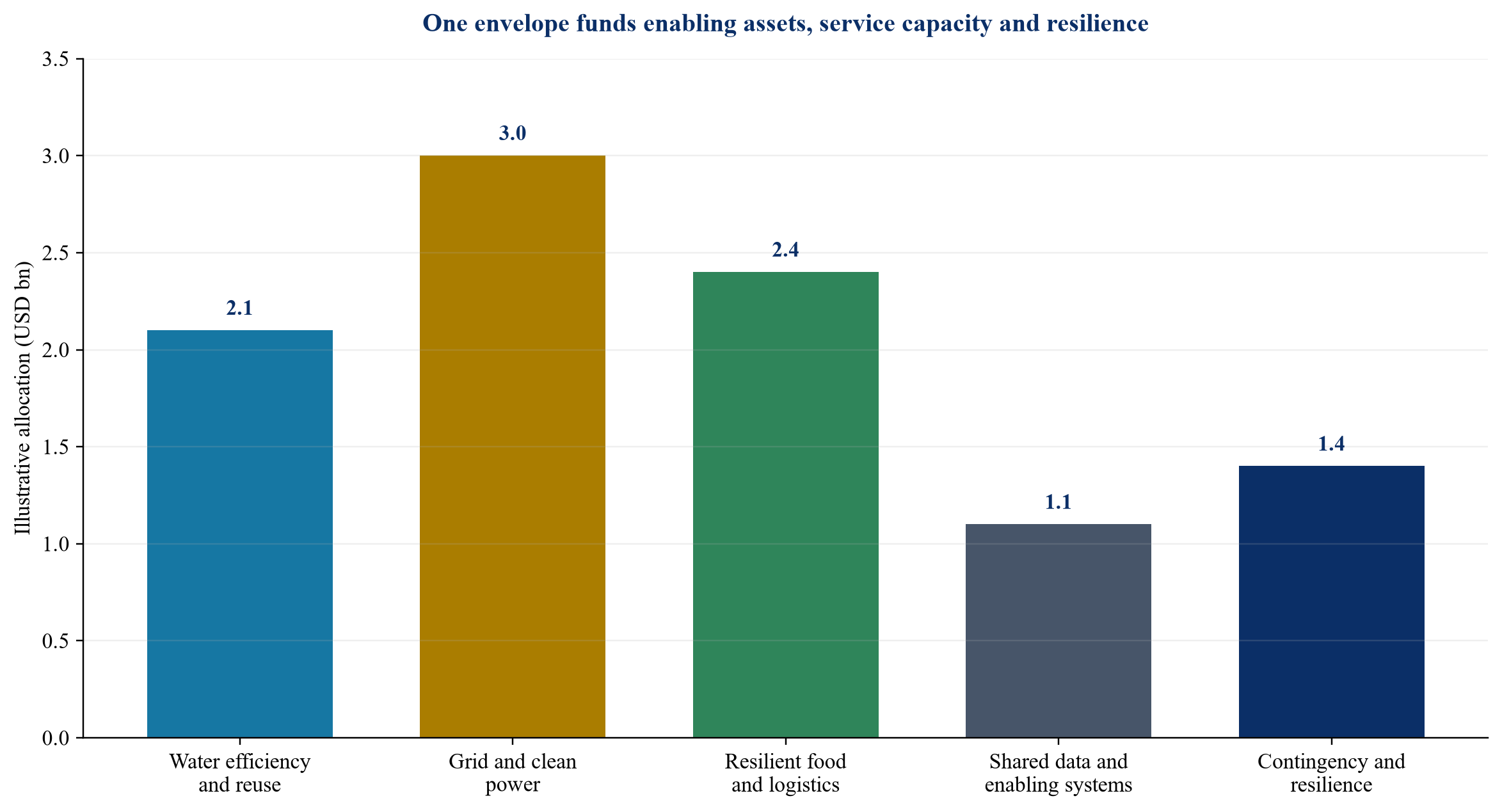
Values are author-modelled assumptions in USD billions. They illustrate portfolio construction and do not represent a national plan, market forecast or recommended allocation.
The illustrative envelope includes capital that can be financed through different instruments. The allocation is a starting point for testing service contribution, readiness, affordability and crowding-in. It is not a sector entitlement. Each category competes for capital at the margin.
Maintenance and operating capability should sit beside new construction. A capital budget that expands capacity while underfunding maintenance weakens security. Contingency should be linked to defined shocks and replenishment rules.
19 Match instruments to cash flow and risk
Table 2. Financing allocation by intervention type
| Intervention | Economic character | Potential financing | Public role | Core transaction test |
|---|---|---|---|---|
| Basin data, regulation and allocation systems | Public good and enabling system | Budget, grant or technical assistance | Authority, standards and sustained operating funding | Does the system change enforceable allocation and investment decisions? |
| Water or grid efficiency programme | Savings and service improvement | Utility finance, performance contract, green loan or blended finance | Tariff, measurement, procurement and targeted support | Are baseline, savings, persistence and payment enforceable? |
| Treatment, reuse or desalination with contracted demand | Revenue-bearing infrastructure | Project finance, utility debt, concession or PPP | Permits, tariff, land, offtake and environmental regulation | Does revenue cover lifecycle cost under the energy and demand stress? |
| Renewable generation and network reinforcement | Market or contracted infrastructure plus enabling network | Corporate finance, project finance, regulated utility debt or guarantee | Market rules, connection, land and targeted de-risking | Is the network ready and is curtailment or offtake risk allocated? |
| Irrigation and farmer service package | Mixed public good and user benefit | Budget, concessional loan, farmer co-investment, guarantee or results finance | Water allocation, extension, aggregation and affordability | Can users adopt, pay and maintain without exceeding the water balance? |
| Storage, cold chain and logistics | Commercial service with public resilience benefit | Corporate or project finance, lease, warehouse finance or guarantee | Standards, access, land and competition | Is throughput sufficient and are users willing and able to pay? |
| Ecosystem restoration and watershed protection | Public and shared long-duration benefit | Budget, grant, results payment or blended facility | Rights, monitoring, stewardship and permanence | Are service outcomes measurable and maintained after funding ends? |
| Strategic reserve and emergency capability | Security and contingent service | Budget, sovereign facility or contracted availability | Release rules, rotation, audit and fiscal provision | Is the reserve sized to a defined disruption and protected from routine use? |
Instrument suitability depends on project-specific revenue, law, credit, affordability and market conditions.
Public capital should finance public goods, affordability support and risks that cannot be efficiently transferred. Private capital should be used where revenue, rights, contracts and risks support repayment. Blended finance should address a diagnosed financing barrier and preserve incentives for performance.
Guarantees and availability payments are fiscal exposures. They should be valued, capped, monitored and approved within the same envelope as direct expenditure. Concessionality should be linked to additional service or risk reduction rather than used to conceal an unaffordable asset.
20 Structure revenue-bearing components
Revenue-bearing projects require clear demand, tariff or offtake. Water and power projects may use utility tariffs, bulk-supply agreements, availability payments or concessions. Logistics projects may use throughput charges, leases or service fees. Agricultural assets can depend on fragmented users and volatile commodity prices, requiring aggregation and flexible finance.
Contracts should allocate construction, performance, resource, demand, price, currency, force-majeure and termination risk to parties able to manage them. Public counterparties should avoid broad guarantees that transfer commercial risk without corresponding control.
The project company should have the rights, land, permits, connections, inputs and offtake needed for operation. Interface risk between separately financed assets should be documented. A desalination plant without a completed grid or network is not an independent project.
21 Use blended finance with an exit logic
Blended finance can combine grants, concessional debt, guarantees, subordinated capital and commercial funding. Its purpose should be stated: fund a public good, absorb an externality, extend tenor, address early-stage technology risk, support affordability or establish a market.
The structure should identify the minimum concessional support required. It should test whether private capital is additional, whether risk is genuinely transferred, and whether the support can decline as data and performance improve. Permanent subsidy can be appropriate for a defined public service; it should remain visible in fiscal planning.
Development institutions can support preparation, standards, capacity and aggregation as well as finance. A bankable pipeline often depends on these enabling functions.
22 Protect affordability and distribution
Capital allocation can shift costs among households, farmers, utilities, taxpayers and future generations. Distributional analysis should identify who receives service, who pays tariffs or taxes, who loses access to land or water, and who bears transition costs.
Affordability support should be targeted and funded. Lifeline tariffs, direct transfers, connection support, farmer grants or insurance can be assessed against broad price subsidies. The delivery system should be capable of identifying eligible users and preventing exclusion.
The portfolio should report service and financial effects by region and user group where data permit. Aggregate benefit cannot substitute for lawful consultation, compensation and safeguards.
23 Score readiness separately from value
A valuable project can be unready. Readiness should cover resource evidence, feasibility, design, land, permits, environmental and social requirements, procurement, operator capability, revenue, financing and institutional authority. The portfolio should avoid giving readiness such weight that mature low-value projects crowd out essential preparation for higher-value interventions.
The budget can reserve funds for preparation and stage-gated development. Early capital buys evidence and options. Construction capital is committed after the relevant uncertainties are reduced.
Readiness scores should be supported by documents and accountable owners. A status label without evidence should not affect ranking.
24 Compare risk-adjusted portfolios
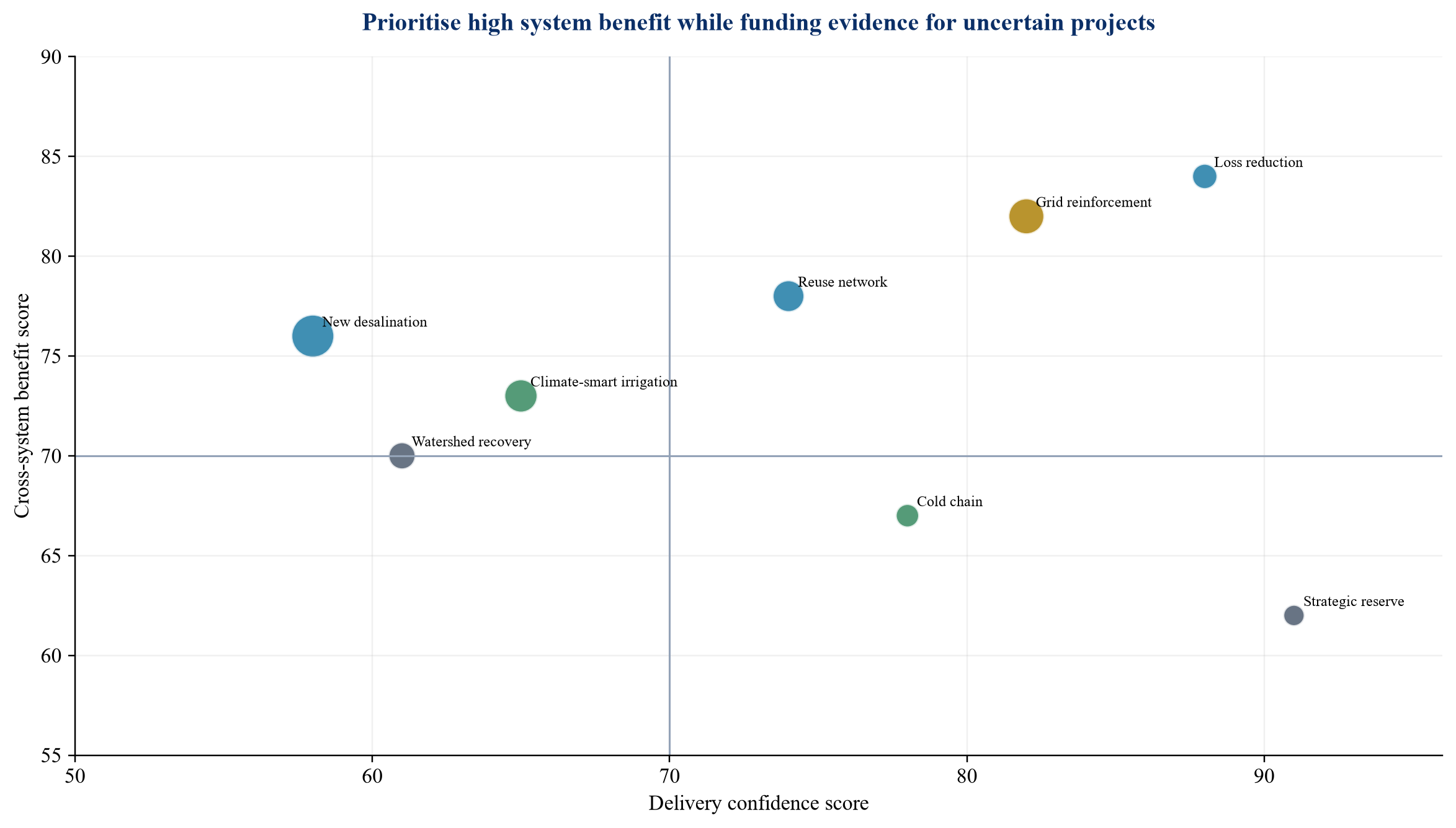
Scores and capital values are author-modelled assumptions for demonstrating a prioritisation method. They are not observed project results or investment recommendations.
The upper-right quadrant contains high-benefit interventions with stronger delivery confidence. High-benefit projects with lower confidence can receive preparation funding rather than premature construction capital. Projects with lower system benefit require redesign or a clear strategic reason.
Bubble size represents illustrative capital. A portfolio should avoid allowing one large project to dominate solely because it is advanced. Marginal analysis should compare the next unit of capital across sectors and packages.
25 Apply a stage-gate scorecard
Table 3. One capital budget stage-gate scorecard
| Gate | Evidence | Decision | Typical release of capital |
|---|---|---|---|
| 1 Service need | Defined service floor, users, geography, baseline and disruption case | Confirm the problem and sponsor | Diagnostic and pre-feasibility budget |
| 2 Resource feasibility | Water, energy, land, food-system and ecosystem balances under stress | Confirm physical feasibility and constraints | Feasibility, options and consultation budget |
| 3 Portfolio value | Common economic case, overlaps, dependencies, distribution and avoided loss | Select preferred package and sequence | Development and transaction budget |
| 4 Delivery readiness | Design, rights, permits, operator, procurement, revenue and safeguards | Approve procurement or market engagement | Bid, design and enabling works budget |
| 5 Financing and fiscal exposure | Funding mix, affordability, guarantees, contingent liabilities and downside | Approve financing envelope and risk allocation | Construction commitment subject to conditions |
| 6 Operations and outcomes | Commissioning, maintenance, data, service metrics and corrective triggers | Accept service and monitor performance | Operating support, reserve and performance payments |
| 7 Portfolio renewal | Updated resource balance, climate, demand, prices and performance | Reallocate, expand, pause or retire | Next budget cycle and option exercise |
Weights and thresholds should be approved for the jurisdiction. Hard legal, resource and environmental constraints remain outside weighted scoring.
Every gate should identify the approving body, evidence owner, deadline and stop condition. A project can return to an earlier gate when resource, cost or policy changes. Approval should expire if key conditions remain unmet.
The scorecard should be consistent across sectors while allowing sector-specific engineering. It should reduce political bargaining over incomparable project narratives by creating one evidence record.
26 Sequence enabling and dependent assets
Sequence determines value. Data and regulatory systems may precede procurement. Grid reinforcement may precede generation or desalination. Distribution and storage may precede additional production. Operator preparation and maintenance systems should begin before commissioning.
The integrated schedule should show dependencies, critical path and temporary service. It should test delays in one project and their effect on the package. Contract interfaces should include notice, coordination, relief and completion evidence.
Phasing can preserve option value. Modular investments allow learning and reduce exposure to demand, technology and climate uncertainty. The decision should compare modularity with scale economies and interface cost.
27 Govern one portfolio across institutions
A central portfolio authority should have a clear mandate without replacing sector accountability. Finance, planning, water, energy, agriculture, environment, trade and subnational authorities need defined roles. Utilities, private operators, farmers, users and communities provide operational evidence and bear material effects.
The governance body should approve service floors, common assumptions, hard constraints, ranking method, fiscal exposure and portfolio changes. Sector agencies remain responsible for technical standards, delivery and operations. Independent assurance can review data, models, procurement and outcomes.
Conflicts should be recorded and resolved through stated decision rights. A shared dashboard without authority does not create integrated allocation.
28 Build the data architecture
The data architecture should connect asset registers, resource balances, demand, prices, climate, project status, contracts, fiscal exposure and service outcomes. Definitions, geography and time periods must align. Data provenance and uncertainty should be visible.
Remote sensing, smart meters, supervisory-control systems, farm data and market information can improve decisions. Digital investment should be assessed for cybersecurity, interoperability, maintenance, access and institutional use. Technology does not repair unclear authority or weak incentives.
The portfolio should establish a minimum evidence set and update cycle. Sensitive data should be governed through lawful access and security controls. Public reporting should focus on service, capital, fiscal exposure and outcomes.
29 Use procurement to preserve system value
Procurement packages should reflect interfaces and market capacity. Combining too much scope can reduce competition and accountability. Fragmenting interdependent assets can create gaps. Market sounding can test capability, risk appetite and financing without committing to a structure.
Bid evaluation should include lifecycle cost, resource use, performance, resilience, delivery and financing. Lowest initial price can create higher energy, water, maintenance or replacement cost. Performance specifications should use measurable outputs and allocate data rights.
Contract management capability should be funded. Variations that change water, energy, land, output or public support should return to portfolio review.
30 Manage fiscal and contingent liabilities
Direct expenditure is only one part of public exposure. The portfolio record should include guarantees, availability payments, minimum revenue, offtake, exchange support, termination compensation, tax expenditure, land and recapitalisation risk. Each should have a valuation method, cap, approval and monitoring owner.
Stress tests should combine project underperformance with macroeconomic and climate shocks. Currency depreciation can raise imported equipment and debt service while food and fuel prices increase. Public revenue can weaken at the same time that support obligations rise.
The budget should include maintenance, subsidies and operating obligations over the asset life. A project that fits the construction-year budget can remain unaffordable.
31 Monitor outcomes and reallocate
Monitoring should distinguish inputs, outputs, service outcomes and system resilience. Relevant measures include reliable water delivered, water loss, energy intensity, dependable power, outage duration, food loss, storage availability, import concentration, affordability, environmental condition and fiscal exposure.
The portfolio authority should review whether projects changed the binding constraint. A successful water project can shift the constraint to power or distribution. Reallocation should be an expected governance action rather than evidence of failure.
Performance payments and guarantees should use measurable data and verification. Indicators should avoid rewarding volume where conservation or quality is the objective.
32 Design the first twelve months
Months one to three should define service floors, governance, common assumptions and the initial system map. Existing plans, fiscal exposures and data gaps should be reconciled. Urgent maintenance and safety actions can proceed under existing authority.
Months four to six should complete resource balances, compound scenarios, project dependency mapping and the first common economic appraisal. Projects should be classified as proceed, prepare, redesign, defer or stop.
Months seven to nine should structure priority packages, assign instruments, value public support and test the market. Months ten to twelve should approve the portfolio, funding envelope, procurement sequence, monitoring and next evidence gates. The first cycle should improve decision quality and create a repeatable process.
33 Translate the framework into transactions
Each priority package should be converted into transaction components with clear sponsors, assets, rights, revenue, risks and interfaces. A government may retain the basin plan, affordability support and strategic reserve while procuring water treatment, renewable generation, storage, logistics or digital services through separate contracts.
Transaction advisers should reconcile the financial model with the system model. Demand, resource and interface assumptions should appear in contracts and financing documents. Lenders need evidence that dependent infrastructure and public obligations will be available when required.
The financing plan should show sources and uses, public and private capital, concessionality, security, covenants, reserves, insurance, guarantees and termination. Conditions precedent should target the evidence that determines system and credit viability.
34 Preserve strategic options
Uncertainty supports staged commitment. Land, permits, data, modular design, standardised contracts and interconnection can create options without committing full construction capital. The portfolio should value the ability to expand, switch input, change crop, reuse water, add storage or diversify imports.
Technology pilots should have learning objectives, comparison baselines and exit rules. A pilot is valuable when it reduces uncertainty that affects a larger decision. Repeated pilots without a pathway to scale consume capital without changing the system.
The annual budget should include option maintenance and preparation. Expired permits, lost land rights or obsolete studies can destroy option value.
Conclusion
Water, energy and food security require a common capital-allocation discipline because their assets share resources, infrastructure, fiscal support and risk. Separate project appraisal can miss the system bottleneck, double-count benefit, strand dependent assets and transfer cost across sectors.
The One Capital Budget Framework begins with measurable service floors, a shared perimeter, resource balances and dependency mapping. It identifies the binding constraint, values projects within a common boundary, protects environmental thresholds, tests compound shocks and distinguishes financial, economic and security benefits. It then constructs a portfolio of enabling systems, maintenance, efficiency, new capacity, resilience and strategic options.
Funding follows economic character. Public budgets fund public goods and explicit affordability obligations. Utility and project finance support enforceable revenue. Blended and concessional capital address diagnosed barriers. Guarantees and long-term payments remain visible fiscal exposures. Stage gates release capital as evidence and readiness improve.
The practical test is whether the selected portfolio maintains essential service under the agreed stress while remaining physically feasible, fiscally supportable and operationally deliverable. A credible national budget states which constraint each project removes, which dependencies it creates, who pays, who bears risk, and what evidence will trigger the next commitment.
References
- Food and Agriculture Organization of the United Nations, Water-energy-food nexus. https://www.fao.org/land-water/water/governance/water-energy-food-nexus/en
- Food and Agriculture Organization of the United Nations, AQUASTAT: Water use. https://www.fao.org/aquastat/en/overview/methodology/water-use/
- Food and Agriculture Organization of the United Nations, AQUASTAT databases. https://www.fao.org/aquastat/en/databases/
- Food and Agriculture Organization of the United Nations, Walking the Nexus Talk: Assessing the Water-Energy-Food Nexus in the Context of the Sustainable Energy for All Initiative. https://www.fao.org/4/i3959e/i3959e.pdf
- Food and Agriculture Organization of the United Nations, An Innovative Accounting Framework for the Food-Energy-Water Nexus. https://www.fao.org/4/i3468e/i3468e.pdf
- United Nations Economic Commission for Europe, Transboundary Nexus Assessment Methodology. https://unece.org/environment-policy/water/areas-work-convention/nexus-methodology
- United Nations Economic Commission for Europe, Methodology for assessing the water-food-energy-ecosystems nexus in transboundary basins and experiences from its application. https://unece.org/environment-policy/publications/methodology-assessing-water-food-energy-ecosystems-nexus-transboundary
- United Nations Economic Commission for Europe, Reconciling resource uses in transboundary basins. https://unece.org/environment-policy/publications/reconciling-resource-uses-transboundary-basins-assessment-water
- United Nations Economic Commission for Europe, Policy Brief: Reconciling resource uses in transboundary basins. https://unece.org/environment-policy/publications/policy-brief-reconciling-resource-uses-transboundary-basins
- UN-Water, Progress on Level of Water Stress: 2024 Update. https://www.unwater.org/publications/progress-level-water-stress-2024-update
- UN-Water, Water, Food and Energy. https://www.unwater.org/water-facts/water-food-and-energy
- UN-Water, Water Facts, September 2025. https://www.unwater.org/sites/default/files/2025-09/UN-Water_Water_Facts_one_pager_September2025.pdf
- International Energy Agency, Water-Energy Nexus. https://www.iea.org/reports/water-energy-nexus
- International Energy Agency, World Energy Investment 2025. https://www.iea.org/reports/world-energy-investment-2025
- International Energy Agency, Electricity 2025. https://www.iea.org/reports/electricity-2025
- International Renewable Energy Agency, Renewable Energy in the Water, Energy and Food Nexus. https://www.irena.org/publications/2015/Jan/Renewable-Energy-in-the-Water-Energy--Food-Nexus
- World Bank, Water Security Financing Report 2024. https://www.worldbank.org/en/topic/water/publication/water-security-financing-report-2024
- World Bank, The Water-Energy-Food Nexus in the Middle East and North Africa: Scenarios for a Sustainable Future. https://openknowledge.worldbank.org/handle/10986/29797
- World Bank, Food Finance Architecture: Financing a Healthy, Equitable and Sustainable Food System. https://www.worldbank.org/en/topic/agriculture/publication/food-finance-architecture-financing-a-healthy-equitable-and-sustainable-food-system
- World Bank, Climate-Smart Agriculture. https://www.worldbank.org/en/topic/climate-smart-agriculture
- World Bank, Climate Smart Agriculture Investment Plans: Bringing CSA to Life. https://www.worldbank.org/en/topic/agriculture/publication/climate-smart-agriculture-investment-plans-bringing-climate-smart-agriculture-to-life
- World Bank, Climate-Smart Agriculture: From Knowledge to Implementation. https://www.worldbank.org/en/results/2024/12/05/climate-smart-agriculture-from-knowledge-to-implementation
- World Bank, Repurposing Agricultural Support. https://www.worldbank.org/en/brief/2025/02/18/repurposing-farm-support
- World Bank, The Nexus of Food, Water and Energy: A Key Element to Egypt's Climate Efforts. https://www.worldbank.org/en/news/feature/2023/12/18/the-nexus-of-food-water-energy-a-key-element-to-egypt-s-climate-efforts
- World Bank, Farmer-led Irrigation Development. https://www.worldbank.org/en/brief/2021/05/19/farmer-led-irrigation-development-flid
- International Fund for Agricultural Development, An integrated investment framework for climate-adaptive and water-resilient food systems. https://www.ifad.org/en/w/publications/white-paper-an-integrated-investment-framework-for-climate-adaptive-and-water-resilient-food-systems
- Intergovernmental Panel on Climate Change, Climate Change 2022: Impacts, Adaptation and Vulnerability. https://www.ipcc.ch/report/ar6/wg2/
- Intergovernmental Panel on Climate Change, Climate Change 2023: Synthesis Report. https://www.ipcc.ch/report/ar6/syr/
- Organisation for Economic Co-operation and Development, Principles on Water Governance. https://www.oecd.org/cfe/regionaldevelopment/oecd-principles-on-water-governance.htm
- Organisation for Economic Co-operation and Development, Financing Water: Investing in Sustainable Growth. https://www.oecd.org/water/financing-water-investing-in-sustainable-growth.htm
- United Nations Environment Programme, Adaptation Gap Report 2024. https://www.unep.org/resources/adaptation-gap-report-2024
- United Nations Environment Programme, Food Waste Index Report 2024. https://www.unep.org/resources/publication/food-waste-index-report-2024
- Asian Development Bank, Water and Other Urban Infrastructure and Services. https://www.adb.org/what-we-do/topics/water-and-other-urban-infrastructure-services
- European Bank for Reconstruction and Development, Green Economy Transition. https://www.ebrd.com/what-we-do/get.html
- Multilateral Investment Guarantee Agency, Climate Finance. https://www.miga.org/climate-finance
About the Author
Chennakeshav (CK) is a corporate finance and investment banking executive with 25+ years of global experience in deal origination, structuring and execution across M&A, growth capital and corporate strategy. He has led value-creation mandates for founders, corporates and funds — bridging the boardroom view to hands-on execution and close.
His career spans Morgan Stanley, HSBC, Lloyds Banking Group, EWEC, ADQ portfolio companies and Emirates Growth Fund, across TMT, real estate, fintech, deeptech, cleantech, infrastructure and energy. He has partnered with C-suite leaders, private equity and venture funds, sovereign wealth funds and family offices to finance complex fund raises and scale-up ventures, and has led M&A due diligence, post-merger integration and business-transformation initiatives to create value.
At Matchpoint Partners he is Managing Partner, leading the firm's corporate finance, M&A and capital-raising practice. He holds an MBA from London Business School, an engineering degree from VTU and a Master of Laws (LLM, in progress) from UCL London.
An active start-up mentor, CK mentors at Techstars, DIFC FinTech Hive, Startup Grind, Founder Institute and IN5, serves as Entrepreneur Mentor in Residence (EMiR) at London Business School, and judges the Entrepreneurship World Cup.
