

1. The financing question
A reuse facility needs a buyer willing and able to pay for defined capacity and output over the debt term. The buyer may be a public utility, municipality, industrial park, power plant, data centre, mine, refinery, irrigation district or portfolio of customers. The contract must translate that need into cash flow that survives construction, ramp-up, demand variation and operating events.
The central underwriting question is simple: who pays when the plant is available and compliant but the expected water is not taken? The answer determines how much fixed capital can be supported by debt.
2. The buyer behind the bond
Project debt relies on a payment chain, not on the physical plant alone. Lenders examine the buyer's legal authority, financial capacity, budget, tariff, business need, termination rights and payment record. They also examine the entities supporting the buyer through guarantees, escrow, grants or system revenues.
A strong asset with a weak buyer can produce weak debt. A creditworthy buyer can still create risk through ambiguous acceptance, discretionary volume or broad set-off rights. Credit and contract must be tested together.
3. Reuse as an offtake business
The World Bank's 2025 reuse report identifies clear offtake agreements, pricing, risk sharing and bankable delivery structures as conditions for private investment [1][2]. Long-life reuse assets can fit long-term public-private structures when responsibilities and payments are ring-fenced [3].
The contract should define what the project company delivers: treatment capacity, treated effluent, reclaimed water at a specification, conveyance, storage or a combined service. Payment should follow the service that the project controls.
4. The payment chain
Cash flow moves through several obligations before reaching debt service. Each link needs evidence and remedy.
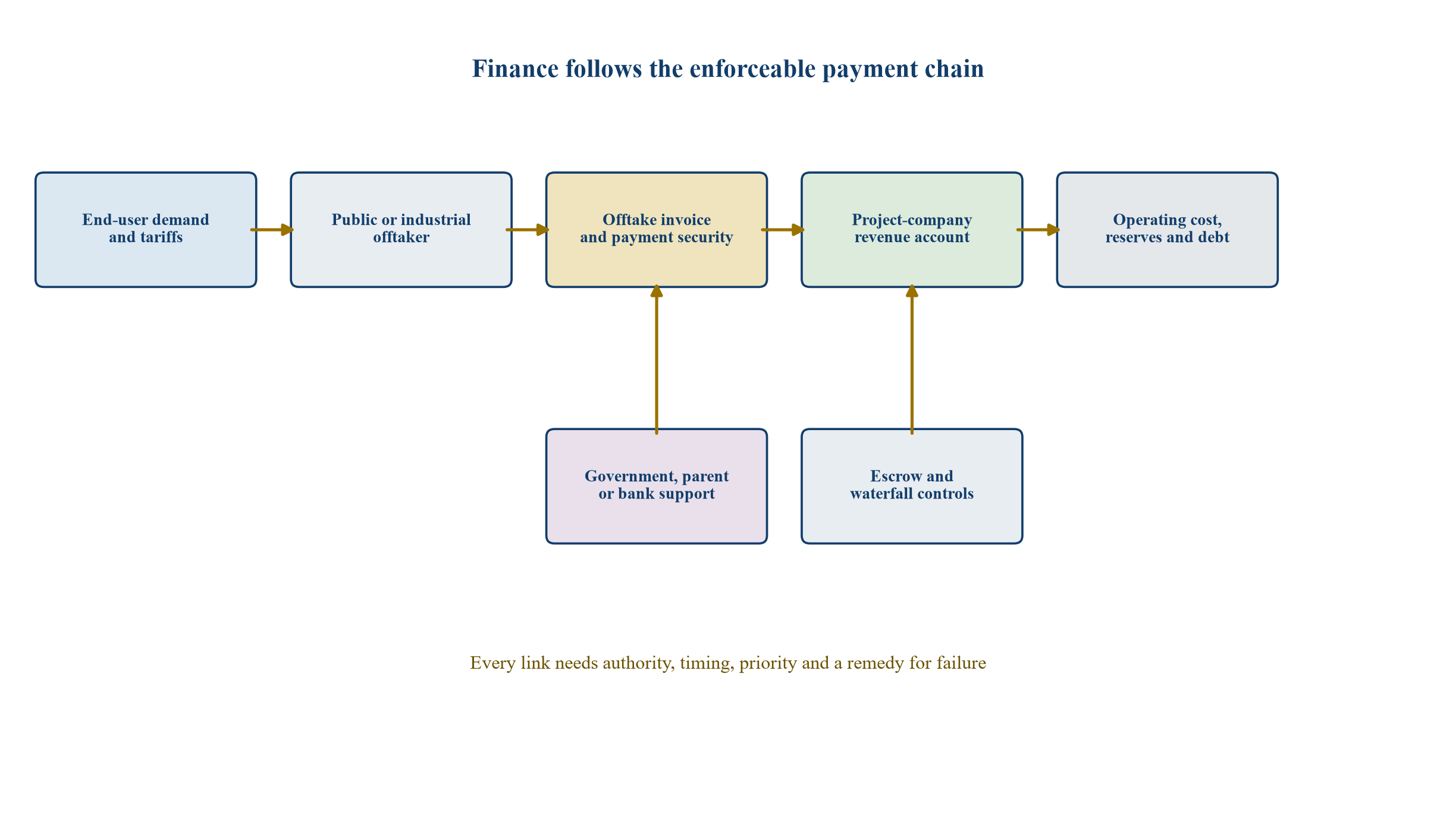
Generic structure; actual security, priority and legal relationships depend on jurisdiction and financing documents.
5. Separate the contracts
The project may require a feedwater agreement, treatment or concession agreement, reclaimed-water purchase agreement, conveyance agreement, land rights, power supply, residual disposal and direct agreement with lenders. Combining every duty into one document can obscure interfaces.
A contract map should show which entity owns the source, controls treatment, accepts product, collects end-user revenue and bears residual obligations. The finance model should use the same map.
6. The project company
Project-financed structures commonly place the assets, contracts and liabilities in a special-purpose vehicle. The World Bank describes the SPV as a mechanism for segregating project assets and obligations [10]. Ring-fencing supports lender control and transparent performance.
The SPV should avoid unrelated activity. Share-transfer restrictions, sponsor support and minimum ownership through completion protect continuity. The project still needs operators and contractors with sufficient technical and financial capacity.
7. Define the service
Service can be treatment availability, accepted volume, delivered water or a combination. A wastewater treatment plant may be paid for treating influent regardless of final reuse demand. A reclaimed-water plant may depend on a buyer accepting output. Conveyance may add a separate delivery obligation.
The contract should avoid charging the project company for risks outside its boundary. The delivery point, meter, quality specification and required pressure determine that boundary.
8. Municipal offtaker
A municipality or utility can buy capacity for system resilience, discharge compliance or potable supply. Its credit rests on statutory authority, budget, tariff-setting power, collections and other debt. Public procurement and appropriation rules can affect enforceability.
The due-diligence case should show how the offtake payment enters the public budget and how it ranks against essential services. A policy commitment without lawful funding authority is insufficient.
9. Industrial anchor buyer
An industrial buyer can provide direct demand and a clear avoided-cost benchmark. It can also relocate, change technology, reduce production or fail. The agreement should address minimum commitment, expansion, quality, internal recycling, change of control and plant closure.
The buyer's credit should be assessed at the signing entity and support provider. A subsidiary with no assets should not be treated as the parent group.
10. Portfolio buyer
An aggregator can contract with the project and resell to several users. This reduces direct interface for the SPV but places concentration in the aggregator. Its tariff, collection and dispatch rules become part of project credit.
The project should know whether the aggregator bears demand risk or merely passes through end-user receipts. Words such as take-or-pay should be tested against actual payment mechanics and exceptions.
11. Multiple direct buyers
Multiple offtakers diversify credit and demand, while increasing metering, quality, scheduling and enforcement complexity. The project needs rules for capacity allocation, curtailment, expansion and replacement customers.
Debt sizing should apply concentration limits and credit haircuts. A portfolio of weak or correlated buyers can remain a single economic risk.
12. Capacity payment
A capacity payment compensates the project for making compliant service available. It can recover fixed capital, fixed operations and debt service. Payment should depend on measured availability and permitted outages, not actual demand within the buyer's control.
The World Bank's sample bulk-water agreement uses fixed payment based on available capacity and variable payment for delivered volume [5]. This structure aligns fixed debt with fixed revenue.
13. Volumetric payment
Variable payment covers electricity, chemicals, residuals and other costs linked to output. It also preserves an incentive to deliver efficient water. The meter, sampling, invoice period and dispute process should be precise.
A fully volumetric tariff transfers demand risk to the project. World Bank commentary on wastewater BOT structures notes that lenders may reject variable-only fees because they provide no guaranteed debt-service stream [7].
14. Take-or-pay
Take-or-pay requires the buyer to pay for a minimum quantity whether or not it takes that quantity, subject to defined project availability and relief. It can support debt where the project reserves capacity and cannot readily sell it elsewhere.
The clause should state make-up rights, carry-forward, exclusions and interaction with force majeure. Broad buyer discretion can empty the obligation.
15. Availability payment
Availability payment rewards compliant capacity while leaving demand with the public or industrial buyer. Deductions can apply for outages, quality failure or pressure failure. The deduction regime should be proportionate and capped before it threatens safe operations.
The World Bank describes minimum availability payment plus volumetric payment as a common model for bulk treatment facilities [11].
16. Output specification
The product definition should cover quality, volume, pressure, temperature where relevant and permitted variability. It should distinguish warning, rejection and emergency limits. Sampling and online instruments need agreed methods and locations.
Quality risk should follow control. The project cannot guarantee parameters outside the agreed source-water envelope unless it prices and designs for them.
17. Feedwater envelope
Municipal and industrial influent can vary. The supplier should define flow, contaminant range, prohibited discharges, notification and consequences of exceptional source events. Source control may sit with the authority rather than the project company.
Feedwater outside the envelope can trigger relief, additional treatment, cost pass-through or temporary suspension. The rules should protect public health and avoid incentive to accept unsafe water.
18. Delivery point
Title, risk and custody should transfer at a defined physical point. Meter ownership, calibration and loss allocation follow. If conveyance after treatment belongs to the buyer, downstream leakage should not reduce project payment.
Separate delivery points can have different specifications and tariffs. Expansion should preserve hydraulic capacity and rights of way.
19. Nomination
The buyer can nominate daily, monthly and annual volume within contracted limits. Notice periods should reflect treatment and storage. Peak nomination and ramp matter as much as annual total.
The contract should address failure to nominate, late change and emergency curtailment. Forecast information supports operations but should not replace binding minimum commitment.
20. Under-take and make-up
If the buyer takes less than the minimum, it pays the shortfall. Make-up rights can allow later delivery of prepaid water when capacity is available. Their duration and priority should avoid creating an unbounded liability.
Make-up water should remain subject to operating limits and expiry. The project should not count expired rights as future revenue.
21. Overtake
Water above contracted capacity can be sold at an incremental price subject to availability. Overtake should not become an implied firm obligation. The buyer should not rely on it for essential operations without reserving capacity.
Additional sales can improve equity returns. Base debt should use contracted capacity and conservative volume.
22. Ramp-up
New industrial or municipal demand may ramp slowly. The payment schedule can use staged capacity, reservation fees or a delayed minimum. Construction milestones should align with buyer readiness.
Ramp risk should not be hidden in optimistic forecasts. Sponsor support, reserves or later debt draw can bridge a bounded period.
23. Contract term
The offtake term should cover debt amortisation and a reasonable tail. Extension options need price, condition and notice rules. An option held only by the buyer may weaken refinancing certainty.
Asset life can exceed the initial term. Handback, renewal and residual value should be planned without assuming a future contract.
24. Price architecture
The price should link payment to the service and risks the project controls.
Table 1. Reuse-offtake payment architecture
| Payment component | Cost or risk recovered | Payment trigger | Key drafting issue |
|---|---|---|---|
| Capacity charge | Debt, fixed operations and reserved capacity | Compliant availability | Deductions, planned outage and minimum availability |
| Volumetric charge | Power, chemicals and variable residual cost | Metered accepted water | Meter, quality acceptance and loss allocation |
| Connection charge | Dedicated pipeline, meter or customer works | Construction milestone or service start | Refund and customer-delay treatment |
| Reservation fee | Pre-commissioning capacity commitment | Agreed development period | Expiry, credit and conversion to capacity |
| Pass-through | Taxes, exceptional power or disposal change | Defined external event | Evidence, mitigation and audit rights |
| Performance adjustment | Efficiency or quality outcome | Verified benchmark | Avoid incentives that conflict with safety |
Generic framework; actual tariff and indexation require cost, legal, tax and affordability analysis.
25. Indexation
Fixed and variable charges can use different indices. Labour, inflation, electricity, chemicals and foreign exchange may move differently. Indexation should match cost exposure while preserving efficiency incentives.
Caps and floors change risk allocation. A cap without matching hedge or contingency can weaken debt coverage. Reopeners should be objective and limited.
26. Energy pass-through
Power can be a major treatment and pumping cost. The contract can pass through an agreed index or actual efficient use. Full actual-cost pass-through weakens efficiency incentives; fixed escalation leaves the project exposed.
A hybrid can benchmark energy intensity and pass through market price. Renewable procurement and grid events should be addressed separately from process efficiency.
27. Chemical and residual cost
Chemicals, membranes, sludge and concentrate disposal can change with source quality and regulation. The base price should cover an agreed envelope. Exceptional changes can use a documented adjustment mechanism.
The project must mitigate cost before claiming relief. Audit rights should protect the buyer without exposing unrelated supplier information.
28. Change in law
General law changes can be treated through the tariff or shared. Project-specific discriminatory change may require fuller relief. The clause should distinguish law, permit interpretation, tax and voluntary standards.
Relief can include time, cost, design change or termination. The project should continue safe operation where lawful while the adjustment is resolved.
29. Taxes and foreign exchange
Tax allocation should cover withholding, value-added tax, customs and changes after bid. Foreign-currency debt or imported equipment can create mismatch with local-currency revenue.
Indexation, hedging or public support can address currency risk. A long-term unhedged mismatch can dominate otherwise sound project economics.
30. Payment timing
Invoice dates, review periods, deemed approval and payment dates should be defined. Disputed amounts should be separated from undisputed amounts. Interest on late payment should reflect financing impact without becoming punitive.
The buyer should not delay the full invoice over a small dispute. The project should provide data and correct errors promptly.
31. Escrow and waterfall
Ring-fenced revenue and escrow can improve payment security where retail collections or fiscal transfers support the offtake. The World Bank identifies ring-fencing and escrow as measures that can enhance reuse bankability [3].
The waterfall should prioritise essential operations, taxes, debt service, reserves and permitted distributions according to the financing structure. It should remain consistent with public-law restrictions.
32. Letter of credit
A revolving letter of credit can cover several months of payment. Its issuer, tenor, replenishment and draw conditions matter. Annual renewal risk should be addressed before the instrument expires.
The amount should reflect invoice volatility and cure period. A weak bank or conditional drawing form provides limited protection.
33. Parent guarantee
An industrial subsidiary can be supported by a parent guarantee. The guarantee should cover all payment and termination obligations, survive change of control where appropriate and permit direct enforcement.
The parent's credit should be monitored. Material downgrade can trigger replacement security, cash collateral or additional reserve.
34. Government support
A public offtaker may receive sovereign, ministry or municipal support. SWPC procurement disclosures state that the Ministry of Finance enters a credit-support agreement for amounts payable by SWPC under sewage-treatment agreements [9].
Support must be analysed under local law, budget and sovereign credit. A political statement is not a guarantee. Conditions, caps and enforcement should be understood.
35. System-revenue pledge
A utility can pledge system revenues rather than project-specific receipts. This diversifies demand and integrates the project into the utility's credit. It also exposes lenders to existing debt, rate covenants and system costs.
EPA notes that WIFIA can accept system revenues, taxes and other dedicated sources, subject to credit review [12][13]. The indenture and additional-bonds test should be modelled.
36. Dedicated revenue source
EPA states that WIFIA projects must be creditworthy and have a dedicated source of revenue [12]. For a privately financed reuse SPV, the offtake agreement often creates that source. The lender should trace revenue from invoice to controlled account.
Dedicated does not mean risk-free. Revenue can remain exposed to availability deductions, buyer default, legal challenge and termination.
37. Reserve accounts
Debt-service reserve, operating reserve and major-maintenance reserve address different risks. Their funding, permitted use and replenishment should be specified. A single reserve can obscure priority.
Reserve size should reflect buyer cure periods, invoice cycle, replacement-water obligations and refinancing risk. Release tests should be evidence-based.
38. Lender direct agreement
The buyer can acknowledge assignment, notify lenders of default, allow cure and recognise step-in through a direct agreement. This protects continuity before termination.
Cure periods should match the default. Payment defaults may require rapid cure; technical defaults may need time to mobilise a replacement operator. Public-health authority remains paramount.
39. Assignment
The SPV assigns receivables and contract rights as security. The offtaker should not withhold consent unreasonably where the financing is within agreed parameters. Assignment on enforcement should preserve operator qualification.
Restrictions on buyer assignment also matter. Transfer to a weaker entity can change credit. Government reorganisation should preserve obligations.
40. Step-in
World Bank model bulk-water agreements provide authority and lender step-in mechanisms to protect operation [5]. Step-in should allow the buyer to protect service and lenders to cure project default without creating competing control.
The contract should define order, notice, liability and exit. Emergency public-health action may occur immediately and should be reconciled later.
41. Termination payments
Termination compensation should address debt, equity, asset condition, insurance and fault. Offtaker default may support debt repayment and agreed equity compensation. Project default usually produces lower value and buyer cure cost.
Force-majeure termination requires a balanced formula. The payment source and timing should be credible, particularly for public buyers.
42. Force majeure
Force majeure should require causation, notice and mitigation. It may provide time relief, cost relief or termination after a long stop. Payment for available capacity during a force-majeure event depends on which party controls demand and source.
Water scarcity, drought or source contamination should be allocated specifically rather than left to broad language.
43. Source-water risk
The authority often controls sewer collection and industrial discharge enforcement. The project controls treatment within the agreed envelope. Source failure can reduce throughput while fixed debt remains.
The contract can preserve capacity payment when the plant is available but source is unavailable for buyer reasons. Exceptional source quality can trigger relief and pass-through.
44. Product rejection
The buyer can reject water outside specification. The project should divert, investigate and restore service. Payment deductions should reflect unavailable capacity and direct cost, subject to caps and persistent-default rights.
Rejection criteria should use agreed methods. Buyer facilities downstream of the delivery point should not create project liability.
45. Residuals
Residual disposal can be controlled by the project, authority or third party. The contract should define quantity, quality, route and change risk. If the buyer provides an outfall, its availability should be an offtaker obligation.
Temporary disposal should not support long-term capacity. The financing case needs a permitted route through the debt term.
46. Commissioning
Payment commencement should follow integrated tests of capacity, quality, availability, metering, controls and residuals. Partial acceptance can support staged capacity when the buyer can use it.
Delay liquidated damages should approximate buyer cost and remain within market capacity. Completion support should bridge debt until tests pass.
47. Performance regime
Availability, quality, energy and output can each have performance measures. The payment mechanism should avoid double deductions for one event. Total deductions can be capped before termination thresholds.
Safety should remain the first priority. The operator should not be rewarded for continuing output when diversion is required.
48. Independent verifier
World Bank model documents use an independent verifier for design and performance [5]. The appointment, scope, data access and dispute role should be established. Independence and technical competence are essential.
Verifier decisions can be binding for routine measurements while preserving formal dispute rights for major questions.
49. Risk-allocation matrix
The contract should place risk with the party best able to control, absorb or insure it.
Table 2. Reuse-offtake risk allocation
| Risk | Primary control | Typical owner | Contract mechanism |
|---|---|---|---|
| Minimum demand | Portfolio planning and customer commitment | Offtaker | Capacity charge or take-or-pay |
| Plant availability | Design, operation and maintenance | Project company | Availability test and deductions |
| Source quantity | Sewer collection or feedwater supply | Source provider or authority | Minimum feed, relief and compensation |
| Source quality | Source control and pretreatment enforcement | Shared | Envelope, notice and exceptional-event relief |
| Product quality | Treatment and monitoring | Project company | Specification, rejection, cure and persistent default |
| Buyer credit | Tariff, budget and support | Offtaker and support provider | Guarantee, escrow, reserve and direct agreement |
| Energy price | Procurement and indexed tariff | Shared | Benchmark pass-through and efficiency test |
| Residual route | Permits and disposal infrastructure | Controlling party | Availability obligation and change mechanism |
| Change in law | Public authority and adaptable design | Shared | Time and cost adjustment |
| Termination | Default and public continuity | Defaulting party subject to formula | Compensation, step-in and handover |
Illustrative only; actual allocation depends on law, delivery model, credit and market capacity.
50. Sources and uses
A project needs a complete funding plan from development through commissioning and reserves.
Table 3. Hypothetical sources and uses for a reuse SPV
| Uses | Index | Sources | Index |
|---|---|---|---|
| Treatment and process equipment | 420 | Senior debt | 540 |
| Conveyance, storage and connection | 210 | Concessional or subordinated debt | 120 |
| Development, permits and advisers | 45 | Public grant or viability support | 80 |
| Construction contingency | 70 | Sponsor equity | 125 |
| Interest and fees during construction | 55 | ||
| Initial reserves and working capital | 65 | ||
| Total uses | 865 | Total sources | 865 |
Illustrative index values only; not a forecast, financing proposal or description of a named project.
51. Revenue waterfall
Offtake receipts should enter a controlled account and fund taxes, essential operations, debt service, reserves and permitted distributions in agreed priority. The waterfall protects treatment continuity and debt while preserving transparency.
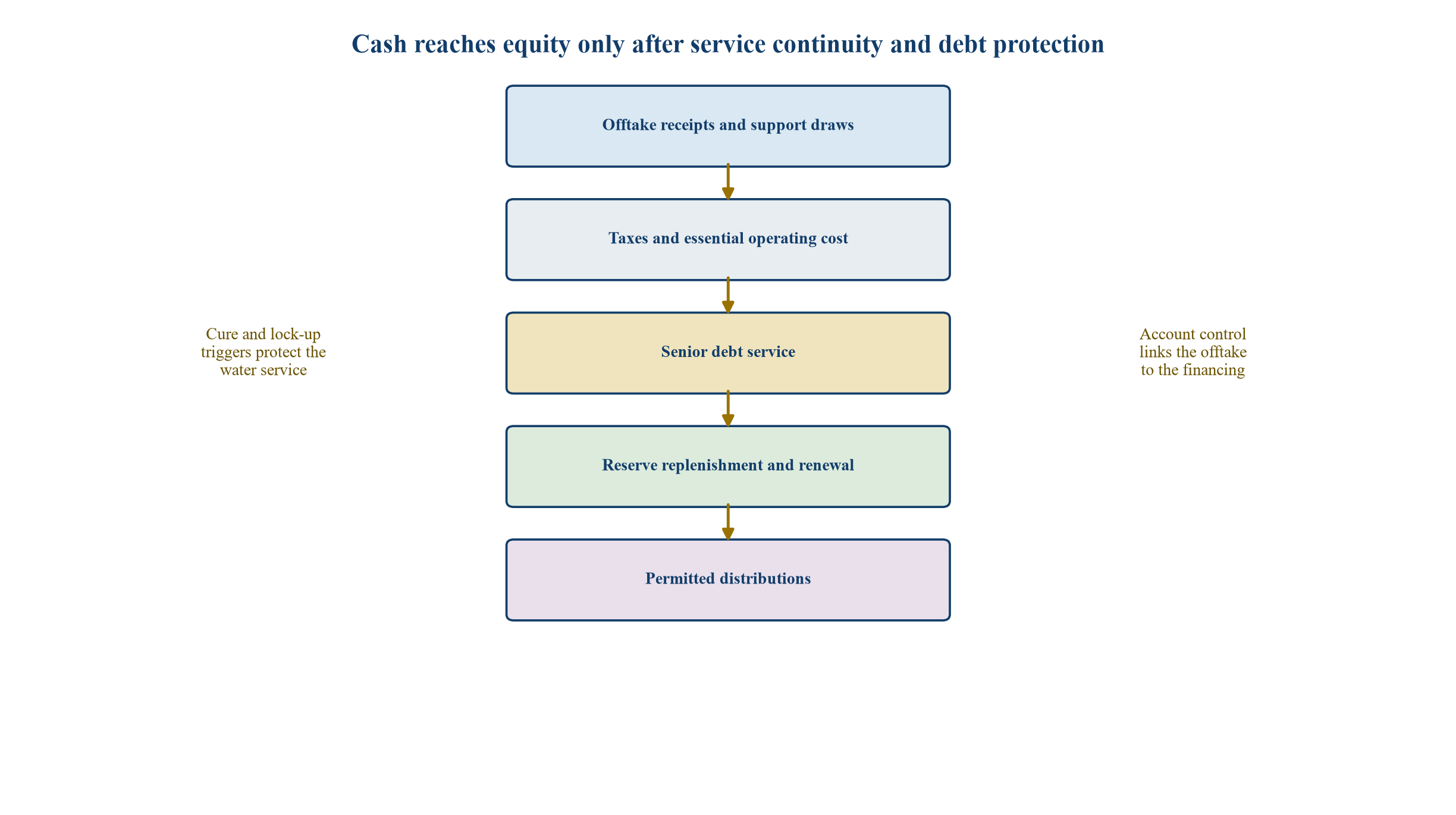
Conceptual structure; account priority and security require jurisdiction-specific legal advice.
52. Base-case debt sizing
Debt should be sized against contracted capacity revenue and conservative variable margin after operations and maintenance. Merchant volume, future expansion and uncommitted tariff increases should remain outside base debt.
The model should reconcile availability assumptions to maintenance and permitted outage. It should reconcile buyer payment timing to working capital and reserves.
53. Debt-service coverage
Coverage should be tested under demand, availability, price, source and credit scenarios. A strong ratio produced by optimistic indexation or low renewal spending is weak evidence.
The covenant can use historical and forward tests, distribution lock-up and default thresholds. Definitions should match the account waterfall.
54. Buyer-credit sensitivity
Payment delay can consume liquidity even when annual revenue is unchanged. The project should model late payment, support draw, reserve use and cure. Support instruments need replenishment before they can protect another cycle.
Credit downgrade can trigger additional security or suspension of expansion. Essential public service may limit termination, which increases the value of early security.
55. Demand sensitivity
The following illustration separates a capacity-supported structure from a volume-only structure.
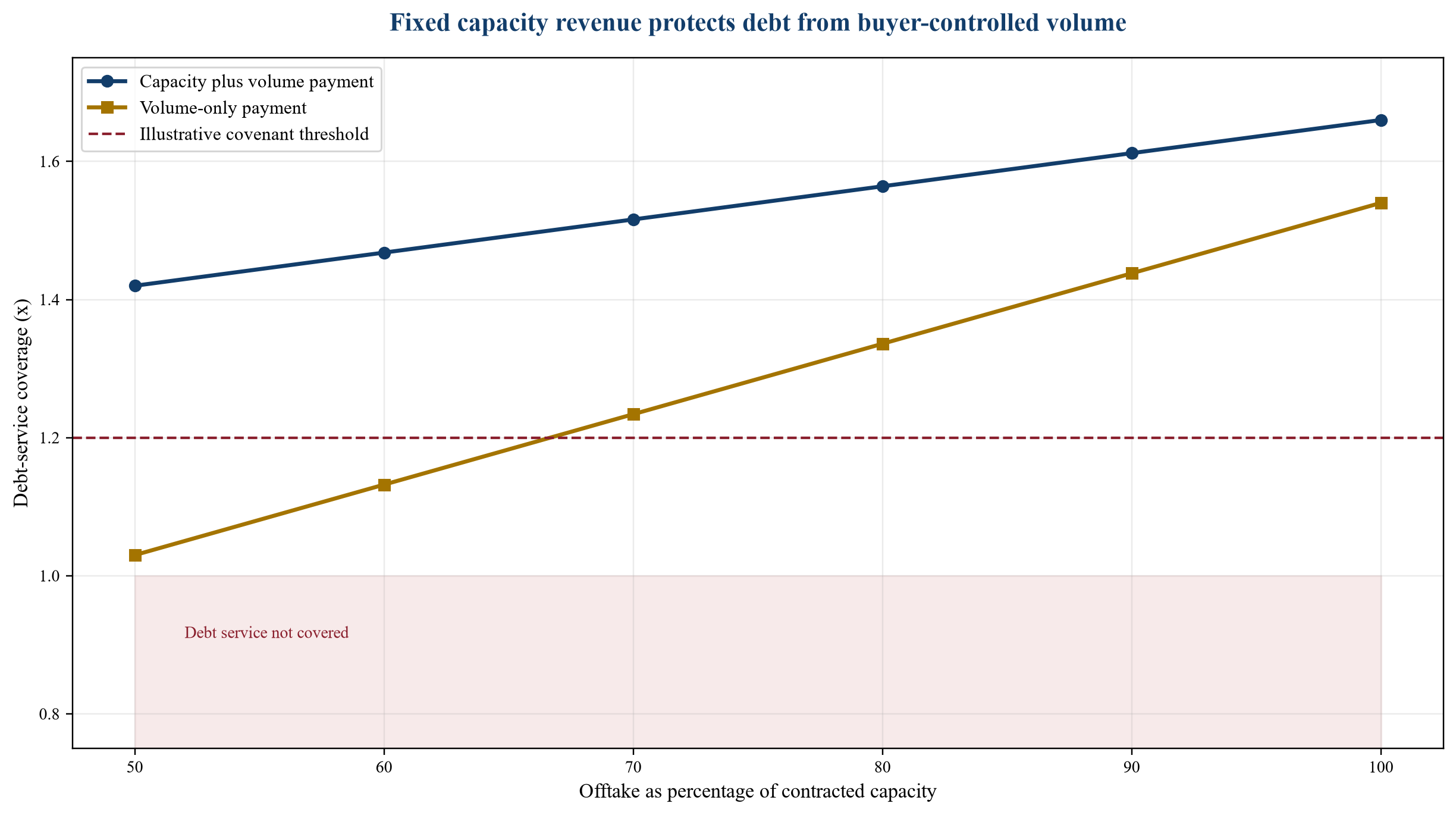
Illustrative index values only; not a forecast, valuation or transaction proposal.
56. Merchant-volume limit
Third-party sales can improve utilisation. They can also conflict with the anchor buyer, consume capacity or require new permits. The offtake agreement should define exclusivity, consent and revenue sharing.
Base debt should exclude merchant revenue unless supported by market evidence and conservative haircut. The anchor buyer's minimum payment should not disappear because the project finds optional sales.
57. Customer technology change
Industrial customers can reduce water demand through recycling or process change. The contract should distinguish efficiency from reserved capacity. The customer can benefit from reduced variable charges while continuing to pay for committed capacity.
Long-term agreements may include reset windows tied to debt amortisation and alternative customers. A unilateral volume reduction right undermines bankability.
58. Customer relocation and closure
Relocation, closure and insolvency can strand dedicated pipelines and treatment. Termination payment can recover unamortised customer-specific investment. Parent support and security can strengthen that obligation.
The project should assess whether assets can serve another user. Recoverability affects debt tenor and residual value.
59. Public tariff mismatch
The offtaker may owe an indexed capacity payment while retail tariffs are frozen. This creates fiscal or utility stress. The transaction should assess tariff authority, adjustment timing and affordability.
World Bank guidance notes that fiscal transfers may be required where tariffs do not cover investment [3]. Any transfer should be documented and budgeted rather than assumed.
60. Appropriation risk
Some public payments require annual appropriation. Lenders should understand whether the obligation is unconditional debt, contractual service payment or subject to budget approval. Remedies may differ.
Reserve, guarantee, intercept or statutory support can mitigate appropriation risk. Each instrument must be legally validated.
61. Industrial buyer diligence
Credit review should cover financial statements, business outlook, site strategy, water criticality, competing supply, environmental permits, parent support and change-of-control risk. Demand forecasts should reconcile to production plans.
The customer should disclose internal recycling and technology roadmaps that affect volume. Confidentiality can protect sensitive data while permitting lender review.
62. Public buyer diligence
Review should cover statute, procurement, budget, tariffs, collections, subsidies, existing debt, litigation, governance and service obligations. The project should identify who approves the offtake and who can adjust rates.
Historical payment and rate action can be more informative than policy statements. External support should be confirmed in binding documents.
63. WIFIA structuring lessons
EPA highlights repayment terms up to 35 years after completion, repayment deferral, sculpted schedules and compatibility with existing debt structures [4]. These features can help align debt with ramping revenue.
WIFIA still requires creditworthiness and a dedicated revenue source [12]. Flexibility should support a conservative structure rather than compensate for weak offtake.
64. Saudi treatment offtake example
SWPC's procurement materials describe treatment-capacity and output offtake under a sewage-treatment agreement, supported by a Ministry of Finance credit-support agreement [9]. The project company must meet environmental standards and sector regulation.
The example illustrates a public buyer, long-term treatment service and layered support. Transaction terms are jurisdiction-specific and should not be imported without legal and fiscal analysis.
65. World Bank contract lessons
World Bank model materials combine fixed and variable payments, independent verification, step-in, assignment and transfer [5][6][7]. These are useful drafting modules. They are not substitutes for project-specific analysis.
The sponsor should adapt the modules to feedwater, reuse product, public-health, residual and local-law requirements. A model form can still misallocate a material risk.
66. Fiscal commitments
Availability and termination payments can create long-term public obligations. Government should assess affordability, contingent liabilities and value for money before procurement. The World Bank specifically identifies these tests for reuse PPPs [3].
Fiscal reporting should include guarantees, compensation events and early termination. Transparency protects both the public authority and project credibility.
67. Environmental and social obligations
The offtake structure should preserve discharge, water allocation, community and worker obligations. Volume incentives should not encourage unsafe source acceptance or residual disposal.
Monitoring and reporting can be conditions to payment and finance. Corrective action should have funded responsibility.
68. Insurance
Construction, property, business interruption and liability insurance can support recovery. Coverage does not replace buyer credit or operating control. Exclusions and deductibles should be tested against contract obligations.
Insurance proceeds should flow through controlled accounts and support repair or debt repayment according to the financing documents.
69. Dispute resolution
Technical disputes over meters and quality need rapid expert determination. Payment, legal and termination disputes may use arbitration or courts. Undisputed amounts should continue to be paid.
The forum, governing law and enforceability should match lender expectations. Public-law limits should be identified before bid.
70. Procurement
Bid documents should present source data, demand, payment structure, support, permits and draft contracts. Bidders need enough information to price risk. Hidden uncertainty returns as contingency or claim.
Evaluation should consider tariff, lifecycle cost, technical compliance, financing certainty and contract qualifications. Lowest headline price can conceal weak deliverability.
71. Conditions precedent
Financial close should require executed offtake, support instruments, direct agreement, permits, land, source rights, residual route, funding and contractor commitments. Material buyer approvals should be complete.
Notice to proceed can have further conditions for design and financing. A long list should not obscure the few matters that determine bankability.
72. Red flags
Red flags include variable-only revenue for fixed debt, weak buyer credit, parent support that can expire, unspecified delivery point, broad rejection rights, tariff without indexation, temporary residual disposal, unbounded deductions, buyer termination without compensation and base debt supported by merchant volume.
Each red flag requires evidence, repricing, restructuring or reduced leverage. Narrative reassurance does not cure it.
73. Implementation sequence
The sponsor should identify buyers, test their credit and need, define the service boundary, develop the source and residual plan, design the payment mechanism, obtain public and customer approvals, procure delivery, secure financing and complete integrated tests.
The offtake term sheet should precede detailed debt sizing. Plant design and customer specification should develop together.
74. First 120 days
The initial programme should map buyers and alternatives, open credit diligence, define product and delivery point, model fixed and variable cost, draft capacity and volume payments, identify support and test termination. It should also assess legal authority and affordability.
By day 120, the sponsor should know whether a credible buyer will support the intended capacity and what unresolved risks prevent lender commitment.
75. Buyer aggregation protocol
Where several industrial customers share a network, the aggregator should publish capacity allocation, nomination, curtailment and credit standards. New buyers should satisfy technical and financial qualification before they rely on firm service. Common terms reduce transaction cost while customer-specific schedules preserve quality and ramp requirements.
The SPV should receive one enforceable payment or a controlled set of direct payments. It should not bear collection risk that it cannot manage. The aggregator's own liquidity and enforcement powers require diligence.
76. Replacement customer mechanism
A buyer exit can be mitigated if the project can contract with another customer. The offtake should permit replacement subject to technical compatibility, credit and public approval. Connection cost and changed product specification need allocation.
Replacement is an option, not guaranteed recovery. Debt sizing should reflect the time, cost and probability only when supported by market evidence. Termination security should remain in place until an approved replacement is effective.
77. Change control
The buyer may request higher quality, different pressure, additional capacity or a new delivery point. The project may propose process changes. The contract should require technical study, price, schedule, permits and funding before implementation.
Emergency safety changes can proceed under a faster protocol with later cost determination. Ordinary change should not be ordered without a defined payment source.
78. Default and cure
Defaults should distinguish payment, technical performance, insolvency, corruption, permit failure and abandonment. Each category needs notice, cure and consequence. Persistent small failures can be material even when each event falls below termination threshold.
The project should continue safe service during cure where lawful and funded. Lender cure rights begin after project-company notice and should not extend an unsafe operating condition.
79. Liquidated damages
Delay and performance liquidated damages can compensate a reasonable estimate of loss and simplify recovery. Their cap should reflect contractor and sponsor capacity. Uncapped exposure can reduce competition or remain unenforceable.
The buyer should preserve termination and completion support for prolonged failure. Liquidated damages should not become the price of abandoning the project.
80. Covenant package
Project debt can include minimum coverage, reserve funding, restrictions on additional debt, distribution tests, insurance, asset maintenance, contract preservation and reporting. Covenants should protect service and repayment without preventing prudent operation.
The offtake agreement should remain consistent with financing covenants. A buyer consent requirement should not block routine lender-required actions within the agreed structure.
81. Refinancing
After completion and operating evidence, the project may refinance. Consent should be objective and protect service, term and counterparty quality. Gain sharing can apply when public support created the refinancing benefit.
The base case should not depend on refinancing proceeds. Debt should amortise from contracted revenue. Refinancing remains an optional value event subject to market conditions.
82. Handback
At contract end, the plant may transfer to the authority. Handback standards should cover remaining life, condition, spares, data, permits, staff and deferred defects. A funded reserve and periodic surveys reduce end-of-term dispute.
The final years should not reward maintenance deferral. Distribution limits can apply until handback obligations are secured.
83. Data and audit
The buyer and lenders need metering, availability, quality, cost and compliance data. The project should maintain audit trails and allow reasonable inspection. Data definitions should reconcile to invoices and performance deductions.
Cybersecurity and confidentiality remain important. Access should be controlled while preserving the evidence needed for payment and public accountability.
84. Contract management
The public or industrial buyer needs a capable contract-management team after financial close. It should monitor performance, changes, claims, security expiry and future demand. Neglected administration can erode an otherwise sound agreement.
The team should maintain a obligations register, decision calendar and financial model. Material waivers should be documented with credit and service impact.
85. Conclusion
The water buyer sits behind the bond. A financeable reuse project begins with a buyer whose obligation is lawful, creditworthy and matched to the asset's fixed cost. The offtake should define service, capacity, volume, quality, delivery, indexation, source conditions, residuals and remedies. Payment security, controlled accounts, reserves, assignment, cure and step-in connect the contract to debt.
Sponsors should size capacity from committed demand, preserve fixed revenue when the compliant plant is available and keep merchant volume outside base debt. Industrial contracts need parent credit, technology-change and closure protection. Public contracts need tariff, budget and fiscal support. The strongest structure makes every party's obligation observable and provides a funded response when demand, quality, payment or law changes.
References
- World Bank Group. Scaling Water Reuse: A Tipping Point for Municipal and Industrial Use. https://www.worldbank.org/en/topic/water/publication/scaling-water-reuse
- World Bank Group. Scaling Water Reuse FAQ. https://thedocs.worldbank.org/en/doc/e7ce18cd9d57698eaa2c3c9496f5d9d0-0400012025/related/FAQ-Scaling-Water-Reuse-Report-V2.pdf
- World Bank Group. Scaling Water Reuse Full Report. https://documents1.worldbank.org/curated/en/099052025124041274/pdf/P506854-7d49fde0-2526-4bcc-8a85-2a7d1d294ee4.pdf
- United States Environmental Protection Agency. WIFIA Benefits and Flexibilities. https://www.epa.gov/wifia/wifia-benefits-and-flexibilities
- World Bank PPP Resource Center. Sample Bulk Supply Agreement for Water. https://ppp.worldbank.org/library/sample-bulk-supply-agreement-bot-water
- World Bank PPP Resource Center. Water Treatment Plant BOT. https://ppp.worldbank.org/library/water-treatment-plant-bot-new-build-only
- World Bank PPP Resource Center. Wastewater Treatment and Sludge Disposal BOT. https://ppp.worldbank.org/library/wastewater-treatment-and-sludge-disposal-bot-example-1
- World Bank PPP Resource Center. PPP Risk Allocation Tool: Water and Waste. https://ppp.worldbank.org/library/ppp-risk-allocation-tool-2019-edition-water-and-waste
- Saudi Water Partnership Company. Request for Qualification for Independent Sewage Treatment Plant Projects. https://www.swpc.sa/wp-content/uploads/2025/03/SWPC-Request-for-Qualification-for-ISTP-Projects-.pdf
- World Bank PPP Resource Center. PPP Contract Types and Terminology. https://ppp.worldbank.org/ppp-contract-types-and-terminology
- World Bank PPP Resource Center. Concessions, BOTs and DBOs. https://ppp.worldbank.org/agreements/concessions-bots-dbos
- United States Environmental Protection Agency. What Is WIFIA? https://www.epa.gov/wifia/what-wifia
- United States Environmental Protection Agency. WIFIA Public Borrowers. https://www.epa.gov/wifia/wifia-public-borrowers
- United States Environmental Protection Agency. WIFIA Frequent Questions. https://www.epa.gov/wifia/wifia-frequent-questions
- World Bank PPP Resource Center. Water and Sanitation Agreements. https://ppp.worldbank.org/sector/water-sanitation/water-agreements
- World Bank Group. Scaling Water Reuse Accelerator. https://documents1.worldbank.org/curated/en/099825301292615028/pdf/IDU-779f0726-3571-40af-b5f2-0ea1a4e63be0.pdf
About the Author
Chennakeshav (CK) is a corporate finance and investment banking executive with 25+ years of global experience in deal origination, structuring and execution across M&A, growth capital and corporate strategy. He has led value-creation mandates for founders, corporates and funds — bridging the boardroom view to hands-on execution and close.
His career spans Morgan Stanley, HSBC, Lloyds Banking Group, EWEC, ADQ portfolio companies and Emirates Growth Fund, across TMT, real estate, fintech, deeptech, cleantech, infrastructure and energy. He has partnered with C-suite leaders, private equity and venture funds, sovereign wealth funds and family offices to finance complex fund raises and scale-up ventures, and has led M&A due diligence, post-merger integration and business-transformation initiatives to create value.
At Matchpoint Partners he is Managing Partner, leading the firm's corporate finance, M&A and capital-raising practice. He holds an MBA from London Business School, an engineering degree from VTU and a Master of Laws (LLM, in progress) from UCL London.
An active start-up mentor, CK mentors at Techstars, DIFC FinTech Hive, Startup Grind, Founder Institute and IN5, serves as Entrepreneur Mentor in Residence (EMiR) at London Business School, and judges the Entrepreneurship World Cup.
LinkedIn: https://www.linkedin.com/in/ckadya/
Profile: https://www.matchpoint-partners.com/team/ck-adya.html
