

1. The trust question
The decision is whether a particular reading is sufficiently reliable for a defined use at a defined time. A value that supports operational awareness may be inadequate for regulatory reporting, customer protection, contractual payment or an investment model. Trust therefore requires purpose, context and evidence.
The assurance task is to show what was measured, where, how, with what uncertainty, under which conditions, through which data path, and under whose review. The same number can carry different decision rights depending on this chain.
2. Continuous is not automatically accurate
A sensor can report every minute while drifting for weeks. Availability measures the presence of data; accuracy and fitness for purpose require separate tests. High-frequency data can amplify confidence without improving truth when the underlying measurement is weak.
Management reporting should distinguish uptime, completeness, validity, uncertainty and decision coverage. A single data-quality percentage can conceal material defects.
3. Measurement system boundary
The measurement system includes the sensor, sample interface, installation, reference standards, power, communications, configuration, software, time source, transformations, storage and people. A technically capable instrument can produce poor results when the sample does not represent the process or when data handling alters meaning.
The assurance plan should map the full boundary before specifying tests or warranties.
4. The measurand
The measurand is the quantity intended to be measured. It needs a clear definition, unit, location, time basis and operating range. Turbidity at a treatment outlet, pressure at a network node and residual disinfectant in a distribution zone are different decision objects.
Ambiguity at this stage propagates through procurement, analytics and reporting. The data dictionary should preserve the agreed definition.
5. Decision rights
Each use should specify who may observe, investigate, control, report, certify or approve action based on the reading. An advisory alarm can tolerate a different evidence threshold from an automatic shutdown or regulatory submission.
The rights matrix prevents a pilot-grade signal from quietly becoming a control-grade dependency after deployment.
6. Assurance chain
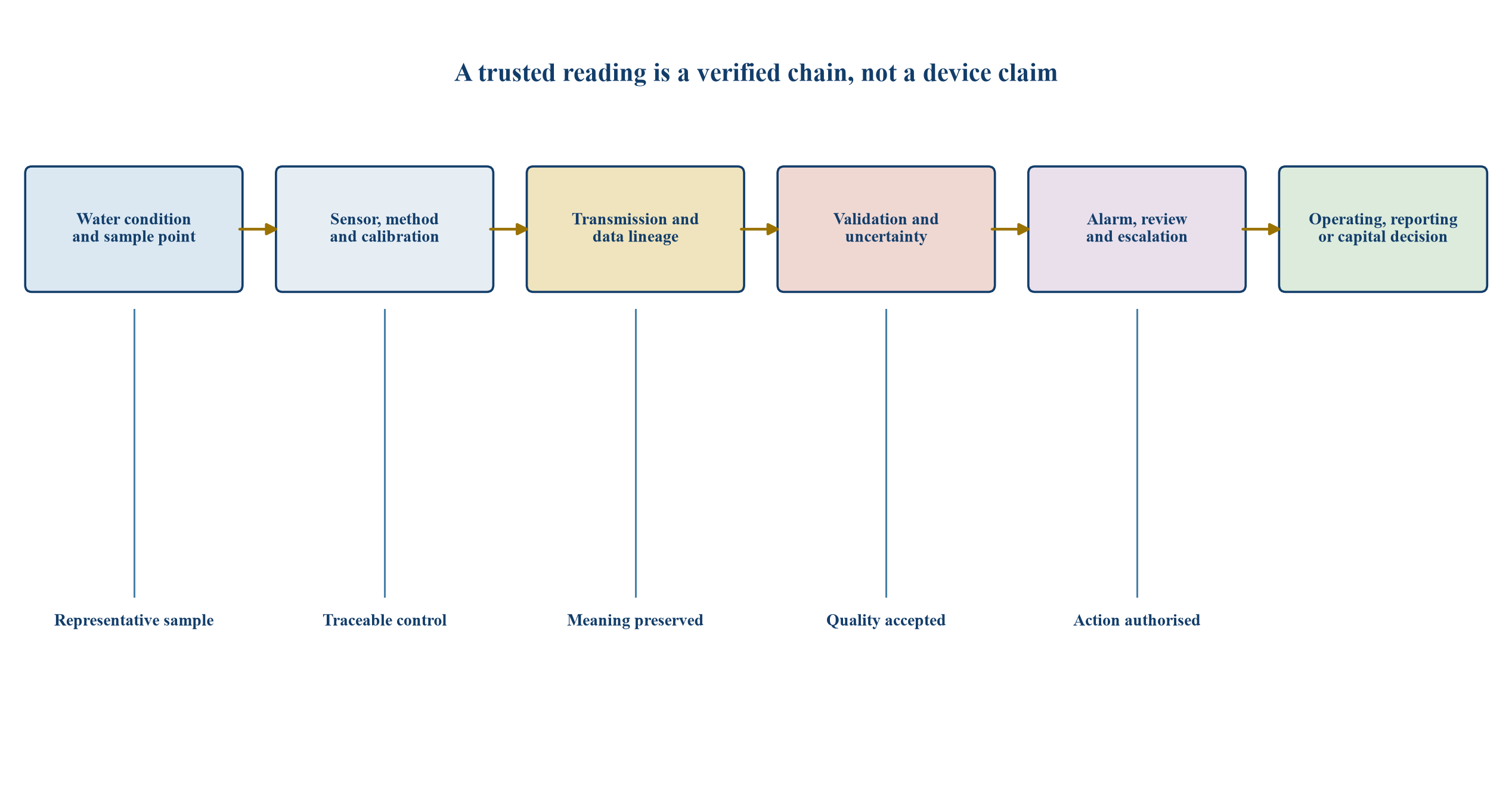
Generic framework; actual methods, limits and approvals depend on the parameter, site, regulation and intended use.
7. Data-quality objectives
The utility should define acceptable range, resolution, bias, precision, response time, completeness, latency and uncertainty for the intended decision. These objectives determine instrument class, maintenance interval, validation and cost.
The objective should be strict enough to protect the decision and no stricter than the use requires. Excess specification can increase cost and complexity without increasing value.
8. Site selection
The sensing location should represent the water, process or network condition of interest. Mixing, residence time, stratification, dead zones, bubbles, sediment, sunlight, temperature and access can affect readings. A convenient location may be a poor measurement location.
Site surveys should document representativeness, installation constraints and expected environmental stress before procurement is finalised.
9. Sampling interface
In-situ, flow-through and extracted samples create different lag, maintenance and representativeness. Lines can foul, trap air, alter temperature or consume disinfectant. Filters and conditioning can change the measurand.
The assurance record should include sample-path design, flow, materials, cleaning and time delay. A sensor specification alone does not cover this interface.
10. Parameter selection
Parameters should be selected for the decision mechanism. Online water-quality monitoring can support treatment optimisation, distribution operation and incident detection, according to EPA guidance [1]. A broad multiparameter installation is not automatically better than a targeted design.
The business case should explain how each parameter changes action, risk or evidence.
11. Operating range
Accuracy can vary across concentration, temperature, pressure, salinity, turbidity and flow. The expected field range should sit within the demonstrated capability of the method. Extreme conditions need specific testing.
Procurement should request performance across the operating envelope rather than a single laboratory point.
12. Response time
The measurement system includes sensor response, sample transport, averaging, polling, transmission, processing and alarm delay. An accurate value received after the decision window can be operationally useless.
Testing should measure end-to-end latency under normal and degraded communications. Alarm design should use the real delay.
13. Detection limit
The lowest reportable value should reflect the method, noise, environment and data-quality objective. Vendor detection limits may be established under conditions different from the deployment.
Values below the reportable limit should retain an explicit qualifier. Treating them as precise zeros can distort trends and models.
14. Selectivity
Other substances or environmental conditions can affect a sensor's response. Cross-sensitivity is material when the interferent changes independently of the target. Laboratory and field testing should reflect credible mixtures.
The utility should document known interferences and decision safeguards. A second parameter or reference method may help distinguish causes.
15. Calibration
Calibration establishes the relationship between instrument indication and reference values under stated conditions. ISO 10012:2026 frames measurement management around confidence in valid and reliable results [2]. Calibration should be traceable, documented and appropriate to the operating range.
The certificate needs identity, method, standards, results, uncertainty, date and acceptance decision. A sticker alone is weak evidence.
16. Calibration verification
Verification checks performance against a known standard without automatically changing the instrument response. USGS guidance distinguishes calibration from calibration verification and uses the latter to decide whether adjustment is required [3].
Pre- and post-deployment verification helps bound the period for which data may be acceptable. The result should link to the affected data interval.
17. Reference materials
Reference materials should be suitable, within expiry, stored correctly and prepared under controlled conditions. Lot, concentration, uncertainty and use should be recorded. Contaminated or poorly handled standards can create systematic error across an estate.
Procurement and inventory controls therefore form part of measurement assurance.
18. Traceability
Metrological traceability connects a result through documented calibrations to stated references, each contributing uncertainty. Traceability supports comparability; it does not guarantee that the field sample is representative or the decision use is valid.
The assurance pack should retain the complete chain and identify any break or non-standard reference.
19. Measurement uncertainty
Uncertainty expresses the dispersion reasonably attributable to the result. Sources can include calibration, repeatability, resolution, environment, sampling, drift and correction. The estimate should be appropriate to the decision and updated when evidence changes.
Decision thresholds near the uncertainty band require explicit treatment. A dashboard should not hide uncertainty behind extra decimal places.
20. Precision
Repeatability shows how closely measurements agree under stated conditions. A precise sensor can remain biased. Replicate tests and co-located instruments help separate variability from process change.
Precision targets should reflect the rate and magnitude of change that matters for action.
21. Bias
Bias is a systematic difference from a reference. It can arise from calibration, matrix effects, installation or processing. Bias may remain stable enough to correct, or it may change with condition.
Corrections should be governed, versioned and supported by evidence. Raw and corrected values should remain distinguishable.
22. Drift
Drift changes the measurement response over time. Fouling, ageing, chemical consumption and environmental exposure can contribute. Review of the difference before and after cleaning, and before and after calibration, can help separate causes.
Intervals should be based on observed performance and risk rather than calendar convention alone.
23. Fouling
Biofilm, sediment, scale and debris can affect the sample interface and optical or electrochemical response. Fouling rates vary by parameter, site and season. USGS procedures require inspection, cleaning and documentation because corrections depend on this evidence [4].
Anti-fouling design can reduce maintenance while creating its own consumables and failure modes.
24. Field verification
Portable instruments, grab samples or laboratory analysis can test an abnormal reading. The Drinking Water Inspectorate has required procedures that check calibration and use independent measurements during events or near misses [5].
The escalation protocol should specify timing, method, authority and action while confirmation is pending.
25. Laboratory comparison
Laboratory comparison can provide independent evidence when sampling, preservation and transport are controlled. The laboratory result may represent a different time or method and should not be treated as a perfect truth without considering uncertainty.
The comparison plan should define acceptance and investigation criteria before results are known.
26. Redundancy
Co-located sensors, different technologies or independent process indicators can improve fault detection. Common-mode failure remains possible when devices share sample lines, standards, power, communications or algorithms.
Redundancy should be designed around independent failure paths and critical decisions, not simply device count.
27. Acceptance testing
Factory, laboratory and site acceptance tests should verify identity, configuration, range, accuracy, response, environmental resilience, communications and data integration. Site testing should use real process conditions where safe.
Acceptance criteria, remedies and retained evidence belong in the contract. Installation completion is not performance acceptance.
28. Commissioning
Commissioning proves that the installed system operates as intended within the utility environment. It includes tags, units, time, alarms, permissions, fail states, maintenance access and data retention.
The handover should identify open defects and the period of heightened review. Decision rights should remain limited until commissioning gates are passed.
29. Configuration control
Range, averaging, compensation, calibration coefficients, firmware and alarm settings change measurement meaning. Configuration should be approved, backed up and versioned. Unauthorised or undocumented change can invalidate comparisons.
The data record should identify the configuration in force at each time.
30. Time assurance
Real-time interpretation depends on synchronized clocks. Drift, time-zone conversion, daylight-saving changes and buffering can misalign readings with events or laboratory samples.
The system should retain source time, receipt time and processing time where material. Clock-health alarms need ownership.
31. Data lineage
Lineage shows how a value moved from sensor to historian, platform, model and report. It should record transformations, aggregation, corrections, exclusions and versions. This allows a decision to be reproduced from source evidence.
Lineage also supports cyber investigation and supplier transition. Proprietary processing should not make material results unauditable.
32. Data marking
EPA sensor-evaluation guidance recommends marking calibration events, bad data and instrument warnings so real-time algorithms can exclude non-actionable anomalies [6]. Marking should preserve the original value and reason.
Deletion creates an incomplete record and can hide estate performance. Quality flags need stable definitions.
33. Missing data
Missingness can result from power, communications, maintenance, fouling, sensor failure or intentional outage. Each cause has a different operational meaning. Automatic interpolation can conceal the event.
Completeness reporting should show duration, frequency, cause, criticality and whether the decision was covered by fallback evidence.
34. Outliers
Outliers can be errors or genuine events. Rules should use physical limits, rate-of-change, redundancy, process context and review. A generic statistical filter can remove the event the system was installed to detect.
Excluded data should remain traceable with reason and approver.
35. Validation states
Table 1. Decision states for real-time sensor data
| State | Evidence | Permitted use | Required action |
|---|---|---|---|
| Raw | Received from source with lineage intact | Engineering review and diagnostics | Apply quality checks |
| Provisional | Automated checks passed; field review pending | Time-sensitive operational awareness | Confirm within stated period |
| Validated | Quality checks and accountable review complete | Approved operational and analytical uses | Preserve evidence and version |
| Qualified | Known limitation with bounded use | Specific approved decision only | Display limitation and monitor |
| Rejected | Material defect or unsupported result | No decision use | Investigate, correct and assess affected interval |
36. Quality-control rules
Rules can test range, rate, persistence, flatline, step change, cross-parameter relationship, calibration status and communications. Every rule should have purpose, threshold basis, version and response.
Rule performance should be evaluated against confirmed events and false alerts. Coverage should reflect the full operating envelope.
37. Contextual validation
Hydraulic state, treatment configuration, weather, demand and maintenance can explain a reading. Context helps determine plausibility while also introducing dependencies. The system should show when contextual data are missing.
A plausible value is not necessarily accurate. Context supports review rather than replaces reference evidence.
38. Alarm design
An alarm needs condition, persistence, priority, recipient, response time, escalation and closure. Excess alarms create fatigue; sparse alarms can miss deterioration. Design should reflect consequence and operator capacity.
Alarm performance should be reviewed using acknowledged, investigated and confirmed-event outcomes.
39. Alarm suppression
Suppression may be necessary during calibration, maintenance or known operating states. It should be authorised, time-limited and visible. Persistent suppression can remove protection without management awareness.
The handback check should confirm that alarms and decision rights are restored.
40. Automated control
When sensor data directly change dosing, pumping or shutdown, assurance extends into control logic, interlocks, fail-safe state and independent protection. The evidence burden is higher than for advisory monitoring.
The design should analyse failure modes such as frozen, biased, noisy or implausible readings and communications loss.
41. Cybersecurity
Sensors, gateways and remote services can create access paths and integrity risks. Identity, segmentation, updates, logging, supplier access and recovery should be proportionate to consequence. Secure configuration also protects measurement meaning.
The utility should distinguish loss of data from manipulation of trusted data. Both need response plans.
42. Supplier assurance
Supplier evidence should cover method, testing, calibration, environmental limits, quality system, vulnerabilities, support, data rights and end-of-life. Marketing accuracy should not replace independent or utility testing.
Critical proprietary components require continuity and exit planning.
43. Service-level agreements
Availability commitments should define excluded time, maintenance, communications, data validity and remedy. A sensor can meet uptime while producing rejected data. Service levels should therefore include decision-grade data and response to quality failure.
Performance reports should be reproducible from utility-accessible evidence.
44. Procurement specification
The specification starts with measurand and decision, then sets environment, performance, calibration, integration, cyber, maintenance, evidence and acceptance. Brand-neutral outcome requirements can preserve competition while protecting assurance.
Mandatory requirements should be separated from scored enhancements and future options.
45. Bid evaluation
Evaluation should test claimed performance, total lifecycle cost, reference deployments, support model, data access and exit. Demonstrations should use representative scenarios and defects.
The panel should include operations, science, metrology, digital, cyber, procurement and finance where material.
46. Contractual remedies
Remedies can include correction, re-performance, replacement, service credits, payment hold, independent testing and termination. They should address the economic consequence and restore evidence.
Liability, data ownership and transition need alignment with the criticality of the use.
47. Total cost of ownership
Cost includes device, installation, sample systems, communications, licences, cloud, standards, consumables, calibration, cleaning, visits, spares, training, integration, assurance and replacement. Remote sites can make field service dominant.
The model should state volume, interval, inflation and asset-life assumptions as management estimates.
48. Benefit pathways
Benefits can arise from earlier event detection, treatment control, reduced manual sampling, compliance evidence, leakage insight, maintenance and better capital decisions. Each pathway needs a decision, counterfactual and evidence plan.
Avoided consequence should remain scenario-based unless a defensible method supports recognition.
49. Hypothetical economics
Table 2. Hypothetical assurance economics for a sensor estate
| Case | Annual estate cost | Valid decision-grade coverage | Verified operating saving | Decision interpretation |
|---|---|---|---|---|
| Low-cost, weak assurance | USD 0.45m | 55 percent | USD 0.10m | Redesign critical coverage and evidence |
| Controlled deployment | USD 0.70m | 85 percent | USD 0.65m | Fund targeted scale with persistence test |
| High-assurance critical estate | USD 1.10m | 95 percent | USD 0.90m | Assess service and regulatory value separately |
| Over-specified estate | USD 1.60m | 96 percent | USD 0.75m | Simplify non-critical requirements |
These figures are hypothetical and illustrate decision structure only. They are not benchmarks or expected results. A real case requires site, parameter, maintenance, tariff and service evidence.
50. Coverage
Coverage should measure whether each critical decision had valid evidence when needed. Device count and data volume are weaker metrics. A small number of well-governed sensors can provide greater coverage than a large unreliable estate.
Coverage should be reported by decision, geography, asset and consequence.
51. Value of assurance
Assurance has value when it changes a material decision, reduces false action, protects compliance or lowers the cost of uncertainty. The optimum level depends on consequence and reversibility.
A low-consequence exploratory use may accept provisional data. A public-health protection action requires stronger evidence and independent safeguards.
52. Capital allocation
Capital should prioritise high-consequence decisions with weak current evidence and an actionable sensor solution. Readiness, maintenance capacity and integration matter alongside technical potential.
Portfolio sequencing should avoid installing more devices than the assurance team can maintain and review.
53. Investment committee
The committee pack should include decision use, system map, evidence objectives, pilot results, lifecycle cost, benefit pathways, cyber and regulatory review, supplier terms, uncertainty, scale gates and downside.
Management estimates and unresolved limitations should be visible. A dashboard screenshot is not sufficient investment evidence.
54. Financing
Sensor programmes may sit within utility capex, performance contracts, concession obligations, green finance or digital-transformation budgets. Financing should match the cash pathway and evidence period.
Debt service should not depend on unverified avoided-event value. Measured operating savings can support a clearer base case where persistence is demonstrated.
55. Outcome-based payment
Payment can be linked to accepted design, commissioned data, validated coverage, supported decisions and sustained outcomes. Vendor control over the outcome should match risk allocation.
The measurement and dispute method should be agreed before deployment. Independent review can protect both parties.
56. Acquisition diligence
Buyers should inspect sensor inventory, decision rights, calibration, quality flags, rejected data, alarms, suppliers, raw access, cyber, maintenance backlog and reporting. A digital estate can carry hidden recurring cost and technical debt.
Valuation should separate remediation, recurring assurance and bounded operational benefit.
57. Regulatory reporting
Regulatory requirements vary by jurisdiction and parameter. Ofwat states that submitted performance information should receive rigorous, high-quality assurance [7]. The Environment Agency addresses management, calibration, quality control and audits for discharge monitoring [8].
The compliance matrix should map the exact current requirement and authority for each reported result.
58. Board assurance
Board reporting should show critical decision coverage, calibration compliance, rejected intervals, alarm response, unresolved defects, supplier concentration, cyber exposure, assurance findings and capital actions. Leading and outcome measures should remain separate.
Sign-off should state the scope and limitations of assurance rather than imply universal accuracy.
59. Independent assurance
Independent review can test design, sampling, traceability, uncertainty, lineage, controls and reported metrics. Independence should reflect materiality and conflict. Technical and financial assurance may both be needed.
The review should sample source evidence and field practice, not only policies and dashboards.
60. Audit trail
The audit trail should reconstruct a reading, quality state, configuration, review and resulting decision. It includes who changed data or thresholds and why. Retention should reflect legal, regulatory and operational needs.
Tamper evidence and access control protect both integrity and accountability.
61. Data ownership
Contracts should define ownership and rights over raw data, metadata, quality flags, configurations, derived values and models. Utility access should continue through supplier failure or transition.
Export should use documented formats and preserve meaning. A proprietary portal alone can create lock-in.
62. Privacy and location
Water sensor data may reveal critical-infrastructure location, operation and vulnerability. Access, publication and sharing should consider security and applicable law. Data minimisation should coexist with audit needs.
The classification scheme should govern maps, live feeds and supplier access.
63. Competence
Assurance requires field, laboratory, process, metrology, data, cyber and governance capability. Roles should have defined competence and refresher requirements. Supplier training can supplement utility knowledge.
Critical approvals should not depend on one individual without succession and review.
64. Maintenance planning
Intervals for inspection, cleaning, standards, consumables and calibration should reflect observed performance and consequence. Fixed schedules can be shortened or extended through evidence and approval.
The work system should link every activity to the sensor and affected data interval.
65. Spares and obsolescence
Critical monitoring needs spare strategy, compatible replacements, firmware support and calibration capability. Long procurement lead times can reduce valid coverage. Excess spares can expire or become obsolete.
Lifecycle planning should include transition before support ends.
66. Pilot design
A pilot should test representative water conditions, seasons, communications and maintenance. It should include adverse scenarios and reference methods. Easy laboratory performance alone does not prove field fitness.
Success criteria and scale decision should be approved before the pilot begins.
67. Scale gates
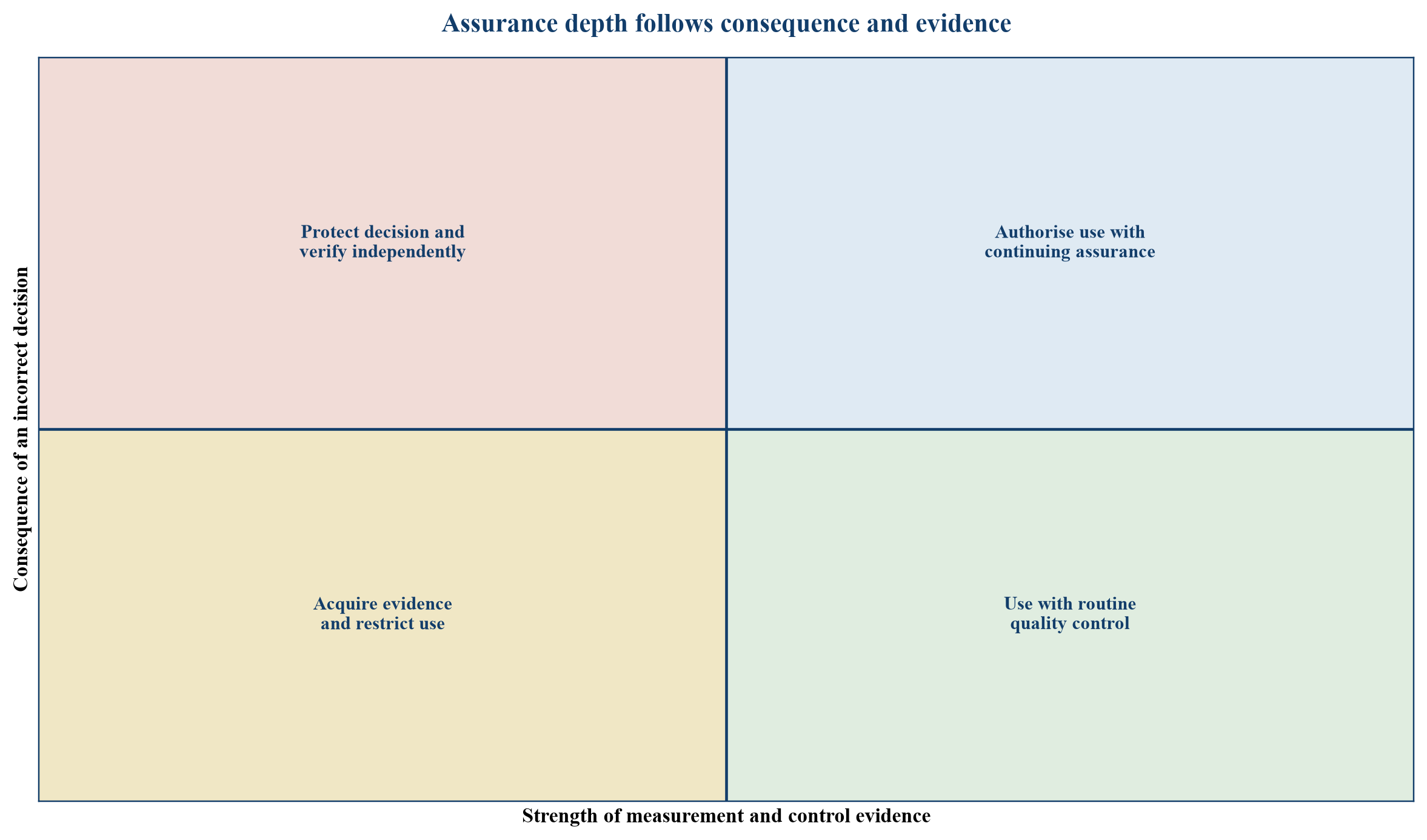
Illustrative decision matrix; thresholds require parameter-specific and jurisdiction-specific approval.
68. Stage-gated procurement
Table 3. Illustrative procurement and payment gates for real-time sensors
| Gate | Evidence | Release decision | Stop condition |
|---|---|---|---|
| Measurement design | Measurand, site, use and quality objectives approved | Release detailed design | Decision or sample point undefined |
| Acceptance | Laboratory and site tests meet criteria | Accept commissioned units | Material unsupported performance |
| Operational proof | Calibration, uptime and validation work through representative period | Release pilot completion | Decision-grade coverage inadequate |
| Outcome proof | Supported decisions and verified benefits documented | Release outcome-linked payment | Benefit evidence fails agreed method |
| Scale | Lifecycle cost, cyber, support and assurance accepted | Authorise portfolio wave | Capacity or supplier risk unresolved |
69. First 90 days
The first phase should map decisions, classify criticality, reconcile sensors, define measurands, test calibration records, inspect sample points, review quality flags and identify unsupported uses. It should establish owners and stop unsafe reliance on weak readings.
The output is a prioritised assurance plan with bounded interim use.
70. Twelve-month programme
The programme should test seasonal performance, maintenance intervals, reference comparisons, alarm outcomes, supplier response and lifecycle cost. It should validate coverage and revise standards based on evidence.
Scale should proceed by decision class and geography. Benefits should follow the agreed evidence hierarchy.
71. Assurance dashboard
The dashboard should report critical decision coverage, valid data, rejected intervals, calibration status, drift, fouling, alarms, response, open defects, supplier service and cost. Users should be able to reach source evidence.
Colour alone should not communicate quality. State, limitation and action need text.
72. Common failure patterns
Weak estates buy devices before defining use, place sensors for convenience, rely on factory calibration, delete bad data, hide uncertainty, count uptime as quality, allow settings to change without control and scale before maintenance works. Each pattern breaks the assurance chain.
Correction begins with the decision, measurand and evidence objective.
73. Red flags
Red flags include missing calibration certificates, identical readings across long periods, unexplained time shifts, values outside physical range, frequent manual overrides, quality flags removed during export, unsupported corrections, stale firmware, supplier-only access and regulatory use of provisional data.
Material red flags should restrict use and trigger investigation.
74. Diligence request list
The request should cover measurement design, site surveys, inventory, specifications, certificates, standards, uncertainty, configuration, maintenance, raw data, flags, lineage, alarms, reference tests, rejected intervals, suppliers, cyber review, reporting and governance minutes.
Field inspection and sample trace-back should supplement summaries.
75. Decision rule
Authorise a sensor result for a defined use when the measurand and site are representative, performance meets the quality objective, calibration and uncertainty are controlled, lineage preserves meaning, validation is complete, limitations are visible and an accountable person owns the decision.
Restrict or reject use when evidence cannot bound the risk of an incorrect decision.
76. Implementation roadmap
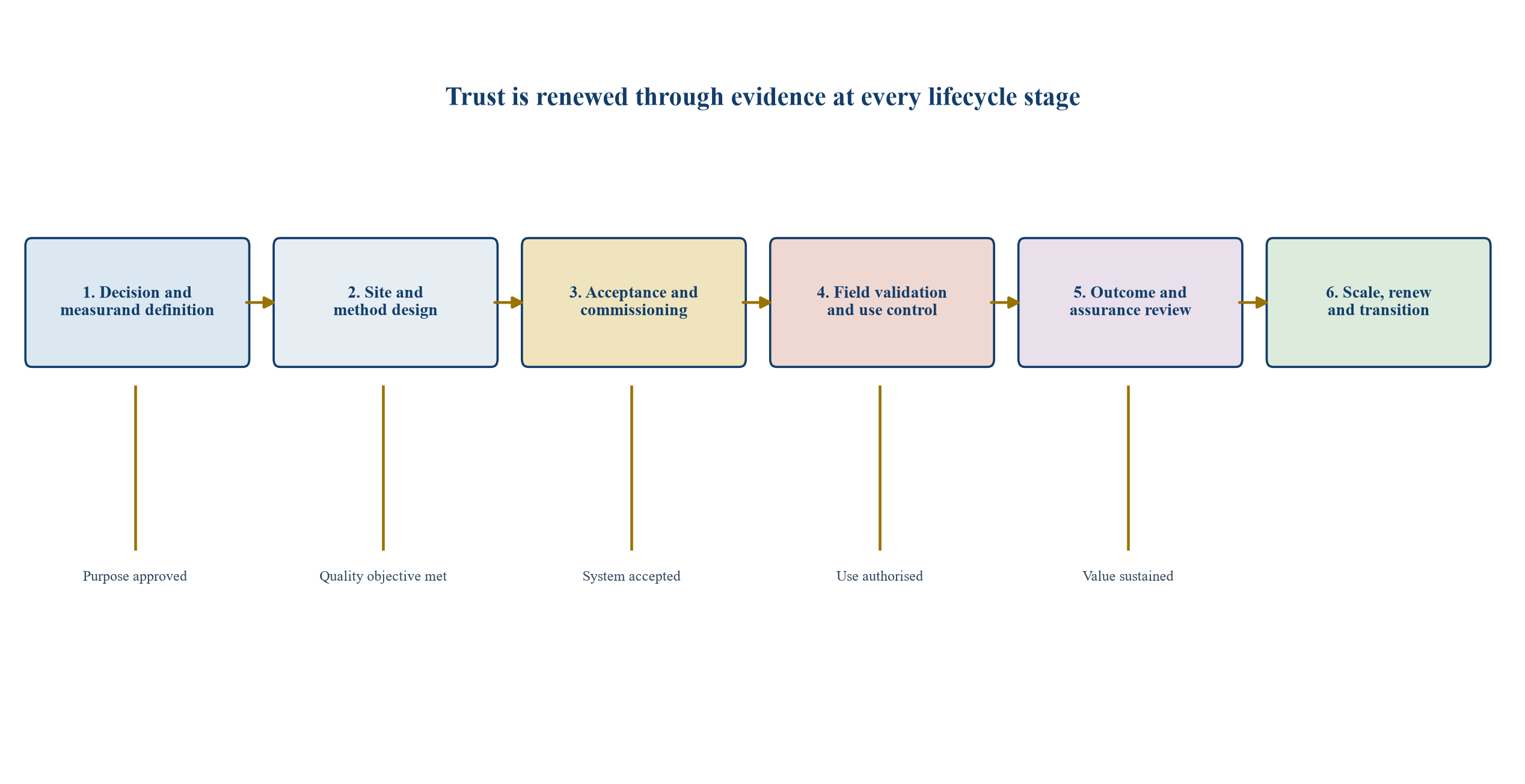
Generic roadmap; timing depends on procurement, field conditions, reference methods and regulatory review.
77. Transfer across geographies
The assurance chain applies across markets, while permitted methods, standards, reporting, accreditation, data residency and liability differ. A design proven in one jurisdiction should be revalidated before regulatory or contractual use elsewhere.
Climate, water matrix, infrastructure age and field-service capacity can also change performance and cost.
78. Innovation governance
New optical, electrochemical, biosensor, remote-sensing and model-derived methods can expand coverage. Innovation should enter through a controlled evidence pathway that defines comparison method, uncertainty, intended use and exit criteria.
Experimental status should remain visible until the approval gate is passed. Innovation value increases when evidence can support adoption.
79. Continuing assurance
Sensor performance changes through ageing, fouling, firmware, configuration, environment, supplier support and network change. Assurance therefore continues after commissioning. Review intervals should reflect consequence and observed stability.
Evidence from failures and corrections should update procurement, maintenance and decision rights.
80. Derived measurements
Some reported values are calculated from multiple sensors, compensation equations or surrogate relationships. Their uncertainty includes each input, transformation and model limitation. The user should be able to distinguish a directly measured parameter from a derived estimate.
Validation should cover the full derivation and operating range. A reliable individual sensor cannot make an unsupported relationship decision-grade.
81. Soft sensors
Soft sensors estimate a difficult or expensive parameter from other measurements and a model. They can increase frequency and coverage while adding model risk. Training data, drift, regime change and missing inputs need governance.
The display should identify model-derived results and confidence. Reference sampling remains necessary at an interval justified by consequence and stability.
82. Edge analytics
Processing near the sensor can reduce latency and communications demand. It can also hide transformations inside field devices. Firmware, algorithms, thresholds and time settings should be versioned and recoverable.
The architecture should define which raw evidence is retained centrally and how an edge decision is reconstructed after an event.
83. Environmental compensation
Temperature, pressure, salinity, humidity and matrix conditions may be used to compensate readings. Compensation sensors and equations create additional dependencies. Their failure can bias a value that otherwise appears stable.
Acceptance testing should challenge the compensation across credible conditions. The data record should preserve compensated and relevant source values.
84. Event confirmation
Incident detection often relies on change across several parameters, locations or time windows. Confirmation should distinguish measurement fault, routine operation and genuine water-quality change. The protocol should preserve timely protective action while evidence is gathered.
Post-event review should compare alarms, field checks, laboratory results, operational changes and final classification. These records improve thresholds and training.
85. Correction of records
Corrections may be appropriate for demonstrated drift, fouling, timestamp or processing error. The method, affected interval, evidence, reviewer and version should be retained. Published or submitted data may require formal replacement procedures.
The original record should remain recoverable. Silent overwrite undermines auditability and can change historic decisions without notice.
86. Data-product tiers
The utility can classify data products as exploratory, operational, control, contractual or regulatory. Each tier has approved sources, quality controls, review, retention and users. Promotion to a higher tier requires evidence.
This structure allows innovation without granting premature authority. It also helps procurement price assurance according to use.
87. Cross-site benchmarking
Benchmarking can identify unusual drift, maintenance cost or invalid-data rates. Differences in matrix, siting, technology, duty and service model must be considered. A high rejection rate can reflect strong quality control rather than poor performance.
Benchmarks should generate questions and targeted review. They should not replace site-level evidence.
88. Supplier concentration
A common supplier can simplify training and integration while concentrating defects, cyber exposure, standards and support risk. Multi-vendor estates can diversify risk while increasing interfaces and calibration complexity.
The portfolio decision should evaluate interoperability, common-mode failure, switching cost and access to raw evidence. Critical functions may justify tested alternatives.
89. Incident response
The response plan should cover false reading, loss of reading, manipulation, widespread drift and quality-event detection. It should define safe operating state, independent verification, communications, regulatory contact and recovery evidence.
Exercises should include data uncertainty and conflicting instruments. Restoration should confirm measurement integrity before normal decision rights resume.
90. Decision reversibility
Assurance depth should reflect whether an incorrect action can be reversed before material harm. A recommendation for inspection is more reversible than automatic dosing or public reporting. Time to detect error also matters.
The rights matrix should therefore combine consequence, reversibility and evidence strength. High-consequence irreversible action needs independent safeguards.
91. Benefits register
The benefits register should link each claimed outcome to the sensor use, affected decision, baseline, evidence owner, calculation, uncertainty and persistence period. It should separate measured cash savings, service indicators and scenario-based avoided consequences.
This prevents double counting across digital, leakage, energy and compliance programmes. Finance should recognize benefits only under the approved evidence class.
92. Retention and evidence availability
Retention periods should reflect operational learning, asset life, contractual claims, regulatory requirements and model validation. Raw values, metadata, calibration, quality flags and configuration may need different storage treatment. Compression or aggregation can remove evidence needed for later investigation.
The archive should be tested for retrieval and interpretation. Data that exists but cannot be linked to units, time, location and configuration provides limited assurance.
93. Independent reference capability
The utility should preserve access to an independent reference method for material parameters. This may be a portable instrument, accredited laboratory, grab-sample protocol or redundant technology. The method must remain available during supplier or platform failure.
Reference capability should be exercised at planned intervals. An unused fallback can fail through expired standards, missing competence or inaccessible equipment.
94. Operating-change review
Changes in treatment chemistry, source water, network configuration, pressure, software or maintenance can invalidate a sensor assumption. Management of change should identify affected measurement systems and trigger review, testing or recalibration.
The same discipline applies when a previously advisory signal becomes part of control, payment or reporting. Expanded use requires a new evidence decision rather than silent reliance.
95. Materiality and escalation
A measurement defect is material when it could change an operating response, compliance conclusion, customer communication, contractual payment or capital decision. Materiality should consider both the magnitude of error and the consequence of reliance. A small bias close to a legal or control threshold can matter more than a larger error in an exploratory dataset.
The escalation protocol should identify decision owners, temporary restrictions, independent checks, affected records and disclosure requirements. Closure requires evidence that the measurement system and downstream uses have been corrected.
96. Renewal decision
Renewal should compare continued support, refurbishment, replacement and redesign of the measurement approach. The case should consider lifecycle cost, evidence quality, interoperability, maintenance capacity, cyber support, obsolescence and future decision needs. A newer device does not automatically improve assurance when sampling or governance remains weak.
The approval should record migration, parallel testing, historic continuity and retirement of old data paths. This protects comparability while the estate changes.
97. Conclusion
Real-time water data becomes trustworthy when the measurement and decision chain is designed, tested and governed. Continuous reporting, vendor reputation and visual precision provide limited assurance without representative sampling, metrological control, lineage, validation and accountable use.
The strongest programme starts with the decision, defines fit-for-purpose evidence, pays for sustained decision-grade coverage and restricts unsupported use. This converts a sensor estate from a collection of devices into defensible operating and investment infrastructure.
For every material use, the final approval should record the accepted uncertainty, fallback evidence, responsible decision owner and event that will trigger reassessment. This concise control keeps technical evidence connected to continuing authority, budget and accountability throughout the sensor lifecycle.
References
- United States Environmental Protection Agency. Online Water Quality Monitoring Resources. https://www.epa.gov/waterresilience/online-water-quality-monitoring-resources
- International Organization for Standardization. ISO 10012:2026, Quality management; Requirements for measurement management systems. February 2026. https://www.iso.org/standard/10012
- United States Geological Survey. Field techniques for fluorescence measurements targeting dissolved organic matter, hydrocarbons, and wastewater in environmental waters. 2022. https://pubs.usgs.gov/publication/tm1D11/full
- United States Geological Survey. Guidelines and Standard Procedures for Continuous Water-Quality Monitors: Station Operation, Record Computation, and Data Reporting. 2006. https://pubs.usgs.gov/tm/2006/tm1D3/
- Drinking Water Inspectorate. Notice of Regulation: South West Water; Scientific Investigations. https://www.dwi.gov.uk/improvement-programmes/south-west-water/notice-of-regulation-south-west-water-scientific-investigations/
- United States Environmental Protection Agency. Distribution System Water Quality Monitoring: Sensor Technology Evaluation Methodology and Results. 2009. https://www.epa.gov/sites/default/files/2015-06/documents/distribution_system_water_quality_monitoring_sensor_technology_evaluation_methodology_results.pdf
- Ofwat. PR24 final determinations performance commitment definitions. https://www.ofwat.gov.uk/regulated-companies/price-review/2024-price-review/pr24-final-determinations-performance-commitment-definitions/
- United Kingdom Environment Agency. Monitoring discharges to water: environmental permits. https://www.gov.uk/government/collections/monitoring-discharges-to-water-environmental-permits
- United States Environmental Protection Agency. Water Sensors Toolbox. https://www.epa.gov/water-research/water-sensors-toolbox
- United States Environmental Protection Agency. ContDataQC: quality control of continuous water quality sensor data. https://assessments.epa.gov/risk/document/%26deid%3D365551
- National Institute of Standards and Technology. Digital Twins for Advanced Manufacturing. https://www.nist.gov/programs-projects/digital-twins-advanced-manufacturing
- National Institute of Standards and Technology. SP 250 Series from Sensor Science Division. https://www.nist.gov/pml/sensor-science/sp-250-series-sensor-science-division
- United States Geological Survey. Evaluation of Xylem EXO Water-Quality Sondes and Sensors. 2015. https://pubs.usgs.gov/of/2015/1063/
- Ofwat. Information and assurance. https://www.ofwat.gov.uk/regulated-companies/company-obligations/information-and-assurance/
- Drinking Water Inspectorate. Guide for private supply owners and users. https://www.dwi.gov.uk/private-water-supplies/technical-information-notes/pws-regulations/guide-for-private-supply-owners-users/
About the Author
Chennakeshav (CK) is a corporate finance and investment banking executive with 25+ years of global experience in deal origination, structuring and execution across M&A, growth capital and corporate strategy. He has led value-creation mandates for founders, corporates and funds — bridging the boardroom view to hands-on execution and close.
His career spans Morgan Stanley, HSBC, Lloyds Banking Group, EWEC, ADQ portfolio companies and Emirates Growth Fund, across TMT, real estate, fintech, deeptech, cleantech, infrastructure and energy. He has partnered with C-suite leaders, private equity and venture funds, sovereign wealth funds and family offices to finance complex fund raises and scale-up ventures, and has led M&A due diligence, post-merger integration and business-transformation initiatives to create value.
At Matchpoint Partners he is Managing Partner, leading the firm's corporate finance, M&A and capital-raising practice. He holds an MBA from London Business School, an engineering degree from VTU and a Master of Laws (LLM, in progress) from UCL London.
An active start-up mentor, CK mentors at Techstars, DIFC FinTech Hive, Startup Grind, Founder Institute and IN5, serves as Entrepreneur Mentor in Residence (EMiR) at London Business School, and judges the Entrepreneurship World Cup.
LinkedIn: https://www.linkedin.com/in/ckadya/
Profile: https://www.matchpoint-partners.com/team/ck-adya.html
