
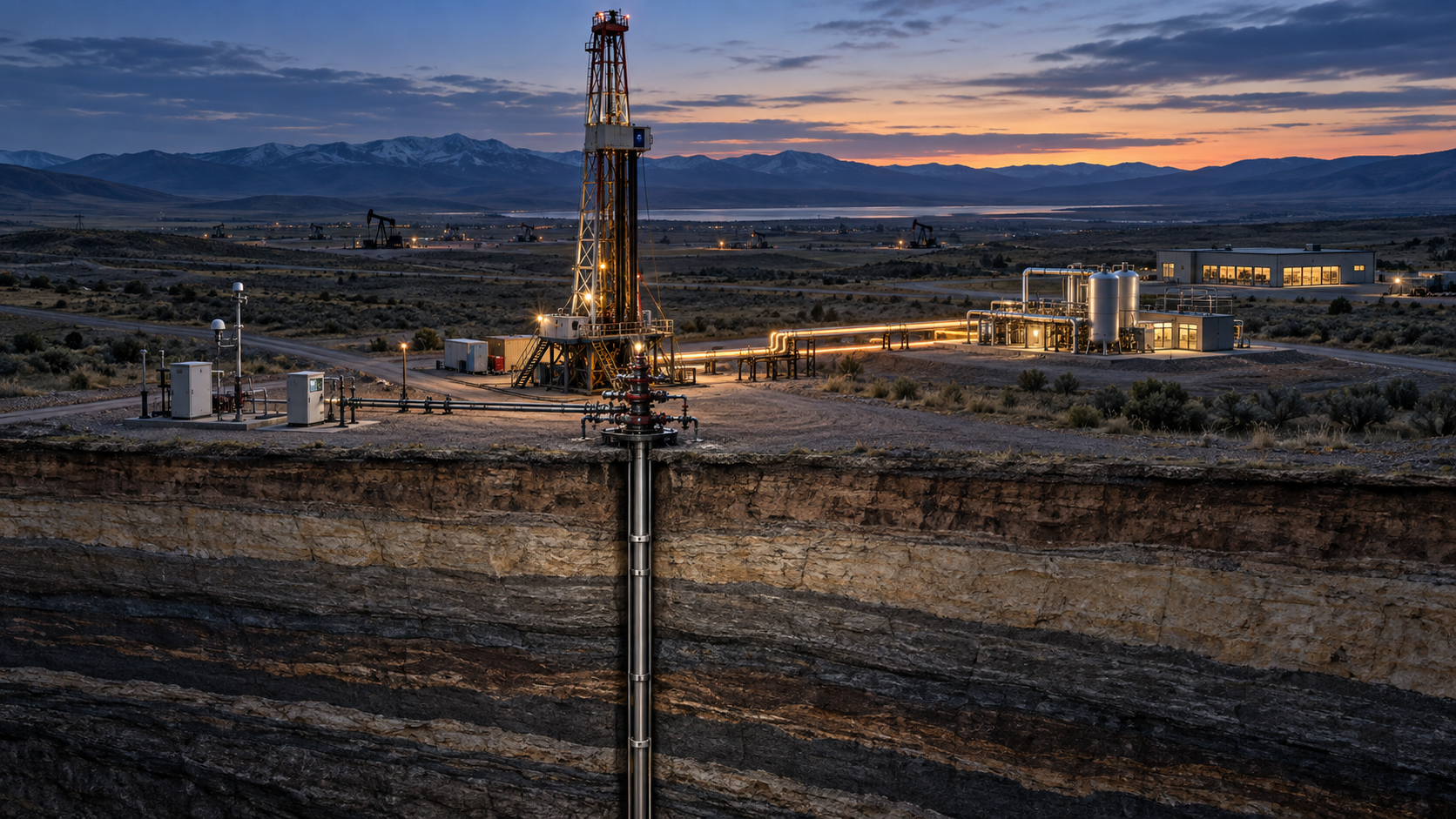
1 Define the decision at the end of oil
An oil or gas well near the end of production presents a real capital choice. The operator can plug and abandon it under the applicable rules, remediate the site and settle associated obligations. It may also study whether the wellbore can provide a new service. Prior drilling expenditure is sunk; it is not a value to be recovered by forcing a second use. The comparison must be between lawful, funded alternatives available from today, including the cost of maintaining a safe well while a decision is developed.
This paper examines three possible services. The first is geothermal energy, principally direct heat where the measured temperature and nearby customer make that route credible. The second is underground thermal energy storage, which charges and recovers heat through a suitable subsurface system. The third is monitoring of a defined reservoir, storage complex or environmental condition for a paying project. These are separate operating businesses. A conversion proposal should identify one primary service before it adds any optional second use. It should show the physical configuration, contract counterparty, permit, operating life and closure owner for that service.
The US Department of Energy's Wells of Opportunity programme investigates retrofits of inactive hydrocarbon wells and heat co-production at active wells [1]. US Geological Survey research has screened orphan wells against temperature-depth information [2]. Both support a search for candidates; neither establishes that a specific casing, cement sheath, reservoir or surface customer is fit for conversion. The International Energy Agency documents transferable oil-and-gas skills in geothermal development [3]. Transferable skill lowers an execution barrier only where a project has evidence of useful energy and a market.
The investment test is incremental value. Estimate the present cost of plugging now, then compare it with the present cost of conversion, operation, integrity monitoring and eventual plugging, net of contracted receipts. Add an explicit downside for repair, low utilisation and customer interruption. A conversion with attractive gross revenue can destroy value if it turns a finite plugging cost into years of unfunded integrity and surface obligations.
2 Classify the well before choosing a technology
The first screen is legal and physical status. A producing well, temporarily suspended well, idle well and orphan well do not arrive with identical decision rights or records. An orphan well may have no solvent party available to sign a supply or monitoring contract. USGS defines documented unplugged orphaned wells through data supplied by states and related criteria; its public viewer is an inventory, not an assurance of ownership, condition or access [4]. An oilfield asset register may also contain wells whose apparent inactivity conceals pressure support, water handling or field-development value.
Build a candidate record from as-built construction and subsequent interventions. Include location, total and completed depth, casing sizes and grades, cement and isolation records, tubing, pressure tests, corrosion history, production and injection history, bottom-hole temperatures, fluid samples, reservoir pressure, surface access, power and nearby demand. Identify data quality and missing intervals. A geospatial screen can rank prospects, but a missing cement record or a sustained annulus pressure can alter the entire conversion scope.
Classify the current obligation to plug. Record the governing authority, licence and lease conditions, approved suspension status, deadlines, security and any change-of-use process. A proposed future energy use does not by itself postpone an existing legal obligation. If an extension, transfer or new permit is required, the investment case must treat it as an unresolved condition until documented approval is obtained. Environmental and surface-restoration duties should remain assigned to a named, creditworthy party throughout the study period.
Finally, compare the candidate with a new purpose-built well. A reused well saves some drilling only if its location, diameter, integrity and completion actually fit the new service. A new well may offer better siting near a heat customer, improved metallurgy, longer useful life or more reliable monitoring geometry. The correct screen can reject reuse and still identify a valuable geothermal or storage project.
Table 1. Candidate-well screen by proposed service
| Decision field | Geothermal heat | Thermal storage | Monitoring service |
|---|---|---|---|
| Subsurface evidence | Temperature, flow and sustainable heat draw | Charge and recovery pathway, cycling and containment | Location and signal quality relative to a defined project |
| Well evidence | Casing, cement, pressure, corrosion and completion fit | Cyclic thermal and hydraulic integrity | Barrier integrity and reliable sensor access |
| Surface evidence | Heat load, distance, connection and backup | Charge source, distribution and dispatch control | Data connection, access and calibration |
| Commercial buyer | Heat or power customer | Capacity or energy-service customer | Storage or environmental project operator |
| Key permission | Approved use, production and reinjection if relevant | Approved injection and withdrawal regime if relevant | Monitoring access and any required sampling approval |
| Closure residual | Plugging and site restoration | Plugging, fluid handling and restoration | Tool removal, plugging and data handover |
Author-developed diligence framework. A pass is conditional on site-specific engineering, rights and permits.
3 Preserve integrity as the first gate
A well is a pressure-containing structure crossing multiple geological intervals. Its historical ability to produce hydrocarbons says little about its fitness for repeated heat cycling, new fluids or long-term sensor access. Casing corrosion, cement channels, micro-annuli, shallow formations and poor legacy records can create leakage or loss of control. The US Department of Energy's National Energy Technology Laboratory studies wellbore integrity for storage projects, including assessment methods and leakage detection [5]. Such work reinforces the need for a purpose-specific integrity demonstration.
Commission a barrier review before calculating a conversion saving. Reconcile well diagrams with actual logs and interventions; test internal and external mechanical integrity under the planned pressure and temperature envelope; inspect casing and cement where access permits; and identify the formations needing isolation. Specify who can stop operations if an integrity threshold is breached. A workover estimate should include uncertainty for inaccessible intervals and the possibility that the well must be plugged after investigation.
The proposed service changes the stress case. A direct-heat system may cycle temperature and flow. A thermal store may cycle pressure and temperature in both directions. A monitoring well may remain open for years near a pressure-changing storage complex. An existing hydrocarbon completion may require removal or replacement. Material compatibility must consider the actual water chemistry and any proposed working fluid. The engineering report should state the tested envelope and explicitly exclude untested use cases.
An investment model should not treat repair as a one-time allowance without evidence. It needs initial workover capital, periodic testing, intervention reserves, downtime assumptions and a funded response to leakage. If the well fails the first integrity gate, the appropriate outcome is a safe abandonment programme. The right to stop protects environmental performance and investor capital simultaneously.
4 Separate resource screening from delivered energy
Temperature at depth is a prospecting variable, not delivered heat. USGS researchers analysed more than 1.4 million bottom-hole-temperature records to screen potential orphan-well geothermal opportunities in the United States [2]. The screen categorised wells by temperature range. A candidate still needs a corrected temperature measurement, completed depth, deliverable circulation path, heat-transfer performance and useful surface load. Original drilling measurements may have been taken before the well reached thermal equilibrium.
For an open-loop configuration, measure sustainable fluid flow, temperature and chemistry at the proposed operating point. Determine where the fluid is reinjected or disposed of, and whether that route is permitted and technically available. For a closed-loop arrangement, analyse the geometry, heat-exchange area, thermal resistance, circulation losses and long-term decline. The two routes have different water, reservoir and permitting requirements. A single well should not be credited with the flow performance of a production-and-injection doublet unless the physical system actually includes both paths.
Direct heat is often the first commercial test for moderate temperatures. DOE describes deep direct-use applications for district, commercial and industrial heating, cooling and underground thermal storage [6]. Electricity generation requires a separate efficiency and net-output case; parasitic pumping and conversion losses matter. A gross thermal resource cannot be converted into an assumed electrical megawatt by applying an unstated efficiency. Where temperature is modest and demand is distant, transport losses and connection cost can dominate the value.
Prepare an hourly heat balance, with delivered temperature, usable flow, return temperature, heat-exchanger efficiency, pumping electricity, downtime and customer demand. Link the cash model to useful megawatt-hours delivered at a metered boundary. Benchmarks from a public research programme can motivate a pilot; they do not substitute for a load study and site test.
5 Underwrite a buyer, not only a hot well
The value of geothermal conversion depends on a customer able to use the heat when it is available. A nearby greenhouse, campus, district network or industrial process may have an appropriate load. Each has a different temperature requirement, seasonal profile, credit risk and backup system. Mapping a well against buildings on a plan is only a lead. The sponsor needs a measured load curve and a route for heat delivery that can be designed, permitted, built and financed.
A heat purchase agreement should define the metering point, minimum and maximum temperature, volume or energy commitment, indexation, availability standard, outage rights, replacement supply and liability for off-specification heat. If the buyer provides the distribution network, allocate responsibility for leakage, maintenance and losses. If the well operator provides it, include capital, easements and restoration. The tariff must be compared with the buyer's actual alternative, including fuel, electricity, carbon and network costs where applicable. A generic heat price is not a bankable revenue assumption.
Demand can move. An industrial process may close, electrify, reduce output or change operating temperature. The well remains a fixed-location asset. Creditworthy offtake, minimum payments, termination compensation or multiple customers can reduce exposure, subject to commercial negotiation. A high contract price from one fragile customer should receive a different risk treatment from a lower price with a diversified district network.
For a retrofit, the seller should show the current rights to the well, pad, access road and thermal output. Surface pipelines may cross land controlled by third parties. A heat contract signed before the surface route is secured can create an unfunded obligation. The model should separate the well-conversion decision from the distribution-system decision and present combined returns only after both are executable.
6 Treat thermal storage as a different asset
Underground thermal energy storage charges the subsurface when energy is available and recovers it later. DOE identifies aquifer thermal energy storage, reservoir thermal energy storage and related approaches; aquifer systems extract and reinject groundwater using wells [7]. A legacy hydrocarbon well could provide access in a suitable configuration, but its presence alone establishes neither a viable storage reservoir nor an approved injection regime. The value proposition is the time shift and reliability of delivered heat, not simply the presence of a deep hole.
Specify the charge source: industrial waste heat, solar thermal, electricity converted to heat or another documented supply. Specify the discharge buyer and required delivery temperature. Model thermal losses, pumping, mixing, breakthrough and cycling. The reservoir must support the required injection and withdrawal without unacceptable pressure, chemistry or migration effects. A single-well storage proposal may need a different completion from an aquifer doublet; the engineering design must show the full circulation pathway.
Storage rights and water rights can differ from rights to produce hydrocarbons. Injection, withdrawal, fluid handling and thermal interference with neighbouring subsurface users need jurisdiction-specific review. A storage case may require continuous pressure and temperature monitoring and a contingency plan. Capital costs include both the subsurface conversion and surface charging, heat exchangers, controls and distribution. A source of inexpensive charge energy does not create a profitable business if recovery is too low or the peak demand cannot be contracted.
Thermal storage can serve an energy system that needs seasonal balancing. A project may have a strategic benefit that is not directly paid in a heat tariff. That benefit should remain outside the bankable base case until a capacity, availability or other enforceable payment mechanism exists. The same heat unit should not be credited once as energy sales and again as an avoided expense unless two distinct payers and obligations are demonstrated.
7 Distinguish storage of heat from storage of fluids
“Storage conversion” can also mean geological storage of carbon dioxide, natural gas or hydrogen. These cases are materially different from thermal storage. A hydrocarbon reservoir may have a geological history relevant to containment, but a pressure-tested storage design, fluid compatibility, operational permissions and full-field well inventory are still required. The legacy well can be an injection well, withdrawal well, observation well or leakage pathway. It should not be described as a storage asset simply because the reservoir once held hydrocarbons.
In the United States, EPA's Class VI programme governs wells that inject carbon dioxide for long-term geologic sequestration and includes site characterisation, area-of-review, well construction, testing, monitoring and closure requirements [8]. EPA guidance on repermitting existing wells stresses mechanical integrity and materials compatibility and allows a permit to be denied if protection cannot be demonstrated [9]. A Class II oilfield injection authorisation does not automatically authorise Class VI storage. The applicable rules elsewhere differ and require local professional review.
For gaseous storage, identify the storage complex, caprock, pressure limits, cushion-gas requirement, cycle profile, produced-fluid management and all nearby wells. One selected well cannot cure the leakage risk created by other historical penetrations. The project cash model needs an explicit service contract, throughput or capacity tariff, surface equipment, compression or conditioning cost, monitoring period and eventual closure. Pore-space rights, title to injected fluids and post-closure liability must be resolved independently of well ownership.
This paper's illustrative financial case is a direct-heat conversion; it does not assign revenues to carbon, gas or hydrogen storage. Those possibilities remain distinct project-development pathways. Treating them as mutually exclusive at the first screening stage protects both capital discipline and safety analysis.
8 Give monitoring an economic definition
A retired well can sometimes be converted into a monitoring point for pressure, temperature, chemistry, seismic response or plume behaviour. DOE's National Energy Technology Laboratory lists well logging, downhole sensors, subsurface sampling, tracers and seismic methods used in storage monitoring [10]. A proposed monitoring well is useful only if its depth, completion and position allow the measurement needed by a defined project. A well outside a pressure front or in an inaccessible interval may add little information despite its proximity on a surface map.
Start with the monitoring plan of the buyer. What regulatory, reservoir-management or environmental question must be answered? Which depth and time resolution are required? What quality assurance and data retention apply? Then compare the existing well with a new purpose-built observation well or an alternative surface method. A legacy borehole may lower drilling cost while raising refurbishment, interpretation or reliability cost. Its value is the verified data service delivered, not the existence of an unused well.
A monitoring agreement should pay for conversion, installation, data acquisition, calibration, routine integrity tests, data delivery, downtime response, eventual tool retrieval and plugging. Allocate ownership of raw data and intellectual property, access rights, cybersecurity, confidentiality and use in regulatory submissions. If a storage operator relies on the well to satisfy a permit condition, replacement and continuity obligations may be significant. The liability allocation must reflect the well's role in that compliance system.
Monitoring can be lower-energy and lower-revenue than heat production, while still being valuable to a nearby project. It is also not automatically passive. Sensors and barriers require maintenance; the well may need workovers; and evidence from a failing well can be difficult to interpret. An underfunded observation well should not become an indefinite deferral of responsible abandonment.
9 Map the three pathways into a decision system
The decision tree begins with a common integrity, rights and closure trunk. If those gates fail, the conversion option ends. If they pass, each proposed use has a different physical proof, permission and contracted payment. A well may be tested for multiple uses at study stage, but simultaneous operation requires an engineering design that manages interactions and an economic model that avoids counting mutually exclusive capacity twice. The diagram below is a screening logic, not a design approval.
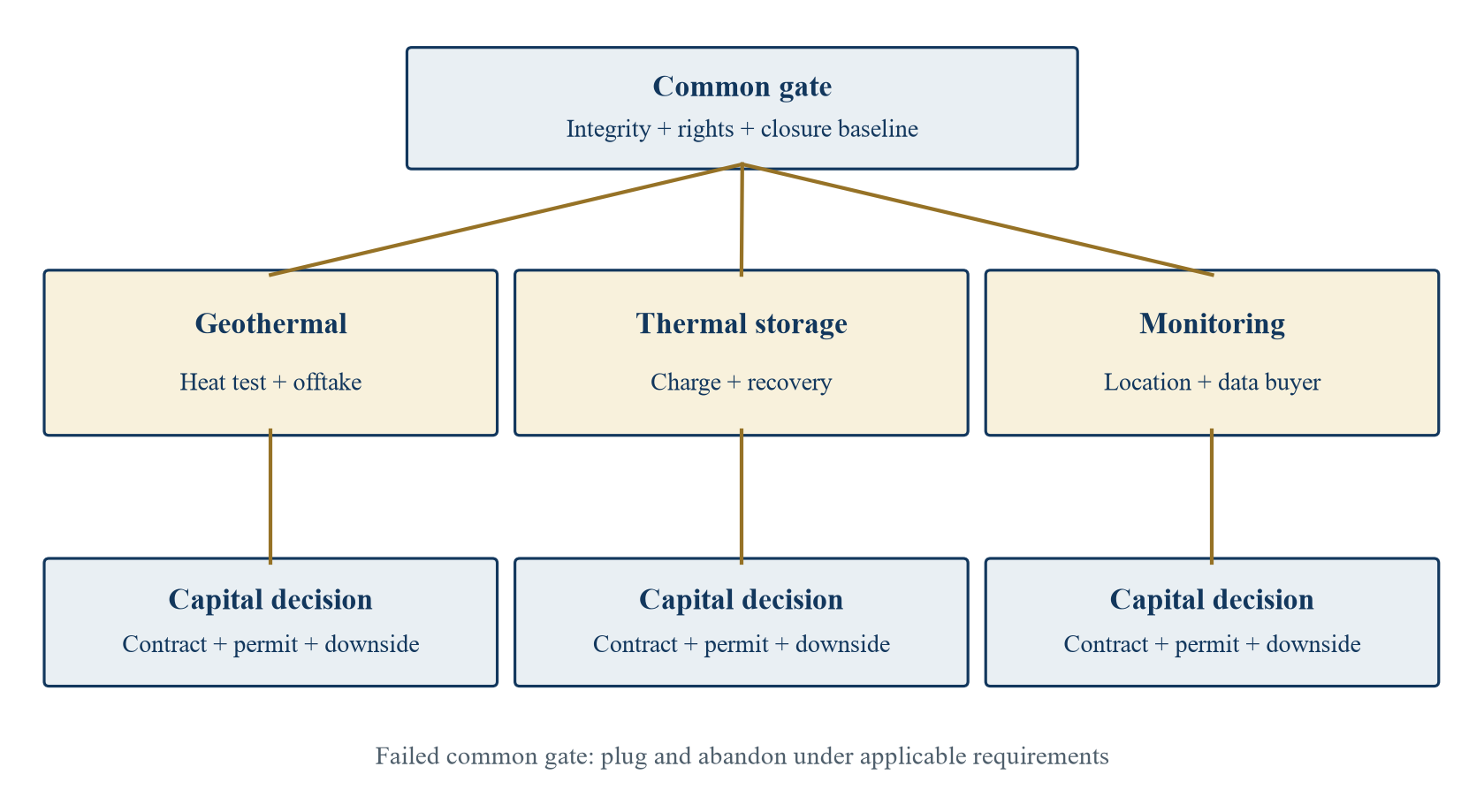
Every branch is conditional on a sound well, lawful rights and funded eventual closure.
The shared evidence file should contain one authoritative well history and one current obligation schedule. The geothermal branch adds temperature, flow and heat-demand evidence. The storage branch adds charge, recovery, containment and cycle evidence. The monitoring branch adds a project-specific information requirement. The commercial team should refuse a blended valuation that adds all three independent headline markets while leaving the same well idle, unavailable or committed to one use for the same period.
Each branch requires an explicit alternative. For heat, the alternatives include a new geothermal well and the customer's present energy system. For thermal storage, alternatives include tanks, surface storage and another subsurface site. For monitoring, alternatives include drilling a new observation well or using other sensing techniques. Conversion wins only when its full risk-adjusted cost and performance are competitive with those alternatives.
10 Build a public benchmark without mistaking it for a forecast
Public programmes show that the research question is legitimate. DOE's Wells of Opportunity initiative describes both inactive-well retrofit and heat co-production routes [1]. Its ReAmplify selections include projects intended to demonstrate commercial geothermal output from hydrocarbon fields, with published award and cost-share amounts [11]. USGS's orphan-well study is a national temperature-screening exercise [2]. IEA's geothermal report describes transfer of oil-and-gas skills, data and supply-chain capacity [3]. These sources operate at different units of analysis and should not be merged into one success rate.
The public evidence does not supply a universal conversion capex, heat tariff, well workover cost or probability of success. Award amounts are research-project funding, not typical commercial plant cost. Temperature ranges are screening categories, not measured delivered heat. Industry skill overlap is a capability statement, not a contract. A disciplined investment committee should use public evidence to define the tests that a specific well must pass and commission vendor quotations and independent estimates for the economics.
Table 2. Public benchmark and the limit on its use
| Public-source observation | Valid use | Unsupported extrapolation |
|---|---|---|
| DOE studies retrofit and co-production [1] | Identify candidate technology pathways | Assume an idle well is conversion-ready |
| USGS screens orphan wells by estimated temperature [2] | Prioritise measurement and field review | Book recoverable heat or power from the map |
| IEA identifies transferable oil-and-gas capabilities [3] | Evaluate team and supply-chain availability | Reduce project capex by an arbitrary percentage |
| DOE describes aquifer thermal storage [7] | Design a site-specific charge-and-recovery test | Assume existing hydrocarbon completion suits cycling |
| EPA sets Class VI geologic CO2 safeguards [8,9] | Scope permit and integrity diligence | Treat a former Class II well as automatically authorised |
| NETL describes subsurface monitoring methods [10] | Specify a project-specific data service | Value any nearby legacy well as a monitoring asset |
Sources [1-3], [7-11]. No number in this table is a price, return or conversion-success forecast for a candidate well.
The benchmark should be refreshed when a real transaction is prepared. Policy, permits, market demand and construction costs change. The reference dates here identify the material reviewed for this paper in October 2026; they do not establish continuing regulatory currency in any jurisdiction.
11 Establish the counterfactual abandonment cost
Plugging and abandonment is the relevant counterfactual when the well has no further hydrocarbon value. It is also a continuing obligation when conversion takes place. Compare the present value of immediate lawful closure with the present value of later closure, while allowing for changes in scope, security, environmental monitoring and surface restoration. The project may defer cash outflow. It does not erase the physical obligation or justify removing it from the balance sheet without the applicable accounting and legal analysis.
The baseline estimate should come from a current site-specific work programme. Include a rig or unit, cement, isolation, contaminated-material handling, access, testing, regulatory inspection and restoration. Historical averages can miss a damaged casing, pressure issue or new standard. The converted route should include a separate contingency for defects discovered during workover and the possibility of early closure after a failed pilot. A bond or security requirement may immobilise cash even when accounting expense is deferred.
Ownership complicates the comparison. In an asset sale, the well and its plugging liability may transfer only with regulatory approval. The seller may retain indemnities or provide escrow; the buyer may need financial assurance. A low purchase price that reflects abandonment risk is not evidence of a high-conversion return unless the buyer's full closure obligation is in the model. A monitoring customer may pay operating fees while the well owner remains legally responsible for abandonment.
Present the baseline separately from project net present value. If plugging now costs an author-assumed amount, that cost is avoided at day zero in the incremental comparison, while eventual closure appears in the conversion case. This treatment should be shown line by line so the model does not both add an avoided cost and omit the later liability.
12 Work a fictional heat-conversion case
The following numbers are author assumptions for one fictional candidate. They are neither observed well performance nor market quotations. Suppose lawful plugging now costs USD 1.50 million. An integrity review indicates that conversion work, heat exchangers, connection and controls would cost USD 2.20 million at the investment date. The well then delivers contracted heat receipts net of routine operating, pumping and ordinary monitoring expenses of USD 0.37 million each year for ten years. Final plugging and restoration at year ten cost USD 1.80 million. The discount rate is an assumed 12% nominal pre-tax rate. The case excludes financing, tax, inflation and interim major workovers.
The ten-year annuity factor at 12% is approximately 5.6502. Discounted annual cash is therefore USD 2.0906 million. The year-ten closure cost has a present value of approximately USD 0.5796 million. Relative to plugging immediately, incremental net present value is the avoided USD 1.50 million initial closure cost, less USD 2.20 million conversion capital, plus USD 2.0906 million net operating cash, less USD 0.5796 million eventual closure: approximately positive USD 0.811 million. The conversion case's own net present value, before the abandonment comparison, is approximately negative USD 0.689 million. Both numbers are useful and answer different questions.
The calculation depends strongly on operational evidence. A 25% fall in net annual cash reduces the incremental value by approximately USD 0.5227 million. An extra USD 1.0 million workover at the start turns the base comparison negative by approximately USD 0.189 million. If the buyer ends the contract early, the operator may still incur plugging and connection-removal costs. The original abandonment cost should never be booked as distributable revenue; it is an avoided counterfactual expenditure subject to legal timing and scope.
Table 3. Fictional ten-year incremental conversion model, USD million
| Item | Assumption or calculation | Present value |
|---|---|---|
| Immediate lawful abandonment avoided | USD 1.50 million at decision date | +1.500 |
| Conversion capital | USD 2.20 million at decision date | -2.200 |
| Net operating cash | USD 0.37 million annually for ten years | +2.091 |
| Eventual plugging and restoration | USD 1.80 million in year ten | -0.580 |
| Incremental net present value | 12% nominal pre-tax discount rate | +0.811 |
| Extra day-zero workover sensitivity | USD 1.00 million beyond base capital | -0.189 total NPV |
Every monetary and operating input is an author assumption. Rounded figures may differ at the last decimal.
13 Make sensitivities decision-relevant
The annual net-cash threshold for zero incremental net present value in the fictional case is approximately USD 0.2265 million if all other assumptions hold. Below that level, the conversion loses against plugging now. This threshold is not a heat tariff. It is the combined amount after operating costs, availability losses and customer payments. A seller cannot infer bankability from a tariff quote without translating it through delivered useful energy and recurring cost.
An investor should sensitise the variables with the strongest direct physical interpretation: delivered temperature, flow or heat-transfer performance, customer utilisation, energy price, pumping cost, initial remediation, unplanned integrity work and closure cost. Correlated downside matters. Low thermal performance may coincide with greater pumping power; weak casing may require both higher capex and more downtime. A spreadsheet that moves one variable at a time can miss this combination.
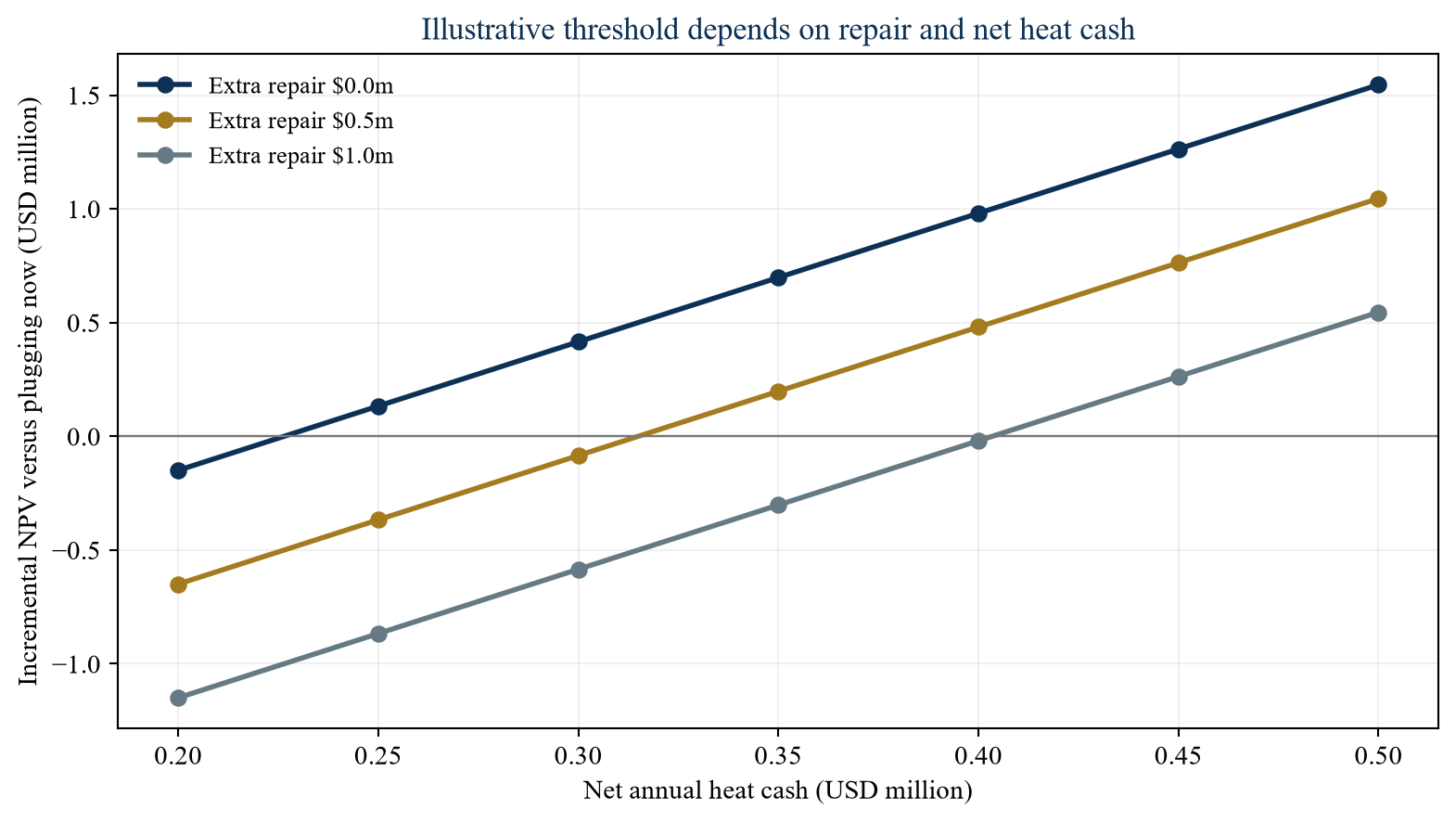
Author-assumed ten-year case. The plotted figures are educational calculations, not measured performance or price forecasts.
The table and figure use a deterministic discount rate and omit a probability of integrity failure. For an actual transaction, scenario probabilities require engineering and commercial evidence. It may be more defensible to show high, base and low cases without assigning precise probabilities than to claim an expected value from unsupported chances. The board should also see the cost of an immediate safe stop after a failed pilot.
14 Design a transaction around staged evidence
An outright acquisition of a legacy well before integrity and demand are tested places technical, legal and closure risk on the buyer too early. A staged option or development agreement can grant access to records and tests while keeping operating and abandonment responsibility clear. The first payment may fund data retrieval and diagnostic work. Later investment may follow a successful pressure test, a heat or storage pilot, a draft permit path and an identified customer. The agreement should specify the consequences of a failed gate.
Rights must cover more than the wellhead. A conversion investor may need subsurface access, surface easements, water handling, heat rights, data rights and permission to alter completion. The hydrocarbon licence holder may retain operating duties and emergency control. A storage customer or monitoring buyer may seek access over a longer period than the underlying lease. Contract term, change of control, termination and step-in rights should match the engineering life and financing tenor.
Consider a special-purpose vehicle only after the asset, services and liabilities are defined. Its capital stack could include sponsor equity, grants or concessional finance where available and senior debt once the technical and revenue gates are met. Public grants should be recorded as actual award terms, with milestones and clawbacks; a press release announcing a programme is not project cash. Lender security should identify the well interest, customer contract, permitted equipment and reserve for plugging.
The seller and buyer should agree the status of all historical environmental matters. A broad indemnity without financial capacity is weak protection. Escrow, security or a funded closure reserve can make responsibility credible. Transaction documents should prevent an investor from paying twice for the same apparent benefit: a discount on purchase price due to plugging liability and an additional projected gain that assumes a third party will fund that liability.
15 Finance only the service that has been proven
Project lenders fund bounded operating and revenue risks. A former oil well with a temperature log and prospective heat customer remains a development option. It becomes a financeable energy service when engineering tests, permits, binding offtake, costs, completion scope, availability and closure reserves support a downside cash-flow model. The underwriting package should include independent well integrity and resource opinions, EPC or workover scope, operating plan, insurance, customer credit review and a debt-service reserve if warranted.
Geothermal heat, storage and monitoring have different contracts. Heat sales pay for delivered thermal energy or availability. Thermal storage may need capacity payments plus throughput or energy-shift payments. Monitoring may be a service fee under a storage project's regulatory plan. A blended business plan should allocate shared capital and operating cost without putting full asset value into each revenue stream. Any simultaneous uses need a technical compatibility assessment and contract priority rules.
Debt sizing should use the lower of contractual cash and independently supported physical capability. A ten-year contract does not fix a casing defect or a declining heat transfer rate. A strong well does not repair a weak customer. Model curtailment, workover downtime and final closure ahead of equity distributions. A covenant can require periodic integrity tests and funding of a closure reserve; the lender also needs clear remedy rights after a failure.
Equity investors may accept staged technical risk in exchange for an option on a portfolio. Portfolio scale can spread design, procurement and customer development costs. It does not make wells interchangeable. Each has a different history, geology, rights, load and remedial requirement. The portfolio valuation should be a sum of gated, well-level cases plus any evidenced shared platform advantage, with a discount for untested candidates.
16 Bring digital tools into the evidence chain
Legacy well files are fragmented across operator databases, scanned completion reports, log images, maintenance records and regulator filings. A disciplined data room can create value before fieldwork: standardise well identifiers; reconcile depths, casing and cement; map interventions and pressure anomalies; connect wells to load centres and environmental receptors; and preserve the original document for every extracted fact. GIS and data-processing tools can rank candidates for tests, provided uncertainty and provenance travel with each output.
Machine-learning tools may classify probable temperature, repair risk or customer proximity. A prediction is a triage aid. It is not an integrity test, permit, temperature measurement or contract. The training sample can overrepresent well-documented assets, producing biased confidence for sparse legacy wells. Reviewers should see missing-data flags, model version, validation set and the decision threshold. A high score should lead to a defined next test; it should not lead directly to capital approval.
For monitoring services, data value depends on calibration, uptime and interpretability. NETL describes established logging and sensor methods for subsurface monitoring [10]. The instrumentation plan should specify sampling frequency, reference measurements, alarm thresholds, cybersecurity, retention and independent audit rights. If a sensor fails, the contract needs a substitute measurement or clear outage response. Data should remain traceable from instrument to report and from report to any regulatory submission.
The commercial team can use digital evidence to make a conversion pipeline efficient without concealing physical risk. A shared schema for integrity, rights, thermal test, customer and closure will support comparable investment decisions. Reusable methods are a platform asset; unverified generated scores should remain outside reported project returns.
17 Test geography and regulation separately
The public sources used here are mainly US and international. They describe technologies and selected US regulatory examples. They do not establish rights or permits in the Gulf, United Kingdom, India or any other jurisdiction. The IEA's skills and resource analysis is international [3], but ownership of wells, heat, pore space and injected substances remains local. An investment committee considering a cross-border portfolio should require a jurisdiction matrix before applying a single conversion template.
The matrix should identify the regulator for current hydrocarbon operations, geothermal production, fluid injection, heat distribution, carbon or gas storage, environmental monitoring and abandonment. It should record subsurface and surface title, consent for transfer, security and post-closure duties. A licence that permits oil production may not authorise a thermal or monitoring service. A nearby municipal or industrial buyer may require its own construction, safety or network approval.
For US carbon dioxide injection, EPA explains the Class VI requirements and the need to address existing wells within the area of review [8]. EPA's guidance on existing well conversion highlights review of construction and integrity evidence [9]. Those are useful warnings for any market: the risk extends beyond the selected well and its surface pad. They are not a legal opinion for a non-US project. Local counsel, reservoir engineers and environmental specialists should document the equivalent questions and current answer.
Regulatory timing should be a critical path in the capital plan. A technically appealing storage site cannot start injection because a heat pilot succeeded; a monitoring well cannot be used as a compliance instrument without the relevant plan and approval. An unresolved permission belongs in a development case with staged capital and a clear stop date.
18 Allocate liability and insurance over the whole life
Conversion extends the period during which a well remains an active or accessible structure. The parties should know who owns it, operates it, maintains barriers, reports incidents, funds emergency response and plugs it when the new service ends. An offtaker's contract may end before the well's physical life. A special-purpose vehicle can become insolvent. Security and step-in arrangements should anticipate both possibilities.
Create a liability ledger with historical contamination, current well integrity, new-service operations, third-party surface damage, subsurface migration, data errors and final closure. For each item identify the legal obligor, indemnifying party, insurance policy, exclusions, deductible and funded reserve. An insurance quotation should be checked against the actual use; a policy written for geothermal heat may not cover carbon dioxide injection or a separate monitoring service. Insurance supports a loss allocation; it does not replace sound barriers and permitted operations.
Periodic integrity testing is an operating cost and a covenant, not an optional annual report. NETL's wellbore-integrity and subsurface-monitoring research identifies the technical importance of detection and remediation [5,10]. A board should set stop-work thresholds and response funding before production or storage begins. When a threshold is breached, an operator needs authority to isolate the well safely without waiting for an investor vote.
Final plugging should be engineered at conversion approval, then revisited as conditions change. A closure reserve may be invested conservatively and adjusted as costs are updated. If a public body holds an orphan well, a private reuse arrangement should specify what happens if the project fails and who funds restoration. Attractive near-term cash cannot justify passing an unfunded residual obligation to the next owner or community.
19 Use an implementation roadmap with stop gates
Gate one is documentary: establish the well's identity, status, historical construction, rights and lawful abandonment baseline. Gate two is physical: test integrity, temperature or reservoir properties, and access. Gate three is service-specific: prove useful heat, charge and recovery, or project-required monitoring information. Gate four is commercial and regulatory: obtain the relevant customer commitment, approvals, construction estimate and full closure funding. Gate five is operations: verify delivered service, monitor integrity, update reserves and stop if the operating envelope fails.
Capital at risk should rise with evidence. A modest record review can reject a candidate that lacks rights. A diagnostic workover can reject one whose barriers are unsound. A heat-load study can reject one whose customer cannot use the resource. An injection-permit review can reject a storage design before heavy engineering spend. Each gate should state the evidence owner, independent reviewer, budget cap, expected completion date and decision right.
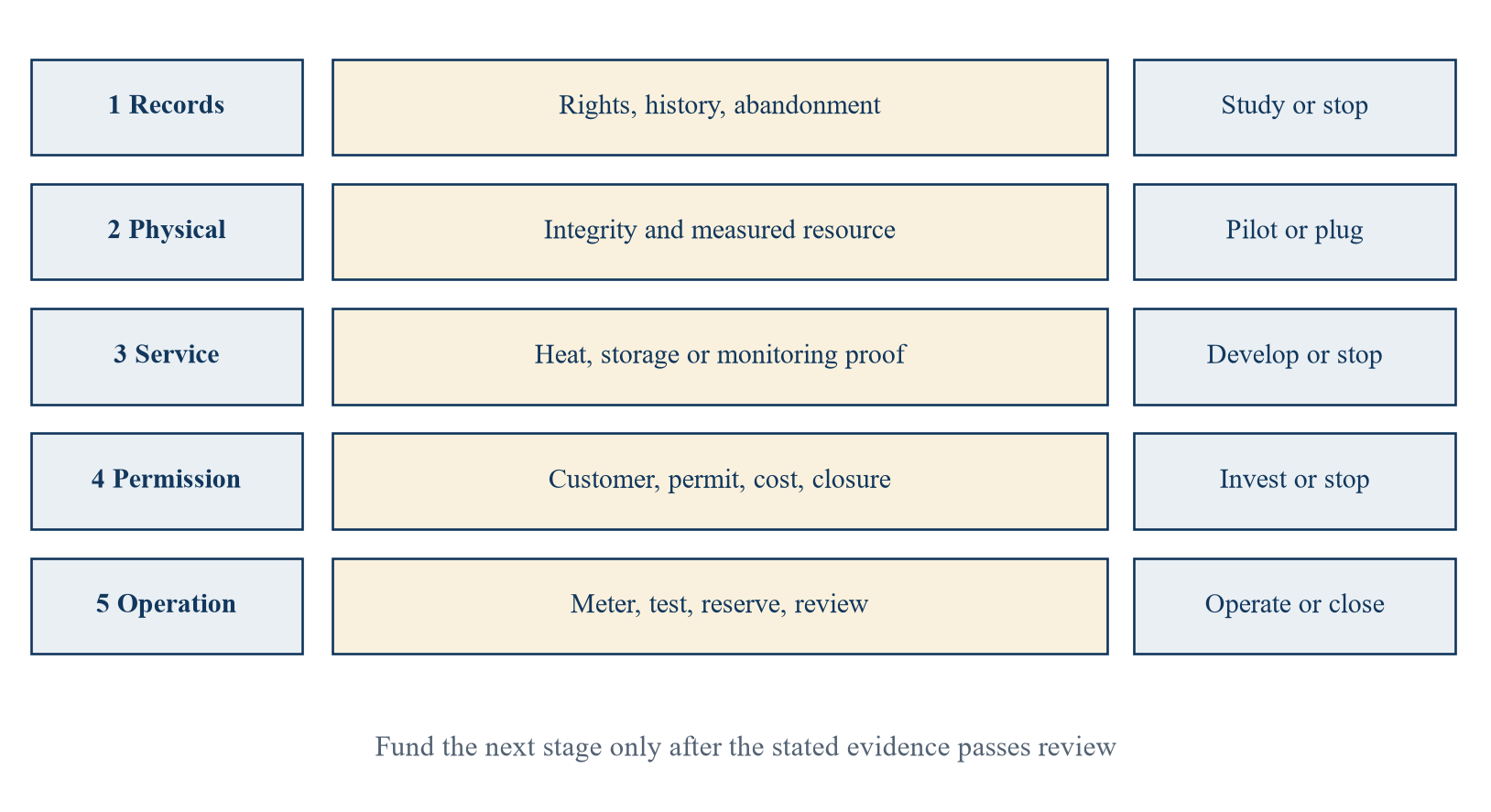
The order is illustrative. Actual permitting and engineering may proceed in parallel where safe and economical.
For a portfolio, use the same gate definitions while recording site-specific results. A rejected geothermal candidate might still be suitable for monitoring, but that branch requires its own buyer and integrity case. A failed barrier test is a common-gate failure and should not be bypassed by switching the proposed use. The roadmap should create a disciplined programme of inexpensive exclusions before it creates a collection of expensive partial developments.
20 State limitations and research needs
This paper is a commercial decision framework. It does not certify the integrity of a well, provide a geothermal resource estimate, approve injection, determine subsurface title, interpret a specific legal deadline, price a heat contract or value an actual asset. The fictional financial model has no field data. Its assumed ten-year cash, capex, discount rate and closure costs are selected for arithmetic illustration. It excludes taxes, financing, inflation, capex phasing, material unscheduled workovers, availability correlation and a probabilistic failure model. A positive illustrative incremental value is not an expected investor return.
The sources have different scopes. DOE's Wells of Opportunity and thermal-storage materials identify technical pathways [1,7,11]. USGS's orphan-well study and dataset support screening, not site certification [2,4]. IEA analyses capability transfer at sector level [3]. NETL discusses well integrity and monitoring technologies [5,10]. EPA materials describe US carbon dioxide injection safeguards [8,9]. None supplies a universal success probability, lawful delay to plugging or a bankable tariff for a candidate well. A real project requires current, local engineering, legal, regulatory and commercial work.
Further research could publish matched datasets of well construction, temperature and flow tests, remediation expenditure, delivered heat or storage efficiency, customer payments and final closure cost. Studies should report rejected candidates as well as successes. That would help investors estimate conversion attrition and understand when a new purpose-built well is preferable. Monitoring studies could link candidate-well geometry to measured information quality and service cost, including sensor outages.
The commercial hypothesis is that existing wells can sometimes become useful infrastructure when their physical and legal characteristics fit a paid service. The hypothesis should be tested with a transparent candidate funnel, not with aggregate well counts or a single successful demonstration. Every reported financial result needs a clearly defined alternative and terminal obligation.
21 Conclusion
The well after oil is an option to investigate, not an asset class that can be booked wholesale. Geothermal heat, underground thermal storage and monitoring can each offer a second service from a suitable existing well. Each requires its own measured resource or information need, engineered configuration, lawful permission, paying customer and funded eventual closure. Integrity and rights are common hard gates. A failed common gate sends the well to safe abandonment under the applicable rules.
The fictional heat case illustrates the decision arithmetic. With assumed USD 2.20 million conversion capital, USD 0.37 million annual net cash for ten years, USD 1.80 million final closure and an avoided USD 1.50 million immediate plugging cost, incremental net present value is approximately USD 0.811 million at 12%. An extra USD 1.0 million immediate repair cost reverses the result. The conclusion is sensitivity to actual well condition and contracted useful heat, not a claim about any real field.
A disciplined conversion programme starts with records and rights, tests physical integrity, proves the chosen service, contracts its payment, obtains the correct approvals and funds closure from the outset. It should compare reuse against plugging and against a new purpose-built well. The most valuable initial output may be the evidence to reject a poor candidate before it absorbs development capital.
References
- US Department of Energy, Office of Geothermal. Wells of Opportunity. Accessed 6 October 2026. https://www.energy.gov/hgeo/geothermal/wells-opportunity
- Gardner, R. and others, US Geological Survey. Geothermal Potential of Orphan Oil and Gas Wells (2025). Accessed 6 October 2026. https://www.usgs.gov/publications/geothermal-potential-orphan-oil-and-gas-wells
- International Energy Agency. The Future of Geothermal Energy: Overview of Synergies between the Oil and Gas and Geothermal Industries (2024). Accessed 6 October 2026. https://www.iea.org/reports/the-future-of-geothermal-energy/overview-of-synergies-between-the-oil-and-gas-and-geothermal-industries
- US Geological Survey. United States Documented Unplugged Orphaned Oil and Gas Well Dataset Viewer. Accessed 6 October 2026. https://www.usgs.gov/tools/united-states-documented-unplugged-orphaned-oil-and-gas-well-dataset-viewer
- US Department of Energy, National Energy Technology Laboratory. Wellbore Integrity. Accessed 6 October 2026. https://netl.doe.gov/carbon-management/carbon-storage/wellboreintegrity
- US Department of Energy, Office of Geothermal. Geothermal Direct Use. Accessed 6 October 2026. https://www.energy.gov/hgeo/geothermal/geothermal-direct-use
- US Department of Energy, Office of Geothermal. Geothermal Energy Storage. Accessed 6 October 2026. https://www.energy.gov/hgeo/geothermal/geothermal-energy-storage
- US Environmental Protection Agency. Class VI: Wells Used for Geologic Sequestration of Carbon Dioxide. Accessed 6 October 2026. https://www.epa.gov/uic/class-vi-wells-used-geologic-sequestration-carbon-dioxide
- US Environmental Protection Agency. Geologic Sequestration of Carbon Dioxide UIC Program Class VI Well Construction Guidance (2012). Accessed 6 October 2026. https://nepis.epa.gov/Exe/ZyPURL.cgi?Dockey=P100MU1M.TXT
- US Department of Energy, National Energy Technology Laboratory. Subsurface Monitoring. Accessed 6 October 2026. https://www.netl.doe.gov/node/5873
- US Department of Energy, Office of Geothermal. Wells of Opportunity: ReAmplify. Accessed 6 October 2026. https://www.energy.gov/hgeo/geothermal/wells-opportunity-reamplify
- US Geological Survey. Orphan Wells Project. Accessed 6 October 2026. https://www.usgs.gov/centers/central-energy-resources-science-center/science/orphan-wells
About the Author
Chennakeshav (CK) is a corporate finance and investment banking executive with 25+ years of global experience in deal origination, structuring and execution across M&A, growth capital and corporate strategy. He has led value-creation mandates for founders, corporates and funds — bridging the boardroom view to hands-on execution and close.
His career spans Morgan Stanley, HSBC, Lloyds Banking Group, EWEC, ADQ portfolio companies and Emirates Growth Fund, across TMT, real estate, fintech, deeptech, cleantech, infrastructure and energy. He has partnered with C-suite leaders, private equity and venture funds, sovereign wealth funds and family offices to finance complex fund raises and scale-up ventures, and has led M&A due diligence, post-merger integration and business-transformation initiatives to create value.
At Matchpoint Partners he is Managing Partner, leading the firm's corporate finance, M&A and capital-raising practice. He holds an MBA from London Business School, an engineering degree from VTU and a Master of Laws (LLM, in progress) from UCL London.
An active start-up mentor, CK mentors at Techstars, DIFC FinTech Hive, Startup Grind, Founder Institute and IN5, serves as Entrepreneur Mentor in Residence (EMiR) at London Business School, and judges the Entrepreneurship World Cup.
