

1 Define the capital decision
A GCC company can receive enthusiastic conversations from a family office, a private fund, a bank and a development finance institution while remaining unfunded. Each organisation may be assessing a different proposition. A family principal may seek a strategic stake through a holding company; a fund manager may be restricted by a fund mandate and investment period; a lender may assess repayment and security; a development institution may require eligibility and impact criteria. The first board task is to specify the financing that the company can actually issue and use. A list of contacts follows that definition.
The issuer should identify its exact legal entity, operating perimeter, amount, minimum viable proceeds, use of funds and date on which cash is needed. It should distinguish a primary share issue from a sale by an existing owner, a loan to an operating company from a facility secured by another group entity, and a commitment from an available draw. These differences affect both the counterparty's authority to invest and the company's economics. A prospective AED 60 million raise cannot be evaluated as one number if only AED 20 million must arrive for the first project milestone and another AED 40 million is conditional on permits, contracts or performance.
The board also needs to decide which rights it can offer. A governance package may include information, board representation, vetoes, reserved matters, anti-dilution, transfer restrictions or a route to exit. A lending package may include cash sweeps, covenants, collateral, guarantees or limits on distributions. The company should identify rights it can accept before marketing an apparently attractive headline valuation or margin. A term that cannot secure required shareholder or lender consent is not executable capital.
This paper asks which strategy, ticket, governance and liquidity attributes can help predict a prospective funder's engagement. It offers a framework for recording those attributes in a live process. The paper does not claim a statistical prediction. No consented matched dataset of approaches and outcomes was available. The practical output is a decision memorandum in which each counterparty is tested against the same financing need, with its own stated mandate and terms preserved separately from the issuer's assumptions.
2 What public sources can and cannot establish
ADGM describes several family-office and holding structures, including a single-family office, a multi-family office, an SPV and a foundation [1]. DIFC describes family offices, holding companies, SPVs and other private-wealth structures through its Family Wealth Centre [2]. These public descriptions demonstrate structural diversity. They do not reveal a particular family's investable cash, delegated investment authority, sector preferences, minimum ticket, decision timetable or appetite for an external company. A family-office label is therefore an inadequate investment mandate.
The DFSA's public explanation of collective investment funds distinguishes public, exempt and qualified-investor funds and describes different offering and investor conditions [3]. Those rules concern specified regulated structures in or from the DIFC. They cannot be applied wholesale to an unregulated direct investment by a family vehicle, a mainland UAE company or an offshore fund. A fund's legal ability to consider a deal is also distinct from the investment period, concentration limits and commercial authority set by its own governing documents. The live manager and vehicle must be identified before describing the mandate.
IFC publishes a preliminary financing application guide and a project cycle with separate appraisal, approval, negotiation, disbursement and supervision stages [4,5]. EBRD states published ranges and cash-flow principles for its own private-sector loans [6]. These are useful counterexamples to generic marketing language: public criteria and stages differ even among institutions. They are institution-specific statements. Neither source supports an assertion that a GCC issuer can obtain a specific ticket or approval within a standard period. IFC's eligibility and development purpose also limit direct transfer to a private family investment.
For regulated UAE lenders, the Central Bank's credit standards require documented due diligence, financial and cash-flow information, assessment of ownership and credit terms within the institutions' scope [7]. The standards identify a formal underwriting basis. They do not govern every family investor or every fund manager. IFC's governance methodology, family-business handbook and development-finance governance framework add a separate observation: decision rights and governance quality can be substantive investment questions [8-10]. The framework below draws these public sources into a common issuer-side process while preserving the different legal and commercial perimeters.
3 Begin with a financing perimeter
The financing perimeter defines what a counterparty would own or be owed, which entity has the underlying cash and which approvals are required. A parent company may own several operating subsidiaries while the proposed investor is offered shares in only one. An infrastructure asset may sit in an SPV that cannot pledge its cash flow without a concession or lender consent. A family-owned group may want new capital for expansion while a shareholder simultaneously seeks personal liquidity. These are distinct transactions with different sources and uses. The issuer should document them before outreach.
The minimum financing brief should specify the legal issuer or borrower, jurisdictions of material entities, ownership chart, instrument, valuation or debt-sizing basis, uses of funds by date, proposed security and expected investor exit or repayment path. It should show the approvals required under articles, shareholder agreements, existing credit documents and licences. A board can then ask counsel and advisers to test legal feasibility. The brief should state how much cash must be received by each operational deadline and whether an amount can be staged without harming the plan.
For equity, a useful starting point is a fully diluted ownership bridge. It should identify existing shares, options, convertibles, preferences and proposed new money, with the assumptions behind conversion or anti-dilution rights. For debt, the equivalent bridge links existing facilities, maturity, security, guarantees, cash interest and amortisation to the proposed financing. For a hybrid structure, both bridges are needed. A term sheet that ignores existing claims may describe proceeds the company cannot legally or economically obtain.
This perimeter has a direct effect on the investor search. If the company needs primary growth capital, a buyer interested only in secondary shares does not meet the funding need. If the company can support a senior loan but cannot provide a parent guarantee, a lender that requires that guarantee is an unfit route until the condition changes. If founders reject board control, a control investor may be unsuitable even where price is attractive. The fit test should eliminate such structural mismatches before the company spends management time on detailed diligence.
4 Six dimensions of counterparty fit
The first dimension is eligibility: geography, sector, legal form, stage and prohibited exposures. The second is instrument: shares, preferred equity, convertible, senior loan, mezzanine, project debt or a combination. Third is capacity: the proposed ticket relative to the counterparty's own stated range, concentration limits and available capital. A public minimum or maximum from one institution is evidence about that institution only. Other counterparties require direct confirmation. A company should record the source and date of every stated range.
The fourth dimension is economic horizon. Equity providers may need a route to value realisation; lenders require a credible repayment or refinancing path. The issuer should state when cash will be generated, whether distributions can be made and what exit scenarios are within board control. Fifth is governance: control, information rights, reserved matters, board representation, related-party policies and ongoing reporting. Sixth is execution: identity of the decision-maker, sequence of approvals, required diligence, documentation and actual transfer of funds. A fit score without a funding timetable is incomplete.
These dimensions should be recorded as a vector rather than collapsed into a single weighted number too early. A deal that fails an absolute legal or mandate constraint cannot be rescued by a high score for valuation. A deal that fits legally but conflicts with the founder's non-negotiable control rights needs a board decision, not a higher investor rank. Capacity should be measured against the proposed cheque and the counterparty's authority at the time, not its publicly described assets under management or family wealth.
The proposed framework therefore has two passes. The hard-gate pass asks whether there is any known reason the capital provider cannot review or deliver the proposed transaction. The conditional-fit pass compares negotiable terms, cash timing and strategic value. A documented unknown remains an unknown; it should not be scored as a pass. This distinction allows the fundraising team to use public information efficiently while leaving private mandate facts for a targeted conversation.
Table 1. Mandate-to-term fit record for a GCC private raise
| Dimension | Issuer proposition to state | Counterparty fact to verify | Hard-gate or conditional question |
|---|---|---|---|
| Eligibility | Entity, geography, sector, stage | Vehicle mandate and legal scope | Is review permitted? |
| Instrument | Equity, debt or hybrid | Instruments the decision vehicle may hold | Can the vehicle invest in this claim? |
| Capacity | Amount and tranche dates | Current ticket authority and concentration | Can it fund the required amount? |
| Horizon | Cash generation and exit or repayment | Investment term and liquidity need | Do dates and outcomes align? |
| Governance | Rights available and prohibited | Control, reporting and consent demands | Are the rights executable? |
| Execution | Critical funding date | Approvals, diligence and cash route | Can cash arrive when needed? |
Author-developed decision tool. A public description supplies a lead for verification, not evidence that a named counterparty has approved a mandate.
5 Family office is a structure, not a single risk appetite
The family-office landscape contains investment vehicles, operating offices, advisers and governance arrangements. ADGM's single-family and multi-family office descriptions make some of these structural distinctions explicit [1]. DIFC describes several private-wealth structures that may serve different legal and administrative purposes [2]. The operating office may research opportunities while an SPV or holding company makes the investment. A principal may retain final authority, or an investment committee may have a delegated limit. The issuer must identify the decision entity and its funding source in the specific approach.
Before sending confidential information, the fundraising team should ask a narrow set of questions: which vehicle would invest, whether it has a written mandate, what ticket and instrument are currently within authority, who signs an initial indication, who approves final terms, and whether the capital is available for the proposed draw date. These questions can be asked respectfully and with the same confidentiality standards applied to institutions. A relationship with one family member cannot substitute for the legal vehicle's approval.
Family capital may be attractive when a particular family seeks strategic exposure, patient ownership or regional operating relationships. These are possibilities to test, not generic traits of family offices. Some families may prefer liquid portfolios or property, have conflict restrictions, or lack an appetite for minority growth equity. Others may seek control or direct participation in operations. ADGM Academy's published programme describes governance and structured investment analysis as needs identified in a survey with a specified family-office association [11]; it cannot establish the preferences of all regional families. The issuer should request evidence of the specific strategy and decision history where it is appropriate to do so, and should record what the family actually says rather than assigning preferences from its name or profile.
Governance is especially important where the issuer is itself a family-controlled company. IFC's family-business governance materials address overlapping family, owner, board and management roles [8]. The negotiation can involve two family governance systems. An external investor's reserved matters may interact with shareholder succession rights, family employment policies and control of related-party transactions. The board should map these rights explicitly. An apparent agreement on valuation may leave unresolved who can approve acquisitions, additional debt, distributions or an eventual sale.
6 Institution is also a heterogeneous category
An institution may be a regulated lender, private fund, sovereign-related investment company, pension fund, development finance institution, insurer or strategic corporate investor. The OECD's Corporate Governance Factbook identifies family offices and several institutional investor categories separately in its ownership taxonomy [12]. Each organisation has a distinct source of capital, authority and objective. The existence of a large balance sheet or widely publicised investment programme does not identify an issuer's eligibility. A counterparty's specific product, vehicle and committee must be identified. This paper uses institutional examples as illustrations of different process disciplines, not as a claim that all institutions share one rule.
The IFC application guide asks for sponsorship, management, market, technical feasibility, financial structure, returns, regulatory context and timetable [4]. Its project cycle separates preliminary work from appraisal and disbursement [5]. EBRD states that the basis for one of its loans is expected project cash flow and repayment ability, and it publishes a range for its own private-sector lending [6]. A UAE bank's credit analysis is governed by the Central Bank's applicable standards [7]. These sources show why an issuer should approach an institutional counterparty with the exact product and investment proposition, then verify its current mandate.
A regulated fund may also need to comply with the law and restrictions of its vehicle. The DFSA distinguishes fund categories in the DIFC and states different rules for offering and minimum subscriptions [3]. Those public rules do not disclose the private investment mandate of a particular manager. The manager may have a remaining investment period, portfolio concentration constraint, conflicts policy or co-investment rule. The issuer should obtain a direct answer from the manager or its authorised representative about the relevant vehicle and stage of approval before counting the route in the funding plan.
Institutional process can be a benefit when a company needs repeatable diligence, clear committee decisions and long-term reporting expectations. The same process may require more time than a company's cash runway permits. The issuer should map stages, owners and likely dependencies based on the actual counterparty's written process. A management team should distinguish internal sponsor support from committee approval and a signed commitment. A document request proves only that some review is taking place; it does not establish the probability of funding.
7 Use a hard-gate screen before commercial ranking
The hard-gate screen should be deliberately short. It can ask whether the issuer and project geography are permitted, whether the sector is allowed, whether the investment vehicle can hold the proposed security, whether the amount lies inside the counterparty's present authority, whether the proposed ownership or control is within mandate, and whether the funding date is structurally possible. Where compliance screening or sanctions issues arise, specialist advice and applicable rules govern. The fundraising team should not use a generic score to override a legal restriction.
A screen result can be supported, adverse or unverified. Supported means a published policy or direct authorised communication addresses the specific condition. Adverse means a documented restriction conflicts with the issuer proposition. Unverified means there is no reliable answer or the source is too general. The issuer should preserve the source, date and person who supplied each answer. A public family-office listing or a conference attendance record can justify a question; it cannot establish current ticket capacity. A fund's historic deal can signal relevant experience; it does not prove that the same vehicle can invest now.
The board should approve the treatment of uncertain but potentially valuable routes. A high-potential counterparty with an unverified investment period can be retained for a short qualification call. A known sector prohibition should remove the prospect from the active lane. A known inability to provide the first required tranche should trigger a redesign rather than a larger slide deck. This approach limits wasted outreach while retaining an audit trail for later changes in mandate.
There is no universal set of six gates that every issuer must use. The categories are an author-developed method for this paper. A transaction involving a regulated utility, defence technology, foreign ownership restriction or politically exposed party may need additional gates. Counsel and compliance teams should determine applicability. The fit screen should be updated when the transaction perimeter changes; an investor suitable for preferred equity at the holding company may be unsuitable for senior debt at an asset SPV.
8 Match instrument to cash flow and risk
The financing instrument determines what the capital provider must believe about future cash. Senior debt normally requires a repayment path and may require security or covenants. The Central Bank's standards require licensed financial institutions to assess creditworthiness and financial obligations within scope [7]. EBRD's loan page similarly describes expected cash flow and ability to repay as the basis for its own lending [6]. These sources do not prescribe a universal leverage multiple or margin. An issuer should build a cash-flow model specific to the proposed facility, including downside and refinance assumptions.
Equity has no scheduled principal repayment, while its economics include dilution, governance rights and an eventual route to value realisation. A family office and a private fund could each consider shares, yet their desired board role, time horizon and exit path may differ. A preference share or convertible can change both downside protection and ownership at exit. The issuer should model conversion, liquidation preferences and the effect of follow-on financing under explicit terms. The model should show who bears losses and who receives proceeds across scenarios.
Hybrid capital can bridge a gap between cash-flow capacity and equity control, but labels can hide economic debt or contingent dilution. A coupon may accrue and compound; an instrument may convert at a discount; a redemption right may create a future liquidity demand. The issuer should identify each cash, control and accounting consequence, then obtain legal and accounting review in the relevant jurisdiction. Combining two instruments can add execution complexity and intercreditor issues. The board should compare the usable proceeds and constraints, not just the headline price of capital.
Instrument fit should precede counterparty prestige. A company with limited near-term cash generation may be unable to service an attractive-looking loan without diverting operational funds. A profitable company with a short working-capital gap may find a control sale disproportionate to the need. The chosen capital provider should have authority for an instrument that solves the dated use of funds while leaving the company able to meet its other obligations. The model must state that conclusion conditionally until written terms and diligence are available.
Table 2. Debt-versus-equity decision matrix for an issuer-side screen
| Test | Senior or structured debt | Minority equity | Hybrid or staged capital |
|---|---|---|---|
| Primary cash obligation | Interest and principal or agreed bullet | No scheduled principal repayment | Coupon, redemption or conversion may apply |
| Ownership impact | Usually no ordinary-share dilution | Immediate or staged dilution | Possible deferred or contingent dilution |
| Main underwriting question | Can borrower repay under downside? | Can investor realise acceptable value? | Can both cash and equity promises be met? |
| Rights to test | Security, covenants, guarantees | Board, veto, information, exit | Intercreditor, conversion, consent rights |
| First draw condition | Credit approval and conditions precedent | Subscription and corporate approvals | Multiple closing and conversion conditions |
| Principal mismatch risk | Debt service exceeds cash capacity | Rights or valuation unacceptable | Complexity obscures actual economic burden |
Author-developed comparison. Actual rights, costs and availability depend on written terms, lender or investor mandates, and governing law.
9 Capacity means available cheque, not reported wealth
A capital provider's publicly reported assets and its ability to write a cheque to one issuer are different quantities. A family balance sheet may be invested, encumbered or allocated to other commitments. A fund may have capital that is committed by its limited partners but unavailable outside its mandate or investment period. A bank may have a large loan book and a small limit for a single borrower, industry or product. The issuer needs a counterparty-specific statement of proposed ticket and funding capacity, followed by documentation appropriate to the stage.
The company should ask whether the proposed amount is within a single decision-maker's delegated authority or requires a committee, co-investor, syndicate or additional vehicle. It should ask whether the amount is for the full transaction or a conditional portion, and whether the counterparty expects the issuer to secure other capital first. A conditional indication of AED 60 million subject to a matching investor does not resolve a board's immediate AED 20 million need. The cash plan should show each dependency and the amount usable after fees, holdbacks or required reserve funding.
Concentration and minimum-ticket rules can operate in opposite directions. A deal may be too small for the institution's underwriting effort or too large for its single-name capacity. EBRD publishes a usual range for its own private-sector project loans [6]; that number should never be presented as the range for other institutions. A family office may have no public ticket policy. In that case, the issuer should record the range as unverified until the authorised representative confirms it. The absence of a published number should not invite an invented estimate.
Capacity can also change during the process. Other investments, distributions, fund closings or internal risk limits may affect availability. A previously financed deal is evidence of historic action, not a current commitment. The fundraising record should date each capacity statement, identify its source and mark whether it is exploratory, approved or contractually committed. This prevents a board from treating multiple overlapping expressions of interest as additive cash.
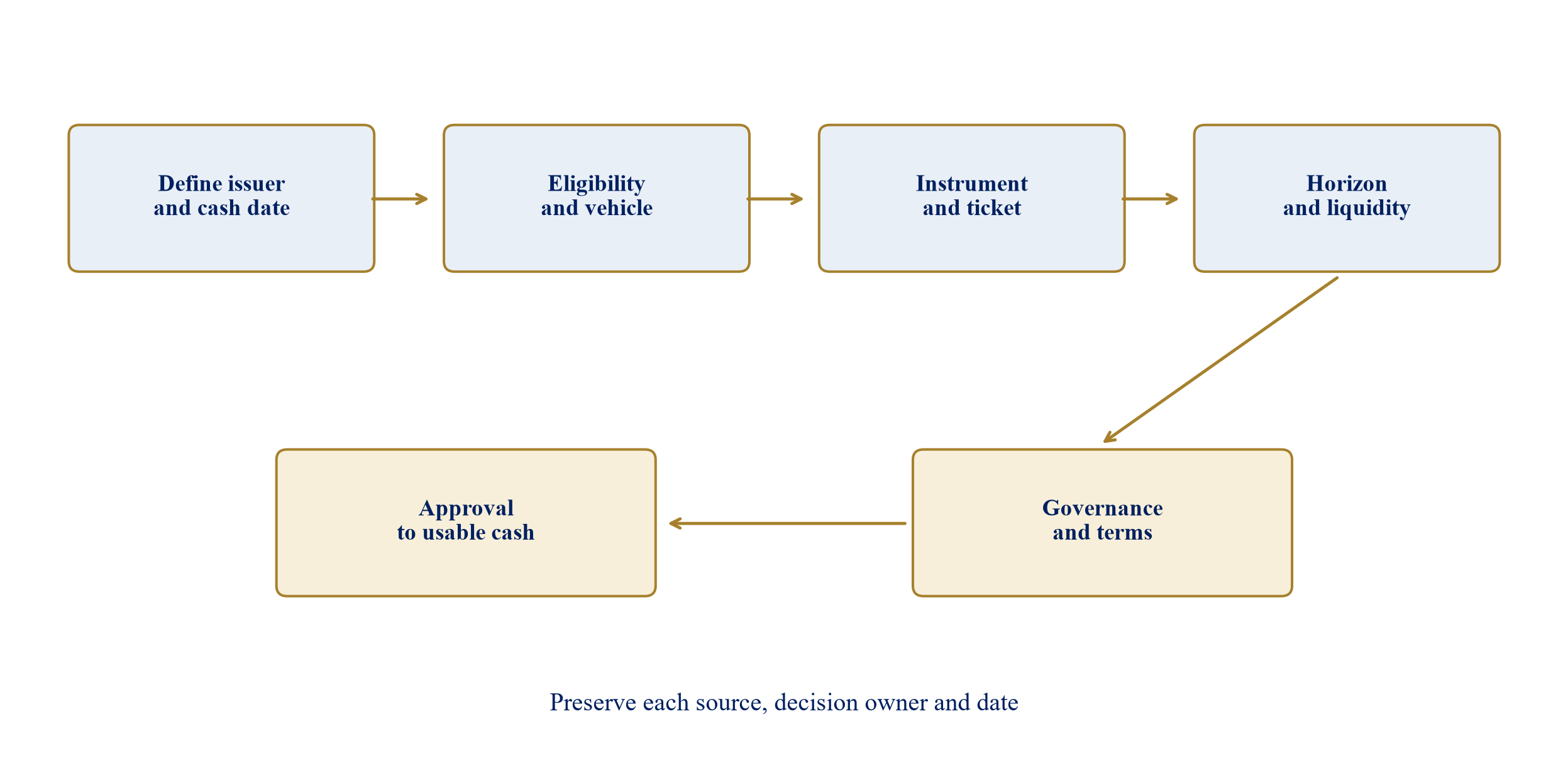
Author-developed sequence. The diagram is a decision tool, not an observed conversion funnel or empirical probability model.
10 Horizon and liquidity belong in the first discussion
A company and its prospective capital provider can agree on the business opportunity while disagreeing on when and how cash should return. An investor expecting a sale in a defined fund life needs an exit route that the company can plausibly influence. A family vehicle may have a different horizon, yet that preference must be confirmed with its decision-maker. A lender needs scheduled servicing, an agreed maturity and a plausible refinance or asset realisation where principal does not amortise. The issuer should model these requirements against its operating and ownership plan before accepting a headline indication.
The discussion should identify cash that can be distributed, cash that must be reinvested and cash that may be trapped by existing agreements. A profitable subsidiary may sit beneath debt restrictions. A project may generate accounting earnings before it generates cash. A shareholder may wish to retain family control indefinitely while a fund needs an exit mechanism. The issuer should state these facts clearly. An exit slide that assumes a third-party buyer in year five is a scenario, not a commitment from a buyer.
Liquidity rights require careful reading. A put option, redemption right or preferred return can transfer future cash risk to the company or controlling shareholders. A drag-along right can affect when the family may be required to sell. A loan with a bullet maturity can require refinancing at a time when the business still needs investment. The board should model a base case and a credible downside case, including cash available at each contractual date. Counsel should identify which rights are enforceable in the relevant entities and jurisdictions.
The financing team should ask a prospective capital provider to describe its required horizon in its own terms. For a fund, that might involve the current vehicle's investment and realisation period; for a family office, it might involve internal liquidity planning and succession; for a bank, it involves facility tenor and amortisation. None of those answers should be inferred from public branding. The decision record should quote the response, note whether it is a mandate condition or negotiable preference, and compare it with the issuer's dated cash plan.
11 Governance and control can decide a raise before price
Equity terms can be economically attractive and operationally impossible. A proposed investor may require a board seat, consent over acquisitions, budgets, related-party transactions, new securities or additional borrowing. Existing shareholders may have pre-emption, veto or transfer rights that constrain a new issue. A lender may require limitations on distributions or new debt that conflict with the equity plan. The term comparison should therefore show rights and conflicts alongside valuation, pricing or margin.
IFC's governance methodology includes ownership, board and disclosure dimensions and is adapted to different company types [9]. Its family-business materials describe overlapping family, owner, board and management roles [8]. These sources justify a practical governance review in a family-controlled raise. They do not specify that any particular external investor must receive a given right. The issuer should begin with the actual constitutional and shareholder documents, then state which rights can be offered without breaching existing commitments or disabling management.
A rights map can separate ordinary protection from decision control in the specific transaction. Information rights provide access to accounts or operating reports. Reserved matters determine which actions require consent. Board representation may give a voice or a vote, depending on documents. Transfer and exit rights affect the eventual sale or secondary transaction. Anti-dilution provisions change economic outcomes in future rounds. The board should ask whether the proposed rights match the capital provider's risk and whether management can operate under them.
The review should include the consequences of disagreement. A veto over a refinancing can affect debt maturity; a veto over budget may affect a project response; an exit right can collide with a family succession plan. The legal advisers should produce a redline showing the actual clause and the entity it binds. A presentation summary such as “investor-friendly governance” provides too little information to approve a financing. The board needs an executable package with a named decision-maker and a path to all required consents.
12 From interest to usable cash
Fundraising stage labels often create false confidence. An introductory call, requested data room, indicative proposal, investment-committee invitation, approved term sheet, signed agreement and funded account are separate events. IFC's public project cycle is one concrete example of appraisal, review, negotiation and disbursement as distinct stages [5]. A private family investor may use fewer formal stages; an institutional fund may use different committees. The issuer should record the actual process rather than importing IFC's sequence as a universal rule.
For each prospect, the transaction log should record the date, decision entity, authorised sponsor, current stage, next decision, evidence requested, responsible person, expected decision date and written condition. A stage should advance only when the counterparty has communicated a decision or completed a specified action. “Positive meeting” is useful context but does not alter the cash forecast. The finance team should track the earliest realistic date of usable proceeds after approvals, documentation, compliance checks, account opening and any draw conditions.
Parallel lanes can improve resilience if managed carefully. A company may qualify an equity route and a debt route while avoiding exclusivity commitments that foreclose alternatives. It should disclose material concurrent discussions as required by its documents and ensure consistency of financial information. Management should not describe the same forecast as committed in one process and optional in another. Each route should have a decision cut-off linked to the board's cash runway. At that cut-off, the board may extend the process, reduce the use of funds, obtain a legally available bridge or stop expenditure.
The time to funding is an issuer-specific critical path. Legal entity repair, audited information, collateral consents and third-party contracts can each determine the date. If these tasks are required across all routes, prospecting more counterparties will not remove them. If only one counterparty requests a condition, the issuer can compare the condition with alternatives. The event ledger should distinguish common issuer work from counterparty-specific work, allowing advisers to direct resources toward the items that actually unlock the next decision.
13 A deliberately fictional GCC financing case
Consider a wholly invented GCC operating group seeking AED 60 million to fund a new production line and associated working capital. Its board assumes that AED 20 million must be available within 12 weeks, AED 25 million by month six and AED 15 million by month twelve. These values, dates, company characteristics and offers are invented solely to test the method. They do not describe an actual mandate, quoted investor, observed financing market or forecast of what a GCC company would receive.
Route F is a hypothetical family-vehicle proposal for AED 60 million of new ordinary equity at an assumed AED 240 million pre-money value. It would imply AED 300 million post-money value and a 20 per cent new-money stake before fees and future dilution. The illustrative principal asks for a board observer, regular reporting and completion of diligence. The fictional cash date is week ten, subject to signed documents and banking checks. The company would need to verify the vehicle, actual authority and availability of the entire amount. An introduction to a family office alone would not establish any of those points.
Route I is a hypothetical institutional growth-fund proposal for AED 60 million at an assumed AED 180 million pre-money value, implying a 25 per cent stake before fees and future dilution. It includes a board seat, specified vetoes and an illustrative investment-committee timetable reaching week eighteen. Route D combines a fictional AED 30 million senior loan at nine per cent annual cash interest with AED 30 million of family equity at an assumed AED 210 million pre-money value. The equity component would imply a 12.5 per cent new-money stake on that isolated issue, while the loan adds AED 2.7 million of annual interest before principal, fees or any rate change. Its illustrative closing date is week fourteen and its guarantee is unresolved.
The arithmetic illustrates why the board needs a full term and timing comparison. Route F appears to meet the 12-week first cash requirement under its invented timetable, yet the route remains unfunded until authority, diligence and transfer are complete. Routes I and D miss that initial assumed deadline absent a viable bridge or operational reschedule. Route D's lower immediate dilution does not make it cheaper or safer without repayment and guarantee analysis. No route should be recommended solely from these fictional terms.
Table 3. Fictional route comparison for an AED 60 million raise
| Assumed route | Proposed proceeds | Immediate ownership effect | Cash obligation | Assumed cash date | Unresolved decision item |
|---|---|---|---|---|---|
| F: family ordinary equity | AED 60m | 20% new-money stake | No scheduled principal | Week 10 | Vehicle authority and funded availability |
| I: growth-fund equity | AED 60m | 25% new-money stake | No scheduled principal | Week 18 | Investment committee and veto package |
| D: debt plus family equity | AED 30m + AED 30m | 12.5% on the AED 30m equity issue | AED 2.7m first-year loan interest assumed | Week 14 | Guarantee, serviceability and two closings |
Every amount, valuation, rate, timetable and right in this table is an invented teaching assumption. Figures exclude fees, taxes, future rounds, principal repayments and contingent rights. No row is an observed market offer.
14 Compare economics through a common cash schedule
The example's percentages use the simple formula new money divided by pre-money value plus new money. That calculation is transparent for an ordinary-share issue with no existing preferences, options, fees or staged valuation changes. The illustrative Route F calculation is 60 divided by 240 plus 60, or 20 per cent. Route I is 60 divided by 180 plus 60, or 25 per cent. Route D's equity leg is 30 divided by 210 plus 30, or 12.5 per cent, with a separate loan. Real cap tables require the actual securities, option pool, conversions, liquidation rights and timing of funds.
The cash schedule should calculate usable cash by each operational deadline. At week twelve, the fictional operating group needs AED 20 million. Route F would supply AED 60 million only if the invented week-ten closing and all conditions occur. Route I and Route D would supply zero by the first deadline under their invented closing dates. A bridge might fill the gap, yet it would add cost, approvals and repayment or conversion terms. A staged project plan could reduce immediate need. The board should evaluate those alternatives separately and use written terms to replace every illustrative input in a live transaction.
The debt-equity combination also needs a liquidity test. Nine per cent of AED 30 million equals AED 2.7 million annual interest under the simple invented assumption of a full-year, fixed-rate, fully drawn facility. The actual cash schedule would depend on draw dates, margins, benchmark rates, fees, amortisation and taxes. The model should compare operating cash after maintenance expenditure and working capital with scheduled service under downside conditions. A preference for lower dilution cannot overcome a repayment shortfall.
The board should report the outcome across several variables rather than a single score: cash received by each date, downside liquidity, fully diluted ownership, economic participation at exit, governance rights, security exposure and conditions that can still fail. One route may rank first on a valuation and last on time. A route may offer the required cash but create a veto that blocks an existing operating plan. The board's stated priorities determine the decision; the framework makes the trade-offs visible and tests whether the preferred route remains feasible.
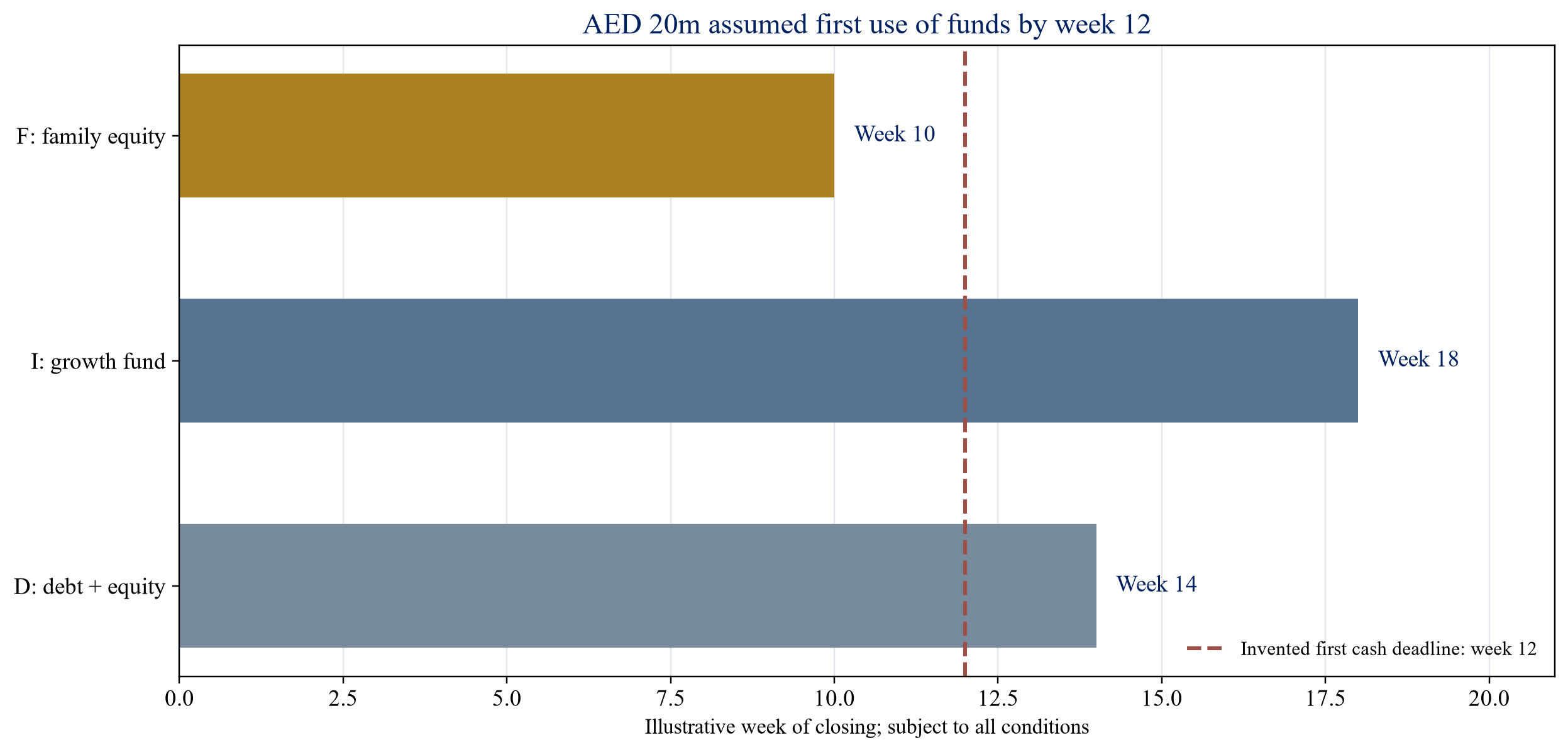
All dates and amounts are invented teaching assumptions. Bars show proposed proceeds only if all hypothetical closing conditions are met; they are not market observations or commitments.
15 Build a fundraising timetable around decision gates
The issuer should work backward from its first irreversible cash use. If a supplier contract requires a deposit in 12 weeks, the board needs a documented source before signing an obligation it cannot otherwise meet. The fundraising timetable should include time for counterparty qualification, preliminary review, detailed diligence, terms, internal approvals, legal documents, compliance checks and transfer. Each stage needs an owner and a cut-off date. The duration must be estimated from the specific counterparties and issuer documents; this paper supplies no universal number of weeks.
The first two weeks of a live process may be used to qualify a limited set of counterparties with a consistent brief and a confidential information protocol. Qualification should seek an answer on the hard gates, ticket, decision entity and expected process. A second lane supplies deeper information only to parties whose mandate and instrument remain plausible. A third lane negotiates executable terms and coordinates consents. This stage design is a proposed operating method, not a description of how every GCC fundraising process proceeds.
At each checkpoint, the board should see cash forecast, active counterparties, documented status, the next decision and any dependency that could cause the first funding date to slip. A prospect without a named decision owner should not be upgraded from exploratory merely because the sponsor is senior or well connected. A prospect with approved terms but an unresolved beneficial-ownership or account-opening requirement should not be counted as available cash. The Central Bank's due-diligence requirements apply to licensed institutions within scope [7]; other counterparties may have separate processes.
An agreed no-go date protects execution. If no counterparty can deliver the first tranche by that date, the company can defer expenditure, revise the size of the raise, secure a properly documented bridge where lawful, or renegotiate its operating timetable. The choice depends on actual cash and obligations. A fundraising process should not continue indefinitely under the assumption that one more introduction will repair a mismatch between the company's deadline and capital providers' approval paths.
16 Assemble a document pack that answers fit questions
The initial pack should be concise and accurate. It can include an entity and ownership chart, financing brief, sources-and-uses schedule, historic accounts, current cash position, forecast with assumptions, key contracts, management biographies, cap table and debt schedule. The issuer should identify which statements are audited, reviewed or management-prepared and show the date of every forecast. IFC's published application guide demonstrates the value of sponsorship, market, technical, financial and timetable information in its own context [4]. A private issuer should tailor the pack to the live transaction and counterparty.
The family-office question may focus on who owns the business, why the family vehicle would be an appropriate partner, what governance rights are available and how the investment could create and realise value. A regulated lender's questions will include repayment, obligations, ownership and legal recoverability within the applicable standards [7]. A fund manager may need portfolio fit, valuation, governance and exit analysis. These are possible lines of inquiry. The actual request list belongs to the authorised counterparty, and confidential information should be shared through an appropriate agreement and controlled room.
Every material claim in the pack should link to an underlying record. A revenue forecast should identify contracted, ordered and assumed activity. A project cost should identify bids, contracts or management estimates. The ownership chart should reconcile with registers and shareholder agreements. The debt schedule should reconcile principal, interest, maturity, guarantees and security. A company should disclose known inconsistencies with a repair owner and date. Presentation polish does not resolve a conflict between a deck and source document.
The document pack is also a sequencing tool. A high-level brief tests eligibility and interest without disclosing the entire room. A qualified counterparty receives the material needed for its next decision, and each version is dated. A full room is provided when the decision process warrants it and confidentiality is controlled. The issuer should record what was shared with whom, when and under which restrictions. This supports consistent answers, reduces repeated diligence and allows the board to understand the information basis of each indication.
17 A disciplined qualification and outreach protocol
Outreach should start from a short, evidence-supported proposition: what entity is raising, what it does, why the amount is needed, what instrument is proposed, what the dated cash need is and which decision rights are open for discussion. The company should then ask one or two mandate questions before sending a long deck. A prospective counterparty may say that the sector, cheque size or minority position is outside its current scope. That answer is useful because it preserves time and clarifies the route.
A qualification call should identify the decision vehicle and the person authorised to speak for it. It should seek an indicative ticket range, instrument preference, geographic or sector restrictions, governance expectations, expected holding or lending horizon, approval stages and information needed for the next decision. The interviewer should distinguish a firm mandate condition from an individual's initial view. Where confidentiality or regulatory constraints limit an answer, the item should remain unverified in the record. The issuer can decide whether further work is justified.
The outreach register should keep explicit statuses: unscreened, qualified for discussion, outside mandate, in preliminary review, in diligence, terms received, internally approved, legally committed, funded, declined, issuer withdrawn or inactive. Each status should have a date and source. “Inactive” should be used when the stated response protocol expires without an answer; silence should not be translated into a decision or a personal preference. A declined route can later become relevant if the issuer's financing perimeter changes, but the old rejection should remain intact.
Adviser incentives deserve review. A process measured only by the number of investor meetings can reward unsuitable approaches and expose the issuer's confidential information. A board should define success as executable, appropriately priced cash received on a date that solves the need, subject to lawful and acceptable terms. The adviser should explain its mandate, fees and conflicts, coordinate counterparties and record the evidence behind each recommendation. The board should remain able to challenge the fit rationale before committing to exclusivity or costly diligence.
18 How the fit test could be examined empirically
The paper's research question asks which observable attributes predict engagement. Answering it requires data on approaches that fail as well as those that progress. A future consented dataset could treat one issuer-counterparty approach as a unit of observation. It would record the original financing perimeter, date, instrument, amount, sector, geography, disclosed ticket and mandate, governance proposal, horizon, decision stages and final outcome. It would distinguish whether the counterparty received only a teaser, a full room or negotiated terms. No such dataset was available to this paper.
The outcome must be defined before analysis. An introductory reply, signed non-binding indication, investment-committee approval and cash receipt are different endpoints. A researcher could test whether an explicitly documented match on instrument or ticket associates with stage progression, conditional on observable issuer and counterparty characteristics. The model should include time and funding date, because a route can progress while failing the issuer's operational deadline. It should report the denominator, missing mandate facts and cases still in progress at the cut-off.
The data would have strong selection risks. Advisers may approach better-known families first, issuers with stronger governance may receive more introductions, and high-quality prospects may disclose mandates more readily. A correlation between a fit score and an outcome would not prove that applying the score causes funding. Within-issuer comparison of several approaches can reduce some variation, while differences in investor type and timing remain. Independent coding of mandates and reasons for decline could improve reliability. Privacy, consent and commercial confidentiality would constrain publication.
The current framework is therefore an auditable hypothesis and management tool. Its hard gates and conditional dimensions can be recorded prospectively and tested when lawful data become available. It should be revised if evidence shows weak predictive value, systematic bias against a class of legitimate capital provider, or consistent failure to identify decision bottlenecks. The paper makes no claim that one category of investor has a higher closing rate, faster timetable or superior return for GCC issuers.
19 The board's capital-fit decision memorandum
A board memorandum should state the financing perimeter and first cash date on page one. It should reconcile uses of funds to a dated cash forecast and identify minimum viable proceeds. The next page can show no more than the serious routes, each with its decision vehicle, documented mandate, proposed instrument and ticket, next approval, likely conditions, rights requested and earliest supportable cash date. Unknowns should be visible in a separate column. A board should not treat missing mandate information as favourable by default.
The memorandum should include a term comparison on a common basis. It should show gross and net proceeds, fees, cash service, fully diluted ownership, value participation at exit, guarantees or security, vetoes, reporting obligations, documentation work and realistic fallback. Illustrative arithmetic must be labelled as assumptions until actual written terms replace it. The fictional case in this paper shows why a high valuation may have little value if funding arrives after the first cash need. It also shows why low dilution may conceal a debt burden the company cannot service.
The recommendation should be conditional and reviewable. It can state which route the board authorises for deeper diligence, what evidence is missing, who is responsible for obtaining it, what the company will do if the date is missed, and when the board will decide again. A recommendation should identify legal, regulatory, tax, accounting and commercial questions that need specialist resolution. It should disclose material adviser conflicts and any exclusivity that could constrain alternatives. An adviser can organise the evidence and execution; the capital provider makes its own independent decision.
The record should be updated when a counterparty changes its terms or status. A lower cheque, new control condition or delayed approval may alter the ranking. A company should resist carrying an obsolete favourable indication forward in the board pack. The final decision is about the capital that can lawfully reach the right entity and meet the cash need on acceptable terms. That standard is demanding, but it gives the board a concrete basis for choosing an active route and for stopping an unsuitable one.
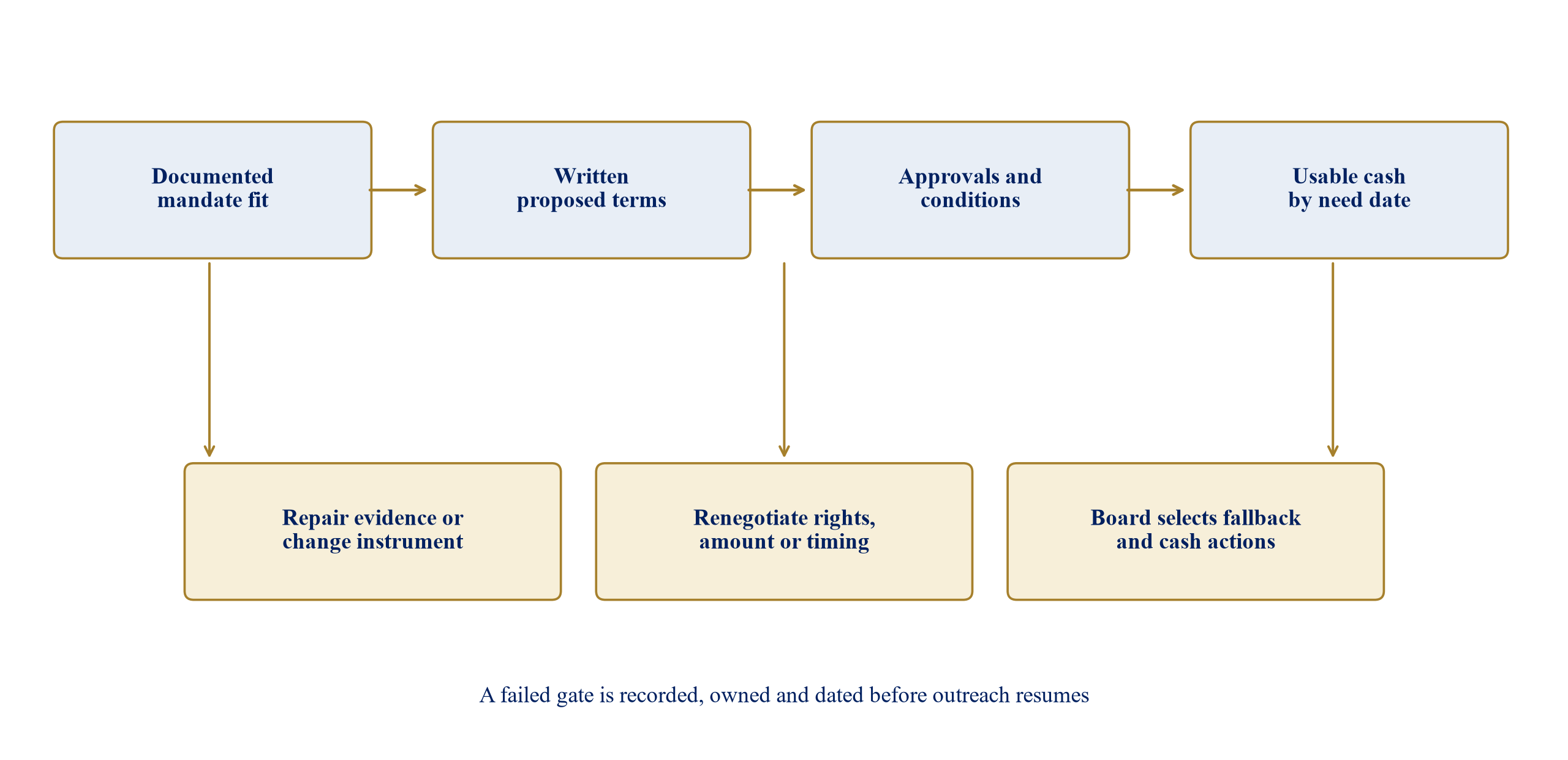
Author-developed workflow. This is a proposed issuer control process, not a representation of any named investor's internal approvals.
20 Conclusion and limitations
Capital fit is a transaction-specific judgement about authority, instrument, amount, rights and cash date. Public information can identify a plausible organisation and provide a first set of questions. A live financing requires confirmation from the correct vehicle and decision-maker, written terms, adequate evidence, corporate approvals and actual funds received. Family offices and institutions each contain varied mandates and processes. Category labels alone cannot answer the board's financing question.
The proposed mandate-to-term framework combines a financing perimeter, six fit dimensions, a hard-gate screen, a term and cash comparison, and an event record. The fictional AED 60 million case illustrates the arithmetic and the funding-date test under invented assumptions. The public sources establish examples of legal structures, regulated fund and credit frameworks, and institutional process within their own stated scopes. They do not establish observed GCC closing probabilities, generic family-office preferences or a standard institutional timetable. A future consented matched-case study would be needed to estimate predictive relationships.
The issuer can apply the framework without waiting for that study. It can define the funding need precisely, ask counterparties for their own mandate and authority, distinguish indications from approvals, model rights and cash on a common basis, and prepare a board fallback before the first cash deadline. Every decision remains conditional on live facts, current rules, written terms and professional advice where required. The method aims to make a financing process more transparent and accountable; it does not promise funding or a particular economic outcome.
References
- Abu Dhabi Global Market. Family Offices, official business-area guidance; accessed 7 October 2026. https://www.adgm.com/business-areas/family-offices
- Dubai International Financial Centre. Global Family Business and Private Wealth, DIFC Family Wealth Centre, official overview; accessed 7 October 2026. https://landing.difc.ae/global-family-business-private-wealth
- Dubai Financial Services Authority. Collective Investment Funds, official regulatory overview; accessed 7 October 2026. https://www.dfsa.ae/what-we-do/collective-investment-funds
- International Finance Corporation. How to Apply for Financing, official application guide; accessed 7 October 2026. https://www.ifc.org/en/what-we-do/products-and-services/how-to-apply-for-financing
- International Finance Corporation. Project Cycle, official process overview; accessed 7 October 2026. https://www.ifc.org/en/what-we-do/products-and-services/ifc-project-cycle
- European Bank for Reconstruction and Development. Loans, official product and eligibility description; accessed 7 October 2026. https://www.ebrd.com/home/what-we-do/products-and-services/ebrd-project-financing/loans.html
- Central Bank of the UAE. Credit Risk Management Standards, C 3/2024 STA, effective 30 November 2024, official rulebook; accessed 7 October 2026. https://rulebook.centralbank.ae/en/rulebook/credit-risk-management-standards
- International Finance Corporation. Family Business Governance Handbook, official publication, 2011. https://www.ifc.org/en/insights-reports/2011/ifc-family-business-governance-handbook
- International Finance Corporation. Corporate Governance Methodology Tools, official methodology overview; accessed 7 October 2026. https://www.ifc.org/en/what-we-do/sector-expertise/corporate-governance/cg-methodology-tools
- International Finance Corporation. Corporate Governance Development Framework, official overview; accessed 7 October 2026. https://www.ifc.org/en/what-we-do/sector-expertise/corporate-governance/cg-development-framework
- Abu Dhabi Global Market Academy Research Centre. Strategic Insights and Solutions for Family Offices, published programme and survey summary, 26 February 2025. https://academy.adgm.com/events/Strategic-Insights-and-Solutions-for-Family-Offices
- Organisation for Economic Co-operation and Development. OECD Corporate Governance Factbook 2025, official publication. https://www.oecd.org/content/dam/oecd/en/publications/reports/2025/10/oecd-corporate-governance-factbook-2025_56febc0d/f4f43735-en.pdf
About the Author
Chennakeshav (CK) is a corporate finance and investment banking executive with 25+ years of global experience in deal origination, structuring and execution across M&A, growth capital and corporate strategy. He has led value-creation mandates for founders, corporates and funds — bridging the boardroom view to hands-on execution and close.
His career spans Morgan Stanley, HSBC, Lloyds Banking Group, EWEC, ADQ portfolio companies and Emirates Growth Fund, across TMT, real estate, fintech, deeptech, cleantech, infrastructure and energy. He has partnered with C-suite leaders, private equity and venture funds, sovereign wealth funds and family offices to finance complex fund raises and scale-up ventures, and has led M&A due diligence, post-merger integration and business-transformation initiatives to create value.
At Matchpoint Partners he is Managing Partner, leading the firm's corporate finance, M&A and capital-raising practice. He holds an MBA from London Business School, an engineering degree from VTU and a Master of Laws (LLM, in progress) from UCL London.
An active start-up mentor, CK mentors at Techstars, DIFC FinTech Hive, Startup Grind, Founder Institute and IN5, serves as Entrepreneur Mentor in Residence (EMiR) at London Business School, and judges the Entrepreneurship World Cup.
