

1 Define a stall as a decision state
A raise is stalled when the process is consuming time while the next decision, the responsible decision-maker and the date of available cash remain unclear. This is an operational definition for this paper. It does not imply that an investor has declined. A company can have several positive conversations and still be unable to name a vehicle that has accepted its price, authorised diligence, approved terms or committed funds. A weekly meeting count cannot resolve that uncertainty.
The issuer should first write down the date on which cash must enter the correct legal entity. It should identify the minimum amount that keeps the underlying plan viable, the uses that can be deferred and the obligations already due. The resulting dated schedule is the reference point for every financing route. An attractive term sheet that arrives after a non-deferrable payment is due may require a separate bridge or an operating change. Those alternatives have costs and approvals of their own.
The board's question is therefore practical: what is preventing the next verifiable financing decision, and can the obstacle be removed before the company's cash deadline? The answer can lie with the issuer, the proposed counterparty or the transaction design. A named investor may be outside mandate; a lender may lack adequate repayment support; a founder's valuation may exceed the range that prospective buyers will underwrite; a legal consent may be unavailable. These possibilities should be tested against records, not assigned from intuition or silence.
This paper treats a stall as a sequence of observable states. It records the offer made, materials shared, the response and its date, explicit objections, requested next steps, written terms, conditions, board approvals and cash transfer. The framework draws on published financing and reporting standards within their own scope. It makes no claim to have observed a sample of UAE fundraises or to know the frequency of any particular reason for failure.
2 Establish the evidence perimeter
The Central Bank of the UAE's Credit Risk Management Standards require licensed financial institutions in scope to understand a facility's purpose and the borrower's risk, including leverage, debt-service coverage, liquidity and operating cash flow [1]. These standards help explain what a regulated lender must assess. They do not establish that a specific private borrower qualifies for credit or that a loan will be available at a particular rate. A privately negotiated equity investment involves a different decision framework.
IFRS 13 sets a framework for fair-value measurement when another standard requires or permits it; its market-participant perspective and risk assumptions are useful discipline for discussing valuation [2]. The 2025 IPEV Guidelines address fair-value reporting for private capital investments [3]. Neither source dictates the price at which a founder must sell new shares in a live primary raise. A transaction price also depends on rights, information, bargaining and the counterparty's investment strategy. Treating a reporting valuation as a mandatory negotiating price would misstate the source.
IFRS 7 describes disclosure of risks arising from financial instruments [4]. IAS 7 addresses cash-flow reporting [5]. IFC's financing application guidance asks its applicants to describe sponsors, markets, project economics, financing requirements and timetable, and its project cycle separates appraisal, approval and disbursement [6,7]. These are different sources with different purposes. Together they support a disciplined issuer-side question: can a capital provider reconcile what the company says about value and cash with its records and a feasible decision path? They do not prove that all investors request the same pack.
The DFSA's Markets Brief explains that offers in or from the DIFC must be assessed against applicable offering and promotion rules [8]. ADGM describes public offers and its exempt-offer regime for activity within its perimeter [9]. Corporate approvals and share rights can also be affected by the entity's jurisdiction and documents. The legal route must be mapped for the actual issuer and communication. This paper does not provide a universal UAE private-placement exemption or legal advice. No consented dataset of approaches, terms, withdrawals and closings was available; the analysis is a proposed diagnostic, a fictional case and a design for empirical testing.
3 Identify the transaction being priced
Price discussions become confused when the parties have not specified what is being purchased or lent. A proposal described as an AED 50 million raise could mean primary ordinary shares in an operating company, preferred shares in a holding company, a secured loan to a project vehicle or a mix. Each claim has a different source of repayment or future value. Existing shareholder liquidity also differs from money paid into the business. The first page of a process memorandum should state the legal issuer or borrower, proposed instrument and net cash the company will receive.
The company should show its ownership and debt structure before announcing a valuation. For equity, a fully diluted cap table includes existing shares, options, convertible instruments, outstanding preferences and the effect of the new money. For debt, a complete schedule includes principal, maturity, interest, security, guarantees, covenants and any restrictions on further borrowing. A shareholder-level value cannot be compared directly with an asset-level loan. The two must be translated into cash and rights for the same company and date.
The uses of funds also need a dated bridge. A project may require AED 30 million to secure equipment and AED 20 million six months later for installation. If the first amount is non-deferrable, a proposal to fund the full AED 50 million after a nine-month approval path does not solve the initial need. A staged proposal may solve it if first-close conditions are achievable and the second stage does not create an unmanageable operating commitment. Both paths require explicit modelling.
The transaction perimeter should be approved internally before an adviser markets the raise. Management must know who can authorise a share issue, grant security, amend existing loan documents, waive pre-emption rights or approve a related-party transaction. ADGM company materials illustrate that share allotment and pre-emption can be formal legal matters for companies within that jurisdiction [10]. Other UAE entities may have different rules and constitutional terms. Counsel should identify the live requirements for the selected entity; the financing timetable should include the resulting approvals.
4 Locate the last verified advance
A deal log should distinguish introduction, qualification, information exchange, preliminary assessment, written indicative terms, internal approval, signed definitive documents and funding. Each transition needs a dated record and a named owner. A verbal statement that a proposal is “interesting” may justify another discussion. It is not a credit approval, investment committee decision or commitment. An issuer can locate the last verified advance by asking what the counterparty actually did, requested or signed.
The log should preserve the original proposal and every material revision. If the company changes the amount, price, security, governance package or fundraising entity, old expressions of interest cannot automatically be transferred to the new offer. The counterparty may need a fresh mandate review. An investor's question about contracts may indicate ordinary diligence, concern about revenue quality or a need for committee materials. The question alone cannot reveal which explanation applies. Ask the authorised contact what decision the requested information supports and when that decision is expected.
Silence requires a defined protocol. After a clear follow-up that states the requested action and a reasonable date, the status can be recorded as inactive if no response arrives. That status is an observation, not a conclusion about valuation, character or investment appetite. Repeated unqualified approaches can create the appearance of an active pipeline while hiding the absence of a decision-ready counterparty. The board should review the number of pathways with a real next gate, rather than the number of names in the register.
The final column of the log is cash. IFC's published project cycle separates board approval, negotiation and disbursement, and notes that funds may be paid in stages or subject to conditions [7]. That specific institutional sequence is not a template for every private fund. It demonstrates why an approval milestone and a cash milestone should be recorded separately. A process that has advanced through diligence can still be too late for the issuer's operational deadline.
5 Separate price from the full economic bargain
The headline pre-money valuation is one component of an equity offer. A new investor may also request liquidation preference, anti-dilution protection, board seats, veto rights, information rights, founder vesting or an exit timetable. The issuer should model the effect of these provisions on distributions in more than one outcome. A higher headline valuation with senior participation or broad protective rights can allocate less value to existing shareholders than a lower price with simpler terms. The comparison must use the actual proposed documents, not generic labels.
For debt, the quoted margin is equally incomplete. Upfront fees, commitment fees, cash sweeps, minimum balances, collateral, guarantees, draw conditions and refinancing requirements affect the cost and availability of capital. The Central Bank's standards require in-scope lenders to assess credit risk and the purpose of the facility [1]. A stated indicative rate does not mean that a borrower satisfies the credit test. The company should model the full cash service under its operating forecast and under a downside case.
The board should ask whether the price gap is explicit. A written counteroffer at a different valuation is evidence of an economic disagreement. A meeting that ends without terms may reflect many other causes. The team can ask whether the objection concerns enterprise value, the equity share purchased, preference rights, downside protection, missing evidence or the financing date. If a counterparty will not articulate a range, its interest should remain exploratory. The issuer can still run its own value and liquidity analysis to decide whether another structure is acceptable.
IFRS 13 and IPEV provide useful disciplines for documenting methods, inputs, uncertainty and market-participant assumptions [2,3]. They do not give a transaction-specific clearing price for a private company. A valuation memorandum should distinguish observed comparable transactions from management forecasts and model assumptions. It should explain how capital structure, transfer restrictions, dilution and rights affect the particular security on offer. Where data are sparse, a range with sensitivities is more candid than a single precise number.
Table 1. Decision variables in a stalled equity or debt raise
| Variable | Issuer record | Counterparty response to obtain | Board decision |
|---|---|---|---|
| Cash need | Minimum net proceeds and dates | Fundable amount and first draw date | Continue, stage or resize |
| Equity price | Fully diluted cap table and value range | Written range and proposed rights | Negotiate, reprice or decline |
| Debt cost | Cash forecast and debt schedule | Margin, fees, security and covenants | Test service and downside |
| Readiness | Source documents and open issues | Decision blocked by each gap | Repair with owner and date |
| Authority | Corporate consents and legal route | Investor or lender approval path | Align timetable and approvals |
| Closing | Conditions and cash transfer steps | Conditions precedent and funding vehicle | Set a supported cash date |
Author-developed diagnostic. Each item requires transaction-specific evidence; the table is not a regulatory checklist.
6 Test the issuer's valuation bridge
A company can justify its desired price by reference to growth plans, comparable businesses or prior financing. The board should then test what portion of the story is supported by realised results, contracted revenue, credible capacity or uncommitted forecasts. A recent transaction is relevant only after adjusting for the security, date, rights, size and business quality. An old financing price may have been negotiated under different conditions. A valuation bridge should identify these differences rather than treating them as footnotes.
The bridge begins with reported financials and a clear measure of current run-rate activity. Management then identifies each forecast driver: volumes, customer contracts, margins, working capital, capital expenditure and exit or terminal assumptions. The analyst should show the sensitivity of value to the few drivers that dominate it. If a small change in assumed margin or funding date produces a large change in implied equity value, that dependency belongs in the negotiation. The company need not surrender its position merely because a model is sensitive; it should know what a counterparty must believe to support it.
The 2025 IPEV Guidelines are intended for private-capital fair-value reporting [3]. A live financing negotiation may weigh strategic or control value and contractual rights differently. A board can still borrow the discipline of calibration and reassessment. It should state the date and terms of a prior transaction, the subsequent operating evidence, changes in market inputs and any security-specific adjustment. A committee can then see whether a proposed new price is supported, aspirational or contingent on milestones.
A persistent valuation gap should lead to a specific choice. The issuer can retain the ask and seek counterparties with a different return or strategic rationale, reduce the amount raised, stage the investment against milestones, adjust rights, change the instrument or wait while performance develops. Each choice has dilution, cash and execution consequences. A board should record why a chosen route can still deliver cash before the operating plan needs it.
7 Test debt capacity on cash rather than accounting profit
A lender's ability to approve a facility depends on its own rules and the borrower's specific repayment profile. The Central Bank's credit standards include operating cash flows, leverage, debt service, liquidity and the wider borrowing group among matters for in-scope credit analysis [1]. This is a reason to reconcile accounting performance with actual cash. A profitable company may still absorb cash through receivables, inventory, tax, capital expenditure or distributions. A cash-flow forecast should show those movements by period.
The issuer should construct a base case and downside cases around variables it can monitor. For a contractor, these may include certification delays, retentions and customer concentration. For a technology company, they may include sales conversion, renewals and implementation costs. For a real-estate vehicle, they may include permits, presales, construction draws and completion dates. These are illustrative categories; the company should choose the risks that govern its own receipts and obligations. The model should distinguish contracts from opportunities and management expectations.
If the lender asks for more collateral or a lower amount, the response may reflect repayment uncertainty, recovery analysis, policy limits or other factors. The issuer needs the actual written position. Reducing the facility can improve coverage while leaving an unfunded project gap. Granting a parent guarantee may create exposure outside the borrowing vehicle. A revised proposal should show both the financing benefit and the cost to the wider group, including restrictions under existing documents.
The board should compare equity and debt using net usable cash at the required dates. Equity avoids scheduled principal service but changes ownership and control. Debt preserves ordinary ownership but creates cash obligations and potentially security claims. A hybrid may defer part of the dilution or payment. No generic instrument wins this comparison. It depends on the company, written terms, cash capacity and approvals, which should be reconciled in one dated financing model.
8 Define readiness by the next decision
Readiness is often reduced to a data-room checklist. A better question is whether the material needed for the next named decision is reliable and accessible. An early mandate screen may require only an accurate financing brief and ownership map. A credit committee needs a different level of cash, covenant and security evidence. Final equity documents require verified share capital, rights, consents and disclosure schedules. A room can hold hundreds of files while missing one document that governs the next decision.
IFC's application guide asks for sponsorship, market, technical, financing and timetable information for its own applicants [6]. IFC's governance methodology examines disclosure, board structure and control environment [11]. The standards do not prescribe a private UAE issuer's universal file list. They show why information quality and governance can be substantive financing questions. A live counterparty should identify its own essential requests, and the issuer should map each request to the decision it supports.
The company should reconcile the investor presentation with accounts, management reporting, bank statements, tax records, cap table, contracts and the model. An unexplained mismatch in revenue, ownership, customer concentration or debt can delay diligence and weaken confidence. The issuer should assign an owner to each mismatch, record the source of the corrected figure and update every affected document. If evidence cannot be obtained before the cash deadline, the board needs to revise its financing route or operating plan. Repeatedly sending a polished deck will not resolve a source-data conflict.
Confidentiality matters during repair. The team should maintain versions, recipient logs, access rights and a process for withdrawing superseded materials. Sensitive customer and employee data should be shared only when justified and lawfully permitted. A statement that a diligence pack is “complete” should refer to a named counterparty and decision stage. The live gate can change after a price revision, instrument switch or new legal vehicle.
9 Diagnose authority and approval timing
A founder may negotiate directly with an investment professional who has no final authority. A bank relationship manager may support a deal without controlling credit approval. A family principal may make an investment decision only after legal, tax or committee review. The issuer should identify who can request information, who recommends, who approves, who signs and who releases cash. The questions are factual and can be asked without assuming that a slow process signals low conviction.
The issuer itself has an approval chain. Its board, shareholders, existing lenders, partners and regulators may need to approve or be notified of a transaction. A change from ordinary equity to preferred shares can require new constitutional rights. New secured debt can conflict with existing covenants. ADGM company rules illustrate one jurisdiction's formal share-allotment and pre-emption requirements [10]; the actual entity's law and documents must be checked. Unresolved issuer authority can make an investor's proposal impossible to execute even if the parties agree on price.
The fundraising timetable should be built backward from a cash date. It should include preparation, counterparty qualification, review, proposed terms, internal approval, documentation, issuer consents, conditions precedent and transfer. IFC's published cycle provides a clear example of staged institutional decision-making [7]. The durations for a particular private transaction need confirmation from its participants. A plan that assigns zero time to legal documentation or third-party consent is a hope, not a defensible cash schedule.
The board should put a review date ahead of the final operational deadline. On that date, it can decide whether the active route is still capable of closing or whether to activate a documented alternative. The alternative could be a narrower raise, reduced capital expenditure, renegotiated customer or supplier timing, a lawful bridge or a different investor. Each alternative needs its own diligence and approval path. Starting it only after the primary route fails may leave insufficient time.
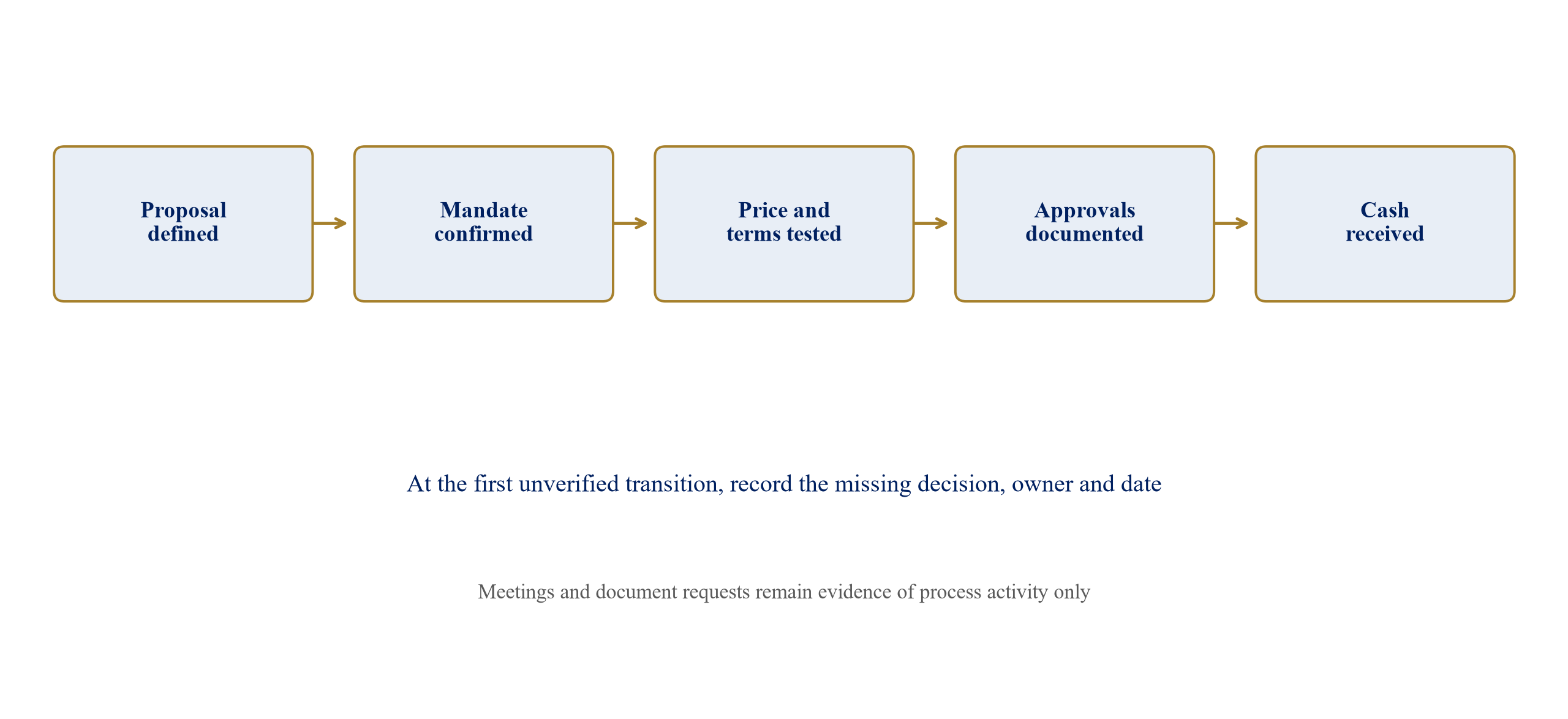
Author-developed process map. It is not a measured UAE fundraising conversion funnel.
10 Check the legal communication route
An issuer can lose time by approaching prospective financiers before deciding which entity is offering what security, from where and to whom. The DFSA's Markets Brief addresses public and exempt offers in or from the DIFC and draws attention to financial-promotion requirements [8]. ADGM identifies an exempt-offer regime within its capital-markets perimeter [9]. These are jurisdiction-specific sources. A mainland company, an ADGM SPV and a DIFC issuer may require different analysis. The company should obtain advice on its precise communication and transaction path before broad distribution.
The audience list should be controlled. A teaser may contain one level of detail; a data room and offer document may carry different obligations and risk. A company should record the legal basis for each form of outreach, the person responsible for approval and any restrictions on onward sharing. A process whose materials cannot lawfully be delivered to its intended audience may need a new route. A pause for legal review should be identified as such in the decision log, rather than attributed to investor price resistance.
The same discipline applies to corporate action. New shares, convertible rights, security over assets, guarantees and intercompany transfers must be available under the governing documents and applicable law. A transaction that requires a waiver from existing holders should identify those holders, the form of consent and the earliest realistic date. If consent is doubtful, a board should avoid describing the offer as executable. The financing comparison should include the probability of timely permission as an unresolved condition, not assign it a numerical value without evidence.
The legal perimeter is an independent diagnostic. It can coexist with a price gap or missing accounts. Treating all objections as “investor sentiment” hides separate tasks and owners. The board should ask counsel for the narrow legal questions that prevent the next decision, management for the commercial revisions and the prospective capital provider for its own approval requirements. The combined answers determine whether the process can continue on its current timetable.
11 Use an explicit reason code for each paused route
A paused route should have one principal reason code supported by an event and any secondary reasons. Possible principal codes include outside mandate, unresolved price, cash-flow capacity, missing evidence, governance rights, corporate consent, regulatory route, approval timing, counterparty capacity and no response after a defined follow-up. These are author-developed process categories. They are not a taxonomy observed in a UAE transaction database. A single case may change code as new information arrives; the log should retain its history.
The code should describe the decision blocked, rather than assign fault. “Pricing” is justified when the counterparty has communicated a specific price or return objection. “Readiness” is justified when a named document, reconciliation or control deficiency prevents the next stage. “Timing” is justified when the counterparty's stated approval or funding path crosses the issuer's cash deadline. “No response” records a fact with a follow-up protocol; it should not be turned into a judgement about the counterparty's motives.
Written objections require care. A counterparty may cite valuation while also being unable to invest in the sector. An adviser should ask whether a price revision would actually permit consideration under the mandate. A lender may request audited accounts as a formal requirement and still have a facility-size constraint. The company should not spend its entire repair budget on a secondary issue. The next-action field should identify the earliest decision that would test whether a route remains viable.
The board can review reason codes across its own active approaches without claiming a market-wide pattern. It should see the count and stage of each route, the source of every classification and the number still unresolved. A route should be removed from the cash plan when a hard constraint is documented. It can remain in an exploratory list if the company may later change its offer. Keeping the two lists separate prevents an attractive but undeliverable discussion from disguising a funding shortfall.
12 A fictional issuer with a narrowing cash window
Consider a wholly fictional UAE operating company, Crescent Components, which needs AED 50 million for equipment and working capital. These amounts, names, dates, offers and outcomes are invented solely to demonstrate the method. The company needs AED 30 million within 90 days to secure equipment and another AED 20 million within the following six months. Its board has discussed a primary ordinary-share raise at AED 200 million pre-money. The starting proposal would issue AED 50 million of shares and give a new investor 20 percent of the enlarged ordinary equity, ignoring any options or other securities for simplicity.
Management's forecast shows a strong expansion but has not reconciled its current receivables, customer concentration and installation timetable to the valuation model. In the fictional scenario, one prospective investor asks for AED 150 million pre-money and a staged first close of AED 30 million. A lender considers a smaller AED 35 million facility subject to security and a cash-flow review. Neither indication is a commitment. No actual family office, bank or transaction is represented. The example is a board decision problem, not evidence of typical UAE terms.
At AED 150 million pre-money, a full AED 50 million ordinary-share subscription would buy 25 percent of the enlarged equity. A first AED 30 million subscription at that price would buy approximately 16.7 percent immediately, before the treatment of any later tranche or dilution. The difference from the founder's starting ask is material, but the board cannot decide from dilution alone. It must compare the probability of receiving the first cash by day 90, the additional rights sought, remaining funding needs and the cost of waiting. Those are case assumptions to validate in a real mandate.
The lender's hypothetical AED 35 million facility has a 10 percent annual cash coupon and AED 1 million of upfront fees, leaving AED 34 million before any reserve or other condition. Annual interest would be AED 3.5 million before principal repayment. In this fictional case, management's base forecast produces only AED 3 million of cash available for debt service in year one. The proposed loan would fail a basic interest-coverage test on those assumptions. This is an arithmetic observation about the invented case, not a market rate, lender threshold or real credit decision.
Table 2. Fictional financing alternatives at the first cash deadline
| Route | First cash potentially available | Ownership or cash cost | Critical condition | Gap against AED 30m first need |
|---|---|---|---|---|
| Original equity ask | AED 50m only after full close | 20% new ordinary equity at AED 200m pre-money | Counterparty accepts value and closes by day 90 | Entire AED 30m until funded |
| Repriced first equity tranche | AED 30m at first close | About 16.7% new ordinary equity at AED 150m pre-money | Rights, consents and first close agreed by day 90 | None if all conditions hold |
| Illustrative loan | AED 34m after assumed AED 1m fee | AED 3.5m annual cash interest before principal | Repayment, security and credit approval | None at draw; year-one service gap remains |
Every amount, rate, date and proposed term is invented. Equity calculations assume simple ordinary shares and exclude options, fees, preferences and taxes. Loan cash excludes possible reserves and later amortisation.
13 Trace the source of the fictional stall
The case has at least three separate issues. The equity counterparty's explicit AED 150 million pre-money proposal establishes a price difference. The unreconciled receivables and installation timetable create an evidence and forecast-quality issue. The 90-day equipment payment makes process timing decisive. These conditions cannot be reduced to one “investor readiness” score. A board should record the next decision for each route: can the equity investor accept a first-tranche structure, can management reconcile the forecast, and can the lender underwrite repayment and security before day 90?
The first equity route can continue at the original price only if a credible counterparty is willing and able to negotiate on that basis within the cash window. The absence of a term sheet does not establish that such a counterparty exists. The staged route may fit the immediate use of funds, but the board must review its later tranche, preference rights and control effects. A first close that leaves an unavoidable future expenditure unfunded can move the problem rather than solve it. The complete sources-and-uses model must include the second stage and any condition on it.
The loan route appears to meet the immediate AED 30 million amount after an assumed fee. Its year-one interest exceeds the invented cash available for debt service by AED 0.5 million, before principal, tax or capex variance. That gap is enough to challenge the route under the stated assumptions. It is not a declaration that any real lender would reject the business. A revised facility might require different size, term, amortisation, cash reserve, equity support or projected receipts; each change should be modelled and tested with an actual provider.
The board's first action is to obtain a reliable current cash position and a dated forecast. It can then decide how long the original-price route may remain active, whether to negotiate a staged equity structure and what operating commitments can be deferred. The alternative should be approved before the cash deadline becomes immediate. A decision log should state the evidence, counterparty response and board approval for each change, preserving the distinction between a scenario and a negotiated term.
14 Build a value and funding sensitivity together
Valuation and funding date can interact. Delaying an equity issue may preserve a desired price if operating evidence improves, yet the company may need temporary cash to reach that evidence. A bridge can carry interest, security, preference or conversion terms that change the eventual equity value. The board should evaluate the full path: cash received at each date, obligations added, ownership after conversion or new issue and the effect of missing operating milestones. A single pre-money value cannot describe that path.
In the fictional case, compare three statements separately: the AED 200 million pre-money management ask, the AED 150 million pre-money counterproposal and a range of values obtained from a documented operating model. The first two are invented negotiation positions. The third would need actual revenue, margin, capex and discount or multiple assumptions if this were a real company. The board can create a sensitivity table showing how customer timing and margin affect the range. It should avoid presenting management's desired number as an independent market measurement.
A risk-adjusted cash view should show the cost of a delayed close. If equipment payment must be made on day 90, a close on day 120 can lead to lost capacity, contractual penalties or a renegotiated delivery date. These consequences should be estimated from company records and counterparties in a real transaction. The paper assigns no generic probability or penalty. The purpose of the sensitivity is to reveal when accepting a lower price may produce more executable value than holding out, and when repricing would sacrifice ownership without solving the funding need.
The analysis can also expose a minimum viable raise. If AED 30 million funds the first stage and the second AED 20 million can be deferred without breaching obligations, staging may preserve optionality. If the project only works with all AED 50 million committed at first close, a partial investment is inadequate unless the second tranche is legally and commercially firm. The term sheet should state whether the later money is unconditional, milestone-based, discretionary or dependent on another investor. The model should follow the actual wording.
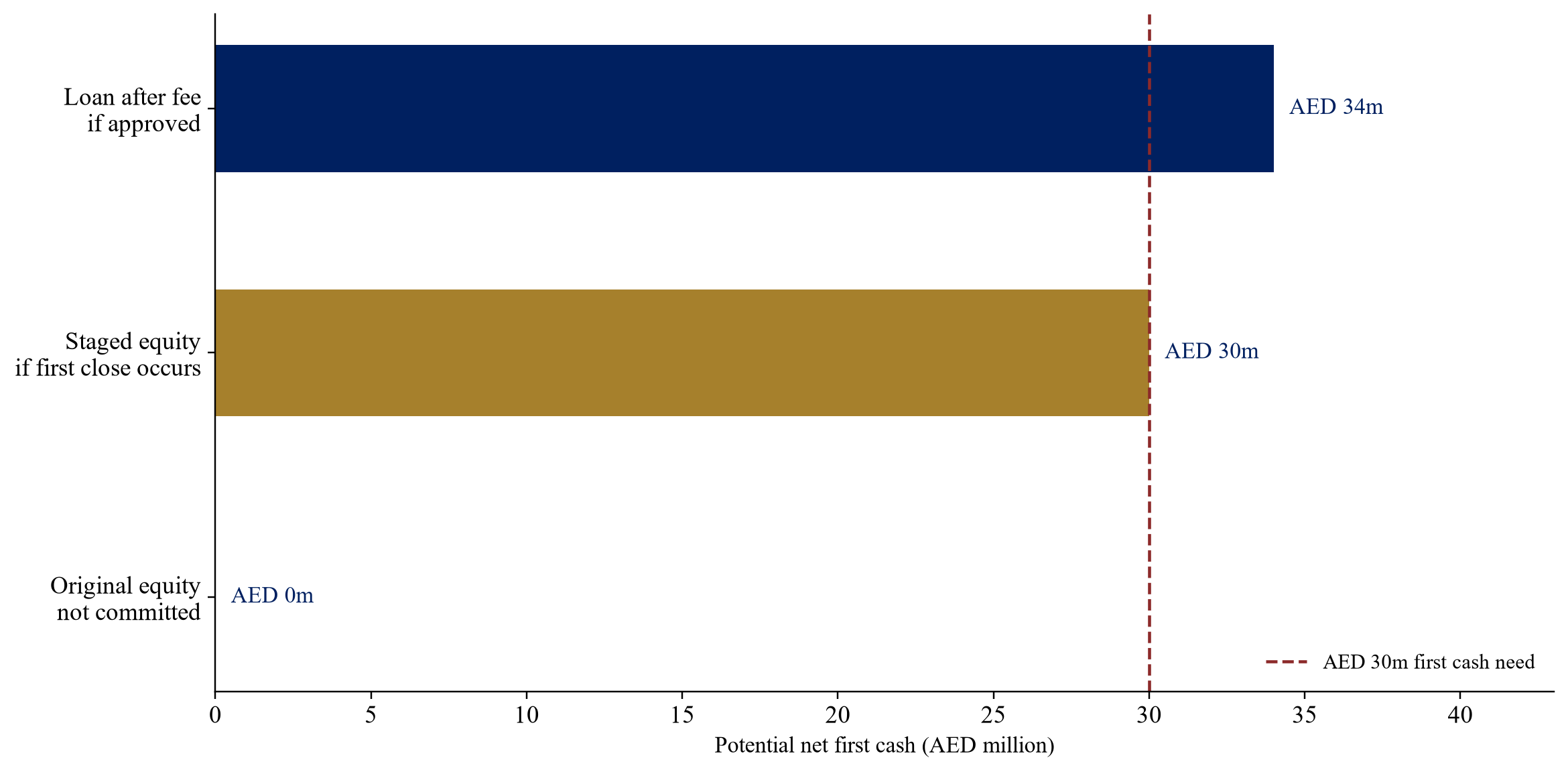
Author-developed illustration using wholly fictional amounts. Bars represent potential first cash before other conditions; they do not indicate approvals or observed financing terms.
15 Repair the process with a time-boxed work plan
A repair sprint begins with a short board-approved list of obstacles. Each item needs a source, owner, required output and date. The list should distinguish a company-controlled task from a counterparty decision. Management can reconcile accounts and contracts; it cannot make an investment committee approve a price. An adviser can obtain a written clarification and coordinate materials; it cannot guarantee a capital provider's mandate or financing. The sprint should focus on the earliest unresolved gate for each route.
For a price issue, the output may be a revised value range, fully diluted ownership bridge and comparison of rights. For a lender capacity issue, it may be a thirteen-week cash forecast, a debt-service schedule and a security map. For document readiness, it may be reconciled accounts, ownership and material contracts, with outstanding issues explicitly disclosed. For timing, it may be a critical path that includes actual counterparties, approval stages and closing conditions. Every output should be dated and reviewed for consistency with the offer document.
The issuer should share a concise update with each qualified counterparty. The update should state what has changed and what decision is now requested. If a price proposal changes, the company should avoid calling it an immaterial clarification. If a forecast changes because a customer contract is delayed, the impact belongs in the model and disclosure. A repair process gains credibility from transparent revisions and traceable evidence, not from suppressing a negative development.
At the sprint's end, the board should choose continue, renegotiate, redesign, pause or stop for each route. Continue requires a named next decision and a cash timetable consistent with the need. Renegotiate requires a price or term gap the company is authorised to address. Redesign changes the amount, instrument or perimeter and therefore may require new approvals. Pause is appropriate when operating evidence must mature. Stop is appropriate when a known hard constraint cannot be resolved within the relevant window. The record should identify any cash and operational actions that follow.
16 Use a controlled data room and one financial truth
The issuer needs one controlled set of numbers. Financial statements, management accounts, banking data and forecasts may legitimately differ in period, accounting basis and purpose. The company should provide a reconciliation that explains each difference. IFRS 18, effective for annual periods beginning on or after 1 January 2027 with earlier application permitted, introduces presentation requirements and management-defined performance-measure disclosures for entities applying IFRS Accounting Standards [12]. The company should distinguish an accounting standard's requirements from an investor's non-GAAP operating metric and identify the date and basis of each measure.
Cash reporting deserves particular attention. IAS 7 distinguishes operating, investing and financing cash flows [5]. A lender or equity investor may also ask for a direct short-term receipts-and-payments forecast. The latter is a management tool, not a replacement for the financial statements. It should reconcile opening cash, collections, supplier payments, payroll, tax, capex, financing flows and closing cash by week or month. The model should state which items are contracted, invoiced, forecast or contingent.
A data room should use a consistent file taxonomy and version history. The company should restrict access to sensitive information, maintain a recipient log and explain superseded materials. Each financial number in a presentation should be traceable to an identified record or assumption. A management estimate should be labelled as an estimate. A verified contract value should be linked to the signed agreement and its conditions. The project model should distinguish a customer's expression of interest from an enforceable purchase obligation.
The purpose is decision reliability. A bidder may request extra materials for ordinary diligence, and a missing file may be immaterial to its next gate. The fundraising team should ask which decision each document supports and whether a deficiency changes economics, approvals or timing. The board should review the room as part of its financing process, with specific attention to the representations it may be asked to sign at close.
17 Compare the routes on a common decision date
The board should not compare an equity offer received today with a hypothetical bank facility that has no credit review, or compare an old indicative price with a current cash deadline. Fix a decision date and ask what is supported as of that date. Each route should show gross amount, net proceeds, cash available by date, required approvals, rights or security, costs, conditions and unverified items. The status column should distinguish exploratory discussion, written non-binding indication, internal approval, signed commitment and funded cash.
The board can then test three scenarios. In the base case, the proposed route closes on its supported timetable. In a delay case, legal or committee review takes longer than expected. In a downside operating case, sales, collections or project completion disappoint. The model should calculate the company's cash balance and obligations in each case. Probabilities should be added only when the company has a defensible evidence base; otherwise present the cases as conditions, not expected values.
Rights require a parallel comparison. Ordinary equity, preferred equity, debt and convertibles can all reshape future decisions. A veto over new debt can affect a later acquisition; a cash sweep can limit investment; a preference can alter founder proceeds at exit. The comparison should show who bears the downside, who controls key decisions and whether the financing permits the operating plan. The published NBER study of venture-capital contracts analyses bargaining and contract terms in a specific research setting [13]. It supports taking contract terms seriously; its findings should not be transposed into a predicted UAE negotiation result.
The output is a board decision, not an algorithmic winner. The board may value control, survival, growth or flexibility differently. It should document those objectives and the evidence supporting the selected route. An adviser can present trade-offs and negotiate within authority. Legal and accounting specialists should review their respective matters. The board must retain responsibility for the choice and update it if the proposed terms or operating forecast change.
Table 3. Board decision record for a paused financing process
| Field | Required record | Decision consequence |
|---|---|---|
| First cash need | Amount, date, entity and underlying obligation | Determines viable closing paths |
| Last verified stage | Dated event and source for each route | Separates activity from commitment |
| Principal blocker | Written objection or missing decision | Directs the repair sprint |
| Price and rights | Value range, debt terms, dilution, controls | Defines economic authority to negotiate |
| Readiness | Source-data discrepancy and remedy owner | Sets evidence before next gate |
| Closing path | Approvals, legal route and conditions | Tests earliest supportable cash date |
| Fallback | Funded alternative or operating action | Protects the dated business decision |
Author-developed template. Populate with verified case facts and actual written terms before use.
18 Design a future test of common stall causes
The paper's research question asks which deficiencies appear most often before a raise pauses or fails. A valid answer would require a defined population, a consistent unit of observation and access to cases that never closed. Public announcements primarily reveal completed or promoted deals; they omit many approaches and revisions. A case series drawn only from an adviser's mandates would also be selected by that adviser's client base, commercial incentives and recordkeeping. This paper does not have a consented dataset or a UAE market denominator and therefore does not rank causes by frequency.
A future study could use one issuer-counterparty route as its unit, nested within a financing process. It would record the legal issuer, instrument, initial and revised amount, price and rights, cash deadline, materials delivered, questions raised, written objections, stage transitions, approval decisions and eventual cash. Cases still active at the data cut-off should be marked as such. Researchers should define “stall” in days and decision-stage terms before examining outcomes. They should preserve unknown reasons separately from documented objections.
The study could report a descriptive table of documented reason codes by stage and route type. It could then examine whether price gaps, specific missing evidence or approval-path length are associated with non-progression after accounting for issuer size, sector and financing need. Association would not establish causation. Stronger issuers may attract different counterparties, and negotiation terms can change because a company is under cash pressure. Consent, confidentiality, regulatory restrictions and data quality would constrain what can be released publicly.
The proposed diagnostic is testable now as a prospective management process. A company can record its routes consistently, audit whether the assigned blocker was supported by the counterparty's communication and compare stated cash dates with eventual outcomes. The framework should be revised if its categories fail to distinguish material decisions or if users routinely assign reasons without evidence. These are design criteria, not observed findings about the UAE fundraising market.
19 The board's stop and restart decision
The board should set a decision date that precedes the company's non-deferrable cash need. At that meeting it should receive a current liquidity forecast, each route's last verified event, written price or credit terms, outstanding evidence and consents, the supported earliest cash date, and an operating fallback. The board can then authorise a defined next action. An open-ended instruction to “keep talking” provides little control when the cash window is narrowing.
A restart is justified when the original offer or process has changed materially enough that a qualified counterparty can make a new decision. Examples include a reconciled cash forecast, a revised instrument, a properly staged funding request, a documented valuation range or newly available consents. The issuer should make the change explicit and date the revised materials. Reusing an old expression of interest as evidence for a new offer would overstate its status. A restart may also require new legal and regulatory review.
A stop decision can preserve value. The board may defer expenditure, renegotiate a supplier timetable, reduce project scope, seek a lawful short-term facility or sell an asset, depending on actual obligations and available alternatives. Each option should be tested for cash, costs, approvals and strategic effect. If no financing route can meet the date, the board needs an operating decision. A prolonged marketing process cannot create cash by itself, and further outreach may expose sensitive information without improving execution.
The decision memorandum should name the responsible owner for every action and the date on which the board will see the result. It should separate verified facts, management estimates and counterparty statements. Material changes should trigger a new comparison of net proceeds, price, rights and timing. The company can maintain relationships with declined or inactive parties while keeping the active cash plan limited to supportable routes. This discipline makes the process governable without claiming that any framework guarantees a closing.
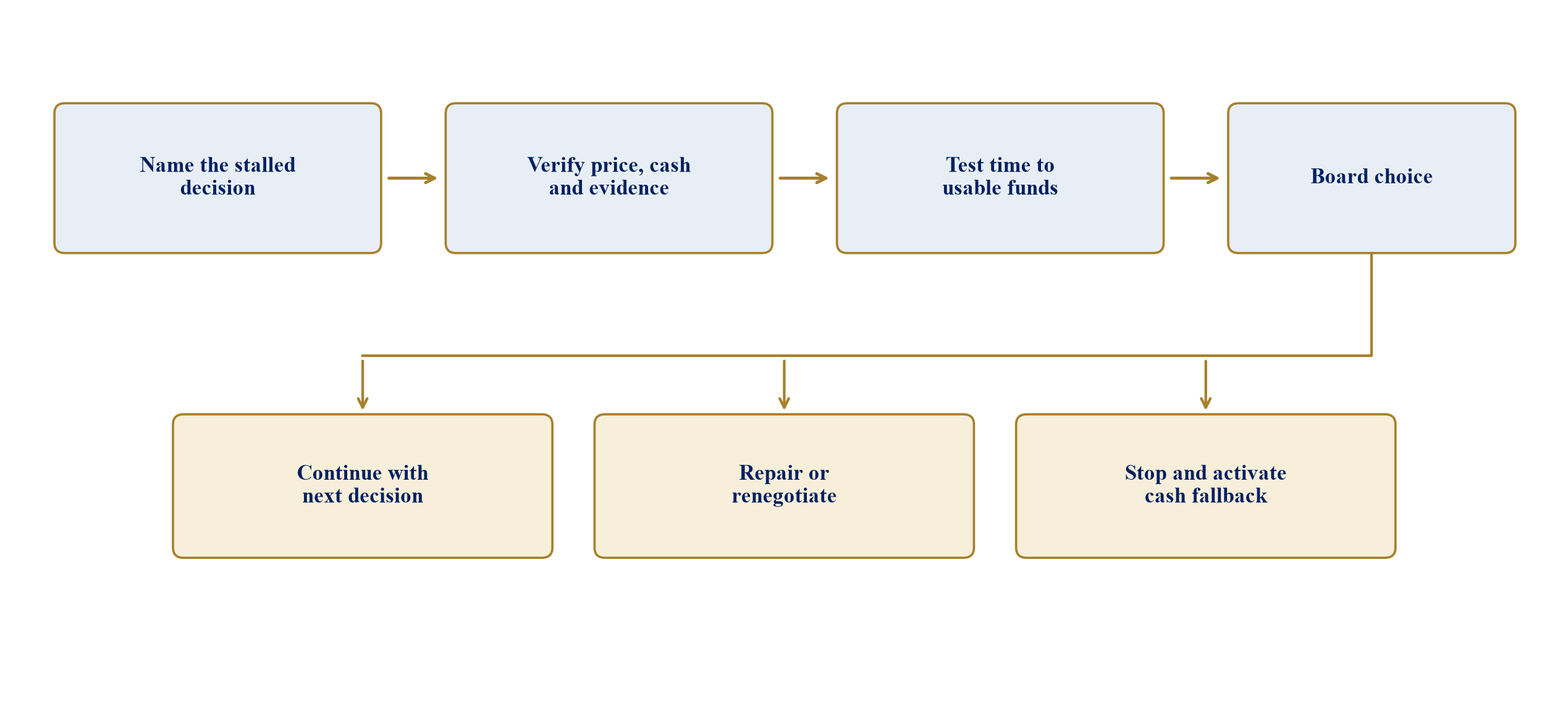
Author-developed board workflow. It does not depict a regulator's rule or an observed financing process.
20 Conclusion and limitations
A stalled raise requires a decision record that links a specific financing offer to the next approval and the date cash is needed. Price is one possible blocker. Cash-flow capacity, missing evidence, rights, corporate authority, regulatory route and timing can be independent barriers. The board should require an observed event or written response before assigning a cause. Silence after a defined follow-up remains a status of no response. It is not evidence of a particular motive.
The proposed framework starts with the transaction perimeter and dated cash need, locates the last verified advance, separates economic terms from issuer readiness, and assigns an owner and deadline to each unresolved gate. A fictional example demonstrates why a lower equity price, a staged first close and a loan cannot be compared using dilution or headline amount alone. All figures and terms in that example are invented. Published standards and guidance support specific valuation, credit, reporting, governance and regulatory considerations within their stated scope. They do not establish a universal UAE fundraising success rate or a ranking of stall causes.
Management can apply the decision framework by keeping one financial truth, asking counterparties which decision is blocked, and setting a board review date before the first cash deadline. A process can continue, be repriced, be redesigned, pause for evidence or stop. Each choice should be supported by actual company records, current rules, written counterparty terms and professional advice where appropriate. A future consented dataset could test whether the reason codes predict stage progression. Until then, the contribution is an auditable method for making the next financing decision, not an empirical prediction or a promise of funding.
References
- Central Bank of the UAE. Credit Risk Management Standards, official rulebook, C 3/2024 STA; accessed 7 October 2026. https://rulebook.centralbank.ae/en/rulebook/credit-risk-management-standards
- IFRS Foundation. IFRS 13 Fair Value Measurement, official standard overview; accessed 7 October 2026. https://www.ifrs.org/issued-standards/list-of-standards/ifrs-13-fair-value-measurement/
- International Private Equity and Venture Capital Valuation Board. IPEV Valuation Guidelines, December 2025; accessed 7 October 2026. https://www.privateequityvaluation.com/Valuation-Guidelines
- IFRS Foundation. IFRS 7 Financial Instruments: Disclosures, official standard overview; accessed 7 October 2026. https://www.ifrs.org/issued-standards/list-of-standards/ifrs-7-financial-instruments-disclosures/
- IFRS Foundation. IAS 7 Statement of Cash Flows, official standard overview; accessed 7 October 2026. https://www.ifrs.org/issued-standards/list-of-standards/ias-7-statement-of-cash-flows.html
- International Finance Corporation. How to Apply for Financing, official guidance; accessed 7 October 2026. https://www.ifc.org/en/what-we-do/products-and-services/how-to-apply-for-financing
- International Finance Corporation. Project Cycle, official process overview; accessed 7 October 2026. https://www.ifc.org/en/what-we-do/products-and-services/ifc-project-cycle
- Dubai Financial Services Authority. Markets Brief 3: Offers of Securities, official publication; accessed 7 October 2026. https://www.dfsa.ae/download_file/1190/463
- Abu Dhabi Global Market. Capital Markets, official overview of offers and exemptions; accessed 7 October 2026. https://www.adgm.com/business-areas/capital-markets
- Abu Dhabi Global Market. Companies Regulations 2020, allotment and pre-emption provisions; accessed 7 October 2026. https://assets.adgm.com/download/assets/ADGM1547_20963_VER072020.pdf/fb4a15ce5d4111efaccc3653e4bba5a5
- International Finance Corporation. Corporate Governance Methodology Tools, official methodology; accessed 7 October 2026. https://www.ifc.org/en/what-we-do/sector-expertise/corporate-governance/cg-methodology-tools
- IFRS Foundation. IFRS 18 Presentation and Disclosure in Financial Statements, official standard overview; accessed 7 October 2026. https://www.ifrs.org/issued-standards/list-of-standards/ifrs-18-presentation-and-disclosure-in-financial-statements/
- Ewens, Michael, Matthew Rhodes-Kropf and Ilya Strebulaev. Venture Capital Contracts, NBER Working Paper 26115, 2019; accessed 7 October 2026. https://www.nber.org/papers/w26115
About the Author
Chennakeshav (CK) is a corporate finance and investment banking executive with 25+ years of global experience in deal origination, structuring and execution across M&A, growth capital and corporate strategy. He has led value-creation mandates for founders, corporates and funds — bridging the boardroom view to hands-on execution and close.
His career spans Morgan Stanley, HSBC, Lloyds Banking Group, EWEC, ADQ portfolio companies and Emirates Growth Fund, across TMT, real estate, fintech, deeptech, cleantech, infrastructure and energy. He has partnered with C-suite leaders, private equity and venture funds, sovereign wealth funds and family offices to finance complex fund raises and scale-up ventures, and has led M&A due diligence, post-merger integration and business-transformation initiatives to create value.
At Matchpoint Partners he is Managing Partner, leading the firm's corporate finance, M&A and capital-raising practice. He holds an MBA from London Business School, an engineering degree from VTU and a Master of Laws (LLM, in progress) from UCL London.
An active start-up mentor, CK mentors at Techstars, DIFC FinTech Hive, Startup Grind, Founder Institute and IN5, serves as Entrepreneur Mentor in Residence (EMiR) at London Business School, and judges the Entrepreneurship World Cup.
