
1 Define the acquisition decision before calculating a transition cost
A power station purchase can transfer shares in an operating company, assets with selected contracts, a land parcel, a grid position or a development option. Each form changes the rights and liabilities that travel with the transaction. The investment committee should begin with the precise perimeter and intended use of the site. A buyer planning continued operation for five years faces a different sequence of staffing, fuel, environmental and closure costs from a buyer intending prompt retirement and storage development. The same headline enterprise value cannot describe both decisions.
The just-transition question is operational: who is affected by the change, what is owed to them under applicable law and contracts, what further commitments have been made, and which feasible alternative produces a viable outcome? This includes people employed through contractors and service providers, not just names on the target's payroll. It includes the place around the plant, where local procurement, taxes, training and public services can depend on the facility. Closure can also change access, safety and land-use arrangements long after generation ends.
A diligence team should distinguish three decisions. The first is whether the asset can be acquired and operated lawfully during the transition. The second is whether a worker and community plan can be executed at a price and timetable compatible with financing. The third is whether the purchaser should acquire at all if these conditions are unresolved. In each decision, the evidence has to be specific to the target and the jurisdiction. A published estimate of sector-wide job effects does not establish a plant's severance bill, retraining capacity or social licence.
The International Labour Organization's just-transition guidelines emphasise decent work, social dialogue, skills and social protection [1]. They are a useful organising framework for a transaction. They are not a substitute for payroll records, labour counsel, consultation with worker representatives or local-law analysis. This paper is an analytical method, not a finding about any real asset or a legal, actuarial, environmental or social-impact opinion.
2 Build a perimeter that follows people, land and contracts
An acquisition perimeter should have three linked maps. The entity map identifies the employer, site owner, permit holder, pension sponsor, grid-contract party and any special-purpose vehicle. The people map shows employees by role, location, contract, age band where lawful, tenure, pay basis, collective arrangement, safety qualification and potential redeployment pathway. The place map covers the plant, ash or waste areas, transmission corridor, water intake, transport routes, adjacent land, public access and communities exposed to closure or redevelopment. Sensitive personal data should be handled under the applicable privacy regime, with aggregated reporting to the investment committee.
The three maps should be reconciled against a contract register. An apparently outsourced maintenance team may have transfer or consultation rights under local employment law or its service contract. A municipal agreement may require support after operations cease. A fuel or power-purchase contract can create a payment if generation ends early. A land lease may require restoration to a specified condition. A bond or parent guarantee may be callable on failure to decommission. The buyer needs counsel to determine which duties actually transfer, remain with the seller or require third-party consent.
The perimeter must include indirect effects without presenting them as automatically compensable liabilities. Local businesses may lose orders, while new construction may create different orders. A town may lose a tax base, yet its response may be governed by public policy rather than a private purchase agreement. Those effects matter to consultation, schedule and the integrity of the redevelopment case. Their cash treatment depends on enforceable commitments, proposed investment, negotiated agreements and evidence of the likely outcome.
Version control is essential. A repowering plan may shift from storage to an industrial load or a transmission upgrade. That change can alter staffing needs, planning approvals and remediation scope. A transaction model should state which site configuration, generation end date and development case it values. Diligence reports should refer to the same version. Without this discipline, a buyer can apply the costs of one closure plan to the revenues of another.
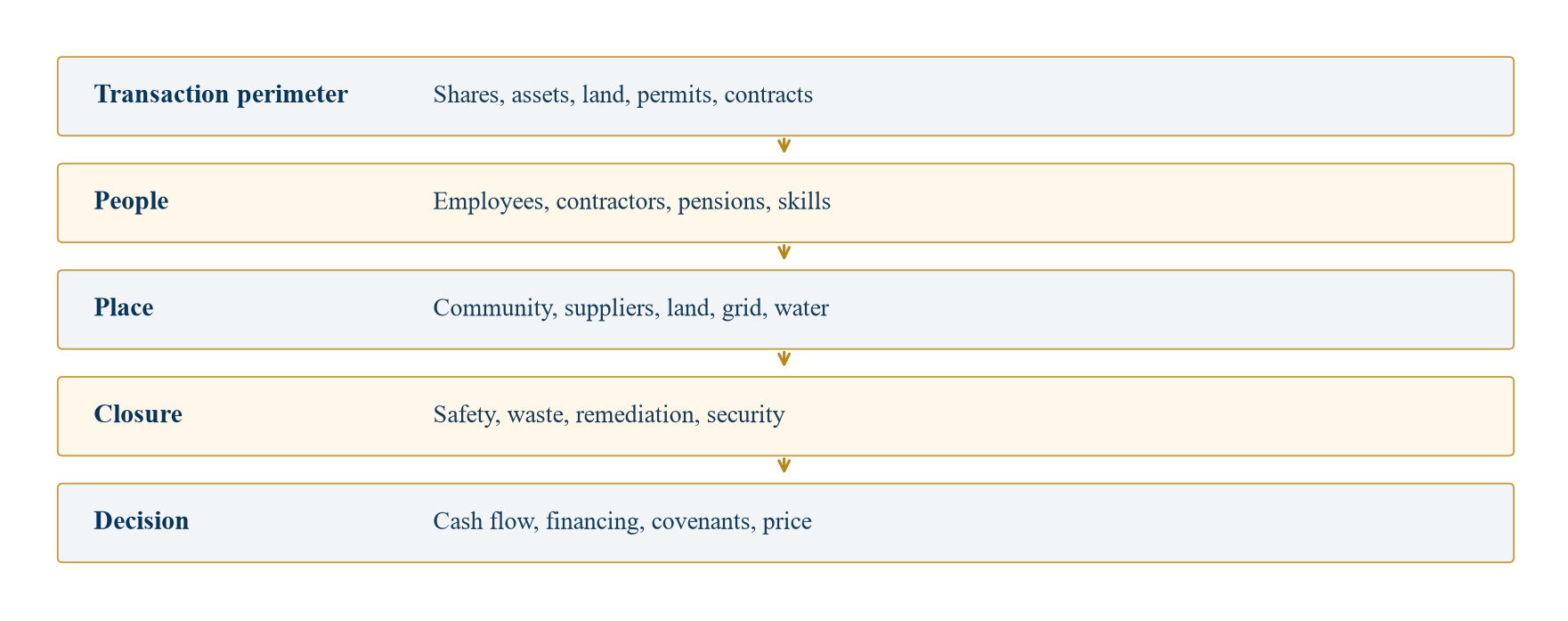
Author-developed system map. It identifies diligence workstreams, not legal duties for a particular site.
3 Separate law, financing standards and voluntary promises
A transition register should have one row for each obligation and a field for its source. Binding national or local law can govern consultation, redundancy, pensions, workplace safety, environmental permits, waste, land remediation and financial security. Collective bargaining agreements, employment contracts, leases, licences, community-benefit agreements and acquisition documents can create further enforceable duties. Lender requirements can incorporate International Finance Corporation Performance Standards or World Bank Environmental and Social Standards by contract. An ILO or OECD guideline supplies a framework for conduct; it does not automatically become a statutory entitlement [1-8].
The distinction matters to price and remedy. A legal severance payment may be due on a specific termination date. A lender-required livelihood plan may need to be funded before a drawdown. A voluntary training pledge might be reputational until it is embedded in a grant, permit or contract. If a seller has publicly promised site restoration, counsel must test whether that promise appears in a permit, planning agreement or other binding instrument. The model should show the cost and timing of each category without treating all statements as equally enforceable.
International Finance Corporation Performance Standard 2 addresses labour and working conditions. It requires clients within its scope to consider alternatives to retrenchment and, where retrenchment proceeds, develop a plan reflecting non-discrimination and consultation, subject to its detailed requirements [2,3]. Performance Standard 1 covers assessment, stakeholder engagement and grievance mechanisms in its project context [4]. Their applicability to an acquisition depends on financing documents and project scope. A buyer should examine whether the target's lender, future lender or investor has actually required them.
World Bank Environmental and Social Standards are tied to the Bank's financing framework where applicable [5]. OECD responsible-business-conduct guidance addresses risk-based due diligence across business relationships [6,7]. A transaction can draw practical questions from those sources even when they are not contractual covenants. The legal memorandum should make the boundary explicit so that a board does not mistake a useful benchmark for a universal rule.
Table 1. Obligation sources and the acquisition question
| Source of duty or standard | Primary evidence | Acquisition question | Financial treatment |
|---|---|---|---|
| Local employment and environmental law | Current statutes, permits, regulator correspondence, legal opinion | Which entity owes what, and when? | Specific cash flow, security and timing |
| Employment and commercial contracts | Payroll, collective terms, supplier and community agreements | Which rights transfer, terminate or require consent? | Price adjustment, provision or covenant |
| IFC Performance Standards 1 and 2 | Applicable loan covenant and project assessment | What labour and stakeholder plan does financing require? | Budgeted measures and drawdown conditions |
| World Bank Environmental and Social Standards | Financing agreement and action plan | Which project requirements are contractually applicable? | Funded actions and monitoring |
| ILO and OECD guidance | Board policy and due-diligence framework | What responsible process should inform a decision? | Scenario and governance, subject to actual commitments |
General framework from cited primary sources reviewed 6 October 2026. Actual applicability requires local legal and financing review.
4 Make the workforce census a transaction-grade dataset
The target's headcount is not a sufficient workforce census. The buyer should reconcile payroll to site-access logs, contractor rosters, pension records, union or works-council agreements, overtime, benefits, leave balances and fixed-term contracts. Roles should be mapped to essential operating tasks and to plausible repurposing jobs. A worker may be technically qualified for generation control but still need safety certification for a storage facility. A general assertion that green jobs will replace lost jobs cannot establish a transfer pathway for a named group.
The census should identify workers whose duties must continue through shutdown, demolition and remediation. These roles may have a different retention and safety profile from workers who can be redeployed early. Temporary contractors can be exposed to an abrupt end of work yet receive different protections under applicable law and contracts. The team should assess these groups separately. Labour counsel should determine consultation, notice and transfer requirements; human-resources specialists should test the feasibility and cost of each proposed route.
The diligence room often contains personally identifiable information. Access should be restricted, the collection basis documented and the reporting aggregated. The investment committee needs cost ranges and execution risks, not individual medical or family histories. Where an agreement or bargaining process is underway, counsel should determine how information can be shared with bidders and worker representatives. Mishandled data can undermine consultation as well as create privacy exposure.
An independent reconciliation can reveal hidden cost. A payroll file may exclude a defined-benefit pension arrangement, contractor indemnities or an unfunded leave balance. Conversely, a seller may have already funded an enforceable obligation. The buyer should avoid adding the same cash duty twice through an enterprise-value deduction, a working-capital adjustment and a separate indemnity. The census is therefore both a people record and a valuation control.
5 Test alternatives to retrenchment before budgeting separation
A credible transition plan compares continued operation, phased retirement, role redesign, internal redeployment, new-project employment, voluntary separation and retraining. It should show how many positions each route can plausibly support, the required skills, the timing of vacancies, the training cost and the conditions under which an offer is real. A future storage project may have a much smaller permanent workforce than the existing thermal facility. Construction employment is usually time-limited and should be shown separately from long-term work.
International Finance Corporation Performance Standard 2 directs clients within its scope to assess alternatives to retrenchment before a plan is implemented [2,3]. That is a useful discipline for any buyer: ask what work can be preserved without compromising a safe and economically viable closure. A forced promise to maintain every job regardless of plant safety or operating economics can create its own risks. The plan should describe actual choices and their consequences, then use consultation to test whether workers can access them.
Retraining needs more than a classroom budget. It may require paid time, assessment, certification, transport, language support, equipment and a credible employer willing to hire. A course completion count is not the same as a sustained job placement. The buyer should define measurable outcomes, how long they will be tracked and whether a third party can verify them. Local institutions and worker representatives can inform design. Private funding cannot by itself create a regional labour market.
Pension and early-retirement pathways need specialist valuation. The economic cost of a pension deficit, withdrawal liability or accelerated retirement can dwarf a simple severance calculation. This paper does not estimate those amounts. An actuarial report, trust documents, applicable law and transaction structure are necessary. The buyer should decide whether a pension condition is a price adjustment, dedicated security, seller retention or a reason to defer signing.
6 Treat safety and knowledge transfer as a closure workstream
The final years of a plant can be more hazardous than stable operation. Experienced workers may leave before complex isolation, fuel removal, waste handling and demolition begin. Maintenance backlogs can accumulate if an asset is run down in anticipation of sale. A transition plan should identify the qualified people needed for safe operation through each stage and the incentives required to retain them. This is an operating and safety requirement, not merely an employee-benefits line.
The buyer should commission an asset-condition review alongside workforce diligence. Critical equipment, maintenance records, permits, incidents, contractor competence and emergency plans should be reconciled. A closure contractor cannot assume that a site's as-built drawings, inventories and hazardous-material records are complete. Knowledge transfer from long-serving staff should be scheduled while those staff remain available and compensated for that work under appropriate agreements.
International Finance Corporation environmental, health and safety guidance for thermal power plants and its general guidance describe sector and lifecycle hazards [9,10]. The detailed closure method remains technology- and site-specific. A coal unit, gas unit and combined heat-and-power facility can have different waste streams and infrastructure dependencies. The site engineer and environmental adviser should specify surveys, isolations, permits, worker protections and contingencies before a fixed closure cost is used in a bid.
Retention bonuses can be justified when they protect safe generation, evidence transfer or remediation execution. They should have objective service dates, safety conditions and anti-discrimination review. A bonus alone cannot replace succession planning. If specialist staff are unavailable, the shutdown timetable and contractor procurement may need revision. The deal model should show the cash consequence of that alternative rather than assuming closure will proceed on the original date.
7 Map community dependence without inventing a liability
The plant's local footprint can include suppliers, apprenticeships, shared infrastructure, tax contributions, transport and social facilities. Each relationship should be described by evidence: contracts, payment data, public agreements, municipal budgets, stakeholder interviews and actual site-use records. A buyer should not turn every indirect impact into a legally owed payment. It should also avoid ignoring effects that can delay approvals, undermine redevelopment or create a legitimate expectation under an existing agreement.
Community engagement should begin with an honest statement of what the transaction can and cannot decide. The owner may control recruitment, procurement, training and access to the site. Government may control education, social protection and regional economic policy. A credible plan can coordinate these actors while keeping their responsibilities distinct. Consultation should reach affected groups beyond the most visible representatives, subject to local context and appropriate safeguards. The process should record concerns and explain how design or funding changed in response.
A community bridge may fund training facilities, supplier adaptation, local infrastructure or other agreed measures. Its amount needs a documented purpose, delivery entity, eligibility rules, timing, monitoring and termination point. An open-ended pledge with no delivery owner can be hard to finance and hard for residents to trust. If public money or grants are expected, the buyer should verify approval and conditions; an indicative policy document is not a signed funding commitment.
The risk of community opposition should not be assigned a precise probability without project evidence. The transaction case can instead compare defined timelines: consent on the expected path, consent after a specified redesign, and no consent by a long-stop date. A buyer can show the cost of each path and preserve an option to stop. This gives the board a disciplined decision without claiming that a numerical model has predicted local consent.
8 Cost closure and remediation as separate, sequenced obligations
Decommissioning removes or makes safe plant equipment. Remediation addresses contamination and other environmental conditions to the standard required for the intended future use. They are linked but distinct. A site that is safe for controlled industrial use may need additional work for housing or public access. A transaction valuation should therefore specify the assumed future land use and the regulator's applicable standard. It should avoid counting a redevelopment uplift while retaining the lower remediation cost of a restricted-use site.
The technical scope may include fuel systems, tanks, cooling water, foundations, ash or waste, underground services, asbestos, contaminated soil, groundwater, transmission equipment and structures shared with other operators. These are possible workstreams, not findings about the hypothetical site. A qualified environmental and engineering team should produce an inventory, investigation plan, closure sequence, cost estimate, contingency basis and monitoring period. Independent review is important where seller and buyer have different incentives to define the baseline narrowly.
Financial security can take the form of a bond, escrow, trust, letter of credit or another mechanism permitted by the relevant authority and transaction documents. Its amount, beneficiary, release conditions, renewal risk and transferability matter. A USD 30 million fund assigned to closure has a different value from unrestricted cash. It may reduce the buyer's funding gap without increasing distributable equity value dollar for dollar. Counsel and accounting advisers should confirm ownership, restrictions and treatment before it appears in a purchase-price bridge.
The closure estimate should show at least a base scope, an adverse scope and timing sensitivities. Contingency is not a licence to conceal unknown contamination. A buyer may need invasive testing, a holdback or a seller indemnity with credit support. If the permit holder changes at completion, regulators may require consent or replacement security. A deal that cannot transfer lawful site control and closure funding is not ready for an unconditional close.
9 Convert obligations into cash timing and valuation
The model should have a separate schedule for each obligation: workforce, community, decommissioning, remediation, pensions and any stranded commercial contract. For each, record the trigger, expected payment period, escalation basis, responsible entity, source document and funding mechanism. An immediate worker programme is not economically interchangeable with a restoration payment five years later. Discounting can compare timing, but the buyer still needs liquidity when the payment falls due.
Enterprise value should be defined before making deductions. If a seller's discounted-cash-flow model already includes severance, community costs and closure, subtracting their present values again understates value. If an offer price is for assets free of specified liabilities, the assumed liability transfer must match the legal documents. The buyer should reconcile the operating forecast, debt-like items, working capital, environmental provisions, restricted cash and purchase-price adjustments in one bridge. Accountancy treatment and economic value may differ; both need specialist review.
An obligation can affect financeability even when its present value appears small. A large year-five closure payment might require a funded reserve from year one. A lender may demand security, a debt-service lock-up, lower leverage or a completion guarantee. These requirements can change equity returns. The model should therefore show the gross obligation, its cash schedule, the reserve build, any restricted assets and the residual amount that investors can distribute.
The useful output is an evidence-linked valuation range, not a single decimal. The board should know which values arise from signed contracts and regulator findings, which come from adviser estimates, and which are author or management assumptions. It should know which risk can be transferred to a solvent counterparty and which remains with the project regardless of contract wording. The acquisition committee can then make a price and structure decision on a transparent basis.
10 Use an explicit hypothetical case to test the arithmetic
Consider an invented 600 MW thermal site with 400 direct employees and a potential repowering plan. No actual plant, worker group or jurisdiction supplied these figures. Assume 250 workers can be redeployed after role-specific assessment and training at USD 15,000 each, for USD 3.75 million. Assume 150 workers receive separation at USD 60,000 each, for USD 9 million. Assume all 400 receive USD 5,000 of transition support, for USD 2 million. Add a USD 4 million safety-retention and knowledge-transfer programme. The immediate worker-related total is USD 18.75 million. These amounts are illustrative author assumptions; they are not local legal entitlements or prevailing rates.
Assume a USD 5 million community bridge at completion and USD 2 million at each of seven year ends. At an assumed 8% annual discount rate, the seven-year annuity factor is approximately 5.20637. The present cost is USD 5 million plus USD 10.41274 million, or USD 15.41274 million. Assume USD 90 million of decommissioning and USD 40 million of remediation both paid at the end of year five. Their present costs are approximately USD 61.25249 million and USD 27.22333 million respectively. The assumed year-five sums need a real engineering and environmental estimate before an actual bid.
The total present cost in this deliberately narrow example is USD 18.75 million plus USD 15.41274 million plus USD 61.25249 million plus USD 27.22333 million, or USD 122.63856 million. If, and only if, an invented USD 300 million gross asset value excludes all four obligation categories, a simple residual is USD 177.36144 million. Taxes, debt, pensions, grants, working capital, restricted funds, future operating cash flow and permit risk are omitted. The residual is not an equity valuation for a real transaction.
The illustration is useful because it forces each line to carry a date and a source. It does not decide whether the plant should retire, what rights workers have, whether redeployment is feasible or whether remediation will be accepted. Those matters require evidence, dialogue and professional sign-off. It also cannot show whether a seller has already priced some obligations into its asking value. The transaction bridge must be reconciled to the actual offer definition before any deduction is applied.
Table 2. Illustrative obligation bridge for an invented power-plant acquisition
| Obligation | Assumed cash basis | Payment timing | Illustrative present cost |
|---|---|---|---|
| Worker redeployment training | 250 × USD 15,000 | Completion | 3.75 |
| Worker separation | 150 × USD 60,000 | Completion | 9.00 |
| General transition support | 400 × USD 5,000 | Completion | 2.00 |
| Safety retention and knowledge transfer | Fixed author assumption | Completion | 4.00 |
| Community bridge | Fixed author assumption | Completion | 5.00 |
| Community programme | USD 2 million annually for seven years | Years 1–7 | 10.41 |
| Decommissioning | USD 90 million | Year 5 | 61.25 |
| Remediation | USD 40 million | Year 5 | 27.22 |
| Total before excluded items | Sum of listed present costs | Mixed | 122.64 |
USD millions, rounded. All quantities, unit costs, dates and discount rates are hypothetical author assumptions, not market observations. Present value of the year-five items uses 8% annual discounting.
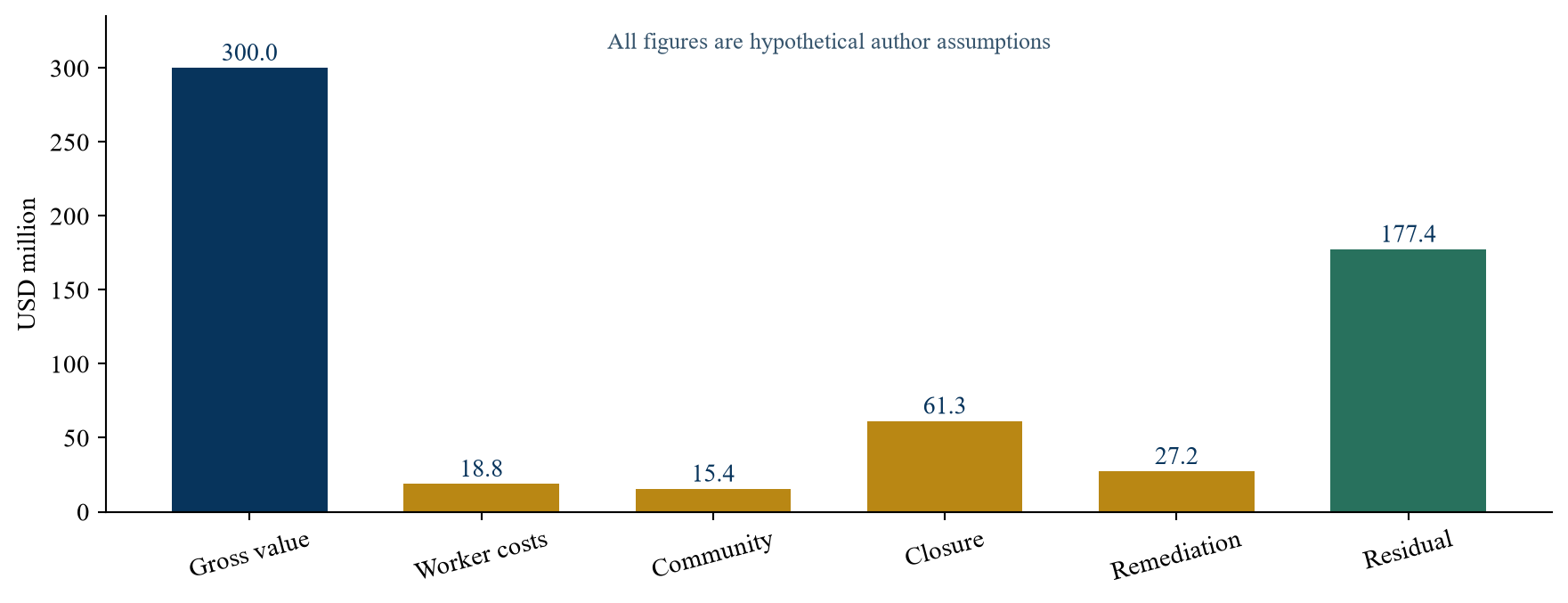
USD millions. This author scenario assumes that the starting USD 300 million value excludes every displayed obligation; it is not a market valuation.
11 Stress the assumptions that could change the bid
The case's first sensitivity is headcount and pathway. If 50 additional workers require separation rather than redeployment, the arithmetic is not simply 50 times the assumed separation payment. Training cost for those 50 would fall, while separation cost would rise; transition support might remain unchanged. The exact difference under this invented case is 50 multiplied by USD 60,000 minus 50 multiplied by USD 15,000, or USD 2.25 million. This does not measure the social consequence or establish a lawful course. It shows why each worker route should be modelled as an alternative, not added independently.
The second sensitivity is closure scope. A 20% increase in the assumed USD 90 million year-five decommissioning cost adds USD 18 million in year five and approximately USD 12.25 million in present value at 8%. A one-year delay in payment reduces its mathematical present value, while potentially increasing operating, security or contamination costs that this model omits. It would be misleading to celebrate a cheaper discounted liability without showing why the work was delayed and who funds the intervening obligations.
The third sensitivity is the annual community payment. A USD 0.5 million annual change over seven year ends shifts illustrative present cost by approximately USD 2.60 million. The legal and practical acceptability of that change cannot be determined by financial optimisation alone. A negotiated programme needs a clear scope, deliverables and engagement process. Its expense should be tested against the actual agreement and the community's priorities, not treated as a discretionary plug in the model.
The board should receive a concise range table with each scenario tied to evidence. Site investigation can narrow remediation scope; actuarial diligence can quantify pension exposure; consultation can test a redeployment proposal; an EPC tender can improve closure pricing. Where an uncertainty could reverse the investment decision, the buyer should secure information before signing, condition closing, retain a priced option or walk away. A sensitivity chart is valuable only if it changes a capital decision.
12 Prevent double counting across price, accounts and security
Power-plant transactions commonly bring together four different measurement systems: operating valuation, financial statements, legal allocation and cash security. They can represent the same obligation differently. A provision in the accounts is not necessarily the cash required to discharge the duty. An indemnity transfers a claim against the seller only to the extent the seller can pay and the agreement covers the event. An escrow restricts cash but can support performance. A lender reserve may be trapped in the project even when the purchase agreement allocates liability elsewhere.
The transaction bridge should start with the seller's forecast and mark every workforce, community and closure line already embedded in earnings or free cash flow. Next, reconcile debt-like and working-capital adjustments in the heads of terms. Then map each unpriced cash duty to the purchase agreement, security and financing plan. The model should show the gross liability and the matching asset or reimbursement separately. Netting before legal review can hide a mismatch in beneficiary, date or transfer conditions.
An example is a closure account funded by the seller. If the account transfers with the site, the buyer may have a lower future funding need. Its restricted balance may be unavailable for payroll or debt service, and the regulator might require further funding. If the seller retains the account while the buyer assumes the permit, the buyer may face a much larger liquidity gap. The purchase agreement should specify ownership, permitted withdrawals, release tests and remedies for shortfall.
Accounting advisers should test recognition and measurement under the relevant reporting standards. Tax advisers should test deductibility, transaction taxes and the treatment of any grant or security. This paper supplies no jurisdiction-specific accounting or tax answer. The investment committee should receive a reconciliation signed by the financial, legal and technical leads so that an apparently precise residual value is not the product of inconsistent definitions.
13 Structure workforce protections into the transaction
The sale documents can make a workforce plan executable. They can state who employs people at each milestone, which consultation process must be completed, who funds accrued and future entitlements, and how employee data are handled. They can require the seller to preserve safety-critical staff and records before closing. They can set covenants for no unapproved material change to workforce terms during the interim period. Each obligation needs a clear trigger, duration and remedy suited to the applicable law.
A seller indemnity may address pre-closing breaches, undisclosed claims or a defined pension risk. An escrow or guarantee can improve collectability, subject to negotiations and local enforceability. A buyer might assume a specified transition programme and receive a corresponding price adjustment. The agreement should avoid an ambiguous promise that one party will bear 'all just-transition costs'; this phrase can leave scope and duration in dispute. Schedules should specify included programmes and exclusions.
Some choices cannot be contracted away from the affected people. Statutory employment rights, consultation requirements and safety duties can remain binding regardless of an allocation between buyer and seller. Worker representatives may need information and time that conflict with a compressed auction. Counsel should identify mandatory sequence and potential challenge routes early, then reflect them in the transaction timetable. The board should see the date at which a workforce decision becomes difficult to reverse.
Governance after closing is equally important. The target may need a transition director with authority over training, HR, safety and the project budget. The buyer should specify how worker concerns reach the board, how outcomes are measured and when a plan can be changed. A purchase agreement can allocate money, while an operating organisation must deliver the actual transition.
14 Allocate site and closure risk with evidence, not slogans
Environmental warranties are useful only when their scope matches the site and the quality of disclosure. A seller may warrant that disclosed permits are complete or that it has received no specified enforcement notice. It may resist an open-ended promise that all contamination is known. The buyer can narrow uncertainty through site investigation, targeted representations, a condition precedent, seller-funded works, insurance where suitable, an escrow or a risk-sharing mechanism. None replaces technical investigation.
The closure specification should be an annex with an inventory, target standard, milestones, monitoring, independent verification, cost escalation process and security. If the future use is unresolved, the agreement can define a base industrial standard and a separate mechanism for higher-use redevelopment. The buyer should understand whether decommissioning can begin before a planning or grid decision. Early demolition could destroy a valuable connection or make a later permit harder; delayed demolition can keep security and monitoring costs alive.
Insurance deserves careful review. A policy may cover defined accidental pollution while excluding known contamination, gradual conditions or the planned cost of closure. Coverage limits, deductibles, claim periods, insured entities and trigger wording should be checked against the actual risk. A spreadsheet line labelled 'insured' is not evidence of recoverability. The board should see the net exposure after specific enforceable protections and a counterparty credit assessment.
The buyer must also test the contractor market and execution capacity. A fixed-price demolition quote can contain exclusions for buried structures, hazardous materials or unstable access. The technical team should compare bids on a like-for-like scope and evaluate contractor solvency, bonding, safety performance and waste-chain traceability. The transaction value depends on a deliverable closure plan, not merely a low quoted price.
15 Match financing to the years of obligation
Debt capacity is usually assessed from the cash generation and security package available to lenders. A plant nearing retirement can have falling operating cash flow while facing rising closure and transition cash requirements. A lender may require reserve accounts, distribution tests, sponsor support or a shorter amortisation schedule. The buyer should model these mechanisms explicitly. A low present-value cost can still create a near-term funding crisis if cash is restricted or a covenant blocks distributions.
The funding plan should identify committed sources for immediate worker payments, the annual community programme and the year-five closure works. If a repowering project is expected to finance part of the transition, the buyer should separate approved project capital from contingent future finance. A planned battery project is not a committed cash source until permitting, grid rights, construction contracts and funding are sufficiently advanced. Grants and concessional finance should be included only after eligibility and approval are verified.
The contractual order of payments matters. Secured debt, statutory claims, worker entitlements and decommissioning security can have different priority under local law. Counsel and lenders should map the actual waterfall. A special-purpose vehicle can ring-fence some project risks, yet it may still require parent guarantees or face regulatory responsibilities that survive a share transfer. The committee should see where the cash ultimately comes from if the project itself cannot pay.
Financing can improve the quality of a transition plan when covenants require reporting and funded milestones. It can also make a plan brittle if all reserves are calibrated to an optimistic base case. A prudent structure tests adverse workforce and remediation cases, inflation, delayed redevelopment revenue and a later-than-planned closure. The paper does not assign probabilities to these cases. It asks whether the capital structure survives them and who has decision rights when one occurs.
16 Assess repurposing as a conditional option
An existing power site can offer land, roads, trained staff, electrical infrastructure and a potential grid connection. These attributes are options, not automatic development rights. The grid agreement may restrict technology or capacity; the site may need environmental remediation; planning authorities may require a new consent; and a replacement project may employ fewer people. A buyer should value repurposing only after identifying which rights transfer, which approvals are needed and what construction capital must be spent.
The diligence case should compare at least three paths: continue operation within law and contract, retire and restore, or retire and repurpose. Each path should carry its own workforce, community, closure, grid, permit and capital schedules. A repurposing premium should not be added to a base value that already assumes the new use. Nor should a buyer deduct full demolition of equipment that a feasible project will retain without checking the cost and permissibility of retention.
Worker pathways can be designed around actual project phases. A few roles may transfer into development planning, more into construction, and fewer into permanent operation. The plan should identify the skills and timing for each phase and disclose the gap. It should avoid implying that a temporary construction job is equivalent to permanent employment. Where the new project is uncertain, a portable training credential and placement support may be more credible than a promise of a future site role.
Option value comes from preserving decisions. A buyer can secure land and grid diligence, commission environmental work and consult on alternatives before committing to irreversible demolition or technology procurement. These steps cost money and time, which belong in the model. The board should specify the evidence gate that releases the next tranche of capital and the loss limit if the option proves unattractive.
17 Treat pensions and contingent claims as specialist gates
Defined-benefit pensions, long-service benefits, deferred compensation, personal-injury claims and historical labour disputes can sit outside the simple worker transition budget. Their amount and allocation depend on legal documents, actuarial assumptions and transaction form. The buyer should not infer a zero exposure because a management presentation reports only active headcount. Nor should it adopt an actuarial surplus without reviewing funding restrictions, covenant strength and current valuation date.
The specialist work should identify every plan and sponsor, participant population, funding position, security, employer covenant and event triggered by a sale or closure. Counsel and actuaries should test whether liabilities remain with the target, accelerate, migrate to another entity or require regulator or trustee consent. If an obligation is genuinely unquantifiable before signing, the transaction can use a condition, separate price mechanism, escrow or decision to defer. The choice depends on law and bargaining position.
Contingent environmental and health claims need similar separation. An incident history is not a forecast of future claims. The diligence file should establish notices, litigation, insurance, medical or exposure records where lawfully accessible, and the condition of the site. Any settlement or reserve requires legal and expert support. The model may show an adverse case without presenting its amount as an expected loss.
These issues matter to the social integrity of a transition. A plan that funds new training while leaving earned benefits uncertain can lose worker trust. A deal team should therefore state what has been verified, what remains contingent and when affected people will receive reliable information. Financial diligence and consultation should share a controlled fact base, subject to confidentiality and privacy duties.
18 Use a gated roadmap from bid to closure
The first gate is the bid perimeter: confirm the transaction form, intended site use, likely closure date and minimum information needed for a credible offer. The second gate is the evidence baseline: reconcile workforce and contracts, commission site and environmental surveys, establish pension and safety workstreams, and identify affected communities. The third gate is alternatives: test continued operation, staged retirement, redeployment, retraining, separation and repurposing. Each alternative should have a cost, timetable and evidence source.
The fourth gate is consultation and legal applicability. Labour counsel should confirm mandatory notices and consultation; environmental counsel should confirm permits and security; the stakeholder team should document engagement and grievances. The fifth gate is a signed capital package: purchase-price bridge, funding sources, reserves, seller protections, lender conditions and decision rights. The sixth gate governs execution after close: worker outcomes, safe shutdown, community delivery, remediation and independent verification.
The duration of these gates cannot be specified globally. A statutory consultation period, election, planning process or seasonal site survey can dominate the calendar in a real market. A board should see actual milestone dates and the consequences of missing each one. Auction deadlines should not silently compress a legally required process. If the seller cannot provide a baseline, a conditional bid may be more honest than a firm price based on invented certainty.
Change control should connect all workstreams. A delayed retirement can change employment, fuel, power sales, community programme timing and closure cash flow. A faster shutdown can increase separation cash immediately and reduce time to retrain. The programme office should reissue a single integrated schedule and model at each gate. The investment committee's approval should apply to that version, with defined tolerances for changes.
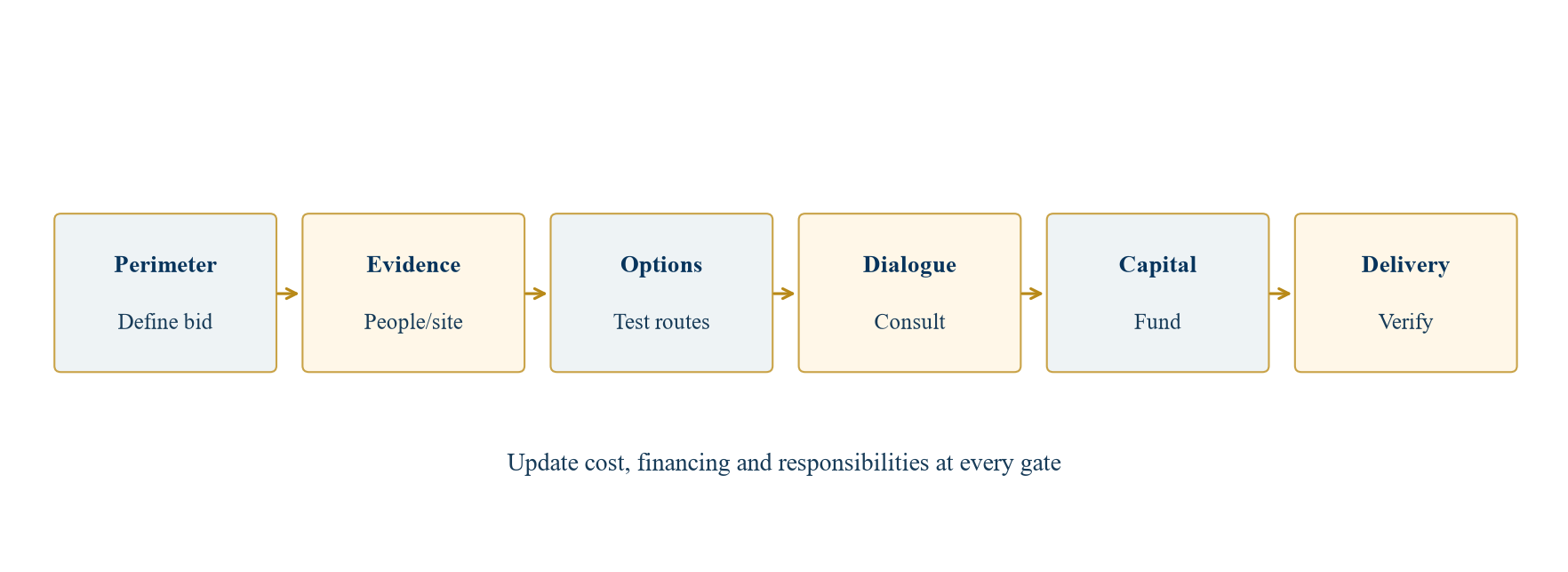
Author-developed implementation sequence. Real dates, consultation stages and statutory steps depend on the transaction and jurisdiction.
19 Require an investment-committee decision record
An investment-committee paper should describe the entity and asset perimeter, operating and closure plan, workforce census quality, consultation route, pension position, community commitments, environmental baseline and security. It should show the seller's forecast reconciled to the proposed liability bridge. It should include the three most decision-sensitive unknowns, the professional responsible for resolving each, the expected date and the capital that becomes irreversible before resolution. A risk label without this information is weak governance.
The committee should choose explicitly among four outcomes: proceed at the proposed price and protection package; proceed only after defined evidence or consent; redesign the plan and return; or decline. A requested survey, actuarial valuation or worker consultation is useful when the result can change one of those outcomes. The committee should set a maximum supported exposure and a cash-funding condition before it accepts a closing timetable. This gives negotiators authority without requiring them to improvise new risk appetite during an auction.
The table below is a generic decision template, not a finding about an actual power plant. Its final column should be populated with named professionals and dated evidence in a live transaction. A board should be able to trace a value adjustment from the obligation source to the cash schedule and the contract protection. It should also see where no workable protection exists. Disclosure, financial security and execution capacity must be tested together.
Table 3. Investment-committee evidence and decision record
| Decision item | Required evidence | Financial translation | Decision owner |
|---|---|---|---|
| Workforce and consultation | Reconciled census, contracts, counsel advice, worker dialogue | Entitlements, retention, training and timing | HR, labour counsel and committee |
| Community commitments | Agreements, payment history, engagement record | Funded bridge and annual programme | Stakeholder lead and finance |
| Pensions and benefits | Plan documents and actuarial report | Separate price and security mechanism | Actuary, counsel and finance |
| Closure and remediation | Site survey, permits, contractor scope and regulator position | Cash schedule, reserve, security and contingency | Technical adviser and environmental counsel |
| Financing and price | Model bridge, lender terms, seller protection and credit review | Residual value, leverage and liquidity | Finance, counsel and committee |
Author-developed template. Populate from the actual target, transaction and jurisdiction before use.
20 State the limits and make the capital decision executable
The sources reviewed here provide principles and selected standards. They do not establish the employment, environmental, community or pension position of the invented 600 MW site. The worker counts, unit payments, bridge programme, closure estimates, discount rate and gross value are hypothetical author assumptions. The numerical case excludes tax, debt, working capital, power revenues, fuel contracts, pension valuation, litigation and site-specific permit risk. No probability of consent, retrenchment outcome or contamination is estimated.
Current law and guidance should be checked again at the date of a real transaction. The financing applicability of IFC or World Bank standards depends on the actual documents. The ILO and OECD frameworks support responsible analysis and engagement; they do not create identical legal outcomes across jurisdictions. A thermal site's hazardous materials and closure standard require professional investigation. The labour and community programme needs affected-worker and stakeholder input, not a spreadsheet-only design.
The executable decision is therefore conditional. A buyer can bid responsibly when it knows the perimeter, has a credible plan for people and place, can fund the required cash, can allocate material historical risk to a creditworthy party where legally possible, and retains a stop or redesign option for unresolved conditions. If those conditions cannot be satisfied within the transaction timetable, the committee should change the structure or the price, postpone commitment, or decline. That conclusion follows from decision discipline rather than any claim that every transition can be reduced to money.
The next step for a specific asset is a joint labour, environmental, technical, community, legal and financing review. It should produce one obligation register, a worker-pathway plan, a site closure scope, a dated cash-flow bridge and an investment-committee decision record. Each should identify its evidence, assumptions and owner. The goal is a transaction whose capital structure can carry the responsibilities that arrive with the power plant.
References
- International Labour Organization. Guidelines for a Just Transition towards Environmentally Sustainable Economies and Societies for All, 2015, publication page 2016. Accessed 6 October 2026. https://www.ilo.org/publications/guidelines-just-transition-towards-environmentally-sustainable-economies
- International Finance Corporation. Performance Standard 2: Labor and Working Conditions, 2012. Accessed 6 October 2026. https://www.ifc.org/en/insights-reports/2012/ifc-performance-standard-2
- International Finance Corporation. Guidance Note 2: Labor and Working Conditions, consolidated guidance notes, 2012. Accessed 6 October 2026. https://www.ifc.org/content/dam/ifc/doc/2010/2012-ifc-performance-standards-guidance-note-en.pdf
- International Finance Corporation. Performance Standard 1: Assessment and Management of Environmental and Social Risks and Impacts, 2012. Accessed 6 October 2026. https://www.ifc.org/en/insights-reports/2012/ifc-performance-standard-1
- World Bank. Environmental and Social Standards, Environmental and Social Framework. Accessed 6 October 2026. https://documents.worldbank.org/en/projects-operations/environmental-and-social-framework/brief/environmental-and-social-standards
- OECD. Guidelines for Multinational Enterprises on Responsible Business Conduct, 2023. Accessed 6 October 2026. https://www.oecd.org/en/publications/oecd-guidelines-for-multinational-enterprises-on-responsible-business-conduct_81f92357-en.html
- OECD. Due Diligence for Responsible Business Conduct. Accessed 6 October 2026. https://www.oecd.org/en/topics/due-diligence-for-responsible-business-conduct.html
- International Labour Organization. ILO Helpdesk for Business and Just Transition. Accessed 6 October 2026. https://www.ilo.org/resource/other/ilo-helpdesk-business-and-just-transition
- International Finance Corporation. Environmental, Health, and Safety Guidelines for Thermal Power Plants, 2008. Accessed 6 October 2026. https://www.ifc.org/content/dam/ifc/doc/2000/2008-thermal-power-ehs-guidelines-en.pdf
- International Finance Corporation. Environmental, Health, and Safety Guidelines: General EHS Guidelines. Accessed 6 October 2026. https://www.ifc.org/en/insights-reports/2000/general-environmental-health-and-safety-guidelines
- International Energy Agency. Policies for People-Centred and Just Transitions: Accelerating Just Transitions for the Coal Sector, 2024. Accessed 6 October 2026. https://www.iea.org/reports/accelerating-just-transitions-for-the-coal-sector/policies-for-people-centred-and-just-transitions-ensuring-a-fair-energy-future-for-everyone
About the Author
Chennakeshav (CK) is a corporate finance and investment banking executive with 25+ years of global experience in deal origination, structuring and execution across M&A, growth capital and corporate strategy. He has led value-creation mandates for founders, corporates and funds — bridging the boardroom view to hands-on execution and close.
His career spans Morgan Stanley, HSBC, Lloyds Banking Group, EWEC, ADQ portfolio companies and Emirates Growth Fund, across TMT, real estate, fintech, deeptech, cleantech, infrastructure and energy. He has partnered with C-suite leaders, private equity and venture funds, sovereign wealth funds and family offices to finance complex fund raises and scale-up ventures, and has led M&A due diligence, post-merger integration and business-transformation initiatives to create value.
At Matchpoint Partners he is Managing Partner, leading the firm's corporate finance, M&A and capital-raising practice. He holds an MBA from London Business School, an engineering degree from VTU and a Master of Laws (LLM, in progress) from UCL London.
An active start-up mentor, CK mentors at Techstars, DIFC FinTech Hive, Startup Grind, Founder Institute and IN5, serves as Entrepreneur Mentor in Residence (EMiR) at London Business School, and judges the Entrepreneurship World Cup.
