

1. Define the post-acquisition liquidity decision
The board must determine how much cash the acquired retailer needs to trade normally, fund integration and withstand a weak season without damaging availability or supplier confidence. The analysis should distinguish observed balances and contractual facts from management assumptions, then connect every material judgment to units, timing and cash. Reconcile the transaction perimeter, opening balance sheet, purchase-price mechanism, financing sources and first twenty-four months of operating cash. The work should cover the central case and a severe-but-plausible downside, with sensitivities for demand, margin, supplier behaviour and integration timing. Approval should state the minimum liquidity reserve, permitted uses, draw triggers and management actions under central and downside cases. Exceptions need a named owner, source, due date and decision consequence. Unsupported improvements remain outside the base case until actions are implemented and cash or service evidence confirms the result. The section output should include a reconciled schedule, decision thresholds, responsible owner, review cadence, link to the weekly liquidity forecast and an explicit transaction or operating consequence. This creates a controlled bridge from diligence finding to cash action after closing.
2. Use the Stock-to-Cash Framework
Retail working capital should be analysed through eight gates: demand, inventory quantity, inventory value, purchasing, supplier terms, returns and liabilities, cash settlement, and governance. The analysis should distinguish observed balances and contractual facts from management assumptions, then connect every material judgment to units, timing and cash. Each gate should produce a reconciled evidence pack, a cash consequence, an accountable owner and a decision for signing, closing or post-close execution. The work should cover the central case and a severe-but-plausible downside, with sensitivities for demand, margin, supplier behaviour and integration timing. The investment committee should prevent movements between gates from disappearing; a purchasing change must update stock, payables, availability, margin and liquidity together. Exceptions need a named owner, source, due date and decision consequence. Unsupported improvements remain outside the base case until actions are implemented and cash or service evidence confirms the result. Evidence should be retained at transaction and contract level, with control totals to the ledger and a documented path for exceptions. The resulting decision should update valuation, purchase-price protection, financing and the post-close operating plan at the same time.
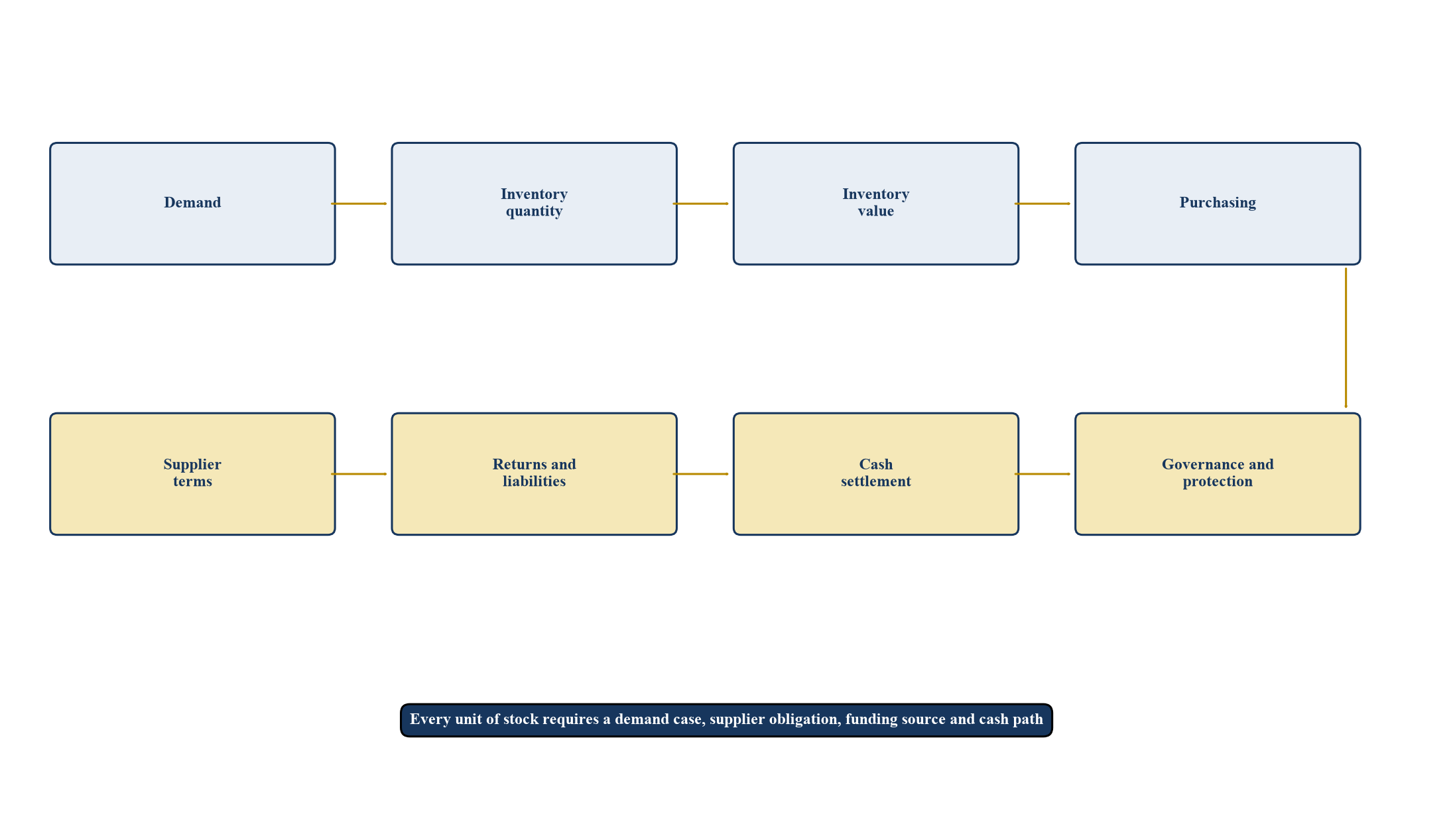
Eight evidence gates connect inventory and supplier decisions to cash and transaction protection.
3. Reconcile the opening working-capital perimeter
The opening balance must capture the assets and obligations required to operate the acquired business, including stock, goods in transit, deposits, payables, accruals, customer liabilities and intercompany items. The analysis should distinguish observed balances and contractual facts from management assumptions, then connect every material judgment to units, timing and cash. Map every account to legal ownership, location, contract, cut-off rule and the completion mechanism; identify balances that disappear at closing and replacement funding that must be created. The work should cover the central case and a severe-but-plausible downside, with sensitivities for demand, margin, supplier behaviour and integration timing. A signed balance-sheet schedule should connect diligence data, audited accounts, the sale agreement and the Day 1 ledger. Exceptions need a named owner, source, due date and decision consequence. Unsupported improvements remain outside the base case until actions are implemented and cash or service evidence confirms the result. Management should define the earliest warning indicator, intervention trigger and funded response before closing. Reporting should preserve the original acquisition assumption, subsequent approved changes and realised cash effect so that the board can distinguish progress from reclassification or timing movement.
4. Build the minimum stock-to-cash dataset
Decision-grade analysis needs SKU, store and warehouse data linked to purchase orders, receipts, transfers, sales, returns, markdowns, shrink, invoices, payments and supplier agreements. The analysis should distinguish observed balances and contractual facts from management assumptions, then connect every material judgment to units, timing and cash. Use stable identifiers, transaction dates, units, currencies, tax, product hierarchy, channel, location, ageing and cost components; reconcile aggregates to subledgers and the general ledger. The work should cover the central case and a severe-but-plausible downside, with sensitivities for demand, margin, supplier behaviour and integration timing. Preserve source files, transformation logic and exception logs so the model can be rerun for the closing period and the first peak season. Exceptions need a named owner, source, due date and decision consequence. Unsupported improvements remain outside the base case until actions are implemented and cash or service evidence confirms the result. The section output should include a reconciled schedule, decision thresholds, responsible owner, review cadence, link to the weekly liquidity forecast and an explicit transaction or operating consequence. This creates a controlled bridge from diligence finding to cash action after closing.
| Layer | Core evidence | Primary decision | Cash consequence |
|---|---|---|---|
| Demand | Units, price, channel, season and returns | Replenishment and assortment | Sales and recovery timing |
| Inventory | SKU, node, age, cost and title | Retain, transfer, mark down or exit | Funding and loss |
| Purchasing | Orders, receipts, lead times and currency | Cancel, defer, accelerate or renegotiate | Commitment and availability |
| Suppliers | Terms, rebates, limits and security | Confirm, replace or protect | Payables and deposits |
| Customer liabilities | Gift cards, loyalty and refunds | Transfer and settle | Future product and cash use |
| Settlement | Processor, marketplace and bank data | Control accounts and cut-off | Cash timing and reserves |
Every layer should reconcile to the legal perimeter and general ledger.
5. Test inventory existence and ownership
Recorded inventory can include missing stock, consignment, supplier-owned goods, customer returns, goods in transit or items held outside the transaction perimeter. The analysis should distinguish observed balances and contractual facts from management assumptions, then connect every material judgment to units, timing and cash. Perform risk-based counts, location reconciliations, title testing, cut-off analysis and third-party confirmations; investigate negative quantities, stale movements and unrecorded transfers. The work should cover the central case and a severe-but-plausible downside, with sensitivities for demand, margin, supplier behaviour and integration timing. Quantity differences should flow into valuation, completion accounts, supplier claims, insurance and the Day 1 control plan rather than remain as an unexplained reserve. Exceptions need a named owner, source, due date and decision consequence. Unsupported improvements remain outside the base case until actions are implemented and cash or service evidence confirms the result. Evidence should be retained at transaction and contract level, with control totals to the ledger and a documented path for exceptions. The resulting decision should update valuation, purchase-price protection, financing and the post-close operating plan at the same time.
6. Apply consistent inventory valuation
IAS 2 measures inventory at the lower of cost and net realisable value and includes costs required to bring inventory to its present location and condition [1]. The analysis should distinguish observed balances and contractual facts from management assumptions, then connect every material judgment to units, timing and cash. Reconcile costing methods, freight, duty, rebates, overhead, foreign exchange, markdown assumptions and selling costs; test policy consistency across entities and periods. The work should cover the central case and a severe-but-plausible downside, with sensitivities for demand, margin, supplier behaviour and integration timing. The buyer should distinguish accounting compliance from the cash recovery expected under its own pricing, channel and clearance strategy. Exceptions need a named owner, source, due date and decision consequence. Unsupported improvements remain outside the base case until actions are implemented and cash or service evidence confirms the result. Management should define the earliest warning indicator, intervention trigger and funded response before closing. Reporting should preserve the original acquisition assumption, subsequent approved changes and realised cash effect so that the board can distinguish progress from reclassification or timing movement.
7. Reconstruct ageing and sell-through
Age buckets alone do not prove recoverability because product season, launch date, replenishment, fashion cycle and channel availability shape demand. The analysis should distinguish observed balances and contractual facts from management assumptions, then connect every material judgment to units, timing and cash. Calculate weeks of supply, sell-through, stock cover, recent sales, markdown depth, gross-margin recovery and return rates by SKU cohort, location and channel. The work should cover the central case and a severe-but-plausible downside, with sensitivities for demand, margin, supplier behaviour and integration timing. Management should identify core, seasonal, slow, obsolete, damaged and strategic stock, with an action and cash outcome for each cohort. Exceptions need a named owner, source, due date and decision consequence. Unsupported improvements remain outside the base case until actions are implemented and cash or service evidence confirms the result. The section output should include a reconciled schedule, decision thresholds, responsible owner, review cadence, link to the weekly liquidity forecast and an explicit transaction or operating consequence. This creates a controlled bridge from diligence finding to cash action after closing.
8. Model seasonal inventory requirements
A retailer can be cash-positive annually while reaching a severe funding low before a peak trading period. The analysis should distinguish observed balances and contractual facts from management assumptions, then connect every material judgment to units, timing and cash. Build weekly purchases, receipts, sales, returns, payables and cash through at least one full seasonal cycle; include lead times, import timing, holiday calendars and promotional commitments. The work should cover the central case and a severe-but-plausible downside, with sensitivities for demand, margin, supplier behaviour and integration timing. The liquidity reserve should cover the lowest projected point plus operational disruption, with committed funding available before suppliers require payment. Exceptions need a named owner, source, due date and decision consequence. Unsupported improvements remain outside the base case until actions are implemented and cash or service evidence confirms the result. Evidence should be retained at transaction and contract level, with control totals to the ledger and a documented path for exceptions. The resulting decision should update valuation, purchase-price protection, financing and the post-close operating plan at the same time.
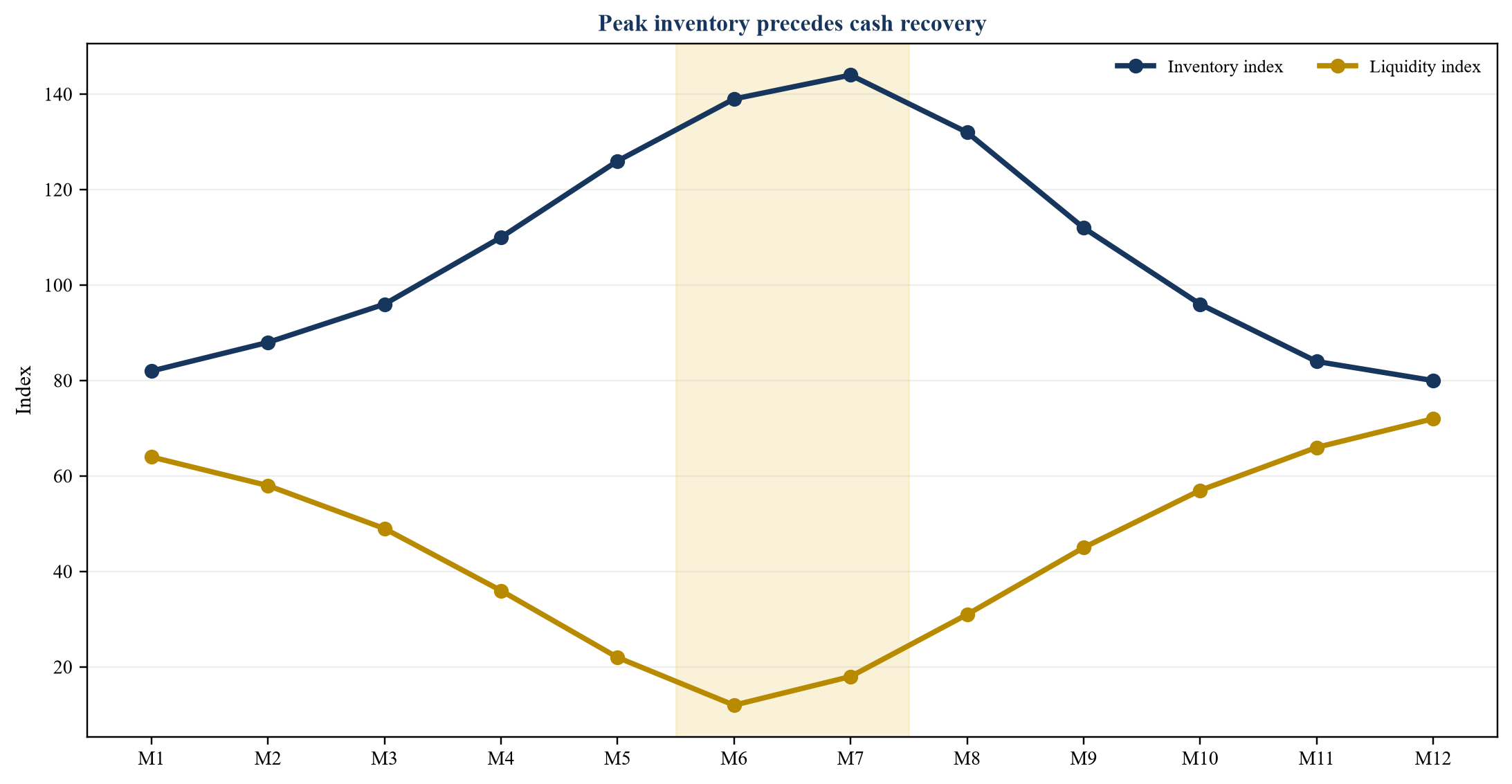
Illustrative monthly management scenario; values are indexed, not observed company data.
9. Rationalise SKUs without destroying demand
Acquisitions often create duplicated ranges, fragmented buying and long-tail inventory, yet aggressive rationalisation can reduce availability or remove products that anchor customer baskets. The analysis should distinguish observed balances and contractual facts from management assumptions, then connect every material judgment to units, timing and cash. Measure sales, margin, cash contribution, substitution, attachment, supplier terms, minimum order quantities and strategic role by SKU; test migration to retained products. The work should cover the central case and a severe-but-plausible downside, with sensitivities for demand, margin, supplier behaviour and integration timing. Exit plans should specify markdown, transfer, return-to-vendor, liquidation or disposal routes and protect customer service during the transition. Exceptions need a named owner, source, due date and decision consequence. Unsupported improvements remain outside the base case until actions are implemented and cash or service evidence confirms the result. Management should define the earliest warning indicator, intervention trigger and funded response before closing. Reporting should preserve the original acquisition assumption, subsequent approved changes and realised cash effect so that the board can distinguish progress from reclassification or timing movement.
10. Separate price, volume and mix
Revenue growth can conceal weaker unit demand, and gross-margin improvement can reflect price, mix, rebates or deferred markdowns rather than faster cash conversion. The analysis should distinguish observed balances and contractual facts from management assumptions, then connect every material judgment to units, timing and cash. Bridge units, ticket, product mix, full-price sales, promotion, markdown, returns and channel costs by period and cohort; link every change to inventory movement. The work should cover the central case and a severe-but-plausible downside, with sensitivities for demand, margin, supplier behaviour and integration timing. The acquisition model should base replenishment and supplier commitments on unit economics and demand evidence, not a blended sales percentage. Exceptions need a named owner, source, due date and decision consequence. Unsupported improvements remain outside the base case until actions are implemented and cash or service evidence confirms the result. The section output should include a reconciled schedule, decision thresholds, responsible owner, review cadence, link to the weekly liquidity forecast and an explicit transaction or operating consequence. This creates a controlled bridge from diligence finding to cash action after closing.
11. Test markdown and clearance economics
Inventory can be recoverable only through discounts that reduce gross margin, create channel conflict and consume fulfilment capacity. The analysis should distinguish observed balances and contractual facts from management assumptions, then connect every material judgment to units, timing and cash. Model price elasticity, units, timing, selling cost, marketplace fees, returns, storage and disposal for each clearance route; compare early action with delayed recovery. The work should cover the central case and a severe-but-plausible downside, with sensitivities for demand, margin, supplier behaviour and integration timing. A markdown authority matrix should set thresholds, approval rights, customer messaging and cash targets while protecting the retained brand and normal-price demand. Exceptions need a named owner, source, due date and decision consequence. Unsupported improvements remain outside the base case until actions are implemented and cash or service evidence confirms the result. Evidence should be retained at transaction and contract level, with control totals to the ledger and a documented path for exceptions. The resulting decision should update valuation, purchase-price protection, financing and the post-close operating plan at the same time.
12. Quantify shrink, damage and obsolescence
Shrink estimates based on historical experience can become unreliable when systems, stores, teams or inventory movements change after an acquisition. The analysis should distinguish observed balances and contractual facts from management assumptions, then connect every material judgment to units, timing and cash. Reconcile physical counts, adjustments, loss incidents, damage, expiry, theft and write-offs by location and category; separate known losses from modelled exposure. The work should cover the central case and a severe-but-plausible downside, with sensitivities for demand, margin, supplier behaviour and integration timing. The buyer should fund realistic loss, strengthen controls and avoid counting a lower future shrink rate before actions and evidence support it. Exceptions need a named owner, source, due date and decision consequence. Unsupported improvements remain outside the base case until actions are implemented and cash or service evidence confirms the result. Management should define the earliest warning indicator, intervention trigger and funded response before closing. Reporting should preserve the original acquisition assumption, subsequent approved changes and realised cash effect so that the board can distinguish progress from reclassification or timing movement.
13. Rebuild supplier terms contract by contract
Headline days payable can reflect seller scale, guarantees, overdue balances, extended terms or temporary concessions that may not survive closing. The analysis should distinguish observed balances and contractual facts from management assumptions, then connect every material judgment to units, timing and cash. Create a supplier register covering price, currency, incoterms, payment days, rebates, minimum orders, exclusivity, credit limits, security, consent and termination rights. The work should cover the central case and a severe-but-plausible downside, with sensitivities for demand, margin, supplier behaviour and integration timing. The central case should use terms confirmed for the acquired business; unconfirmed continuity belongs in downside liquidity and transaction protection. Exceptions need a named owner, source, due date and decision consequence. Unsupported improvements remain outside the base case until actions are implemented and cash or service evidence confirms the result. The section output should include a reconciled schedule, decision thresholds, responsible owner, review cadence, link to the weekly liquidity forecast and an explicit transaction or operating consequence. This creates a controlled bridge from diligence finding to cash action after closing.
| Supplier class | Evidence | Central response | Downside response |
|---|---|---|---|
| Critical and concentrated | Consent, capacity, stock cover | Executive confirmation and forecast | Safety stock and alternative source |
| Private label | Tooling, IP, quality and lead time | Secure production and rights | Fund replacement and transition |
| Commodity or substitutable | Price, terms and alternatives | Competitive procurement | Controlled switch |
| Distressed or constrained | Financial health and arrears | Payment and delivery plan | Reserve, dual source or exit |
| Rebate-dependent | Agreements and thresholds | Rebase supportable economics | Remove unsupported benefit |
Supplier segmentation should connect operational criticality and funding exposure.
14. Protect critical supplier continuity
A small number of suppliers may control essential products, private-label manufacturing, licences, packaging or lead-time capacity. The analysis should distinguish observed balances and contractual facts from management assumptions, then connect every material judgment to units, timing and cash. Segment suppliers by customer impact, substitutability, spend, stock cover, financial health and consent risk; identify operational and contractual alternatives. The work should cover the central case and a severe-but-plausible downside, with sensitivities for demand, margin, supplier behaviour and integration timing. Day 1 plans should include executive outreach, approved purchase orders, payment assurance, forecast sharing and rapid escalation for constrained or disputed supply. Exceptions need a named owner, source, due date and decision consequence. Unsupported improvements remain outside the base case until actions are implemented and cash or service evidence confirms the result. Evidence should be retained at transaction and contract level, with control totals to the ledger and a documented path for exceptions. The resulting decision should update valuation, purchase-price protection, financing and the post-close operating plan at the same time.
15. Analyse vendor funding and rebates
Volume rebates, promotional allowances, markdown support and co-operative advertising can change inventory cost, margin and receivables. The analysis should distinguish observed balances and contractual facts from management assumptions, then connect every material judgment to units, timing and cash. Inspect executed agreements, performance conditions, accrual calculations, purchase volumes, claims, cash receipts and reversals; reconcile treatment to inventory and cost of sales. The work should cover the central case and a severe-but-plausible downside, with sensitivities for demand, margin, supplier behaviour and integration timing. Only supportable benefits should reduce the working-capital requirement; acquisition-driven volume loss or changed programmes should be modelled explicitly. Exceptions need a named owner, source, due date and decision consequence. Unsupported improvements remain outside the base case until actions are implemented and cash or service evidence confirms the result. Management should define the earliest warning indicator, intervention trigger and funded response before closing. Reporting should preserve the original acquisition assumption, subsequent approved changes and realised cash effect so that the board can distinguish progress from reclassification or timing movement.
16. Control open purchase orders
Outstanding orders can commit the buyer to cash and stock that is absent from the closing balance sheet. The analysis should distinguish observed balances and contractual facts from management assumptions, then connect every material judgment to units, timing and cash. Reconcile purchase orders to approvals, supplier acknowledgements, goods in transit, letters of credit, cancellations, forecast demand and the transaction cut-off. The work should cover the central case and a severe-but-plausible downside, with sensitivities for demand, margin, supplier behaviour and integration timing. The sale agreement and interim covenants should restrict abnormal ordering, define ownership and allocate cancellation, freight and foreign-exchange exposure. Exceptions need a named owner, source, due date and decision consequence. Unsupported improvements remain outside the base case until actions are implemented and cash or service evidence confirms the result. The section output should include a reconciled schedule, decision thresholds, responsible owner, review cadence, link to the weekly liquidity forecast and an explicit transaction or operating consequence. This creates a controlled bridge from diligence finding to cash action after closing.
17. Map returns and reverse logistics
Returns delay cash recovery and can create inventory whose condition, location and resale value are uncertain. The analysis should distinguish observed balances and contractual facts from management assumptions, then connect every material judgment to units, timing and cash. Trace the original sale, customer refund, payment settlement, physical receipt, inspection, refurbishment, markdown, supplier recovery and final disposition. The work should cover the central case and a severe-but-plausible downside, with sensitivities for demand, margin, supplier behaviour and integration timing. A returns control account should reconcile units, value and cash across channels and legal entities, with ageing and exception ownership from Day 1. Exceptions need a named owner, source, due date and decision consequence. Unsupported improvements remain outside the base case until actions are implemented and cash or service evidence confirms the result. Evidence should be retained at transaction and contract level, with control totals to the ledger and a documented path for exceptions. The resulting decision should update valuation, purchase-price protection, financing and the post-close operating plan at the same time.
18. Quantify customer liabilities
Gift cards, loyalty points, vouchers, deposits, warranties and subscriptions can produce cash before revenue while creating future product and service obligations. The analysis should distinguish observed balances and contractual facts from management assumptions, then connect every material judgment to units, timing and cash. Reconcile issued, redeemed, expired and outstanding balances to customer records and accounting liabilities; test transfer rights, breakage policies and post-close settlement. The work should cover the central case and a severe-but-plausible downside, with sensitivities for demand, margin, supplier behaviour and integration timing. The buyer should include expected redemption, fulfilment cost and liquidity timing in price and funding rather than treating customer cash as unrestricted value. Exceptions need a named owner, source, due date and decision consequence. Unsupported improvements remain outside the base case until actions are implemented and cash or service evidence confirms the result. Management should define the earliest warning indicator, intervention trigger and funded response before closing. Reporting should preserve the original acquisition assumption, subsequent approved changes and realised cash effect so that the board can distinguish progress from reclassification or timing movement.
19. Reconcile payment settlement and chargebacks
Card processors, marketplaces and alternative-payment providers can hold reserves, delay settlement or recover refunds and chargebacks after closing. The analysis should distinguish observed balances and contractual facts from management assumptions, then connect every material judgment to units, timing and cash. Bridge authorisation, capture, fees, reserve, settlement, refund and chargeback by processor and transaction date; identify merchant-account changes required at completion. The work should cover the central case and a severe-but-plausible downside, with sensitivities for demand, margin, supplier behaviour and integration timing. The weekly cash model should include settlement lags, new reserves and inherited claims, supported by contractual allocation and operating controls. Exceptions need a named owner, source, due date and decision consequence. Unsupported improvements remain outside the base case until actions are implemented and cash or service evidence confirms the result. The section output should include a reconciled schedule, decision thresholds, responsible owner, review cadence, link to the weekly liquidity forecast and an explicit transaction or operating consequence. This creates a controlled bridge from diligence finding to cash action after closing.
20. Build the cash-conversion cycle correctly
Days inventory, payable and receivable are useful summaries, but blended ratios can hide seasonality, overdue suppliers, channel mix and stock-quality problems. The analysis should distinguish observed balances and contractual facts from management assumptions, then connect every material judgment to units, timing and cash. Calculate operational drivers in units and cash by month, category, channel and supplier; show the bridge from order placement through sale and final settlement. The work should cover the central case and a severe-but-plausible downside, with sensitivities for demand, margin, supplier behaviour and integration timing. Management should set driver-level targets and avoid claiming improvement merely by delaying critical suppliers or reducing availability. Exceptions need a named owner, source, due date and decision consequence. Unsupported improvements remain outside the base case until actions are implemented and cash or service evidence confirms the result. Evidence should be retained at transaction and contract level, with control totals to the ledger and a documented path for exceptions. The resulting decision should update valuation, purchase-price protection, financing and the post-close operating plan at the same time.
21. Design the completion mechanism
The purchase-price adjustment should transfer a normal level of working capital while protecting both parties from abnormal pre-close actions. The analysis should distinguish observed balances and contractual facts from management assumptions, then connect every material judgment to units, timing and cash. Define included accounts, accounting policies, consistency, target calculation, seasonality, ageing, specific reserves, permitted leakage, sample calculations and dispute procedures. The work should cover the central case and a severe-but-plausible downside, with sensitivities for demand, margin, supplier behaviour and integration timing. The mechanism should align with the actual perimeter and prevent double counting between net debt, working capital, inventory valuation and specific indemnities. Exceptions need a named owner, source, due date and decision consequence. Unsupported improvements remain outside the base case until actions are implemented and cash or service evidence confirms the result. Management should define the earliest warning indicator, intervention trigger and funded response before closing. Reporting should preserve the original acquisition assumption, subsequent approved changes and realised cash effect so that the board can distinguish progress from reclassification or timing movement.
| Area | Definition requirement | Evidence | Protection |
|---|---|---|---|
| Inventory | Quantity, cost, reserves and exclusions | Count and SKU ledger | Specific adjustment |
| Trade payables | Normal, overdue and disputed balances | Supplier statements | Target and indemnity |
| Purchase orders | Ownership and cut-off | Approved order register | Covenant and schedule |
| Customer liabilities | Transfer and redemption | Customer subledger | Price and settlement |
| Supplier finance | Operating or debt-like treatment | Contract and payment history | Net-debt classification |
Definitions should align working capital, net debt and specific protections.
22. Separate working capital from net debt
Supplier finance, overdue balances, factoring, inventory facilities, letters of credit and processor reserves can behave like financing despite appearing in operating accounts. The analysis should distinguish observed balances and contractual facts from management assumptions, then connect every material judgment to units, timing and cash. Review legal terms, recourse, maturity, pricing, security, normal practice and transaction treatment; reconcile every reclassification to the valuation bridge. The work should cover the central case and a severe-but-plausible downside, with sensitivities for demand, margin, supplier behaviour and integration timing. The board should see economic debt, operating working capital and contingent liquidity separately, with consistent definitions in the sale and finance documents. Exceptions need a named owner, source, due date and decision consequence. Unsupported improvements remain outside the base case until actions are implemented and cash or service evidence confirms the result. The section output should include a reconciled schedule, decision thresholds, responsible owner, review cadence, link to the weekly liquidity forecast and an explicit transaction or operating consequence. This creates a controlled bridge from diligence finding to cash action after closing.
23. Fund integration and duplicated stock
System migration, network changes, assortment harmonisation and supplier renegotiation can require temporary safety stock and duplicated inventory. The analysis should distinguish observed balances and contractual facts from management assumptions, then connect every material judgment to units, timing and cash. Build project-level timing for purchases, storage, transfers, markdowns and release of old stock; distinguish recurring inventory from one-off transition investment. The work should cover the central case and a severe-but-plausible downside, with sensitivities for demand, margin, supplier behaviour and integration timing. Committed financing and approval gates should prevent teams from using supplier arrears or service deterioration to fund integration. Exceptions need a named owner, source, due date and decision consequence. Unsupported improvements remain outside the base case until actions are implemented and cash or service evidence confirms the result. Evidence should be retained at transaction and contract level, with control totals to the ledger and a documented path for exceptions. The resulting decision should update valuation, purchase-price protection, financing and the post-close operating plan at the same time.
24. Stress demand, margin and supply together
A realistic downside combines lower unit demand, deeper markdowns, longer lead times, supplier-term contraction, higher returns and slower integration. The analysis should distinguish observed balances and contractual facts from management assumptions, then connect every material judgment to units, timing and cash. Run weekly scenarios with correlated drivers and identify the cash low, covenant pressure, stock-outs, excess stock and management response under each case. The work should cover the central case and a severe-but-plausible downside, with sensitivities for demand, margin, supplier behaviour and integration timing. Actions should have lead times, owners and limits; assumptions that cannot be implemented before the liquidity breach should not count as mitigation. Exceptions need a named owner, source, due date and decision consequence. Unsupported improvements remain outside the base case until actions are implemented and cash or service evidence confirms the result. Management should define the earliest warning indicator, intervention trigger and funded response before closing. Reporting should preserve the original acquisition assumption, subsequent approved changes and realised cash effect so that the board can distinguish progress from reclassification or timing movement.
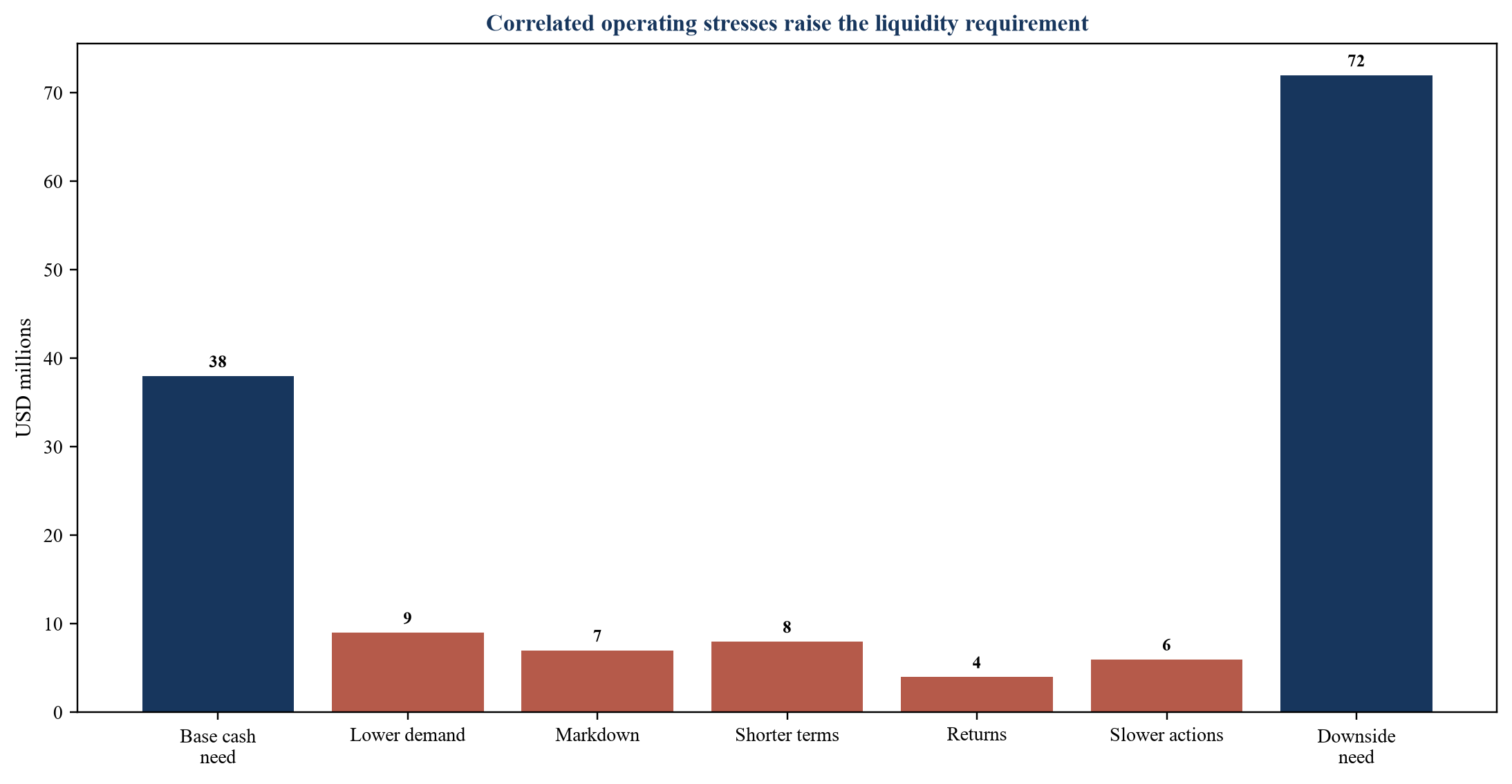
USD millions; every value is an illustrative management assumption.
25. Convert diligence into transaction protection
Working-capital findings should affect price, structure, conditions, covenants, representations, indemnities, escrow and information rights. The analysis should distinguish observed balances and contractual facts from management assumptions, then connect every material judgment to units, timing and cash. Translate each material issue into an economic response supported by evidence, including stock counts, supplier consents, abnormal purchases, aged inventory and customer liabilities. The work should cover the central case and a severe-but-plausible downside, with sensitivities for demand, margin, supplier behaviour and integration timing. The legal schedules, completion model, financing base and Day 1 plan should describe the same assets, obligations and cut-off rules. Exceptions need a named owner, source, due date and decision consequence. Unsupported improvements remain outside the base case until actions are implemented and cash or service evidence confirms the result. The section output should include a reconciled schedule, decision thresholds, responsible owner, review cadence, link to the weekly liquidity forecast and an explicit transaction or operating consequence. This creates a controlled bridge from diligence finding to cash action after closing.
26. Model a hypothetical acquisition
The hypothetical target reports USD 210 million of inventory and USD 145 million of trade payables, implying a simple net inventory investment of USD 65 million. The analysis should distinguish observed balances and contractual facts from management assumptions, then connect every material judgment to units, timing and cash. The central reconstruction adds aged-stock reserve, supplier-term reset, returns and peak-season funding, partly offset by SKU actions and vendor recoveries; additional liquidity is USD 38 million. The work should cover the central case and a severe-but-plausible downside, with sensitivities for demand, margin, supplier behaviour and integration timing. The downside assumes weaker demand, deeper markdowns, shorter terms and slower integration; additional liquidity rises to USD 72 million. All figures are illustrative management assumptions. Exceptions need a named owner, source, due date and decision consequence. Unsupported improvements remain outside the base case until actions are implemented and cash or service evidence confirms the result. Evidence should be retained at transaction and contract level, with control totals to the ledger and a documented path for exceptions. The resulting decision should update valuation, purchase-price protection, financing and the post-close operating plan at the same time.
| Measure | Central case | Downside case | Decision meaning |
|---|---|---|---|
| Reported inventory | 210 | 210 | Starting balance only |
| Trade payables | 145 | 145 | Terms require confirmation |
| Aged and markdown exposure | 18 | 31 | Recovery and margin risk |
| Supplier-term reset | 11 | 22 | Post-close payment acceleration |
| Peak and integration requirement | 24 | 37 | Seasonal and execution funding |
| Cash release from actions | 15 | 18 | SKU, recovery and purchasing actions |
| Additional liquidity required | 38 | 72 | Funding above reported balances |
USD millions; all values are illustrative management assumptions.
27. Size acquisition financing to the cash low
Debt capacity should use downside cash after inventory, suppliers, returns, taxes, capex, integration and customer liabilities. The analysis should distinguish observed balances and contractual facts from management assumptions, then connect every material judgment to units, timing and cash. Provide lenders with a weekly liquidity model, borrowing-base rules where relevant, supplier concentration, seasonal peaks and covenant sensitivities. The work should cover the central case and a severe-but-plausible downside, with sensitivities for demand, margin, supplier behaviour and integration timing. A revolving facility, committed equity and funded reserve should be available before the projected low point, with reporting tied to the same stock-to-cash controls. Exceptions need a named owner, source, due date and decision consequence. Unsupported improvements remain outside the base case until actions are implemented and cash or service evidence confirms the result. Management should define the earliest warning indicator, intervention trigger and funded response before closing. Reporting should preserve the original acquisition assumption, subsequent approved changes and realised cash effect so that the board can distinguish progress from reclassification or timing movement.
28. Establish Day 1 controls
The buyer should secure purchasing, goods receipt, inventory, pricing, returns, supplier payment, bank, processor and reporting authority at closing. The analysis should distinguish observed balances and contractual facts from management assumptions, then connect every material judgment to units, timing and cash. Daily controls should monitor sales, stock-outs, receipts, aged stock, payables, disputed invoices, cash, settlement and exceptions; critical access and delegated authorities should be tested. The work should cover the central case and a severe-but-plausible downside, with sensitivities for demand, margin, supplier behaviour and integration timing. A control room should escalate customer or supplier harm immediately and preserve evidence for completion accounts and post-close claims. Exceptions need a named owner, source, due date and decision consequence. Unsupported improvements remain outside the base case until actions are implemented and cash or service evidence confirms the result. The section output should include a reconciled schedule, decision thresholds, responsible owner, review cadence, link to the weekly liquidity forecast and an explicit transaction or operating consequence. This creates a controlled bridge from diligence finding to cash action after closing.
29. Govern the first twenty-four months
Working-capital improvement requires an integrated plan across merchandising, supply chain, stores, digital, finance, procurement and technology. The analysis should distinguish observed balances and contractual facts from management assumptions, then connect every material judgment to units, timing and cash. Track inventory units and value, availability, sell-through, markdown, returns, supplier terms, overdue balances, cash conversion, liquidity and project milestones against the approved baseline. The work should cover the central case and a severe-but-plausible downside, with sensitivities for demand, margin, supplier behaviour and integration timing. Benefits should be recognised only after cash is realised and service remains stable; changes to assortment or network should update demand and funding together. Exceptions need a named owner, source, due date and decision consequence. Unsupported improvements remain outside the base case until actions are implemented and cash or service evidence confirms the result. Evidence should be retained at transaction and contract level, with control totals to the ledger and a documented path for exceptions. The resulting decision should update valuation, purchase-price protection, financing and the post-close operating plan at the same time.
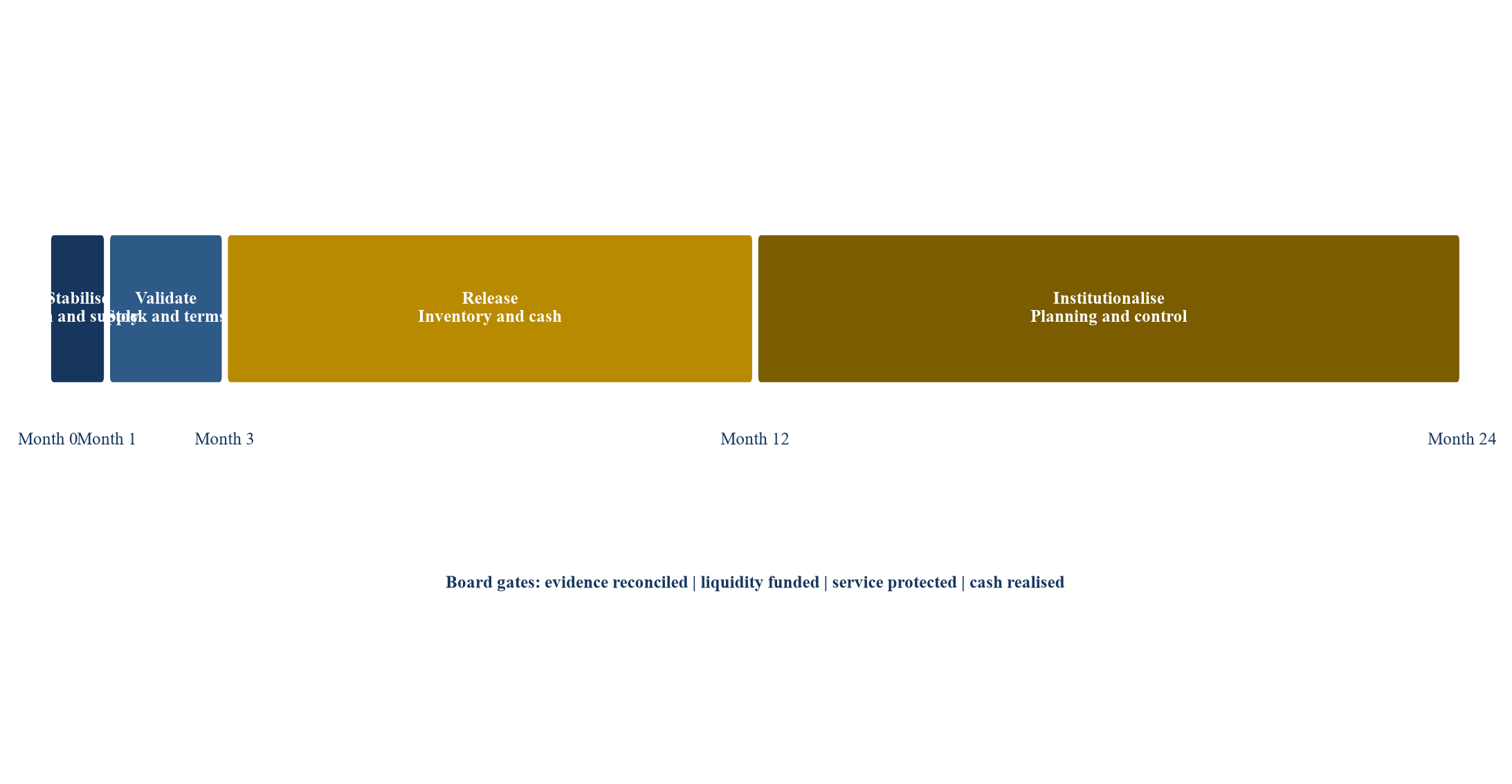
The roadmap links immediate control, cash release and durable operating discipline.
30. Conclude with cash-backed retail value
Retail value after an acquisition depends on having the right stock, under durable supplier terms, with sufficient liquidity to convert demand into cash. The analysis should distinguish observed balances and contractual facts from management assumptions, then connect every material judgment to units, timing and cash. The framework gives boards a sequence: freeze the perimeter, verify stock, test value and ageing, rebuild supplier economics, model seasonality, fund integration and govern cash conversion. The work should cover the central case and a severe-but-plausible downside, with sensitivities for demand, margin, supplier behaviour and integration timing. The result is an acquisition case grounded in operating evidence, explicit downside and executable controls rather than a single working-capital percentage. Exceptions need a named owner, source, due date and decision consequence. Unsupported improvements remain outside the base case until actions are implemented and cash or service evidence confirms the result. Management should define the earliest warning indicator, intervention trigger and funded response before closing. Reporting should preserve the original acquisition assumption, subsequent approved changes and realised cash effect so that the board can distinguish progress from reclassification or timing movement.
Sources
- IFRS Foundation. IAS 2 Inventories. Read the primary source
- US Securities and Exchange Commission. Financial Reporting Manual, Topic 2. Read the primary source
- US Securities and Exchange Commission. Financial Reporting Manual, Topic 3; Regulation S-X Article 11. Read the primary source
- IFRS Foundation. IFRS 3 Business Combinations. Read the primary source
- IFRS Foundation. IFRS 7 Financial Instruments: Disclosures. Read the primary source
- IFRS Foundation. IFRS 9 Financial Instruments. Read the primary source
- IFRS Foundation. IFRS 15 Revenue from Contracts with Customers. Read the primary source
- Target Corporation. 2025 Annual Report. Read the primary source
- Walmart Inc. 2025 Annual Report. Read the primary source
- The TJX Companies, Inc. Annual Report on Form 10-K for the year ended 31 January 2026. Read the primary source
- Dollar General Corporation. Annual Report on Form 10-K for the year ended 30 January 2026. Read the primary source
- National Retail Federation. Retail Returns Landscape. Read the primary source
- US Census Bureau. Monthly Retail Trade. Read the primary source
- Office for National Statistics. Retail sales datasets. Read the primary source
- Eurostat. Retail trade volume indicators. Read the primary source
- US Federal Reserve. Financial Accounts Guide; trade credit. Read the primary source
- Bank for International Settlements. Trade credit and supply-chain finance publications. Read the primary source
- International Chamber of Commerce. Uniform Customs and Practice for Documentary Credits, UCP 600. Read the primary source
- Financial Accounting Standards Board. Accounting Standards Codification Topic 330, Inventory. Read the primary source
- National Institute of Standards and Technology. Cybersecurity Framework 2.0. Read the primary source
