

1. Define the partnership thesis
The decision question is which strategic and financial outcomes require a joint venture rather than a loan, offtake or minority investment. The diligence team should begin with board mandates, project stage, mineral, geography, downstream objective and capital plan. Evidence should be attributable, versioned and reconciled across technical, legal, commercial and financial workstreams. [1][2]
The principal failure mode is that a broad security-of-supply narrative can conceal incompatible return, control and industrial objectives. Management forecasts can support planning when they are identified as forecasts and kept separate from observed results, competent-person statements, contracts and regulatory approvals. The model should show how each unresolved item changes recoverable product, schedule, price, operating cost, capital expenditure, funding or control.
The recommended response is to state the value proposition, evidence gate, capital commitment and decision owner for every workstream. A named executive should own delivery, an independent reviewer should challenge material assumptions, and the board should see the evidence required to release the next tranche of capital. Central, downside and stop cases should identify both the financial effect and the earliest practical intervention. In the hypothetical partnership, unsupported value remains outside the base case or is carried through probability, contingency, delayed funding or a closing condition.
2. Set the mineral and market perimeter
The decision question is which products, specifications and value-chain stages the partnership will fund and control. The diligence team should begin with critical-minerals lists, end-use demand, market balances, export controls and customer specifications. Evidence should be attributable, versioned and reconciled across technical, legal, commercial and financial workstreams. [2][3]
The principal failure mode is that one mineral name can cover products with different purity, pricing, qualification and processing routes. Management forecasts can support planning when they are identified as forecasts and kept separate from observed results, competent-person statements, contracts and regulatory approvals. The model should show how each unresolved item changes recoverable product, schedule, price, operating cost, capital expenditure, funding or control.
The recommended response is to define the saleable product, customer test, benchmark and substitution risk before valuing capacity. A named executive should own delivery, an independent reviewer should challenge material assumptions, and the board should see the evidence required to release the next tranche of capital. Central, downside and stop cases should identify both the financial effect and the earliest practical intervention. In the hypothetical partnership, unsupported value remains outside the base case or is carried through probability, contingency, delayed funding or a closing condition.
| Item | Primary evidence | Risk if unresolved | Deal treatment |
|---|---|---|---|
| tenements | register extracts and licence conditions | lost or conditional access | closing condition |
| land and access | agreements and native-title records | delayed drilling or construction | funded engagement plan |
| technical data | repository, provenance and licence | unusable or incomplete model | data licence and warranty |
| infrastructure | connection and service agreements | stranded development | contracted milestone |
| offtake | executed formula and buyer support | unbankable revenue | financing condition |
| processing IP | technology and improvement rights | dependence or restricted use | durable licence |
Proposed diligence map; legal advisers should confirm rights and transfer.
3. Verify tenure, title and transaction perimeter
The decision question is whether licences, land access, approvals, data, infrastructure and contracts can enter the venture. The diligence team should begin with tenement registers, corporate ownership, native-title records, licences, leases and encumbrances. Evidence should be attributable, versioned and reconciled across technical, legal, commercial and financial workstreams. [4][5]
The principal failure mode is that an attractive geological area can be outside the transferable perimeter or subject to conditions that delay control. Management forecasts can support planning when they are identified as forecasts and kept separate from observed results, competent-person statements, contracts and regulatory approvals. The model should show how each unresolved item changes recoverable product, schedule, price, operating cost, capital expenditure, funding or control.
The recommended response is to tie every material asset and right to ownership, consent, closing treatment and ongoing obligation. A named executive should own delivery, an independent reviewer should challenge material assumptions, and the board should see the evidence required to release the next tranche of capital. Central, downside and stop cases should identify both the financial effect and the earliest practical intervention. In the hypothetical partnership, unsupported value remains outside the base case or is carried through probability, contingency, delayed funding or a closing condition.
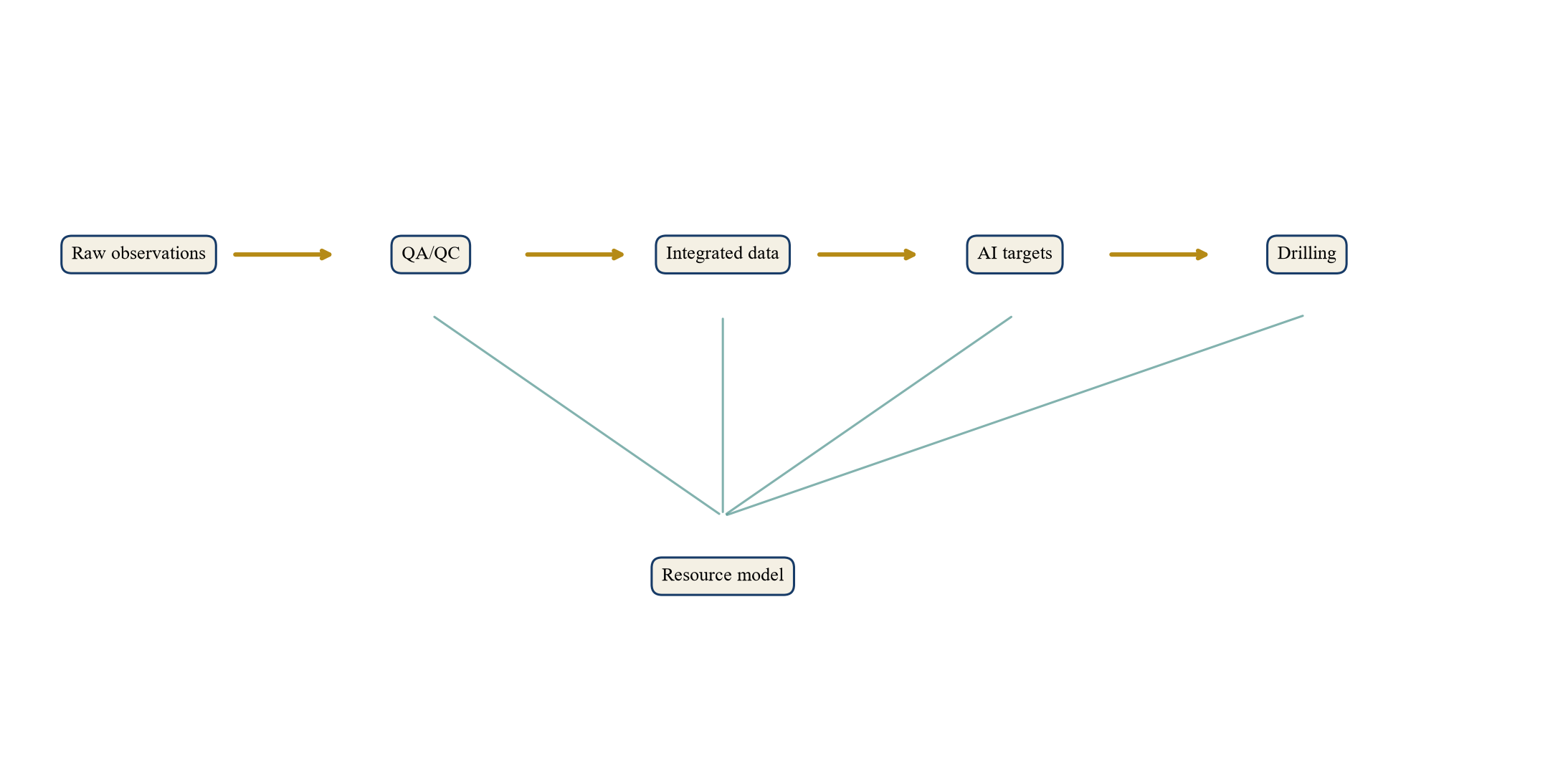
Analytical framework; the evidentiary status of each data set requires project-specific review.
4. Build geological data lineage
The decision question is whether each interpretation can be traced to raw observations, location, method, transformation and reviewer. The diligence team should begin with drill logs, assays, geophysics, geochemistry, QA/QC, coordinates, versions and competent-person records. Evidence should be attributable, versioned and reconciled across technical, legal, commercial and financial workstreams. [4][6]
The principal failure mode is that legacy data can contain duplicate samples, coordinate errors, inconsistent detection limits and undocumented transformations. Management forecasts can support planning when they are identified as forecasts and kept separate from observed results, competent-person statements, contracts and regulatory approvals. The model should show how each unresolved item changes recoverable product, schedule, price, operating cost, capital expenditure, funding or control.
The recommended response is to create a versioned evidence map from raw data through interpretation to public statement. A named executive should own delivery, an independent reviewer should challenge material assumptions, and the board should see the evidence required to release the next tranche of capital. Central, downside and stop cases should identify both the financial effect and the earliest practical intervention. In the hypothetical partnership, unsupported value remains outside the base case or is carried through probability, contingency, delayed funding or a closing condition.
| Test | Evidence | Failure mode | Investment response |
|---|---|---|---|
| data lineage | raw files and transformation log | hidden cleaning or duplication | rebuild governed data set |
| spatial holdout | unseen geological area | geographic leakage | prospective blind test |
| target ranking | ranked anomalies and drilling | selective testing | pre-register drill programme |
| uncertainty | calibrated probability | false precision | range and stop rule |
| override | reason, approver and outcome | confirmation bias | independent review |
| economic value | discovery per exploration dollar | accuracy without value | capital-allocation threshold |
Proposed testing; model performance requires prospective evidence.
5. Validate AI-assisted exploration
The decision question is whether the model improves target selection under prospective testing. The diligence team should begin with training data, features, labels, holdouts, target rankings, drilling outcomes and override logs. Evidence should be attributable, versioned and reconciled across technical, legal, commercial and financial workstreams. [7][8]
The principal failure mode is that spatial leakage and selective drilling can make historical back-tests appear more accurate than prospective performance. Management forecasts can support planning when they are identified as forecasts and kept separate from observed results, competent-person statements, contracts and regulatory approvals. The model should show how each unresolved item changes recoverable product, schedule, price, operating cost, capital expenditure, funding or control.
The recommended response is to freeze the model, test blind targets and measure discovery value per unit of exploration expenditure. A named executive should own delivery, an independent reviewer should challenge material assumptions, and the board should see the evidence required to release the next tranche of capital. Central, downside and stop cases should identify both the financial effect and the earliest practical intervention. In the hypothetical partnership, unsupported value remains outside the base case or is carried through probability, contingency, delayed funding or a closing condition.
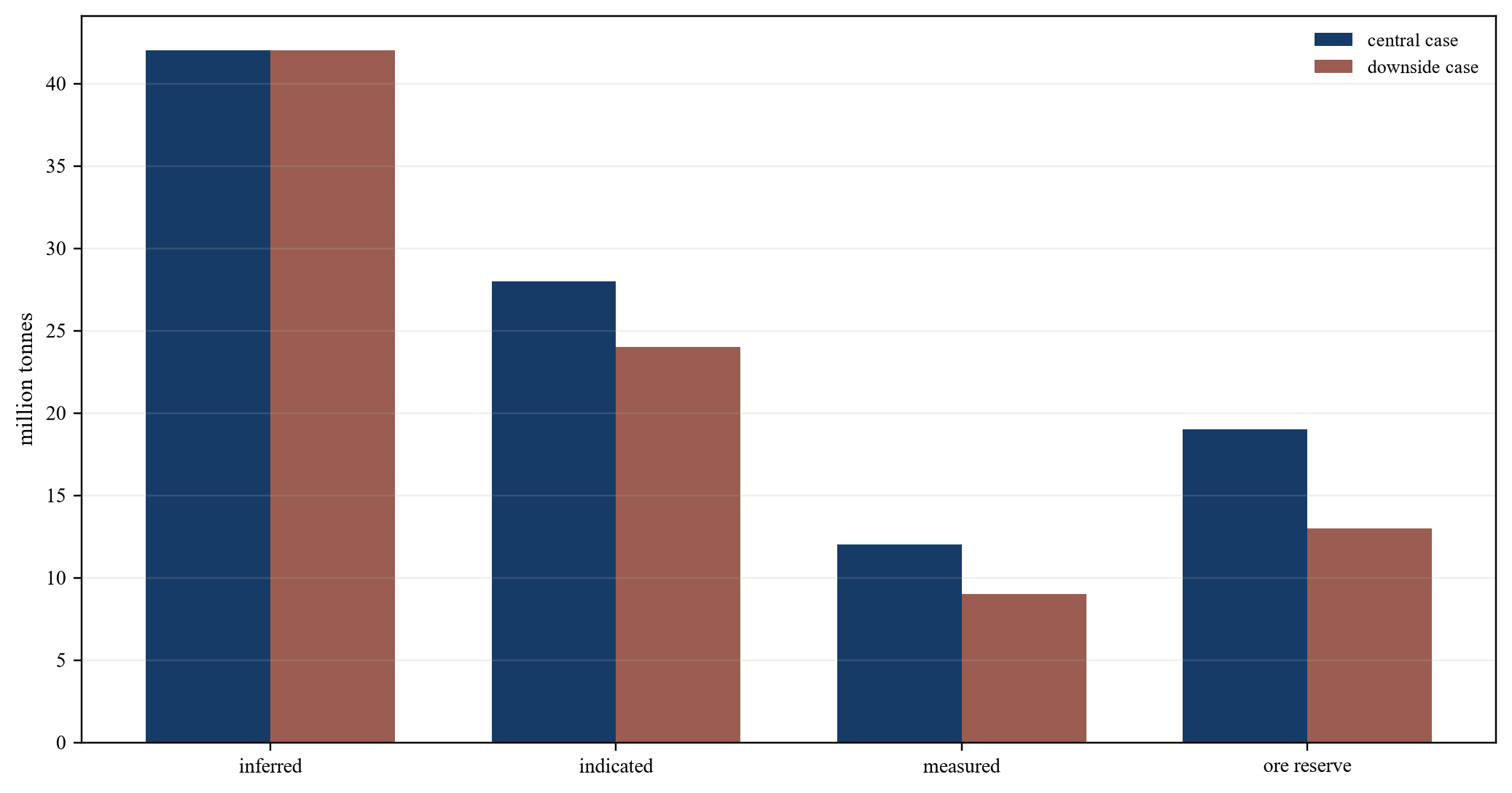
Wholly hypothetical million tonnes; categories and conversion require competent-person evidence.
6. Separate exploration results, resources and reserves
The decision question is how confidence and economic feasibility change across reporting categories. The diligence team should begin with competent-person reports, JORC Table 1, resource models, studies and Modifying Factors. Evidence should be attributable, versioned and reconciled across technical, legal, commercial and financial workstreams. [6][9]
The principal failure mode is that commercial models can treat low-confidence or unconverted material as if it were scheduled saleable production. Management forecasts can support planning when they are identified as forecasts and kept separate from observed results, competent-person statements, contracts and regulatory approvals. The model should show how each unresolved item changes recoverable product, schedule, price, operating cost, capital expenditure, funding or control.
The recommended response is to map every tonne and grade assumption to its reporting category and permitted economic use. A named executive should own delivery, an independent reviewer should challenge material assumptions, and the board should see the evidence required to release the next tranche of capital. Central, downside and stop cases should identify both the financial effect and the earliest practical intervention. In the hypothetical partnership, unsupported value remains outside the base case or is carried through probability, contingency, delayed funding or a closing condition.
| Stage | Evidence | Principal uncertainty | Financing use |
|---|---|---|---|
| exploration result | sampling and QA/QC | continuity and representativeness | target selection only |
| Mineral Resource | model and reasonable prospects | confidence and Modifying Factors | staged study funding |
| Ore Reserve | study and applied Modifying Factors | execution and market change | development case |
| plant feed | mine plan and reconciliation | dilution and variability | operating forecast |
| saleable product | recovery and specification | scale-up and qualification | revenue and debt service |
Proposed reconciliation; competent-person reporting and technical studies govern classification.
7. Test mineralogy and metallurgical recovery
The decision question is whether the mineral can be liberated, recovered and converted into a saleable product at scale. The diligence team should begin with mineralogy, variability samples, bench and pilot tests, recovery, impurities and reagent consumption. Evidence should be attributable, versioned and reconciled across technical, legal, commercial and financial workstreams. [10]
The principal failure mode is that headline grade may not translate into payable metal when mineral form, recovery or deleterious elements differ. Management forecasts can support planning when they are identified as forecasts and kept separate from observed results, competent-person statements, contracts and regulatory approvals. The model should show how each unresolved item changes recoverable product, schedule, price, operating cost, capital expenditure, funding or control.
The recommended response is to use representative variability testing and reconcile mass, recovery, product quality and waste. A named executive should own delivery, an independent reviewer should challenge material assumptions, and the board should see the evidence required to release the next tranche of capital. Central, downside and stop cases should identify both the financial effect and the earliest practical intervention. In the hypothetical partnership, unsupported value remains outside the base case or is carried through probability, contingency, delayed funding or a closing condition.
8. Assess infrastructure and logistics
The decision question is whether power, water, roads, rail, port, accommodation and reagents support construction and operation. The diligence team should begin with capacity studies, connection offers, route surveys, tariffs, schedules and contingency plans. Evidence should be attributable, versioned and reconciled across technical, legal, commercial and financial workstreams. [1][11]
The principal failure mode is that regional infrastructure may exist yet remain unavailable, uncontracted or incompatible with product movement. Management forecasts can support planning when they are identified as forecasts and kept separate from observed results, competent-person statements, contracts and regulatory approvals. The model should show how each unresolved item changes recoverable product, schedule, price, operating cost, capital expenditure, funding or control.
The recommended response is to value contracted capacity separately from planned or shared infrastructure. A named executive should own delivery, an independent reviewer should challenge material assumptions, and the board should see the evidence required to release the next tranche of capital. Central, downside and stop cases should identify both the financial effect and the earliest practical intervention. In the hypothetical partnership, unsupported value remains outside the base case or is carried through probability, contingency, delayed funding or a closing condition.
9. Embed environmental, community and First Nations obligations
The decision question is how rights, approvals, benefits and impacts affect schedule, design and legitimacy. The diligence team should begin with baseline studies, engagement records, agreements, approvals, closure plans and benefit-sharing arrangements. Evidence should be attributable, versioned and reconciled across technical, legal, commercial and financial workstreams. [1][12]
The principal failure mode is that treating engagement as a timetable item can create redesign, delay, dispute and enduring loss of trust. Management forecasts can support planning when they are identified as forecasts and kept separate from observed results, competent-person statements, contracts and regulatory approvals. The model should show how each unresolved item changes recoverable product, schedule, price, operating cost, capital expenditure, funding or control.
The recommended response is to make participation, consent requirements and benefit delivery part of governance and funding gates. A named executive should own delivery, an independent reviewer should challenge material assumptions, and the board should see the evidence required to release the next tranche of capital. Central, downside and stop cases should identify both the financial effect and the earliest practical intervention. In the hypothetical partnership, unsupported value remains outside the base case or is carried through probability, contingency, delayed funding or a closing condition.
10. Complete foreign-investment and national-security review
The decision question is which investment, control, data and offtake rights require approval or conditions. The diligence team should begin with FIRB guidance, ownership, control, sensitive assets, data access and contractual rights. Evidence should be attributable, versioned and reconciled across technical, legal, commercial and financial workstreams. [5][13]
The principal failure mode is that a non-controlling equity interest can still create review issues through information, veto, access or operational influence. Management forecasts can support planning when they are identified as forecasts and kept separate from observed results, competent-person statements, contracts and regulatory approvals. The model should show how each unresolved item changes recoverable product, schedule, price, operating cost, capital expenditure, funding or control.
The recommended response is to obtain jurisdiction-specific advice and align approval assumptions with the JV rights actually negotiated. A named executive should own delivery, an independent reviewer should challenge material assumptions, and the board should see the evidence required to release the next tranche of capital. Central, downside and stop cases should identify both the financial effect and the earliest practical intervention. In the hypothetical partnership, unsupported value remains outside the base case or is carried through probability, contingency, delayed funding or a closing condition.
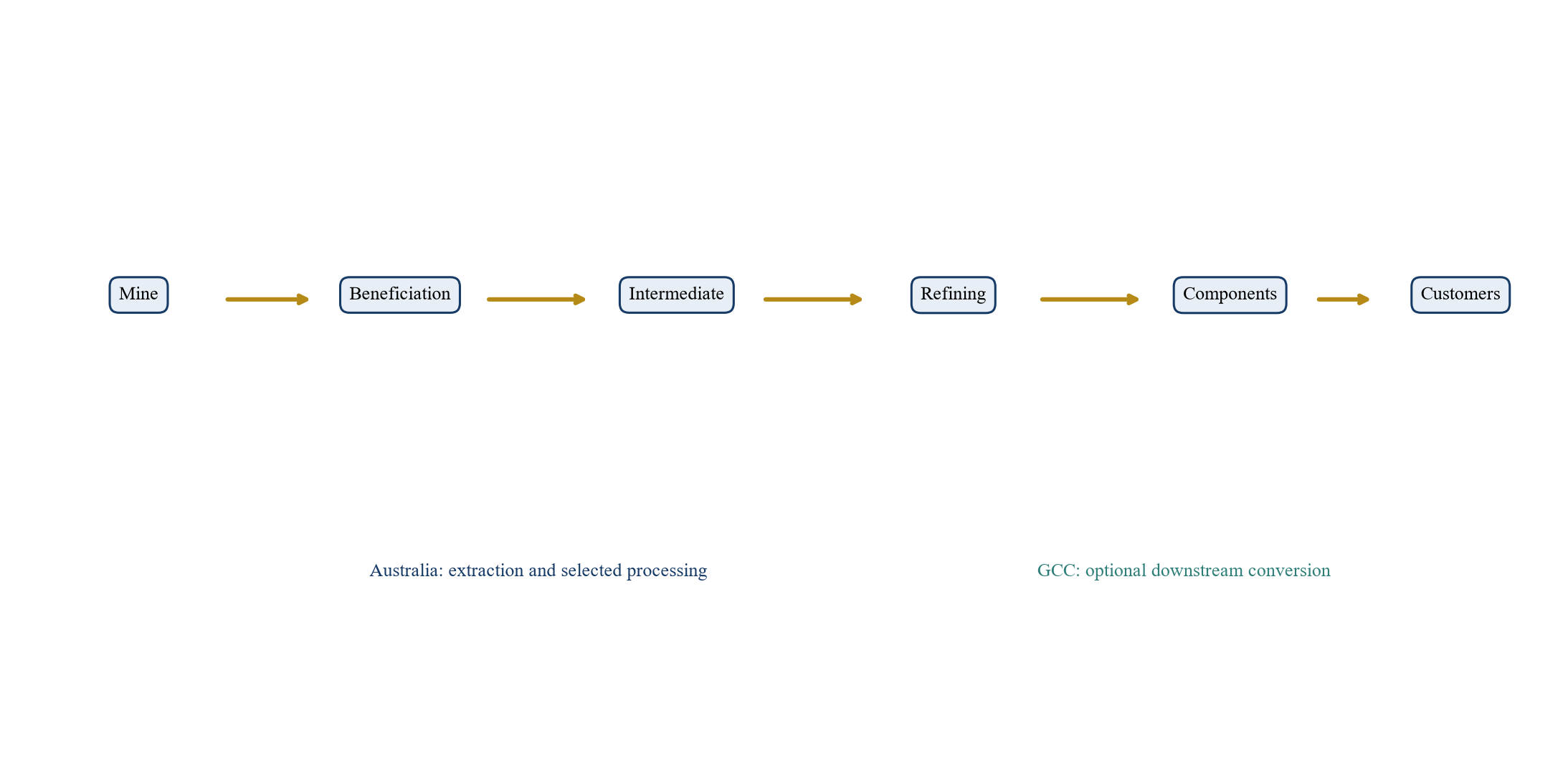
Route-selection framework; actual recovery, capacity and location economics require testwork.
11. Select the processing route
The decision question is which processing steps belong in Australia, the Gulf or third-party facilities. The diligence team should begin with testwork, flowsheets, energy, water, waste, reagents, product qualification and location economics. Evidence should be attributable, versioned and reconciled across technical, legal, commercial and financial workstreams. [1][10]
The principal failure mode is that a downstream ambition can destroy value if recovery, scale, feed variability or customer qualification is weak. Management forecasts can support planning when they are identified as forecasts and kept separate from observed results, competent-person statements, contracts and regulatory approvals. The model should show how each unresolved item changes recoverable product, schedule, price, operating cost, capital expenditure, funding or control.
The recommended response is to compare staged routes on netback, resilience, capital intensity and execution evidence. A named executive should own delivery, an independent reviewer should challenge material assumptions, and the board should see the evidence required to release the next tranche of capital. Central, downside and stop cases should identify both the financial effect and the earliest practical intervention. In the hypothetical partnership, unsupported value remains outside the base case or is carried through probability, contingency, delayed funding or a closing condition.
12. Reconcile development expenditure and schedule
The decision question is what capital is required to reach each technical and commercial milestone. The diligence team should begin with engineering estimates, quantities, procurement, owner costs, contingency, escalation and schedule logic. Evidence should be attributable, versioned and reconciled across technical, legal, commercial and financial workstreams. [14]
The principal failure mode is that early estimates may exclude infrastructure, commissioning, working capital, taxes, closure and interface risk. Management forecasts can support planning when they are identified as forecasts and kept separate from observed results, competent-person statements, contracts and regulatory approvals. The model should show how each unresolved item changes recoverable product, schedule, price, operating cost, capital expenditure, funding or control.
The recommended response is to use range-based estimates and release capital only after defined evidence gates. A named executive should own delivery, an independent reviewer should challenge material assumptions, and the board should see the evidence required to release the next tranche of capital. Central, downside and stop cases should identify both the financial effect and the earliest practical intervention. In the hypothetical partnership, unsupported value remains outside the base case or is carried through probability, contingency, delayed funding or a closing condition.
13. Model operating cost and ramp-up
The decision question is which throughput, recovery, availability and cost assumptions create sustainable cash. The diligence team should begin with mine plans, energy, labour, consumables, maintenance, logistics and ramp-up evidence. Evidence should be attributable, versioned and reconciled across technical, legal, commercial and financial workstreams. [10][14]
The principal failure mode is that steady-state unit cost can conceal low initial utilisation, rehandling, impurities and learning losses. Management forecasts can support planning when they are identified as forecasts and kept separate from observed results, competent-person statements, contracts and regulatory approvals. The model should show how each unresolved item changes recoverable product, schedule, price, operating cost, capital expenditure, funding or control.
The recommended response is to model monthly ramp-up, availability and recovery with funded operating contingencies. A named executive should own delivery, an independent reviewer should challenge material assumptions, and the board should see the evidence required to release the next tranche of capital. Central, downside and stop cases should identify both the financial effect and the earliest practical intervention. In the hypothetical partnership, unsupported value remains outside the base case or is carried through probability, contingency, delayed funding or a closing condition.
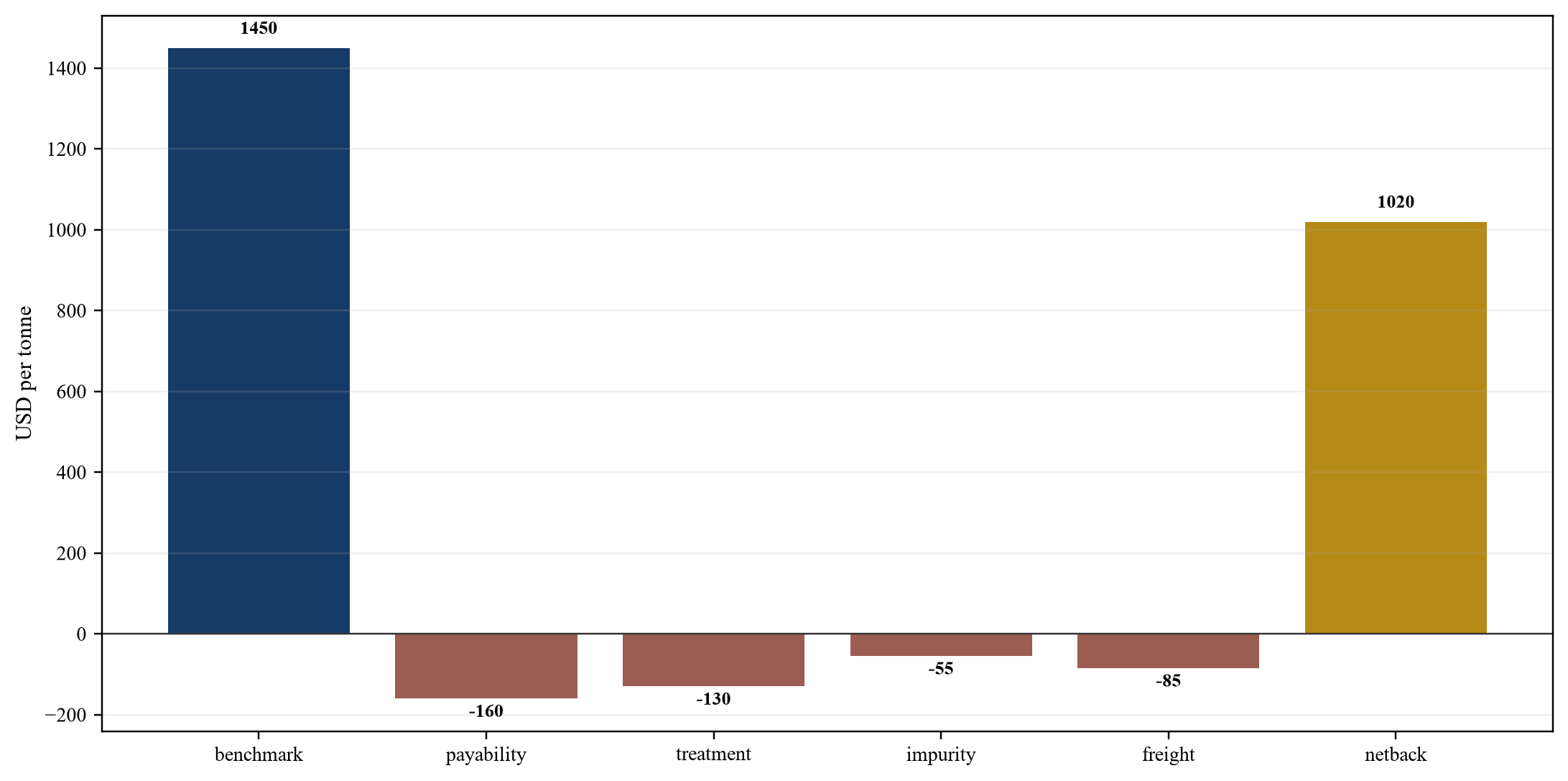
Wholly hypothetical USD per tonne; values do not describe an identified contract.
| Term | Evidence | Economic effect | Protection |
|---|---|---|---|
| benchmark | named publication and timing | gross reference price | independent source |
| payability | contained and payable units | revenue reduction | assay and umpire process |
| treatment and refining | formula and escalators | processing deduction | caps or review bands |
| impurities and moisture | thresholds and penalties | quality deduction | testwork and blending |
| freight and insurance | delivery term and route | netback and working capital | transparent pass-through |
| provisional settlement | quotational period and true-up | cash timing and price exposure | liquidity reserve |
Proposed contract review; the executed agreement governs economics.
14. Design the offtake pricing architecture
The decision question is how quantity, quality, benchmark, payability, treatment charges, penalties, freight and settlement determine net revenue. The diligence team should begin with term sheets, formulas, assays, quotational periods, provisional invoices and credit support. Evidence should be attributable, versioned and reconciled across technical, legal, commercial and financial workstreams. [2][15]
The principal failure mode is that a headline benchmark can overstate cash when deductions, penalties and timing are omitted. Management forecasts can support planning when they are identified as forecasts and kept separate from observed results, competent-person statements, contracts and regulatory approvals. The model should show how each unresolved item changes recoverable product, schedule, price, operating cost, capital expenditure, funding or control.
The recommended response is to build an auditable netback waterfall and test buyer, basis and settlement risk. A named executive should own delivery, an independent reviewer should challenge material assumptions, and the board should see the evidence required to release the next tranche of capital. Central, downside and stop cases should identify both the financial effect and the earliest practical intervention. In the hypothetical partnership, unsupported value remains outside the base case or is carried through probability, contingency, delayed funding or a closing condition.
15. Define Gulf downstream participation
The decision question is which conversion, manufacturing, inventory, customer and technology activities occur in the GCC. The diligence team should begin with industrial strategy, energy and infrastructure terms, technology licences, customer demand and product specifications. Evidence should be attributable, versioned and reconciled across technical, legal, commercial and financial workstreams. [16][17]
The principal failure mode is that an optional downstream phase can become an unfunded political aspiration that distorts the base investment case. Management forecasts can support planning when they are identified as forecasts and kept separate from observed results, competent-person statements, contracts and regulatory approvals. The model should show how each unresolved item changes recoverable product, schedule, price, operating cost, capital expenditure, funding or control.
The recommended response is to separate committed, conditional and future phases with their own returns and approvals. A named executive should own delivery, an independent reviewer should challenge material assumptions, and the board should see the evidence required to release the next tranche of capital. Central, downside and stop cases should identify both the financial effect and the earliest practical intervention. In the hypothetical partnership, unsupported value remains outside the base case or is carried through probability, contingency, delayed funding or a closing condition.
16. Stress price, concentration and policy risk
The decision question is how price volatility, supply concentration, export controls and technology shifts affect cash and strategy. The diligence team should begin with IEA scenarios, market data, customer forecasts, policy measures and substitution analysis. Evidence should be attributable, versioned and reconciled across technical, legal, commercial and financial workstreams. [2][3]
The principal failure mode is that a central price deck can ignore the path dependency created by concentrated refining and policy intervention. Management forecasts can support planning when they are identified as forecasts and kept separate from observed results, competent-person statements, contracts and regulatory approvals. The model should show how each unresolved item changes recoverable product, schedule, price, operating cost, capital expenditure, funding or control.
The recommended response is to use multiple price and access regimes rather than one deterministic long-term forecast. A named executive should own delivery, an independent reviewer should challenge material assumptions, and the board should see the evidence required to release the next tranche of capital. Central, downside and stop cases should identify both the financial effect and the earliest practical intervention. In the hypothetical partnership, unsupported value remains outside the base case or is carried through probability, contingency, delayed funding or a closing condition.
| Stage | Equity | Government or ECA | Project debt | Evidence gate |
|---|---|---|---|---|
| exploration and resource | 70 | 10 | 0 | tenure, data and drill programme |
| feasibility and approvals | 95 | 35 | 0 | resource, testwork and study scope |
| construction | 260 | 300 | 360 | reserve, approvals, offtake and EPC |
| ramp-up and liquidity | 45 | 15 | 60 | commissioning and working-capital plan |
| total | 470 | 360 | 420 | board and lender conditions |
Wholly hypothetical USD millions; the table is not a financing recommendation.
17. Build the financing plan
The decision question is which equity, shareholder loans, project debt, export credit, government facilities and offtake support fund each stage. The diligence team should begin with sources and uses, conditions, security, covenants, guarantees and liquidity. Evidence should be attributable, versioned and reconciled across technical, legal, commercial and financial workstreams. [18][19]
The principal failure mode is that exploration risk, construction risk and ramp-up risk require different capital and cannot be refinanced on assumed success. Management forecasts can support planning when they are identified as forecasts and kept separate from observed results, competent-person statements, contracts and regulatory approvals. The model should show how each unresolved item changes recoverable product, schedule, price, operating cost, capital expenditure, funding or control.
The recommended response is to match funding tenor and recourse to the evidence available at each milestone. A named executive should own delivery, an independent reviewer should challenge material assumptions, and the board should see the evidence required to release the next tranche of capital. Central, downside and stop cases should identify both the financial effect and the earliest practical intervention. In the hypothetical partnership, unsupported value remains outside the base case or is carried through probability, contingency, delayed funding or a closing condition.
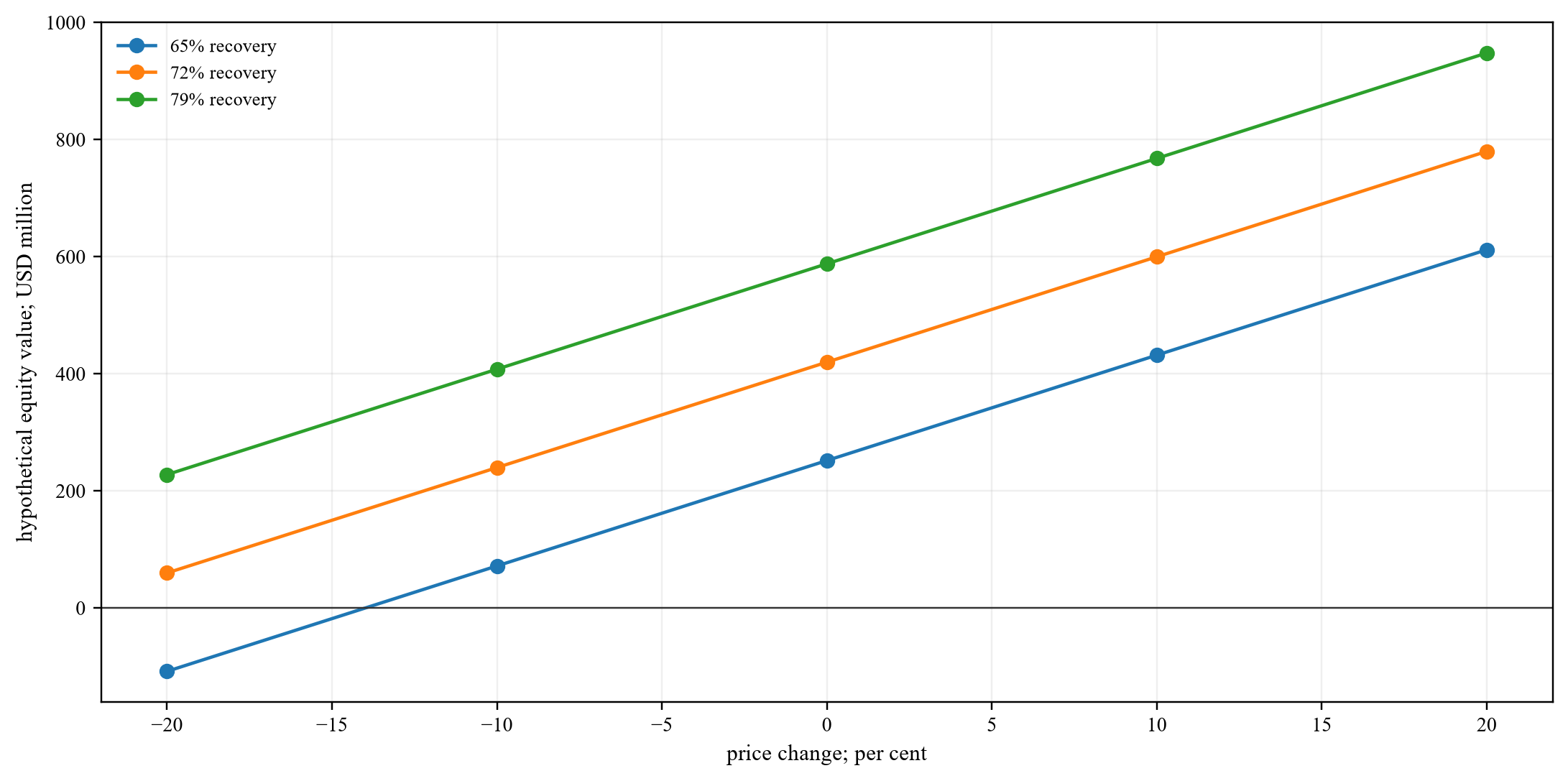
Wholly hypothetical USD millions; this is a sensitivity illustration rather than a valuation opinion.
18. Value the staged opportunity
The decision question is how exploration, development, processing and downstream options contribute to present value. The diligence team should begin with probability-weighted milestones, scenario cash flows, comparable evidence and financing effects. Evidence should be attributable, versioned and reconciled across technical, legal, commercial and financial workstreams. [20]
The principal failure mode is that adding a single probability to a full success case can hide correlated technical, approval, market and funding risks. Management forecasts can support planning when they are identified as forecasts and kept separate from observed results, competent-person statements, contracts and regulatory approvals. The model should show how each unresolved item changes recoverable product, schedule, price, operating cost, capital expenditure, funding or control.
The recommended response is to value discrete stages and avoid counting optional downstream value as committed base cash. A named executive should own delivery, an independent reviewer should challenge material assumptions, and the board should see the evidence required to release the next tranche of capital. Central, downside and stop cases should identify both the financial effect and the earliest practical intervention. In the hypothetical partnership, unsupported value remains outside the base case or is carried through probability, contingency, delayed funding or a closing condition.
| Decision | Proposed authority | Evidence | Deadlock treatment |
|---|---|---|---|
| approved work programme | board with defined majority | technical plan and budget | independent technical review |
| material scope or product change | unanimous | revised economics and approvals | staged escalation |
| new debt or security | unanimous | financing case | alternative funding process |
| ordinary procurement | delegated management | approved policy | audit and limits |
| data release and public statement | competent technical and board controls | verified disclosure | no release without approval |
| transfer or exit | reserved matter | valuation and buyer evidence | pre-emption and sale process |
Proposed governance design; rights depend on law and definitive agreements.
19. Allocate JV governance and control
The decision question is which decisions require unanimity, majority, delegated authority or technical independence. The diligence team should begin with reserved matters, budgets, work programmes, management appointments, audit and reporting. Evidence should be attributable, versioned and reconciled across technical, legal, commercial and financial workstreams. [21]
The principal failure mode is that equal economics can coexist with operational control, information asymmetry or perpetual veto. Management forecasts can support planning when they are identified as forecasts and kept separate from observed results, competent-person statements, contracts and regulatory approvals. The model should show how each unresolved item changes recoverable product, schedule, price, operating cost, capital expenditure, funding or control.
The recommended response is to match consent rights to capital exposure, expertise and the ability to act during an incident. A named executive should own delivery, an independent reviewer should challenge material assumptions, and the board should see the evidence required to release the next tranche of capital. Central, downside and stop cases should identify both the financial effect and the earliest practical intervention. In the hypothetical partnership, unsupported value remains outside the base case or is carried through probability, contingency, delayed funding or a closing condition.
20. Protect data, models and intellectual property
The decision question is who owns background data, new data, models, improvements and permitted derivative use. The diligence team should begin with licences, repositories, access logs, model documentation, source code and exit rights. Evidence should be attributable, versioned and reconciled across technical, legal, commercial and financial workstreams. [7][21]
The principal failure mode is that a partner can fund exploration yet lack usable data if ownership and licence terms are incomplete. Management forecasts can support planning when they are identified as forecasts and kept separate from observed results, competent-person statements, contracts and regulatory approvals. The model should show how each unresolved item changes recoverable product, schedule, price, operating cost, capital expenditure, funding or control.
The recommended response is to grant durable, auditable rights that survive dispute, transfer and termination. A named executive should own delivery, an independent reviewer should challenge material assumptions, and the board should see the evidence required to release the next tranche of capital. Central, downside and stop cases should identify both the financial effect and the earliest practical intervention. In the hypothetical partnership, unsupported value remains outside the base case or is carried through probability, contingency, delayed funding or a closing condition.
21. Specify funding calls, default and dilution
The decision question is what happens when a party cannot or will not fund an approved programme. The diligence team should begin with commitments, notice, cure, dilution formulas, shareholder loans, security and buyout rights. Evidence should be attributable, versioned and reconciled across technical, legal, commercial and financial workstreams. [21]
The principal failure mode is that an aggressive default mechanism can transfer value unfairly before technical uncertainty is resolved. Management forecasts can support planning when they are identified as forecasts and kept separate from observed results, competent-person statements, contracts and regulatory approvals. The model should show how each unresolved item changes recoverable product, schedule, price, operating cost, capital expenditure, funding or control.
The recommended response is to calibrate remedies to stage, evidence, materiality and access to alternative capital. A named executive should own delivery, an independent reviewer should challenge material assumptions, and the board should see the evidence required to release the next tranche of capital. Central, downside and stop cases should identify both the financial effect and the earliest practical intervention. In the hypothetical partnership, unsupported value remains outside the base case or is carried through probability, contingency, delayed funding or a closing condition.
22. Align accounting, tax and reporting
The decision question is how joint control, exploration assets, impairment, revenue and cross-border flows appear in the accounts. The diligence team should begin with IFRS analysis, tax advice, transfer pricing, customs, withholding and consolidation assessment. Evidence should be attributable, versioned and reconciled across technical, legal, commercial and financial workstreams. [22][23]
The principal failure mode is that economic rights can be misunderstood when legal form, joint control and funding instruments differ. Management forecasts can support planning when they are identified as forecasts and kept separate from observed results, competent-person statements, contracts and regulatory approvals. The model should show how each unresolved item changes recoverable product, schedule, price, operating cost, capital expenditure, funding or control.
The recommended response is to complete accounting and tax analysis before finalising governance and distributions. A named executive should own delivery, an independent reviewer should challenge material assumptions, and the board should see the evidence required to release the next tranche of capital. Central, downside and stop cases should identify both the financial effect and the earliest practical intervention. In the hypothetical partnership, unsupported value remains outside the base case or is carried through probability, contingency, delayed funding or a closing condition.
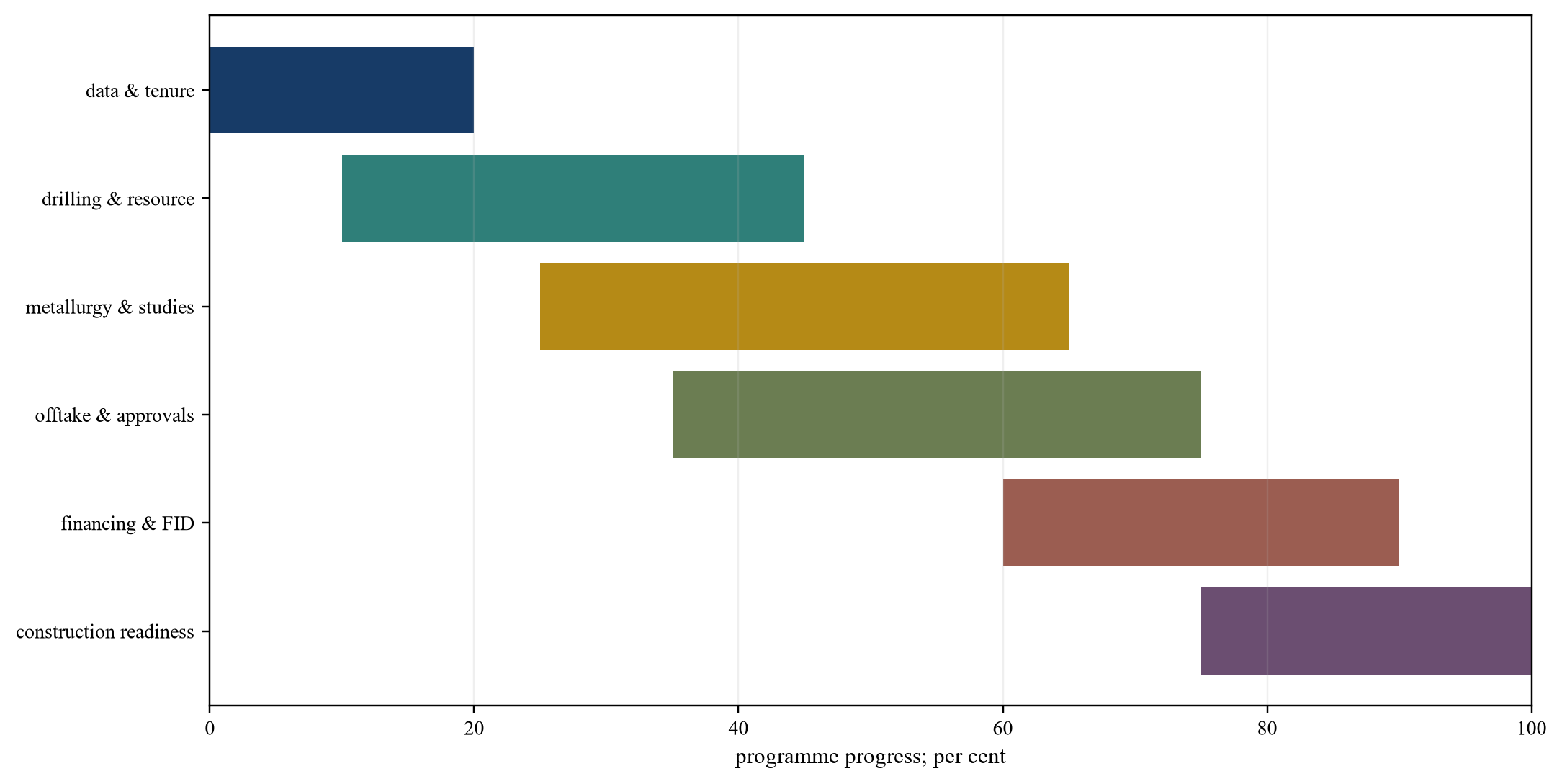
Illustrative sequence; actual timing depends on geology, approvals, testwork and funding.
23. Execute a milestone-based programme
The decision question is which work must be completed from term sheet through feasibility, financing and final investment decision. The diligence team should begin with integrated plan, workstreams, budgets, evidence gates, approvals and accountable owners. Evidence should be attributable, versioned and reconciled across technical, legal, commercial and financial workstreams. [1][18]
The principal failure mode is that parallel technical and commercial work can diverge until price, product, schedule and funding no longer reconcile. Management forecasts can support planning when they are identified as forecasts and kept separate from observed results, competent-person statements, contracts and regulatory approvals. The model should show how each unresolved item changes recoverable product, schedule, price, operating cost, capital expenditure, funding or control.
The recommended response is to maintain one decision model and a controlled evidence register across all teams. A named executive should own delivery, an independent reviewer should challenge material assumptions, and the board should see the evidence required to release the next tranche of capital. Central, downside and stop cases should identify both the financial effect and the earliest practical intervention. In the hypothetical partnership, unsupported value remains outside the base case or is carried through probability, contingency, delayed funding or a closing condition.
Implementation detail: making the joint venture investable
The transaction team should establish a single evidence register. Each record identifies the source, owner, date, version, assurance status, permitted use and decision supported. Raw exploration data, interpreted models, competent-person statements, engineering studies, market data and management forecasts should remain distinguishable. A committee member should be able to trace a production or value assumption back to the relevant technical evidence.
The geological database requires coordinate, unit, sample, assay, detection-limit and QA/QC controls. Duplicate, blank and standard results should be reviewed with laboratory performance. Historical records need provenance and conversion logic. Where the venture relies on third-party or government data, licences should permit analysis, model training, sharing with financiers and continued use after a dispute or ownership change.
AI exploration should operate through a registered model inventory. Each use case states the geological question, inputs, training period, target definition, algorithm, validation, uncertainty and accountable geoscientist. Spatial cross-validation should prevent nearby observations from leaking into both training and testing. The venture should preserve rejected targets and drilling decisions so later performance analysis does not include only successful campaigns.
Prospective testing links model claims to capital allocation. The board can approve a limited drilling programme with pre-registered targets and success criteria. Results should update geological interpretation and the model through controlled change. A higher hit rate has value only if discoveries have material scale, grade, continuity, recovery, access and development potential. The metric should therefore connect exploration spend to risk-adjusted project value.
Resource and reserve reporting should remain under competent-person accountability. The transaction model should label Exploration Targets, Exploration Results, Inferred, Indicated and Measured Mineral Resources, and Probable and Proved Ore Reserves correctly. Scenarios can explore conversion, while public claims and base financing assumptions should respect the confidence and study requirements of the applicable reporting framework.
Metallurgical work should cover mineralogical and spatial variability rather than one favourable composite. Testwork should reconcile feed mass, valuable mineral, recovery, product grade, impurities, reagents, water, energy and residue. Bench results require an explicit scale-up path. Pilot or demonstration work may be needed where the flowsheet, mineral form or product specification is novel.
The product strategy should begin with customer requirements. Battery, magnet, semiconductor, alloy or chemical customers may require different purity, particle, impurity and qualification evidence. Qualification can take longer than construction. The schedule should include samples, trials, feedback, repeatability and commercial approval. A product that meets a generic commodity description may still fail a customer's manufacturing process.
Offtake should be modelled as a complete cash formula. The bridge begins with contained product and benchmark price, then applies payability, treatment and refining charges, impurity penalties, moisture, freight, insurance, quotational period, provisional settlement, currency, tax and working capital. Buyer credit, termination, take-or-pay, force majeure, assignment and security should be analysed separately.
The venture should distinguish market access from financing support. A long-term buyer can improve revenue visibility and provide technical qualification. It can also concentrate sales, cap upside, create price discretion or control amendments. Lenders may require minimum committed quantity, transparent pricing, credit support and assignment. Minority owners need protection where an affiliated buyer purchases product.
Processing location should be decided through netback and capability. Australian processing can increase local value and simplify mine-to-intermediate control. Gulf processing may use energy, infrastructure, industrial customers and capital. The comparison should include recovery, scale, feed and product logistics, technology licence, energy and water, waste, emissions, tax, incentives, working capital, customer qualification and policy conditions.
The capital estimate should maintain scope discipline. Mine, plant, utilities, roads, port, camp, owner's costs, spares, commissioning, working capital, closure, escalation and contingency should reconcile with the schedule. Interfaces between mine and processing, Australian and Gulf facilities, and project and shared infrastructure deserve named owners. Contingency should reflect estimate maturity and risk rather than serve as an unexplained percentage.
The operating model should run monthly through ramp-up. Throughput, recovery and product grade may improve at different rates. Reagent, maintenance, labour, power and logistics costs can rise when utilisation is low. The cash model should include inventory and provisional pricing. A project can meet annual production while breaching liquidity during commissioning or a settlement true-up.
Funding should be staged against evidence. Exploration equity can fund data and drilling. Study capital can follow resource and testwork gates. Construction debt or public facilities usually require permits, reserve support, contracted construction, offtake and sponsor completion capacity. The parties should agree whether a failure to reach a gate stops the project, requires redesign or triggers a new funding decision.
Government and export-credit support should be treated as conditional until approved. Eligibility, national-interest tests, Australian benefit, technology, feasibility and buyer commitments may affect availability. The model should not fill a financing gap with an assumed facility. Applications, diligence, timing, conditions and intercreditor requirements belong in the integrated programme.
The JV agreement should state who proposes work, who verifies it and who releases capital. Reserved matters should focus on decisions that can change exposure, control or value. Excessive unanimity can create operational paralysis. Weak minority rights can permit value transfer through budgets, related-party contracts, product sales, data access or future financing. Delegations and conflicts processes should be practical.
Funding-default provisions should preserve proportionality. A cure period, shareholder loan, third-party funding process, dilution, default interest or buyout can address a shortfall. The formula should avoid rewarding opportunistic non-funding or allowing one party to capture a technically uncertain project at a distressed value. Independent valuation and dispute procedures can protect both continuity and fairness.
Data governance should survive the partnership. Background intellectual property remains identified; project data, models and improvements receive clear ownership and licences. Both parties need access for governance, financing and compliance. Export controls, national-security conditions and confidentiality may restrict location or sharing. Exit provisions should allow an owner to preserve records needed to operate or realise its interest.
The board dashboard should connect geology to cash. It can report metres drilled, assay turnaround, QA/QC exceptions, target performance, resource movement, testwork, recovery, product qualification, permits, capital commitments, schedule, offtake netback, funding headroom and decision gates. A change bridge should explain why the approved case moved and which evidence supports it.
Independent technical review should target material value drivers. Replicating the entire project can consume time without improving the decision. Priority areas include data integrity, resource classification, mine plan, representative metallurgy, infrastructure, capital, ramp-up and product marketability. Review findings should show value or schedule effect and a closure path.
Red-team scenarios should combine events. A lower resource conversion may coincide with weaker recovery, higher capital and a lower price. An approval delay can increase escalation and consume committed capital. A buyer dispute can coincide with provisional-price repayment. The model should locate the funding failure point and the rights available before the venture loses optionality.
Final investment approval should include explicit conditions. The committee should receive the technical basis, offtake formula, processing route, capital and schedule, financing, governance, approvals, community obligations, data rights, downside cases and implementation plan. Each unresolved matter should have an owner, deadline, funding consequence and stop rule. This converts a strategic partnership announcement into an investable and governable programme.
24. Red-team the transaction
The decision question is how data error, model bias, recovery failure, price change, approval delay, funding default and deadlock defeat value. The diligence team should begin with independent technical review, model replication, scenario tests, legal challenge and governance simulation. Evidence should be attributable, versioned and reconciled across technical, legal, commercial and financial workstreams. [6][21]
The principal failure mode is that controls that appear complete in documents can fail when a party withholds data, capital or consent. Management forecasts can support planning when they are identified as forecasts and kept separate from observed results, competent-person statements, contracts and regulatory approvals. The model should show how each unresolved item changes recoverable product, schedule, price, operating cost, capital expenditure, funding or control.
The recommended response is to test high-impact failure paths before committing irreversible capital. A named executive should own delivery, an independent reviewer should challenge material assumptions, and the board should see the evidence required to release the next tranche of capital. Central, downside and stop cases should identify both the financial effect and the earliest practical intervention. In the hypothetical partnership, unsupported value remains outside the base case or is carried through probability, contingency, delayed funding or a closing condition.
| Finding | Cash consequence | Deal response | Accountable owner |
|---|---|---|---|
| data lineage or tenure is incomplete | unsupported target value | exclude or condition funding | technical and legal leads |
| resource conversion is below plan | lower mineable inventory | stage capital and re-plan | competent technical lead |
| recovery or product quality is weak | reduced revenue and higher cost | further testwork or route change | metallurgy lead |
| offtake deductions are opaque | overstated netback | formula reset and audit rights | commercial lead |
| funding or governance can deadlock | delay and value loss | calibrated default and escalation | board and counsel |
| downside remains funded and controlled | stronger execution capacity | approve subject to evidence gates | investment committee |
Proposed decision framework; it is not an investment recommendation.
25. Use an investment-committee decision matrix
The decision question is whether evidence, economics, control and industrial logic support the proposed commitment. The diligence team should begin with technical report, market case, valuation, financing, agreements, approvals and implementation plan. Evidence should be attributable, versioned and reconciled across technical, legal, commercial and financial workstreams. [1][20]
The principal failure mode is that a large diligence archive can leave the committee without explicit conditions, downside ownership or stop points. Management forecasts can support planning when they are identified as forecasts and kept separate from observed results, competent-person statements, contracts and regulatory approvals. The model should show how each unresolved item changes recoverable product, schedule, price, operating cost, capital expenditure, funding or control.
The recommended response is to convert every material finding into cash effect, protection, owner, deadline and approval condition. A named executive should own delivery, an independent reviewer should challenge material assumptions, and the board should see the evidence required to release the next tranche of capital. Central, downside and stop cases should identify both the financial effect and the earliest practical intervention. In the hypothetical partnership, unsupported value remains outside the base case or is carried through probability, contingency, delayed funding or a closing condition.
Sources
- Australian Government, Critical Minerals Strategy 2023-2030, Read the primary source
- International Energy Agency, Global Critical Minerals Outlook 2025, Read the primary source
- International Energy Agency, Overview of Outlook for Key Minerals, 2025, Read the primary source
- Geoscience Australia, Australia's Identified Mineral Resources 2025, Read the primary source
- Australian Treasury, Foreign Investment Review Board, National Security Guidance Note 8, Read the primary source
- Joint Ore Reserves Committee, Australasian Code for Reporting of Exploration Results, Mineral Resources and Ore Reserves, 2012, Read the primary source
- National Institute of Standards and Technology, Artificial Intelligence Risk Management Framework, Read the primary source
- Geoscience Australia, Critical Minerals Portal, Read the primary source
- Geoscience Australia, Australia's Estimated Ore Reserves, 2025, Read the primary source
- Australian Government, Critical Minerals Research and Development Hub, Read the primary source
- Infrastructure Australia, Infrastructure Market Capacity Report, Read the primary source
- Australian Government, Indigenous Land Use Agreements, Read the primary source
- Australian Treasury, Australia's Foreign Investment Policy, Read the primary source
- Association for the Advancement of Cost Engineering, Cost Estimate Classification System, Read the primary source
- International Chamber of Commerce, Incoterms 2020, Read the primary source
- Saudi Ministry of Industry and Mineral Resources, Mining Investment Law and sector information, Read the primary source
- UAE Ministry of Industry and Advanced Technology, Industrial Strategy Operation 300bn, Read the primary source
- Export Finance Australia, Critical Minerals Facility, Read the primary source
- Australian Government, National Reconstruction Fund Corporation, Read the primary source
- IFRS Foundation, IFRS 13 Fair Value Measurement, Read the primary source
- IFRS Foundation, IFRS 11 Joint Arrangements, Read the primary source
- IFRS Foundation, IFRS 6 Exploration for and Evaluation of Mineral Resources, Read the primary source
- IFRS Foundation, IAS 36 Impairment of Assets, Read the primary source
- OECD, Due Diligence Guidance for Responsible Supply Chains of Minerals from Conflict-Affected and High-Risk Areas, Read the primary source
