

1. Define the financial close decision
The controlling decision is whether the public authority, preferred bidder, project company, contractors and financing parties have completed the legal, commercial and operational work required for committed funding to become available. Contract signature can occur before this point. Award can occur earlier still. Treating these events as interchangeable creates false certainty in public announcements, construction plans and financing assumptions.
The World Bank defines financial close as the point at which the project and financing agreements have been signed, their conditions have been met and the private party can begin drawing the financing. Its guidance also recognises the circularity that can arise when effectiveness of the public-private partnership agreement depends on finance being available while lenders require an effective project agreement before drawdown. [1] The critical-path system must expose and resolve that circularity through agreed sequencing, documentary forms and simultaneous completion mechanics.
The transaction mandate should identify four separate events. Preferred-bidder appointment identifies the party with which the authority intends to complete the transaction. Commercial close records execution of the principal project agreement, subject to any stated effectiveness conditions. Financial close records satisfaction or waiver of the financing conditions required for funding availability. First drawdown records actual access to cash after any further utilisation requirements. Each event needs an exact definition, evidence requirement, approving body and long-stop consequence.
The timetable should begin with the service and implementation objective. The authority needs to know the date by which the asset or service must become available and which dependencies can compromise that date. The closing plan then works backwards through construction mobilisation, first drawdown, financial close, commercial close, preferred-bidder work and the competitive bidding process.
The output is a controlled completion case. It should state the target close date, confidence range, remaining critical activities, available float, decisions required, financing consequences and recovery actions. A target date without this evidence is an aspiration.
2. Build one integrated transaction timetable
A public-private partnership timetable often starts as several schedules. The procurement team maintains the bid calendar. Technical advisers manage design clarification. Legal advisers maintain contract mark-ups and approvals. The sponsor maintains its bid programme. Lenders and their advisers operate a due-diligence list. Land and permitting agencies use statutory or administrative timetables. These schedules need a common architecture because a delay in one workstream can change every other workstream.
The integrated timetable should contain activities, milestones, owners, predecessors, successors, evidence, decision rights, baseline dates, forecast dates, float and status. It should distinguish elapsed time from working time and identify holidays, meeting cycles, statutory notice periods and approval calendars. The scheduling logic should be visible rather than embedded in unexplained date changes.
Milestones should describe completed states. "Permit complete" is too broad when the project requires an environmental approval, building permit, grid connection consent and operating licence. "Financing complete" is too broad when credit approval, documentation, hedging, security perfection and conditions precedent remain separate. A reliable milestone might read: final environmental approval issued by the named authority, free from conditions that change the approved design or capital cost.
The baseline should be approved once the procurement route, key information, governance and decision calendar are credible. Forecast dates can then move while the baseline remains visible. Rebaselining should require a documented change in project scope, procurement strategy or approved delivery objective. Routine slippage should remain visible as variance.
The timetable needs a regular status date. Owners should report actual completion, forecast completion, evidence and emerging risk to that date. Percentage-complete estimates are weak for binary approvals and documents. Evidence-based states such as not started, in preparation, submitted, under review, comments received, resubmitted and approved provide clearer control.
| Field | Purpose | Minimum evidence | Control response |
|---|---|---|---|
| Activity and milestone | Define the work and completed state | Dated deliverable or approval criterion | Reject vague or combined milestones |
| Accountable owner | Identify the party responsible for completion | Named organisation and role | Escalate owner gaps before baseline approval |
| Dependencies | Connect predecessor and successor logic | Documented logical relationship | Challenge open starts and circular dependencies |
| Baseline and forecast | Preserve commitment and current expectation | Approved baseline plus dated forecast | Explain every material variance |
| Float | Show time available before successor or close moves | Calculated network logic | Protect scarce float from discretionary work |
| Evidence status | Distinguish activity from completion | Controlled document, decision or official receipt | Prevent unsupported completion claims |
| Cost and financing effect | Connect delay to economics | Model input and calculation | Trigger financial and affordability review |
| Escalation date | Set the latest useful intervention point | Governance calendar and remedy lead time | Escalate before the milestone fails |
Original framework. The exact fields and decision rights should reflect the jurisdiction, procurement rules and project documents.
3. Map dependencies rather than dates alone
Critical-path control depends on relationships. A land survey may precede reference design. Reference design may precede environmental submission. Environmental approval may constrain the bidder's design. The bidder's design may determine construction price. Construction price and schedule then affect the financing model, credit approval and hedging. Recording these items as independent dates conceals the chain.
Each dependency should state its type. A finish-to-start relationship means a successor cannot begin until its predecessor completes. A start-to-start relationship allows parallel work after a defined point. A finish-to-finish relationship controls coordinated completion. Leads and lags should have an operational reason, such as a statutory review period or lender adviser mobilisation time.
The transaction team should identify external dependencies, including government approvals, utilities, courts, regulators, landowners and third-party consents. These items may sit outside the contractual control of the project company or authority team. They still belong in the timetable, with a named relationship owner, evidence route and contingency.
The dependency ledger should also expose information dependencies. Bidders cannot price a risk that is absent from the data room. Lenders cannot complete technical diligence before the design, construction contract and base-case model reach sufficient maturity. The finance ministry cannot approve contingent exposure until the payment and termination mechanisms are quantified.
Circular dependencies require explicit completion mechanics. The parties can agree documents in final form, place signatures in escrow, deliver conditional approvals, prepare funds-flow statements and complete through a coordinated closing agenda. Legal advice should confirm that the chosen mechanism is valid and preserves procurement integrity.
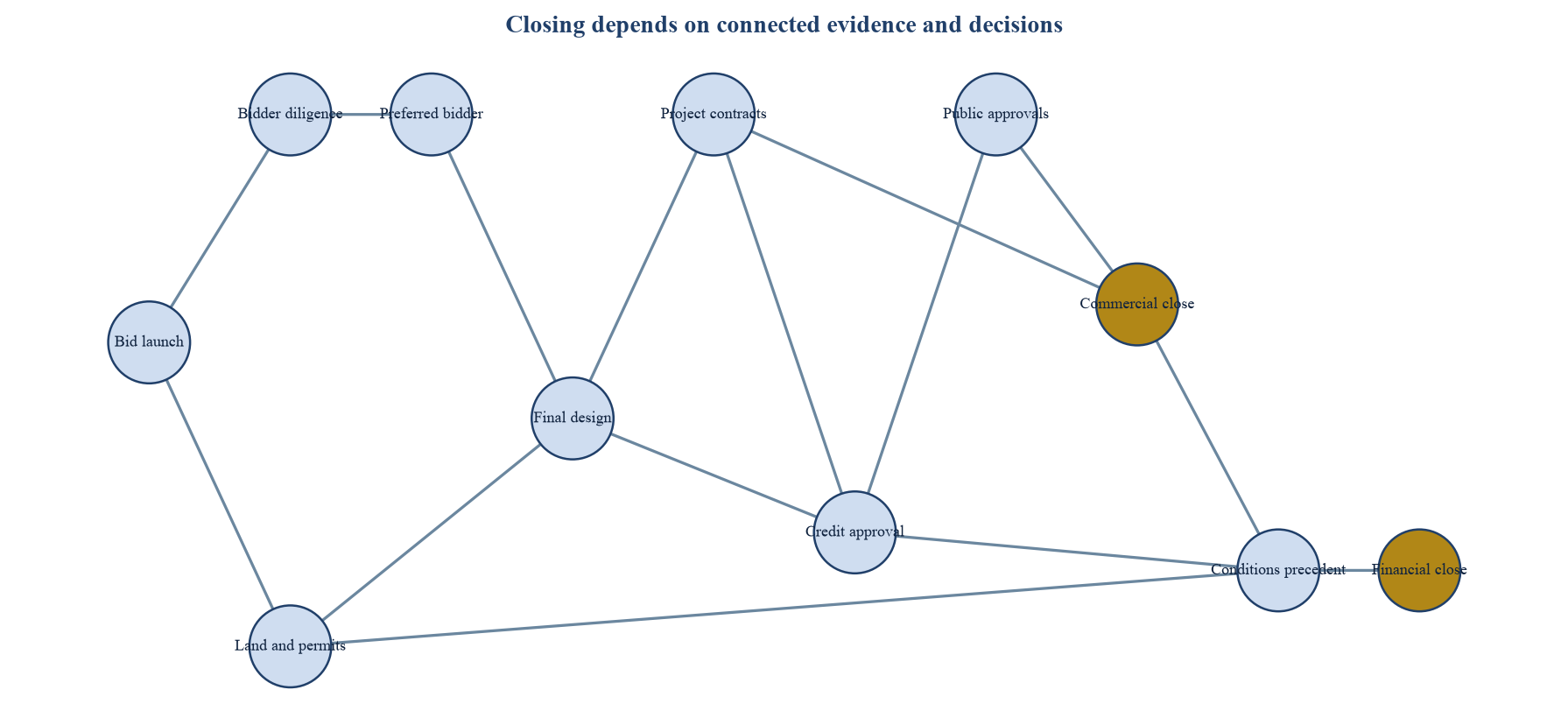
Original framework. The sequence is illustrative and requires project-specific legal, procurement and technical validation.
4. Protect procurement integrity while resolving issues
The procurement workstream should define the permitted dialogue, clarification and negotiation process before bids are received. World Bank guidance describes the bid process as extending through request-for-proposal preparation, bidder interaction, bid receipt, evaluation, preferred-bidder selection and contract finalisation. It cautions against changes after bid that materially alter the risk allocation without having been evaluated through the competitive process. [2]
The timetable should reserve adequate periods for bidder questions, authority responses, data-room updates, site access, model audit, bid preparation and internal approvals. Responses that affect price, scope or risk should be released consistently to eligible bidders in accordance with the procurement rules. The authority should record whether an answer clarifies existing requirements or changes them.
Bid validity, bid security and financing commitments need their own dates. A close programme that extends beyond validity can require consent, security extensions and refreshed financing. The authority should know the latest date on which it can request an extension without undermining competition or creating unequal treatment.
The evaluation plan should identify evaluators, conflicts, quorum, criteria, scoring, clarification rights, moderation and approval. Technical and financial evaluation should use the published basis. Clarifications should not become unrecorded negotiations. Material departures should be treated under the applicable procurement framework.
Preferred-bidder work should have a controlled issues list. Each item should identify the bid position, required clarification, legal basis, commercial effect, approval path and resolution date. The authority should measure movement from the evaluated bid and test whether the resulting contract remains the transaction selected through competition.
The final approval paper should reconcile the executed terms to the procurement outcome. It should identify changes, value effects, risk effects and reasons. EPEC guidance states that the contracting authority commonly brings the procurement result, affordability, stakeholder support, authorisations and readiness to manage the contract into the decision to proceed to commercial and financial close. [3]
5. Control the bidder and authority data rooms
The data room is part of the critical path because diligence questions depend on accessible, current and reliable information. The authority should publish an index that covers project scope, feasibility, design, demand, land, utilities, environment, permits, surveys, legal authority, procurement, payment, fiscal support, existing assets and stakeholder matters.
Every item should have a document owner, version, date, status, confidentiality level and reliance statement. Superseded documents should remain traceable without appearing current. A missing survey or draft approval should be identified as such, with the expected date and allocation of the underlying risk.
Bidder questions should link to source documents and official responses. Repeated questions often indicate that the documents conflict or omit a material assumption. The team should resolve the source issue instead of issuing separate explanations that create an inconsistent record.
After preferred-bidder selection, the financing data room expands to include the final bid model, sponsor approvals, project company documents, construction and operating contracts, insurance, technical reports, environmental and social material, permits, land documents and draft finance agreements. Lender advisers need a controlled cut-off and a method for receiving changes.
The close team should maintain a reliance matrix. It should identify which adviser report can be relied upon by the authority, sponsor, lenders and other parties, under which duty and liability terms. Report delivery alone does not establish lender reliance.
An information-release calendar should sit in the integrated timetable. Late information can require repricing, new approvals or bid extensions. The decision to release new material should state its effect on competition, risk and schedule.
6. Bring land and site access onto the critical path
Land should be decomposed into ownership, acquisition, lease or concession rights, rights of way, access, possession, encumbrances, resettlement, utilities, surveys and registration. World Bank guidance identifies land acquisition and permits among common conditions for contract effectiveness and financial close. [1]
The authority should map every parcel and corridor to the asset design. It should identify the legal interest required, the party responsible, the process, the forecast date and any continuing third-party right. A percentage of land acquired can conceal a missing parcel that blocks the whole alignment.
Site conditions affect both cost and schedule. Geotechnical, contamination, archaeology, unexploded ordnance, existing utilities and access constraints should be investigated to the level needed for pricing and allocation. The tender should state the information on which bidders may rely and how unknown conditions are treated.
Resettlement and stakeholder obligations require realistic sequencing. Consultation, compensation, livelihood restoration and grievance processes can continue beyond a single approval. Environmental and social requirements can affect design, land availability and lender commitment. World Bank guidance states that environmental and social diligence should inform technical feasibility, commercial viability, mitigation cost and risk allocation. [4]
Land conditions precedent should be drafted carefully. Requiring every parcel to be transferred before financial close can delay funding even where construction can proceed in phases. Allowing close without sufficient access can leave debt accruing before productive work begins. The transaction should define the minimum available package, phased access dates, relief, compensation and termination rights.
| Dependency | Completion evidence | Latest useful date | Consequence if late | Planned response |
|---|---|---|---|---|
| Core site possession | Registered right and handover record | Before first drawdown | Mobilisation blocked | Complete transfer or revise draw conditions |
| Linear rights of way | Parcel and access schedule | Before affected works | Sectional delay and contractor claim | Phase works and protect access milestones |
| Environmental approval | Final decision and conditions | Before design freeze | Redesign, mitigation cost or lender hold | Resolve conditions in design and model |
| Construction permit | Issued permit for approved scope | Before site works | Illegal or delayed construction | Align submission, design and review calendar |
| Utility connection | Executed connection agreement | Before testing dependency | Stranded completed asset | Secure capacity, works and energisation dates |
| Third-party interface | Executed interface agreement | Before dependent contract commitment | Unpriced scope and schedule risk | Define service, liability and escalation |
Original framework. Legal interests, authorities and sequencing vary by project and jurisdiction.
7. Convert permits into an approval programme
The permit register should identify the approving authority, legal basis, required submission, design maturity, consultation, fee, statutory period, expected period, conditions, appeal risk, renewal and dependency. Permit names alone do not reveal the work needed to secure them.
The programme should distinguish authority-side enabling approvals from project-company operational approvals. The party best placed to secure an approval should own it, supported by information obligations and relief where another party controls an input.
Submission dates should be linked to design decisions. A permit cannot be accelerated by scheduling it before the required design and studies exist. Parallel development can reduce elapsed time where the authority accepts staged submissions and the project can manage change risk.
Permit conditions must feed the technical scope, construction contract, operating plan, insurance and financial model. An approval that requires additional mitigation, monitoring or redesign has commercial consequences. The close team should record whether these consequences are priced and funded.
Statutory review periods rarely capture the entire elapsed process. Pre-application consultation, validation, requests for additional information, public comment, hearings and appeals can control completion. Historical processing evidence can inform the forecast where it is comparable and verified.
The authority should establish a permit escalation route that respects the independence of regulators. Escalation can resolve missing information, unclear ownership or coordination. It should not predetermine a statutory decision.
8. Align technical diligence with the contracting structure
Technical diligence should test whether the project can be designed, constructed, commissioned, operated, maintained and handed back under the proposed contracts. The review should reconcile output requirements, reference design, bidder solution, construction scope, operating scope, interfaces, standards and payment mechanism.
The technical adviser should maintain a departures register. Each departure should identify the tender requirement, proposed solution, performance consequence, risk allocation, model effect and approval. A technically acceptable alternative can still affect maintenance cost, permit compliance or lender security.
Design maturity should be sufficient for price and schedule confidence while preserving appropriate performance responsibility. An incomplete design can produce exclusions and contingencies. An overly prescriptive design can transfer limited design risk while the contract claims broad private responsibility.
Construction diligence should examine programme logic, critical equipment, supply chain, labour, interfaces, testing, damages, security, parent support and relief. The project schedule and construction schedule need consistent milestone definitions. Service commencement in the payment mechanism should match completion under the construction contract.
Operating diligence should test mobilisation, staffing, maintenance, lifecycle replacement, technology, utilities, performance measurement, deductions, emergency response and handback. Costs should reconcile to the model and contract obligations.
EPEC describes technical adviser work during procurement as including output specifications, technical evaluation, bidder-solution diligence and site, planning and design work. It also describes financial and environmental adviser roles that connect the model, lender negotiations, hedging, permits and environmental diligence. [5] The integrated plan should give these advisers shared assumptions and dates.
9. Make the bid model a controlled transaction instrument
The bid model should have a defined purpose, specification, version, owner, review protocol and approval route. It translates the technical and contractual case into construction funding, revenue, operating cost, tax, debt service, reserves and equity cash flow.
The authority should specify the financial variables used for evaluation and the treatment of inflation, foreign exchange, interest rates, tax, refinancing, deductions and public contributions. Bidder assumptions should be separated from authority inputs. The model should identify which values are fixed at bid, reset at close or determined through market execution.
The preferred-bidder model develops after selection. Changes should pass through a model-change protocol that records the trigger, contractual basis, calculation, evaluation effect and approval. Model changes should not provide an informal route to alter the evaluated bargain.
An independent audit should test arithmetic, logic, consistency with documents, scenario operation and outputs. The audit scope should include macros, circularities, copy errors, flags, units, dates and tax where relevant. Audit completion should be tied to an identified model version.
Financing terms evolve between bid and close. Debt amount, margin, benchmark, fees, tenor, amortisation, reserve accounts, hedging and lender requirements can change. The model should show the effect on tariff, availability payment, equity return, public affordability and funding requirement.
The closing model should reconcile to the sources and uses statement, financing agreements, construction price, sponsor equity and public funding. It should also produce the initial covenant and reserve calculations used by the financing parties.
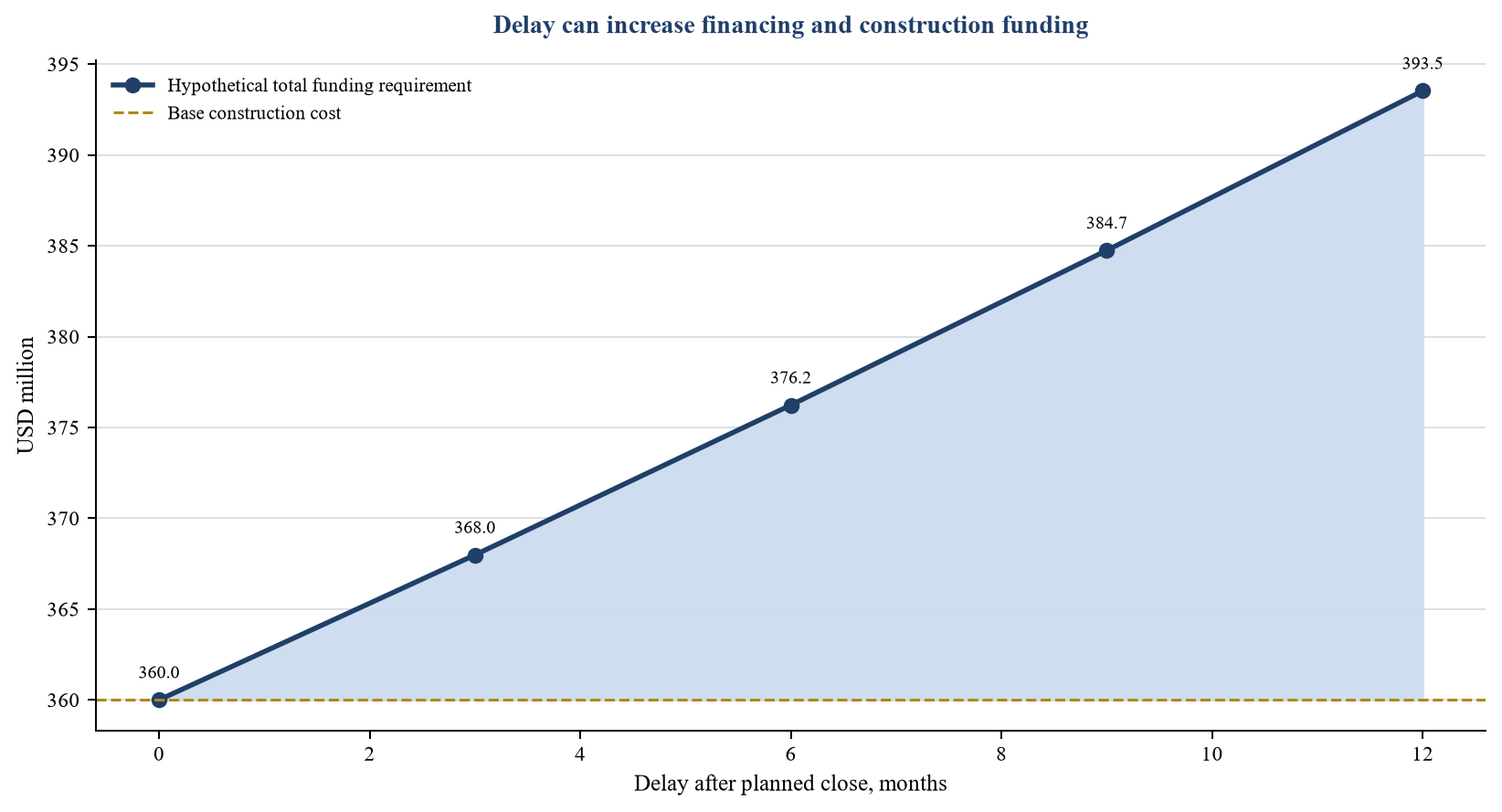
Original hypothetical illustration. All amounts, rates and timing assumptions are illustrative and do not describe a live project.
10. Run financing as a workstream before award
The authority should test financing conditions during project preparation and market sounding. The bidder should develop a credible financing plan during the competition. Waiting until preferred-bidder appointment to discover lender concerns increases the risk of delay or material contract change.
The financing plan should identify debt and equity sources, currency, tenor, underwriting approach, syndication, development-finance participation, export-credit support, hedging, security and conditions. It should distinguish expressions of interest, indicative terms, credit-approved commitments and executed agreements.
Lender diligence generally covers the project agreement, construction and operating contracts, model, technical case, environmental and social matters, insurance, land, permits, sponsors, legal authority, tax and security. The timetable should show when each package reaches review maturity, when adviser reports are issued and when issues must be resolved for credit approval.
World Bank guidance notes that lenders can require changes to project agreements or that financing terms may change after award. Requiring firm commitments at bid can reduce the risk but may be expensive and may reduce competition. [1] The procurement strategy should select a financing-evidence standard proportionate to the market and project.
The authority should set boundaries for lender-driven change. A direct agreement, step-in arrangement or cure period can improve continuity and bankability. A change that shifts an evaluated commercial risk or increases public exposure requires procurement, legal and fiscal review.
Hedging should have a defined execution window, governance and model treatment. Benchmark movement between bid and close can affect payments or returns depending on the contract. The timetable should identify who bears the movement, how rates are fixed and which approvals must precede execution.
11. Control public approvals and decision forums
Approvals should be mapped from legal and policy requirements rather than inferred from an organisation chart. The project can require decisions by the sponsoring authority, procurement committee, sector regulator, finance ministry, PPP unit, cabinet, environmental body, land authority or other competent institution.
Each approval should state the matter decided, evidence required, submission owner, meeting calendar, quorum, dependencies, conditions and expiry. A committee endorsement may be insufficient if formal authority sits elsewhere. Conditional approvals should remain open until their conditions are completed or lawfully carried forward.
Approval papers should use the same scope, model and contract version. The close team should prevent a situation in which one body approves an earlier payment mechanism while another reviews the current risk allocation. Version reconciliation belongs on the agenda for every material decision.
The programme should work backwards from fixed meeting dates and statutory periods. Drafting, internal review, translation, circulation and responses require time. Late submissions can add a full meeting cycle and consume critical float.
Decision makers need a clear record of affordability, fiscal exposure, procurement result, legal authority, project readiness, open conditions and recommendation. Material qualifications should remain visible. Approval should not be described as unconditional when reliance depends on later evidence.
The World Bank due-diligence checklist asks whether the institutional process for feasibility, appraisal, advisers, procurement and approvals is clear, and whether government support requires additional approval. [6] The integrated programme converts that institutional map into dated deliverables and accountable actions.
12. Separate commercial close, effectiveness and first drawdown
Commercial close usually records execution of the project agreement and related commercial documents. Contract effectiveness may occur at signature or after stated conditions. Financial close concerns the executed financing and satisfaction of its conditions. First drawdown can require additional evidence after financial close.
The contract and financing documents should use consistent definitions. A project agreement that starts the construction period at effectiveness can create delay damages before funds are available. A financing agreement that requires an effective construction contract can conflict with a construction contract conditioned on first drawdown.
The completion agenda should list every document, signature, approval, certificate, opinion, payment, account and release. It should identify the party holding each item, the release condition and the sequence. A funds-flow statement should reconcile equity, debt, fees, reserves and public contributions.
Conditions precedent should be objective, evidenced and owned. Material conditions should not be hidden in general compliance certificates. Waiver rights, materiality, satisfaction standards and reliance should be clear. A waiver by lenders does not necessarily waive a public-law or project-agreement requirement.
Long-stop dates and consequences should align. The project agreement, bid security, financing commitments, hedges, construction price and permits can expire on different dates. The team should know which expiry becomes controlling and what extension or termination rights apply.
| Event | Proposed completed state | Evidence | Common control failure |
|---|---|---|---|
| Preferred bidder | Procurement decision approved and notified | Formal award or appointment record | Treating appointment as an executed transaction |
| Commercial close | Principal project documents executed | Signed agreement set and approval record | Leaving effectiveness and open schedules unclear |
| Contract effectiveness | Contract conditions satisfied or waived lawfully | Effectiveness certificate and condition record | Starting obligations before finance is available |
| Financial close | Finance documents effective and funding available | Closing memorandum and lender confirmation | Calling signed loan documents available funding |
| First drawdown | Utilisation conditions met and cash released | Draw request, conditions certificate and bank evidence | Omitting post-close utilisation dependencies |
Original framework. Transaction counsel should tailor definitions and completion mechanics to the governing law and documents.
13. Maintain a live conditions-precedent matrix
The conditions-precedent matrix should combine the requirements from the project agreement, financing documents, shareholder arrangements, construction contract, public-funding documents and material third-party agreements. Separate lists can create conflicting language, duplicate evidence and missed dependencies.
Each condition should identify the source clause, responsible party, evidence, required form, reviewing party, submission date, comments, satisfaction status, waiver authority and relationship to other conditions. It should also identify whether the condition is required for effectiveness, financial close or utilisation.
Draft documents should be circulated early enough for reviewers to agree form. Legal opinions, certificates and corporate approvals often depend on final documents. The timetable should distinguish agreement of form from execution and delivery.
The matrix should record substantive status. "With lawyers" provides little control. A condition can be drafted, submitted, reviewed, agreed in form, signed, delivered and released. Outstanding comments should name the decision needed.
The close manager should hold regular evidence reviews. Owners should present the actual document or official confirmation. The status date, version and storage location should be recorded. Conditions satisfied subject to an uncompleted action should remain qualified.
EPEC guidance describes reaching financial close as signing the project-related agreements and meeting their effectiveness conditions. [3] The matrix gives that principle an auditable operating record.
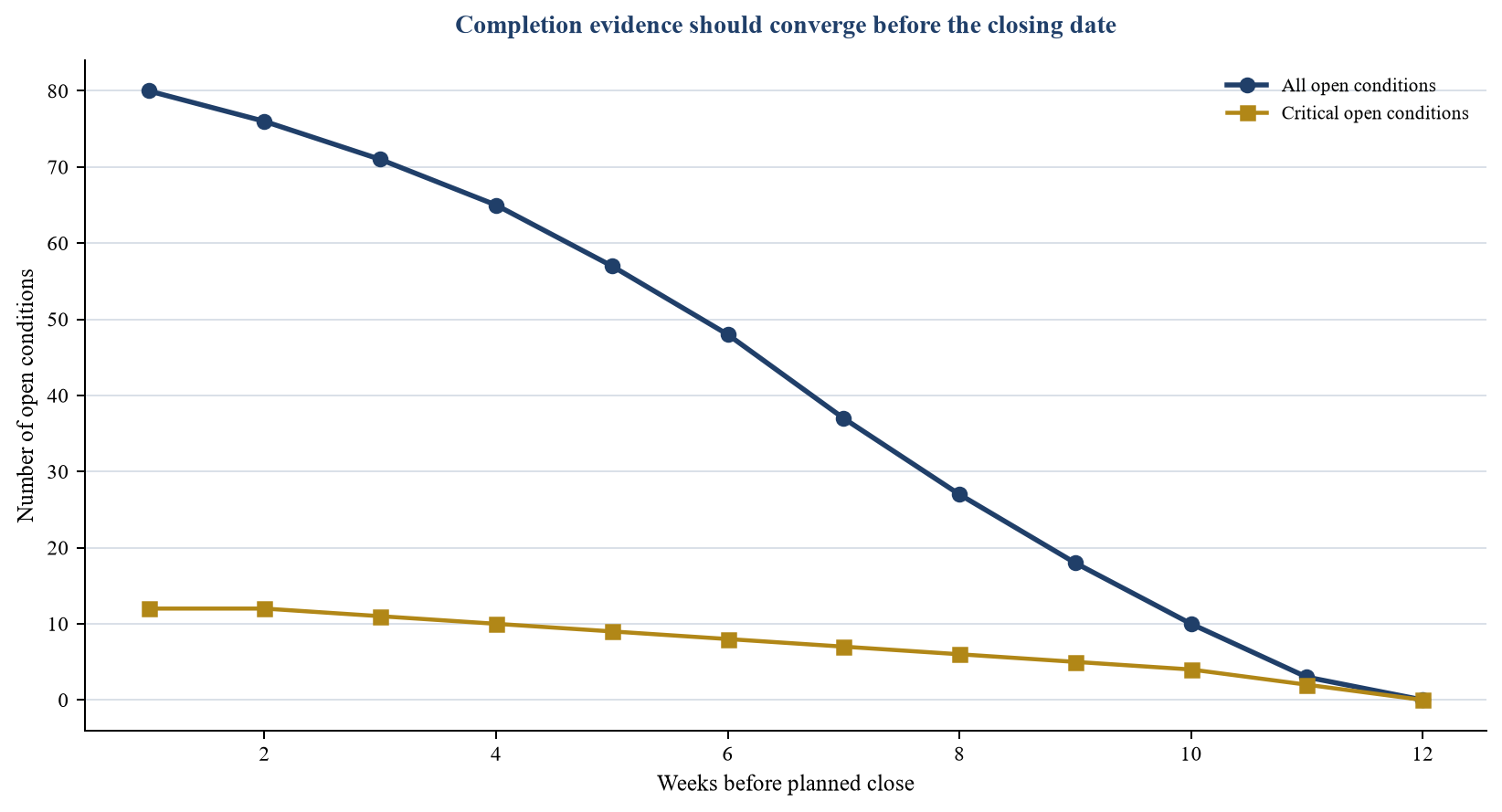
Original hypothetical illustration. Counts and dates are assumptions used to demonstrate close control.
14. Quantify schedule risk and economic consequences
The timetable should connect delay to money and service. A three-month delay can extend adviser cost, bid security, contractor validity, financing commitment fees, interest-rate exposure and inflation. It can also postpone service commencement and public benefits.
The model should define delay scenarios by cause and consequence. Permit delay may postpone design freeze and construction. Financing delay after commercial close may increase commitment costs and consume the construction price validity period. Land delay may affect only one section if the contract supports phased access.
Schedule ranges should reflect evidence. Statutory periods, historical approvals, adviser estimates and contractor programmes have different bases. The team should record the source and confidence of each duration. Correlated delays should be tested because the same design issue can affect permits, price and financing.
Float belongs to the transaction, not to the workstream that first notices it. A noncritical request can consume time needed later for a statutory approval. The programme manager should control changes that use shared float.
Contingency should identify actions, trigger dates, decision owners and costs. Recovery can include parallel review, additional resources, phased land, staged permits, early document agreement or a revised closing mechanism. Acceleration should remain lawful and technically credible.
The close forecast should report a date range where uncertainty is material. It should explain the drivers of the earliest, expected and latest dates and the probability basis if one is used. A single deterministic date can conceal a wide range.
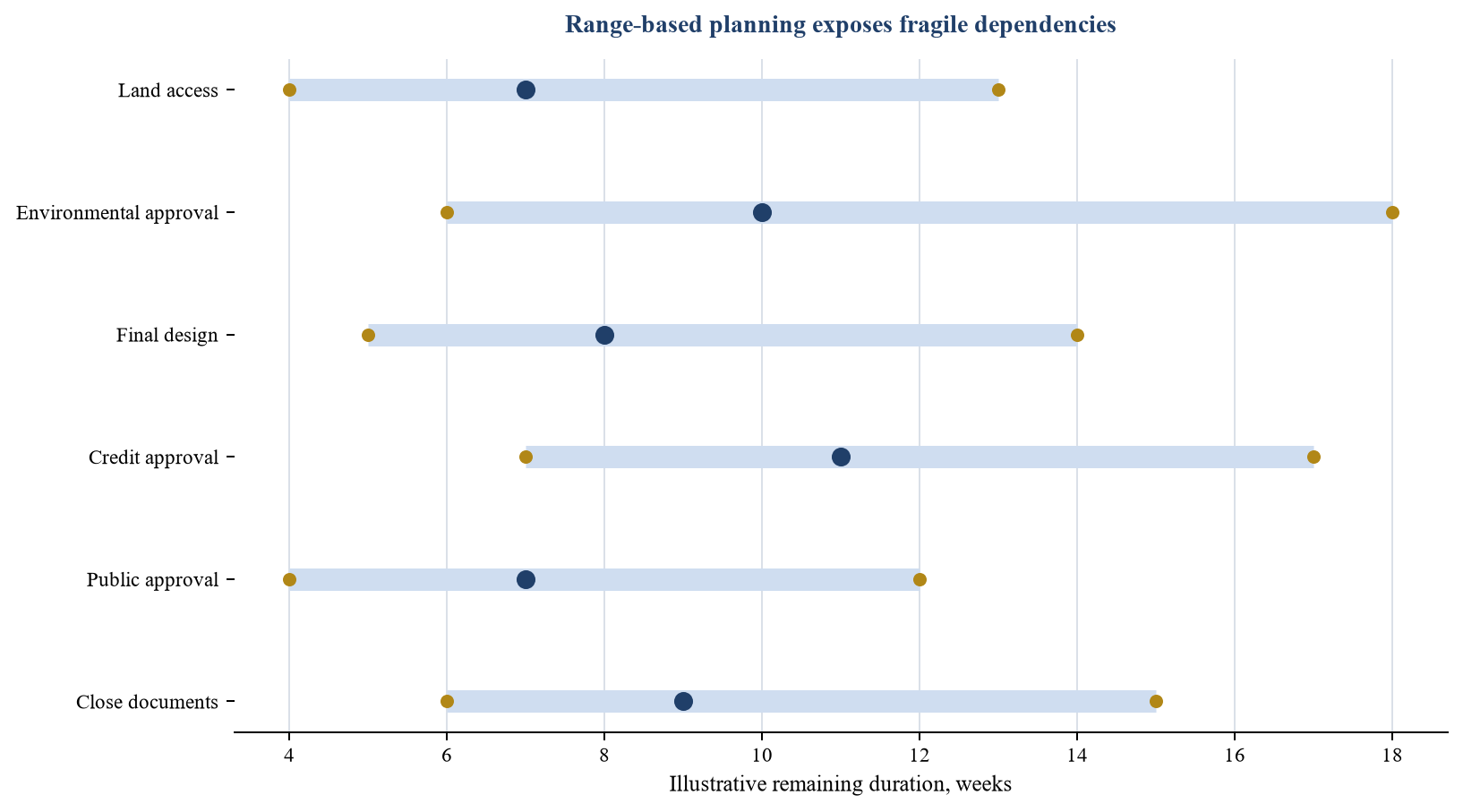
Original hypothetical illustration. Durations and confidence ranges are assumptions and do not predict a live transaction.
15. Use decision gates and escalation before dates fail
The programme should include gates at bid readiness, request-for-proposal release, preferred-bidder appointment, commercial close readiness and financial close readiness. Each gate should test evidence against a defined decision rather than celebrate activity completed.
Bid readiness should cover scope, procurement documents, data room, approvals, land and permit strategy, market evidence, affordability and governance. Preferred-bidder readiness should cover evaluation completion, bid validity, financing credibility, departures and approval. Commercial close readiness should cover final commercial terms, fiscal effects, legal authority and contract-management readiness. Financial close readiness should cover executed finance documents, conditions, security, hedging, funding and first-draw requirements.
Gate papers should list open conditions with consequence and owner. A conditional pass should identify the latest completion date and the authority that can accept residual risk. A failed gate should lead to recovery, restructure or revised timing.
Escalation should occur when intervention remains useful. Reporting a missed permit date after the planned close provides history. Reporting that the submission will miss the next regulator meeting unless a design decision is made within three days enables action.
The governance cadence should match transaction intensity. A weekly integrated review may be adequate during early bidding. Daily close calls can be appropriate near completion. Meetings should decide exceptions and dependencies, while the controlled registers retain detail.
| Decision area | Evidence question | Early warning | Decision response |
|---|---|---|---|
| Procurement | Is the process operating on the published and approved basis | Material clarification, validity pressure or unresolved departure | Issue controlled clarification, extend lawfully or revise decision date |
| Land and permits | Is sufficient lawful access and approval available for the next stage | Submission rejection, parcel dispute or condition affecting design | Re-sequence, resolve scope or activate approved contingency |
| Technical and contracts | Are design, price, schedule and obligations aligned | Exclusion, interface gap or inconsistent milestone | Resolve allocation and update contracts and model |
| Financing | Can committed funds become available on the required terms | Credit qualification, expired terms or unagreed direct agreement | Resolve term, seek approval or revise funding plan |
| Public approvals | Has the competent body approved the current case | Meeting-cycle risk or approval based on superseded version | Reconcile case and secure valid decision |
| Conditions precedent | Is complete evidence converging before the long stop | Critical condition without agreed form or owner | Escalate, restructure sequence or reset close with consequences |
Original framework. Status should be supported by dated evidence and project-specific thresholds.
16. Transfer the closing record into implementation
Financial close should produce an implementation baseline. The contract-management team needs the final agreements, model, land and permit conditions, risk register, stakeholder obligations, reporting requirements, construction programme, payment mechanism and open post-close actions.
The transaction team should prepare a handover record before close. It should identify obligations beginning at effectiveness, notices due, approvals retained by government, monitoring systems, security expiry, insurance, deliverables and decision rights. Owners should accept the record.
The programme should distinguish closed conditions from continuing obligations. A permit may be issued with monitoring requirements. Phased land can remain an authority obligation. Sponsor support can continue until completion. These items should move into the contract-management system with dates and consequences.
The final model and funding plan should become controlled baselines for construction monitoring, payment and fiscal reporting. Changes after close should follow the contract and approval framework.
The Global Infrastructure Hub contract-management tool, summarised by the World Bank, draws on data from more than 250 projects and emphasises that arrangements before financial close influence performance during construction and operations. [7] Close quality therefore affects the authority's ability to manage the project over its life.
The close report should record the final transaction, approved departures, conditions satisfied or waived, residual risks, funding sources, model outputs, public commitments and lessons for later procurements. It should preserve evidence without disclosing protected commercial information improperly.
17. Apply the framework to a hypothetical transaction
Consider a wholly hypothetical infrastructure partnership with USD 360 million of base construction cost. The public authority plans an eighteen-month period from bid launch to financial close. The procurement includes a competitive request for proposals, preferred-bidder phase, commercial close and financing completion.
The baseline assumes that core land is available at bid launch, remaining linear rights are completed by preferred-bidder appointment, the environmental approval is obtained two months before final design, credit approval follows agreed project contracts, and public fiscal approval precedes commercial close. These are assumptions.
At month nine, three issues emerge. A corridor parcel is disputed, the environmental authority requests additional modelling, and lenders require a revised termination schedule and direct agreement. The dependencies place final design, construction price, credit approval and conditions precedent on the same path.
The first response separates the core site from the affected corridor and tests whether phased access is lawful and technically feasible. The second creates a dated design and environmental response plan. The third agrees the direct-agreement principles and revised termination calculation before full documentation.
The hypothetical delay model assumes base construction cost of USD 360 million, monthly financing and adviser effects rising from zero to USD 13.6 million over twelve months, and monthly construction escalation of 0.45 per cent. Under those assumptions, total funding rises to approximately USD 393.6 million after twelve months. The result is arithmetic based on the stated assumptions and excludes many project-specific effects.
The conditions matrix begins with 84 items, including twelve classified as critical. The close manager measures satisfied evidence weekly. By the ninth week, eighteen conditions remain open, including five critical items. The parties do not describe the transaction as ready for close until those items have agreed evidence, owners and completion dates.
The framework does not establish that the project is suitable, affordable or financeable. It shows how a project team can connect evidence, decisions and consequences so that those conclusions can be made transparently.
18. Implementation roadmap
The first thirty days should establish governance, definitions and the integrated schedule. The authority should confirm the procurement route, workstreams, owners, decision bodies, evidence standard and status date. The team should reconcile existing schedules and identify circular dependencies.
Days thirty-one to ninety should strengthen the project information and approval programme. The team should complete the dependency ledger, land and permit matrix, controlled data-room index, model protocol, financing plan and public-approval map. Material gaps should be resolved before they become bidder qualifications.
During bidding, the team should maintain controlled clarifications, data releases, site access and version alignment. It should monitor bid validity, adviser deliverables, approvals and market changes. The forecast should be updated against the approved baseline.
After preferred-bidder appointment, the programme should shift to a close plan. The parties should freeze the issues list, agree document principles, mobilise lender advisers, complete the model audit, prepare direct agreements and populate the conditions-precedent matrix.
Before commercial close, the authority should confirm that the final terms remain within the approved procurement result, that fiscal and legal approvals cover the current version, and that the contract-management team is ready. Before financial close, the parties should complete the closing agenda, funding plan, security, hedging, conditions and first-draw sequence.
After close, the team should transfer every continuing obligation and residual risk to implementation owners. The final close report should preserve the basis on which the transaction was approved and funded.
19. Management questions at each reporting date
Senior decision makers should receive a short set of questions tied to evidence. Which milestone currently controls the close date? Which predecessor prevents it from completing? How much float remains? What decision must be taken, by whom and by what date? Which project document, model input or approval changes if the activity moves? What cost, funding, bid-validity or service consequence follows?
The answers should come from the integrated timetable and its supporting registers. A red status should identify a defined failure or forecast breach. An amber status should identify a dated intervention needed to protect the baseline. A green status should have completed evidence or sufficient verified float. Colour without these definitions can conceal judgement and inconsistency.
Management should also test whether the programme preserves competition and public value. Schedule pressure can encourage late bilateral changes, incomplete diligence or reliance on conditional approvals. The close team should state when timing choices affect the evaluated transaction, fiscal exposure or legal process and route those choices to the competent decision maker.
The final question is whether the reported close date remains credible. Credibility depends on connected evidence, remaining durations, review capacity and the behaviour of external parties. The team should change the forecast when evidence changes. Preserving an outdated date shifts uncertainty into documents, pricing and execution.
Sources
- World Bank Group, Achieving Contract Effectiveness and Financial Close, PPP Legal Resource Center, accessed 15 September 2026. Read the primary source
- World Bank Group, Managing the Bid Process, PPP Legal Resource Center, accessed 15 September 2026. Read the primary source
- European PPP Expertise Centre, EPEC Guide to Public-Private Partnerships, 2024. Read the primary source
- World Bank Group, Environmental and Social Studies and Standards, PPP Legal Resource Center, accessed 15 September 2026. Read the primary source
- European PPP Expertise Centre, The Guide to Guidance: How to Prepare, Procure and Deliver PPP Projects, 2011. Read the primary source
- World Bank Group, Due Diligence Checklist, PPP Legal Resource Center, accessed 15 September 2026. Read the primary source
- Global Infrastructure Hub, PPP Contract Management Tool, 2018, as hosted by the World Bank PPP Legal Resource Center. Read the primary source
- World Bank Group, Public-Private Partnerships Reference Guide Version 3, 2017. Read the primary source
- Organisation for Economic Co-operation and Development, Infrastructure Governance, accessed 15 September 2026. Read the primary source
- European Bank for Reconstruction and Development, PPP Regulatory Guidelines Collection Volume 2 Chapter 6, 2023. Read the primary source
