

1. Treat primary and secondary capital as separate decisions
Primary and secondary transactions move cash to different recipients. A primary subscription issues new shares and puts cash on the company’s balance sheet. A secondary purchase transfers existing shares and pays the selling shareholder. The investor may negotiate both components at the same time, but the board should assess the company financing and the shareholder sale separately before approving the combined transaction.
The distinction determines the use of proceeds, dilution, share count, seller tax, securities-law route, accounting treatment and governance process. It also changes the commercial signal. Primary capital says that the company has a funded plan. Secondary liquidity says that some existing holders are converting part of their illiquid wealth into cash. Neither signal is inherently positive or negative. The interpretation depends on scale, timing, seller behaviour and the company’s remaining funding position.
The Primary and Secondary Allocation Test begins with the amount the company needs to finance an approved plan through a defined milestone. It then assesses whether shareholder liquidity supports concentration reduction, retention, estate planning, fund-life management or cap-table repair. The transaction proceeds only when the liquidity component does not displace essential primary capital or impair alignment.
The board should record two conclusions. First, the primary amount is sufficient under the agreed downside case. Second, the secondary amount and seller allocation are fair to the company and its shareholders. Combining those conclusions in one paper can conceal the trade-off. Keeping them visible creates a better negotiation and a stronger approval record.
2. Map the two cash flows before negotiating price
The transaction map should show the source and destination of every dollar. It should distinguish new shares, transferred shares, option exercises, tax withholding, fees, debt repayment and cash retained by the company. This prevents the headline financing amount from overstating the capital available for growth.
An investor offering USD 60 million may be willing to fund any combination of primary and secondary purchases. If USD 25 million goes to sellers, only USD 35 million extends runway. The company must test whether that amount covers the operating plan, committed capital expenditure, working capital, financing fees and a downside buffer. The sellers must understand any exercise cost, withholding, transfer tax and transaction expense that reduces their net proceeds.
The map should also identify securities and rights. Newly issued preferred shares may have liquidation, anti-dilution, information and governance rights that existing ordinary shares do not carry. A buyer can acquire existing ordinary shares, require their conversion, or buy a new preferred security from the company while purchasing ordinary shares from sellers. The same price per share does not make instruments economically identical.
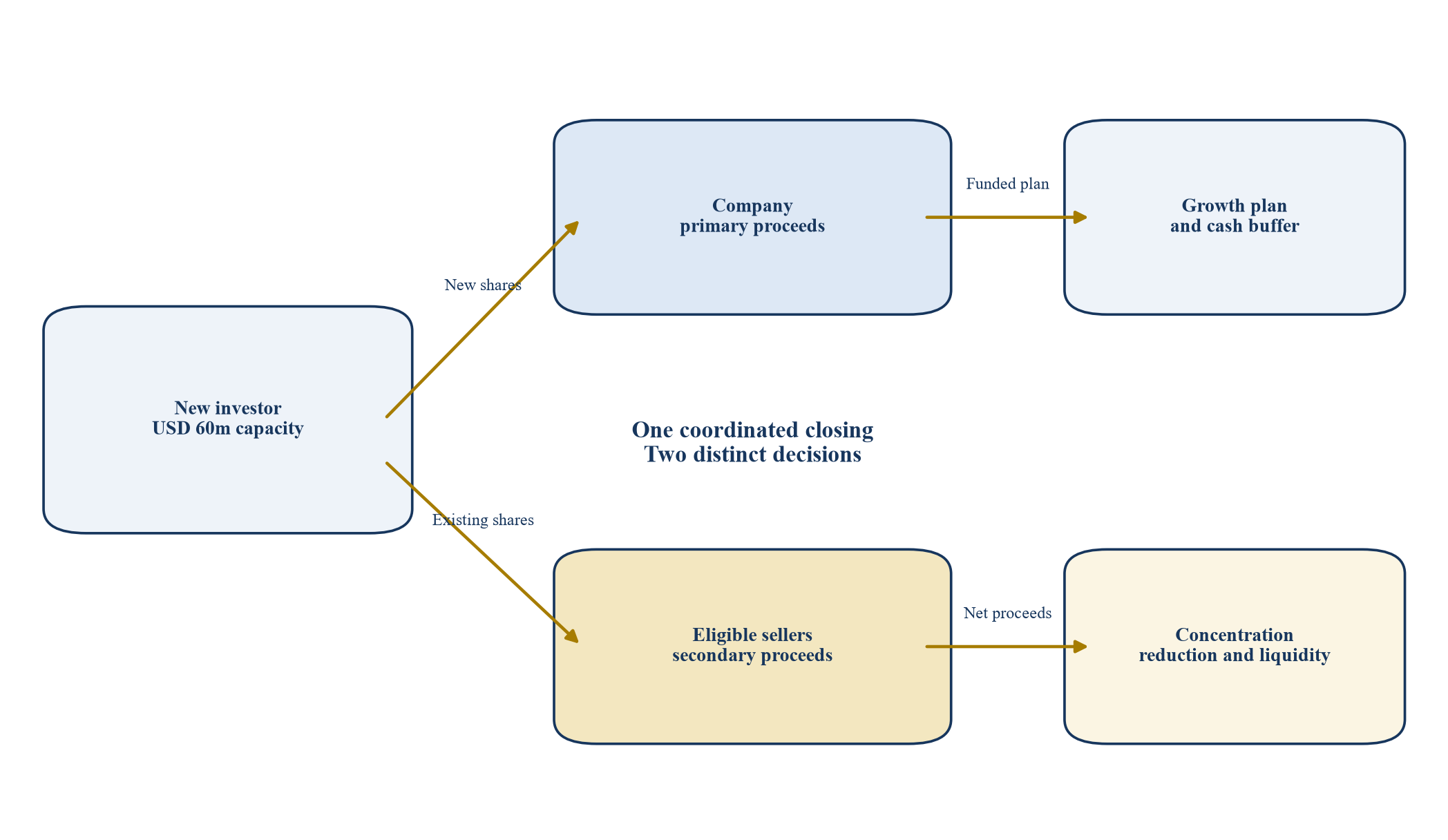
The diagram separates company funding from shareholder liquidity. Legal form, tax and accounting treatment depend on the definitive documents and applicable jurisdiction.
3. Fix the primary requirement from the operating plan
The company’s capital requirement should be established before the secondary pool is negotiated. The starting point is a monthly cash model through the next value-creating milestone. The model should include revenue conversion, gross margin, payroll, capital expenditure, debt service, working capital, taxes and transaction costs. It should state the minimum cash balance required for operational resilience.
Management should prepare a base case and at least one downside case. The downside should delay revenue, reduce margin or extend working-capital cycles rather than apply an unexplained percentage haircut. Financing risk often appears through time: a six-month delay in customer acceptance can require more cash even when the eventual revenue remains unchanged.
The primary amount should fund the downside case to a milestone that can support the next financing, strategic transaction or self-funded position. A round that leaves the company dependent on another raise within twelve months may limit negotiating leverage. A larger primary round creates more dilution, so the board must balance financing resilience against ownership cost.
For the hypothetical company, the approved operating plan requires USD 36 million. A USD 9 million buffer covers a defined delay in commercial conversion and working-capital collection. The primary requirement is therefore USD 45 million. Secondary capacity is considered only after that amount is protected.
| Funding component | Base requirement | Downside adjustment | Proposed funding |
|---|---|---|---|
| Product and commercial investment | USD 17m | USD 2m timing extension | USD 19m |
| Working capital | USD 8m | USD 4m slower collection | USD 12m |
| Capital expenditure and systems | USD 7m | USD 1m contingency | USD 8m |
| Debt service and transaction costs | USD 4m | USD 1m fee and rate buffer | USD 5m |
| Minimum operating cash | Included in plan | USD 1m additional reserve | USD 1m |
| Total | USD 36m | USD 9m | USD 45m |
All values are hypothetical inputs for the worked case and are not forecasts or market benchmarks.
4. Define the commercial purpose of secondary liquidity
Secondary liquidity should solve an identified ownership problem. A founder may hold nearly all personal wealth in one company after a decade of work. An employee may need cash to exercise options and meet tax. An early investor may face fund-life constraints. A former employee may remain on the cap table without an active relationship. Each case has a different rationale and should not be treated as a general entitlement to sell.
The board should state the objective in the transaction paper. Founder concentration reduction can support patient decision-making. Employee liquidity can improve retention when it is offered under a consistent programme. Early-investor liquidity can simplify the ownership register and remove pressure for an early exit. Cap-table repair can consolidate small or inactive holdings before a larger institutional round.
The purpose should determine the cap. A limited sale that converts a modest portion of a founder’s holding may preserve substantial upside exposure. A broad sale that removes most of the founder’s economic stake requires a different assessment. The buyer should examine post-closing ownership, vesting, governance role, employment obligations and the founder’s continuing financial exposure.
The company should avoid describing liquidity as a reward for past service. That framing can create expectations among holders who are not included and can blur the distinction between a share sale and compensation. Eligibility and allocation should be tied to the documented transaction objective.
5. Set a liquidity budget and concentration limits
The secondary budget is constrained by investor capacity, company funding needs and alignment. The budget can be expressed as a percentage of total investor cheque, a percentage of seller holdings, a multiple of salary, or a fixed amount. Using more than one limit prevents a single metric from producing an extreme result.
For example, the policy may limit total secondary purchases to 25 per cent of the investor’s cheque, founder sales to 15 per cent of each founder’s pre-transaction holding, and employee sales to the amount required for option exercise, tax and a modest cash distribution. These are design examples rather than recommended market terms. The appropriate limits depend on stage, profitability, ownership concentration and transaction purpose.
Post-sale concentration matters more than gross proceeds. A founder selling USD 10 million from a USD 150 million holding remains highly exposed. A founder selling the same amount from a USD 12 million holding nearly exits. The board should show retained shares, fully diluted ownership, vested and unvested awards, voting power and value under downside, base and upside scenarios.
The investor should also disclose whether it intends to acquire more shares from other holders. Parallel bilateral purchases can defeat a company-approved cap and change control or governance without a single visible transaction. The definitive documents should aggregate coordinated purchases where appropriate.
| Seller category | Permitted purpose | Illustrative limit | Required evidence |
|---|---|---|---|
| Founder still operating the business | Personal concentration reduction and long-term planning | Lower of 15% of holding or agreed cash cap | Retained ownership, role, vesting and tax advice |
| Current employee | Exercise cost, tax and limited liquidity | Vested securities only; programme cap | Award documents, payroll analysis and continued-service status |
| Former employee | Cap-table simplification | Board-approved amount or full small holding | Good-leaver status, transfer documents and tax analysis |
| Early institutional investor | Fund-life or portfolio-management need | Negotiated pro rata allocation | Authority to sell, title and side-letter review |
| Related party or director | Documented liquidity purpose | Independent approval and enhanced disclosure | Conflict declaration, fairness evidence and disinterested recommendation |
The matrix is a governance framework. The values and priorities are hypothetical and should be adapted to the transaction.
6. Decide who sells through a disclosed allocation policy
Demand to sell can exceed the secondary budget. The company should adopt an allocation method before collecting binding orders. Common methods include pro rata allocation, priority tiers, minimum participation for small holders, or a combination. The chosen method should reflect the transaction objective and be disclosed to eligible participants.
A founder-only sale may be defensible when the purpose is concentration reduction and the founder remains central to execution. An employee programme may support broader fairness and retention. An investor-led tender can offer the same terms to a defined class. The process should avoid ad hoc exceptions that reward access or create unexplained differences among similarly situated holders.
Oversubscription should be expected. The rules should specify whether requests are reduced pro rata by shares tendered, ownership, or an equal base allocation followed by pro rata distribution. The company should also decide how cancelled, unvested, pledged, disputed or otherwise restricted securities are treated.
The allocation record should identify invitations, elections, accepted amounts and reasons for exclusion. Personal tax data should remain confidential. The board needs enough information to assess fairness without circulating unnecessary individual details.
7. Compare price and rights on a common economic basis
A primary preferred share and a secondary ordinary share can have different rights. Applying the same price to both can overpay for ordinary shares or understate the economics of the preferred security. Applying a discount to secondary shares may be justified by rights differences, illiquidity, transfer restrictions or the absence of company proceeds. It can also create employee-relations and tax issues if the rationale is weak.
The price analysis should bridge enterprise value to equity value and then allocate value across the capital structure. It should test liquidation preferences, participation, conversion, anti-dilution, dividends, voting rights and transfer constraints. If the secondary shares convert into the new preferred class at closing, the conversion should be explicit and the resulting rights reflected in the cap table.
IFRS 13 defines fair value as an exit price in an orderly transaction between market participants at the measurement date. [1] It does not establish the tax value or the price that parties must use. It provides a disciplined reminder that instrument characteristics, market conditions and participant assumptions matter.
The board should receive a price-and-rights bridge. The bridge should show the primary price, secondary price, security class, rights package, implied fully diluted equity value and sensitivity to preference terms. A single headline valuation is insufficient where different instruments carry different economics.
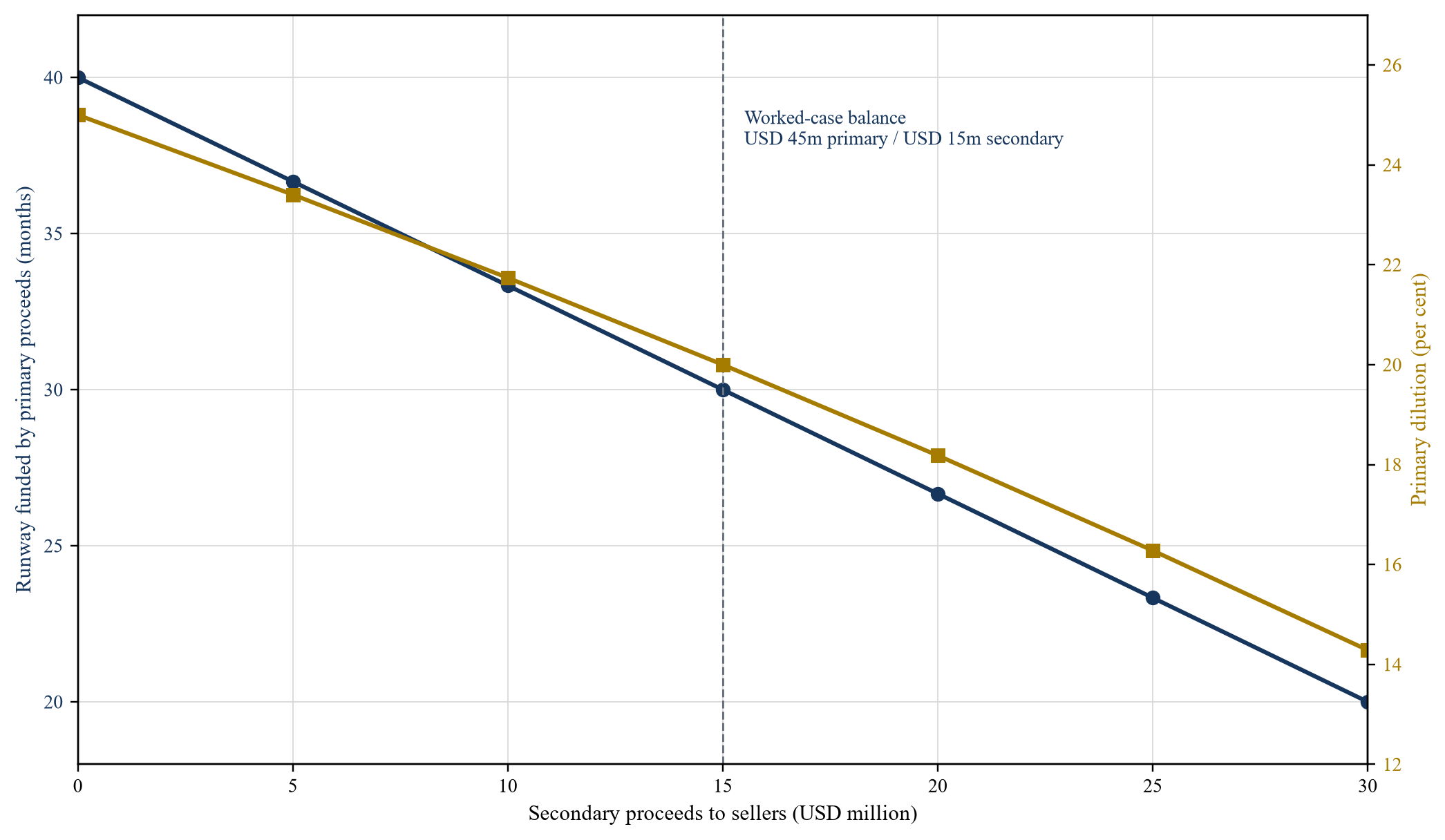
The frontier assumes a USD 180 million pre-money equity value and USD 1.00 per share. Runway uses a hypothetical USD 1.5 million monthly cash requirement.
8. Model dilution ownership and voting after closing
The fully diluted cap table should be modelled before documents are negotiated. Primary shares increase the denominator. Secondary shares transfer ownership without increasing the denominator. Option exercises may increase issued shares but may already be included in the fully diluted denominator. Conversions, warrants and pool increases can change both ownership and rights.
The hypothetical company has 180 million fully diluted shares and a USD 180 million pre-money equity value, implying USD 1.00 per share. An all-primary USD 60 million financing issues 60 million shares and gives the investor 25 per cent of the post-money fully diluted equity. A USD 45 million primary subscription issues 45 million shares. If the investor also buys 15 million existing shares, it holds 60 million of 225 million post-closing shares, or 26.7 per cent. The company receives USD 45 million and sellers receive USD 15 million.
With USD 35 million primary and USD 25 million secondary, the post-closing denominator is 215 million shares and the investor holds 60 million, or 27.9 per cent. The company has less cash and less primary dilution, while the investor’s ownership is higher because more shares are transferred from existing holders.
Voting must be tested separately. The new preferred class may vote on an as-converted basis and also hold class consents. Seller voting power declines by the number of shares sold. Board appointment rights may depend on ownership thresholds. The model should test whether the combined purchase crosses thresholds in the articles, shareholder agreement, financing documents or regulation.
| Structure | Primary proceeds | Secondary proceeds | Post-money shares | Investor ownership | Runway at USD 1.5m per month |
|---|---|---|---|---|---|
| All primary | USD 60m | USD 0m | 240m | 25.0% | 40.0 months |
| Balanced mix | USD 45m | USD 15m | 225m | 26.7% | 30.0 months |
| Liquidity weighted | USD 35m | USD 25m | 215m | 27.9% | 23.3 months |
The illustration excludes fees, taxes and option-pool changes. Amounts do not represent a recommendation or forecast.
9. Test whether the financing signal remains credible
Future investors will examine why sellers took liquidity and whether the company received enough capital. A modest, disclosed programme after years of illiquidity can show maturity. A large founder sale before operating targets are met can raise questions about conviction. The board cannot control every interpretation, but it can make the underlying logic coherent.
The transaction narrative should connect the primary amount to an operating milestone and the secondary amount to an ownership purpose. It should show meaningful continuing ownership for active founders and employees. It should avoid promotional claims about alignment that are inconsistent with the post-closing cap table.
The company should model the next round. If the current investor owns 26.7 per cent after the balanced structure and has pro rata rights, a later financing may require significant follow-on capacity. The option pool, management incentive plan and acquisition currency should remain large enough to support execution. A current transaction that consumes all authorised shares or creates a complex rights stack can reduce future flexibility.
Information supplied to future investors should reconcile with the current board paper, cap table and financial statements. Inconsistent descriptions of seller motivation, price or use of proceeds can damage diligence even when the transaction itself was sound.
10. Establish an independent conflict process
A company-facilitated sale by founders or directors creates a conflict because decision-makers may receive personal proceeds. The board should identify interested directors, determine the applicable approval route and obtain a disinterested recommendation where possible. Minutes should record the company purpose, alternatives, process and effect on non-selling shareholders.
The G20/OECD Principles call for related-party transactions to be approved and conducted through processes that manage conflicts and protect the company and shareholders. They also emphasise equitable treatment and disclosure of material interests. [2] Those principles are designed for broader corporate-governance systems, but the conflict discipline is directly relevant to a private recapitalisation.
The board should consider whether the company is providing resources to facilitate a private benefit. Management time, legal costs, waivers and information can be necessary for the financing as a whole. The transaction documents should allocate costs explicitly. Seller-specific tax, estate-planning or title work should not automatically be borne by the company.
Where all directors are interested, the company may need shareholder approval, a special committee, an independent director, or external advice depending on its jurisdiction and documents. The paper should identify the legal basis rather than using independence as a label without authority.
11. Check transfer restrictions and company approvals
Existing shares may be subject to rights of first refusal, co-sale rights, board consent, permitted-transfer rules, lock-ups, pledges, leaver provisions and securities-law legends. The company should build a transfer matrix for each selling holder and security class. A signed purchase agreement does not cure a prohibited or incomplete transfer.
Delaware General Corporation Law permits written transfer restrictions in the certificate, bylaws or agreements, subject to statutory conditions and notice requirements. [3] The NVCA model documents include a right of first refusal and co-sale agreement alongside the principal financing documents. [4] These sources show why the transfer process must be coordinated with the financing suite.
UK companies must also operate within their articles, shareholder agreements and the Companies Act 2006. A company purchase of its own shares is different from an investor’s secondary purchase and is subject to specific rules on authority, funding and payment. [5] ADGM Companies Regulations similarly contain provisions governing company purchases of own shares and their financing. [6]
The closing checklist should identify every waiver, consent, notice, certificate, stock power, register update and beneficial-ownership filing. It should also confirm that the buyer becomes party to applicable shareholder and investor-rights agreements.
12. Select the securities-law route for each leg
The primary issuance and each secondary resale require an applicable securities-law analysis. In the United States, privately issued securities are generally restricted. The SEC identifies registration exemptions for private offerings and notes that secondary resales require registration or a valid exemption. [7] Rule 144 provides one safe-harbour route for specified public resales, subject to conditions that vary by issuer and seller status. [8]
A negotiated private sale to an institutional investor may rely on a different exemption from a public resale. The parties should assess seller status, purchaser qualification, manner of offering, information delivery, state law and integration with the primary financing. The company should avoid describing a private transaction as freely tradable liquidity.
Employee participation introduces additional issues. SEC Rule 701 covers specified compensatory issuances by non-reporting companies and requires disclosure above the current threshold, while securities issued under the rule remain restricted. [9] A later employee sale is a separate transaction and requires its own analysis.
Outside the United States, the company should identify the issuer jurisdiction, seller residence, purchaser location and any financial-promotion, prospectus, market-intermediary or exchange-control requirements. The transaction plan should assign responsibility for each legal opinion and representation.
13. Complete tax analysis before inviting sellers
Seller tax can determine participation and net proceeds. The company should provide process information and require sellers to obtain personal advice. It should not promise a capital-gains result or a specific net amount. Residence, domicile, employment history, security terms, acquisition cost, vesting and elections can change the analysis.
UK guidance states that a gain on the disposal of shares may be subject to capital gains tax. [10] Employment-related securities rules can apply where shares or options arise from employment, and the tax treatment may include income tax, National Insurance, reporting and capital gains consequences. [11] Current HMRC guidance includes specific rules for restricted and convertible securities. [12]
The company should assess payroll withholding and employer obligations. If an employee exercises options immediately before selling, the exercise and sale may produce different tax events. If shares are restricted, the unrestricted market value and any elections can matter. Cross-border service can allocate employment income across jurisdictions.
The seller pack should show gross price, exercise cost, estimated withholding, fees and cash paid at closing. Any estimate must be labelled as provisional and subject to the seller’s circumstances. The company should retain tax forms and payroll evidence required by law.
14. Protect employee equity and retention economics
Employee liquidity can improve the credibility of equity compensation when staff have held illiquid awards for years. It can also reduce future motivation if participation is large, arbitrary or followed by a lower financing price. The programme should connect liquidity to retention and a clear long-term incentive design.
IFRS 2 requires entities to recognise share-based payment transactions, including employee equity awards, in their financial statements. [13] A secondary sale does not automatically change the original grant-date accounting. Modifications, cancellations, net settlement or new awards can affect accounting and should be reviewed before terms are promised.
Eligibility should normally distinguish vested and unvested awards. Allowing sale of unvested economics can weaken service conditions unless the company creates a replacement mechanism. Requiring employees to exercise all options to sell a small portion can create unnecessary funding and tax burdens. Net exercise, sell-to-cover or limited exercise arrangements may be considered where legally and administratively available.
Post-sale incentives should be tested by employee cohort and role. The compensation committee should review retained equity value, vesting schedule, dilution from any pool refresh and fairness across participants. A liquidity programme should not become a substitute for a coherent compensation policy.
15. Preserve founder and management alignment
Alignment depends on retained exposure, role, governance and future incentives. A founder can remain strongly aligned after a secondary sale if most ownership is retained and the operating role is clear. A founder can remain poorly aligned despite high ownership if governance, succession or compensation is unresolved.
The board should model founder wealth under downside, base and upside cases before and after the sale. It should distinguish cash received, retained equity, vested options, unvested incentives and any earn-out or performance award. The analysis should consider whether personal guarantees, loans or pledges are released at closing.
The buyer may request reverse vesting, lock-up, good-leaver and bad-leaver provisions, or service commitments. These terms can protect continuity but must be proportionate and documented. Re-vesting shares that were already earned can create negotiation, tax and accounting consequences. New incentive awards should have an identified commercial purpose.
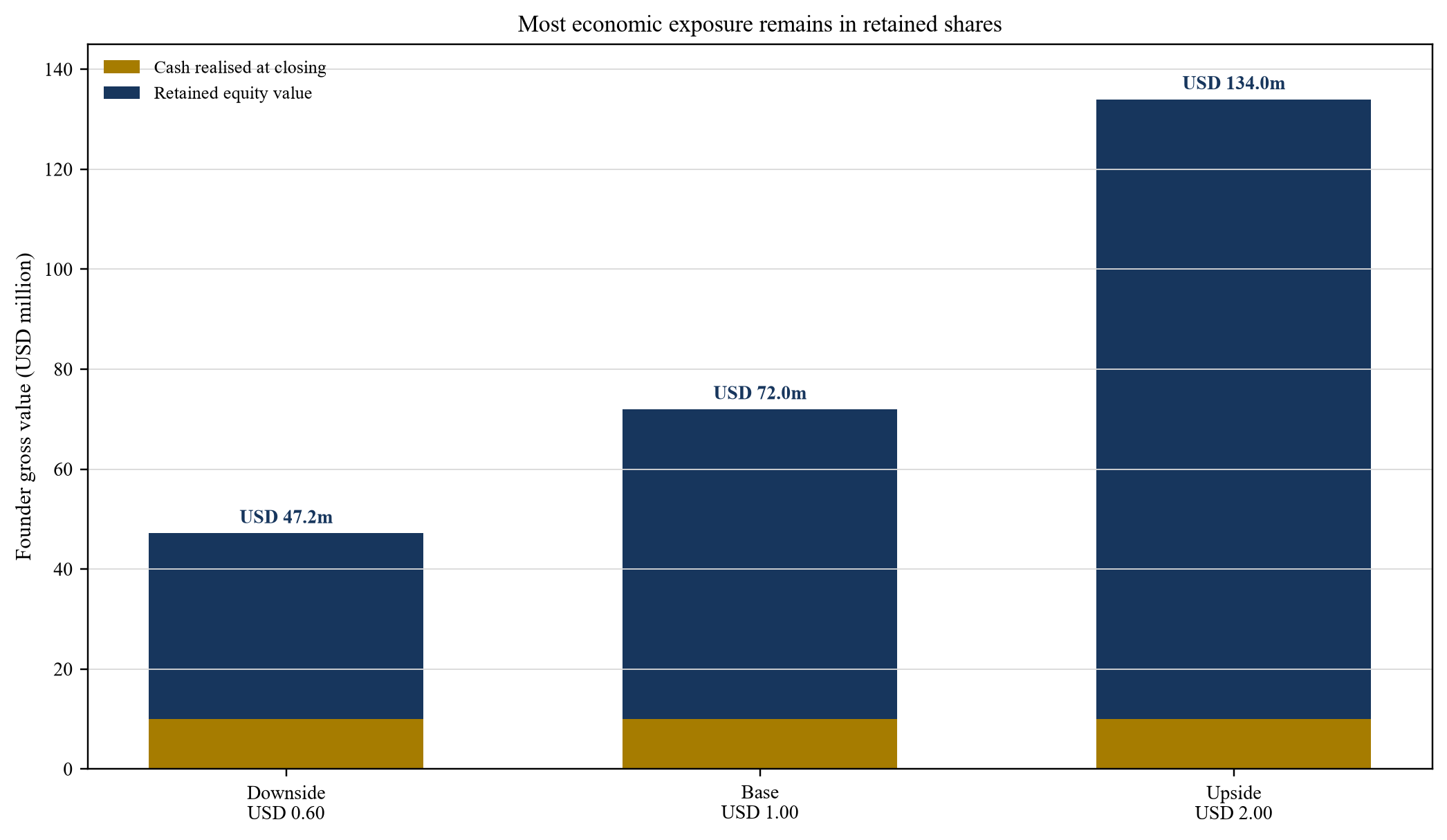
Values assume a founder holds 72 million shares before closing and sells 10 million at USD 1.00 per share. Equity values are scenario inputs and exclude tax.
16. Coordinate the financing documents as one system
The primary and secondary legs should share a coordinated signing and closing plan. The documents may include a stock purchase agreement for new shares, a secondary share purchase agreement, amended constitutional documents, investor-rights agreement, voting agreement, transfer waivers, disclosure letter, employment amendments and joinders.
The NVCA model-document suite is designed as an internally consistent starting point for venture financings and is updated for changes in law and market practice. [4] Transaction teams should still adapt it to the company, jurisdiction and mixed primary-secondary structure. Copying a model without reconciling the secondary leg can create inconsistent representations, indemnities, closing conditions or transfer rights.
Company representations should cover the primary issuance and cap table. Sellers should give title, authority and encumbrance representations for transferred shares. The buyer may require business representations from the company for both legs. The allocation of liability should reflect who receives the proceeds and who controls the information.
Closing conditions should prevent one leg from completing without the other unless the board has approved that outcome. The funds-flow memorandum should state purchase price, fees, withholding, exercise costs and settlement accounts. The post-closing register should reconcile exactly to the transaction documents.
17. Protect capacity for future fundraising
A mixed recapitalisation can affect the next round through price precedent, ownership, pro rata rights, preference stack and information rights. The current investor may require participation rights that consume a large share of the next financing. Sellers may retain rights that were intended for active major holders. The company should model these effects before closing.
The authorised share capital or board issuance authority must cover the new shares, option pool and foreseeable follow-on financing. UK statutory pre-emption and any contractual pre-emption should be reviewed. Delaware corporations should confirm certificate authority for the class and series. The documents should state which rights terminate below ownership thresholds and how transferred shares count.
The price of a company-facilitated secondary can become a reference point in later negotiations, valuations and employee communications. A discount or premium should have a documented basis. The company should avoid representations that the transaction establishes fair market value for every legal, tax or accounting purpose.
Future financing capacity also depends on operational performance. The primary amount should preserve enough runway to reach the stated milestone under the downside case. Secondary liquidity should be reduced if it would bring forward the next capital raise or weaken the company’s ability to absorb volatility.
18. Build a decision-grade data room
The data room should allow the investor, board and advisers to trace ownership and transaction authority. Core materials include the charter and articles, shareholder agreements, cap table, option ledger, board and shareholder approvals, prior financing documents, side letters, transfer restrictions, securities-law records, employment awards, tax elections, liens and beneficial-ownership information.
The financial folder should include the operating model, monthly cash bridge, budget, downside case, debt schedule, working-capital analysis and use-of-proceeds schedule. The buyer should be able to reconcile the primary requirement to the board-approved plan. The seller folder should reconcile shares offered, acquisition history, vesting, exercise status and title.
The company should maintain one transaction model with controlled assumptions. Different advisers often create separate cap tables, tax schedules and funds flows. Small differences can produce closing errors. A named owner should control the fully diluted definition, security mapping and version history.
Personal seller documents require access controls. Passport, bank, tax and employment data should be separated from the general financing room. Access should be limited to the teams responsible for know-your-customer, settlement, payroll and legal verification.
19. Design settlement and funds flow before signing
Private-share settlement is operationally complex. The transfer may require option exercise, share issuance, certificate surrender, board registration, waiver of rights, joinder to agreements, payment of withholding and updates to several registers. The closing plan should identify the sequence and the party responsible for each step.
Cash should move according to a verified funds-flow memorandum. Seller bank details should be confirmed through a controlled process. The company should avoid receiving secondary proceeds unless required for withholding or settlement. Any escrow, holdback or indemnity reserve should be linked to a defined claim process.
The share register, cap table and accounting records should be updated immediately after closing. The buyer should receive evidence of title and class rights. Sellers should receive a closing statement showing gross consideration, deductions and net payment.
Cross-border payments may require exchange-control, sanctions and source-of-funds checks. The schedule should allow time for these controls without leaving the company uncertain about primary funding. Conditions and long-stop dates should allocate failure risk clearly.
20. Use a risk heat map to set approval depth
The board can focus review by scoring each component across company funding, alignment, fairness, legal execution, tax, accounting and future-round capacity. High risk in one category should trigger targeted mitigation rather than an unexplained overall score.
An underfunded primary leg is usually a stop issue because seller liquidity cannot replace company cash. A high seller-concentration risk may be reduced by lowering an individual allocation. A legal transfer issue may be cured through waivers or a different security. A tax uncertainty may require a seller election, withholding reserve or delayed participation.
| Risk | Evidence test | Worked-case rating | Proposed control |
|---|---|---|---|
| Primary funding adequacy | Downside plan funded to milestone | Low at USD 45m primary | Ring-fence primary proceeds before secondary allocation |
| Founder alignment | Retained ownership and operating role | Medium | Cap founder sale and document continuing role |
| Seller fairness | Eligibility and allocation applied consistently | Medium | Approved policy, conflict process and allocation log |
| Price and rights | Economic bridge across security classes | Medium | Independent valuation analysis and rights reconciliation |
| Legal transfer | Consents, waivers and exemptions complete | Medium | Holder-level transfer checklist and closing condition |
| Tax and payroll | Seller analysis and withholding route complete | Medium | Individual advice, payroll review and provisional withholding |
| Future financing | Pro rata, pool and preference capacity tested | Low to medium | Next-round cap-table model and rights thresholds |
Ratings are illustrative. The board should record evidence, owner and residual risk for the actual transaction.
21. Compare the three worked-case structures
The all-primary structure maximises company cash and funds forty months at the assumed monthly requirement. It creates 25 per cent primary dilution and provides no shareholder liquidity. It is strongest where execution risk is high, capital needs are uncertain or the investor is unwilling to increase its cheque.
The balanced structure funds thirty months, including the defined plan and downside buffer, and provides USD 15 million of liquidity. Primary dilution is 20 per cent, while the investor’s total ownership is 26.7 per cent after purchasing existing shares. This structure satisfies the worked-case primary requirement and allows a controlled seller programme.
The liquidity-weighted structure funds 23.3 months and pays USD 25 million to sellers. It reduces primary dilution to 16.3 per cent and raises the investor’s ownership to 27.9 per cent. It fails the worked-case USD 45 million primary requirement. The company would need to cut the plan, use debt, accept a smaller buffer or return to market earlier.
The Primary and Secondary Allocation Test therefore selects the balanced structure for this hypothetical case. The conclusion depends on the stated inputs. A profitable company with positive cash flow may support more secondary liquidity. A capital-intensive or volatile company may require an all-primary round.
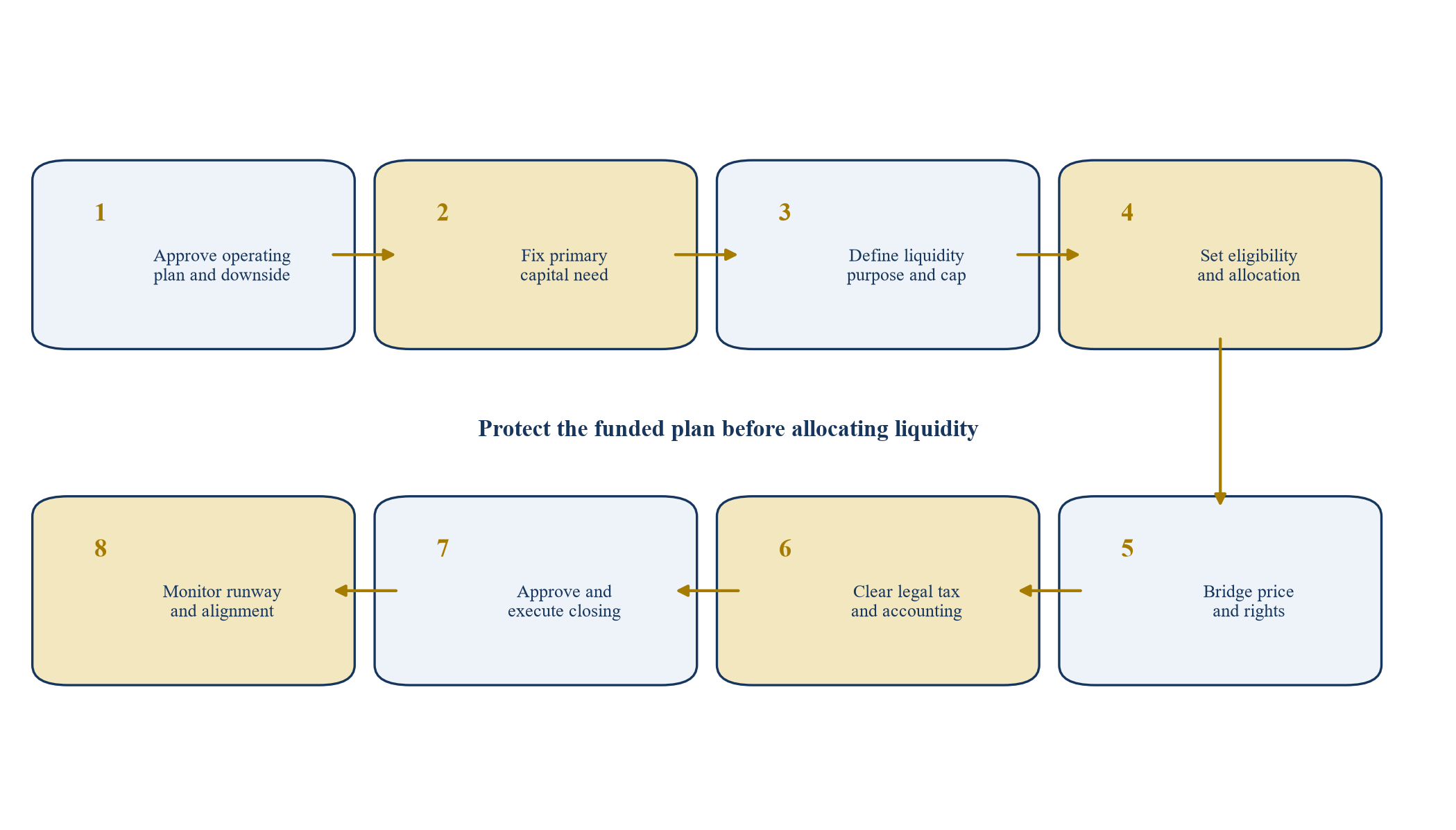
The sequence is a governance tool. Applicable law, definitive documents and transaction facts determine the required approvals.
22. Implement through a controlled twelve-week process
Weeks one and two should establish the operating plan, downside case, primary requirement and transaction objectives. The board should appoint the conflict process and approve the design mandate before investors or sellers receive firm terms.
Weeks three and four should map the cap table, securities, transfer restrictions, tax populations and seller demand. Management should prepare the price-and-rights bridge and next-round model. The company can then set a provisional secondary pool and eligibility policy.
Weeks five through eight should cover investor diligence, seller elections and document negotiation. The company should reconcile representations, disclosure, indemnities, rights, allocation and closing conditions across both legs. Tax and payroll analysis should be completed before final seller commitments.
Weeks nine through twelve should complete approvals, waivers, securities-law steps, know-your-customer checks and funds flow. The company should run a closing rehearsal using the final cap table and settlement schedule. Post-closing review should confirm receipt of primary cash, seller payments, register updates and compliance filings.
23. Monitor the transaction after closing
The board should track whether the primary proceeds fund the uses approved in the investment case. Monthly reporting should compare cash, hiring, capital expenditure, working capital and milestone delivery with the financed plan. Variances should trigger operating action before they become another financing requirement.
Alignment monitoring should cover founder and management retention, vesting, governance attendance and ownership changes. The company should enforce transfer restrictions and update beneficial-ownership records. Any promised employee-liquidity programme should be documented carefully and should not create an expectation of recurring windows unless the board intends one.
The finance team should complete accounting and tax reporting. It should reconcile the share register, option ledger, general ledger and valuation records. Any withholding estimate should be finalised and communicated to the seller through the appropriate process.
The transaction should be reviewed before the next financing. The board should ask whether the primary amount proved sufficient, whether the liquidity allocation supported retention, and whether rights or price terms constrained the next round. Those findings should inform future capital and liquidity policy.
24. Limitations and conclusion
The framework is a decision tool rather than legal, tax, accounting or investment advice. Corporate authority, securities exemptions, tax treatment, accounting and required filings depend on the company, security, seller, investor and jurisdiction. The worked case is hypothetical and does not estimate the result of any actual transaction.
A combined primary and secondary financing can fund growth and provide responsible liquidity when the two decisions remain visible. The company should fix the primary requirement from a board-approved downside plan, then allocate a bounded secondary pool through a disclosed policy. Price must be analysed together with rights, and conflicts, tax, securities, accounting and transfer requirements must be cleared before closing.
The practical test is whether the company remains fully funded, active leaders retain meaningful exposure, similarly situated sellers are treated under a coherent policy, and the post-closing capital structure can support the next stage. When those conditions are documented and monitored, partial liquidity can strengthen a minority recapitalisation without turning the financing into an early exit.
Sources
- IFRS Foundation, IFRS 13 Fair Value Measurement, defines fair value and the market-participant measurement framework, accessed 17 September 2026, Read the primary source
- OECD, G20/OECD Principles of Corporate Governance 2023, shareholder rights, equitable treatment, conflicts and related-party transaction safeguards, accessed 17 September 2026, Read the primary source
- Delaware General Assembly, Delaware General Corporation Law, Title 8, sections 201 and 202, transfer and ownership restrictions for securities, accessed 17 September 2026, Read the primary source
- National Venture Capital Association, Model Legal Documents, including the financing suite and Right of First Refusal and Co-Sale Agreement, updated October 2025, accessed 17 September 2026, Read the primary source
- UK Parliament, Companies Act 2006, Part 18 and related provisions governing company purchases of own shares, accessed 17 September 2026, Read the primary source
- Abu Dhabi Global Market, Companies Regulations 2020, provisions on purchase of own shares and financing, accessed 17 September 2026, Read the primary source
- U.S. Securities and Exchange Commission, Private Secondary Markets, overview of registration exemptions for private secondary transactions, accessed 17 September 2026, Read the primary source
- U.S. Securities and Exchange Commission, Rule 144: Selling Restricted and Control Securities, accessed 17 September 2026, Read the primary source
- U.S. Securities and Exchange Commission, Employee Benefit Plans: Rule 701, compensatory issuance exemption, disclosure threshold and restricted-security status, accessed 17 September 2026, Read the primary source
- HM Revenue & Customs, Tax when you sell shares, accessed 17 September 2026, Read the primary source
- HM Revenue & Customs, How employment-related securities work if you are an employer, accessed 17 September 2026, Read the primary source
- HM Revenue & Customs, Employment Related Securities Manual, including restricted and convertible securities guidance, accessed 17 September 2026, Read the primary source
- IFRS Foundation, IFRS 2 Share-based Payment, recognition and measurement of employee and other share-based payment transactions, accessed 17 September 2026, Read the primary source
- U.S. Securities and Exchange Commission, Frequently Asked Questions About Exempt Offerings, restricted securities and resale conditions, accessed 17 September 2026, Read the primary source
- U.S. Securities and Exchange Commission, Tender Offer Rules and Schedules, Compliance and Disclosure Interpretations, accessed 17 September 2026, Read the primary source
- OECD, OECD Corporate Governance Factbook 2023, comparative approval and disclosure safeguards for related-party transactions, accessed 17 September 2026, Read the primary source
