

1. Establish investment and company authority
The company, lender and their advisers should record the company approvals, lender investment-committee authority, delegated powers, conflicts and advice required for each financing and ownership step. The work starts with board minutes, fund constitutional documents, investment policies, delegations and current professional advice. The decision question is whether each party can lawfully negotiate, fund, amend, enforce, acquire and exit. The record should identify the responsible entity, evidence date, owner, assumptions, open issues and the next irreversible deadline [1][18][19].
The controlled output is an authority and reserved-matters schedule. It should connect financial analysis to legal rights, fund authority, operating dependencies and the transaction timetable. Each conclusion should be traceable to current evidence or attributed professional advice.
The principal risk is that unclear authority can invalidate a commitment, delay emergency funding or expose decision-makers to conflicts. The team should measure the effect on liquidity, priority, recovery, control, regulatory timing and exit value. A material change should update the investment case and route decision on the day it becomes known.
2. Define the legal and economic perimeter
This stage requires the transaction team to map every borrower, guarantor, security provider, operating company, asset owner, regulated entity and cash account. Evidence should come from entity charts, statutory registers, finance documents, licences, bank mandates and operating records. The practical test is where cash, liabilities, collateral, contracts and enterprise value legally sit. The analysis should use one valuation date and preserve entity-level links among cash, claims, collateral and ownership [3][4][37].
Management and the fund should maintain an entity and obligation map. The schedule should show documents, calculation logic, conditions, dependencies and the person authorised to resolve each exception. Legal, insolvency, tax, valuation and regulatory judgements remain with the relevant qualified adviser.
A material execution failure occurs when group-level figures can conceal trapped cash, structural subordination and assets outside the collateral package. Review the structure against the base case and a combined downside. A route that cannot survive a credible delay, cash shortfall or missing consent should not be approved as executable.
3. Fix the liquidity and enforcement clock
The investment team should translate payroll, tax, debt service, covenant, waiver, filing, enforcement and sale milestones into one dated calendar, using a thirteen-week cash forecast, payment runs, notices, facility terms, court timetables and regulatory guidance. Its central question is the last practical date for new money, amendment, signing, transfer or a protected process. The answer matters only when it is current enough to guide the next draw, waiver, vote, enforcement step, bid or ownership decision [1][6][34].
The required deliverable is a decision clock with irreversible dates. It should distinguish binding rights from commercial expectations, committed capital from indications and observed performance from scenarios. The investment committee should see how every unresolved item affects value and timing.
The execution threat is that a structure can appear economically attractive while becoming unavailable before funding or control can be obtained. Owners should define a control, evidence threshold, escalation route and switch date. Scenario values require continuing reconciliation to cash, legal rights, offers, financing terms and operating results.
4. Build the opening exposure certificate
The company should reconcile principal, accrued interest, PIK, fees, hedges, guarantees, undrawn commitments, collateral and cash by legal entity. The evidence base includes facility statements, agent notices, bank records, hedge confirmations and claims evidence. The decisive test asks the fund's current funded and contingent exposure and its place in the capital structure. Conclusions should remain at entity and instrument level because cash, claims, collateral, licences and approvals may sit in different parts of the group [14][15][45].
The decision-makers should receive an exposure and claim certificate. It should state the calculation date, evidence source, governing documents, conditions and required approvals. This makes the comparison reproducible when facts change or a stakeholder challenges it.
The material downside is that incorrect balances or entity allocation can distort voting, priority, recoveries and new-money capacity. Connect the response to minimum cash, recovery thresholds, control boundaries and transaction milestones. The selected route remains preferred only while these controls continue to support it.
5. Test the fund mandate and capital capacity
The company, lender and their advisers should verify strategy limits, concentration, follow-on reserves, borrowing constraints, conflicts, valuation policy and approval conditions. The work starts with fund documents, side letters, policies, portfolio data, subscription facilities and committee records. The decision question is whether the fund can provide rescue capital and hold debt, equity or acquired assets through the required period. The record should identify the responsible entity, evidence date, owner, assumptions, open issues and the next irreversible deadline [20][21][22].
The controlled output is a mandate and capacity memorandum. It should connect financial analysis to legal rights, fund authority, operating dependencies and the transaction timetable. Each conclusion should be traceable to current evidence or attributed professional advice.
The principal risk is that a commercially attractive rescue can breach fund restrictions or leave insufficient capital for downside draws. The team should measure the effect on liquidity, priority, recovery, control, regulatory timing and exit value. A material change should update the investment case and route decision on the day it becomes known.
6. Define the complete transaction set
This stage requires the transaction team to screen amendment, waiver, rescue loan, super-senior facility, debt purchase, exchange, credit bid, consensual acquisition, enforcement, third-party sale and formal restructuring. Evidence should come from market soundings, sponsor positions, buyer evidence, financing capacity and legal advice. The practical test is which routes are legally available, financeable and capable of preserving value within runway. The analysis should use one valuation date and preserve entity-level links among cash, claims, collateral and ownership [6][7][8].
Management and the fund should maintain an option register with entry and stop tests. The schedule should show documents, calculation logic, conditions, dependencies and the person authorised to resolve each exception. Legal, insolvency, tax, valuation and regulatory judgements remain with the relevant qualified adviser.
A material execution failure occurs when premature commitment to loan-to-own can suppress a higher-value rescue or third-party transaction. Review the structure against the base case and a combined downside. A route that cannot survive a credible delay, cash shortfall or missing consent should not be approved as executable.
Table 1. Private-credit transaction screen
| Route | Minimum evidence | Early stop condition |
|---|---|---|
| amendment | sustainable debt and lender support | runway remains inadequate |
| rescue | viability, priority and committed capital | peak funding gap persists |
| loan-to-own | executable control pathway | rights or approvals fail |
| third-party sale | funded buyer and transferable perimeter | completion exceeds runway |
Amounts and scores are analytical scenarios; transaction evidence should replace model values.
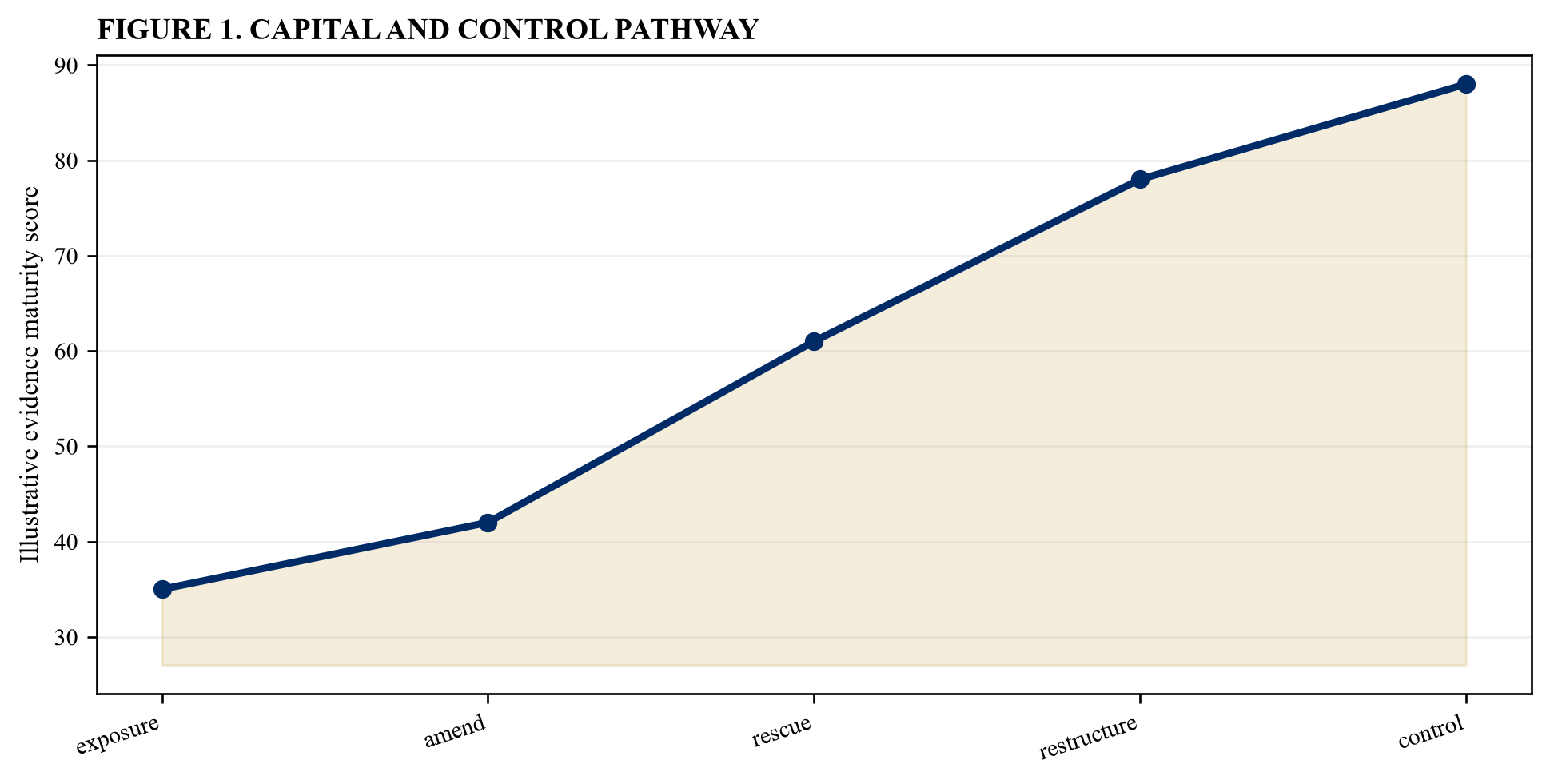
Illustrative analytical scenario; transaction evidence should replace model values.
7. Set the counterfactual
The investment team should describe the expected cash, operational and recovery outcome if no transaction completes by the decision date, using liquidity, creditor rights, insolvency advice, asset values, customer behaviour and operating dependencies. Its central question is the relevant enforcement, insolvency, liquidation or disorderly cessation baseline. The answer matters only when it is current enough to guide the next draw, waiver, vote, enforcement step, bid or ownership decision [3][6][9].
The required deliverable is a dated counterfactual case. It should distinguish binding rights from commercial expectations, committed capital from indications and observed performance from scenarios. The investment committee should see how every unresolved item affects value and timing.
The execution threat is that an unrealistic status quo can overstate the incremental value of new money or ownership. Owners should define a control, evidence threshold, escalation route and switch date. Scenario values require continuing reconciliation to cash, legal rights, offers, financing terms and operating results.
8. Extract the debt-document control map
The company should identify defaults, cures, acceleration, voting, amendments, transfers, information, inspections, security, enforcement and release mechanics. The evidence base includes facility, security, intercreditor, hedging and shareholder documents together with notices and waivers. The decisive test asks which creditor or agent can permit, block, condition or execute each step. Conclusions should remain at entity and instrument level because cash, claims, collateral, licences and approvals may sit in different parts of the group [14][15][16].
The decision-makers should receive a rights and voting matrix. It should state the calculation date, evidence source, governing documents, conditions and required approvals. This makes the comparison reproducible when facts change or a stakeholder challenges it.
The material downside is that economic exposure may diverge from formal control when thresholds, agents or hedge providers hold decisive rights. Connect the response to minimum cash, recovery thresholds, control boundaries and transaction milestones. The selected route remains preferred only while these controls continue to support it.
9. Verify collateral and perfection
The company, lender and their advisers should reconcile ownership, attachment, registration, priority, proceeds, guarantees, exclusions and enforcement requirements for every material asset. The work starts with security instruments, public filings, title records, legal opinions, asset registers and valuation reports. The decision question is what collateral supports existing debt and proposed rescue money in each entity. The record should identify the responsible entity, evidence date, owner, assumptions, open issues and the next irreversible deadline [11][12][37].
The controlled output is a collateral and perfection certificate. It should connect financial analysis to legal rights, fund authority, operating dependencies and the transaction timetable. Each conclusion should be traceable to current evidence or attributed professional advice.
The principal risk is that double counting, stale registrations or unverified ownership can create false coverage and bargaining leverage. The team should measure the effect on liquidity, priority, recovery, control, regulatory timing and exit value. A material change should update the investment case and route decision on the day it becomes known.
10. Map intercreditor economics
This stage requires the transaction team to model payment blockage, turnover, standstill, enforcement control, release, voting, hedging and new-money provisions across creditor classes. Evidence should come from intercreditor agreements, priority deeds, subordination terms, facility documents and legal advice. The practical test is how value and decision rights move under amendment, enforcement, sale and restructuring. The analysis should use one valuation date and preserve entity-level links among cash, claims, collateral and ownership [14][16][45].
Management and the fund should maintain an intercreditor rights and value map. The schedule should show documents, calculation logic, conditions, dependencies and the person authorised to resolve each exception. Legal, insolvency, tax, valuation and regulatory judgements remain with the relevant qualified adviser.
A material execution failure occurs when a rescue can fail because commercial agreement does not satisfy contractual priority or voting mechanics. Review the structure against the base case and a combined downside. A route that cannot survive a credible delay, cash shortfall or missing consent should not be approved as executable.
11. Diagnose the distress cause
The investment team should separate a temporary liquidity gap from unsustainable leverage, weak margins, customer loss, working-capital stress, operational failure or strategic decline, using cohort economics, order book, customer retention, margin, fixed costs, capex, working capital and management plans. Its central question is whether new capital can finance a credible recovery or merely defer loss recognition. The answer matters only when it is current enough to guide the next draw, waiver, vote, enforcement step, bid or ownership decision [17][24][25].
The required deliverable is a viability diagnosis with evidence tests. It should distinguish binding rights from commercial expectations, committed capital from indications and observed performance from scenarios. The investment committee should see how every unresolved item affects value and timing.
The execution threat is that capital can extend runway while the business continues to destroy value. Owners should define a control, evidence threshold, escalation route and switch date. Scenario values require continuing reconciliation to cash, legal rights, offers, financing terms and operating results.
12. Build the integrated operating case
The company should connect revenue, margin, working capital, capex, taxes, restructuring costs and financing flows by week, month and legal entity. The evidence base includes historical results, contracts, operational plans, debt schedules and external evidence. The decisive test asks the cash generation and funding requirement under base, downside and severe cases. Conclusions should remain at entity and instrument level because cash, claims, collateral, licences and approvals may sit in different parts of the group [17][23][44].
The decision-makers should receive an integrated operating and liquidity model. It should state the calculation date, evidence source, governing documents, conditions and required approvals. This makes the comparison reproducible when facts change or a stakeholder challenges it.
The material downside is that annual EBITDA projections can hide intra-period cash deficits and essential investment. Connect the response to minimum cash, recovery thresholds, control boundaries and transaction milestones. The selected route remains preferred only while these controls continue to support it.
13. Size the rescue quantum
The company, lender and their advisers should bridge available cash through operating losses, restructuring actions, transaction costs, contingency and minimum liquidity to the next durable milestone. The work starts with the controlled forecast, downside cases, cost estimates, milestone calendar and funding terms. The decision question is how much money is required, when it is required and which uses must be permitted. The record should identify the responsible entity, evidence date, owner, assumptions, open issues and the next irreversible deadline [10][11][17].
The controlled output is a rescue sources-and-uses schedule. It should connect financial analysis to legal rights, fund authority, operating dependencies and the transaction timetable. Each conclusion should be traceable to current evidence or attributed professional advice.
The principal risk is that an under-sized facility can increase priority debt and still fail before completion. The team should measure the effect on liquidity, priority, recovery, control, regulatory timing and exit value. A material change should update the investment case and route decision on the day it becomes known.
14. Choose the new-money instrument
This stage requires the transaction team to compare revolver, term loan, delayed draw, bridge, PIK, preferred equity, convertible instrument and asset-backed structures. Evidence should come from cash needs, collateral, tax, accounting, covenant and exit evidence. The practical test is which instrument matches timing, risk, cash-pay capacity, priority and expected route. The analysis should use one valuation date and preserve entity-level links among cash, claims, collateral and ownership [14][23][40].
Management and the fund should maintain an instrument comparison memorandum. The schedule should show documents, calculation logic, conditions, dependencies and the person authorised to resolve each exception. Legal, insolvency, tax, valuation and regulatory judgements remain with the relevant qualified adviser.
A material execution failure occurs when instrument labels can obscure different cash burdens, control rights and recovery positions. Review the structure against the base case and a combined downside. A route that cannot survive a credible delay, cash shortfall or missing consent should not be approved as executable.
15. Design priority and priming
The investment team should test consensual seniority, additional collateral, structural priority, statutory priority, court approval and adequate protection where applicable, using existing documents, creditor consents, collateral values, legal opinions and restructuring law. Its central question is whether rescue money receives enforceable priority without creating avoidable challenge or value transfer. The answer matters only when it is current enough to guide the next draw, waiver, vote, enforcement step, bid or ownership decision [10][11][45].
The required deliverable is a priority and consent matrix. It should distinguish binding rights from commercial expectations, committed capital from indications and observed performance from scenarios. The investment committee should see how every unresolved item affects value and timing.
The execution threat is that assumed seniority can fail at enforcement or be challenged by affected stakeholders. Owners should define a control, evidence threshold, escalation route and switch date. Scenario values require continuing reconciliation to cash, legal rights, offers, financing terms and operating results.
Table 2. Illustrative priority structure
| Layer | Illustrative claim | Primary control |
|---|---|---|
| rescue facility | 15 | priority and draw milestones |
| first-lien debt | 55 | security and enforcement |
| second-lien debt | 25 | standstill and turnover |
| unsecured claims | 20 | voting and distribution |
Amounts and scores are analytical scenarios; transaction evidence should replace model values.
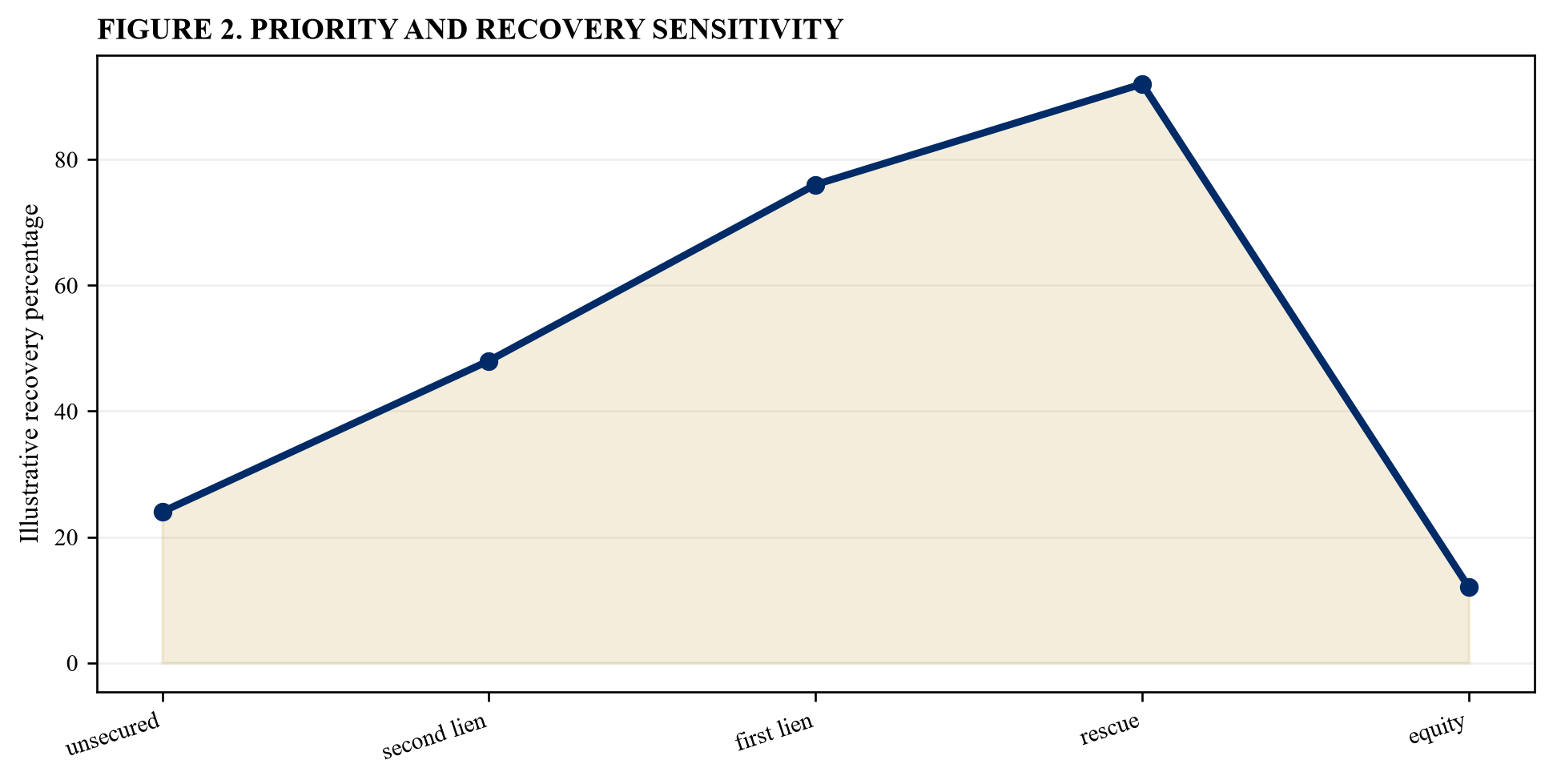
Illustrative analytical scenario; transaction evidence should replace model values.
16. Price the full economic return
The company should model cash interest, PIK, original issue discount, fees, exit premium, warrants, equity conversion, commitment charges and downside recovery. The evidence base includes term sheets, cash forecasts, valuation scenarios, tax advice and market evidence. The decisive test asks the gross and net return across repayment, restructuring, control and exit scenarios. Conclusions should remain at entity and instrument level because cash, claims, collateral, licences and approvals may sit in different parts of the group [17][20][26].
The decision-makers should receive a probability-weighted return model. It should state the calculation date, evidence source, governing documents, conditions and required approvals. This makes the comparison reproducible when facts change or a stakeholder challenges it.
The material downside is that headline yield can conceal loss severity, duration, unfunded exposure and value leakage. Connect the response to minimum cash, recovery thresholds, control boundaries and transaction milestones. The selected route remains preferred only while these controls continue to support it.
17. Set availability conditions and milestones
The company, lender and their advisers should tie drawings to liquidity needs, budgets, reporting, restructuring actions, sale steps, approvals and objective stop events. The work starts with the implementation plan, forecast, diligence findings, legal conditions and transaction timetable. The decision question is which evidence must exist before each incremental unit of capital is advanced. The record should identify the responsible entity, evidence date, owner, assumptions, open issues and the next irreversible deadline [14][32][34].
The controlled output is a drawdown and milestone schedule. It should connect financial analysis to legal rights, fund authority, operating dependencies and the transaction timetable. Each conclusion should be traceable to current evidence or attributed professional advice.
The principal risk is that front-loaded funding can remove leverage before critical protections or value-preservation actions are complete. The team should measure the effect on liquidity, priority, recovery, control, regulatory timing and exit value. A material change should update the investment case and route decision on the day it becomes known.
18. Calibrate covenants and information rights
This stage requires the transaction team to define liquidity, leverage, coverage, capex, asset-sale, debt-incurrence, reporting, inspection and variance controls. Evidence should come from the operating case, debt capacity, document rights and information systems. The practical test is which controls identify deterioration early without blocking necessary operating decisions. The analysis should use one valuation date and preserve entity-level links among cash, claims, collateral and ownership [14][17][32].
Management and the fund should maintain a covenant and information package. The schedule should show documents, calculation logic, conditions, dependencies and the person authorised to resolve each exception. Legal, insolvency, tax, valuation and regulatory judgements remain with the relevant qualified adviser.
A material execution failure occurs when overly loose controls delay intervention while overly rigid controls can impair recovery. Review the structure against the base case and a combined downside. A route that cannot survive a credible delay, cash shortfall or missing consent should not be approved as executable.
19. Define governance boundaries before ownership
The investment team should separate lender consent rights, observer access, board appointment, budget control, management direction and operational responsibility, using finance documents, governance terms, conflicts analysis, regulatory advice and communication protocols. Its central question is how the lender can protect capital without assuming undocumented management control. The answer matters only when it is current enough to guide the next draw, waiver, vote, enforcement step, bid or ownership decision [18][30][35].
The required deliverable is a pre-ownership governance protocol. It should distinguish binding rights from commercial expectations, committed capital from indications and observed performance from scenarios. The investment committee should see how every unresolved item affects value and timing.
The execution threat is that influence beyond documented creditor protections can create conduct, conflict or liability exposure. Owners should define a control, evidence threshold, escalation route and switch date. Scenario values require continuing reconciliation to cash, legal rights, offers, financing terms and operating results.
20. Test amendment economics
The company should compare maturity extension, covenant reset, cash-pay reduction, PIK, partial paydown, collateral enhancement and new equity support. The evidence base includes existing terms, lender proposals, sponsor capacity, forecasts and market soundings. The decisive test asks whether amendment restores a sustainable capital structure at an acceptable risk-adjusted return. Conclusions should remain at entity and instrument level because cash, claims, collateral, licences and approvals may sit in different parts of the group [14][17][44].
The decision-makers should receive an amend-and-extend economics schedule. It should state the calculation date, evidence source, governing documents, conditions and required approvals. This makes the comparison reproducible when facts change or a stakeholder challenges it.
The material downside is that a maturity extension can preserve an unsustainable debt quantum and delay a better transaction. Connect the response to minimum cash, recovery thresholds, control boundaries and transaction milestones. The selected route remains preferred only while these controls continue to support it.
21. Evaluate secondary debt purchase
The company, lender and their advisers should verify seller title, settlement, transfer restrictions, accrued claims, confidential information, sanctions and voting effects. The work starts with trade confirmations, transfer certificates, agent records, finance documents and compliance advice. The decision question is the clean purchase price and the rights obtained for each acquired claim. The record should identify the responsible entity, evidence date, owner, assumptions, open issues and the next irreversible deadline [14][16][29].
The controlled output is a debt-purchase and control bridge. It should connect financial analysis to legal rights, fund authority, operating dependencies and the transaction timetable. Each conclusion should be traceable to current evidence or attributed professional advice.
The principal risk is that a discount to face value can be illusory when claims are disputed, subordinated or transfer-restricted. The team should measure the effect on liquidity, priority, recovery, control, regulatory timing and exit value. A material change should update the investment case and route decision on the day it becomes known.
22. Map the loan-to-own pathway
This stage requires the transaction team to sequence debt acquisition, rescue funding, amendments, enforcement, restructuring votes, credit bid, ownership transfer and exit. Evidence should come from the rights map, liquidity plan, transaction documents, legal routes and stakeholder positions. The practical test is which executable sequence can produce control and what can interrupt it. The analysis should use one valuation date and preserve entity-level links among cash, claims, collateral and ownership [6][7][9].
Management and the fund should maintain a pathway map with decision gates. The schedule should show documents, calculation logic, conditions, dependencies and the person authorised to resolve each exception. Legal, insolvency, tax, valuation and regulatory judgements remain with the relevant qualified adviser.
A material execution failure occurs when treating loan-to-own as a single outcome can hide legal, funding and consent dependencies. Review the structure against the base case and a combined downside. A route that cannot survive a credible delay, cash shortfall or missing consent should not be approved as executable.
23. Compare consensual and enforcement routes
The investment team should test negotiated exchange, scheme or plan, security enforcement, administration sale, Chapter 11 process and other applicable mechanisms, using stakeholder support, voting rules, security rights, court procedures, costs and timing. Its central question is which route transfers value with the strongest execution certainty and least avoidable leakage. The answer matters only when it is current enough to guide the next draw, waiver, vote, enforcement step, bid or ownership decision [3][4][5].
The required deliverable is a route comparison schedule. It should distinguish binding rights from commercial expectations, committed capital from indications and observed performance from scenarios. The investment committee should see how every unresolved item affects value and timing.
The execution threat is that enforcement can destroy customer, licence, employee or contract value that a consensual process preserves. Owners should define a control, evidence threshold, escalation route and switch date. Scenario values require continuing reconciliation to cash, legal rights, offers, financing terms and operating results.
24. Analyse credit-bid capacity
The company should determine which allowed claims can be offset, the cash component, cure costs, excluded liabilities, competing bids and approval requirements. The evidence base includes claims evidence, sale procedures, legal advice, asset perimeter and funds-flow models. The decisive test asks the maximum supportable bid and additional cash required to complete. Conclusions should remain at entity and instrument level because cash, claims, collateral, licences and approvals may sit in different parts of the group [9][10][13].
The decision-makers should receive a credit-bid sources-and-uses model. It should state the calculation date, evidence source, governing documents, conditions and required approvals. This makes the comparison reproducible when facts change or a stakeholder challenges it.
The material downside is that face value can be mistaken for purchasing power despite priority disputes, cash obligations and court discretion. Connect the response to minimum cash, recovery thresholds, control boundaries and transaction milestones. The selected route remains preferred only while these controls continue to support it.
Table 3. Illustrative common-date route economics
| Measure | Amend | Rescue | Loan-to-own | Sale |
|---|---|---|---|---|
| new cash | 6 | 18 | 24 | 5 |
| completion months | 2 | 4 | 9 | 6 |
| recovery value | 63 | 78 | 91 | 84 |
| certainty score | 67% | 73% | 58% | 76% |
Amounts and scores are analytical scenarios; transaction evidence should replace model values.
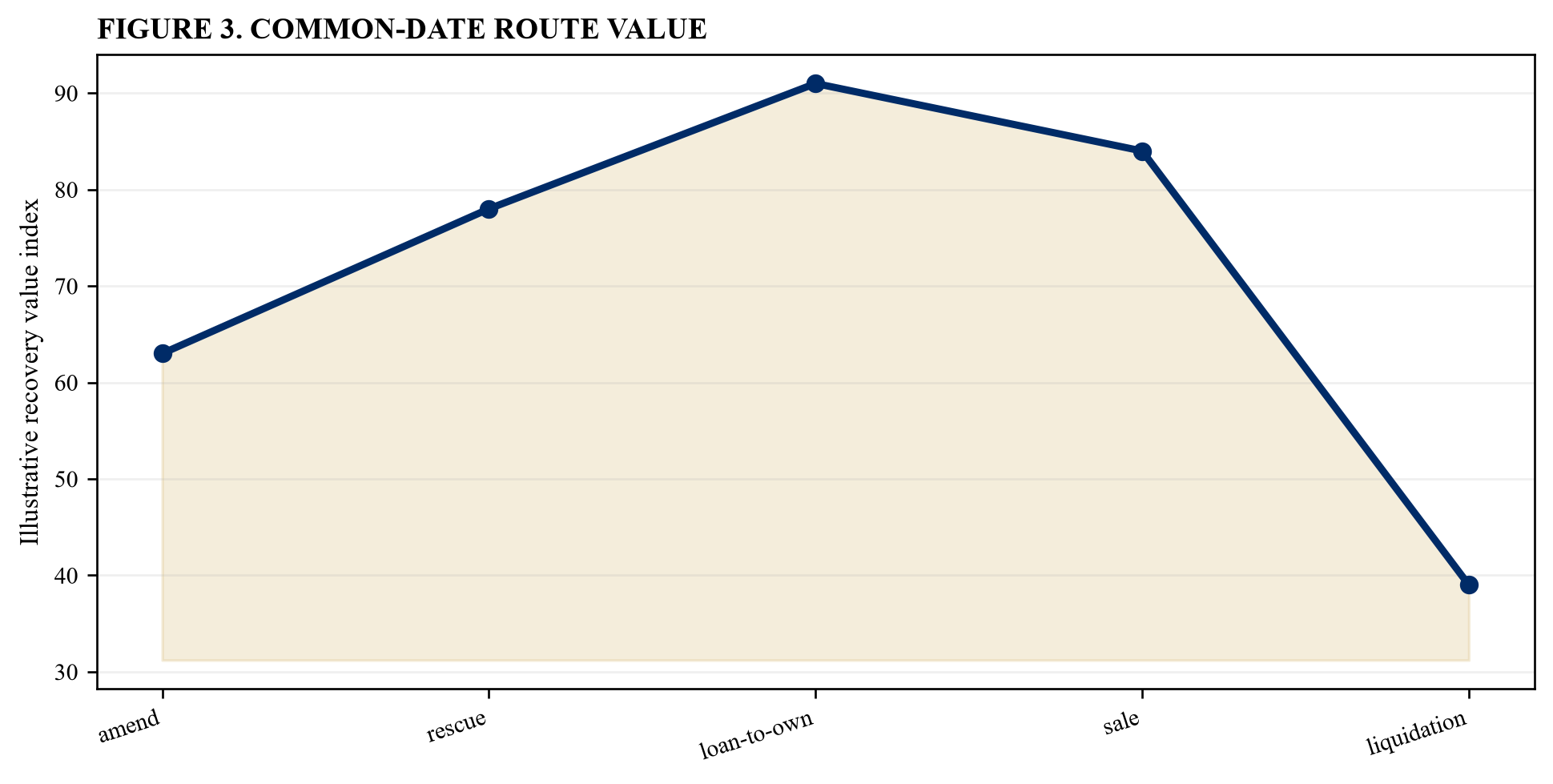
Illustrative analytical scenario; transaction evidence should replace model values.
25. Define the acquisition perimeter
The company, lender and their advisers should choose among shares, business, assets, debt instruments or a restructuring security and map liabilities and consents. The work starts with entity records, asset registers, contracts, licences, tax analysis and operational dependencies. The decision question is which perimeter transfers the desired value and leaves manageable stranded costs and liabilities. The record should identify the responsible entity, evidence date, owner, assumptions, open issues and the next irreversible deadline [3][27][28].
The controlled output is an acquisition-perimeter memorandum. It should connect financial analysis to legal rights, fund authority, operating dependencies and the transaction timetable. Each conclusion should be traceable to current evidence or attributed professional advice.
The principal risk is that control of debt or selected assets may not transfer the people, contracts, systems or permissions that generate value. The team should measure the effect on liquidity, priority, recovery, control, regulatory timing and exit value. A material change should update the investment case and route decision on the day it becomes known.
26. Value enterprise and collateral on one date
This stage requires the transaction team to estimate enterprise value, collateral value, liquidation value and transaction value using consistent forecasts and dates. Evidence should come from current financials, operational evidence, market data, appraisals, bids and valuation standards. The practical test is the value available before financing, restructuring and transaction leakage. The analysis should use one valuation date and preserve entity-level links among cash, claims, collateral and ownership [23][24][25].
Management and the fund should maintain a common-date valuation range. The schedule should show documents, calculation logic, conditions, dependencies and the person authorised to resolve each exception. Legal, insolvency, tax, valuation and regulatory judgements remain with the relevant qualified adviser.
A material execution failure occurs when stale marks or mixed valuation dates can overstate collateral coverage and equity value. Review the structure against the base case and a combined downside. A route that cannot survive a credible delay, cash shortfall or missing consent should not be approved as executable.
27. Calculate sustainable debt capacity
The investment team should size post-transaction debt from downside free cash flow, fixed-charge coverage, maintenance investment and minimum liquidity, using the integrated forecast, covenant definitions, capex evidence and market terms. Its central question is how much cash-pay and PIK debt the reorganised business can support through downside. The answer matters only when it is current enough to guide the next draw, waiver, vote, enforcement step, bid or ownership decision [17][23][44].
The required deliverable is a sustainable debt-capacity model. It should distinguish binding rights from commercial expectations, committed capital from indications and observed performance from scenarios. The investment committee should see how every unresolved item affects value and timing.
The execution threat is that capital structure can remain distressed when debt is sized to claims rather than future cash generation. Owners should define a control, evidence threshold, escalation route and switch date. Scenario values require continuing reconciliation to cash, legal rights, offers, financing terms and operating results.
28. Build the claims and recovery waterfall
The company should apply ownership, security, priority, costs, set-off, guarantees, intercompany claims and transaction proceeds by class. The evidence base includes the claims ledger, legal priority analysis, collateral values and scenario proceeds. The decisive test asks the amount, timing and form of recovery for each stakeholder in every route. Conclusions should remain at entity and instrument level because cash, claims, collateral, licences and approvals may sit in different parts of the group [11][12][45].
The decision-makers should receive a scenario recovery waterfall. It should state the calculation date, evidence source, governing documents, conditions and required approvals. This makes the comparison reproducible when facts change or a stakeholder challenges it.
The material downside is that headline enterprise value can obscure how little value reaches the fund after senior claims and costs. Connect the response to minimum cash, recovery thresholds, control boundaries and transaction milestones. The selected route remains preferred only while these controls continue to support it.
29. Measure control economics
The company, lender and their advisers should bridge debt purchase price, funded rescue, carrying cost, fees, conversion terms, ownership percentage, dilution and exit proceeds. The work starts with transaction terms, cap table, forecasts, valuation ranges and exit cases. The decision question is the total capital at risk and return attributable to obtaining and holding control. The record should identify the responsible entity, evidence date, owner, assumptions, open issues and the next irreversible deadline [20][23][26].
The controlled output is a control-economics model. It should connect financial analysis to legal rights, fund authority, operating dependencies and the transaction timetable. Each conclusion should be traceable to current evidence or attributed professional advice.
The principal risk is that return can be overstated when new-money exposure, dilution, duration and follow-on needs are excluded. The team should measure the effect on liquidity, priority, recovery, control, regulatory timing and exit value. A material change should update the investment case and route decision on the day it becomes known.
30. Run combined downside scenarios
This stage requires the transaction team to stress collections, margin, working capital, rescue delay, priority challenge, bidder withdrawal, covenant breach and exit multiple together. Evidence should come from the integrated cash, valuation, recovery and return models. The practical test is which structures remain funded and value-preserving under correlated adverse events. The analysis should use one valuation date and preserve entity-level links among cash, claims, collateral and ownership [20][21][34].
Management and the fund should maintain a combined downside matrix. The schedule should show documents, calculation logic, conditions, dependencies and the person authorised to resolve each exception. Legal, insolvency, tax, valuation and regulatory judgements remain with the relevant qualified adviser.
A material execution failure occurs when single-variable sensitivities can miss the way operational decline and transaction delay reinforce one another. Review the structure against the base case and a combined downside. A route that cannot survive a credible delay, cash shortfall or missing consent should not be approved as executable.
31. Identify conflicts and allocation issues
The investment team should map positions of performing and distressed funds, affiliates, co-investors, hedging desks, sponsors and portfolio companies, using fund policies, committee records, allocation rules, information barriers and legal advice. Its central question is which decisions require recusal, disclosure, independent review or allocation controls. The answer matters only when it is current enough to guide the next draw, waiver, vote, enforcement step, bid or ownership decision [20][30][31].
The required deliverable is a conflicts and allocation register. It should distinguish binding rights from commercial expectations, committed capital from indications and observed performance from scenarios. The investment committee should see how every unresolved item affects value and timing.
The execution threat is that one affiliate can benefit from priority, pricing or ownership terms that reduce another investor's recovery. Owners should define a control, evidence threshold, escalation route and switch date. Scenario values require continuing reconciliation to cash, legal rights, offers, financing terms and operating results.
Table 4. Control-risk matrix
| Risk | Leading indicator | Required control |
|---|---|---|
| priority challenge | open consent or perfection issue | legal closing certificate |
| liquidity failure | minimum cash variance | draw and switch gate |
| control overreach | operational direction outside terms | governance boundary protocol |
| exit shortfall | multiple or cash-flow deterioration | quarterly exit re-underwrite |
Amounts and scores are analytical scenarios; transaction evidence should replace model values.
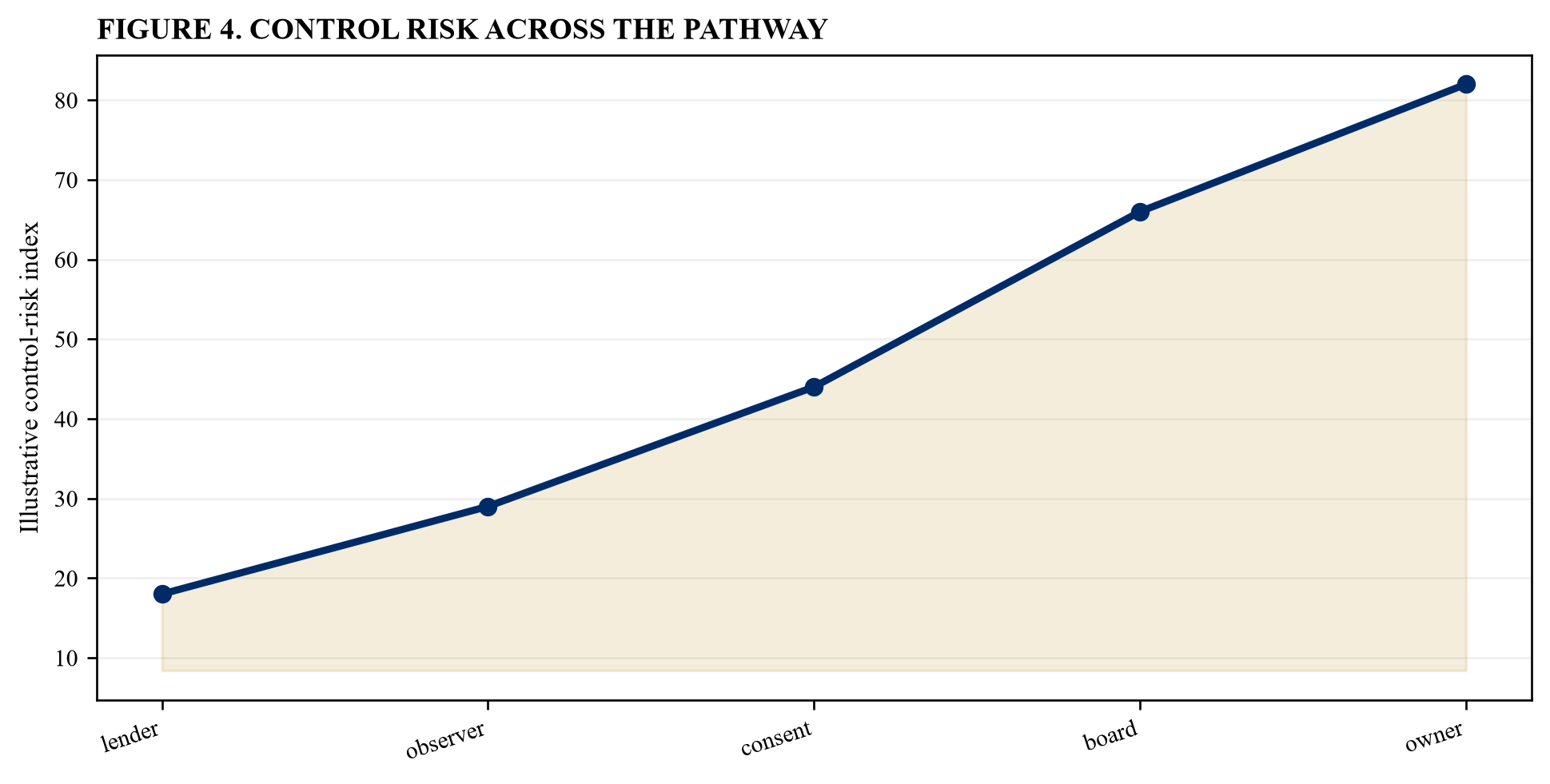
Illustrative analytical scenario; transaction evidence should replace model values.
32. Control lender conduct and communications
The company should govern information requests, negotiations, waivers, management contact, public statements, customer messages and market-sensitive data. The evidence base includes contractual rights, legal advice, communication plans, listing rules and data controls. The decisive test asks how the lender can exercise rights consistently with contract, law and transaction integrity. Conclusions should remain at entity and instrument level because cash, claims, collateral, licences and approvals may sit in different parts of the group [29][30][35].
The decision-makers should receive a conduct and communication protocol. It should state the calculation date, evidence source, governing documents, conditions and required approvals. This makes the comparison reproducible when facts change or a stakeholder challenges it.
The material downside is that informal direction or selective information use can create dispute, confidentiality or market-conduct risk. Connect the response to minimum cash, recovery thresholds, control boundaries and transaction milestones. The selected route remains preferred only while these controls continue to support it.
33. Clear regulatory and ownership gates
The company, lender and their advisers should identify merger control, foreign investment, sector approvals, licences, sanctions, beneficial ownership and change-of-control requirements. The work starts with official guidance, ownership data, transaction perimeter, regulator correspondence and specialist advice. The decision question is whether control can transfer within runway and on acceptable conditions. The record should identify the responsible entity, evidence date, owner, assumptions, open issues and the next irreversible deadline [27][28][29].
The controlled output is a regulatory critical path. It should connect financial analysis to legal rights, fund authority, operating dependencies and the transaction timetable. Each conclusion should be traceable to current evidence or attributed professional advice.
The principal risk is that an economically viable ownership route can fail or lose value through approval delay or remedies. The team should measure the effect on liquidity, priority, recovery, control, regulatory timing and exit value. A material change should update the investment case and route decision on the day it becomes known.
34. Protect operating continuity and management incentives
This stage requires the transaction team to fund essential suppliers, retain critical people, preserve licences and align management with cash, transaction and value milestones. Evidence should come from continuity plans, workforce data, service contracts, permits, insurance and incentive terms. The practical test is which measures preserve the cash flow and capabilities required for recovery and exit. The analysis should use one valuation date and preserve entity-level links among cash, claims, collateral and ownership [1][33][36].
Management and the fund should maintain a continuity and incentive plan. The schedule should show documents, calculation logic, conditions, dependencies and the person authorised to resolve each exception. Legal, insolvency, tax, valuation and regulatory judgements remain with the relevant qualified adviser.
A material execution failure occurs when aggressive cost reduction or poorly designed incentives can damage collections, customers and sale value. Review the structure against the base case and a combined downside. A route that cannot survive a credible delay, cash shortfall or missing consent should not be approved as executable.
35. Design the ownership and exit plan
The investment team should define governance, capital needs, strategy, reporting, operational programme, refinancing, strategic sale and secondary exit routes, using the post-transaction business plan, board design, capital model, buyer map and market evidence. Its central question is how the fund will protect value, fund the plan and realise proceeds within mandate. The answer matters only when it is current enough to guide the next draw, waiver, vote, enforcement step, bid or ownership decision [20][22][26].
The required deliverable is an ownership and exit roadmap. It should distinguish binding rights from commercial expectations, committed capital from indications and observed performance from scenarios. The investment committee should see how every unresolved item affects value and timing.
The execution threat is that control can become a capital trap when follow-on needs, governance capacity or exit demand are under-tested. Owners should define a control, evidence threshold, escalation route and switch date. Scenario values require continuing reconciliation to cash, legal rights, offers, financing terms and operating results.
36. Issue the investment and transaction certificate
The company should reconcile authority, liquidity, viability, mandate, rights, priority, valuation, recoveries, regulation, control and exit evidence. The evidence base includes signed models, legal memoranda, reconciliations, term sheets, approvals and implementation records. The decisive test asks whether the selected structure is funded, executable and superior to the relevant counterfactual on the decision date. Conclusions should remain at entity and instrument level because cash, claims, collateral, licences and approvals may sit in different parts of the group [18][32][34].
The decision-makers should receive a private-credit transaction certificate. It should state the calculation date, evidence source, governing documents, conditions and required approvals. This makes the comparison reproducible when facts change or a stakeholder challenges it.
The material downside is that decision-makers can mistake an attractive narrative for an evidence-backed and executable investment. Connect the response to minimum cash, recovery thresholds, control boundaries and transaction milestones. The selected route remains preferred only while these controls continue to support it.
Table 5. Implementation roadmap
| Horizon | Decision | Evidence |
|---|---|---|
| 0 to 48 hours | stabilise cash and authority | mandates and bank reconciliation |
| days 3 to 10 | screen financing and control routes | rights, viability and priority |
| weeks 2 to 8 | commit executable structure | terms, consents and documents |
| ownership period | deliver value and exit | operating plan and market evidence |
Amounts and scores are analytical scenarios; transaction evidence should replace model values.
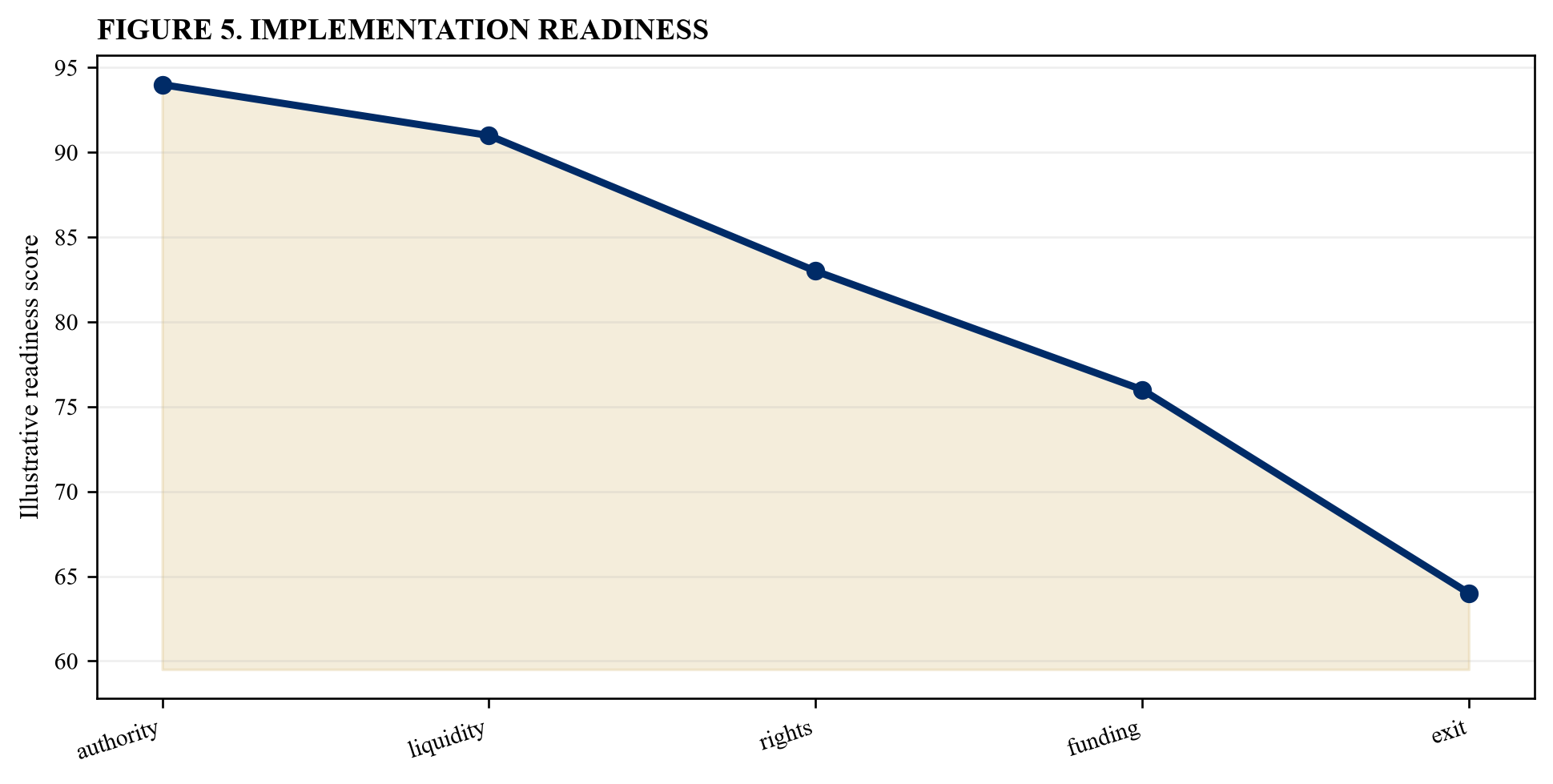
Illustrative analytical scenario; transaction evidence should replace model values.
References
- UK Government, Corporate Financial Distress Guidance Note, updated 15 June 2026, https://www.gov.uk/government/publications/the-sourcing-and-consultancy-playbooks/corporate-financial-distress-guidance-note-html
- UK Insolvency Service, Company Insolvency Statistics Releases, https://www.gov.uk/government/collections/company-insolvency-statistics-releases
- Insolvency Act 1986, https://www.legislation.gov.uk/ukpga/1986/45/contents
- Corporate Insolvency and Governance Act 2020, https://www.legislation.gov.uk/ukpga/2020/12/contents
- Companies Act 2006, Part 26A, https://www.legislation.gov.uk/ukpga/2006/46/part/26A
- UNCITRAL, Legislative Guide on Insolvency Law, https://uncitral.un.org/en/texts/insolvency/legislativeguides/insolvency_law
- European Union, Directive 2019/1023 on Restructuring and Insolvency, https://eur-lex.europa.eu/legal-content/EN/TXT/?uri=CELEX:32019L1023
- World Bank, Principles for Effective Insolvency and Creditor-Debtor Regimes, https://www.worldbank.org/en/topic/financialsector/brief/the-world-bank-principles-for-effective-insolvency-and-creditor-rights
- United States Bankruptcy Code, Section 363, https://uscode.house.gov/view.xhtml?req=granuleid:USC-prelim-title11-section363
- United States Bankruptcy Code, Section 364, https://uscode.house.gov/view.xhtml?req=granuleid:USC-prelim-title11-section364
- United States Bankruptcy Code, Section 506, https://uscode.house.gov/view.xhtml?req=granuleid:USC-prelim-title11-section506
- United States Bankruptcy Code, Section 507, https://uscode.house.gov/view.xhtml?req=granuleid:USC-prelim-title11-section507
- United States Bankruptcy Code, Section 1129, https://uscode.house.gov/view.xhtml?req=granuleid:USC-prelim-title11-section1129
- Loan Market Association, Documents and Guidelines, https://www.lma.eu.com/documents-guidelines
- Loan Syndications and Trading Association, Standard Documents, https://www.lsta.org/content/standard-documents/
- International Capital Market Association, Secondary Market Rules and Recommendations, https://www.icmagroup.org/market-practice-and-regulatory-policy/secondary-markets/secondary-market-practices-committee-rules-and-recommendations/
- European Banking Authority, Guidelines on Loan Origination and Monitoring, https://www.eba.europa.eu/activities/single-rulebook/regulatory-activities/credit-risk/guidelines-loan-origination-and-monitoring
- Financial Reporting Council, UK Corporate Governance Code, https://www.frc.org.uk/library/standards-codes-policy/corporate-governance/uk-corporate-governance-code/
- UK Supreme Court, BTI 2014 LLC v Sequana SA, https://www.supremecourt.uk/cases/uksc-2019-0046
- International Monetary Fund, Global Financial Stability Report April 2024 Chapter 2 The Rise and Risks of Private Credit, https://www.imf.org/-/media/Files/Publications/GFSR/2024/April/English/ch2.ashx
- International Organization of Securities Commissions, Thematic Analysis Emerging Risks in Private Finance, https://www.iosco.org/library/pubdocs/pdf/IOSCOPD776.pdf
- Financial Stability Board, Global Monitoring Report on Non-Bank Financial Intermediation 2025, https://www.fsb.org/uploads/P161225.pdf
- International Valuation Standards Council, International Valuation Standards, https://ivsc.org/standards/
- IFRS Foundation, IFRS 13 Fair Value Measurement, https://www.ifrs.org/issued-standards/list-of-standards/ifrs-13-fair-value-measurement/
- IFRS Foundation, IAS 36 Impairment of Assets, https://www.ifrs.org/issued-standards/list-of-standards/ias-36-impairment-of-assets/
- Financial Conduct Authority, Private Market Valuation Practices, https://www.fca.org.uk/publications/multi-firm-reviews/private-market-valuation-practices
- Competition and Markets Authority, Mergers Guidance, https://www.gov.uk/topic/competition/mergers
- UK Government, National Security and Investment Act Guidance, https://www.gov.uk/government/collections/national-security-and-investment-act
- UK Government, UK Sanctions, https://www.gov.uk/government/collections/uk-sanctions
- Financial Conduct Authority, Principles for Businesses, https://www.handbook.fca.org.uk/handbook/PRIN/2/
- Financial Conduct Authority, Conflicts of Interest, https://www.handbook.fca.org.uk/handbook/SYSC/22/
- Basel Committee on Banking Supervision, Principles for the Management of Credit Risk, https://www.bis.org/bcbs/publ/d591.htm
- ISO, ISO 22301 Business Continuity Management, https://www.iso.org/standard/75106.html
- ISO, ISO 31000 Risk Management, https://www.iso.org/iso-31000-risk-management.html
- Information Commissioner's Office, Data Sharing, https://ico.org.uk/for-organisations/uk-gdpr-guidance-and-resources/data-sharing/
- UK Government, Employee Rights on Insolvency, https://www.gov.uk/your-rights-if-your-employer-is-insolvent
- Companies House, Register a Charge, https://www.gov.uk/guidance/register-a-charge-mortgage-for-a-limited-company
- UNCITRAL, Secured Transactions Resources, https://uncitral.un.org/en/texts/securityinterests
- United States Bankruptcy Code, Section 362, https://uscode.house.gov/view.xhtml?req=granuleid:USC-prelim-title11-section362
- United States Bankruptcy Code, Section 365, https://uscode.house.gov/view.xhtml?req=granuleid:USC-prelim-title11-section365
- United States Courts, Chapter 11 Bankruptcy Basics, https://www.uscourts.gov/court-programs/bankruptcy/bankruptcy-basics/chapter-11-bankruptcy-basics
- US Trustee Program, Chapter 11 Case Administration Manual, https://www.justice.gov/ust/united-states-trustee-program-policy-and-practices-manual
- Board of Governors of the Federal Reserve System, Interagency Guidance on Leveraged Lending, https://www.federalreserve.gov/frrs/guidance/interagency-guidance-on-leveraged-lending.htm
- Board of Governors of the Federal Reserve System, SR 13-3 Interagency Guidance on Leveraged Lending, https://www.federalreserve.gov/supervisionreg/srletters/sr1303.htm
- European Central Bank, Guidance on Leveraged Transactions, https://www.bankingsupervision.europa.eu/framework/legal-framework/public-consultations/html/leveraged_transactions.en.html
- Bank of England, Financial Stability Report December 2025, https://www.bankofengland.co.uk/financial-stability-report/2025/december-2025
- IFRS Foundation, IFRS 9 Financial Instruments, https://www.ifrs.org/issued-standards/list-of-standards/ifrs-9-financial-instruments/
- IFRS Foundation, IFRS 7 Financial Instruments Disclosures, https://www.ifrs.org/issued-standards/list-of-standards/ifrs-7-financial-instruments-disclosures/
- IFRS Foundation, IAS 1 Presentation of Financial Statements, https://www.ifrs.org/issued-standards/list-of-standards/ias-1-presentation-of-financial-statements/
- IFRS Foundation, IAS 10 Events after the Reporting Period, https://www.ifrs.org/issued-standards/list-of-standards/ias-10-events-after-the-reporting-period/
- IFRS Foundation, IAS 37 Provisions Contingent Liabilities and Contingent Assets, https://www.ifrs.org/issued-standards/list-of-standards/ias-37-provisions-contingent-liabilities-and-contingent-assets/
- UK Insolvency Rules 2016, https://www.legislation.gov.uk/uksi/2016/1024/contents
- Administration Restrictions on Disposal to Connected Persons Regulations 2021, https://www.legislation.gov.uk/uksi/2021/427/contents
- UK Government, Pre-pack Sales in Administration Report, https://www.gov.uk/government/publications/pre-pack-sales-in-administration/pre-pack-sales-in-administration-report
- UK Pensions Regulator, Clearance Guidance, https://www.thepensionsregulator.gov.uk/en/document-library/regulatory-guidance/clearance-guidance
- Financial Conduct Authority, Change in Control, https://www.fca.org.uk/firms/change-control
- European Commission, EU Merger Control Overview, https://competition-policy.ec.europa.eu/mergers/overview_en
- United States Federal Trade Commission, Premerger Notification Program, https://www.ftc.gov/enforcement/premerger-notification-program
- US Treasury Office of Foreign Assets Control, Sanctions Programs and Country Information, https://ofac.treasury.gov/sanctions-programs-and-country-information
- OECD, G20 OECD Principles of Corporate Governance 2023, https://www.oecd.org/en/publications/g20-oecd-principles-of-corporate-governance-2023_ed750b30-en.html
- COSO, Internal Control Integrated Framework, https://www.coso.org/internal-control
- Institute of Internal Auditors, Three Lines Model, https://www.theiia.org/en/content/position-papers/2020/the-iias-three-lines-model-an-update-of-the-three-lines-of-defense/
- International Swaps and Derivatives Association, Documentation, https://www.isda.org/book/
- UNIDROIT, Principles of International Commercial Contracts 2016, https://www.unidroit.org/instruments/commercial-contracts/unidroit-principles-2016/
- Matchpoint Partners, Thirteen-Week Cash Flow as Transaction Infrastructure, https://www.matchpoint-partners.com/our-insights/thirteen-week-cash-flow-transaction-infrastructure.html
- Matchpoint Partners, The Distress Stakeholder Map, https://www.matchpoint-partners.com/our-insights/distress-stakeholder-map-claims-security-control-blocking-rights.html
- Matchpoint Partners, Rescue, Refinance or Sell, https://www.matchpoint-partners.com/our-insights/rescue-refinance-sell-decision-tree-value-time-pressure.html
- International Monetary Fund, Global Financial Stability Report April 2026 Chapter 2 Capital Flows to Emerging Markets, https://www.elibrary.imf.org/abstract/book/9798229035910/CH002.xml
