

1. Define the refinancing decision
An operational PPP refinancing changes the financing arrangements of a project company after contract award. It may replace existing senior debt, extend maturity, alter amortisation, reset covenants, reduce reserves, increase gearing or release shareholder support. The transaction can combine several of these changes. A narrow definition based only on a new loan can therefore miss economically equivalent restructurings.
The decision should begin with the project agreement. The contract may require prior consent, prescribe a gain calculation, distinguish exempt and qualifying transactions, allocate adviser costs and give the public authority a choice over how it receives its share. The financing documents add lender consent, prepayment, hedge termination, security and intercreditor requirements. Corporate approvals, tax treatment and accounting consequences sit alongside those contracts.
The European PPP Expertise Centre explains that lower pricing, longer maturity, higher gearing, lighter reserves and released guarantees can create shareholder gains after project risk has fallen. It also notes that some gains reflect sponsor performance while others reflect market conditions. Modern PPP contracts commonly provide a calculation and sharing mechanism because the sources of value differ. [1]
Management should decide four matters. Does the transaction qualify as a refinancing under the contract? Does it improve project resilience after considering the full risk transfer? What incremental sponsor value does it create against the correct baseline? How should the public share be paid without weakening debt service or removing the sponsor's incentive to execute?
Consent should follow a documented decision rather than an informal exchange between the sponsor and contract manager. The record should show the contractual basis, financial effect, risk effect, gain calculation, fiscal consequences, public payment and approvals.
2. Explain why operational projects refinance
Construction-period debt prices completion risk, interface risk, delay and uncertainty over operating performance. Once the asset reaches completion and demonstrates stable service, lenders can underwrite observed cash flow and remaining lifecycle obligations. A broader lender group may become available. The project may also move from a short-tenor or mini-perm facility into long-term bank debt, bonds or institutional credit.
Refinancing is not evidence that the original financing was defective. The original lenders may have funded risks that later lenders do not face. The financing strategy may have anticipated a take-out once completion tests were met. The relevant comparison is the agreed original base case and contractual allocation, not a hindsight comparison between construction debt and mature operational debt.
Several drivers can operate together. Market rates or credit spreads may fall. The project may outperform the base case. Operating history may reduce uncertainty. A public guarantee, tariff mechanism or availability-payment record may support better terms. The authority may approve a contract variation that improves cash-flow certainty. Each driver affects whether the gain reflects sponsor-created value, public support or wider markets.
The World Bank's PPP contractual guidance recognises that a mini-perm or bridge-to-bond structure may make refinancing predictable from the outset. It recommends clear treatment in the PPP contract and careful definition of exempt refinancing. [2] The baseline should therefore record any refinancing already priced into the bid. Sharing the same anticipated value again would distort the bargain.
An operational refinancing should also respond to future capital needs. The asset may require lifecycle expenditure, climate adaptation, technology replacement or handback work. Releasing every available reserve and maximising leverage can create a near-term distribution while leaving the project exposed later. Financing efficiency should be assessed across the remaining concession term.
3. Establish the contractual perimeter
The refinancing definition should capture replacement, amendment, waiver and restructuring of senior financing where those actions change investor returns, public liabilities or authority rights. It should extend to transactions with equivalent economic effect, including shareholder debt conversion, subordinated funding changes, reserve releases and material hedge restructuring when appropriate.
The definition should also contain disciplined exclusions. Ordinary interest-period selections, permitted hedge maintenance, scheduled drawdowns, agreed working-capital renewals and financings already assumed in the original base case may qualify as exempt transactions. Rescue financing deserves separate treatment because it may preserve service without producing an economic gain against the baseline.
World Bank guidance recommends a generic definition linked to the senior finance documents, supported by a catch-all provision that reduces circumvention. It also recognises the need for project-specific exempt refinancing provisions. [2] A long list of named instruments can become obsolete as markets develop. An effects-based test can capture new structures while exclusions protect routine treasury activity.
The authority should retain consent where the refinancing changes risk transfer, termination exposure, security, lender step-in, maturity beyond contract expiry, distributions or public payments. Consent should not be unreasonably withheld where the transaction satisfies agreed conditions. A vague veto creates execution uncertainty and can reduce lender competition.
The contract should specify information rights, model access, audit rights, adviser cost, timing, dispute resolution and payment mechanics. These rights matter because the authority must evaluate a transaction designed and negotiated by the private partner. The World Bank's recommended drafting provides for prompt disclosure, audit of the original base case, prior consent for qualifying refinancing and payment through a lump sum, future payment adjustment or a combination. [3]
4. Separate four refinancing classes
Classification prevents one sharing rule from producing arbitrary outcomes. The first class is ordinary treasury management that stays within agreed limits and does not increase equity value or public exposure. The second is rescue refinancing required to avoid default or service interruption. The third is an assumed refinancing already reflected in the bid and original base case. The fourth is a qualifying refinancing that creates incremental equity value or changes public risk.
Ordinary treasury actions should follow notice or streamlined consent. A rescue transaction should be tested against credible alternatives, sponsor contribution and the consequences of default. An assumed refinancing should be measured against the terms and value already embedded in the bid. A qualifying transaction should enter the full gain-sharing process.
Classification should reflect substance. A waiver that permits a large distribution can have the same economic effect as new debt. A reserve release may change lender protection without changing principal. A maturity extension can reduce annual debt service and increase distributable cash. A shareholder loan repayment funded by additional senior debt can accelerate equity recovery.
The classification decision should be documented before detailed gain negotiation. Management should record the provision relied upon, the economic effect, the baseline treatment and whether public consent is required. The sponsor should identify any element it regards as exempt and provide supporting evidence.
| Class | Typical transaction | Gain-sharing treatment | Authority process | Core evidence |
|---|---|---|---|---|
| Ordinary treasury management | Permitted hedge maintenance or working-capital renewal | No share unless economic effect exceeds agreed limits | Notice or streamlined consent | Term comparison and compliance certificate |
| Rescue refinancing | New money or covenant relief needed to prevent default | No automatic share; test sponsor contribution and public exposure | Distress governance and alternatives review | Independent viability and downside analysis |
| Assumed refinancing | Take-out already priced in the original base case | Share only value beyond the agreed assumption | Confirm baseline and execution variance | Approved original model and bid commitments |
| Qualifying refinancing | Repricing, extension, re-gearing or reserve release creates incremental value | Apply contractual gain calculation and sharing mechanism | Full consent, model audit and fiscal review | Lender terms, revised model and risk comparison |
Original framework. Legal classification depends on the project agreement and governing law.
5. Map the consent process
A refinancing should move through defined gates. Gate one records the sponsor's proposal, transaction perimeter and requested timetable. Gate two verifies classification and the contractual baseline. Gate three tests lender terms, project resilience, service obligations and fiscal exposure. Gate four calculates the gain and public share. Gate five approves documents and conditions. Gate six confirms closing evidence and payment.
The sponsor should submit a financing term sheet, sources and uses, debt-service profile, covenant package, reserve changes, security amendments, hedge consequences, fees, distribution plan and revised financial model. It should explain the transaction's purpose and identify all related parties. The authority should have sufficient time to appoint advisers and run independent checks.
The review should operate on parallel workstreams. Financial advisers test pricing, model changes and gain. Legal advisers test the project agreement, financing amendments, security and termination provisions. Technical and contract-management teams confirm performance, lifecycle obligations and outstanding defaults. Fiscal authorities assess direct and contingent liabilities.
Conditions precedent can include lender documentation, model audit, no continuing default, funded reserves, lifecycle sufficiency, insurance compliance, agreed public-payment mechanics and sponsor certifications. The authority should receive a final funds flow and updated base case at closing.
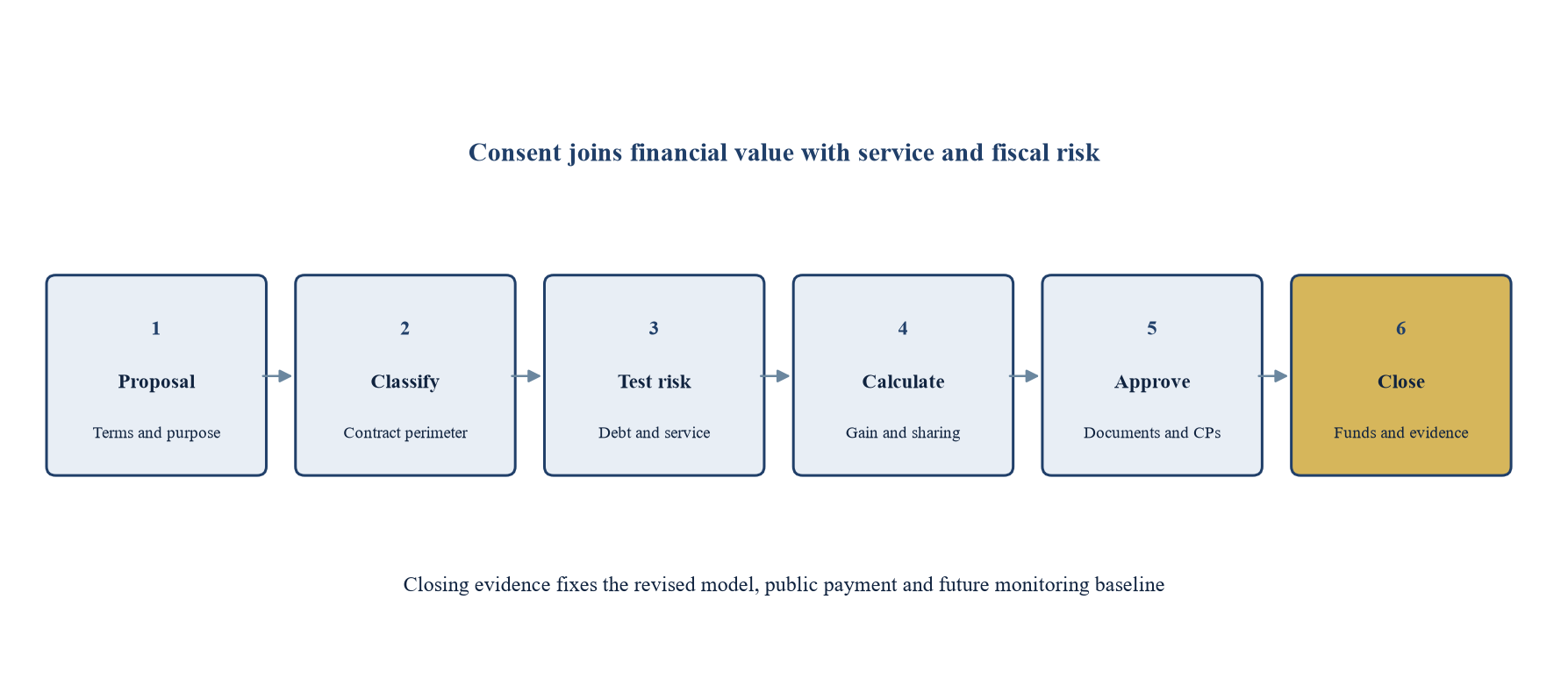
Original framework. A live transaction must follow the project agreement, financing documents and applicable public-finance rules.
6. Protect the original base case
The original base case is the reference financial model approved at contract close, including agreed amendments. It should show financing terms, operating assumptions, tax, lifecycle cost, reserve policy, distributions and equity return. A gain calculation becomes unreliable when the baseline is missing, unapproved or changed after the refinancing proposal emerges.
The authority should preserve the original model, model audit, locked inputs and change history. It should record any refinancing assumption included in the winning bid. If the project agreement defines a threshold equity return, the model should show how that threshold operates and whether earlier performance has already changed investor returns.
The revised model should differ only for permitted refinancing changes and consequential effects. Unrelated operating improvements, claims, tax assumptions or future variations should not be inserted without clear treatment. A bridge should identify every changed input and its effect on distributions, debt service and termination liabilities.
Discount rates and valuation dates require particular care. HM Treasury's refinancing guidance calculates gain through changes in forecast distributions and addresses the pace of public payment. It also notes that a payment through reduced unitary charges can create tax effects that require an iterative post-tax calculation. [4] The model should therefore apply the contractual basis consistently rather than selecting assumptions that maximise one party's result.
Model governance should include version control, independent review, locked formulas, sensitivity testing and sign-off. The closing model becomes the new operational baseline for future refinancing, termination and monitoring where the contract so provides.
7. Calculate economic gain
Refinancing gain should measure incremental investor value caused by the qualifying transaction against the contractual baseline. A common method compares the net present value of projected equity distributions before and after refinancing at the agreed discount rate. The calculation should include cash released at closing, changed debt service, reserve releases, fees, taxes and any revised distribution timing.
The calculation should avoid counting operating outperformance twice. If higher revenue or lower cost already increased distributable cash before the financing change, that value may belong outside the refinancing gain. The model should isolate value created by altered financing terms. Where the refinancing enables a distribution that could not otherwise occur, the effect belongs in the calculation.
Transaction costs reduce the gross gain. Eligible costs can include lender fees, break costs, hedge termination, model audit, external advisers and agreed authority costs. Related-party costs require scrutiny. Costs should be reasonable, documented and attributable to the refinancing.
The model should identify effects on termination compensation. If compensation is linked to outstanding senior debt, additional borrowing can increase the authority's exposure on termination. A refinancing that raises sponsor distributions while increasing public downside should not be approved solely because the NPV gain is positive.
Sensitivity analysis should test interest rates, inflation, performance deductions, lifecycle cost, default timing and residual value. The gain may be fixed at closing under the contract, while the risk assessment should still consider future downside.
8. Preserve sponsor incentives
Sponsors need a credible reason to identify, negotiate and execute a refinancing. They bear transaction cost, market risk and execution effort. A rule that transfers every unit of upside to the authority can discourage value-creating transactions or encourage sponsors to structure around the provision.
The incentive should reward value after protecting the public bargain. The sponsor can recover approved transaction costs before sharing. A defined share of incremental value can remain with investors. A threshold can protect the return assumed at bid stage where the contract supports that approach. Performance conditions can prevent distribution when service, lifecycle or reserve obligations are deficient.
The authority should avoid promising an absolute investor return. Equity remains exposed to project performance and contractual risk. A threshold equity IRR, where used, is a mechanism for calculating a refinancing share, not a guaranteed return.
An incentive corridor can combine a baseline, cost recovery and progressive sharing. Value up to the approved base-case return remains with investors. Incremental gain above the baseline is shared at the contractual rate. A higher public share can apply above a second threshold where exceptional value arises mainly from leverage, public support or market repricing.
The corridor should remain simple enough to model and audit. Excessive tiers can create disputes and distort transaction design. The governing principle is that the sponsor retains a meaningful marginal benefit after every tier.
9. Choose the public share
The share percentage is a policy and contractual choice. A 50:50 split has been used in established PPP frameworks. The World Bank's recommended provisions present a 50 per cent authority share as adaptable drafting, while Australia's national commercial principles generally refer to 50:50 sharing where projected equity return exceeds the original base case. [3] [5]
The percentage should reflect how the original bargain treated refinancing, which party created the value, and which party bears the revised risk. A lower authority share may be appropriate where the sponsor funds material improvements or accepts additional risk. A higher share may be justified where value comes from a public guarantee, contract extension, approved tariff change or substantially increased termination exposure.
The share should be set by contract or a disclosed policy rather than negotiated from scratch after the sponsor has arranged financing. Predictability supports lender competition and reduces allegations of arbitrary treatment.
A progressive share can address unusually large gains. It should use clearly defined bands and preserve a positive sponsor return at the margin. The model should show both nominal payments and present value. Management should understand how payment timing changes value.
The authority should also consider whether users should benefit. In user-pay concessions, reduced tariffs or service improvements may provide public value, subject to regulatory and affordability requirements. The payment route should match the contract and sector policy.
10. Select the payment mechanism
The public share can be paid as a lump sum, reduced availability payments, lower user tariffs, additional services or a combination. Each route has different cash, tax, accounting and credit consequences.
A lump sum gives immediate certainty when the refinancing releases cash at closing. The amount should not exceed available distributions if the contract protects project solvency. Reduced availability payments spread the benefit across the remaining term and may align with savings generated over time. Lower tariffs can benefit users but require regulatory and demand analysis. Additional services require procurement, scope and value-for-money controls.
HM Treasury guidance states that the authority should not receive its share faster than investors receive the increased distributions and discusses limits linked to the projected distribution increase. It also warns that a long-dated receivable from the contractor can create credit risk. [4] Payment should therefore follow an enforceable schedule and avoid turning the authority into an unsecured investor.
The payment mechanism should not weaken required debt-service coverage, reserves or lifecycle funding. Lenders should understand the public share and its priority. The closing funds flow should show the sponsor distribution, public payment, debt repayment, fees and reserve funding.
Any future payment adjustment should be documented in the revised project agreement or an approved deed. The financial model, invoices and contract-management system should use the same schedule.
11. Control additional leverage
Re-gearing can create value by replacing equity with cheaper senior debt. It can also reduce the cushion available to absorb operating shocks. The authority should assess leverage with the same care as pricing.
The review should compare debt-service coverage, loan life coverage, reserve requirements, maturity, tail, amortisation and downside performance. It should test whether the project can fund lifecycle work and handback obligations after the refinancing. A longer maturity should not extend beyond the period in which debt can be serviced or impair transfer at contract expiry.
Additional debt may increase termination compensation where the authority must repay senior debt following specified termination events. World Bank operational guidance identifies this as a refinancing risk, alongside reduced sponsor commitment after re-gearing. [6] The authority should calculate termination payments under representative events before and after the transaction.
Distribution conditions can protect the project. These may include no default, compliance with service standards, funded reserves, current lifecycle plans, minimum coverage ratios and completion of required works. The authority should distinguish lender distribution tests from public-contract conditions.
The consent decision should state an approved leverage ceiling and prohibit value leakage through parallel instruments. Security and direct agreements should preserve authority rights and lender step-in arrangements.
12. Reset covenants carefully
Lower risk can justify covenant changes. Lenders may reduce coverage thresholds, release guarantees, lower reserve requirements or permit larger distributions. Each change transfers part of the financing cushion to investors.
The authority should request a covenant bridge that compares current and proposed tests. It should identify cure rights, lock-up triggers, default thresholds, reserve floors and information requirements. A lower default threshold may increase termination risk. A lower lock-up threshold may accelerate distributions before the project has built resilience.
Covenant changes should be assessed under downside scenarios. A project can pass the central forecast while failing under modest performance deductions or lifecycle overruns. The test should include correlated shocks where contract performance and financing conditions deteriorate together.
The authority should avoid duplicating lender control. It should focus on changes that affect public risk, service continuity, distributions and termination. Contractual consent should preserve a clear boundary between lender credit decisions and the authority's public-interest duties.
Closing documents should update reporting. The contract manager needs the new debt profile, covenant definitions, testing dates and notification obligations. A model that remains with transaction advisers provides little operational control.
13. Protect lifecycle and handback
Operational PPPs often face major maintenance and replacement expenditure after refinancing. The sponsor may have an incentive to release cash before those obligations peak. The authority should connect refinancing consent to a current lifecycle plan and condition survey.
The technical review should compare forecast and actual asset condition, completed maintenance, deferred work, lifecycle reserve balances and future expenditure. It should test whether the revised financing can support required work under downside performance.
Handback obligations deserve separate analysis where debt maturity approaches contract expiry. The refinancing should preserve a sufficient debt tail and avoid security that impedes asset transfer. Any handback reserve or inspection programme should remain funded.
Additional services offered as the authority's share should not replace existing obligations. The variation should define incremental scope, price, performance and ownership. Procurement rules may apply.
The consent conditions can require completion of overdue works, funding of reserves or delivery of an updated asset-management plan. These conditions connect financial upside to the service outcome that supports the PPP's public purpose.
14. Measure fiscal exposure
The authority should assess direct payments, guarantees, termination compensation and contingent liabilities before consent. Refinancing can reduce future availability payments while increasing termination exposure. It can also change the timing of public receipts and the probability of support.
The IMF and World Bank PPP Fiscal Risk Assessment Model provides a structured approach to fiscal cost and risk. It asks how the asset is controlled, who pays, what government support exists and which risks remain with the public sector. [7] The refinancing review should update the relevant model or fiscal risk register.
Fiscal analysis should include the central case and stress cases. It should show the authority's public-share receipts, any payment reductions, revised termination amounts and guarantee exposure. A gain received today should not obscure a larger contingent liability.
Accounting and statistical treatment may depend on refinancing provisions and risk allocation. EPEC notes that refinancing clauses can matter to statistical treatment. [1] The authority should obtain project-specific advice rather than assume that a financing change leaves classification unchanged.
The final approval should identify the fiscal owner responsible for monitoring revised exposure. Future budgets and disclosures should reflect the agreed payment mechanism.
15. Build the hypothetical transaction
The hypothetical project is an operational water-treatment PPP with sixteen years remaining. Senior debt outstanding is USD 280 million. The existing financing rate is 6.5 per cent with twelve years remaining. The project has completed construction and achieved three years of stable operating performance.
The sponsor proposes USD 320 million of new senior debt at 5.1 per cent with a fifteen-year maturity. The transaction repays existing debt, funds USD 5 million of fees and releases USD 35 million before any public payment. It also reduces annual debt service under the model and relaxes selected reserve and distribution tests.
The original base case did not assume this refinancing. The contract requires authority consent and a 50 per cent share of qualifying gain after approved transaction costs. The model uses a 12 per cent equity discount rate solely for illustration. All values, terms and outputs are hypothetical.
The authority tests four structures. Structure A grants consent without sharing. Structure B applies a straight 50:50 NPV split. Structure C protects the agreed base-case return and then applies a progressive public share to exceptional gain. Structure D takes part of the public share through a closing payment and the balance through availability-payment reductions.
| Input | Existing financing | Proposed refinancing | Decision relevance |
|---|---|---|---|
| Senior debt | USD 280 million | USD 320 million | Additional leverage and termination exposure |
| Financing rate | 6.5 per cent | 5.1 per cent | Debt-service reduction before fees and hedging |
| Remaining maturity | 12 years | 15 years | Lower annual service with a shorter debt tail |
| Transaction costs | Not applicable | USD 5 million | Deduct from gross transaction value if eligible |
| Closing cash release | None | USD 35 million | Source for sponsor and public closing payments |
| Equity discount rate | 12 per cent | 12 per cent | Contractual illustration for NPV comparison |
Original scenario. All amounts and financing terms are hypothetical and do not describe a live project.
16. Compare gain-sharing structures
The hypothetical model estimates a USD 52 million qualifying refinancing gain in NPV terms after eligible costs. This result is an assumed model output for comparing structures. It is not derived from observed market data.
Under Structure A, the sponsor retains the full gain and the authority receives no direct value. The sponsor has the strongest incentive, but the outcome may be difficult to defend where public commitments support cash flow and the contract provides for sharing.
Under Structure B, each party receives USD 26 million in NPV terms. The mechanism is simple and auditable. It does not distinguish ordinary improvement from exceptional leverage-driven value.
Structure C assigns USD 20 million to the sponsor within the incentive corridor, splits the next USD 20 million equally and assigns 70 per cent of the remaining USD 12 million to the authority. The resulting illustrative allocation is USD 31.6 million to the sponsor and USD 20.4 million to the authority. The sponsor retains positive marginal value in every tier.
Structure D uses the same 50:50 value allocation as Structure B. The authority receives USD 15 million at closing and the remaining USD 11 million of NPV through payment reductions. Actual nominal reductions would depend on the contractual discount rate, tax and timing.
| Structure | Sponsor NPV gain | Authority NPV gain | Payment route | Principal issue |
|---|---|---|---|---|
| A No share | USD 52.0 million | USD 0.0 million | Sponsor distribution | Weak public-value case where sharing applies |
| B Straight 50:50 | USD 26.0 million | USD 26.0 million | Agreed lump sum or payment reduction | Simple but insensitive to gain source |
| C Incentive corridor | USD 31.6 million | USD 20.4 million | Progressive allocation | Requires clear thresholds and model audit |
| D Mixed settlement | USD 26.0 million | USD 26.0 million | USD 15 million at close plus future reductions | Introduces timing, tax and credit questions |
Original scenario. NPV outputs are assumed for decision illustration and are not forecasts.
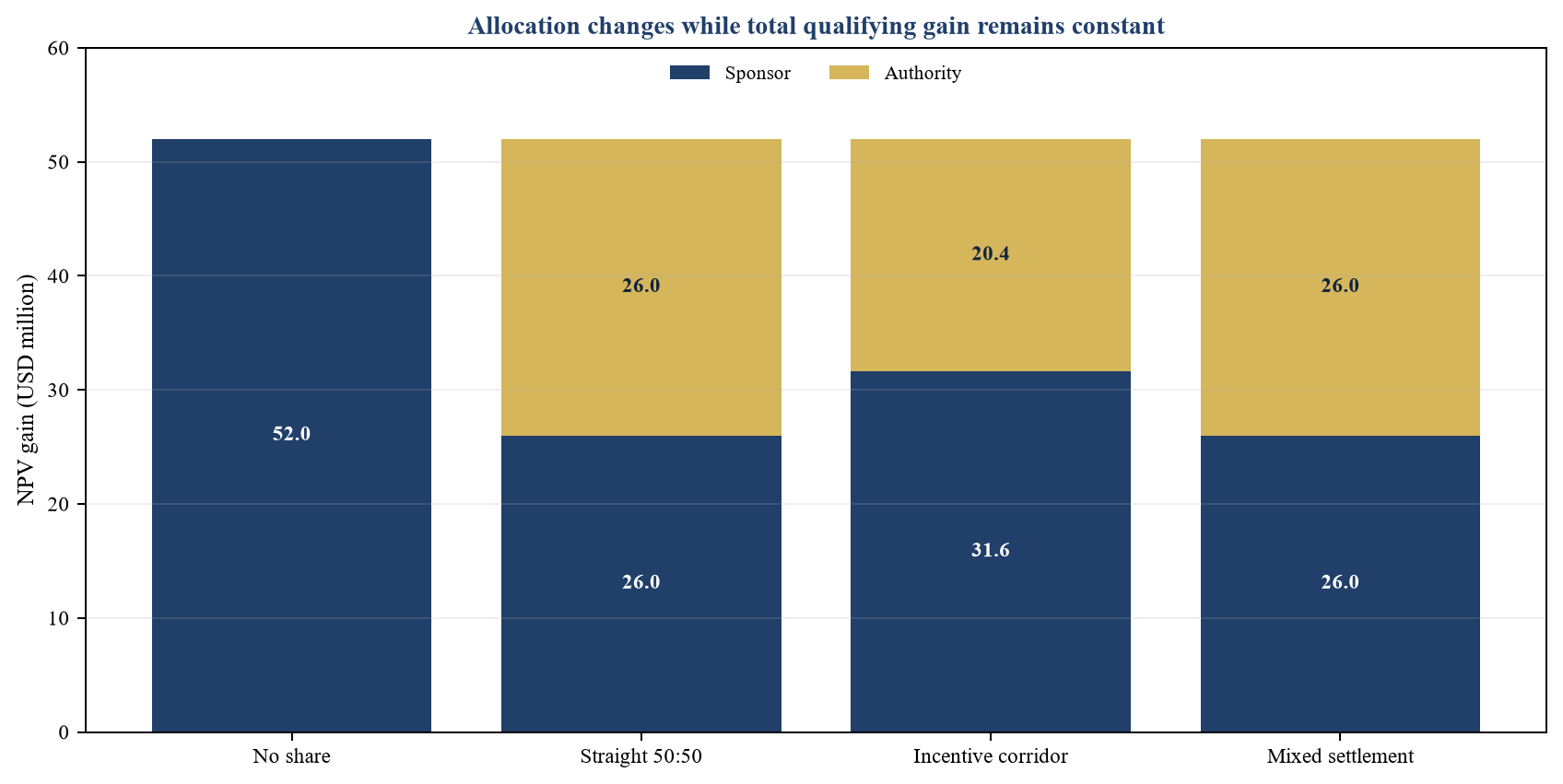
Original scenario. Values are hypothetical NPV amounts used to compare sharing structures.
17. Test risk alongside value
The gain calculation should sit beside a risk comparison. Management should see leverage, debt service, covenant headroom, reserves, lifecycle funding, termination exposure and sponsor capital after the transaction.
The hypothetical refinancing increases senior debt by USD 40 million. Lower pricing and longer maturity reduce annual debt service in the central case, while higher principal increases termination exposure. The public share does not by itself cure that risk. Consent conditions may need a leverage cap, debt tail, reserve floor and restriction on further distributions.
The authority should compare central, downside and severe cases. The downside case can combine a performance deduction with lifecycle cost inflation. The severe case can add a prolonged service failure or refinancing-rate shock. The analysis should show which covenants trigger, whether distributions lock up and whether the project can recover without public support.
Sponsor incentives should be measured after conditions. A structure that leaves nominal upside but makes approval uncertain or payment mechanics unworkable may still deter refinancing. The authority should use clear, pre-agreed tests.
Risk attribution should distinguish changes caused by the refinancing from risks already present in the project. Existing performance weakness should remain visible in the operational forecast. New leverage, longer maturity, reduced reserves and relaxed covenants should be shown as refinancing effects. This bridge prevents a favourable central case from concealing a weaker financing structure.
The authority should also test the timing of value and downside. A large closing distribution is immediate, while lifecycle work and termination exposure may arise years later. Present-value comparison helps, but it does not replace liquidity analysis or contractual protection. Management should see annual cash flows, reserve balances and exposure at each material milestone through debt maturity and handback.
Independent review should challenge the sponsor's sensitivities rather than repeat them. Advisers should identify the variables that most affect debt service, distributions and public liability, then test combinations that reflect the project's actual risk. The decision paper should state which cases fail and which consent conditions address those failures.
| Risk | Evidence required | Approval control | Monitoring indicator | Escalation trigger |
|---|---|---|---|---|
| Excess leverage | Sources and uses, coverage and termination model | Debt ceiling and debt tail | Debt balance and coverage | Breach of approved leverage or coverage |
| Premature distribution | Funds flow and reserve forecast | Distribution conditions | Reserves, lifecycle funding and service status | Distribution while condition is unsatisfied |
| Gain understatement | Original and revised models with change bridge | Independent model audit | Actual closing flows | Unexplained model or funds-flow variance |
| Service deterioration | Performance history and downside cases | No material default at close | Deductions and availability | Persistent service failure |
| Public credit exposure | Payment route and contractor credit analysis | Lump sum or secured adjustment | Outstanding public receivable | Delayed or disputed public payment |
| Future circumvention | Complete financing and related-party disclosure | Catch-all definition and audit rights | Financing amendments and waivers | Undisclosed restructuring or reserve release |
Original framework. Owners and thresholds must be adapted to the live contract and financing documents.
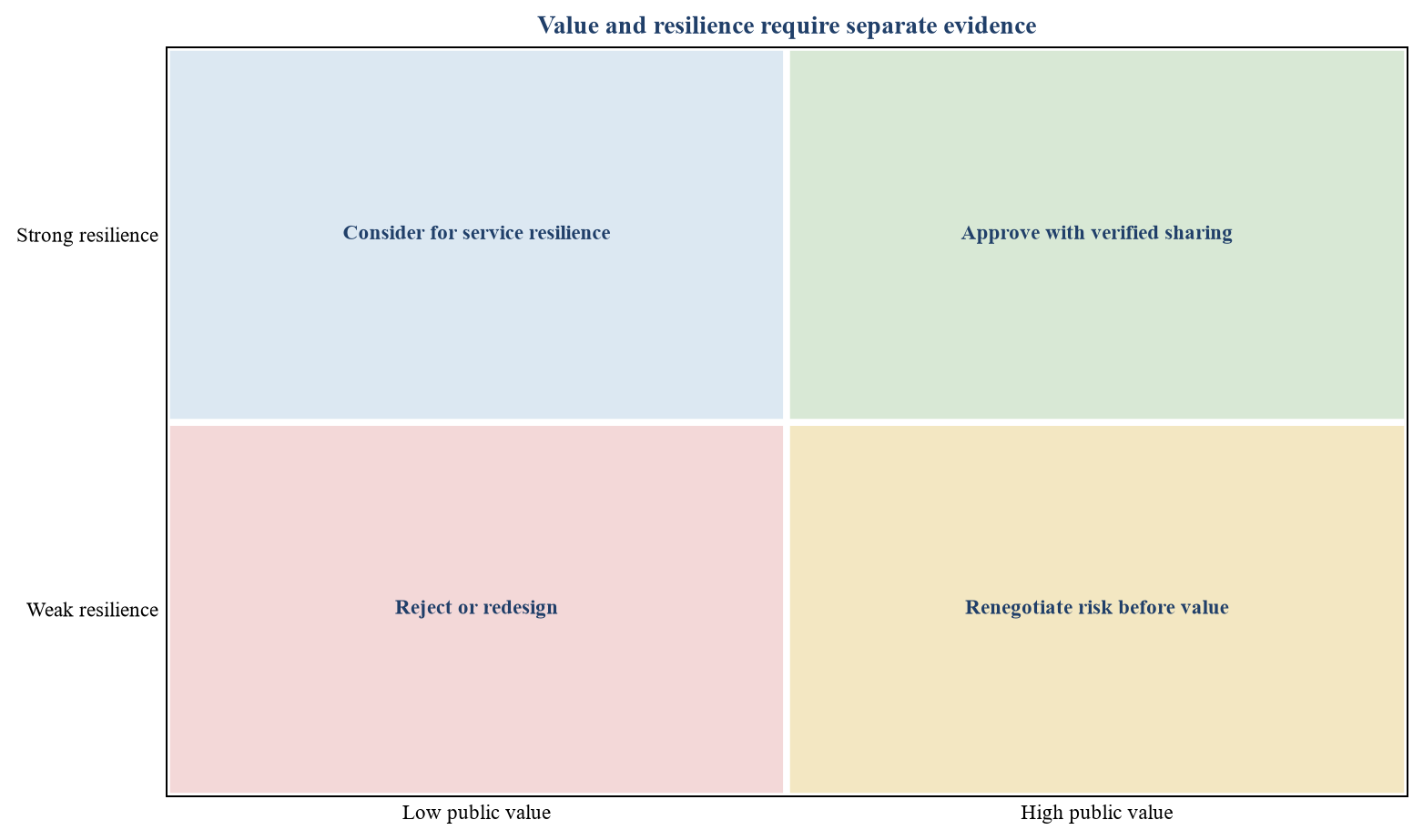
Original framework. A transaction should advance only when value and resilience are both acceptable.
18. Govern the closing distribution
Closing funds should follow an approved waterfall. New debt first repays existing lenders and transaction costs. Required reserves and agreed project expenditure should be funded. The public closing payment follows the contract. Remaining cash can then be distributed to sponsors subject to all conditions.
The authority should receive a final funds-flow statement before closing and evidence immediately afterward. Evidence can include lender repayment confirmations, hedge settlement, reserve balances, public payment, updated registers and board approvals.
The sponsor should certify that disclosed arrangements represent the entire refinancing and that no side agreement changes the economics. Related-party payments should be identified. The authority should retain audit and clawback rights where the contract permits.
Future payment reductions should be loaded into billing systems and reconciled to the closing model. Responsibility should pass from transaction advisers to contract management through a formal handover.
The authority should avoid delaying an otherwise compliant closing through unresolved internal ownership. The approval plan should identify who signs the consent, project-agreement amendment, fiscal approval and payment instruction.
19. Learn from observed cases
Historical PFI experience shows both the scale of refinancing gains and the risk of weak contractual preparation. The UK National Audit Office reported that early contracts often lacked sharing provisions and that government later introduced standard arrangements. It also found examples where gains were not shared as intended. [8]
The Norfolk and Norwich hospital refinancing generated a reported GBP 115 million NPV gain, of which GBP 34 million was shared with the trust. The NAO reported that shareholder IRR rose from 16 per cent to 60 per cent, reflecting earlier distributions after increased borrowing and better terms. [9] This case is historical evidence from a specific contract, not a benchmark for current projects.
The lesson is institutional. Authorities need the model, rights and capability to evaluate a proposal before the transaction is urgent. A clause without contract-management capacity may not secure value.
Current UK contract-management guidance identifies refinancing as a decision with financial, legal or strategic implications requiring escalation and recognises gain sharing as a project-company obligation. [10] Operational governance should therefore maintain financing knowledge throughout the contract term.
20. Implement a refinancing control system
The authority should first inventory contractual rights across the PPP portfolio. The inventory should identify refinancing definitions, consent rights, gain shares, model availability, audit rights, termination formulas and known financing milestones.
Second, management should preserve models and financing documents in a controlled repository. Each project should have an accountable commercial owner, finance owner and legal owner. Contact details for lenders and sponsors should remain current.
Third, the authority should adopt a standard proposal template and decision timetable. The template should request terms, sources and uses, covenant changes, reserves, distributions, risk effects and public-payment options.
Fourth, a panel of financial, legal, technical and tax advisers can reduce mobilisation time. Adviser independence and cost recovery should follow the contract.
Fifth, closing controls should connect approvals to funds flow, model delivery and contract-management handover. Post-closing monitoring should confirm payments and conditions.
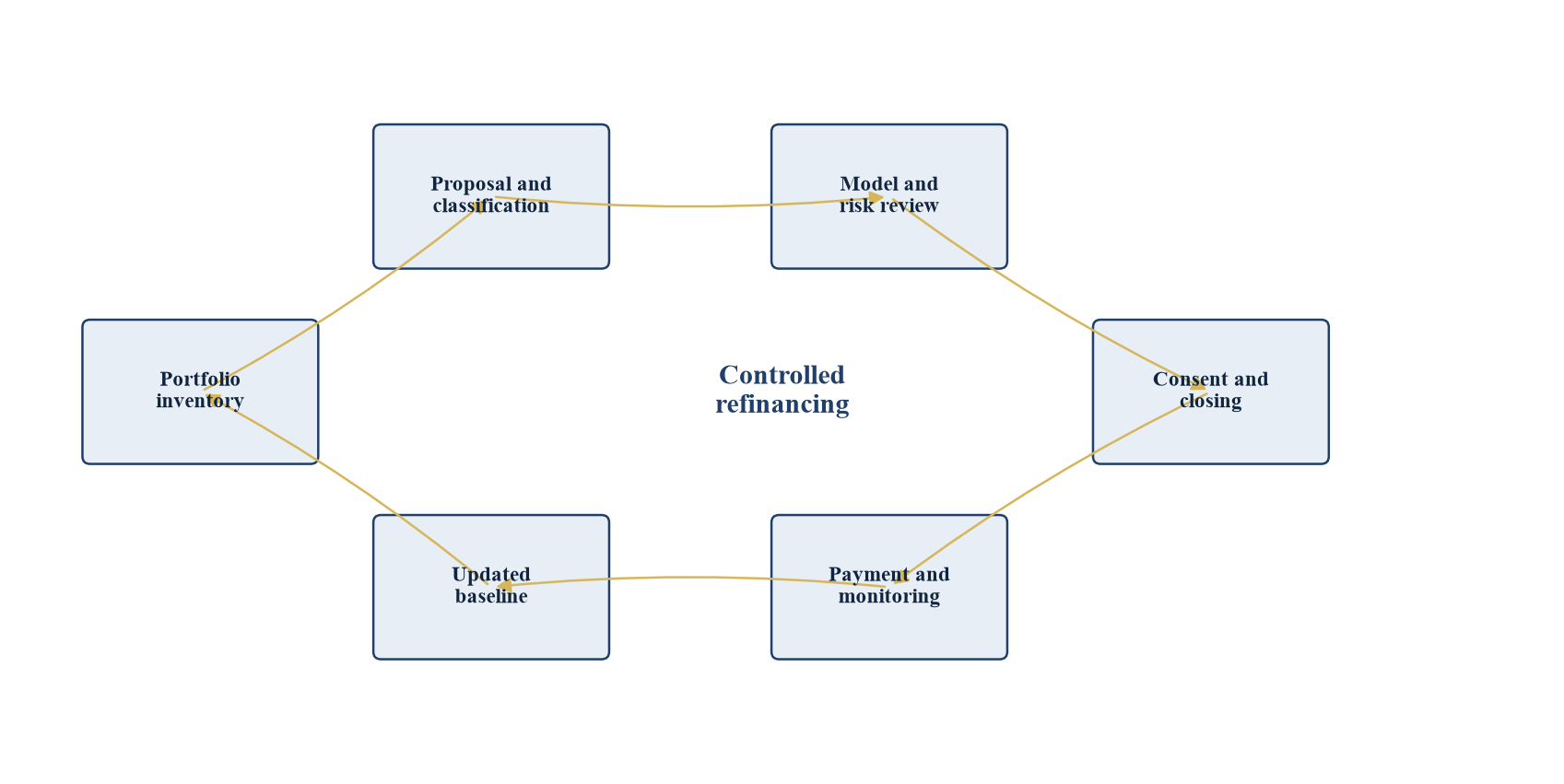
Original framework. Portfolio controls support project-specific decisions and do not replace contractual analysis.
21. Management questions before consent
Management should ask whether the transaction is classified correctly and whether the original base case is complete. It should confirm which value was already priced into the bid and which value arises from the proposed financing.
The decision body should understand the source of gain. It should know how much comes from lower pricing, longer maturity, re-gearing, reserve release, public action or operating performance. The model should show the sponsor and public allocation under the contract.
Management should test whether service and asset obligations remain funded. It should review lifecycle work, handback, reserves, covenants and downside coverage. Any existing default or unresolved variation should be explicit.
The authority should understand fiscal effects. The approval paper should show direct receipts, payment reductions, termination exposure, guarantees and accounting considerations.
The closing plan should identify conditions, documents, funds flow, model delivery, payment and post-closing monitoring. Consent should expire if the transaction changes materially or does not close within the approved period.
22. Conclusion
An operational PPP refinancing can convert reduced project risk into lower financing cost and stronger cash flow. The decision should measure the whole transaction, including leverage, covenants, reserves, distributions, termination exposure and public payments.
Clear classification protects routine treasury management, rescue transactions and financing already assumed in the original bid. A qualifying transaction should use the approved base case, an independently reviewed model and a transparent gain calculation.
The sponsor should retain enough incremental value to justify execution effort and continued performance. The public authority should receive its contractual share where value arises from changed financing, public commitments or risk reduction embedded in the PPP. An incentive corridor can preserve both objectives when its baseline, tiers and payment rules are simple and auditable.
Consent should depend on resilience as well as value. Required reserves, lifecycle work, debt tail, service performance and fiscal exposure should remain acceptable after closing. The revised model and payment schedule should then pass into ordinary contract management.
The framework provides a structured route from proposal to monitored closing. Its numerical illustration is hypothetical and intended only to explain the mechanics.
Sources
- European PPP Expertise Centre, EPEC Guide to Public-Private Partnerships, 2026, accessed 16 September 2026. Read the primary source
- World Bank Group, Guidance on PPP Contractual Provisions, 2019 edition, accessed 16 September 2026. Read the primary source
- World Bank Group, Recommended PPP Contractual Provisions, Refinancing, accessed 16 September 2026. Read the primary source
- HM Treasury, Guidance Note: Calculation of the Authority's Share of a Refinancing Gain, accessed 16 September 2026. Read the primary source
- Australian Government, National PPP Guidelines Volume 7: Commercial Principles for Economic Infrastructure, accessed 16 September 2026. Read the primary source
- Asian Development Bank, European Bank for Reconstruction and Development, Inter-American Development Bank, Islamic Development Bank and World Bank Group, PPP Reference Guide, Operations and Handback, accessed 16 September 2026. Read the primary source
- International Monetary Fund and World Bank Group, Public-Private Partnerships and the PPP Fiscal Risk Assessment Model, accessed 16 September 2026. Read the primary source
- UK National Audit Office, Update on PFI Debt Refinancing and the PFI Equity Market, 2006, accessed 16 September 2026. Read the primary source
- UK National Audit Office, The Refinancing of the Norfolk and Norwich PFI Hospital, 2005, accessed 16 September 2026. Read the primary source
- UK National Infrastructure and Service Transformation Authority, Contract Management Guidance: PFI Foundations, 2026, accessed 16 September 2026. Read the primary source
