

1. Frame the approval decision around collectible cash
The lender's decision is whether a defined pool of rooftop-solar assets can produce collectible, controlled and resilient cash flows sufficient to service debt throughout the facility tenor. Installed capacity and contracted revenue matter, yet neither establishes repayment capacity by itself. The credit committee needs evidence that energy is generated, measured, invoiced, collected and available to the financing vehicle under enforceable arrangements.
The decision should be expressed as a set of conditions. The lender should identify the eligible host population, maximum exposure to any host or connected group, minimum contract tenor, technical acceptance evidence, permitted payment structures, required site rights, equipment-title standard, collection-account controls, reserve requirements and circumstances that remove a site from the borrowing base. The conditions should operate at site level and at consolidated portfolio level.
Saudi Electricity Company's connection guidance covers planning, execution, modification, operation and maintenance of small-scale solar photovoltaic systems connected to its low-voltage or medium-voltage distribution networks. The guidance directs consumers, consultants and contractors to the applicable regulatory framework and companion technical standards. [1] SEC's technical standards describe equipment, protection, operating and disconnection requirements for systems operating in parallel with the distribution network. [2] These materials make connection and technical compliance part of the evidence chain. They do not establish that the host will pay the project company on time.
The financing case therefore requires two linked files. The technical file demonstrates that each asset can lawfully and safely operate at the intended connection point. The commercial-credit file demonstrates that the resulting cash flow can reach the lender. Missing evidence in either file should reduce eligibility, availability or advance value until cured.
2. Understand the Saudi rooftop-solar setting
Saudi Arabia's energy policy supports renewable-energy development. The National Industrial Development and Logistics Program's 2024 annual report stated that 20 gigawatts of renewable-energy project capacity had been announced and connected that programme with the objective of increasing renewables to 50 per cent of the electricity mix by 2030. [4] The scale and procurement model of utility projects differ from a portfolio of host-sited rooftop systems, so the policy objective should be used as strategic context rather than a proxy for distributed-generation bankability.
Rooftop systems use existing commercial or industrial premises. The host relationship can involve an onsite power-purchase agreement, equipment lease, instalment arrangement, self-consumption service, or another approved structure. SEC materials describe self-consumption and net-billing concepts and place responsibility for compliance, design and connection evidence on the relevant participants. [1][2][3] The lender should identify the exact model used by every site and avoid treating labels as interchangeable.
The latest applicable connection documents should be obtained directly for a live transaction. SEC's published guidance expressly notes that standards can be superseded or amended and that users should ensure they are consulting the current edition. [1] The financing conditions should therefore require confirmation of applicable rules at initial draw, commissioning, material modification and any refinancing.
The Saudi Central Bank's in-force credit-risk rules require banks to identify, measure, manage and report credit exposures and to maintain criteria for new credit, renewal and refinancing that address the nature, amount, terms and contractual obligations of the exposure. [5] SAMA's credit-policy rules also call for a clear understanding of the borrower, the purpose and structure of the credit and its source of repayment. [7] A portfolio lender can translate those principles into a site-level credit file and a consolidated source-of-repayment model.
3. Distinguish the borrower, the assets and the hosts
A rooftop-solar portfolio usually contains at least three credit layers. The borrower owns or controls the financed assets and incurs the debt. The sponsor supports development, operations and portfolio management. The hosts consume electricity, provide roof access and make payments under the site contracts. Each layer needs separate analysis.
The borrower may be a special-purpose vehicle with limited independent resources. Its ability to pay debt therefore depends on upstream collections from the host contracts. SAMA's specialised-lending framework describes project-finance exposures where repayment depends materially on income from the financed assets and sets supervisory criteria for their treatment. [6] The precise regulatory classification is a matter for the regulated lender. The analytical point is broader: a thinly capitalised vehicle cannot cure weak host cash flow through its own balance sheet.
The sponsor analysis should cover construction and operating capability, procurement discipline, warranty management, treasury controls, reporting, related-party arrangements and willingness to support problem sites. Sponsor strength can improve execution and provide contingent support. The lender should document the legal form, limit and duration of any support rather than treating reputation as cash collateral.
Host analysis should identify the contractual obligor, ultimate ownership, business model, financial condition, payment history, sector exposure, cyclicality, location, concentration and dependency on government or large customers. Where the contracting entity belongs to a group, the lender should determine whether any parent support exists and whether the entity itself has sufficient assets and cash flow.
The equipment remains a separate source of value. Panels, inverters, mounting systems, cables and monitoring equipment can have title, warranty and replacement value. Their recovery value depends on removability, condition, access, logistics, remaining useful life, compatibility and a real route to redeployment. The lender should avoid assigning residual value to equipment that cannot be accessed or economically reused.
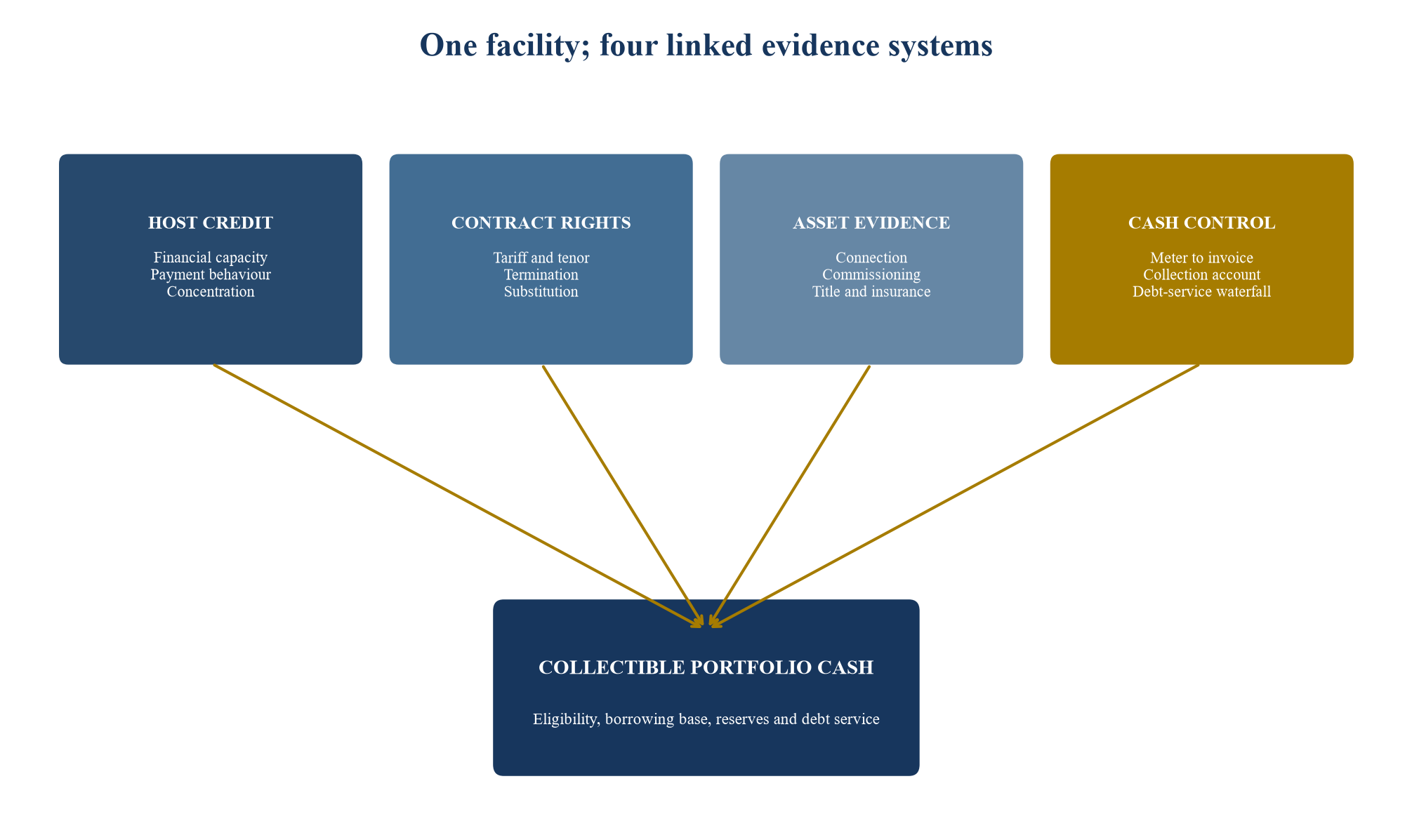
Original framework. Legal rights and cash controls require transaction-specific Saudi review.
4. Create a host-credit taxonomy
The lender needs a consistent host taxonomy before applying concentration limits. A simple investment-grade or non-investment-grade label is rarely available for private commercial and industrial hosts. The taxonomy should use evidence that can be maintained throughout the loan.
One approach uses four dimensions. Financial capacity covers audited or reviewed accounts, liquidity, leverage, profitability, cash conversion and forecast resilience. Payment behaviour covers historical invoice ageing, disputes, deductions and timeliness. Business resilience covers sector cyclicality, customer concentration, import dependency, energy intensity and site importance. Contract support covers guarantees, deposits, direct debit, letters of credit or other enforceable credit enhancement.
The result can be organised into host tiers. Tier 1 hosts show strong financial capacity, reliable payment behaviour and strategic use of the site. Tier 2 hosts show acceptable capacity with identifiable sensitivities. Tier 3 hosts require tighter limits, reserves or credit enhancement. Ineligible hosts lack sufficient evidence, have unacceptable arrears, present material sanctions or compliance concerns, or fail essential contract and access tests.
The tier is an internal financing classification. It should not be presented as an external credit rating. The lender should define the evidence required for each tier, review frequency and automatic downgrade triggers. A host can move between tiers as facts change.
| Dimension | Tier 1 evidence | Tier 2 evidence | Tier 3 control | Ineligible condition |
|---|---|---|---|---|
| Financial capacity | Current audited accounts, positive operating cash flow and adequate liquidity | Reliable accounts with manageable leverage or cyclicality | Limited disclosure, weaker liquidity or dependence on support; enhanced monitoring required | Evidence insufficient to assess repayment capacity or material distress exists |
| Payment behaviour | Consistent on-time payment and minimal disputes | Occasional delay with credible cure history | Repeated delay, deductions or reliance on negotiated plans | Material unresolved arrears or refusal to recognise valid invoices |
| Site importance | Site is central to continuing operations and energy demand is stable | Site remains active with identifiable demand variability | Relocation, downsizing or operational volatility is plausible | Closure, loss of occupancy or prohibited use is expected |
| Contract support | Strong obligor, enforceable guarantee or equivalent support | Contracted obligor has acceptable standalone capacity | Deposit, reserve, direct debit or other enhancement required | Obligations depend on an uncommitted affiliate or unenforceable assurance |
| Monitoring | Annual full review and monthly performance data | Semi-annual credit review and monthly performance data | Quarterly credit review, ageing triggers and cash sweep | Required reporting cannot be obtained |
The matrix is an underwriting framework. Thresholds require lender policy and transaction-specific calibration.
5. Measure concentration through cash contribution
Site count is a weak diversification measure. The lender should calculate concentration using contracted billings, expected collections, cash available for debt service, outstanding exposure and stressed loss contribution. A portfolio with twenty-four sites may still depend on five hosts for most debt service.
The hypothetical case has eight Tier 1 hosts contributing 45 per cent of annual billings, ten Tier 2 hosts contributing 38 per cent and six Tier 3 hosts contributing 17 per cent. The largest host contributes 12 per cent and the five largest hosts contribute 43 per cent. These values are assumptions created to illustrate the method.
Concentration should also be tested by connected group, sector, city, property owner, installer, equipment model, network area and contract expiry year. Two hosts with different names may share the same parent, customer base or property owner. A portfolio can therefore contain economic correlation that is invisible in the host list.
The credit committee can set limits at approval and establish cure mechanics. A new site that breaches a concentration limit may receive a lower advance rate. A downgrade can trigger a borrowing-base deficiency, cash sweep, reserve top-up or replacement requirement. The cure period should reflect how quickly the sponsor can add eligible assets or repay debt.
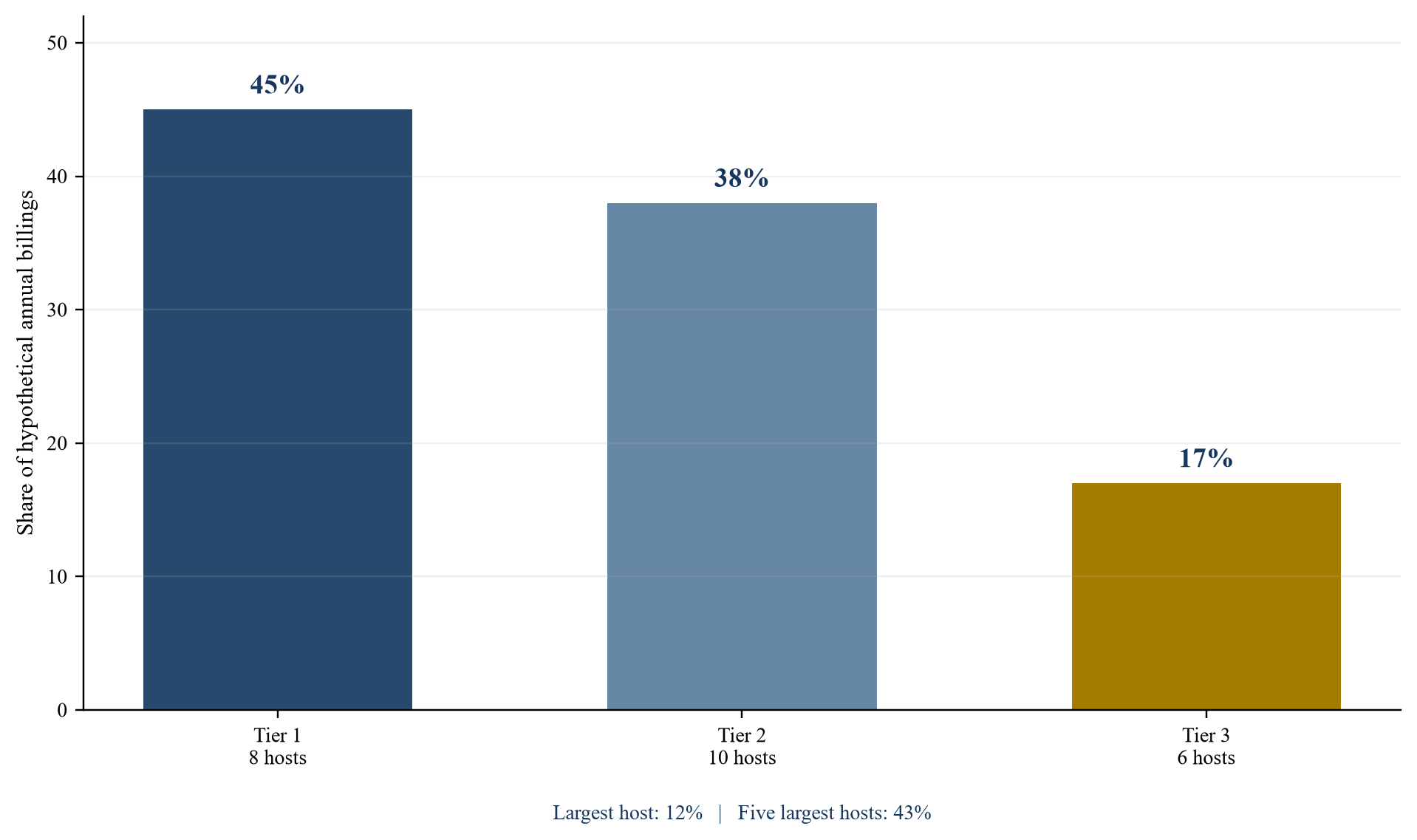
Twenty-four hosts and all percentages are scenario assumptions, not observed Saudi portfolio data.
6. Build a site-level eligibility test
Eligibility should be tested before a site contributes to availability. The test should cover the host, contract, connection, asset, property, cash collection, insurance and environmental and social evidence. Each criterion should have a defined document and responsible reviewer.
Host eligibility requires verified legal identity, ownership, authorised signatories, satisfactory know-your-customer review, current financial information, credit classification and payment evidence where the site is operating. Contract eligibility requires an executed agreement, defined price or payment formula, remaining tenor compatible with debt repayment, enforceable invoicing obligations, limited termination rights and clear treatment of site closure, change of control and default.
Technical eligibility requires approved design evidence, connection approval where applicable, completed testing and commissioning, metering configuration, operating data, warranties and an operations-and-maintenance plan. SEC's standards address equipment and system behaviour, including connection, protection, start-up, operation and disconnection. [2] The lender should obtain confirmation from qualified technical advisers that each financed system satisfies the requirements applicable to that installation.
Property eligibility requires evidence that the host has rights over the premises, that roof use is permitted and that the project company can access the equipment for inspection, maintenance and enforcement. The analysis should cover landlord consent, mortgagee interests, lease expiry, roof condition, building alterations, structural loading, fire-safety obligations and reinstatement.
Cash eligibility requires a controlled invoicing and collection route. The meter data, invoice, payment and bank statement should reconcile. The lender should identify deductions, disputed quantities, netting, taxes, fees and any right of the host to set off other claims.
7. Treat contract rights as credit infrastructure
The site agreement converts generation into a receivable. Its provisions should be underwritten as part of the collateral package and source of repayment. Legal counsel should analyse the agreement under its governing law and the facts of the site.
The price clause should state how delivered or self-consumed energy is measured and valued, the billing period, taxes, indexation, minimum-payment mechanics and treatment of meter failure. The term should cover the debt period with appropriate tail. Termination provisions should distinguish host default, project-company default, prolonged force majeure, site loss and regulatory change.
The lender should identify compensation on early termination. A contractual termination payment may support recovery only if it is enforceable, correctly calculated and payable by a creditworthy obligor. It should be stress-tested alongside the host's ability to pay at the time of default.
Assignment and direct-agreement provisions can give the lender notice of default, cure rights, step-in rights and control over amendments. Their effectiveness depends on applicable law, consent and the final documents. A financing assumption should therefore cite the executed legal instrument rather than a standard-form expectation.
| Right or control | Credit purpose | Evidence required | Failure response |
|---|---|---|---|
| Payment and metering | Converts verified energy into a collectible receivable | Price schedule, meter protocol, invoice sample, dispute and tax clauses | Reduce eligible revenue; require cure or alternate evidence |
| Contract tenor and renewal | Aligns host cash flow with debt maturity | Executed term, renewal process, termination rights and expiry schedule | Shorten sculpting period or exclude tail cash flow |
| Assignment and amendment control | Preserves the financed contract and lender influence | Host consent, security assignment and restricted amendment provisions | Exclude contract or require direct agreement |
| Notice and cure | Gives the lender time to protect the site | Notice addresses, cure periods, step-in mechanics and acknowledgement | Increase reserve or require stronger credit support |
| Roof and site access | Supports maintenance, inspection, removal and enforcement | Lease, licence, landlord consent, access protocol and safety requirements | Assign no equipment recovery value until cured |
| Removal and reinstatement | Defines the route and cost of recovering equipment | Removal rights, ownership record, reinstatement scope and cost estimate | Deduct removal and reinstatement cost from recovery value |
| Substitution or relocation | Allows cash flow to be restored after host failure | Host replacement right, permitting path, logistics and compatibility study | Apply longer downtime and lower stressed recovery |
Rights require Saudi legal review, property review and confirmation against each executed contract.
8. Underwrite roof access and removal before assigning residual value
Rooftop equipment can provide collateral value only when the project company can reach and control it. Access can be constrained by property ownership, leases, security procedures, safety rules, operational shutdowns or insolvency. The lender should review those constraints before crediting equipment value.
The site file should identify the property owner, occupier, mortgagee where relevant and all consents supporting installation and removal. It should state whether the project company owns the equipment, whether it remains movable property, whether attachment to the building affects title and whether any third party can claim a lien. Legal advice is required for the actual structure.
Removal economics should include isolation, disassembly, cranes or lifting equipment, transport, storage, roof reinstatement, testing, recertification, recommissioning and lost generation. Modules and inverters may have remaining technical life, yet the recovered value can be modest after these costs and a period without revenue.
The lender should run a site-access drill before first draw or shortly after commissioning. The drill can confirm the contacts, notice route, permits, safe working procedures and practical access path. It also reveals whether the contractual right can be exercised without disrupting the host's critical operations.
9. Connect technical output to billable energy
Technical performance and host credit should remain separate in the model. Lower irradiation, soiling, inverter failure, curtailment, meter error and downtime reduce energy available to bill. Host default affects collection after energy has been delivered. Combining the two can conceal the actual remedy.
The base energy model should use site-specific resource data, design assumptions, loss factors and degradation. Independent technical review should confirm the probability case used for debt sizing, the availability assumptions and the treatment of degradation. Actual monthly production should be compared with weather-adjusted expectation.
SEC's standards place importance on protection, power quality, coordination with the distribution network and safe operating behaviour. [2] Commissioning evidence should therefore include approved settings, inspection and test records, as-built design, meter configuration and confirmation of the applicable connection point.
Performance guarantees and warranties should identify the responsible party, remedy, claim period and security. A warranty from a weak or inaccessible supplier should receive limited credit. The operating model should include spare parts, response times, replacement schedules and recurring inspection.
Meter governance is a central control. The lender should know which meter determines the invoice, who owns it, how data are collected, how exceptions are corrected and how the host can dispute readings. Data from monitoring platforms should reconcile with the contractual billing meter and the collection record.
10. Design a controlled cash waterfall
The cash waterfall should make host collections visible and restrict leakage. Hosts should pay into the agreed collection account where legally and operationally feasible. The account structure should separate taxes, operating costs, reserve funding, scheduled debt service, permitted sponsor distributions and extraordinary recoveries.
The monthly report should reconcile generated energy, billable energy, invoices, collections, ageing, credits, deductions and cash received. It should identify each host and site. Aggregate bank receipts without invoice-level reconciliation provide limited assurance.
In the hypothetical base case, annual contracted billings are USD 10.8 million. Operating and portfolio costs are USD 2.7 million. Cash available for debt service is USD 8.1 million and scheduled debt service is USD 5.4 million, producing a debt-service coverage ratio of 1.50 times. All values are assumptions.
The waterfall can retain excess cash when a host is downgraded, concentration rises, arrears breach a threshold, technical availability falls or a site becomes ineligible. Release tests should use both historic and forward-looking measures. A strong trailing ratio can coexist with a near-term contract expiry or material host deterioration.
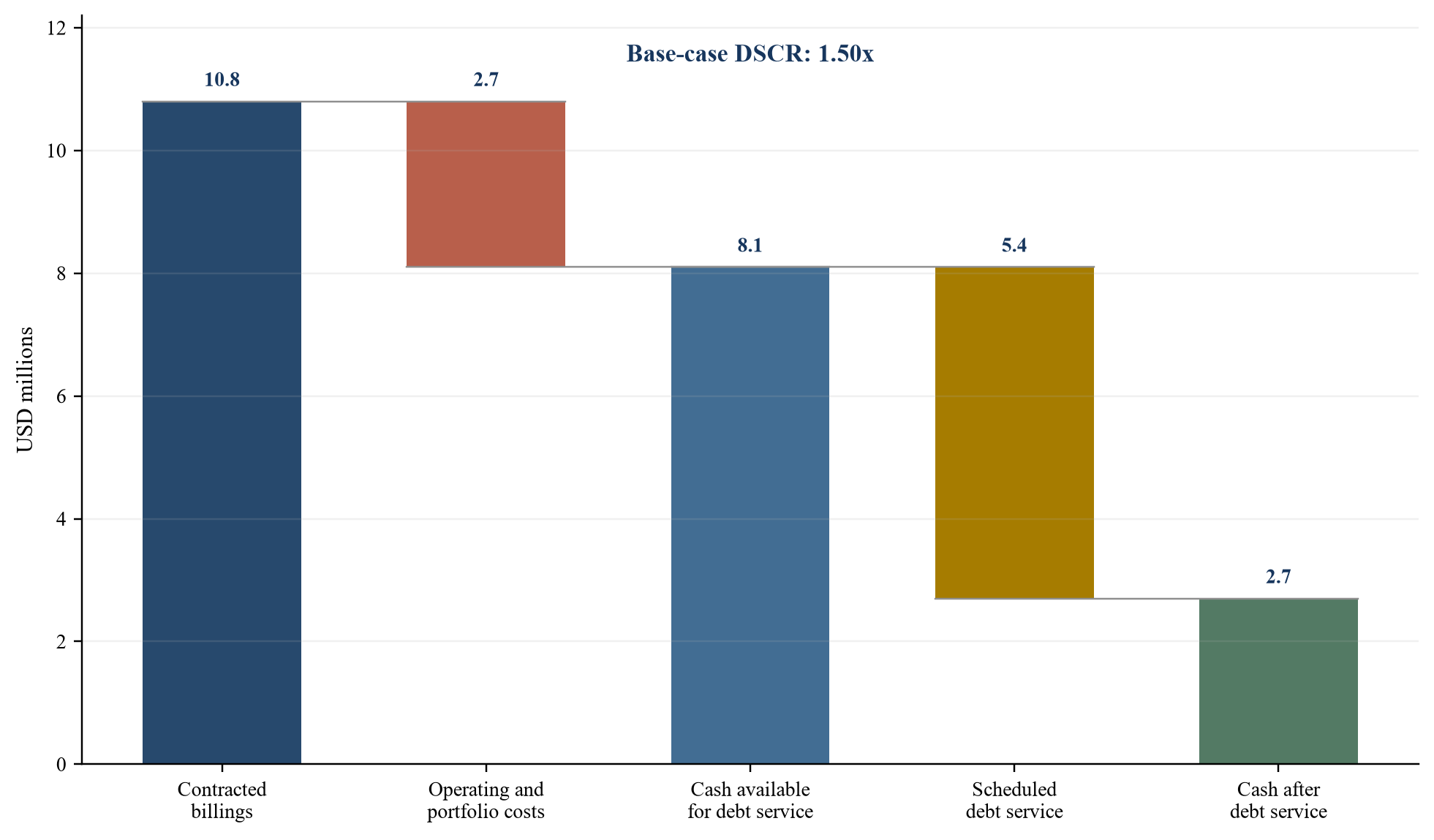
All amounts are scenario assumptions in USD millions and do not represent a market forecast.
11. Model payment delay as a liquidity event
A host can remain solvent and still pay late because of procurement cycles, invoice disputes or internal approvals. Delay creates a liquidity need even when the receivable is eventually collected. The facility should therefore model timing as well as ultimate loss.
Ageing should be reported by invoice and host. A current invoice, a disputed invoice and a promised payment should not share the same status. The lender should track days sales outstanding, collection effectiveness, disputed amounts, repeated short payments and the age of the oldest invoice.
The hypothetical delay case assumes that a group of Tier 2 and Tier 3 hosts pays ninety days later than contracted. Current-year collections fall by USD 1.4 million because part of the receivable moves beyond the test period. Cash available for debt service falls from USD 8.1 million to USD 6.7 million and the period debt-service coverage ratio falls from 1.50 times to 1.24 times. The unpaid amount may still be recoverable later. The scenario isolates liquidity pressure rather than permanent loss.
A debt-service reserve can cover short timing gaps. Its size should reflect billing frequency, delay distribution, concentration and access to working-capital support. A reserve funded once and released without forward tests can provide false comfort. Replenishment mechanics and permitted draws should be explicit.
The lender can also require a host-level payment trigger. Repeated delay may reduce the site's advance value before a formal default occurs. This creates an earlier response and reduces reliance on a binary default definition.
12. Model host default as a cash-flow and enforcement event
Host default can create several losses. Future billings can stop, unpaid receivables can become impaired, site access can be contested, equipment can require removal, and replacement revenue can be delayed. The lender should model each component.
The default sequence should start with notice, verification, cure and any direct-agreement rights. It should then determine whether the host continues to use the site, whether energy supply can be suspended, whether equipment remains safe and insured, and whether removal is permitted. Counsel and technical advisers should define the live response.
The hypothetical top-host case assumes that the largest host, contributing 12 per cent of billings, defaults. Nine months pass before the equipment can be removed and redeployed. The scenario assumes USD 1.3 million of foregone or uncollected billing, USD 0.4 million of eventual recovery and USD 0.3 million of removal, reinstatement and recommissioning cost. These are modelling inputs, not observed outcomes.
The scenario also tests correlation. A sector shock may affect several hosts simultaneously. A sponsor with standardised contracts can still face common legal or operational weaknesses across the portfolio. The stress case should therefore include a group of affected sites rather than only the largest single host.
13. Build a borrowing base that responds to evidence
A borrowing base can connect debt availability to the current quality of assets and hosts. Each site contributes value only while it remains eligible. The advance rate can reflect host tier, contract tenor, technical status, payment history, concentration and site rights.
The borrowing-base certificate should list every site, eligible revenue, host tier, concentration adjustment, remaining contract life, arrears, technical availability, insurance status and resulting advance value. The lender should have audit and verification rights.
Concentration reserves can reduce the value assigned to exposure above an approved limit. Contract-tail reserves can remove cash flow after the debt maturity or before a required tail period. Host-downgrade reserves can retain cash while the sponsor adds support, replaces the host or repays debt.
The borrowing base should avoid counting the same protection twice. A host guarantee, cash reserve and equipment value may respond to different loss components. The model should state the sequence of use and whether one recovery reduces another.
14. Use covenants and triggers that lead indicators can support
Financial covenants should be measurable from controlled information. Possible measures include historic and projected debt-service coverage, minimum liquidity, reserve funding, maximum Tier 3 share, maximum single-host exposure, overdue receivables, eligible-site count and technical availability.
Operational covenants can require maintenance, insurance, warranty preservation, regulatory compliance, accurate metering, tax payment, data retention and timely reporting. Negative covenants can restrict amendments, asset disposals, new security, related-party payments and distributions.
Early-warning triggers should precede an event of default. They can include a host rating downgrade, adverse payment trend, material dispute, site closure announcement, landlord notice, insurance lapse, connection non-compliance, persistent generation variance or repeated reporting failure.
Each trigger needs a defined response. Responses can include enhanced reporting, independent review, cash retention, reserve top-up, reduced availability, host replacement plan, technical remediation or mandatory prepayment. Vague discretion can slow action when several stakeholders disagree.
15. Price the portfolio using a risk map, not one blended label
Pricing should reflect the facility structure, host mix, concentration, tenor, construction exposure, technical performance, reserves, legal rights and sponsor support. The paper does not estimate a Saudi market margin. A live lender should source current market evidence and apply its own capital, liquidity and return requirements.
The internal model can allocate expected loss and capital usage by host tier and site. It can then add portfolio effects such as diversification, correlation, operational concentration and common contract risk. The result supports pricing and limit decisions without implying that each host borrows directly from the lender.
Fees and advisory costs should remain separate from principal and interest. The financing model should identify commitment fees, agency fees, monitoring costs, technical-adviser costs, legal costs and any hedging costs. The borrower should understand which amounts are funded and which are paid separately.
Sharia-compliant structures may require a different contractual and cash-flow architecture. The parties should obtain current Sharia, legal, tax and accounting advice and verify how title, rent, service payments, purchase undertakings and enforcement operate in the chosen structure.
16. Test portfolio resilience through linked downside cases
The credit committee should receive a set of downside cases that connect operational facts to cash. The cases should include payment delay, permanent host loss, reduced generation, denied access, higher operating cost and slower redeployment. Combined cases reveal interactions.
| Case | Principal assumptions | Cash available for debt service | Scheduled debt service | DSCR | Decision use |
|---|---|---|---|---|---|
| Base case | Twenty-four eligible sites; assumed billings and costs realised | USD 8.1m | USD 5.4m | 1.50x | Initial sizing reference |
| Ninety-day collection delay | USD 1.4m shifts beyond the test period | USD 6.7m | USD 5.4m | 1.24x | Reserve and liquidity sizing |
| Reduced generation | Portfolio billable energy falls by 12%; variable cost partly offsets | USD 6.9m | USD 5.4m | 1.28x | Technical downside and O&M response |
| Tier 3 permanent loss | 15% of Tier 3 billings lost and selected costs continue | USD 7.6m | USD 5.4m | 1.41x | Tier limit and replacement plan |
| Combined stress | Payment delay, lower generation and one host access dispute | USD 5.2m | USD 5.4m | 0.96x | Cash lock-up, cure and capital buffer |
All values are scenario assumptions. DSCR means debt-service coverage ratio.
The combined stress falls below one times coverage in the hypothetical model. This does not predict a default. It shows that a portfolio with acceptable base coverage can require a liquidity and cure plan when independent risks occur together.
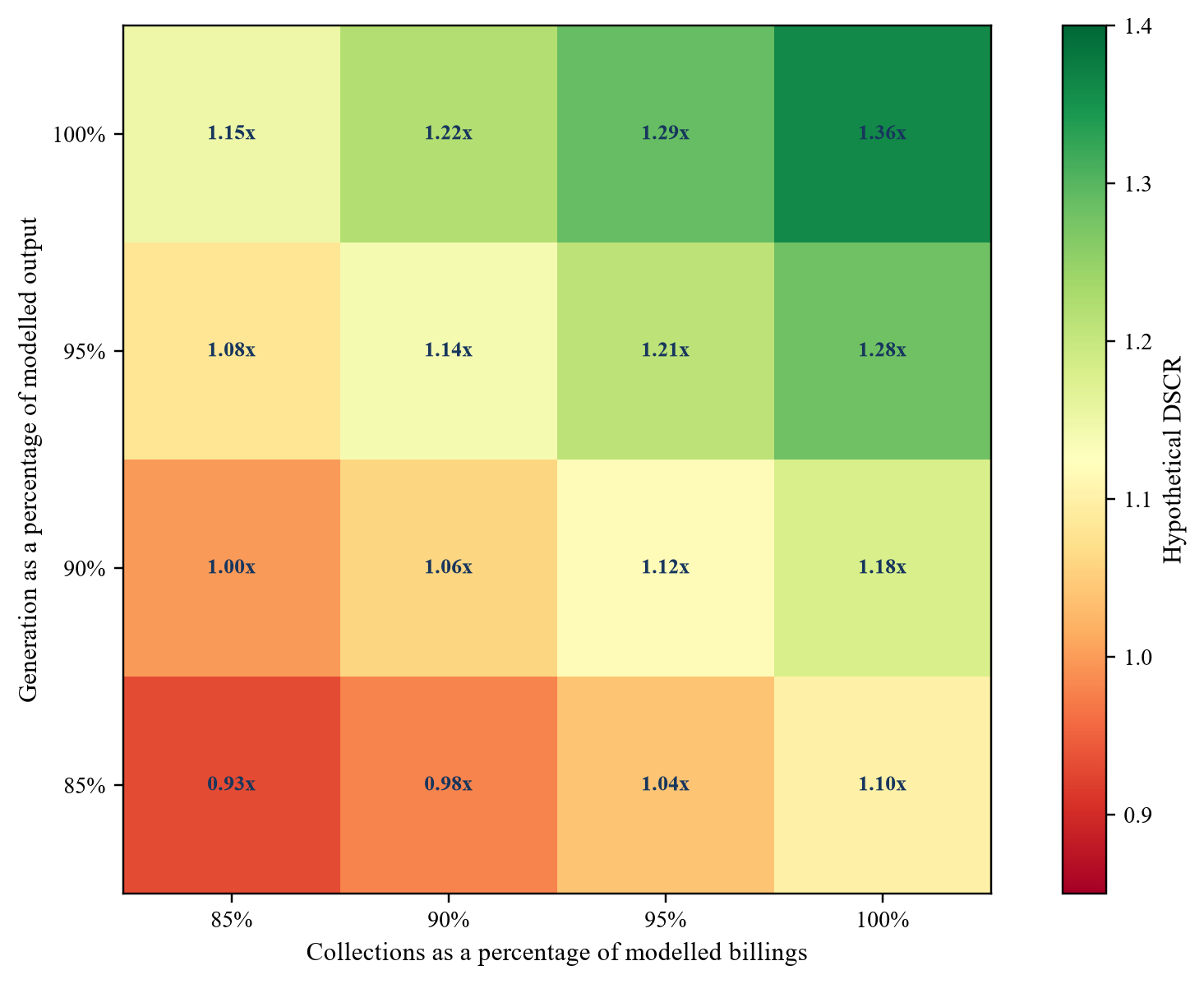
Ratios are model outputs based entirely on scenario assumptions.
17. Design reserves around identifiable loss mechanisms
One reserve should not be expected to solve every risk. A debt-service reserve addresses timing and short cash deficits. An operating reserve addresses maintenance and replacement. A removal reserve addresses access, disassembly, transport and reinstatement. A tax or regulatory reserve addresses specific known obligations where appropriate.
The required amount should be derived from a scenario and refreshed. For example, the debt-service reserve can be sized around concentrated host delay and billing frequency. The removal reserve can use site-specific contractor estimates and access conditions. The operating reserve can reflect inverter replacement, warranty gaps and the maturity profile of the equipment.
Reserve accounts require clear permitted uses, replenishment tests and release conditions. A reserve that can be distributed immediately after a strong month provides limited protection. The lender should also verify where the cash is held, who controls it and whether it is legally segregated.
Liquidity support from the sponsor can complement reserves. Its value depends on the sponsor's capacity, legal commitment, ranking and duration. An uncommitted intention should not be modelled as available cash.
18. Integrate environmental, social, safety and supply-chain diligence
Rooftop solar typically has a different impact profile from a greenfield utility project because the system uses an existing site. IFC disclosures for distributed and rooftop-solar financings still identify environmental and social management, occupational health and safety, labour, supply-chain and waste-management risks. [8][9][10][11]
The lender should review working-at-height safety, electrical safety, fire response, structural integrity, contractor management, emergency procedures and end-of-life handling. Existing industrial sites can introduce hazards that are unrelated to the solar system but relevant to access and operations.
Supply-chain review should cover module and battery sourcing where applicable, warranty counterparties, product compliance, forced-labour concerns, traceability and supplier concentration. IFC's recent Candi Solar review described strengthening procurement and supplier-code controls and monitoring higher-risk suppliers. [9] The precise lender requirements should follow applicable law, policy and the transaction's risk classification.
Decommissioning and waste plans should identify responsibility, timing and cost. Equipment removal can occur at contract expiry, host default, roof replacement or site closure. The financial model should include the applicable obligation rather than assume that all equipment will remain in place for its technical life.
19. Create a lender evidence checklist
The evidence pack should permit an independent reviewer to reproduce the credit conclusion. It should connect source documents to eligibility, model inputs and ongoing monitoring.
| Evidence area | Initial approval evidence | Ongoing evidence | Trigger for escalation |
|---|---|---|---|
| Host credit | Legal identity, ownership, financial statements, credit review and support documents | Updated accounts, payment ageing, disputes and material-event notices | Deteriorating liquidity, arrears, restructuring or site-closure plan |
| Site contract | Executed agreement, legal review, price, tenor, assignment, termination and cure rights | Amendment log, expiry schedule and compliance confirmations | Unapproved amendment, termination notice or material dispute |
| Property and access | Roof right, landlord consent, structural review, access and removal plan | Access tests, property changes and lease status | Landlord objection, lease expiry, roof works or denied access |
| Technical and connection | Applicable approval, design, tests, commissioning and meter evidence | Generation, availability, maintenance, incidents and warranty claims | Persistent variance, protection event, unsafe condition or approval lapse |
| Cash control | Account documents, invoice process, waterfall and reconciliation design | Host-level invoices, collections, bank statements, reserves and DSCR | Payment delay, unreconciled cash, leakage or reserve shortfall |
| Insurance | Property, liability, business interruption and lender-interest evidence | Renewal, premium payment, claims and coverage changes | Lapse, exclusion change, uninsured loss or delayed claim |
| Environmental and social | Risk classification, safety plan, contractor controls and waste plan | Incidents, audits, corrective actions and supplier monitoring | Serious incident, repeat breach or unclosed action |
| Portfolio governance | Eligibility certificate, concentration tests, model and approvals | Monthly borrowing base, covenant certificate and forecast | Deficiency, concentration breach, reporting failure or model change |
The checklist should be adapted to the facility, applicable law and lender policy.
The checklist should identify evidence quality. A document can be present and still be insufficient because it is unsigned, expired, incomplete, inconsistent or attributable to another entity. Review status should therefore distinguish received, validated, qualified and rejected.
Independent sampling can strengthen assurance. The lender or its adviser can select sites across host tiers, regions, installers and contract vintages and trace each one from meter output through invoice to bank receipt. Exceptions should feed the broader control assessment.
20. Establish monitoring and governance after closing
The portfolio requires active monitoring because host quality, payment behaviour, site use and technical performance change over time. The facility should name responsible teams across credit, agency, technical, legal and environmental functions.
Monthly reporting should cover eligible assets, host tiers, concentration, invoices, collections, ageing, generation, availability, reserves, debt service, covenants and material events. Quarterly or semi-annual reporting can add host financial updates, portfolio forecasts, insurance, contract expiries, site-access tests and environmental and social actions.
The credit file should record model changes. If a host is reclassified, a contract is amended, a system is relocated or a reserve is released, the lender should preserve the approval and resulting borrowing-base effect. This supports auditability and consistent treatment.
Governance should also address fraud and operational error. Meter tampering, duplicate invoices, unauthorised bank changes, inflated availability and related-party payments can affect collections. Controls should include segregation of duties, approved account changes, system access, exception reporting and independent reconciliation.
The committee should receive a concise watchlist. It should show each deteriorating host or site, exposure, trigger, action owner, deadline, cash effect and fallback. A long operational report can obscure the few matters that require credit decisions.
21. Use approval gates from origination to maturity
The first gate is portfolio-design approval. It sets eligible host types, contract standards, concentration limits, technical criteria, advance rates, reserves and required advisers. This gate should occur before the lender relies on a large pipeline.
The second gate is initial-draw approval. It confirms executed documents, condition satisfaction, valid connection and commissioning evidence, account control, insurance, site rights, model integrity and the initial borrowing base. Conditions that remain open should have explicit waivers, owners and deadlines.
The third gate is each additional draw or site addition. The lender should test the new site and the resulting portfolio. A high-quality site can still be unacceptable if it creates a connected-group, sector or expiry concentration.
The fourth gate is periodic redetermination. It refreshes host tiers, payment history, technical performance, reserves, contract life and collateral value. It can change availability without waiting for default.
The fifth gate is problem-site resolution. The lender and sponsor choose among cure, enhanced support, cash retention, removal, substitution, sale, repayment or enforcement. The decision should be based on expected cash recovery, time, legal rights and operational feasibility.
22. Implement the framework in six workstreams
The first workstream builds the host and contract inventory. It assigns unique identifiers and reconciles legal obligors, properties, systems, meters, contracts and collection accounts.
The second workstream completes technical and connection diligence. It validates applicable standards, designs, tests, commissioning, monitoring, warranties and the operating plan.
The third workstream creates the host-credit taxonomy and concentration map. It reviews financial capacity, payment behaviour, sector correlation and support.
The fourth workstream tests legal rights. It covers contract enforceability, assignment, notice, cure, roof access, equipment title, removal, substitution, security and insolvency analysis.
The fifth workstream builds the model, borrowing base, reserves and covenant package. It runs base, delay, default, performance and combined stresses and connects each trigger to an action.
The sixth workstream prepares closing and monitoring. It finalises account control, reporting templates, adviser certificates, insurance, document retention, watchlists and redetermination calendars.
The workstreams should share one issue register. A roof-access defect affects collateral value, redeployment timing, reserve sizing and the borrowing base. A host dispute affects collections, covenant calculations and site strategy. Separate registers can miss those connections.
23. Conclusion
Saudi rooftop-solar portfolio lending depends on the quality of the cash chain. A lender needs to see how an approved and operating system produces measured energy, how a site contract converts that output into an invoice, how the host's credit quality affects collection, and how cash reaches debt service under controlled accounts.
The portfolio should be underwritten at site level and consolidated at facility level. Host tiers, concentration tests, contract rights, property access, technical evidence, borrowing-base adjustments, reserves and early-warning triggers create a coherent control system. Equipment value should reflect practical access and redeployment economics.
The hypothetical case illustrates the decision method. Twenty-four sites support a USD 60.0 million facility with base-case cash available for debt service of USD 8.1 million and scheduled debt service of USD 5.4 million. A ninety-day collection delay reduces the hypothetical ratio to 1.24 times. A combined stress reduces it to 0.96 times and activates cash retention and cure measures. These outputs are scenario results only.
A lender can use the framework to ask a disciplined question: which current evidence supports each unit of debt? The answer should identify the host, contract, site, technical performance, collection path, reserve and enforceable remedy. That evidence should be refreshed until the debt is repaid.
Sources
- Saudi Electricity Company, Connection Guidelines for Small-Scale Solar PV Systems, Read the primary source
- Saudi Electricity Company, Technical Standards for the Connection of Small-Scale Solar PV Systems, Read the primary source
- Saudi Electricity Company, Renewable Energy Generation Systems Connection Process Guide, Read the primary source
- Saudi Vision 2030, National Industrial Development and Logistics Program Annual Report 2024, Read the primary source
- Saudi Central Bank, Shariah Governance Framework for Local Banks Operating in Saudi Arabia, Section 7 Credit Risk, in force from 14 November 2023, Read the primary source
- Saudi Central Bank, Basel III Final Reforms, Risk Weights for Specialised Lending, in force from 1 January 2023, Read the primary source
- Saudi Central Bank, Rules on Credit Risk Management for Banks, Credit Policy and Procedures, Read the primary source
- International Finance Corporation, IDCOL Risk Sharing Facility, project disclosure 49271, Read the primary source
- International Finance Corporation, Candi Solar, environmental and social review summary 49109, Read the primary source
- International Finance Corporation, CleanMax Energy Thailand, environmental and social review summary 48136, Read the primary source
- International Finance Corporation, Fourth Partner Energy Portfolio Financing, project disclosure 46362, Read the primary source
- International Finance Corporation, Portfolio Guarantees and Risk Sharing Facilities, Read the primary source
- International Finance Corporation, SIMA Commercial and Industrial Solar Green Bond, project disclosure 47834, Read the primary source
- World Bank Group, Rooftop Solar Installation Model for Public-Private Partnerships, Read the primary source
- International Energy Agency, Saudi National Renewable Energy Program, last updated 13 March 2026, Read the primary source
