

1. Price insurance acquisitions through regulatory returns
Insurance M&A joins two regulated balance sheets whose economic capacity cannot be inferred from book equity alone. The buyer acquires underwriting obligations, investment assets, reinsurance arrangements, operational systems and licences. It also acquires capital requirements, supervisory relationships and restrictions on how resources can be used or distributed.
The transaction model should therefore begin with the regulatory balance sheet. It should identify eligible own funds, required capital, capital quality, legal-entity location, group treatment, restrictions and management buffers. Purchase price, financing and expected earnings should then be connected to that architecture.
The International Association of Insurance Supervisors adopted the Insurance Capital Standard as a prescribed capital requirement for internationally active insurance groups in December 2024 [1]. The standard provides a group-wide risk-based measure and a solvency control level for supervisory intervention. Jurisdictions retain their own legal implementation, and buyers should map the rules that apply to each relevant entity and group.
The proposed Solvency-to-Return Transaction Test has seven gates. It verifies control and approval, reconstructs the target regulatory balance sheet, tests capital quality, measures diversification, tests fungibility and liquidity, prices transaction funding, and converts post-close earnings into regulatory returns. The test is a decision framework rather than a substitute for actuarial, legal, accounting or supervisory analysis.
The board should receive three prices. The first is headline consideration. The second is capital-adjusted consideration after transaction deductions, required recapitalisation and trapped resources. The third is risk-adjusted value after approval conditions, integration execution and downside solvency are reflected. A bid should proceed only when the selected price remains supportable across those views.
2. Treat change of control as a value gate
An insurance acquisition usually requires supervisory approval before control changes. IAIS Insurance Core Principle 6 states that supervisors assess proposals to acquire significant ownership or control and portfolio transfers [2]. The assessment extends through direct, indirect and beneficial ownership and can address financial soundness, governance, effective supervision and policyholder interests.
Approval is therefore a value gate. The legal condition precedent determines whether the transaction can close. The supervisory review can also shape the economic result through capital commitments, governance changes, restrictions on distributions, reporting obligations, business-plan requirements or structural remedies.
The United Kingdom requires prior approval for an acquisition or increase in control of a dual-regulated firm. The Prudential Regulation Authority can assess the target's business model, capital, liquidity, governance, controls and group structure [3]. Its supervisory statement on acquisitions also explains the approach to conditional approvals [4]. A model that includes only an approval probability misses the cost and operating effect of possible conditions.
In the United States, a purchaser of a domestic insurer commonly makes a Form A filing under the relevant state holding-company framework. The NAIC identifies Form A as the filing used when acquiring or merging an insurance company [5]. State requirements vary, so the model should follow the target domicile and the exact filing process.
The UAE's Insurance Group Supervision Regulation applies group supervision to specified insurance companies and holding companies and requires relevant group information [6]. It also requires notification of plans for a holding company to be merged with or acquired by another entity [7]. The transaction team should map solo, subgroup and group obligations rather than rely on a consolidated headline.
The approval workstream should produce a conditions register. Each potential condition should have an owner, probability range, cash effect, capital effect, timing effect and valuation response. The register turns regulatory engagement into a managed transaction input.
3. Reconstruct the regulatory balance sheet
The regulatory balance sheet can differ materially from the accounting balance sheet. Assets and liabilities may use different valuation methods, technical provisions can include risk-sensitive adjustments, and only eligible own funds can cover prescribed requirements. Goodwill and some intangible assets can receive limited or no capital recognition.
The buyer should rebuild the target's position from source data. The reconstruction should include assets by class and legal entity, technical provisions, reinsurance recoverables, deferred tax, own-fund items, capital tiers, solvency capital requirement, minimum requirement, group adjustments and supervisory add-ons. It should reconcile to filed returns and explain every material difference from statutory accounts.
The European Solvency II framework uses market-consistent valuation, technical provisions, own funds and risk-based capital. The 2025 review changes elements of the framework from 30 January 2027, including valuation, proportionality, reporting and group solvency [8]. Transaction models spanning that date should identify both current and forthcoming rules where they affect price or capital.
US statutory risk-based capital is designed as a regulatory tool based on insurer size and inherent risk. The NAIC explains that it is not a general ranking measure and is one element of solvency supervision [9]. A cross-border buyer should resist converting US RBC and European or other solvency ratios into a single percentage without explaining their different construction.
The reconstruction should also identify management overlays. Insurers commonly operate above regulatory minima because of rating objectives, risk appetite, volatility, board policy, debt covenants and supervisory expectations. The economic constraint is the highest binding threshold under the relevant scenario.
The output should be a controlled capital ledger. It should show source, date, owner, currency, legal entity, capital classification, restriction, valuation basis and reconciliation status for every material line.
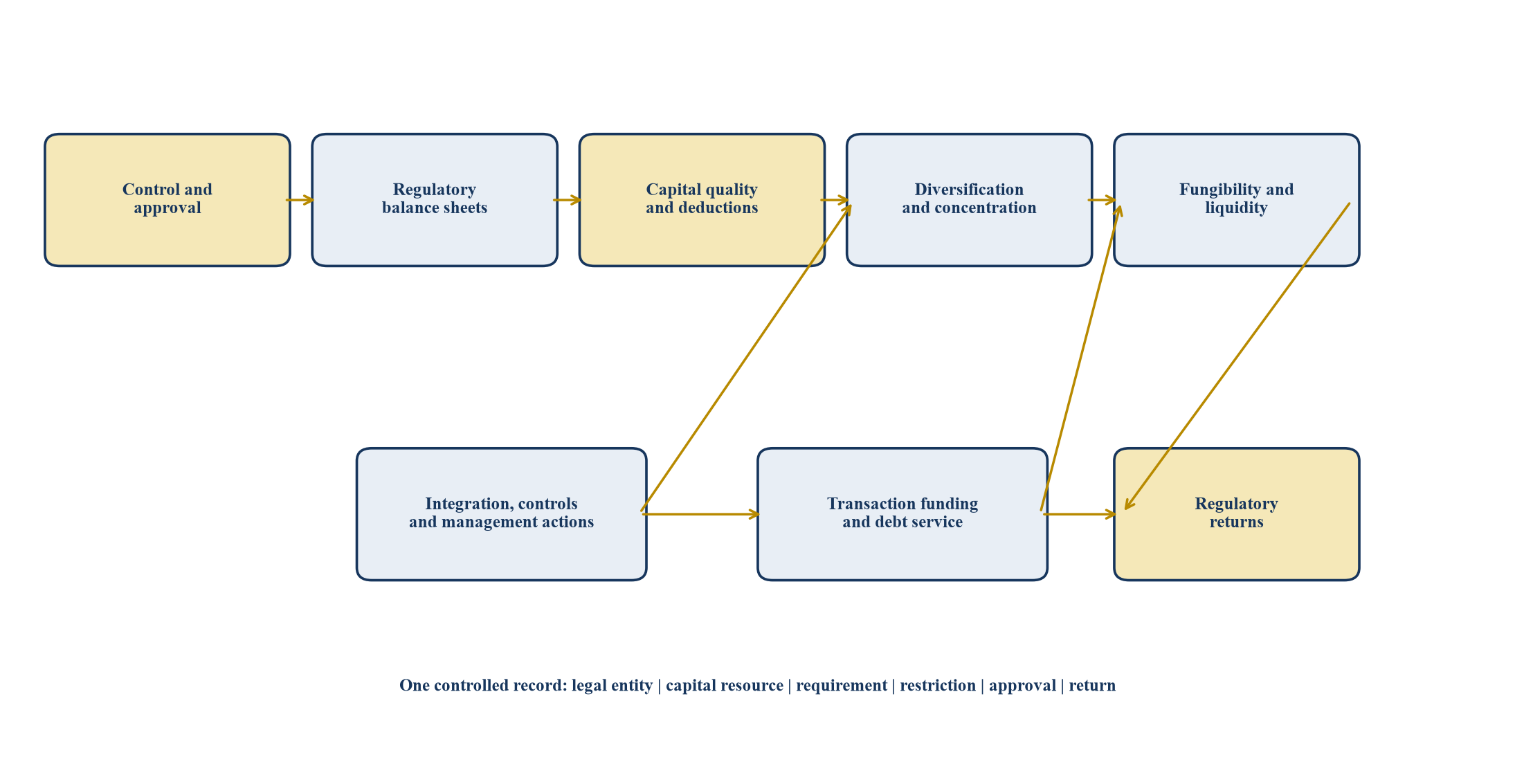
The architecture connects approval, regulatory balance sheets, capital quality, diversification, fungibility, funding and shareholder returns through one evidence chain.
4. Define the hypothetical acquisition
The worked case assumes a diversified insurance group considers acquiring a regional life and general insurer for USD 1.8 billion. The target reports eligible own funds of USD 1.05 billion and a solvency capital requirement of USD 700 million. Its reported coverage ratio is therefore 150 per cent.
The buyer reports eligible own funds of USD 4.20 billion and a solvency capital requirement of USD 2.40 billion, producing a reported coverage ratio of 175 per cent. These values are illustrative and do not describe an actual entity or jurisdiction.
The transaction is funded with USD 1.20 billion of new ordinary equity at the acquisition holding company and USD 600 million of holding-company debt. Whether the equity and debt count as group own funds, and in what tier, depends on their legal terms, issuance entity and applicable framework. The scenarios therefore show eligibility as an assumption rather than a fact.
The buyer's policy is to maintain a post-close operating buffer above the regulatory requirement. The central case tests a 160 per cent operating target. The downside case tests a 150 per cent target and a larger stressed capital requirement. Those targets are management assumptions, not regulatory minima.
The target is assumed to generate USD 155 million of sustainable annual distributable earnings before transaction financing, subject to capital restrictions. The model tests whether earnings are legally available to the holding company and whether they remain sustainable after reserve, reinsurance, investment, integration and tax changes.
The transaction requires approval in the target jurisdiction and recognition by the buyer's group supervisor. The model assumes that closing conditions can include a target recapitalisation, a temporary distribution restriction and an integration plan. The actual conditions in any transaction would require direct supervisory evidence.
| Item | Illustrative assumption | Transaction relevance | Required evidence |
|---|---|---|---|
| Purchase price | USD 1.80bn | Headline equity consideration | Executed sale agreement and funding plan |
| Target eligible own funds | USD 1.05bn | Starting regulatory resources | Filed return and capital-quality schedule |
| Target capital requirement | USD 700m | Starting prescribed requirement | Regulatory return and actuarial support |
| Target coverage ratio | 150% | Starting headroom | Reconciled calculation and supervisor correspondence |
| Buyer eligible own funds | USD 4.20bn | Group starting resources | Filed group return |
| Buyer capital requirement | USD 2.40bn | Group starting requirement | Group capital model |
| New ordinary equity | USD 1.20bn | Funds purchase and may support capital | Subscription and eligibility analysis |
| Holding-company debt | USD 600m | Funds purchase and creates fixed service | Facility terms and upstream capacity |
| Sustainable target earnings | USD 155m a year | Return numerator before financing | Actuarial, accounting and business-plan evidence |
| Operating buffer target | 160% central case | Defines capital retained above minimum | Board-approved risk appetite |
All amounts and ratios are illustrative. Eligibility, requirements, buffers and distributions require jurisdiction-specific verification.
5. Distinguish capital quantity from capital quality
Two transactions with the same coverage ratio can have different resilience because their own funds differ in permanence, subordination, loss absorbency, duration and availability. Capital quality affects eligibility, limits and the capacity to absorb stress.
The diligence team should map every material own-fund item to the legal instrument, issuer, holder, maturity, coupon, step-up, redemption, conversion, subordination and regulatory classification. It should identify limits by tier and any amount that becomes ineligible after closing or refinancing.
The IAIS Insurance Capital Standard provides a globally comparable measure for internationally active insurance groups and forms part of ComFrame [1]. Its legal effect depends on jurisdictional implementation. A buyer should determine whether the target, buyer or combined group is within scope and how local rules interact.
The PRA requires notification for most insurance capital instruments intended to qualify as own funds, and its process asks firms to explain the intended qualification and legal basis [10]. A transaction-financing instrument should therefore be assessed for both funding and regulatory-capital consequences.
The capital ledger should also distinguish equity that supports acquisition consideration from equity that is available inside regulated insurance entities. Cash raised at a parent does not automatically solve a subsidiary solvency deficit. Transfer requires legal capacity, governance approval, tax analysis and supervisory acceptability.
The valuation model should assign no benefit to proposed capital until eligibility and location are supported. A sensitivity can show the result if only part of an issuance qualifies or if the capital is recognised at group level while remaining unavailable to a stressed subsidiary.
6. Measure the purchase-price deductions
Purchase accounting and regulatory capital use different lenses. The buyer may recognise goodwill, customer relationships, distribution rights, software or deferred tax assets in its financial statements. Regulatory frameworks can deduct or constrain some of those items when determining eligible resources.
The transaction model should create a purchase-price deduction schedule. It should begin with consideration and acquired net assets, then identify expected goodwill and intangibles, capital treatment, tax effects, minority interests and any double-gearing adjustment. The schedule should be scenario-based because final purchase-price allocation follows closing.
A buyer that pays a high multiple for future growth can create a larger regulatory deduction before the growth materialises. The resulting capital drag can reduce distributable earnings and delay the economic payback. The board should see this effect before signing.
The schedule should separate accounting uncertainty from regulatory uncertainty. Accounting valuation specialists can estimate identifiable assets and goodwill. Regulatory specialists should determine eligibility, deductions and group treatment. The model then connects both conclusions without assuming they are the same.
Deferred tax effects require specific support. A deferred tax asset can depend on future taxable profit and may receive constrained recognition for regulatory purposes. A deferred tax liability can affect net asset value and the purchase-price allocation. The transaction case should show both the accounting and solvency pathways.
Any post-close restructuring should be included. Portfolio transfers, reinsurance, legal-entity mergers and asset reallocations can change deductions or capital requirements, but they also need execution, approval and time. Value should be recognised according to probability and timing rather than as immediate certainty.
7. Test diversification with evidence
Diversification can reduce a group capital requirement when risks are not perfectly correlated and the applicable framework recognises the combination. It is a potential source of value in insurance M&A and a common source of overstatement.
The buyer should calculate diversification at several levels. The first is within the target. The second is within the buyer. The third is incremental diversification after consolidation. The fourth is the amount still recognised after legal-entity, group and supervisory constraints.
The calculation should preserve gross requirements by risk. These can include market, credit, underwriting, operational and other applicable modules. Netting directly to a combined requirement hides where concentration increases and where the model depends on correlation assumptions.
The EIOPA framework recognises group diversification while requiring assessment of availability, fungibility and transferability of own funds [11]. A mathematical reduction in group requirement does not establish that resources are available where losses occur.
The buyer should challenge diversification under stress. Correlations can increase, reinsurance recoverables can weaken, asset exposures can become concentrated and management actions can be delayed. The downside case should therefore reduce claimed diversification and increase selected requirements.
The deal team should also test model approval. If the combined group uses different internal models, a standard formula and an internal model, or different local methods, the integration timetable matters. The PRA's Solvency II review permits a group up to six months after an acquisition to produce a clear integration plan for internal models, followed by a two-year implementation period [12]. The value model should reflect the required capital during transition.
8. Identify concentration created by the deal
An acquisition can diversify products or geographies while increasing concentration in assets, counterparties, catastrophe zones, distributors, reinsurers or operational platforms. The net capital effect requires a risk-by-risk view.
Asset concentration should be tested through issuer, sector, geography, currency, duration, liquidity and collateral. A life insurer acquisition can add long-duration assets that appear aligned with liabilities while increasing exposure to a narrow credit sector. A general insurer acquisition can add short-tail liquidity while increasing catastrophe accumulation.
Reinsurance concentration should include recoverables, collateral, recapture rights, termination events and the capital effect of counterparty deterioration. The model should distinguish risk transfer from financing and identify any dependence on affiliate reinsurance.
Operational concentration can arise when both businesses depend on the same cloud provider, administrator, data source or distribution partner. Regulatory capital may capture only part of that dependency. The board's operating buffer should reflect the residual risk.
The combined risk map should use exposure measures appropriate to each risk. Percentages of own funds, requirements, earnings and liquidity can all be useful. A single heat-map score should link back to the underlying amount and evidence.
Concentration remedies can include reinsurance, asset sales, hedging, portfolio transfers, capital injection, product change or operational separation. The model should include cost, timing, approval and residual risk for each remedy.
9. Test fungibility before counting group capital
Fungibility asks whether capital can be used across the group. Transferability asks whether resources can move when and where needed. Both are central to transaction value because group headroom can coexist with a constrained subsidiary.
Restrictions can arise from law, regulation, policyholder protection, ring-fenced funds, contractual terms, tax, exchange controls, minority interests, debt covenants and supervisory expectations. The model should identify each restriction by legal entity and scenario.
EIOPA has stated that groups should assess significant restrictions affecting availability, fungibility or transferability and should be able to demonstrate the availability of own funds [11]. The buyer should therefore support upstream assumptions with dividend capacity, capital policy and supervisory evidence.
The model should calculate three resource measures. Reported eligible own funds follow the applicable return. Deployable own funds exclude amounts unavailable for the relevant loss or requirement. Distributable resources reflect legal and practical capacity to pay the parent after maintaining the operating buffer.
These measures should not be collapsed. A resource can qualify for a group ratio while remaining unavailable for holding-company debt service. Another resource can be distributable in the central case and become restricted under stress.
The board should receive a legal-entity capital map. It should show local requirements, operating buffers, excess, restrictions, expected distributions, liquidity and management actions. The map provides the bridge from solvency coverage to cash returns.
10. Link solvency and liquidity
Solvency measures the capacity to absorb loss under the applicable framework. Liquidity measures the ability to meet cash obligations when due. An insurer can report capital headroom and still face liquidity pressure from collateral calls, claims, surrenders, reinsurance timing or debt service.
The transaction can change liquidity through purchase consideration, refinancing, derivative close-out, tax, integration expenditure and collateral. The buyer should model daily and monthly cash through signing, closing and the first stressed period.
The EU Solvency II review includes new liquidity-management requirements and supervisory powers that become applicable from 30 January 2027 [13]. Transaction planning that spans this period should identify the combined group's implementation obligations.
The target's liquid assets should be mapped by legal entity, encumbrance, settlement period and currency. Assets counted in regulatory capital may require a discount or delay in a liquidity model. Reinsurance recoverables should follow contractual timing and dispute assumptions.
The downside case should combine underwriting loss, asset decline, collateral demand, lower distributions and transaction funding. This joint stress is more informative than a separate solvency and liquidity test.
Management actions should be sequenced. Asset sales, reinsurance, capital injection, dividend suspension and debt draw can have different execution speeds and secondary effects. The model should apply an action only after its authority, capacity and timing are established.
11. Model capital at solo, subgroup and group levels
Group consolidation can obscure the entity that bears a loss. The transaction model should therefore calculate capital at the target legal entity, material subsidiaries, relevant subgroups and ultimate group.
Each level can have a different perimeter and method. Insurance subsidiaries can be risk-based. Non-insurance entities can be deducted, consolidated or treated under sectoral rules. Joint ventures and minority interests can require additional adjustments.
The CBUAE Insurance Group Supervision Regulation permits case-by-case decisions on scope where inclusion would be negligible, inappropriate or misleading [6]. The NAIC Group Capital Calculation also gives the lead state a role in determining group scope [14]. Scope is therefore an evidence item rather than a modelling convenience.
The model should prevent double use of capital. A parent investment in a subsidiary can appear as an asset at the parent and as capital inside the subsidiary. Group rules address this through consolidation, deduction or other adjustments. The capital ledger should show the elimination.
Subgroup constraints matter in cross-border groups. A regional holding company can face a local group requirement even when the ultimate group reports ample resources. The buyer should identify concurrent requirements and the resources allocated to each.
The acquisition agreement should allocate responsibility for pre-closing capital deterioration. A covenant can require the target to operate within agreed capital ranges, restrict dividends and notify the buyer of material changes. The buyer should retain termination, price or capital-injection responses appropriate to the negotiated risk.
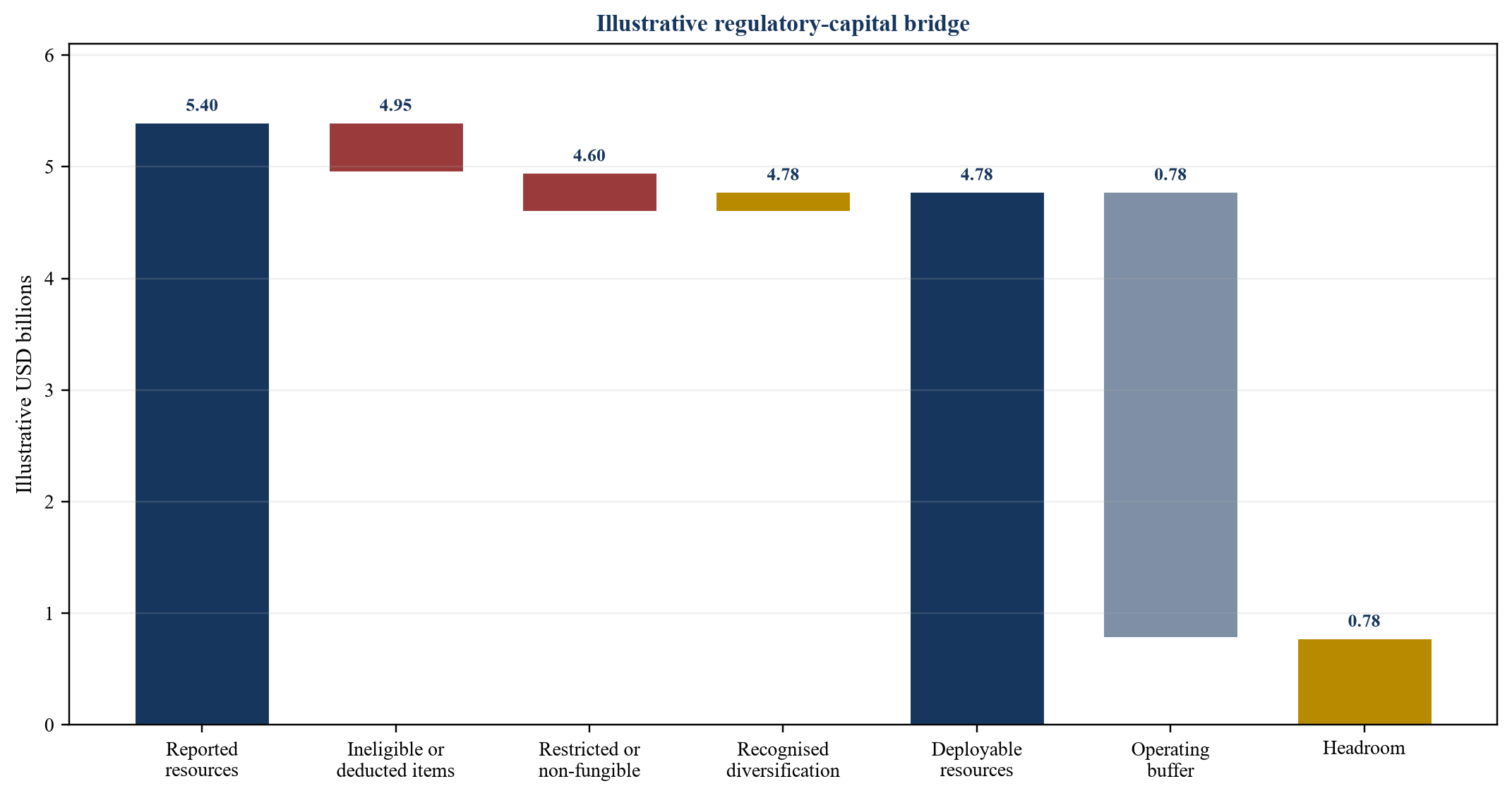
The bridge uses illustrative amounts. Regulatory classification, deductions, diversification and buffers require transaction-specific evidence.
12. Convert approval conditions into economic terms
Supervisory approval can be unconditional, conditional or refused, subject to the applicable law. A condition can preserve policyholder protection while changing transaction economics.
Potential conditions can include additional capital, limits on distributions, governance appointments, reporting, risk reduction, reinsurance changes, local incorporation, business-plan commitments or integration milestones. The transaction team should not predict a condition without evidence. It should maintain a scenario register based on regulatory dialogue and precedent reviewed by counsel.
Each condition should be translated into cash and time. An additional capital commitment increases deployed resources. A distribution restriction delays holding-company cash. A governance condition creates recurring cost. A portfolio remedy can reduce earnings or release capital. Reporting and integration conditions consume management capacity.
The purchase agreement should allocate the risk of conditions. A buyer can seek a cap on required capital, define unacceptable structural conditions, negotiate a price response or retain a termination right. The language should be aligned with the financing documents and board mandate.
The bid model should show a condition-adjusted price. The model can assign scenarios rather than a single expected value where evidence is limited. The board should see the full result under each relevant condition.
Regulatory engagement should begin early enough to test structure. Early engagement does not guarantee approval. It can identify information needs, control issues, ownership questions and likely sequencing before the transaction becomes difficult to change.
13. Price holding-company debt through upstream capacity
Holding-company debt can reduce equity funding and increase shareholder returns in the central case. It also creates fixed obligations outside the regulated insurer. Debt service depends on cash that can be distributed upstream.
The model should calculate interest, amortisation, maturity, covenant, refinancing and liquidity under central and stressed distributions. It should identify which subsidiaries pay dividends, when they can pay, the tax cost and the required approvals.
The target's reported earnings are not the same as distributable cash. Earnings can be retained to support growth, reserves, capital requirements or stress recovery. The parent may also need to inject capital while servicing debt.
The buyer should set a debt-service coverage threshold based on its financing documents and risk appetite. The model should test zero target distributions for a defined period, because a supervisory restriction or stress event can interrupt cash even when the group remains solvent.
Debt at a regulated entity requires separate analysis. Its capital treatment, policyholder ranking, interest burden and regulatory approval can differ from parent debt. The model should preserve the issuer and claim hierarchy.
The board should receive a funding capacity range. It should show the maximum debt supportable without relying on capital release, unapproved distributions or immediate refinancing. Any additional leverage should be recognised as a separate risk decision.
14. Estimate sustainable distributable earnings
Regulatory returns need a defensible numerator. Reported net income can include reserve releases, investment gains, assumption changes, tax benefits or acquisition accounting that do not recur or cannot be distributed.
The team should build sustainable earnings from underwriting margin, claims, expenses, investment income, reinsurance, tax and capital costs. It should reconcile to historical accounts, actuarial reports and the business plan.
Reserve quality is central. A favourable development pattern can support earnings, while adverse development can consume capital and cash. The diligence should examine reserve methods, claims inflation, catastrophe exposure, discounting, reinsurance collectability and management overlays.
Investment earnings should be tested against asset quality, duration, liquidity and reinvestment assumptions. A higher yield can accompany higher capital charges or credit risk. The return model should include both income and capital consumption.
Synergies should follow implementation evidence. Expense savings require systems, people, contracts and timing. Reinsurance and capital synergies require market capacity and approval. Revenue synergies should reflect distribution, customer and product constraints.
The output should show earnings before financing, after financing, after required capital retention and available for distribution. This sequence prevents the model from using the same cash for growth, solvency support and debt service.
15. Define regulatory return measures
No single return measure captures insurance M&A. The board should use a small set of consistent measures tied to capital and cash.
Return on deployable capital can divide sustainable post-tax earnings by the equity and regulatory resources that must remain committed. Return on incremental capital can compare incremental earnings with the additional resources required because of the transaction. Cash payback can compare cumulative distributions with capital-adjusted consideration.
These measures are management tools, not regulatory definitions. Their construction should be disclosed. The denominator should state whether it includes purchase price, acquisition funding, regulatory capital, deductions, integration cost and trapped resources.
The model should also calculate value under stress. A transaction that meets the central return threshold and requires a large recapitalisation under a plausible downside may be inconsistent with risk appetite.
The discount rate should reflect the cash-flow risk and capital structure. It should not duplicate risks already captured through reduced cash flows or explicit capital charges. The valuation memo should explain the treatment.
The board should compare the acquisition with alternatives such as organic growth, a distribution agreement, reinsurance, a portfolio transfer or a minority investment. Each route has a different capital and control profile.
| Measure | Proposed calculation | Decision use | Principal limitation |
|---|---|---|---|
| Capital-adjusted consideration | Headline price plus required recapitalisation, deductions and transaction cash less verified releases | Compares economic outlay with headline bid | Depends on regulatory and purchase-price estimates |
| Return on deployable capital | Sustainable post-tax earnings divided by deployable capital committed | Tests recurring return against capital use | Sensitive to earnings normalisation and fungibility |
| Incremental capital return | Incremental post-close earnings divided by incremental required and buffer capital | Tests transaction-specific capital efficiency | Allocation of group diversification requires judgement |
| Distribution yield | Verified upstream cash divided by capital-adjusted consideration | Tests holding-company cash support | Can understate value retained for growth |
| Debt-service coverage | Upstream cash available for debt service divided by required interest and principal | Tests financing resilience | Supervisory action can interrupt distributions |
| Stressed recapitalisation | Additional capital required to restore the chosen buffer after stress | Tests downside capacity | Depends on scenario severity and management actions |
| Cash payback | Years until cumulative verified distributions equal capital-adjusted consideration | Tests recovery period | Ignores value after payback and timing within periods |
These are management measures. Their definitions should be approved and applied consistently to the transaction scenarios.
16. Build central, adverse and severe cases
The central case should use evidence-supported business plans, current regulatory rules and a stated operating buffer. It should not assume immediate capital release from unapproved actions.
The adverse case can combine lower earnings, weaker asset values, higher underwriting requirements, reduced diversification and delayed distributions. The severe case can add reserve deterioration, reinsurance stress, liquidity pressure and a capital-injection condition.
Each case should show own funds, capital requirement, coverage ratio, deployable resources, target buffer, headroom, holding-company liquidity, debt-service coverage and shareholder return. The model should preserve legal-entity detail beneath the consolidated view.
The scenario should identify which inputs are observed, management estimates or hypothetical stresses. It should show management actions before and after approval. An unapproved portfolio transfer or capital instrument should not appear in the pre-action result.
The hypothetical central case assumes USD 4.78 billion of deployable group resources after deductions, restrictions and recognised diversification. It compares this with a USD 2.50 billion combined requirement and a USD 4.00 billion operating-buffer requirement at 160 per cent, leaving USD 780 million of headroom.
The illustrative adverse case reduces deployable resources to USD 4.35 billion and increases the requirement to USD 2.90 billion. A 150 per cent operating target then requires USD 4.35 billion, leaving no headroom. The severe case assumes USD 4.05 billion of resources and a USD 3.15 billion requirement, producing a reported ratio of about 129 per cent and an illustrative capital need of USD 675 million to restore a 150 per cent buffer.
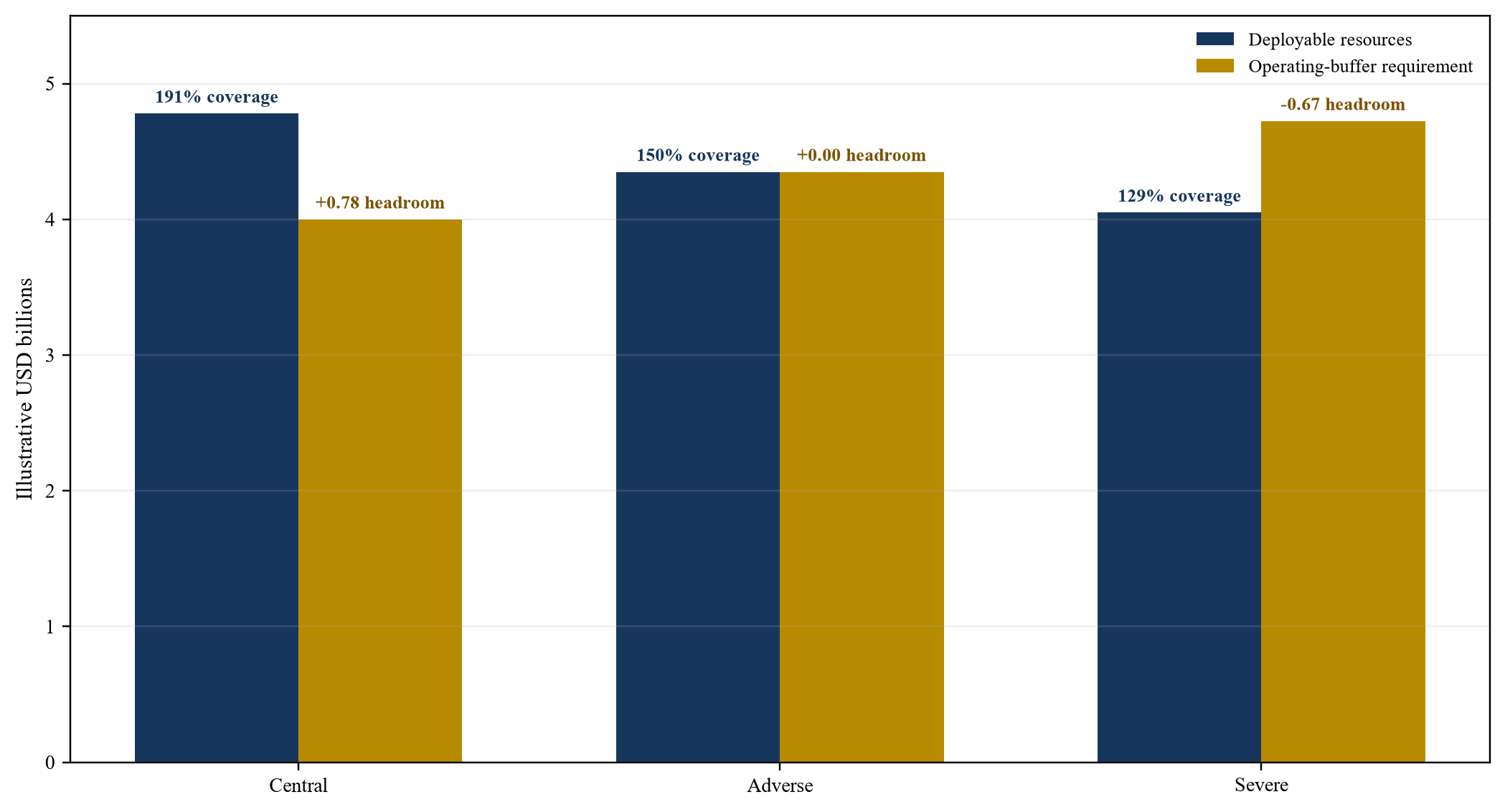
The scenarios are illustrative and are not probabilities or forecasts. Actual capital ratios and buffers depend on the applicable regime and transaction facts.
17. Treat the operating buffer as a transaction input
The regulatory minimum is an intervention threshold rather than a transaction target. Boards generally need a higher operating buffer to absorb volatility, support ratings, write business, pay dividends and avoid repeated capital actions.
The operating target should be approved before price. It should reflect business mix, volatility, model uncertainty, liquidity, refinancing, risk appetite and supervisory expectations. A target chosen after the purchase price is agreed can become a balancing item.
The model should distinguish the target by legal entity and group. A subsidiary can require a higher ratio because of local volatility or distribution constraints. The combined group target should not allow one entity's excess to disguise another's weakness.
Management can define a ladder. A green zone supports ordinary operations and planned distributions. An amber zone restricts growth or distributions and activates remediation. A red zone triggers capital, reinsurance, asset or business actions. The ladder should align with the risk-management framework.
Transaction documents can require a pre-closing minimum and a no-leakage covenant. Financing documents can restrict debt draw if the solvency position deteriorates. These protections should use agreed definitions and data dates.
The value case should include the cost of the chosen buffer. Capital held above the legal minimum has an opportunity cost, while reducing it can increase volatility and supervisory risk. The board should decide the trade-off explicitly.
18. Model reinsurance as capital and counterparty exposure
Reinsurance can reduce underwriting risk and capital requirements. It also creates counterparty, collateral, basis, renewal and recapture risk. A transaction model should show both sides.
The diligence should inventory treaties, facultative covers, collateral, limits, exclusions, reinstatements, termination, change-of-control clauses and disputes. It should identify affiliate arrangements and transactions with non-traditional risk transfer.
The capital model should test the effect of reinsurer downgrade, delayed recovery, collateral shortfall and non-renewal. The liquidity model should apply actual payment timing rather than assume immediate cash.
Post-close reinsurance changes can create value through programme consolidation, improved terms or portfolio protection. Those benefits require market quotes, capacity and approval. The model should phase them according to renewal dates and execution evidence.
Funded reinsurance and similar structures require specific prudential analysis. The PRA has issued expectations for UK life insurers' use of funded reinsurance [15]. Buyers should assess whether the target's strategy remains acceptable after control changes and whether concentration or recapture risk increases.
The acquisition agreement should address consents and termination rights. A change of control can alter coverage or economics. The buyer should know the replacement cost before counting reinsurance benefits.
19. Connect valuation with new business and run-off
Insurance value combines in-force earnings, new business, capital release and risk. A single earnings multiple can obscure their different capital profiles.
The model should separate existing portfolios from future originations. In-force business can release capital over time as obligations run off, subject to claims, lapse, market and expense experience. New business can consume capital before producing distributable earnings.
The transaction case should show the present value of in-force cash flows, the value and capital strain of new business, and the cost of required buffers. Accounting measures such as contractual service margin can inform analysis but do not replace solvency and cash modelling.
Growth assumptions should include distribution capacity, pricing, claims, expenses, reinsurance and regulatory capital. A high-growth plan can reduce near-term distributions even when franchise value increases.
Run-off decisions can release capital, but they can also increase unit expenses, operational risk and policyholder sensitivity. Portfolio transfer or reinsurance can accelerate release subject to price and approval.
The board should see value by cohort and action. This allows it to distinguish value from profitable growth, capital release, cost reduction and optimistic multiple expansion.
20. Integrate rating and market constraints
Regulatory capital is one constraint. Rating agencies, counterparties, distributors, policyholders and debt investors can apply additional thresholds.
A downgrade can affect new business, collateral, reinsurance, borrowing cost and customer retention. The model should identify rating sensitivities and any contractual triggers. It should avoid presenting a rating outcome as certain without direct evidence.
The transaction funding plan should include rating-agency engagement where appropriate. The buyer should explain leverage, capital, integration, liquidity and management actions. An equity-funded deal can still create rating pressure if business risk, execution or asset concentration increases.
Market access also matters. The combined group can need to refinance debt or issue capital in stressed conditions. The model should test cost and availability rather than assume constant spreads.
Distribution partners can require minimum ratings or solvency levels. A decline can reduce sales and increase lapse or commission pressure. These commercial thresholds should be included in the operating-buffer analysis.
The board should receive a constraint stack showing the binding threshold in each scenario. This prevents the model from treating the legal minimum as the only limit.
21. Create an integrated due-diligence data model
Capital diligence depends on actuarial, financial, investment, reinsurance, legal, tax, operational and regulatory data. A fragmented request list creates reconciliation risk.
The team should create a common data model with legal-entity, product, currency, risk, counterparty, date and scenario dimensions. Regulatory returns, accounts, actuarial models and transaction schedules should map into it.
Every reported capital number should retain lineage to the source, version, owner and approval. Adjustments should state purpose and reversibility. The model should prevent silent overrides.
The team should reconcile balances across regulatory, statutory and management information. Differences can be legitimate and should be explained. Unreconciled differences should remain open issues with valuation consequences.
Access controls matter because insurance data can include policyholder and health information. The diligence protocol should minimise personal data, use aggregation where possible and restrict access according to purpose and law.
The closing data package should become the baseline for post-close capital reporting. Reusing the controlled model reduces the risk that diligence conclusions disappear during integration.
| Workstream | Core evidence | Capital question | Decision output |
|---|---|---|---|
| Regulatory | Returns, correspondence, approvals, remediation and ORSA | What requirement, buffer and condition can bind? | Regulatory-capital baseline and conditions register |
| Actuarial | Reserves, experience, models, stress and validation | How can liability experience change resources and requirements? | Reserve and capital sensitivities |
| Investments | Holdings, duration, credit, liquidity and collateral | What asset stress and concentration are embedded? | Asset-capital and liquidity map |
| Reinsurance | Treaties, recoverables, collateral and disputes | How durable is risk transfer under stress and control change? | Counterparty and replacement scenario |
| Own funds | Instruments, terms, tiers, issuers and limits | Which resources remain eligible after closing? | Capital-quality schedule |
| Group structure | Ownership, minorities, subgroups and guarantees | Where is capital recognised and where can it move? | Fungibility and double-use analysis |
| Funding | Equity, debt, covenants, interest and maturities | Can the holding company service debt without fragile distributions? | Funding capacity and coverage |
| Integration | Systems, models, governance, people and timetable | What capital and operational uncertainty remains during transition? | Integration buffer and milestone plan |
The matrix is a proposed control tool. Scope should be adapted to the target, jurisdictions and transaction structure.
22. Design management actions before relying on them
Management actions can reduce requirements, increase resources or protect liquidity. They include reinsurance, asset sales, hedging, dividend suspension, capital issuance, portfolio transfer, business reduction and expense action.
The model should classify each action by authority, legal feasibility, supervisory approval, market capacity, time, cost and operational dependency. An action should not reduce required capital before those conditions are met.
The ORSA and stress framework can provide evidence about existing actions. The buyer should test whether they remain feasible after the acquisition and whether both businesses rely on the same scarce capacity.
Actions can interact. Asset sales can crystallise losses and reduce earnings. Reinsurance can reduce requirements and create counterparty concentration. Dividend suspension can protect a subsidiary and weaken holding-company debt service.
The board should approve a prioritised action ladder. Early actions should preserve optionality and address the binding constraint. Later actions can be more structural and require approval.
The post-close model should track action readiness. A proposed action should move to recognised only when evidence is complete. This keeps solvency forecasts from depending on stale assumptions.
23. Apply the Solvency-to-Return Transaction Test
Gate one confirms ownership, control thresholds, filing requirements, supervisory perimeter and possible conditions. Gate two reconstructs solo and group regulatory balance sheets and reconciles them to filed evidence.
Gate three verifies capital quality, deductions and limits. Gate four calculates gross requirements, diversification and concentration. Gate five tests fungibility, transferability, liquidity and distributions.
Gate six assesses transaction funding, debt service and recapitalisation capacity. Gate seven calculates sustainable earnings, deployable capital, regulatory returns and stressed value.
Each gate has a pass, conditional pass or fail. A conditional pass requires a priced mitigation, owner and deadline. The board pack should retain the open items and show their effect on value.
The test should be run at indicative bid, binding bid, signing, regulatory submission, pre-closing refresh and closing. A material change returns the case to the relevant gate.
The investment decision should identify the maximum supportable price under the approved risk appetite. That price can differ from the negotiating price and should remain controlled.
| Gate | Required evidence | Decision output | Accountable owner |
|---|---|---|---|
| Control and approval | Ownership chain, thresholds, filings and supervisor engagement | Approval path and conditions envelope | General counsel and regulatory lead |
| Regulatory balance sheet | Filed returns, valuation, technical provisions and reconciliations | Verified solo and group baseline | Chief actuary and CFO |
| Capital quality | Instrument terms, tiers, deductions and limits | Eligible and deployable resource schedule | Capital management lead |
| Requirement and diversification | Gross modules, model method, correlations and concentration | Central and stressed requirement | Chief risk officer |
| Fungibility and liquidity | Legal restrictions, dividends, cash, collateral and transfer routes | Usable capital and upstream cash | Treasurer and legal entities |
| Funding and resilience | Equity, debt, covenants, maturity and recapitalisation | Supportable funding plan | CFO and treasury committee |
| Return and value | Sustainable earnings, capital-adjusted consideration and scenarios | Maximum price and risk-adjusted return | Board and investment committee |
Each gate requires transaction-specific evidence. A reported solvency ratio alone does not satisfy the test.
24. Execute a controlled transaction roadmap
During strategic screening, the buyer should identify the regulatory regime, ownership thresholds, target solvency position and likely capital intensity. It should reject opportunities that conflict with group risk appetite before incurring full diligence cost.
At indicative bid, the buyer should build a preliminary capital bridge and approval map. Price should be conditional on verified regulatory data, reserves, capital quality and fungibility.
During diligence, the team should reconstruct the regulatory balance sheet, challenge actuarial and investment assumptions, map legal entities and quantify funding. Supervisor engagement should follow counsel's advice and the applicable process.
Before binding bid, the board should approve the maximum price, minimum closing capital, operating buffer, financing limits, unacceptable conditions and management-action plan. The model should include central, adverse and severe cases.
At signing, the transaction documents should preserve capital, restrict leakage, require updates and allocate approval-condition risk. Financing commitments should align with regulatory conditions and long-stop dates.
Before closing, the buyer should refresh capital, reserves, investments, reinsurance, liquidity and approvals. Closing funds should include verified capital injection and transaction costs. Post-close reporting should begin from the signed capital ledger.
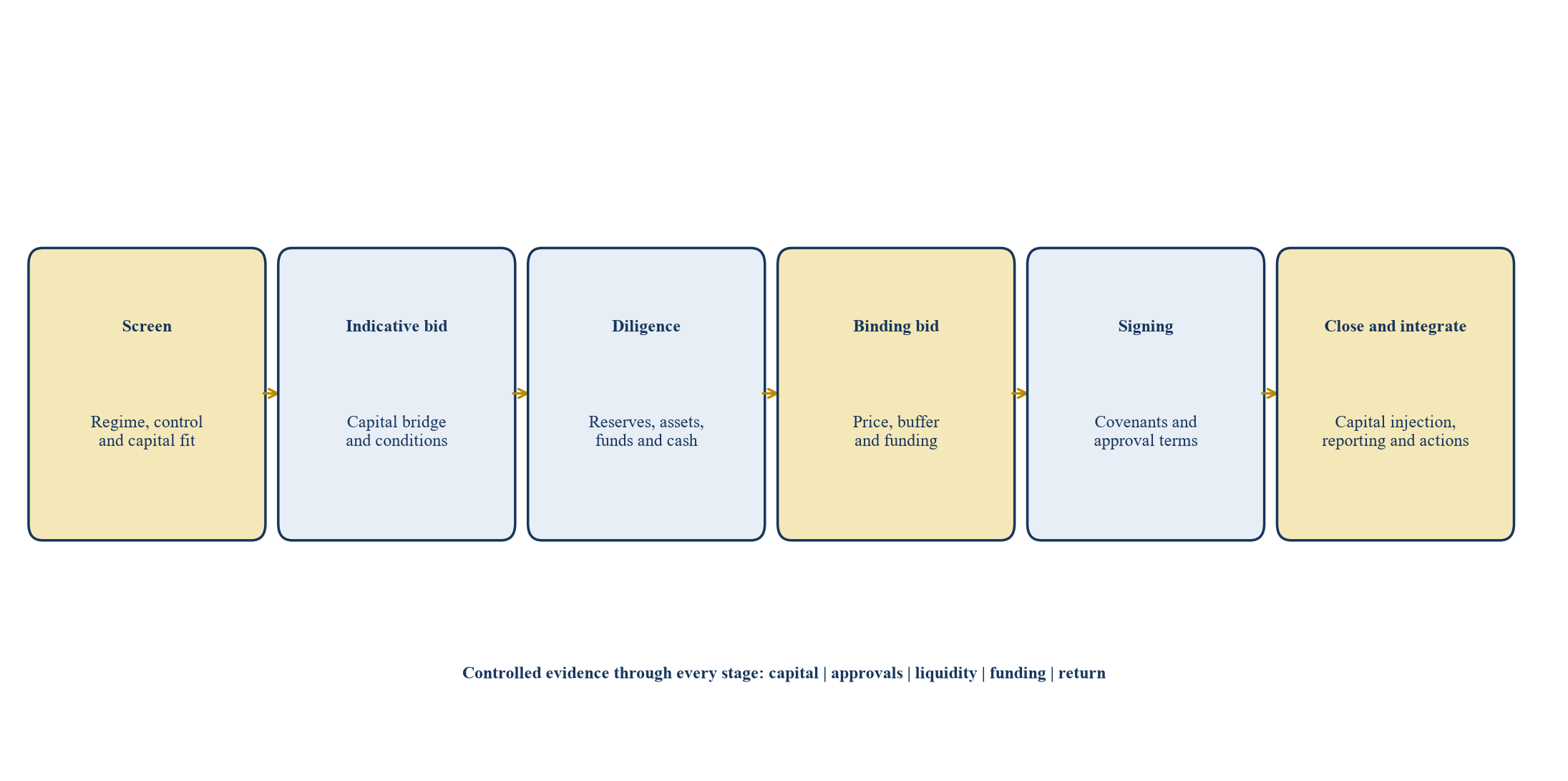
The roadmap connects screening, diligence, bidding, signing, supervisory review, closing and post-close integration.
25. Establish post-close capital governance
The first post-close year determines whether modeled capital value becomes available. The combined group should establish decision rights, reporting, limits and escalation from day one.
The capital committee should reconcile actual closing resources and requirements to the signing model. Differences should be attributed to purchase price, market movement, reserves, transaction costs, financing, deductions, model treatment and approval conditions.
The combined ORSA should incorporate the transaction, integration and funding risks. Legal-entity plans should remain visible. Group aggregation should not remove local accountability.
Model integration should have milestones, validation, governance and fallback calculations. The transition capital position should be monitored using the method accepted by supervisors. Any planned capital benefit should remain contingent until recognised.
Distributions should follow a policy tied to solvency, liquidity, operating buffer, rating and debt service. The policy should state when distributions stop and who decides.
The board should receive a monthly capital and liquidity dashboard during integration. It should show resources, requirements, ratios, headroom, restrictions, actions, conditions, debt coverage and forecast changes by legal entity and group.
26. Set escalation and decision rights
The board should approve the transaction capital framework, maximum price, operating buffer, funding, management actions and regulatory-condition envelope. It should receive changes that threaten those limits.
The chief financial officer should own the integrated capital and return model. The chief risk officer should own requirement, stress and risk-appetite analysis. The chief actuary should own reserve and liability evidence. Treasury should own liquidity and funding. Legal and regulatory teams should own approval, ownership and restriction analysis.
Escalation triggers should include capital below the operating target, a material reserve change, asset or reinsurance concentration, distribution restriction, approval condition outside the board envelope, model delay, rating pressure, debt-service weakness or a change in law.
Each trigger should have a response time and authority. The board should know which actions are executable without further approval and which require supervisor consent.
The decision record should preserve evidence at each transaction stage. It should state what was known, what was estimated, which scenario was approved and how the price responded.
This governance supports accountability during a period when market data, actuarial estimates and supervisory requirements can change quickly.
27. Limitations and conclusion
This paper provides a transaction decision framework. It does not constitute investment, actuarial, accounting, legal, tax, regulatory or rating advice. Solvency treatment, approvals and capital eligibility depend on the jurisdictions, entities, products, instruments and facts.
The worked case is hypothetical. Purchase price, own funds, requirements, ratios, financing, earnings, diversification, deductions, restrictions and stress outcomes are illustrative. They are not forecasts and should not be applied to an actual insurer without independent evidence.
The central conclusion is that insurance M&A should be priced through regulatory returns. Headline consideration should be reconciled to capital-adjusted consideration, deployable resources and verified upstream cash.
Diversification creates value only to the extent recognised by the applicable framework and usable across the group. Capital quality and fungibility determine whether reported headroom can absorb loss or support distributions.
Approval conditions are transaction economics. They should be identified, priced and allocated in the transaction documents. Funding should be sized against stressed distributions rather than reported earnings alone.
The Solvency-to-Return Transaction Test gives boards a controlled path from regulatory evidence to price. It supports a decision that remains intelligible under central and stressed cases and makes the cost of capital, restrictions and execution visible before control changes.
Sources
- International Association of Insurance Supervisors, IAIS adopts the Insurance Capital Standard and enhancements to global standards, 5 December 2024, accessed 17 September 2026, Read the primary source
- International Association of Insurance Supervisors, Insurance Core Principles and ComFrame, Insurance Core Principle 6 Change of control and portfolio transfers, December 2024, accessed 17 September 2026, Read the primary source
- Bank of England, Prudential Regulation Authority, Change in control, updated 13 February 2026, accessed 17 September 2026, Read the primary source
- Bank of England, Prudential Regulation Authority, SS10/24 Prudential assessment of acquisitions and increases in control, 1 November 2024, accessed 17 September 2026, Read the primary source
- National Association of Insurance Commissioners, UCAA Form A, acquisition or merger of an insurance company, accessed 17 September 2026, Read the primary source
- Central Bank of the UAE, Insurance Group Supervision Regulation C4/2025, effective 14 November 2025, accessed 17 September 2026, Read the primary source
- Central Bank of the UAE, Insurance Group Supervision Regulation, Article 7 Special Considerations for Holding Companies, accessed 17 September 2026, Read the primary source
- European Commission, Questions and answers on the Solvency II delegated regulation, 29 October 2025, accessed 17 September 2026, Read the primary source
- National Association of Insurance Commissioners, Risk-Based Capital, updated 30 June 2026, accessed 17 September 2026, Read the primary source
- Bank of England, Prudential Regulation Authority, Insurance capital instruments pre- and post-issuance notification, accessed 17 September 2026, Read the primary source
- European Insurance and Occupational Pensions Authority, Q&A 438 on group own-fund availability, fungibility and transferability, accessed 17 September 2026, Read the primary source
- Bank of England, Prudential Regulation Authority, PS2/24 Review of Solvency II Adapting to the UK insurance market, February 2024, accessed 17 September 2026, Read the primary source
- European Insurance and Occupational Pensions Authority, Guidelines on supervisory powers to remedy liquidity vulnerabilities, 15 July 2026, accessed 17 September 2026, Read the primary source
- National Association of Insurance Commissioners, Group Capital Calculation, accessed 17 September 2026, Read the primary source
- Bank of England, Prudential Regulation Authority, Business Plan 2025/26, funded reinsurance and Solvency UK priorities, April 2025, accessed 17 September 2026, Read the primary source
- National Association of Insurance Commissioners, Insurance Holding Company System Regulatory Act Model 440, accessed 17 September 2026, Read the primary source
- National Association of Insurance Commissioners, Domestic Change of Control Form A requirements by state, updated 24 July 2026, accessed 17 September 2026, Read the primary source
- European Commission, Insurance regulation and recovery and resolution framework, accessed 17 September 2026, Read the primary source
