

1. Define the continuity-funding decision
The board's decision is how the business will fund the period from sale launch to completion while preserving the customer, supplier and operating relationships that support the buyer's price. The decision is wider than arranging a loan. It determines which receipts are genuinely available, which payments protect value, which liabilities must be cured, what support can be documented, and how the company will respond if closing moves.
A sale timetable is rarely a cash timetable. Marketing, diligence, regulatory approvals, lender consent, employee actions, contract transfers, competition review and documentation can move independently. Payroll, supplier payments, rent, utilities, insurance, taxes and customer delivery continue on fixed dates. A process described as ten weeks can require fourteen weeks of cash once a realistic contingency is included.
The board should approve five items before launch: the minimum safe cash floor, the latest safe closing date, the contracts and suppliers that must remain operational, the funding sources that are committed or still conditional, and the action that follows each liquidity trigger. The sale team should present these items together. A transaction timetable without a weekly cash model is incomplete. A cash model without a contract and operating map can fund the wrong activities.
Continuity funding should protect an executable transaction and a credible alternative. It should avoid using cash merely to prolong an unviable process. The decision paper should state the legal objective, governing duties, approval authority, security constraints, priority consequences and evidence supporting the assumption that continued trading improves the relevant stakeholder outcome.
2. Distinguish cash from liquidity
Cash reported on the balance sheet can differ materially from cash available to support the sale. Bank balances may include customer deposits, cash collateral, segregated amounts, controlled accounts, tax balances, joint-venture funds, restricted subsidiaries, blocked jurisdictions or proceeds subject to security. The model should identify legal ownership, account control, currency, restriction, permitted use, transfer route and release condition for each balance.
IAS 7 defines cash and cash equivalents for financial-reporting purposes and requires disclosure and reconciliation of their components. [10] A transaction liquidity model asks an additional question: which amount can be used, by which entity, for which payment, on what date and with what consequence? Financial-statement classification does not answer that operational and legal question.
The minimum safe cash floor should be built from payment mechanics. It can include payroll, critical suppliers, utilities, insurance, tax, customer delivery, health and safety, data, bank fees and a contingency for timing error. The floor should be entity-specific where value depends on several legal entities. Excess cash in one company may not be transferable to another without corporate authority, lender consent, tax, exchange-control or insolvency analysis.
The weekly model should reconcile opening bank cash to unrestricted cash, committed but undrawn funding, forecast receipts, approved payments and closing cash. It should show gross flows. A net working-capital assumption can conceal a payroll payment on Friday and a customer receipt expected the following Tuesday. Timing precision matters when the safe margin is measured in days.
Cash ownership and cash access should be tested separately. A subsidiary can own a bank balance while a lender controls the account, a customer has a contractual claim on the use of proceeds, or local law restricts upstreaming. The model should record the step required to move cash and the time needed for approval, conversion and settlement. A parent-level schedule that assumes immediate pooling can overstate liquidity available to the operating company.
Currency creates a second timing layer. Customer receipts, supplier invoices, payroll and facility draws can arise in different currencies. The team should model conversion spreads, cut-off times, banking holidays, trapped-cash exposure and the effect of adverse movements on the cash floor. Any hedge or forward should be connected to its collateral, termination and close-out requirements.
3. Build one launch-to-closing control architecture
The control architecture connects five records. The cash ledger identifies accounts, restrictions, receipts and payments. The customer ledger identifies deposits, milestones, remaining performance and refund exposure. The supplier ledger identifies arrears, future supply, title, security, dependency and leverage. The transaction timetable identifies diligence, bids, approvals, signing and closing. The funding register identifies source, commitment, conditions, security, priority, draw mechanics and maturity.
All records should use common contract, entity and payment identifiers. A supplier described as critical in the operational plan should appear in the cash model, contract register and funding need. A customer deposit shown as liquidity should link to a performance obligation, delivery cost and legal analysis. A rescue facility shown as available should link to signed documents, conditions precedent and a tested funds-flow route.
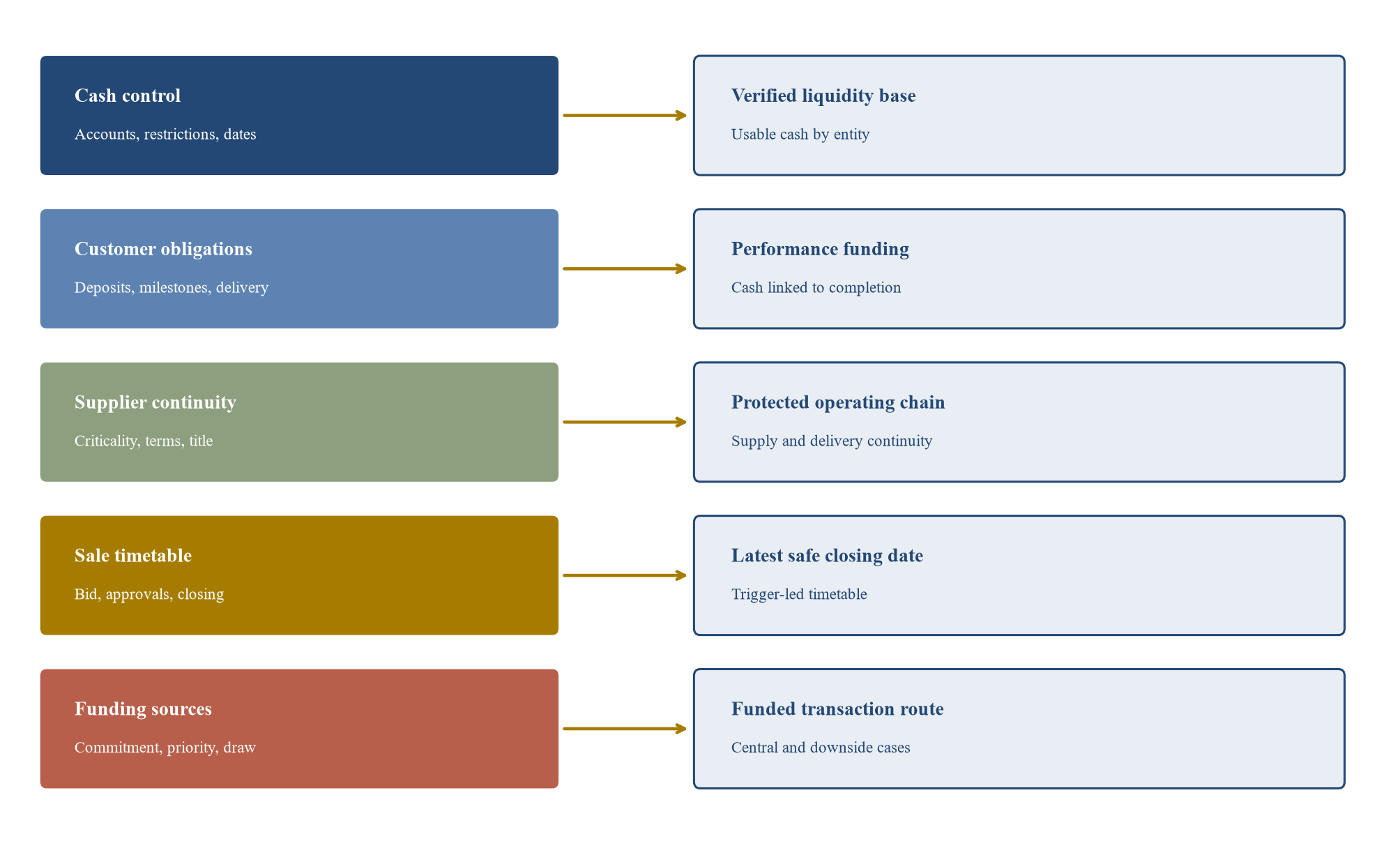
Original framework. A live transaction requires current instrument-specific, contract-specific and jurisdiction-specific verification.
The architecture creates one decision sequence. Control the cash. Determine what customers and suppliers require. Align the sale timetable to the latest safe date. Secure funding with enough time and authority to draw. Maintain an alternative if a key condition fails.
4. Map customer deposits to performance obligations
Customer deposits can provide cash before delivery while creating an obligation to perform, refund or protect the amount. IFRS 15 requires a customer prepayment to be recognised as a contract liability until the related good or service transfers, and it addresses refund liabilities where consideration is expected to be returned. [8] [9] The accounting position provides useful contract-balance evidence. The legal right to use, retain, refund, set off or transfer the deposit depends on the contract and applicable law.
The transaction team should build a deposit register by customer, contract, legal entity, bank account, amount received, revenue recognised, remaining obligation, expected completion cost, title position, performance security, refund right, set-off right, termination right, assignment requirement and delivery date. The register should distinguish cash already spent from cash still held. It should quantify the cost to complete every deposit-backed obligation.
A deposit can be economically negative if the remaining cost to perform exceeds the cash retained and the customer can claim damages or call security. It can be valuable where the work is profitable, the customer remains committed and the contract transfers. A buyer may accept a deposit liability only with enough working capital, margin and evidence to complete the work.
The board should avoid treating all deposit cash as unrestricted liquidity. The cash model should identify an amount reserved for performance where use elsewhere would create an unfunded obligation. Any proposed use should be supported by contract analysis, a delivery plan and the governing decision authority.
5. Segment customers by continuity value and cash effect
Customers should be segmented on two axes: their importance to the sale perimeter and their near-term cash effect. A strategic customer can preserve backlog, recurring revenue, certification, reference value or market access. Its contract can still consume cash before closing. A smaller customer can provide an early milestone with modest delivery cost and extend the runway.
The model should classify each customer as cash generative, cash neutral or cash consuming through closing. It should include collections, new deposits, milestone receipts, refunds, rebates, warranty work, penalties, fulfilment costs and buyer-specific retention requirements. Expected receipts should have dates, probability-independent evidence states and accountable owners. The base case should include only receipts supported by contract and collection evidence.
Customer negotiations can address accelerated acceptance, partial delivery, milestone redesign, direct payment to a critical supplier, escrow, buyer-backed performance, assignment consent or a paid extension. Changes should be documented and assessed for revenue recognition, tax, sanctions, competition, disclosure and fairness consequences. A customer concession that accelerates USD 3.0 million can destroy more value if it grants an uncapped refund right or price reduction across the remaining backlog.
Customer communication should follow the approved process. The funding model should define the required commercial result without making unsupported statements about solvency, buyer certainty or contract performance. Key customers may require coordinated participation by management, legal, finance and the proposed buyer.
6. Build the supplier continuity map
The supplier map should identify goods and services whose interruption would stop production, breach a customer contract, compromise safety or quality, disable data and systems, invalidate certification, or prevent closing. Criticality should be based on operating dependency and replacement time, not annual spend alone.
For each supplier, record the contracting entity, arrears, current terms, future orders, lead time, alternative sources, tooling, inventory held, title terms, security, set-off, termination rights, insolvency clauses, guarantees, insurance, currency and required payment schedule. The register should distinguish pre-launch arrears from post-launch supply. The economic and legal treatment can differ.
UNCITRAL's Legislative Guide recognises that continued operation requires payment for crucial goods and services, including labour, insurance, rent, maintenance and asset preservation. It also identifies existing vendors as potential sources of post-commencement trade credit and discusses administrative treatment or priority for new obligations. [1] [3] The World Bank Principles support insolvency systems that preserve productive value while protecting creditor rights. [2]
The supplier plan should state the minimum supply needed to reach closing, the cash required, the commercial ask and the alternative. Alternatives can include shorter order horizons, cash on delivery, direct buyer support, purchase-order finance, consignment, tolling, escrow, controlled payment accounts, substitute supply or a staged transfer of tooling and work in progress.
7. Separate historical debt from new supply
Combining arrears and future supply into one negotiation can obscure the decision. A supplier may hold an unsecured historical claim while providing goods essential to the sale. The company should identify the legal and commercial basis for any payment of historical arrears, the value protected, approval required and treatment of comparable creditors.
Future supply should be priced and funded on its own terms. The company needs quantities, delivery dates, quality requirements, payment terms, credit limits and remedies. The supplier needs evidence that new obligations can be paid. The arrangement can use cash before delivery, escrow, letters of credit, guarantees, insurance, priority treatment where available, or buyer sponsorship.
In the United States, section 503(b)(9) of Title 11 gives administrative-expense treatment to the value of goods received in the ordinary course within twenty days before commencement, subject to the statutory requirements. Section 546(c) addresses reclamation rights for qualifying goods received while the debtor was insolvent and preserves specified notice periods and the relationship with secured interests. [6] [7] These rules are jurisdiction-specific and should not be translated into a generic supplier-payment assumption.
The UK Corporate Insolvency and Governance Act 2020 restricts defined insolvency-triggered termination and other actions in contracts for supplies of goods and services, subject to stated exclusions and supplier protections. Post-procedure non-payment can still create rights, and supplier hardship can support a court application. [12] UAE law provides that, where continuation is decided and assets are sufficient, the trustee shall pay necessary amounts to suppliers of goods and service providers regularly at the agreed contractual time. [13] The live plan must apply the relevant law, procedure and contract.
8. Build a contract and payment register
| Relationship | Cash position through closing | Continuity dependency | Key evidence | Proposed control |
|---|---|---|---|---|
| Customer deposits | Cash held against incomplete obligations | Delivery preserves backlog and transfer value | Contract, bank receipt, cost to complete, refund and set-off terms | Ring-fence performance amount and approve use |
| Milestone receivables | Receipt follows acceptance or certification | Acceptance can determine runway | Delivery record, certificate, dispute and collection date | Daily acceptance and collection owner |
| Critical materials | Arrears plus new purchase orders | Production stops without supply | Inventory, lead time, title, quality and alternatives | Separate arrears from funded future supply |
| Utilities and data | Recurring post-launch charges | Interruption can stop the business | Contract, consumption, termination and restoration | Priority payment calendar and usage control |
| Logistics and customs | Payment tied to each shipment | Delivery and collections depend on release | Shipment, title, duties and lien rights | Shipment-level cash authorisation |
| Professional and transaction services | Fees accrue to milestones | Process may depend on specialist work | Engagement, cap, milestone and success fee | Scope gate and weekly accrual reconciliation |
Fields and example classifications are illustrative. Contract rights and payment treatment require current legal and commercial verification.
The register should reconcile to the cash model and sale data room. It should show who has contacted each counterparty, what has been agreed, which approval remains, and the latest safe action date. Verbal support should remain uncommitted until documented by an authorised party.
9. Construct a direct weekly cash model
The model should begin with bank-level cash and use daily detail for the first two weeks, weekly detail through the expected closing and monthly detail thereafter. The direct method identifies actual receipt and payment classes. IAS 7 recognises a direct method for presenting major classes of gross operating cash receipts and payments. [10] A transaction model should extend that discipline to entity, account, contract and due date.
Receipts should include collections, deposits, milestones, tax refunds, asset proceeds, insurance receipts, shareholder support, buyer funding and facility draws. Payments should include payroll, suppliers, rent, utilities, insurance, taxes, debt service, professional fees, customer performance, refunds, capex, cure, retention and closing costs. Non-cash accounting movements should remain outside the liquidity line.
The model should show opening unrestricted cash, available committed facilities, gross receipts, gross payments, closing unrestricted cash, minimum floor, headroom and days of liquidity. It should identify restricted balances separately. Each forecast line should carry an evidence state: bank-confirmed, contractually due, operationally scheduled, management-estimated or excluded. Management estimates should be labelled within the internal decision model and replaced with evidence as the process develops.
Sensitivity should focus on timing and linked effects. A delayed customer receipt can require additional supplier funding. A supplier stop can delay delivery and collection simultaneously. A closing delay can increase payroll, rent and professional fees while reducing customer confidence. Independent percentage haircuts can miss those connections.
Payroll should be decomposed into wages, benefits, payroll taxes, pensions, commissions, overtime, contractors and retention. The operating plan should identify people whose absence stops delivery, certification, collections, safety or transaction execution. Retention should have a documented purpose, period, approval route, payment condition and cash date. The company should avoid using a broad retention pool as a substitute for role-by-role continuity planning.
Tax and insurance require their own dated schedules. A tax payment can be legally due while management expects a refund elsewhere. Insurance can lapse before a replacement policy is effective. The company should identify filing dates, payment dates, authority for deferral, policy cancellation terms, premium-finance arrangements and evidence of cover. Assumed deferrals should remain outside the central case until authorised and documented.
Utilities, data hosting, telecommunications and payment processing can have short suspension or restoration timetables. The model should include deposits, arrears, usage charges, personal or office-holder guarantees where relevant, and costs of reinstatement. A continuity plan that funds production and misses a cloud-service or payment-processing invoice can still fail operationally.
10. Quantify the hypothetical central case
The hypothetical group begins week zero with USD 8.0 million of unrestricted cash. It also holds USD 11.0 million of customer deposits associated with incomplete work; those deposits are modelled through their delivery obligations and are not added again as free cash. Contracted collections and ordinary receipts during the twelve-week process total USD 34.0 million. Operating, customer-delivery and transaction payments total USD 55.0 million.
Without intervention, the unrestricted balance reaches negative USD 13.0 million at the lowest point. The stated minimum safe cash floor is USD 4.0 million, creating a peak continuity requirement of USD 17.0 million. The amount is a timing requirement under the scenario, not an estimate of enterprise value or a representation of financing availability.
The central response comprises USD 4.0 million of accelerated collections supported by completed work, USD 3.0 million of new customer milestones linked to agreed deliverables, USD 2.5 million of supplier-term extensions, USD 1.5 million of controlled discretionary deferrals and a committed continuity facility with a USD 9.0 million limit. The model draws a maximum USD 7.0 million from the facility. The package totals USD 18.0 million of potential headroom because timing and availability differ across components.
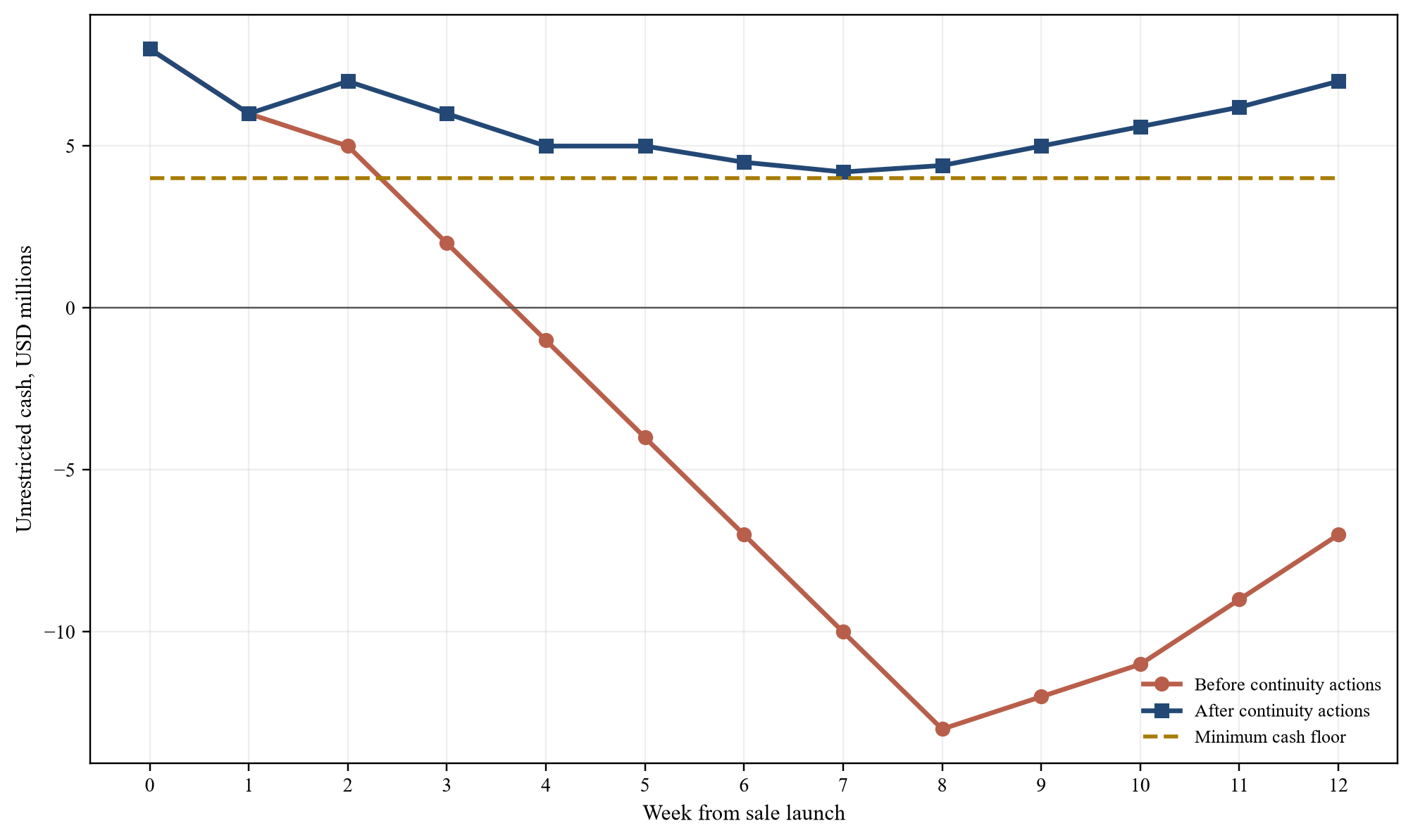
Original scenario analysis using hypothetical amounts. Values do not establish financing availability or probability of closing.
The facility should be sized from the weekly low point with contingency, fees and interest. The central case should identify the draw dates, repayment source and amount expected to remain at closing. A facility that is large enough in aggregate can still fail if conditions delay the first draw beyond the cash runway.
11. Model customer delivery as a funded workstream
Deposit-backed contracts should have a separate cost-to-complete schedule. It should include material, labour, subcontractor, logistics, warranty, penalties, certification and working-capital timing. The schedule should identify cash already received, revenue recognised, remaining liability, remaining margin, security calls and delivery dependencies.
The funding plan can prioritise contracts that convert work in progress into acceptance and cash, preserve transferable backlog or avoid refund and security exposure. It should avoid funding loss-making work solely because a deposit exists. The decision should compare completion, renegotiation, transfer, suspension and termination under the applicable contract and law.
If a buyer will assume the obligation, the purchase agreement should state the deposit balance, transferred performance obligation, working-capital treatment, customer consent, indemnity, security and funds flow. The seller and buyer should avoid counting the same deposit as cash, purchase-price value and funding for future performance.
Customer-specific cash should remain traceable after closing. A closing statement can reconcile deposits, contract assets, contract liabilities, receivables, inventory and cost to complete. Exceptions should have named owners and agreed economic treatment.
12. Negotiate supplier credit as part of the transaction
Supplier support can reduce peak cash use and preserve the operating chain. It can include extended terms, staged arrears, cash on delivery, reduced order volumes, consignment, direct buyer payment, purchase-order finance, inventory finance or a buyer guarantee. Each form changes risk, security, priority, price and control.
The supplier ask should be specific. It should state the future order schedule, proposed payment dates, treatment of arrears, information available, control mechanism and termination trigger. The company should avoid promising transaction certainty or recoveries beyond verified authority. The supplier should understand which obligations relate to new supply and which remain historical.
Supplier concentration can create cross-default and contagion. A single stop can prevent customer delivery, collections and buyer diligence. The plan should sequence suppliers by latest safe order date and replacement lead time. It should reserve management attention for dependencies with high value consequence and weak alternatives.
The transaction team should test whether a buyer can contract directly with a supplier before closing, provide a limited guarantee, fund materials into escrow or acquire specified inventory. These structures require legal, tax, title, accounting and competition analysis. They should be reflected in the purchase agreement and closing conditions.
13. Compare continuity-funding sources
Funding sources should be compared on usable cash, availability date, conditions, security, priority, control rights, cost, maturity and effect on the sale. A low nominal interest rate can be irrelevant if the lender cannot complete diligence before the runway expires. A fast facility can constrain the auction through milestones, bid protections, roll-up economics or control rights.
UNCITRAL identifies post-commencement finance as important to continued operation and going-concern sale outcomes. It discusses ordinary-course trade credit, administrative treatment, security and priority, and the need to balance new funding with existing creditor rights. [1] [3] EU Directive 2019/1023 provides protections for qualifying new and interim financing within its restructuring framework, subject to national implementation and safeguards. [11]
In the United States, section 364 permits specified ordinary-course unsecured credit and provides routes for court-authorised administrative priority, liens on unencumbered property, junior liens and, where statutory conditions are met, senior or equal liens with adequate protection. [4] Section 365 addresses assumption and rejection of executory contracts and includes cure and adequate-assurance requirements for assumption in applicable cases. [5]
| Source | Earliest usable cash question | Principal condition | Transaction interaction | Key downside |
|---|---|---|---|---|
| Accelerated collections | Has acceptance occurred and is payment unconditional? | Completed performance and customer approval | Reduces financing need | Discount, dispute or future service obligation |
| New customer milestone | Can the contract support payment before delivery? | Agreed deliverable and performance protection | Aligns customer with continuity | Refund, security or completion exposure |
| Supplier extension | Will supply continue through the safe date? | Defined future orders and payment schedule | Preserves operating chain | Concentration, title or stop risk |
| Shareholder support | Is funding committed and transferable to the right entity? | Authority, documentation and ranking | Can preserve sale flexibility | Availability, subordination or conflict |
| Buyer funding | Is the buyer committed before closing? | Bid status, conditions and protections | Can strengthen execution evidence | Auction distortion or failed closing |
| Rescue facility | Can conditions and security close before cash expiry? | Diligence, approvals, priority and collateral | Extends runway with defined controls | Cost, priming, milestones or enforcement |
Terms are structural considerations rather than market quotations. Availability and treatment require current lender, document and jurisdiction evidence.
The board should choose a package rather than a single source where timing and conditions justify diversification. Every source should have a fallback and an expiry date.
14. Design the continuity facility from use of proceeds
The facility should start with a controlled use-of-proceeds schedule. Permitted uses can include payroll, critical future supply, utilities, insurance, customer completion, safety, required capex, agreed professional fees and transaction costs. Prohibited or reserved uses can include distributions, affiliate transfers, unapproved historical creditor payments, speculative inventory and non-essential capex.
The borrowing base or availability test should match the operating case. Receivables can be reduced for dispute, concentration, set-off and ageing. Inventory can be reduced for title, customer specificity, work in progress and obsolescence. Contract value should not substitute for collateral without verified rights and cash conversion.
Documentation should address borrower entities, guarantors, security, priority, intercreditor arrangements, fees, interest, maturity, budgets, variances, reporting, milestones, events of default, remedies, sale proceeds, permitted bids and repayment. The company should test the facility against the planned transaction documents and existing finance agreements.
The lender should receive a weekly variance pack. It should reconcile actual cash to forecast, explain deviations, update the thirteen-week model, report customer and supplier events, and restate headroom. A covenant based on stale enterprise value provides limited control over near-term cash failure.
15. Govern payments under distress
The payment process should use a controlled calendar, authority matrix and evidence archive. Each payment should identify entity, account, counterparty, contract, amount, due date, purpose, legal basis, value protected, approval and cash-model line. Related-party and historical-creditor payments require particular scrutiny.
The board should obtain current advice on duties, preferences, transactions at undervalue, fraudulent trading, wrongful trading, priorities, set-off and security. A commercial desire to preserve supply does not establish that a historical payment is authorised or defensible. The decision record should distinguish legal advice from management's value judgement.
The payment committee should meet frequently enough for the runway. It should review cash, exceptions, critical counterparties, funding conditions and latest safe dates. Emergency authority should be bounded and documented. Bank access, dual approval, cyber controls and payment-file verification remain essential during management turnover and transaction pressure.
The company should reconcile forecast and actual bank cash daily. It should investigate unexpected receipts, returned payments, account freezes, currency gaps and duplicate instructions. Cash control failure can invalidate the model faster than a forecast error.
Variance governance should separate amount, timing and classification. A receipt arriving two days late can create a larger liquidity issue than a modest permanent shortfall. A payment coded as discretionary can prove essential to a customer delivery. Each material variance should update the forecast, the contract register and the relevant trigger, rather than remaining an unexplained bridge item.
The board pack should show both gross headroom and usable headroom. Gross headroom includes every modelled source. Usable headroom excludes unsigned arrangements, undrawn facilities with unmet conditions, receipts lacking acceptance and amounts restricted to a different entity or purpose. The difference should have named actions and expiry dates.
Fraud and cyber risk increase when a distressed process changes counterparties, bank accounts and approval routes. Supplier-account changes should be independently verified using known contact details. Funding instructions should be tested before the critical draw date. Access should be removed promptly when employees or advisers leave the process. The evidence archive should retain approvals, bank confirmations and payment files.
16. Apply the hypothetical industrial case
The hypothetical group provides engineered components, inspection and maintenance services across three jurisdictions. Its sale perimeter depends on certified staff, customer-specific inventory, licensed software, specialist suppliers and uninterrupted data systems. Five customers represent most near-term receipts. Six suppliers can stop delivery within ten days if new orders are unpaid.
The group holds USD 11.0 million of customer deposits. The cost-to-complete analysis allocates USD 7.5 million to materials, labour and logistics required before closing, USD 1.0 million to warranty and contingency, and USD 2.5 million to work expected after closing. The last amount requires buyer acceptance and purchase-agreement treatment. None of the deposit balance is treated as new free cash in the model.
The no-action case begins with USD 8.0 million of unrestricted cash and falls to negative USD 13.0 million. The USD 4.0 million floor produces a USD 17.0 million peak requirement. The operating package contributes USD 11.0 million through accelerated collections, milestones, supplier extensions and deferrals. The continuity facility contributes a maximum USD 7.0 million draw under the central timetable.
| Component | Amount | Earliest assumed availability | Evidence required | Treatment in model |
|---|---|---|---|---|
| Peak requirement to minimum floor | 17.0 | Week 7 to week 9 | Direct weekly cash model | Funding need |
| Accelerated certified collections | 4.0 | Weeks 2 to 5 | Acceptance and payment confirmation | Permanent reduction |
| New customer milestones | 3.0 | Weeks 3 to 6 | Amended contract and delivery plan | Performance-linked cash |
| Supplier-term extensions | 2.5 | Weeks 2 to 10 | Signed schedules and supply commitment | Timing deferral |
| Controlled discretionary deferrals | 1.5 | Weeks 1 to 8 | Approval and no critical value impact | Timing deferral |
| Maximum continuity-facility draw | 7.0 | Weeks 4 to 9 | Executed facility and conditions satisfied | Debt funding |
| Central package headroom | 1.0 | At peak | All stated components remain effective | Contingency above floor |
Amounts are USD millions and wholly hypothetical. The bridge is a deterministic scenario, not a financing commitment or probability-weighted forecast.
The central package keeps unrestricted cash at or above USD 4.0 million. The model assumes the facility can first draw in week four, the largest customer certifies USD 2.0 million by week three, and two critical suppliers sign extensions before new orders are released. These assumptions require dated evidence before launch.
17. Test timing, failure and linked scenarios
The principal scenarios should change events that can alter the route. A two-week closing delay adds payroll, supply, rent and professional costs. A failed customer certificate removes a receipt and can increase inventory. A supplier stop can delay customer delivery and collections. A facility delay can cause a cash breach even if final availability remains unchanged.
The hypothetical delay scenario moves closing from week twelve to week fourteen and adds USD 4.5 million of net cash use. If the facility limit remains USD 9.0 million, available headroom falls materially and requires a supplementary customer or shareholder solution. The customer-failure scenario removes USD 3.0 million of assumed cash and adds USD 1.0 million of completion or remediation cost. The supplier-stop scenario removes USD 2.5 million of term support and delays USD 2.0 million of collections. A delayed first facility draw produces the highest illustrated peak requirement at USD 24.0 million.
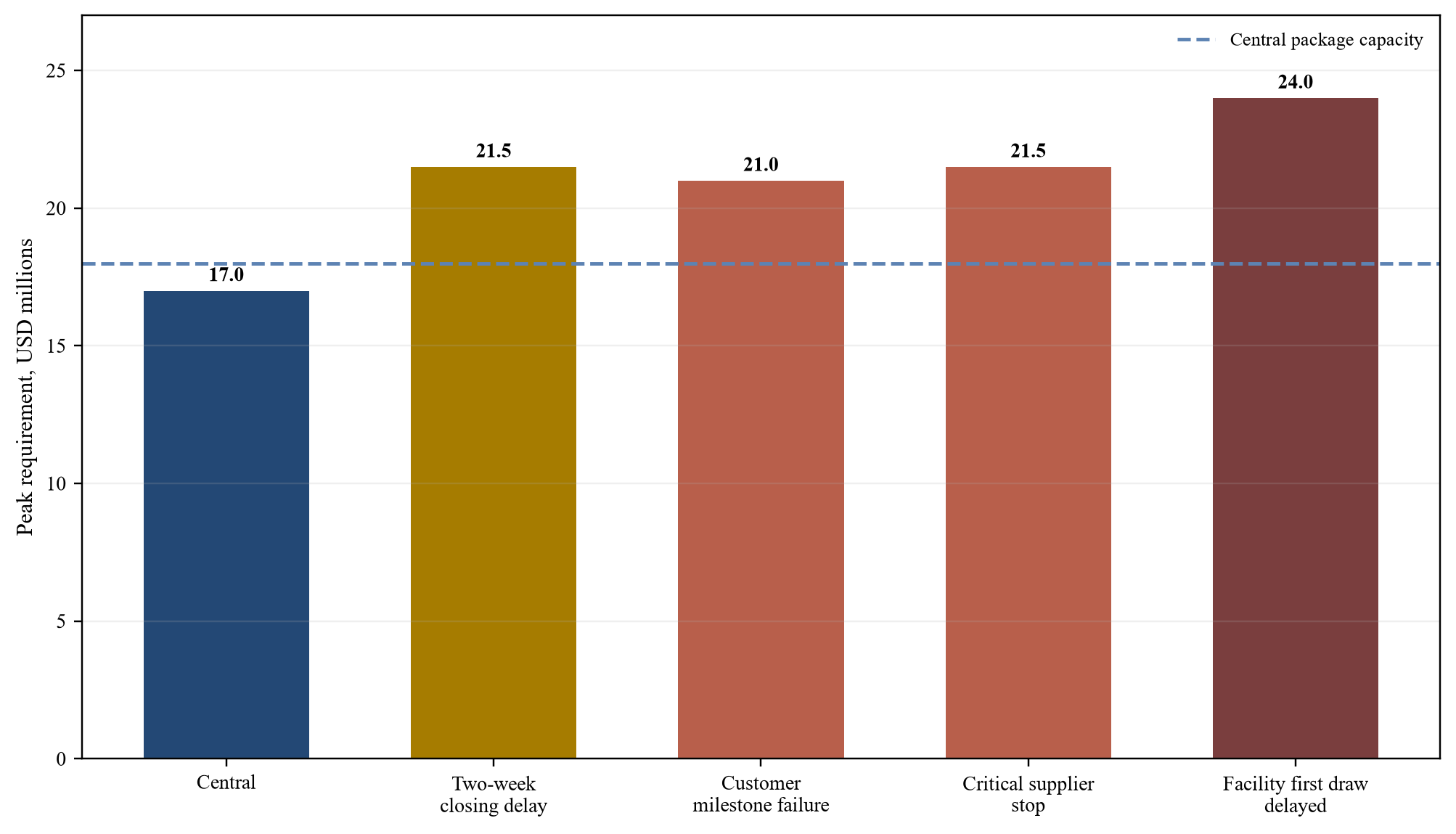
Original scenario analysis using hypothetical amounts. Scenarios combine linked cash effects and do not represent forecasts.
Each scenario should state its early indicator, latest safe action date, decision owner and prepared response. A trigger should operate before the cash breach. The latest safe action date can precede the forecast breach by the lead time needed to draw funding, obtain approval, place materials or inform the market.
18. Build a risk heat map around continuity failure
The risk register should connect evidence weakness to cash and transaction consequence. Priority risks can include customer deposit misuse, failed milestone acceptance, supplier stop, title claim, utility interruption, facility condition failure, account restriction, payroll shortfall, buyer delay and loss of certification.
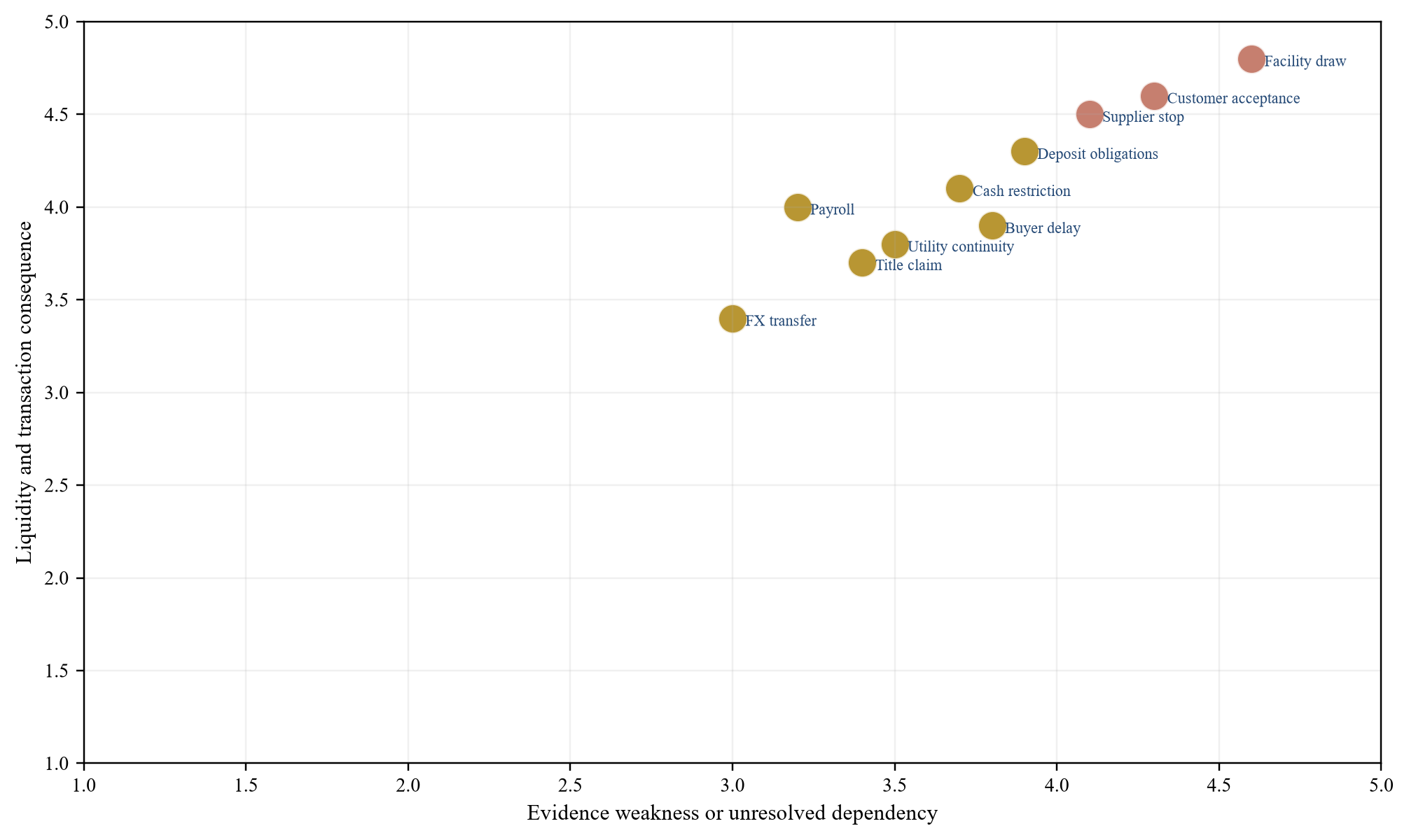
Original framework using hypothetical positions. Ratings require documented evidence, legal review and accountable management judgement.
The register should quantify exposure where evidence supports it. It should avoid generic red, amber and green labels. Every item should identify current evidence, affected contract, cash consequence, owner, latest safe date, mitigating action and fallback. Correlated risks should be grouped into scenarios.
19. Link the sale agreement to the liquidity plan
The purchase agreement should reflect the cash reality between signing and closing. Interim operating covenants, permitted payments, debt and cash definitions, working-capital targets, customer deposits, contract liabilities, leakage, capex, supplier arrangements, cure amounts and funding should reconcile to the continuity model.
The buyer should understand which continuity actions remain in place at closing. Supplier extensions can reverse after closing. Customer milestone cash can carry future performance. Facility debt and fees can reduce sale proceeds. Direct buyer payments can affect purchase price, title or working capital. Each item needs agreed treatment.
Signing conditions and closing conditions should have funding consequences. A regulatory delay can require additional liquidity. A material-adverse-change clause can interact with deteriorating trading. A closing account mechanism can penalise the seller for cash used to preserve the buyer's acquired business unless the parties define treatment.
The funds-flow statement should show facility repayment, secured debt, transaction expenses, employee and tax amounts, reserves, customer and supplier arrangements, and distributable cash. It should avoid counting a customer deposit or buyer prepayment twice.
20. Implement the framework in five phases
Phase one controls the facts. Finance reconciles bank cash, restrictions, deposits, receivables, payables, payroll, tax, facilities and entity transfers. Operations identifies critical customer and supplier dependencies.
Phase two builds the direct cash model and contract registers. The team links deposit obligations, cost to complete, supplier requirements, collections, sale milestones and the minimum cash floor.
Phase three secures the operating package. Customers approve milestones, suppliers document future supply, management controls deferrals, and advisers prepare facility diligence, authority, security and priority analysis.
Phase four launches and governs the sale. The company updates cash daily, reviews the thirteen-week model weekly, monitors funding conditions, controls payments and advances alternatives before triggers expire.
Phase five signs, closes and validates. The parties reconcile debt, cash, deposits, working capital, cure, continuity arrangements, facility repayment and residual obligations. The company archives evidence and reviews actual outcomes.
| Phase | Indicative timing | Core outputs | Board gate | Escalation if incomplete |
|---|---|---|---|---|
| Cash and contract control | Days 1 to 7 | Bank cash, restrictions, deposit and supplier registers | Is usable cash verified? | Freeze discretionary cash and repair data |
| Direct liquidity model | Days 3 to 10 | Daily and weekly cash, floor, linked scenarios | Is the latest safe date credible? | Shorten process and activate alternatives |
| Operating package | Days 7 to 20 | Collections, milestones, supplier schedules and deferrals | Are continuity actions documented? | Reprice runway and narrow operations |
| Facility and sale launch | Days 10 to 30 | Committed funding, draw mechanics, process timetable | Can cash arrive before the breach? | Advance backup source or transaction route |
| Governance and closing | Launch onward | Variance pack, triggers, agreement treatment and funds flow | Do cash and documents remain aligned? | Hold, amend or activate alternative |
| Post-close validation | Closing onward | Cash reconciliation and residual obligation register | Were approved uses and outcomes delivered? | Correct payments, reserves and controls |
Timing is indicative and should follow verified runway, contracts, financing documents, law, approvals and sale complexity.
The roadmap should remain linked to the actual runway. Completion percentages are weak evidence. The governing measure is whether the next required cash, consent, supply and funding event can occur before the latest safe date.
21. Conclusion
Trading through a distressed sale is a transaction-finance problem. Value depends on keeping the operating chain intact long enough for a buyer to diligence, document, approve and close. The board needs a direct cash model, a customer-deposit ledger, a supplier continuity map, committed funding and trigger-led alternatives.
The hypothetical case shows the difference between reported cash and usable runway. USD 8.0 million of unrestricted opening cash cannot absorb a USD 17.0 million peak requirement to the stated floor. USD 11.0 million of customer deposits carries performance obligations and is not counted again as free cash. The central package combines USD 11.0 million of operating actions with a maximum USD 7.0 million facility draw to preserve at least USD 4.0 million of cash under the stated assumptions.
The reusable discipline is direct. Verify bank cash. Map deposits to performance. Separate supplier arrears from future supply. Forecast gross receipts and payments by date. Compare funding sources on usable cash and timing. Document authority, security and priority. Link the purchase agreement to the continuity model. Trigger alternatives before the runway expires.
Sources
- UNCITRAL, Legislative Guide on Insolvency Law, Read the primary source
- World Bank, Principles for Effective Insolvency and Creditor/Debtor Regimes, revised 2021 and current ICR standard page, Read the primary source
- UNCITRAL, Legislative Guide on Insolvency Law, Part Two, post-commencement finance and treatment of contracts, Read the primary source
- United States Code, Title 11 Section 364, obtaining credit, Read the primary source
- United States Code, Title 11 Section 365, executory contracts and unexpired leases, Read the primary source
- United States Code, Title 11 Section 503, administrative expenses including qualifying recent goods, Read the primary source
- United States Code, Title 11 Section 546, limitations including seller reclamation, Read the primary source
- IFRS Foundation, IFRS 15 Revenue from Contracts with Customers, Read the primary source
- IFRS Foundation, IFRS 15 issued standard, customer prepayments, contract liabilities and refund liabilities, Read the primary source
- IFRS Foundation, IAS 7 Statement of Cash Flows, Read the primary source
- European Union, Directive EU 2019/1023 on restructuring, new financing and interim financing, Read the primary source
- United Kingdom, Corporate Insolvency and Governance Act 2020 explanatory notes on termination clauses in supply contracts, Read the primary source
- United Arab Emirates, Federal Decree-Law No. 51 of 2023 Promulgating the Financial Restructuring and Bankruptcy Law, including Articles 144 and 145, Read the primary source
- United States Courts, Chapter 11 Bankruptcy Basics, Read the primary source
