

1. Define the portfolio decision before choosing a partner
A GCC partnership should begin with the asset owner's portfolio problem. The governing body should specify the return objective, risk budget, liquidity tolerance, currency policy, strategic asset allocation role, permitted structures, concentration limits and investment horizon. A relationship objective can support the programme, although the investment case must remain anchored in the interests of beneficiaries or the institution's mission.
The portfolio role should be explicit. A programme may seek infrastructure cash flows, private-credit income, growth exposure, inflation linkage, technology access or diversification from existing developed-market holdings. Each purpose implies a different opportunity set and different underwriting capabilities. A broad ambition to access the Gulf cannot substitute for a defined mandate.
OECD pension principles place ultimate responsibility with the governing body, require a written investment policy and expect external providers to remain subject to monitoring and oversight [1]. The UK Pensions Regulator similarly directs trustees considering private markets to assess liquidity, governance, advice, valuation and contractual terms [2]. These principles support a simple starting rule: partnership design follows portfolio purpose.
The approval paper should identify what the programme adds to the existing portfolio, which risks it introduces, what evidence supports the allocation and how success will be measured. It should also state the conditions that would lead to a smaller allocation, delayed deployment or termination.
2. Treat partnership as an investment architecture
The word partnership can describe several economically different arrangements. A fund commitment delegates selection and ownership to a manager. A separately managed account can provide mandate control and reporting. A co-investment exposes the asset owner to a specific transaction alongside a sponsor or sovereign institution. A joint venture shares control over an operating platform. A direct investment places underwriting and ownership responsibilities on the asset owner itself.
The architecture determines rights, resources and risk. Fund commitments can provide diversification and an established operating platform, while fees, blind-pool risk and limited control remain material. Separate accounts can tailor exposures but require scale and governance attention. Co-investments can reduce blended fees and provide transaction-level choice, while increasing concentration, execution speed and adverse-selection risk. Direct and joint-control structures demand deep sector, legal and operating capability.
The governing body should approve a route map rather than a generic relationship. The map should show how opportunities enter the programme, who screens them, who performs diligence, which committee approves capital, who holds legal title, how follow-on capital is decided and how exits are governed.
This approach prevents relationship momentum from determining structure. It also allows several routes to coexist. A core fund commitment can build information and access; a separate co-investment sleeve can remain subject to independent approval; a later direct programme can follow only after capability has been demonstrated.
3. Use two approval gates
Institutional partnerships combine counterparty risk with asset risk. A two-gate process keeps those questions separate. Gate One approves the partner and operating architecture. Gate Two approves each fund, mandate or transaction under the asset owner's normal investment standards.
Gate One should test legal standing, regulatory status, governance, decision independence, conflicts, track record, operating controls, valuation, reporting, cyber resilience, sanctions compliance, anti-money-laundering controls and reputation. It should also establish the proposed partner's mandate, policy objectives and economic incentives. A sovereign or strategic investor may pursue development, localisation or sector-building objectives alongside financial returns; these objectives require clear disclosure and governance.
Gate Two should test expected return, downside, valuation, leverage, concentration, liquidity, governance rights, cash-flow profile, exit routes and portfolio fit. A trusted partner can improve information and execution, yet trust cannot replace asset-level underwriting.
The International Forum of Sovereign Wealth Funds describes the Santiago Principles as a framework for governance, accountability, transparency and prudent investment practices [3]. The framework can inform partner diligence while preserving recognition that each institution has its own legal mandate.
Approval papers should document both gates. A failed asset case should remain declined even when the relationship is strategically valuable. A strong asset case should remain subject to counterparty and structure controls.
4. Map the GCC opportunity set by decision relevance
The GCC is a group of distinct jurisdictions and markets. The asset owner should map opportunities by cash-flow source, ownership regime, regulatory framework, sponsor quality, currency, development stage and exit route. Country labels alone provide limited investment information.
Relevant segments may include contracted infrastructure, renewable power, water, transport, logistics, data centres, private credit, real estate, financial services, healthcare, education, industrial platforms, technology and growth companies. The investable characteristics vary sharply. A regulated utility project with long-dated contracted revenue presents a different risk system from a venture investment, a hospitality development or a private-credit loan.
The map should connect market depth with the asset owner's capabilities. It should identify where public data is sufficient, where local operational diligence is essential, where government-related counterparties matter and where ownership or licensing rules affect control. It should also compare primary investment, secondary acquisition, development capital and refinancing opportunities.
The result should be a bounded investable universe. Each segment receives an eligibility definition, minimum return threshold, risk limits, required partner capability and approved structure. This prevents thematic enthusiasm from producing an incoherent portfolio.
Public sources can help frame the opportunity set. PIF reports that its international strategy uses direct investments and co-investments with selected partners [7]. Mubadala describes minority co-investments, external-manager relationships and purpose-built vehicles as parts of its investment model [8]. These examples illustrate institutional routes rather than expected outcomes for another investor.
5. Select the jurisdiction before selecting the vehicle
Vehicle choice should follow the investment, investor eligibility, governance needs, tax analysis, regulatory permissions and dispute-resolution requirements. A familiar legal form can still be unsuitable if it creates weak control, inefficient cash flows or uncertain enforcement.
The Dubai Financial Services Authority distinguishes Public Funds, Exempt Funds and Qualified Investor Funds. Exempt Funds and Qualified Investor Funds are restricted to Professional Clients and private placement, with different minimum subscriptions and regulatory intensity [5]. ADGM's FSRA has continued to develop its funds framework, including periodic reporting and proposals for institutional fund managers [6]. Current rules and implementation dates require transaction-specific legal verification.
The jurisdiction review should cover licensing, fund manager status, custody, administration, audit, valuation, investor classification, marketing, beneficial ownership, data protection, insolvency, security enforcement, foreign ownership, withholding, corporate tax, treaty access and arbitration. The asset owner should obtain advice in each relevant jurisdiction and in its home jurisdiction.
The decision record should distinguish legal conclusions from commercial preferences. It should identify required opinions, regulatory filings, conditions precedent and residual uncertainties. Structures should remain proportionate. Additional entities can improve segregation and governance, while each entity adds cost, reporting and operational failure points.
6. Build a counterparty evidence file
Institutional reputation is useful context; the decision requires evidence about the specific team, mandate and proposed arrangement. The evidence file should cover legal identity, ownership, governing law, board and committee structure, delegated authority, financial resources, audited accounts, regulatory permissions, litigation, compliance events, staff continuity and service providers.
The asset owner should map the people responsible for origination, underwriting, approval, portfolio management, valuation, risk and reporting. It should test whether named senior figures will participate or whether execution will be delegated to a different team. References should include investors, co-investors, lenders, advisers, portfolio companies and counterparties that declined to transact.
Past transactions should be reconstructed from original underwriting through exit or current valuation. The analysis should separate market movement, leverage, operating improvement, multiple change, currency and fees. It should include losses and delayed investments, since these reveal governance and disclosure under pressure.
The file should also identify policy objectives or related-party relationships that can shape the opportunity set. These factors can create access and value, and they can create allocation or conflict questions. A documented conflict map allows the partnership to manage them explicitly.
The output is an institutional view of the counterparty's capacity and constraints. It should be refreshed annually and after material changes in ownership, leadership, regulatory status or mandate.
7. Separate relationship access from investment merit
Local relationships can improve sourcing, information, regulatory navigation and operating execution. Their value should be assessed through measurable outcomes. The asset owner should record which opportunities were accessed through the partnership, the quality and timing of information, conversion rates, pricing, governance rights and realised results.
Access has several forms. Early visibility provides time to prepare. Proprietary access can reduce auction competition. Policy and sector knowledge can improve underwriting. Local operating networks can accelerate permits, hiring or commercial partnerships. Co-investor credibility can improve execution certainty.
Each form requires evidence. A claim of proprietary sourcing should identify how the opportunity originated and whether it improved price or terms. A claim of operating advantage should identify actions, responsible parties, cost, timing and effect. A claim of regulatory insight should remain separate from any expectation of preferential treatment.
The partnership agreement should preserve independent decline rights. It should also prevent pressure to support transactions for relationship reasons. Investment committee materials should state whether an opportunity was introduced by the partner, whether the partner has another economic interest and whether the asset owner received sufficient time and information.
This separation protects both institutions. The local partner gains a disciplined, reliable capital counterparty. The asset owner gains access without weakening its own mandate.
8. Design co-investment allocation rules before opportunities arrive
Co-investment decisions often occur under compressed timelines. Pre-agreed allocation, diligence and approval rules reduce the risk that speed displaces judgement. The policy should define eligible strategies, ticket sizes, concentration limits, minimum diligence materials, decision deadlines and approved delegation.
ILPA Principles 3.0 call for written disclosure of how opportunities, interests and expenses are allocated, how conflicts are managed, whether some investors receive priority and how follow-on investments are treated [4]. ILPA's model agreement also provides a reference point for same-time, same-terms participation and pro-rata fees, expenses and liabilities [15]. These provisions require adaptation to the actual transaction.
The asset owner should understand why a co-investment tranche exists. Legitimate reasons include fund concentration limits, transaction size, strategic expertise or portfolio construction. The diligence team should test whether the sponsor is retaining adequate exposure and whether the co-investor receives the same security, price and information.
An allocation register should record every offered, accepted and declined opportunity. It should show available capacity, allocation rationale, economics, timing and related parties. Periodic review can test whether the programme receives a representative set of opportunities or a skewed subset.
9. Establish decision rights and reserved matters
Governance rights should reflect ownership, risk and operational dependence. The asset owner should map rights across the fund, investment vehicle and portfolio company. Rights at one level can be weakened by decisions taken at another.
Key matters may include strategy change, leverage, acquisitions, disposals, budgets, related-party transactions, valuation policy, new securities, senior management, auditor, distributions, refinancing, litigation and exit. The allocation of consent, veto, consultation and information rights should be explicit.
Minority rights require enforceability and practical use. A broad veto can protect capital, while it can also create deadlock. A consultation right can improve information, while it may offer limited control. The agreement should provide escalation, deadlock, buy-sell or exit mechanisms appropriate to the asset.
The asset owner should avoid governance theatre. A board seat has value when the representative receives timely information, has the required expertise, can challenge decisions and operates under clear conflicts and confidentiality rules. Committee calendars and information packs should support meaningful preparation.
Decision rights should be summarized in a governance matrix approved before closing. The matrix should identify the legal source of each right, the responsible internal owner, notice period and escalation path.
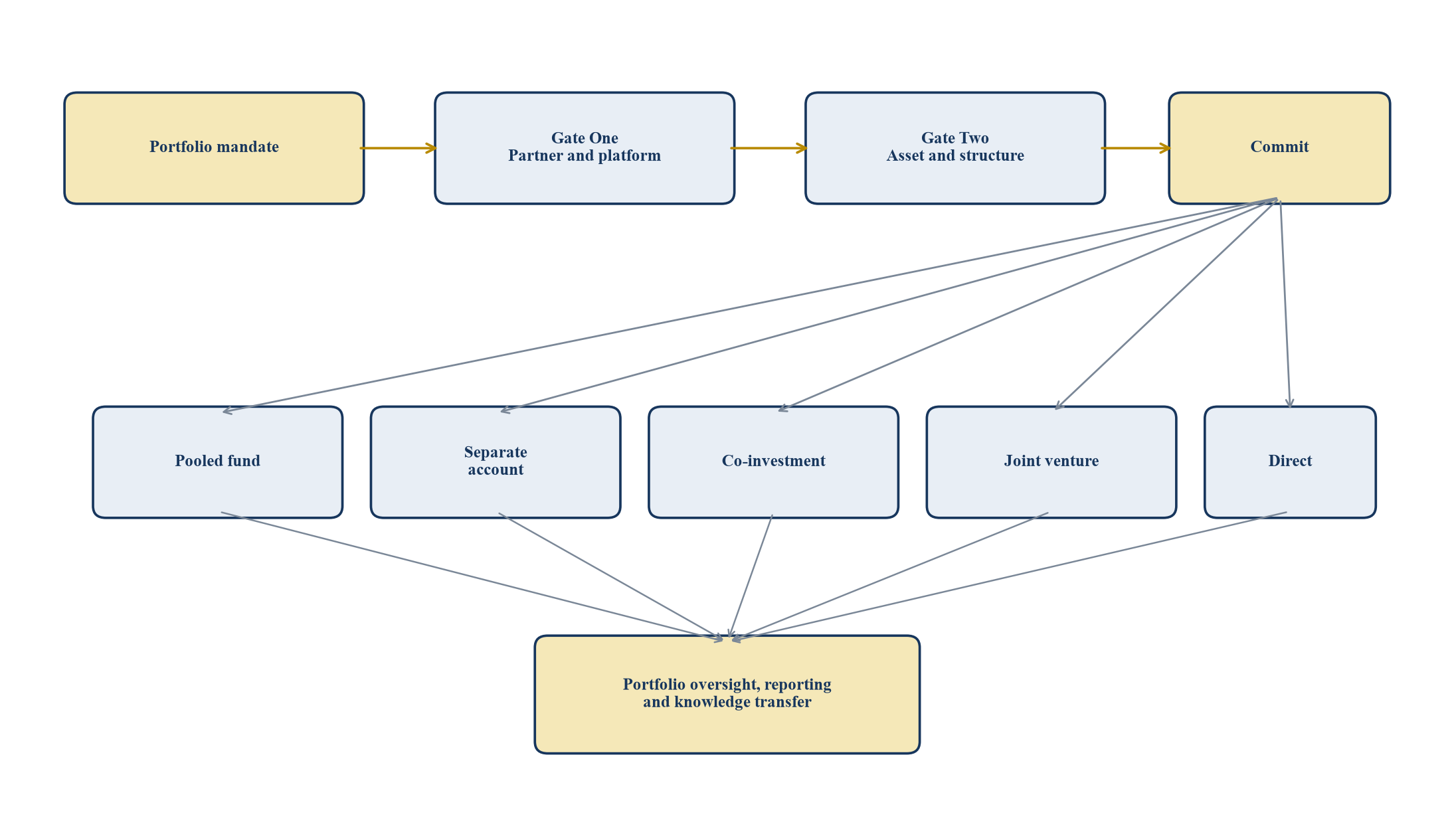
The proposed architecture keeps partner approval separate from transaction approval while connecting oversight, execution and monitoring.
10. Make conflicts observable
Potential conflicts can arise from allocation, fees, related parties, valuation, financing, service providers, follow-on capital and exit timing. The governance objective is to identify each conflict, assign decision authority and create an auditable response.
The partner should disclose interests held by its affiliates, other funds, government-related entities, advisers and key personnel. The asset owner should disclose its own relationships where they can affect decision-making. The conflict register should cover the fund, transaction and portfolio-company levels.
OECD corporate-governance principles expect fiduciary institutions to disclose governance and voting policies and to manage conflicts affecting ownership rights [12]. ILPA guidance calls for written allocation policies and disclosure of differentiated economics and related co-investments [4]. These standards support transaction-specific procedures rather than general boilerplate.
Controls can include independent committee review, recusal, third-party valuation, competitive procurement, fairness opinions, consent rights, arm's-length evidence and enhanced disclosure. The chosen control should address the economic mechanism of the conflict.
The minutes should record the conflict, information considered, persons excluded, advice received and decision. Repeated conflict categories should lead to a policy change rather than repeated exceptions.
11. Underwrite valuation and price discovery
Private-market valuations affect entry, performance, collateral, follow-on capital and exit. A partnership can improve local information, although the asset owner should maintain independent valuation governance.
The diligence file should state valuation methodology, assumptions, comparable sets, discount rates, exchange rates, forecast horizon and sensitivity. It should identify who prepares, reviews and approves valuations, how conflicts are handled and when independent work is required.
IOSCO's analysis of private finance identifies infrequent repricing, uncertainty and conflicts as material features of private markets [11]. The asset owner should therefore reconcile marks with financing events, secondary transactions, operating performance and eventual exits. Material methodology changes should be separately approved.
Price discovery deserves special attention in bilateral or related-party transactions. The committee should ask what alternative buyers or sellers existed, how terms compare with observable markets and whether strategic benefits are being used to justify a financial premium. Strategic benefits should be described, evidenced and valued separately.
Monitoring should include mark-to-exit variance, valuation overrides, stale valuations and differences between partner, administrator and independent views. These measures indicate valuation-process quality rather than future return.
12. Build portfolio-level concentration controls
Individual opportunities can appear attractive while producing an unbalanced programme. The asset owner should set limits for country, sector, sponsor, partner, asset, vintage, development stage, currency, leverage and revenue counterparty.
Concentration should be measured through economic exposure rather than vehicle labels. Two funds can own the same asset or depend on the same government customer. A co-investment can duplicate exposure already held through a pooled vehicle. A project and its lender can share the same macroeconomic risk.
The programme should use look-through data where available and conservative estimates where it is incomplete. The risk system should aggregate committed capital, funded capital, unfunded commitments, guarantees, hedges and contingent follow-on requirements.
Limits should include escalation thresholds below hard caps. A warning level gives the investment team time to adjust pipeline and pacing. Overrides should require documented justification, duration and remediation.
The governing body should view the GCC programme within total-fund exposures. Oil prices, interest rates, global trade, technology demand and regional liquidity can influence several sectors at once. Scenario analysis should therefore test cross-asset correlations rather than treating every transaction independently.
13. Integrate liquidity and commitment pacing
Private-market commitments create uncertain cash-flow timing. The asset owner should model capital calls, distributions, follow-ons, fees, hedging and liquidity needs under several scenarios.
The UK Pensions Regulator advises trustees to model calls and distributions, stress delayed realisations, accelerate capital calls and account for adverse currency movements [2]. These practices apply directly to a GCC programme containing funds, co-investments and direct assets.
The pacing model should distinguish committed, funded and net asset value. It should incorporate overlapping vehicles, recycling, subscription facilities and partner discretion over drawdowns. A base case should be accompanied by slow-exit, fast-call and currency-stress cases.
Liquidity governance should identify the assets available to fund calls, minimum buffers, escalation thresholds and contingent actions. The asset owner should avoid relying on a future distribution from one illiquid asset to fund another commitment.
Co-investment can intensify timing risk because opportunities may require rapid funding outside the original pacing plan. The policy should reserve capacity for opportunistic deployment and define when an otherwise attractive investment must be declined for portfolio-liquidity reasons.
14. Govern currency and financing risk
Many GCC currencies are pegged to the US dollar, although underlying assets can have revenues, costs, debt or exit values in several currencies. The asset owner should map economic currency exposure rather than relying on vehicle denomination.
The analysis should identify revenue currency, operating costs, debt currency, hedge availability, tenor, collateral, counterparty, break costs and accounting treatment. It should also test basis risk where the hedge instrument does not match the exposure.
Financing can improve capital efficiency and increase downside sensitivity. The committee should examine loan-to-value, interest coverage, refinancing dates, amortisation, covenants, recourse, hedging and cure rights. It should model higher rates, lower valuations, delayed completion and restricted distributions.
Subscription facilities and net-asset-value financing require separate treatment. They can change reported cash-flow timing, leverage and liquidity. The asset owner should require transparent reporting and calculate performance with and without financing effects where feasible.
The programme should set financing limits at asset, vehicle and total-programme levels. Breach procedures should specify notice, remediation and approval. Related-party financing should receive independent conflict and pricing review.
15. Define knowledge transfer as an operating deliverable
Knowledge transfer is valuable when it improves the asset owner's ability to originate, evaluate, govern and monitor investments. It should be defined through deliverables, responsible people and evidence of adoption.
A plan can include secondments, joint underwriting, sector workshops, shared data standards, investment-committee observation, operating playbooks and post-investment reviews. Each activity should have a purpose, frequency, confidentiality framework and output.
The asset owner should distinguish information access from capability transfer. Receiving reports does not establish the ability to make an independent decision. Capability is demonstrated when the internal team can apply the method to a new case, challenge assumptions and operate the governance process.
The partnership agreement should address intellectual property, data use, confidentiality, employee solicitation and continuity after termination. The asset owner should retain its own decision records and models within permitted boundaries.
Progress can be measured through trained staff, completed joint diligences, improved cycle time, internal coverage, model quality and successful independent reviews. Metrics should focus on institutional capability rather than attendance.
16. Build a shared data and reporting standard
A partnership cannot be governed through inconsistent presentations. The asset owner should define a common data model before commitment. It should cover exposures, cash flows, valuations, leverage, covenants, fees, expenses, sustainability factors, incidents, related parties and ownership rights.
Definitions should be written. Gross and net return, committed capital, invested capital, realised value, unrealised value, leverage and concentration can be calculated differently. The reporting agreement should state calculation methods, valuation dates, currency translation, look-through level and restatement policy.
The asset owner should receive enough detail to reconcile the programme with its custodian, administrator, risk system and financial statements. Data delivery should use secure channels, named owners, validation checks and remediation deadlines. Material errors should be logged and reported to the appropriate committee.
Reporting frequency should follow the risk. Quarterly reporting may suit stable funds; construction, covenant or liquidity risks can require monthly or event-driven updates. The agreement should identify events that trigger immediate notice, including regulatory action, key-person change, valuation override, covenant breach, litigation, cyber incident or material change in strategy.
Shared data can also support knowledge transfer. Standardised underwriting and monitoring templates allow teams to compare decisions across partners and vintages without forcing every asset into an identical economic model.
| Domain | Minimum evidence | Frequency | Escalation trigger |
|---|---|---|---|
| Portfolio | Cost, value, cash flows, exposures and concentration | Quarterly | Limit warning or material restatement |
| Asset risk | Operating KPIs, leverage, covenants and liquidity | Monthly or quarterly | Covenant breach or forecast variance |
| Governance | Reserved matters, votes, conflicts and related parties | Event-driven | Unresolved conflict or rights impairment |
| Valuation | Method, assumptions, committee approval and overrides | Quarterly | Method change or independent-value gap |
| Operations | Administrator, custody, cyber, compliance and incidents | Quarterly | Control failure or regulatory event |
| Fees | Management fees, performance fees, expenses and offsets | Quarterly | Allocation error or undisclosed charge |
The proposed minimum set should be adapted to the asset, structure and home-jurisdiction requirements.
17. Align stewardship and ownership practice
Ownership rights should be treated as economic assets. The partnership should specify who votes, who engages with management, how objectives are set and how outcomes are reported.
OECD corporate-governance principles recognise voting rights as part of the value managed by fiduciary institutions and call for disclosure of governance and voting policies [12]. PRI describes stewardship as including engagement with intermediaries and investee entities across asset classes [17]. These principles support a written ownership framework for GCC private-market investments.
The framework should cover board representation, shareholder voting, lender consent, information rights, executive remuneration, succession, audit, risk, sustainability and exit readiness. It should allocate responsibility between the local partner, sponsor, asset owner and external manager.
The asset owner should preserve the ability to escalate material concerns. Escalation can include enhanced reporting, board challenge, independent review, consent withholding, remediation plans, syndication or exit. The choice should reflect ownership rights and expected effect.
Stewardship reporting should focus on financially material objectives and actions. It should identify the issue, requested change, action taken, response, current status and expected economic relevance. Broad activity counts provide limited evidence of effectiveness.
18. Integrate sustainability factors through financial materiality
Energy, water, labour, governance, physical climate, transition policy and community relationships can affect revenue, cost, financing, permits and exit value across GCC assets. The underwriting process should identify the financially material factors for each investment.
The analysis should connect each factor to cash flow, probability, time horizon and control. A data-centre investment may depend on power availability, water use and grid carbon intensity. A logistics asset may depend on fuel efficiency, labour practice and trade corridors. A real-estate asset may depend on cooling cost, insurance and building standards.
Mubadala reports a responsible-investing approach that includes a climate-integration framework, engagement with portfolio companies and a GP model for external managers and co-investors [9]. This provides a current institutional example of integrating sustainability into partnership processes, without establishing expected results for other programmes.
The asset owner should define baseline data, targets, ownership and verification. It should avoid imposing metrics that lack decision relevance or reliable measurement. Material gaps should be priced, covenanted or included in the implementation plan.
Post-close monitoring should track both risk and value creation. Energy efficiency, governance improvement or workforce stability can reduce cost or improve resilience. Each claim should be supported by measured operational evidence.
19. Protect independence when strategic objectives are present
GCC investment platforms may combine commercial returns with economic-development, localisation, technology-transfer or sector-building objectives. Global pensions and endowments can participate when the arrangement remains consistent with their own mandate and fiduciary duties.
The decision paper should identify every strategic objective, the party that benefits and the expected economic channel. A localisation programme may improve supply-chain resilience or market access. It may also add cost or restrict procurement. The committee should model both effects.
The partnership agreement should preserve independent investment approval, access to information, conflict procedures and exit rights. It should state that policy or relationship considerations do not change the asset owner's approved return and risk criteria.
The IFSWF explains that the Santiago Principles seek professional, independent and commercially oriented investment management while recognising diverse mandates [3]. Its review work also notes that strategic investment funds can use governance transparency to reduce ambiguity when mobilising foreign capital [18].
The asset owner should report strategic outcomes separately from financial performance. This keeps accountability clear and prevents a weak financial result from being obscured by unrelated activity measures.
20. Build the operating model before committing capital
The operating model converts legal rights into daily control. It should identify every process from opportunity intake through approval, funding, custody, accounting, valuation, monitoring, voting, tax, distributions and exit.
Responsibility should be assigned through a RACI matrix covering the asset owner, local partner, manager, administrator, custodian, legal counsel, tax adviser, auditor and portfolio company. Interfaces deserve particular attention because errors often occur between institutions.
The asset owner should test bank-account controls, payment approvals, capital-call verification, authorised signatories, document retention, cyber security, business continuity and incident response. A tabletop exercise can simulate a fraudulent payment request, system outage or disputed capital call.
Service-provider diligence should cover independence, capacity, location, subcontracting, insurance, regulatory status and termination support. The asset owner should understand which records it can retrieve if the partnership ends.
The model should include a cost budget. Legal entities, administration, custody, audit, tax, travel, secondments and data integration can materially affect net return. Costs should be allocated transparently across the fund, partner and co-investors.
21. Plan tax, substance and cash movement together
Tax analysis should follow the complete cash path from the asset owner to the investment and back. It should cover entity residence, permanent establishment, withholding, capital gains, value-added tax, transfer pricing, treaty eligibility, beneficial ownership, interest limitation, substance and reporting.
The asset owner should obtain current advice in the home jurisdiction, vehicle jurisdiction and asset jurisdiction. Rules can change, and outcomes can depend on facts, ownership, investor type and documentation. The paper therefore does not provide a tax conclusion.
Cash movement should be mapped alongside legal and tax analysis. The map should show capital calls, debt, fees, expenses, dividends, interest, sale proceeds, hedging and distributions. It should identify approvals, bank accounts, currencies and expected timing.
Substance should be operational rather than documentary. Board composition, meeting location, decision records, staff, systems and service providers should support the entity's stated role. The asset owner should avoid structures whose economic purpose is unclear or whose compliance depends on assumptions that cannot be maintained.
Tax leakage should enter the scenario model and net-return calculation. The committee should see the effect of withholding, denied deductions, restructuring cost and delayed distributions.
22. Design exit and termination at entry
Partnerships can outlive the people who negotiated them. Exit provisions should therefore be operational, priced and tested before capital is committed.
The agreement should address fund term, extensions, transfer rights, pre-emption, drag, tag, put, call, deadlock, key person, cause removal, no-fault removal, change of control and dissolution. The appropriate rights depend on the vehicle and ownership position.
Exit analysis should identify likely buyers, market depth, regulatory approvals, valuation process, transaction costs and information required for diligence. A put right has limited value if the counterparty lacks capacity or the price formula is weak. A transfer right has limited value if consent can be withheld broadly.
Termination planning should cover data, records, bank mandates, service providers, intellectual property, seconded employees, confidentiality and ongoing portfolio management. The asset owner should know how investments will be managed after the relationship ends.
The committee should review exit readiness annually. This includes ownership records, audited accounts, legal compliance, data room quality, management succession and unresolved disputes. Better readiness can improve optionality even when no sale is planned.
23. Use a risk heat map linked to controls
A useful heat map connects each risk to exposure, likelihood, impact, control, owner and indicator. Colour alone provides limited decision value.
The programme should assess investment, concentration, liquidity, leverage, currency, valuation, governance, conflict, regulatory, tax, operational, cyber, counterparty, political and reputation risks. It should distinguish risks controlled by the asset owner, shared with the partner and largely external.
Each high risk should have a preventive control, monitoring indicator and response. For example, concentration risk can be controlled through limits and pipeline pacing; valuation risk through independent review and mark-to-exit monitoring; key-person risk through named clauses and succession evidence.
The heat map should state residual risk after controls. It should also identify correlations. A regional funding shock can affect refinancing, valuation, distributions and exit simultaneously.
The risk committee should review indicators at an agreed frequency. Trigger breaches should lead to a defined action, owner and deadline. The record should distinguish a temporary exception from a structural change in the programme.
| Risk | Inherent rating | Principal control | Indicator | Residual rating |
|---|---|---|---|---|
| Allocation conflict | High | Written policy, register and independent review | Offer pattern and allocation variance | Medium |
| Valuation uncertainty | High | Independent review and mark-to-exit analysis | Override count and value gap | Medium |
| Liquidity and calls | High | Pacing model and liquidity buffer | Stressed coverage ratio | Medium |
| Partner dependency | Medium | Rights, succession and termination plan | Key-person or control change | Low-Medium |
| Regulatory change | Medium | Local counsel and compliance monitoring | Rule or licence change | Low-Medium |
| Data quality | Medium | Data standard, reconciliation and error log | Late or restated reports | Low |
Ratings are hypothetical management judgements and require programme-specific evidence.
24. Build a scenario model around cash, value and governance
Scenario analysis should expose how the programme behaves when several assumptions move together. It should focus on decisions rather than a single expected return.
The hypothetical case assumes a USD 30.0 billion asset owner considers a USD 750 million GCC programme. The proposed allocation is USD 300 million to diversified funds, USD 250 million to a separate account and USD 200 million reserved for co-investments. These values are illustrative management assumptions.
The base case assumes planned deployment, normal exits and stable governance. The access-upside case assumes better sourcing and co-investment conversion. The delay case assumes slower deployment and distributions. The stress case assumes valuation decline, refinancing pressure, delayed exits and a key-person event.
The model should calculate funded exposure, unfunded commitments, net cash flow, programme value, concentration, liquidity coverage and governance triggers. It should display results before and after fees, tax leakage and hedging cost.
The committee should decide which actions follow each scenario. Actions can include slowing commitments, increasing liquidity, reducing co-investment tickets, requiring remediation, seeking secondary sales or suspending new approvals.
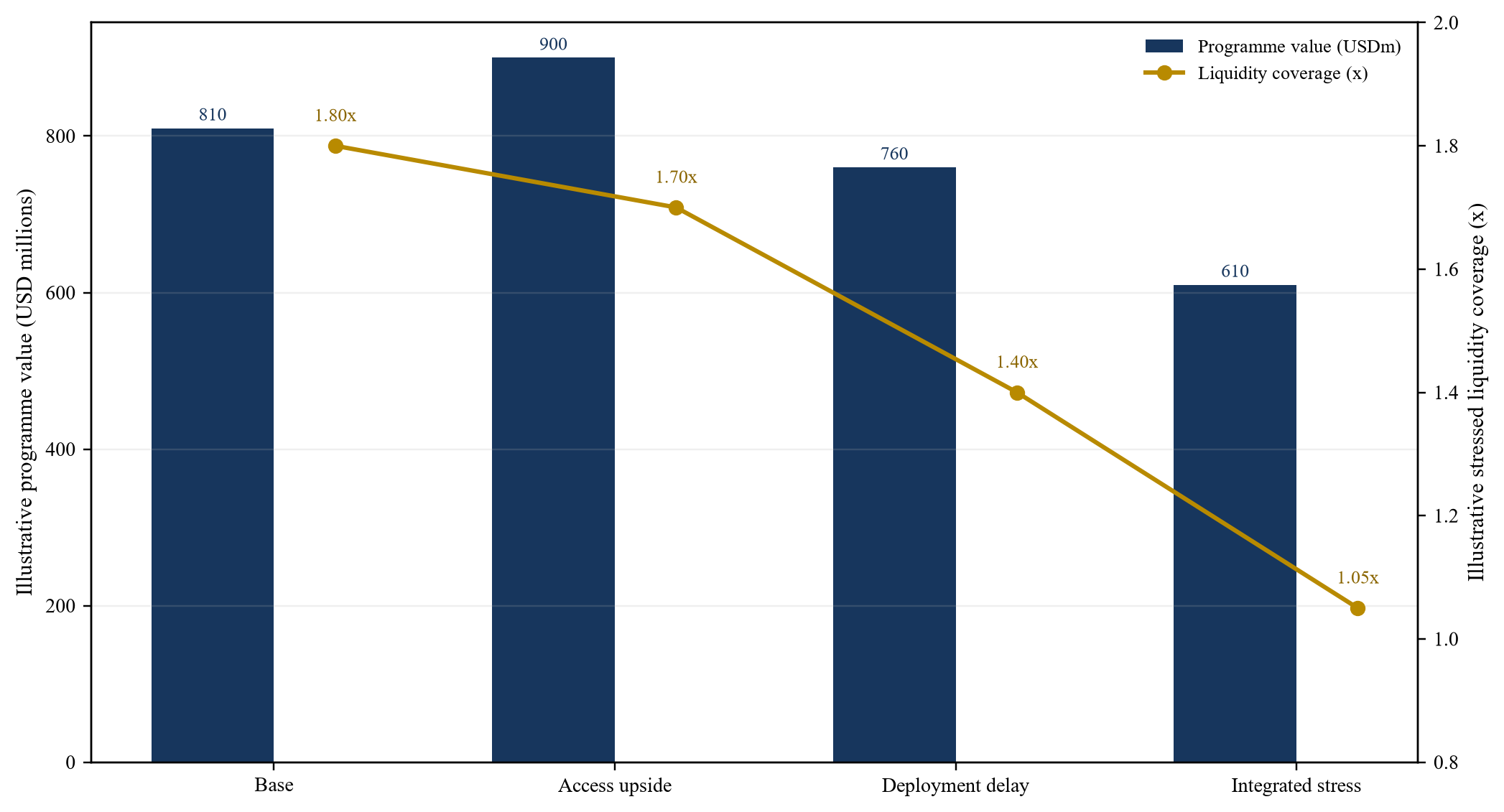
All values are illustrative management assumptions for a USD 750 million programme and do not forecast performance.
| Scenario | Deployment | Programme value | Liquidity coverage | Governance event | Management response |
|---|---|---|---|---|---|
| Base | As planned | USD 810m | 1.80x | None | Continue within limits |
| Access upside | Faster quality deployment | USD 900m | 1.70x | Higher co-investment flow | Preserve selectivity and limits |
| Deployment delay | 18-month delay | USD 760m | 1.40x | Pipeline conversion weakens | Reduce commitment pace |
| Integrated stress | Calls accelerate; exits slow | USD 610m | 1.05x | Key-person and refinancing event | Suspend approvals and execute remediation |
Amounts and outcomes are illustrative and require replacement with approved programme assumptions.
25. Score partner quality and structure separately
A scorecard can improve consistency when it preserves judgement and evidence. The asset owner should score partner quality, structure quality and investment fit in separate modules.
Partner quality can include governance, team, track record, sourcing, operating controls, regulation, reporting and knowledge transfer. Structure quality can include rights, alignment, conflicts, valuation, liquidity, tax, costs and exit. Investment fit can include expected return, downside, diversification and portfolio role.
Weights should follow the mandate. A direct co-investment programme requires more internal capability and transaction governance than a diversified fund allocation. A strategic infrastructure programme may place more weight on local operating capability and contracted cash flow.
Scores require evidence notes and confidence ratings. A high score based on limited evidence should not carry the same decision weight as a well-supported score. Certain failures should remain disqualifying regardless of the weighted total, including unresolved legal authority, weak custody, material integrity concerns or loss of decision independence.
The committee should review sensitivity to weights and scores. If a small change reverses the ranking, the decision requires more evidence or a smaller initial commitment.
26. Stage commitment through earned discretion
A staged programme allows the asset owner to learn while controlling exposure. The first phase can use a diversified fund or limited separate account. Co-investment discretion can expand after the partnership demonstrates reporting, allocation fairness, execution and governance quality.
Milestones should be measurable. Examples include delivery of agreed data, completion of joint diligence, satisfactory references, clean operational testing, compliance with concentration limits and successful handling of an adverse event.
Capital should be linked to evidence rather than calendar time alone. An annual increase can create pressure to deploy even when the pipeline is weak. The committee should retain the ability to hold, reduce or reallocate capital.
Earned discretion can also apply to decision authority. Early transactions can require full committee approval. Later transactions within a pre-approved mandate can be delegated after controls and staff capability have been demonstrated.
The staged approach requires clear communication with the partner. It should be presented as the planned institutional process rather than as an informal trial. Both sides can then resource the programme and measure progress against the same expectations.
27. Monitor the relationship and the assets on different cadences
Relationship monitoring should cover governance, team, conflicts, service quality, strategic alignment and knowledge transfer. Asset monitoring should cover performance, cash flow, valuation, leverage, operations, covenants and exit.
The relationship review can be annual with event-driven escalation. The asset review should follow risk and may be monthly or quarterly. Combining both into one meeting can cause asset problems to be obscured by relationship activity.
The asset owner should maintain a dashboard with exposure, commitments, concentration, liquidity, performance, fees, valuation changes, incidents, conflicts and outstanding actions. It should identify source systems and data owners.
Monitoring should test the original thesis. The committee should compare actual outcomes with entry assumptions and record why differences occurred. Repeated variance in the same direction can reveal optimism, weak data or changed market conditions.
The partnership should include periodic deep dives and post-investment reviews. Lessons should feed into underwriting, terms and portfolio construction. A monitoring process creates value when it changes decisions.
28. Use independent assurance selectively
External assurance can strengthen governance when it addresses a material information or control gap. It should be scoped to a specific question.
Potential assignments include legal opinions, tax advice, valuation, financial due diligence, technical review, environmental assessment, cyber testing, compliance review, administrator controls and agreed-upon procedures for fees.
The asset owner should assess adviser independence, expertise, liability, access and conflicts. A report commissioned by the sponsor can provide evidence, while the asset owner should understand scope, reliance and limitations.
Assurance should complement internal accountability. The governing body retains responsibility for the decision under OECD pension principles even when functions are delegated [1]. External advice should be challenged and connected to approval conditions.
The programme should maintain an assurance plan showing which risks require recurring work, event-driven work or internal review. This helps control cost and avoids commissioning broad reports that do not affect decisions.
29. Implement through a 180-day roadmap
Implementation should proceed in controlled workstreams. Days 0-30 define the portfolio mandate, governance, eligible routes and diligence plan. Days 31-60 shortlist jurisdictions, partners and structures. Days 61-100 complete partner, legal, tax, operational and investment diligence. Days 101-140 negotiate terms, build reporting and run operating tests. Days 141-180 approve, close and establish monitoring.
Each workstream should have an executive owner, decision owner, advisers, deliverables and acceptance criteria. Open issues should be logged with risk, action and deadline.
The governing body should approve the mandate and final commitment. An investment committee can approve individual opportunities within delegation. Risk, legal, compliance, tax and operations should provide independent challenge.
The roadmap should include a stop decision. If evidence remains incomplete, rights are inadequate or operating controls fail, the programme should pause. The sunk cost of diligence should not determine commitment.
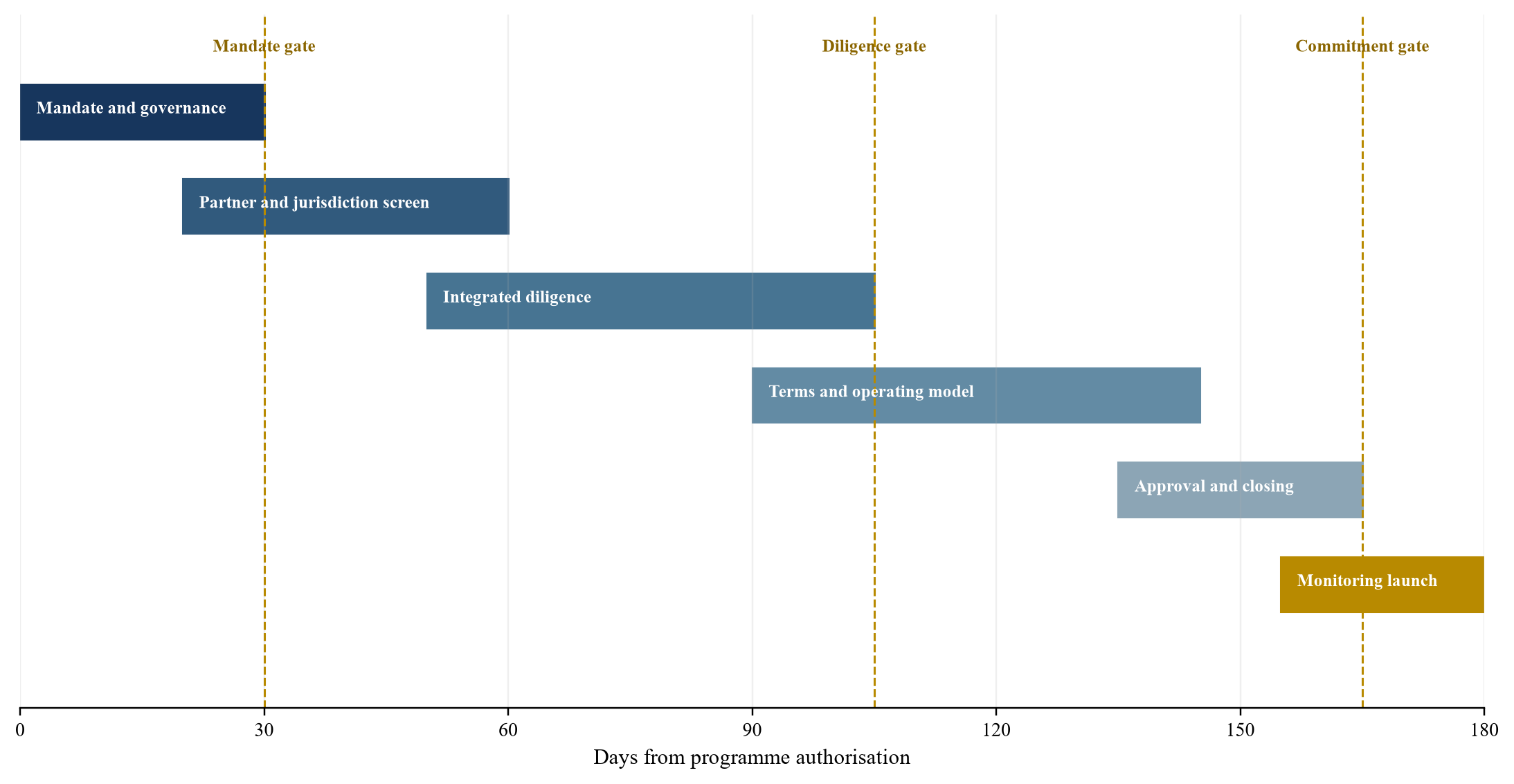
The sequencing is illustrative and should be adapted to the asset owner's governance calendar and transaction timetable.
30. Record the decision and preserve institutional memory
The final paper should state the portfolio purpose, selected partner, structure, commitment, conditions, evidence, risks, conflicts, scenario results, rights, costs, monitoring and exit plan. It should also record declined alternatives.
The decision record should distinguish observed evidence, legal advice, management assumptions and committee judgement. This distinction helps future reviewers understand why the decision was reasonable at the time.
Institutional memory should include data-room indexes, models, minutes, approvals, material correspondence, contracts, valuation papers, monitoring reports and lessons learned. Records should be retained under the asset owner's policy and remain accessible after staff or partner changes.
Annual review should compare outcomes with the original thesis. The committee should identify which assumptions held, which changed and which controls operated as intended. It should decide whether to continue, expand, modify or terminate the programme.
A strong GCC partnership is therefore a governed investment system. Local access, co-investment and knowledge transfer can add value when decision independence, evidence and portfolio discipline remain visible throughout the programme.
| Decision question | Required evidence | Decision owner |
|---|---|---|
| Does the programme serve a defined portfolio role? | Mandate, allocation analysis and scenario model | Governing body |
| Is the partner institutionally acceptable? | Partner diligence, governance and control review | Governing body or delegated committee |
| Is the structure proportionate and enforceable? | Legal, regulatory, tax and operating analysis | Investment committee with independent advice |
| Are allocation and conflicts governable? | Written policies, register and consent rights | Investment committee |
| Can liquidity absorb calls and stress? | Pacing model and liquidity coverage | Investment and risk committees |
| Are monitoring and exit operational? | Data standard, dashboard, rights and termination plan | Investment committee |
The checklist supports a documented decision and does not replace legal, tax or investment advice.
Sources
- OECD, “Core Principles of Private Pension Regulation.” Read the primary source
- The Pensions Regulator, “Private markets investment,” 24 January 2024. Read the primary source
- International Forum of Sovereign Wealth Funds, “Santiago Principles.” Read the primary source
- Institutional Limited Partners Association, “ILPA Principles 3.0,” 2019. Read the primary source
- Dubai Financial Services Authority, “Collective Investment Funds.” Read the primary source
- Abu Dhabi Global Market FSRA, “FSRA showcases enhancements to its Funds Regulatory Framework at ADFW,” 9 December 2025. Read the primary source
- Public Investment Fund, “Annual Report 2024.” Read the primary source
- Mubadala Investment Company, “How We Invest,” Annual Review 2024. Read the primary source
- Mubadala Investment Company, “Responsible Investing,” Annual Review 2024. Read the primary source
- Principles for Responsible Investment, “A limited partner's guide to responsible investment in private equity.” Read the primary source
- IOSCO, “Thematic Analysis: Emerging Risks in Private Finance,” September 2023. Read the primary source
- OECD, “G20/OECD Principles of Corporate Governance 2023: Institutional investors, stock markets, and other intermediaries.” Read the primary source
- CalPERS, “CalPERS Will Increase Private Markets Investments,” 19 March 2024. Read the primary source
- CalPERS, “Private Equity Annual Program Review as of 31 March 2024.” Read the primary source
- Institutional Limited Partners Association, “ILPA Model Limited Partnership Agreement,” October 2019. Read the primary source
- Dubai Financial Services Authority, “Q&A: The DFSA Collective Investment Fund regime.” Read the primary source
- Principles for Responsible Investment, “About stewardship.” Read the primary source
- International Forum of Sovereign Wealth Funds, “2022 IFSWF Member Self-Assessment Review.” Read the primary source
- Mubadala Investment Company, “AlpInvest and Mubadala Establish New Portfolio Senior Fund Financing Partnership,” 11 December 2024. Read the primary source
