

1 The financing decision created by a deadline
The decision begins with the date on which the company needs the proposed work financed. A grant application sits within a sequence that can include an initial suitability check, a formal submission, competitive assessment, an interview, an agreement and a payment process. Management needs to identify which event supports a commitment and which event supplies usable cash. A calendar entry containing the application closing date leaves those later dependencies unresolved. The proposed framework links the submission timetable to the business milestone, the expenditure required before that milestone and the financing available while the outcome remains uncertain.
The phrase lost option has a specific meaning in this paper. It concerns the ability to enter a particular funding process at a particular time under the applicable conditions. Missing an intermediate evaluation batch may delay consideration. Missing the last permitted submission under an invitation may have a different consequence. A company can also retain permission to apply while losing the commercial ability to wait for the outcome. The relevant unit of analysis is therefore the combination of legal applicant, programme, stage, funding cycle and cash timetable. Neither a nominal grant amount nor an incomplete application establishes an economic loss.
The practical audience includes founders preparing an initial application, finance teams comparing grants with other capital, corporate innovation teams coordinating partners and investors reviewing a portfolio company's runway. The organisation making the application must satisfy the actual eligibility requirements. An international founder's location does not establish an entity's right to enter a domestic programme. Timing analysis follows that eligibility check and remains conditional on continuing eligibility throughout the stages to which the rules apply. This paper concentrates on execution and financing rather than providing country-specific legal advice.
The central recommendation is to approve an application only with a current rule record, a feasible dependency schedule and an explicit funding alternative. These are proposed management controls. Their value must be tested against the organisation's actual work and funding outcomes. The analysis demonstrates their arithmetic and decision implications using constructed cases; it does not establish that companies adopting them win more grants. Its immediate deliverable is a reviewable decision about the next feasible submission and the resources committed before the business learns whether funding will be available.
| Decision | Required evidence | Planning consequence |
|---|---|---|
| Enter the programme | Current eligibility and entry-stage rules | Authorise preparation only for a permitted route |
| Target a funding cycle | Published closing rule and stage permission | Choose an achievable submission event |
| Approve the application | Completed content and authorised budget | Establish who can commit the organisation |
| Commit project expenditure | Applicable award and start conditions | Separate application work from funded work |
| Rely on grant cash | Agreement and payment conditions | Retain financing for an uncertain receipt |
Proposed decision structure. Actual programme documents determine the applicable sequence.
2 Research method and evidence boundaries
The documentary review selects official submission and funding-administration guidance that exposes different timing mechanisms. The United Kingdom sources distinguish the UKRI Funding Service from Innovate UK's Innovation Funding Service. The European sources distinguish annual EIC work programmes, amendments and frequently asked questions. The United States sources distinguish an NSF solicitation, general NSF proposal policy and Grants.gov procedures. These are purposeful examples of different systems. They do not constitute a census of innovation funding, and a provision appearing in one system supplies no evidence that another funder follows it.
Each factual rule used in the analysis needs a programme identity, a document or page identity, the relevant application stage and an access date. Where an annual programme and an updated live page differ, the case must retain the applicable version rather than combining attractive provisions from both. A date that has passed remains useful as a documentary example if its historical status is explicit. It must not appear as an upcoming deadline. Current applicants should verify the actual call record and any invitation immediately before relying on the comparison.
The numerical analysis has two separate components. The scheduling model enumerates a fixed network over seven sets of assumed task durations. The liquidity model varies expenditure and the interval from the selected model cut-off to a conditional receipt. Every duration, cash balance, reserve and acceleration intervention is a constructed input. The official programme examples supply context for why dependencies and timing rules matter; they do not calibrate those inputs. A model business day excludes holiday and civil-time complications by construction. It is kept separate from the exact calendar dates discussed in the documentary cases.
No applicant-level records were obtained for this study. Consequently the paper cannot estimate the number of companies that miss deadlines, the proportion rejected for timing reasons, the probability of an award or the value of funding that an earlier submission would have secured. Those questions require linked, permissioned data and a defensible counterfactual. The proposed empirical protocol explains how such a study could be designed. Until then, the contribution is a source-grounded management synthesis and a reproducible sensitivity analysis with an inspectable boundary between programme facts and hypothetical company decisions.
| Evidence class | Permitted conclusion | Conclusion outside scope |
|---|---|---|
| Official deadline rule | The stated condition for that programme and version | A universal rule across funders |
| Saved submission receipt | The system recorded the stated submission event | Eligibility or funding approval |
| Constructed task network | Completion under the specified dependencies | Observed applicant performance |
| Conditional cash sensitivity | Cash required under the stated dates and burn | Expected grant income |
| Company outcome study | Only what its design and data support | Causality from a simple before-and-after count |
Methodological boundaries apply throughout the paper, including the abstract, figures and worked cases.
3 Define the event that actually closes
A deadline register should distinguish a hard closing time from an evaluation batching date. It should also identify whether the event concerns an expression of interest, a short application, a full proposal, an interview or an agreement. These distinctions affect what a late action means. An application accepted continuously can still wait for the next evaluation cycle. A fixed competition may close entirely. An invitation can expire even when a related programme continues to operate. The responsible manager should record the actual event and its consequence before deciding that another available date is an equivalent replacement.
NSF's general proposal policy explicitly distinguishes target dates, deadline dates and submission windows. A target date can affect the panel or meeting reached by a proposal. A submission window's closing date is subject to deadline policy. The guide also describes specific exceptions and the usual local-time requirement. These distinctions support a precise classification rather than an assumption that every date is either optional or absolute. The governing solicitation and any applicable supplements remain part of the record. A company should use the rule for its selected funding opportunity. [9]
A proposed internal taxonomy has five fields: event type, affected stage, required completed action, consequence of missing the event and available next route. The completed action could be the funder's receipt of a submitted application, an invitation-based full proposal or an accepted project agreement. A marketing email saying that a programme is open does not establish all five fields. When the source is incomplete, the entry should remain unresolved and a named person should obtain clarification through the funder's stated channel. An unresolved entry cannot support an unconditional funding date in the cash forecast.
The title's warning therefore needs a local interpretation. A missed event can remove the current cycle from the financing plan without permanently removing the company's ability to apply. A rollover provision can preserve a later assessment opportunity while changing the period the business must finance. A lost invitation can require an additional entry stage before another full application becomes possible. The manager's task is to identify which of these consequences is evidenced and then revise the operational and financial plan accordingly. Treating every consequence as permanent forfeiture would overstate the evidence.
| Event | Question to verify | Possible consequence to test |
|---|---|---|
| Fixed competition close | What must the system receive by the cut-off? | Current competition unavailable |
| Evaluation batch | Does a late proposal roll into another batch? | Later assessment rather than automatic rejection |
| Invitation expiry | Which stages and submissions does the invitation permit? | New entry step or lost permission |
| Target date | Can submission continue after this date? | Different panel or assessment timing |
| Project setup deadline | What conditions must be completed after selection? | Offer at risk before the project starts |
Consequences are questions for programme-specific verification; this taxonomy grants no exception or entitlement.
4 Preserve the governing programme version
A useful deadline record preserves the rule that a decision-maker actually relied on. The minimum record contains the funder's name, programme and call identifier, application stage, document title, version or publication date, source URL, access time and the responsible reviewer. It also retains the relevant invitation or amendment. The current deadline is then linked to that record. A later edit creates a new observation and identifies which planned submissions it affects. This approach makes a date change visible as a decision requiring review rather than silently replacing an earlier calendar entry.
The EIC's annual programme structure makes version discipline particularly important. A company can hold an entry-stage outcome from one year while considering a full application in another year under the published transition conditions. Its next feasible batch must be checked against the applicable work programme and current official instructions. The corrected 2027 material and the live FAQ are documentary inputs for a 2027 case; they should not be relabelled as the 2026 calendar. An annual page retained by a search engine also needs a current-source check before its dates enter the operating plan. [5,6,7]
The proposed change process asks four practical questions. Did the closing instant change? Did the required submission package or stage change? Did the applicant's permission or eligibility period change? Did the later evaluation or project-start sequence change? A change in any field can require a new approval even when the application title and technical narrative stay the same. The source document should be attached to the change record, and the owner should identify the affected budget, partner commitments and financing milestones. The proposed process is an internal control rather than a description of every funder's administration.
A company should preserve superseded records as history. They explain why preparation started, why a partner was asked for a document and why a financing assumption changed. The current approved record should be readily identifiable so that history does not become competing instructions. Access controls matter where the file contains personal information, partner pricing or unpublished technology. A public deadline-monitoring system needs only the programme metadata and the company's authorised status fields; it does not need to expose the application itself. Source monitoring and application drafting can therefore use different permissions.
| Field group | Required content | Review trigger |
|---|---|---|
| Programme identity | Funder call year and stage | New call or successor programme |
| Timing rule | Local date time zone and closing action | Deadline or batch amendment |
| Permission | Invitation and submission limits | Invitation expiry or outcome |
| Source provenance | URL document version access time | New official publication |
| Execution | Owners dependencies receipt and decision | Changed task or authority |
| Financing | Conditional receipt range and alternative funds | Changed cycle or project start |
Proposed register; retain programme-specific fields where the generic structure is insufficient.
5 Use the correct clock and calendar
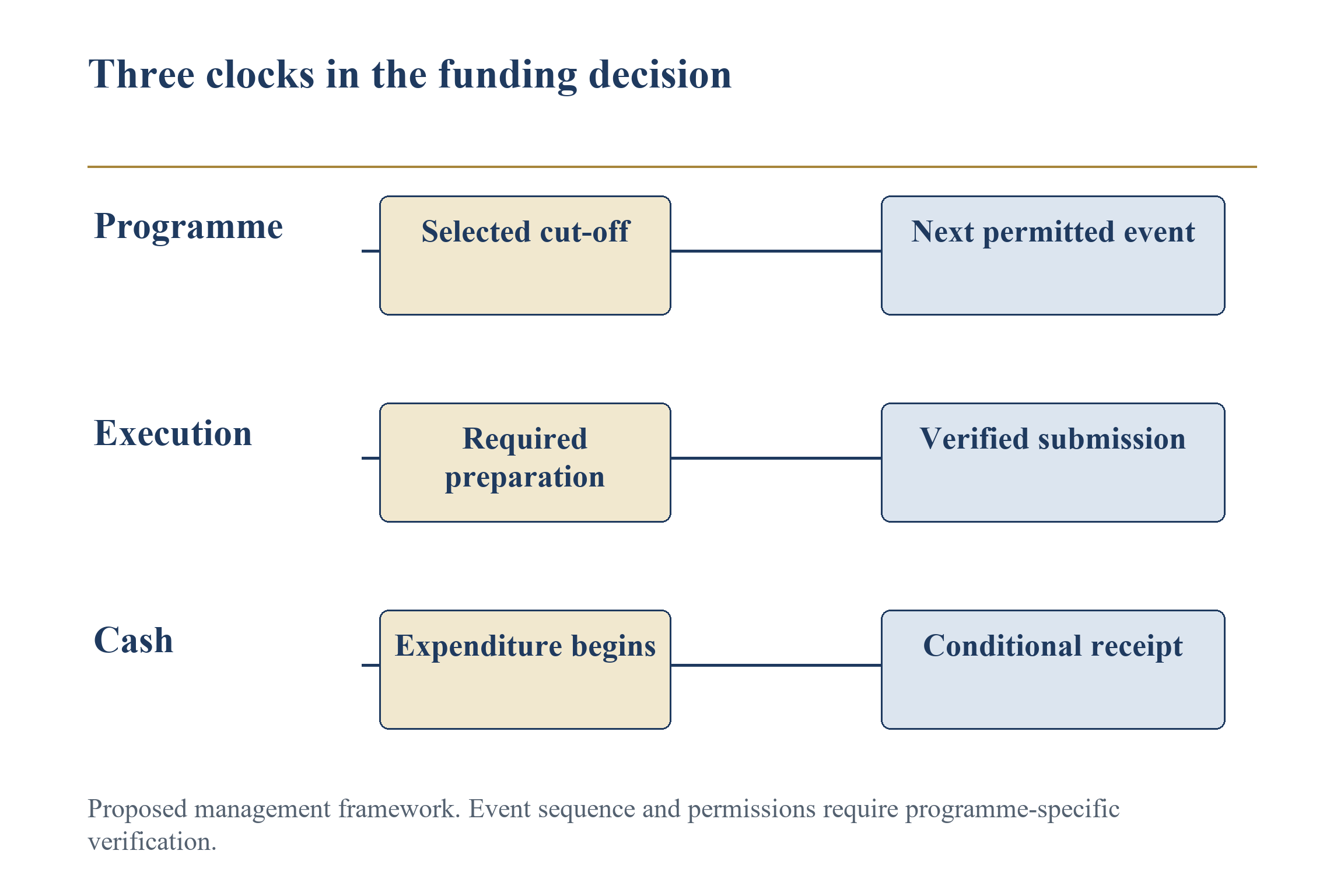
The closing instant should be stored in the funder's stated local time and converted into the operating team's time zone for execution. A calendar entry containing only a date can hide the difference between an 11 am close, a 4 pm close and a local 5 pm submission rule. The location used to interpret local time also matters. An internationally distributed team should not substitute the founder's current travel location for the submitting organisation's location when the rule names the latter. The original wording remains the authority for the conversion. [2,8,9,18]
Civil-time rules can change and some locations observe seasonal transitions. IANA's time-zone documentation explains why location-based identifiers represent rules rather than a single permanent UTC offset. A proposed operating record should therefore preserve both the stated local rule and the converted instant, together with the time-zone identifier and conversion date. An abbreviation alone can be ambiguous. This recommendation concerns the reliability of a business record; the paper does not establish a new interpretation of any funder's deadline wording. Questions about ambiguous published times should be resolved with the source organisation. [14]
Working backwards requires a separate working calendar for each task owner. A finance review measured in three working days can cross a holiday, while a portal remains open on a calendar-day basis. A partner in another jurisdiction may observe a different weekend or public holiday. The proposed schedule assigns a calendar to the activity and names the handoff that completes it. A duration supplied as days should be clarified before it enters a dependency calculation. The model later in the paper deliberately uses simplified business-day indices so that the arithmetic is reproducible.
The internal submission target should precede the published closing instant by an explicitly chosen interval. That interval is a management assumption based on validation, authority and correction needs. It must not be presented as an official grace period or as a universal optimal buffer. A later system error does not automatically extend the external deadline. The plan should identify when the team stops making discretionary edits, who can authorise a necessary correction and how the final submitted package is preserved. These decisions are most useful when agreed before the final working day.
Scroll horizontally to read the figure at full size. You can also open the full-size figure.
Proposed management framework. Official civil-time deadlines and simplified model business days are separate representations.
6 Registration and authority are schedule dependencies
A technically complete application can remain unsubmitted because the legal entity, account or authorised representative is not ready. Registration should therefore appear as a task with a named owner, required evidence and an earliest verified completion date. The owner should establish whether the organisation already has the required identifier, whether the registration remains active and whether the person expected to submit holds the relevant authority. Password access alone is insufficient evidence of organisational permission. The proposed control tests the actual role in the relevant system before the final approval window.
The NSF full-proposal page describes registration steps and cautions that the process should begin early. General NSF policy requires a valid active SAM registration and UEI before submission can proceed. The NSF programme's own channel and stage requirements govern the application; the existence of a Grants.gov profile does not establish readiness for a Research.gov submission. An applicant should verify the current instruction set, registration status and role assignment together. Published processing estimates are planning information rather than a promise that a new or corrected record will be ready on a particular date. [9,10]
Grants.gov separately describes organisation registration, the electronic business point of contact and applicant roles. Its registration guidance allows for longer processing where information cannot be verified. That process is useful as a second example of a prerequisite extending beyond writing the proposal. A business planning a Grants.gov application should retain evidence of the actual organisation profile and submission role, then apply the specific awarding agency's requirements. This comparison does not suggest switching channels when a prescribed system is unavailable or a deadline has passed. [11]
A proposed readiness test records the legal applicant, the relevant identifier, the active status, the authorised submitter and an alternate where the rules permit one. It also records what remains dependent on an external administrator. The task should close only when the required evidence is available. A pending registration is a live dependency with an uncertain completion date. Management can then decide whether the targeted funding cycle remains feasible, whether a later cycle is available and what preparation expenditure remains justified while the registration outcome is unresolved.
| Check | Evidence | Owner question |
|---|---|---|
| Correct applicant | Entity identity and relevant identifier | Does the record name the organisation that will apply? |
| Active registration | System status and expiry | Will it remain valid at the required event? |
| Submission role | Actual role assignment | Can this person submit for this entity? |
| External validation | Outstanding request and response | Who controls completion and what is unresolved? |
| Continuity | Permitted alternate and access | What happens if the primary submitter is unavailable? |
Proposed checks. Programme-specific rules determine what account and authority evidence is required.
7 Stage permissions and invitation expiry
An early-stage approval should be treated as a permission with conditions. Its existence does not establish that a full proposal can be submitted indefinitely or to every later call. The applicant should record the issuing programme, the decision date, the permitted next stage, the applicable submission limits and any expiry or transition rule. The relevant official instruction should be stored with the actual invitation. Where permission depends on the legal entity or project remaining materially the same, a change in ownership, scope or consortium can require additional review before the timetable is accepted.
NSF's current Project Pitch information describes an initial suitability process and an invitation to a full proposal. It also states limits on Project Pitches and conditions concerning previously declined proposals and new or revised pitches. Those instructions create timing dependencies that a full-proposal deadline alone cannot describe. A company should establish the status of its own pitch and invitation before assuming that the next advertised full-proposal deadline is available to it. The printed programme calendar and the applicant's individual permission are distinct inputs. [15]
The EIC material similarly requires attention to entry-stage outcomes, programme-year transitions and limits on submissions. Its FAQ describes treatment of proposals after a cut-off and identifies a boundary at the last cut-off of the year. A financial plan should therefore distinguish preservation of a later evaluation opportunity from the loss of the targeted cycle. The organisation should not rely on a generic statement that applications can be prepared at any time when its full proposal depends on an earlier permission or an applicable annual call. [6,7]
The proposed permission register attaches a latest usable submission event to each live invitation only when the source supports it. If the permission's interpretation is unresolved, the schedule carries that uncertainty and identifies who will obtain an answer. Preparation can continue selectively where reusable work has value, but the board should understand which expenditure depends on the unresolved permission. This makes it possible to limit further commitment without discarding already useful technical evidence or forcing a rushed application into a route that has not been established as available.
| Record | Question | Consequence of an unresolved answer |
|---|---|---|
| Issuing decision | Which programme stage and applicant received it? | Permission cannot be assumed for another entity |
| Validity condition | Which dates or cycles remain available? | The next advertised deadline may be unavailable |
| Submission history | Which counted attempts have been used? | Remaining opportunities require verification |
| Project continuity | Has the proposal materially changed? | Check whether new entry review is needed |
| Transition provision | Which annual rules apply? | Do not combine incompatible programme years |
Proposed management structure; retain each programme's exact terminology and actual decision letter.
8 Build the application dependency network
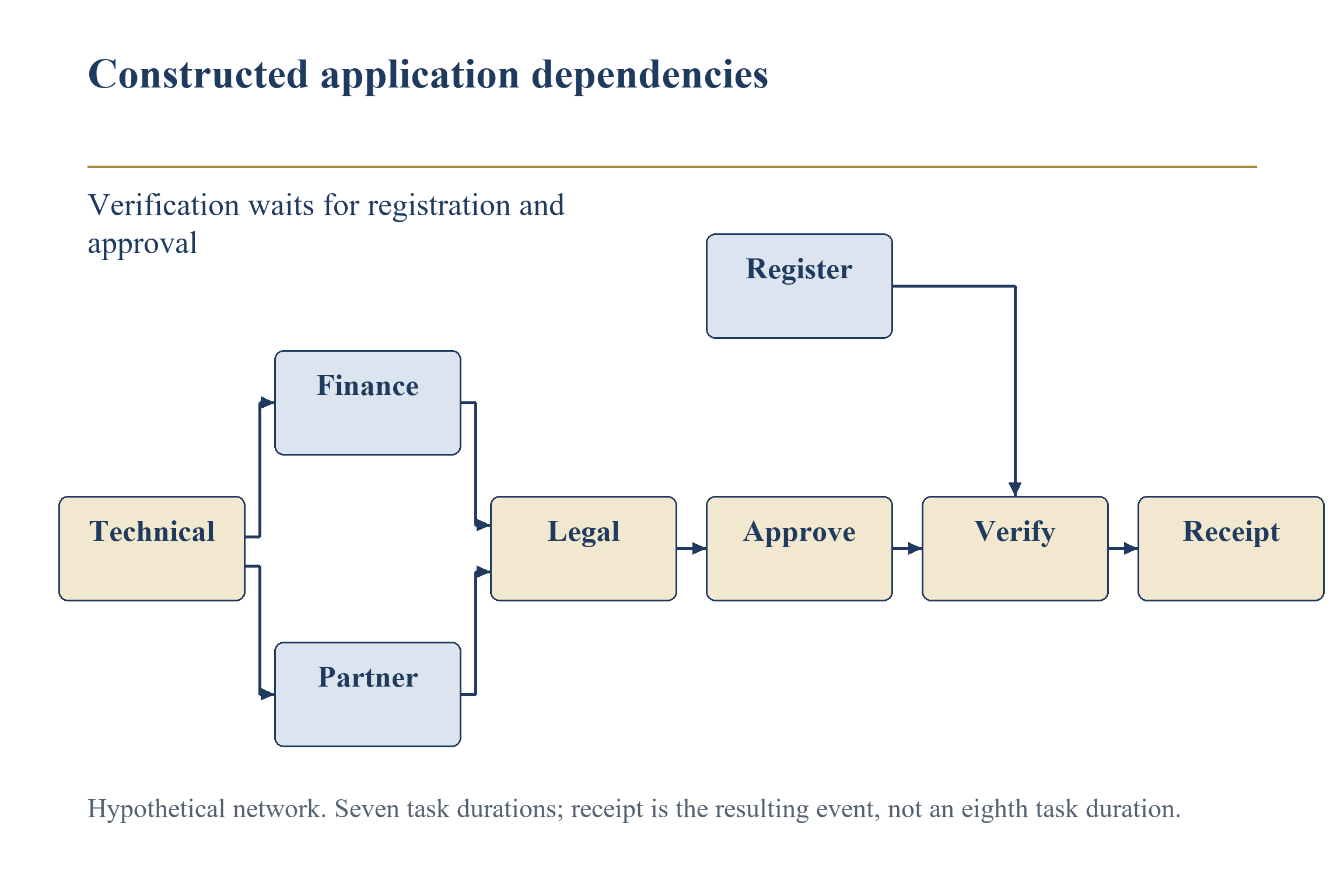
The schedule should describe completed handoffs rather than a list of people working on the proposal. A technical package can release both a finance review and a partner request. Legal review can depend on both returning. An executive approval can depend on the final legal and financial position. Portal verification can depend on registration and the approved package. These dependencies determine the earliest feasible submission even when some activities run in parallel. A task owner should state what evidence completes the activity and which downstream activity is allowed to begin.
Dependency-based scheduling is an established operations-research approach. Kelley's mathematical treatment of the critical-path method describes a model incorporating sequence, durations and costs. This paper applies that broad scheduling principle to a funding-application decision and links the result to pre-receipt cash needs. It claims no invention of the critical-path method and does not reproduce an inaccessible full-text derivation. The specific seven-task network used here is a constructed teaching model. A company's actual network may include scientific experiments, procurement, ethics, export controls or other activities absent from it. [13]
The proposed model has registration running independently from technical preparation. Finance review and partner preparation begin after the technical package. Legal review waits for both; executive approval follows legal review. Final submission verification waits for executive approval and registration. Each duration is expressed in model business days. In a real application, the owner should replace this topology with the actual required sequence and document whether a task can overlap or requires an approved predecessor. An assumption that two activities run in parallel should be supported by the people who perform them.
The longest remaining path can change as work finishes or a source amendment arrives. Completing a draft faster has little scheduling value if an outstanding registration still controls the submission date. Bringing a partner letter forward has value only where that letter constrains a downstream handoff. The proposed review therefore asks which unfinished dependency currently determines the earliest complete submission. It also records the work and financial cost of changing that dependency. This focuses management attention on an identifiable activity while leaving the quality and legality of the application as separate requirements.
Scroll horizontally to read the figure at full size. You can also open the full-size figure.
Hypothetical network. Task duration assumptions are specified in the model table; the network is not an official funder process.
| Task | Predecessor | Model business day values |
|---|---|---|
| Registration | None | 2, 10, 20 |
| Technical package | None | 8, 15, 22 |
| Finance review | Technical package | 2, 5, 8 |
| Partner preparation | Technical package | 3, 7, 12 |
| Legal review | Finance and partner | 1, 3, 6 |
| Executive approval | Legal review | 1, 2, 4 |
| Submission verification | Registration and approval | 1, 2, 3 |
All values are hypothetical inputs. They are not estimates of official processing times or applicant behaviour.
9 Calculate a feasible submission date
The earliest model completion date follows directly from the dependency network. Technical completion occurs after its assumed duration. Finance and partner work each add their duration to that technical completion date. Legal review starts when the slower of those two activities finishes. Executive approval follows legal completion. Verification starts when both executive approval and registration have finished, then adds its own duration. This recurrence preserves the order of required work. Adding every duration in a single column would incorrectly treat the two parallel activities as sequential.
For the seven-task network, completion can be written in words as the later of registration completion and the combined technical, slower finance-or-partner, legal and approval path, plus verification time. The experiment enumerates all three duration choices for each of seven tasks, giving 3 to the power 7, or 2,187 combinations. The first synthetic cut-off is model day 30 and the next is day 60. Every combination receives equal enumeration weight solely to describe the design space. No claim is made that the duration choices are equally likely in an operating company.
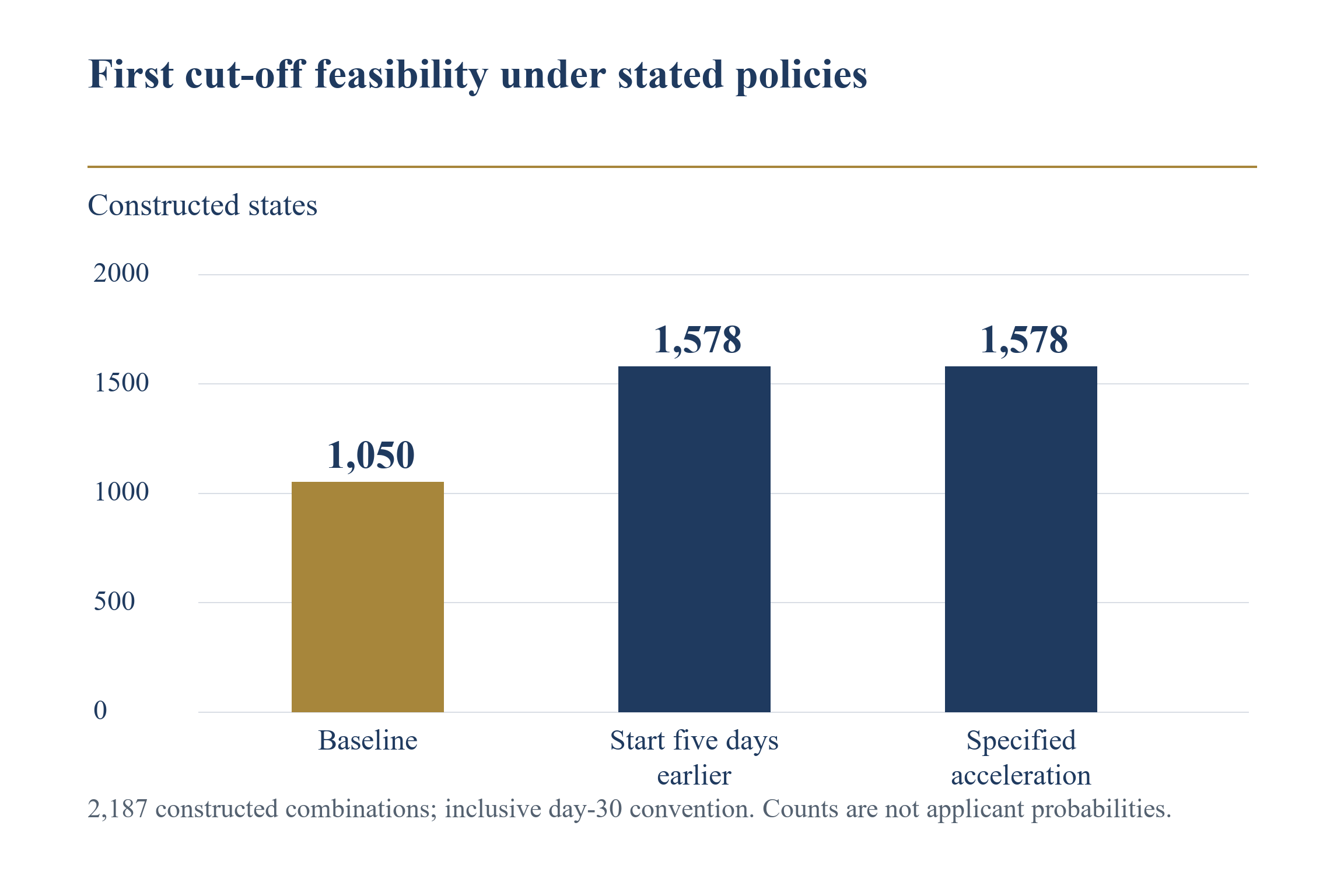
The baseline completion dates range from model day 14 to day 47. Of the constructed combinations, 1,050 finish by day 30 and 1,137 finish later. All 2,187 finish by day 60 under the stated assumptions. These are arithmetic results for this finite network. They establish neither the actual proportion of late applicants nor the chance of receiving an award. Eligibility, technical quality, competition and funder capacity are outside the scheduling experiment. A company can satisfy the model's timing condition and still fail a real programme's other requirements.
The experiment counts completion exactly on model day 30 as feasible. This inclusive comparison is a stated modelling convention and is not a claim about a portal accepting an action at its final timestamp. There are 102 baseline states and 111 states under each intervention that finish exactly on day 30. A strict-before diagnostic would therefore give 948 baseline and 1,467 intervention states. An actual application should target an earlier verified submission and use the funder's rule and system evidence for the closing instant.
The practical use of the calculation is to expose which input makes the targeted event infeasible. Where a task duration is unknown, a range or explicitly unresolved input is more informative than an optimistic point estimate. The company can inspect the schedule under different assumptions and decide when further expenditure needs approval. A director should be able to see the task, owner, evidence and calendar behind the proposed date. A completed scheduling spreadsheet does not itself prove that the work has been completed or that a funder will accept the application.
| Measure | Result | Interpretation |
|---|---|---|
| Duration combinations | 2,187 | Unweighted design states |
| Ready by first model cut-off | 1,050 | Completion at or before day 30 |
| Ready after first model cut-off | 1,137 | Completion after day 30 |
| Ready by second model cut-off | 2,187 | Completion at or before day 60 |
| Completion range | Day 14 to day 47 | Range within the specified network |
Constructed results. No applicant frequencies, award probabilities or actual funding losses are estimated.
10 Compare earlier preparation with faster execution
The first intervention begins the entire model preparation process five business days earlier. Every completion date then moves five model days earlier because the task network and durations remain unchanged. The second intervention changes three assumed activities: technical preparation is shortened by three days, and finance and partner work are each shortened by two days subject to a one-day minimum. Registration, legal review, executive approval and verification remain unchanged. These are explicit hypothetical interventions. The analysis assumes neither that actual teams can deliver these reductions nor that doing so has no financial or quality cost.
Both interventions make 1,578 constructed combinations feasible at the first cut-off, an increase of 528 from the baseline. Each leaves 609 combinations later than day 30. Equal cut-off counts do not establish equivalent operating performance. The per-state completion dates differ in 213 combinations because the acceleration policy leaves registration unchanged while the earlier start moves it forward. In other combinations the same critical path determines the cut-off result. The comparison illustrates why a headline count should be accompanied by the underlying dependency calculation and the resources assumed to produce it.
A real acceleration decision needs a priced and feasible task change. Adding a reviewer can create a useful parallel activity or can increase coordination time; the model assumes neither outcome. Compressing a technical evidence task may remove the work needed to support the proposal. Legal and financial approvals cannot be considered complete simply because the internal target has arrived. Management should authorise a specific change, identify its owner and record whether the evidence standard remains satisfied. Any additional fee or staff time belongs in the financing comparison.
The two interventions rescue the same set of 528 states at the first model cut-off. Their 213 differences concern completion dates elsewhere in the grid, rather than different sets of newly feasible applications. This detail limits the comparison: the experiment shows two specified ways to alter this network's cut-off count, and it cannot rank their cost or quality without additional assumptions and evidence.
Earlier preparation can also carry a cost. An organisation may spend on a competition that later changes or may commit scarce technical staff before the opportunity is sufficiently defined. The decision should therefore distinguish reusable preparation from call-specific work. Entity registration, an evidence inventory and an initial financing assessment can have uses beyond one submission; a tightly specified annex may have less transfer value. Those are proposed classifications requiring company-level judgement. The experiment supplies a way to test schedule consequences, leaving the commercial value and cost of the actual work to an evidenced decision.
Scroll horizontally to read the figure at full size. You can also open the full-size figure.
Counts are constructed states, not probabilities. Equal cut-off counts conceal 213 different per-state completion dates between the two interventions.
11 Treat submission reserves as decision thresholds
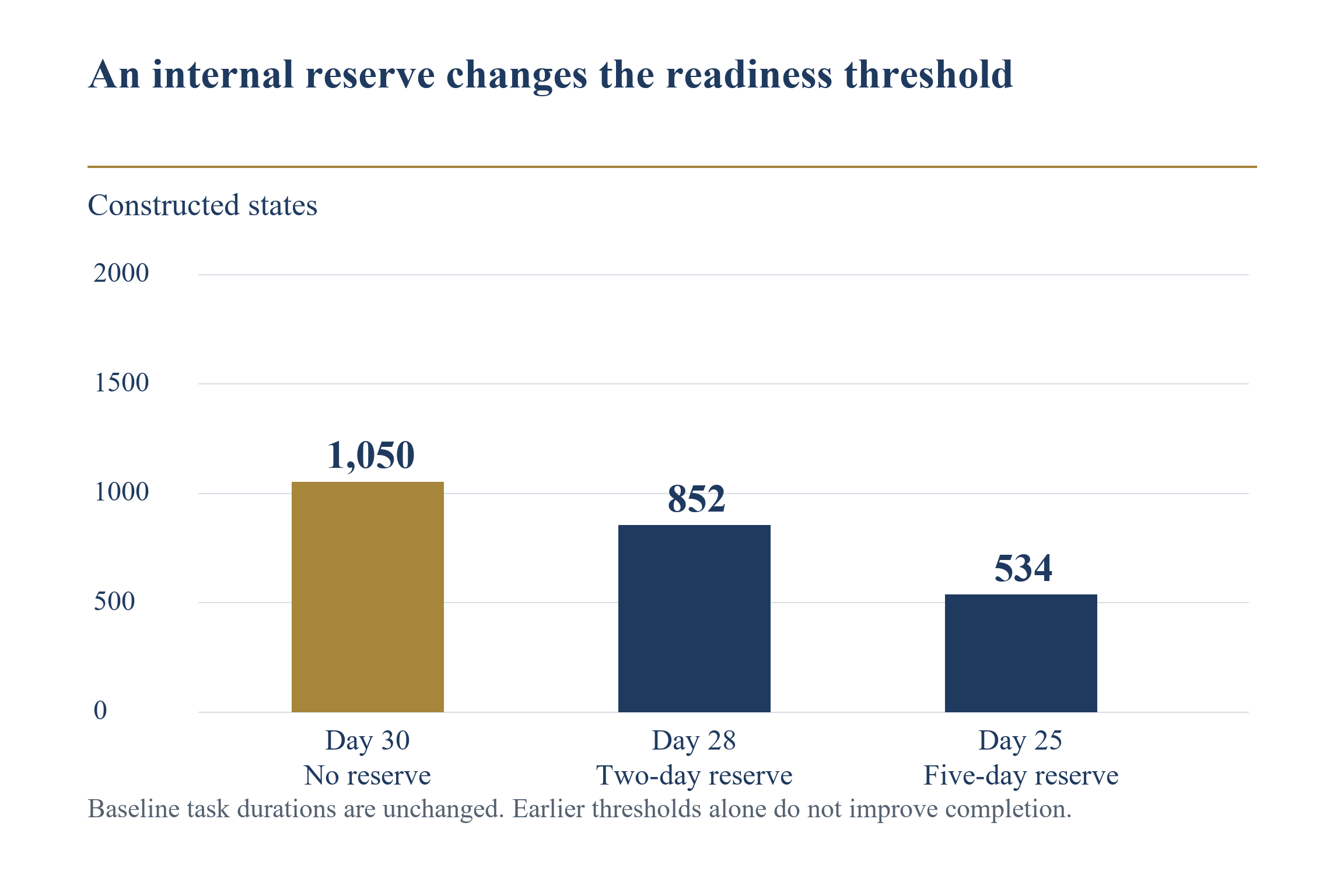
A reserve before the external close creates an earlier internal decision point. It does not shorten any task in the model. With no reserve, the baseline classifies 1,050 combinations as ready for the day 30 cut-off. A two-day reserve requires readiness by day 28 and admits 852 combinations. A five-day reserve requires readiness by day 25 and admits 534. This reduction is the direct consequence of the stricter internal threshold. It must not be described as proof that adding a reserve improves completion or reduces late submissions.
The operational value of an internal threshold depends on the action it triggers. A team can begin earlier, change a feasible task, defer to an available later event or stop additional expenditure. Each action changes a different part of the decision. A reserve that is repeatedly waived without review may supply little information to the board. A reserve that triggers an unnecessary cancellation can also impose a cost. The appropriate interval should reflect the system, approval sequence, evidence uncertainty and available correction process of the actual application.
The proposed control separates three dates. The content-completion target closes discretionary drafting. The authorised-submission target leaves time for the required system checks. The external close remains the funder's rule. The record should explain how the intervals were chosen and who may approve a change. A material correction discovered after the content target should be assessed against both accuracy and remaining time. The organisation should preserve the reason for submitting, deferring or withdrawing rather than treating a calendar reminder as sufficient governance.
A reserve can be evaluated empirically using timestamped task and submission records. The relevant outcome is the actual system-recognised event and the quality of the package submitted, together with the resources used to achieve it. Comparing teams with and without reserves requires attention to application difficulty, prior experience and selection into the policy. An organisation should first measure these variables before attributing an observed improvement to a buffer. The current constructed analysis demonstrates threshold arithmetic and identifies questions for such a study; it provides no causal estimate of behavioural change.
Scroll horizontally to read the figure at full size. You can also open the full-size figure.
Hypothetical threshold comparison. A reserve requires a specified management action to change the actual schedule.
12 Internal approvals need an evidence based handoff
An approval task should specify the decision that the reviewer is being asked to make. Finance may approve eligible expenditure, matching funds and the cash available before reimbursement. Legal may review partner obligations, intellectual property and required declarations. The executive signatory may approve the final commitment on behalf of the applicant. These are illustrative management responsibilities; the organisation's actual governance and the programme's certifications determine the required roles. Combining them into an unlabelled final sign-off can hide the information that each reviewer needs.
The proposed handoff contains the final material to be approved, the outstanding uncertainties, the source requirements that affect the decision and the date by which the answer is needed. It distinguishes approval of the budget from confirmation that funds have been committed. It also distinguishes agreement with the application narrative from authority to submit organisational certifications. The reviewer should have a version-controlled package so that a later edit does not silently invalidate an earlier approval. Where the approved package changes materially, the schedule should include the actual reapproval work.
UKRI's generic Funding Service guidance encourages review for completeness and accuracy before submission and states its post-submit amendment policy. Innovate UK's separate service guidance has its own application process. The company should therefore verify the mechanism used for the actual opportunity before assuming that a submitted draft can be reopened, corrected or replaced. An internal approval process should be designed around the applicable system's behaviour. It should not depend on a correction route that has not been established as available. [1,3]
Approval delays also have information value. An unresolved source of matching finance, an unagreed partner obligation or an unsupported declaration can be a substantive reason to defer the application. Compressing the approval task without resolving that issue would change the meaning of completion. The proposed escalation asks the decision-maker to identify the unresolved commitment and the consequence of proceeding. The board can then authorise a specific, evidenced position or select a later route. This keeps the schedule attached to the company's obligations rather than treating rapid submission as a sufficient outcome.
| Handoff item | Purpose | Completion evidence |
|---|---|---|
| Frozen package version | Identify exactly what is being approved | Dated package and document identifiers |
| Funding commitment | Establish finance before grant receipt | Approved cash plan and available source |
| Declarations and obligations | Identify what the entity certifies | Authorised review and unresolved items |
| Material changes | Determine whether reapproval is required | Change record and named decision |
| Submission authority | Identify who can perform the final action | Verified role and organisational authority |
Proposed operating record; actual certifications and delegated authorities are programme and organisation specific.
13 Read a published calendar as a sequence of decisions
The selected official calendars show why an application date should be connected to later events. NSF 26-510 lists 4 November 2026 and 4 March 2027 as full-proposal deadlines at 5 pm in the submitting organisation's local time. There are 120 calendar days between those dates. That arithmetic establishes the interval between two published events; it does not establish that an individual applicant can use both, that an invitation remains valid or that a decision will arrive a fixed number of days afterwards. Those conditions require the applicant's actual programme and permission record. [8]
The EIC's reviewed 2026 programme describes six full-proposal batching dates, while the current corrected 2027 programme describes four. The 2027 dates are 20 January, 17 March, 1 September and 4 November at 17:00 Brussels time. All six reviewed 2026 batch dates precede this paper's access date. The comparison concerns annual programme calendars rather than a promise that the applicant can transfer between them. The live FAQ's treatment of intermediate late submissions must be read with its last-cut-off qualification and the applicable programme conditions. [5,6,7]
The United Kingdom examples also require a named route. The MDI Programme Innovation and Scale-up Hub competition publishes an 18 November 2026 close at 11 am UK time, with later interview and project-start events. UKRI's Enabling AI adoption across science and engineering opportunity publishes 1 December 2026 at 4 pm UK time and uses the research-office submission process. These programmes have their own eligibility and purpose. They illustrate different clocks and handoffs; they do not establish that every commercial reader can apply or that every UK innovation opportunity uses either closing time. [17,18]
A company should add its own known dates to the published sequence: the experiment required to support the technical case, the partner's approval meeting, the finance committee's delegated decision and the commercial milestone requiring cash. Where one event is uncertain, the schedule should retain a range and an owner. The management question becomes whether a permitted application can be completed and whether the business can wait for the resulting sequence. A published project-start date can guide planning while remaining distinct from agreement completion and the bank's receipt of funds.
| Programme and event | Published local rule | Boundary for using the example |
|---|---|---|
| NSF 26-510 full proposal | 4 March 2027 at 5 pm organisation local time | Check individual entry permission and current solicitation |
| EIC 2027 full proposal batches | 20 January 2027; 17 March 2027; 1 September 2027; 4 November 2027; each at 17:00 Brussels time | Apply annual rules and actual entry-stage permission |
| Innovate UK MDI competition | 18 November 2026 at 11 am UK time | Named competition with its own eligibility |
| UKRI Enabling AI adoption | 1 December 2026 at 4 pm UK time | Named research-funding opportunity and research-office route |
Documentary examples, not a comprehensive opportunity list. Verify the live official record before action. Month abbreviations in the EIC row identify four distinct dates in 2027.
14 Respond to an amended deadline without losing the evidence
An amendment should trigger a review of the affected decision rather than an automatic assumption that more preparation time is available. A later closing date may arrive with changed scope, requirements or downstream dates. An earlier event can invalidate an internal schedule even if the headline funding amount remains the same. The proposed change record identifies the old condition, the new official condition, the date the organisation learned of it and the application versions affected. The owner then checks whether the existing approval remains valid and which dependencies need a new completion estimate.
The UK Obesity Research Institute full-application page provides a concrete amendment example. Its update record moves the closing date from 19 November 2026 to 3 December 2026 at 4 pm UK time. This is a named research-funding process with its own applicant and business-case conditions. It demonstrates that an official deadline can change and that the source can preserve the change. It supplies no evidence that an applicant can request an equivalent extension elsewhere or that every later event automatically moves by the same interval. [16]
The company should decide how to use additional time. It may complete an essential missing experiment, strengthen a budget assumption or preserve the existing package and avoid further discretionary spending. Each choice should state its expected information gain and cost. Continuing to rewrite until the new external close can consume the same reserve that the amendment appeared to create. That is a proposed management concern rather than a measured behavioural result. The decision should be anchored to the remaining evidence needed for the particular application.
Where an amendment appears in a live page before the downloaded guide changes, the record should preserve both observations and seek the relevant official clarification. A monitoring tool can flag the discrepancy, but the organisation still needs a named interpretation of the applicable rule. A system-generated date should not silently overwrite an approved schedule. Once the responsible reviewer resolves the issue, the new record should identify the source and the affected decisions. The superseded record remains useful evidence of the information available when earlier commitments were made.
15 Handle submission problems through the applicable procedure
A late-submission problem requires an immediate distinction between evidence of a system problem and permission to proceed after the deadline. An internal record should preserve the application identifier, the attempted action, the exact time and time zone, the system message and the support case. The person making the record should also retain the submitted or attempted package where the system permits it. These materials can support the funder's stated investigation process. They do not independently create an extension or prove that the application satisfied the required event.
Innovate UK's application guidance asks applicants to log submission difficulties before the deadline and distinguishes issues attributed to Innovate UK from applicant-side problems. The generic UKRI Funding Service page separately describes exceptional late requests through the organisation's research-office manager. Those are different procedures in different operating contexts. A company should verify the route for its own opportunity rather than combining the most permissive wording into a general entitlement. The selected official guidance also identifies circumstances and checks that the funder, rather than the applicant, determines. [1,3]
The proposed incident decision has three stages. First establish what action and status can actually be evidenced. Then identify the applicable official procedure and contact channel. Finally record the funder's response and revise the schedule accordingly. While a request remains unresolved, the application should be shown as pending rather than accepted. The finance forecast should not assume that the original funding cycle has been preserved. The company can continue work that remains useful across outcomes while limiting further commitments that depend on the disputed submission.
An incident review should also distinguish a recurring operating weakness from an exceptional external event. An unassigned submitter, incomplete partner response or unresolved registration calls for a different correction from a documented service outage. The purpose is to improve the next decision with evidence. It is not to convert an internal explanation into a statement that the funder caused the delay. The relevant support record and determination should remain attached to the application history so that later reports can state precisely what is known and what remains unresolved.
| Record | Evidence to preserve | Status that can be supported |
|---|---|---|
| Attempted action | Timestamp system message and package | Attempt documented |
| Support request | Case number channel and time | Issue reported |
| Applicable procedure | Current programme rule | Request route identified |
| Funder response | Actual determination and conditions | Only the decision expressly communicated |
| Financing revision | Revised cycle and cash assumptions | Conditional plan while the outcome is unresolved |
Proposed evidence record. A support case or screenshot alone does not establish a valid submission or approved exception.
16 Verify the submitted package and its system status
The final handoff should close only when the organisation has evidence of the required submitted state. A draft marked complete, a package sent to a research office and a receipt from a portal can represent different events. The record should identify which event the deadline requires and preserve the corresponding system evidence. It should also retain the actual package version. A later reviewer needs to be able to establish what the organisation submitted and which confirmations it received, without reconstructing the event from an email thread or an editable working folder.
Grants.gov's status guidance distinguishes receipt awaiting validation, successful validation, rejection with errors and receipt by an awarding agency. It also describes downloading the submitted package and retaining the tracking information. Those distinctions support an event-based evidence record for applications using that system. They do not establish the particular awarding agency's deadline test or an automatic opportunity to correct errors after closing. The organisation should preserve the relevant status chain and then apply the named opportunity's rules. [12]
A reopened application needs additional attention. Innovate UK's guidance states that an application reopened after submission must be submitted again before the deadline to progress. The proposed control therefore records the package version and the final submitted state after any reopening. A receipt for an earlier version cannot be assumed to represent the current reopened work. The organisation should identify who can reopen or edit the package, how other reviewers learn of that action and who verifies the final system state. [3]
The same logic applies to internal transfers. A technical lead can complete a task correctly while a required organisational submission remains outstanding. A proposed closeout checklist asks the submitter to confirm the applicant, call, stage, package, status and timestamp, then stores the evidence in a restricted record. A second person can verify the record where the organisation's resources and policy allow it. That proposed review adds an explicit control cost. The paper makes no measured claim about its effect on error rates or grant outcomes.
| Item | Verification question | Evidence location |
|---|---|---|
| Applicant and call | Was the intended entity submitted to the intended stage? | System record and call identifier |
| Package version | Which documents and financial figures were actually sent? | Downloaded or otherwise preserved submitted package |
| Final status | Did reopening or an error leave further action outstanding? | Latest relevant system status |
| Closing instant | Which timestamp and local rule apply? | Receipt and governing source |
| Confirmation chain | What was received and what remains pending? | Receipt validation and agency messages where applicable |
Proposed checklist. Required system evidence and timestamp interpretation are determined by the relevant programme.
17 Protect the quality and eligibility of the application
A feasible date is one condition for a useful submission. The company still needs a proposal that addresses the actual programme, supports its material claims and satisfies the required declarations. A rushed package can reach the portal while leaving those conditions unresolved. The schedule should therefore contain evidence-completion tests rather than only production dates. A technical milestone is complete when the required supporting material is available for review. A financial milestone is complete when the assumptions, cost eligibility and committed resources can support the actual decision being requested.
The proposed quality review begins with the programme's stated criteria and the application's central claims. It asks whether the claimed technical uncertainty is actually being investigated, whether the planned work and costs are consistent and whether the commercial case is supported at the level asserted. The reviewer should identify a material unresolved claim by its source and consequence. The schedule can then distinguish a necessary correction from optional stylistic work. That classification requires subject-matter judgement; a generic text-quality score or a completed document checklist cannot establish technical validity.
A decision to defer can preserve an opportunity to submit a better-supported proposal where another permitted event exists. The company must verify that event and any limits on reapplication before relying on it. Deferral can also create additional financing needs, so it should be compared with the cost of proceeding on the evidence actually available. The proposed framework does not define the better choice without those facts. It makes the constraints visible: permission, readiness, supporting evidence, expenditure and the commercial date that the funding is expected to serve.
Independent review should focus on substantive financial and technical meaning as well as presentation. A translated deadline page, for example, needs to preserve the exact event and qualification rather than merely the date. An application using AI-generated material needs responsible verification of facts, sources and confidential content under the funder's actual policy. The company's authorised signatories remain accountable for what is submitted. This paper proposes evidence-linked review responsibilities; it does not treat the use of a particular tool or the presence of a reviewer as proof that an application is correct.
18 Separate selection project setup and cash receipt
The financing schedule should show the events between submission and usable cash separately. An assessment outcome can lead to further conditions. An agreement can require work before the project is permitted to start. A permitted start can precede the expenditure, evidence and claim needed for payment. The cash plan should state which stage has actually been reached and which dates remain assumptions. Replacing that sequence with a single grant-expected date can conceal expenditure that the company must finance from another source.
Innovate UK's funding-offer guidance describes project setup, finance checks and the go-live permission required before starting the project. Its general setup timetable is subject to the notification and relevant conditions. The grant terms separately describe the ordinary quarterly-in-arrears claim structure unless otherwise agreed, supporting evidence and retained amounts. These provisions establish why selection alone does not supply an unconditional bank date. The specific competition, grant offer letter and applicable terms need to be read together for the actual award. [4,19]
The proposed cash record has a source and status for every material receipt. A signed agreement can support different conclusions from an application under evaluation. A valid submitted claim can support different conclusions from expenditure merely planned for next quarter. Management should identify the eligible costs already paid, the amount being claimed, any retention, outstanding information and the current payment observation. Forecast dates remain forecasts until the relevant cash is received and reconciled. This discipline also helps an investor distinguish the company's financing assumptions from the funder's actual commitments.
Grant receipts can be restricted by their terms and relationship to eligible project costs. They should not automatically be treated as unrestricted cash available for any corporate use, repayment or distribution. A proposed bridge facility therefore needs its own review of permitted uses, repayment sources, security and the grant's conditions. The numerical model that follows measures cash immediately before a hypothetical eligible-cost reimbursement. It does not establish that the grant can service debt or that the company can assign a future payment to a lender.
| Event | What it can evidence | What remains to verify |
|---|---|---|
| Application submitted | Entry into the stated process | Eligibility assessment and selection |
| Positive selection outcome | The communicated decision | Conditions and agreement |
| Agreement and permitted start | Applicable commitments and start permission | Eligible expenditure and claims |
| Claim submitted | Amount and evidence requested for payment | Review retention queries and settlement |
| Cash received | Actual bank receipt | Restrictions reconciliation and continuing obligations |
Proposed finance record. The exact award documentation determines the applicable steps and permitted uses.
19 Quantify the cash effect of a later cycle
The liquidity sensitivity uses a separate hypothetical company with GBP 600,000 of initial cash and a protected reserve of GBP 150,000. Operating cash use is assumed at GBP 3,000, GBP 5,000 or GBP 7,000 per model business day. The interval from the selected model cut-off to a conditional receipt is assumed at 30, 50 or 70 model days. Combining three expenditure rates, three lags and two target cut-offs produces 18 cases. These values are deliberately stated assumptions. They are not official programme processing times, observed operating costs or estimates derived from an applicant sample.
In the central case, cash use is GBP 5,000 per model day and the post-cut-off interval is 50 days. Targeting the day 30 cut-off places the conditional receipt at day 80. Cash immediately before that event is GBP 200,000, which exceeds the chosen reserve. Targeting day 60 places the same conditional event at day 110 and leaves GBP 50,000. The resulting shortfall to the GBP 150,000 reserve is GBP 100,000. The 30-day delay consumes GBP 150,000 of cash, while the reserve-based financing requirement rises by GBP 100,000 because the earlier case had GBP 50,000 above the reserve.
The conditional reimbursement amount is assumed at GBP 180,000. Its role is to describe a possible later eligible-cost receipt, and the pre-receipt gap calculation does not depend on treating that amount as certain or unrestricted. A company applying the method must substitute its eligible costs, grant share, claim requirements and financing agreements. The constructed amount should not be interpreted as a recommended grant request, a typical award size or an estimate of expected income. The analysis keeps the condition of a valid funded reimbursement explicit and retains a separate no-receipt case.
The liquidity calculation measures the assumed lag from the selected cut-off, not from each individual task combination's earlier completion date. It is a separate financing sensitivity rather than a state-by-state cash model joined to the scheduling grid. The model assumes a hypothetical valid eligible-cost reimbursement at that later event; it does not model award probability, claim approval or a lender's response.
With no grant receipt and the central assumed cash use, the company reaches its protected reserve at model day 90 and exhausts its initial cash at day 120. Those thresholds follow from the cash and expenditure assumptions. They indicate when the company would need a financing or expenditure decision in this simplified case. They do not predict insolvency, because real cash flows, liabilities, available facilities and legal tests are absent. The proposed board review should use the company's complete forecast and explain which actions remain feasible before the reserve is reached.
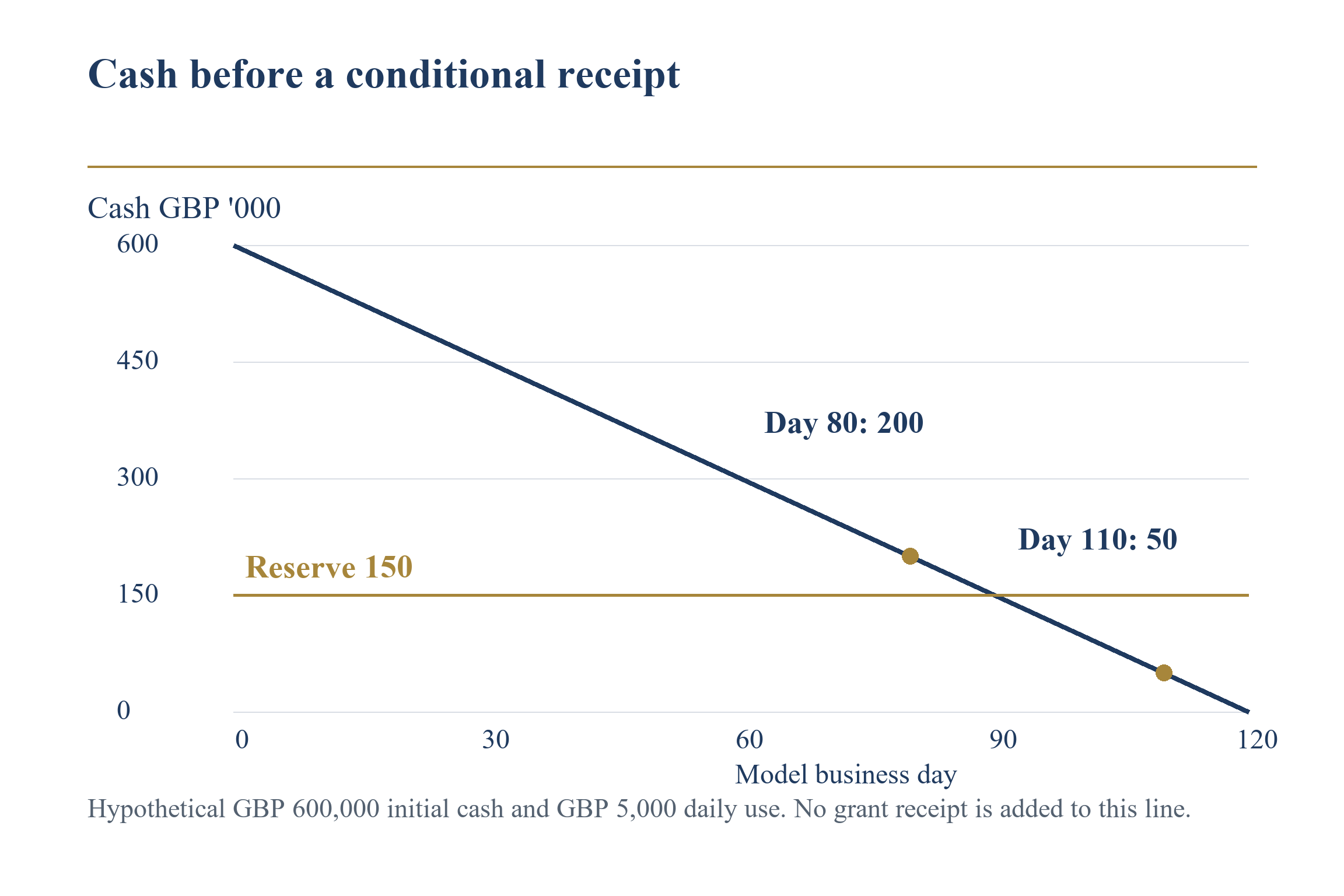
Scroll horizontally to read the figure at full size. You can also open the full-size figure.
Hypothetical pre-receipt arithmetic. Receipt dates are conditional assumptions; grant funding, unrestricted use and financing availability are not established.
| Assumed target cut off | Conditional receipt day | Pre receipt cash | Finance needed to preserve reserve |
|---|---|---|---|
| Model day 30 | Model day 80 | GBP 200,000 | GBP 0 |
| Model day 60 | Model day 110 | GBP 50,000 | GBP 100,000 |
Initial cash GBP 600,000; burn GBP 5,000 per model day; reserve GBP 150,000; post-cut-off lag 50 model days. Neither scenario establishes an actual award or payment.
20 Compare financing actions before the reserve is reached
A cash shortfall should trigger a comparison of evidenced actions while the company still has time to execute them. Options can include reducing discretionary expenditure, moving a project milestone, obtaining customer finance, raising equity or arranging a suitable credit facility. Each has different conditions, costs and consequences. The company should identify which source is actually available and how long its decision and documentation will take. A list of potential funders is not evidence of committed finance. The application schedule and the alternative financing schedule need to be considered together.
A bridge comparison should identify the cash amount and period being financed, the contractual repayment source, fees, interest, security and conditions precedent. The assumed grant outcome should remain visible as a dependency if repayment relies on it. The company should also analyse an outcome in which the grant is declined, delayed further or pays less than the assumed claim. This paper does not supply indicative lender pricing or assert that a lender will advance against an application. Those conclusions require current terms from an authorised counterparty and a review of the transaction's actual conditions.
The sensitivity grid shows why the required financing can change even when the nominal application remains the same. A higher cash-use rate increases expenditure during both preparation and waiting. A longer post-cut-off lag can create a gap before the first targeted cycle pays. An earlier submission has limited financing value if the assumed receipt remains outside the company's supported runway. The appropriate response depends on the actual business and permitted project sequence. The figure presents the constructed reserve gaps so that the effect of the assumptions can be inspected directly.
Five sensitivity cases produce negative counterfactual pre-receipt balances. Those arithmetic values indicate a financing or expenditure decision needed before the assumed receipt. They do not imply that the company can operate with an unapproved overdraft or spend cash it does not possess. A real forecast should identify when the minimum cash condition is breached, the source that could cover it and the actions required if that source is unavailable.
Management should avoid counting the same financing benefit twice. Moving an application to an earlier event and assuming a faster evaluation can be two separate changes; the forecast needs evidence for each. A financing facility that merely replaces available cash should be distinguished from new capacity. A grant receipt restricted to eligible costs should remain associated with those costs. The proposed decision paper should reconcile all sources and uses in one cash forecast, record the no-grant case and identify the latest date by which a credible alternative must be executed.
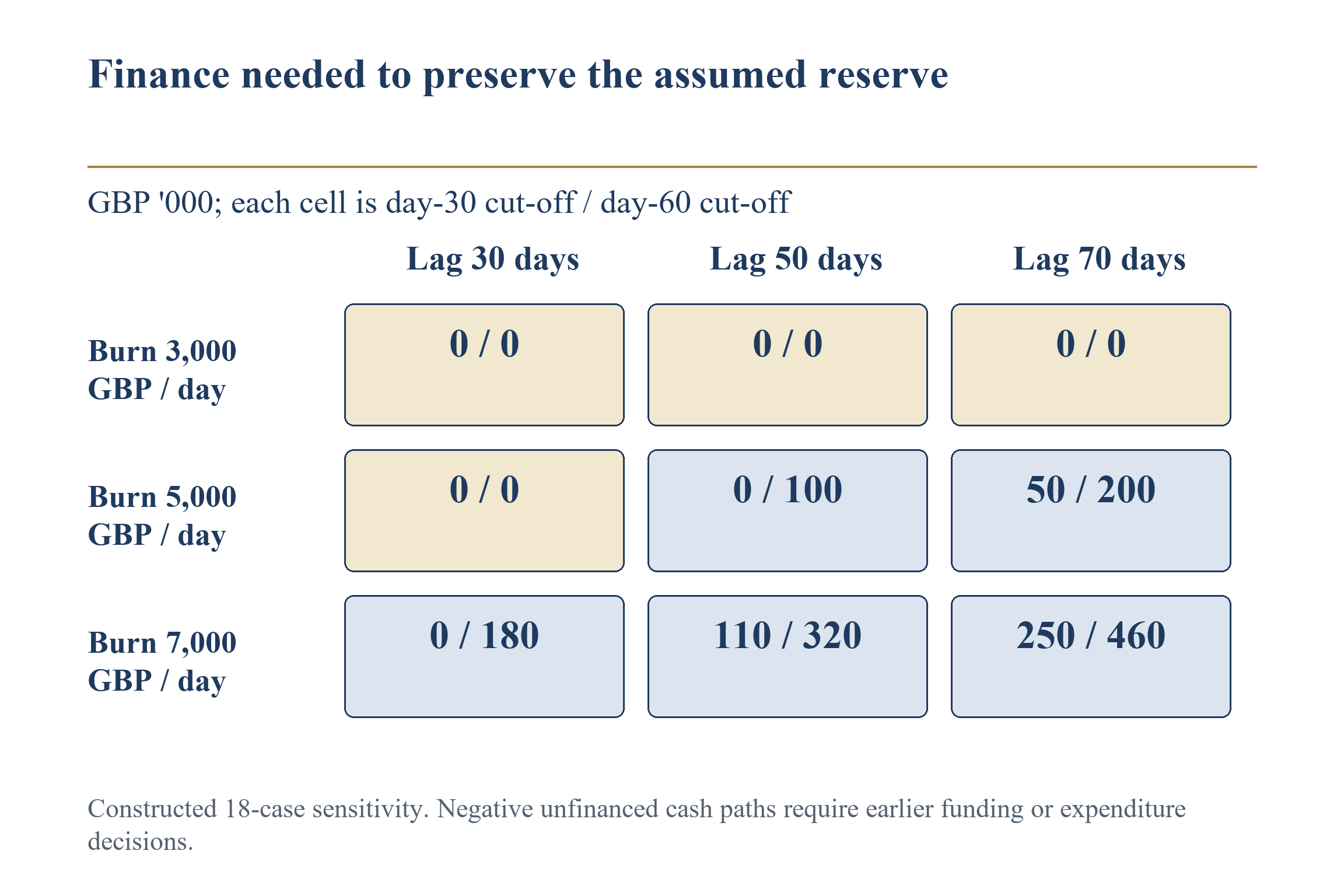
Scroll horizontally to read the figure at full size. You can also open the full-size figure.
Constructed sensitivity only. Values measure a chosen reserve gap, not expected funding lost, lender availability or a prediction of award outcomes.
21 Manage overlapping applications and shared review capacity
The single-application network leaves shared resource capacity outside the calculation. In practice a finance lead, technical expert or authorised signatory can appear in several simultaneous applications. Two schedules can each look feasible when considered separately while requiring the same person at the same time. A portfolio review should therefore identify the common reviewer, the work required and the actual available calendar. The organisation can then sequence applications, assign a permitted alternate or reduce the work in progress. The constructed model supplies no measured estimate of these capacity effects.
A proposed portfolio record separates reusable evidence from application-specific commitments. An entity record or approved technical description may support several permitted applications, subject to current facts and programme requirements. A partner budget, project date or certification may need a separate decision for each. Reuse should preserve the version and context in which the evidence was approved. It should not conceal duplicate-funding restrictions or lead the business to commit the same resource twice. The portfolio owner needs visibility of both the application timetable and the project obligations that would arise if more than one proposal succeeded.
Prioritisation can begin with strategic fit, verified eligibility, feasible preparation, cash need and the cost of waiting. Each is an evidenced decision criterion rather than a prediction of award success. An application consuming scarce review capacity should be compared with the work displaced. The organisation may choose a later permitted event for one project to protect a more time-sensitive commercial milestone elsewhere. Such a decision should state the trade-off and its assumptions. It cannot be justified by multiplying nominal grant amounts by unsupported probabilities.
The proposed review cadence should match the organisation's exposure. A team with one mature application needs a different process from a group coordinating several partners and programmes. Useful evidence includes the number of unresolved mandatory tasks, the longest remaining dependency, the next irreversible commitment and the cash available before a conditional receipt. Aggregate completion percentages can be misleading when a single uncompleted approval controls submission. The portfolio report should show the actual limiting task and the decision required, together with an owner and a date supported by the relevant calendar.
22 Use AI and data tools with source linked human decisions
A monitoring system can help collect official opportunity records, detect changes and assemble a list of decisions needing review. A useful design stores the source URL, document identity, access time and extracted field alongside the proposed deadline. It distinguishes a changed page from a changed rule. It also preserves the prior observation so that the reviewer can inspect what actually moved. The system should present an unresolved difference for human decision where the programme version, stage or time zone is ambiguous. This is a proposed design, not a claim of verified performance by a particular product.
The automation boundary matters because a date can be syntactically correct and apply to the wrong event. A short-application batch can be confused with a full-proposal cut-off. A historical annual guide can appear above a current amendment in search. A rendered page can present a time-zone abbreviation that needs context. The proposed control asks a responsible reviewer to approve the source and meaning before the system changes the committed schedule. Text similarity or a language model's confident answer does not establish the applicable programme rule.
Private application data should be governed separately from public source monitoring. A system that watches a public deadline page does not need unrestricted access to confidential technical annexes, partner contracts or bank details. The organisation should define which inputs can enter an external tool and who can approve a different route. Human approval of an extracted date is also distinct from authority to submit an application or organisational certification. The proposed architecture keeps those permissions explicit and retains an audit trail of the source, reviewer and decision.
A useful evaluation would measure detection coverage, false alerts, missed material amendments, time to reviewed decision and errors in the resulting schedule. Those metrics need a labelled set of actual source changes and clearly defined outcomes. A demonstration that a tool extracts a date from several pages is a limited capability test. It does not establish complete monitoring, confidentiality protection or an improvement in funding outcomes. The recommended operating design uses a small, reviewable register first and expands automation only where the organisation can measure and supervise the resulting decisions.
23 Design an empirical study of timing and funding outcomes
Estimating the effect of timing requires data linking the programme rule to the applicant's actual sequence. A useful permissioned dataset would include the legal applicant, programme version, stage, invitation, observed task completions, submitted package, system status, assessment outcome, award conditions and actual cash dates. It would also record expenditure and application effort. Missing or inaccessible fields should be reported as missing. Public lists of awarded grants alone cannot identify the applicants that failed to submit or establish the funding they would have received under another schedule.
A first descriptive study could classify events without claiming causality. It could report how many applications reached the required submitted state, how often a recorded registration or approval constrained completion and how far cash receipt followed relevant funding events. The denominator should be explicit for every measure. Applications withdrawn before assessment, technically rejected submissions and assessed unsuccessful applications require separate states. The study should preserve changes in programme rules and avoid treating an applicant's record as complete merely because an award appears in a public database.
A causal study would need a design addressing selection into earlier preparation or a different approval process. More experienced teams may begin earlier and submit stronger proposals for reasons unrelated to the policy being tested. A programme amendment can affect several conditions at once. A randomised internal scheduling intervention may be possible in some organisations, subject to ethics, fairness and operational constraints; a carefully justified comparison design may be appropriate elsewhere. The analysis should specify the outcome in advance and preserve adverse effects, including additional effort, cancelled applications and unsupported claims submitted under time pressure.
The value of funding lost needs an additional counterfactual. A missed submission cannot be valued automatically at the requested amount because selection, eligibility, award size and payment remain conditional. A defensible study would need evidence about the alternative timely application and its potential outcome, with uncertainty stated explicitly. The current paper therefore reports only deterministic schedule feasibility and hypothetical cash sensitivities. These results can guide the data collection plan and reveal which missing evidence prevents a stronger conclusion. They should not be converted into a sales claim about grant income generated or losses avoided.
24 Approve the next action with a complete timing and cash record
The proposed board decision contains the actual programme route, the targeted event, the current permission, the limiting dependency and the cash required to reach the next evidenced funding stage. It states whether the organisation should proceed, change a specific task, defer to a verified later event or stop additional expenditure. The recommendation should include its basis and unresolved conditions. The decision-maker can then review a concrete commitment rather than an assertion that an application is nearly finished. The submitted package and later outcomes remain attached to the same record.
Implementation can start with one live application. The owner reconstructs its current official rule and actual permission, maps the remaining handoffs and compares the earliest supported submission with the selected internal target. Finance then adds the relevant no-award and delayed-receipt cases. The resulting gaps identify decisions that need action. This sequence is a proposed operating method; the organisation should adapt it to its governance and programme obligations. The paper's model durations and cash assumptions are examples to be replaced, not default forecasts to copy into an investment memorandum.
The documentary evidence and constructed results support a limited conclusion. Different closing events create different consequences, and the entire preparation chain determines the completion date within a specified network. Beginning earlier or changing a limiting task can change feasibility under explicit assumptions. An internal reserve alone changes a readiness threshold. A later conditional receipt can increase the cash that a company must finance. None of those results establishes an actual award probability, a universal optimal submission interval or observed funding lost across applicants. Those questions remain for programme-specific evidence and the empirical study described above.
The decision to pursue a grant should therefore remain connected to the commercial work it is intended to finance. A permitted future submission can be useful while arriving too late for a particular product milestone or expenditure commitment. An apparently available funding amount can be unusable for a proposed corporate purpose. A completed application can require further organisational authority before the relevant portal event occurs. Preserving these distinctions gives the board an inspectable basis for allocating people and cash. The final output is a dated, sourced next action with a feasible schedule and an explicit financing alternative.
| Decision field | Evidence required | Accountable response |
|---|---|---|
| Permitted route | Current call stage and individual permission | Confirm or resolve before commitment |
| Target event | Governing local deadline and required status | Select the actual funding cycle |
| Completion path | Remaining dependencies and owners | Authorise a feasible schedule |
| Quality and obligations | Supported claims costs and certifications | Approve the specific package |
| Cash and alternatives | No-award and delayed-receipt forecast | Execute a credible financing action |
| Closeout | Submitted package receipt and later outcomes | Preserve and review the actual result |
Proposed decision framework. Programme documents, actual company facts and authorised professional advice govern implementation.
References
- UK Research and Innovation. Submitting your application. Updated 17 July 2026. https://www.ukri.org/apply-for-funding/develop-your-application/submitting-your-application/ Accessed 14 November 2026.
- Innovate UK. Before you start an application. Updated 8 May 2026. https://www.ukri.org/councils/innovate-uk/guidance-for-applicants/general-guidance/before-you-start-an-application/ Accessed 14 November 2026.
- Innovate UK. Your application. Updated 16 July 2026. https://www.ukri.org/councils/innovate-uk/guidance-for-applicants/general-guidance/your-application/ Accessed 14 November 2026.
- Innovate UK. What happens if you receive a funding offer. Updated 8 September 2026. https://www.ukri.org/councils/innovate-uk/guidance-for-applicants/general-guidance/what-happens-if-you-receive-a-funding-offer/ Accessed 14 November 2026.
- European Commission. EIC Work Programme 2026. C(2026)4080. Official download linked as current on the 2026 work-programme page; Accelerator printed pages 78 to 81. https://eic.ec.europa.eu/document/download/52598755-1351-4b54-b46b-e2682d0a3aec_en?filename=EIC-Work-Programme-2026.pdf Accessed 14 November 2026.
- European Commission. EIC Work Programme 2027. C(2026)7629, corrected official download; Accelerator printed pages 77 to 82. https://eic.ec.europa.eu/document/download/ed9ab103-1ffb-4d5f-a6ad-168ac3b36900_en?filename=EIC-2027-Work-Programme.pdf Accessed 14 November 2026.
- European Innovation Council. FAQs EIC Accelerator. Live page referring to 2027; individual prior-stage applicability requires checking against the governing programme. https://eic.ec.europa.eu/eic-frequently-asked-questions/faqs-eic-accelerator_en Accessed 14 November 2026.
- U.S. National Science Foundation. NSF 26-510: Small Business Innovation Research / Small Business Technology Transfer Phase I, Phase II, Fast-Track Programs SBIR/STTR: Developing Deep Technologies that Advance U.S. Competitiveness and Security. Posted 22 May 2026. https://www.nsf.gov/funding/opportunities/small-business-innovation-research-small-business-technology/nsf26-510/solicitation Accessed 14 November 2026.
- U.S. National Science Foundation. Proposal and Award Policies and Procedures Guide 24-1, Chapter I: Pre-Submission Information. Read with applicable supplements and funding-specific instructions. https://www.nsf.gov/policies/pappg/24-1/ch-1-pre-submission Accessed 14 November 2026.
- U.S. National Science Foundation. Key information for submitting a full SBIR/STTR proposal. https://seedfund.nsf.gov/apply/full-proposal/ Accessed 14 November 2026.
- Grants.gov. Applicant Registration. https://www.grants.gov/applicants/applicant-registration Accessed 14 November 2026.
- Grants.gov. Check Application Status. https://www.grants.gov/help/applicants/check-application-status Accessed 14 November 2026.
- Kelley JE Jr. 1961. Critical-Path Planning and Scheduling: Mathematical Basis. Operations Research 9(3):296-320. Publisher abstract and bibliographic record reviewed. https://doi.org/10.1287/opre.9.3.296 Accessed 14 November 2026.
- Internet Assigned Numbers Authority. Theory and pragmatics of the tz code and data. https://data.iana.org/time-zones/theory.html Accessed 14 November 2026.
- U.S. National Science Foundation. Project Suitability Assessment and Project Pitch information. https://seedfund.nsf.gov/apply/project-pitch-information/ Accessed 14 November 2026.
- UK Research and Innovation Medical Research Council. UK Obesity Research Institute full application. Update 20 October 2026 records the closing-date extension. https://www.ukri.org/opportunity/uk-obesity-research-institute/ Accessed 14 November 2026.
- Innovate UK. MDI Programme Innovation and Scale-up Hub competition 2588. Official competition overview and dates. https://apply-for-innovation-funding.service.gov.uk/competition/2588/overview/acbd9666-c1df-4635-b86f-fa426100c876 Accessed 14 November 2026.
- UK Research and Innovation. UKRI Enabling AI adoption across science and engineering. Published 17 September 2026; updated 5 November 2026. https://www.ukri.org/opportunity/ukri-enabling-ai-adoption-across-science-and-engineering/ Accessed 14 November 2026.
- Innovate UK. Terms and Conditions of an Innovate UK Grant Award. October 2025 document, clauses 4.3 and 9.3 to 9.14; read with the applicable award terms and offer. https://www.ukri.org/wp-content/uploads/2025/11/IUK-171125-Sept-2025-IUK-TCs.pdf Accessed 14 November 2026.
About the Author
Chennakeshav (CK) is a corporate finance and investment banking executive with 25+ years of global experience in deal origination, structuring and execution across M&A, growth capital and corporate strategy. He has led value-creation mandates for founders, corporates and funds — bridging the boardroom view to hands-on execution and close.
His career spans Morgan Stanley, HSBC, Lloyds Banking Group, EWEC, ADQ portfolio companies and Emirates Growth Fund, across TMT, real estate, fintech, deeptech, cleantech, infrastructure and energy. He has partnered with C-suite leaders, private equity and venture funds, sovereign wealth funds and family offices to finance complex fund raises and scale-up ventures, and has led M&A due diligence, post-merger integration and business-transformation initiatives to create value.
At Matchpoint Partners he is Managing Partner, leading the firm's corporate finance, M&A and capital-raising practice. He holds an MBA from London Business School, an engineering degree from VTU and a Master of Laws (LLM, in progress) from UCL London.
An active start-up mentor, CK mentors at Techstars, DIFC FinTech Hive, Startup Grind, Founder Institute and IN5, serves as Entrepreneur Mentor in Residence (EMiR) at London Business School, and judges the Entrepreneurship World Cup.
https://www.linkedin.com/in/ckadya/
https://www.matchpoint-partners.com/team/ck-adya.html
Disclaimer
This paper is part of a continuing series on the structure of private and alternative markets. The views expressed are the author's own. The paper is for information only, describes market structure in general terms, and does not constitute investment, legal, tax or regulatory advice or a recommendation in respect of any security, vehicle or counterparty.
