

1 The decision after an unsuccessful application
The first management task after an unsuccessful application is to establish what decision was made. A notification may describe an incomplete submission, an ineligible applicant, a project outside the competition's scope, an assessment below a required standard, a competitive ranking or a condition that remains unresolved before an award. These descriptions lead to different next actions. The person authorising further expenditure needs the outcome letter, relevant application record and governing rules before approving another writing exercise. A short internal summary should retain the funder's exact stated reason and identify any remaining uncertainty about its meaning.
The resulting decision has an immediate financing dimension. Preparing a new submission consumes management time, technical capacity and cash while the business continues to meet payroll, product-development and customer commitments. An application deadline may arrive before a missing experiment or ownership clarification can be completed. Another funding route may finance the same commercial milestone on different terms. The board therefore needs a comparison of feasible actions, their required evidence, resource requirements and timing. A revised narrative is one possible task within that comparison; the decision concerns the company's next use of scarce resources.
Official Innovate UK guidance separates eligibility and scope review from assessment and describes ranking, minimum quality and possible portfolio considerations. It also explains that feedback is unavailable for some competitions and that responding to comments does not assure a successful later outcome. These distinctions support an outcome-stage record rather than a single undifferentiated rejection label. The exact competition brief remains material because the published description is a standard process with stated variations. A company should attach that brief to its diagnostic record and retain the notification that establishes which process actually applied. [2]
This paper proposes a disciplined sequence: establish the applicable route, identify the evidenced decision stage, determine which conditions remain open, test the feasibility of correction and authorise a next action. Its contribution is a management synthesis and a reproducible constructed counterexample concerning mandatory conditions. No applicant-level dataset or controlled intervention establishes the framework's effect on funding outcomes. The method is intended to make decisions and their limitations inspectable. Its practical output is a dated correction and financing decision that another responsible person can review against the same documents.
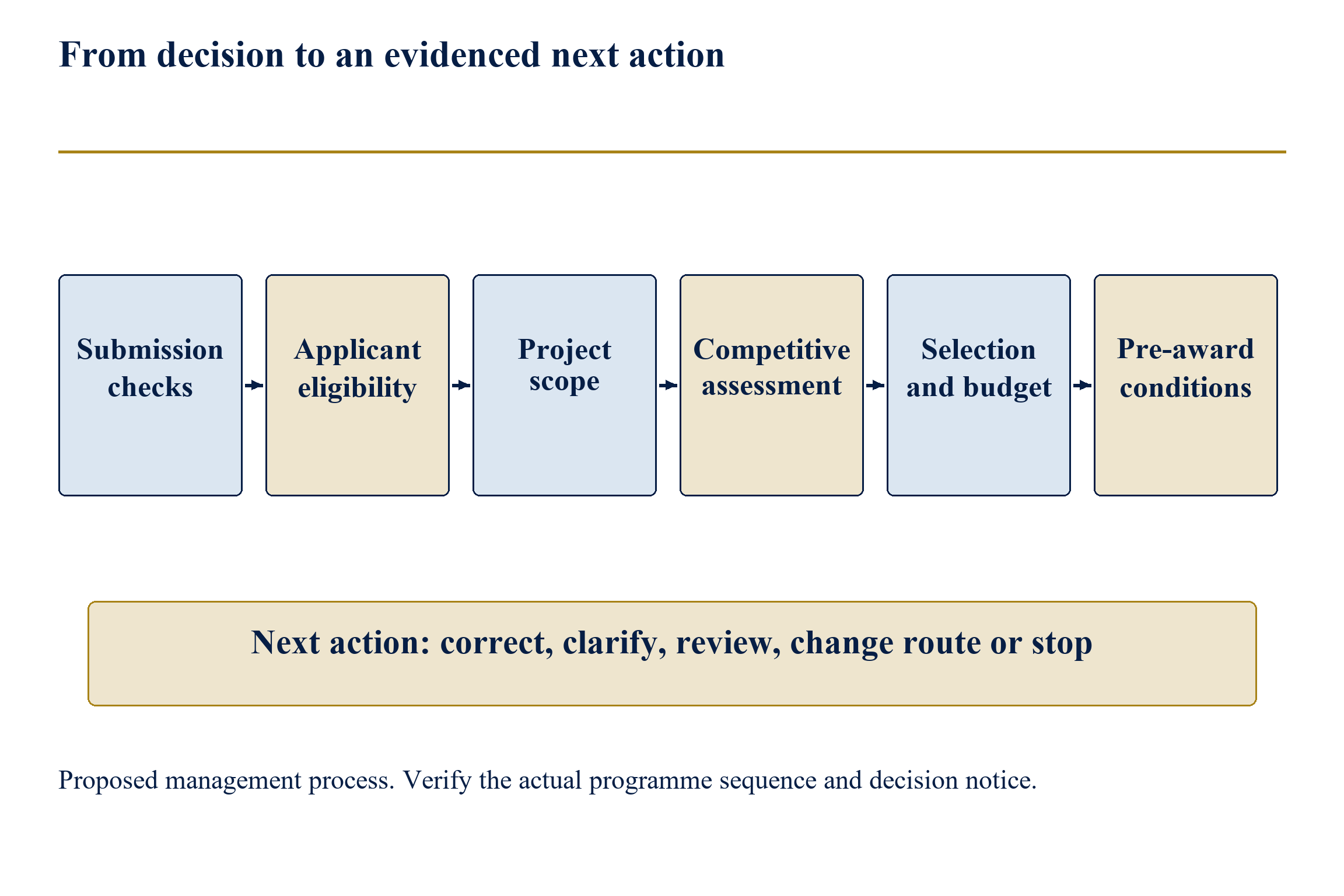
| Stage | Evidence to retain | Next question |
|---|---|---|
| Administrative admissibility | Submitted package, required forms and receipt | Was the prescribed submission process satisfied? |
| Applicant eligibility | Entity facts and applicable definitions | Does the selected applicant meet the requirement at the relevant stage? |
| Project scope | Call scope and actual proposed work | Does the work fit the opportunity? |
| Competitive assessment | Available reviews, scores and criteria | Which evidenced weakness can a proposed correction address? |
| Selection and budget | Actual outcome notice and available selection explanation | What is known about selection beyond the assessment? |
| Pre-award conditions | Requests, due diligence and formal offer or agreement | Which conditions remain before a commitment or receipt? |
Proposed diagnostic taxonomy. Preserve the funder's actual wording and sequence; an unavailable reason remains unknown. Selected official processes are discussed in references 2, 7, 11, 18 and 20.
Scroll horizontally to read the figure at full size. You can also open the full-size figure.
Proposed management process. The stages are a diagnostic structure and do not assert one identical sequence across all programmes.
2 Method and evidence boundaries
The documentary unit in this study is an identified rule or process statement, attached to an issuer, programme, document version and application stage. The review uses official guidance and governing programme material for selected UK, European Union and United States examples. These examples establish specific process distinctions and support the design of the diagnostic register. They do not provide a complete survey of every innovation-funding instrument. The selection is purposive: the reviewed material needs to expose different reasons for unsuccessful applications, restrictions on a later submission and the evidence required to make a defensible next decision.
Three kinds of statement are kept separate throughout the analysis. A documentary statement describes what an identified source says within its stated scope. A proposed management practice describes an approach developed in this paper. A constructed result follows from disclosed model inputs and rules. This separation allows a reader to inspect the basis for each conclusion. An official statement about application eligibility supplies no measured estimate of the value of a consultant's work. A successful model test supplies no certification of a real applicant's legal status, technical merit or entitlement to receive an award.
A complete empirical comparison would need the original application population, the eligibility facts and rules at each submission, the communicated decisions and any feedback, later submissions, award terms, cash receipts and subsequent commercial milestones. Companies that discontinue applications would also need to remain observable. This study has not obtained such a linked dataset. Consequently it does not calculate a rejection rate, a causal improvement from rewriting or a realised reduction in dilution. A research design for obtaining those observations is developed later so that a future empirical study can test the framework without treating publicly visible awards as the entire applicant population.
The numerical component is an exhaustive logical experiment. Six required checks take one of three states: pass, unknown or fail. Every combination is enumerated and classified under a mandatory-condition rule. A separate, deliberately constructed weighted comparator provides a falsification example. The exercise asks whether a representation can clear a case that contains a failed condition or unresolved evidence. Its output is a finite count within an artificial state space. The frequencies have no population weighting, and the equal enumeration of combinations represents a testing design rather than a distribution of actual companies.
| Evidence type | Permitted use in this paper | Boundary |
|---|---|---|
| Official programme document | Describe a dated requirement within its stated scope | Does not establish an applicant's compliance |
| Actual decision notice | Identify the communicated stage and reason for that case | Unavailable in this study's applicant dataset |
| Public funded-project record | Describe the disclosed selected project or award | Incomplete rejection denominator |
| Constructed model result | Test a specified logical rule on disclosed inputs | No funding-success or population-frequency estimate |
| Company planning assumption | Calculate a conditional resource or runway scenario | Requires the company's own verification and approval |
Research design and evidence boundaries; no new empirical applicant cohort is claimed.
3 Identify the actual decision stage
A useful diagnostic record begins with the event that the funder communicated. Administrative admissibility concerns the submission's conformity with required procedure and form. Applicant eligibility concerns whether the relevant entity and participants satisfy applicable conditions. Project scope concerns whether the proposed activity belongs within the opportunity. Competitive assessment concerns the quality evaluated under the programme's criteria. Ranking and budget allocation concern selection among assessed proposals. Pre-award review concerns conditions that remain before an agreement or investment can be completed. The categories are analytical aids; the source's own terminology and decision sequence should be preserved alongside them.
The record should include the application identifier, submission date, programme year, call and stage, legal entity, notice date, decision wording and supporting documents. An explanation supplied by an intermediary should be distinguished from a statement issued by the funder. Where a notice gives several reasons, each should remain visible. A reported scientific weakness can coexist with a failed formal condition. Where the available correspondence gives no reason, the correct entry is that the reason has not been established. Assigning an attractive explanation to a silent record would direct correction effort towards an unsupported diagnosis.
Management can then map each evidenced issue to a potential action. An omitted document may call for better submission control if a later route permits correction. An applicant-category restriction may call for a different opportunity or a separately assessed change in facts. A technical-evidence weakness may require additional research. A portfolio decision may leave the application's factual content intact while changing its financing prospects in that competition. The action record needs to explain the link between the stated issue and the proposed remedy, including any permission or external dependency required before that remedy becomes available.
A team should also distinguish the decision it wants from the decision the process can provide. A request for clarification, a procedural complaint, an invited resubmission and a new application can have different admissibility conditions and purposes. None should be entered into a funding forecast merely because a message has been sent. The operating register should show the current status, next required event and latest decision date. This creates a visible connection between the funding process and the company's cash planning while leaving the funder's substantive decision and any legal interpretation with the appropriate authority.
4 Build the programme and version register
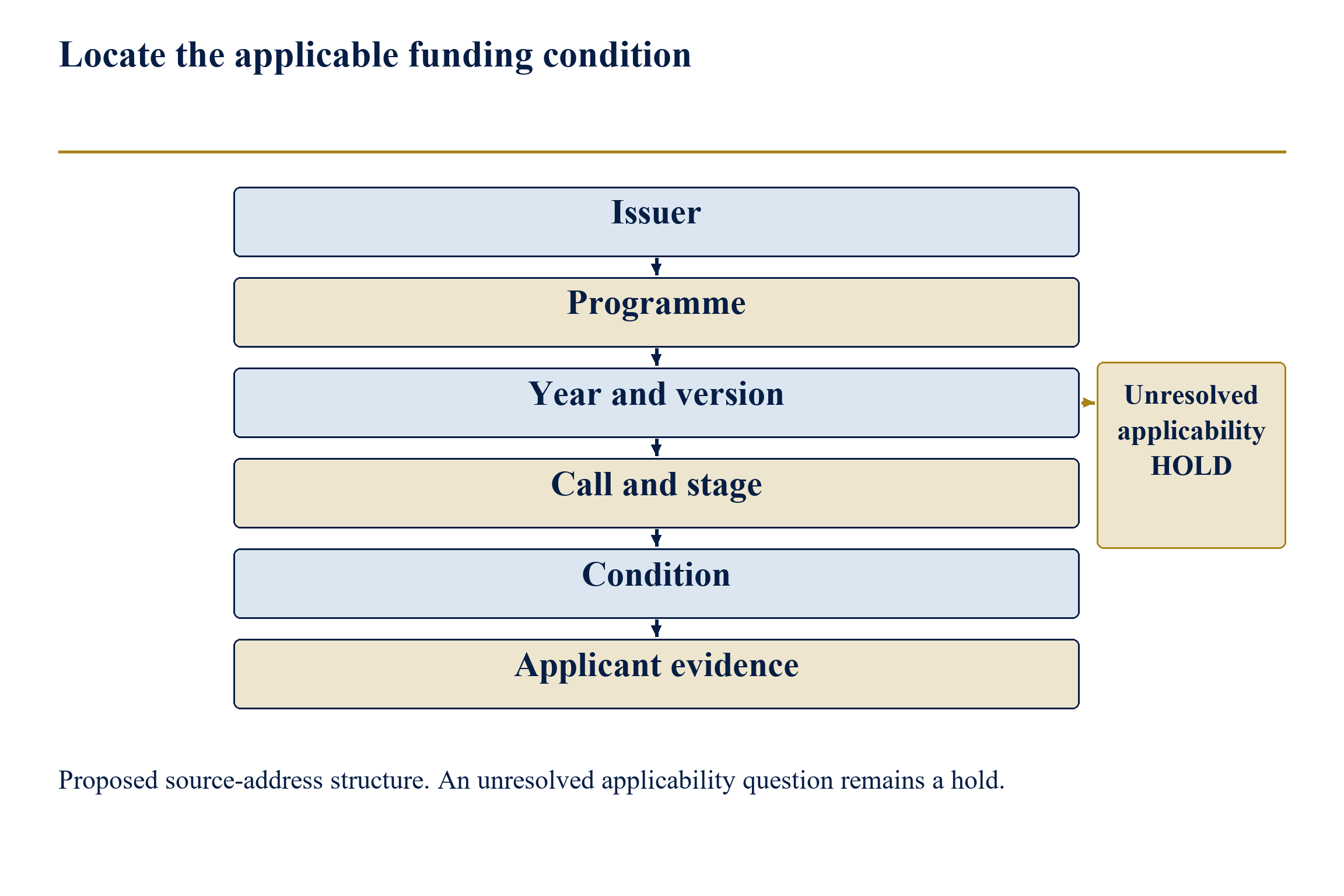
Every material condition needs a programme address. The minimum address identifies the issuing body, instrument, call or competition, programme year, application stage, applicant category, governing document and observed version. A source URL alone is insufficient when the page is updated in place. The saved record should include the capture date, exact relevant passage or locator and a content hash where a reproducible copy is permitted. An owner should record why that rule applies to the selected application. These fields allow a reviewer to distinguish an authoritative current call condition from useful background guidance.
The reviewed UK material demonstrates an applicability question that requires explicit handling. Innovate UK's business-applicant guidance describes a further same-proposal application after assessment, subject to the specific competition allowing an updated application. The general UKRI resubmission page describes invited resubmissions, uninvited resubmissions and substantially different new submissions. The pages have different contexts and update dates. A diagnostic system should retain both records and require confirmation of the applicable programme rule. It should not silently choose a broad statement merely because the issuing organisation's name appears on both pages. [1,3]
Programme years introduce a second boundary. The live EIC Accelerator FAQ reviewed for this paper refers to the 2027 Work Programme. The official EIC 2026 landing page identifies the 17 June 2026 revision as current and lists the March revision among previous versions. A deadline or permission taken from the FAQ therefore needs its applicable year and call recorded. An older saved source can explain an earlier decision; a later submission needs its governing version checked. The register should preserve each observation without relabelling it as universally current. [5,6,10]
An unresolved conflict becomes a task with a named owner, a question and a decision deadline. The team can seek clarification through the programme's published channel, inspect the call-specific guidance or obtain appropriate professional advice. A response should be saved with the exact question and relevant application facts. Until the applicability issue is resolved, downstream drafting can proceed only as a conditional activity whose cost has been authorised. The programme register makes that condition visible. It also preserves the basis for a stop decision when the clarification cannot be obtained in time.
| Source | Version observed | Applicability control |
|---|---|---|
| Innovate UK before-start guidance | 8 May 2026 | Read the specific competition's resubmission permission [1] |
| General UKRI resubmissions | 22 October 2026 | Invited-only rule and exceptions; resolve the actual programme's applicability [3] |
| EIC 2026 Work Programme | Current 17 June 2026; C(2026)4080 | Keep March previous version separate; apply the relevant call and stage [5,10] |
| Live EIC Accelerator FAQ | Discusses 2027 when accessed | Do not import later-year cut-offs into a different call [6] |
| NSF SBIR/STTR | Current NSF 26-510, posted 22 May 2026 | Solicitation instructions and the version effective at the proposal due date matter [7] |
| NSF PAPPG framework | 24-1 plus applicable Supplements 1 and 2 | Record proposal-date and award-date applicability separately [9,19,20] |
| Main Horizon general annexes | 2026-2027 | Scope expressly excludes EIC; use the relevant separate programme annex [11] |
| EU Online Manual | Actual V1.3 of 1 May 2026 | Verify the saved document, applicable route and decision letter [12] |
Targeted source comparison checked 13 November 2026. No rule is a universal cross-programme permission and no current funding availability is inferred.
Scroll horizontally to read the figure at full size. You can also open the full-size figure.
Proposed evidence-address structure. A URL or matching keyword alone does not establish that a rule governs the selected application.
5 Administrative admissibility
Administrative checks concern the submitted package and the process used to deliver it. A company needs a current list of required forms, attachments, declarations, formats, word or page limits, authorised submitters and deadline conventions. Each requirement should be mapped to an owner and a verifiable submission artifact. The review must distinguish a document that exists internally from a document actually attached to the submitted application. A completed draft in a shared folder establishes no evidence of portal receipt. The relevant record is the accepted submission package and its confirmation, preserved in the form supplied by the system.
A submission-control schedule should work backwards from the actual cut-off. External registrations, signatures, partner approvals and uploads need their own completion times. A final package review should use the exact proposed files and the final portal fields. Changes after that review should be identified and checked before submission. The schedule should record time zone and the source of the deadline. It should also identify the point at which management must stop optional improvements and protect the verified submission package. These are proposed process controls; their benefit and appropriate lead time depend on the company's actual dependencies.
The Innovate UK before-start guidance states that competition-specific guidance contains the application requirements and warns about deadlines and applicant-side technical difficulties. Its standard deadline description includes a stated exception for a different time in the brief. That structure reinforces the need to record the actual competition cut-off rather than adopt a default time from a generic calendar. A team considering an issue after submission should preserve its contemporaneous record and consult the programme's stated process. It should not assume that an internal upload attempt extends the published deadline. [1]
After an administrative rejection, the correction plan should identify the failed control and the factual evidence needed for a permitted later application. Rewriting technical sections will not establish that a required registration was active or that a missing attachment had been submitted. Those facts need their own evidence. The company should also record whether the original decision concerned administrative checks or a later assessment stage because a programme may treat those events differently for future submissions. The record should retain uncertainty where the notice does not establish the stage, with a targeted clarification task rather than an assumed attempt count.
| Control | Verification object | Open question to resolve |
|---|---|---|
| Required package | Exact final forms and attachments | Is every required item included in the submitted package? |
| Portal registration | Actual status for the required entity and stage | Is the registration required and valid at this point? |
| Authorised submitter | Authority and submission record | Who can submit and certify? |
| Deadline | Call-specific cut-off and time zone | Which source and trigger govern the cut-off? |
| Technical issue | Contemporaneous record and official support process | What was reported and when? |
| Receipt | Actual portal confirmation | Was the package accepted by the submission system? |
Proposed control checklist; references 1, 4, 7 and 8 provide selected programme-specific context. This table supplies no extension or correction entitlement.
6 Applicant and ownership eligibility
Applicant eligibility is attached to a specific legal entity and set of facts. A commercial group can contain several companies with different places of establishment, ownership, employee counts, financial records and roles in a proposed project. An application should identify the entity seeking support and the documents that establish its relevant status. A brand name, operating office or founder's residence may answer a different question from the one posed by the programme. The evidence register should preserve the rule's defined subject and measurement basis before a team decides which corporate record is responsive.
Ownership facts require effective dates. A funding application prepared during a financing round, acquisition or group restructuring can be overtaken by a change in control or an affiliate relationship. The management process proposed here records the ownership position at the relevant application or award stage and assigns a refresh task when a planned transaction could change that position. It does not assume that every ownership change is prohibited or that every subsidiary qualifies independently. The applicable instrument and entity definitions determine the assessment, and any unresolved interpretation should remain explicit in the decision record.
The correction question is whether the underlying condition can be satisfied at the stage specified by the governing rule. An incomplete explanation of an existing fact may be repairable through adequate evidence. A fact that does not meet the condition requires a different assessment of available routes or changes in the proposed arrangement. A later-issued document may provide evidence of an earlier fact if the programme accepts that evidence. Its creation cannot change whether the underlying condition was satisfied at the required time. The register should identify which facts are historical, which can change prospectively and which need an external decision before a later submission becomes feasible.
Transaction teams can use the same record in diligence. The board should ask which funding assumptions depend on the current group structure, whether a change requires notification or consent and what is known about the status of an application or award. A buyer or investor should receive a precise description of the evidence reviewed and the outstanding conditions. This paper supplies no jurisdiction-wide eligibility opinion and no conclusion about a particular company's status. The proposed diligence output is a sourced list of transaction-sensitive conditions and the steps required to obtain the relevant programme or professional determination.
| Fact | Evidence boundary | Transaction-sensitive question |
|---|---|---|
| Legal entity | Exact applicant and registration | Does the transaction change the applicant or relevant group? |
| Ownership and control | Defined date, owners and applicable definitions | Which planned change requires review? |
| Affiliates and size | Actual rule and supported group facts | How does the programme treat the relevant affiliate relationship? |
| Place of work | Project locations and participants | Does the proposed arrangement meet the selected condition? |
| Team and employment | Person, role, date and stated programme test | Does a required commitment remain valid? |
| Prior support | Application and award history | Which restrictions or obligations remain relevant? |
Proposed evidence schedule. Definitions and measurement dates must come from the actual programme; this table is no eligibility opinion.
7 Project scope and innovation evidence
Project scope should be assessed against the activities and outcomes described by the particular opportunity. A company may have a commercially attractive technology while proposing work that falls outside a funding call. The review should identify the project's objective, technical uncertainty, planned activities, participants, costs, timetable and expected outputs. Each material scope criterion needs an explicit link to that description. A general company presentation can support context, but the submitted answer needs to address the proposed funded work. The reviewer should record any uncertainty about the boundary between eligible research, development, deployment and ordinary commercial activity.
Evidence of innovation should be responsive to the programme's actual question. A technical comparison may require a documented baseline, defined performance measures and a credible explanation of the work needed to address an uncertainty. Commercial evidence may concern customer need, adoption, alternatives or implementation. An application can distinguish completed observations from planned experiments and forecasts. This proposed evidence structure gives an assessor a basis to inspect the claim without implying that every programme uses the same innovation test. The specific criteria, scoring guidance and application question remain the sources for deciding what the submission must demonstrate.
An unsuccessful scope decision should prompt a review of fit before new prose is commissioned. The team should compare the stated boundary with the actual proposed work and decide whether a permitted redesign is commercially worthwhile. A genuine change in research objective or method can require different people, costs and milestones. Those consequences belong in the financing decision. A change of wording that leaves the underlying project unchanged should not be described internally as a new research programme without evidence that the relevant submission rules treat it that way.
For an assessment-stage technical weakness, management needs a testable correction task. The task might specify a baseline comparison, an additional experiment, a clearer explanation of the proposed method or evidence that the team can execute a defined work package. Its completion criteria should describe what new information will exist and who will verify it. A stronger explanation of existing evidence can be a legitimate correction. A new scientific claim requires its own support. The distinction keeps the application process connected to the underlying development programme and limits the risk of promising an experiment that the approved budget cannot deliver.
8 Costs funding history and double funding
A funding request should have a defined project boundary and cost basis. The diagnostic record needs the entities bearing the costs, relevant periods, work packages, requested support and other sources of finance. Where a rule restricts overlapping support, the team needs the actual applicable definition and the underlying records. A label such as matched funding does not explain which expenditure a second instrument finances. The proposed management control is a cost-to-source reconciliation that makes the treatment of each material funding contribution inspectable before the company authorises a later submission.
Previous awards and applications should be included in the review even when different teams prepared them. An existing project may share personnel, equipment, work packages or deliverables with the new proposal. The company should identify those overlaps and determine their treatment under the relevant rules. It should also preserve prior reporting and close-out obligations where they affect access to later support. A conclusion that the funding structures are compatible needs an identified basis. The diagnostic register should show the documents examined and any unresolved question requiring a programme-specific or professional decision.
A correction to a cost table can change the economic decision. Excluding an item may reduce the support available while leaving the company responsible for the expenditure. Moving an activity to a later period can alter the development schedule. Adding a required contribution can increase the cash commitment before reimbursement. The board should see a reconciled funding and expenditure plan under the revised assumptions, with the timing of cash receipts kept distinct from the approval of an award. An application team should not retain an earlier runway projection after the underlying project budget or funding treatment changes.
This paper proposes a funding-history schedule that links each relevant prior instrument to its legal entity, project purpose, expenditure period, reporting status and possible interaction with the new application. The schedule is a discovery and verification tool. It establishes no automatic conclusion that a particular combination is permissible or impermissible. When a compatibility question remains unresolved, the action plan should assign it to the correct owner and preserve the conditional status of the associated financing assumption. A later application should use the corrected factual record and the rules governing that particular opportunity.
9 Assessment feedback and conflicting comments
Feedback should be converted into questions that can be answered with evidence. A comment about an insufficiently clear technical method needs a precise description of the ambiguity. A comment about market opportunity needs the relevant claim and supporting analysis identified. A concern about the team needs the proposed responsibility, capability or commitment examined. The internal response should retain the original comment, the team's interpretation, the proposed change and its evidence. This record allows a reviewer to challenge the diagnosis before the business incurs the cost of a new experiment or revised application.
Different comments can concern different parts of the same proposal. One assessor may find an explanation persuasive while another identifies an unanswered question. The company should investigate the underlying claims and the applicable scoring criteria without treating the feedback as a set of instructions that must all be implemented literally. A proposed correction needs a reasoned link to the issue. Changes that make one answer clearer can introduce inconsistency elsewhere in the proposal, particularly when milestones, technical claims, costs and market assumptions are revised by different owners.
A feedback-response matrix can use five fields: the original observation, evidence supporting the relevant claim, the proposed correction, the affected application sections and the person accepting the correction. Disagreement with an observation should be documented with the same discipline. A reviewer can then distinguish a supported factual correction from an alternative judgement. The matrix should also retain comments that remain unresolved and the consequence for a later submission. Hiding an unresolved technical question inside a confident response paragraph would leave management without an accurate view of the work still required.
The next application should stand on its own under the applicable process. Where prior feedback is available to a later assessment stage, the company needs to understand how it is used. Where it is unavailable, the revised application needs to contain the necessary explanation and evidence itself. The team should check the programme's actual instructions before adding a response appendix or relying on a prior reviewer to remember a clarification. The internal response matrix remains valuable for governance even when it is not part of the permitted submission package.
A useful completion test asks what has changed in the evidential basis of the application. A revised section may clarify a previously obscured fact, correct an error, incorporate a new measurement or explain a materially different project. These changes should be identified separately. Management can then decide whether the expected informational value justifies the correction cost and whether the application still fits the opportunity. The method does not estimate the score that another assessor will award. It records the work completed and the remaining decision dependencies so that resubmission expenditure has an inspectable basis.
| Feedback issue | Possible evidence task | Acceptance question |
|---|---|---|
| Technical method unclear | Map objective, method, uncertainty and measurements | Does the revised explanation match the actual proposed work? |
| Commercial rationale weak | Examine the stated claim and its supporting evidence | What evidence supports the particular opportunity claim? |
| Team capability questioned | Verify relevant responsibility and commitment | Who will do the work, with what evidenced capability? |
| Budget inconsistent | Reconcile work, cost and funding schedules | Are the material totals and boundaries consistent? |
| Conflicting comments | Retain both observations and investigate their bases | Which uncertainty has been resolved and which remains? |
| Reason unavailable | Seek the permitted explanation or preserve unknown | Is there evidence for the proposed correction? |
Proposed task design, with no prediction of a later score. NSF phase-specific evidence instructions give examples of technical, commercial and supporting-document requirements [18,21].
10 Ranking budget and portfolio selection
A company can receive an unsuccessful outcome after a proposal has passed formal checks and undergone assessment. The diagnostic record should preserve any evidence that distinguishes a quality threshold from selection within an available budget. An application's assessment result, position in a competition and final award decision are separate observations. The internal funding plan should use the event that has actually occurred. A positive comment, qualifying score or invitation to a further stage needs its own description and cannot be booked as unrestricted cash available to the business.
The analysis of a competitive outcome should identify what the company can observe. An outcome letter may describe a ranking, a budget constraint or a portfolio consideration. An applicant may receive only a final decision and limited feedback. The team should retain the available information and avoid inventing the scores or attributes of competing applications. A public list of funded projects supplies information about selected awards. It does not establish the identity, eligibility, quality or subsequent choices of every unsuccessful applicant in the same competition.
A management response can compare three routes under explicit assumptions: a permitted later application, a different opportunity with a better documented fit and an alternative source of capital. The comparison needs the required milestone, timing of a possible decision, cash contribution, preparation effort and any restrictions that matter to the company. The relevant funding value can differ across instruments because an approval, a reimbursable award and an investment commitment have different conditions and cash-flow consequences. The instrument's actual terms should determine the financial treatment in the comparison.
Where the available decision indicates a selection constraint outside the applicant's control, the correction budget should remain linked to a specific purpose. Additional evidence may support a later submission or another financing discussion. A new application may also be commercially unattractive if its timetable misses the company's milestone. The board should identify the decision boundary and the latest date at which it needs to commit to a fallback. This keeps an unsuccessful competition from becoming an indefinite reason to postpone a necessary financing decision.
The company's learning record should preserve qualified and unqualified conclusions separately. It can record that a particular competition did not provide funding, that certain comments were received and that the proposed project remains within a documented technical plan. It should leave unknown the counterfactual outcome under a different narrative, assessor group or budget. A sequence of later awards and unsuccessful applications can support future analysis only when the relevant population, rules and applicant changes are documented. The proposed framework treats those data requirements as part of research design rather than filling the gaps with a retrospective story.
11 Resubmission permission and attempt history
Permission to submit again is a condition to establish before a substantial correction programme is commissioned. The register should identify the previous submission, decision stage, legal entity, applicable programme period and any invitation or restriction. It should preserve withdrawn applications and the timing of withdrawal because the governing rule may distinguish events before and after assessment feedback. A founder's recollection that the company applied once is an input for investigation. The evidence record should include the actual applications and decisions relevant to the programme's definition of an attempt.
A resubmission log should track the relationship between the old and proposed projects. Relevant fields include objectives, research method, work packages, team, resource request and the changes made. A different title or a revised application summary supplies little information about whether the underlying programme of work has changed. Where the rule distinguishes an updated proposal from a substantially different endeavour, management needs a documented assessment of those substantive elements. The record should retain the source of any clarification and the exact applicant facts on which that clarification depended.
The ownership of the decision also needs attention. An adviser can assemble application history and identify the relevant published condition. The programme may retain discretion over whether a proposal meets its definition or remains eligible for a later stage. The internal register should therefore separate the company's proposed classification from an actual determination or invitation. Where permission is unresolved, the cost approval should show what limited work may proceed and when a definitive answer is needed. This preserves management choice without converting uncertainty into an assumed right to submit.
The reviewed current EIC 2026 programme counts unsuccessful submissions of the same or improved proposal by the same legal entity from 1 January 2024 across specified Accelerator stages and support forms, with a limit of three. Its precise scope matters when reconstructing an entity's application history. Current NSF-linked eligibility guidance makes a different distinction: a returned-without-review Phase I or Fast-Track proposal may use a still-valid invitation, while a previously declined proposal requires submission of a new Project Pitch and receipt of an invitation to submit a full proposal; any subsequent full proposal must be significantly revised. Those permissions belong to their identified programmes and stages. [8,10]
Attempt limits create an additional resource consideration when they apply. A submission can consume a future opportunity under a programme-specific rule. The team should identify what event counts, how stages interact and which legal entity or proposal history the rule follows. Those details need current governing evidence. A general statement about the number of applications allowed should not be copied into a plan for another programme or period. A correction strategy should explain why the new information and available time justify making the proposed submission under the applicable limit.
The practical output is a permission record with a clear state. A documented invitation or applicable allowance supports further preparation, subject to the remaining conditions. A documented restriction may require another funding route or a properly assessed future project. Missing history or an unresolved definition calls for evidence and clarification. The board can approve discovery work separately from application production. This sequencing gives the company a controlled way to resolve the question before spending on a full package, while leaving any final application or eligibility decision with the authority responsible for it.
| Field | Purpose | Evidence |
|---|---|---|
| Legal entity and programme | Define the relevant applicant history | Original submission and governing definition |
| Call, year and stage | Identify the process being counted | Call documents and actual application |
| Outcome and date | Distinguish return, decline, withdrawal and later stages | Notice and portal record |
| Project identity | Assess same, improved or substantively changed work | Objectives, method, work packages and resources |
| Permission or invitation | Establish the allowed next route | Applicable rule or actual invitation |
| Validity and deadline | Check that the route remains available | Dated source and stage-specific condition |
| Unresolved interpretation | Retain a hold with an owner | Exact question and saved clarification |
Proposed record. Programme examples differ: Innovate UK, EIC and NSF instructions require their own applicability assessment [1,3,8,10,13].
12 Procedural review and its limits
An unsuccessful applicant should identify the available procedure before preparing a challenge. A process can allow an enquiry, a complaint about administration, an evaluation review or a specified reconsideration while restricting attempts to reopen an assessor's substantive judgement. The relevant notice and governing rules need to establish the available route, who may use it, what grounds it accepts, what evidence is required and the deadline. The company should retain the original communication and access or receipt record relevant to that deadline. The terms used by one funder should not be assumed to describe another funder's procedure.
The internal review should begin with an event chronology. It should record submission, confirmation, communications, assessment stages, the decision notice and any alleged procedural event. A concern should be expressed as a specific question supported by contemporaneous evidence. The team should distinguish an alleged departure from published procedure from disagreement with a scientific or commercial judgement. This distinction helps management decide whether the available process is responsive to the issue it wants examined. It also supports appropriate professional advice where interpretation, rights or a time-sensitive response are involved.
The reviewed EIC 2026 Annex 2 F.2 sets a procedural evaluation-review route, excludes evaluation of merits and specifies timing linked to access to results, including a deemed-access rule. Its 30-day request period, 10-day unopened-notification provision and 7,000-character request limit need to be read with the actual notification and route. The main Horizon general annex has its own scope and expressly excludes EIC. NSF's applicable Supplement 1 separately removes reconsideration for all SBIR/STTR proposals, while the policy retains a distinct route for specified pre-award financial or administrative decisions. None of these statements calculates an individual applicant's deadline or entitlement. [9,10,11,20]
A review deadline belongs in the same control environment as an application deadline. It needs a source, time convention, triggering event, responsible owner and recorded response. The company's diary should preserve a conservative internal completion date while leaving the actual legal or procedural deadline separately visible. If the triggering event or permissible grounds remain uncertain, the issue needs timely clarification or advice. An analytical estimate of how long the team expects to need does not alter the deadline prescribed by the applicable process.
Management should also define the economic and operational purpose of the review. A favourable procedural determination may lead to a further assessment step under the applicable rules. The cash forecast should remain conditional on the events required before funds could be received. The company can preserve an alternative financing route while a complaint or review is pending. The decision record should show the cost authorised, the issue being pursued and the next event on which management will reassess its position. No outcome should be promised in advance of the responsible body's decision.
The proposed framework therefore treats procedural review as a distinct branch in the decision tree. It has its own admissibility, evidence, deadline and outcome states. The branch can be open alongside application correction work when the applicable rules permit both and management has approved the cost. It can also be closed when the available process does not address the concern or a required condition has not been met. Recording the branch separately avoids confusing a sent complaint, an accepted request, a completed review and an actual funding award.
| Control | What to record | Boundary |
|---|---|---|
| Available procedure | Exact route in the governing source and notice | An enquiry, debrief, review and appeal are different events |
| Permitted grounds | Specific issue and supporting evidence | Do not assume a route reopens substantive merits |
| Triggering event | Actual notice, receipt or access record | The applicable rule determines the clock |
| Deadline | Source, time convention and internal owner | No individual deadline is calculated here |
| Submission requirements | Form, length, recipient and authority | Check the actual route |
| Possible next event | The process step the rule can provide | A request or review is not a funding receipt |
Proposed control structure. Relevant source-specific limits are discussed in the text and references 2, 9, 10, 11, 12 and 20.
13 Deadline and evidence-expiry controls
A condition can be satisfied at one date and unresolved at another. Corporate registrations, financial reporting periods, partner commitments, invitations, project dates and application windows can change. The diagnostic register should therefore attach a relevant time to each material fact and rule. A review needs the version applicable to the proposed submission and the stage at which the programme tests the condition. The resulting timeline connects the team's correction work to the actual point at which the evidence must be available and valid.
The proposed deadline control separates the external cut-off from the internal work plan. The external record contains the issuing source, date, time zone, relevant stage and any stated treatment of late or amended submissions. The internal record contains the dependencies, owners and target completion times chosen by management. The team can then identify whether a technically useful correction can be completed within the available window. An internal contingency period is a management assumption that should be disclosed in the plan; it is not a statement that the funder grants additional time.
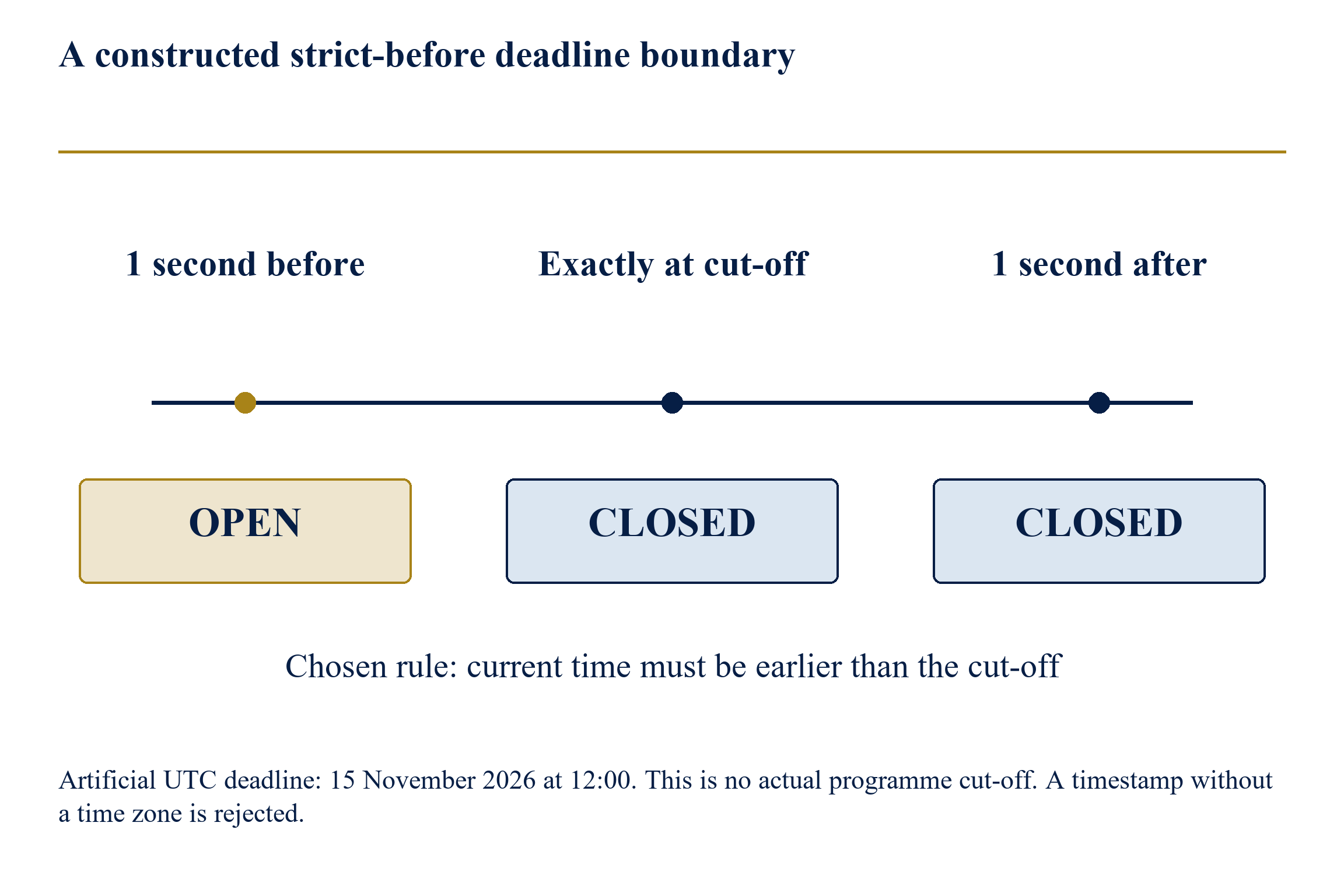
The model includes a separate constructed boundary test using a strict-before condition at 12:00 UTC on 15 November 2026. One second before the selected boundary is open; the exact boundary and one second after are closed under that chosen rule. A timestamp with no time zone is rejected by the test. This date is an artificial test input and identifies no actual programme deadline. The example demonstrates how a timing convention affects a deterministic check. Each real programme requires its own verified timing rule and trigger.
Evidence refresh should be scheduled by the fact it establishes. A document may remain an accurate historical statement while becoming insufficient to demonstrate a current condition. A new financing round may require an ownership record to be refreshed. A later call may ask for a different financial period or an updated project timetable. The review should state why a refresh is required and identify every dependent application claim. Replacing a document without rechecking its dependent numbers can leave a package internally inconsistent even when the replacement itself is authentic.
A stop or defer decision can follow from the timing analysis. A company may have a credible correction plan that cannot be completed by the relevant cut-off. Management can then evaluate a later permitted opportunity, a different programme or another financing route. The record should preserve the reason for the choice and the remaining preparation work so that a future team can reuse verified information without assuming that the earlier deadline is still relevant. This is a decision about the feasible action set at a stated time, supported by the observed rules and the company's supplied capacity.
Scroll horizontally to read the figure at full size. You can also open the full-size figure.
Artificial boundary at 15 November 2026, 12:00 UTC; no actual funding deadline is represented. A missing time zone is rejected by the test.
14 A three-valued clearance model
The constructed model represents a mandatory check using one of three values. Pass means that the supplied facts and selected rule establish the condition for the purpose of the case. Fail means that they establish a condition that is not satisfied. Unknown means that the necessary evidence or interpretation has not been resolved. These are model input states. Assigning them in a real application requires a responsible review of the actual rule and facts. A high-quality program implementation cannot establish that a source is applicable or that a management-supplied fact is true.
For the experiment, six positions represent selected mandatory checks concerning applicant status, project scope, funding compatibility, submission completeness, resubmission permission and timing. The labels define a designed test case. A real opportunity may require a different number of checks, conditional branches and definitions. A condition recorded as not applicable should have its applicability decision documented before the remaining required checks are evaluated. The experiment covers the six selected checks once their applicability has been specified; it does not derive that applicability from programme text.
The rule gives a known failure priority over an unresolved item. If any required check fails, the case is blocked under the supplied conditions. If no check fails and at least one remains unknown, the case is held for evidence. Only a case whose required checks all pass is cleared for submission review. The final state has a limited meaning: it indicates the result of the model's required-condition check. The application still needs the relevant quality assessment, formal submission process and funder decision, with no award outcome predicted.
The model's design makes the reason for a state inspectable. A blocked record should retain each failed check and its source rather than produce only a red indicator. A held record should identify the information needed, its owner and decision deadline. A cleared record should retain the supporting evidence and the scope of the clearance. Changes in a material fact or rule should trigger review of the affected checks. This approach supports a traceable management decision while leaving judgements that require programme authority or professional advice outside the automatic classifier.
A compensatory score is included solely as a designed comparison. It assigns one to pass, one-half to unknown and zero to fail, then clears an average at or above four-fifths. No funder is claimed to use this rule. The comparison asks whether averaging can permit strong values on some checks to offset an unsatisfied mandatory condition. Its parameters are chosen transparently to expose the representation issue. A competitive merit score can have a legitimate purpose under an actual programme; the experiment concerns the inappropriate use of a compensatory average as clearance of mandatory conditions.
| Input state | Case-level consequence | What the state does not establish |
|---|---|---|
| At least one fail | Blocked under the supplied conditions | Whether a different opportunity or legitimate future change is feasible |
| No fail; one or more unknown | Held for evidence or applicability review | A prediction that the condition will pass or fail |
| All selected mandatory checks pass | Clear for submission review in the model | Assessor merit, formal acceptance or an award |
Constructed policy after applicability is supplied. Real rule selection and factual verification require separate review.
Scroll horizontally to read the figure at full size. You can also open the full-size figure.
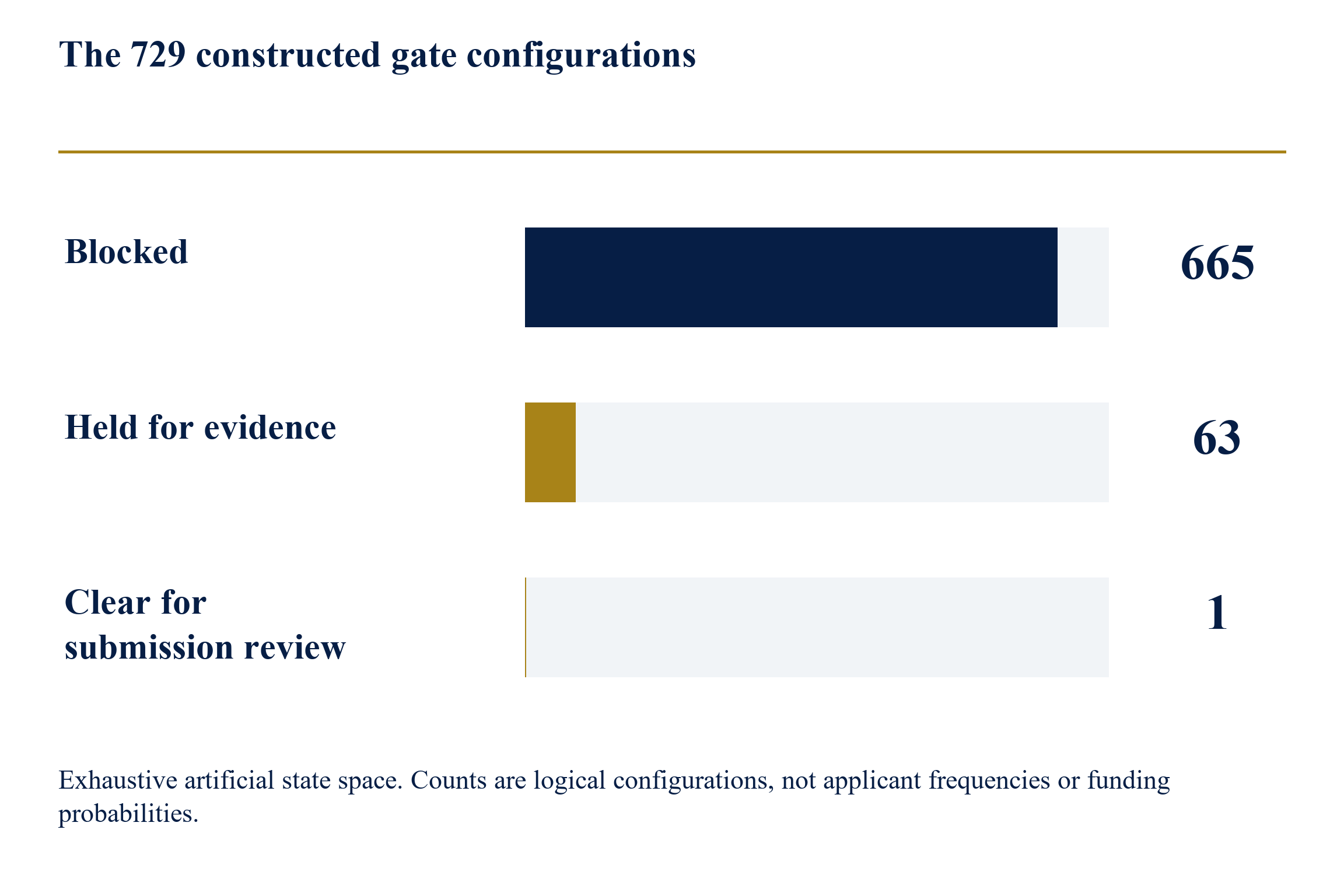
Exhaustive constructed six-gate ternary domain. Logical counts are not applicant frequencies or funding probabilities.
15 Constructed dossiers and test design
The experiment enumerates every combination of six positions and three possible values. There are 729 states because each position can independently take pass, unknown or fail in the constructed test domain. No state is assigned an applicant count, observed frequency or likelihood. Uniform enumeration gives each logical configuration one test record. It allows the implementation to be checked at boundary cases that could be rare, common or absent in a real application population. That testing choice should remain visible when the results are used in a management discussion.
The primary classifier and a separate expected-result calculation are compared for each state. Additional assertions require clearance only when every selected check passes, blocking whenever a selected condition fails and a hold when evidence remains unknown without a known failure. The test also rejects empty check lists and unsupported input labels. These assertions specify the algorithm's intended behaviour within the constructed domain. They establish no independent accuracy of the documentary inputs and cannot substitute for review of a selected programme's conditions.
The expected counts can be checked combinatorially. Sixty-four configurations contain no failed condition because each of six positions can then take pass or unknown. One of those configurations has six passes. The remaining 63 have unresolved evidence and no failed condition. Subtracting the 64 failure-free configurations from all 729 states leaves 665 with at least one failure. These relationships give a transparent cross-check of the enumeration. They are properties of this designed state space, and should not be presented as the proportion of grant applications that a company or funder experiences.
The compensatory comparator is run against exactly the same inputs. The output records which states it clears and whether each contains a failed condition or an unknown. With the chosen numeric mapping and threshold, a case containing five passes and one failure reaches five-sixths and is cleared by the comparator. There are six ways to place that failure. Cases containing unresolved evidence can also cross the selected average threshold. The saved results retain every vector so that a reviewer can reproduce the counts and inspect the examples rather than rely on a summary graphic.
A scientific review of the experiment should examine the specification, implementation, independently calculated expectations and the interpretation attached to the outputs. It should also test alterations that would invalidate the design, such as treating an unknown as a pass or using a weight to offset an explicit failure. Any extension to conditional applicability or legal interpretation would need a revised specification and new tests. The scope of the present experiment remains deliberately narrow so that its logical conclusion is reproducible without claiming that a decision model has automated the evaluation of a real funding application.
16 Model results and falsification cases
The mandatory-condition classifier returns 665 blocked states, 63 held states and one state cleared for submission review. The retained execution passes 2,925 assertions covering the enumeration, count checks, invalid inputs and the constructed timing boundary. The interpretation follows the specified rule. Blocking identifies at least one supplied failed check; holding identifies missing evidence without a known failed check; clearance identifies six supplied passes. These results concern the finite experiment and establish no measured performance on company documents, actual portal submissions or decisions issued by a funder.
The deliberately weighted comparator clears 28 of the same 729 configurations. Six contain a known failed mandatory condition. Another 21 contain unknown evidence without a known failure. One contains six passes. The six failed-condition examples each have five passes and one fail. The 21 unknown examples comprise six configurations with one unknown and 15 with two unknowns. These counts show exactly how the selected average can mask conditions that the mandatory rule requires to remain visible. They provide a falsification case for that representation under the disclosed assumptions.
The operational implication is that a clearance system needs to preserve the logical role of a condition. A project-quality score and an applicant-eligibility requirement answer different questions. The proposed workflow therefore retains separate fields for required-condition state, competitive assessment observations and management's financing decision. This separation supports a review of a strong project whose present route is blocked, and a formally admissible project whose commercial case still needs work. It also allows a company to investigate an unknown without converting that investigation into a passed check.
The results have several explicit limits. They depend on a fixed six-check representation with no empirical weighting. They do not measure how reliably a person can classify documentary evidence, whether the selected checks are complete or whether an automated extraction process understands a rule. They also exclude any attempt to predict the judgement of an assessor or the availability of a funding budget. The supplied checks and their applicability remain management and programme-specific questions. An implementation intended for operational use would need to test those interfaces using a representative, permissioned document set.
A practical falsification exercise should include a persuasive application with one documented ineligibility, an apparently complete package with one unverified entity fact, a technically weak project with all formal requirements passed and a well-assessed project with an unsuccessful budget outcome. The first two probe clearance logic, while the latter two probe whether formal clearance is being misreported as quality or funding. These are constructed test descriptions. They can guide a future validation set whose actual labels are independently established from governing documents and decision correspondence, with disagreements retained for review.
| Result | Configurations | Meaning in the model |
|---|---|---|
| Blocked | 665 | At least one selected required condition fails |
| Held | 63 | No selected failure; at least one unknown |
| Clear for submission review | 1 | All six selected required conditions pass |
| Total | 729 | Every ternary vector in the designed six-check domain |
Constructed exhaustive state space; counts are logical configurations, not observed applicants, rejection rates or funding probabilities.
| Comparator-cleared state | Configurations | Issue |
|---|---|---|
| Five pass and one fail | 6 | A known failed condition is masked by the average |
| Five pass and one unknown | 6 | An unresolved condition is cleared |
| Four pass and two unknown | 15 | Two unresolved conditions are cleared |
| Six pass | 1 | Agrees with the mandatory-condition clearance |
| Total comparator clearances | 28 | Designed numeric comparator only; no funder practice is asserted |
Pass=1, unknown=1/2, fail=0; constructed average threshold=4/5. The comparator illustrates a representation error under these assumptions.
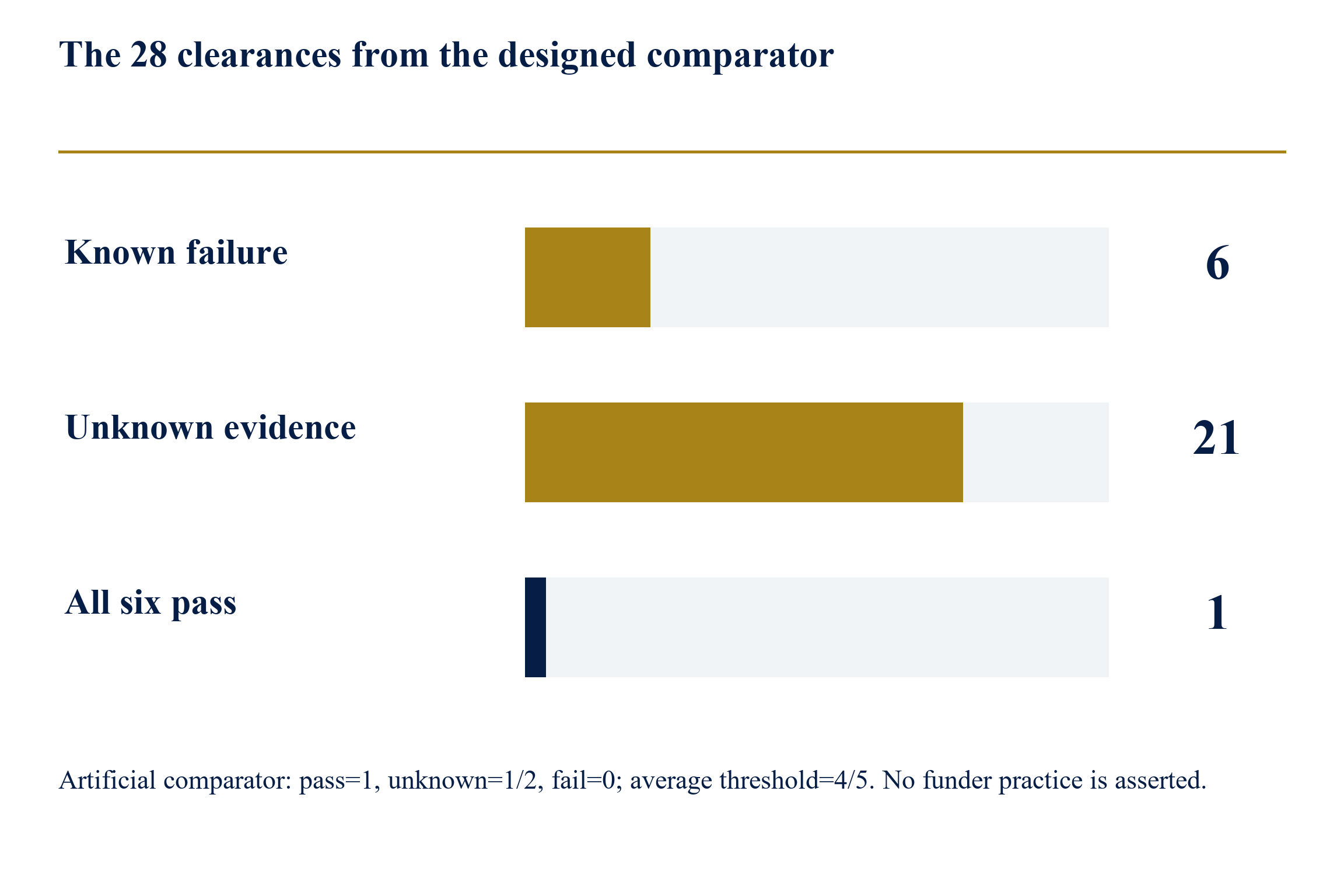
Scroll horizontally to read the figure at full size. You can also open the full-size figure.
Deliberately constructed comparator: pass=1, unknown=1/2, fail=0, average threshold=4/5. No funder is said to use this rule.
17 Prioritise correction effort
A correction plan should begin with the condition that constrains the available action. If a required permission is unresolved, management needs to know the cost and timing of resolving it before authorising the full application. If a technical experiment is necessary, its design, resources and completion date should be explicit. If a documented condition cannot be changed for the selected opportunity, the team should consider the alternatives available under the actual rules. The sequence of work should preserve these dependencies so that completing an easy drafting task does not conceal the issue that determines feasibility.
Each task can be specified through an evidence object, an owner, a completion criterion, a dependency and a latest useful date. The criterion should describe an observable output, such as a reconciled cost schedule, a verified registration record, an experimental result or a written determination. The plan should also record who accepts the output and how it affects the relevant check. A task that produces a draft answer remains a drafting task until the underlying factual claim and required approval have been checked. This distinction supports accountable delegation across finance, technical, legal and application teams.
The proposed prioritisation method first identifies work required to determine whether the route is open. It then identifies correction work that is feasible before the selected cut-off and work whose result supports more than one financing route. Management can compare cost, dependency and usefulness without assigning unsupported funding probabilities. A market study, technical validation or financial reconciliation may have value beyond one competition. That additional use should be identified separately from the claim that the work increases the chance of an award. The company can then approve its expenditure for a defined set of purposes.
A constructed case shows the importance of dependencies. Suppose an application needs a partner's commitment and a revised work package before a final cost reconciliation can be accepted. The team estimates two days for the commitment, three days for the work-package revision and one day for reconciliation after both are complete. The earliest completion depends on whether the first two tasks can run together. These are supplied planning assumptions. They identify a scheduling question for the team; they establish no programme deadline, typical correction period or actual partner willingness.
The decision record should state the amount of work approved now, the event that releases the next tranche and the condition that stops further spending. Actual completion evidence should be attached as tasks close. Where an input changes, the owner should identify the affected dependencies and obtain a revised decision when necessary. The company can preserve valid work while changing the financing route. This creates a controlled way to learn from an unsuccessful application without assuming that every outstanding comment warrants unlimited additional preparation or that a completed checklist represents a funding commitment.
| Work category | Required output | Decision before further spending |
|---|---|---|
| Applicability discovery | A sourced answer or retained unresolved issue | Is the proposed route sufficiently established? |
| Evidence correction | Verified record or completed analysis | Does it address the identified issue? |
| Project redesign | Revised objectives, method, resources and milestones | Does management support the changed project? |
| Application production | A reconciled permitted package | Are the conditions, permissions and deadline checked? |
| Alternative finance | A reviewed scenario using actual proposed terms | What event and cash boundary require a choice? |
Proposed staged spending control. Costs, durations and risk preferences need company inputs.
18 Runway and alternative finance
The financing plan needs to distinguish an application, a favourable assessment, a formal offer, a signed agreement and available cash. The events between those states can require time, expenditure, conditions and further decisions. The company's cash model should identify the actual event supporting each forecast receipt and retain uncertainty where the event has not occurred. A project can remain technically promising while its funding timetable creates a cash shortfall. Management should examine that shortfall using the company's supplied operating assumptions rather than rely on the label of a preferred programme.
The first comparison can use the amount of cash committed to preparation and the milestone that the company must finance. Consider a constructed business with 400,000 monetary units of unrestricted cash and baseline net spending of 50,000 units per month. Dividing the starting cash by that constant spending gives eight months before cash reaches zero under the simple model. Paying 30,000 units immediately for a correction programme reduces the corresponding period to 7.4 months if every other input stays unchanged. The figures are chosen examples, with no revenue changes, working-capital effects, reserve policy or financing receipts included.
A useful grant comparison should examine timing and conditions as well as the nominal support amount. If an award reimburses eligible expenditure, the company needs to finance the expenditure before the relevant receipt under its actual terms. A required contribution, excluded cost or delayed start can change the cash requirement. Equity, debt, customer finance and strategic partnerships introduce their own rights, costs, conditions and execution risks. Each alternative should be evaluated using its actual proposed terms and current availability. The framework provides no ranking that applies to every company and makes no assumption that a fallback provider will finance the project.
An expected-value calculation would require a defensible outcome probability and an accurately defined net benefit. Neither can be supplied by the logical state counts in this paper. If management has a justified probability estimate from an appropriate source, it can test that estimate as an explicit input and examine its sensitivity. Where the probability is unknown, the decision can retain it as a variable and identify the value required to justify the preparation cost. The result is an indifference condition under stated assumptions. It does not create evidence that the required probability exists.
The board should retain a latest decision date for alternative finance and identify the evidence that would change that date. Continued grant preparation can proceed alongside a financing discussion when the relevant restrictions and resource commitments are understood. A commercial milestone can also be staged, redesigned or deferred if management considers that feasible. Each choice needs its own cash and operational consequences recorded. The funding decision should therefore end with a plan for the next financing event and the minimum cash position management is prepared to accept, with those thresholds identified as company decisions rather than findings of this study.
| Immediate correction expenditure | Cash after expenditure | Months to zero at 50,000 per month |
|---|---|---|
| 0 | 400,000 | 8.0 |
| 30,000 | 370,000 | 7.4 |
| 60,000 | 340,000 | 6.8 |
| 100,000 | 300,000 | 6.0 |
Chosen monetary units; starting unrestricted cash 400,000 and constant monthly net spending 50,000. Simple arithmetic scenario with no receipts, working capital, reserves or changes in spending; no market calibration or funding probability.
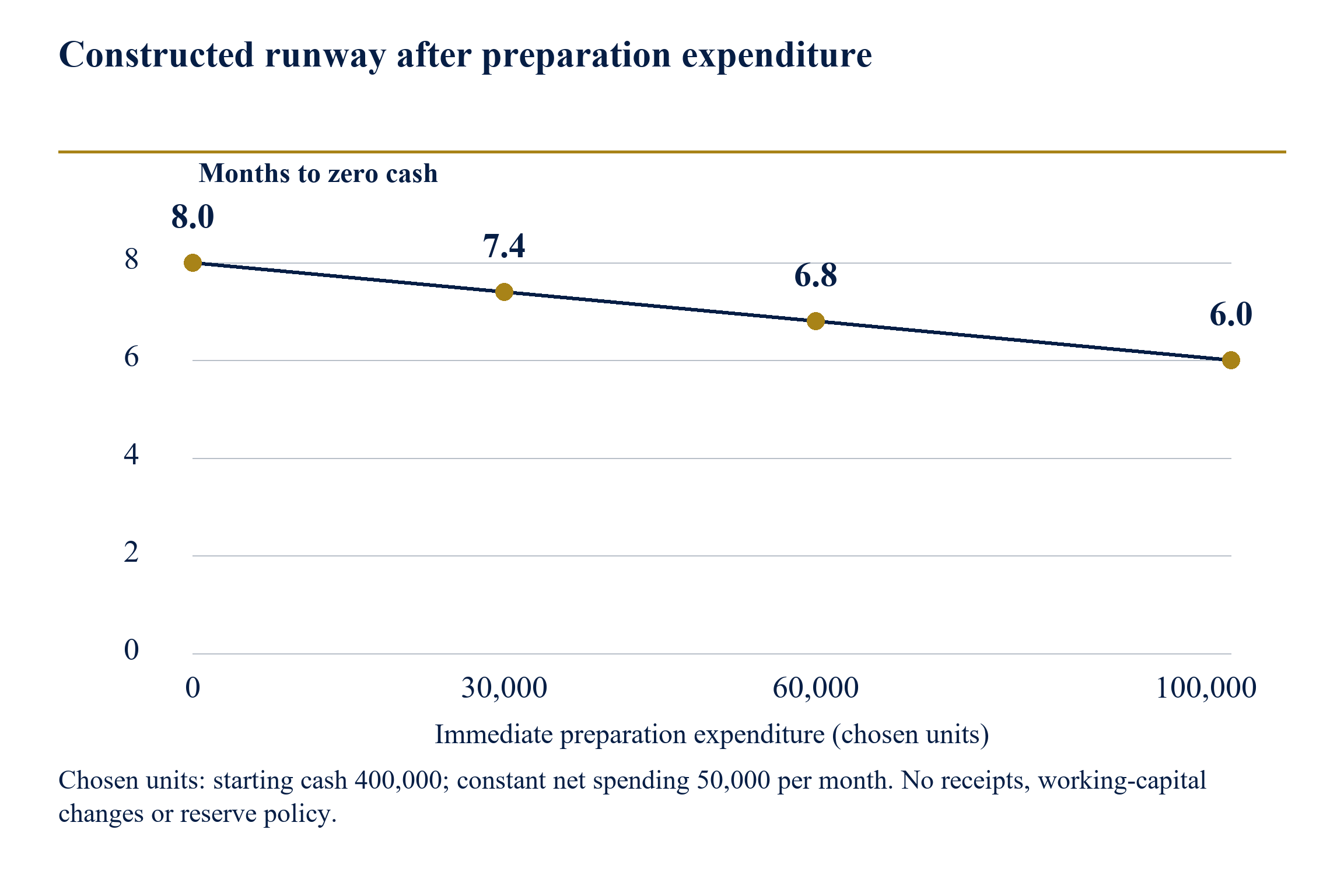
Scroll horizontally to read the figure at full size. You can also open the full-size figure.
Constructed constant-spending arithmetic. A company's actual cash model and minimum reserve policy require its own inputs and review.
19 Ownership changes and transaction diligence
A financing round or acquisition can change facts that an application or award relies on. The transaction team should identify the legal entity receiving support, the proposed changes in ownership or control, relevant affiliates, work locations, project responsibilities and commitments. It should then examine the applicable application documents, award terms and notification or consent requirements. The review should preserve the state of each condition at the relevant dates. It should also distinguish a grant application from an existing award and an award from an investment component that remains subject to further approval.
The company's funding-history schedule can support diligence by linking each relevant application or instrument to its evidence. A buyer or investor may need the original submission, amendments, decision correspondence, project budget, reporting record and conditions associated with a transaction. The schedule should identify which documents have been reviewed and which remain outstanding. A high-level statement that the business has grant support does not describe the full set of obligations or establish that a contemplated transaction is compatible with them. Any conclusion requires the actual applicable documents and appropriate review.
The proposed transaction checklist focuses on dependencies rather than assigning an automatic value adjustment. It asks whether a change affects a defined eligibility condition, an application representation, a required project participant, a cost allocation or a source of matched funding. It asks who can determine the consequence and what event needs to occur before completion. It also identifies the cash forecast entries that depend on continued access to support. These questions allow financial, commercial and legal advisers to coordinate their work without allowing a general funding description to stand in for a programme-specific determination.
A conditional issue can be reflected in the execution plan while the parties obtain evidence. The appropriate treatment could depend on the transaction documents and advice, including the timing of a consent, the allocation of responsibility for a condition or a revised project plan. This paper proposes no standard contractual clause or price reduction for every case. A financial model can show the effect of supplied funding scenarios once the underlying assumptions are identified. Those scenarios should remain visibly separate from verified rights and from any conclusion that a particular funder has agreed to the proposed transaction.
An unsuccessful application can also provide useful diligence information when its limits are understood. A technical comment may identify a question that warrants investigation. It should be evaluated against the underlying evidence and the scope of the original review. The outcome of one funding competition does not provide a complete valuation or commercial diligence opinion on the company. The transaction team should retain the original record, identify the issue that is relevant to its own decision and commission the work needed to address that issue under the transaction's actual scope.
20 AI-assisted evidence triage and human authority
A proposed AI-assisted workflow can help organise the document set by extracting candidate rules, dates, entities and application statements for review. Its output should identify the exact source passage and document version associated with each suggestion. The system should retain the original document alongside the extraction and make unresolved applicability visible. The useful design objective is a reviewable evidence map. Acceptance of a rule, a factual status or a recommended next action remains a separate decision by the responsible person, based on the applicable programme and documents.
Document status creates a material design risk. An archived solicitation, a live FAQ discussing a later programme year and a policy supplement can all appear relevant to a search query. A retrieval process should therefore capture the source's status, effective date, replacement links and scope. It should preserve amendment markup and identify when extracted text includes both deleted and inserted wording. These are proposed system controls based on the version distinctions documented in the source review. Their presence in a specification establishes no measured accuracy for a deployed AI product.
The evaluation set should include deliberately difficult pairs. One pair can present an archived rule beside its identified successor. Another can present a general policy beside a programme-specific condition whose applicability requires clarification. A third can include a missing applicant fact and test whether the system preserves an unknown rather than supplies a plausible value. Other cases should test numerical boundaries, stage-specific dates, conditional permissions and a decision notice that gives no cause. Each label should be established independently from the relevant evidence. Disagreements should be retained as review items.
Confidential application materials require a separate data-handling decision. The company should identify the documents proposed for processing, their confidentiality and contractual restrictions, personal data and intellectual property, the authorised environment, access permissions and retention. A public source-review tool and a system handling an unpublished application have different data scopes. Any operational deployment would need its own approved handling arrangements, security review and assessment of the applicable legal and contractual requirements.
A release criterion for the proposed workflow should focus on a defined task and evidence set. Examples include correct retrieval of the selected governing source, accurate extraction of a dated rule, faithful retention of unknowns and the ability to reproduce a decision record. The business should also examine the time required for human checking and correction. No productivity saving or reduction in rejection is measured here. The constructed gate experiment tests the downstream logic once inputs are supplied; a separate evaluation is required to establish whether an extraction or reasoning system supplies those inputs reliably.
| Case | Expected review behaviour | Failure to detect |
|---|---|---|
| Archived rule beside its successor | Retain status and version, inspect actual applicability | Old rule silently treated as current |
| General and programme-specific conditions | Retain the conflict for resolution | Unsupported universal precedence |
| Missing applicant fact | Preserve unknown and request evidence | A plausible fact supplied without evidence |
| Deleted and inserted policy wording | Inspect the effective amendment | Both versions merged into a false current rule |
| Stage-specific timing | Bind the condition to the relevant stage | Submission and award conditions confused |
| Notice with no reason | Retain unknown cause | A rejection reason invented from surrounding material |
Proposed test cases, not a measured AI-system performance result. Input labels need independent source and case review.
21 A post-decision operating process
The operating process begins when the responsible owner receives the actual outcome communication. The owner preserves the notice, application package and relevant portal or receipt records, then registers the programme, call, stage and legal entity. The initial record should describe the decision using the funder's wording and identify the documents available. Where a deadline for a review or further step may apply, it should be escalated immediately for the appropriate interpretation and diary control. The first management output is a reliable description of the event and the questions that remain open.
A second step establishes the applicable source set and the decision-stage diagnosis. The reviewer should identify any archived material, replacement policy, programme-specific condition or unresolved conflict. Each material issue is linked to the evidence that supports it. The company can then classify the required checks as passed, failed or unknown for the proposed next action, with a named reviewer and date. The classification should state its scope. It can support an internal decision without implying that the programme has accepted the company's interpretation or approved an application.
The correction workshop should produce a limited set of actionable tasks. Each task needs an owner, a cost or effort estimate supplied by the company, a completion criterion and a latest useful date. The team should identify dependencies, required third-party decisions and work that supports another financing route. It should also identify any task whose purpose remains unclear because the stated rejection reason is unavailable. That task belongs in discovery and clarification until the link is established. The resulting plan provides management with a basis to approve work in stages and to review progress against evidence.
The financing decision should be recorded alongside the correction plan. Management needs the cash position under the relevant supplied assumptions, the next commercial milestone, the timing of a possible funding decision and the alternative actions it is prepared to pursue. A further submission should have a defined approval point and a final package review. A decision to defer or stop should preserve useful evidence and the reason for the choice. The record should remain intelligible to another responsible person who was absent from the workshop and needs to understand why resources were committed.
After the next event, the company can close or update the record. It should preserve the actual submission, decision, award conditions and cash receipts as separate observations. It should also record work discontinued, changes in the project and departures from the original plan. This information can support internal learning and a later empirical study if the data are permissioned and sufficiently complete. The process should avoid rewriting an earlier decision record to match a later outcome. Preserving what was known at the time allows a more credible evaluation of the decision and its assumptions.
22 Empirical validation and selection bias
An empirical test of the proposed framework needs an application-level denominator. The dataset should include eligible and ineligible submissions, applications returned before assessment, withdrawn projects, assessed unsuccessful proposals and awards. It should identify repeat applications and legal entities across time. Public award records can support part of that work but leave important parts of the population unobserved. The Innovate UK dataset reviewed here describes funded-project records, and CORDIS describes funded research projects and results. This study has not acquired the application and decision data needed to fill the negative-outcome portion of a new panel. [14,15]
Existing research already examines applicants and unsuccessful outcomes. The Joint Research Centre's 2023 report Spurring Subsidy Entrepreneurs describes 2,302 applicants across 40 Italian local competitions, with rankings and funding decisions. The official Fast Start process evaluation dated February 2024 includes interviews with 14 successful and seven unsuccessful applicants; its unsuccessful sampling frame began with the 30 highest-scoring unsuccessful cases. These are distinct research designs and populations. They establish relevant prior art and demonstrate the importance of the sampling frame. Their results cannot be treated as a new representative cohort for this paper's selected programmes. [16,17]
A prospective study could register companies when they decide whether to prepare an application, before an outcome is known. It would record the applicable opportunity, applicant facts, proposed milestone, preparation resources, initial gate states and the evidence available at the decision date. Later observations would capture submission, assessment, decision, terms, cash receipts and commercial outcomes. Companies that stop applying would remain part of the follow-up population. The study would need an appropriate consent, confidentiality and data-governance design, and would have to report attrition and missing records explicitly.
The principal empirical challenge is selection. Companies choosing to reapply may differ in technology, resources, experience, eligibility or financing prospects from companies that stop. Programme rules and available budgets can also change between rounds. A later award following a correction programme does not, on its own, identify the effect of the correction. The study should define its estimand, comparison group, timing and confounders before calculating an effect. Where the data support description only, the conclusions should remain descriptive. An observational design would need to explain the assumptions required for any stronger interpretation.
Commercial outcomes require equally careful definitions. A grant amount does not reveal equity dilution, and an award date does not establish cash receipt. A subsequent fundraising announcement can omit terms and timing that matter to the company's financing decision. A milestone can change in scope or measurement. The proposed panel should therefore specify how each outcome is observed and distinguish missing information from zero. It should report the usable sample for each analysis and preserve the source documents supporting material observations. No such linked award, dilution, timing and milestone panel has been obtained for the present paper.
| Data group | Required observation | Missing-data risk |
|---|---|---|
| Entry population | All eligible and ineligible attempts within a defined frame | Award-only selection |
| Entity and repeat attempts | Stable joins with dated application history | Repeated firms treated as independent entrants |
| Decision process | Actual stage, notice and available feedback | Causes assigned without a notice |
| Intervention | Correction tasks and costs measured before the outcome | Retrospective success narrative |
| Funding | Offer, agreement, terms and actual receipts | Award date substituted for cash receipt |
| Commercial outcomes | Predefined milestone, timing and financing terms | Changed outcome definition or undisclosed dilution |
| Attrition | Stopped applications, withdrawals and unobserved follow-up | Survivorship and informative missingness |
Proposed empirical design. No new linked applicant-level panel has been obtained for this paper.
23 Limitations and transferability
The documentary review covers selected official sources and the relevant passages identified in the source register. It is neither a complete inventory of innovation-funding opportunities nor a legal opinion on every application route. Rules can change, and the applicable call, invitation, decision letter and award documents may contain additional conditions. The paper records the versions reviewed and preserves unresolved questions rather than selecting a universal rule from different contexts. A company using the framework needs a current programme-specific review tied to its own facts and proposed action.
The mandatory-condition experiment tests a specified logical representation. Its inputs are constructed, its checks are assumed applicable and its state space has no empirical distribution. The numerical results therefore cannot estimate the share of companies that should reapply or the expected return from a correction programme. The experiment also leaves out the quality of rule extraction, completeness of the condition set and accuracy of applicant evidence. Those interfaces are central to operational use and need separate validation. A passed software test should be described using the task it actually verifies.
The proposed workflow can be adapted to another programme by replacing the rule register, decision stages, required conditions, permitted actions and timing conventions. The adaptation should preserve the meanings of pass, fail and unknown while documenting programme-specific exceptions. A route that allows a particular correction or review supplies no general permission elsewhere. Transferability therefore concerns the structure of the management method, with each substantive application requiring new evidence. The saved output should identify which parts are reused process design and which are newly established programme or applicant facts.
The financing examples use supplied constant inputs and omit many features of an operating company. Actual cash forecasting can require revenue, working capital, tax, contractual commitments, reserves, foreign exchange, project spending and the timing and conditions of receipts. The business needs its own reviewed model and appropriate advice. This paper does not quote an available funding offer or verify the willingness of a capital provider.
The lack of a newly acquired rejected-applicant cohort limits empirical conclusions but leaves a defined research programme. A future study can test the reliability of the diagnostic labels, usefulness of the task plan, cost of review and association with later decisions under a pre-specified design. It can also test an AI-assisted workflow against independently established source and case labels. Until such evidence exists, the contribution remains a source-grounded operating framework and a reproducible logical counterexample. Its use should preserve the boundaries between documented rules, proposed practice, constructed calculations and observed outcomes.
24 Management conclusions
The decision after an unsuccessful application should begin with the actual notice, applicable programme and available evidence. Management needs to identify the decision stage before choosing a correction task. Administrative conformity, applicant eligibility, project scope, competitive assessment, selection and pre-award conditions can lead to different next actions. A clear record of what is known, what remains unknown and who can resolve the issue provides a stronger basis for authorising further expenditure than an undifferentiated instruction to improve the application.
Programme and version identity belong inside that decision. The reviewed sources contain current and archived material, programme-specific submission conditions, amendments and guidance addressing a later year. A business should preserve those distinctions in its rule register and resolve applicability questions against the actual opportunity and decision documents. The register should also retain the source and timing of any clarification. This allows a reviewer to inspect the basis for a proposed next action and identify the circumstances under which it needs to be reconsidered.
The constructed experiment supplies a precise warning about mandatory-condition representation. In the six-check state space, the conjunctive rule clears only the all-pass case, while the designed compensatory comparator also clears configurations with failures and unknowns. A submission-clearance model should therefore keep required conditions distinct from competitive merit scores and from management's commercial judgement. The result is a logical property of the disclosed model. It does not certify eligibility, automate an assessor's decision or estimate the probability that any company will receive funding.
Correction work should have a defined purpose, evidence output, owner, completion date and spending boundary. A later application also needs a current permission and timing assessment. The financing plan should preserve the difference between application activity, formal award conditions and cash available to the business. Management can examine alternative capital and project choices using the company's own facts and assumptions while the grant route remains conditional. That comparison should be updated when the evidence, programme conditions or commercial milestone changes.
The practical deliverable is a reviewable next-action decision with its supporting evidence and financing consequences. It can authorise a permitted revised application, targeted discovery, a procedural step, another funding route or a stop decision. Each outcome should preserve the reason for the choice and the information available when it was made. The proposed empirical agenda then provides a way to test the method using a genuine applicant denominator and observed later outcomes. Further research should establish those effects before claims about reduced rejection, improved funding success or lower dilution are made.
References
- UK Research and Innovation. Before you start an application. Innovate UK general guidance. Updated 8 May 2026. Accessed 13 November 2026. https://www.ukri.org/councils/innovate-uk/guidance-for-applicants/general-guidance/before-you-start-an-application/
- UK Research and Innovation. What happens after you have submitted your application. Innovate UK general guidance. Updated 7 May 2026. Accessed 13 November 2026. https://www.ukri.org/councils/innovate-uk/guidance-for-applicants/general-guidance/what-happens-after-you-have-submitted-your-application/
- UK Research and Innovation. Application resubmissions. Updated 22 October 2026. Accessed 13 November 2026. https://www.ukri.org/apply-for-funding/develop-your-application/application-resubmissions/
- UK Research and Innovation. Your application. Innovate UK general guidance. Accessed 13 November 2026. https://www.ukri.org/councils/innovate-uk/guidance-for-applicants/general-guidance/your-application/
- European Commission. European Innovation Council Work Programme 2026. C(2026)2051, 26 March 2026 revision. Historical version, separately captured from the official previous-version download. Accessed 13 November 2026. https://eic.ec.europa.eu/document/download/023b0721-db3e-4f4b-b043-75fec1fcbb2b_en?filename=EIC-Work-Programme-march-2026.pdf
- European Innovation Council. FAQs EIC Accelerator. Live page referring to the 2027 Work Programme when accessed on 13 November 2026; relevant year and call require separate verification. https://eic.ec.europa.eu/eic-frequently-asked-questions/faqs-eic-accelerator_en
- US National Science Foundation. NSF 26-510. Small Business Innovation Research and Small Business Technology Transfer Phase I, Phase II and Fast-Track Programs. Posted 22 May 2026; active/current when accessed on 13 November 2026. Sections IV and VI. https://www.nsf.gov/funding/opportunities/small-business-innovation-research-small-business-technology/nsf26-510/solicitation
- US National Science Foundation. SBIR/STTR Eligibility. Current linked programme guidance, including returned-without-review and declined proposal instructions. Accessed 13 November 2026. https://seedfund.nsf.gov/solicitation-eligibility/
- US National Science Foundation. PAPPG 24-1 Supplement 1, NSF 26-200. Effective 8 December 2025. Sections 8 and 9; inserted and deleted amendment text checked in the official HTML. Accessed 13 November 2026. https://www.nsf.gov/policies/document/pappg24-1-supplement-1
- European Commission. European Innovation Council Work Programme 2026. Current 17 June 2026 revision, C(2026)4080. Application submission limits page 87; Annex 2 F.2 page 191. Accessed 13 November 2026. https://eic.ec.europa.eu/document/download/52598755-1351-4b54-b46b-e2682d0a3aec_en?filename=EIC-Work-Programme-2026.pdf
- European Commission. Horizon Europe Work Programme 2026-2027, General Annexes. Scope page 3 and evaluation review page 30. EIC is separately governed. Accessed 13 November 2026. https://ec.europa.eu/info/funding-tenders/opportunities/docs/2021-2027/horizon/wp-call/2026-2027/wp-15-general-annexes_horizon-2026-2027_en.pdf
- European Commission. EU Funding and Tenders Portal Online Manual. Version 1.3, 1 May 2026. Applicable procedure and confidential proposal records. Accessed 13 November 2026. https://ec.europa.eu/info/funding-tenders/opportunities/docs/2021-2027/common/guidance/om_en.pdf
- US National Science Foundation. Proposal and Award Policies and Procedures Guide 24-1, Chapter IV, Non-Award Decisions and Transactions. Read with applicable supplements and solicitation. Accessed 13 November 2026. https://www.nsf.gov/policies/pappg/24-1/ch-4-non-award-decisions-transactions
- UK Research and Innovation. Innovate UK funded projects since 2004. Dataset landing page updated 3 November 2026. Award records are not a complete rejected-applicant population. Accessed 13 November 2026. https://www.ukri.org/publications/innovate-uk-funded-projects-since-2004/
- European Commission. About CORDIS. Funded-project information and research results. Accessed 13 November 2026. https://cordis.europa.eu/about
- European Commission Joint Research Centre. Spurring Subsidy Entrepreneurs. JRC135716, 2023. Applicant and competition sample described in the report. Accessed 13 November 2026. https://publications.jrc.ec.europa.eu/repository/handle/JRC135716
- Innovate UK. Fast Start Process Evaluation. Report dated February 2024, hosted in the UKRI public report library. Interview sample and unsuccessful-applicant sampling frame. Accessed 13 November 2026. https://www.ukri.org/wp-content/uploads/2026/01/22-057322-01-IUK-Process-Eval-Report_MASTER_V4_Client-use_CLEAN.pdf
- US National Science Foundation. SBIR/STTR Merit Review Criteria and Process. Current guidance linked by NSF 26-510. Accessed 13 November 2026. https://seedfund.nsf.gov/solicitation-merit-review/
- US National Science Foundation. PAPPG 24-1 Supplement 2, NSF 26-202. Applicable award-date provisions require separate checking. Accessed 13 November 2026. https://www.nsf.gov/policies/document/pappg24-1-supplement-2
- US National Science Foundation. Proposal and Award Policies and Procedures Guide 24-1, Chapter III, Proposal Processing and Review. Recommendation, final decision and specified financial or administrative appeal provisions; read with applicable supplements. Accessed 13 November 2026. https://www.nsf.gov/policies/pappg/24-1/ch-3-proposal-processing-review
- US National Science Foundation. SBIR/STTR Supplementary Documents. Phase-specific requirements and evidence instructions. Accessed 13 November 2026. https://seedfund.nsf.gov/solicitation-documents/
About the Author
Chennakeshav (CK) is a corporate finance and investment banking executive with 25+ years of global experience in deal origination, structuring and execution across M&A, growth capital and corporate strategy. He has led value-creation mandates for founders, corporates and funds — bridging the boardroom view to hands-on execution and close.
His career spans Morgan Stanley, HSBC, Lloyds Banking Group, EWEC, ADQ portfolio companies and Emirates Growth Fund, across TMT, real estate, fintech, deeptech, cleantech, infrastructure and energy. He has partnered with C-suite leaders, private equity and venture funds, sovereign wealth funds and family offices to finance complex fund raises and scale-up ventures, and has led M&A due diligence, post-merger integration and business-transformation initiatives to create value.
At Matchpoint Partners he is Managing Partner, leading the firm's corporate finance, M&A and capital-raising practice. He holds an MBA from London Business School, an engineering degree from VTU and a Master of Laws (LLM, in progress) from UCL London.
An active start-up mentor, CK mentors at Techstars, DIFC FinTech Hive, Startup Grind, Founder Institute and IN5, serves as Entrepreneur Mentor in Residence (EMiR) at London Business School, and judges the Entrepreneurship World Cup.
https://www.linkedin.com/in/ckadya/
https://www.matchpoint-partners.com/team/ck-adya.html
Disclaimer
This paper is part of a continuing series on the structure of private and alternative markets. The views expressed are the author's own. The paper is for information only, describes market structure in general terms, and does not constitute investment, legal, tax or regulatory advice or a recommendation in respect of any security, vehicle or counterparty.
