

1. Price the security rather than the headline valuation
A pre-money valuation and the amount invested determine an initial ownership percentage only when the fully diluted denominator is controlled. They do not determine the investor's payoff. Preferred equity can receive proceeds before ordinary equity, participate in residual value after receiving a preference, accrue dividends, adjust its conversion price after a down round or require redemption. The economic bargain therefore sits in the security as well as the valuation.
The board's first question should be: what does each stakeholder receive under plausible outcomes? A term sheet that states a USD 160 million pre-money valuation but leaves participation, ranking and anti-dilution to later drafting does not contain enough information for an economic decision. Those terms can alter the distribution of value at the exit values most relevant to the company's plan.
Current UK government term-sheet guidance distinguishes participating and non-participating preference. It describes non-participating preference as a choice between the initial preference, usually 1x, and sharing with other holders; participating preference receives the initial amount and then a further share of remaining proceeds. The guidance identifies 1x non-participating preference as the standard approach observed in that programme. [1] That evidence is useful for orientation. The board still needs transaction-specific analysis because ranking, dividends, caps and future securities can change the result.
The Preference Stack Test treats the latest financing as one layer in a dynamic capital structure. It models the legal rights, the sequence of payments, holder elections, time and later financing. It then compares packages on equivalent economic terms. This allows a board to see whether a movement in headline valuation compensates for a more investor-favourable security.
2. Reconstruct the capital stack before negotiating the new round
The model should begin with the company's legal and fully diluted capitalisation immediately before the financing. It should identify every class and series, issued shares, options, warrants, convertible instruments, unallocated option pool, declared or accruing dividends, conversion price, preference amount, participation terms, ranking and special adjustments. A summary cap table without these rights is insufficient.
The source documents should include the constitution or certificate of incorporation, amendments and designations, shareholder agreements, subscription documents, option plans, warrants, notes, side letters and any transaction-specific waivers. The current NVCA model suite separates the certificate of incorporation, stock purchase agreement, investors' rights agreement, voting agreement and right of first refusal and co-sale agreement. The models were updated recently for changing law and financing practice, and they are designed as internally consistent starting points. [2] The executed documents remain the authority for the company.
The inventory should distinguish legal ownership, as-converted ownership and fully diluted ownership. It should also state the treatment of unvested awards, cancelled options, promised grants and instruments that convert at a discount or valuation cap. A financing model can appear to balance when the issued share count is correct while still allocating value incorrectly because the option pool or convertible denominator differs from the documents.
Every security should receive a unique identifier in the model. The identifier links the legal term, cap-table line, cash flow and approval evidence. Changes should be version-controlled. A board should not approve a financing from a waterfall that cannot be reconciled to the executed capital records.
| Field | Question | Evidence | Model consequence |
|---|---|---|---|
| Class and series | Which legal security owns the claim? | Charter, articles and amendments | Establishes separate waterfall line |
| Original issue price | What price anchors preference and conversion? | Subscription and designation | Sets preference and conversion basis |
| Ranking | Senior, pari passu or junior to each other class? | Charter and inter-class provisions | Determines payment sequence |
| Preference multiple | What amount is paid before junior claims? | Liquidation provision | Creates downside floor subject to available proceeds |
| Participation | Does the holder share again after preference? | Participation and cap language | Changes residual allocation |
| Dividend | Declared, accruing, simple or compounding? | Dividend provision | Changes preference through time |
| Conversion | Optional, automatic or event-driven? | Conversion provision | Creates holder election and breakpoint |
| Anti-dilution | Which issues reset the conversion price? | Adjustment provision and exclusions | Changes as-converted ownership |
| Pool and convertibles | Which instruments enter the denominator? | Option plan, warrants and notes | Changes dilution and adjustment formula |
Each field should be reconciled to the definitive documents and current cap table.
3. Define distributable proceeds and the triggering event
The waterfall cannot be modelled until distributable proceeds are defined. Enterprise value is not the amount available to shareholders. The bridge may include debt, debt-like items, cash, transaction costs, working-capital adjustments, tax, leakage, escrow, indemnity holdbacks, earn-outs, rollover equity and other consideration. The model should show the path from headline transaction value to the proceeds governed by the preference provisions.
The documents should define liquidation, dissolution and winding up, and they often extend the waterfall to a deemed liquidation event such as a merger, change of control or sale of substantially all assets. Delaware law permits classes and series with stated preferences, participating or optional rights and rights on dissolution or distributions of assets. Those rights must be expressed in the certificate or valid authorising resolutions. [3] A commercial spreadsheet cannot repair a legal definition that excludes the transaction being considered.
The team should test asset sales and share sales separately. In an asset sale, consideration first enters the company and is reduced by liabilities, tax and wind-up costs before distribution. In a share sale, consideration may be paid directly to holders under the transaction agreement. The documents may treat both as deemed liquidation events, yet cash timing and deductions can differ.
The model should also define the measurement date. Dividends, preference accretion and conversion adjustments may continue until closing, signing, payment or another contractual date. A long regulatory closing period can therefore change the economics. The closing statement and waterfall model must use consistent dates and definitions.
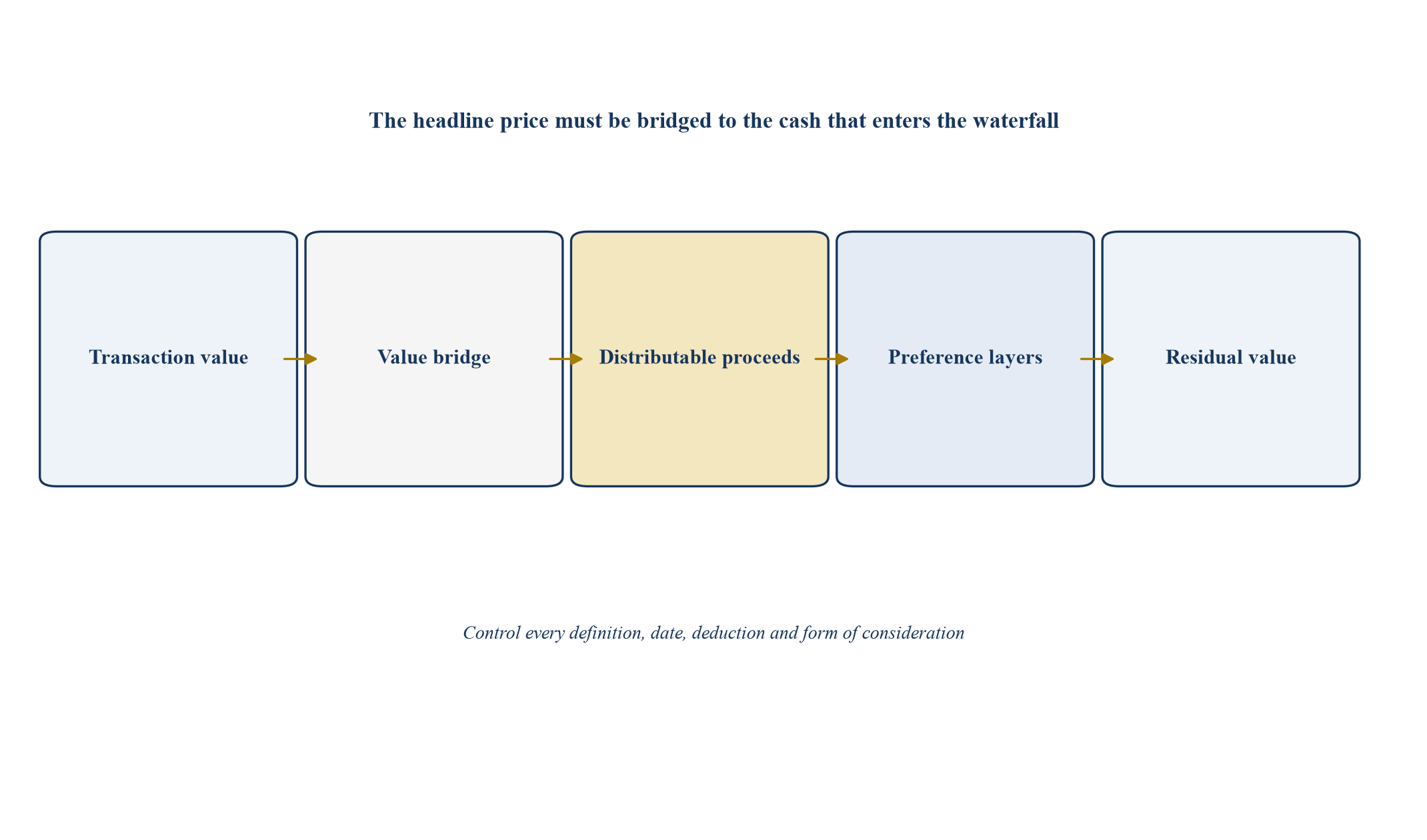
The sequence is illustrative. The definitive documents and transaction structure determine actual deductions and priority.
4. Map seniority pari passu ranking and junior claims
Ranking determines who absorbs a shortfall. A senior class receives its contractual amount before a junior class. Pari passu classes share an insufficient pool according to the formula in the documents, often in proportion to their respective preference entitlements. Ordinary shareholders receive value only after claims that rank ahead of them, subject to conversion elections and participation.
The stack should be drawn as a directed payment sequence rather than a list of securities. A new investor may request seniority over all existing preferred shares. Existing investors may have class consent rights that prevent subordination without approval. The financing can therefore require amendments, waivers or a reorganisation of existing rights in addition to the new subscription.
Public filings show that multi-class structures can contain several layers. A 2025 filing describes Series B preferred as senior to Seed and Series A preferred, with specified junior classes participating pari passu within their layer. [4] That example does not establish a market norm. It demonstrates why the model must reproduce the actual hierarchy and the pro-rata shortfall rule.
Seniority can be priced by comparing proceeds under equal exit values. At a high exit, every class may convert and ranking can become economically irrelevant. At a low or moderate exit, seniority can shift value materially. The board should therefore evaluate the exit distribution implied by the business plan rather than judging seniority from a single optimistic outcome.
5. Model the non-participating conversion election
A non-participating preferred holder generally chooses between taking the contractual preference and converting into ordinary equity. The choice creates a breakpoint. Below that point, the preference is more valuable. Above it, the as-converted share of proceeds is more valuable. The model should make the election separately for each class unless the documents impose collective or automatic conversion mechanics.
For a simple 1x security with a USD 40 million investment and 20 per cent as-converted ownership, the standalone conversion breakpoint is USD 200 million: USD 40 million divided by 20 per cent. The actual breakpoint can differ when another preferred class ranks alongside it, dividends increase the preference, later dilution changes ownership or the distribution formula treats classes differently.
The calculation should not assume that every class makes the same election. One class can take its preference while another converts. The model should evaluate permissible combinations and select the outcome available under the documents. Where an election is made by a class vote rather than each holder, the model should show the controlling threshold and any conflict among holders.
The non-participating structure still transfers downside protection. It limits the investor's loss where proceeds are sufficient to pay the preference, while preserving upside through conversion. The price of that protection is the reduction in value available to junior and ordinary holders in outcomes below the conversion breakpoint.
6. Price participating preference and participation caps
Participating preferred receives its preference and then shares in residual proceeds. This creates a second claim on value and can produce an effective ownership percentage above the headline percentage across a wide range of exits. The effect is strongest where the exit is large enough to leave residual proceeds but below the point at which a negotiated cap forces conversion or stops further participation.
An uncapped 1x participating security with a USD 40 million preference and 20 per cent participation receives USD 40 million first and 20 per cent of the remaining distributable proceeds. At USD 200 million of distributable proceeds, the scenario payoff is USD 72 million before considering other preferred classes: USD 40 million plus 20 per cent of USD 160 million. A 20 per cent ordinary-equity stake alone would receive USD 40 million. The USD 32 million difference is the participation value in that simplified case.
A cap can limit the total proceeds, commonly by reference to a multiple of original investment. The drafting must state whether the cap includes dividends, whether the holder can convert instead, and how partial proceeds are allocated. A 2x cap on a USD 40 million investment limits the preferred payoff to USD 80 million if those are the governing terms. The model should not apply a cap inferred from a term-sheet label.
Participation can also affect incentives. Management and founders may receive little incremental value through a range of exit outcomes after senior claims are paid. The board should plot marginal proceeds, not only total proceeds, to identify zones where each additional dollar of exit value is distributed disproportionately.
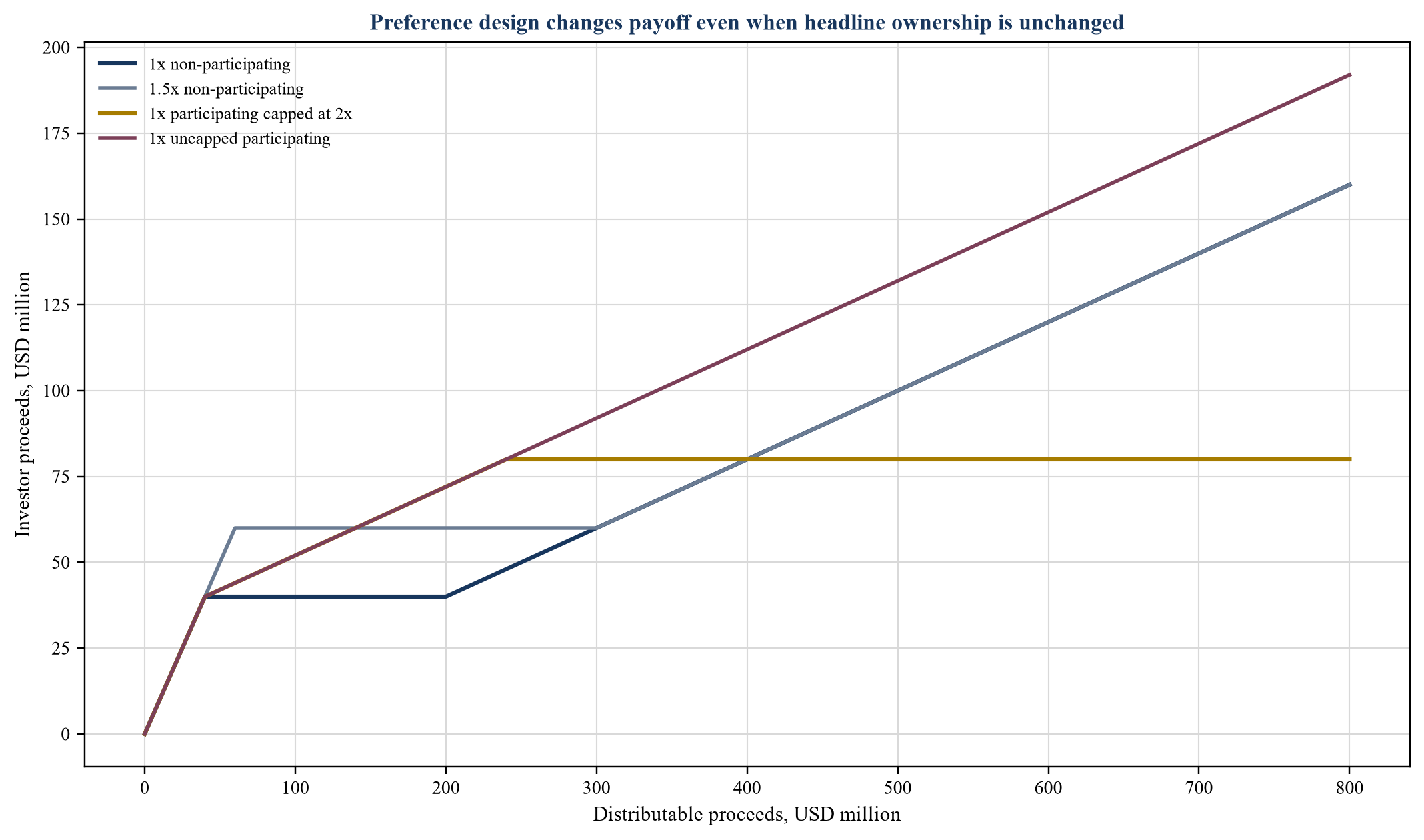
Values use a USD 40 million investment and 20 per cent as-converted ownership. They exclude other classes, debt, costs and tax and are illustrative only.
7. Add cumulative dividends and time to exit
Dividends can increase the preference amount before any residual value is shared. The model should distinguish dividends that are payable only when declared, dividends that accrue automatically, payment-in-kind amounts, simple accumulation and compounding. The term sheet should state the rate, base, frequency, priority, payment conditions and treatment on conversion.
Time matters. An 8 per cent simple cumulative return on USD 40 million adds USD 3.2 million for each full year if that is the contractual method. After four years, the preference would be USD 52.8 million. Annual compounding at 8 per cent produces approximately USD 54.4 million after four years. The difference becomes larger as time extends, and both figures can change if dividends accrue on previously accrued amounts at a different frequency.
A dividend can move the conversion breakpoint and extend the range in which the investor takes the preference. It can also affect a participation cap. If the cap includes accrued dividends, the remaining participation capacity is lower. If it excludes them, total proceeds can exceed the stated multiple. The model should implement the executed definition exactly.
IAS 32 classifies instruments according to the substance of their contractual arrangements. Mandatory redemption or a contractual obligation to transfer cash can create a financial liability, while a non-redeemable preference share with discretionary distributions may be equity, subject to its complete terms. [5] The accounting analysis should be completed before signing because classification can affect reported leverage, profit, covenants and future financing capacity.
8. Treat deemed liquidation mechanics as part of economics
Preference rights are valuable only when the relevant event triggers them and the proceeds fall within the allocation provisions. A deemed liquidation event commonly includes specified mergers, changes of control, asset sales or exclusive licences. Definitions vary, and exceptions can cover transactions in which existing holders retain a stated level of voting power.
The transaction team should test the company's plausible exit routes against the definition. A share sale, reverse merger, sale of a subsidiary, transfer of intellectual property and staged asset sale can produce different results. The team should also determine whether the company or the preferred class can waive deemed-liquidation treatment, the approval threshold and whether dissenting holders retain separate statutory rights.
Publicly filed charter language illustrates how detailed these provisions can be. One filing gives a preferred class a 1x original issue price plus accruing and declared unpaid dividends before junior classes in a liquidation or deemed liquidation event. [6] Another filing defines a preference by reference to an initial amount multiplied by an applicable MOIC return. [7] These examples are evidence of possible drafting structures rather than recommended terms.
The model should include an event matrix. Each contemplated route is classified as liquidation, deemed liquidation, conversion event, redemption event or outside the preference provision. Counsel should confirm the result and identify required class approvals. The board can then compare transaction flexibility as part of the security's price.
9. Model escrow holdbacks earn-outs rollover and contingent value
Exit consideration is rarely a single cash payment made at closing. Part can be held in escrow, retained for indemnity, paid through an earn-out, rolled into buyer securities or made contingent on regulatory, customer or performance events. The waterfall must state when each form of consideration is valued and allocated.
The documents may allocate escrow as if the withheld amount had been paid at closing, with later losses charged to holders in the same proportions. Another structure can defer the preference calculation until cash is released. These approaches create different timing and credit exposure. Earn-outs can be allocated according to the closing waterfall, the ownership percentages at payment or a bespoke formula linked to the people who deliver the performance.
Rollover equity introduces valuation risk. The preferred holder can receive cash while ordinary holders roll into the buyer, or every holder can receive a mixture. The board should compare value, liquidity, seniority, transfer restrictions and governance in the rollover instrument. A nominal dollar of illiquid buyer equity is not automatically equivalent to a dollar of cash.
The model should use separate consideration columns for cash at closing, escrow, deferred fixed payments, earn-out, rollover and other contingent rights. Each column should identify valuation date, probability treatment, discounting, security and allocation rule. The board can then see both stated proceeds and risk-adjusted exposure without presenting the risk adjustment as a guaranteed outcome.
10. Test broad-based weighted-average anti-dilution
Price-based anti-dilution adjusts the conversion price when the company issues qualifying securities below the protected class's conversion price. Broad-based weighted-average protection considers both the lower price and the size of the new issue. A small issue therefore creates a smaller adjustment than a large issue at the same price.
A common conceptual formula is CP2 = CP1 x (A + B) / (A + C). CP1 is the conversion price before the issue. A is the fully diluted share count before the issue under the contractual definition. B is the number of shares the new consideration would have purchased at CP1. C is the actual number of shares issued. The executed document controls every input and exclusion.
The definition of A can include or exclude reserved options, warrants, convertibles and particular classes. C can exclude employee grants, strategic issuances, acquisition consideration, equipment leases or securities approved by the protected class. These details determine the economic transfer. The model should therefore display the formula inputs beside the resulting conversion ratio and ownership change.
The NVCA yearbook describes broad-based weighted-average protection as an adjustment that reflects a lower-priced issuance using a fully diluted denominator. [8] That description supports the mechanism but does not replace the charter formula. The board should approve the actual adjustment and exclusions, then test several issue sizes and prices.
11. Compare full ratchet and pay-to-play alternatives
Full-ratchet anti-dilution resets the protected conversion price to the lowest qualifying issue price without weighting the adjustment for the amount raised. A small issuance can therefore create a large transfer of ownership. The mechanism protects the earlier investor from price decline and places more of the dilution on founders, employees and unprotected holders.
The hypothetical case assumes the Series B invests USD 40 million at the original financing price and a later investor provides USD 30 million at a USD 90 million pre-money valuation. The model calculates the new issue price from the controlled fully diluted cap table. It then compares no adjustment, broad-based weighted average and full ratchet. The result is shown in shares, ownership, exit proceeds and value transferred at each tested exit.
Pay-to-play can condition some protection on the investor participating in the later financing. A holder that invests its required share may retain preferred status or anti-dilution protection; a holder that declines can lose specified rights or convert into a less protected security. The documents need clear participation calculations, notice, timing, permitted transferees and consequences.
The board should assess financing feasibility as well as immediate protection. A severe adjustment can make a rescue round harder to syndicate or leave management with weak incentives. A weak protection package can make the original investment unacceptable. Scenario analysis makes the trade visible and allows the parties to negotiate a measured response to future price risk.
| Mechanism | Adjustment driver | Main protected interest | Main exposure for other holders | Required model evidence |
|---|---|---|---|---|
| No price adjustment | Ownership changes only through the new issue | Simplicity and financing flexibility | Earlier investor bears full price decline | Post-money cap table and pro-rata participation |
| Broad-based weighted average | New price and relative issue size | Partial protection against a material down round | Additional dilution depends on denominator and exclusions | CP1, A, B, C and excluded issuances |
| Full ratchet | Lowest qualifying issue price | Maximum price protection for the protected class | Potentially large dilution from a small issue | Lowest price, qualifying security and revised conversion ratio |
| Pay-to-play | Participation in the new financing | Rewards investors that support the company | Non-participants can lose rights or status | Participation threshold, notice and conversion consequence |
The table describes mechanisms. Numerical results must be calculated from the definitive formula and the controlled cap table.
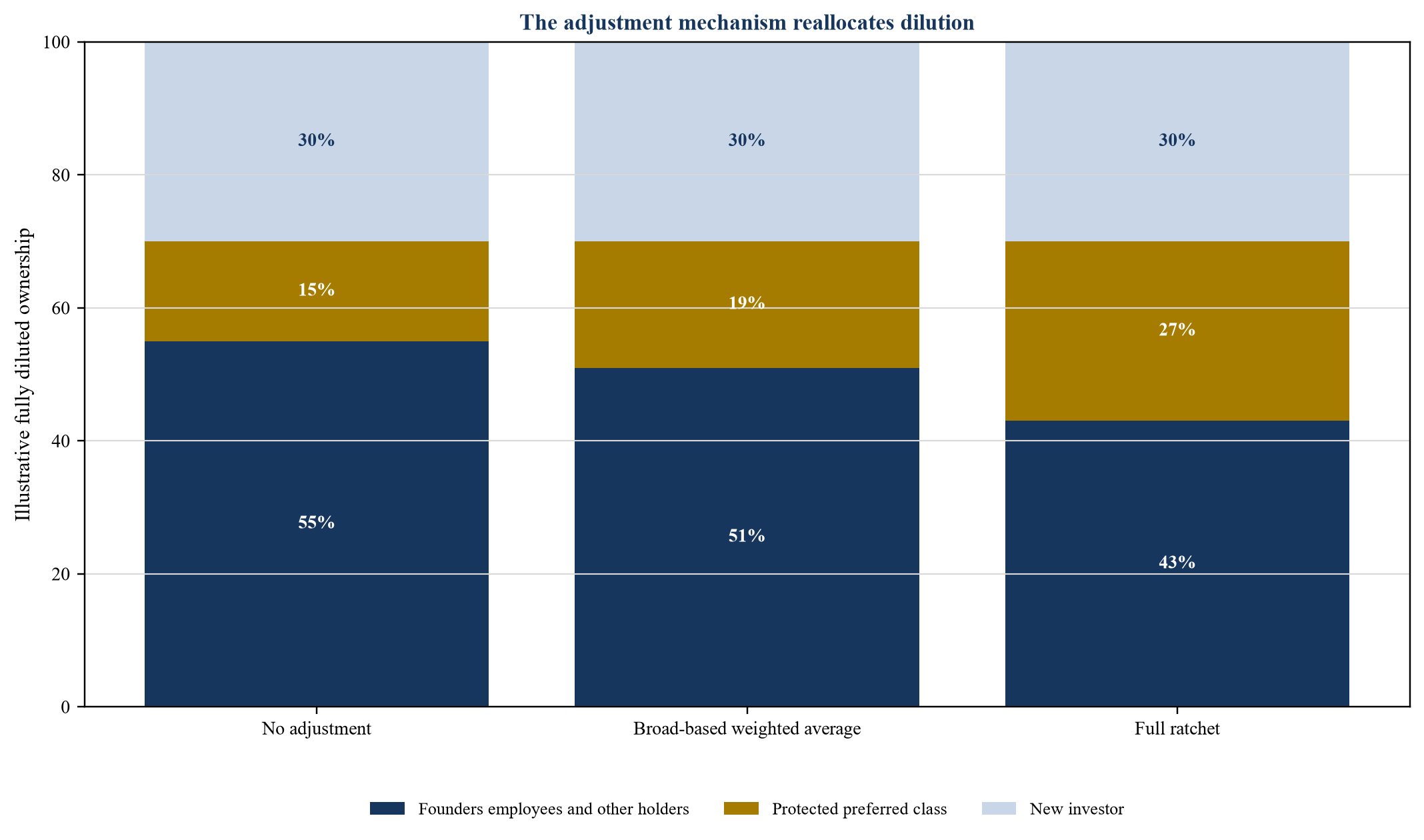
Percentages are illustrative model outputs used to show direction. Final values require the controlled cap table and executed formula.
12. Separate anti-dilution from pre-emption and pro-rata rights
Three protections are often discussed together and should be modelled separately. Price-based anti-dilution changes the conversion ratio after a qualifying lower-priced issue. Pre-emption can restrict an issue unless existing holders receive an opportunity or approve a disapplication. A contractual pro-rata right permits an investor to purchase enough of a later issue to maintain an agreed ownership percentage.
These rights can operate simultaneously. An investor can buy its pro-rata share and also receive a conversion-price adjustment on its existing preferred securities. The economic model should show both effects. The governance map should show who approves the new issue, who receives notice, the election period and the consequence of declining.
The UK Companies Act contains statutory rules concerning allotment and pre-emption, subject to the company's circumstances, articles and valid shareholder action. [9] Delaware companies rely on their charter and contractual arrangements within the statutory framework. Cross-border groups should not assume that a clause drafted for one jurisdiction has the same effect elsewhere.
The board should test an urgent financing in which cash runway is short. Long notice periods, numerous consents and uncertain waiver mechanics can impair execution. A controlled process can protect participation while allowing an emergency bridge approved under defined conditions. Any exception should be narrow and should preserve disclosure and conflict management.
13. Include options warrants convertibles and unallocated pools
The preference stack sits above a fully diluted denominator that can change during negotiation. A pre-money option-pool increase usually dilutes existing holders before the new investor enters; a post-money increase spreads dilution across existing holders and the new investor. The stated percentage should therefore be accompanied by the exact share count and pool treatment.
Convertible notes and simple agreements for future equity can convert at discounts, caps, most-favoured terms or negotiated prices. Some convert into the new preferred class; others receive a shadow series with similar economics but a different original issue price. The preference amount, conversion price and anti-dilution treatment of each resulting series should be modelled explicitly.
Warrants can add both dilution and a separate cash inflow if exercised. Penny warrants, contingent warrants and lender warrants require different treatment. Promised grants that have not been formally awarded create governance and record risk. The board should reconcile the hiring plan, option ledger and legal approvals before finalising the financing denominator.
The model should include a cap-table bridge from current issued shares to current fully diluted shares, the pre-financing pool adjustment, convertible conversion, new-money issuance and post-financing ownership. Each line should state price, share count, cash flow and governing term. This bridge is the control total for the waterfall and anti-dilution calculations.
14. Examine tranche and milestone financing effects
Tranched financing commits capital in stages based on time, milestones or approvals. Current NVCA materials state that updated model documents include mechanics for time- or milestone-based funding. [2] The economics depend on whether every tranche uses the same price and rights, whether unfunded commitments count in voting or preference, and what happens when a milestone is disputed.
The model should separate committed, funded and cancelled amounts. Preference should be calculated from the amount recognised under the documents, which can differ from the total headline commitment. Dividends may accrue only on funded amounts. Ownership can be issued upfront, released by tranche or subject to repurchase. Each structure changes incentives and remedies.
A milestone needs an objective measurement source, observation period, decision authority, cure process and dispute mechanism. A commercial milestone such as annual recurring revenue can be affected by definitions, currency, acquisitions, churn and contract duration. A technical milestone can require independent certification and clear treatment of partial achievement.
The board should model both successful and failed tranches. It should test runway, ownership, preference, governance and alternative financing if a tranche does not fund. A commitment that can be withheld under an ambiguous milestone should not be treated as certain liquidity in the operating plan.
15. Connect preference terms to accounting and valuation
Legal equity is not automatically accounting equity. IAS 32 focuses on the substance of contractual obligations. A mandatory redemption feature, holder put or required cash distribution can create a liability or compound instrument depending on the complete terms. [5] Classification can affect reported debt, finance cost, earnings, distributable reserves and financial covenants.
IFRS 13 requires fair value to use assumptions that market participants would apply. [10] The latest financing price can be an important calibration point, but different classes have different rights. Valuation should consider the preference stack, expected exit distribution, dilution, time, volatility and other relevant assumptions. Multiplying every share by the latest preferred price can misstate the value of ordinary equity.
The transaction model and financial-reporting valuation serve different purposes. The waterfall calculates contractual proceeds under stated scenarios. Fair-value work estimates an exit price under the applicable accounting framework and valuation technique. The models should reconcile key terms while preserving their distinct objectives.
The board should obtain accounting advice before accepting redemption, dividend or settlement terms. It should also check lender definitions. A security presented as equity in commercial materials can still fall within debt or fixed-charge definitions in financing agreements. Those consequences belong in the negotiation package.
16. Assess tax regulatory and jurisdictional consequences
Preference terms can affect tax relief, withholding, deductibility, transfer pricing, participation exemptions, employee incentives and the treatment of returns as dividend, interest or capital. The result depends on the investor, issuer, instrument, jurisdiction and transaction path. The model should identify cash-tax assumptions without claiming a legal conclusion.
HM Revenue & Customs guidance for venture-capital schemes defines relevant preference shares for a specific statutory purpose and lists conditions concerning voting, consideration, conversion and dividends. [11] This illustrates that a commercially familiar term can have a distinct statutory meaning. Eligibility should be confirmed under the current law applicable to the company and investor.
Securities, foreign-investment, exchange-control and sector rules can also affect issuance, governance, conversion and exit. A cross-border investor may need approval to acquire or increase rights. An anti-dilution adjustment can change ownership without a new cash payment. A conversion or redemption can create a filing or consent requirement.
The closing checklist should identify the issuer's jurisdiction, investor location, operating subsidiaries, regulated activities, sensitive technology, licences and capital controls. Counsel should map each financing and exit scenario to approvals, timing, information restrictions and conditions. The waterfall should then reflect proceeds and timing after those constraints.
17. Apply the framework to a hypothetical financing
Consider a company raising USD 40 million at a USD 160 million pre-money valuation. The new Series B owns 20 per cent on an as-converted, post-money basis before later dilution. An existing Series A has invested USD 20 million and owns 10 per cent as converted. Ordinary holders own 70 per cent. The initial case ranks Series A and Series B pari passu.
The base alternative gives each preferred class a 1x non-participating preference without cumulative dividends. Series B alternatives test 1.5x non-participating preference, 1x participation capped at 2x and 1x uncapped participation. A separate timing case adds 8 per cent cumulative dividends. Every alternative assumes the holder may convert when conversion produces more value.
The exit bridge uses distributable equity proceeds after debt, cash, transaction costs and closing adjustments. Values of USD 50 million, USD 100 million, USD 200 million, USD 400 million and USD 800 million expose the downside, breakpoint and upside regions. The model preserves separate lines for Series A, Series B and ordinary holders.
This case is deliberately simplified. A transaction model should include the complete legal stack, actual share counts, security-specific elections, contingent consideration and tax. Its purpose is to show how apparently modest term changes can reallocate proceeds without changing headline valuation.
18. Compare downside base and upside proceeds
At USD 50 million, the pari passu preferences exceed available proceeds. Series A and Series B share the shortfall according to their USD 20 million and USD 40 million entitlements; ordinary holders receive nothing. At USD 100 million, both classes take their 1x preferences and ordinary holders receive the USD 40 million residual.
At USD 200 million, the simple as-converted values equal the original preferences: USD 20 million for Series A and USD 40 million for Series B. Above that level, conversion becomes preferable in the base case. At USD 400 million, the as-converted distribution is USD 40 million, USD 80 million and USD 280 million. The result follows ownership because both preferred classes convert.
Participation changes the middle of the curve. At USD 200 million, 1x participating Series B receives its USD 40 million preference plus 20 per cent of the residual after both pari passu preferences, producing USD 68 million in the simplified model. At USD 400 million, uncapped participation produces USD 108 million. A 2x cap limits the participation route to USD 80 million, while the holder retains a conversion election if the documents permit it.
| Distributable proceeds | 1x non-participating | 1.5x non-participating senior | 1x participating capped at 2x | 1x uncapped participating |
|---|---|---|---|---|
| 50 | 33.3 | 50.0 | 33.3 | 33.3 |
| 100 | 40.0 | 60.0 | 48.0 | 48.0 |
| 200 | 40.0 | 60.0 | 68.0 | 68.0 |
| 400 | 80.0 | 80.0 | 80.0 | 108.0 |
| 800 | 160.0 | 160.0 | 160.0 | 188.0 |
USD millions. The simplified model assumes Series A has a USD 20 million pari passu 1x preference and 10 per cent as-converted ownership. Values exclude debt, costs, tax and contingent consideration.
19. Stress-test the later down round
The company next raises USD 30 million at a USD 90 million pre-money valuation. The model first calculates the new share price and new shares from the controlled cap table. It then applies the Series B anti-dilution formula, recalculates the conversion ratio and rebuilds fully diluted ownership.
The no-adjustment case allocates dilution according to the new issue. Broad-based weighted average increases Series B ownership by an amount that reflects both price and issue size. Full ratchet resets to the qualifying lower price and produces the largest adjustment. The model records value transfer at each tested exit rather than presenting ownership alone.
Exclusions should be tested independently. An employee grant, acquisition issue or strategic partnership can fall outside the adjustment if the documents say so. A financing divided into nominally separate issuances should be tested for aggregation. Waiver and class-vote thresholds should be recorded.
The board should review runway and alternatives alongside dilution. A down round can be economically preferable to insolvency or a distressed sale. The decision record should show the financing need, available alternatives, conflicts, class outcomes and the reasons the selected protection remains proportionate.
20. Negotiate packages using equivalent-value analysis
Terms should be negotiated as packages. A higher valuation can be paired with seniority, participation or cumulative dividends; a lower valuation can be paired with 1x non-participating preference and broad-based protection. Equivalent-value analysis compares the packages across common scenarios.
The analysis should calculate proceeds, internal rate of return and multiple of invested capital for investors; dilution and proceeds for founders and employees; and financing capacity for the company. Probability-weighted outputs can support discussion when assumptions are disclosed, but they should not conceal the individual downside cases.
The board should identify the outcomes most relevant to the operating plan. A company expecting a near-term strategic sale should focus on the middle of the waterfall and contingent consideration. A capital-intensive company expecting several rounds should focus on ranking, anti-dilution, pool growth and tranche mechanics.
Negotiation records should distinguish value, control and process. A right can have modest modelled value while creating execution risk. A clean package is one the company can explain, administer and finance through future rounds.
| Term change | Downside effect | Base-case effect | Upside effect | Future-financing effect |
|---|---|---|---|---|
| Higher headline valuation | Reduces investor ownership | Preserves founder ownership | Preserves founder ownership | Can raise next-round expectations |
| Higher preference multiple | Transfers low-exit proceeds | Can delay conversion | Often disappears after conversion | Can concern later investors |
| Participation | Adds a second investor claim | Can transfer substantial proceeds | Cap or conversion may limit effect | Complicates waterfall |
| Cumulative dividend | Grows preference with time | Moves conversion breakpoint | May be outweighed by conversion | Can affect accounting and leverage |
| Full-ratchet protection | Little effect before down round | Large transfer after qualifying issue | Persists through conversion ratio | Can impede rescue financing |
Directional assessment only. A transaction-specific model is required before a board decision.
21. Run a pre-signing waterfall audit
The audit begins with source reconciliation. Legal counsel confirms each class right, trigger, ranking, election, adjustment, approval and waiver. Finance confirms share counts, cash flows and the enterprise-to-equity bridge. Tax and accounting advisers confirm issues within their mandates.
The model is then tested with known invariants. Total allocated proceeds must equal distributable proceeds. No holder can receive more than available cash. Caps, shortfalls and conversion elections must work at boundary values. Share counts must reconcile before and after each financing. Formula inputs should be visible rather than embedded in opaque cells.
Independent review should reproduce selected cases from the documents. The reviewer should test a low exit, each conversion breakpoint, the participation cap, a dividend period, a down round, an excluded issuance and an earn-out. Differences should be resolved before signing.
The board pack should include the legal stack map, cap-table bridge, scenario table, payoff curves, unresolved judgements and signed-off model version. Approval should record why the package supports the financing need and remains acceptable across the tested outcomes.
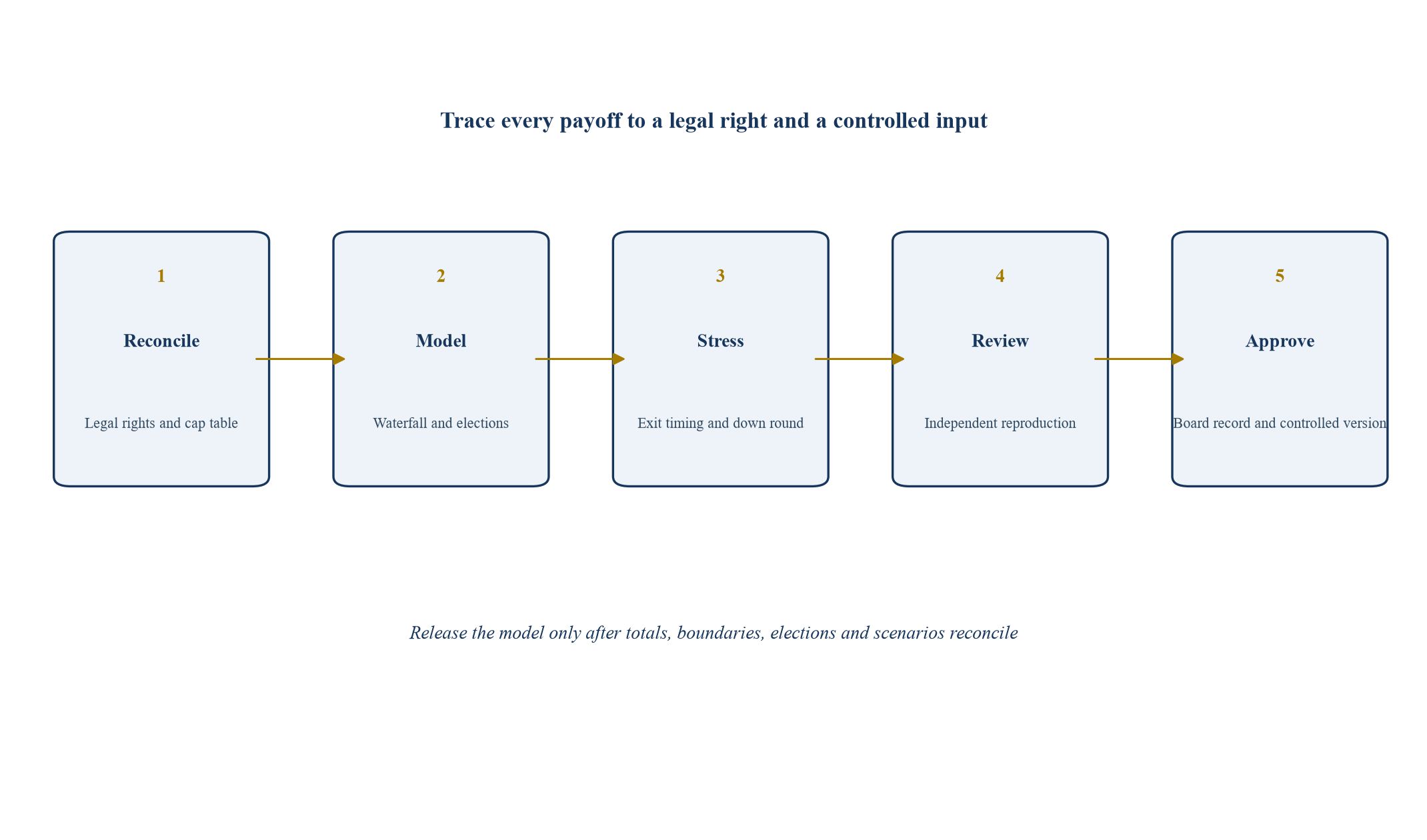
The workflow should be adapted to the transaction, jurisdiction and governance process.
22. Implement a controlled model and closing checklist
The final model should have named inputs, protected formulas, change control and a visible version number. Source documents and approvals should be linked in an evidence register. Access should be limited while allowing the board and advisers to review outputs.
At signing, the team freezes the agreed terms and updates the model for drafting changes. At closing, it reconciles issued shares, funded cash, fees, option grants, converted instruments and executed documents. The final waterfall baseline is archived with the closing set.
After closing, finance should update the model for new issuances, transfers, dividends, conversions, waivers and amendments. The company secretary or legal owner should confirm that the cap table and charter remain aligned. A board review should accompany every financing or proposed exit.
The checklist should name owners and deadlines. It should cover capital records, accounting classification, tax, regulatory approvals, lender consents, employee communications and future reporting. A preference model is a governance control rather than a one-off negotiation spreadsheet.
23. Recognise limitations
The framework cannot determine appropriate terms without company-specific facts and current professional advice. Corporate, securities, tax, accounting, insolvency, employment, competition and foreign-investment rules vary by jurisdiction and can change.
The hypothetical calculations simplify the capital structure. They exclude many transaction adjustments, taxes, claims and behavioural choices. Their values are teaching inputs rather than market estimates, forecasts or recommendations.
The economic model depends on the executed documents. A spreadsheet interpretation can be wrong where definitions, class votes, waivers or statutory rights alter the result. Legal review is required.
Scenario probabilities are uncertain. Boards should examine individual outcomes and sensitivity rather than relying only on an expected value. A model improves decision discipline; it does not remove commercial risk.
24. Conclusion
Preferred-equity price is a combination of valuation and security rights. Ranking, preference multiple, participation, dividends, conversion, anti-dilution and future instruments determine how exit value is distributed.
The Preference Stack Test reconstructs the legal capital structure, defines distributable proceeds, models holder elections and tests the package across exit, timing and financing scenarios. It makes hidden value transfer visible before the company signs.
Boards should approve a controlled model alongside the term sheet and definitive documents. When every payoff traces to a legal right and every assumption is disclosed, founders and investors can negotiate a financing that is intelligible, executable and aligned with the value-creation plan.
Sources
- UK Government, Term Sheet Key Points and Guardrails, 2 December 2025, Read the primary source
- National Venture Capital Association, Model Legal Documents, current page accessed 17 September 2026, Read the primary source
- Delaware General Assembly, Delaware Code Title 8 section 151, Read the primary source
- US Securities and Exchange Commission, Form C/A filing describing a multi-class preference hierarchy, 2025, Read the primary source
- IFRS Foundation, IAS 32 Financial Instruments Presentation, Read the primary source
- US Securities and Exchange Commission, Series C preferred charter filing, Read the primary source
- US Securities and Exchange Commission, preferred charter with MOIC-linked liquidation preference, 2025, Read the primary source
- National Venture Capital Association, 2024 Yearbook, weighted-average anti-dilution glossary, Read the primary source
- UK Parliament, Companies Act 2006, allotment, class-right and pre-emption provisions, Read the primary source
- IFRS Foundation, IFRS 13 Fair Value Measurement, Read the primary source
- HM Revenue and Customs, Venture Capital Schemes Manual, relevant preference shares, updated 14 July 2026, Read the primary source
- British Business Bank, What is a Term Sheet, Read the primary source
- Delaware General Assembly, Delaware Code Title 8 section 242, certificate amendments, Read the primary source
- Delaware General Assembly, Delaware Code Title 8 section 262, appraisal rights, Read the primary source
- US Securities and Exchange Commission, Series A preferred financing example, Read the primary source
- International Private Equity and Venture Capital Valuation Guidelines, Read the primary source
