

1. Convert the yield decision into a balance-sheet decision
An insurer does not invest a free pool of capital. It invests assets that support policyholder liabilities, operating liquidity, collateral needs, regulatory capital and shareholder objectives. The appropriate private-credit allocation is therefore a balance-sheet decision rather than a comparison of asset yields.
Private credit can offer negotiated covenants, security, information rights, amortisation profiles and spread compensation for illiquidity. Those features can support long-duration insurance liabilities when cash flows are predictable and the insurer has the ability to hold the asset. The same features can create risk when valuations are model-dependent, borrower reporting weakens, loan amendments defer recognition of stress, or the asset cannot be sold when policyholder cash demands rise.
The International Monetary Fund reported in October 2025 that private credit can offer insurers additional spread and long-duration assets, while increasing the need for advanced asset-liability management, liquidity analysis and concentration control [1]. The International Association of Insurance Supervisors identified greater allocation to alternative assets as a structural shift in life insurance and emphasised valuation, issuer creditworthiness, diversification, asset-liability management and stress testing [2].
The investment decision should answer five questions. What liability cash flow does the asset support? What net spread remains after expected loss, fees, hedging and operating cost? How much capital and management buffer does the asset consume? What liquidity can the insurer obtain or must it supply under stress? What evidence permits the board to monitor deterioration before a loss becomes irreversible?
The proposed framework links those questions through eight controlled records: liability need, asset eligibility, credit evidence, cash-flow and duration match, valuation, liquidity, concentration, and capital and return. The allocation proceeds only when every record has a named owner and a supported decision.
2. Define private credit by economic substance
Private credit is a broad label. It can include bilateral corporate loans, club deals, private placements, infrastructure and project debt, commercial real-estate lending, asset-based finance, fund finance, specialty finance, feeder notes, collateralised fund obligations and interests in private-credit funds. These instruments can differ materially in priority, security, leverage, cash-flow certainty, governance and liquidity.
The allocation framework should classify each exposure by economic substance rather than marketing label. The National Association of Insurance Commissioners' principles-based bond definition became effective on 1 January 2025 and seeks to classify assets according to substance rather than legal form [3]. That principle is useful beyond the United States because it prevents a structure with equity-like risk from entering the portfolio as if it were ordinary senior debt.
The classification record should identify borrower or underlying obligor, instrument, seniority, collateral, repayment source, covenants, payment form, maturity, call rights, extension rights, sponsor support, leverage, currency, jurisdiction and affiliated parties. A fund or securitised exposure should also identify look-through assets, structural leverage, priority of payments, manager discretion and redemption terms.
Payment-in-kind interest requires particular attention. It can preserve short-term borrower liquidity while increasing principal and delaying cash receipt. The investment model should separate accrued accounting income from cash available to pay claims, collateral or expenses. A growing PIK balance should also be tested as an indicator of borrower stress rather than treated automatically as ordinary yield.
The result is an investable-perimeter map. Senior secured loans with controlled documentation and direct reporting may sit inside the core credit perimeter. Instruments with weak look-through data, material structural leverage, discretionary liquidity or equity-like repayment may require a separate limit, higher capital assumption or rejection.
3. Begin with the liability portfolio
The liability portfolio determines the economic capacity to hold illiquid credit. Long-duration annuity liabilities with predictable cash flows can support a different allocation from surrenderable savings products, catastrophe-exposed non-life liabilities or collateral-intensive reinsurance.
The insurer should map liability cash flows by legal entity, currency, product and scenario. The map should include expected claims, expenses, lapses, surrenders, collateral, reinsurance settlements, tax and debt service. It should distinguish ordinary cash needs from stress demands and management actions.
The asset allocation then starts with required cash-flow characteristics. These include duration, timing, currency, prepayment behaviour, call risk, amortisation and terminal value. A private loan whose scheduled cash flows align with the liability can reduce reinvestment risk. A loan with uncertain extensions, bullet repayment and sponsor-controlled prepayment can introduce mismatch even when its stated maturity appears suitable.
The PRA's matching-adjustment framework recognises that insurers with predictable liabilities and closely matched asset cash flows may be able to hold credit assets through market-price volatility [4]. The framework also retains an allowance for risks borne by the insurer. This distinction is central: illiquidity can support value when the insurer truly has hold capacity, while credit risk, downgrade risk and cash-flow uncertainty remain.
Liability mapping should be completed before the asset pipeline is considered. Origination opportunities can otherwise determine the portfolio, reversing the order of control. The investment committee should approve the liability need, risk capacity and eligible cash-flow profile before approving managers or transactions.
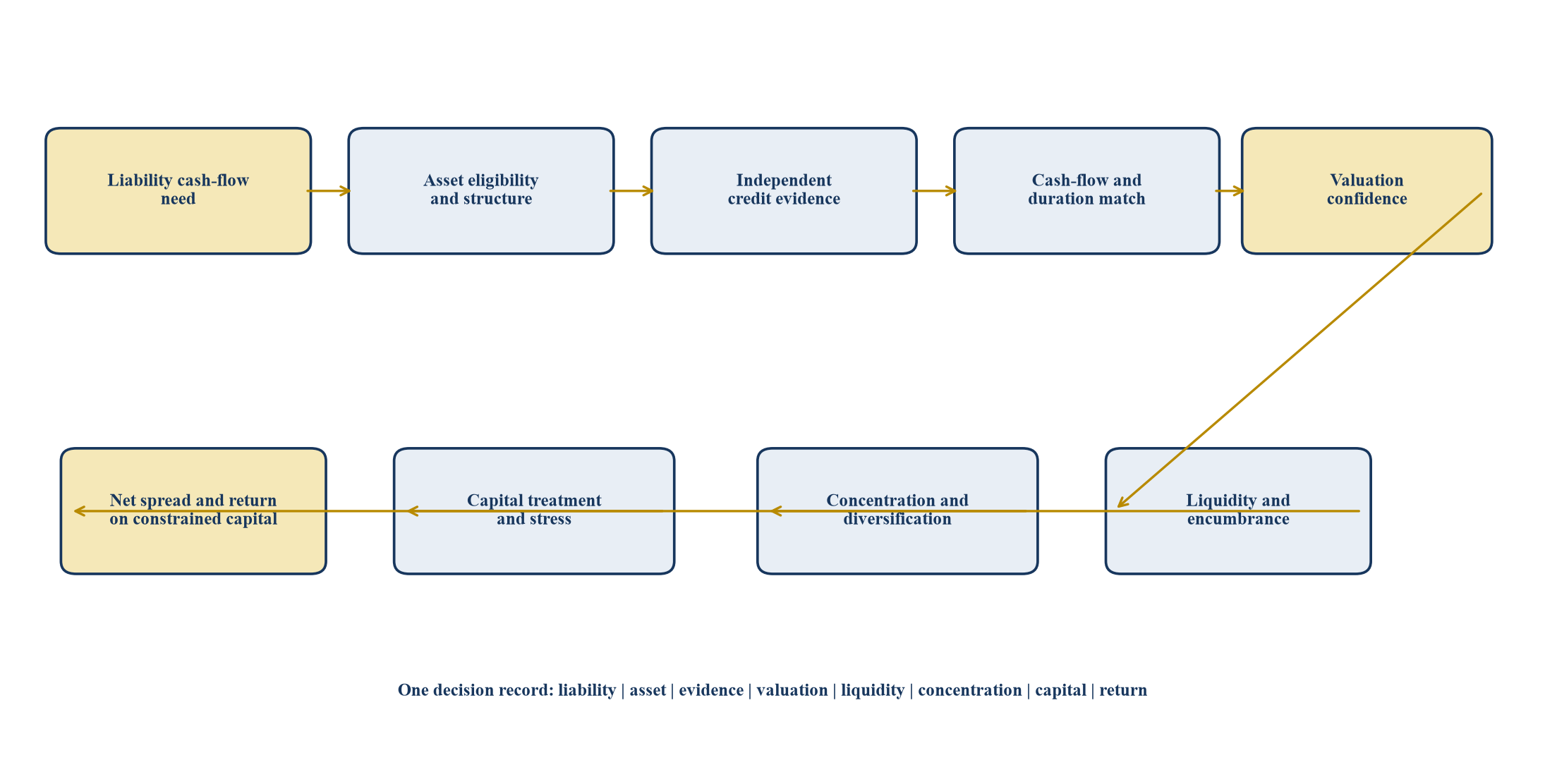
The framework begins with liabilities and connects asset eligibility, credit evidence, cash-flow matching, valuation, liquidity, concentration, capital and return.
4. Reconcile regulatory, accounting and economic views
An investment can have different values and risk measures under accounting, solvency, internal economic-capital and rating frameworks. The allocation model should preserve those views separately and reconcile them rather than force them into one number.
Accounting determines recognition, measurement, impairment and reported income. Solvency frameworks determine eligible capital and required resources. Internal economic capital reflects the insurer's own risk appetite and stress assumptions. Rating objectives and debt covenants can create further constraints. The binding requirement is the most restrictive supported threshold under the relevant scenario.
IFRS 9 applies an expected-credit-loss model to financial assets within its scope. Credit deterioration can move an asset from a twelve-month expected-loss allowance to lifetime expected losses. The insurer's data, model governance and staging process therefore affect the timing of reported impairment [5]. IFRS 17 governs insurance-contract measurement and presentation; coordination between asset and liability reporting is necessary to understand earnings and equity volatility [6].
In the United States, risk-based capital is a regulatory tool based on insurer size and inherent risk and is one part of solvency supervision [7]. NAIC designations, statutory accounting and asset classification influence treatment. In Europe, Solvency II applies market-consistent valuation and risk-based capital, including concentration effects. In the United Kingdom, Solvency UK and matching-adjustment rules add asset-eligibility, internal-rating and attestation requirements for relevant portfolios [4].
The model should record the exact rule source, effective date, legal entity and evidence owner for every capital assumption. A generic percentage copied from a market presentation is insufficient. Where final treatment is uncertain, the board should see a range and a condition precedent for deployment.
5. Ground the allocation in current supervisory evidence
Private assets are material in insurer portfolios, although exposure varies by jurisdiction and business model. EIOPA reported that EEA insurer private-asset exposures reached EUR 1.185 trillion, approximately 11 per cent of total assets at the end of 2025; private credit represented about 5.0 per cent [8]. Life insurers had a greater tendency toward private credit than several other lines of business.
EIOPA's December 2025 Financial Stability Report found that insurer and pension-fund private-credit holdings were concentrated by sector and geography and noted that corporate-bond and loan concentration can attract capital requirements under Solvency II [9]. The finding supports a portfolio-level approach rather than transaction-by-transaction approval without aggregate limits.
The NAIC stated in 2026 that private credit offers customised terms and higher yields while having less secondary-market liquidity, less transparency and more difficult pricing than public debt [10]. It also described regulatory work on reporting, bond classification, ratings and capital treatment. Beginning with 2026 reporting, enhanced disclosures include private-investment classification, fair value, Level 2 and Level 3 exposure, PIK interest and private-letter-rating information [3].
The evidence supports neither a blanket allocation nor a blanket prohibition. It supports controlled selection, look-through data, independent credit analysis, liquidity planning, valuation governance, concentration limits and stress-responsive capital management.
6. Define the hypothetical insurer and allocation question
The worked case assumes a life insurer with USD 10.0 billion of invested assets and long-duration liabilities. The insurer currently holds USD 600 million of private credit and considers increasing the allocation to USD 1.20 billion over three years.
The current portfolio includes public government and corporate bonds, cash and short-term instruments, mortgages, listed equities, real assets and private credit. The insurer has sufficient ordinary cash flow in the central case, while surrender and collateral stress can create a twelve-month liquidity need.
The proposed incremental USD 600 million is divided among four candidate sleeves: senior corporate direct lending, infrastructure debt, asset-based finance and a diversified private-credit fund. The model excludes highly subordinated instruments, equity tranches and exposures without adequate look-through data from the core allocation.
The central portfolio objective is to increase sustainable net spread while maintaining liability cash-flow coverage, liquid resources, concentration limits and solvency headroom. The insurer uses management capital proxies for planning. Those proxies are not statements of any jurisdiction's required charge.
The central scenario assumes a 7.0 per cent net cash yield on the incremental portfolio after fees, expected credit loss and hedging cost. The adverse scenario reduces cash receipts through defaults, restructurings and PIK elections and raises the management capital proxy. The severe scenario adds concentrated defaults, valuation lag correction, collateral and surrender demands.
| Item | Illustrative assumption | Decision relevance | Required evidence |
|---|---|---|---|
| Invested assets | USD 10.0bn | Portfolio denominator | Audited investment ledger |
| Existing private credit | USD 600m | Starting exposure | Look-through holdings and reconciled valuation |
| Proposed private credit | USD 1.20bn | Three-year target | Board-approved pacing and limits |
| Incremental commitments | USD 600m | New allocation envelope | Pipeline, legal terms and funding plan |
| Central net cash yield | 7.0% | Income objective | Instrument cash flows and cost bridge |
| Twelve-month stress liquidity need | USD 950m | Hold-capacity test | Liability, surrender and collateral scenarios |
| Minimum liquid-resource target | USD 1.25bn | Management buffer | Treasury policy and executable sources |
| Single-obligor limit | 0.75% of invested assets | Concentration control | Aggregated borrower and affiliate map |
| Core private-credit limit | 12% of invested assets | Portfolio control | Board risk appetite and solvency analysis |
| Deployment period | 36 months | Vintage and capacity control | Origination plan and quarterly gates |
All amounts, yields, losses, limits and capital proxies are illustrative management assumptions rather than forecasts or regulatory calibrations.
7. Build the spread bridge from cash rather than headline yield
The investment case should begin with contractual cash and deduct every supported cost. Headline yield can include non-cash accrual, upfront fees, delayed draw economics or leverage that does not translate into distributable cash.
The spread bridge should show base rate, contractual margin, original-issue discount, fees, cash interest, PIK interest, hedging cost, manager fees, servicing cost, expected credit loss, tax and operational cost. It should also show the public-market comparator on a consistent currency, duration and rating basis.
In the hypothetical case, the weighted contractual yield is 8.8 per cent. Cash and non-cash components are separated. Manager and operating costs deduct 0.35 percentage points, currency and rate hedging deduct 0.25 points, and through-cycle expected credit loss deducts 1.20 points. The resulting central net cash yield is approximately 7.0 per cent after rounding and timing effects.
Expected loss is not a substitute for stress loss. It represents a probability-weighted central cost. The capital model should separately test default clustering, downgrade migration, lower recoveries, delayed enforcement and amendment-driven cash deferral.
The bridge should be refreshed at origination, each valuation date and after a material amendment. An asset that preserves its stated coupon by switching to PIK may have lower cash value and higher credit risk even when accounting income remains positive.
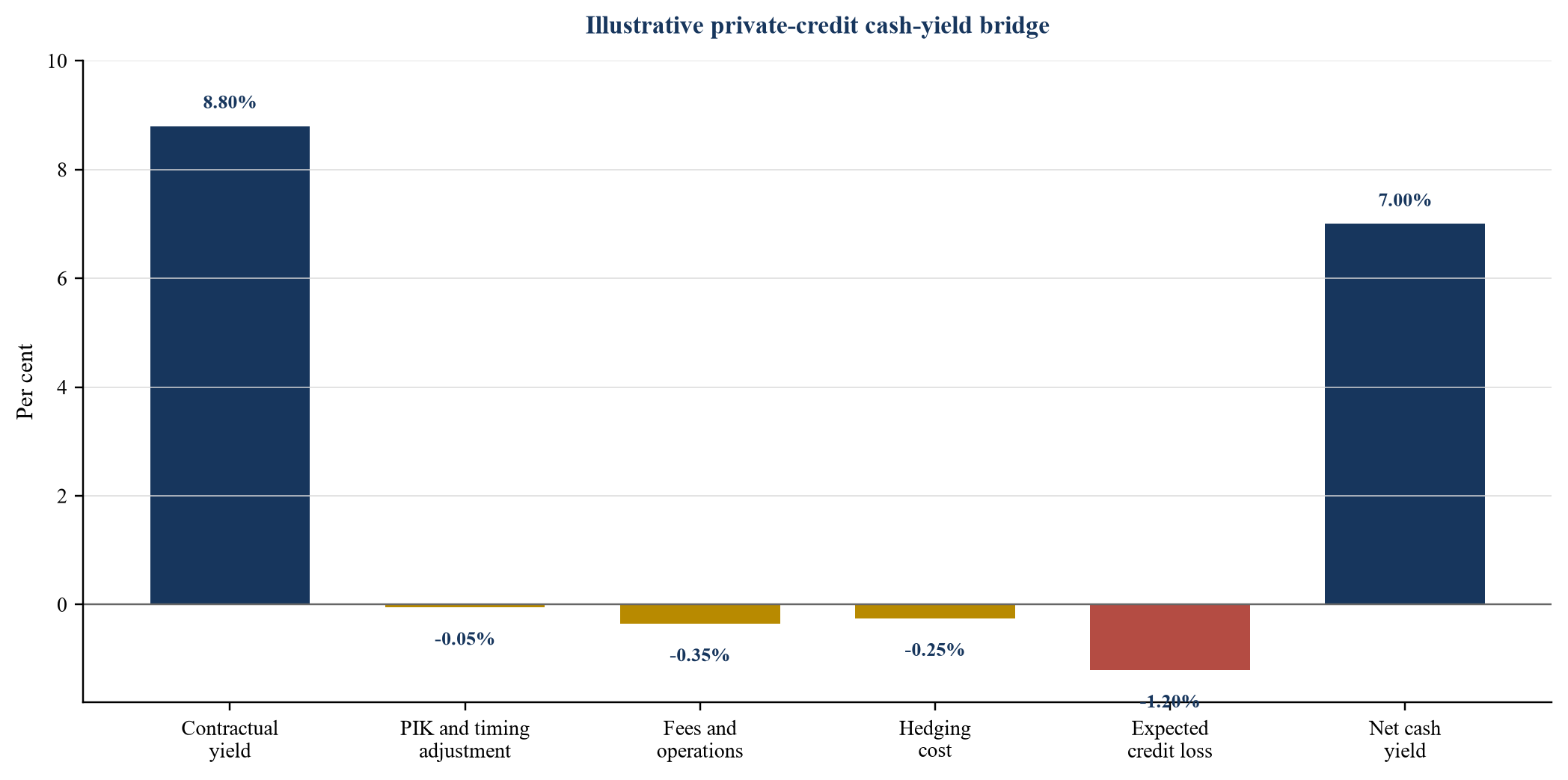
The bridge separates cash yield, non-cash accrual, costs, expected loss and a management capital proxy. Values are illustrative.
8. Measure credit risk through the full holding period
Private credit requires underwriting and monitoring capabilities comparable with a lending institution. The insurer should not outsource its risk judgment entirely to an originator, manager or external rating.
The credit record should include borrower business risk, leverage, debt-service capacity, covenant headroom, collateral, enterprise-value dependence, sponsor behaviour, documentation, jurisdiction, refinancing need and downside recovery. It should identify the source date and owner of each input.
Floating-rate assets can increase insurer income as base rates rise while weakening borrowers whose cash generation does not rise correspondingly. The IMF observed that direct-lending borrowers can remain vulnerable because loans are commonly floating-rate and borrowers may rely on growth and lower policy rates [1]. The insurer should therefore test borrower interest coverage and liquidity under persistent-rate scenarios rather than treat floating-rate exposure as a pure asset-side benefit.
Amendments should enter the monitoring record as economic events. Maturity extensions, covenant resets, PIK elections, sponsor injections and collateral changes can preserve value, defer loss or transfer risk. The committee should see pre- and post-amendment cash flows, expected recovery and valuation.
The portfolio should use early-warning indicators including revenue variance, margin, liquidity, interest coverage, covenant headroom, sponsor support, rating movement, payment form, collateral value and reporting delay. Each indicator should have a trigger, escalation owner and permitted action.
9. Establish independent internal credit assessment
An internal rating should express the insurer's own view of default and loss risk. External ratings and manager assessments can inform that view, while governance should prevent mechanical reliance.
The PRA requires relevant insurers using the matching adjustment to maintain internal credit assessments and understand qualitative and quantitative sources of credit risk [11]. The NAIC has strengthened oversight of private ratings and requires private rating rationale reports to possess analytical substance [3]. These developments point toward deeper evidence rather than label-based treatment.
The internal assessment should document obligor, facility, collateral, structural priority, industry, jurisdiction, financial model, downside, recovery and rating rationale. It should record model overrides, validation and the relationship between the internal view and any external rating.
The insurer should compare rating migration with cash performance and valuation changes. A rating that remains unchanged while cash interest converts to PIK, covenant headroom disappears or reporting is delayed requires challenge.
The credit committee should be independent of origination incentives. Compensation, affiliated relationships and fee arrangements should be disclosed. Approval authority should scale with risk, complexity and concentration.
10. Treat valuation confidence as a portfolio constraint
Private assets lack continuous quoted prices. Valuation often depends on models, comparable instruments, discounted cash flows, broker indications, manager marks and judgment. The absence of price volatility does not establish the absence of economic volatility.
The valuation policy should define methodology hierarchy, observable inputs, model ownership, challenge, calibration, frequency and independent review. It should specify how amendments, defaults, delayed reporting and market-spread movements enter the mark.
The IMF recommended close monitoring of valuation approaches and stronger governance and independence where valuation risks increase [12]. The IAIS reported that supervisors use off-site analysis, on-site review and third-party work to assess alternative-asset valuation [2].
The insurer should assign each asset a valuation-confidence score. A directly originated senior loan with current borrower reporting and comparable market data may receive a stronger score than a complex structured exposure with stale look-through information. The score should affect limits, review frequency and capital overlay.
Valuation lag should be stressed explicitly. The severe scenario should assume that delayed recognition is corrected during a period of weaker liquidity. The simultaneous effect on capital, collateral, earnings and management action is more important than the isolated mark.
11. Build a legal-entity liquidity waterfall
Liquidity is the capacity to meet cash obligations when due without unacceptable loss. An insurer can be solvent on a modelled basis and still face liquidity pressure if claims, surrenders, collateral or operating payments accelerate while assets cannot be sold or financed.
The liquidity waterfall should begin with cash and committed inflows by legal entity. It should then add saleable government securities, repo capacity, committed facilities, expected private-credit receipts and other executable sources. Haircuts, settlement timing, encumbrance, currency and legal transfer restrictions should be explicit.
Private-credit cash flows should be separated into scheduled principal, cash coupon, uncertain prepayments, PIK accrual and recoveries. Fund capital calls and delayed distributions should be included when the insurer invests through vehicles.
The IAIS Insurance Core Principles require insurers to manage investment and liquidity risk as part of enterprise risk management [13]. EIOPA issued final guidelines in July 2026 on supervisory powers to remedy liquidity vulnerabilities under the Solvency II review [14]. The direction of travel supports forward-looking liquidity evidence and executable management actions.
The insurer should maintain a liquid-resource floor above the modeled stress need. It should not count an asset sale at par, an uncommitted facility or a distribution requiring regulatory approval as certain liquidity.
12. Test concentration through connected exposures
Concentration can arise by obligor, sponsor, manager, originator, sector, geography, collateral, rating, maturity, currency, covenant form or data provider. Legal diversification can conceal common economic risk.
The exposure map should aggregate parent and subsidiary borrowers, sponsor-controlled companies, common collateral, correlated revenue drivers and fund look-through holdings. It should also capture the same obligor appearing in direct loans, funds, securitisations and reinsurance collateral.
The hypothetical insurer sets a single-obligor limit of 0.75 per cent of invested assets and separate limits for sponsor, sector and manager. Lower sublimits apply when valuation confidence, internal rating or look-through data are weak.
Concentration should affect both approval and capital planning. A high-quality exposure can still weaken the portfolio if it consumes scarce capacity in a sector already correlated with liabilities or other assets.
The committee should review concentration before each commitment and after amendments, downgrades or corporate actions. The report should show gross exposure, stress exposure, collateral, undrawn commitments and connected holdings.
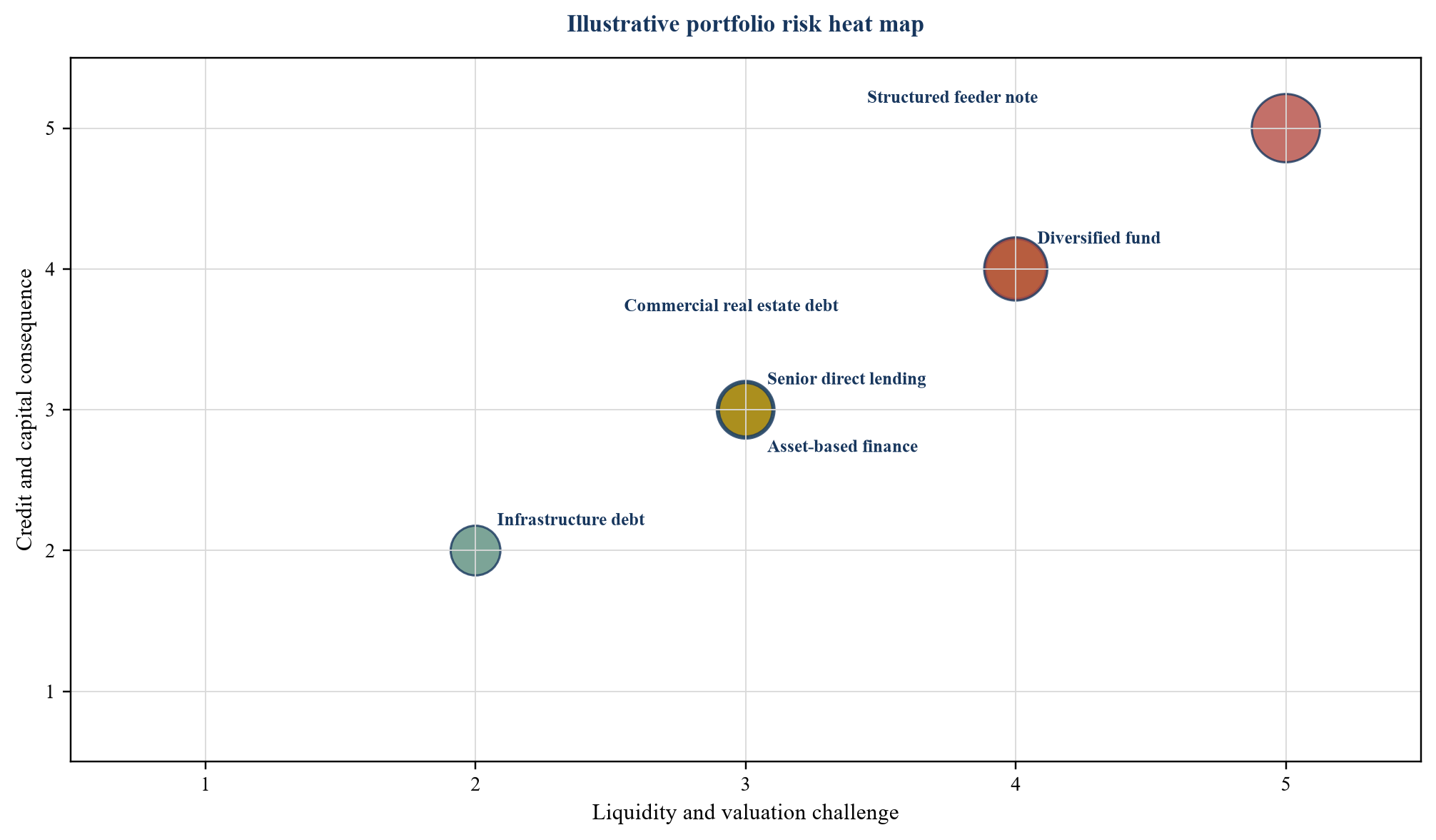
Bubble size represents illustrative stress exposure. Scores are management assumptions and do not represent observed market data.
13. Translate risk into capital consumption
The capital record should show required regulatory capital, internal economic capital, management buffer, diversification recognition and any rating or debt constraint. Each value should be traceable to a rule or approved management assumption.
The incremental return should be compared with incremental constrained capital. A higher-yielding asset can destroy value if it consumes disproportionate capital, weakens diversification or increases the probability that the insurer must hold a larger operating buffer.
The hypothetical model uses a management capital proxy of 12 per cent for the incremental portfolio in the central case, 18 per cent in the adverse case and 26 per cent in the severe case. These proxies combine credit, concentration, valuation and liquidity overlays for planning. They are not regulatory factors.
Return on constrained capital is calculated as incremental net cash income after expected loss and operating cost divided by the capital allocated to the exposure. The ratio is reviewed alongside absolute loss capacity, because a high ratio on a small capital base can be misleading if the severe loss exceeds available headroom.
Capital treatment should be confirmed before commitment. If final classification, rating recognition or matching treatment is uncertain, the model should use the more conservative supported case and record the approval needed for a different outcome.
14. Compare allocation sleeves on a common basis
The four candidate sleeves should be compared using the same measures. Senior direct lending may offer strong covenants and direct information while introducing middle-market and sponsor concentration. Infrastructure debt may support long duration and predictable cash flows while creating construction, political or refinancing risk. Asset-based finance can provide collateral and amortisation while requiring operational data and servicing controls. A diversified fund can broaden access while adding fees, capital-call timing, manager dependence and look-through challenges.
The hypothetical comparison does not select an asset class in isolation. It tests how each sleeve fits the insurer's liabilities and operational capabilities.
| Sleeve | Allocation | Net cash yield | Expected loss | Effective duration | Management capital proxy | Principal control issue |
|---|---|---|---|---|---|---|
| Senior corporate direct lending | USD 210m | 7.4% | 1.5% | 4.2 years | 14% | Borrower and sponsor concentration |
| Infrastructure debt | USD 180m | 6.4% | 0.7% | 9.0 years | 10% | Construction, covenant and refinancing evidence |
| Asset-based finance | USD 120m | 7.2% | 1.0% | 3.1 years | 12% | Collateral, servicing and data integrity |
| Diversified private-credit fund | USD 90m | 6.6% | 1.1% | 5.5 years | 15% | Look-through data, fees and capital calls |
| Weighted incremental portfolio | USD 600m | 7.0% | 1.2% | 5.7 years | 12% central | Aggregate liquidity, valuation and concentration |
Values are illustrative management assumptions. Actual yield, loss, duration, capital and liquidity depend on instrument terms and applicable rules.
15. Distinguish direct assets, funds and structured exposures
Direct assets give the insurer greater control over diligence, documentation and monitoring while requiring origination and workout capability. Fund exposures diversify manager sourcing and borrower access while introducing fee layers, capital calls and dependence on manager valuations. Structured exposures transform cash flows and risk through priority, leverage and triggers.
The insurer should choose the form that matches its operating capability. It should not select a structured note solely because its external rating or legal form produces favourable treatment. Look-through economics, leverage, collateral, waterfall and trigger behaviour remain relevant.
The IMF noted growing insurer exposure to structured instruments linked to private credit, including middle-market CLOs, feeder notes and collateralised fund obligations [1]. It also identified potential conflicts and transparency concerns when exposures are sourced through affiliated managers.
The eligibility test should require an economic-risk memorandum for every fund or structured exposure. The memorandum should show underlying assets, leverage, subordination, cash waterfall, liquidity, valuation, fees, conflicts and stress behaviour.
Fund leverage should be measured beyond the amount recorded as the insurer's investment. Subscription facilities, net-asset-value facilities, warehouse financing and leverage within portfolio companies can create several layers of debt between the insurer and the underlying cash flow. The model should show each layer, its lender, maturity, collateral, covenant and refinancing dependency. It should also identify whether a facility accelerates capital calls or changes the priority of investor distributions.
The insurer should distinguish a commitment to a closed-end fund from ownership of a funded direct loan. The commitment creates a contingent liquidity obligation whose timing is controlled partly by the manager. The funded asset creates credit and valuation exposure. Both belong in the balance-sheet model, while their cash-flow patterns and management actions differ.
Structured exposures require cash-waterfall testing. The model should project collateral defaults, recoveries, prepayments, reinvestment, diversion triggers and interest deferral. A tranche can retain its contractual rating while its distance to a trigger falls. The insurer should therefore monitor structural protection and cash generation in addition to the rating.
Private credit can also appear in collateral supporting reinsurance arrangements. In that setting, the insurer should connect collateral eligibility, valuation, haircuts, substitution rights, concentration and control arrangements with the reinsurance counterparty exposure. A higher asset spread cannot be evaluated separately from the terms that determine whether collateral remains available when the cedant needs it.
16. Control affiliated origination and conflicts
Affiliated origination can provide scale, specialist expertise and access. It can also create conflicts over asset selection, pricing, fees, ratings, valuation, amendments and workouts.
The governance record should disclose ownership, fee flows, revenue sharing, service agreements, rating relationships and decision rights. Related-party transactions should be approved through an independent process with benchmark evidence.
The insurer's board retains responsibility for investment risk even when activity is outsourced. The IAIS Insurance Core Principles require governance and risk-management frameworks appropriate to the nature, scale and complexity of the business [13].
Independent functions should have access to borrower-level data and authority to challenge origination and valuation. The insurer should be able to replace a service provider or take control of monitoring and workout records if the relationship fails.
The committee should receive performance by originator and affiliate, including defaults, amendments, recoveries, valuation changes, PIK usage, fees and exceptions. Aggregate returns should not conceal weaker affiliated vintages.
17. Build the central, adverse and severe scenarios
The stress model should combine credit, liquidity, valuation and capital effects. Single-factor shocks can miss the interaction that matters most to the balance sheet.
The central scenario assumes ordinary defaults and recoveries, stable surrender behaviour and available liquid resources. The adverse scenario assumes higher defaults, lower recoveries, greater PIK usage, a valuation correction, delayed fund distributions and higher surrender and collateral demand. The severe scenario adds correlated sector defaults, wider valuation haircuts, rating migration and a larger capital proxy.
The model should run by legal entity and month for at least the liquidity horizon. It should show income, losses, marks, capital, liquid resources and management actions.
The hypothetical portfolio remains above its liquid-resource floor in the central and adverse cases. In the severe case, liquid resources fall below the management target before actions. A staged commitment programme and a larger liquidity reserve close the gap.
The scenario model should also identify path dependency. Two portfolios can reach the same final cumulative loss through different cash paths. An early default wave can require immediate collateral or capital before recoveries arrive, while a later valuation correction can affect reported headroom after the insurer has already made new commitments. Monthly modelling reveals these differences.
Downgrade migration should be applied before default. Migration can increase capital consumption, reduce matching-adjustment benefit where relevant, tighten internal limits and weaken financing capacity. The model should therefore show the capital and liquidity effect of a broad one- or two-notch migration even when ultimate losses remain moderate.
The severe case should test correlation between borrower stress and policyholder behaviour. Economic weakness can reduce borrower cash generation while increasing surrenders or claims in parts of the insurance portfolio. Assuming independence between both sides of the balance sheet can overstate hold capacity.
Reverse stress testing provides a final control. The insurer should calculate the combination of default, recovery, valuation, surrender and collateral assumptions that exhausts its management buffer or liquid-resource floor. The result should be translated into early-warning indicators and a maximum supportable allocation.
| Measure | Central | Adverse | Severe | Severe after actions |
|---|---|---|---|---|
| Annual net cash income | USD 42m | USD 29m | USD 12m | USD 18m |
| Three-year cumulative credit loss | USD 22m | USD 61m | USD 126m | USD 104m |
| Valuation reduction | 2% | 8% | 17% | 14% |
| Management capital proxy | 12% | 18% | 26% | 22% |
| Twelve-month liquidity need | USD 950m | USD 1.18bn | USD 1.52bn | USD 1.38bn |
| Available liquid resources | USD 1.62bn | USD 1.46bn | USD 1.21bn | USD 1.48bn |
| Headroom to USD 1.25bn target | USD 370m | USD 210m | USD (40m) | USD 230m |
| Core private-credit allocation | 12.0% | 12.0% | 12.0% | 10.5% |
Values are illustrative scenario outputs, not forecasts. Capital proxies and liquidity targets are management assumptions.
18. Pre-approve executable management actions
A stress response should identify actions that can be executed within the scenario horizon. Possible actions include reducing new commitments, retaining public bonds, increasing cash, hedging currency or rates, selling liquid assets, drawing committed facilities, negotiating collateral terms, reducing distributions or raising capital.
Each action should state amount, timing, authority, legal entity, prerequisites, cost and second-order effects. A planned sale of private loans should use a stressed price and settlement period. A facility should be counted only if committed and available under the scenario.
The severe-after-actions case assumes USD 150 million of new commitments are deferred, USD 120 million of additional liquid securities are retained, and a USD 100 million committed facility is available. It also assumes selective restructurings improve cash recovery without restoring the original carrying value.
Actions should avoid double counting. Reducing new commitments can preserve liquidity but may also reduce future income and diversification. Selling public bonds can generate cash while worsening duration match. The board should see those consequences.
19. Set limits that respond to evidence quality
Static percentage limits are useful but incomplete. The insurer should combine exposure limits with evidence and control conditions.
The limit architecture should include total private credit, illiquid assets, single obligor, sponsor, sector, geography, manager, originator, affiliated exposure, below-investment-grade risk, PIK, Level 3 valuation, fund commitments and structured products. It should also track undrawn commitments and contingent funding.
An exposure with weak reporting, stale valuation or a challenged rating should consume more limit capacity. This creates an incentive to improve information and reduces dependence on a single risk label.
Breaches should have explicit responses. Some require a pause in new commitments; others require remediation, sale, hedging, capital allocation or board approval. Passive cure through portfolio growth should not be the default.
20. Pace commitments across vintages
Private-credit allocation should be built across time. Pacing diversifies underwriting environments, base rates, sponsors and managers and allows the insurer to learn from early vintages.
The hypothetical insurer deploys USD 600 million over twelve quarterly gates. Each gate depends on liability coverage, liquid resources, capital headroom, concentration, pipeline quality and operating readiness.
Commitments and funded assets should be modelled separately. Fund commitments can create delayed and uncertain calls. Direct-loan pipelines can close faster or slower than expected. Treasury should reserve cash for plausible draw timing.
The committee should compare actual deployment, yield, credit migration and data quality with the original case before releasing the next tranche. A volume target should not override underwriting standards.
21. Integrate climate, technology and transition risk
Private-credit borrowers can face physical climate risk, transition cost, technological substitution, cyber risk and business-model disruption. These risks affect cash generation, collateral, refinancing and recovery.
The PRA stated in 2025 that internal credit assessment for relevant matching-adjustment assets should consider material climate-related risks and that firms should avoid sole or mechanical reliance on ratings [15]. The principle applies more broadly to robust credit judgment.
The insurer should connect sector scenarios with obligor models. It should avoid a separate qualitative score that never changes cash flow, rating, valuation or covenant analysis.
Technology risk is particularly relevant where loans rely on recurring revenue, intangible assets or rapid product change. The model should test customer concentration, churn, reinvestment need, intellectual-property dependence and the effect of artificial-intelligence adoption on pricing and competitive position.
22. Create the investment decision scorecard
The decision scorecard should bring the eight records into one board view. It should show liability fit, net cash spread, expected and stressed loss, valuation confidence, liquidity effect, concentration, capital consumption and return on constrained capital.
The scorecard should not collapse all risk into a single weighted score. A strong yield cannot compensate for a failed legal, liquidity or capital gate. The framework therefore uses pass-fail gates for eligibility, data, liquidity and capital, followed by comparative scoring among assets that pass.
The investment committee should see the base case, adverse case, severe case and actions. It should also see sensitivity to ratings, recoveries, PIK, prepayment, valuation and capital treatment.
| Gate | Required decision | Evidence | Primary owner | Escalation trigger |
|---|---|---|---|---|
| Liability fit | Confirm cash-flow and duration role | Product and legal-entity cash-flow map | Asset-liability committee | Material mismatch or surrender sensitivity |
| Asset eligibility | Confirm economic substance and permitted structure | Legal terms and look-through memorandum | Chief investment officer | Equity-like risk or insufficient transparency |
| Credit | Approve independent risk view | Underwriting, rating and recovery case | Chief risk officer | Rating challenge, amendment or covenant erosion |
| Valuation | Approve method and confidence | Model, inputs and independent challenge | Finance | Stale data or material model uncertainty |
| Liquidity | Confirm hold capacity and stress resources | Monthly liquidity waterfall | Treasurer | Resources below management floor |
| Concentration | Confirm aggregate capacity | Connected-exposure map | Risk committee | Limit breach or correlated exposure |
| Capital | Confirm treatment and buffer | Rule mapping and stress model | Chief financial officer | Uncertain classification or buffer breach |
| Return | Approve net spread and constrained return | Cash-yield bridge and scenarios | Investment committee | Return below hurdle after updated evidence |
The framework should be adapted to the insurer's governance, legal entities and applicable supervisory regime.
23. Execute through a controlled roadmap
Implementation should proceed from portfolio diagnosis through mandate, data, pilot allocation, scaled deployment and continuing assurance.
The first stage maps liabilities, current holdings, liquidity and capital. The second defines eligibility, limits, rating, valuation and conflict policies. The third builds data and operating capability. The fourth approves a pilot allocation with conservative capacity. The fifth reviews observed performance and releases further tranches.
The roadmap should include legal documentation, custody, accounting, valuation, risk systems, borrower reporting, manager oversight, workout capability and board reporting. A portfolio can fail operationally even when individual loans are sound.
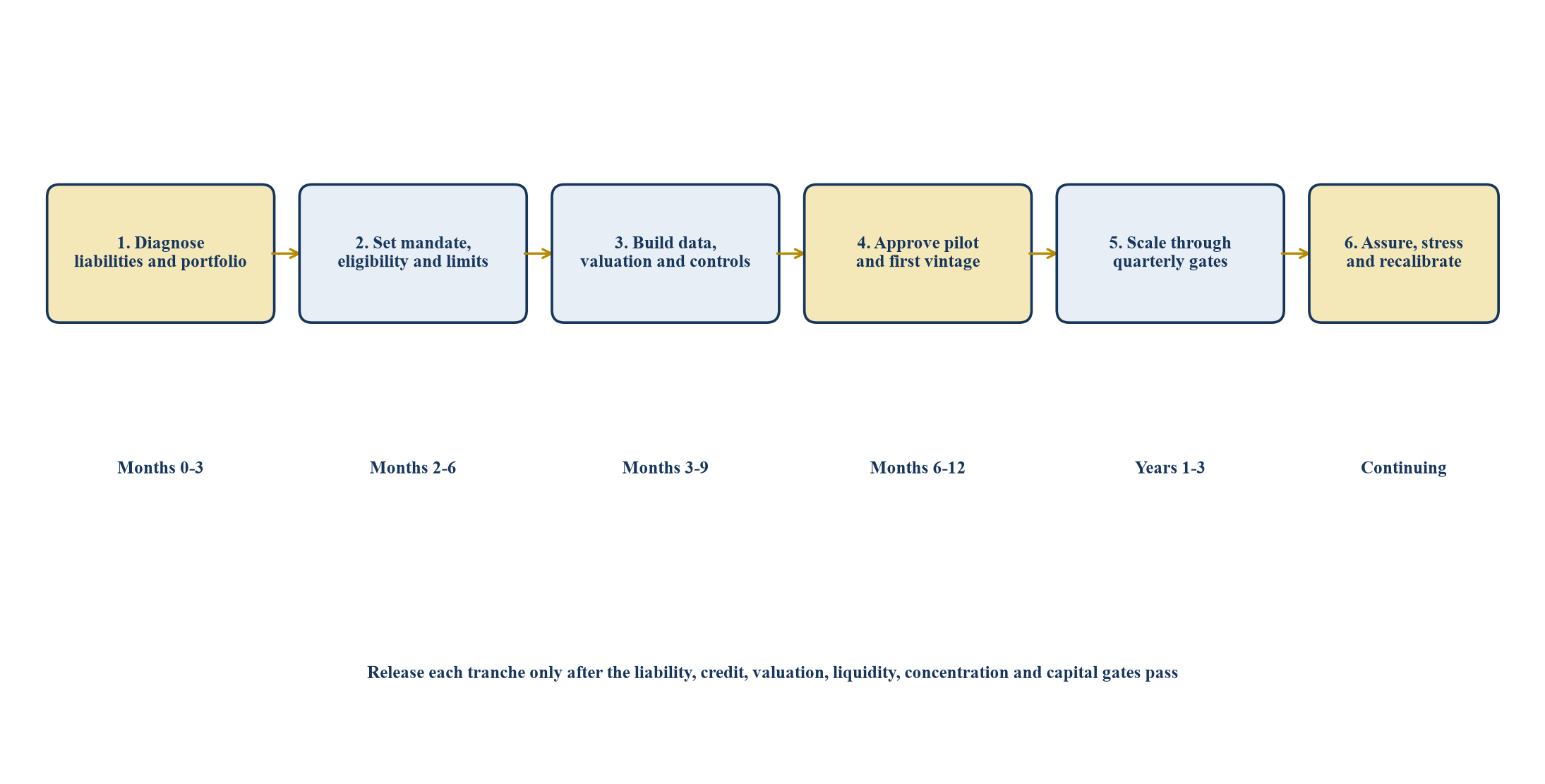
Deployment gates remain conditional on liability fit, evidence quality, liquidity, concentration and capital headroom.
24. Govern the portfolio after investment
Private credit requires continuing governance because risk can change between formal valuations. The operating model should define committee authority, first-line monitoring, independent risk challenge, valuation control, accounting, treasury and internal audit.
The board should receive a quarterly portfolio dashboard and an immediate escalation for material events. The dashboard should include funded and committed exposure, cash yield, PIK, arrears, amendments, internal and external ratings, expected loss, valuation movement, covenant headroom, concentration, liquidity, capital and exceptions.
Workouts require clear authority. The insurer should decide who can amend, waive, enforce, sell, inject new money or take control of collateral. Conflicts should be managed when an affiliated manager represents multiple vehicles or creditor classes.
Data lineage should connect borrower evidence to rating, valuation, accounting, capital and committee decisions. A change in one record should trigger review of the others.
25. Apply the Private Credit Balance-Sheet Allocation Framework
The framework can be applied through a disciplined sequence.
First, define the liability cash-flow need and liquidity capacity by legal entity. Second, classify each asset by economic substance and exclude structures without sufficient transparency. Third, build an independent credit and recovery case. Fourth, test cash-flow matching and valuation confidence. Fifth, aggregate liquidity, concentration and connected exposures. Sixth, confirm regulatory and management capital. Seventh, calculate net cash spread and return on constrained capital. Eighth, approve pacing, limits, management actions and monitoring.
The sequence is intentionally restrictive. It prevents a high headline yield from entering the portfolio before the insurer understands the liability role and downside capacity.
For the hypothetical insurer, the framework supports a paced increase to the 12 per cent limit only while liquid resources and capital headroom remain above management thresholds. The severe case requires actions and a lower allocation. The board therefore approves a conditional target rather than an unconditional volume commitment.
26. Limitations and conclusion
This paper provides an investment and balance-sheet decision framework. It does not constitute investment, actuarial, accounting, legal, tax, regulatory or rating advice. Capital treatment, asset eligibility, valuation and reporting depend on the jurisdiction, legal entity, instrument and facts.
The worked case is hypothetical. Portfolio size, allocations, yields, losses, liquidity needs, limits, capital proxies and stress outcomes are illustrative management assumptions. They are not forecasts and should not be applied to an actual insurer without independent evidence.
Private credit can create value for an insurer when it supplies durable cash flows, diversified credit exposure and spread that exceeds expected loss, operating cost and capital consumption. The value depends on the insurer's ability to hold the asset and to govern credit, valuation, liquidity and concentration through stress.
The binding constraint can change over time. A portfolio initially limited by origination capacity can later be limited by concentration, valuation uncertainty, surrender risk, capital or operating capability. The allocation framework should therefore be refreshed before each commitment and after material changes.
The central board decision is the amount of private credit that remains supportable in the severe case after realistic management actions. That amount, rather than the headline yield or market allocation of peers, should anchor the mandate.
The Private Credit Balance-Sheet Allocation Framework provides a controlled path from liability need to investment, capital and monitoring. It makes the trade between yield and resilience visible before illiquid assets enter the balance sheet.
Sources
- International Monetary Fund, Global Financial Stability Report October 2025, Chapter 1 and Box 1.3 on banks, insurers and private credit, October 2025, accessed 17 September 2026, Read the primary source
- International Association of Insurance Supervisors, Global Insurance Market Report 2024, alternative assets and asset-intensive reinsurance, December 2024, accessed 17 September 2026, Read the primary source
- National Association of Insurance Commissioners, Private Credit Issue Brief, 2026, accessed 17 September 2026, Read the primary source
- Bank of England, Prudential Regulation Authority, SS7/18 Solvency II Matching Adjustment, updated October 2025, accessed 17 September 2026, Read the primary source
- IFRS Foundation, IFRS 9 Financial Instruments, project and standard overview, accessed 17 September 2026, Read the primary source
- IFRS Foundation, IFRS 17 Insurance Contracts, project and standard overview, accessed 17 September 2026, Read the primary source
- National Association of Insurance Commissioners, Risk-Based Capital, updated 30 June 2026, accessed 17 September 2026, Read the primary source
- European Insurance and Occupational Pensions Authority, European insurers' exposures to private credit and private equity, 16 July 2026, accessed 17 September 2026, Read the primary source
- European Insurance and Occupational Pensions Authority, Financial Stability Report December 2025, private credit exposures and concentration, December 2025, accessed 17 September 2026, Read the primary source
- National Association of Insurance Commissioners, Insurance Topics Private Credit, updated 24 July 2026, accessed 17 September 2026, Read the primary source
- Bank of England, Prudential Regulation Authority, PS25/25 Enhancing banks' and insurers' approaches to managing climate-related risks, December 2025, accessed 17 September 2026, Read the primary source
- International Monetary Fund, Global Financial Stability Report April 2024, Chapter 2 The Rise and Risks of Private Credit, April 2024, accessed 17 September 2026, Read the primary source
- International Association of Insurance Supervisors, Insurance Core Principles and ComFrame, December 2024, accessed 17 September 2026, Read the primary source
- European Insurance and Occupational Pensions Authority, Final report on guidelines on supervisory powers to remedy liquidity vulnerabilities, 15 July 2026, accessed 17 September 2026, Read the primary source
- Bank of England, Prudential Regulation Authority, SS5/25 Enhancing banks' and insurers' approaches to managing climate-related risks, December 2025, accessed 17 September 2026, Read the primary source
- Bank for International Settlements, Shifting landscapes life insurance and financial stability, BIS Quarterly Review, September 2024, accessed 17 September 2026, Read the primary source
- Bank for International Settlements, Collateralized lending in private credit, Working Paper 1267, 13 May 2025, accessed 17 September 2026, Read the primary source
- Bank of England, Prudential Regulation Authority, Life Insurance Stress Test 2025 results, November 2025, accessed 17 September 2026, Read the primary source
