

1. Define the origination bargain
An unsolicited proposal begins outside a government request. A private party identifies an infrastructure need or offers a solution and asks the public authority to evaluate it. The proposal may contain useful innovation, but origination alone does not establish that the project is needed, affordable, financeable or best delivered as a PPP. The authority must make those decisions through its own governance process.
The World Bank and PPIAF describe unsolicited proposals as an exception to public initiation and warn that they can divert resources from government priorities, reduce competition and create transparency concerns. Their policy guidance therefore places submission, evaluation, project development and procurement inside a defined public process. [1] The originator's contribution is recognised, but the public authority remains responsible for the project decision.
The bargain should be explicit at intake. The originator provides a defined package of information and accepts that government may reject, defer, redesign or competitively procure the project. The authority protects agreed confidential information, states how it may use project material and discloses any available reward if the project proceeds. Neither party should rely on an informal expectation that the originator will receive the contract.
Management should distinguish three questions. Does the proposal merit evaluation? Should the authority develop the project? How should a contract be awarded? A favourable answer at one stage does not decide the next. Separating the questions protects the authority from commitment creep and helps the originator understand when additional expenditure is at risk.
The governing objective is to preserve useful private initiative without compromising public value. The process needs enough protection to support credible origination, enough competition to test price and quality, and enough disclosure to withstand later scrutiny.
2. Set policy objectives and scope
A government should state why it accepts unsolicited proposals. Possible objectives include discovering infrastructure needs, receiving technology-led solutions, accelerating projects that fit established priorities or accessing development capacity that the public sector lacks. A broad statement that government welcomes ideas gives limited guidance to proponents and evaluators.
Scope should identify eligible sectors, project sizes, forms of public support and excluded circumstances. Proposals should generally be excluded when the project is already in procurement, substantially prepared for procurement, or designed mainly to bypass an announced competitive route. The World Bank guidelines recommend a definition that separates genuine private initiation from an attempt to repackage a public project. [1]
The policy should also determine whether submissions are accepted continuously or during windows. A continuous channel can capture time-sensitive ideas but may overload the authority and create uneven treatment. Windows allow proposals to be compared against priorities and available evaluation capacity. The choice should match institutional resources.
Minimum submission requirements should be sufficient for screening without forcing the proponent to fund full feasibility before the authority has expressed interest. The initial package can cover the public need, proposed solution, novelty, land and permits, indicative cost, revenue concept, requested government support, delivery capability, conflicts and proprietary elements. A later detailed stage can require engineering, environmental, financial and legal work.
The authority should publish evaluation criteria, decision rights, indicative timelines, cost responsibility and confidentiality terms. Ontario's framework, for example, identifies scope, public benefit, alignment with priorities, technical and commercial viability and value for money where government funding is required. [8] A live framework must follow its governing procurement law.
3. Map the stage-gated transaction
The transaction should move through controlled gates rather than an extended bilateral negotiation. Gate one confirms administrative completeness and eligibility. Gate two screens strategic fit, public need, novelty and plausible viability. Gate three authorises detailed project development under written terms. Gate four approves the project and procurement route. Gate five conducts the competition or approved exception. Gate six reaches contract award and financial close.
Each gate should have an accountable decision maker, evidence requirements and a recorded outcome. The proponent should know whether it may continue work, what information government may disclose, which costs may qualify for compensation and what conditions could end the process. The authority should know what it has and has not approved.
The project-development stage deserves special control because information and expenditure increase quickly. The authority may use the proponent's studies, commission independent work or divide responsibilities. Public-interest studies such as needs assessment, affordability, environmental impact, fiscal exposure and procurement options should remain under public control even when the proponent supplies inputs.
Before approving procurement, the authority should confirm that the project fits infrastructure plans, passes economic and fiscal tests, has a lawful delivery route and can attract a credible bidder field. The decision should identify what value derives from the original concept and what value must still be discovered through competition.
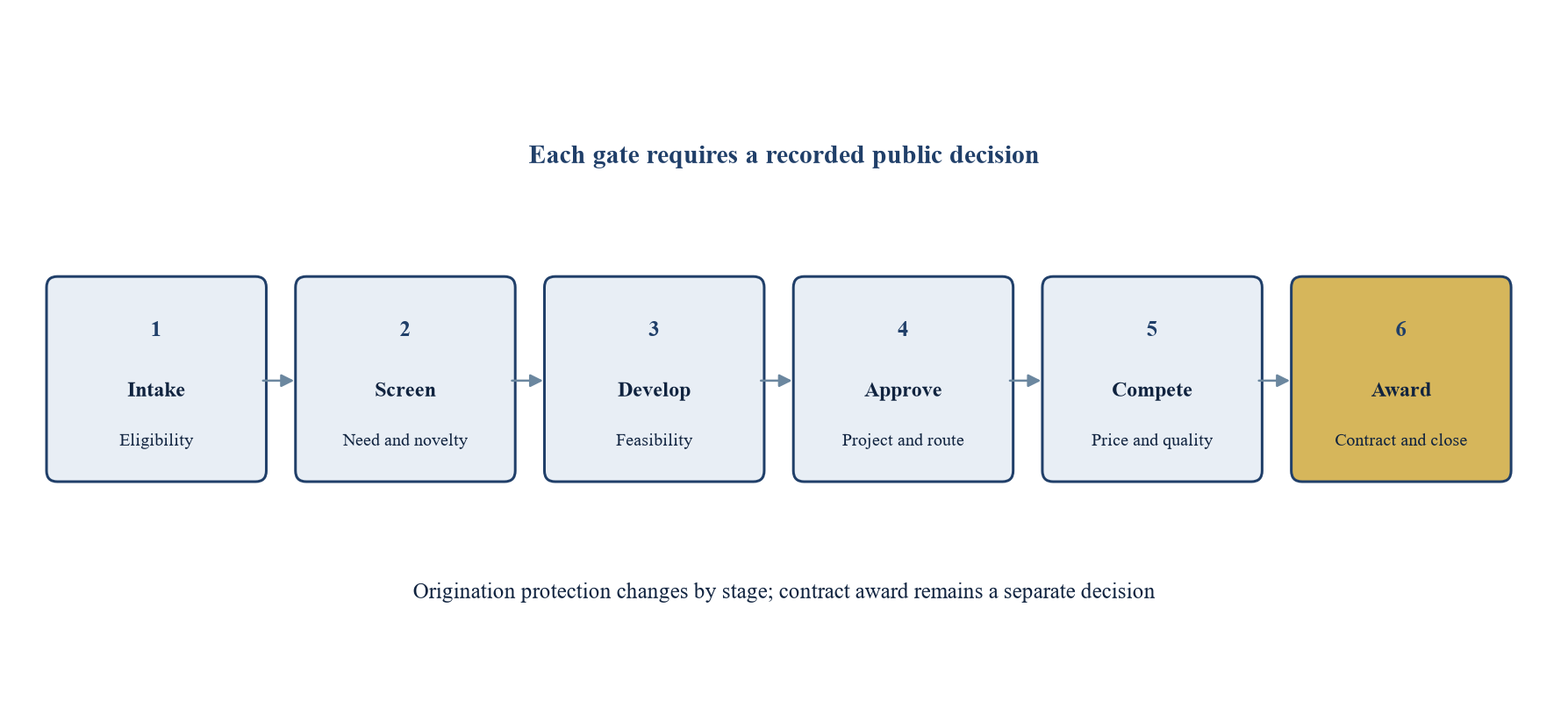
Original framework. A live process must follow the applicable procurement, PPP, fiscal and intellectual-property rules.
4. Screen before committing development resources
Initial screening should determine whether the proposal warrants deeper work. It should not attempt to complete feasibility. The authority should test strategic alignment, additionality, public benefit, apparent legal feasibility, sponsor capability, requested support and obvious alternatives. A proposal that depends on an unavailable site, prohibited tariff or unfunded sovereign guarantee should not consume months of detailed work.
Novelty needs a precise definition. A familiar asset does not become innovative because the proponent uses a different label. Novelty may arise from a protected technology, a new service model, an unusual combination of assets, a financing source tied to the concept or access to land or rights that government cannot readily reproduce. The authority should test whether the claimed feature is genuinely necessary to the public outcome.
The screen should compare the proposal with the approved infrastructure pipeline and reasonable non-PPP alternatives. UNCITRAL states that an unsolicited proposal should not replace government's own assessment of infrastructure need and project preparation. [4] The proposal may trigger an assessment, but it cannot provide its own public-interest conclusion.
Sponsor capability should be tested at the level required for the proposed development role. The originator may be a technology company, developer, fund, contractor or consortium. It should disclose ownership, financial capacity, relevant experience, conflicts, sanctions exposure and intended role. Capability to originate does not necessarily establish capability to finance, build or operate.
The screening record should state why the project advances, what remains unverified and which public resources are authorised. Rejection reasons should be documented consistently. A process that silently holds proposals for years creates uncertainty for the originator and weakens accountability.
5. Classify information before disclosure
The project information should be classified before government uses it. Background intellectual property includes technology, software, methods and know-how developed independently of the proposal. Project-specific proprietary information may include a novel configuration, protected design or privately assembled dataset. Public-interest information includes the service need, output requirements, environmental findings, affordability constraints and other material necessary for fair procurement.
The authority should request a marked confidential version and a disclosure version. The proponent should identify the legal and commercial basis for each claimed restriction. Blanket confidentiality over the entire proposal prevents scrutiny and can make competition impossible. Blanket public ownership of every submission may deter legitimate innovation.
The intake terms should state how government may evaluate, copy, share and retain material. External advisers, auditors and decision bodies may need access subject to confidentiality obligations. The terms should also address freedom-of-information law, court orders, regulatory disclosure and records retention. Government should avoid promising secrecy beyond its legal power.
Before tender, the authority and proponent should agree which information can be disclosed to bidders, which material will be licensed for the project, and which protected element will remain outside the bid package. Where a proprietary technology is essential and no reasonable substitute exists, the procurement analysis may support a narrow exception. UNCITRAL recommends objective and transparent testing of that conclusion. [4]
The classification should be maintained in an information register. Every item should have an owner, source, confidentiality basis, permitted users, release decision and expiry or review date. This register connects intellectual-property protection to an operable procurement process.
| Information class | Typical content | Default treatment | Procurement use | Required control |
|---|---|---|---|---|
| Background intellectual property | Existing technology, software, methods and know-how | Originator retains ownership | Licence only if necessary | Rights schedule and licence terms |
| Project-specific proprietary material | Novel configuration, protected design or private dataset | Protect until rights are agreed | Disclose only to permitted extent | Confidentiality decision and audit trail |
| Public-interest studies | Need, options, affordability, environmental and social evidence | Authority-controlled or independently validated | Provide equally to bidders | Independent review and source record |
| Tender information | Output specification, draft contract and evaluation method | Public procurement material | Equal access | Controlled data room and query log |
| Bidder-created material | Competing technical and commercial proposals | Protected under procurement rules | Evaluation only | Segregated access and retention policy |
Original framework. Rights and disclosure depend on governing law and negotiated documents.
6. Use a project-development agreement
A project-development agreement should govern detailed work after screening. It should define scope, deliverables, standards, timetable, responsibilities, approvals, cost records, information rights, conflicts, termination and the future procurement route. The agreement should not promise contract award.
The authority should retain control over public-interest decisions. The originator can prepare technical studies, market analysis and a financial model, while the authority commissions or controls needs assessment, value-for-money analysis, fiscal review and procurement design. Independent advisers can test assumptions and remove information asymmetry.
Cost treatment should be stated before expenditure. The agreement can define eligible categories, approved budgets, procurement standards, audit rights and caps. Related-party charges, financing costs, overhead allocations and success premiums require explicit treatment. An originator should not be able to create a reimbursement claim through unapproved work.
The agreement should contain a termination path. Government may stop because the project fails feasibility, loses priority, becomes unaffordable, cannot obtain approvals or cannot support competition. The originator may stop if government changes the scope beyond the agreed development commitment. Consequences should address information use, licence survival, reimbursable cost and handover.
Conflicts should be managed from the start. An adviser preparing the public evaluation should not also optimise the originator's bid. Authority staff who receive proprietary information should follow access controls. The development team and procurement evaluation team may require separation, particularly when the originator has shaped the output specification.
7. Define eligible development cost
Development-cost reimbursement can protect origination value without changing bid evaluation. It compensates a defined portion of verified work if government adopts the project and another bidder wins. The winning bidder may fund the payment through the contract price, or government may pay it directly. The choice affects affordability, bidder cash requirements and fiscal treatment.
Eligible cost should correspond to usable project development. It may include approved technical, environmental, legal, financial and stakeholder studies that transfer to the authority and procurement. It should exclude lobbying, ordinary business development, bid preparation after procurement starts, unapproved scope and costs unsupported by records.
The reimbursement base should be independently audited. Cost alone does not prove value. A study that cannot be relied upon, is duplicated by independent work or remains proprietary may justify limited or no reimbursement. The authority should assess usefulness, quality, transferability and compliance with the approved budget.
A cap protects public affordability and competitive entry. EBRD guidance discusses development-cost compensation as a small percentage of project cost, with regulations determining the maximum and the party liable. [7] A live cap should follow evidence, local law and market testing rather than a generic percentage.
Payment triggers should be precise. Possible triggers include contract award to another bidder, financial close, authority cancellation after adoption, or government use of the studies in another procurement. Different triggers can produce different amounts. Reimbursement should not reward misconduct, material misrepresentation or failure to comply with the development agreement.
8. Compare originator incentives
Available incentives affect competition differently. Development-cost reimbursement protects verified expenditure and leaves scoring unchanged. Automatic shortlisting gives the originator access to the final competition if it meets stated qualification criteria. A bid bonus adds evaluation points or a price preference. A Swiss challenge allows the originator to improve its proposal after competing offers are received. A right to match lets the originator equal the best competing bid.
The authority should evaluate the incentive against four tests: whether it encourages useful origination, whether competitors can still win, whether bidders can price the rule, and whether the final award remains defensible. An incentive that appears modest can have a large behavioural effect if competitors expect the originator to use their work as a free option.
Automatic shortlisting preserves participation but should not waive technical or financial qualification. A bid bonus can be transparent if its size is fixed and modest, but it weakens pure price comparison and may overcompensate weak origination. A Swiss challenge or right to match can suppress bidder effort because a competitor must reveal a winning offer before the originator decides whether to equal it.
The World Bank toolkit places direct negotiation and right-to-match toward the more distortionary end of the incentive spectrum. [1] The authority should prefer the least distortive mechanism that addresses the verified origination problem. More extensive protection requires stronger evidence that the project could not otherwise be brought forward.
| Mechanism | Origination protection | Effect on competition | Public-cost visibility | Main control |
|---|---|---|---|---|
| Verified cost reimbursement | Protects approved transferable work | Limited if scoring remains neutral | High when cap and payer are disclosed | Independent cost and usefulness audit |
| Automatic shortlisting | Protects access to final bid stage | Moderate; originator still competes | High | Full qualification threshold |
| Bid bonus | Improves originator evaluation score | Moderate to high depending on size | High if formula is published | Modest fixed bonus and sensitivity test |
| Swiss challenge | Gives a final improvement opportunity | High; competitors may reduce effort | Medium | Strict timetable and complete disclosure |
| Right to match | Allows originator to equal best bid | High; can discourage entry | Medium | Avoid unless law and exceptional evidence support it |
| Direct negotiation | Protects route to award | Removes tender competition | Low without independent benchmarks | Narrow legal exception and independent value test |
Original framework. Scores are qualitative and require jurisdiction-specific procurement review.
9. Avoid an unpriced right to match
A right to match changes the economics of bidding. A competing bidder may spend heavily to develop a compliant, financeable offer and still lose after the originator observes the best price and matches it. The originator holds an option over competitors' effort. Rational bidders may decline to participate, spend less on innovation or include the probability of loss in their price.
The authority should assess market response before selecting this mechanism. The relevant question is not whether the right appears fair to the originator. It is whether enough qualified bidders will invest under the rule to create a credible price and quality test. Market sounding should ask bidders about approval, diligence, financing and consortium costs, as well as their expected chance of award.
If law requires a right to match, the procedure should define what must be matched. Price alone may be insufficient when bids differ in risk allocation, technical performance, financing certainty, lifecycle cost or public support. A loosely defined match can produce litigation or an award that does not replicate the superior bid.
The timetable should prevent selective renegotiation. The originator should receive only the information necessary to exercise the right and should have a short, fixed period. Material changes after matching should trigger the same controls that apply to any preferred bidder. The authority should publish the mechanism before bids are prepared.
Cost reimbursement or automatic shortlisting will often provide cleaner protection. They compensate or preserve access without granting a final option over another bidder's work.
10. Design a credible competitive challenge
The competitive challenge should begin after government has converted the concept into a public output requirement. The tender should describe the required service, performance, risk allocation, support, land position, procurement timetable and evaluation. It should disclose project information equally while respecting legitimate protected rights.
The response period should reflect the complexity of diligence and financing. A short challenge window can create the appearance of competition while leaving only the originator able to submit. Bidders need access to data, sites, authority interfaces, advisers and lenders. They also need enough time for consortium formation and approvals.
Qualification should be proportionate. Criteria copied from the originator's credentials can exclude capable alternatives. The authority should test whether experience requirements relate to actual delivery risk and whether equivalent capability can qualify. Technical specifications should express outcomes where possible so competing solutions can emerge.
The evaluation method should compare whole-life public value. Price, public support, service performance, technical resilience, financing certainty, risk transfer and deliverability may all matter. Criteria and weights must be published and applied consistently. Clarifications should not allow one bidder to redesign the project privately.
The authority should plan for one bid or no bid. A single responsive bid does not establish competitive value. The process may require independent benchmarking, renegotiation limits, re-tender or cancellation. The procurement record should explain how the authority tested value and why proceeding remained justified.
11. Build an equal-information data room
Competition depends on information symmetry. The authority should establish a controlled data room containing the approved feasibility evidence, site and land records, surveys, environmental information, demand or service data, draft contracts, public-support terms and material authority dependencies. Bidders should receive the same version at the same time.
The data room should distinguish authority warranties from information supplied without reliance. Excessive disclaimers can make bids conditional and shift diligence costs into price. Overbroad warranties can expose government to claims for matters outside its knowledge. The allocation should follow which party can investigate and control the information.
Questions and answers should be logged and disclosed to all bidders unless a question contains bidder-specific intellectual property. The procurement team should decide whether the underlying issue still requires a common clarification. Private bilateral guidance can create unequal interpretations of the same contract.
The originator's involvement requires additional controls. Staff who worked with it during development may possess information about its approach. The authority should separate teams where appropriate, record contacts and provide competitors with all material project information that can lawfully be disclosed. Any protected technology retained by the originator should be clearly outside the common specification unless the procurement requires a licensed use.
The final data-room index should form part of the transaction record. It supports bidder reliance, contract interpretation and later dispute review.
12. Manage conflicts and independent review
Unsolicited proposals create structural information asymmetry. The originator knows the concept and may have influenced assumptions. The authority may depend on the originator's work before it has advisers or budget. Independent review is therefore a core control rather than an optional assurance exercise.
Technical advisers should test design, cost, performance and alternatives. Financial advisers should test revenue, financing, public support, affordability and value for money. Legal advisers should review authority, procurement route, intellectual property, land, permits and contract allocation. Environmental and social specialists should assess applicable impacts and approvals.
Adviser independence should be documented. Firms that helped the originator should not validate the same work for government. Potential bidders and their affiliates may have conflicts. The authority should require disclosures, information barriers and replacement when a conflict cannot be managed.
Decision bodies should receive both the originator's case and the independent assessment. Differences should be reconciled or presented clearly. The authority should identify assumptions that remain uncertain and state how procurement will test them.
Governance should also address political contact. Meetings, instructions and material commitments should be recorded through the authorised process. Senior sponsorship may help resolve cross-government issues, but it should not bypass evaluation or procurement controls.
13. Preserve bankability through competition
A competitive route can preserve the bankable core of an unsolicited proposal while improving price discovery. The authority should identify the features on which feasibility depends, such as a site, offtake arrangement, tariff, public payment, licence, technology interface or construction sequence. Those features should be validated before tender and expressed consistently in the documents.
Lenders need clarity on the procurement's legal validity. A process vulnerable to challenge can delay close or undermine enforceability. The authority should obtain advice on its powers, required approvals, disclosure and remedies. Bidder lenders should understand the originator incentive and any reimbursement obligation.
The project-development work should produce a reference case without locking bidders into one financing structure. The tender can specify minimum financial assumptions, public-support limits and evaluation metrics while permitting competing debt, equity and risk solutions. Comparability requires a common model basis and clear adjustment rules.
Financing certainty should be assessed through evidence rather than a generic letter. The evaluation can consider lender diligence, credit approvals, terms, conditions, hedging, reserve requirements and committed equity. The preferred bidder stage should control changes between bid and close.
Where the originator owns essential technology, the authority should determine whether competitors can license it on disclosed terms or propose substitutes. A tender that requires an unavailable proprietary input is not meaningfully competitive. A technology-neutral output specification may preserve competition while still achieving the original public benefit.
14. Measure fiscal exposure before procurement
Government should assess the project's fiscal effect before choosing the procurement route. Direct payments, grants, guarantees, land contributions, tax concessions, termination compensation and development-cost reimbursement can all create public exposure. An unsolicited origin does not reduce the need for budget and debt review.
The IMF and World Bank PFRAM asks who initiates the project, who controls the asset, who pays, what support government provides and what contractual risk government bears. It produces cash and accrual outcomes, debt-sustainability analysis and a fiscal risk matrix based on project and macroeconomic inputs. [6] The authority can use this structure to make retained risks visible.
Development compensation should appear in the fiscal record even when the winning bidder pays it. The cost may enter the contract price and ultimately be funded through government payments or user tariffs. A contingent cancellation payment should be modelled under its triggers.
The authority should also measure the cost of weak competition. A larger financing margin, conservative construction price or reduced innovation can exceed the visible originator reward. Scenario analysis should therefore compare total expected public cost, bidder participation and delivery risk rather than focusing on the reimbursement amount alone.
Fiscal approval should state the central case, downside, contingent exposures and budget route. It should remain valid through procurement. Material changes to scope, support or risk allocation should return for approval.
15. Evaluate value and bids separately
Project appraisal determines whether the project should proceed and whether PPP delivery is justified. Bid evaluation determines which compliant proposal provides the best outcome under the approved method. Combining the two can allow a strong bid to rescue a weak project or a favoured project to excuse a weak bid.
The project appraisal should cover strategic need, options, economic case, affordability, environmental and social impacts, fiscal risk and delivery capacity. OECD guidance states that delivery-mode choice should be separate from procurement and financing decisions to reduce institutional and accounting bias. [3]
Bid evaluation should use published criteria and a common comparator. The authority should normalise public support, financing assumptions, tax, timetable and risk exceptions. It should test whether a low price depends on qualifications or optimistic assumptions that shift cost back to government.
The originator reward should be applied exactly as disclosed. Cost reimbursement should sit outside scoring. A bonus should be visible in the evaluation calculation. Automatic shortlisting should not influence later scoring. Any departure should be approved and documented before bids are opened.
The evaluation report should explain the result, material sensitivities, clarifications and residual risks. It should record the originator's treatment and confirm that all bidders received equal project information.
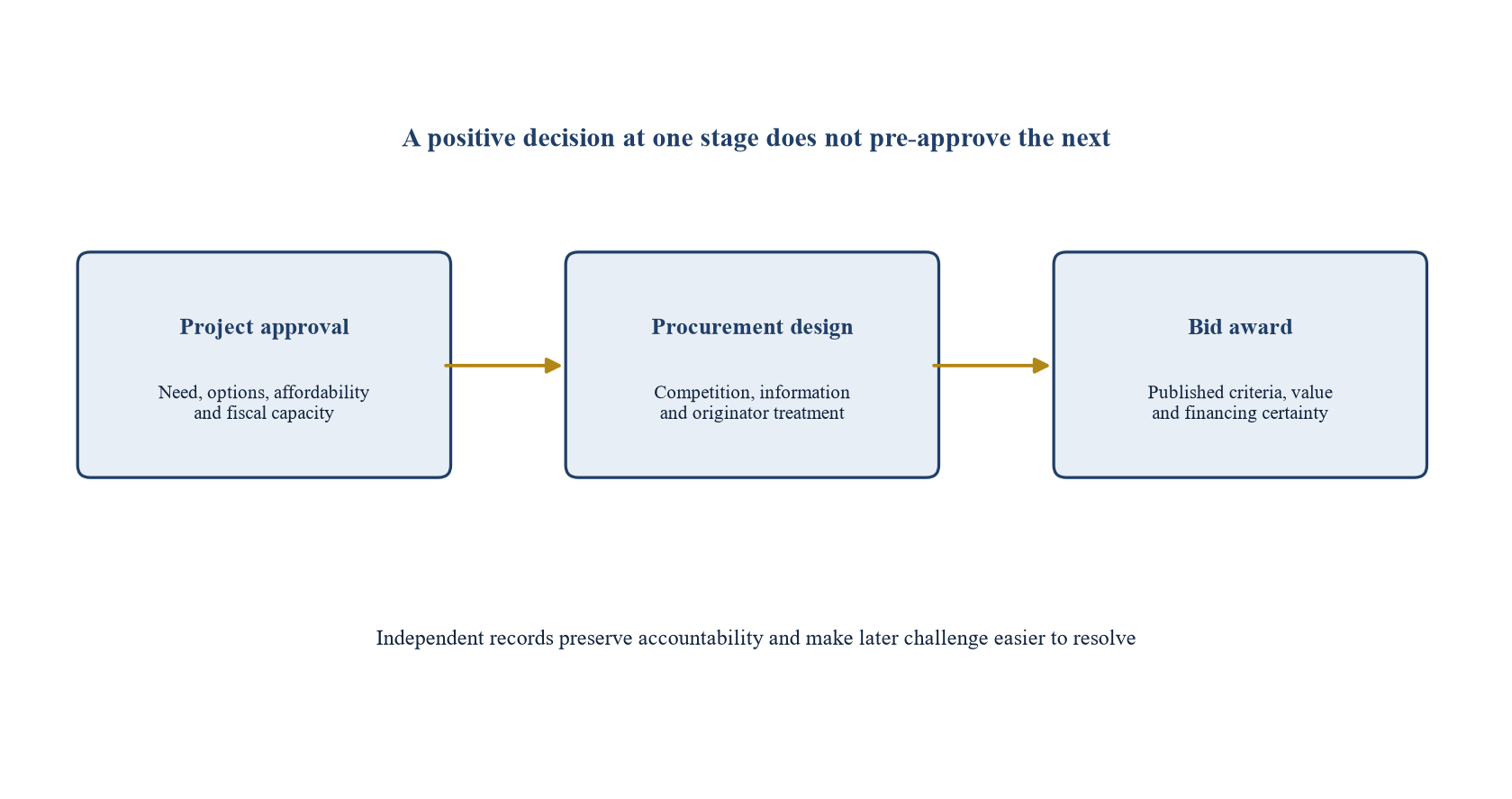
Original framework. The three decisions require separate evidence and approvals.
16. Allocate cancellation and bid-failure risk
The process should state what happens when the authority stops the project, procurement fails or the originator loses. Without defined consequences, each event becomes a negotiation under pressure.
At initial screening, the originator normally bears its own cost. During project development, approved transferable work may become conditionally reimbursable. After tender launch, all bidders usually bear their own bid costs, subject to any exceptional stipend disclosed in advance. The development agreement should identify the transition between these stages.
Government-caused cancellation may justify payment for approved work if the authority retains and uses it. Cancellation because the project fails feasibility may produce no payment or a limited amount, depending on the agreement. Originator misconduct, inaccurate disclosure or unauthorised expenditure should reduce or eliminate reimbursement.
If procurement produces no compliant bids, the authority should diagnose the cause before entering direct negotiation. The scope, risk allocation, timetable or public support may be unbankable. Negotiating only with the originator can conceal these weaknesses. A revised tender or project redesign may be required.
Challenge and review procedures should remain available. EBRD's regulatory collection includes review and challenge as part of a modern PPP framework. [7] The authority should preserve records sufficient to show eligibility, appraisal, information equality, evaluation and approvals. A standstill period can allow procurement remedies before contract execution where law provides one.
17. Build the hypothetical scenario
The hypothetical project is a regional water-reuse network with USD 650 million of initial investment. The concept combines treatment upgrades, transmission, storage and industrial offtake. The originator has identified the customer cluster, developed a technical configuration and secured preliminary discussions with landowners and equipment suppliers. Government has not independently approved the need, tariff or PPP route.
The originator expects to spend USD 6.0 million before procurement. The development agreement caps potentially reimbursable, transferable work at USD 4.5 million. The remaining USD 1.5 million represents business development, consortium formation and work that remains proprietary or bid-specific. All values are hypothetical.
Four procurement designs are compared. The first offers no originator reward. The second reimburses up to USD 4.5 million of verified cost if another bidder reaches financial close. The third gives the originator a 3 per cent evaluation bonus. The fourth gives a right to match the best compliant offer. The analysis uses assumed bidder participation and award probabilities to illustrate incentives; it is not a forecast.
Under the assumed no-reward case, the originator has a 20 per cent probability of winning and no recovery if it loses. Its expected recovery before profit is therefore USD 1.2 million against USD 6.0 million spent. With reimbursement, the same win probability plus USD 4.5 million on an 80 per cent loss produces expected recovery of USD 4.8 million before profit. This calculation excludes time value, risk, tax and bid-stage cost.
The bonus and right-to-match cases may improve the originator's chance of award, but the public effect depends on bidder response. The hypothetical assumptions use four expected qualified bids under neutral reimbursement, three under a bonus and two under a right to match. These counts are scenario inputs and need market evidence in a live procurement.
| Procurement design | Originator win probability | Recovery on loss | Expected originator recovery before profit | Expected qualified bids | Visible public compensation |
|---|---|---|---|---|---|
| No reward | 20% | USD 0.0m | USD 1.2m | 4 | USD 0.0m |
| Verified reimbursement | 20% | USD 4.5m | USD 4.8m | 4 | Up to USD 4.5m |
| 3% bid bonus | 35% | USD 0.0m | USD 2.1m | 3 | Embedded in evaluation |
| Right to match | 55% | USD 0.0m | USD 3.3m | 2 | Embedded in reduced competition risk |
Wholly hypothetical illustration. Probabilities, bidder counts and costs are assumptions, not observed results.
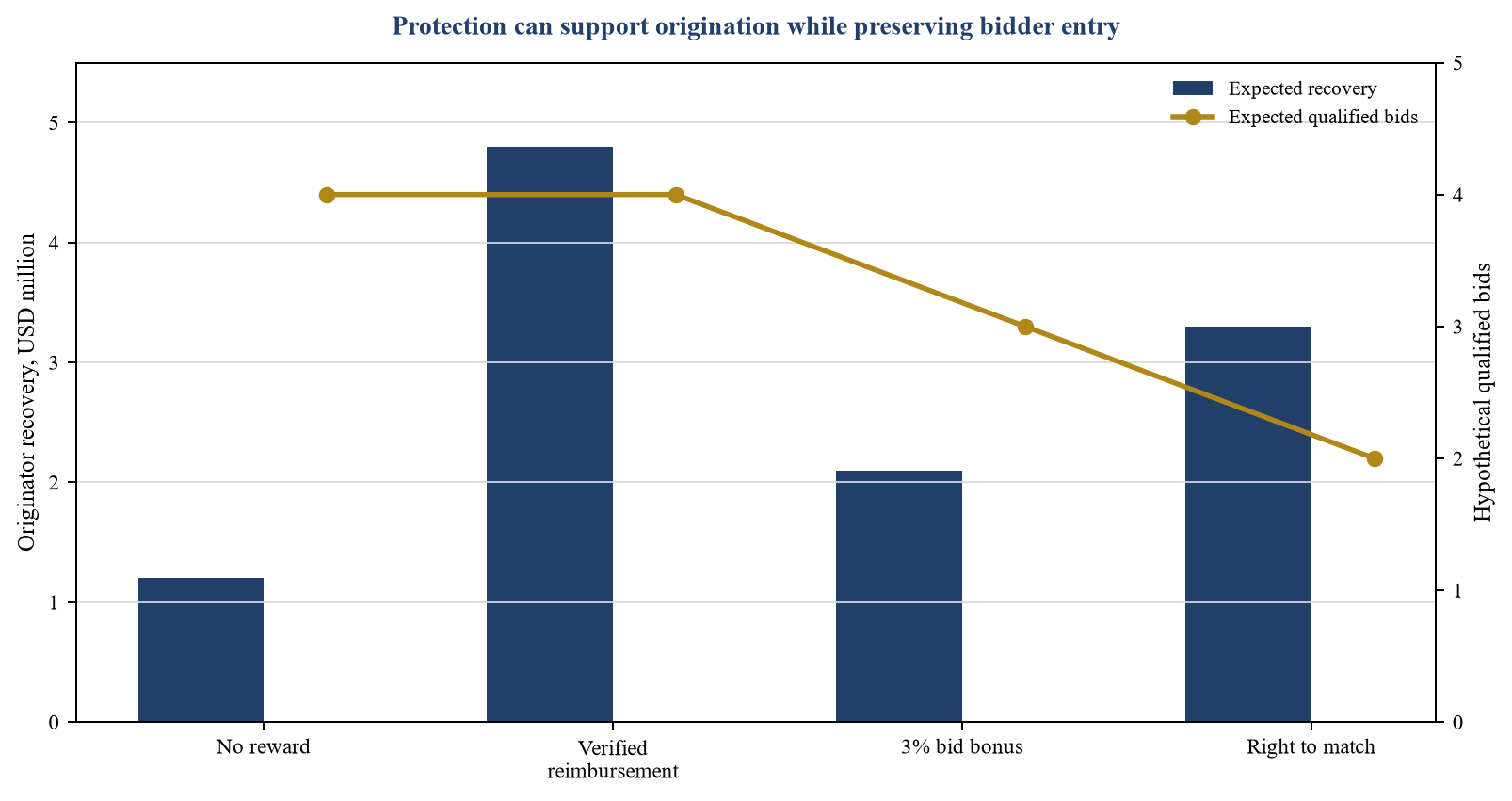
Wholly hypothetical illustration based on Table 3. Values are scenario inputs and calculated recovery, not empirical estimates.
18. Apply an integrated risk test
The authority should assess each design across origination, competition, information, fiscal, legal and delivery risk. A mechanism can protect development cost and still fail if it produces weak bidder entry or ambiguous information rights.
Origination risk concerns whether credible firms will invest before government commitment. Competition risk concerns bidder entry, effort and pricing. Information risk concerns whether the authority can disclose enough for comparable bids. Fiscal risk includes compensation, public support and the cost of weak price discovery. Legal risk covers authority, procurement challenge and intellectual-property claims. Delivery risk covers whether the awarded solution remains feasible and financeable.
The risk owner should have an action, evidence source, threshold and escalation route. For example, the procurement team can test bidder appetite; the legal team can approve information rights; the fiscal team can cap reimbursement; and technical advisers can confirm that the output specification does not depend on undisclosed proprietary material.
The authority should examine combined failure. Weak documentation, a short tender and a right to match can interact to leave only the originator bidding. An otherwise modest compensation amount can become contentious if the cost audit is performed after award. The integrated test should therefore examine the system rather than isolated clauses.
| Risk | Primary owner | Evidence | Proposed control | Escalation trigger |
|---|---|---|---|---|
| Origination deterrence | PPP policy owner | Submission quality and proponent feedback | Clear staged rights and reimbursement policy | Credible proposals stop before detailed stage |
| Weak competition | Procurement lead | Market sounding and bidder registrations | Neutral specification, adequate time and limited reward | Fewer than the approved bidder threshold |
| Intellectual-property dispute | Legal lead | Rights register and licence analysis | Marked submissions and project-development agreement | Essential material cannot be disclosed or licensed |
| Unverified development cost | Finance lead | Approved budget, invoices and deliverables | Independent cost and usefulness audit | Claimed cost exceeds cap or lacks support |
| Fiscal exposure | Ministry of finance or equivalent | PFRAM and budget analysis | Approval of direct and contingent commitments | Support or cancellation cost exceeds approval |
| Process challenge | Procurement authority | Decision and disclosure record | Independent review and standstill process | Material unequal treatment or undisclosed change |
| Bankability loss | Transaction lead | Lender and bidder feedback | Validate project core and common financing basis | Bids require material unapproved risk change |
Original framework. Ratings must be set from project-specific evidence.
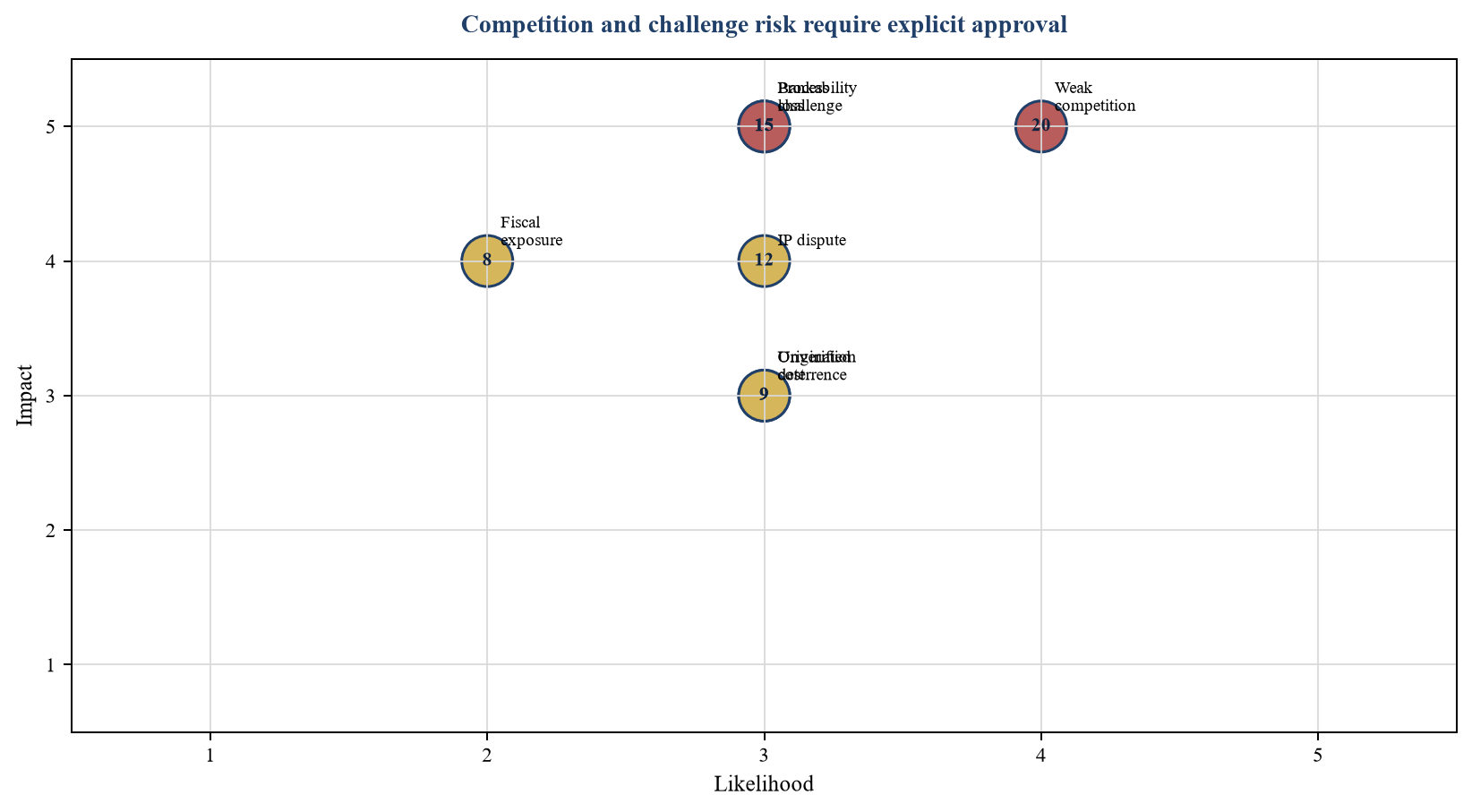
Original illustrative ratings. A live authority should assign ratings using documented project evidence.
19. Establish governance and model control
The authority should appoint a single process owner and separate decision roles. The originating ministry or agency may sponsor the service need. A PPP unit can test process and project preparation. The finance ministry or equivalent approves fiscal exposure. A procurement authority controls competition. Independent advisers support technical, financial and legal review.
The decision register should record submission, screening, development scope, information rights, cost approvals, project appraisal, procurement route, bidder communications, evaluation and award. Each record should identify the evidence considered, conflicts and approving authority.
Models should use controlled assumptions and documented sources. The originator model may inform the reference case, but the authority should own the model used for affordability, fiscal approval and bid comparison. Independent model audit confirms arithmetic and document consistency; it does not prove demand, cost or policy assumptions unless specifically scoped.
The cost register should reconcile approved budget, commitments, invoices, deliverables and reimbursement eligibility. The information register should track rights and disclosure. The issue register should connect bidder questions to common clarifications and document changes.
Governance continues after award. The authority should confirm payment of any reimbursement, transfer or licensing of project material, procurement record closure and preservation of audit evidence. Lessons should update the policy for future proposals.
20. Implementation roadmap
The first stage is policy design. Government should define objectives, scope, exclusions, submission requirements, evaluation criteria, confidentiality, cost responsibility, incentive options, procurement defaults and decision authority. It should consult procuring bodies, finance, competition, audit and market participants.
The second stage is intake capability. The authority should establish a secure submission channel, standard forms, conflict declarations, information marking and a triage team. It should publish timelines and a contact protocol. Staff should be trained to avoid informal commitments.
The third stage is evaluation capability. Screening templates should cover need, priority, novelty, viability, support and alternatives. The authority should have access to independent technical, legal, financial, environmental and fiscal advisers. Proposals that pass should receive a scoped development plan.
The fourth stage is the project-development agreement. The parties should agree deliverables, standards, rights, cost cap, audit, disclosure, termination and expected procurement route before substantial work begins. Public-interest studies should remain independently controlled.
The fifth stage is tender preparation. The authority should complete appraisal and approvals, test the market, create the common data room and publish the originator treatment. The specification, contract, model and evaluation should use consistent assumptions.
The sixth stage is competition and close. The procurement team should manage equal information, evaluate under the published method, observe challenge procedures and control preferred-bidder changes. Financial close should trigger any approved reimbursement and rights transfer.
Periodic policy review should compare proposal quality, processing time, development cost, bidder participation, challenges, award outcomes and completed service. These measures inform policy; they do not by themselves prove public value.
21. Management questions before approval
Decision makers should ask whether the proposal addresses a verified public need and whether the need appears in the infrastructure plan. They should ask what is genuinely novel, what government can reproduce, and what protected right is essential to the solution.
They should examine the originator's proposed role and capability. Origination, development, financing, construction and operation require different evidence. Conflicts and related parties should be disclosed.
The information questions should cover ownership, confidentiality, disclosure and licensing. Management should know whether competitors can receive enough information to prepare comparable bids and whether the authority can retain work if the relationship ends.
The cost questions should cover approved development scope, eligible categories, cap, audit, payer and trigger. The authority should understand how reimbursement enters the public price or budget.
The competition questions should cover market depth, bidder preparation time, qualification, incentive distortion, evaluation and the response to one or no bid. A procurement labelled competitive still requires credible entry and effort.
The final approval should identify the chosen originator protection, rejected alternatives, remaining legal and fiscal risks, and the evidence supporting the procurement route. Management should be able to explain the decision to bidders, auditors and the public from the same record.
22. Conclusion
An unsolicited proposal can create public value when it identifies a credible need or solution that government has not prepared. Its origin does not remove the authority's duties to plan, appraise, approve and procure the project. Legitimate origination value should be protected through defined rights and compensation rather than an informal expectation of award.
The strongest process separates stages and information classes. Initial submissions receive stated confidentiality. Detailed development proceeds under a written agreement. Transferable work can qualify for capped, audited reimbursement. Public-interest evidence remains independently controlled. Competition uses a common data room, adequate time, published criteria and a limited, disclosed originator incentive.
Rights to match and direct negotiation require exceptional justification because they can reduce bidder participation and price discovery. Cost reimbursement and automatic shortlisting can provide more transparent protection where law permits. The final design should follow market testing, fiscal analysis, legal advice and project-specific evidence.
The framework in this paper provides a route from private initiative to a defensible public contract. Its calculations are hypothetical and illustrate mechanics only.
Sources
- World Bank Group and Public-Private Infrastructure Advisory Facility, Policy Guidelines for Managing Unsolicited Proposals in Infrastructure Projects, Volume II, 2017, accessed 16 September 2026. Read the primary source
- World Bank Group and Public-Private Infrastructure Advisory Facility, Policy Guidelines for Managing Unsolicited Proposals in Infrastructure Projects, volumes I to III, accessed 16 September 2026. Read the primary source
- Organisation for Economic Co-operation and Development, Infrastructure Governance, accessed 16 September 2026. Read the primary source
- United Nations Commission on International Trade Law, UNCITRAL Legislative Guide on Public-Private Partnerships, 2019, accessed 16 September 2026. Read the primary source
- United Nations Commission on International Trade Law, UNCITRAL Legislative Guide on Public-Private Partnerships, full text, 2021 edition. Read the primary source
- International Monetary Fund and World Bank Group, Public-Private Partnerships and the PPP Fiscal Risk Assessment Model, accessed 16 September 2026. Read the primary source
- European Bank for Reconstruction and Development, PPP Regulatory Guidelines Collection, 2024, accessed 16 September 2026. Read the primary source
- Government of Ontario, Unsolicited Proposals Submission and Assessment Guidelines, accessed 16 September 2026. Read the primary source
- World Bank Group, Defining Clear Policy and Processes for Unsolicited Proposals, accessed 16 September 2026. Read the primary source
- Organisation for Economic Co-operation and Development, Subnational Public-Private Partnerships, 2018. Read the primary source
