

1 Define the overseas entry decision before comparing offers
An overseas accelerator should be evaluated against a company decision with a defined operating milestone, a dated cash requirement and an explicit alternative. The relevant milestone might be a completed customer evaluation, an executable distribution agreement or a financing round that places usable funds in the company account. Each outcome requires different work and evidence. A programme's investment headline gives an incomplete description of the route when participation requires travel, a different corporate structure, a period of residence or expenditure before the investment becomes available. The economic question is whether the company can fund the complete route and justify the ownership and operating commitments attached to it.
The assessment begins with the company that signs the programme documents and the company that bears the operating costs. These can be different entities. The board should identify the receiving entity, existing shareholders, founder obligations and any required parent or subsidiary before approving a budget. It should also identify the people whose physical presence is required and their permitted activities in the destination. Acceptance, investment selection, legal restructuring, immigration permission and bank release belong on separate lines of the decision record. Evidence for one event cannot complete the record for another. A signed offer should therefore be reconciled to the company's own legal and cash position.
This paper develops an access-adjusted financing and commercialisation method. It combines a dated register of selected public programme and government sources with a constructed cash-ledger experiment and a protocol for recording commercial progress. The analytical contribution is a conditional interval for the customer contribution that a particular route can finance. Delivery expenditure before collection can impose an upper working-capital bound as well as a lower receipt requirement. A later contract can also leave an earlier cash constraint unresolved. These are consequences of a specified event calendar and cash policy. They are not estimates of the effect of joining an accelerator.
The public-source review concerns the offers and rules served at the stated observation date. Executed applicant agreements, individual immigration decisions, founder cost quotations and a matched register of introductions followed through to collected cash were unavailable for this analysis. The worked companies and numerical inputs are expressly constructed. The findings therefore support a decision method, a set of questions for an offer and a measurement design. They do not identify a current programme's causal sales return or an applicant's probability of receiving investment. A company can replace the constructed inputs with its own documented commitments without changing that distinction.
2 Separate programme services from investment and commercial commitments
A programme description can contain several economically different items. An initial investment, a contingent investment opportunity, a reimbursement entitlement, a competitive prize and access to advisers should be recorded separately. Their conditions, timing and ownership consequences differ. A funding ceiling supplies an upper limit under the published description. The company needs the amount committed to its own entity and the date on which it can use that amount. Programme fees and other deductions need a separate reconciliation. Services and credits require their own eligibility and utilisation records. Combining these items into a single support total prevents a reader from identifying the resources available to meet a particular invoice.
Public deal terms provide useful starting evidence when the version and instrument remain visible. Y Combinator's published standard deal describes a fixed-percentage SAFE component alongside an uncapped most-favoured-nation SAFE and states that it charges no programme fee. Techstars describes an initial common-equity component, an uncapped most-favoured-nation SAFE and further rights and obligations. Its published offer also differs for Asia-Pacific programmes. These structures require instrument-specific review before a founder calculates eventual ownership. The cash and equity terms of one component cannot stand in for the entire arrangement. The constructed financial cases later in this paper use a deliberately narrower convention and do not reproduce either provider's complete contract.
The programme version matters independently of its brand. The canonical 500 Global flagship page served during this research identifies The 500 Fellowship, with a November 2026 to April 2027 period and conditional initial and potential later investment. Older indexed descriptions refer to a different headline deal. The current page leaves material instrument and fee questions for verification. This difference warrants a fresh offer record, with a saved source date and explicit unresolved fields. Reconstructing current bank cash from a historical fee and an older investment headline would combine different versions of a product. The resulting number would lack a valid documentary basis.
Commercial support should be recorded through its promised deliverable. Access to a network, an introduction to a potential buyer, participation in a demonstration event and an executed customer contract describe different events. The same applies to investor access, a term sheet, an investment agreement and cleared financing cash. The assessment should state which event the programme actually offers, what further selection or negotiation is required and whose decision controls the next stage. This allows the company to monitor delivery of a service without treating every service as revenue. It also supplies a clear starting point for discussions about milestones, reporting, participation fees and the scope of any follow-on investment.
| Event | Required evidence | Cash treatment |
|---|---|---|
| Admission | Accepted offer and obligations | No automatic receipt |
| Investment | Instrument, satisfied conditions and wire | Usable funding on settlement |
| Introduction | Dated qualifying communication | No automatic customer receipt |
| Paid contract | Signed scope and payment terms | Delivery and collection separately |
| Follow-on | Selection and financing documentation | Conditional until settlement |
Author's decision framework; no programme outcome asserted.
3 Establish permission and eligibility before irreversible expenditure
The company should complete its permission and eligibility review before incurring commitments that cannot be recovered. This review covers the programme's applicant definition, the investment entity, founder ownership, geographic conditions and the activities intended in the destination. It should identify unresolved requirements and the person responsible for confirming them. The financial model treats an unresolved legal or programme condition as a separate decision state. It does not assign a convenient probability to permission or treat a positive year-end cash balance as a substitute for it. The finance team can prepare conditional budgets while the required documentary work proceeds.
Immigration permission needs a route-specific assessment. The UK government's Standard Visitor guidance permits specified business activities, including meetings and negotiating contracts, within its conditions. It directs applicants to an appropriate work route for other paid or unpaid work. The US Department of State's B-1 fact sheet similarly distinguishes permitted business activity from employment and labour. These published summaries do not decide whether a particular founder's planned programme work is permitted. A programme invitation, the ability to register a company and the ability to work in it should therefore have separate evidence. The paper makes no applicant-specific immigration recommendation.
Route availability must be checked at the intended entry date. Canada's official Start-up Visa page was marked paused during this research. The historical exception required a valid 2025 commitment certificate and an application by 30 June 2026, a date already past at the November observation. An offer from a business-support organisation cannot establish access through that paused route. Other Canadian business or immigration pathways require their own assessment. The decision record should preserve the exact route and the date checked, rather than relying on a general reference to a country or a programme's older description of relocation support.
Corporate and programme eligibility also require their own ownership and operating facts. Enterprise Singapore's GIA Shanghai page includes registration and operation in Singapore, a specified ultimate local-equity threshold, a business-to-business proposition and revenue conditions. Such requirements belong to that route and should remain attached to it. A programme described for international market access does not thereby admit every foreign company. Proposed restructuring should be assessed together with the founders' investment documents and operating requirements. The relevant authority or adviser should confirm whether a change actually satisfies the applicable test. Incorporation by itself supplies an insufficient record of eligibility.
| Route | Published rule to check | Applicant evidence |
|---|---|---|
| United Kingdom | Permitted business activities and participation | Individual route and actual activities |
| United States | B-1 permitted activities and programme requirements | Appropriate individual permission |
| Singapore | EntrePass and applicable support criteria | Ownership, business and founder facts |
| Canada Start-up Visa | Published pause and historical exception | Current applicable route confirmation |
Official immigration sources accessed 12 November 2026; individual eligibility is not determined here.
4 Construct a documented stay alternative and an incremental entry budget
The comparison needs an explicit stay alternative. The same company begins both routes with the same opening resources, existing commitments and observation horizon. The stay route should contain the financing and commercial opportunities that management can substantiate without overseas participation. Assigning it zero opportunities while crediting every overseas introduction would predetermine the result. Where the available evidence supports only a conditional forecast, that condition should remain visible in both routes. The constructed experiment uses a simple common operating business to isolate mechanisms. Its zero baseline receipts are an analytical input, not a description of the typical company or the absence of domestic market opportunity.
Access expenditure should be incremental to that alternative. Relocation can replace an existing cost, add a new cost or leave an existing obligation in place while adding another. The budget should identify which situation applies. An overseas accommodation invoice cannot automatically be treated as the full incremental housing cost if a domestic expense ends. Conversely, an unexpired domestic lease can continue alongside the new invoice. The same logic applies to staff, insurance, entity maintenance and professional services. Each material item needs an amount, currency, payment date, condition and source. A company-specific quotation has a different evidential role from an author-selected scenario input.
Cost bearers must remain identifiable. A founder's personal expenditure, a company payment and a programme reimbursement affect different cash positions. The analysis should show any founder loan, reimbursement obligation or capital contribution that transfers a cost between them. A personal payment should not silently reduce the company's bank balance. The worked experiment assigns its modelled access costs to the company and records that convention expressly. This keeps the cash identities testable. A real decision would add the founder's personal budget and funding constraints before approving relocation, particularly where the company is relying on the founder to bridge expenses before investment or reimbursement.
Time commitments need a disciplined treatment. The board can record the work displaced by programme attendance, the work required to maintain the domestic business and the capacity needed to deliver an overseas pilot. Those items should be translated into a documented staffing or delivery assumption where cash is affected. The analysis should avoid adding a second generic opportunity-cost charge for the same already budgeted resource. A separate non-cash time assessment can remain useful for a decision involving founder attention. It should retain its own units and decision purpose, rather than being inserted into the cash ledger at an invented hourly rate.
The resulting budget should allow a reader to trace each difference between the routes. Common operating items remain identical unless a stated route decision changes them. Incremental access items receive unique identifiers, with displaced domestic costs cross-referenced where relevant. Payment dates should follow contractual or supplier evidence where available. A scheduled event, an estimate awaiting a quotation and a board-approved commitment need distinct statuses. This structure allows later invoice reconciliation without rewriting the original forecast. It also allows the company to identify whether an adverse result arose from a fee, a changed participation requirement, slower financing or a different commercial outcome.
| Item | Treatment | Evidence |
|---|---|---|
| Existing operating cost | Common unless displaced | Budget and contract |
| Programme fee | Confirm payer and settlement mechanism | Fee agreement |
| Travel and living | Incremental amount and actual payer | Required attendance and quote |
| Financing | Separate conditions and ownership | Instrument and bank receipt |
| Support | Eligible claim and collection separately | Award and payment terms |
| Founder payment | Separate personal ledger and reimbursements | Invoice and reimbursement terms |
The constructed model has company-paid costs and a zero founder-personal ledger.
5 Record introductions through observable customer decisions
A commercial evidence register should follow individual opportunities beyond the meeting count. Each opportunity needs a unique identifier, the buyer organisation, the business need, the accountable contact and a dated next action. A record can then distinguish an introduction from a qualified conversation, a pilot agreement, delivery, an executed paid contract and collection. The proposed sequence is a reporting convention. A company can enter a record at a later stage when evidence for that stage already exists, without inventing earlier programme involvement. Lost and stalled opportunities should remain in the register so that the surviving accounts do not become the entire denominator.
Qualification should describe a buying situation that the company can test. The register can record the problem under discussion, the relevant product or service, the buyer's decision process and the next mutually agreed step. Evidence might include a correspondence trail, a documented evaluation plan or a meeting record accepted by the commercial owner. The point is to make the stage reproducible within the company. An introduction made to someone without a relevant role can remain an introduction while the company seeks a more suitable contact. Recording it at that stage preserves the activity without claiming that the opportunity is ready to produce a contract.
Pilots require their own delivery and cash records. A pilot can require staff time, implementation work, data access, insurance or other spending before the company receives a customer payment. The register should identify who approved those costs and the conditions for moving into a paid engagement. Delivery of an unpaid pilot records work completed. It supplies no customer cash receipt until a separately evidenced payment occurs. An executed paid contract also needs its collection schedule and outstanding conditions. The finance team can then connect the commercial record to the cash ledger through transaction identifiers, rather than valuing the entire funnel as if it had already been collected.
The relationship between programme involvement and an outcome should be recorded separately from the outcome itself. A programme may have supplied an introduction, improved an existing conversation or had no documented role in an account. A customer reached through a domestic relationship should remain in the stay alternative where that alternative is part of the comparison. Co-occurrence after programme entry supplies a sequence of events. It does not alone identify the additional business caused by participation. An attribution review should therefore retain the contact's origin, the pre-entry account history, the actions taken and the alternative channels available to the company.
Monitoring also needs a defined observation period and population. A rate calculated among funded portfolio companies has a different denominator from one calculated among all admitted residents or all eligible applicants. An early-stage pilot measure cannot be compared directly with collected revenue measured over a later horizon. The proposed register records cohort, geography, entry date, outcome date, currency and missing follow-up. It does not substitute a selected provider's aggregate success rate for the company's own evidence. Those records can support later descriptive analysis or a properly designed comparison study. The present research does not claim to have assembled such an applicant-level panel.
| Stage | Evidence | Meaning |
|---|---|---|
| Introduced | Dated relevant contact | Access event |
| Qualified | Problem, authority and buying process | Assessed opportunity |
| Pilot agreed | Scope, obligations and payment status | Delivery commitment |
| Paid contract | Executed terms | Contractual payment entitlement |
| Cash collected | Bank and invoice reconciliation | Collected customer funds |
Proposed operational definitions; no observed conversion rate.
6 Recognise follow-on finance when its conditions and cash are evidenced
Follow-on capital needs an investment record that is separate from the customer register. The record should distinguish an investor introduction, a meeting, a non-binding indication, a term sheet, an executed instrument and the bank receipt. It should also identify any further conditions, including legal restructuring, ownership checks or a matching external investment. The initial financing decision should use the funds committed and usable under its stated conditions. A conditional future investment can be retained as a scenario and a due-diligence question. Giving it a separate line prevents the programme's potential funding ceiling from becoming current operating cash.
The published terms reviewed for this paper demonstrate why those distinctions matter. Entrepreneurs First's London FAQ separates entry support from later investment selection and conditions attached to an optional San Francisco financing leg. Antler Singapore describes matching capital linked to institutional financing. The current 500 Fellowship description uses conditional language for initial and possible later investment. Each is a distinct published proposition that requires its own applicant agreement and payment evidence. The descriptions should retain their currencies, selection conditions and programme versions. They supply no common probability of funding and no verified financing receipt for the company considering participation.
A later investment also changes the claims on the company. The cash ledger records the amount received and the date it becomes usable. A separate ownership schedule records the instrument, conversion conditions and the share allocated to new capital. Fixed ordinary equity and a contingent convertible instrument require different treatment. The constructed experiment uses a deliberately limited post-money-cap convention for one case and states the conditions under which its calculation applies. It does not extend that convention to uncapped most-favoured-nation instruments, multiple overlapping SAFEs or undisclosed option-pool changes. An actual offer needs its own compatible capitalisation analysis.
The board should also keep financing performance separate from operating performance. An investment increases company cash and creates the corresponding investor claim. It does not establish customer revenue or a commercial margin. A route can finish the observation period with more cash because it sold more ownership. That result should be reported beside the cash use and ownership retained, with the limitations of any comparison made explicit. The decision then remains open to the shareholders' actual objectives and constraints. The analytical method supplies the feasible choices and the evidence needed to judge them; it does not manufacture a universal ranking from incompatible measures.
| Stage | Record | Remaining dependency |
|---|---|---|
| Meeting | Dated contact | Selection and terms |
| Term sheet | Version and binding status | Documentation and conditions |
| Signed financing | Receiving entity and instrument | Conditions and settlement |
| Cleared proceeds | Bank receipt and restrictions | Permitted use and future obligations |
Author's control framework; no real investment pipeline supplied.
7 Read each published offer as a dated set of separate components
The selected programmes illustrate several structures that require different questions at diligence. Y Combinator publishes a USD500,000 investment divided between a USD125,000 SAFE for a fixed seven per cent and a USD375,000 uncapped MFN SAFE, with no programme fee. The two securities should remain separate in an ownership analysis. The fixed component supplies one stated percentage, while the eventual treatment of the MFN component depends on its documents and subsequent financing. The programme's FAQ describes an in-person San Francisco programme and international applications. That description does not establish an applicant's travel permission, restructuring bill or final financing timetable. Each of those matters requires its own evidence (Y Combinator, Deal and FAQ).
Techstars publishes a USD220,000 structure comprising USD20,000 through a convertible equity agreement associated with five per cent common equity and USD200,000 through an uncapped MFN SAFE. Its published regional exception gives APAC programmes a USD100,000 SAFE component, producing a different headline total. The investment announcement describes checks and an initial payment process. It would be premature to place the entire headline amount in a company's opening bank balance solely from that announcement. A board should request the exact applicable offer, its conditions and the wire sequence. The geographical exception also means that a generic comparison table needs an identifiable location and version (Techstars, Investment Terms; 17 April 2025 announcement).
Antler's UK page publishes £125,000 for 8.5 per cent equity, an £85,000 convertible note and a £40,000 programme fee. Its Singapore page describes a different investment package, no residency fee and founder-funded travel and living costs. The Singapore page uses dollar amounts without an explicit ISO currency designation in the reviewed text; the register preserves that uncertainty. The UK fee cannot be assumed to be withheld from the investment on a specified date without the actual settlement documents. The two published offers therefore support a component comparison, while a calculation of usable bank cash remains conditional on unresolved terms. Each company should also confirm which residency and investment selection rules apply (Antler, UK and Singapore location pages).
The current 500 Global flagship page presents The 500 Fellowship, updated in September 2026. It describes potential early investment up to USD50,000 and potential additional investment up to USD1 million. Those maximum statements do not identify a universal cheque, equity percentage, programme fee or receipt date. Historic descriptions of a different programme should not be combined with the current page to manufacture net proceeds. Entrepreneurs First similarly separates its London support, investment committee decision and optional additional financing associated with San Francisco relocation and a Delaware C corporation. These examples motivate a comparison with explicit unresolved cells. A blank supported by a precise question is more useful than a confident number assembled from incompatible offer versions.
| Programme | Published structure | Unresolved or conditional |
|---|---|---|
| Y Combinator | USD125k for 7%; USD375k uncapped MFN SAFE | Subsequent instrument treatment and applicant costs |
| Techstars | USD20k CEA associated with 5%; USD200k MFN SAFE | APAC SAFE USD100k; applicable wire sequence |
| Antler UK | £125k for 8.5%; £85k note; £40k fee | Fee tax, settlement, refund and receipt dates |
| Antler Singapore | Source $100k for 10%; $50k MFN; no residency fee | ISO currency not explicit; founder living/travel |
| Entrepreneurs First London | Conditional £6k support; selected source $125k for 8% | Optional source $125k MFN with relocation/structure conditions; ISO currency not explicit |
| The 500 Fellowship | Potential up to USD50k initially; up to USD1m more | Current fees, instrument, equity and settlement not verified |
Official pages accessed 12 November 2026. Components do not establish usable bank proceeds or current cohort availability.
8 Compare access subsidies, competitive awards and equity participation separately
Market-access support can reduce eligible expenditure without supplying unrestricted investment. Enterprise Singapore's GIA+ page states an enhanced support rate effective from 1 April 2026 of up to seventy per cent, subject to stated caps of S$35,000 for general technology and S$50,000 for deep technology. It identifies eligible programme fees, living expenses and airfare, and describes programme acceptance before the support application. These terms do not establish an award to a particular company or a reimbursement date. A model should place approved eligible support in its own receivable and payment schedule, with the applicant contribution and any costs outside the award identified separately (Enterprise Singapore, GIA initiative).
CORFO's Ignite 13 call supplies a currently dated example of non-equity support with participation and contribution conditions. The page states support up to CLP30 million and eighty per cent, with a ninety per cent rate for a qualifying female project leader under the stated registered-sex rule. The reviewed consolidated bases discuss leader participation in Chile, ownership, dedication and contribution requirements. The linked consolidation identifies itself as non-official; the governing resolutions and signed agreement require confirmation. The contribution requirement should therefore be traced to eligible cash or in-kind items and the applicable funding mechanism. An advance against security and a reimbursement after expenditure have different liquidity consequences even when the approved support amount is identical.
The reviewed European calls include competitive allocations with different recipients and conditions. EIT's venture incubation page describes selected growth support and a further competitive award, with a SAFE requirement for selected ventures. EIT Jumpstarter's 2026 terms concern eligible natural persons, an early-stage eligibility condition, training support subject to conditions and ranked prizes. Combining every advertised award into one assumed founder receipt would discard the selection process. The proper comparison records the population entitled to apply, the event creating the entitlement, the beneficiary, the permitted use and the payment evidence. It also records whether the call remains open at the decision date (EIT, venture incubation page; EIT Jumpstarter, 2026 terms).
MassChallenge's reviewed Security and Resiliency Traction programme states no fee and no equity, while participants bear travel costs for mandatory events. The absence of an equity instrument leaves those cash costs relevant to the company decision. Likewise, the UK's Global Entrepreneur Programme describes support without participation fees or equity and sets out a target company profile and selection process. Mentoring, connections and endorsement support are specific services. Neither description provides a general commitment to customer revenue or new investment. The financing comparison should consequently retain separate columns for investment, cash support, conditional support, services and company-funded access. This preserves the economic character of each item without imposing a common fictional cheque.
| Route | Published support | Qualification |
|---|---|---|
| GIA+ | Up to 70%; S$35k general-tech / S$50k deep-tech cap | Eligible cost, selection and payment conditions |
| CORFO Ignite 13 | Up to CLP30m; 80% or qualifying 90% | Contribution, participation and payment mechanism |
| EIT incubation 2026 | Selected support and competitive further award | Selected-venture SAFE; reviewed call closed |
| EIT Jumpstarter 2026 | Conditional training support and ranked prizes | Natural-person eligibility; reviewed call closed |
| MassChallenge Traction 2026 | No fee or equity | Mandatory travel self-funded |
| UK Global Entrepreneur Programme | No fee or equity; specified services | Company screening; no automatic cash or visa |
Official sources and terms. CORFO's linked consolidated bases identify themselves as non-official; governing documents require confirmation.
9 Maintain an eligibility matrix and a calendar with verifiable cutoffs
An eligibility matrix should begin with the actual applicant and current evidence. For every route, it should record the eligible legal form, company age, ownership conditions, sector, development stage, required physical participation and individual immigration status. A second set of fields should identify investment selection and funding conditions. Where the public page omits a relevant test, the cell should state the missing document and the party responsible for confirming it. Treating an unknown condition as satisfied would make a low-cost route appear available when it may be inaccessible. Treating every unknown as an absolute rejection would also exceed the evidence. A conditional status supports a specific diligence request.
A deadline tracker should preserve the original timestamp and its stated time zone. CORFO's reviewed Ignite 13 page opens the call on 3 November 2026 and closes it on 24 November 2026 at 13:00. The displayed cutoff does not specify a time zone in the reviewed material, so this paper provides no conversion to UAE time. The tracker should carry that unresolved field and require confirmation before submission planning. The stated expected benefit period in May or June 2027 also belongs in the schedule as a programme indication. It supplies insufficient evidence for a particular applicant's bank receipt on a selected day.
Several other pages contain dates already past at the observation date of 12 November 2026. Antler's reviewed UK and Singapore pages display September and October 2026 cohort starts. The reviewed EIT incubation and Jumpstarter calls closed earlier in 2026. A page continuing to describe a programme does not demonstrate that a new application window has opened. The calendar should distinguish the last advertised cohort, the application cutoff, the programme start and a verified future opening. In the absence of a verified future call, that last field remains unresolved. This treatment also avoids taking a stale 'next start' label literally after its printed date.
Immigration and company formation need calendar entries that precede non-refundable commitments when the participation rules make them prerequisites. Canada's Start-up Visa page states a pause and a historical exception for holders of valid 2025 commitment certificates applying by 30 June 2026. That cutoff has passed at this paper's observation date. The finding concerns that route; it does not establish that every Canadian immigration pathway is unavailable. The matrix should name the programme and rule being tested, preserve the authority's version date and identify any required professional confirmation. A programme admission letter should remain attached to its own status rather than being recorded as a visa, incorporation certificate or completed funding condition.
| Route | Published conditions to check | Required company evidence |
|---|---|---|
| GIA Shanghai | Singapore operation, B2B, local ownership and revenue tests | Ownership chain, operations and acceptance |
| EntrePass | Business/founder criteria and 30% ownership | Company facts and qualifying support |
| CORFO Ignite 13 | Leader participation, dedication and ownership | Governing bases, agreement and contribution |
| EIT Jumpstarter | Natural-person, citizenship and formation timing | Individual eligibility and company history |
| UK Global Entrepreneur Programme | Mobile company and scaling profile | Company evidence and selection |
Diligence matrix only; programme acceptance does not establish immigration permission.
| Route | Published date | Position at 12 November 2026 |
|---|---|---|
| CORFO Ignite 13 | 3 to 24 November 2026; closes 13:00 | Open; displayed cutoff time zone unresolved |
| The 500 Fellowship | 30 November 2026 to 9 April 2027 | Programme dates; cutoff not verified |
| Antler UK | 23 September 2026 start | Past; next window not verified |
| Antler Singapore | 5 October 2026 start | Past; next window not verified |
| EIT incubation 2026 | 9 June 2026, 17:00 CET | Past |
| EIT Jumpstarter v2 | 17 May 2026, 23:59 CEST | Past |
Original stated zones retained; no UAE conversion where a zone is absent. No 2027 application window is inferred.
10 Use accelerator research with its identification limits intact
Published research can inform the mechanisms worth testing and the design of an evaluation. It cannot supply a general conversion factor from an accelerator introduction to current cross-border customer cash. Hallen, Cohen and Bingham examine organisational learning and outcomes across selected accelerator settings. Their study and reviewed author manuscript use accepted and nearly accepted ventures, together with balancing and event-history methods. The programmes and early cohorts are historical, and the effects vary across settings. This supports examining programme design and learning mechanisms. It does not identify the current net return of every programme on this paper's public-offer register (Hallen, Cohen and Bingham, 2020).
Gonzalez-Uribe and Leatherbee study Start-Up Chile using a regression discontinuity design around selection thresholds and examine entrepreneurship schooling alongside basic services. Their setting and design distinguish the schooling bundle from other support. The reviewed manuscript reports historical applicants and participants, with survey response limitations that matter for interpretation. A local estimate near a selection boundary addresses a specific comparison. It should not be converted into an unconditional prediction for a founder considering a different programme, country or year. The study does, however, support separating the content of support when designing a company-level observation plan (Gonzalez-Uribe and Leatherbee, 2018).
Gonzalez-Uribe and Reyes analyse a Colombian setting using variation related to judge generosity after a screening process. The reviewed accepted manuscript identifies a narrower sample than the full applicant population. Its instrumental-variable design should be described on those terms, with the assumptions and local population retained. Yu's article examines accelerator information and selection outcomes; the current review accessed its abstract and therefore makes no claim to have inspected its complete methods or coefficients. Earlier venture closure in such research can concern information and stopping decisions as well as conventional success measures. A short summary that treats all closure as programme failure would require more evidence than the reviewed abstract supplies (Gonzalez-Uribe and Reyes, 2021; Yu, 2020).
The empirical studies use different interventions, samples, geographies, periods and outcome measures. The present paper combines none of their coefficients into its numerical examples. Its constructed cases test accounting relationships, timing constraints and ownership conventions under disclosed inputs. A later empirical paper would require an applicant-level research protocol, a defined comparison population, a complete cost measure and follow-up through customer collection and financing. Missing outcomes, founder selection, programme rejection and subsequent treatment changes would all require treatment in that protocol. The contribution here is an auditable decision framework that makes those data requirements visible, while leaving causal and population claims to an appropriate design.
| Study | Reviewed design | Limit |
|---|---|---|
| Hallen et al. (2020) | Accepted/nearly accepted ventures; balancing/event history | Selected historical programmes; heterogeneous effects |
| Gonzalez-Uribe and Leatherbee (2018) | Selection-threshold regression discontinuity | Local historical intervention and population |
| Gonzalez-Uribe and Reyes (2021) | Judge-generosity instrument after screening | Instrument assumptions and screened sample |
| Yu (2020) | Published abstract only | Full methods and coefficients not inspected |
No coefficient from these studies calibrates the constructed experiment.
11 Freeze a constructed company and a common operating alternative
The numerical experiment specifies one constructed company with £120,000 of opening unrestricted cash, a 360-day horizon and £8,000 of common operating payments every thirty days. Common business receipts are set to zero. That assumption describes the experiment's cash stress; it is not a claim about an accelerator applicant's normal revenue. The stay route and every participation route retain the same common operating calendar. All access and pilot costs in the experiment are paid by the company. The founder's separate personal cash ledger is explicitly zero. Actual founders should replace that convention where they pay their own relocation or living costs and should identify transfers between themselves and the company.
The board-selected minimum unrestricted cash balance is £20,000. The floor is a management liquidity policy rather than a contractual default or a legal solvency test. Every required outflow is applied before a receipt on the same model day, and the balance is tested after each event. This convention exposes a funding gap when the company needs to pay before money clears. It is deliberately conservative about same-day sequencing. It does not predict a bank's transaction order or establish whether an actual company can defer a particular invoice. The first policy breach remains recorded even when later receipts restore cash above the floor.
The constructed participation base has £100,000 of financing received on day thirty for a fixed five per cent ownership interest. Access costs comprise £10,000 at entry and £10,000 on day thirty, with £1,000 of additional operating overhead at each common payment date. The access costs use an artificial foreign-currency unit, with a baseline rate of one pound per unit. This artificial unit allows a controlled exchange-rate experiment without asserting a current market quote. No tax, interest, hedge cost or supplier refund is included. All such items would need dated evidence in an applicant-specific application.
Twelve main cases change explicitly identified features of this company. Twenty one-way sensitivities vary financing date, access expense, foreign-cost conversion or customer collection date. A separate twenty-five-node grid crosses five financing dates with five additional access expenses. Eleven contribution experiments examine the working-capital consequences of a specified delivery and collection pattern. These are deterministic computations for constructed inputs. They supply no frequency estimate, probability of success, market cost distribution or programme ranking. Keeping the common operating business fixed allows each result to be traced to the stated change, and keeping the experiment finite makes the comparison reproducible without claiming a global optimum.
| Input | Value | Qualification |
|---|---|---|
| Opening free cash | £120,000 | Same company |
| Common operating payments | £8,000 each 30 days to day 360 | Zero common receipts |
| Cash floor | £20,000 | Management policy |
| Base financing | £100,000 day 30; fixed 5% | Case-specific overrides explicit |
| Access / overhead | 10k units at days 0/30; 1k each payment date | Artificial unit at £1 baseline |
| Customer pattern | £20k delivery; £60k collection | Stipulated contract |
| Evidence class | All financial inputs and outcomes constructed | No probability, market cost or causal effect |
All costs company-paid; founder personal cash ledger zero. Programme admissibility stipulated for arithmetic only.
12 Reconcile gross commitments, usable proceeds and restricted balances
A commitment should enter the operating cash ledger through its actual settlement terms. The constructed deducted-fee case begins with £100,000 of gross financing and a £10,000 fee withheld at settlement. It credits £90,000 to unrestricted cash. The fee is shown in the gross-to-net bridge and is not charged a second time as a bank debit. A separate company-paid access invoice would remain an additional cash event if the facts required it. This distinction matters because a comparison can otherwise overstate available funds or count the same expense twice. The signed investment and fee documents should establish which mechanism applies.
Restricted financing requires a second wallet in the schedule. The constructed restricted case credits £40,000 to usable cash and £60,000 to restricted cash simultaneously from the same £100,000 settlement. The restricted portion becomes usable on day three hundred. Its release transfers money between wallets and creates no new financing receipt in the combined balance. There is no assumed £60,000 pre-funding debit from the company's existing bank account. Recording such a debit would create an event absent from the stipulated settlement. Conversely, briefly displaying all £100,000 as usable would let the model spend funds that are restricted from their arrival.
Non-cash services require a different record. The constructed entitlement case adds a stated £40,000 non-cash benefit and a £10,000 prize that has not been awarded. Neither creates an unrestricted cash receipt. If a credit later replaces a qualifying supplier payment, the model should reduce that payment by the evidenced saving, subject to redemption terms and actual use. Its advertised face value alone does not establish that saving. An unawarded competitive prize can remain in a contingent-opportunity register with its selection date. The base cash plan should identify an alternative way to pay mandatory costs if the award does not occur.
A financing announcement, an award letter, a reimbursement claim and cleared bank cash therefore occupy different positions in the reconciliation. The board should preserve the document creating the claim, conditions still open, counterparty, permitted use and expected release evidence. When a condition changes, the original forecast should remain available alongside the revised schedule. This allows the company to explain why the route's cash position moved. The reconciliation also supports a focused conversation with the provider about payment sequencing or restricted uses. The constructed examples illustrate that conversation; they supply no conclusion about the settlement practices of an unnamed real programme.
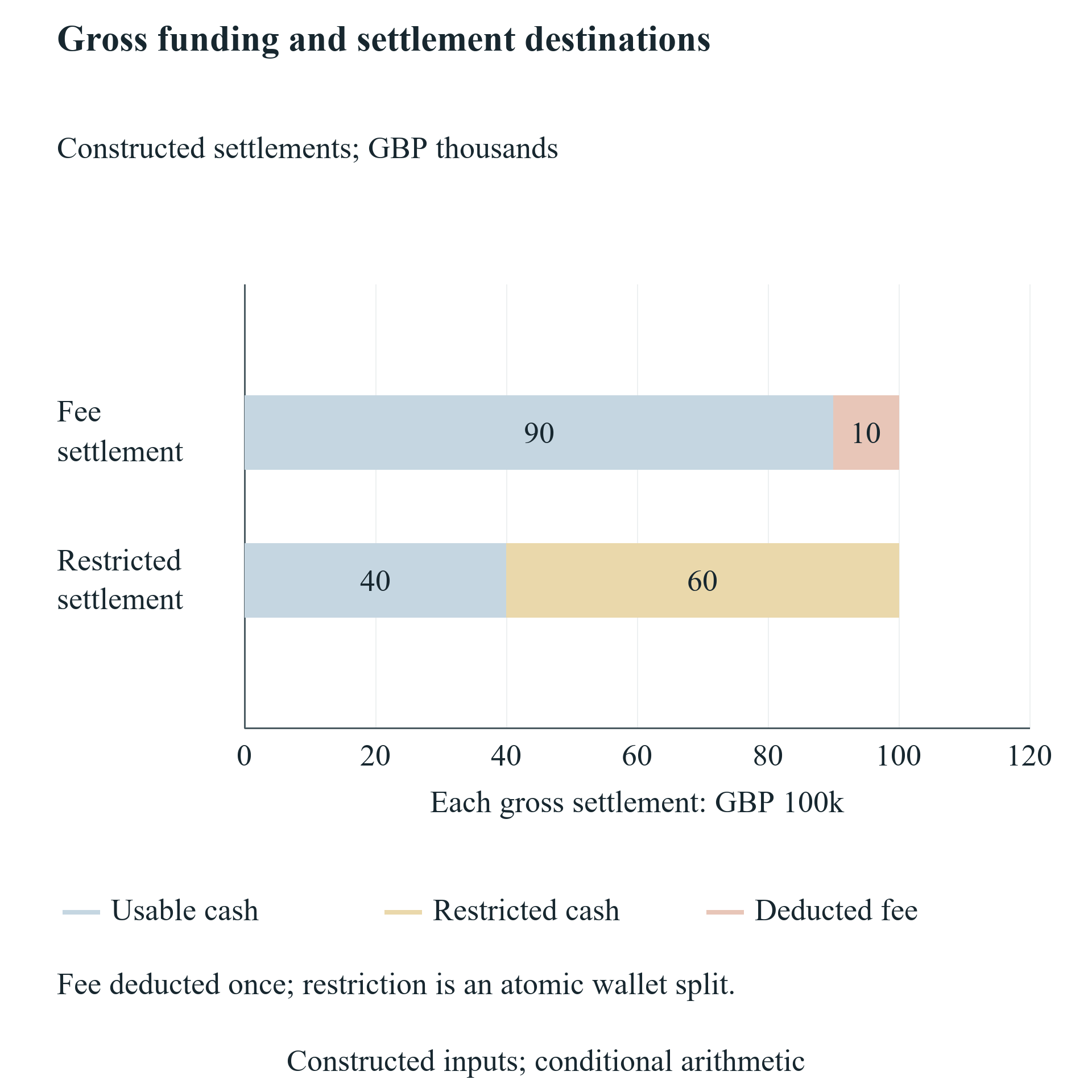
Scroll horizontally to read the figure at full size. You can also open the full-size figure.
Constructed settlements. Restricted release transfers existing cash; no new financing.
13 Specify the event ledger and the meaning of a feasible route
For each event, the ledger records a unique identifier, day, native-currency amount, conversion rate, unrestricted-cash movement and any restricted-cash movement. The free balance after an event equals opening free cash plus the sum of free movements up to that checkpoint. The combined free and restricted balances reconcile to cash received and spent, with transfers cancelling between wallets. The ownership schedule is stored separately. This structure keeps customer collections, delivery expenditure, participation costs and financing receipts visible by category. It also gives a reviewer a finite list of events to compare with contracts, invoices, bank statements and the original decision calendar.
A route is feasible under the experiment's liquidity policy only when every tested unrestricted balance meets or exceeds £20,000. Equality meets the floor. A policy breach is distinct from a negative bank balance, and the model records both the first floor breach and any first required outflow that would take cash below zero. Continuing the arithmetic after a breach shows the diagnostic closing balance. It does not assume the company could actually fund every later payment without intervention. In an application, an unfunded event should trigger a separate revised financing or operating plan whose costs, conditions and ownership effects are documented.
The same-day convention applies to actual required outflows before incoming money. The initial restricted settlement is an atomic credit split between two wallets; it is not separated into a temporary usable credit and a subsequent withdrawal. A restricted-wallet release is also a transfer. These rules preserve the economics of the stipulated contract while allowing the model to test genuine payment demands. They also define how an earlier collection changes the contribution analysis. Even if a customer pays on the delivery date, the constructed company must be able to fund the preceding delivery outflow under the adopted event order.
The experiment uses exact rational arithmetic for amounts, rates and ownership fractions. Displayed decimal percentages are explanatory rounding of the exact fractions. Every main case, sensitivity and grid node retains its full event schedule, first breach and category totals. The contribution analysis retains every binding inequality. These records support replication and a review of individual claims. They do not resolve uncertainties in an actual offer or establish a company's ability to pay. Before applying the method to a transaction, the board should replace every constructed input, agree the appropriate timing convention and approve the liquidity policy that the route is required to satisfy.
14 Interpret the twelve cases through cash paths and commercial evidence
The stay alternative closes with £24,000 after twelve common payments and remains above the £20,000 policy floor. The participation base closes with £92,000 and has a minimum tested free balance of £91,000. The £68,000 difference in closing cash comprises £100,000 of new financing less £32,000 of incremental access and overhead costs. There is no customer contribution in that comparison. Shareholders have also granted the stated five per cent interest. The result identifies a financed cash position and its ownership consequence; it supplies no evidence that the programme created £68,000 of operating value or improved the company's market valuation.
An additional £30,000 upfront participation expense reduces closing cash to £62,000 and the minimum to £61,000. Withholding a £10,000 fee from the initial financing produces £82,000 at closing, with the fee counted once. Delaying the same £100,000 financing to day 270 leaves the closing balance at £92,000 but produces a £19,000 minimum before receipt. That route breaches the policy floor. Restricting £60,000 until day 300 produces a £50,000 minimum and the same £92,000 closing cash after release. These cases show the separate effects of an expense, a deducted fee, a late receipt and a restricted wallet under the stated calendar.
The non-cash entitlement and unawarded-prize case has the same £92,000 closing cash and £91,000 minimum as the base. The foreign-cost stress at 1.25 pounds per artificial foreign unit produces £84,000 closing cash. The introductions and unpaid-pilot case incurs £20,000 of delivery cost and closes at £72,000, with no customer receipt. The paid-contract case incurs the same delivery cost and collects £60,000 on day 270, closing at £132,000. Its net commercial cash contribution is £40,000. These constructed outcomes are stipulated individually; they cannot be read as a measured conversion rate from four introductions to a paying customer.
Both follow-on cases receive an additional £200,000 on day 240 and close with £292,000. Their cash paths are identical because their cash inputs are identical. Their ownership structures differ: the fixed-interest route leaves collective founders with seventy-six per cent after the new round, while the specified capped-SAFE route leaves sixty-four per cent. Neither case includes customer contribution. The result table accordingly reports operating cash, financing, minimum liquidity and conditional ownership separately. It assigns no single financial rank. A shareholder choosing between actual offers would also need the rights, preferences, control provisions, liabilities and alternatives excluded from this deliberately narrow experiment.
| Route | Minimum / closing free cash | Floor / net commercial cash |
|---|---|---|
| Stay | £24k / £24k | Meets / £0 |
| Base | £91k / £92k | Meets / £0 |
| Extra £30k access | £61k / £62k | Meets / £0 |
| £10k deducted fee | £82k / £82k | Meets / £0 |
| Financing day 270 | £19k / £92k | Breach day 270 / £0 |
| £60k restricted | £50k / £92k | Meets / £0 |
| Non-cash and unawarded prize | £91k / £92k | Meets / £0 |
| Foreign costs £1.25/unit | £84k / £84k | Meets / £0 |
| Unpaid pilot | £72k / £72k | Meets / negative £20k |
| Paid contract | £91k / £132k | Meets / £40k |
| Fixed plus follow-on | £91k / £292k | Meets / £0 |
| Single SAFE plus round | £91k / £292k | Meets / £0 |
Exact saved constructed model. Arithmetic after a breach is diagnostic; closing cash does not establish continuous feasibility.
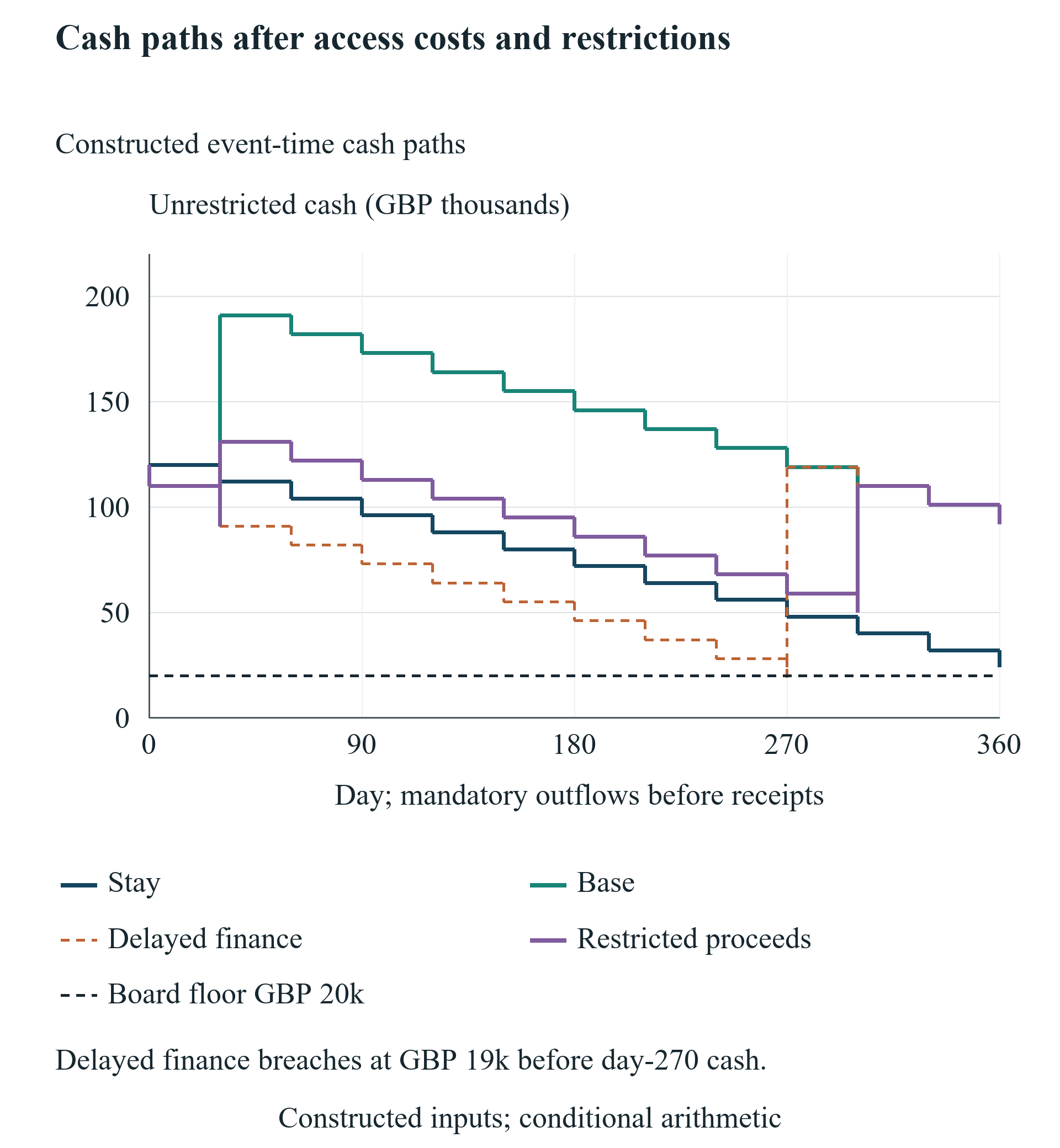
Scroll horizontally to read the figure at full size. You can also open the full-size figure.
Constructed paths, £20k policy floor, outflows before same-day receipts; post-breach continuation diagnostic.
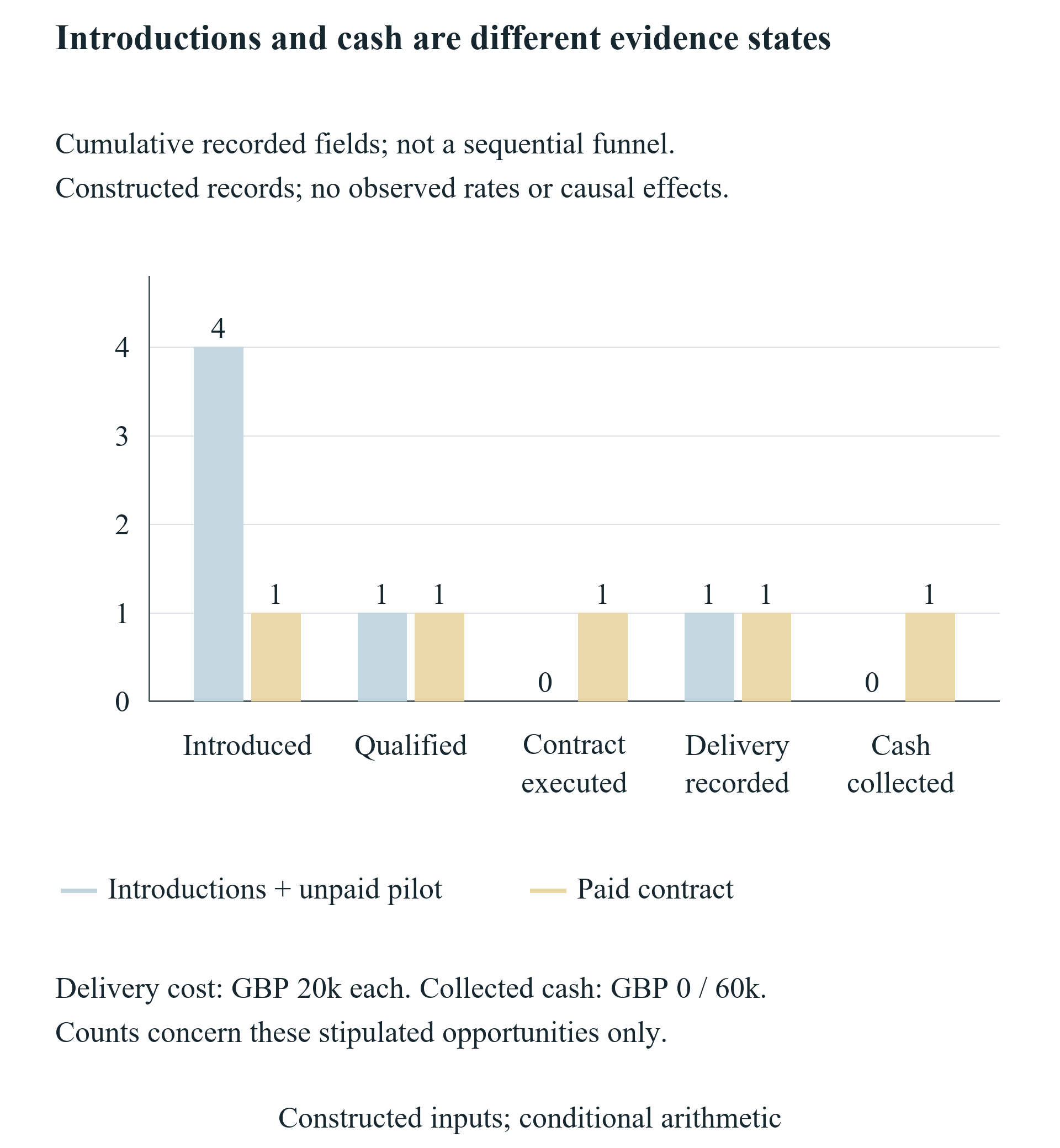
Scroll horizontally to read the figure at full size. You can also open the full-size figure.
Constructed evidence states, not a cohort conversion rate or causal estimate.
15 Read sensitivities through the checkpoint they change
The financing-date sensitivity moves the same £100,000 receipt among days zero, thirty, ninety, 180 and 270. Closing unrestricted cash remains £92,000 in all five runs, because the experiment includes no interest or changed expenditure. Minimum cash is £92,000, £91,000, £73,000, £46,000 and £19,000 respectively. The last route breaches the policy floor. Earlier money changes the interim ability to meet commitments even where the endpoint is unchanged. These results depend on the assumed common operating calendar, the access payments and the adopted sequence of outflows before receipts. A different company must recalculate its own checkpoints rather than transferring the breach date.
The additional-access-expense sensitivity charges zero, £10,000, £20,000, £30,000 and £40,000 at entry. Closing cash declines from £92,000 to £52,000 in £10,000 steps. The corresponding minimum declines from £91,000 to £51,000, and all five routes meet the floor at the base financing date. This is a controlled expense comparison with fixed financing and no commercial response. It makes no assumption that a more expensive programme supplies a better or worse service. To evaluate an actual fee, the company would need to document the service and test the associated customer and financing evidence under that route.
The foreign-cost sensitivity applies rates of 0.75, 1, 1.25, 1.5 and 2 pounds per artificial foreign unit to all specified foreign access costs and incremental overhead. The GBP financing receipt remains unchanged. Closing cash is £100,000, £92,000, £84,000, £76,000 and £60,000. The first rate produces a £96,250 minimum before the initial financing, illustrating why the minimum need not equal closing cash. These are controlled conversion factors without a market forecast. An actual foreign-currency plan should identify the currency of each contract, conversion dates, bank charges and any hedge, and should avoid applying the same exchange-rate movement to a GBP-denominated financing commitment.
The customer-date sensitivity retains £20,000 of delivery expenditure on day 120 and £60,000 of customer receipts, collected on one of five dates. Each case closes at £132,000 and records £40,000 of net commercial cash. Collection on day 360 lowers the minimum to £72,000; collection on days 120, 180, 240 or 270 leaves the overall minimum at £91,000. A shared minimum does not imply identical daily liquidity throughout the year. The event ledgers preserve those paths. The one-way experiments hold other inputs fixed and therefore identify arithmetic exposure to a specified change, without estimating how payment delay, contract size, customer quality and financing availability might co-move in a real company.
| Tested values in order | Minimum cash in order | Closing cash in order |
|---|---|---|
| Financing day 0/30/90/180/270 | £92k/91k/73k/46k/19k | £92k each |
| Extra cost £0k/10k/20k/30k/40k | £91k/81k/71k/61k/51k | £92k/82k/72k/62k/52k |
| GBP per unit 0.75/1/1.25/1.5/2 | £96.25k/91k/84k/76k/60k | £100k/92k/84k/76k/60k |
| Collection day 120/180/240/270/360 | £91k/91k/91k/91k/72k | £132k each |
Customer tests use the paid-contract case; other tests use base participation. Day-270 financing breaches the £20k floor.
16 Use the two-dimensional grid to expose combinations that one-way tests miss
The grid combines the five financing dates with the five extra entry expenses, holding the rest of the participation base fixed. It contains twenty-five explicitly computed nodes. Eighteen nodes meet the £20,000 floor and seven breach it under the constructed convention. These counts describe a selected design grid, not probabilities. The dates and costs were chosen for transparency; no distribution over them is assumed. A board should read each cell as a question about a particular route and its documented calendar. The grid provides no warrant for saying that an applicant has an eighteen-in-twenty-five chance of a feasible programme.
Financing on day zero, thirty or ninety meets the floor at every tested extra expense through £40,000. With financing on day 180, extra expenses of zero, £10,000 and £20,000 meet the floor; £30,000 and £40,000 breach it. The £30,000 route first breaches on day 180, while the £40,000 route first breaches on day 150. Both later finish above the floor after financing. Their differing breach dates matter for any proposed remedy. A payment deferral after the first breach would leave the original route infeasible unless the revised schedule explicitly changes that earlier event.
Every tested day-270 financing route breaches the floor. At zero extra expense, its minimum is £19,000. At £40,000 extra expense, its diagnostic minimum is negative £21,000, and the first floor breach occurs on day 150. A negative arithmetic balance identifies a required intervention in the stipulated schedule. It does not assume that a bank allows the payment or that the company obtains an overdraft. The output distinguishes the first policy breach from the first required payment that cannot be funded from available free cash. The board must specify the permitted intervention before treating a revised route as executable.
The feasible nodes can guide diligence on the variables under negotiation. If a supplier can defer an entry invoice or an investor can advance a wire, the company should obtain the exact revised commitment and run that calendar. Introducing bridge finance creates a new transaction with its own interest, fees, maturity, security and ownership effects; those terms are absent from the current grid. Cells between the selected nodes are also not calculated here. A smooth-looking chart should not imply a continuous verified frontier. The appropriate output is the discrete grid, the actual minimum at each node and a route-specific list of changes requiring evidence.
| Finance day | Extra £0k | £10k | £20k | £30k | £40k |
|---|---|---|---|---|---|
| 0 | 92 | 82 | 72 | 62 | 52 |
| 30 | 91 | 81 | 71 | 61 | 51 |
| 90 | 73 | 63 | 53 | 43 | 33 |
| 180 | 46 | 36 | 26 | 16 breach | 6 breach |
| 270 | 19 breach | 9 breach | -1 breach | -11 breach | -21 breach |
Twenty-five constructed nodes; eighteen meet the £20k floor and seven breach. Negative cash is diagnostic. No probability or interpolated frontier.
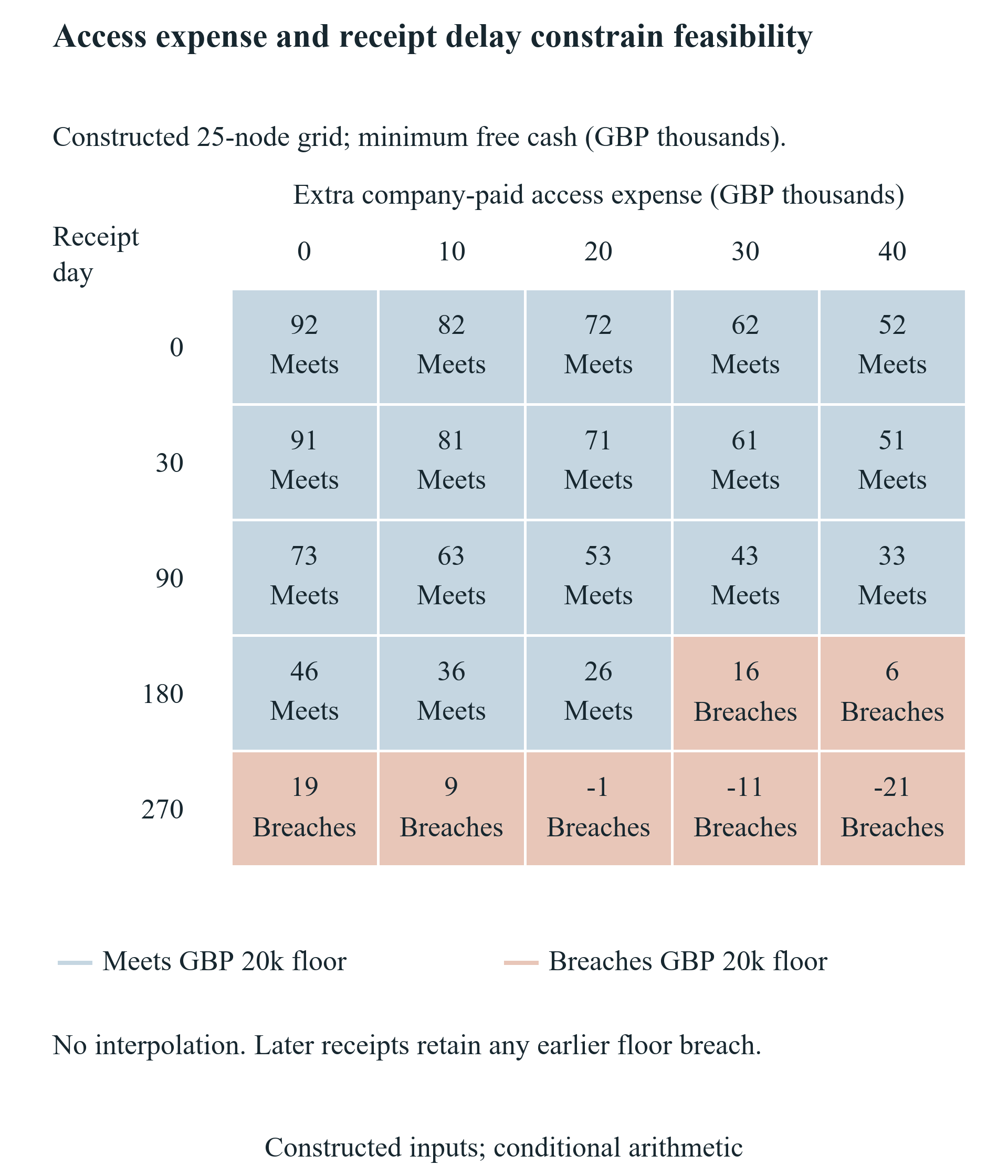
Scroll horizontally to read the figure at full size. You can also open the full-size figure.
Discrete constructed grid; no interpolation, probability or programme ranking.
17 Derive a contribution interval that recognises delivery funding
Customer contribution needs a cash-timing definition. Let z denote the eventual incremental net cash contribution of a specified contract, measured in pounds after its modelled delivery cash cost. Let C0 at a checkpoint denote the route's unrestricted cash without that contract. Let G at the same checkpoint denote the cumulative cash effect per pound of eventual contribution. The route with the contract has cash C0 plus z multiplied by G. Every checkpoint must satisfy the adopted £20,000 floor. The normalisation requires G to equal one after all modelled contract receipts and costs have occurred, so the final incremental cash is z rather than a second invented receipt.
In the experiment, the reference contract costs £20,000 to deliver and collects £60,000, producing £40,000 of eventual net contribution. Scaling that pattern gives a delivery outflow of one half of z and a later receipt of one and a half times z. G is zero before delivery, negative one half after delivery and before collection, and one after collection. This is a conditional scalable pattern. It assumes constant cash ratios, the stipulated dates and no extra cost steps or capacity limits. It supplies no estimate that a founder can sell such a contract or increase its size continuously in practice.
At a checkpoint with positive G, the floor imposes a lower bound on z: the floor less C0, divided by G. The operative lower bound is the greatest of those requirements and zero. At a checkpoint with negative G, the floor imposes an upper bound: C0 less the floor, divided by the absolute value of G. The operative upper bound is the smallest of those constraints. If a checkpoint has zero G and C0 is below the floor, no contract scaled through this pattern can repair that checkpoint. An interval is also empty when its lower bound exceeds its upper bound. A route with no upper constraint has an unbounded upper end only within the specified cash model.
The method consequently reports a feasible interval or an explicit empty set. It does not reduce every problem to a minimum revenue target. The lower bound concerns how much eventual contribution is needed under a schedule; the upper bound concerns how much pre-collection delivery the route can finance. Larger eventual contribution can increase the earlier funding demand. The complete checkpoint derivation preserves the source of every bound, including a negative upper bound when the base route is already too weak before collection. A board can then assess whether earlier customer deposits, smaller stages, earlier financing or reduced delivery expenditure creates an evidenced revised interval.
| G | Constraint | Interpretation |
|---|---|---|
| Positive | z ≥ (floor - C0) / G | Greatest lower bound, including zero |
| Negative | z ≤ (C0 - floor) / |G| | Smallest upper bound |
| Zero and C0 below floor | No contribution changes the checkpoint | Empty interval |
| Lower above upper | No non-negative feasible z | Empty interval |
| Horizon G = 1 | Incremental final cash equals z | No second contribution receipt |
Exact conditional identities. The stipulated delivery/collection pattern gives G of 0, then -1/2, then 1.
18 Interpret bounded and empty commercial-contribution results
With financing on day thirty, all five collection schedules have a zero lower bound. The base route already meets the floor without the added customer contract. Its upper contribution bounds are £288,000 for collection on day 120, £252,000 on day 180, £216,000 on day 240, £198,000 on day 270 and £144,000 on day 360. Each upper bound comes from a pre-collection cash checkpoint while delivery expenditure has reduced G to negative one half. Collection on the delivery day still leaves a delivery-first checkpoint under the adopted convention. These bounds are cash-capacity results for the scalable constructed contract, without a claim that the company can originate any of those contract sizes.
With financing delayed to day 270, collection on day 120, 180 or 240 yields bounded intervals. The lower bound is £1,000 in each case, while the upper bounds are £88,000, £52,000 and £16,000 respectively. Early collections can help the route through the later pre-financing liquidity requirement, provided delivery itself remains affordable. Collection on day 270 or 360 produces an empty interval. In those schedules the pre-financing checkpoint occurs after delivery and before collection, when G is negative. Its computed upper bound is negative £2,000, incompatible with a non-negative contribution. That mechanism differs from a checkpoint at which G remains zero.
A separately declared thin-financing experiment reduces the initial participation financing from £100,000 to £20,000, keeping the other base participation inputs unchanged. Without a customer contract it closes at £12,000. For delivery on day 120 and collection on day 270, the feasible eventual contribution interval is £8,000 to £38,000. The lower endpoint supplies the £8,000 needed to reach the £20,000 closing floor. The upper endpoint follows from the minimum base cash of £39,000 immediately before collection: that checkpoint can fund at most £19,000 of additional delivery cash, equal to one half of £38,000. Both endpoint constraints are retained in the calculation.
The thin-financing interval demonstrates why a positive-margin opportunity can exceed a company's working-capital capacity. Under the stated pattern, £40,000 of eventual net contribution requires £20,000 of delivery cash before collection and exceeds the £38,000 upper bound. The route would need a documented change, such as an earlier deposit or a different delivery schedule. No assumed loan fills the gap. This interpretation is conditional on the same cost ratio and calendar. Capacity constraints, taxes, staged acceptance, retention, disputes and credit losses could alter both endpoints in an application. The company should calculate those events from the proposed contract and keep an opportunity outside the interval separate from an executable, funded plan.
| Financing / collection day | Lower | Upper |
|---|---|---|
| 30 / 120 | £0 | £288k |
| 30 / 180 | £0 | £252k |
| 30 / 240 | £0 | £216k |
| 30 / 270 | £0 | £198k |
| 30 / 360 | £0 | £144k |
| 270 / 120 | £1k | £88k |
| 270 / 180 | £1k | £52k |
| 270 / 240 | £1k | £16k |
| 270 / 270 | Empty | Negative £2k constraint |
| 270 / 360 | Empty | Negative £2k constraint |
| Thin £20k financing / 270 | £8k | £38k |
Delivery day 120, outflows before same-day receipts. Late empty cases fail at a negative-G checkpoint, not a zero-G checkpoint.
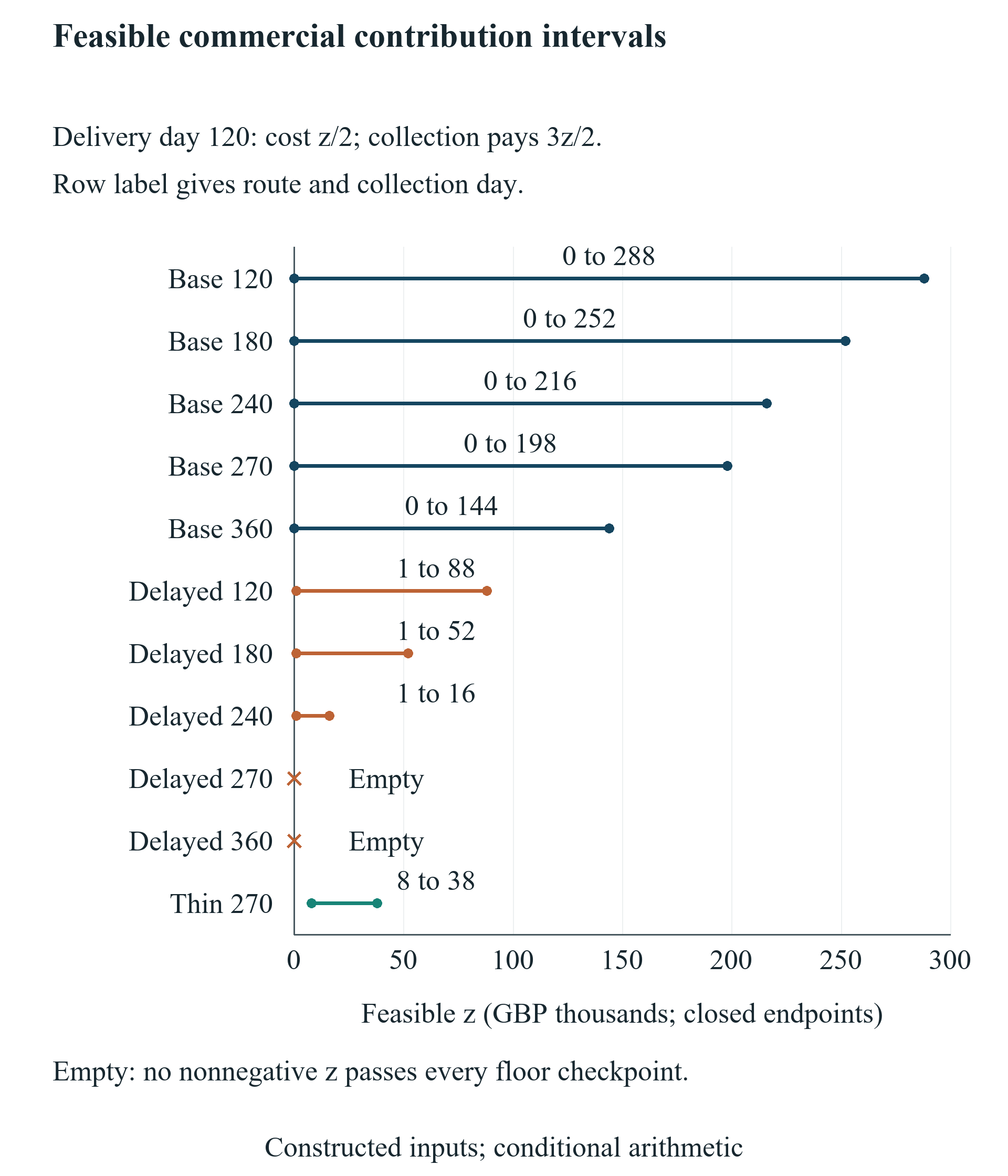
Scroll horizontally to read the figure at full size. You can also open the full-size figure.
Eventual net cash contribution; negative-G pre-collection constraints retained.
19 Show ownership as a conditional capitalisation schedule
The fixed-interest participation case gives the initial investor five per cent and leaves collective founders with ninety-five per cent before a subsequent round. In the constructed follow-on case, new investors pay £200,000 for twenty per cent after that round, corresponding to the stated £800,000 pre-money value in this simplified capitalisation. The existing founders and initial investor each retain eighty per cent of their prior fractions. Founders therefore hold seventy-six per cent, the initial investor four per cent and new money twenty per cent. The fractions sum to one. This calculation excludes option-pool changes, preferences, secondary sales and other instruments.
The SAFE case uses a single post-money capped instrument with £100,000 of principal and a £500,000 cap. The explicitly adopted cap-binding convention gives the SAFE a twenty per cent interest immediately before the new money. The next £200,000 financing buys twenty per cent of the post-round company, leaving founders with sixty-four per cent, the SAFE holder sixteen per cent and new investors twenty per cent. The specified £800,000 pre-new-money value is above the cap, consistent with the cap-binding price condition in this experiment. The result requires the stated single-instrument convention; it is not a calculator for every document called a SAFE.
Where the priced round does not occur, the instrument remains a contingent claim under its documents. This analysis does not label the absence of conversion as zero dilution or assign a converted founder percentage. It also does not model a liquidity event, dissolution, MFN election, discount, multiple SAFEs, option pool or priority waterfall. Those terms require the actual signed instrument and a fuller capitalisation. A programme's headline investment divided by a hoped-for future valuation would conceal these details. The diligence pack should therefore include the instrument version, conversion mechanics, all existing claims and any rights governing future fundraising or company reorganisation.
Cash and ownership should be presented together without treating one as a realised return. The fixed-interest and SAFE follow-on cases have equal £292,000 closing cash, different conditional founder fractions and no measured customer contribution. The experiment assigns no exit valuation and calculates no founder proceeds. It also assigns no value to network services or counterfactual financing alternatives. Shareholders can use the conditional schedules to identify which contractual terms matter and to request professional advice. A commercial choice still depends on executable alternatives, strategic benefits, control and the financing needed to reach a milestone, with each unmeasured element identified rather than silently converted into a financial score.
| Holder | Initial fixed 5% | Single cap-binding SAFE |
|---|---|---|
| Founders | 76% | 64% |
| Fixed investor | 4% | 0% |
| SAFE investor | 0% | 16% |
| New money | 20% | 20% |
| Total | 100% | 100% |
| Closing company cash | £292k | £292k |
Constructed £100k SAFE, £500k cap and £800k pre-new-money value. No option pool, preferences or realised exit. No-round SAFE remains contingent.
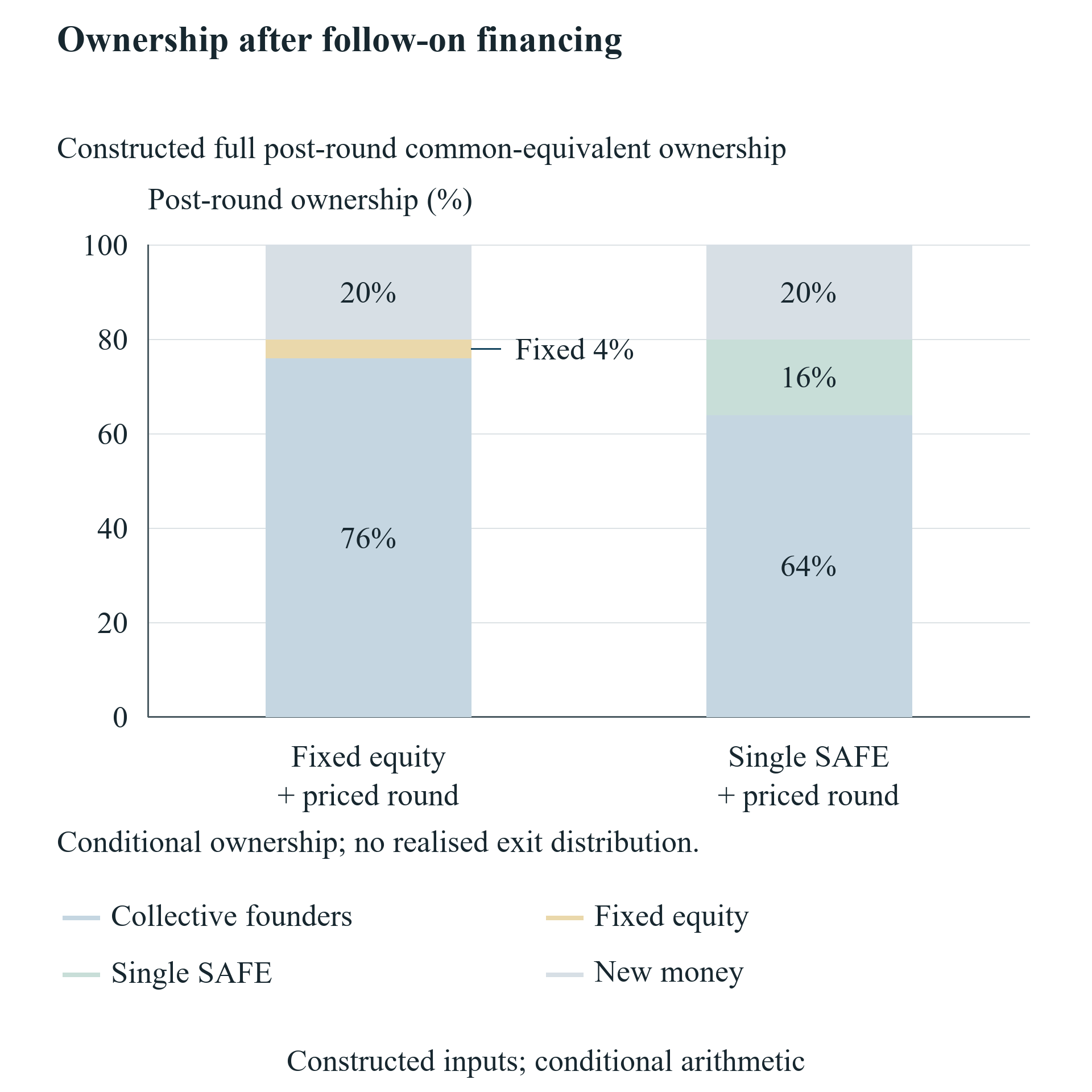
Scroll horizontally to read the figure at full size. You can also open the full-size figure.
Constructed capitalisation, not realised founder proceeds; no-round SAFE contingent.
20 Create a commercial evidence register with an observable endpoint
The proposed company register begins with an opportunity identifier that survives introductions, account changes and follow-up. It records the programme contact, named buyer organisation in the company's confidential file, date introduced, founder owner and consent basis for storing the information. Qualification then records a defined customer problem, decision-maker, relevant budget process, procurement route and expected next event. An introduction is complete when the relevant communication has occurred under the agreed service definition. Customer qualification requires additional observations. The register should retain a contact who declines or becomes inactive, alongside a dated reason where the counterparty supplies one.
Pilot evidence should identify the statement of work, acceptance criteria, scope, delivery costs, access dependencies, intellectual-property terms and whether payment is actually due. A demonstration to a potential buyer can be a useful learning event, while still creating no invoiceable entitlement. A paid pilot adds a contract and a receivable, with collection monitored separately. The receipt record should reconcile bank cash, invoice and customer entity, including tax, refunds or third-party deductions where applicable. This makes it possible to distinguish a delivered service from a booked order, a receivable and collected cash. It also supports a review of the delivery obligations created by an apparently promising introduction.
Financing evidence needs a parallel register. An investor meeting, a diligence request, a term sheet, signed documentation, satisfaction of conditions and a cleared wire are distinct dated events. The receiving company and instrument should be identified at each binding stage. Follow-on capital should be attributed to an introduction only under a pre-agreed descriptive rule, such as the first evidenced qualifying contact, with competing contacts and pre-existing relationships retained. Such a rule can describe a route through the pipeline; it does not identify the investment that would have occurred without the programme. Causal attribution requires an appropriate comparison design beyond this operational register.
The dashboard should report the relevant population and missing follow-up. Useful descriptive outputs include introduced opportunities reaching a specified stage, median observed stage duration among completed transitions, delivery cash committed, cash collected and financing received. Each measure needs an entry cohort, observation date, currency treatment and denominator. A live opportunity awaiting follow-up should not be silently counted as a completed loss or a completed sale. Cohort reporting should preserve rejected, withdrawn and uncontactable cases. The company can then assess whether the programme delivered its agreed service and whether the company's own next-stage execution is progressing, while keeping the limits of that evidence visible.
21 Negotiate payment and service milestones that the company can observe
The offer discussion should separate the provider's controllable service from decisions controlled by investors, customers and authorities. A provider may agree to a defined number of qualified meetings, a documented selection process or a scheduled programme of support. A buyer's procurement approval, investment committee decision and visa outcome belong to their respective decision-makers. Contract language should identify deliverables, participant obligations, reporting, fee dates, cancellation treatment and dispute procedures. A company should obtain qualified advice on the actual agreement. The research method supplies the diligence questions and cash consequences of alternative terms; it does not offer a universal legal clause or assert that a provider accepts a particular risk allocation.
Milestone-linked payment can be evaluated by moving the specified fee events in the company's ledger. A later fee helps only at checkpoints occurring before that payment, subject to any price change or contractual consequence. Refundability also needs a clear trigger and a credible receipt date. A contingent refund should remain a separate claim until its conditions and settlement are evidenced. The company should test the gross payment and refund timeline, including the case in which the refund is delayed or disputed. Reporting only the final net fee could conceal the temporary funding requirement and leave the decision disconnected from the board's floor.
Customer contracting can address the negative-G period through an evidenced deposit, staged delivery or staged acceptance and collection. Each structure changes the cash events and may change the commercial proposition, price or customer's willingness to contract. The method should model the resulting signed terms, with no assumption that a customer agrees to a deposit. Where delivery requires a local partner, the cash calendar should include partner invoices and the company's payment entitlement. Foreign withholding, indirect tax, settlement charges and currency conversion require transaction-specific treatment. The present numerical experiment excludes these items so that the basic contribution interval can be inspected clearly.
Financing negotiations can similarly focus on the date funds become usable, conditions precedent, reserved amounts and interaction with participation expenses. An earlier first tranche may change liquidity while leaving a later tranche contingent. Any bridge facility creates an additional instrument with its own repayment demand. The board should compare a fully specified revised route with the original, including all new obligations. The outcome should be a short decision record identifying the unresolved term and its responsible owner. If a necessary term remains unconfirmed, the route remains conditional and the company should identify the expenditure it is prepared to commit before receiving that confirmation.
22 Build the board pack around decisions, documents and remaining runway
The first page of the decision pack should state the proposed operating milestone, the existing cash position, the approval sought and the alternative if the programme is declined. The underlying appendix should reconcile cash to a dated bank statement, remove restricted amounts from usable funds and identify liabilities falling due. The company should attach the applicable programme offer and highlight the version used. A route summary can then show gross financing, deductions, company-paid access costs, founder-paid costs, restricted proceeds and the first policy breach. These fields allow directors to examine the complete route without relying on a headline investment amount or a narrative about network value.
The second component should be an eligibility and execution calendar with a named owner for every prerequisite. Items include programme acceptance, investment selection, immigration confirmation, company formation or reorganisation, banking, travel and any support application. Each unresolved item should have a target confirmation date and the spending decision it controls. A calendar can show dependency without assuming a favourable outcome. If a deadline is published without a time zone, the responsible owner should obtain clarification. If an old programme page remains online after its cohort start, the pack should identify the absence of a verified next window rather than treating the route as currently open.
The commercial component should show the current evidence for each relevant opportunity and the cost of the next stage. Directors can review which meetings are promised, which have occurred, which pilots create spending and which contracts have been collected. Financing contacts need a separate schedule of signed commitments and receipt conditions. The cash model should draw only from the status appropriate to the scenario being considered. A base plan based on cleared and committed evidence can sit beside expressly conditional opportunities. The pack should not convert an unqualified contact into a forecast receipt solely because the programme's brochure describes investor access.
Approval can specify a maximum irreversible cash commitment, the floor to maintain, information required before the next stage and a review date. The company should preserve the originally approved forecast and record later changes separately. At the review, differences can be attributed to dated events such as changed visa timing, a deferred wire, a paid pilot or revised travel costs. This supports operational learning and an audit trail. It also supplies a disciplined stopping decision when conditions do not arrive. The research offers no guarantee that staged approval produces a successful market entry; its practical purpose is to make the board's commitments and evidence requirements explicit.
23 Design a future evaluation around costs, selection and collected outcomes
A future empirical study of cross-border accelerator access would need a population defined before outcomes are known. A useful starting point is the eligible applicant cohort, with application dates, selection scores where lawfully available, admission decisions, acceptances, withdrawals and participation. Tracking only funded portfolio companies would omit founders who incur access costs without investment. The study should distinguish the country of the founder, operating company, programme and target customer. Legal and privacy controls would govern individual records. The current paper has no such dataset and therefore reports no applicant-level conversion rate, average treatment effect or return on participation.
Cost measurement should record payments, dates, currency, payer, reimbursements and the activity displaced. Founder time requires its own disclosed valuation assumption if monetised. Common operating expenditure should be distinguished from incremental costs of the route, with a documented counterfactual. Non-cash credits should be valued through actual use or an explicit separate assumption and should not appear as bank cash. Equity instruments need their executed terms and subsequent conversion history. Comparing fee-based programmes with equity programmes requires reporting financing and ownership alongside operating outcomes; a single expense total would omit the capital claim transferred to an investor.
Outcome definitions should run from introductions through qualification, contracts, delivery and collections, with follow-on financing recorded independently. A fixed observation date creates right-censoring for companies still negotiating or waiting for payment. Missing records and founder non-response need to be reported by cohort and status. Repeated applications, joining multiple programmes and pre-existing customer or investor contacts can complicate attribution. A design claiming causal effects would need a credible source of comparison and appropriate assumptions, such as a defensible selection-threshold design in a particular programme. Matching alone would not establish that unobserved founder quality or opportunity selection has been removed.
The public-offer register can contribute a dated description of the treatment rather than a causal estimate. Programmes may change investment terms, location requirements and commercial support across cohorts. The evaluation should preserve those versions and avoid combining them into a single unchanging product. Programme-level marketing rates can be recorded with their stated denominators and horizons, then checked against underlying data if available. Their absence from the numerical calibration here is deliberate: the constructed experiment has no empirical probability inputs. A later research dataset could test mechanisms suggested by the ledger while retaining the difference between observed associations, local causal estimates and conditional accounting identities.
24 Set the decision boundary and state what remains unmeasured
The method evaluates a specified financing and commercialisation route under a selected liquidity policy. It does not estimate programme quality, founder suitability, immigration eligibility, investment approval or the probability of winning a customer. Public pages may change, and signed agreements can contain material conditions absent from those pages. The programme comparison therefore remains dated to 12 November 2026. The selected routes are examples for analytical contrast and supply no comprehensive global ranking. The unresolved fields identify where a company's own diligence must begin. They also limit the use of the comparison in an application made after the observation date.
The constructed model excludes taxes, interest, inflation, credit losses, option pools, multiple securities, exit preferences, disputed refunds and real capacity constraints. It uses a common operating business with zero common receipts, company-paid access expenditure and a zero personal-cash ledger. The foreign unit is artificial. Every customer, financing outcome and payment date is stipulated. These limits make the accounting relationships inspectable and prevent the worked numbers from being presented as market estimates. A company applying the framework should replace those inputs and extend the event calendar for its actual obligations. A changed input can change feasibility, the contribution interval and the ownership comparison.
The principal analytical finding is the conditional interval for eventual customer contribution. Delivery before collection creates a negative cash exposure per pound of contribution, and that exposure can impose a finite upper bound on a route that also needs a positive lower contribution. The thin-financing example gives an interval of £8,000 to £38,000 under its exact stipulated schedule. The late-financing examples show that an attractive closing cash figure can coexist with an earlier policy breach. These are reproducible consequences of the specified events and conventions. They remain useful questions for diligence even though the present research supplies no causal evidence about a real accelerator's commercial results.
A decision-ready founder or board can request a component-level offer, confirm eligibility and participation permission, construct the stay alternative, reconcile usable funding and track introductions through collected outcomes. It can then evaluate a route with the actual company cash calendar and a clearly approved floor. Unresolved commercial opportunities remain visible beside funded commitments. Ownership is shown through the applicable instruments rather than a fictional realised exit. The resulting pack gives counterparties concrete questions about timing, fees, restricted use and service delivery. Its final recommendation should be based on documented feasible choices and the shareholders' stated objectives, with any additional assumptions disclosed for the decision they affect.
References
- Y Combinator. The Y Combinator Deal. Accessed 12 November 2026. https://www.ycombinator.com/deal
- Y Combinator. Frequently Asked Questions. Accessed 12 November 2026. https://www.ycombinator.com/faq
- Techstars. Investment Terms. Accessed 12 November 2026. https://www.techstars.com/investment-terms
- Techstars. Investment Terms announcement, 17 April 2025. Accessed 12 November 2026. https://www.techstars.com/newsroom/investment-terms
- 500 Global. The 500 Fellowship, current flagship page, updated September 2026. Accessed 12 November 2026. https://500.co/founders/flagship
- Entrepreneurs First. London FAQs. Accessed 12 November 2026. https://www.joinef.com/faqs/london/
- Antler. Antler in Singapore. Accessed 12 November 2026. https://www.antler.co/location/singapore
- Immigration, Refugees and Citizenship Canada. Start-up Visa Program, page details 21 July 2026. Accessed 12 November 2026. https://www.canada.ca/en/immigration-refugees-citizenship/services/immigrate-canada/start-visa.html
- GOV.UK. Visit the UK as a Standard Visitor, Visit on business. Accessed 12 November 2026. https://www.gov.uk/standard-visitor/visit-on-business
- US Department of State. Fact Sheet U.S. Business Visas B-1 and Allowable Uses. Accessed 12 November 2026. https://travel.state.gov/content/travel/en/us-visas/business/b-1-fact-sheet.html
- Enterprise Singapore. GIA Shanghai Acceleration Programme. Accessed 12 November 2026. https://www.enterprisesg.gov.sg/grow-your-business/innovate-with-us/market-access-and-networks/global-innovation-alliance/gia/gia-shanghai
- Techstars Support. Can I apply to Techstars programs not in my country? Can you help with visa or immigration issues? Modified 17 May 2024. Accessed 12 November 2026. https://help.techstars.com/support/solutions/articles/4000207088-can-i-apply-to-techstars-programs-not-in-my-country-can-you-help-with-visa-or-immigration-issues-
- Techstars Support. After a Techstars program ends, do I need to stay in the program location? Accessed 12 November 2026. https://help.techstars.com/support/solutions/articles/4000207073-after-a-techstars-program-ends-do-i-need-to-stay-in-the-program-location-
- MassChallenge. Security and Resiliency Traction 2026. Accessed 12 November 2026. https://masschallenge.org/security-and-resiliency-traction-2026/
- Antler. Antler in UK. Accessed 12 November 2026. https://www.antler.co/location/uk
- Enterprise Singapore. Global Innovation Alliance initiative, including GIA+ effective 1 April 2026. Accessed 12 November 2026. https://www.enterprisesg.gov.sg/grow-your-business/innovate-with-us/market-access-and-networks/global-innovation-alliance/gia-initiative
- Singapore Ministry of Manpower. EntrePass eligibility. Accessed 12 November 2026. https://www.mom.gov.sg/passes-and-permits/entrepass/eligibility
- CORFO. Start-Up Chile Ignite 13 call. Accessed 12 November 2026. https://www.corfo.gob.cl/sites/cpp/convocatoria/start-up-chile-ignite-13/
- CORFO. Bases Start-Up Chile, refundido no oficial, November 2026. Non-official consolidation; governing resolutions and executed agreement require confirmation. Accessed 12 November 2026. https://saowcsblobassets.blob.core.windows.net/assets/CONV/26IGN-2/Bases%20Start-Up%20Chile%20-%20Refundido%20No%20Oficial%20(nov%202026).pdf
- European Institute of Innovation and Technology. Venture incubation program, 2026 opportunity. Accessed 12 November 2026. https://www.eit.europa.eu/our-activities/opportunities/venture-incubation-program
- EIT Jumpstarter. Terms and Conditions 2026, version 2, 6 May 2026. Accessed 12 November 2026. https://eitjumpstarter.eu/wp-content/uploads/2026/05/EIT-Jumpstarter-2026_Terms-and-Conditions_v2_20260506.pdf
- DIPRES. Start-Up Chile monitoring, 2023 period and 2024 price base. Publication date not independently established. Accessed 12 November 2026. https://www.dipres.gob.cl/597/articles-338261_doc_pdf.pdf
- UK Department for Business and Trade. Global Entrepreneur Programme, Frequently Asked Questions, updated 27 August 2026. Accessed 12 November 2026. https://www.business.gov.uk/campaign/gep/frequently-asked-questions/
- Hallen, B. L., Cohen, S. L. and Bingham, C. B. (2020). Do Accelerators Work? If So, How? Organization Science 31(2), 378-414. DOI:10.1287/orsc.2019.1304. Author manuscript dated 3 April 2019. https://d3brk8rkzvc45n.cloudfront.net/s3fs-public/2024-02/SSRN-id2719810.pdf
- Yu, S. (2020). How Do Accelerators Impact the Performance of High-Technology Ventures? Management Science 66(2), 530-552. DOI:10.1287/mnsc.2018.3256. Abstract reviewed only. https://pubsonline.informs.org/doi/10.1287/mnsc.2018.3256
- Gonzalez-Uribe, J. and Reyes, S. (2021). Identifying and Boosting Gazelles: Evidence from Business Accelerators. Journal of Financial Economics 139(1), 260-287. DOI:10.1016/j.jfineco.2020.07.012. Accepted manuscript, April 2020. https://eprints.lse.ac.uk/103145/1/Gazelles_16042020_JFE.pdf
- Gonzalez-Uribe, J. and Leatherbee, M. (2018). The Effects of Business Accelerators on Venture Performance: Evidence from Start-Up Chile. Review of Financial Studies 31(4), 1566-1603. DOI:10.1093/rfs/hhx103. Accepted manuscript, August 2017. https://researchonline.lse.ac.uk/id/eprint/84553/1/Gonzalez-Uribe_Effects%20of%20Business%20Accelerators.pdf
About the Author
Chennakeshav (CK) is a corporate finance and investment banking executive with 25+ years of global experience in deal origination, structuring and execution across M&A, growth capital and corporate strategy. He has led value-creation mandates for founders, corporates and funds — bridging the boardroom view to hands-on execution and close.
His career spans Morgan Stanley, HSBC, Lloyds Banking Group, EWEC, ADQ portfolio companies and Emirates Growth Fund, across TMT, real estate, fintech, deeptech, cleantech, infrastructure and energy. He has partnered with C-suite leaders, private equity and venture funds, sovereign wealth funds and family offices to finance complex fund raises and scale-up ventures, and has led M&A due diligence, post-merger integration and business-transformation initiatives to create value.
At Matchpoint Partners he is Managing Partner, leading the firm's corporate finance, M&A and capital-raising practice. He holds an MBA from London Business School, an engineering degree from VTU and a Master of Laws (LLM, in progress) from UCL London.
An active start-up mentor, CK mentors at Techstars, DIFC FinTech Hive, Startup Grind, Founder Institute and IN5, serves as Entrepreneur Mentor in Residence (EMiR) at London Business School, and judges the Entrepreneurship World Cup.
https://www.linkedin.com/in/ckadya/
https://www.matchpoint-partners.com/team/ck-adya.html
Disclaimer
This paper is part of a continuing series on the structure of private and alternative markets. The views expressed are the author's own. The paper is for information only, describes market structure in general terms, and does not constitute investment, legal, tax or regulatory advice or a recommendation in respect of any security, vehicle or counterparty.
