

1 The decision before accepting programme terms
An accelerator agreement can affect the commercial contracts a company may accept, the uses it may make of its technology and the investors it may admit into a later financing. A founder evaluating an offer therefore needs a record of the rights attached to the support, the assets those rights cover and the dates on which they become effective. The decision concerns a particular company with existing commitments and opportunities. A percentage of equity, a cash award or a statement about retaining intellectual property describes part of that decision. Each needs to be read alongside the other documents that will govern the relationship.
Separate agreements are visible in published programme descriptions. Techstars describes an investment structure comprising two convertible agreements and a side letter; its summary identifies future-financing participation, information and exit-related rights. Y Combinator describes two SAFEs accompanied by a YC Agreement that includes participation rights in subsequent financing. These descriptions establish that several documents have a role. The precise obligations of a particular company require the governing versions, negotiated changes and signed agreements. A founder should identify that complete document set before treating a standard financing form as a sufficient account of the transaction.
The practical question is which provision changes an affordable action that the company otherwise expects to take. A restricted field of use can affect one customer opportunity while leaving another available. An exclusive negotiating period can expire before or after a counterparty's deadline. A financing participation right can be exercised with additional money at the same price as a new investor. These mechanisms call for different calculations. Their economic effect depends on the relevant opportunity, required cash, available alternatives and retained assets. An arbitrary percentage discount applied to every noncash right would conceal those differences.
This paper develops a documentary and constructed-scenario approach to that decision. The documentary review records selected official programme descriptions, published rules and explanatory legal materials with their dates and scope. The numerical experiment examines explicitly stipulated permissions and commercial choices. It identifies conditional negotiation priorities and the assumptions that determine them. No linked population of eligible projects, executed programme contracts and subsequent outcomes is analysed. The worked cases represent hypothetical companies; their monetary results provide a calculation method for documented company inputs.
2 A dated register of documents and rights
The useful unit of observation is a document and a provision within its stated scope. A programme name can cover different locations, cohorts, legal entities and funding instruments. A document register should therefore preserve the publisher, programme or call, document title, version or displayed update date, retrieval date and relevant clause. It should also identify whether the material is a programme summary, application rule, participant agreement, investment instrument, side letter, data policy or contract with another party. This separation makes it possible to trace a statement about rights to the document that actually supports it.
| Source and observed version | Supported observation | Limit of the observation |
|---|---|---|
| Techstars investment summary; accessed 12 November 2026 | Two convertible agreements and a side letter; specified future rights | Public summary; executed company terms unavailable |
| Y Combinator deal and SAFE guidance; accessed 12 November 2026 | Investment instruments and a separate agreement; optional participation documentation | Actual signed agreement and amendments required |
| MassChallenge rules; updated 8 March 2022 | Programme-specific incorporated requirements and distinct information permissions | Dated rules; no finding of a currently open call |
| CDL overview and privacy policy; accessed 12 November 2026 | Published ownership/fee statement and distinct research-data permissions | Stream-specific documents and actual research access not obtained |
| Google Accelerator China legal specimen; 2023 call | Retained submission IP with programme-connected use and publicity permissions | Historical specimen; no current eligibility claim |
| UNICEF Venture Fund FAQ; accessed 12 November 2026 | Funded solution's open-source commitment; stated scope of other retained IP | Actual funding contract and applicable call required |
| EIC investment FAQ; accessed 12 November 2026 | Investment documents, process and transaction-specific IP considerations | Programme-year and transaction conditions remain separate |
| WIPO licensing guidance; accessed 12 November 2026 | Assignment and licensing have distinct ownership/use roles | Explanatory guidance; no opinion on a particular contract |
| UK IPO collaboration guidance; accessed 12 November 2026 | Negotiation periods and licence options have distinct operative meanings | University-collaboration comparator |
| NVCA model-document index; accessed 12 November 2026 | Different investment-rights and transaction-document families | Index inspected; underlying forms not clause-audited |
Selected public documents; scope-limited observations, not a representative programme survey. URLs and access qualifications appear in the references.
The register used here is purposefully selected. It illustrates materially different kinds of documented condition and disclosure. It supplies no representative estimate of how often a clause occurs across accelerators. Current public summaries sit alongside dated rules and a historical legal specimen, with those roles identified separately. For example, the MassChallenge rules page inspected for this study displays a last-updated date of 8 March 2022 and incorporates programme-specific requirements. The Google for Start-Ups Accelerator China specimen specifies a submission period in 2023. Neither date can be converted into evidence of an open call in November 2026.
Each provision also needs an operational description. The record should identify the right holder, obligated entity, covered asset or security, trigger, permitted uses, field, territory, duration and any exception. Consent procedures, notice periods, transfer rights, termination and continuing obligations can determine whether a proposed transaction remains available. A clause concerning submitted application material has a different subject from one concerning the company's product technology. A permission to buy newly issued shares has a different cash recipient from a right affecting the sale of a founder's existing shares.
These fields create a basis for a transaction-specific discussion with counsel and the relevant commercial owner. A sales team can identify the customer deadline affected by a restriction. A technical team can identify which component a licence covers and whether other technology depends on it. Finance can identify the required payment date and prospective investor allocation. Counsel can assess the actual text, governing law, amendments and enforceability. The economic model then uses the resulting stipulated permissions. It supplies no legal determination about a provision whose operative meaning remains unresolved.
3 Missing terms and the limits of public evidence
| Evidence state | Permitted statement | Next evidence |
|---|---|---|
| Inspected operative clause | Describe its actual stated scope | Executed version and amendments |
| Published summary | Attribute the precise summary statement | Underlying incorporated agreements |
| Term unmentioned | The inspected source does not resolve it | Counterparty answer and governing text |
| Historical specimen | Describe that dated call or agreement | Current applicable documents |
| Research-data policy | Describe stated access conditions | Actual permission, data and linkage rights |
No missing term is converted into proof that an obligation is absent.
A summary's silence should remain visible in the assessment. When a public page says that a side letter exists but does not disclose its waiver or transfer terms, those terms require the document itself. A register should distinguish an inspected provision, an express statement limited to a particular subject, an undisclosed term and an unavailable agreement. Those categories describe the evidence available to the reviewer. They cannot establish that an unmentioned obligation is absent from every document that the company may eventually sign.
The distinction is relevant to a programme's statement about intellectual property. Creative Destruction Lab's public overview states that it takes no equity or IP ownership and charges no fees. That is a specific published description of those subjects. Its separate privacy policy addresses information sharing and qualified research access. A founder evaluating a particular stream or relationship would still need the applicable documents to understand information, publicity, confidentiality and any independently negotiated investment. The published ownership statement should retain its stated scope throughout the evaluation.
Several opportunities to obtain information occur before final acceptance. The company can request the participant agreement and investment documents, ask for incorporated policies and identify which documents will be amended at a priced round or exit. If a counterparty provides a summary, the record should preserve the summary alongside the underlying agreement when it becomes available. Any difference requires an explicit resolution. The company should also record who supplied an answer, its date, the question it answers and whether that answer is incorporated into the binding documents.
Decision timing should reflect the unresolved information. A board may be able to approve further diligence while reserving acceptance of a provision that affects a valuable asset or financing. The conditions for proceeding should be written in terms that can be checked, such as receipt of a particular agreement, an agreed field boundary or a documented release from a restriction. This creates a practical connection between evidence and authority. It avoids treating an unanswered question as an economic input with a convenient zero value.
4 Rights domains and the boundaries of the company
| Domain | Economic record | Evidence needed |
|---|---|---|
| Commercial exclusivity | Permitted actions and acceptance windows | Covered field, activity, dates and carve-outs |
| IP assignment or licence | Operating permissions and retained assets | Owner, reserved rights, territory, duration and reversion |
| Primary participation | Company cash and new share allocation | Price, size, paid take-up and share rights |
| Secondary transfer | Existing shares and seller's personal receipt | Transfer scope, purchaser and price |
| Information and publicity | Specified disclosed content and permitted use | Recipient, purpose, confidentiality and consent |
| Financing process | Usable receipt and offer expiry | Notice, response, release and actual settlement dates |
Author's analytical taxonomy. A provision's operative text determines its actual scope.
Intellectual property ownership, exploitation permission and permission to grant rights to others are separate questions. WIPO's assignment and licensing guidance describes a transfer of ownership through assignment and authorization to use IP through licensing while ownership is retained. Licence scope and retained rights determine the distinction among sole, exclusive and non-exclusive arrangements. Country-specific requirements also matter. A company reviewing a proposed arrangement should identify the relevant technology and the permissions required for its business rather than relying on an isolated ownership statement.
The historical Google China specimen illustrates the importance of that distinction. Its 2023 terms retain ownership of intellectual property in submitted content while specifying a programme-connected non-exclusive licence over the submission and separate branding and publicity permissions. The register preserves the subject and purpose of those provisions. Those permissions cannot be expanded into an assumed exclusive licence to the company's entire underlying product. The specimen provides a dated example of document structure; it supplies no evidence of current Google programme eligibility or of the conditions in an individual executed agreement.
UNICEF Venture Fund's published funding FAQ provides a different boundary. It states an open-source requirement for the funded solution by month six of the stated one-year investment period, with other company IP distinguished separately. A company considering such support needs to identify the funded components, their dependencies and the applicable licence. A proprietary component elsewhere in the company and a component on which the funded solution depends require specific technical and contractual assessment. A financial model should use that component-level assessment instead of assigning the same assumed restriction to every asset of the business.
The constructed experiment consequently represents permissions by commercial field and transaction domain. A stipulated restriction changes the opportunities or continuation assets that the hypothetical company can use. Its effect is measured through those explicit changes. A licence with no stipulated effect on an opportunity, asset value or financing condition is retained as a control. This representation permits a clear test of the mechanism being discussed. Application materials, product exploitation, primary financing, founder share transfers and information access retain their own subjects throughout the analysis.
5 Published programme conditions and their scope
A programme comparison should preserve the level of evidence behind each entry. A published investment summary can identify a side letter and describe its subjects. Public competition rules can set conditions that apply at entry. A legal specimen can show a complete clause for a particular dated call. An executed agreement would establish the negotiated position of a specific signatory. These records answer different questions. The comparison should display their document roles and unresolved elements so that a reader can see what further evidence is needed for a company decision.
The current public Techstars summary identifies participation, digital-asset, drag-along and information subjects in its side letter. YC's deal description identifies its accompanying agreement and future-financing participation. The exact scope, notice and waiver provisions of an individual company's documents remain to be inspected. These observations support a request for the additional agreements. They supply no basis for entering an assumed exclusivity period, company-wide IP transfer or consent deadline into a valuation of either programme.
The EIC investment FAQ expressly places certain board-appointment and IPR-related conditions in individual agreements and due diligence. That offers a further example of the boundary between a general policy explanation and a transaction. A founder needs the actual conditions proposed for the company before assigning a numerical consequence. Work-programme versions must also stay separate. This paper uses the inspected FAQ for those documentary distinctions and introduces no combination of eligibility or investment limits from different programme years.
A useful comparison ends with a document request and a decision condition for each unresolved material term. The request may concern an asset schedule, a participation formula, a period during which another transaction cannot proceed or the treatment of existing licences. The decision condition should identify what would change the company's action. That process gives the register a commercial purpose: it directs attention to information that can affect a documented opportunity or financing, while leaving immaterial and unresolved amounts explicitly unpriced.
6 Exclusive licences and negotiation windows
A right to negotiate needs its own description. The UK Intellectual Property Office's university collaboration guidance explains arrangements in which a collaborator can call for negotiations over an exclusive licence. It distinguishes that opportunity from a right to compel the licence and describes restrictions on third-party dealings during specified periods. Those provisions are comparators for understanding a mechanism. They are not evidence that an accelerator has the same rights or that a particular founder is subject to the university model.
For a company, the economic questions concern the affected transaction and the available calendar. The board should identify the earliest permitted decision date, the customer's last acceptance date, any required notice and the route to a waiver or release. A right that expires before a particular offer closes can leave that offer available under the stipulated conditions. A release after the deadline can remove it. The assessment should retain the deadline and release conventions explicitly; a general statement that a restriction lasts several months is insufficient for that comparison.
Field and territory boundaries can change which alternative remains available. A hypothetical company may be considering commercial uses of the same technology in two fields with a limited ability to serve both. A restriction covering one field can leave the other usable. If the company had already selected the unaffected alternative, the restriction may have no effect on that particular policy. If the affected opportunity was preferable and affordable, the loss is measured against the feasible replacement. The valuation depends on the stated choices and their contributions, rather than the name given to the restriction.
Exceptions, consent and expiry should therefore be evaluated with the commercial owner. A customer arrangement may fall within an express exception, or a proposed carve-out may preserve the transaction the company actually needs. The model treats an agreed exception as a change in the specified permission set. It assigns no assumed probability to obtaining consent and supplies no view on enforceability. An unsigned expectation of a waiver remains a matter for negotiation and documentation, with its economic consequence shown conditionally.
7 Participation rights and the next financing round
A participation right needs a funding and share-allocation description. YC's public SAFE guidance describes pro rata as an optional right to invest, with a standardized side letter separate from the SAFE. A programme agreement can contain additional participation provisions. To evaluate an actual right, the company needs to establish the covered financing, eligible holder, allocation basis, notice process and treatment of an unexercised entitlement. A label such as follow-on rights leaves those inputs unresolved.
The financing comparison should then account for the money paid by every holder. At a fixed issue price and fixed total round size, an investor taking part of the round replaces another source of subscribed money for that amount. An entitlement that is not exercised supplies no cash and creates no shares. Founder dilution follows from the actual shares issued under the stipulated terms. Other consequences, including a different round price, investor mix, minimum allocation or ability to complete the round, require their own explicit assumptions and evidence.
A right concerning newly issued company shares also differs in its accounting from a right affecting a founder's sale of existing shares. New issuance can place cash in the company and increases the number of shares outstanding. A secondary sale moves existing shares between holders and pays the seller under the agreed transaction. The company receives no financing cash merely because the founder receives sale proceeds. Combining these transactions in one line can hide a funding gap or misstate founder wealth.
The experiment uses matched financing controls to isolate these accounting relationships. It keeps total paid round cash, price and closing date fixed where those conditions are expressly stipulated, then varies participation or the identity of a timely matching investor. Separate cases change a financing process or deadline. This structure permits the effect of allocation to be distinguished from the effect of delay or an unavailable round. Any application to a real agreement requires confirmation that the right covers the transaction being modelled.
8 Information disclosure and publicity permissions
Information obligations should be recorded by content, recipient, purpose and timing. A requirement to supply operating information can affect the company's reporting work and disclosure arrangements. Publicity permission can affect names, images or company stories. Permission to use submitted material can concern the application and programme activities. A transfer of product IP has a different subject. The review should retain these distinctions before making a technical or financial assessment of the company's commitments.
MassChallenge's published rules distinguish confidentiality, publicity and submitted entry material. They also treat agreements with third-party experts separately. The assessment of a proposed mentoring, pilot or investment relationship therefore needs the documents governing that relationship as well as the competition rules. Retention of submitted material should retain its stated meaning; it supplies no independent evidence that a programme owns the company's technology. The same scope discipline should apply when a summary uses broad terms such as access, collaboration or support.
Research-data permission also has a particular purpose. CDL's privacy policy describes sharing de-identified applicant and participant information with academic researchers who have relevant ethics approval, with sensitive technical information and venture IP excluded from that description. Such a policy supplies no access permission to the author of this paper. An empirical study would need the actual data, permitted uses and linkage conditions. A list of accepted companies likewise supplies no complete account of eligible applicants, rejected applications or the agreements that were signed.
The financial experiment assigns a consequence to a permission only through a stated channel. A reporting requirement with no modelled operating cost remains an unpriced item for further company assessment. A publicity permission with no stipulated change in receipts, expenditure, assets or financing remains a scope-coded condition. This treatment preserves an unresolved economic effect explicitly. A founder can later add supported costs or contractual interactions without converting the present documentary observations into an unsupported claim about the monetary value of a programme's information rights.
9 Design of the constructed experiment
The experiment describes a hypothetical company over 360 days, with every monetary input denominated in pounds sterling. Days are relative event dates and have no connection to a programme's application calendar. Opening corporate cash is GBP 20,000. A constructed programme supplies GBP 50,000 on day zero and requires GBP 20,000 of expenditure on day 30. Operating expenditure is GBP 15,000 on each of days 90, 180, 270 and 360. These amounts are assumptions chosen to expose contractual mechanisms. They are neither estimates of a named accelerator's costs nor recommendations for a founder's budget.
At the opening of the experiment, founders hold 90 of 100 existing shares and the programme investor holds ten. Those holdings are assumed to exist already; the experiment supplies no conversion formula connecting them to the initial programme receipt. A later primary round offers GBP 150,000 at a GBP 600,000 pre-money valuation. Its earliest closing is day 150 and its last permitted closing is day 210, inclusive. Investor funding capacity is explicitly supplied. The model changes the participation and timing conditions around that fixed round while holding its price and size constant where the comparison requires matched terms.
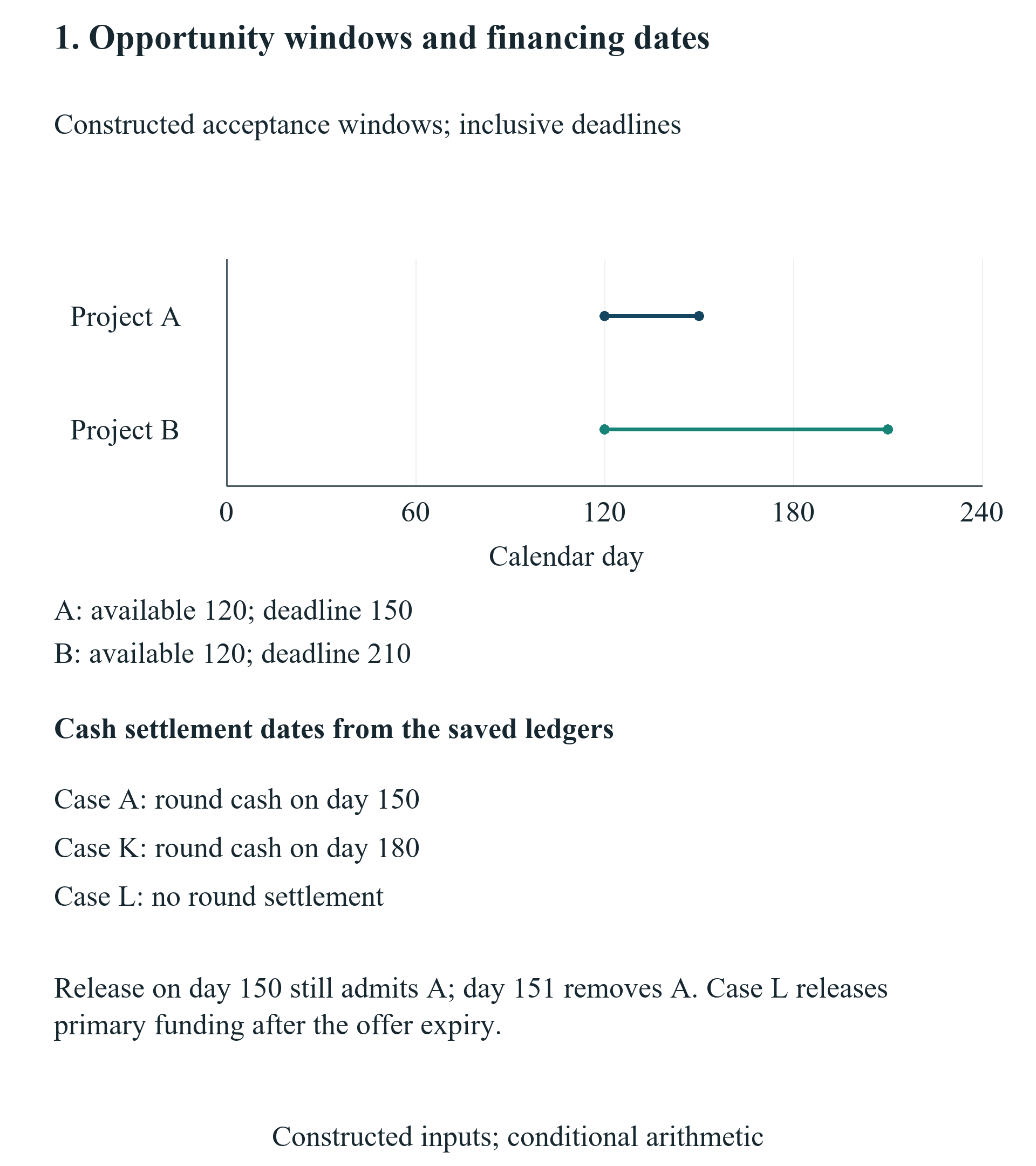
The company has two mutually exclusive commercial opportunities, labelled A and B solely within the experiment. Each becomes available on day 120. Opportunity A must be accepted by day 150, costs GBP 35,000 on day 180 and produces a stipulated receipt of GBP 140,000 on day 240. Opportunity B has a day-210 acceptance deadline, a GBP 20,000 cost on day 210 and a GBP 90,000 receipt on day 300. The company can choose one opportunity or abstain. Receipts are deterministic assumptions in the main cases. Customer default, partial delivery and variable operating expenditure require separate extensions.
The continuation balance comprises a GBP 160,000 core asset component, GBP 320,000 associated with field A and GBP 160,000 associated with field B. These are constructed end-of-horizon asset values, excluding cash already in the event ledger and revenue already received during the horizon. They contain no claim about market multiples, terminal growth or expected programme outcomes. Removing a field from the company's retained asset permissions removes only its specified continuation component. The separation makes the economic treatment traceable and avoids charging the same assumed loss through both an arbitrary valuation discount and a direct cash deduction.
The experiment keeps time-value discounting outside its scope: every displayed terminal comparison uses the same undiscounted horizon. A commercial decision needs an appropriate discount rate, funding risk and a defensible terminal valuation before using comparable amounts as a transaction price. The research purpose here is to identify which rights alter a feasible choice, cash event, ownership fraction or retained asset. With those channels explicit, a reader can replace the constructed parameters and rerun the same accounting relationships. The main results remain conditional on the stated inputs and the declared policy-selection criterion.
| Input | Amount or date | Scope |
|---|---|---|
| Opening cash and floor | 20,000; zero | Before any day-zero receipt |
| Programme receipt | 50,000 on day 0 | Assumed corporate cash |
| Programme expenditure | 20,000 on day 30 | Assumed payment |
| Operating expenditure | 15,000 on days 90, 180, 270, 360 | Each payment counted once |
| Existing shares | Founders 90; programme investor 10 | Assumed opening holdings |
| Primary round | 150,000; pre-money 600,000 | Fixed price and total cash |
| Round window | Earliest day 150; expiry day 210 | Expiry inclusive |
| Opportunity A | Cost 35,000; receipt 140,000 | Accept by 150; pay 180; receive 240 |
| Opportunity B | Cost 20,000; receipt 90,000 | Accept by 210; pay 210; receive 300 |
| Commercial choice | One project or abstention | Fields and dates constrain actions |
| Continuation assets | Core 160,000; A 320,000; B 160,000 | Exclude cash and modelled receipts |
| Horizon and money | 360 relative days; GBP | Undiscounted common horizon |
All values are constructed in GBP; no programme calibration or empirical outcome is claimed.
Scroll horizontally to read the figure at full size. You can also open the full-size figure.
All dates and conditions are hypothetical. A release on day 150 is timely for A; release on day 151 misses its inclusive deadline. The primary offer expires on day 210.
10 The commercial and financing action sets
A policy consists of a permitted commercial choice together with the financing terms assigned to its case. Commercial eligibility requires the company to retain permission to operate in the relevant field and to act within the opportunity's availability and expiry dates. An exclusivity release applicable to field A can postpone its acceptance date. The same release leaves field B's acceptance timing unchanged unless a separate provision restricts that field. This representation gives each restriction an explicit scope and makes the deadline convention visible. A release on the last permitted day is timely in the constructed contract.
Legal eligibility and cash feasibility are tested separately. A policy can satisfy its assumed permissions and still lack money for an intermediate payment. Conversely, available cash cannot reopen a commercial opportunity whose acceptance deadline has passed. Abstention is included in the main action set, allowing the company to retain its remaining assets without pursuing either project. A separate control removes abstention while removing every permitted commercial field. That combination produces an empty legal action set. It remains an impossible case rather than receiving a fabricated low valuation or an arbitrary rescue policy.
The financing action uses a primary issuance of new shares. In the unrestricted case, external investors supply the entire fixed round. The participation cases let the existing investor supply its specified share within that same total or leave its right unused. A separate matching-right case allows that investor to supply the whole round on the same assumed price and cash terms. These behaviours are explicit inputs. No right is treated as an obligation to invest; the analysis also specifies investor cash capacity. A scheduled round disappears when the stipulated cash capacity or operating-permission condition fails.
The primary-round matching and first-offer cases are hypothetical contractual arrangements. They make no finding about the scope of an observed accelerator's agreement. A primary entitlement concerns money entering the company and newly issued shares. The separate secondary-sale control concerns a transfer of existing shares and money paid personally to the seller. Keeping those domains separate permits a direct check of corporate cash and ownership conservation. An analyst should identify the transaction domain before interpreting a provision's name, because similar shorthand can accompany different operative language.
Each feasible policy is evaluated through the same cash ledger and retained-asset calculation. The main selection rule chooses the permitted, funded policy with the highest constructed founder terminal-wealth proxy. That criterion assumes the founder values the measured monetary outcome and has no additional preference for a particular customer, operating field or investor. Ties follow a fixed enumeration order and have no claimed economic significance. A board with additional strategic objectives should record them as decision constraints or report a set of acceptable policies. Changing the objective can change the preferred action even when the financial accounting is unchanged.
11 Cash feasibility at each payment date
| Item | Applied convention | Interpretation |
|---|---|---|
| Opening balance | Test before any day-zero receipt | A later receipt cannot cure an opening breach |
| Matching dates | Outflows precede receipts | Declared settlement stress convention |
| Each receipt/payment | Count once in the corporate ledger | No separate lost-opportunity expense |
| Continuation assets | Exclude modelled cash and in-period receipts | Avoid duplicate value |
| Breach | Funded founder wealth unavailable | Diagnostic arithmetic retained separately |
| Sponsor compensation | Outside payment before opening; ownership fixed | Distinct from founder cash or priced equity |
| New share issue | Paid primary cash divided by issue price | Secondary transfers supply no company cash |
Constructed accounting rules; company-specific settlement, tax and legal arrangements require separate evidence.
The cash account starts before any day-zero receipt. Every operating cost, commercial payment, programme receipt and financing receipt then enters the account once at its specified date. When a date contains both a payment and a receipt, the experiment processes payments first. This convention deliberately requires the company to fund an obligation before relying on money that arrives later on the same day. The convention is a declared stress assumption. A real transaction can use a different ordering when escrow mechanics, settlement instructions or an executed bridge arrangement support it.
Feasibility requires every cash prefix to remain at or above the stipulated floor, which is zero in the main cases. The smallest balance and the first breach are retained for each policy. A later funding receipt cannot retrospectively cure an earlier failed payment. When a prefix falls below the floor, the model withholds funded terminal wealth for that policy. It can still retain a clearly identified diagnostic closing balance for auditing the event arithmetic. That diagnostic is not an achieved financing outcome and does not enter the feasible-policy comparison.
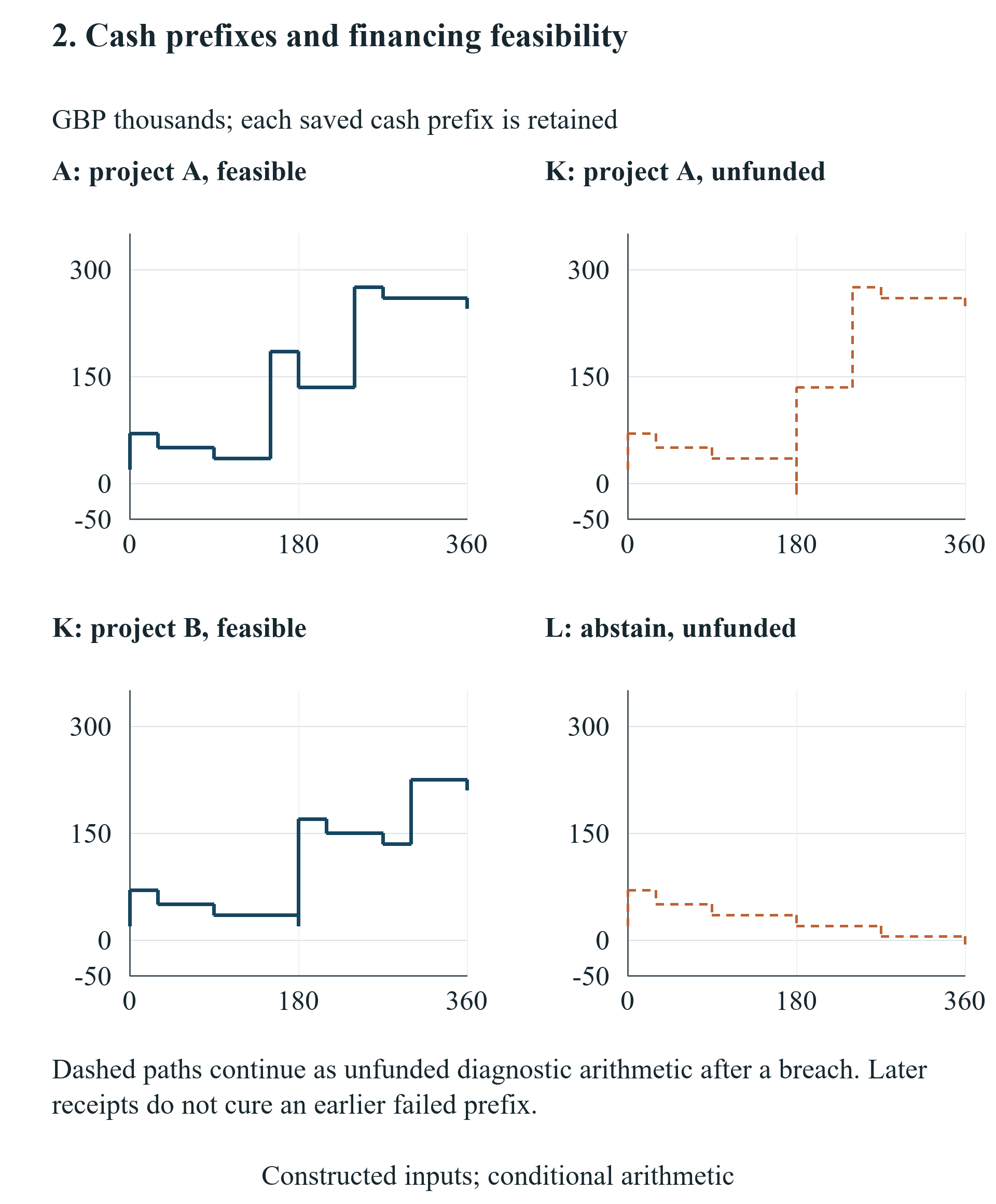
The base ledger permits an independent reconstruction. Opening cash and the programme receipt together provide GBP 70,000 before later expenditure. The day-30 programme payment reduces that balance to GBP 50,000, and the day-90 operating payment reduces it to GBP 35,000. Subsequent financing and commercial choices determine the later prefixes. The table of dated events should therefore be read alongside the terminal comparison. A company with a positive end-of-horizon balance can still fail this funding test if the commercial payment occurs before the money needed to make it.
For compensation analysis, a corporate sponsor top-up is credited to opening cash before the first prefix test. It is counted once and leaves the stipulated ownership fractions, round size, valuation and later payments unchanged. A top-up paid after a breach would answer a different question and cannot satisfy this convention. Founder-financed rescue money would also require a separate personal cash debit or a documented security. The present compensation mechanism is an outside corporate payment with no new ownership claim, making its interpretation intentionally narrower than a general financing recommendation.
This event-ledger method exposes the source of any liquidity requirement. The analyst can identify the date, payment and amount that bind the decision and then test a specific contractual change. An earlier release may preserve a customer opportunity; an earlier round settlement may fund its cost; an opening sponsor payment may cover the cash trough. Those changes have different operative requirements. The model prices no default penalty, insolvency proceeding or emergency loan after a breach. Such consequences need verified jurisdiction-specific facts and separate contractual inputs before entering the financial comparison.
Scroll horizontally to read the figure at full size. You can also open the full-size figure.
Constructed GBP balances. Every intermediate payment prefix counts, with outflows before same-day receipts. The delayed A path breaches by GBP 15,000 before round cash. Breached paths are diagnostic, with no achieved terminal wealth.
12 Commercial exclusivity and expiring opportunities
The commercial-window comparison changes the day on which field A becomes available to the company while preserving the opportunity's acceptance deadline. A release on day 150 satisfies the experiment's inclusive deadline. A release on day 151 removes opportunity A from the permitted menu. The one-day difference is economically discontinuous because the opportunity itself expires. This is a stipulated contractual boundary in the constructed example. It provides no estimate of the usual length of an accelerator restriction or the probability that a real customer would extend its deadline.
Before the restriction binds, the reference policy selects opportunity A under the supplied cash and asset assumptions. The company ends with GBP 245,000 in cash and retains GBP 640,000 of continuation assets. Applying the seventy-two-per-cent founder fraction gives a constructed terminal proxy of GBP 637,200. Once the window removes A, the funded alternative is B. Its closing cash is GBP 210,000, with the same retained assets, and its founder proxy is GBP 612,000. The conditional difference is GBP 25,200. It is a difference between complete feasible packages with a common horizon and ownership basis.
The underlying corporate cash difference is GBP 35,000: opportunity A's stipulated receipt less its commercial cost is GBP 105,000, while B's is GBP 70,000. Multiplying that difference by the unchanged founder fraction yields GBP 25,200. There is no separate exclusivity expense in the ledger. Charging the lost opportunity's gross receipt, charging its net contribution again and applying an additional rights discount would conflate different quantities. The opportunity's own costs, receipts and feasible replacement already supply the channel used in the comparison.
Duration matters through its relationship with the available alternatives. Within the supplied dates, several releases before or on day 150 lead to the same selected opportunity and monetary result. Later releases remove A but leave B's separate field available. Further delay in field A therefore creates no additional commercial loss in this particular two-opportunity menu. A company with a succession of customer deadlines could display several steps, while a continuous sales process would need a different opportunity representation. The shape of the result belongs to the supported commercial calendar, rather than to an assumed daily cost attached to the word exclusive.
A negotiation can target the field boundary, the acceptance deadline or a documented release mechanism. For example, a hypothetical carve-out allowing the identified A transaction would restore its legal eligibility under this model, provided its financing and cash prefixes also pass. A date change alone supplies no customer consent in a real contract. The company would need the actual release, any required third-party approval and confirmation that the customer offer remains open. The framework makes those dependencies explicit before a board places a monetary value on the proposed amendment.
The difference is conditional on the company's outside option. A business with no supported A opportunity should not claim the example's GBP 25,200 as its own loss. A business with a more valuable alternative might prefer that alternative even before a restriction applies. The relevant calculation compares the best feasible supported policy under each complete term package, using a consistent objective and information set. The constructed result demonstrates the importance of an expiring opportunity; its magnitude comes entirely from the stated experimental inputs.
| Package | Chosen policy | Founder proxy, GBP | Minimum cash, GBP |
|---|---|---|---|
| A: Unrestricted reference | A | 637,200 | 20,000 |
| B: Release on A deadline | A | 637,200 | 20,000 |
| C: Release after A deadline | B | 612,000 | 20,000 |
| D: Field-A licence; no reserved use | B | 381,600 | 20,000 |
| E: Timing and field-A licence together | B | 381,600 | 20,000 |
| F: Assignment of both fields; no licence-back | Abstain | 216,000 | 20,000 |
All values are constructed in GBP; no programme calibration or empirical outcome is claimed. An unfunded package has no achieved terminal proxy. Minimum cash refers to the selected policy.
13 IP permissions and overlapping restrictions
An IP condition enters the constructed model through two distinct permissions. The first concerns operating a commercial project during the horizon. The second concerns retaining the associated asset value at the horizon. In the exclusive field-A licence case, the assumed licence removes the company's field-A exploitation permission throughout the valued period and provides no reserved use or reversion. The company consequently loses access to opportunity A and excludes the field-A continuation asset. Field B and the core asset remain available. These are express experimental assumptions about a hypothetical licence, with no conclusion about what a named programme requires.
The assignment case removes the operating permissions and continuation values for both commercial fields, while leaving the core asset with the company. It supplies no licence-back. The fixed financing round is still explicitly available under this case's input assumptions. That financing availability is a strong conditional choice: an investor in a real transaction might change its offer after an IP transfer. The present comparison holds the round fixed to expose the rights channel. A company-specific evaluation should add a documented financing-permission condition or a different supported offer when the transfer changes investor willingness to fund.
The monetary effect of excluding a field depends on the alternatives that remain. A company able to undertake another profitable project can choose it. A company with no remaining commercial permission can abstain when the contract and decision problem permit abstention. The resulting values should therefore be calculated from the revised action set and retained assets. Subtracting a generic percentage for IP restrictions would conceal both mechanisms. It could also count the same field loss twice if the valuation already excludes that field and the analyst additionally deducts an assumed contractual penalty.
Overlapping provisions require a joint comparison. A commercial window restriction can remove opportunity A by delaying acceptance beyond its deadline. A sufficiently broad field-A licence can independently remove that same opportunity. Imposing both conditions cannot remove opportunity A twice. The joint case also excludes the field-A continuation component when the licence has that stipulated scope. The correct comparison evaluates four complete packages: unrestricted, timing-only, licence-only and joint. Their difference-in-differences identifies the overlap within the constructed decision problem. It supplies no causal estimate from observed companies and no additive schedule of legal damages.
A non-exclusive licence receives a separate control. The control explicitly preserves the company's operating permissions, retained assets, cash amounts and financing terms, and it introduces no competing-sales effect. Its economic result is therefore invariant by construction. This establishes the boundary of the modelled channels. A real non-exclusive licence could affect pricing, competition, technical secrecy or customer behaviour; those consequences need additional evidence and parameters. The present control supports no general claim that non-exclusive licences are costless. It documents that the word licence alone creates no monetary deduction in this framework.
The permission map should accompany every proposed IP valuation. It should identify the owner before and after the agreement, permitted users, product or field boundaries, territory, duration, sublicensing, improvements, reserved rights and reversion. The company should also distinguish application material, pre-existing technology and work produced during a programme. An executed document can allocate those categories differently. Legal review determines the agreement's meaning and enforceability in its jurisdiction. Financial analysis then uses the supported permission changes, with unresolved terms retained as separate scenarios and their assumptions disclosed to the decision-maker.
14 Ownership under matched financing terms
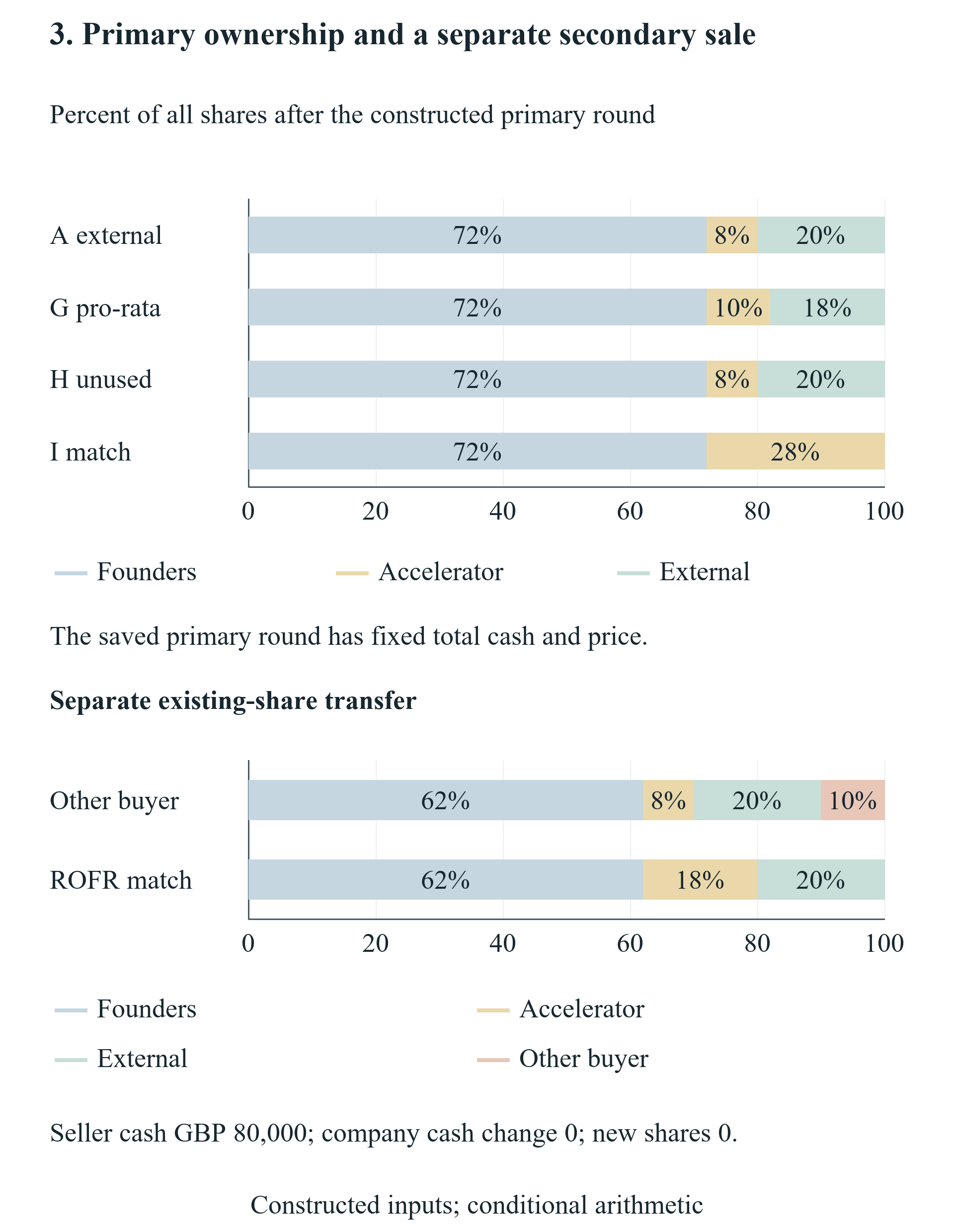
The primary financing comparison begins with the same 100 existing shares and GBP 600,000 pre-money valuation. The stipulated price is therefore GBP 6,000 per new share. Raising GBP 150,000 at that price issues 25 shares, giving 125 shares after the round. The founders continue to hold their original 90 shares. Their resulting fraction is 90 divided by 125, or 72 per cent. This calculation holds the round's price, size, share rights and existing holdings constant. A change in any of those conditions belongs in a separately specified comparison.
Full exercise of the existing investor's ten-per-cent pro-rata entitlement supplies GBP 15,000 within the fixed round. That payment buys 2.5 new shares. External investors supply GBP 135,000 and receive 22.5 new shares. The existing investor then holds 12.5 shares, external investors hold 22.5 and founders hold 90. The final percentages are ten, eighteen and seventy-two respectively. When the entitlement is left unused, external investors instead supply the whole GBP 150,000. The existing investor keeps ten shares, representing eight per cent after the round, while founders still hold seventy-two per cent.
The hypothetical whole-round primary matching case changes the identity of the subscriber. The existing investor supplies GBP 150,000 at the same GBP 6,000 price and receives all 25 new shares. Its final holding is 35 shares, or twenty-eight per cent, and the founders again hold seventy-two per cent. The corporate cash receipt and total issued shares match the external-financing case. Within these supplied terms, a change of subscriber does not itself change founder dilution. A negotiated change in price, governance, preference rights or total cash would require a broader security-level and contractual analysis.
Cash capacity and actual behaviour remain necessary conditions. The model records an entitlement separately from the investor's payment, and it creates new shares only for paid company cash under the assigned round. A right that is waived produces no subscription payment. A promised round whose supplied investor capacity is inadequate produces no completed financing event. These distinctions matter in a founder's planning because an allocation reservation, indication of interest and funded subscription can occupy different stages. The constructed accounting neither values a promise as cash nor treats optional participation as an automatic future capital commitment.
The secondary-sale control transfers ten percentage points of the post-round company from the founders for GBP 80,000 paid to them personally. The company receives no new cash and issues no shares in that control. A same-price secondary match changes the purchaser while preserving the seller's transferred fraction and personal cash receipt. That limited accounting result says nothing about consent rights, taxes, transfer restrictions or differences in the purchaser's future conduct. Those matters require their own evidence. The control demonstrates why a secondary right cannot simply be inserted into the primary-fundraising cash ledger.
Each ownership bridge should show initial shares, company cash paid, shares issued at the stated price, final shares and final fraction. The payment and issue columns reconcile the investor's participation with the company's receipt. Ownership quantities attached to a cash-breached operating policy remain conditional scheduled quantities, with no assertion that the company successfully completed that policy. The terminal founder-wealth proxy uses an ownership fraction only for a funded policy. This presentation lets a reader check whether an apparent rights cost comes from dilution, lost corporate cash, delayed funding or a separate change in operating assets.
| Package and holder | Before + issue = after shares | Paid company cash, GBP | Final holding |
|---|---|---|---|
| A; Founders | 90 + 0 = 90 | 0 | 72% |
| A; Existing investor | 10 + 0 = 10 | 0 | 8% |
| A; External investor | 0 + 25 = 25 | 150,000 | 20% |
| G; Founders | 90 + 0 = 90 | 0 | 72% |
| G; Existing investor | 10 + 5/2 = 25/2 | 15,000 | 10% |
| G; External investor | 0 + 45/2 = 45/2 | 135,000 | 18% |
| H; Founders | 90 + 0 = 90 | 0 | 72% |
| H; Existing investor | 10 + 0 = 10 | 0 | 8% |
| H; External investor | 0 + 25 = 25 | 150,000 | 20% |
| I; Founders | 90 + 0 = 90 | 0 | 72% |
| I; Existing investor | 10 + 25 = 35 | 150,000 | 28% |
| I; External investor | 0 + 0 = 0 | 0 | 0% |
Constructed ordinary-equity round. Price GBP 6,000 per new share. Each package supplies GBP 150,000 to the company; final shares total 125.
Scroll horizontally to read the figure at full size. You can also open the full-size figure.
The primary round issues 25 shares at GBP 6,000 and retains seventy-two-per-cent founder ownership under the matched cases. The secondary control transfers existing shares and pays the seller; it supplies no company cash.
15 Financing delays and the loss of an offer
Financing timing operates through a different calendar. The stipulated primary round can first settle on day 150 and expires after day 210. A process delay postpones the round's cash event without changing the commercial acceptance dates or investor price. Where the company has already committed to opportunity A, the day-180 payment sequence becomes binding. The ledger has GBP 35,000 after day 90. On day 180, GBP 15,000 of operating expenditure and GBP 35,000 of commercial cost fall due before any same-day financing receipt. The minimum at that point is negative GBP 15,000.
Moving the round settlement to day 179 avoids that particular trough because the GBP 150,000 is available before the day-180 obligations. A settlement on day 180 under the declared outflow-first convention arrives too late to fund the earlier prefix. The eventual same-day balance after receipt is positive, but the committed policy has already failed the financing test. This distinction is relevant to a contractual right that consumes time without changing a subscription price. The company should identify its actual settlement mechanics and payment priorities before using a calendar-day comparison as evidence of available liquidity.
The company can also change its commercial policy when the timing information is available before commitment. Opportunity B has no day-180 commercial payment and remains fundable with the stipulated round settlement on that day. Selecting B therefore avoids the A-specific cash breach, while giving up A's larger assumed net contribution. The optimal funded-policy comparison can report that switch. A precommitted-A compensation calculation answers a narrower question and retains A as its required policy. Reporting both exposes whether a stated rights cost reflects a cash injection requirement, a feasible adaptation or an irreversible prior commitment.
The hypothetical first-offer case supplies invitation, reply and external-offer dates before the scheduled settlement. Its specified decline permits the same external cash on day 150. Under those exact process dates and fixed terms, the first-offer label has no separate monetary effect. The hypothetical matching-right delay case instead supplies a later external settlement. The later date, together with the ledger, produces its funding consequence. Neither experiment establishes a universal effect of a right of first offer or refusal; the operative domain, notice mechanics, investor response and eventual offer determine the company-specific calculation.
A fundraising release on day 211 misses the stipulated offer expiry. The model then records no completed round, no corporate financing receipt and no new shares from that round. With the supplied opening liquidity and expenditure calendar, no main commercial policy remains funded through the full horizon in this case. The terminal founder-wealth comparison remains unavailable. A diagnostic asset-plus-cash amount cannot be reported as an achieved outcome, and an expired offer cannot be treated as money that merely arrived a day late. A replacement investor or emergency loan would be a new supported financing scenario.
The practical review should connect every process provision to a latest usable cash date. The company can request a specified response period, automatic expiry of a negotiation window, a transaction-specific waiver or evidence of committed bridge finance. Each proposal needs its actual documents and economics. An interest-bearing bridge adds cost and repayment obligations; new equity changes ownership; a sponsor payment has another incidence. The framework keeps those alternatives separate so the board can see what contractual change or funded security supports a proposed recovery path.
| Package | Chosen policy | Founder proxy, GBP | Minimum cash, GBP |
|---|---|---|---|
| G: Full voluntary pro-rata | A | 637,200 | 20,000 |
| H: Unused participation right | A | 637,200 | 20,000 |
| I: Same-terms primary match | A | 637,200 | 20,000 |
| J: First-offer decline; timely cash | A | 637,200 | 20,000 |
| K: Matching process; cash on day 180 | B | 612,000 | 20,000 |
| L: Fundraising release after offer expiry | No funded policy | Unavailable | Unavailable |
All values are constructed in GBP; no programme calibration or empirical outcome is claimed. An unfunded package has no achieved terminal proxy. Minimum cash refers to the selected policy.
16 Compensation thresholds and opening liquidity
A compensation question needs a defined recipient, date and financing incidence. Here an outside sponsor pays a non-negative amount into the company before the opening balance is tested. The payment creates no security, leaves the founder fraction fixed and changes no later cost, receipt, permission or financing term. The experiment asks for the smallest such payment that makes an admissible policy funded and reaches a stated founder-wealth benchmark. These conditions deliberately restrict the interpretation. They do not describe a new equity investment, a founder's personal cash contribution or compensation paid after an obligation has already been missed.
For each legal policy, the liquidity requirement is the amount needed to bring its smallest unassisted cash prefix up to the specified floor, with a lower bound of zero. The wealth requirement compares the reference founder proxy with the policy's diagnostic affine intercept and divides the difference by the positive founder fraction. The policy's top-up is the largest of zero, the liquidity requirement and that economic hurdle. The calculation then compares every permitted policy and selects the smallest feasible top-up. Retaining the signed economic hurdle separately shows when a policy already exceeds the wealth benchmark before a payment.
The diagnostic intercept has a limited mathematical role. It is the policy's closing asset-plus-cash expression at zero compensation, multiplied by its scheduled founder fraction, even where an earlier cash breach prevents the policy from being funded. It supplies the intercept of the affine expression needed to solve for a pre-opening top-up. It is not reported as achieved founder wealth. After calculating compensation, the experiment reruns every cash prefix and the wealth condition for the compensated policy. A proposed payment passes only when the actual compensated path satisfies both tests.
The fixed-A timing control requires GBP 15,000 before opening when financing arrives on day 180. That payment brings the binding prefix exactly to zero. The release-after-deadline comparison requires GBP 35,000 to the company to restore the unrestricted founder benchmark while undertaking B. The latter amount is larger than the GBP 25,200 founder-level difference because founders own seventy-two per cent of the company. In the assignment case, restoring the same benchmark through the stipulated corporate channel requires GBP 585,000. The comparison reflects the assumed missing field assets and commercial contribution, together with retained core assets and cash.
Some controls have qualitatively different answers. An opening balance of negative GBP 5,000 needs at least GBP 5,000 before any later day-zero receipt, even when that receipt is large. A company with a zero founder fraction cannot improve this particular founder-wealth proxy through corporate cash. If the benchmark is already zero, liquidity can still be repaired; a positive founder benchmark is impossible through that channel. A case requiring a commercial action while forbidding every action has no admissible policy. A larger cash payment cannot cure that logical restriction.
A finite threshold should be interpreted alongside its binding condition and chosen policy. The minimum payment can switch policies as a parameter changes, so solving only for the initially preferred project can overstate the required compensation. Whole-pound displays are rounded upward for a funding requirement, with exact rational values retained in the calculations. A real negotiation needs the payment's tax, legal, accounting and security treatment before using it as a settlement proposal. The constructed thresholds supply an auditable answer to a specific payment mechanism; other compensation mechanisms require their own equations and supporting terms.
| Question | Selected policy | Opening payment, GBP | Result |
|---|---|---|---|
| Zero opening; floor equality | Abstain | 0 | Zero |
| Opening shortfall before receipt | Abstain | 5,000 | Finite |
| Required A; round day 179 | A | 0 | Zero |
| Required A; round day 180 | A | 15,000 | Finite |
| Release on deadline; matched wealth | A | 0 | Zero |
| Release after deadline; matched wealth | B | 35,000 | Finite |
| No field-A terminal asset; matched wealth | B | 35,000 | Finite |
| Assignment; matched wealth | Abstain | 585,000 | Finite |
| Negative signed wealth hurdle | A | 0 | Zero |
| Zero founder fraction; zero target | Abstain | 0 | Zero |
| Zero founder fraction; positive target | No policy reaches target | Unavailable | Impossible |
| Required action; empty permitted menu | No admissible policy | Unavailable | Impossible |
Constructed sponsor money enters before opening and changes no ownership or other term. An impossible result cannot be cured through this channel. Exact amounts are retained; whole-pound funding requirements round upward when necessary.
17 Sensitivity to timing and retained assets
The one-way experiments vary one declared input at a time within a specified package. Five release dates test the opportunity boundary; five opening balances test the delayed-financing cash trough; five field-A continuation values test the matched cost of excluding that asset; and five pro-rata take-up fractions test allocation inside the fixed round. The twenty observations are constructed scenario rows. Their spacing supplies no empirical frequency or probability distribution. The purpose is to identify which input reaches an operative boundary and which held-fixed assumptions explain an invariant result.
The release-date series contains days zero, 120, 150, 151 and 211. The first three preserve opportunity A under the inclusive acceptance convention. The latter two remove A while leaving field B's permission and deadlines unchanged. Those cases therefore select the same alternative under the other fixed assumptions. The flat regions and step arise from the supplied menu. A real opportunity register should include supported expiry dates and dependencies. Extrapolating the step to an unobserved customer pipeline would require new evidence and could substantially change the preferred policy.
The opening-cash series uses balances of zero, GBP 5,000, GBP 20,000, GBP 35,000 and GBP 50,000 with financing delayed to day 180. It retains every legal policy and its cash test, allowing the reader to see where the selected funded action changes. The precommitted A policy has a GBP 35,000 opening-liquidity requirement under that delayed settlement convention; the standard opening GBP 20,000 is GBP 15,000 short of it. An optimal-policy result can differ because abstention or B remains available. The output must preserve those policy-level distinctions rather than replacing the entire package with the cash trough of one project.
The field-A continuation series uses zero, GBP 80,000, GBP 160,000, GBP 320,000 and GBP 640,000. Each value is applied to both the unrestricted reference and the field-A-restricted package. The restricted package itself retains core and field B, so its value is invariant to the excluded field-A scalar. The matched difference varies because the unrestricted package retains that field. This pairing measures the intended asset-rights sensitivity while keeping the restriction's own asset boundary intact. A table showing only the restricted values would be an invariance check and would not establish how the cost of the restriction changes.
Pro-rata take-up varies from zero through one-quarter, one-half and three-quarters to full exercise of the stipulated entitlement. External subscription adjusts within the same GBP 150,000 round. With price, size and security terms unchanged, founder ownership and corporate funding remain constant. The existing and external investors' allocations change. This invariance supplies a check on transaction arithmetic. It supports no claim about pricing negotiations, crowding out, investor selection or financing capacity in an actual market. Those effects require additional terms, observed behaviour and a separate comparison.
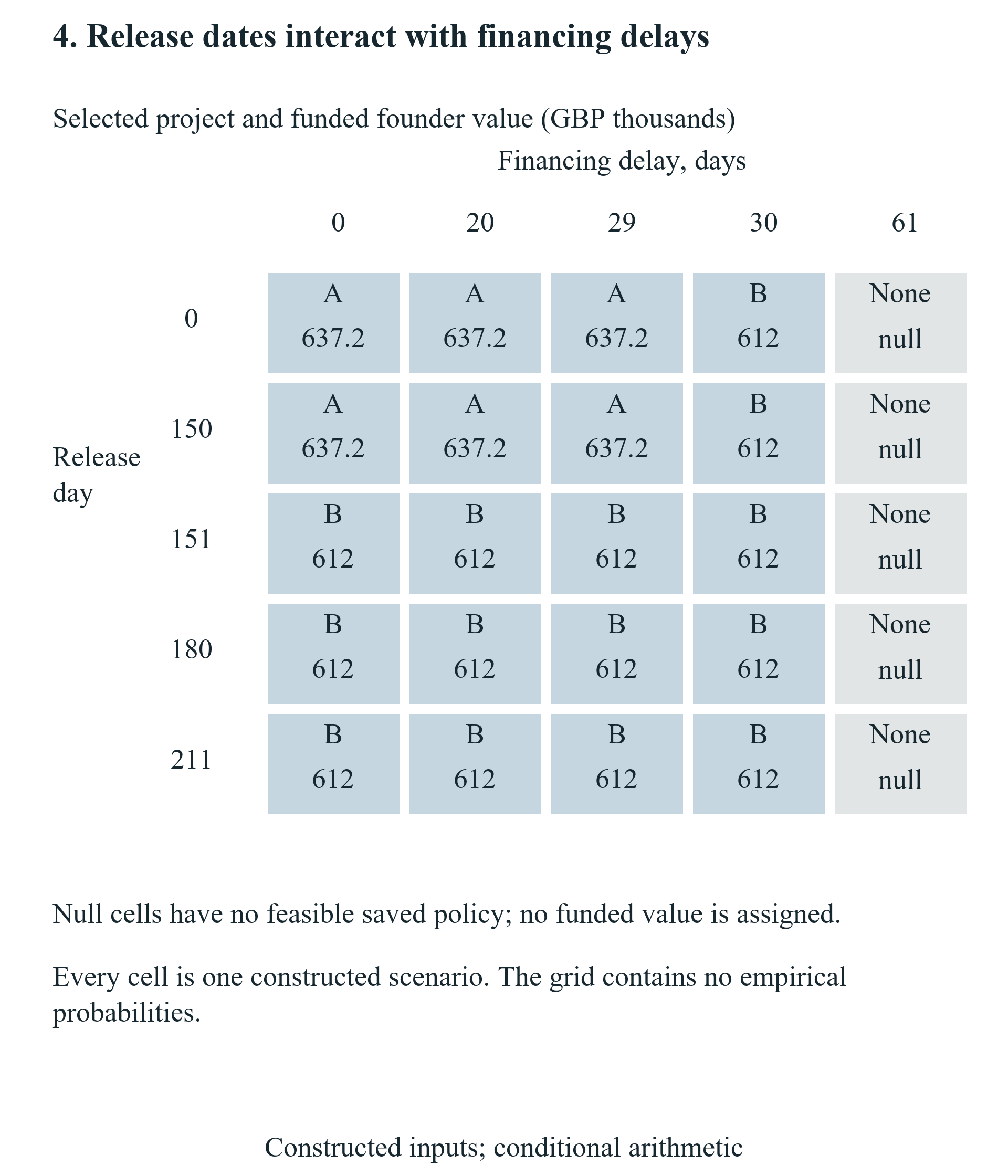
The interaction grid crosses five commercial release dates with financing delays of zero, twenty, twenty-nine, thirty and sixty-one days. It identifies the funded policy in each of twenty-five cells and leaves a terminal value unavailable where no policy can be funded. The last delay misses the supplied financing-offer expiry. The grid is a deterministic map of the stated opportunities, rights and cash conditions, with no distributional interpretation. Its practical use is to identify which dates require negotiation or cash evidence first. It supplies no forecast of the frequency with which an accelerator agreement would place a company in any particular cell.
| Varied input | Chosen policy | Founder proxy, GBP | Paired reference loss, GBP |
|---|---|---|---|
| A release day 0 | A | 637,200 | Not this comparison |
| A release day 120 | A | 637,200 | Not this comparison |
| A release day 150 | A | 637,200 | Not this comparison |
| A release day 151 | B | 612,000 | Not this comparison |
| A release day 211 | B | 612,000 | Not this comparison |
| Delayed round; opening cash 0 | B | 597,600 | Not this comparison |
| Delayed round; opening cash 5,000 | B | 601,200 | Not this comparison |
| Delayed round; opening cash 20,000 | B | 612,000 | Not this comparison |
| Delayed round; opening cash 35,000 | A | 648,000 | Not this comparison |
| Delayed round; opening cash 50,000 | A | 658,800 | Not this comparison |
| Paired field-A asset 0 | B | 381,600 | 25,200 |
| Paired field-A asset 80,000 | B | 381,600 | 82,800 |
| Paired field-A asset 160,000 | B | 381,600 | 140,400 |
| Paired field-A asset 320,000 | B | 381,600 | 255,600 |
| Paired field-A asset 640,000 | B | 381,600 | 486,000 |
| Pro-rata entitlement take-up 0 | A | 637,200 | Not this comparison |
| Pro-rata entitlement take-up 1/4 | A | 637,200 | Not this comparison |
| Pro-rata entitlement take-up 1/2 | A | 637,200 | Not this comparison |
| Pro-rata entitlement take-up 3/4 | A | 637,200 | Not this comparison |
| Pro-rata entitlement take-up 1 | A | 637,200 | Not this comparison |
All values are constructed in GBP; no programme calibration or empirical outcome is claimed. For the five asset rows, loss is the same-patch unrestricted reference minus the restricted package; the restricted asset value itself is invariant.
| A release day | Delay 0 | Delay 20 | Delay 29 | Delay 30 | Delay 61 |
|---|---|---|---|---|---|
| 0 | A; 637,200 | A; 637,200 | A; 637,200 | B; 612,000 | Unfunded |
| 150 | A; 637,200 | A; 637,200 | A; 637,200 | B; 612,000 | Unfunded |
| 151 | B; 612,000 | B; 612,000 | B; 612,000 | B; 612,000 | Unfunded |
| 180 | B; 612,000 | B; 612,000 | B; 612,000 | B; 612,000 | Unfunded |
| 211 | B; 612,000 | B; 612,000 | B; 612,000 | B; 612,000 | Unfunded |
Each cell gives selected policy and constructed founder proxy in GBP. Delay is relative to round day 150. A sixty-one-day delay misses the day-210 offer expiry. No probabilities are assigned.
Scroll horizontally to read the figure at full size. You can also open the full-size figure.
Financing delays are relative to day 150. Each cell follows its full legal menu and cash ledger. An unavailable funded outcome is not assigned zero terminal wealth. No probability distribution is attached to the grid.
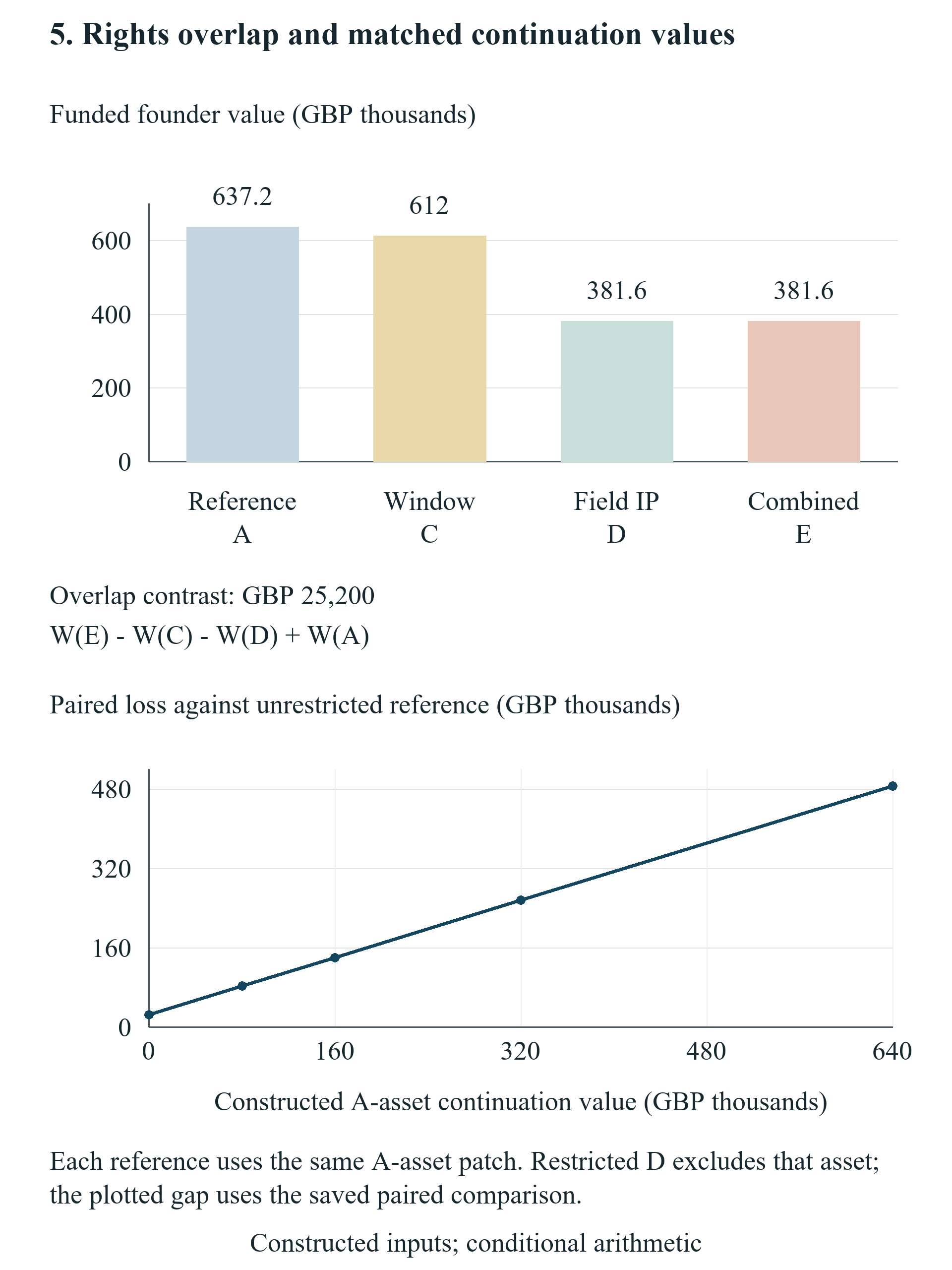
Scroll horizontally to read the figure at full size. You can also open the full-size figure.
Constructed founder proxies in GBP. The signed joint interaction is GBP 25,200. For asset sensitivity, the same field-A value is varied in both packages; the restricted package excludes that asset and remains invariant.
18 Information and the value of keeping a choice
The separate information experiment asks whether a company benefits from preserving its choice until relevant commercial information becomes available. A company may commit to A or B at opening, or retain the ability to choose on day 120. In this experiment the commercial state is observed on day 120 before either acceptance deadline. The first state retains A's GBP 140,000 receipt and B's GBP 90,000 receipt. In the second state A's receipt is GBP 70,000 and B's is GBP 130,000. Every other supplied commercial, financing and ownership input stays fixed.
No probability is assigned to either state. The declared decision criterion is maximin: compare the smallest founder payoff available under each permissible policy. A committed policy uses the same commercial action in both states. An adaptive policy may select a different action after observing the state, provided that action remains legally permitted and funded. The resulting flexibility premium is the difference between the adaptive and committed maximin values. It is a finite-scenario decision-rule quantity. It is not an expected return, a market option price or a statistically estimated effect of joining an accelerator.
Under the supplied timely financing, A produces founder proxies of GBP 637,200 in the first state and GBP 586,800 in the second. B produces GBP 612,000 and GBP 640,800 respectively. The best committed maximin policy chooses B, with a worst-state proxy of GBP 612,000. The adaptive policy chooses A in the first state and B in the second, with a worst-state proxy of GBP 637,200. The resulting maximin flexibility premium is GBP 25,200. The output retains the full vectors and selected actions so the scalar comparison can be reconstructed.
Statewise foregone surplus supplies a complementary description. The committed B policy gives up GBP 25,200 relative to the best feasible policy in the first state and gives up zero in the second. The implemented adaptive policy gives up zero in both under the supplied information timing. These are differences from the statewise feasible benchmark and contain no probability weighting. A board choosing another risk criterion may prefer another policy. It should state that criterion and compare the same feasible payoff vectors, including any strategic, legal or liquidity constraints omitted from this monetary experiment.
Two controls test the interpretation. In the no-information control, revelation occurs after the opportunity deadlines, so the company cannot condition its implemented choice on the observed state. Statewise best outcomes remain diagnostic benchmarks, and implemented flexibility receives no benefit from that unavailable information. In the one-action control only A is admissible; observing a state cannot create an alternative commercial choice. Its flexibility premium is also zero. Both controls retain the distinction between information that exists somewhere in the experiment and information that a decision-maker can use at the required decision date.
The contractual implication is conditional on both access and timing. A restriction that forces an early commitment can remove the ability to act on later evidence. A waiver delivered after all relevant offers expire cannot restore that decision right within the same opportunity set. A founder reviewing such a provision should identify the information expected, the observation date, the decision it could alter and the cost of preserving the alternative. The present two-state example establishes those dependencies transparently. A real valuation requires supported states, decision criteria and financing arrangements, with any missing probability evidence left explicit.
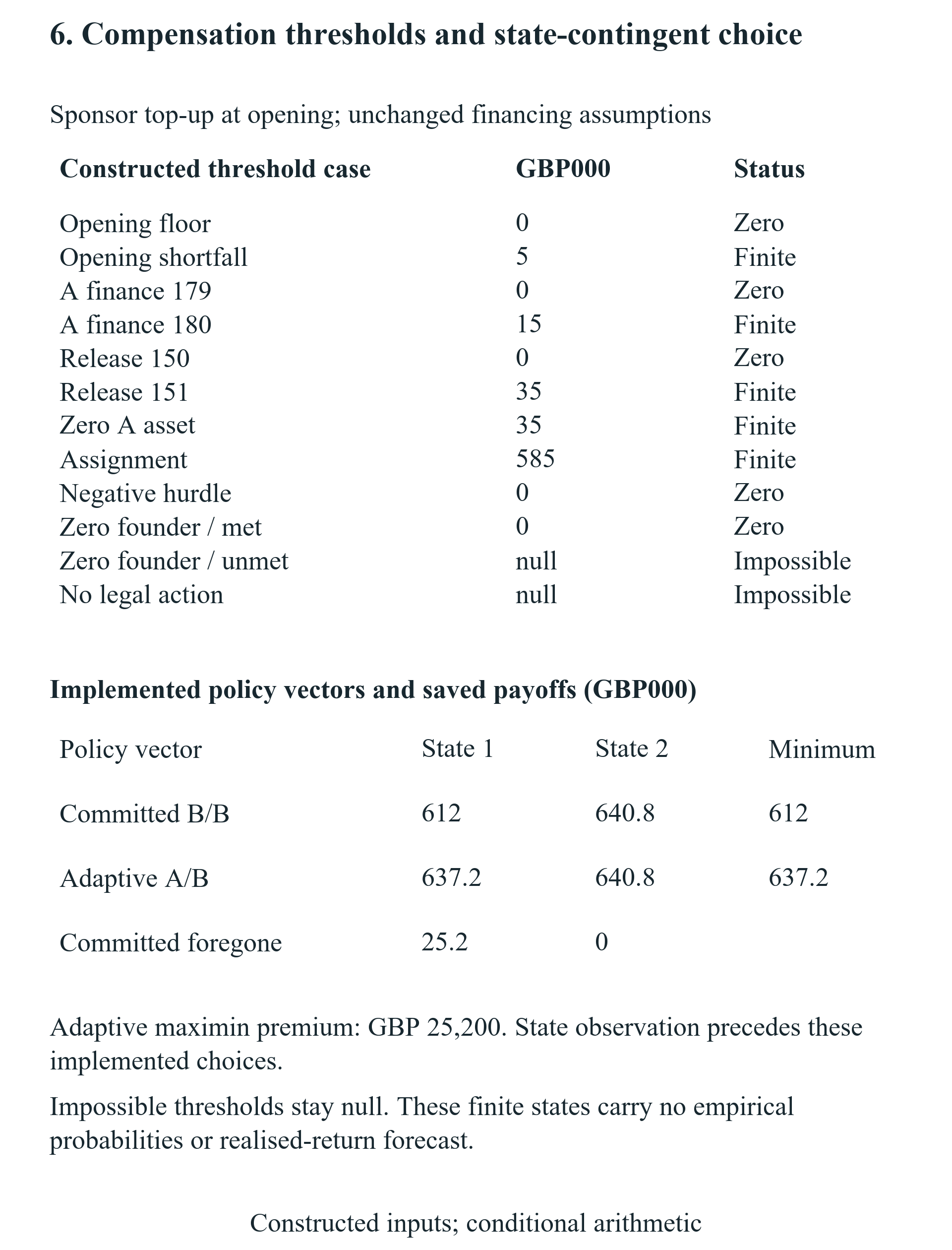
Scroll horizontally to read the figure at full size. You can also open the full-size figure.
Compensation enters corporate cash before opening with ownership fixed. Impossible cases remain distinct from finite payments. The declared two-state maximin choice premium is GBP 25,200, with no probabilities or market-option-price interpretation.
| Policy or measure | State 1, GBP | State 2, GBP | Maximin or qualification |
|---|---|---|---|
| Commit A | 637,200 | 586,800 | 586,800 |
| Commit B | 612,000 | 640,800 | 612,000 |
| Adaptive A/B | 637,200 | 640,800 | 637,200 |
| Committed B foregone surplus | 25,200 | 0 | No probability weighting |
Constructed receipts are observed on day 120 in the adaptive case. Maximin premium GBP 25,200. The no-information and one-action controls both give zero premium; this is no market option price.
19 Questions that connect clauses to economic inputs
| Proposed amendment | Decision input to establish | Responsible evidence |
|---|---|---|
| Earlier commercial release | Actual offer and last acceptance date | Customer offer and signed release |
| Retained technical field | Asset dependency and permitted uses | Technical map and IP agreement |
| Faster investor response | Latest usable settlement date | Subscription process and payment calendar |
| Participation allocation | Paid cash within round and share price | Cap table and subscription documents |
| Opening sponsor payment | Recipient, timing and security incidence | Executed payment terms and bank evidence |
| Information carve-out | Content, recipient and permitted purpose | Applicable confidentiality and data terms |
Author's diligence framework; no counterparty commitment is asserted.
A clause becomes an economic input through a specific question about an action. For an exclusive arrangement, the reviewer needs the covered business activity and the dates during which the company is restricted. For a licence, the reviewer needs the asset, permitted exploitation, field, territory and treatment at expiry. For a financing right, the reviewer needs the relevant transaction, eligible holder, exercise process and actual subscription. The model should preserve an unresolved answer rather than assign a convenient amount or infer a permission from an unrelated document.
Commercial teams should supply the opportunity behind the valuation. An offer should have a counterparty, a defined product or service, a price, expected delivery costs, acceptance conditions and a payment schedule. A business plan assumption can support a sensitivity case when it is labelled accordingly. It cannot be described as a signed customer commitment. Capacity also needs an explicit treatment: an alternative may be legally available while the company lacks the personnel, production capacity or finance to execute it alongside its preferred project.
Finance should reconcile the company and holder ledgers before comparing wealth. The register should identify whether a payment funds company operations, acquires newly issued shares or purchases an existing holder's shares. It should identify whose cash is being used for a top-up and when that money is available. A sponsor payment that leaves ownership fixed has different consequences from a founder contribution or a priced equity issue. A compensation formula derived for one of those arrangements cannot be applied unchanged to the others.
The technical and legal reviewers should then confirm the asset mapping used in any continuation value. Existing licences, employer or university interests, customer commitments and component dependencies can affect what the company controls. A proposed field definition needs to be reconciled to the actual product and documents. Unresolved matters should appear in the decision record with the transaction they could affect and the evidence required to close them. This allows the board to distinguish a calculation that is ready for use from a question that remains unpriced.
20 Negotiating the terms that bind the decision
Negotiation should begin with the alternative action that a proposed term affects. A founder who can identify a customer deadline, a required field of use or a financing allocation can ask for a change tied to the company's operating plan. The request can specify a narrower field, an exception for an identified agreement, a shorter exclusive period or a documented response process. Its economic significance can be examined against the alternative policy. A generic assertion that a clause is onerous supplies much less information for that discussion.
Compensation also needs a defined form. A corporate payment made available before a cash constraint may finance an otherwise unaffordable policy. A payment received after an opportunity expires cannot restore the expired offer in the experiment. Additional shares issued in exchange for new money change the ownership calculation. A founder personally funding the company bears a personal cost. The proposed terms should therefore identify the payer, recipient, payment date, ownership consequences and conditions on the payment before a threshold is interpreted as a negotiation amount.
The matched-package comparison isolates the stipulated rights by holding programme cash, initial ownership and other inputs fixed. An actual choice between two different programmes may change all of those inputs at once. The company should reconstruct both complete alternatives, including fees, required expenditure, financing conditions and the rights it retains. A threshold computed under a fixed ownership fraction is useful within that specified comparison. A different equity split, investor condition or operating budget requires a new calculation of the complete policy.
Negotiation priorities should also reflect what the company can document and implement. A proposed exception is useful when the final agreement actually covers the intended transaction. A consent process is useful when its scope, timing and consequences can be understood alongside the relevant opportunity. A decision to accept an unresolved risk should identify the responsible board authority and the evidence still missing. These records support subsequent action if the company raises another round, grants a customer licence or receives an acquisition approach.
21 Sector and jurisdiction specific review
Sector-specific application begins with the relevant asset and commercial use. In a hypothetical water-sensor business, the same technical platform may support agricultural and industrial applications. A stipulated restriction covering one field should be assessed against the opportunities and assets in that field. The model should retain a separately permitted field when the documents and technical architecture support that distinction. Neither a global ban on every use nor an unaffected alternative should be assumed from a broad description of the technology.
Software and AI businesses require attention to component and permission boundaries. The company should identify code, data, model-related assets, interfaces and third-party dependencies that a proposed licence or disclosure actually covers. Its own ability to grant the requested rights should be established before the economic effect is calculated. If a funded component must be made available under an open-source licence, the technical team needs to assess the component and dependencies against the applicable documents. This paper supplies no general opinion that every licensing obligation is compatible with every proprietary business model.
A university-originated venture needs to reconcile programme documents with the rights it already holds. The UK collaboration guidance used as a comparator describes choices about institutional results, negotiation and licences. An individual spinout's position depends on its own agreements. Similar attention is required for employment-created IP, existing customer licences and research sponsorship. An accelerator document alone cannot determine the company's full set of usable rights. A restriction can affect the value of a commercial plan only after the relevant rights and obligations have been identified.
Cross-border corporate structure creates another review boundary. The receiving company, operating company and owner or licensee of technology should be recorded separately. A change in the corporate wrapper needs its own legal and tax assessment, while the economic model should identify which entity receives money and bears obligations. The analysis assigns no unverified incorporation, migration or enforcement outcome to a jurisdiction. The selected international sources illustrate documentary differences; they supply no country ranking or prediction of how a court would interpret an individual agreement.
22 Requirements for an empirical outcome study
The financial-contracting literature provides relevant conceptual boundaries. The public abstract of Kaplan and Strömberg's discussion paper distinguishes cash-flow, voting, board, liquidation and other control rights in venture financing. The repository abstract for Ewens, Gorbenko and Korteweg describes venture contracts through a structural search-and-matching framework. These bounded readings support attention to several contractual dimensions and to the selection process through which firms and investors reach an agreement. No parameter, numerical result or detailed method from either full article is used to calibrate this experiment.
A comparison of accelerator terms should therefore preserve the documents and the assignment process alongside measured outcomes. A company accepting a restrictive term may differ in technology, bargaining position, funding alternatives or commercial opportunity from one accepting another package. A recorded term can also respond to those characteristics. A descriptive association between a provision and later fundraising would require those limitations to be stated. The present experiment holds its inputs expressly fixed and makes conditional accounting comparisons. It provides no empirical identification strategy or causal estimate for an actual programme.
An empirical estimate of the cost of a particular right would require a linked observation of the right and the outcome being explained. The relevant contract record would identify the governing version, company-specific amendments, waivers and actual exercise. The company record would identify its opportunities, financing requirements and subsequent outcomes over a defined period. A public programme description and an alumni list cannot supply those observations for every venture. The present analysis consequently uses documentary observations and constructed scenarios, with no applicant-level treatment-effect estimate.
A future project should define its population before analysing outcomes. Eligibility, application, admission, attendance, execution of investment documents and receipt of funds are separate events. A study of applicants would need to explain which eligible companies never applied and how that affects its question. A study of accepted companies would need a basis for comparison beyond acceptance itself. Contract terms may also depend on the company, programme, investor and negotiation. Those selection processes belong in the research design before a difference in outcomes is attributed to a clause.
Outcome definitions should retain the cash and ownership distinctions used in the experiment. Announced funding, an executed subscription and money collected in the bank describe different events. Revenue bookings, cash receipts, equity values and founder sale proceeds likewise answer different questions. A rights study should observe when a term bound an actual transaction, whether a release or waiver occurred and what alternative remained available. It should also specify how it treats closed companies, missing follow-up and observations that cannot be linked to the governing agreement.
Data access would need its own permissions and controls. Anonymised records may have insufficient identifiers for a programme- and version-level join. A policy describing possible research sharing supplies no access permission for a particular study. The researcher would need the permitted uses, confidentiality terms, necessary approvals and a defensible linkage procedure. Any resulting analysis should report the observed sample, missingness, identification assumptions and the population to which its results apply. None of those future requirements is treated as completed by the public-document register in this paper.
| Check family | Saved evidence | Boundary |
|---|---|---|
| Scenario census | 12 main; 20 one-way; 25 grid; 12 thresholds | Constructed observations |
| Evaluated identities | 49 names; 4,822 evaluations | Arithmetic checks; no empirical validation |
| Cash chronology | Every prefix and first breach retained | Outflows first; no post-breach funded value |
| Ownership | Per-holder payment and issue bridges | Scheduled quantities conditional on funding |
| Compensation | Policy envelope and compensated-prefix retests | Fixed-fraction opening sponsor channel |
| Information | Selected implemented state vectors and two controls | Maximin; no probabilities |
Original constructed experiment. A deterministic consistency check does not validate assumed commercial values, legal enforceability or programme outcomes.
23 Limitations and interpretation of the experiment
| Dimension | Supported within the experiment | Unresolved externally |
|---|---|---|
| Contract rights | Explicit stipulated permission vectors | Executed meaning and enforceability |
| Economic parameters | Declared GBP amounts and dates | Company quotations and commercial evidence |
| Terminal comparison | Common-horizon asset-plus-cash proxy | Market valuation, discounting and preferences |
| Information | Two supplied states and maximin rule | State probabilities and actual learning |
| Programme outcomes | No empirical estimate | Eligible cohort, selection and linked outcomes |
| Compensation | Pre-opening corporate sponsor channel | Tax, founder funding and priced-security alternatives |
All numerical inputs are constructed; no causal programme ranking or expected return is estimated.
The experiment provides conditional comparisons under stated inputs. Its continuation asset values, commercial receipts, costs, deadlines, initial ownership and financing conditions are constructed. They are not estimates of the terms, investment quality or return of a named programme. A different set of opportunities or financing conditions can change the preferred action and the binding restriction. The numerical examples should therefore be used to examine a mechanism and to check a company's own documented inputs, with sensitivity to the assumptions that matter for that company.
Debt is assumed zero in this experiment. The wealth measure adds retained continuation assets and company cash and applies the relevant holder fraction. Personal cash in the secondary-sale control is presented separately. It contains no independently valued exit waterfall or negotiated preference stack. A real preferred-share structure, debt covenant, tax liability or contingent obligation needs explicit treatment. The model also holds certain financing prices and totals fixed in its allocation controls. Those controls identify an accounting relationship under those assumptions; they supply no forecast of a real investor's willingness to fund.
The cash convention is equally specific. Each intermediate payment position is checked against the declared floor, with the stipulated ordering of independent outflows and receipts. This is an analytical convention for the experiment. A company needs its actual settlement arrangements, available funds, credit conditions and required reserves before applying it. A later receipt has a different effect from money available before an earlier payment. A policy that fails a cash check retains an explicit feasibility failure, even when a diagnostic calculation can describe its hypothetical end position.
Finally, public terms and mathematical permissions have different roles. The documentary sources show selected descriptions or provisions at the recorded dates. They establish no complete market census or opinion on an executed agreement's enforceability. The experiment supplies an explicit representation of rights and choices once those inputs are stipulated. Legal advice, technical diligence and verified operating evidence remain necessary for a company transaction. The analysis should retain those boundaries whenever a result is summarized or used in a negotiation.
24 A board process for accepting the final agreement
A board evaluating an accelerator offer should maintain a compact decision record connecting the governing documents to the company's intended actions. That record should identify the assets and transactions covered, the right holder, the relevant dates, the affordable alternatives and unresolved questions. It should preserve the distinction between the programme's general explanation and the agreements proposed for the company. A clear record allows the commercial, technical, legal and finance teams to review the same decision.
The economic assessment should follow the permissions and money. A stipulated restriction changes a specific opportunity set, asset permission or financing condition. A participation right needs an actual subscription and resulting share allocation. A secondary transfer needs the seller's proceeds and the changed holdings. A corporate top-up needs its availability date and ownership treatment. Keeping those items separate provides a basis for checking that a lost opportunity, cash receipt or ownership change has been counted once.
Negotiation can then concentrate on the condition that changes the decision. The relevant proposal may concern a field boundary, a release date, an exception, a consent procedure or the form and timing of compensation. Its value should be tested against a complete feasible alternative. Material uncertainties should remain explicit until supported by the governing documents and company evidence. A mathematical threshold can inform that discussion within its assumptions, while the final agreement determines the rights the company actually accepts.
The resulting process is usable after entry as well as before acceptance. The company should revisit the record when a customer opportunity, licence, financing or ownership transaction changes. New documents, waivers and revised assumptions should be retained with the decision they support. This gives the founder and board a traceable explanation of the commitments made and the alternatives considered. It also identifies the additional contract and outcome data that an empirical study would require before making broader claims about the costs of accelerator rights.
References
- Techstars. Investment Terms. Public programme summary accessed 12 November 2026. https://www.techstars.com/investment-terms
- Nathoo, K. The Y Combinator Deal. Y Combinator. Accessed 12 November 2026. https://www.ycombinator.com/deal
- Y Combinator. The SAFE. Public forms and guidance accessed 12 November 2026. https://www.ycombinator.com/safe
- MassChallenge. Competition Rules. Page marked last updated 8 March 2022; accessed 12 November 2026. https://masschallenge.org/competition-rules/
- Creative Destruction Lab. CDL Intro Webinar. Programme overview accessed 12 November 2026. https://creativedestructionlab.com/webinars/cdl-intro/
- Creative Destruction Lab. Privacy Policy. Accessed 12 November 2026. https://creativedestructionlab.com/privacy-policy/
- Google Information Technology (China) Co., Ltd. Terms & Conditions for Google for Start-Ups Accelerator China. Historical 2023 call; clauses 2.3 and 7. Accessed 12 November 2026. https://services.google.cn/fh/files/misc/gfsa_cn_legal_terms_and_conditions_update.pdf
- UNICEF Venture Fund. Apply for Funding. Funding FAQ accessed 12 November 2026. https://www.unicefventurefund.org/apply-funding
- World Intellectual Property Organization. IP Assignment and Licensing. Accessed 12 November 2026. https://www.wipo.int/en/web/business/assignment-licensing
- European Innovation Council. FAQs on EIC Investments. Selected investment-process and IP answers accessed 12 November 2026; programme-year qualifications retained. https://eic.ec.europa.eu/eic-frequently-asked-questions/faqs-eic-investments_en
- UK Intellectual Property Office. University and Business Collaboration Agreements: Model Agreement Guidance. Negotiation and option guidance used as a university-collaboration comparator. Accessed 12 November 2026. https://www.gov.uk/government/publications/university-and-business-collaboration-agreements-model-agreement-guidance/university-and-business-collaboration-agreements-model-agreement-guidance
- National Venture Capital Association. Model Legal Documents. Index inspected 12 November 2026; underlying model agreements were not clause-audited for this study. https://nvca.org/model-legal-documents/
- Ewens, M., Gorbenko, A. and Korteweg, A. (2022). Venture Capital Contracts. Journal of Financial Economics, 143(1), 131-158. DOI: 10.1016/j.jfineco.2021.06.042. Repository abstract and bibliographic record inspected; no numerical calibration drawn from the article. https://authors.library.caltech.edu/records/5qxf0-4s371
- Kaplan, S. and Strömberg, P. (2000). Financial Contracting Theory Meets the Real World: An Empirical Analysis of Venture Capital Contracts. CEPR Discussion Paper 2421. Public abstract inspected; full paper not used as a source for numerical findings. https://cepr.org/publications/dp2421
About the Author
Chennakeshav (CK) is a corporate finance and investment banking executive with 25+ years of global experience in deal origination, structuring and execution across M&A, growth capital and corporate strategy. He has led value-creation mandates for founders, corporates and funds — bridging the boardroom view to hands-on execution and close.
His career spans Morgan Stanley, HSBC, Lloyds Banking Group, EWEC, ADQ portfolio companies and Emirates Growth Fund, across TMT, real estate, fintech, deeptech, cleantech, infrastructure and energy. He has partnered with C-suite leaders, private equity and venture funds, sovereign wealth funds and family offices to finance complex fund raises and scale-up ventures, and has led M&A due diligence, post-merger integration and business-transformation initiatives to create value.
At Matchpoint Partners he is Managing Partner, leading the firm's corporate finance, M&A and capital-raising practice. He holds an MBA from London Business School, an engineering degree from VTU and a Master of Laws (LLM, in progress) from UCL London.
An active start-up mentor, CK mentors at Techstars, DIFC FinTech Hive, Startup Grind, Founder Institute and IN5, serves as Entrepreneur Mentor in Residence (EMiR) at London Business School, and judges the Entrepreneurship World Cup.
https://www.linkedin.com/in/ckadya/
https://www.matchpoint-partners.com/team/ck-adya.html
Disclaimer
This paper is part of a continuing series on the structure of private and alternative markets. The views expressed are the author's own. The paper is for information only, describes market structure in general terms, and does not constitute investment, legal, tax or regulatory advice or a recommendation in respect of any security, vehicle or counterparty.
